




Abstract
This essay remaps geographies of belonging in Athens. It thinks the city in circles and circulations, writing an anticolonial Athens made out of nonlinear geographies and histories, anti-border struggles, anticolonial pasts and futures, migrations and mobilisations. The essay writes three circular movements: narrating how Athens is part of a Mediterranean feedback loop in which struggles are in constant circulation; thinking a circular square in the middle of the city as a polis not dictated by ideas of ethnos; and following the ways that people make new choreographies of belonging in the dance circle, finding footwork out of step with the restrictive rhythms of the nation. These movements are forms of spatial resistance, and the essay closes by sharing some methods of movement writing. Through these circular movements, the essay seeks to map ways out of the linear geographies and histories of empire, and the ongoing colonialities of citizenship.
Writing from “the wild nights of Athens,” from the uprising against dictatorship of November 1973, the poet Nikolas Asimos crafted a set of lines that set resistance spinning in circular motion around the city: I begin a song and the dance begins In the wax silence of censorship The knowledge circulates Don’t disturb my circles.
1
Asimos’s poem signals a set of meanings – cultural meanings, political meanings – that circles take on in Athens. In dance and song, in struggle and resistance, circles give shape to movements, to collective expression and ways of being (not to be disturbed). This essay moves in the same shapes, thinking in and with circles in an effort to open new ways of understanding geographies of struggle. Circles have a bit of an image problem, often a metaphor for violence or enclosure, or getting stuck in bad habits or ways of thinking. Here I seek other meanings in this shape and spatial arrangement. Specifically, I attempt to draw out the anticolonial politics that exist in circular movements. Imperial thinking involves fixing time and space along linear paths – histories and geographies that move in straight lines (Nakamura, 2022) – producing borders and the racial taxonomies drawn to differentiate people, and civilisational thinking that sets places as being ahead and behind. Circles move otherwise, spinning and looping to map ways out of these linear geographies and histories of empire. “No circle is vicious” (Césaire, 1984: 143).
The setting (and protagonist) here is Athens – the city so often claimed as civilizational origin point and invoked as symbol of Euro-colonial superiority. The linear logics of imperial space-time are built into the city and its geographies of belonging, with Athens and its civilisational achievements (fictively) conflated with Europe and with whiteness. This continues to play out in Greece, which, despite not being a modern colonial power, has embraced the colonial logics of citizenship – whereby people are racialised, placed into hierarches and placed at various distances from the idea of the Greek nation and “European civilisation” (Lowe, 2015). Citizenship, in other words, is a colonial project and product; a regime of statehood and racial capitalism; a border, a bordering (Mongia, 2018; Walia, 2022; Wilson Gilmore, 2022). Yet it is also something that people are remaking at street level – through contexts of migration and within diverse, creative communities in the city – in ways that push against the colonialities of borders and ethnonationalist limits on belonging (Boatcă, 2021; Dyrness and Sepúlveda, 2020; Hawthorne, 2022). This essay seeks to contribute to these movements.
It does so through writing in circles and circulations. Circular movements are forms of spatial resistance, opening the city. Here I write an anticolonial Athens which speaks through these movements, made out of nonlinear geographies and histories, anti-border struggles, anticolonial pasts and futures, circulations, mobilisations, and migratory collaborations. These ideas stem from my participation in various forms of collaborative research and movement building in the city. Particularly, this writing carries things I have learnt as a member of the Syrian and Greek Youth Forum – an Athens-based community organisation. From this, I aim to make three contributions to conversations on migration and borders, space and place, and de/coloniality in Mediterranean contexts. First, that circular movements open ways of thinking against the violence of borders and beyond the linearities of imperial time-space. Second, and as a result of this, that citizenship itself can be remade as something mobile and migratory. And third, that these processes can be narrated through what I am calling movement writing, which encompasses mobilities and social movements, and writes spaces through the creativities that inhere to both.
What follows, then, is a series of textual and spatial experiments – a gathering of conversations (some real, some imagined) with Athenian activists and poets, anticolonial thinkers and writers, dancers and improvisers, geographers and historians of the Mediterranean. I draw three circles, the essay structured in three movements. The first movement is about how movements move: how Athens is part of a Mediterranean feedback loop in which struggles are in constant circulation. The second movement narrates a circular square in the middle of the city as a polis not dictated by ideas of ethnos, thinking with poets who make mobile representations of the city and echo Athens across anticolonial trajectories. The third movement follows the ways that people make new choreographies of belonging in and beyond the dance circle, finding footwork deliberately out of step with the restrictive rhythms of the nation. I close with some ideas on movement writing (intended as an alternative term to scholar-activism) – in the hope that some of these circles generate methods that might be useful in other spaces, times, and movements.
Movement #1 – Το Κί νημα , η Κίνηση (the movement, the movement)
“We can see in Athena – the place that we belong – we can feel many different cities, acting in the same circle, acting in the same direction.” My colleague Kareem sits on the rooftop of a disused print factory in the old textile district, now repurposed as a community centre. We can feel many different cities … He narrates an urban space that holds multiple places and possibilities for belonging, and speaks from his own experience of movement from Damascus, Syria, to Athens, Greece. … Acting in the same circle. The result is a spatial invention. A city-circle. An image and a space made out of Mediterranean relations and collective geographies.
In this first movement, I run with the spatial imaginations that develop out of community organising in Athens. This work draws together multiple places, bringing different cities into the same urban space. To make sense of this, I write with two Greek words for movement. Τo κίνημα (as social movements are known in Greece), and η κίνηση (the movement of people, ideas, and things). I seek to think both kinds of movement together, reflecting the ways that movements move: how activisms travel, circulate, migrate; how citizenship struggles shuttle from place to place; how resistances resonate across relational geographies. The city-circle renders Athens as a gathering space of both kinds of movements, which in turn casts the Mediterranean as a feedback loop of circulating struggles. I write these movements here through a set of mobile histories and urban relations, which generate possibilities for understanding citizenships in motion.
Mobile histories
The city-circle holds together movements that loop across both time and space. The work of my colleagues in the Syrian and Greek Youth Forum conveys this, where the team has developed methods to build platforms of belonging in Athens, while at the same time continuing the ongoing work of revolution in Syria. Founded in Athens in 2018 by people who had been forced to move from Syrian cities – many having been part of uprisings that began in 2011 – this collective works with ways of organising that are carried, remembered, and remade in migratory contexts. This is a citizenship movement that plays out in multiple places: in Syria, where revolution was, in Hassan Abbas’s words, “an exceptional act of citizenship […] the first steps in the process of reclaiming the bonds of citizenship” (2014: 56) following decades of dictatorship; and in Athens, where people work to reimagine political and cultural community, foregrounding the city and the ways we all become it.
These movements are now part of the same movement, and spatial imaginations develop from these entwined struggles. As Kareem puts it: “Athens now, I believe it’s holding other cities. We are in Athens and we are free to express ourselves and express our city, to bring our city’s feeling and our city’s struggle. Athens is giving us this space.” Athens holds Damascus, holds cities from all around the Mediterranean. The sea is a feedback loop, where movements are in constant motion. The city-circle is a gathering space. These relations are built on recursive histories; histories that are always mobile, turning trajectories rather than territories. Historians trace circulations across centuries and millennia, charting how different forms of mobility – travel and trade, migration and displacement, colonialism and conquest, movements of culture and capital – have “produced the Mediterranean as a single but also multiple geographical spaces” (cooke et al., 2008: 1). 2 The sea is made through circling, through movements that produce these connections, that turn centres into margins and vice versa.
These are also cartographies of resistance, of contestation as much as circulation. In the late-19th century, as Ilham Khuri-Makdisi shows us, political ideas bounced between urban spaces around the Eastern Mediterranean, fostering a sense of global radicalism in the region. Different kinds of migration stacked up, as urbanisation, labour movements, and political exile saw people move between cities around the sea, with cities becoming spaces for developing methods of collective action. Migration and resistance were bound up together, completely connected in history. Anticolonial politics, or what Khuri-Makdisi calls “popular anti-imperialism” (2013: 144), were central to these movements, as people organised against direct and indirect forms of imperialism. Athens was (and is) part of these communities, speaking across trajectories where political ideas circulate in multiple languages, and cultures of resistance do not map onto national(ist) and Eurocentric histories. And these histories resound into the present, where movements gather in Athens and loop back around the Mediterranean. These are circular movements – resisting oppression in multiple times and places.
Citizenship as movement
Of course the stakes of this are pretty high. Athens has been a key site in Europe’s so-called “refugee crisis” since (and before) 2015, meaning that efforts to create geographies of belonging have been contested, resisted, and usually violently policed. By way of illustration: In November 2022, the Greek Minister of Migration and Asylum, Notis Mitarakis, posed for cameras in a refugee camp just to the west of the city centre. As he announced the camp’s closure – with the removal of residents to closed facilities far from the city – he stated that he was “returning the space to the Athenians.” 3 In so doing, Mitarakis drew a border around who belongs in the city. The word “Athenians” becomes coded along ethnonational lines, conflating the city, its histories and urban spaces, with monocultural formations of ethnicity, language, and identity. The result is an exclusion – literally and figuratively – of everyone else.
In this light, efforts to claim Athenian identities and claim belonging in the city are fraught and fragile – often dangerous. There are literatures that help to understand these politics, both in their potentialities and their problems, often centring on the terms “migrant activism” or “migrant resistance” (e.g. Stierl, 2019; Tyler and Marciniak, 2013). Yet I want to suggest that circular movements do slightly different work, and can open other ways of understanding citizenships that reflect the geographical multiplicities of the spatialities that people are building in the city. On one level, much research on migrant resistance, drawing on the Autonomy of Migration approach, tends to focus on “nonmovements” – the multiple, dispersed, autonomous actions of people on the move, not bound together in any obvious way, which gives migration its transformative potential (Bayat, 2010; Squire, 2022). Whereas this approach tends to posit transborder solidarity as something fleeting and momentary (e.g. Stierl, 2019: 95), the work of our team in Athens is a consciously organised effort to loop places and struggles together, generating place-based forms of belonging that are simultaneously mobile and can exist in multiple places at once.
On another level, while much writing on the autonomy of migration regards citizenship as the ultimate border – an always-exclusionary force and “hopelessly statist category” (Nyers, 2015: 31) – circular movements speak more closely to recent writing on citizenship and race, which recognises how these concepts are bound together, generating many forms of racial and spatial injustice, yet being restlessly remade by youth movements in diaspora (Dyrness and Sepúlveda, 2020; Hawthorne, 2022). In Mediterranean contexts, regimes of citizenship emerge through geographies of racial formation and colonial practices of dispossession that were tested in the region before being exported elsewhere (Hawthorne, 2021, 2022; Robinson, 1983). This is what Camilla Hawthorne and others call the Black Mediterranean: a formulation that at once recalls histories of racialisation which took shape around the sea, and at the same time recognises how shared struggles emerge through these histories, opening ways of pushing against those same racialised hierarchies (Black Mediterranean Collective, 2021). The Black Mediterranean, then, is a space of convergence and contestation, of looping histories and geographies, that complicate linear understandings of politics and identity (Hawthorne, 2022: 10).
These histories echo into Greek migration policies, border politics, and resistance movements against them; into the discourse of politicians drawing borders around the word “Athenians,” and the move to claim this term by people regardless of their legal citizenship status. Our work in Athens is part of a circle of movements that reimagine questions of being and belonging in the city. A cartography of youth resistance (Magaña, 2020) connects struggles for refugee rights, second-generation claims to citizenship (Mavrommatis, 2021), and movements against austerity and dispossession that affect all precarious populations. Citizenship, from these bearings, becomes something mobile and migratory, and speaks to an ongoing collective effort – in Athens and elsewhere – to remake citizenship through movement, as movement, as a movement.
The politics of this are a bit tangled. In many ways, the colonialities of citizenship continue to have very real consequences in people’s lives. The border follows people around, racialised policing and document checks intensify, refugee populations are removed from the city, access to resources is limited for migrant communities. Yet for my colleagues in Athens – and for people in so many related settings – citizenship remains a galvanising force and a key focus of organising. Crucially, this is not only about seeking citizenship as it is, but about unmaking and remaking its meanings. It is about decoupling ideas of citizenship from national identities and their exclusions, from the nation-state itself (Bojadžijev and Karakayali, 2010; Hawthorne, 2021; Nyers and Rygiel, 2012). These are citizenships centred not on state recognition, but on communities grown at street level, on one another. This can amount to a refusal of national and state affiliations altogether (what we might call citizenships against citizenship). As Kareem puts it: in creating our new Syria – after the dictatorship and after this hard time – we really, as a revolution community, are coming back with a method of citizenship. I don’t want to come back as a Syrian, or as Greek, or as any nationality. I’m a citizen, and I am really welcoming any person that believes in this method to come and to live this experience.
Relational city
We can feel many different cities, acting in the same circle. What emerges is a relational city. A place that contains other places. Movements that carry other movements. This is an Athens that holds multiple cities inside it, based both on old entanglements of cultures and people, and on newer ideas and creativities. The citizenship struggles my colleagues have carried from Syria enter into conversation, relation, and shared spaces with longstanding Athenian activisms – activisms which themselves are always relational, centring on “capacious worldviews” that people use to think and hold movements together (Rakopoulos, 2014: 326). Collective struggles in Greece speak in grammars of κινηματικότητα, or movementality, describing the mechanisms through which movements mobilise and expand (Rakopoulos, 2015), and which ensure that movements are always moving.
The relational city, then, is a place where struggles converge. Social movement scholars show how this plays out across Athenian spatialities of the street, the square, and the neighbourhood (Arampatzi, 2017; Hadjimichalis, 2013; Kaika and Karaliotas, 2016), and the kinds of urban citizenship that emerge as a result (Kandylis, 2017; Zavos et al., 2017). And this knowledge speaks to insights from literatures that map out the spatialities of social movements more broadly: specifically, the ways that place-based struggles become embedded in other places, how ties to places can be mobile, how convergence spaces articulate collective visions produced through relation, and hold many worlds within worlds (Bosco, 2001; Routledge, 2003, 2009). Movements do not simply take place within existing spaces, but actively produce them, remaking the meanings and possibilities of places in the process (Routledge, 2017). These spatialities are always relational (Nicholls et al., 2013: 2), and the people who produce them are “enormously creative in cobbling together different spatial imaginaries and strategies on the fly” (Leitner et al., 2008: 158). Movements make multiple spatialities.
In Athens, again these are not linear processes, either spatially or temporally. The city holds internationalist, Thirdworldist, and anticolonial struggles – albeit ones usually buried beneath the marble weight of national history. People resisted imperialisms imposed upon them in the form of dictatorship recounted at the top of this essay, propped up by U.S. and Israeli foreign policy, and placed their struggle into Mediterranean and global geographies of anticolonialism (Kornetis, 2015a, 2015b; Mack, 2023; Salem and Western, forthcoming; Western, 2021). The city hosted an “Anticolonial Conference of the Mediterranean” in 1957, and became the base of a “Permanent Committee for Anticolonial Struggle of the Mediterranean” in the same year (Kornetis, 2015a: 491; Stefanidis, 2016: 106–107). Today, again, the city becomes a space of popular anticolonialism (c.f. Khuri-Makdisi, 2013), mobilised against the border violence of Fortress Europe.
Both the city and the sea are spaces of circulation, imagination and mobilisation. Yet these relations have been tethered, enclosed – the Athenian landscape repeatedly whitewashed in efforts to make these commonalities disappear. “The Mediterranean is not merely geography,” to borrow a line from Predrag Matvejevic’s cultural study of the sea. “Its boundaries are drawn in neither space nor time. There is in fact no way of drawing them: they are neither ethnic nor historical, state nor national; they are like a chalk circle that is constantly traced and erased” (1999: 10). Thinking το κίνημα (social movement) and η κίνηση (circulatory movement) together is a way of recognising this circularity. Migratory citizenships reject vocabularies that divide people into “migrants” and “citizens” (or “refugees” and “Athenians”) – which leave questions of race and the racial formations of citizenship untouched. Through circular movements, Athens becomes a relational city, a song of solidarities, an amplifier of demands, an abundance of languages; part of a Mediterranean city-circle that always exists but always needs redrawing.
Movement #2 – The circular symphony
The slow erosion of the absolutes of History, as the histories of peoples who have been disarmed, dominated or sometimes that are purely and simply disappearing but have nevertheless burst onto the scene of our common theatre, have finally met up and contributed to changing the whole representation that we had of History and its system. (Édouard Glissant)
Round Omonoia square/May they turn to immense circles. (Nicolas Calas)
Right in the middle of Athens, a round road, the spinning heart of the city. It is called Omonoia Square, but really it is a circle. Most journeys pass through it – a gathering point of people and energy, constantly gravitating inwards then redistributed, flung off along the various streets and metro lines that scatter outwards from its rickety infrastructures. A pinwheel polis. A large fountain reinstalled in its centre, where people catch a breath by the coolness of the water, all facing outwards in circular formation. A sculpture nearby called “Five Circles,” with each circle perpetually in motion, clanking their rhythms into the urban polyrhythm. The circular square is a miniature of the whole city: always moving, always being remade.
An Athenian poet called Nicolas Calas wrote a symphony about Omonoia in one of his poems, “Στρογγυλή Συμφωνία” (“Circular Symphony”) – on the square as a circle, and the whole city as a circulation. Published in 1933, the Omonoia in Calas’s writing contains everyone and everything, turning, spinning, struggling, resisting. Full of hope despite the grind of the city. As analysed by comparative literature scholar Effie Rentzou, “various images of the circle – wheels, balls, tops, coins, and a record on a gramophone – are used to depict the endless circulation around this pivotal point of the city” (2008: 286). The Athens in Calas’s writing is built on constant movement, more or less frenetic. The city lives through rhythm and sound. The city circulates, is made through circulation (Rentzou, 2008).
This second movement finds its cartography through an imagined conversation between Calas, the hyperrealist and urbanist who focused much of his work on Athens, and another poet, Édouard Glissant, the great theorist of relation from Martinique. 4 Both think in circles and circulations, and make a musical language that sounds out the rhythms and relations of struggle. This is a movement of representations: engaging with the contested readings of the city that exist in texts of various kinds and play out in everyday life. The representations in this movement are mobile, and make a stage for citizenships to circle, collide and coalesce. “The scene of our common theatre,” as Glissant (2020: 7) puts it. A scenography of citizenships in the polis. Reading anticolonial Athens means thinking the city from horizons not clouded by Euro-colonial visions, which in turn open geographies of belonging not tethered to racial taxonomies.
These ideas speak to a lineage within cultural geography of reading the city as text, whereby cities – like landscapes – are understood as cultural artefacts or creations, filled with signs and symbols that can be read in various ways (Daniels and Cosgrove, 1988; Duncan, 1990). In Tariq Jazeel’s (2021) expansion of this methodology, the city as text joins with postcolonial critique to become both an imperative to reimagine urban spatialities away from European ideal visions (i.e. to read cities on their own terms) and a move towards understanding spatial difference by creatively sidestepping the Eurocentrisms built into much urban theory itself. Athens is a compelling test space for these ideas precisely because it is so often narrated as Europe’s origin story, and these narratives mute other spatial stories, geographical imaginations, and lived realities that stack up, jut out, and circle round the urban landscape. The circular movements of Omonoia destabilise the supposed Europeanness of the city, instead spinning stories that respatialise ways of being and belonging.
Concord, contestation
Start in the middle. Omonoia. A site of contested and competing imaginations. The circular square was built as the symbolic centrepiece of the modern city – an attempt to make national space at the end of Ottoman rule in the 1820s. Athens was installed as capital of the new nation; its urban design orchestrated by Parisian architects and Bavarian princes, overseen by the European “Great Powers,” projected onto idealised images of the ancient polis. The city was drawn in straight lines between ancient monuments, between past and present (Athanasiadou, 2016; Bastéa, 2000). An effort to break the “old Turkish rhythm” of Ottoman urban planning (Theocharopoulou, 2017: 71), at once restoring the city to old Euro-fantasies, and a laboratory for creating urban citizens and disseminating the values of the new nation (Theocharopoulou, 2017: 22).
The urban plan – a series of projections. Ομόνοια. The word means “concord” – named with dreams of harmonisation, one nation. Omonoia – a space under constant transformation. In the early 20th century, Omonoia was a performance of Greek geopolitical yearning to be accepted as a European country. In the 1950s, it was given to car traffic – a roundabout, billboards, a fountain, a symbol of Greek cosmopolitan modernism at once informed by U.S. influence in Europe after the Second World War. In the 1990s, the square and surrounding neighbourhood became exoticised for their diversity, which was then reconfigured into foreignness and hostility once austerity hit in the early 21st century – the square beaten down and whipped up as an image of crisis (Athanasiadou, 2016).
Through policies of abandonment, the circular square has since become synonymous with urban decay, attracting talk of ghettoization, as Omonoia became a politically useful space for those wishing to paint migration as a problem. Where, in the words of Nicos Trimikliniotis et al., “inner city Athens is recurrently presented as a ghetto and migration is presented as threat to the city’s historical and cultural centre” (2015: 67). Multiple crisis narratives crowd around. Which explains why such fanfare was made out of Omonoia’s renovation in 2019 and 2020, with giddy announcements that the square was being returned to some golden age. “Ομόνοια όπως παλιά!” “Omonoia like the old days!” “Omonoia as it used to be!” (iefimerida, 2019). The headlines parroted a political line, dogwhistling a nostalgia – part of the ruling right-wing New Democracy party’s platform of drawing borders around who belongs and who does not.
Yet this is a discourse without history or geography. In Calas’s symphony, Omonoia is a circle, and the whole city is a circulation. The poet guides us through the movements and diversities of the city: “All of Athens is found in Omonoia,” he writes; “A thousand kinds of people”; “And the round road sets the rhythm, a sound madder than any dance” (1998[1933]: 32–35). Crucially, Omonoia is read as non-national space. Contra to dominant literary and artistic movements in 1930s’ Athens, which were engaged in an introverted search for Greek Hellenism and focused on expressing forms of Greekness (Hoff, 2014: 68–70), Calas moved against this, writing with a geographic playfulness that critiqued cultural nationalism and developed a sense of Omonoia as a worldly space.
On one level, the geographies of Calas’s poem map onto the city’s diverse histories. The circular symphony fits with historical studies of Greek urbanism. Ioanna Theocharopoulou depicts an Athenian poetics that has long frustrated the effort to impose an elite European culture onto everyday Mediterranean life. Theocharopoulou calls this the “popular-Eastern Mediterranean” (2017: 55–60): something that plays out in language, in architecture, in music, in cultural identity, and in uses of urban space and time, and which draws attention to the multiple Athenian cultures that have co-existed for centuries. On another level, Calas’s refusal of Greekness speaks to a nascent surrealism that would define his later writing. In keeping with the broader surrealist movement, the Omonoia that Calas writes is a cosmopolitan space, wherein cosmopolitanism is less defined by international mobility and is more a posture of being in the world (Rentzou, 2022: 156). The city – for Calas, for the surrealists – is a whole world in itself. And Omonoia, in constant rotation, is a place from which the whole world can be imagined.
Echos-monde – the city as echo
Circling outwards from Omonoia, Calas’s spinning city is close to what Glissant calls echos-monde. An echos-monde is a place or idea that is everywhere, and contains everywhere within itself; something that opens an image of the world, open to meet other images of the world. Echos-monde exists in and through relation, through which all places resonate. This is part of Glissant’s system of understanding, perceiving, and addressing the world: Echos-monde “are at work in the matter of the world; they prophesy or illuminate it, divert it or conversely gain strength from it” (1997: 93). An echos-monde is made out of resonance, connection, interaction, relation, playing out along the scattering of people and ideas across global trajectories (Chude-Sokei, 2016; Suga, 2006).
If we think Glissant and Calas together, we can hear Athens, too, as an echos-monde. Athens is a mobile representation, a place that is everywhere and that contains everything. Very often the global circulations of Athens have had colonial overtones. The city – the idea of the city – has long been enrolled in imperial thinking. Routinely invoked as a sign and a symbol, grabbed at as the civilisational origin point, built and imagined as monument of Europeanness (Gourgouris, 2021[1996]). But Athens as echos-monde does other work, too. It can be, and has been, used to subvert colonial readings of the city. This chimes with Louis Chude-Sokei’s reading of Glissant, in which echo “is metaphoric of diversity and cross-cultural interaction without the architecture of colonialism […] to adjudicate or authorise hearing or meaning or blending” (2016: 169). Echos-monde is a refusal of imperial overtures that score the city along European lines; a refusal of the notion of ethnos, which maps both the city and the Greek nation onto homogeneities of religion, language, and ethnicity. (Shouted by those who Calas, in his circular symphony, calls “puppets on a phonograph’s plate, crying aloud Home and Country” (1998[1933]: 33)). Echos-monde makes space for community formation and forms of belonging not bound to the nation and its exclusionary logics.
If these geographies seem a little speculative, it is worth saying that such speculations have existed for a while. Glissant himself wrote of the Mediterranean as a “sea that concentrates” (1997: 33) – a space that gathers and echoes ideas. And a counterarchive of Caribbean thought reworks Athens into an anticolonial echo, unmoored and reclaimed from the colonial archive. Emily Greenwood (2010) brilliantly details how Caribbean authors received ancient Greece, particularly Athens, through the 20th century. These receptions are, for Greenwood, cross-cultural and transhistorical articulations, waymarking a “two-way flow of ideas” between Greece and the Caribbean, with writers thinking with the ancient polis to build visions of Caribbean societies against and after empire; which in turn can be reversed to read Greece through the Caribbean (2010: 5).
This feedback loop between Athens and the Caribbean short-circuits the sketchy genealogies that lead from ancient Greece to modern Europe, and smashes the “proprietary fiction of Classics as the property of the ‘West’” (Greenwood, 2010: 6). The writings of C.L.R. James – to borrow one example – work to take back Greek literatures from the colonial archive through which they have been transmitted. James puts ancient Athens into direct conversation with modern Trinidad to bypass – deflate and undermine – colonial pretentions. The result is “the invention of a new, Caribbean tradition of engaging with ancient Greece, one that is intended to supplant the colonial version” (Greenwood, 2010: 196). Athens is remade as anticolonial echos-monde.
A place comes into view: the Caribbean-Aegean. What Derek Walcott called “reversible seas” (1997: 62). A place made out of circular movements, echo and resonance. Without the architecture of colonialism. “Never blinded by the plaster casts and hypocritical marble copies” of European nostalgia and colonial rule (Walcott, in Greenwood, 2010: 197). Such a place opens geographical possibilities, thinking against Athens as European wellspring. Such a place eddies into conversations on the Black Mediterranean. Such a place opens connections and commonalities, revealing that an anticolonial Athens always intimately bound up with the rest of the world (c.f. Lowe, 2015). Such a place remakes citizenships in the city itself.
Turning citizenships
Lines of Calas’s circular symphony start with the word γυρίζει (turning/it turns) – a circular refrain that spins through the poem. Glissant too narrates a turning, in an essay called “The Cry of the World”: “The whole world is speaking to you, through so many gagged voices,” he writes. “Wherever you turn, there is desolation – but you still turn” (2020: 7). This turning has creative-political potential. Maybe if we turn enough, we can turn Athens from a black map of racist violence – to borrow the title of a book (Alexandropoulou and Takou, 2019) that collates the attacks perpetrated by the fascist Golden Dawn party, many of which happened around Omonoia – into a space of plural forms of belonging, multiple spatial imaginations, and an openness to the word Athenians that reflects historical diversities and intimacies.
It is telling that the first articulation of Greek citizenship came not from the European “protecting powers,” or even from the Greek state, but from Haiti. In 1821, inspired by the Haitian revolution at the turn of the century, Greeks fighting for independence from the Ottoman Empire sent a letter to Haitian president Jean-Pierre Boyer, to which Boyer replied with news and support, writing: “Citizens! Convey to your co-patriots the warm wishes that the people of Haiti send on behalf of your liberation” (in Sideris and Konsta, 2005). The first official reference to Greek citizenship comes from the revolutionary, anticolonial Caribbean. And this can be channelled to understand Athenian citizenships as always migratory, under collective construction at street level, circling and folding into movements elsewhere.
Calas and the surrealists are useful here, transforming cosmopolitanism – the bottom-up worldliness of life in the city – into a kind of citizenship detached from, even opposed to, the nation (Rentzou, 2022: 179). In Athens, Omonoia is where these cosmopolitanisms continue to assemble, comingle, and resound. If Syntagma (Constitution) Square is the city’s main gathering point for protest, a polis beneath the parliament building, a space of political vocalisation, that which Neni Panourgia (2011) calls the “squared constitution of dissent,” then Omonoia is downtown, a different kind of polis, decentred and multiple, always spinning, always changing, a space of citizenship in many languages, that speaks back to state power in quiet dissonances. In summer 2020, some friends and I staged and filmed a collective multilingual reading of Calas’s “Circular Symphony” in Omonoia (Figure 1). We read passages in Greek and Arabic (and some English), guided by what Glissant calls the imagination of languages: “the harmony, and just as persistent, the disharmonies that multilingualism generates in us, this new passion for our most secret voices and rhythms” (2020: 8, 15). Reading Calas with the imagination of languages, Omonoia again becomes a circular movement, a space of Athenian citizenships not dictated by colonial taxonomies or ideas of ethnos.
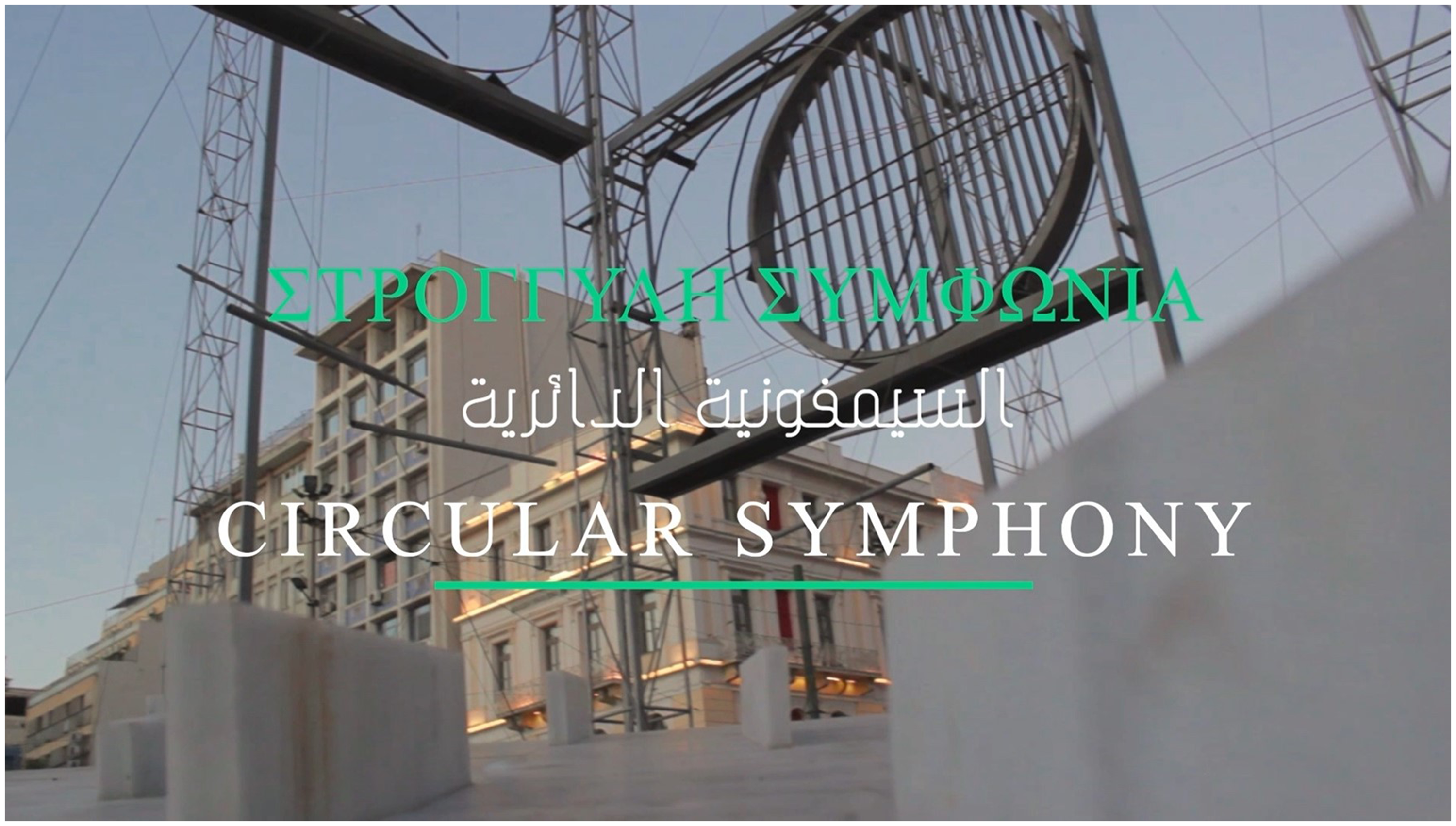
Still from video, ‘Παγκόσμια Ηχώ | Echos-Monde | The World is Echo’ (Western, 2020).
Again Glissant: “this errant thought, silently emerges from the destructuring of compact national identities that yesterday were still triumphant and, at the same time, from difficult, uncertain births of new forms of identity that call to us” (1997: 18). Calas would agree – with his narration of belonging tied to cities and neighbourhoods, not nations (Rentzou, 2008: 303–304). These errantries resound with planetary thought, spinning together with a definition from philosopher Kostas Axelos, for whom “planetary means whatever is itinerant and errant, wandering as it follows a trajectory in space-time and performing a rotational movement” (1964: 46; Deleuze, 2004: 156). 5 And this, in turn, loops to the work of Katherine McKittrick, who sits with Glissant’s errantry in her writing, and has crafted it into a method – refusing “all modes of geographic belonging that are tied to racist and colonial knowledge systems” (2021: 32).
All these ideas rewrite spatialities, spin geographical imaginations, move against regimes of citizenship based on imperialism, ethnonationalism, exclusion, bordering, violence. The city as text can be read in circles, rhythms, relations. The circle, the circulation, the circular. Calas writes a circular symphony; Glissant writes an open circle. “Thus” – Glissant’s words again – “we go the open circle of our relayed aesthetics, our unflagging politics. We leave the matrix abyss and the immeasurable abyss for this other one in which we wander without becoming lost” (1997: 203). A surety of foot, a change in representation, a mobile belonging. An open circle. An open city. Burst onto the scene of our common theatre (to close by remixing this movement’s epigraphs) – may they turn to immense circles.
Movement #3 – Like so many dances
Struggle makes music. Full of noise and life, sociality and study (Harney and Moten, 2013), collectivity and community (Glissant, 1997: 93), rhythm and relation. A kind of ensemble work (Simone, 2018). A noisy citizenship. This final movement dances to this struggle music. It narrates another circular movement – the movements of dances – with footwork and formations shared and held in common across cultures. In Athens, youth movements make new dances out of diverse traditions that fit together in the city, deliberately out of step with the restrictive rhythms of national citizenship. This section draws on conversations and collaborations with dancers in Athens, and on ideas from dance literatures that build an understanding of choreography as a form of spatial resistance. The collective movement of bodies in the dance circle extends outwards into the city, generating anti-border choreographies, improvised citizenships, and resistance movements – which make up the structure of this final section.
Anti-border choreographies
Dance – to borrow a line from Fred Moten – is “the city’s mother tongue” (Moten, 2018). A city that speaks in dances is a city that is always moving, that is built on movement. Thinking with this idea in Athens opens ways of finding commonalities that exist across performance cultures all around the Eastern Mediterranean. In the Syrian and Greek Youth Forum, dance is another creative space of belonging, another migratory citizenship. Greek dance and Arabic dabke are merged into anti-border choreographies. And here again I do not just mean borders at national or state level, but borders that exist in urban space, that play out in everyday life, that are written onto people’s bodies in the form of racialised regimes of citizenship and equally racialised systems of policing, of access to resources, and to life and livingness in the city.
The dancers in our team lead Greek and Arabic dance classes – teaching them separately but also working them together. Traditional Greek dance and Arabic dabke share the same shape: the open circle. In the dance space, people move together in rotational movements. The circle never closes. Through combining traditions and movements, our teachers find footwork that steps across geographies and dances through difference. Christina – a dancer and choreographer (and friend) who leads us in these lessons – asserts how this practice stretches spatialities, temporalities, and identities: I am a dancer of Greek traditional dances, but in a sense of not remaining stuck in the past and not continuing elements of the past that don’t reflect modern reality. We combine several elements of dancing and our cultures. Sometimes during the class, I find myself doing steps of Greek dances that totally fit with dabke, which is really exciting. It is Greek, but it's not only Greek. And to be honest, you know, it is Greek because we think of it as Greek now. But the Greek dances are influenced, on the north, by the Balkans. The islands on the west, they are influenced by Italy. On the other side, they're influenced by Turkey. They have common songs. So from its base, there is nothing clearly Greek. It’s like our own thing now. Because it's a process of exploring, it's not stable. And we're trying to find new things based on the things we already know and respecting the traditions of the past for sure. But we're trying to do it to synchronise the art with the needs that we have now.
In various other ways, these ideas offer a response to a question posed by the poet June Jordan: of “how to design cities so that dancing all together will not appear ridiculous” (in Diaz, 2021). Choreography is a kind of city making. In this case, Athens itself becomes an open circle, like so many dances: always open, always changing, a space of social and political improvisation. The dance circle makes cities. It models a society made with movement and without marginalisation. Ayman articulates it beautifully: “It's like we're all trying to open everything. I hope one day, we will have a country for only the dancers, you know; or a city.” One of the Greek words for the circle dance is συρτός (syrtos), meaning dragging. With each rotation, each repetition and variation, the dance circle drags the city into possible futures. A collaborative rebellion (c.f. McKittrick, 2021: 166) – loving, soaring, moving.
This is a lightness of liberation, but it also drags heavy histories. Dance scholar Irene Loutzaki (2001) marks out the “political rhythms” of dance histories in Greece. Dance has long been folded into practices of statehood, with certain dances banned under dictatorship in the 1930s and forbidden by the junta in the 60s and 70s, because of their political content or their associations with non-national geographies. This, in turn, maps onto longer histories of dance in the development of Greek cultural nationalism – part of the choreography of nation building (Savrami, 2019). The dancing body is indexed to the body of the nation, and the dance circle becomes metaphor and metonym of tightly bordered ideas of civilisation, an exercise of racial purification, and a form of cultural coercion. Under dictatorship, for Loutzaki, “no one escaped from the circle” (2001: 131).
Similar dynamics play out in Syria, where dabke has been variously tied to postcolonial nationalism, masculinist statecraft, and obedience to the al-Assad regime (cooke, 2017; Silverstein, 2021). Yet it was also central to uprising and popular protest in and after 2011 – a “performance technique that embodied collective resistance against the state” (Silverstein, 2019: 246), giving the movement its revolutionary rhythms. Dabke symbolises both repression and resistance, and mediates the relationship between the two (Silverstein, 2021: 200). Choreography is about the organisation of movement, and dance is about the organisation of space. Both are about power relations, and are forms of social commentary (Mills, 2021). “Dancing is a way of acting,” Christina tells me. “We can say everything that we cannot say with words.” People in Greece and Syria danced against dictatorships, and these movements move together now, taking on new meanings as citizenship movements in migratory contexts – as anti-border choreographies.
Improvising citizenship
These circular movements signal a dynamic between choreography and improvisation. The dance circle becomes a space of belonging: a set of social relations articulated and sustained beyond the reach of border enforcement, state surveillance, and the politics of integration programmes (cooke, 2017: 10; Dyrness and Sepúlveda, 2020: 28). The circle is a space for improvising citizenship. I am guided here by dance literatures. Aimee Meredith Cox, in her study of choreographies of citizenship amongst young Black women in Detroit, writes of how movement narrates things that are “not otherwise legible” (2015: 28) – and can disrupt and discredit practices that mark young racialised bodies as “undesirable, dangerous, captive, or out of place” (2015: 29). The context is different but the issues resonate. People use dance “to shift the shape of spaces that restrict and punish them as well as those that offer care and support” (2015: 26). Choreography becomes a movement-method, remaking spaces and shapes of belonging.
This works on a few levels. It is, first, another kind of carrying work. As my colleague Wael – one of the co-founders of our organisation – puts it: “We encourage our team, always, act how you act in the dabke. Be together, on one line. Everyone act as one body and support the one next to you.” This is a collaborative method of care, a collective workout and working out of life lived under multiple forms of violence in a world that keeps falling apart. And it is, again, a kind of citizenship based on interdependence, on relations between one another rather than with the state – something that has carried from revolution in Syria (Abbas, in cooke, 2017: 8) to building platforms of belonging in Athens.
It is, second, an act of holding: holding one another and holding these movements together. In Christina’s practice, “it's not counting the steps, you know; you just follow and you show trust to the people next to you. We hold the people around us. We're close to each other.” Similarly for Ayman, the dance circle is a space of community organising. “It's like something changed inside this community. We make them believe they should be close to each other and support each other and learn from each other.” These practices expand beyond the dance circle to a web of mutual aid that fills the city (Bruno, 2022). “A lot of the time after our dance lesson we go to a restaurant to eat or there is a friend who has problem and we try to solve it,” Ayman continues. “Or we don't like what the government is doing so we prepare a demonstration. It's a big way of life.” In all cases, and to borrow a line from AbdouMaliq Simone, “The question of holding is important. No matter how improvised, lives need to be held, supported” (2018: 4). The dance circle is a kind of urban planning – not in the sense that we usually think this term, but as a space of planning for life in the city.
It is, third, an anticolonial imagination. A liberation movement against the colonialities of borders and citizenships. In the dance classes, we set a loudspeaker down in whichever public space we are gathering, connect a phone to soundtrack the session, and set about reimagining society. The six-step of dabke cuts across and combines with the threes, fives, eights, and twelves of Greek dances, making transborder counter-rhythms in circular motion. The dance circle becomes a space of border thinking, decoupling citizenship from the nation-state and its colonial cultural constructs (Dyrness and Sepúlveda, 2020: 25). Dancing together opens paths out of regimes of refugeeness and its narratives of suffering, victimhood, and threat. These are movements, to borrow another line from Cox, “committed not to inclusion but to creation” (2015: 27). Choreographies make new worlds and realities. And to follow dance scholar Sarah Bruno, the circle is a space where people feel free, choreographing liberation against “the metronome of colonial violence,” improvising citizenships and imagining futurities that move against systems of distancing (2021).
Resistance movements
Taken together, the ideas that circulate from the dance circle to the city amount to another kind of spatial resistance. This is a citizenship made out of rhythm and footwork, that again refuses the distinction between “migrants” and “citizens,” and notion that the city is the territory of a single group of people. Dance is the city’s mother tongue; both are made out of movement. In Ayman’s words, “it's an open community and we should be an open circle.” The topographies of Athens appear differently from the perspective of the dance circle. Against the closure of the city enacted by politicians and border policies that reach into urban spaces, Athens is remapped within everyday life by diverse communities of struggle, in which movement is both starting point and necessity, and the insistence on the open circle always leaves space for new ideas and people.
Yet this spatial resistance cannot be determined in advance, cannot be written out in its entirety. It “cannot take the form of a strictly notated score; it cannot keep a strict count; it can’t make some lives count more or less than others” (Simone, 2018: 4). In its improvisations, it is maybe closer to what fahima ife calls anachoreography (from the Greek αναχωρώ: to withdraw or depart): “a recursive practice of refusal,” against the “choreographed apparatuses of coloniality, its methodologies, its origin stories, its naming rituals, and its movements” (2021: xi). Citizenship – as conventionally understood – is part of these apparatuses. Dancing around and against it, dancing it up into new shapes and constellations, dancing circular movements that move over borders and against nations, that step across time and space – all of this requires agility and creativity and errantry. These are improvisations of citizenship performed on the steady footing of movements built across borders, which render citizenships mobile, and rewrite narratives of migration.
Epilogue: On movement writing
I close with some thoughts on movement writing. In narrating these circular movements, I have sought a kind of writing that is able to gather, hold together, reflect somehow, and also contribute to the movements under discussion. This involves a few things. On one level, it means writing places and spaces through mobilities. This is an errant chorography – a form of space-writing that takes movement as its starting point. Rather than revalidating notions of rootedness, of fixity, of the nation, the territory, the national geographic (Malkki, 1992), writing that takes movement as its starting point recognises how movements make spaces and places (Amin, 2004; Cabot and Ramsay, 2021). A single place holds multiple spatial imaginations and struggles. To think in circles is to think with circulation, spinning away from static ideas of belonging.
At the same time, it means writing in and with social movements, political movements (rather than just writing about them). Movement writing moves with the forms of spatial resistance that circulate at street level. This involves being and thinking with people who creatively contest the racialised logics of borders and citizenship regimes. For this, I want a term that is not scholar-activism, where the hyphen does not mask a split between these identities, and both terms draw attention to the individual (the scholar-activist). Instead, I prefer movement writing, which does the work of relating and decentring, and seeks to reflect the ways that movement work always involves collective forms of research and scholarship. As well as learning from colleagues in Athens, then, I learn from movement writers – Aziz Choudry (2015), Yasmin El-Rifae (2022), Robyn Maynard (2017), Richa Nagar (2014), Harsha Walia (2013) – whose work contains lessons on how to write collectives and collectivities; how the often-solitary work of writing is always full of solidarities; how to channel the vulnerabilities and responsibilities of writing movements back into those movements themselves, rather than playing to the demands of disciplines and academic institutions. 6
Movement writing thus holds mobilities, mobilisations, and collective study together. This is another circular movement, echoing concepts of liberation as praxis (Freire, 2017[1970]), which moves in a cycle of action, reflection, and action, through which people work to transform their worlds (Lock Swarr and Nagar, 2010). As Lola Olufemi – who writes beautifully about the organising work and imagination that goes into liberatory movements – puts it: “Think of how a circle, rounded lines from a fixed point, seems to keep going and going. That could be key to our method” (2021: 111). This circle again holds space for new ideas and multiple trajectories, where writing is just one of many activities, and people combine knowledges, leverage positionalities, sustain one another, working always collectively (“our method”) and in relation. Movement writing also holds space for creativities, playfulness, speculation. The work of writing geographies of belonging involves bringing together texts of various kinds. Close to what Katherine McKittrick calls an “ongoing method of gathering multifariously textured tales, narratives, fictions, whispers, songs, grooves” (2021: 4) – in her formulation of anticolonial studies.
Hence my focus in this essay on poem, dance, and conversation, as much as on academic literatures and debates. Movement writing prioritises the knowledges that circulate in communities made out of migration and struggle. Putting all this another way, this writing operates with, and as, a set of anti-crisis methods. Methods of anti-crisis refuse the colonial logics of border regimes and citizenship. They refuse the rendering of certain kinds of movement as crisis. They refuse the racialised (il)logics of the very term “crisis,” and the ways it is strapped to particular people. They refuse the narration of the sea as only a border, a crime scene, a carceral space. They work beneath the over-saturation of images of border violence, circulating the deep untenability of the border rather than reproducing it through spectacle. They focus on emergence rather than emergency (Athanasiou, 2018). They produce forms of belonging that are at once emergent and recursive, joyful and rebellious, anti-border and anti-crisis; reflecting the profound normality of movement and struggle that is an essential part of everyday urban life.
To finish, movement writing and anti-crisis methods are geared towards anticolonial futures. Anticolonial movements in the last century defied colonial cartographies that outlawed people from relating to one another on their own terms. These were solidarities constructed through political and spatial imaginaries that looped different parts of the world together – not least through the circulation of writing that strengthened these imaginations (Desai and Ziadah, 2022). These connections still exist, and can point towards possible futures. Here I have tried to illustrate what this might look like in Athens. But these are methods that exist in circulation, and can land in different times and places – are anticolonial gatherings of struggles, choreographies, poems, rhythms, resistances, feedback, echo, and more. Circular movements open geographies of struggle. And these movements spin with and into other movements, in constant relation and imagination, moving towards social transformation.
Short description
This essay remaps geographies of belonging in Athens. It thinks the city in circles and circulations, narrating circular movements as a form of spatial resistance, looping together to write ways out of the colonialities of citizenship.
Footnotes
Acknowledgements
My thanks to the editors and reviewers of this article for making it better. Thanks to my colleagues in the Syrian and Greek Youth Forum, who have taught me many of the things I write about in this piece. Thanks to friends at Decolonize Hellas – Penelope Papailias and George Mantzios – who shared spaces where these ideas developed. Special thanks to Pasqua Vorgia for opening the city, to Georgios Sourmelis for getting me into circles, and to Konstantina Methymaki for teaching me to dance.
Declaration of conflicting interests
The author(s) declared no potential conflicts of interest with respect to the research, authorship, and/or publication of this article.
Funding
The author(s) disclosed receipt of the following financial support for the research, authorship, and/or publication of this article: This work was supported by a Marie Curie Individual Fellowship from the European Commission (grant number REP-846982–1) (2019–2020).
