




Abstract
Following significant social and legal challenges to Australia’s colonial policy of ‘offshoring’ immigration detention, the system has become more mobile and diffuse, expanding through a range of new, ad-hoc, and established detention sites both ‘on’ and ‘offshore’. Refugees, asylum seekers and other non-citizens are frequently transferred and dispersed between these sites, which form ‘spaces of disappearance’. In this article, we draw upon concepts of racial surveillance capitalism and data justice to analyse a work by the Manus Recording Project Collective, titled where are you today, that sought to expose and counter the colonial border’s disappearing effects. The work involved the creation and distribution of audio-recordings from inside detention sites to subscribers. Recordings were distributed via text messages that also plotted individual subscribers in spatiotemporal relation to the detained artists that created them. The Collective thereby appropriated the tools of surveillance capitalism – such as GPS tracking and timestamping – to create dynamic digital cartographies of the mobile-carceral border. Through studying this work, we aim to deepen understandings of colonial bordering practices and highlight possibilities for disrupting the social divisions and exclusions that they reproduce.
Keywords
Introduction
Every day for a month … you’ll receive a text message with a new ten-minute audio recording from Farhad Bandesh, Farhad Rahmati, Samad Abdul, Shamindan Kanapathi, Thanush Selvraj or Yasin Abdallah. These men, seeking asylum by boat, were forcibly transferred to Manus Island by the Australian government nearly seven years ago. Now, they are held in hotels or detention centres in Port Moresby, Melbourne or Brisbane …
The site will display some additional information: the number of kilometres between you and the person who made the recording, and the number of hours or days that have elapsed since the recording* was made.
*In order to calculate that information, the site will require access to your device’s location. You will be prompted to allow the site to access that data. Depending on the privacy settings on your device, you may not see that prompt. Any data shared will only be displayed in a de-identified, generic format recording the distance between recorder and listener – i.e. 15 km, or 180 km. More precise location data, if shared, will be stored in a de-identified format – i.e. unconnected to a phone number – for possible use in a future archive of where are you today. Nobody, including the Manus Recording Project Collective, will be able to determine the identity of a listener based on that archive.
(Manus Recording Project Collective, 2020)
There is … an interesting theme about surveillance and the detainee’s experience of being watched. Is it possible to use surveillance tools as a critique, a way to render their surveillance absurd?
(M Green 2020, personal communication, 3 March)
GPS tracking and digital recording technologies play important roles in many sectors of contemporary racial capitalism (Kanngieser, 2013; Sadowski, 2019), including the carceral state (Hucklesby et al., 2021; Jefferson, 2020; Wang, 2018). Indeed, digital surveillance tools enhance ‘digital colonialism’ and reinforce interlocking forms of discrimination (Benjamin, 2019; Birhane, 2020; Mann and Daly, 2018). However, they can also be harnessed as tools of creative resistance, self-representation, ‘sousveillance’ (inverse or counter-surveillance), and critique (Benjamin, 2016; Browne, 2015; Harju, 2020; Kidd, 2019; Walsh, 2013).
This article analyses a collaborative project that repurposed some of the digital tools of surveillance capitalism (Zuboff, 2019) to counter-map Australia’s mobile-carceral border and its violent program of dispersal: the subscription-based sound work, where are you today, by the Manus Recording Project Collective (‘The Collective’). It brings together theory on the colonial violence of borders (Giannacopoulos and Loughnan, 2019; McKinnon, 2020; Perera and Pugliese, 2018), racial surveillance capitalism (Mirzoeff, 2021), and counter-mapping as data justice (Kidd, 2019), to deepen understandings of the relationships between race, borders, and technology, and to explore the possibilities for disrupting the forms of exclusion and violence that they reproduce. Through this theoretical framework, we conceptualise where are you today as a practice of counter-mapping the racial-colonial project of ‘migrant dispersal’ (Tazzioli, 2019) that artificially (re)secures and sustains the nation as a ‘white space’ (McQuire, 2019). We consider how the artistic design of the work responds to and exposes important changes in the system of immigration detention in Australia, especially the increasing use of hotels as ‘Alternative Places of Detention’ (APODs) (Jerrems et al., 2023), and disrupts some of its intended effects, namely the seamless production of ‘spaces of disappearance’ (Davis, 2000; Mirzoeff, 2021) for those who are seen to threaten the racial-colonial imaginary of the nation as a white possession (Moreton-Robinson, 2015).
Elsewhere we have explored the sensory (sonic, affective, and atmospheric) aspects of where are you today (de Souza and Russell, 2023). Here, we focus on its technological and data-driven (digital, mobile, and cartographic) aspects. The analysis draws from our experiences of subscribing to the work from Narrm (Melbourne) and Meanjin (Brisbane), respectively, throughout August 2020, and the regular reflective fieldnotes we exchanged throughout. Both authors wrote detailed responses to each recording, often in real time on our mobile devices. We recounted how the work ‘filtered into aspects of our everyday’ by noting when, where, and how we listened – while taking a walk, cooking a meal, or lying in bed, as we variously negotiated COVID-19 restrictions on movement, caring responsibilities, and health issues (de Souza and Russell, 2023: 27). By sharing these notes with each other on a weekly basis, we inadvertently created a small ‘listening public’ through the cumulative effects of our embodied, situated, and relational listening practices. As always, our capacities to listen and interpret this work are shaped by our social positioning (de Souza, 2018; Kanngieser, 2023): as a white Anglo settler (first author), a settler of Anglo and Eurasian-Malaysian descent (second author), and as Australian citizens (both). Critical reflection upon our positionalities is necessary to challenge the idea that researchers can assume dehistoricised and unmarked listening positions in settler colonial contexts, unaffected by the bordering practices that they are investigating (Brooks, 2020). To extend our analysis beyond our own experience of where are you today, we draw upon published accounts from the artists (asylum seekers and refugees from Iran, Sri Lanka, Sudan and Afghanistan, all named in the epigraph above), personal correspondence with their collaborators and fellow Collective members (André Dao, Jon Tjhia, and Michael Green), and the archive of where are you today that is now available online.
Directing our attention to the Collective’s use of digital metadata gathering and networking tools to resist spaces of disappearance contributes to knowledge of the potentials and limitations of data justice or sousveillance projects and the nature of power exercised through border policing and detention more broadly. where are you today was produced at a very particular conjunctural moment of bordered forms of governance, marked by a significant shift towards the use of onshore APODs for asylum seekers and refugees and by the rapid development of new border controls and restrictions on mobility in response to the emergence of the COVID-19 pandemic. The work contextualised these new city, state, and country-wide spatial restrictions (that were, in practice, unevenly enforced and felt (Russell et al., 2022)) by drawing attention to the persistent violence of indefinite detention that refugees and asylum seekers endure. The work also emphasised that the racialised violence of colonial bordering practices had not dissipated or contracted with the partial shift towards onshore warehousing and APODs, but had instead dispersed, expanded and ‘come closer’ to the urban environments that many of us inhabit – on unceded and sovereign Indigenous lands (Giannacopoulos and Loughnan, 2019; Keenan, 2020). While limited by its ‘opt-in’ and ‘one-way’ design, where are you today exposed our shared geographies and transformed us into proximal witnesses, without concealing the ways in which mobilities and rights are unequally distributed in settler colonies (Morris, 2023; Puar, 2021; Simpson, 2014).
Border policing, data in/justice and counter-mapping
Asylum seekers, refugees, and other non-citizens are key targets of the colonial state’s racialised surveillance systems (Mann and Daly, 2018; Vogl and Methven, 2020; Wilson and Weber, 2008). To police and control the imaginary borders of the nation as a white space, the settler colonial state uses techniques of erasure, extraction and surveillance that create spaces of disappearance (Banivanua Mar, 2016; McQuire, 2019; Mirzoeff, 2021). These spaces include prisons and youth detention centres that overwhelmingly target First Nations people, and immigration detention centres and APODs for racialised non-citizens that become trapped (through enclosure or exclusion) by the border (Loughnan, 2022; Morris, 2023; O’Donnell, 2022). Together, they comprise a ‘carceral archipelago’ (Foucault, 1991) that is embedded in colonial genealogies of racial-spatial control (McKinnon, 2020; Perera and Pugliese, 2018).
Border surveillance and policing are central to the symbolic power of the settler colonial state and have been ‘amplified in the name of crime control and counter terrorism’ (Perera, 2009; Walsh, 2015). The authoritarian securitisation of the border and the carceral control of non-citizens is justified through the reproduction of racialised imaginaries of asylum seekers as ‘enemy’ and ‘alien’ (McHardy, 2021; O’Donnell, 2022; Smith, 2018). Those who arrive in Australia by boat are subject to particularly vitriolic labels and exclusions – as ‘illegal’ threats to both national security and the very fabric of Australian society (Grewcock, 2017; Mountz, 2015). In effect, the Australian Government’s response to refugees and ‘irregular migrants’ (like other settler colonies) continues to be primarily framed by racialised discourses of criminality and disposability (Francis, 2018; Perera and Pugliese, 2018; Vogl et al., 2020).
In detention, non-citizens are subject to particularly intense forms of surveillance and exposure that, paradoxically, render them ‘invisible as persons of value and agency’ (Loughnan, 2022). Thus, rather than totalising spaces of disappearance, authoritative attempts to control of the visibility and audibility of detention, and of other flows of information about asylum seekers’ experiences (Boon-Kuo, 2022), can variously function to hide, normalise, or legitimise the structural and epistemic violence of indefinite detention (Loughnan, 2020; Mountz, 2015; O’Donnell, 2022). Indeed, the legitimacy of border securitisation is in part achieved through visual(ised) performances of state control that transmute the trauma of border confinement into a ‘telegenic’ or media ‘spectacle’ (Pugliese, 2008; Walsh, 2015). Such penal spectacles work to dispense lessons on deterrence and construct government authorities as heroic defenders of the (white) nation under threat.
In the bordering context, there are numerous examples of reactionary projects that appropriate digital network tools to reinforce and expand – rather than challenge and disrupt – border surveillance. There are ‘top-down’ initiatives such as the government’s creation of ‘tip-lines’ to encourage citizens to surveil and ‘dob-in’ irregular migrants in Australia (Walsh, 2018) and ‘bottom-up’ examples of ‘societal vigilantism’, such as the use of Facebook groups ‘to act on immigration, national identity, ethnic boundaries, and cultural values’ (Tanner and Campana, 2020). The performative effects of these practices include the (re)construction of racialised boundaries that increase polarisation between social groups.
In contrast to the development of digital networks that enhance injustice – by supplementing state policing and magnifying social divisions – projects that fit under the broad umbrella term of ‘data justice’ are involved in ‘extracting and redirecting’ existing digital and data-gathering infrastructures away from conditions of domination and exploitation in the service of more liberatory projects (Dencik et al., 2016, 2019; Kidd, 2019). Situating data justice in a broader conversation about social justice, rather than narrow legal frameworks to restrict the reach of surveillance, Dencik et al. (2019) conceive of ‘data justice’ as: [A] form of critique, a framework for shifting the entry-point and debate on data-related developments in a way that foregrounds social justice concerns and ongoing historical struggles against inequality, oppression and domination.
Counter-mapping initiatives have the capacity to ‘locate in place phenomena that might have been thought unmappable’ (Popovski and Young, 2023: 7), such as sounds, sensations, or infrastructural arrangements premised on invisibility and disappearance. Recent contributions in this vein use visual, sonic and digital methods (that rely upon web-based geographic information systems such as Google Maps, for example) to study a range of social and cultural changes in different environments, such as patterns in gender-based violence (Fileborn and Trott, 2021), the privatisation and securitisation of ‘public’ space (Tulumello, 2015), and the construction of border walls (Margulies, 2023). As a collaborative project and art work, where are you today succeeds in digitally and sonically mapping the border’s spaces of disappearance at a particular historical juncture, defined by major shifts in the system of immigration detention and the social upheavals of the COVID-19 pandemic on the one hand, and by continuities in colonial bordering practices on the other. Amidst this tension, the work reminds us that bordering regimes are always racially and spatially ordered. By challenging assumptions that asylum seekers and refugees are only ever the objects rather than the producers of knowledge (through sound), the work further unsettles norms of colonial and extractivist listening (Kanngieser, 2023; Robinson, 2020).
Mobile-carceral borders and racialised migrant dispersal
Despite numerous social and legal challenges to its legitimacy, Australia’s punitive system of immigration detention persists and adapts through territorial diffusion (Walia, 2021). The state appropriates and encloses new sites and disperses its captives among and through them (Giannacopoulos and Loughnan, 2019).
1
For people who seek asylum upon arriving ‘unauthorised’ in Australia by boat, these colonising moves keep them ‘indefinitely stuck’ (Russell and Rae, 2020), without rights (Tazreiter and Burridge, 2022), and yet forcibly mobile (Peterie, 2021). Frequently, and without warning, refugees and asylum seekers are transferred into and between a variety of purpose-built, adapted, and ad-hoc detention sites both ‘on’ and ‘offshore’ (Vogl et al., 2020). This dispersal, as Tazzioli (2019) points out, is an important strategy in the racialised governance and containment of people seeking asylum. However, this colonial strategy is not new. Historically, in the Australian context, the term ‘dispersal’ has been used as a euphemism for massacres and the attempted genocide of First Nations peoples (Behrendt, 2019; Nettelbeck and Ryan, 2018). Accordingly, contemporary strategies of racialised governance of (non-white) people seeking asylum extends a longer history of colonial surveillance, dispossession and attempts at erasure (McKinnon, 2020; Palombo, 2009). These continuities and adaptations remind us that the border is not natural, inevitable, or fixed, but a polymorphous space and (neo)colonial technology of racialisation and confinement (Burridge et al., 2017; Perera, 2009; Plonski, 2022).Where are you today was produced roughly eight months after the reactionary repeal of Australia’s short-lived Medevac laws (on 4 December 2019), which allowed for the temporary transfer of offshore detainees to the ‘mainland’ for urgent medical treatment, and seven months after the first COVID-19 cases were recorded in Australia (on 25 January 2020). The short-lived Medevac laws provided a small glimmer of hope for asylum seekers and refugees languishing indefinitely in offshore detention, but their repeal due to ‘national security’ concerns led to unanticipated and devastating consequences for hundreds who were imprisoned in hotels for extended periods of time. In 2020, urban hotels were rapidly and widely used as APODs to detain those transferred under Medevac legislation and to quarantine international travellers to prevent the spread of COVID-19 (Jerrems et al., 2023; Loughnan, 2020). Patrolled by roving guards, refugees and asylum seekers were indefinitely detained in small hotel rooms (some for 23 hours a day) with limited or no ventilation, generating significant negative health effects for those detained (Commonwealth Ombudsman, 2020). Kurdish refugee Mostafa Azimitabar describes how his health deteriorated in hotel prisons in Melbourne: After 13 months locked in the Mantra [hotel] prison without sunlight I was so sick they said they would take me to a better place. But that was a lie, the situation in the Park hotel was much worse. In Mantra sometimes I could put my hand out of a small window to touch sunlight with my hand, but in the Park prison, there was a dark glass facing a cement wall, I felt I was in an invisible prison. I couldn’t see trees, or wave to people outside. (Doherty, 2021)
2
In the months following where are you today, the infrastructures of the Australian border continued to be rearranged in response to various socio-political forces and shifts. In the lead up to the 2022 federal election, The Guardian reported on 7 April that the ‘final detainees at Melbourne’s Park hotel’ were ‘freed’ amidst a ‘haphazard’ flurry of refugee releases (Australian Associated Press, 2022). 3 While it seems unlikely that ‘border hotels’ will ‘disappear’ – as in, cease to be used by the government (especially because they have significant history prior to Medevac, see Pugliese, 2009) – Australian governments’ well-established record of erasing the architectural remnants of their organised violence reinforces the need to document these spaces and expose their affective violence (Giannacopoulos and Loughnan, 2019). 4
Amid this carceral contortion and systematic disappearance, refugees, asylum seekers and other non-citizens in detention continue to resist, endure, and theorise their captivity, often in collaboration with non-incarcerated allies and supporters (Bandesh et al., 2021; McKinnon, 2020; Tofighian, 2020). While powerful, the border’s disappearing functions, and the vernacular violence that shields the detention hotel’s production of refugee trauma from public view, are not totalising. The flexibility of carceral power under racial surveillance capitalism that allows for the instrumentalisation of new sites and technologies to securitise and expand the border also provides new opportunities for appropriation and disruption. For instance, refugees and non-citizens detained in hotel rooms at Mantra in Melbourne and Kangaroo Point in Brisbane conducted (sometimes daily) protests at the windows and on balconies with placards and campaigned on social media for their release (Loughnan, 2020; Vogl et al., 2020). During this period of campaigning, surveillance capitalism tools were important, as Vogl et al. (2020) describe an example of a campaign launched by Amnesty International that leveraged online platforms typically used for the promotion of consumption to highlight the injustice of APODs, by encouraging supporters to post negative online reviews of hotels in border violence on sites such as Triapadvisor and Google reviews.
Amidst the ‘ever-growing panopoly of carceral but mobile forms’ (Stierl, 2021), keeping track of detainees and publicly exposing the ‘relentless harms’ of Australia’s punitive immigration detention system, are not straightforward or simple tasks (Nethery and Holman, 2016; Vogl et al., 2020). Making visible and audible those who are routinely disappeared is necessary to challenge not only the lack of transparency and accountability in Australia’s racialised border regime (Rae et al., 2019), but also the colonial logics that reproduce the nation as a fixed and bounded white space (Moreton-Robinson, 2015; Perera, 2009). Resisting the invisibilising, silencing, and dehumanising effects of indefinite detention requires opportunities for refugees and asylum seekers to self-represent their experiences of confinement and practices of survival in conditions of unfreedom, which is precisely what the Collective creates (Bandesh et al., 2021; Brooks, 2020; Dao and Boochani, 2020).
Digital cartographies of detention and proximal relations in where are you today
At the beginning of August 2020, as the urban environment of Melbourne noticeably stilled and quieted under ‘stage 4’ COVID-19 restrictions, the Collective began a daily ritual of distributing 10-minute audio recordings from immigration detention sites via text message to hundreds of subscribers in the city and beyond. The audio recordings provided subscribers with a daily ‘portal’ into the spaces of disappearance created by the Australian border: hotel rooms in the Mantra on Bell Street in Melbourne and the Shady Rest in Port Moresby; and established ‘immigration transit accommodation’ or detention centres on the unceded lands of the Wurundjeri people of the Kulin Nations in Narrm (Melbourne) (MITA) and the Jagera and Turrbal in Meanjin (Brisbane) (BITA). Interested members of the public subscribed to the work by texting ‘hello’ to a dedicated mobile number and then received a daily alert via text as each new recording was uploaded to the website, manusrecordingproject.com. The non-incarcerated members of the Collective (Dao, Green and Tjhia) used a platform called Twilio to send text messages to subscribers (M Green 2022, personal correspondence, 29 August), which contained a URL link to the new audio recording created by one of the six detained artists. In a speech delivered in Melbourne on 23 September 2020, Dao, Green and Tjhia noted that, for the participating artists in detention, ‘the fact that this project exists primarily in phones is significant – the phone is their primary artistic tool’. Access to mobile phones in detention has been highly regulated and contested by government actors (Boon-Kuo, 2022), which further highlights the contingency of precarity of this work’s conditions of possibility.
The text messages sent for where are you today included a brief title description that prepared the subscriber for what they might expect to hear when they tap on the link (see Figure 1). When subscribers tapped on the link, new information was displayed in our browsers that quantified metadata gathered from our personal devices: the precise distance between each individual subscriber and detained artist, and timestamp data which indicated the amount of time that had passed since the audio was recorded (see Figure 2). This created new networks of connection and data transfer from Australia’s on- and off-shore immigration prisons to the urban environments that they were often sited within, but thoroughly excluded from.
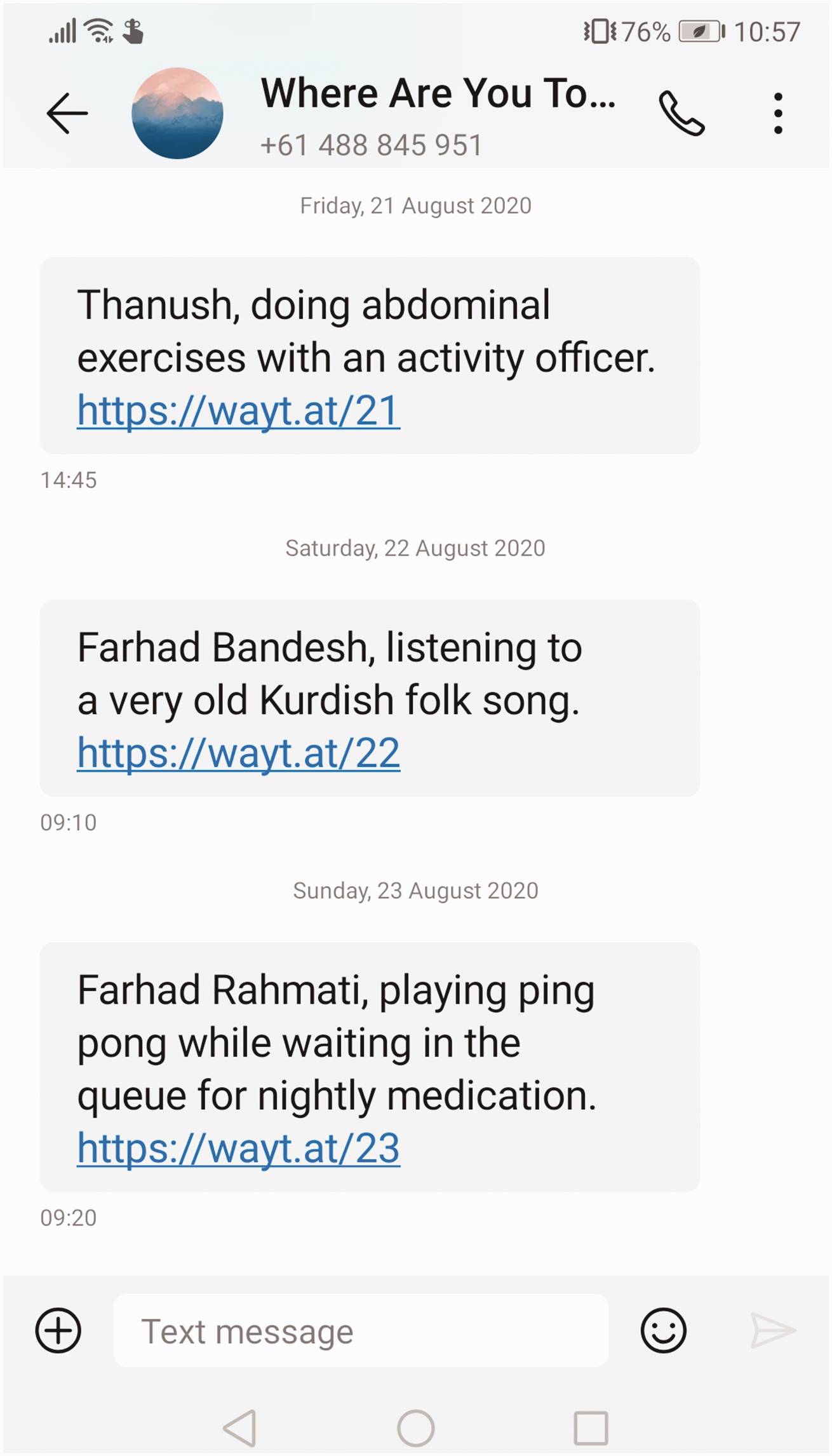
Screenshot of text messages on the first author’s phone.
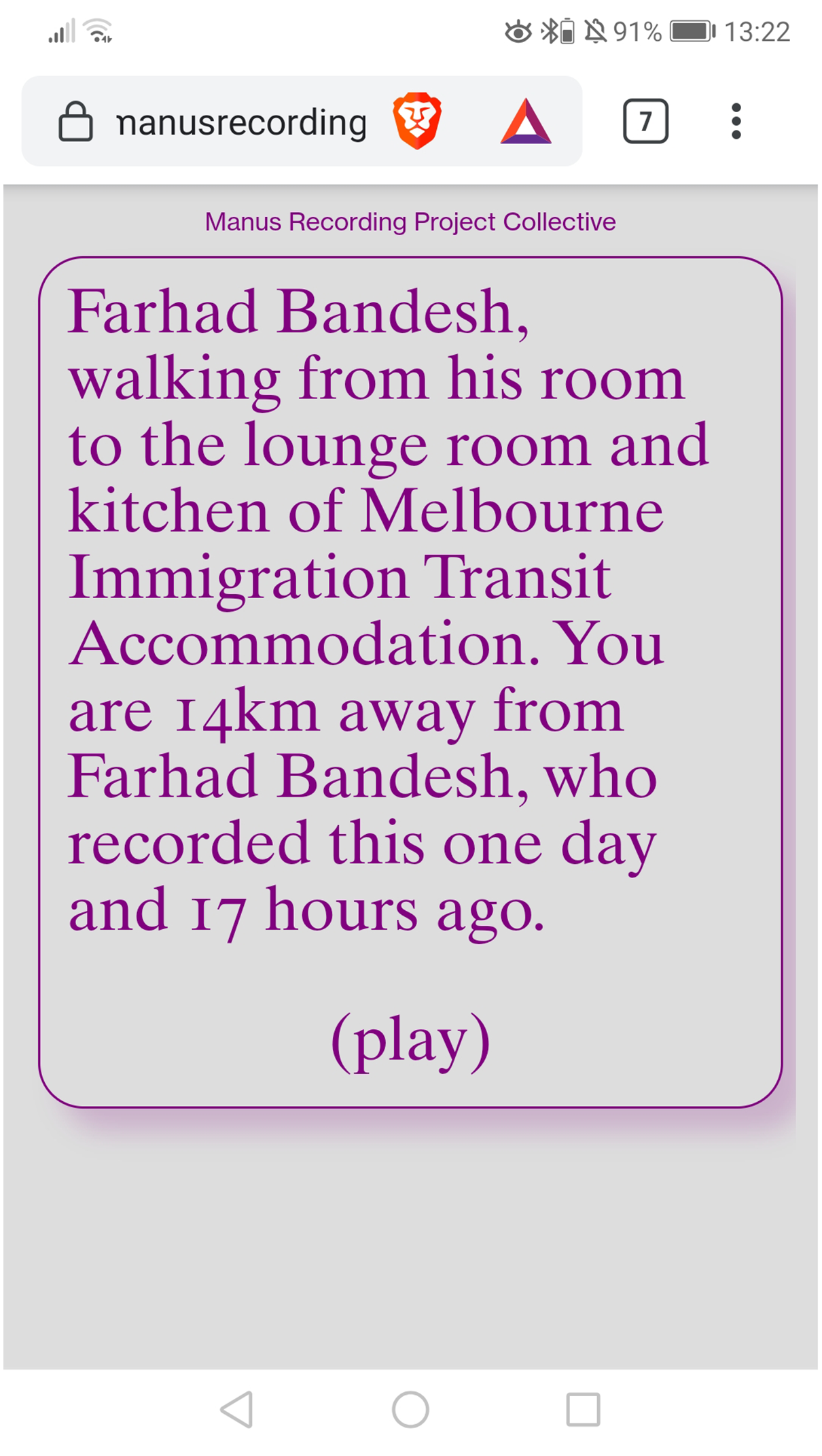
Screenshot of website on the first author’s phone on 3 August 2020. Credit: Manus Recording Project Collective 2020.
The use of daily text messaging for where are you today allowed the work to ‘follow’ listeners and interrupt our daily routines. For a short period, the soundscapes of detention punctured our intimate spaces and everyday activities. For example, Emma has ‘push notifications’ on their smartphone switched to ‘off’ for email and most applications, but text messages regularly display on their screen or trigger their device to vibrate (see Figure 3). The texts were sent at varying times of day, and Emma noted listening to recordings while washing dishes, taking a walk, driving the car, or at a playground with their child. On 5 June 2020, during the design phase of where are you today, Dao, Green and Tjhia articulated their hope ‘that the phone subscription/listening data elements … will help to establish a sense of connection and bodily relationship (as well as feelings of accountability, whiffs of surveillance, and an ache of quarantine)’. In contrast to this approach, the Collective’s previous work, how are you today, was first exhibited in a Melbourne art gallery from July to October 2018 (Parker and Stern, 2020). While similar in its design of daily 10-minute audio recordings from detention, engagement with this earlier work to counter erasure required listeners to travel to an inner-city art gallery within a set period. Even as this became impossible during the extended COVID-19 lockdowns in Melbourne during 2020, the decision to use text messages to distribute the audio for where are you today eliminated the need for listeners to travel. Instead, the work itself was mobile. By creating a month-long ritual and repeated prompts to reflect and relate to the artists involved, where are you today made a claim on our time and attention.
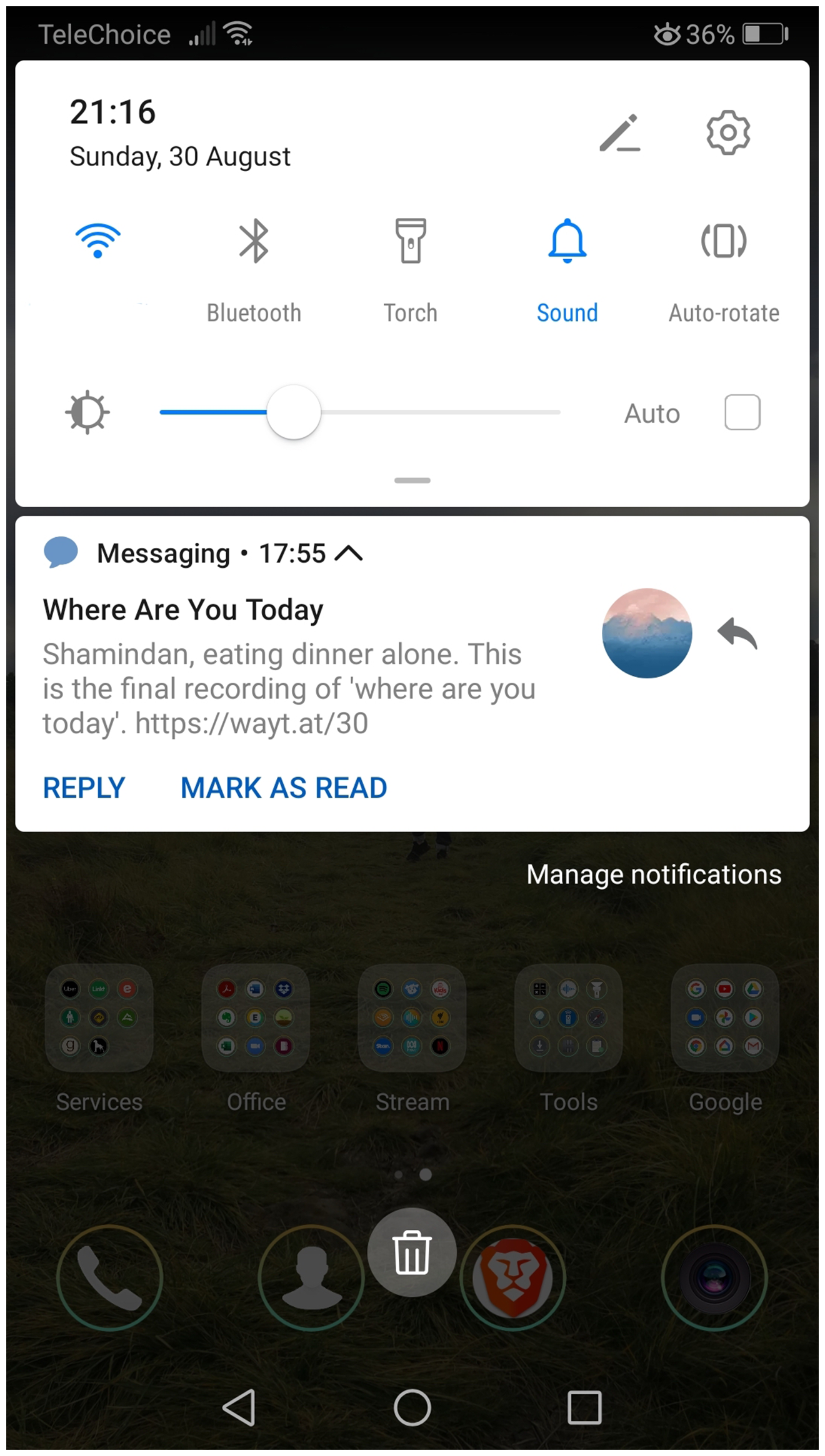
Screenshot from the first author’s phone on Sunday, 30 August 2022.
For us, receiving a text alert about a new recording each day made it easier to sustain our engagement with the work as it unfolded, and subsequently, the injustice of the artists’ ongoing captivity in relation to our own experiences of (relative) mobility. However, the archive of the work shows that the proportion of subscribers that listened to each recording declined over the life of the work (e.g., 390 listens on 31 July 2022 when 289 text messages were sent, compared to 141 listens on 27 August 2022 when 701 messages sent). This might reflect Boochani’s observation about some people struggling to engage with the slow and abstract soundscapes of detention produced for how are you today: there will be people who find it boring, and they won’t want to listen. But there are many people … they close their eyes, just to imagine the people in Manus, and try to make a connection with the men. (Dao and Boochani, 2020: 54) There are some messages if you look carefully at what we are doing. Someone is having coffee or green tea and just listening to music. It’s really simple and just normal but where are they when they have green tea and listen to music? What’s their feeling? What do you think when they are not free? […] There is a sadness to the recordings. I think people need to find that, not just listen [and think] oh, someone is playing music, having a green tea or whatever. There is some message, we need to get that message. (Bandesh et al., 2021)
Even if a subscriber did not listen to a particular recording, the repeated daily intrusion of a text message functioned as a reminder that refugees and asylum seekers were ‘still here’, suffering in indefinite detention, despite the official downscaling and diffusion of offshore detention since how are you today, for which all recordings of detention sites were sent from Manus Island. However, members of the Collective wanted the impact of the work to extend beyond this message of endurance to instead point out the transformations of colonial power that were occurring through the reorganisation of border detention. During the conceptualisation of the work, Michael Green wrote on 30 March 2020: In terms of concept, it seems like the work is just saying, “we’re still here”. I want it to do more than that. For the men in the hotels … there is something compelling in the fact that they’re right in the middle of our communities but isolated. It’s quite extraordinary. I am thinking of the Mantra hotel, and this photo that Aziz’s friend Yasin sent me, looking south from his window to the skyscrapers of the city [of Melbourne]. And the fact that other people are guests at the hotel at the same time. It’s such a curious development in the history of offshore detention. They are still marooned, but within a sea of people. Their access to telecommunications is good now and the onshore people can have visitors relatively easily (though in a designated visitor space, not the rooms where they are living).
Eventually, the de-identified subscriber metadata collected by the Collective ‘plotted’ where are you today artists and subscribers on a textual counter-map of detention with intersecting paths and points of relation to multiple and dispersed border sites. The archive of the work shows that during the month, the number of text messages sent to subscribers ranged from 289 for the first recording on 31 July 2020 to 686 for the last recording on 28 August 2020 (and peaked at 701 messages on 27 August 2020). The work reached subscribers in multiple continents, with the majority appearing to be concentrated in Australia. The quantitative and geographic distribution of each recording, and the number of listens, can be viewed on the Collective’s website (manusrecordingproject.com), by hovering a cursor over each recording (see Figure 4).
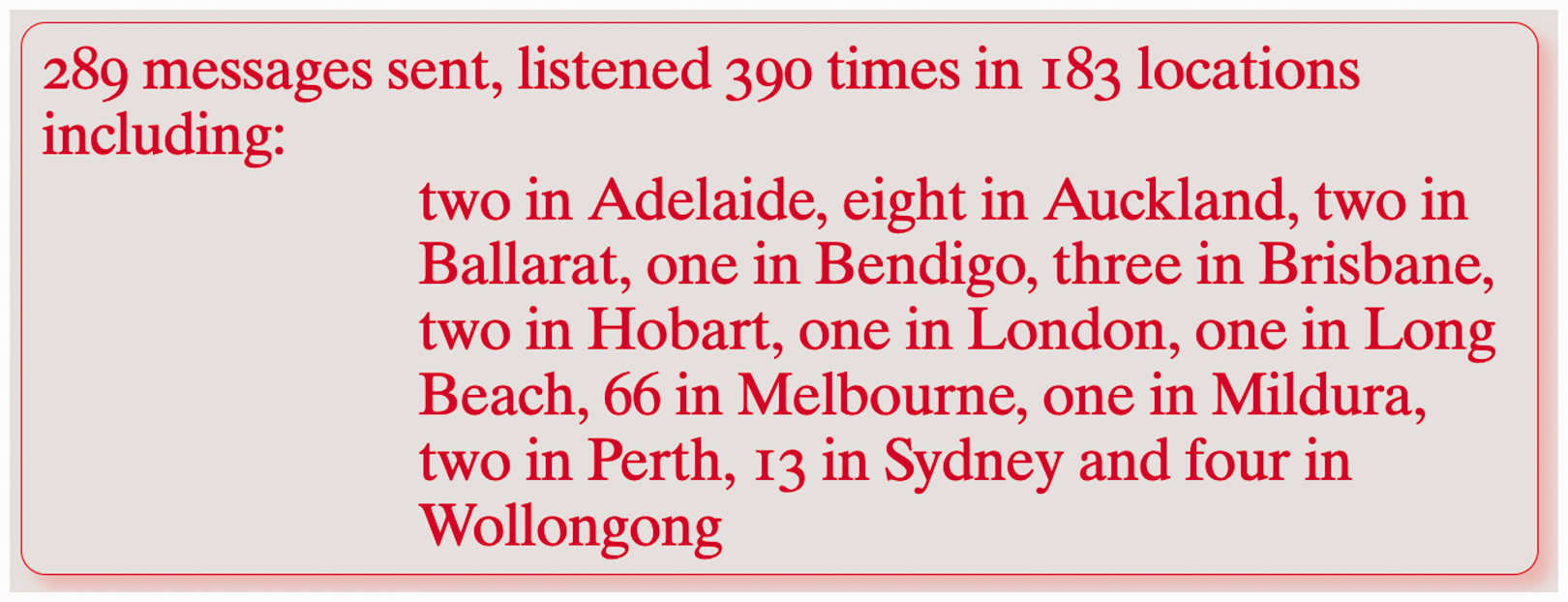
Screenshots of website taken on 14 September 2022 showing geographic distribution of the first recording for where are you today. Image credit: Manus Recording Project Collective 2020.
The datafication of the inherent relationality between artists and subscribers in where are you today troubled the colonial and geopolitical distinction between ‘onshore’ and ‘offshore’, and reminded us that the border is also here, ‘just up the road’ (Keenan, 2020). As the proximal location of the border came ‘closer’ to subscribers’ communities and environments, it was once again revealed, not as a fixed line that marks the outer edges of the continent, but as a mobile interface and set of social power relations (Gilmore, 2007; Perera, 2009). It is thus changeable and relational, rather than natural and inevitable. As Green reflected on 24 August 2020, during the design of the online archive for where are you today: ‘one thing about distance [e.g., X kms away] is it just ignores borders and focuses on the pure relationship between the two points – listener and recorder’.
In specific recordings, the border’s edge can be discerned more easily, when the shape of confined spaces are ‘sounded out’, such as when a creator’s proximity to a compound fence is made explicit, or where the sound of the sea brings up longer histories of colonial and anti-colonial struggle (Banivanua Mar, 2016). The work invites us to listen across these ‘interlocking geographies of excision’ (Perera, 2009: 21), so that we actually intuit this shifting border and come to understand its very mutability as a technique of power. For instance, in one audio recording, we listen as Yasin, imprisoned in Mantra hotel, speaks with two friends: one is still waiting in detention in Papua New Guinea, while the other has been resettled in the USA (Figure 5). While neither of us were able to understand the content of the conversation in the recording (due to the language spoken), the means and conditions of its very production nonetheless indexed the frequency and seeming arbitrariness of the border’s use of transfer as a technique of power that produces migrant dispersal (to hotels, ITAs, or negotiated resettlement elsewhere). The digital-spatial routes that this recorded sound travelled through becomes a counter-map of the mobile-carceral border, and our relation to it.Where are you today tracked subscribers’ intimate temporal and spatial connections to the mobile-carceral border, and the ways in which indefinite detention was being insidiously integrated and normalised in urban environments in Australia and Papua New Guinea. Australia’s neo-colonial and extractive relationship to Papua New Guinea continues to be heard through the work (Banivanua Mar, 2016), as two of the detained men sent their recordings from APODs in Port Moresby. These carceral adaptations are not seamless, but have the effect of respatialising and repatterning cities, recalling and amplifying pre-existing inequalities and exclusions (Morris, 2023). For instance, just up the road from Kangaroo Point hotel – which at the time was used as an APOD – is Boundary Street, which marked the exclusion zone that kept Aboriginal people out of the city of Brisbane after 4 pm under the Police Towns Act (1839). This broader topography of shifting borders echoes across space and time, reworking and extending systems of racialisation that stratify places by governing mobilities. The mobile-carceral border is thus part of the continual work of the settler-colonial project to maintain the legitimacy of white possession (Moreton-Robinson, 2015). As Walia (2021: 95) reminds us, Australia’s system of offshore detention is ‘squarely connected to the genocidal history of colonisation and racist regulation of migration by White Australia’ (see also McKinnon, 2020; Tofighian, 2020).
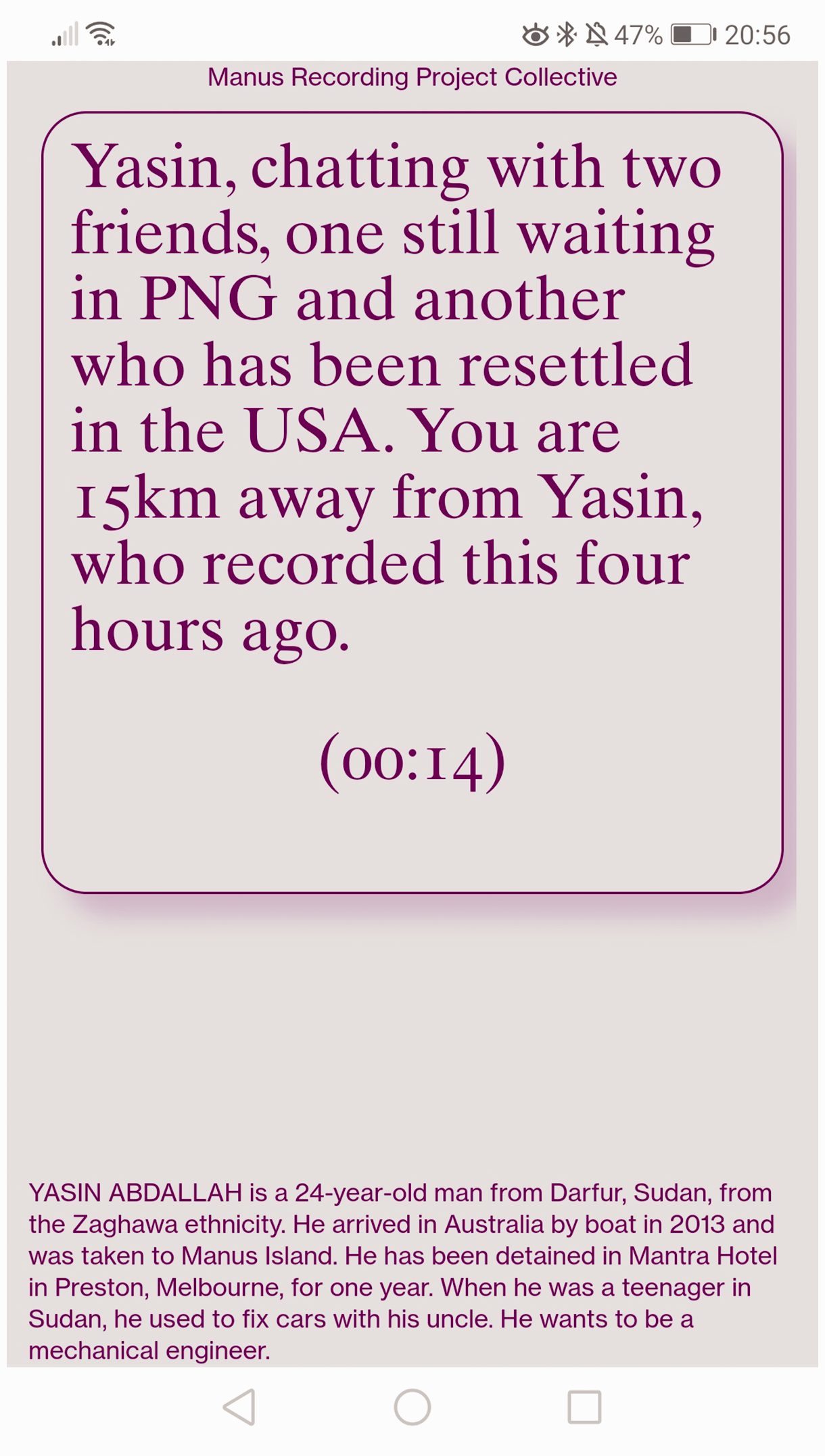
Screenshot of website on the first author’s phone on 24 August 2020. Credit: Manus Recording Project Collective 2020.
The digital infrastructure of where are you today implicated subscribers as proximal witnesses to the shifting infrastructural inequalities of colonial bordering practices. Throughout the work, carceral soundscapes travelled from different places, some (re)enclosed within our communities but re-cast as ‘external’ to the territory of the state. As subscribers, we were given access to geolocation information about how close (or far away) we were to each detained creator and timestamp data that quantified the time that had lapsed since the recording was made. This re-oriented and re-anchored us in place and time when we listened to the recordings. The work showed our ‘shared climates’ and inherent relationalities with the creators, but also our heterogenous experiences of urban space as a result of colonial bordering practices. In contrast to listening to podcasts as a (seemingly) anonymous mass, the text delivered to us each day felt ‘personalised’ – an impression generated by the work’s use of our personal meta data. Where are you today mapped in exact kilometres our proximity to the various and evolving sites of indefinite detention and spelled out in precise days, hours and minutes how long had passed since the recording of its soundscape had been made (see Figure 5). As Poppy reflected in her fieldnotes on 7 August 2020: [When] I listen to the recordings from the offshore-within-onshore enclosures – MITA, Mantra Hotel and BITA – I am made aware of how racialised border practices move and spring up in new places. Geographically, I am only 9 kilometres away from BITA … so when I hear a plane fly overhead, for example, I know the same plane has crossed over above the place where I live. These moments of connection/disconnection are sprinkled throughout where are you today and make some sort of claim on us that is more complicated than empathy and asks us to reflect on our complicity.
By foregrounding the contingency of (cross-border) connections, the project reflected and extended the Manus Recording Project Collective’s mode of organising. The Collective itself is constituted through relations that exceed and already cross the border and thus, must itself be understood as a border-crossing project at its heart. It is a collaboration between incarcerated and non-incarcerated men living and making art in relation to the liminal spaces between ‘offshore’ and ‘onshore’ and in unevenly distributed and contingent conditions of entrapment, fugitivity, freedom and escape (de Souza, 2020). In seeking to make audible every day, quotidian, and sometimes mundane aspects of racialised border violence, the patterning of the Collective’s sound-based works (serialised, iterative, and durational in form) index subtle shifts in social and political relations through which the border is constantly being (re)constituted. If the border is a shifting, mutable, dense but also porous set of relations, then the structure of the Collective itself also reveals something important about the durable, yet flexible, arrangements and connections that have made these works possible – and which might help us imagine otherwise worlds. The Collective’s organising reminds us that relationships of care, creativity, and solidarity persist through, amongst, and despite border violence (Boochani, 2018; de Souza and Russell, 2023).
Conclusion
As a data-driven project that forms part of a larger movement for migrant and refugee justice, where are you today not only tracked the mobile-carceral border but exposed its strategies of dispersal and disappearance. The Collective utilised the data flows of mobile digital technology to track migrant dispersal, reposition willing subscribers in relation to it, and provide a portal into the carceral soundscapes of transformed sites of detention. The work built dynamic digital cartographies of detention that challenged the border’s erasures and facilitated cross-border connections. By foregrounding spatiotemporal connections between subscribers and detained creators, the project disrupted the choreographed divisions that sustain the exclusion of the latter. Even though not all subscribers listened to each audio recording, their distribution via text message allowed the fact of the audio creators’ ongoing confinement to follow subscribers and puncture their days, ultimately creating a cumulative and evolving experience of detention sound maps over the course of one month. By geographically resituating and reorienting us to the mobile border, subscribers were enfolded into and made visible in the work, prompting deeper reflection on our status as witnesses to a distinct contemporary formation of colonial violence. As the state devised new – and updated old – methods for controlling unauthorised migration and punishing those who attempt it, the Collective experimented with forms of counter-mapping that highlight the interconnections that are needed to sustain cross-border solidarities and build towards more just relations. Potentially, this compelled subscribers to think about the form that those relations might take and how the border’s disappearing functions can be refused. Through the production of alternative, shifting, and contingent social relations and networks, where are you today also intervened into the seeming inevitability, necessity, and desirability of border enforcement.
As bordering practices evolve, methods for exposing and disrupting them must adapt too. Data-gathering technologies can be used in the service of social and racial justice projects, especially those that involve mobile participants and power structures (like borders), since they enable dynamic and adaptive forms of mapping and tracking that foreground relationality. This challenges the notion of the border as a static and external structure, and instead highlights the pervasiveness and spread of the mobile-carceral border across everyday urban spaces. Beyond simply documenting border violence, data justice projects can deepen understandings of the specific techniques of power it involves.
Footnotes
Acknowledgements
Thanks foremost to the artists of where are you today for the creative and intellectual labour that has inspired and challenged us to do this work. Thanks to Michael Green, André Dao, and Jon Tjhia for their generous engagement and responses to our questions as we developed the article, and to the anonymous reviewers whose feedback sharpened our analysis. Poppy undertook initial research for the article with the support of the Griffith Centre for Social and Cultural Research at Griffith University, Brisbane.
Declaration of conflicting interests
The author(s) declared no potential conflicts of interest with respect to the research, authorship, and/or publication of this article.
Funding
The author(s) received no financial support for the research, authorship, and/or publication of this article.
