



Abstract
Tens of thousands of children living on Mainland China cross the border between Shenzhen and Hong Kong for a ‘better education’ every day. A well-oiled industry is in place to manage, facilitate and control this education mobility field. It involves schools, diverse businesses and non-governmental organisations that, in articulation with the Chinese and Hong Kong states, stimulate and regulate the movement of people, materialities, ideas and practices. Drawing on our fieldwork and media analysis, this paper unpacks the transurban mobility industry to illustrate the role of the various players and how they work in conjunction to facilitate cross-border schooling, especially among the very young children. We map out and visualise with photos the workings of the schools, buses, escorts, tutoring centres, day care and boarding houses. We show how the mobility industry, intersecting with other business networks and mobility systems, links Shenzhen and Hong Kong, taking and making places in these cities, especially in the border region. Our paper illustrates the role of this mobility industry in the making of the political-economy and socio-culture of the border area, which constantly connects, divides and redefines the two cities and regions it bridges. We end with some reflections on the implications of the recent political challenges and COVID-19 pandemic on this cross-border education mobility system.
Introduction
The field of education has become increasingly internationalised in the past few decades. Mobility of students, staff members, institutions as well as education services and products has become more common worldwide. Like any other kind of human mobility, the practice and imaginaries of education mobility are shaped by the migration or mobility industry, comprising a network of ‘actors, entrepreneurs or systems of governance involved in facilitating student mobility and migration’ (Beech, 2018: 611). Despite its importance in stimulating and regulating the mobility field, academic attention to the education mobility industry has been scant. This body of work draws on the wider literature on migration industries (e.g. Cranston, 2018; Cranston et al., 2018; Goh et al., 2017; Koh and Wissink, 2018; Lindquist, 2010; McCollum and Findlay, 2018; Nyberg Sørensen and Gammeltoft-Hansen, 2013; Xiang, 2012) or more broadly on migration infrastructure (Xiang and Lindquist, 2014). A common focus has been on the role of intermediaries such as education agents, recruiters, brokers and money lenders, in particular, in linking aspiring students and their parents to a certain study destination. Exemplary research includes that by Collins (2012) on the role of education agents in facilitating student mobility to New Zealand, Beech (2018) on the relationship between agencies and universities in recruiting students, as well as Heuts (2013), Lan (2019) and Liu-Farrer and Tran (2019) on the directing function of these intermediaries for Chinese self-funded university students planning their journeys to study abroad.
This paper extends our understanding of student mobility and the industry associated with these flows. We shift the focus of international student mobility from how it is usually imagined – privileged youngsters leaving home once or twice a year to study and undergo adventure somewhere far away – to more mundane daily border-crossings (Waters and Leung, 2020). While practised by numerous children worldwide such as along the Mexico–USA, Malaysia–Singapore, Uganda–Kenya and the new Ukraine–Russia borders, the experiences and implications of these education mobility flows have been largely overlooked in academic research. Specifically, we focus on the case of cross-border schooling undertaken by tens of thousands of pupils and students ranging from kindergarten- to university-age, commuting between Shenzhen on the Mainland side and the Hong Kong Special Administrative Region (hereafter ‘Hong Kong’) in China (Figure 1). 1 Though located in the same country, Shenzhen and Hong Kong are separated by a ‘hard’ border guarded by strict immigration and customs controls. It demarcates the divide between two distinct, and yet highly interlinked sets of political, social and economic regimes, including education systems. Hence, insights in extant literature on international student mobility provide a useful foundation for our analysis. Yet, this peculiar intra-yet-international context gives rise to particular characteristics of this education mobility field. In their recent study on university student mobility between Scotland and England – also an intra-yet-international student mobility context, Findlay et al. (2018) examine Scottish students’ motivations to study in England and their rationale for this particular location. Their findings conclude that intra- and international student flows can be explained by similar factors such as fees, admission requirements, perceived social and cultural capital that come with a certain education, as well as location. Yet, these factors sometimes manifest at the local level in rather different ways.
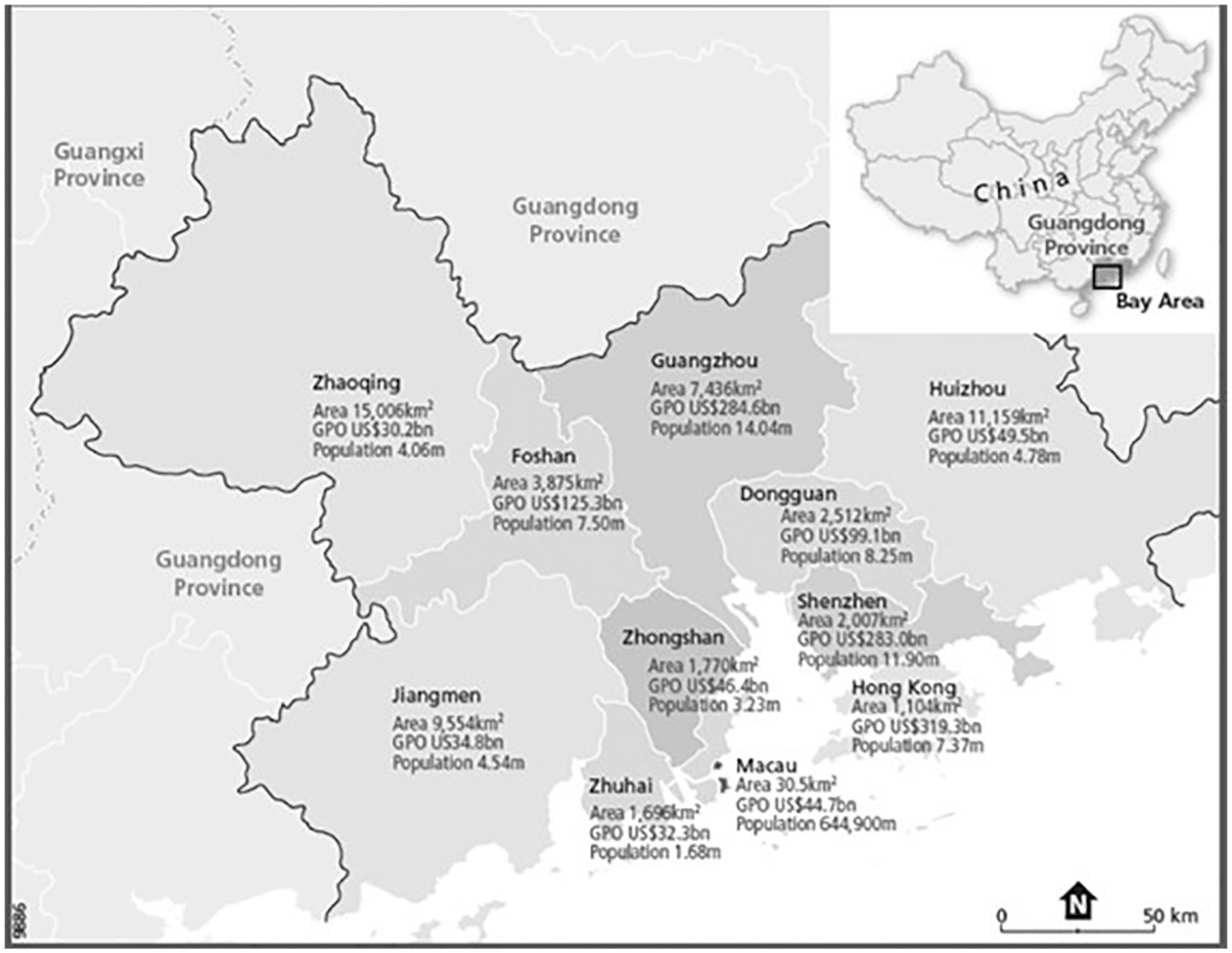
The Guangdong-Hong Kong-Macao Greater Bay Area.
Our paper illustrates some of these factors and takes a step further. We focus on the ways in which the Shenzhen-Hong Kong student – very young children – mobility field is related to the mobility industry within which it is couched. In particular, we focus on the distinctive spatialities and temporalities of the quotidian education that arises in this intra-yet-international transborder context. These particularities call also for renewed thinking regarding the education mobility industry as thus far analysed in the student mobility literature. In our case in point, young children cross multiple border control points daily and often journey for several hours without parental supervision. This spatial-temporal constellation has given rise to specific demands for products and services that are different from those offered for international students who travel long distances infrequently. In turn, the mobility industry engenders transformations of the urban spaces they are embedded in and which link on both sides of the border.
A main aim of the paper is to ‘place’ the education mobility industry under study. We do so by focusing on the materialities of the education mobility field as they take, but also make, place and space on the ground (see also Waters, 2017; Waters and Leung, 2020). Our paper gives substance to the spatial perspectives taken in extant scholarship. National-level processes have been given a central position in the study of international student mobility. There are reasons for such ‘methodological nationalism’ (Wimmer and Glick Schiller, 2003): as the movement is ‘international’, the role of country-level immigration and trade regulations deserves attention. Through this body of research, we have learned about, for instance, the motivations and experiences among Indian students going to the UK (Beech, 2018) or how Chinese and Vietnamese students are recruited to Japan (Liu-Farrer and Tran, 2019). Some scholars have gone beyond such national framings to illustrate local experiences. This line of work offers rich observations on cities, especially education hubs such as London (Findlay, 2011) or Taipei (Ma, 2014), as sites where international students live and study. A few studies have further provided more differentiated insights into the role of international student mobilities in transforming the destination cities where they study, in particular under the rubric of ‘studentification’. This body of research illustrates the emergence of residential developments, new (ethnic) economies of food, service and entertainment businesses that explicitly target international students, for instance, in the UK (Kinton et al., 2018), Australia (Collins, 2010; Holton and Mouat, 2021), South Korea (Collins, 2014) and China (He, 2015). Based on his research in Lisbon, Malet Calvo (2018) further maps out the broader impact of international students, as transnational urban consumers, in the broader urban processes such as the tourism industry, marginal gentrification or entrepreneurial creativity. The focus on international students as young consumers who live some months of each year of their study in their university town has, however, side-lined the experiences of other mobile student groups. The children in our study, for example, commute. The do not go out for dinners, party or travel around during semester breaks. Their daily commute makes a very different footprint on the urban landscape, through the articulation of a network of actors and institutions that manage their movements on both sides and through the border.
Our paper contributes, therefore, to further urbanising student mobility research. With a dialectic perspective, we map out the workings for the business network that emerges out of and co-produces the education mobility field. We define mobility industry based on Spaan and Hillmann’s (2013: 64) definition of ‘migration industry’ as the network of ‘public and private agencies and actors [that] provide information, products and services relating to, and thereby promoting, facilitating and organising the process of migration’. Shifting from a destination-city focused perspective, this paper examines the transurban education mobility industry that traverses Shenzhen and Hong Kong. We will also shed light on its intersections with other business networks (parallel trading) and mobility systems (‘birth tourism’). We attend to the border regions where the workings of the education mobility industry are most observable. The impact of this education mobility industry has, however, much broader, socio-spatial and political-economic repercussions in and across the two highly connected and yet divided cities.
Research context: The Shenzhen- Hong Kong urban region
Shenzhen and Hong Kong are major economic powerhouses in the Pearl River Delta, recently reframed in 2016–2017 as the ‘Guangdong-Hong Kong-Macao Greater Bay Area’ (Figure 1), a megalopolis that should become ever more integrated economically and physically through intensifying flows of people, capital, goods and services. 2 Being direct neighbours, Shenzhen and Hong Kong have always shared close socio-economic ties. Yet, their relationship and relative positions vis-à-vis each other and in the broader political economy have changed over time. Important historical junctures such as British colonial rule in Hong Kong, the establishment of the communist People’s Republic of China, the implementation of the Open Door Policy, the handover of Hong Kong’s sovereignty to China, the rise of China as the world’s factory and recently the new hub of technological development all account for the changing relations and positionalities, and in turn the flows traversing the two cities.
As represented in the official narrative, Shenzhen has transformed from ‘a backward agricultural county to a modern international mega city with full functionality’ (Shenzhen Government Online, 2020). Over the past four decades, Shenzhen’s built-up area expanded from 3.8 km 2 to more than 1000 km 2 . Its population has grown by as much as 40 times from 31,000 (1979) to 13.43 million (2019). As such, Shenzhen has evolved to be a major sub-provincial city in Guangdong Province. As an investment hub for a huge amount of domestic and foreign capital, Shenzhen has attracted vast numbers of workers and professionals working for companies and factories that produce electronics, pharmaceuticals, chemicals, textiles, building materials and processed foods. In recent years, Shenzhen has made huge strides in technology and innovation sectors and is considered the ‘Silicon Valley of China’.
With an earlier start in urban development compared with Shenzhen, Hong Kong has been an international financial, transportation, trade centre and aviation hub for a longer period and indeed served as a ‘door opener’ for Shenzhen, and China as a whole, in the beginning of the economic reform in the 1980s. With over 7.5 million residents in a 1104 km 2 territory, Hong Kong is one of the most densely populated places in the world (Hong Kong Government, Census and Statistics Department, 2020). Hong Kong grew into a major metropolitan region during British colonial rule (1842–1997). When the former British colony was returned to China in 1997, it was given a special status, namely as a Special Administrative Region. The return of sovereignty was arranged with the principle of ‘One Country, Two Systems’. Under this framework, Hong Kong was given semi-sovereignty for 50 years after the handover and guaranteed a high degree of autonomy, including retaining its capitalist system, independent judiciary and rule of law, free trade and freedom of speech. The peculiar and innovative legal construct required a clear boundary between the two territories, though within one country. This explains the continuation of the Shenzhen–Hong Kong border after 1997.
The border was drawn in 1898 when Britain was granted an additional 99 years of rule over the Hong Kong territory under the Second Convention of Peking. It is important to note that the Shenzhen–Hong Kong border has functioned in different ways in the course of time. Between 1898 and 1949, there was no border patrol at all. People and goods were free to move; families and communities led transborder lives. After the Communist Party came to power in 1949, migration from the Mainland to Hong Kong increased. In 1952, in an effort to combat illegal immigration and smuggling, the Hong Kong Government established the Frontier Closed Area and imposed immigration and customs control. Today, the border functions similarly to an international border under the One Country Two Systems principle. It is used to control flows of goods, services, capital and people. Immigration and customs regulations have, however, changed over time. Concerning human movements, the control is highly uneven. Mainlanders’ mobility to Hong Kong is much more restricted than vice versa.
Dissimilarities between the Mainland/Shenzhen and Hong Kong systems have motivated a huge amount of mobility of people, capital and goods across the border. The difference between the education systems in Mainland China and Hong Kong, and their respective links to the broader international educational system, have stimulated education mobility, and a related industry. At the higher education level, students move from Mainland China to Hong Kong and vice versa, because of the increasing number of highly competitive, high-ranking universities on both sides. Their mobility pattern predominantly follows the student mobility ‘prototype’, namely that is, longer distance (e.g. Hong Kong to Beijing) and infrequent travel. At the other end of the spectrum is the daily cross-border mobility among the young children and youth who live in Shenzhen and go to kindergarten or school in Hong Kong. Our paper offers an analysis of this latter group.
Around thirty thousand (27,000 as of May 2020, according to the Hong Kong Education Bureau) cross-border students (CBS) living on Mainland China cross the border between Shenzhen and Hong Kong for a ‘better education’ every day (The Standard, 2020). Being born in Hong Kong, these children are eligible for subsidised education in Hong Kong but not for public education in Shenzhen in spite of their residency there. While they come from a mix of socio-economic backgrounds, the majority of the CBS are from the middle or lower middle classes. Children engaged in cross-border schooling go through four control moments daily to exit Shenzhen and enter Hong Kong to get to school in the morning and then return home again in the afternoon. The majority of them commute through six land Boundary Control Points (Figure 2), which are located in Control Areas where access is highly restricted. The vast majority of CBS attend schools in the districts close to the border. Even though immigration control has been simplified by both governments with the use of dedicated e-channels and on-board clearance, it sometimes entails several hours – up to four hours for some children – of travelling daily (Figure 3). 3 This cumbersome way of getting a ‘better education’ brings about a transurban mobility industry that helps smooth the mundane journeys, especially for very young children. The mobility industry serves beyond moving the children physically, safely and efficiently through the cities. As a network it allows, in various degrees, these Mainland children to fit in and perform better in the Hong Kong education system (cf. Holloway and Kirby, 2020). As such, they promote the social mobility of these children, who are often seen as misfits (Chan and Kabir, 2014). As also shown later in our analysis, cross-border families are often denied cultural membership. Symbolic boundaries are strongly in place, delegitimising the perceived outsiders’ claims to socio-cultural citizenship, despite their legal status (Chiu and Choi, 2019). These contestations are a key marker of the educational and wider mobility field under study.
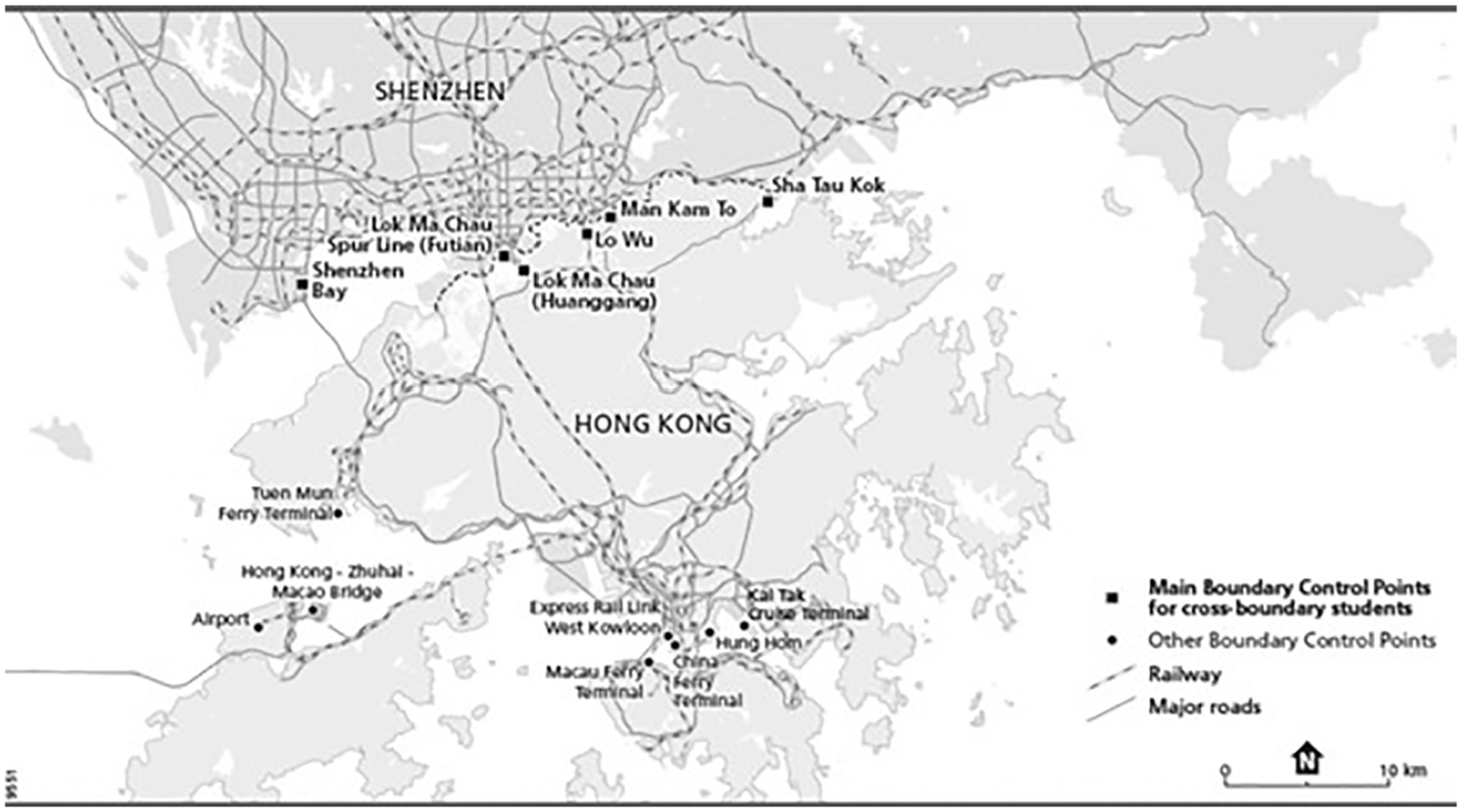
Map of the Shenzhen–Hong Kong boundary and ports.
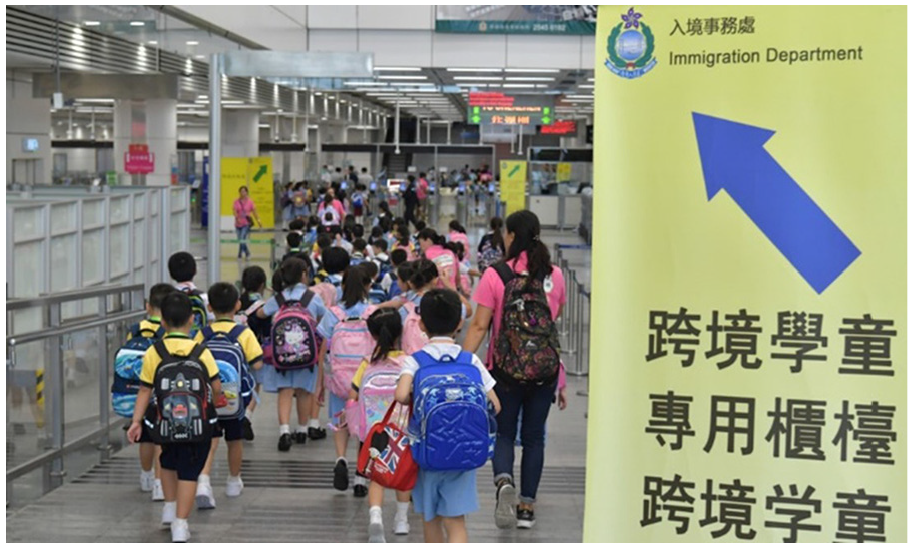
School children at border control point.
Methodology
Our analysis here is part of a broader qualitative research that examines parents’ motivations in sending their children to Hong Kong for school, and their experiences as parents of CBS. In addition, perspectives of teachers and social workers who have direct experiences working with these children were also collected. Physical fieldwork in Shenzhen, Hong Kong and at the border was conducted in 2018 and 2019, supplemented with follow-up interviews, and on-going policy and media analyses.
The core of our field data is derived from interviews and observation. Potential interviewees were approached through WeChat, the Chinese multi-purpose messaging, social media and mobile payment app (with the parents), and through personal contacts (with teachers and social workers). In total, we interviewed – in some cases with follow-ups – 12 families (17 mothers and fathers), a university student (early 20s) who had been crossing the border for school since he was a young child, a high-school teenager (16 years old) who had been engaged in cross-border schooling for around 10 years, two 6th-grade teenagers (12 years old) who had been commuting for six years, a grandfather of a CBS, a former school principal, five teachers, one school social worker, one government officer working at Shenzhen Customs and one staff member at a tutoring centre near one of the main border crossings. While most of the interviews were face-to-face, some of the conversations were conducted over WeChat or by phone. The interviews were conducted in Mandarin or Cantonese Chinese as our interviewees preferred. A small number of interviews were conducted in English. We conducted the interviews in public places such as restaurants or coffee shops, but also at the home of two interviewees. Our research assistant was invited to accompany one of the families on the journey from the port to their home together with their children. In addition to observation at the border crossings, we also followed along the school journeys and visited related social service centres.
We conducted an in-depth content analysis of relevant policies, news and social media coverage on the phenomenon. In addition, we followed the discussion on two WeChat groups dedicated to cross-border families. One of the groups was founded by a social service organisation Shenzhen-Hong Kong Family Service and the other one was initiated by a parent. Each of the groups had around 400 members at the time we conducted our research. The online groups were very useful for gaining insights into parents’ perceptions, concerns and experiences. Our analysis of the mobility industry here draws also on a broad internet search for advertisements of and reference to service providers (e.g. on school websites, CBS family forums) and other media coverage of these businesses and services (e.g. in news and documentaries).
The researchers are differently ‘positioned’ as insider/outsider in relation to the interviewees and the ‘research field’. One of us was born in Hong Kong, with Hong Kong permanent residency, the other is British. In addition, we were assisted by two researchers, one of whom was born in Mainland China and the other born and living in Hong Kong. All of us are familiar with the Hong Kong education system.
Mapping the Shenzhen-Hong Kong education mobility industry
Before we focus on the cross-border education mobility industry, it is important to note that it does not exist in isolation. Let us illustrate with two examples here. First, most of the CBS were born in Hong Kong, through which they are entitled to the right of abode in Hong Kong, and in turn the opportunity to access Hong Kong’s education provision and other social services. A vibrant mobility industry is at work linking service providers on both sides of the border to facilitate such ‘birth tourism’. This mobility industry consists of hospitals, agencies, care centres and individual care-givers, residential rental, car and chauffeur hire service and caterers, among others. Beyond serving the clients, these individuals and institutions in the mobility network also inspire and facilitate Mainland mothers to give birth in Hong Kong. Previous research has concluded that better education is one of the most important reasons for Mainland parents to give birth to their children in Hong Kong. In concrete terms, parents consider the much wider use of the English language, less rote learning, better trained and kinder teachers and more international orientation as the desired qualities offered by education in Hong Kong (Chan and Kabir, 2014; Chiu and Choi, 2019; Leung, 2012; Yuen, 2011). The birth tourism industry therefore produces future clients for the education mobility industry as we will examine. In the longer term, some parents acquire a Hong Kong passport for their children in order to gain the ease of global mobility it promises. With that, their children can more conveniently pursue an international higher education abroad (Chan and Kabir, 2014; Chan and Ngan, 2018; Chen and Nai, 2012; Huang, 2016). As such, the higher education mobility industry is also connected, in a sequential manner, to the one we focus on in this paper.
We now turn to illustrating the nature and working of the mobility industry that facilitates cross-border schooling. We do so by integrating our interviews, careful study of school websites, business advertisements, parent chatrooms as well relevant media reports. We describe the role of the key players, namely the schools, school buses, carers who escort the children on their school journeys, tutoring centres, day–care and boarding houses and related social service organisations. In the following, we will show how these individuals and institutions make a mark on the urban landscape, in intersecting ways. We chart how the network, as a whole, stimulates and regulates the movement of young children, their parents and service-providers, and non-human flows such as ideas, practices and materialities in this mobility field.
For what they see as a ‘better education’, parents send their children to
Having a reliable transport infrastructure is key for these schools to attract CBS. Logically, schools with higher CBS enrolment work in close partnership with
An essential service offered by most school buses is supervision by ‘
Nannies play a particularly important role in the CBS context because journeys across the border are much more complex than ordinary get-on-get-off school journeys. During our field observation at the border, we saw dozens of nannies wearing distinctive coloured tops as uniforms that the children can recognise quickly, herding young children up and down stairways, through doorways and barriers, and on and off buses (Figure 4). The fact that traffic flows in opposite directions in Hong Kong vis-à-vis Mainland China already imposes the need for extra care for (very) young children. Parents rely on the nannies to take care of their children, or keep them under control on the journeys. LSC,
4
a CBS mother with two daughters, told us about her ambivalent sentiments towards the nannies: There are one to two Ah Yee on each bus. They train the kids to be very obedient. They follow rules. They must sit there, remain sitting, put on the safety belt. Yes, my daughter behaves well. Ah Yee will also give her something as a reward. This one is quite good. But there are some really fierce ones. Actually, I can understand, especially when the kids are naughty, and there are so many of them. These Ah Yee have to mind so many kids. But still, of course, if we, as parents, see these Ah Yee treat the children this way, we would be very sad. But, there is no choice. Otherwise, they cannot keep them under control. They need to keep them under control.
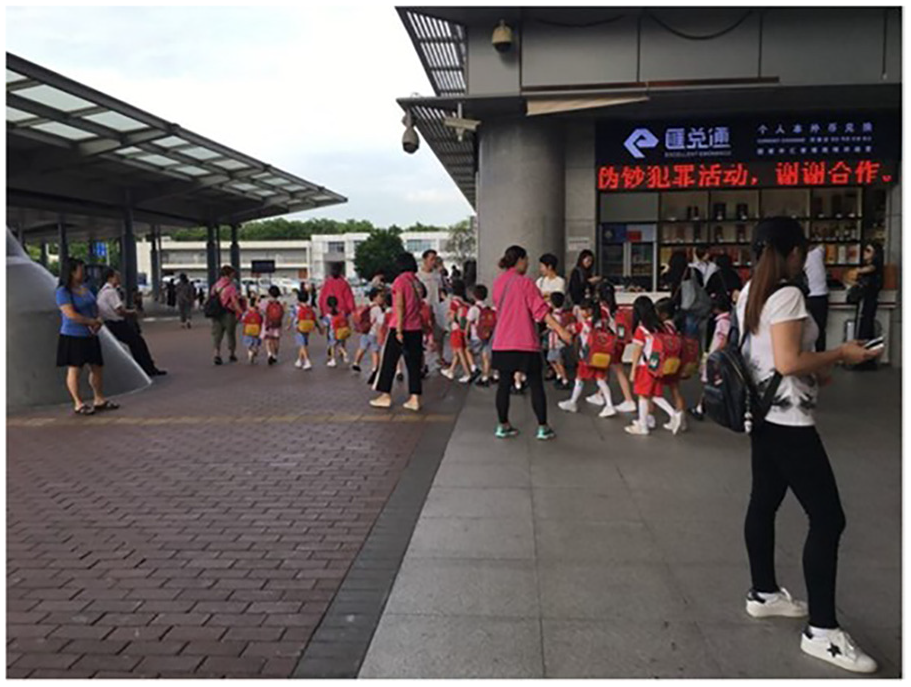
Nannies, in pink tops, at work herding CBS to board the school bus on the Shenzhen side of the border.
In keeping the school children moving (or not) in order, in accordance with the transport and safety rules on both sides of the border, bus drivers and nannies actively produce the urban landscape. They identify and regulate, in detail and with heavy responsibilities, where, when and for how long children should be in the midst of the varied and changing urban hustle-and-bustle – considering the different traffic directions, regulations and social rules, cultures, etc. – on both sides of the border and through the border. Being a nanny is demanding. Their work often starts as early as 6am to escort the first group across the boundary to school. Many of them repeat their journeys both in the morning and in the afternoon. Bearing the responsibility for dozens to hundreds of young children – many nannies escort several rounds of children every morning and afternoon, they have to be very alert and vigilant. Under extreme weather conditions such as high summer temperatures, heavy rain or a typhoon, the challenge of bringing these children to school and home in ‘good shape’ intensifies.
Before the advent of convenient communication tools such as WeChat and the common practice of children having their own mobile phones or GPS-equipped watches, nannies were also expected to serve as go-betweens linking the parents and the children, and also the parents and the schools. In a media interview, a successful entrepreneur recalled the extra functions of the nannies as information portals. Huang Qinghong, now in her mid-50s, started off escorting her own child after quitting her teaching job, became a nanny and the owner of a big business. She is now the boss of over 200 employees, operating 50 school buses, serving over 80 schools and 2000 CBS. She recalled that before it was common for school children to have their own phones, she once managed three mobile phones at the same time and was called over a hundred times daily by parents who needed information from the school, wanted to get in touch with their children or had complaints about the conduct of their children’s peers (Tang, 2017). Hence, nannies are not only escorts, they are also considered bridges and translators between the two societies that operate with their own rules and cultures.
Some nannies are networked with
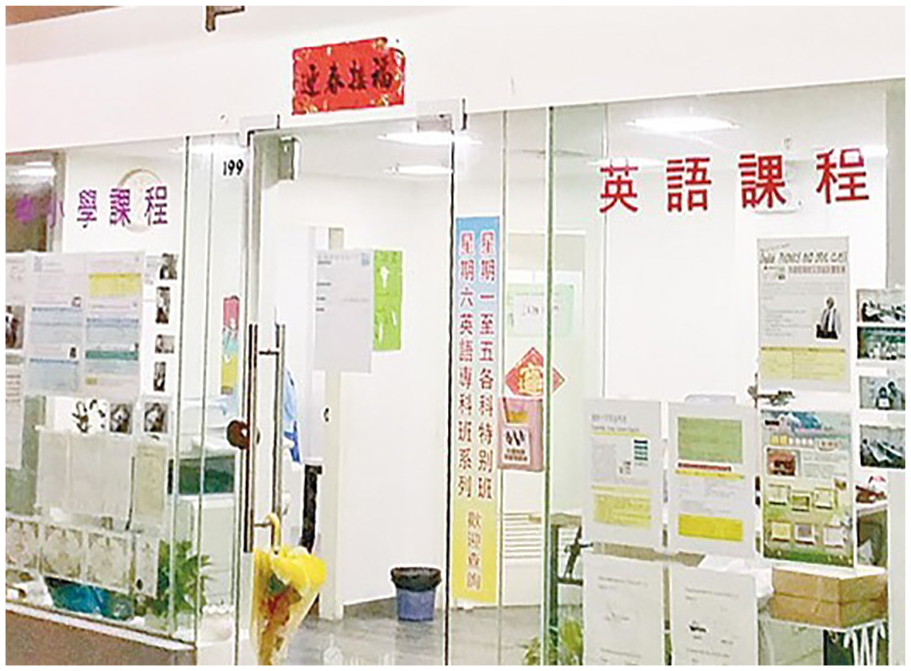
A ‘Hong Kong style’ tutoring centre in Shenzhen.
Some
Most CBS commute daily from home to school and back. Yet, a small portion of these children are in need of additional care in Hong Kong because their parents are less available to mind their children in the afternoon. Some parents opt to let their children stay in a
Last but not least,
Links to cross-border trade networks
We began the previous section pointing to the links of this education mobility industry with the ‘birth tourism’ and higher education mobility industry. It is also relevant to draw the connection between the business network discussed above to other vibrant webs of business traversing the border. Some school bus drivers, nannies and parents are known also to work as parallel traders. They purchase supplies in Hong Kong, which does not charge a goods and services tax, and take them across the border to Mainland China in small quantities to avoid paying import duties. Milk formula, cosmetics and personal care products such as shampoo or toothpaste of particular brands, red wine and other foodstuff, mobile phones (expensive, high-end ones), external hard drives and other small electronic items are well sought after items. Even though one can get practically any such consumer products in Mainland China, there is still a concern about counterfeit goods and differences in the safety and other standards of the products sold on the Mainland. This expanding volume of parallel trading in recent years has made big changes to the urban landscape in the northern districts, especially in areas close to the train and bus stations. Numerous pharmacies, cosmetics shops, money exchanges, temporary storage spaces for traders and jewellery shops have opened up in the former ‘sleepy’ local shopping neighbourhoods. Their ability to pay much higher rent has pushed out other local businesses such as hair salons, stationery shops and small grocery stores. The demand for such ‘Hong Kong quality’ products from traders was at times so high in Hong Kong that shelves were emptied (Figure 6). 7
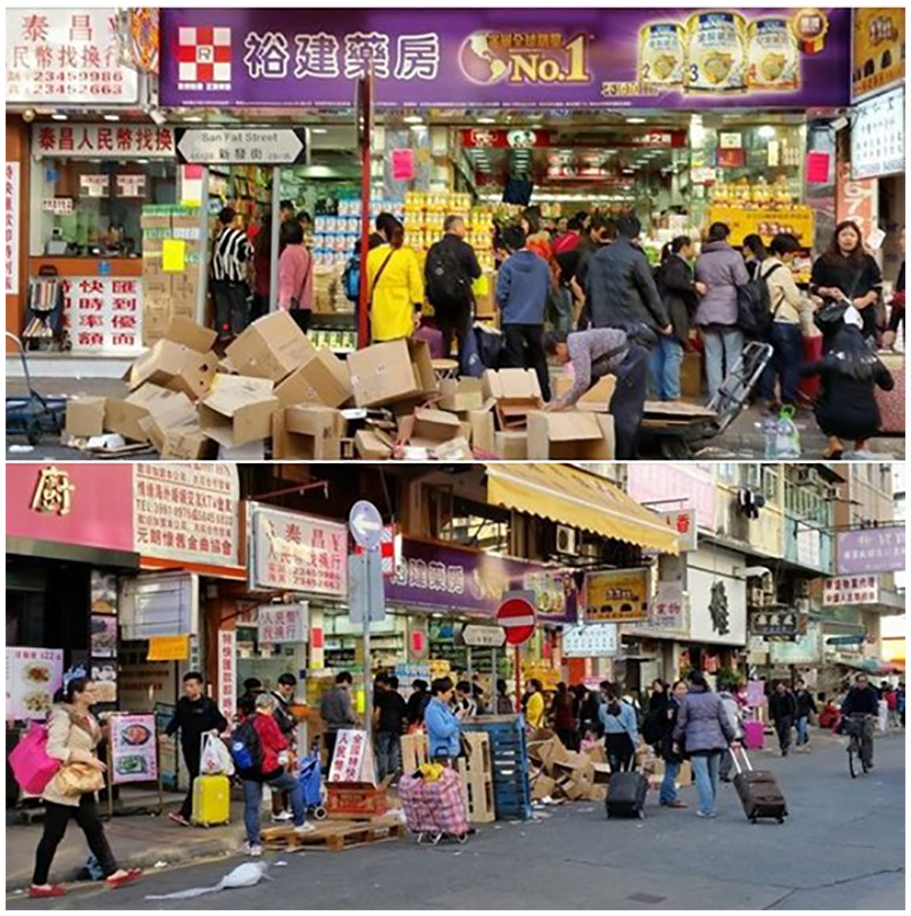
A common street scene in Sheung Shui district, showing many traders in front of a pharmacy.
Feeling that their daily life is being disturbed, people have held street protests over the mass purchase of these goods causing shortage of supply to meet local demands, the associated increased congestion and waste disposal disorder on the streets, transport system and other infrastructure, as well as inflation in rent and other prices (Figure 7). Reacting to that, the Hong Kong government set a limit to the amount of milk powder, arguably the most politicised item, that could be carried across the border in 2013. In spite of the customs rules and more regular customs checks, parallel trading has persisted. For instance, in Sheung Shui, one of the northern districts, 462 related shops including pharmacies and money exchange shops that mostly served visitors from the Mainland were tallied in 2019, while 142 such shops were in business in 2013 (Creery, 2019).
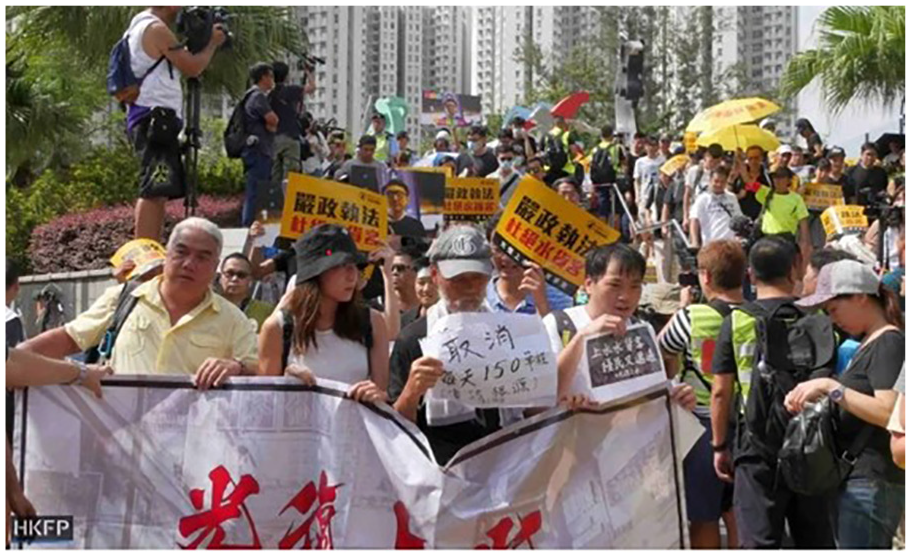
Street protests against, among other things, the impact of parallel trading in Sheung Shui in Hong Kong northern district.
A few of the parents we have interviewed also engaged in parallel trading, either as the main income-earning activities or as a side job when they escorted their children across the border daily. SY, mother of two young CBS, and her husband started their work as traders also as a way to deal with the otherwise even more draining cross-border schooling. She told us about her cross-border life routine: My husband sends my son to kindergarten in Hong Kong, then he starts shopping. My husband and I don’t have a normal job; we both do parallel trading. In the afternoon, around 4pm, my husband picks up my son from the kindergarten. I wait for them at the border at around 5:30pm, then we go home together happily. Every day is the same. We also have some pressure. But our advantage is that we do parallel trading and have more free, flexible time. Many couples need to go to work. They are very tired.
The occasionally discovered cases of such smuggling activities conducted by CBS parents, nannies or bus drivers have been heavily condemned in the Mainland, especially when they involved young children in the transport of smuggled goods (e.g. Wenweipo, 2013). While the involvement among CBS families in parallel trade is only a small part of the much bigger issue, they are being drawn deep into the ‘social disturbances’ discourse. These socio-political entanglements account for the social distances between CBS families and their counterparts. As we have illustrated in another paper (Leung, Waters and Qin, 2019), classrooms, school grounds, spaces outside the schools, border control areas, transport spaces, shopping spaces, etc. all are micro-level spaces where identities and differences are (re)produced and negotiated, and in/exclusion are played out. In a mutually constitutive way, these spaces shape the social relations of the mobility field.
Discussion and conclusions
As illustrated above, the Shenzhen-Hong Kong education mobility industry is a transurban (business) network that produces and serves parents’ desire for a ‘better education’ for their children. The mobility industry is a vibrant business network, providing jobs for many people. It smooths the cumbersome paths that children have to travel between home and school and helps them to fit better into the Hong Kong education system. Despite being in one country, the border between the cities of Shenzhen and Hong Kong marks not only the separation but also the dynamic links between two societies that are characterised by different political, economic and socio-cultural systems. The various players in the mobility industry connect and constitute the two cities spatially, socially and discursively. As such, the cross-border education mobility industry, in interaction with other mobility systems (such as trade, tourism, etc.), is shaped by and constitutes the political, economic and cultural geographies of the cities.
In contrast to the education mobility industries covered in extant literature, our analysis does not focus only on the ‘origin’ or ‘destination’ city. Rather it follows the mobility flows that transcend both cities and the border. The border, in our case, is not a line that divides the two cities, but is also a dynamic space where various mobility industries are the most observable. As such, we do not only challenge the common practice of methodological nationalism in the study of migration and mobility, we take a step further to unpack ‘the city’. For our case of cross-border schooling among young children, the border region deserves particular attention. We have shown how the border and the spaces extending from it are not just the urban periphery or a simple reflection of ‘the city’. On the contrary, it is a highly dynamic space where mobility industries are most active on the ground. Happenings in the borderland have repercussions beyond the area, reaching into and beyond the cities on its two sides. Our case illustrates and reflects on the role of mobility industries in the making of the political-economic and socio-cultural spaces along the Shenzhen–Hong Kong borderland, which constantly connects, divides and redefines the two cities and regions it bridges.
Through mapping out the cross-border education mobility industry, we visualise how various players involved, not to mention the CBS themselves, have reconstituted the urban landscape in Hong Kong and Shenzhen. Following a seasonal (academic year) and daily rhythm, young and older students, their service providers, materials ranging from English textbooks, traded goods, money (different currencies, adding more dynamics to trading activities), advertisements and other imageries are moved across the busy border, at varied speed, taking places and (re)making them. Intangibles such as aspiration, values, meanings, cultures and practices also move across alongside the tangibles in motion. Different kinds of mobilities and the desire to move more quickly, or move less, are being created and redefined as business opportunities.
The mobility industry we have mapped out serves beyond mobilising the children spatially. The broad array of (commercialised) service supports the Mainland children to fit in and perform better in the Hong Kong education system. Our findings speak to Holloway and Kirby’s (2020) plea for attention to the progressive possibilities of neoliberalisation in education for social mobility and social reproduction of the excluded, however limited the impact might be in the broader educational landscape that is shaped by enduring regimes of power.
The future of this mobility industry is uncertain. At the time when this paper was finalised, Hong Kong had faced immense socio-political and public health challenges. In different ways, the pro-democracy social movements and the COVID-19 pandemic have given new meanings to and affected the practices of the cross-border schooling. Being worried about the intensification of prejudice against Mainlanders and the chance that their children will learn to be ‘too critical’, the intention of some CBS parents to bring their children back to the Mainland for school has been heard and confirmed by one of our school teacher interviewees in a follow-up conversation. On the other hand, the government’s increasingly forceful control of speech and expression in Hong Kong might discourage parents, who send their children to Hong Kong schools for more critical and independent thinking. Time will tell about the impact of the political challenges in Hong Kong. For the majority of the CBS parents, however, the quality of Hong Kong education that they look for continues to be the non-political elements, for example, English language, less rote learning, better trained and kinder teachers and a more international perspective as our interviewees have indicated. As such, the demand for a mobility industry will remain for some time to come. Yet, the kinds of service and players involved will change as businesses adapt to, and co-produce, new needs and desires of parents and students. These business networks will in turn make new footprints on the urban landscapes they traverse.
While the impact of the democracy movement is yet to be seen, the pandemic impacted immediately. As was the case worldwide, schools were closed for a period of time when the pandemic flared up in Hong Kong. Home schooling and online education were put in place quickly. Yet some websites necessary for the classes cannot be accessed on the Mainland due to state censorship, jeopardising students’ learning opportunities. This was a particularly serious problem for senior students who needed to prepare for or take part in public exams. When school resumed at the end of May 2020, the quarantine rule had made going to school impossible for CBS. Two weeks later, the Hong Kong authorities recognised the problems and reached an agreement with their Shenzhen counterparts to arrange for CBS in more advanced classes to cross the border without having to go through quarantine. The increase in COVID cases after the relaxation of the border, which was extended not only to students but much more broadly to a series of, also non-regular, border-crossers, has aroused much grievance in Hong Kong. 8 Social service providers have shown concern that CBS could suffer from stigmatisation (Chan, 2020). More broadly, as human mobility is assigned new meanings while societies around the world find ways to grapple with the pandemic, cross-border schooling, as a global phenomenon, and its surrounding mobility industry are also bound to change.
Footnotes
Acknowledgements
We would like to thank Yunyun Qin and Yutin Ki for their support. We are grateful for the support of all our interviewees who took part in this project willingly. We also thank the guest editors and anonymous referees for their insightful comments on earlier drafts of this paper.
Declaration of conflicting interests
The author(s) declared no potential conflicts of interest with respect to the research, authorship, and/or publication of this article.
Funding
The author(s) disclosed receipt of the following financial support for the research, authorship, and/or publication of this article: This research was funded by University of Oxford (Fell Fund) and Utrecht University (Department of Human Geography and Spatial Planning – Strategic Research Fund).

Notes
References

 .
.  . Available at: https://orientaldaily.on.cc/cnt/news/20140704/00176_097.html (
 ’
’ . Available at: http://paper.wenweipo.com/2013/09/13/HK1309130023.htm (