




Abstract
Putting research on the socio-political effects of Kenya’s new Standard Gauge Railway in conversation with geographically and anthropologically grounded scholarship on infrastructure, the article analyses how megaprojects, in spite of state spectacles of infrastructure-qua-development, are embroiled in multiple modalities of ruination. It specifically highlights how mega-infrastructures disrupt ecologies of social reproduction: the new railway disorders people’s mobility patterns and their access to essential infrastructures, as well as decouples their labour from transport systems and informal road economies central to self-sustainment. The article conceptualises these intersections between infrastructure’s spectacle and ruination as disquieting ambivalence of infrastructure. Shifting from spectacle to ruination – rather than oscillating between the two – this ambivalence is not one of uncertainty, malleability, or open-ended futures that are analysed in recent strands of critical scholarship on infrastructure, in which material devastation is often bracketed due to this literature’s predominant focus on multiple temporalities of infrastructure as heterogeneous possibilities of reconfiguration. The article, instead, shows that this ambivalence of infrastructure is disquieting – fraught with precarity, struggle, and despair, as the lives of those in shadows of mega-infrastructures need to be rebuilt within the ruins of the here and now, and of infrastructure’s spectacle.
Keywords
Introduction
Following the “infrastructural turn” in humanities and social sciences, infrastructure has received exponentially increasing theoretical reflection. Understood as constantly ranking, connecting, and segmenting people, objects, and landscapes (Graham and Marvin, 2001), infrastructure has been analysed as inscribing specific orders into space and onto society. On the one hand, a mediating role of infrastructure in aligning physical networks, socio-economic systems, and commodification processes has been conceptualised as determining socio-material configurations of capital across multiple scales: the globe, geopolitical regions, nation-states, cities, and their hinterlands, particularly through urban infrastructures (Kanai and Schindler, 2019; Rao, 2015; Wiig and Silver, 2019). On the other hand, infrastructure has been theorised as fundamentally entangled with modalities of governance, articulating relations between states and their populations (Fredericks, 2018; Lemanski, 2019; Lesutis, 2022b, 2022c; Von Schnitzler, 2018). As Larkin (2013) observes, the “peculiar ontology” of infrastructures “lies in the fact that they are things and also the relation between things” (p. 329): infrastructures are objects that create the grounds on which other objects and bodies operate, and, when they do so, they also function as material, social, and political relations.
Acknowledging this relationality, geographically and anthropologically grounded scholarship has analysed infrastructures “as prime arenas for observing the unfolding of the urban social contract” (Chaflin, 2017: 665) that takes unruly, malleable, and mobile forms (Anand, 2017; Larkin, 2013; Von Schnitzler, 2016). This is particularly so in contexts where, due to the lack of state-provided public services, city residents themselves have to contingently reproduce and sustain urban life. Foregrounding how disadvantaged populations, circumventing unfavourable structural conditions, create access to essential public services, different authors have theorised infrastructures as incremental (Silver, 2014), lively (Amin, 2014), labour- (Fredericks, 2018) and citizen-making (Lemanski, 2019), or peopled and lived (Chaflin, 2017; Graham and McFarlane, 2014). Following these theoretical iterations of mercurial infrastructural relationalities – thus accounting for heterogeneous lifeworlds producing, and produced by, infrastructures (Lawhon et al., 2018) – another recent strand of scholarship has foregrounded multiple temporalities and open-ended futures inscribed in, and unfolding through, infrastructures and their promises (e.g., Anand et al., 2018; Gupta, 2018; Harvey, 2018; Larkin, 2008).
This article is an attempt to write against the grain of this dominant discourse on infrastructure as a heterogeneous possibility of reconfiguration, or as changing, malleable, and unpredictable futures. Whilst this literature productively foregrounds “the force of infrastructural promise as a complex and unstable temporal alignment” (Harvey, 2018: 82), my wager is that such focus on mercurial temporalities, uncertainties, and malleabilities does not thoroughly acknowledge and conceptualise the ruinous present and materiality of infrastructure, already knowable and tangible. Theoretically, I address this by focusing on mega-infrastructures as unfolding through an interplay between spectacle and ruination, thus rendering infrastructure a simulacrum of “development” or “progress”, 1 immediately undone by its devastating materiality.
On the one hand, infrastructure indeed functions as “both a visual spectacle and a political ritual” (Larkin, 2008: 19): it possesses an inherent capacity to generate powerful effects of social promise, sublime and enchanting, or not-yet-achieved propitious futures (see Anand et al., 2018; Harvey and Knox, 2012, 2015; Larkin, 2013). This semiotics of infrastructure is glaringly vivid in the postcolony, in which political power relies on theatrical expressions of authority in a public sphere where state leadership stages itself through a spectacle (Mbembe, 2001). In the postcolony, presidential grandiosity, pompous national holiday celebrations, or other forms of political authority and coercive ceremonialism are ostentatiously performed as the ruler’s “magnificence and desire to shine” (p. 131). As Mbembe (1992) put it, spectacle-like public ceremonies are key to postcolonial “aesthetics and stylistics of power” (p. 9): they are “the vehicles, par excellence, for giving expression to the commandement 2 and for staging its displays of magnificence and prodigality” (p. 7, emphasis in the original).
On the other hand, whilst a spectacle of political power constitutes an essential part of “the edifice of postcolonial dramaturgy” (Mbembe, 1991: 20–21), spatial morphologies of the postcolony also engender, and depend on, different modalities of violence (see Lesutis, 2022a). For Stoler (2013), this confluence of violences manifests through ruination – painful-to-endure aftermaths of an imperial assault “in the corroded hollows of landscapes, in the gutted infrastructures of segregated cityspaces, and in the microecologies of matter and mind” (pp. 9–10). Stoler (2013) specifically foregrounds ongoing, inextinguishable logics of colonialism, unevenly sedimented in material and psychic landscapes of social life. Building on this, in this article I approach infrastructural ruination more broadly – not distinctively as expressions of empire but as infrastructure-based advancement of power that, inscribing linear developmental time of “progress” into spaces of everyday life, results in their material devastation. This ruination, therefore, does not necessarily encompass preceding forms of empire now decomposed and compounded as ruins (Stoler, 2013) or rubble (Gordillo, 2014), nor is it instances of incomplete infrastructure projects breaking apart as “the ruins of the [promised] future” (Gupta, 2018: 69). Instead, infrastructural ruination is a devastating “afterlife” (Benjamin, 1999: 460) of the here and now – completed, functioning megaprojects as material expressions of a return to “high modernism” (Dye, 2016) within contemporary development theory and practice.
Such modalities of infrastructural ruination, for instance, were immediately visible in the grandiose dam projects of the mid-20th century that dispossessed vulnerable populations within postcolonial articulations of nation-making (Tischler, 2013), thereby engendering “very real ecological, economic, and social trauma” (Isaacman and Isaacman, 2013: 4). Corporeal, symbolic, or structural modes of harm and injury sustained through infrastructure development (see Lesutis, 2022a) have been explicitly foregrounded in the literature on infrastructural violence that shows how urban infrastructures enunciate specific configurations of power that subject the vulnerable to marginalisation, abjection, and disconnection (e.g., Nixon, 2011; Rodgers and O’Neill, 2012). Infrastructural spectacle and ruination – as a conceptual armature foregrounding an interplay between politically-charged symbolic forms of mega-infrastructures and their injurious afterlives – is a specific iteration of infrastructural violence where tangible, material forms of devastation as aftermaths of grandiose projects are contingently masked by their spectacular representations. This intersection of infrastructural spectacle and ruination unfolds as disquieting ambivalence of mega-infrastructures. Whilst the social subject does not embrace the simulacrum of infrastructure-qua-development, this spectacle is, at times, sustained and reproduced by different subject groups, especially those directly embedded within nepotistic patronage networks of state power. However, for the marginalised, infrastructure-qua-development continues to manifest, and is experienced, as the ruination of (already highly) precarious spaces of everyday life that need to be reconfigured within pernicious materialities of megaprojects. Therefore, to these groups, the ambivalent force of infrastructure – shifting from spectacle to ruination, rather than oscillating between the two – is more unsettling and disquieting than generating promises of open, malleable futures. In other words, a new, shining infrastructure project might be a persistently deferred hope for “development”, but the here and now is undeniably in ruins.
This theorisation of infrastructural spectacle and ruination highlights the devastating present and materiality of infrastructure that are often bracketed in the aforementioned scholarship on unruly, unpredictable, enchanting promises and temporalities of infrastructure (e.g., Harvey and Knox, 2012, 2015; Larkin, 2008). For instance, Larkin (2008) writes that infrastructure simulates “emotions of hope, nostalgia and desire, frustration and anger that constitute promise (and its failure) as emotive and political force” (p. 176, my emphasis). Foregrounding openness and malleability, Harvey and Knox (2012) argue that state-led infrastructures “manage to hold competing and often quite divergent hopes and expectations together to produce a generalized sense of social good to which the majority of people subscribe” (p. 522). It is indeed a promise of infrastructure that dominates recent scholarship (e.g., Anand et al., 2018), where this promise is seen as “unruly and expansive”, resting “on the open possibility of that which has yet to happen” (Harvey, 2018: 99). In contrast, my focus on infrastructure as spectacle and ruination highlights what has already happened and what is already tangible. Whilst infrastructure might imply deferral, waiting, or unknowability (e.g., Harvey, 2018; Harvey and Knox, 2015; Larkin, 2008), infrastructural ruination is visible and knowable. It is the now that is in ruins and the promise of infrastructure does not hold: it proves to be nothing else but an ostentatious spectacle of state power that masks how infrastructures manifest as “intimacies of containment, premature death, and division” (Cowen, 2020: 483). Therefore, it is onto spatial layers of infrastructural ruination that lives need to be precariously rebuilt. But this sublime, enchanting poetics of infrastructure (Anand et al., 2018; Harvey and Knox, 2015; Larkin, 2008, 2013) is a different aspect of the story about mega-infrastructure developments (e.g., Mains, 2019). The article, instead, foregrounds the disquieting ambivalence of megaprojects that manifests as ruinous materialities of infrastructure – tangible, and yet, at times and only contingently, masked by infrastructure’s spectacle.
Empirically, the article focuses on the construction of Kenya’s Standard Gauge Railway (SGR), a flagship project of its national development programme “Vision 2030”. Centred on several megaprojects, this programme is supposed to industrialise Kenya, overcome its aid dependencies, and achieve a “middle-income status” in less than two decades (Enns, 2017). Funded with loans from the Exim Bank of China, the SGR project construction commenced in 2014. The new railway – Phase I completed in June 2017 – now connects the port of Mombasa with the capital city of Nairobi. The Phase IIA, concluded in October 2019, stretches the new railroad 120 kilometres further north-west of Nairobi. 3 Analysing everyday experiences of the SGR infrastructures, the article foregrounds how this megaproject, in spite of functioning as an (unstable) spectacle of “development”, disorders ecologies of social reproduction where life is sustained daily. As heterogeneity of these ecologies cannot be comprehensively examined in one article, I hereby focus on their two aspects – patterns of mobility and labour – in order to highlight different modalities of ruination implicated in, and engendered by, the SGR project. On the one hand, the railway disrupts people’s movement across the landscapes that it traverses, as well as impedes access to essential infrastructures that this movement enables. On the other hand, the new railway decouples the labour of local populations from transport systems and informal road economies that had been essential to social reproduction strategies before the SGR arrival. This demonstrates that ruination is central in how mega-infrastructures mould topographies of everyday life. Infrastructure, therefore, unfolds as disquieting ambivalence that is constituted through a state spectacle of “development”, rendered futile and empty by disavowing intimacies of ruination that mega-infrastructure developments engender.
The article is based on five months of fieldwork research – open-ended interviews, participant observations, and informal conversations – undertaken over four different time periods between November 2018 and January 2020, across multiple sites, including provincial government and Kenya Railways offices, railway stations, construction sites, and the SGR contractor compounds, population settlements around railway infrastructures, in urban, peri-urban, and rural areas, and onboard train, as well as with civil society groups in Kenya. Therefore, rather than focusing on one specific site, the research was carried alongside the 472 kilometres of the railway line that connects the two main SGR terminals in Nairobi and Mombasa (SGR I), as well as 120 kilometres from Nairobi to Naivasha (SGR IIA). The article, however, does not attempt to ethnographically represent diverse lifeworlds of these heterogenous landscapes. Instead, it foregrounds a shared pattern of ruination that, in spite of infrastructure’s spectacle of “development”, has unfolded along the railway line after the SGR construction. This is intended to provide a critical reflection on politics of mega-infrastructures in Kenya and beyond.
The article is structured as follows. First, I discuss how, in spite of ongoing contestations, the SGR, as a state spectacle that aesthetically dramatises its power, contingently inscribes a singular notion of infrastructure-qua-development. Second, I analyse how this infrastructure and its spectacle intersect with Kenya’s landscapes, disrupting people’s mobility patterns and their access to essential infrastructures that this mobility enables. Third, I focus on how the new railway disorders ecologies of social reproduction by decoupling the labour of local populations from pre-existing transport systems and road economies. In the concluding section, I reflect on the article’s main contributions to critical scholarship on infrastructure, as well as gesture at potentialities of emancipatory politics implied in, or foreclosed by, infrastructure.
The SGR as spectacle
Since the end of the 19th century, railway developments played a key role in the state-making processes across East Africa (Mann, 1984). As in other colonies of the British Empire (Cowen, 2020; Goswami, 2004), in Kenya transport infrastructures were tied into extractivist projects of colonial control (Kimari and Ernstson, 2020; Lesutis, 2021). During the Scramble for Africa that followed the Berlin Conference, the British East Africa Company sought to establish its dominance, investing heavily in the development of regional transport infrastructures. The construction of the Uganda Railway commenced in the port city of Mombasa in British East Africa in 1896, and in 1901 the railway reached Kisumu on the eastern shore of Lake Victoria. The new railroad was of strategic importance to the British Protectorate: with access to Uganda, the British could transport soldiers and military machinery to ensure their domination of the Great Lakes region (Ogonda and Onyango, 2002). However, in spite of these attempts of colonial subjugation, the British Empire started to crumble by the mid-20th century, and Kenya declared national independence in 1963.
Following Kenya’s separation from the British Empire, after a number of mergers and splits the Uganda Railway was divided into two lines to be managed by Kenya Railways and Uganda Railways Corporations. Since then, due to ongoing operational and management challenges, Kenya’s railway line deteriorated. In spite of the wave of privatisation that followed Structural Adjustment in the late 1980 s, Kenya Railways was not privatised until 2006. The concession by a consortium Rift Valley Railways, however, did not improve the rail transport performance (Republic of Kenya, 2009: 24): operational challenges continued, with the trip from Mombasa to Nairobi often taking as long as 24 hours. These dynamics demonstrated Kenya’s ongoing struggle for “development”, regional imbalances, and its untapped potential to function as a strategic transport link between East Africa and Asian commodity markets connected through the Indian Ocean. It is this context of uneven development that the current national focus on transport mega-infrastructures in Kenya is supposed to change (Lesutis, 2020). For instance, the national development programme, “Vision 2030”, “aspires for a country firmly interconnected through a network of roads, railways, ports, airports, water and sanitation facilities, and telecommunications. By 2030, it will become impossible to refer to any region of our country as ‘remote’” (Republic of Kenya, 2007: 6). Furthermore, under the East African Railway Master Plan (CPCS, 2009), Kenya’s SGR is supposed to be linked with other SGRs to be built across East Africa, thereby completing the regional railway master plan that is expected to bring prosperity to the region (see Lesutis, 2021).
Primarily focused on enhanced trade and connectivity, the SGR development is a state attempt to enchant: according to Harvey and Knox (2012), in spite of competing interests, grandiose transport infrastructures – even if failing to deliver what had been promised – produce “a generalized sense of social good to which the majority of people subscribe” (p. 522). In the context of East Africa, Mains (2019), focusing on megaprojects in Ethiopia, similarly concludes that the infrastructural state aims to secure legitimacy through imaginaries of “progress” and “modernity”. This attempt to enchant through infrastructure has also been prominent in Kenya. The completion of the SGR project Phase I – officially called the Madaraka Express – was celebrated on 1 June 2017, a Kenyan national holiday popularly known as Madaraka Day. With madaraka in Kiswahili meaning freedom or independence, this holiday commemorates the day in 1963 when Kenya attained independence from the British Empire. Such tethering of infrastructural developments to national liberation recapitulates Larkin’s (2008) emphasis of grand openings of infrastructure as “both a visual spectacle and a political ritual” (p. 19). As I discussed in the Introduction, this theatricality of power is particularly vivid in the postcolony where political power relies on ostentatious expressions of authority and coercive ceremonialism in a public sphere, with state leadership staging itself through spectacle-like forms of simulacra such as extravagant presidential send-offs or homecomings ( Mbembe, 1992, 2001).
The SGR forms a part of such state spectacle. Speaking at the inauguration of the SGR Phase I project, President Kenyatta dramatically noted: this is a historic day and it is a day that everyone of us should feel proud to be a Kenyan. <…> Today, despite criticism and opposition, we have launched the Madaraka Express to reshape the story of Kenya for the next 100 years. (Railway Technology, 2017)
Two years later, at the opening of the SGR Phase IIA from Nairobi to Naivasha, Kenyatta once again emphasised enchanting powers of the SGR, noting how the project, creating linkages across East and Central Africa, “will allow for the seamless movement of Goods and Persons across borders; and, with that, the unlocking of our greater full potential” (Presidential Office, 2019). In the national context of ever-present struggles for “development” (see Smith, 2008), excessively performed political authority – as a promise to fundamentally reshape and unlock Kenya, as the ruler’s “magnificence and desire to shine” (Mbembe, 2001: 131) – at least for the moment of this spectacle, functions as reconcilement that mega-infrastructures as praxis of “development” ought to achieve in a fundamentally unstable world. Chosen by the presidential office to be celebrated on Madaraka Day, the SGR inauguration denotes the power of the Kenyan state’s leadership to inscribe specific visions of “progress” and national pride into the physical form of the railroad. In this way, through the spectacle of Freedom Express, the state reinforces the idea of Kenya’s independence and its ability to successfully realise megaprojects that, as progressive unfolding of national development, are supposed to bring prosperity.
However, it is the president’s passing mention of criticism and opposition that indicate that, despite the state’s attempts to enchant through infrastructure, the SGR project has come into existence as an unstable alignment of specific state and capital interests (see Lesutis, 2021) – and not those of national “development”. On the one hand, the SGR project was promoted by the Presidential Office of Kenyatta as part of the presidential Jubilee campaign to be re-elected in the August 2017 general national elections. Whilst the preceding President Mwai Kibaki had made plans to upgrade the existing national railway system, Kenyatta reversed this decision in his run-up for a second term, instead opting to build a new standard meter gauge railway that runs parallel, or intersects with, the existing railroad. Even though this was politically justified as the most cost-effective national investment, Kenyatta was criticised by political opponents and civil society alike for his authoritarian grip on national development strategies as an attempt to secure an election victory. This reveals how the SGR, politically articulated as praxis of “national development”, functions as a spectacle necessary to strengthen and secure Kenyatta’s presidential leadership and cast away “the nature of domination and subordination” that, as Mbembe (2001: 103) highlights, characterise political sovereignty in the postcolony.
On the other hand, besides this spectacle of political leadership, the SGR is embedded in national and global networks of elite power. The SGR budget reached almost 4 billion USD in a form of financial loans issued by the Exim Bank of China. Because this national debt amounts to roughly 66 per cent of Kenya’s external debt, in the public domain, the project has been criticised for unjustifiably undermining national sovereignty and possibilities of “development” for current and future generations (see Ndii, 2018). As one small business owner observed, “even the babies that [Kenyans] are yet to have will be paying this debt for the SGR” (10 February 2019, Nairobi). This public anxiety has led to numerous critiques from political opposition and civil society groups about the project’s financial unsustainability, as well as national political elites’ involvement in financial agreements with the Chinese financial sector that, shrouded in secrecy, are not accessible to the public. Like other railway projects that are embedded in histories of colonial dispossession (see Cowen, 2020), the SGR – reflecting the pre-existing dynamics of racialised exploitation and national elite collaboration (Kimari and Ernstson, 2020) – provides new opportunities to re-affirm class power for Kenya’s political elites. This group, since Structural Adjustment in the late 1980s, has been responsible for diverting state capital to the private sector, facilitating privatisation of national industries, and providing huge tax benefits to foreign direct investment. This integrated Kenya’s economy into global neoliberal economy, anchoring its national elites in global circuits of capital (Harrison, 2005; Lehman, 1990; Rono, 2002). The SGR megaproject, based on the enormous public debt, is the latest iteration of this class power (see Lesutis, 2021).
As elites aim to mobilise solidarity in order to align mega-infrastructures with social, political, and material landscapes, this inevitably results in conflicts over “development” visions between national, county, and local government authorities that have different expectations from megaprojects (see Kochore, 2016; Lesutis, 2022c; Lind, 2017). Before the SGR construction was approved by Kenya’s Senate, the Governor of Mombasa Hassan Joho openly objected the SGR project on the grounds that it would disproportionally benefit the central government and its patronage networks (for details, see Lesutis, 2021). Simultaneously, though, in spite of the contestations that highlight how the SGR is contingently embedded within Kenya’s political settlement, other provincial government authorities reiterate state-led spectacles of “development”. In the county government office of Taita Taveta that the SGR passes, for instance, several higher-ranking county government officers emphasised how the “impressive SGR developments” bring substantial benefits to Kenya by “opening up the country to business and trade opportunities” (Mwatate, 1 February 2019). As Mbembe (2001: 108, 118–121) argues, within postcolonial aesthetics of power, different subjects participate in the spectacle of political leadership not because they believe it to be true, nor that they are enchanted by it. They are cynical and, knowing the fallacy of the spectacle, they participate regardless in order to appear to obey, thereby affirming their place within nepotistic networks of political sycophancy. This is particularly the case in Kenya where patronage networks provide primary means of social mobility (Česnulytė, 2020: 33). Therefore, in spite of the ongoing multiple contestations, the SGR as a state spectacle that aesthetically dramatises its power is simultaneously sustained as a simulacrum of infrastructure-qua-development.
However, even though some subject groups might internalise “the authoritarian epistemology to the point where they reproduce it themselves” (Mbembe, 1992: 25), this spectacle is fundamentally contingent. As infrastructure-qua-development is iterated by political elites and their allies, it is simultaneously rendered untrue by wider social and political forcefields within which infrastructures operate. In Kenya, the futility of this spectacle is particularly visible within the topographies of everyday life that the SGR comes in contact with, where the new railway is experienced as multiple modalities of ruination. The following two sections focus on the disrupted ecologies of social reproduction, thus demonstrating how the railway project unfolds through tangible, material forms of devastation. These dynamics destabilise the spectacle of infrastructure-qua-development, constituting the SGR as a force of disquieting ambivalence.
Infrastructural ruination and movement
Across the Global South, infrastructures form an integral part of complex relations between people and environments that they affect and are affected by (Silver, 2014; Simone, 2004; Von Schnitzler, 2016). Megaprojects such as the SGR inevitably interfere with the pre-existing “complex ecologies of different material, social, and bodily technologies” (Fredericks, 2018: 99): they change transportation networks, patterns of mobility, and subsequently alter strategies of social reproduction. These dynamics, however, are often overshadowed by state spectacles of infrastructure-qua-development that obscure ruinous materialities of megaprojects. This is reflected vividly in the narrative of Kenya Railways that focuses on how the SGR intersects with the pre-existing landscapes in a socially and environmentally sustainable way. As the main project coordinating national institution, Kenya Railways was legally obliged to undertake environmental and social impact assessment required by Kenya’s Constitution. One of its employees explained: a project like SGR cannot go [ahead] if we do not get the approval from the specific government ministries. The [SGR] construction was done by the law, and we had an official license from [National Environmental Management Authority]. This meant that the project was planned in a way that was not going to negatively affect the people of Kenya. (Nairobi, 31 January 2019)
This focus on “legality” and “no negative effects” demonstrates a fantasy of a harmonious, conflict-free social order (see Adorno, 1973) that a modern (capitalist) state iterates through spectacles of “development” or infrastructure as modes of enchantment (Harvey and Knox, 2012). In Kenya, however, the state-projected smooth implementation of the SGR project does not correspond with the existing lifeworlds of infrastructure. At the most fundamental level, this process of infrastructural mediation has been characterised by political imposition of a state-led vision of “development” over marginalised populations. Local civil activists observe that in some areas, particularly those that are historically marginalised, that the SGR passes the impact assessment was not undertaken at all. Because these population groups are not directly implicated in patron–client relations that, constituting informal safety nets, are central to Kenya’s political economy (Česnulytė, 2020: 33), they have no significant influence in national politics. As a result, more often than not, they are left out from legally required prior community consultation procedures (Chome, 2020; Lesutis, 2022b, 2022c). This exclusion from the SGR project was highlighted by community leaders; as one of them observed, “we know nothing about the SGR. [The project contractors] do whatever they want, and we just have to stand and watch what is happening to our environment” (Kajiado, 4 May 2019).
In the national context of the increasing focus on megaprojects (Enns, 2017; Kimari and Ernstson, 2020; Lesutis, 2020, 2021, 2022c), with the SGR project pushed ahead despite the arising controversies, it is difficult, or even nearly impossible, to hold its implementors accountable for not complying with national legal regulations on environment and social impact assessment. As one county officer observed, “what the president says becomes a national decree that all have to follow. To contest it, would be political suicide. So these projects just go ahead, even if they [do not] meet all legal requirements” (Kibwezi, 16 February 2019). According to local activists, in rural areas, in the best-case scenario, marginal population groups, instead of being consulted about potential social, economic, and ecological impacts, were only informed about the SGR project. This usually happened in a one-off community meeting, where government officials presented the upcoming project to village elders. In order to guard the “development” vision associated with the SGR from any potential discontent emerging at a local level, these presentations were often dominated by narratives of a “better life” or “lifelong employment” that were used to convince the representatives of local communities to support the new railway. Those who contest this spectacle of infrastructure for wilfully ignoring potential disruptions to be caused by the project are labelled as “anti-development” in an attempt to undermine their legitimacy. This echoes broader national dynamics of framing dispossession triggered by investment as necessary to “give way to development” (Kanyinga, 2000: 6).
Ruination, however, is at the heart of mega-infrastructure that, as a method of power, disavow possibilities of self-sustainment for the most vulnerable (Cowen, 2020; Lesutis, 2022c). In spite of the spectacle of infrastructure-qua-development that is supposed to seemingly reconcile the national modernist vision with complex landscapes, the SGR infrastructures (the railroad, under-bridges and overpasses, parallel security fences, and service and passenger stations) intersect with heterogeneous topographies of everyday life in ruinous ways. This can be particularly observed by looking at the material form of the railway. According to Harvey and Knox (2015: 3), “mundane material structures register histories and expectations of state presence and of state neglect”. As Tischler (2013) shows, mega-infrastructures do not change but further sustain specific iterations of political and economic power that exist at the time of their construction. Attention to the materiality of the SGR reveals how infrastructures, further bolstering the pre-existing vectors of power, disorder ecologies of social reproduction.
The SGR’s track gauge of 1445 mm (4 ft 8 ½ inches) alters the landscape almost beyond repair. Even though the new railroad runs parallel to the colonial Uganda Railway, the SGR has a straighter track alignment that accommodates higher speed of 120 km/h. Due to the hilly terrain, this straight alignment could only be realised by building the railroad on viaducts, embankments, or through cuttings. Therefore, unlike the existing transportation routes, including the colonial railway and the Nairobi-Mombasa Road built at a ground level, viaducts (as high as 43 meters) and embankments (as high as 27 meters) elevate the new railroad above ground level. The narrative of Kenya Railways focuses on how this infrastructural composition prevents disruptive impacts. Reproducing the spectacle of infrastructure as “development”, engineers who had worked with the main project contractor CRBC, 4 for instance, note that the SGR line was designed in a way that does not disturb the pre-existing mobility patterns (Nairobi, 30 January 2019).
In spite of this, the SGR infrastructures interfere with ecologies of social reproduction in ruinous ways. In the landscapes that it traverses, the railway has altered customary mobility routes, significantly prolonging travel time to access the national road system or different population settlements. Although the SGR design includes underpasses and fly-overs, the project has divided villages and customary land, thereby separating families and starting to change modes of sociality. In Kajiado County, for instance, some small villages such as Kima were cut into two; whilst previously its residents could visit their neighbours and relatives in less than 15 minutes, today what used to be a short trip takes one hour due to the time needed to reach the closest underpass that connects the area that once was a single village. As a group of men in the village recounted,
[the government is] imagining that they are creating development for the people, but this is not the case, this railway brings serious problems to the people – the road to development is paved on the pain and suffering of the poor people like us. (Kima, 3 March 2019)
This disruption of mobility patterns – experienced as pain and suffering – occurs due to a wilful disregard to the existing topographies of everyday life. According to several community leaders, during the construction stage there was no mutual understanding. There were no government representatives, so the contractors could do anything they wanted, and they tried to save money, so they cut corners. They [did not] care about the people or the environment here. They just left when they were done. The people [here] are now enclosed within their own land, they are landlocked. (Kima, Kajiado, 5 March 2019)
In a similar way, several community liaison officers – contracted by Kenya Railways to mediate community relations before and during the new railway construction – pointed out how the SGR design ignored local socialites and existing mobility routes. According to them, the design was developed by CRBC without prior community consultation. The contractor thus did not provide underpasses where they were most needed to minimise negative impacts on rural populations (location anonymous, 5 4 March 2019). These insights that conflict with the official narrative of Kenya Railways, were also (surprisingly) echoed by CRBC managers: in passing, answering a different question about the project implementation, one of them remarked that the SGR underpasses were built based on their economic feasibility and not on local population needs (Nairobi, 30 May 2019).
Whilst the SGR railway line redirects population mobility routes, it also disrupts ecologies of social reproduction by changing the movement of physical matter, particularly water, across the landscape. The construction of the SGR embankments that elevate the rail line above the ground level affects rainwater flows across the landscape, particularly in downhill areas. In several villages in Kajiado West, for instance, rainwater flows are blocked by the SGR embankment that can be as high as 27 meters. When it rains, running downhill, rainwater accumulates, and eventually water streams, unabsorbed by soil, find their way through the SGR underpasses. These altered rainwater flows overflood underpass areas, lasting from a couple of hours to several days, depending on rainfall intensity. This impedes people’s movement necessary for social reproduction: the floods prevent local residents from accessing primary schools, churches, local health clinics, or the main national road network. Therefore, as in other contexts where social impacts of large-scale projects are strongly gendered (see Isaacman and Isaacman, 2013), it is specifically women who, responsible for care work, highlight daily limitations caused by these floods, especially worrisome in situations of childcare, sickness, or any other life eventuality that requires leaving one’s home. As one mother of three school-aged children explained, “during the rains, the SGR entraps us in our village. [We] cannot leave until the rain stops, and the water dissolves. So we become like a remote island with nowhere to go in the case of emergency” (Duka Moja, Kajiado West, 20 February 2019).
These observations demonstrate that, as a spectacle-like iteration of state power, the imaginary of infrastructure-qua-development does not reflect how megaprojects materialise and are experienced on the ground. Instead, enabled through a political and administrative apparatus of the state, the SGR disorders the existing mobility patterns and disrupts people’s access to essential infrastructures. Rather than resulting in “development” that would reconcile complex landscapes into one infrastructural space of “modern Kenya”, the SGR materialises as ruination: at odds with its spectacle-like representation contingently sustained by the state and different social groups that unevenly reproduce the imaginary of infrastructure-qua-development, the new railway harbours modalities of ruination that unfold as disordered local ecologies of social reproduction. That this ruination is more forceful than the spectacle of infrastructure – thus constituting the new railway as a force of disquieting ambivalence that unsettles any given promise of “development” – is especially made visible by dynamics of labour, which I discuss next.
Infrastructural ruination and labour
The SGR infrastructures also disrupt pre-existing modalities of social reproduction in both informal and formal sectors of work. This is made visible by how the railway intersects with local transport systems, specifically the Nairobi-Mombasa Road A109 that, before the SGR construction, was a primary transportation route for both freight and passengers. The SGR starts in Mombasa, Kenya’s historical sea gateway, through which commodities and people travelling through the Indian Ocean enter and leave the country. Mombasa Port, therefore, has been the centre of the regional economy, providing employment opportunities in cargo handling, port maintenance, administrative, and security services. With regional unemployment rates as high as 44 per cent (Rift Valley Institute, 2017), Mombasa has historically attracted various groups of people in search of work. In the last decade, due to growing port operations, freight storage services were increasingly taken up by private small and medium business enterprises, thereby expanding the port boundaries (Lamarque, 2019). This outgrowth of storage handling units within the city has further facilitated the integration of the port into the urban fabric. Besides the port itself, Mombasa has food catering, guesthouses, bars, and informal sex work industry, accommodating people that come and go with cargo.
Through a cargo transportation industry, Mombasa’s seaport economy also intersects with broader landscapes of Kenya. Following gradual decay of the national railway system – sustained by political favouring of a private truck industry for cargo-carrying services that ensued after Structural Adjustment in the early 1990s (Ogonda, 1992) – the cargo arriving through Mombasa has been transported by long-distance trucks to Nairobi, as well as further into East Africa with final destinations in South Sudan, Uganda, or Congo (interview with a civil servant, Mombasa, 29 November 2019). Before the SGR arrival in June 2017, the Kenyan Ministry of Transport and Communication estimated that on any given day there were around 20,000 trucks on the Nairobi-Mombasa Road that spilled out of Mombasa Port into Kenya’s landscapes (Nairobi, 20 February 2019). Due to this high number of cargo-carrying trucks, the A109 road has been infamous for frequent accidents, often occurring due to exhausted long-distance truck drivers colliding with night buses. The highway is also often overburdened, particularly in industrial zones of Nairobi County around Machakos where traffic comes to halt for endless hours when large trucks carrying freight from Mombasa congest the road.
Focusing on the overcrowded national road system, the Kenyan Ministry of Transport and Communication justified the new SGR system as having a real capacity to effectively address the traffic congestion issue by minimising the cargo-carrying transport. However, even if the overburdened road system might be perceived as problematic from the national public health point of view, at the same time, the sustained transport activity on the A109 Road has played a central role in local ecologies of social reproduction of the populations that inhabit the landscapes stretching alongside the 482-kilometre-long road. In these areas, with scarce prospects of formal employment, frequent movement of cargo-carrying trucks provide an important means of subsistence. As Česnulytė (2020: 32) observes, in Kenya, precarious informality – based on the logic of livelihood and not of accumulation (Connell and Dados, 2014: 131) – defines social reproduction strategies.
In the county of Taita Taveta, in the range of 47 kilometres of the A109 Road between Voi and Miaseni, for instance, social reproduction is closely entangled with the Nairobi-Mombasa Road that forms a part of informal road economies catering for long-distance trucks (also see Bize, 2020). Alongside the road, there are food and convenience shops, eateries, guesthouses, and brothels. Outside of these facilities, young men provide car washing or technical services to passing-by trucks. For a small fee not exceeding a few hundred Kenyan shillings (around 2 USD), older men watch these trucks overnight when drivers stop for rest. Women provide laundry or sex services. Therefore, whilst trucks congest the road, resulting in air and noise pollution, a busy road means economic activity for those engaged in these road economies. Trucks bring money here. When they stop here, we get business. [Truck drivers] eat and drink here, they rent a room, take local girls with them. When there are no trucks on the road, there is no food on my plate, money [does not] move here
expressed one guesthouse owner (Miaseni, 29 February 2019). Her emphasis on empty plates and limited financial flows highlight how the truck industry that is closely intertwined with Mombasa Port is central to social reproduction strategies alongside the Nairobi-Mombasa Road.
However, when, after the SGR Phase I completion in June 2017, the Kenyan Government passed a national decree obliging all containerised cargo entering Mombasa Port to be transported with the SGR in 2019 April, it was only a matter of time before the economies that serve Mombasa Port and the Nairobi-Mombasa Road were going to start feeling drastic effects of this change. The SGR decree first hit freight handling and transportation services in Mombasa. Because all containerised cargo is now shipped by the SGR line, incoming and outgoing containers do not leave the port area. As a result, due to the lack of customers, the rate of closing storage units is estimated to be around 80 percent (Kenyan Freight Handling Association, Mombasa, 15 November 2019). Similarly, for the transportation industry, it is only bulk cargo, either in a liquified or granular form, that is transported in large quantities by long-distance trucks. According to Kenya’s Transporters Association, following the SGR decree, around 12,000 trucks carrying container cargo have been put out of business (Mombasa, 18 November 2019). Large companies can relocate their operations to Nairobi to collect and deliver cargo upcountry and other regional destinations. However, for smaller truck companies this is a considerable operational cost that very few can successfully sustain. These dynamics thus have resulted in what one local businessman described as a dying city that will soon be a ghost town. Mombasa was busy before [the SGR construction] – you would get stuck in traffic for hours when large ships arrived. But now it is emptier by the day, leaving young men idle, roaming the streets looking for work. (Mombasa, 12 November 2019)
The relocation of cargo handling and transportation services has also had noticeable effects on the economies of the Nairobi-Mombasa Road. Residents of the areas alongside the A109, for the last 30 years economically dependent on the long-distance truck industry, express their discontentment, or even despair, with the decreasing truck numbers. As one shop owner, for instance, noted:
This SGR, it has taken our lives from us, it has left us here with no customers, no movement, no nothing. People are very poor here, so they don’t buy the things I sell here, I need movement to survive,
also emphasising increasing difficulties to sustain her family of four school-aged children (Ruinga, Taita Taveta, 23 February 2019). Alongside the A109 road, guesthouses accommodating long-distance drivers are almost empty most days, car washing spots have gone dry, and drinking houses are only frequented by local men. One civil servant observed how this is directly implicated in the decreasing economic activities in Mombasa:
If trucks could be understood as arteries that connect the pumping heart of Mombasa with the rest of the country, with the dying port city of Mombasa and all the trucks being put out of business, the rest of the country [is] run[ing] dry too, making people suffer. (Mombasa, 30 November 2019)
This infrastructural ruination of social ecologies of labour is vividly exposed by protests against the SGR cargo directive. Urban infrastructure developments function as a material basis on which modes of political belonging such as citizenship are contested and reshaped (Lemanski, 2019; Von Schnitzler, 2016). According to Fredericks (2018), protests and other forms of collective action “are the flip side of the performative mode of infrastructure” (p. 131) when human agents living within socio-technological systems invert the representational logic of this system. In Mombasa, with the crumbling local economy, representatives of the freight handling services, feeling discontent about their disrupted livelihoods and lacking political will to address their concerns, started organising weekly protests against the SGR cargo directive, naming themselves Fast Action Movement. These protests, known as Black Mondays, take place in front of the governor’s office, the main road intersection that connects Mombasa with the airport, or the SGR terminal. Carrying placards with such phrases as “Mombasa is bleeding” and “RIP Mombasa economy”, or wood-made coffins meant to symbolise the dying local economy (see Figure 1), protestors highlight how the SGR and the legal context that regulates its use disorder their social reproduction strategies. When these demonstrations pause, some protesters take turns to lie in these coffins themselves, this way highlighting how Mombasa’s crumbling economy also means social death for the people implicated in it. As one young man observed, “we are protesting because we [do not] want [Mombasa’s] economy to die, because when it [does], we will be done, too” (Mombasa, 27 November 2019). Even though they captured national media attention, these protests so far have been ineffective in bringing any significant changes. The movement’s representatives were invited to the National Senate hearing on the SGR decree and national transport issues, and the decree was eventually revoked in a speech given by the Minister of Transport James Macharia. However, no legal regulations have been put in practice, and most in-coming cargo continues to be transported by the new railway.
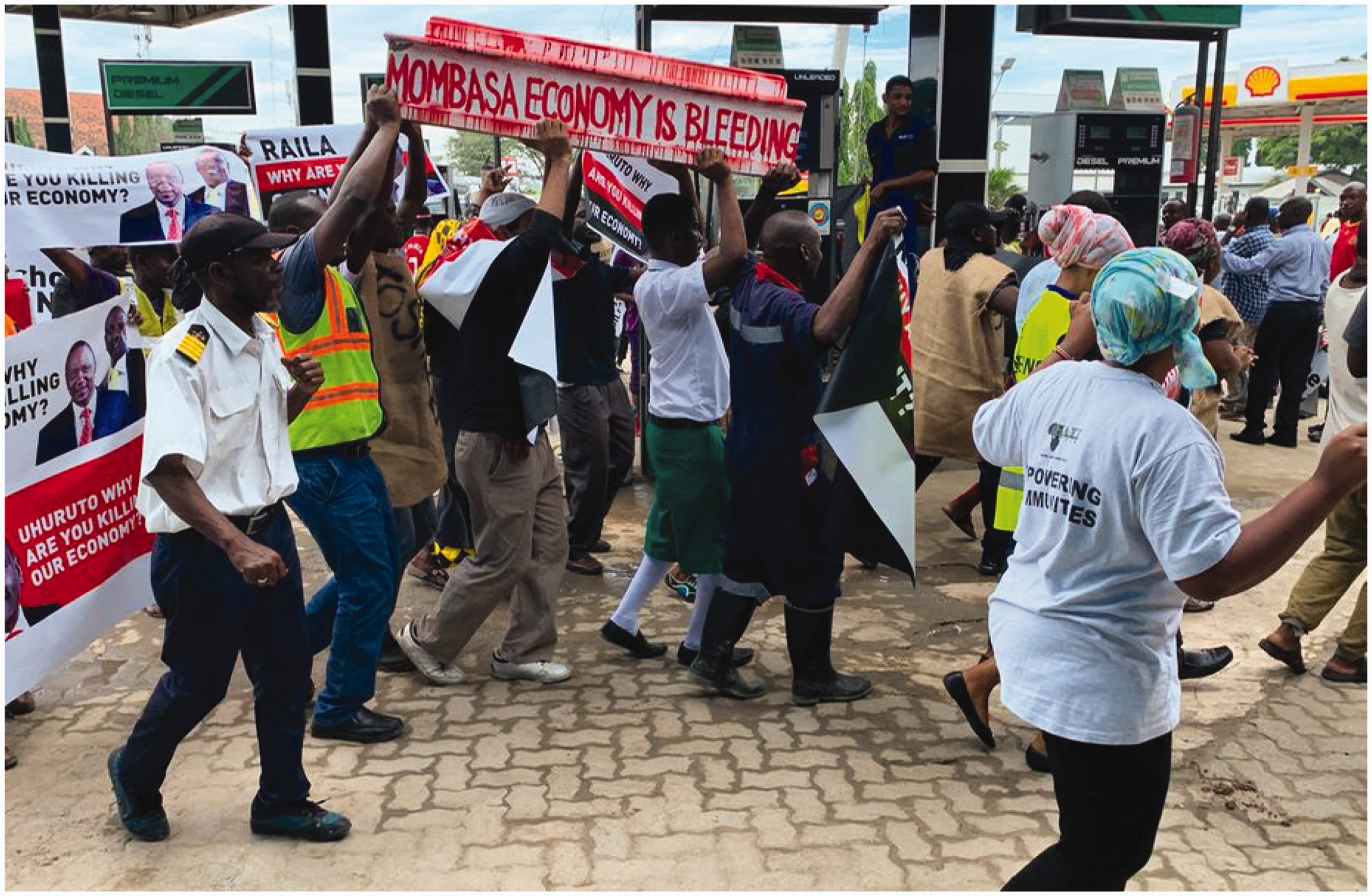
Protests against the SGR directive in Mombasa, November 2019 (author photograph).
Whilst the rationale of this movement and how its strategies intersect with Kenya’s political economy merit extensive analyses in their own right, here I highlight how the SGR’s spectacle disorders the pre-existing ecologies of social reproduction. The new railway decouples the labour of the populations alongside the A109 road and in Mombasa from the pre-existing road economies. This disarticulation of people’s labour has resulted in the open contestation of the infrastructure-based development vision of the Kenyan state. The performative strategies of the protest highlight how the state’s spectacle of infrastructure-qua-development, in fact, unfolds through ruination. Like the grandiose projects of the mid-20th century that perniciously inscribed imaginaries and practices of postcolonial nation-building (Tischler, 2013), modernity (Yarrow, 2017), or imperial forms of domination and extractivism (Isaacman and Isaacman, 2013) in different contexts across Africa, the SGR as a mode of “development” also results in ruination as it acquires a spectacle-like form. The megaproject thus functions as a force of disquieting ambivalence: for the people disconnected from the new transportation system, the new railway, in spite of the promises of “development”, continues to be experienced as the devastation of (already highly) precarious topographies of the everyday onto which life needs to be rebuilt.
Conclusion
This article, focusing on Kenya’s new railway megaproject, demonstrated that the poetics of infrastructure is not sublime nor enchanting but unfolds through disquieting ambivalence. This ambivalence manifests as ruinous materialities of infrastructure that, in spite of being contingently masked by state-led infrastructure’s spectacle, prevail as dominant experiences of mega-infrastructures, particularly for the most vulnerable. Although infrastructural imaginaries of “development” are reproduced by certain social groups directly implicated in patronage networks of the Kenyan state, the SGR overall does not sustain powerful effects of generative social promises that Harvey and Knox (2012, 2015) or Larkin (2013), for instance, highlight in their theorisation of infrastructures as state promises of “modernity” and yet-to-come futures (Anand et al., 2018) that different subject groups might embody. Therefore, rather than engendering hopes of “development” within heterogeneous topographies of everyday life, thus constituting infrastructural enchantments as collectively shared experiences of a smoothly functioning railway, the SGR is a spectacle – a form of state space through which political power projects and sustains itself. This spectacle, however, ultimately is futile: neither the state can stabilise the contested forcefields of social and material relations within which mega-infrastructures unfold, nor does the social subject, continually faced with the ruinous materialities of the new railway, fully embrace this simulacrum of infrastructure, even if different subject groups at times might contingently sustain it.
Whilst the spectacle of infrastructure already fails to enchant from the moment of its articulation, any reified fantasy of “development” that infrastructure might iterate is further undone by the devastating materialities of megaprojects. In Kenya, rather than functioning as an uncontested story of national “prosperity”, the new railway infrastructures – albeit facilitating the movement of goods, capital, and some people (see Lesutis, 2022b) – disorder ecologies of social reproduction of marginalised populations. In the article, I highlighted two interrelated dynamics of this infrastructural ruination that foreground the new railroad as a mode of “development” to be a spectacle, empty and futile. One, the ruinous materialities of the railway are laid bare through the disruption of the movement of people and matter across landscapes that the new railroad crosses. Two, the SGR infrastructures decouple the labour of local populations from the pre-existing transport systems and road economies. Considered together, these dynamics highlight how the spectacle of infrastructure-qua-development is irreconcilable with modalities of ruination that this infrastructure engenders in its wake. The article conceptualised these intersections between spectacle and ruination as disquieting ambivalence of infrastructure. Shifting from spectacle to ruination – rather than oscillating between the two – this ambivalence is not one of malleability, multiple temporalities, and open-ended futures (e.g., Anand et al., 2018). Instead, it is fraught with heightened precarity, struggle, and despair: the lives of those in shadows of mega-infrastructures need to be rebuilt within the ruins of the here and now, and of infrastructure’s spectacle.
Rather than as an extensive record of how the SGR megaproject materialises, or how its infrastructural spectacle and ruination might be unevenly mediated by manifold social differences that exist in diverse landscapes that the railway passes, the article is intended to function as a meaningful (and yet inevitably incomplete) account of some dynamics of the SGR infrastructure’s politics. Other pieces of scholarship on Kenya’s mega-infrastructures, for instance, highlight how infrastructure-based investments mask the pre-existing relations of racialisation, empire, and colonialism (Enns and Bersaglio, 2020; Kimari and Ernstson, 2020; Lesutis, 2021), or complex patterns of socio-economic differentiation and political contestation triggered by these investments (Chome, 2020; Enns, 2017; Kochore, 2016; Lesutis, 2022b, 2022c), thereby foregrounding multiple – temporal, spatial, corporeal, and affective – entanglements of mega-infrastructures. Either way, however, a complete theoretical account of infrastructure’s lives and materialities is impossible: as Adorno (1973: 53) put it, “concepts alone can achieve what concepts can prevent”. No theorisation, therefore, can incontestably grasp multifarious unfoldings of social and material worlds. Nevertheless, in spite of inevitable analytical ellipses that any conceptuality permeates, foregrounding the interplay of infrastructural spectacle and ruination as a force of disquieting ambivalence, theoretically this article defamiliarises the dominant scholarly analyses of infrastructures as mercurial temporalities and yet-to-be-seen futures.
I intend this theorisation of disquieting ambivalence of megaprojects to be read as an invitation to further reconsider emancipatory potentialities of infrastructure. (How) can infrastructure inscribe open-ended futures that might be contingently reworked in spaces of everyday life (e.g., Anand et al., 2018; Harvey and Knox, 2012, 2015; Larkin, 2008; Lawhon et al., 2018)? Particularly, when the now of infrastructure is blatantly ruinous, rendering the spectacle of infrastructure-qua-development futile and empty. Foregrounding this violence of infrastructure, often bracketed due to recent scholarship’s predominant focus on multiple temporalities of infrastructure as heterogeneous possibilities of reconfiguration, the article highlights that the way we study, research, theorise – as well as build – infrastructure, requires not leaving the ruinous present behind too quickly, not assuming the coming of the future too hastily. It asks to remain in the here and now, facing that which has already happened and what is already tangible. Such endeavour can be distressing: when infrastructures maim everyday, corporeal ecologies of social reproduction – disordering landscapes, rerouting flows of water, and disrupting how bodies move in spaces of not their own making – indelible contingency of life is rendered particularly painful and is embodied as the everyday without any guarantee of a better tomorrow. In such contexts, infrastructure cannot be just a metaphor or an analytic to understand how different lifeworlds are unpredictably entangled, made and remade, at the margins of urban growth and development (e.g., Amin, 2014; Lawhon et al., 2018; Silver, 2014; Simone, 2004). Instead, infrastructures ought to be seen, acknowledged, and taken to the core of theorisation as tangible, ruinous materialities of capitalist state-led spectacles of “progress” and “development”. It is within these topographies of heightened precarity and (im)possibilities of liveability opened or disavowed by them (see Lesutis, 2022a) that emancipatory politics, praxes of being otherwise, ought to be imagined, articulated, and lived. There, the future is never expected but is struggled and fought for in the face of, and against, the violence of state, capital, and their infrastructures.
Footnotes
Acknowledgements
I sincerely thank all participants of my research in Kenya. I am also grateful to Chris Sandbrook, Jolynna Sinanan, Monica Nkina Sairo, David Harrison, Jon Las Heras, five anonymous reviewers, and the editor Kate Derickson for their insightful comments on earlier drafts of the article.
Declaration of conflicting interests
The author(s) declared no potential conflicts of interest with respect to the research, authorship, and/or publication of this article.
Funding
The author(s) disclosed receipt of the following financial support for the research, authorship, and/or publication of this article: UK Research and Innovation's Global Challenges Research Fund (Grant Number: ES/P011500/1). Horizon 2020 Marie Skłodowska-Curie Actions Individual Fellowship (Project ID: 101023118).
Notes
 . His research is at the intersection of global politics, human geography, and critical theory, with a specific focus on politics of infrastructure, precarity, extractivism, queer and feminist epistemologies, and contemporary capitalist development across South and East Africa. Prior to his current position, Gediminas was a Research Associate in Geography at the University of Cambridge, the United Kingdom. His first monograph, The Politics of Precarity: Spaces of Extractivism, Violence, and Suffering, was published in 2022 with Routledge Interventions.