




Abstract
This paper repositions the indoor–outdoor threshold as a neglected yet vital site of climate governance in urban studies. Examining how infrastructure modulates air, temperature, and comfort, it develops the concept of hybrid urban socio-natures as spatial assemblages formed by climate control technologies that dissolve traditional distinctions between inside and outside. Drawing on political ecology, science and technology studies, and critical urban geography, the paper proposes a typology of three governance modes, reversion, extension and inversion, that reveal how cities selectively reorganise thermal boundaries. Through comparative analysis of New York, Toronto, Ahmedabad and Medellín, it demonstrates how comfort becomes an infrastructural capacity that is unevenly governed, creating new geographies of thermal privilege and exclusion. The paper contends that modulating the indoor–outdoor boundary is a distinct aspect of urban atmospheric governance, in which comfort and exposure are politically contested. The paper highlights this boundary as a domain of infrastructural and social struggle and opens new avenues for urban climate research, placing questions of comfort and thermal justice at the core of urban studies.
Introduction
Urban life has always been shaped by the interplay between interior and exterior environments. Yet, in an era of accelerating climate volatility, the governance of this boundary has acquired new urgency. Cities are increasingly becoming sites of intentional modulation of the indoor–outdoor threshold, which is configured through architectural, infrastructural, and policy interventions aimed at regulating air, temperature and exposure. These practices reshape the material conditions of urban life and its social and political relations, raising critical questions for urban studies about climate governance, spatial justice and infrastructural citizenship.
Recent scholarship in urban studies, urban political ecology, and science and technology studies has examined how infrastructures mediate the flows of resources, energy, and atmospheres (Allen, 2011; Gandy, 2017; Graham and Marvin, 2001; Wachsmuth, 2012). Within this literature, climate urbanism has emerged as a frame for understanding the remaking of urban environments in response to climate risk (Bulkeley et al., 2011; Carpio and Swyngedouw, 2022). Yet while attention has been given to heat mitigation, air quality and climate adaptation, there has been less systematic exploration of how cities reconfigure the relational topology between inside and outside as a distinct domain of governance. The modulation of this boundary is a socio-technical issue as it redistributes environmental benefits and burdens, redefines who is exposed to or shielded from climatic extremes, and produces new socio-natural hybrids.
This article progresses urban studies debates by offering a conceptual and empirical analysis of how the indoor–outdoor boundary is governed under climate change. We develop a framework for understanding these processes as forms of atmospheric governance, targeting the composition and qualities of air, the milieu and climate at the threshold between indoor and outdoor spaces. Drawing on political ecology and relational geography (Harvey, 2008; Jones, 2009), we make two linked contributions. First, we identify four relational modes (separation/coupling, in-betweenness/hybridity, substitution and networked relationality) that describe how built forms and infrastructures reconfigure the interface between interior and exterior environments. Second, we demonstrate how these modes underpin three broader governance modalities (reversion, extension and inversion) through which cities manage climatic conditions at and across the indoor–outdoor divide.
The argument is developed through comparative analysis of : (1) the closure of retail doors to conserve cooled air in New York City; (2) the expansion of thermally controlled outdoor spaces in Toronto and (3) climate adaptation corridors in Medellín and heat action plans in Ahmedabad. These cases, drawn from diverse socio-climatic contexts, illustrate the different ways urban authorities, designers, and communities modulate exposure and connectivity between inside and outside. They also show how such interventions intersect with questions of inequality, governance capacity and environmental justice.
The rest of the article is structured in four sections. The following section, ‘Urban indoor – outdoor relations’, combines architectural theory, political ecology, and science and technology studies to show how indoor–outdoor relations are co-constituted through infrastructures, atmospheric interventions, and governance practices. The third section, ‘Shifting the boundaries’, develops this framework by analysing empirical contexts that reveal how contemporary urbanism is modulating the indoor–outdoor relation through distinct socio-technical strategies. The fourth section, ‘Hybrid urban socio-natures’, illustrates how each response exemplifies a different modality of climate intervention, called reversion, extension and inversion, which collectively enable us to theorise the emergence of hybrid urban socio-natures. Then the conclusion summarises the paper’s distinctive contribution and sets out the future research priorities for urban studies.
Urban indoor – outdoor relations: A relational socio-technical understanding
Urban space is increasingly definedby dynamic and contested relations across the threshold between indoors and outdoors. Historically, architecture has played a central role in stabilising this boundary, distinguishing between the enclosed interior and the open exterior through material, symbolic, and environmental means (Banham, 1969; Leatherbarrow and Mostafavi, 2002). Building envelopes, façades, and regulatory codes have long organised the city through logics of enclosure and exposure. However, from a critical urban studies perspective, this boundary is is governed, socio-technically produced and unevenly distributed.
This section develops a relational socio-technical framework for understanding the transformation of the indoor–outdoor boundary in contemporary urbanism. Drawing on architectural theory, urban political ecology (Heynen et al., 2006; Swyngedouw, 2004; Wachsmuth, 2012), science and technology studies (Barry, 2001; Latour, 2005; Marres, 2012), and infrastructural urbanism (Furlong, 2014; Graham and McFarlane, 2015; Simone, 2004), we argue that the inside and outside should not be treated as ontological opposites. Instead, the framework seeks to understand the relationally co-constituted spatial effects between inside and outside that are continuously reworked through climate technologies, building standards, governance strategies, and cultural imaginaries. Below, we identify four interrelated modes through which the boundary is being reconfigured.
Separation and coupling
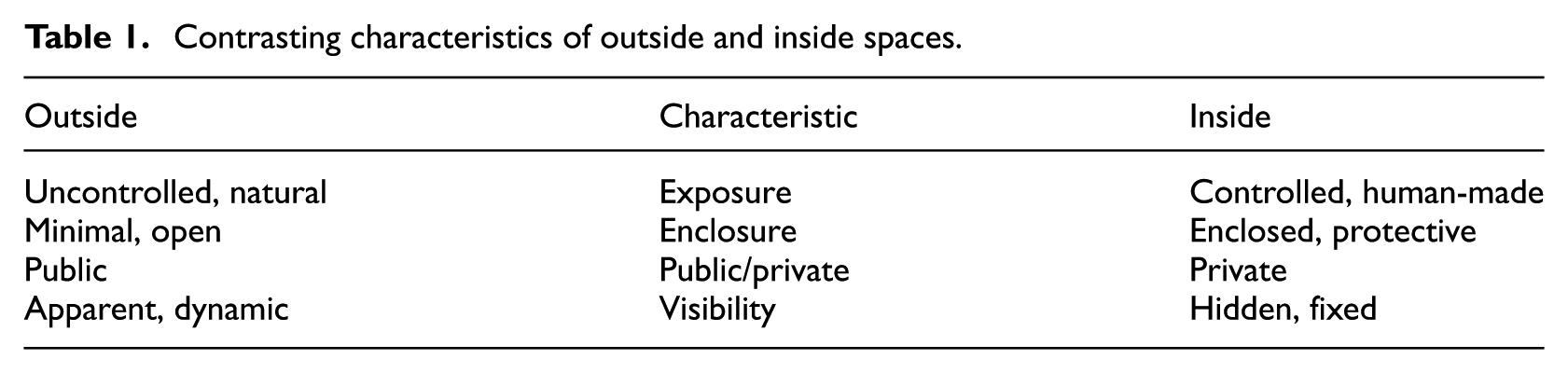
In architectural discourse, the indoors and outdoors are often conceived as binary opposites where the interior is enclosed, controlled and secure, while the exterior is open, variable, and exposed to natural forces – see Table 1. This distinction remains embedded in building codes, as well as in the design of ventilation and air conditioning systems, thermal comfort standards, and energy governance (Shove, 2003). Here, we mean architecture in its material-regulatory dimensions, assembling components to stabilise indoor-outdoor conditions, rather than architectural theory or professional discourse. As Reyner Banham (1969) famously illustrated, the modern architecture of the ‘well-tempered environment’ depends on sealing the indoors off from the atmospheric volatility of the outside.
Contrasting characteristics of outside and inside spaces.
Yet this binary logic conceals a more profound interdependence. From a critical urban perspective, indoors and outdoors are mutually constituted through socio-technical flows of air, energy, heat, and regulation. The calibration of indoor thermal comfort through air conditioning, for example, directly contributes to the formation of outdoor heat islands and to greenhouse gas emissions that intensify climate change (Santamouris, 2015). Conversely, outdoor air quality, solar exposure, and weather volatility shape how buildings are designed, insulated and ventilated. Urban infrastructures, therefore, mediate the coupling of indoor and outdoor environments in ways that are both technical and political (Bulkeley et al., 2011; Hodson and Marvin, 2010).
This coupling is becoming an increasingly prominent site of climate intervention. Urban authorities have been increasingly involved in attempts to regulate the boundary between air-conditioned indoor and outdoor environments. Campaigns to ‘close the door’ and reduce the additional energy consumption associated with heat loss or cooled air escaping into urban streets are frequently launched by coalitions of business owners, retailers and metropolitan authorities. These exemplify how governance strategies attempt to reassert the boundary between indoor and outdoor in the name of energy conservation. The open shopfront becomes a site of atmospheric leakage, prompting regulatory efforts to redraw and enforce the boundary. Thus, architectural boundaries are entangled in broader systems of climate governance and infrastructural politics.
Inbetweenness and hybridity
Between the interior and exterior lies a spectrum of in-between spaces, including arcades, atria, breezeways, courtyards and verandas, that complicate any simple distinction between inside and outside. Architectural theorists have long attended to these transitional spaces as zones of ambiguity, openness and modulation (Brookes, 2012; Corner, 1999). Increasingly, these spaces are also engineered microclimates, calibrated to provide comfort while retaining an open-air aesthetic. These hybrid spaces function as atmospheric infrastructures through material interventions that modulate exposure and redistribute thermal privilege. They are often designed for environmental purposes, and for economic and aesthetic reasons by inviting consumption, leisure, and pedestrian activity while maintaining climatic control (Gabrys, 2014; Potvin, 2010).
Significantly, these hybrid spaces are shaped by social stratification. The distribution of shaded plazas, misted café terraces or climate-buffered commercial walkways often aligns with zones of affluence and exclusion. The hybridity of indoor–outdoor spaces is therefore not politically neutral but entangled with infrastructures of privilege, raising concerns about spatial justice and the selective governance of comfort (Angelo and Wachsmuth, 2020; Mitchell, 2003).
Substitution: Simulating the outdoors indoors
A further transformation is evident in the shift from indoor spaces to outdoor experiences. The rise of indoor ski slopes in desert cities, biodomes simulating rainforests, and air-conditioned malls designed as pseudo-outdoor boulevards points to an emerging logic of climate substitution (Marvin and Rutherford, 2018). Here, the outdoors is socio-technically modulated, and it is strategically replicated within sealed environments that insulate human activity from climatic unpredictability. From an infrastructural perspective, these spaces are technically mediated ecologies that are heavily reliant on intensive energy and material flows to sustain artificial atmospheres (Marvin and Rutherford, 2021). The appeal lies in their promise of all-year-round comfort and stability, but at a significant ecological cost.
The substitution of the outdoors indoors also reflects a more profound shift in how urban publics engage with climate. As exposure to real weather diminishes, so too may our collective capacity for thermal adaptation and environmental responsiveness (Brager and De Dear, 2001; Farías and Blok, 2016; Nikolopoulou and Steemers, 2003). What emerges is a post-natural urban condition, where the experience of ‘outside’ becomes a simulation, carefully curated through light, airflow, temperature and aesthetics.
Networked relationality
Ultimately, the contemporary city must be understood as a networked climate system, in which indoor and outdoor spaces are interconnected by distributed infrastructures that modulate thermal conditions. This includes building systems, such as smart façades and operable shading, and district-scale interventions, including district cooling, heat pump networks and smart environmental sensors (Bulkeley et al., 2011; Marvin and Rutherford, 2021). From this perspective, indoor–outdoor relations are no longer spatially bounded, but systemically integrated. What matters is not the building envelope per se, but the capacity to control air, temperature, and exposure across multiple spaces and scales. As such, the inside and outside become strategic sites within urban atmospheric governance, shaped by data, algorithms and optimisation logics (Carpio and Swyngedouw, 2022; Gabrys, 2014).
This relational framing shifts the analytical focus from discrete spaces to circulatory regimes, emphasising how energy, climate, and comfort flow through infrastructures and institutions. It also raises political questions about governance, access, and control. Who gets to experience comfort? Whose atmospheres are modulated? Who bears the costs of maintaining climatic stability across relational indoor–outdoor networks?
In summary, this relational framework allows us to move beyond fixed spatial categories and toward a more dynamic understanding of how climate control and comfort are governed across the urban fabric. Indoors and outdoors no longer operate as bounded containers but as socio-technical domains that are shaped through infrastructural interventions, cultural expectations and political contestation. While the four relational modes outlined here describe how the physical and experiential threshold between indoors and outdoors is reconfigured, they do not, in themselves, explain the broader governance strategies through which such reconfigurations are mobilised, scaled and justified. These modes can be understood as the micro-level spatial and socio-technical operations mediated through the design moves, infrastructural arrangements and experiential framings that, in practice, are assembled into wider climate governance modalities. In the next section, we examine how these abstract dynamics manifest in material and spatial form through three contrasting responses. Each illustrates a different modality of governing the indoor–outdoor relations, and together they reveal the diversity and unevenness of contemporary urban atmospheric governance.
Shifting the boundaries
To examine how the governance modalities outlined above manifest in practice, we analyse three contrasting responses drawn from diverse socio-climatic and governance contexts. These include the closure of retail doors to conserve cooled air in New York City, the expansion of thermally controlled outdoor spaces in Toronto, and climate adaptation corridors in Medellín, alongside heat action planning in Ahmedabad. These were selected to capture variation in climate type (temperate, cold, tropical), governance arrangements (municipal regulation, public–private development, community-based adaptation), and socio-economic conditions (high-income cities, rapidly urbanising contexts). Together, they offer a comparative vantage point for observing how the modulation of the indoor–outdoor threshold is operationalised through different combinations of relational modes – separation/coupling, inbetweenness/hybridity, substitution and networked relationality. Rather than aiming for representativeness, the selection is deliberately illustrative as each response illuminates distinct design strategies, political drivers and distributive consequences, allowing us to map both the diversity and the commonalities in contemporary forms of atmospheric governance. The analysis draws on secondary materials, including policy reports, technical publications, and peer-reviewed studies, and examines them through document analysis to identify how urban climate boundaries are problematised and governed.
Boundary maintenance: ‘Shut the front door’
In 2015, New York City adopted Local Law 38, popularly known as ‘Shut the Front Door’, which prohibits retail and service establishments from leaving their doors open while their air-conditioning systems are running (City of New York, 2015). The measure was a direct response to widespread practices of ‘cooling the sidewalk’, in which open shopfronts allowed conditioned air to spill into public space to entice overheated passers-by indoors. This tactic, while commercially attractive, carries significant environmental and infrastructural costs, intensifying electricity demand during summer peaks and contributing to urban heat island effects.
The ordinance originated from a coalition of city agencies, environmental advocates, and business improvement districts, which sought to align energy conservation with climate adaptation objectives. The Natural Resources Defense Council (NRDC, 2015) estimated that open-door cooling could increase a store’s energy consumption by up to 25%, adding substantial load to the city’s grid during heatwaves. This concern was amplified by climate projections indicating more frequent and intense heat events in New York (Ebi et al., 2021), placing further strain on ageing infrastructure.
Technically, the ordinance reinforced the building envelope as a climatic boundary (Banham, 1969), reasserting separation between controlled interiors and variable exteriors. It also sought to shift cultural norms where the closing of doors could become a visible act of conservation, a public demonstration that businesses were contributing to climate mitigation. However, the law’s exemptions reveal the compromises inherent in urban climate governance. Sidewalk cafés and restaurants with open-air service windows were exempted, reflecting the economic and aesthetic value placed on permeability in New York’s celebrated street culture (Potvin, 2010). The ordinance also applied only to cooling, leaving winter heat leakage an omission that undercut its climate rationale.
Moreover, while the city moved to close thermal boundaries in commercial spaces, other interventions blurred them. Luxury residential buildings installed heated sidewalks to melt ice in winter, a high-energy amenity marketed as enhancing safety and convenience (Higgins, 2014). Public parks equipped with artificial turf sports fields have installed misting systems to maintain usability during heatwaves (Spivack, 2020). These developments illustrate the coexistence of contradictory governance logics through reversionary regulatory measures aimed at containment alongside extensionary and amenity-driven measures that expand climatic control into public space (Carpio and Swyngedouw, 2022).
The New York case shows how the boundary between indoors and outdoors is politically negotiated rather than physically fixed. Regulatory attempts to stabilise it are mediated by competing priorities, including environmental objectives, economic performance, and cultural identity, and are always partial. The reversion modality here is partly about technical closure but also about asserting normative limits on the spatial reach of comfort, even as other actors strategically transgress them.
Stretching outdoor use all year round: RWDI and Toronto’s microclimates
Toronto’s waterfront and innovation districts have become sites for experimenting with microclimate engineering as a strategic urban design approach. RWDI, a Canadian environmental engineering consultancy, collaborated with Sidewalk Labs to develop design packages that aim to substantially increase the proportion of ‘thermally comfortable’ daylight hours in public spaces (RWDI, n.d.). Their modelling suggested that a combination of passive and active measures, using existing commercially applied technologies, could increase comfort hours in certain zones from around 30% to more than 70% annually.
Passive strategies included orienting buildings to maximise winter sun and summer shade, selecting paving and façade materials with high reflectance or thermal mass, and strategically planting vegetation to block prevailing winds and channel breezes (Santamouris et al., 2017). Active measures ranged from under-pavement heating to prevent ice build-up, to high-pressure misting systems for summer cooling, retractable canopies, and wind screens to reduce exposure (Potvin, 2010; Ulpiani, 2019).
These interventions reflect the hybridisation of indoor–outdoor relations, by extending the calibrated environmental control of interiors into spaces historically governed by seasonal variability (Marvin and Rutherford, 2021). In Toronto, the logic was explicitly economic as enhancing the comfort of outdoor public spaces is framed as a strategy to boost retail activity, attract events, and differentiate the city in global competition for investment and talent.
The extension modality here is deeply tied to the commodification of comfort. RWDI’s comfort-optimisation packages are typically deployed in high-profile developments, such as waterfront precincts, rather than in underserved or low-income neighbourhoods. This spatial selectivity aligns with Angelo and Wachsmuth’s (2020) critique of climate urbanism, which often privileges already advantaged areas, creating what Hodson and Marvin (2010) term “premium ecological enclaves.” The result is a fragmented infrastructure of atmospheres, where curated comfort zones sit alongside spaces left unmodified.
From a behavioural standpoint, extending comfort outdoors can diminish climatic adaptability. The proliferation of engineered atmospheres can reduce residents’ tolerance for temperature fluctuations, increasing reliance on infrastructure. This creates a feedback loop as heightened expectations for comfort drive demand for further interventions, locking cities into high-energy trajectories even as they pursue climate resilience (Gandy, 2017).
In Toronto, this approach is also about branding. By providing the waterfront with a technically mediated pleasant outdoor condition all year-round, the district is positioned as liveable, innovative, and resilient. Yet this branding masks the uneven distribution of comfort, and the ecological costs of active systems remain largely unexamined in public discourse. The extension modality exemplified here blurs the line between public and private benefit, as investments in public microclimates often serve adjacent private developments.
Climate-sensitive commons: Ahmedabad and Medellín
Cities in tropical and subtropical regions are facing intensifying heatwaves, which have profound health, economic, and infrastructural consequences (Ebi et al., 2021). In these contexts, the expansion of mechanical air-conditioning offers immediate relief but risks driving massive increases in energy demand and greenhouse gas emissions (Sustainable Energy for All, 2018). Without alternative strategies, projections suggest that global cooling-related emissions could rise thirtyfold by 2100 (Sustainable Energy for All, 2018).
Yet, air conditioning is not just an energy challenge. The spread of air conditioning tends to follow patterns of thermal privilege, where wealthier households and commercial centres can insulate themselves from climate extremes while others remain exposed. This creates a thermal divide constituted through a geography of comfort that mirrors existing inequalities in income, infrastructure and access. Recognising this, planners and researchers have begun to argue that cooling must move beyond the building partly because of energy limits, but also because not all buildings, especially informal ones, can be retrofitted for efficient thermal control. What is missing, researchers argue, is a strategic, spatially coordinated and publicly accessible approach to thermal management (Emmanuel, 2018). In response, the idea of the climate-sensitive commons emerges as a more systemic solution that works across building envelopes and public spaces to cool whole neighbourhoods, that is rooted in three interconnected strategies:
Creation of ‘urban asymmetrical thermal environments’: This involves designing urban microclimates with differentiated thermal zones, allowing for selective cooling in high-use public areas. Techniques include street trees, green roofs, vegetated corridors and active water features such as misting systems.
Thermal planning by activity pattern: Instead of a one-size-fits-all approach, climate interventions are mapped onto specific activity clusters, including bus stops, street markets, pedestrian corridors and public squares. These are locations where people are most likely to gather and are most vulnerable to heat exposure.
Linking indoor and outdoor systems: Instead of viewing buildings as isolated entities, the approach is to design them in harmony with their surroundings. For example, arcaded street fronts, tree-lined facades and shaded courtyards can minimise solar gain and reduce cooling loads indoors. This relational design bridges the artificial divide between inside and outside, creating interdependent thermal ecologies.
Together, these strategies aim to reduce the need for mechanical cooling inside buildings by enhancing the livability of the outside. This is particularly crucial in informal settlements and low-income housing areas where mechanical air conditioning is financially or logistically inaccessible. The climate-sensitive commons approach seeks to address this by cooling outdoor environments at the neighbourhood scale to reduce reliance on indoor mechanical systems. This form of inversion is a reversal of the conventional flow of climate control.
Two cities exemplify this inversion modality by modifying outdoor climates to impact indoor conditions. In Ahmedabad, India, the Heat Action Plan combines behavioural, infrastructural, and design measures to lower heat exposure (Knowlton et al., 2014). The city’s cool roof programme applies reflective coatings to rooftops in informal settlements, reducing indoor temperatures by up to 5°C. These are complemented by shaded bus stops, public drinking water stations, and targeted public health messaging during extreme heat events (Hess et al., 2018). In Medellín, Colombia, the Green Corridors programme has planted thousands of trees and shrubs along major roads and waterways, reducing ambient temperatures by up to 2°C (BBC Future, 2023; C40 Cities, 2019). These corridors connect green spaces, improve air quality, and enhance biodiversity, functioning as public cooling infrastructures that benefit pedestrians, cyclists, and nearby residents. However, such approaches encounter significant governance challenges. Many cities in the Global South lack the institutional frameworks and inter-agency coordination necessary for cross-sectoral interventions (Parnell and Pieterse, 2014). Funding limitations, competing priorities, and deeply rooted cultural associations of air conditioning with modernity and status (Healy, 2008) can restrict political support.
Despite these barriers, the climate-sensitive commons approach reframes cooling as a collective right rather than an individual commodity. By embedding thermal comfort in shared spaces rather than privatised interiors, inversion strategies advance principles of infrastructural citizenship (Roy, 2009; Simone, 2004) and thermal justice (Angelo and Wachsmuth, 2020). They also challenge the assumption that urban climate adaptation must follow the Global North’s enclosure-based trajectory, offering instead a vision of adaptive, open-air resilience grounded in public space and local ecology.
Hybrid urban socio-natures: Reversions, extensions and inversions
Hybrid urban socio-natures denote the socio-technical assemblages of built form, atmosphere, and climate interventions that co-produce indoor–outdoor environments. This concept extends debates in urban political ecology where urban transformations ‘always combine infinitely connected physical and social processes’ (Heynen et al., 2006: 2) and in socio-technical systems (Farías and Blok, 2016; Gabrys, 2014) into the atmospheric domain. Importantly, our use of ‘emergent’ does not refer to a new form of nature appearing spontaneously. Our concern is with emergent configurations of climate governance, consisting of new policy logics, modalities and infrastructural arrangements that actively produce and shape these hybrid climates.
The governance of thermal comfort is not simply a matter of technological improvement or environmental adaptation. It involves the reorganisation of the urban atmospheric commons into differentiated, socio-technical zones configured as hybrid urban socio-natures, where air, temperature, and comfort are selectively produced, distributed, and withheld. These hybrids are ‘urban’ in their infrastructural and governance logics, and ‘socio-natural’ in how they assemble human bodies, weather, materials and energy flows into new spatial arrangements (Furlong, 2014; Heynen et al., 2006). The three modalities identified here – reversion, extension, and inversion – emerged inductively through a recursive dialogue between the empirical cases and the theoretical framework developed in the second section, ‘Urban indoor–outdoor relations’:
Reversions: Deliberate attempts to reassert traditional spatial distinctions between indoors and outdoors, often framed as efficiency or conservation measures. NYC’s ‘Shut the Front Door’ ordinance exemplifies this logic (City of New York, 2015; NRDC, 2015). Closing retail doors during air conditioning use stabilises the building envelope, reinforces the boundary as a site of governance, and embeds conservation norms (Shove, 2003). Yet even here, partial exemptions and competing practices, such as heated sidewalks and misting systems in public parks, reveal that boundary closure is never absolute.
Extensions: Active expansion of climate-managed comfort from inside to outside, treating public space as a continuous extension of the interior. RWDI’s Toronto microclimate engineering demonstrates how infrastructural design, incorporating both passive and active measures, can double the hours of outdoor comfort (RWDI, n.d.), thereby creating ‘all-year-round cities’ (Marvin and Rutherford, 2021). These interventions market comfort as an urban amenity, yet they also risk producing a soft enclosure of the outdoors, reinforcing economic privilege through selective deployment (Angelo and Wachsmuth, 2020; Mitchell, 2003).
Inversions: Outdoor climate modification designed to reduce indoor cooling demand, reversing the conventional flow of climate control. The climate-sensitive commons in Ahmedabad and Medellín utilise cool streets, markets, and public corridors to reduce reliance on mechanical indoor systems (C40 Cities, 2019; Hess et al., 2018; Knowlton et al., 2014). Here, comfort is framed as a shared resource (Parnell and Pieterse, 2014), but delivery remains constrained by institutional capacity, funding and entrenched cultural norms around air conditioning (Sustainable Energy for All, 2018).
Comparatively – see Figure 1 – the three modalities are not mutually exclusive. They can co-exist in the same city, neighbourhood, or even street, reflecting competing logics of climate governance (Carpio and Swyngedouw, 2022). A ‘reversion’ ordinance may operate next to an ‘extension’ project, while ‘inversion’ strategies may be layered onto existing enclosed systems. This points to an emergent topological condition in which the inside–outside relation is continuously reconfigured through overlapping infrastructural interventions (Allen, 2011; Jones, 2009).
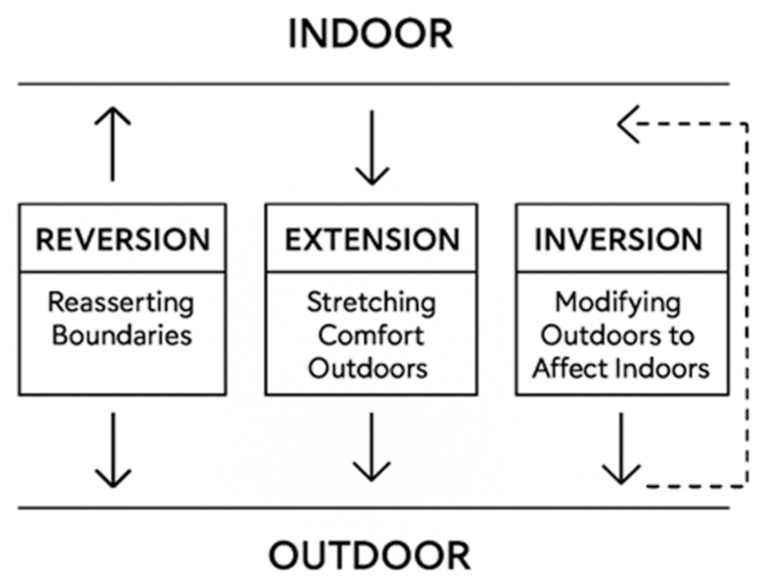
Schematic of modes of indoor–outdoor modulation.
The hybrid urban socio-natures concept captures this condition by emphasising three interlinked dynamics. First material hybridity through new configurations of vegetation, shading, water, mechanical systems and building envelopes that blur environmental thresholds (Santamouris et al., 2017; Ulpiani, 2019). Second, governance hybridity, achieved through the interplay of regulation, market incentives, and civic initiatives, produces uneven landscapes of climate control (Bulkeley et al., 2011; Hodson and Marvin, 2010). And third experiential hybridity, where bodily encounters with comfort and discomfort are increasingly mediated by socio-technical systems, reshaping adaptation norms and thermal expectations (Adey, 2013; Farías and Blok, 2016). These dynamics are politically charged. The selective modulation of thermal conditions creates geographies of thermal privilege, where comfort is actively curated for specific publics, and others where exposure remains unmanaged (Angelo and Wachsmuth, 2020).
This has two important implications for urban studies. First, it extends the scope of scholarship on energy poverty and thermal justice. Bouzarovski and Petrova (2015) define fuel poverty as ‘the inability to attain a socially and materially necessitated level of domestic energy services’ (p.31), highlighting how debates have centred on household energy deprivation. Our analysis complements this by extending the frame of thermal justice beyond the home, to include access to comfortable outdoor and communal environments. In other words, we see thermal comfort as reflecting private energy affordability but also the political distribution of infrastructure and urban design. Second, the governance of the indoors–outdoors threshold becomes a form of infrastructural citizenship (Lemanski, 2020), determining whose presence is supported and whose is neglected (Roy, 2009; Simone, 2004). Thermal infrastructural citizenship is an everyday form of citizenship enacted through the negotiation of everyday materials of the built environment and climate infrastructures. Consequently, the rights, responsibilities, and agency around thermal comfort emerge from how buildings, public spaces, and cooling systems are materially arranged and governed. Urban residents gain a form of citizenship by configuring, maintaining or contesting these infrastructures.
In summary, by treating the indoors–outdoors relation as a variable to be strategically modulated rather than a fixed architectural configuration, these cases reveal how climate urbanism is reorganising urban space in ways that are fragmented, contested and profoundly unequal (Graham, 2015; Swyngedouw, 2009). Recognising and theorising this hybrid condition is essential if urban studies is to address the intertwined challenges of climate adaptation, energy transition and spatial justice.
Conclusion
The reconfiguration of the indoors–outdoors boundary represents more than a set of architectural innovations or climate-adaptive design tactics. It is part of a broader transformation in urban atmospheric governance in which the capacity to engineer and distribute thermal comfort becomes a key instrument of urban spatial politics. Across reversions, extensions, and inversions, this paper has shown how air, temperature and comfort are governed as relational, socio-technical variables embedded in infrastructures, regulations, and cultural norms.
The typology developed here makes three contributions. First, it advances the concept of hybrid urban socio-natures, which focuses on the material, governance and experiential entanglements of climate control. In doing so, it extends urban political ecology’s concern with socio-natural relations into the atmospheric domain, where climate adaptation strategies both reveal and reproduce socio-spatial inequalities. The selective curation of comfort creates geographies of thermal privilege that map closely onto existing divisions of wealth, power and access.
Second, it defines comfort itself as an infrastructural capacity, rather than as a subjective amenity. Comfort in this sense is the capacity of a given space to maintain human-acceptable thermal conditions through networks of material systems and by how these elements are coordinated and governed. Understanding comfort as capacity highlights that access to comfortable environments depends on the configuration and control of infrastructure. In our cases, struggles over comfort thus reveal uneven distributions of infrastructural power where some groups shape or control the systems that keep spaces cool while others remain exposed.
Third, it also offers a diagnostic tool for policymakers, planners, and designers seeking to evaluate and intervene in the governance of the indoor–outdoor boundary. Making visible the relational modes that underpin governance modalities, means that it becomes possible to anticipate the distributive effects of climatic interventions. This includes who is insulated from risk, who is made more exposed, and how comfort and vulnerability are differentially allocated across urban populations and space. In future urban climate policy, it is clear that atmospheric governance is both a technical challenge of delivering thermal comfort and also a political project that shapes the lived experience of public and private space.
This analysis raises critical research and societal questions: Who decides what ‘comfortable’ means? Whose bodies are these microclimates calibrated for? And who bears the ecological costs of their operation? As climate extremes intensify, the political stakes of these questions will grow. Efforts to manage the urban atmosphere will increasingly operate through a fragmented patchwork of localised interventions, rather than through uniform, citywide systems that create a topological politics of comfort in which boundaries are continuously remade.
The implications for urban research are threefold. First, to trace the governability of the atmospheric commons, focusing on how temperature, humidity and airflow are made knowable and actionable across different political and infrastructural regimes. Second, to examine the standardisation of climate-control technologies and the ways they circulate transnationally, shaping both the Global North and the Global South’s adaptation trajectories. Third, to interrogate the justice implications of atmospheric governance, situating thermal privilege within broader debates on infrastructural citizenship and the right to the city.
By situating the modulation of the indoor–outdoor boundary within the broader politics of urban infrastructure, this article contributes to an emerging field of inquiry in urban studies that recognises climate governance as an infrastructural, spatial and relational practice. The challenge ahead lies in ensuring that the transformation of this boundary produces more just and inclusive urban climates.
Footnotes
Acknowledgements
I am grateful for the constructive feedback from colleagues in Sydney and Sheffield on earlier versions of this article. Thanks to Richard de Dear for discussing the controversies and challenges involved in understanding and modulating indoor and outdoor environments. Thanks also to the reviewers for their constructive and critical comments, which improved the paper. Any remaining deficits in the article are my own.

Funding
The author received no financial support for the research, authorship, and/or publication of this article.
Declaration of conflicting interests
The author declared no potential conflicts of interest with respect to the research, authorship, and/or publication of this article.