




Abstract
This paper examines the eliminatory speed of Israeli settler colonialism, particularly the ways in which settler organizations aim to accelerate the pace of elimination at the colonial frontiers in Palestine. We show, by focusing on the settler NGO Regavim, how such settler entrepreneurs constantly develop new techniques that challenge the slow and creeping eliminatory pace of state’s administrative, legal and security bodies with an intensifying eliminatory speed we call ‘dromoelimination’. By closely elaborating the ongoing events in the West Bank village of Susiya, we argue that dromoelimination operates, firstly, through accelerative state-settler dynamics that traverses beyond the eliminatory functions of the state while at the same time fundamentally reconfiguring them; and secondly, by turning Palestinian life and struggle against dispossession, forced displacement and destruction increasingly vulnerable to intensified temporalities of ‘depleting time’. Settler colonialism, we contend, becomes comprehensible in a more tangible, complex and spatially nuanced terms when looked through the speed and pace of its movement: that is, through intensified and accelerated eliminatory rhythms – of dromoelimination.
Introduction
In 2012 the settler organisation Regavim (‘clods of land’) initiated one of its many appeals to the Israeli High Court of Justice (HCJ) against the state of Israel. By not effectively demolishing the West Bank Palestinian village of Susiya, according to Regavim the state had neither effectively enforced the law nor properly implemented the functions it was bound up with in the occupied West Bank. In particular, the settler NGO claimed that the demolition processes in the site had been inefficient and slow, to the extent of enabling what Regavim inversely referred to as the ‘silent [Palestinian] conquest of the Land of Israel’, which the organisation was initiated to protect (Regavim, no date a). Accordingly, over the last two decades settler organisations like Regavim have played an increasing role in accelerating the processes of elimination in Palestine through various means and innovative tactics, ranging from antagonist critique of the state to a providing of at front information and new tools of elimination to its bodies. In this article our aim is to explore how these various functions and seemingly conflictual settler-state dynamics operate in Palestine to accelerate the prevalent pace of settler colonial elimination – a process we call dromoelimination.
With dromoelimination we thus seek to combine two crucial aspects that together, we argue, enable a more dynamic understanding of how dispossessive violence operates in Palestine: Paul Virilio’s (2006) notion of dromology (from Greek dromos; racecourse) – the governance by speed – and the notion key for understanding how settler colonialism operates in relation to indigenous populations dwelling in the settled lands – the one of elimination (see Wolfe, 2006). In doing so, we pay attention to ways in which elimination operates through the alteration of speed, especially by accelerating it. In the existing literature within geography and cognate disciplines debates on acceleration and speed have been spread around vast range of topics, including the planetary-wide logistical networks (Cowen, 2010), time-space compression (Harvey, 1989), technological speed of globalisation (Joronen, 2008), colonization (Luke and Tuathail, 2000), capitalist logics and fascist politics of acceleration (Noys, 2014), and the more specific questions of speed related to, for instance, deceleration, futurism, algorithms, urban planning, warfare and revolutionary acceleration (e.g., Armitage, 1999; Deleuze and Guattari, 1987; Grindsted, 2015; Leach, 1999; Virilio, 2006). Within the literature focusing explicitly on Palestine/Israel, the notion of speed has most often been approached in terms of slow violence and purposely inefficient legal and administrative processes that have effectively stolen Palestinians’ time by keeping them waiting under highly restrictive and vulnerable conditions (e.g., Berda, 2017; Joronen, 2017, 2021; Peteet, 2017). Acceleration, in turn, has been less often taken under explicit focus, though it has been mentioned in relation to infrastructural/architectonic ways of speeding up separatory politics (Jabary-Salamanca, 2016; Weizman, 2007), and indicated by works focusing on more abrupt events of spectacular violence (Azoulay and Ophir, 2009). Less explicit attention, however, has been paid on how alteration of eliminatory speed engenders, through various accelerative dynamics between state bodies and what we call settler entrepreneurs, a key constituent of dispossessive violence undisputedly destructive for Palestinians and Palestinian spaces.
We start the paper by briefly sketching what we mean by dromoelimination. By discussing some of the key works on acceleration and speed, especially as they are aligned around Paul Virilio’s notorious work on dromology, we set the stage for thinking dromoelimination via two key fronts: one focusing on state-settler dynamics of acceleration, especially on Regavim’s methods of accelerating the eliminatory speed (i.e., the dynamic functions of dromoelimination); and the other on their transformative capacities, especially on the capacity to turn Palestinian struggle increasingly vulnerable to intensified temporalities of ‘depleting time’ (i.e., the conditions of dromoelimination). The second section starts by unpacking the first front in the West Bank village of Susiya. By using various materials collected from the site since the year 2016, 1 we elaborate administrative, legal and security tensions through which the accelerative entrepreneurial functions of Regavim break through and re-set the prevalent limits of state eliminatory speed. The third section then moves on to discuss the second front of dromoelimination: its ability to condition Palestinian struggle. It shows how through constant challenging of the restrictive limits of state’s slow and creeping eliminatory pace Regavim’s accelerative functions effectively recenter Palestinian everyday struggle around the urgency of ‘depleting time’. We end by thinking how the spatial dimension of elimination, well covered in the current literature on settler colonialism, should be seen as embedded in the politics of speed. Settler colonialism, we thus conclude, should be seen less as a stable structure of elimination, and more as a process of speed whose eliminatory conditions, tensions and functions become comprehensible with more tangible, complex and spatially nuanced terms when looked through their pace and motility.
Dromoelimination and the politics of speed
In his posthumously published book, Contributions to Philosophy (of the Event), philosopher Martin Heidegger (2012) introduced first sketches of the onto-historical condition he saw characteristic for our modern technological age – the ‘machination’ (Machenschaft). As a mode of ‘gigantic’ revealing, ‘machination’ presented a grandiose endpoint of a long history of Western metaphysical thinking responsible for the violent ‘darkening of the world’ and the ‘destruction of the earth’, and thus for what Heidegger discusses under the broader rubric of ‘forgetfulness of being’ (Heidegger, 2012: 83). Interestingly, Heidegger holds, machination presents such an endpoint via three key conditions: calculation, massiveness, and acceleration. These conditions all play different roles in this prevalent onto-historical stage: calculation by signifying the positioning of things as knowable and transparently organizable; acceleration by referring to all kinds of increases of speed, from restlessness and mechanical acceleration to a mania for what is surprising and immediately impressive; massiveness, in turn, bringing these two together into equal accessibility to things so stripped of their mystery, eventuality and openness to being. While in the following works Heidegger further connected this discussion to spatiality – to a constant drive to reach towards ‘planetary’ disposability, where the whole planet is transformed into a massive ‘marketplace’ (e.g., Heidegger, 2001; see Elden, 2005; Joronen, 2013) – the notion of acceleration was not taken under explicit elaboration until Paul Virilio’s (2006) novel work on dromology in Speed and Politics. Here Virilio held dromology – the logic of speed – as a key, rather than a secondary quality for understanding modern forms of governance, war, politics and (political) economy. Interestingly, as John Collins (2011) has suggested more recently, one of the most prominent scenes for inquiring what he specifies, by leaning on Virilio, dromocolonization – the ‘colonization through speed’ – can be found today in Palestine. Following Collins’ insight, we approach Palestine-Israel not simply as a case embedded in various continuities of colonialism, capitalism, and war-economy but as offering a space for a thorough elaboration of their more extreme, intense, and accelerated eliminatory forms (see also Mbembe, 2003; Weizman, 2007).
What we see particularly helpful in Collins’ take on dromocolonization is the way it resonates with the two fronts we held crucial for thinking speed and elimination in Palestine at the beginning of the paper: the dynamic functions and conditions of dromoelimination. Accordingly, with dromocolonization Collins means, not only the ‘fastness’ of colonization (i.e., the efficient control of its strategic speed in places like Palestine), but also the ‘gradual colonization of humanity by techno-logical acceleration’, where its ‘forms of confinement’ are nonetheless spread unevenly across the globe (Collins, 2011: 80–87). Dromocolonization should therefore not be taken as a mere strategic use of certain tactics (of speed) by certain actors (such as Regavim we focus on); dromocolonization, like dromology, is also about the violence of intensified speed, which takes place as a ‘permanent assault on the world’ and ‘depletion of the earth’, as Virilio (2006: 85–86) wrote with words akin to those of Heidegger we quoted above. What we see crucial here, however, has less to do with the ontological change of technological world-making, and more with the way acceleration transforms temporal conditions of settler colonial elimination.
This brings us to the former aspect: the functions of eliminatory speed. Firstly, it is crucial to notice at front that Virilio had already developed the aspect of colonization through his discussion of the history of dromology. Crucial for Virilio is the way colonization relates to logics of war and capital, particularly to the way ‘military engineers’ and ‘military advisers’ turn into war entrepreneurs who continue to invent new means of production and destruction to serve the centralized and institutionalized functions of modern states. While this new figure of the ‘war entrepreneur’ works under the newly established state monopoly of violence (Virilio, 2006: 37), what we are interested at herein is the elaboration of what we call settler entrepreneur: an innovative force whose speed of operation constantly challenges the restrictive measures of the state, often to the point of transforming them.
Secondly, and relatedly, Virilio (2006: 91–93) pays further attention to the semi-colonial nature of the invasive powers of feudal period. In feudal times, he writes, the ‘powers of invasion’ (the military occupier) still needed to distinguish their mastery over the earth from the landowners (the native), thus ruling through the ‘continuous lines’ spreading beyond the grid of the city (or between the citadels). While Virilio separates this ‘semi-colonial’ rule from the way modern ‘dromocratic states’ use speed to colonize vast spaces and control (fairly) durable territories, not only through military means but through the intensified ‘political economy of speed’ (Armitage, 1999: 5), the semi-colonial distinction between the ‘landed ownership of the native’ and the ‘moving power of invasion’ is perhaps most clearly reconfigured, we claim, through the logic of settler colonialism. As the decades-long processes in Palestine show in grave detail (see Abu-Lughod, 1987; Barakat, 2018; Khalidi, 2020; Said, 1994; Sayegh, 2012), the settler presence constitutes a sovereign claim to inhabit the colonized lands and so to eliminate those native to them. Here, invaders turn inhabitants and the native inhabitants a problem to eliminate through various means and modes of violence and coercion, ranging from assimilation policies and dispossession to outright genocides (Wolfe, 2006).
While settler colonisation hence reflects state’s rising dromocratic mastery over the ‘earth’ and the ‘world’, as the works of Virilio, Collins and Heidegger help in revealing, what we wish to pay attention to herein is less the dromological turn that has ontologically transformed planet and its life-worlds. We rather argue that what makes settler colonial elimination functional in the first place is the ability to govern differences in motility. With this we do not mean only the fastness (or effective swiftness) of power, but the ability to machinate and alter the speed of elimination. Settler colonial elimination, in other words, is not merely a spatial process of colonizing native lands and replacing the native population, but also an eliminatory process of speed – a process of dromoelimination. It is in this regard that we wish to suggest a step beyond thinking the eliminatory processes through the rather generic spatial terms peculiar to current debates on settler colonialism: namely, beyond framing settler colonialism as a mere structure based on settler inhabitation of appropriated lands and the elimination of those already dwelling on them (Veracini, 2013; Wolfe, 2006). Instead, we argue that the eliminatory process of settler colonialism becomes understandable in more tangible and spatially nuanced terms when looked through the speed and pace of its movement.
Considering the above, with the notion of dromoelimination we wish to make two crucial moves. Firstly, we wish to move beyond the eliminatory politics of the settler colonial state by looking at the ways through which settler entrepreneurs – NGOs, private operators, and so on – function as driving forces and key catalysts of elimination. Our focus here is not merely on the innovative operations of Regavim, but on the accelerative state-settler dynamics they instigate: namely, on how the operations of Regavim engender an entrepreneurial force closely tied up with the eliminatory processes of the state. Unlike the ‘war entrepreneurs’ (of Virilio), who invent the means of production/destruction under the aegis of state apparatuses, we detect an accelerative figure of ‘settler entrepreneur’, who constantly develops innovative functions that challenge the slow processes and means of state elimination. It is in this regard that we see Regavim’s operations at the same time endogenous and exogenous to the settler colonial state: they operate beyond the state grid, even by antagonising its practices, but only to accelerate and intensify the eliminatory functions executed through administrative, juridical and security functions of the state. This leads to our second claim: namely, that dromoelimination renders Palestinian struggle increasingly vulnerable to accelerating speed of elimination. Such vulnerability is particularly clear in ways through which dromoelimination compresses the time available for Palestinian reflection, counteraction, planning, refusal and claims for justice, hence making acceleration a key condition for Palestinians to tackle with in their struggles to preserve their mundane spaces of dwelling. In other words, dromoelimination names, not a mere use of acceleration as a tool of elimination, but also something that conditions the politics of elimination by enforcing and evoking what we call a ‘depletion of time’.
Unpacking dromoelimination: Shifting temporalities in Susiya
Similar to early Zionist settlement in historic Palestine, at the center of Israel’s conquest of the occupied Palestinian territory (oPt) since 1967 lies an ongoing coercive demographic and territorial engineering directed towards the elimination of the Palestinian inhabitants – their dispossession, the appropriation of their lands, the elimination of their cultures and political aspirations, and their replacement with an exclusively Jewish population through establishing settlements (see Jabary-Salamanca et al., 2012; Khalidi, 2020; Wolfe, 2006). This logic of elimination does not take place only during belligerent periods of intense hostilities and wars accompanied with Palestinian dispossession on visibly massive scale (e.g., 1948, 1967, the intifadas etc.), but also informs day-to-day colonial governing practices that effectuate more mundane and slower rhythms of violence through implemented policies, laws, bureaucratic procedures, planning schemes, permits processes, and security-related measures. In the aftermath of the Oslo Accords in 1993/1995, these everyday eliminatory methods became concentrated on around 60% of the West Bank’s territory marked as ‘Area C’, where Israel was temporarily given control over security and administrative matters, and which includes most of the Israeli settlements, Palestinian farming lands and villages ‘unrecognized’ by the Israeli regime (OCHA, 2015b). During the decades that followed, overlaps between various state mechanisms of control in Area C have laid ground for the ongoing dispossession of Palestinian inhabitants, and the appropriation, fragmentation and strangulation of their spaces, through what in the prevalent literature has been described in terms of ‘creeping apartheid/closure’ (Peteet, 2017; Yiftachel, 2009), ‘slow violence/wounding’ (Joronen, 2017, 2021) and ‘silent transfer’ (Badil, 2013).
While Israeli (civilian) settlers have played a central role in generating and enacting these mechanisms of elimination/appropriation since the early days of the occupation, it is during the last two decades that we can witness a dramatic shift in their role. This is reflected, not only in the growing role settler movements have gained in steering state-decisions, developing and executing policing activities, or in engineering innovative and flexible means for expanding and establishing settlements, but also in their recent incarnation in the form of specialized NGOs – e.g., Regavim specialized on land-use, Ad Kan on security and spying, NGO Monitor on advocacy, Shurat Hadin on litigation, and so on. While such trend is tied to settlers’ sense of victimhood that was amplified when territorial retreats were raised in the Oslo Accords and enacted in the 2005 Gaza disengagement plan, it also goes in tandem with the global emergence of neoconservative NGOs that have increasingly appropriated the human rights field, emulated liberal NGOs’ methods, and infiltrated varying political spaces to support, justify and catalyze their exclusivist, xenophobic, and chauvinist agendas. While some of these trends have already been carefully documented in the context of Palestine-Israel (e.g., Dudai, 2017; Jamal, 2018; Perugini and Gordon, 2015, Rabie, 2021), what remains less explored, we contend, is the complex dynamics through which settler NGOs work to accelerate Palestinian elimination.
These eliminatory dynamics are well manifest in the site we focus on in this paper: the Palestinian village of Susiya, located in the Southern Hebron Hills of the West Bank. The current situation started to escalate already in 1982 when a group of settlers, with the support of Israeli state authorities, established an outpost on an adjacent hill of Susiya. The outpost was legalized a year after and a settlement carrying a name almost identical to the Palestinian village (Susya) hence formally established. At the time, Palestinian Susiya consisted of a compound of ancient caves that served as residential houses around which residents owned vast areas of lands that they used to grow seasonal corps and herd their livestock. In 1986, however, the Israeli Civil Administration (ICA; an Israeli military body responsible for ‘civilian’ matters in the oPt) declared Susiya as an ‘archaeological site’, consequently expelling the villagers from their homes and annexing the site to Susya settlement. Susiya villagers, then, moved on to live on their nearby agricultural lands, on which they erected numerous tent-houses (see Figure 1). Despite the Israeli authorities recognizing Susiya residents (private) ownership to these lands, the authorities refused to recognize the village itself, deeming it ‘unrecognized’ and ‘illegal’, and hence prone to demolition. This existential threat, however, was fully actualized only during the Second Intifada in early Millennium, particularly after the killing of a settler from Susya in 2001, when the Israeli army, together with settlers, demolished and expelled the entire Susiya community. It was only after the appeal to the Israeli HCJ and the interim injunction order the court placed, that the villagers were allowed to return to erect their tent-houses back to the location, where the circa 300 villagers still reside today. In 2007, however, the HCJ decided to vacate this petition, advising the parties to seek solution through planning channels. All the subsequent requests by Susiya residents to legalize their homes, including the master plan they submitted, were rejected by the ICA, which has, instead, continued to issue and execute occasional demolitions in Susiya (more on the history, see B’Tselem, 2018a; OCHA, 2015a). An interesting turn took place in 2012, when the settler NGO of Regavim, together with the Susya settlement council, filed a petition demanding the HCJ to order the state of Israel to entirely destroy the ‘unrecognized’ Susiya (HCJ, 2012). Regavim’s petition was followed by several counter-petitions from Susiya residents, and after convoluted legal proceedings the HCJ authorized demolition of most of the structures in the village – an authorization which has been postponed multiple times by the state due to growing international pressure (see Berger, 2017; Hass, 2018b).
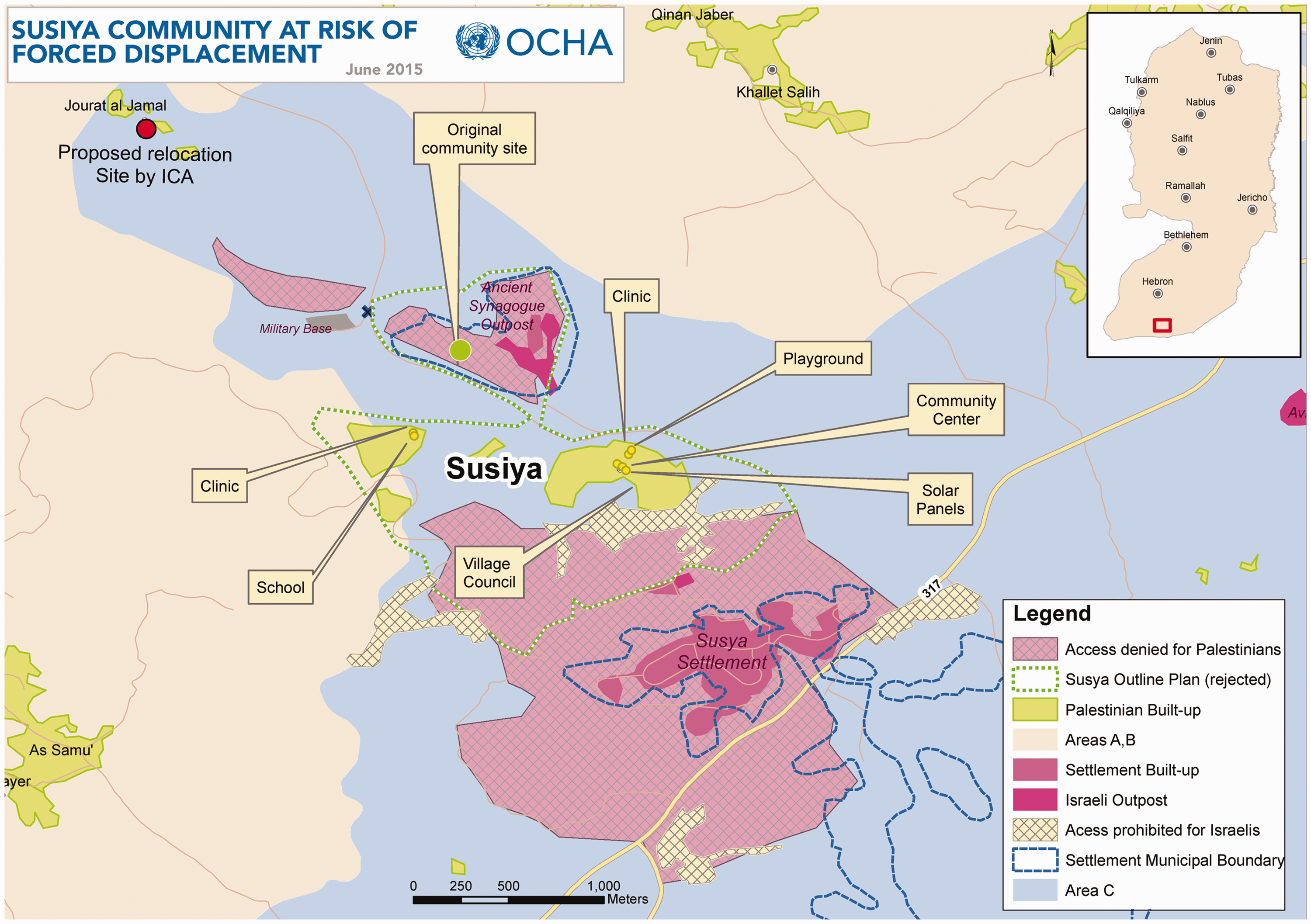
Map of Susiya. OCHA 2015a.
Albeit merely scratching the surface, the discussion above indicates how over the recent years Regavim’s accelerative pace of elimination has increasingly started to challenge the slow, silent and creeping eliminatory pace of the state. Certainly, state bodies are not slow out of inherent necessity: in as much as slow elimination is a tactical move from the state, the bureaucratic weight and lengthy viscosity that are typical for state’s legal, political and administrative procedures are slow precisely in relation to the operational model pursued by settler organisations. As we will show in detail below, these settler bodies – or settler entrepreneurs as we call them – operate in highly flexible manners, not only challenging and using different public channels and mechanisms, but also developing innovative tools, methods and technologies that in the due course have become incorporated to various operations of the state. This incorporation, however, is far from being smooth and neat one, instead constituting altogether diffused and conflictual dynamics, whereby the internal tensions (between the state and the settlers) constitute the main driving force of acceleration. Below we unpack these dynamics of acceleration by showing how the eliminatory rhythms of the state and settlers collide and collude in three key areas of operation: surveillance and monitoring; administrative procedures; and judicial channels. In particular, we show how these dynamics of dromoelimination play out in relation to Susiya residents’ countless efforts to evade Israel’s monitoring technologies and decelerate the legal/administrative channels of elimination.
Acceleration via immanent surveillance
Ever since the start of the occupation one of the key policies of Israel has been the strict regulation and limitation of Palestinian construction and development in the strategically important parts of the oPt. Over the course of decades this policy has become heavily concentrated on West Bank Area C, where most often the only option left for Palestinians to accommodate basic infrastructural needs, such as water availability, sewerage, electricity, road connections or housing, is to implement them without the Israel-issued permits. The detection of these ‘unauthorized’ constructions is carried out by the ICA’s Central Inspection Unit (CIU), mostly through periodical patrols in the field. The unit maintains a database where each detected case is classified according to their status: finished structures are given ‘demolition orders’, while the unfinished ones receive ‘stop-work orders’ (State Comptroller, 2016: 82–84). However, the existing legal framework also grants Palestinians an opportunity to appeal against these orders to both, the ICA’s Appealing Committee and the Israeli HCJ (Ministry of Interior, 2018, 74–75). While in most cases such appeals are doomed to fail, Palestinians still pursue them as vital means to ‘buy time’ and defer the demolitions. As one villager from Susiya explained, ‘the main issue here is time; [by appealing to court] we buy time and delay the immediate dispossession of children and whole families’ (Susiya resident, 2018).
Indeed, the very possibility for Palestinians to ‘buy time’ lies in the ICA’s slow and weighty detection-pace, and the bureaucratic and judicial procedures that require multiple proceedings before a final demolition can materialize (demolitions themselves are executed by the military). It is exactly this ‘slowness’ and the possibility it grants for Palestinians to ‘buy time’ that prompted the establishment of Regavim in 2006. According to its own words, Regavim’s proclaimed aim is to protect and restore the ‘Land of Israel’ (Eretz Israel, referring to Palestine-Israel as a whole) from what it terms a Palestinian ‘silent conquest’: Ever so quietly, without the roar of battle and clamor of war, the Jewish People is being robbed of the Land of Israel. On this battlefield cement mixers have replaced tanks, plows replace cannons and innocent-looking civilians replace uniformed soldiers. […] Acre after acre, house after house, buying, squatting, illegally cultivating the soil that is not theirs, sometimes with guile, other times with violence […] Israel is losing its hold on the Jewish people’s lands. (Regavim, no date b)
It is through this rationale that Regavim’s eliminatory rhythm also clashes with what it deems as the ‘hesitant Israeli leadership and the bound hands of the enforcement authorities’ (Regavim, no date b). For Regavim, the ‘bound hands’ of the ICA are a manifest of its inefficient and slow eliminatory rhythm, incapable of properly handling the imminent ‘danger’ that Palestinian presence poses for them. Interestingly, this problem of inefficient procedures had also sneaked into the 2016 Israeli State Comptroller’s report, which saw several deficiencies in the existing CIU methods. These included, for instance, the lack of clear working plans and proper timeframes for detection, and the dependence on geographical information systems that contained partial information and lacked proper functions for prioritizing urgent cases (State Comptroller, 2016: 66–67). Similar inefficiency was seen to hamper the ICA’s Appealing Committee, whose slow proceedings, together with the high numbers of Palestinian appeals accumulating over the years, had pushed the average time of appeal processing up to two years (State Comptroller, 2016: 88).
Regavim, however, does not merely aim at challenging ICA’s slow eliminatory procedures; it also presents an innovative entrepreneurial force that develops novel methods for intensifying prevalent speed of eliminatory processes. One of the key methods is related to Regavim’s establishment of a ‘drone unit’. By intensifying surveillance over Palestinian villages, the unit aims to shorten the detection-time of ‘illegal’ constructions and thus to accelerate the ICA’s administrative procedures for demolition. Drone surveillance is conducted in cooperation between Regavim and local settler volunteers (supported by settlement councils) who are given the role of ‘field inspectors’. The main task of these ‘field inspectors’ is to frequently fly surveillance drones over the nearby Palestinian communities. When suspicion over construction arises, video and still photo materials recorded by the ‘drone unit’ are cross-referenced in mapping software programs and reported to ICA, which is urged to halt construction and place demolition orders (see Regavim, no date a). As one of Susiya’s residents described the drone operations: The settlers work as Regavim’s agents […] every few days they fly their drones above our village and take photos of the area and push the ICA to take actions against Palestinian structures that should, according to them, be demolished […]. They of course use Israeli racist laws and policies and pretend that they are defending the law – as if the government’s demolitions are not enough, as if Israel is not doing its job well enough [laughing sarcastically]. (Susiya resident, 2017) Before Regavim’s intervention, in this area we used to build a house, finish it, and only after a month or two we would receive a demolition order. But today 99% of the time they stop us while constructing. This is mainly because Regavim recorded it and created tremendous pressure on the state to act against it, also providing them with evidence. It [Regavim] would then say to the ICA, ‘look, those people got a stop-work order, but still they continued to work afterwards, they did not respect your order’. This also accelerates the [appeal] procedure, as we will be seen as disrespecting the orders we receive. (Susiya resident, 2018)
As the reporting of ‘illegal’ construction, and the pressuring of the ICA exemplifies – alongside with the reports and policy recommendations provided to Israeli Knesset committees, and the continuous meetings with ICA staff (Regavim, 2019) – Regavim does not simply operate as a vigilant force of destruction (Gazit, 2015), but to force its eliminatory speed to permeate state mechanisms. During the last few years, as several residents of Susiya and nearby villages also confirmed, Regavim’s employees have been conducting joint patrols with the members of the CIU to instruct them on the use of surveillance drones (Figure 2; see also Dvori, 2017). A new level of collaboration, however, was reached in 2020, when Israel’s Settlement Affairs Ministry (SAM) officially announced that it will start outsourcing inspection tasks of Palestinian construction in Area C to settler communities. According to this new policy alignment, SMA would directly fund settlement patrol units and supply them with drones, vehicles and other tools in order to facilitate their monitoring activities. These ‘settler inspection units’ would now formally start gathering ‘intelligence folders’ on unauthorized construction, which are then transmitted to newly established ‘Area C Situation Room’ within the ICA (see Ben Kimon, 2020; Hass, 2021). From now on, Regavim’s monitoring model is not only fully incorporated to state operations; state operations are also formally outsourced to the entrepreneurial settler force – to Regavim (and settler communities it collaborates with). Through this new policy plan, whose large-scale effects are yet to be seen, the state thus aligned itself even more closely with Regavim’s eliminatory rhythm.
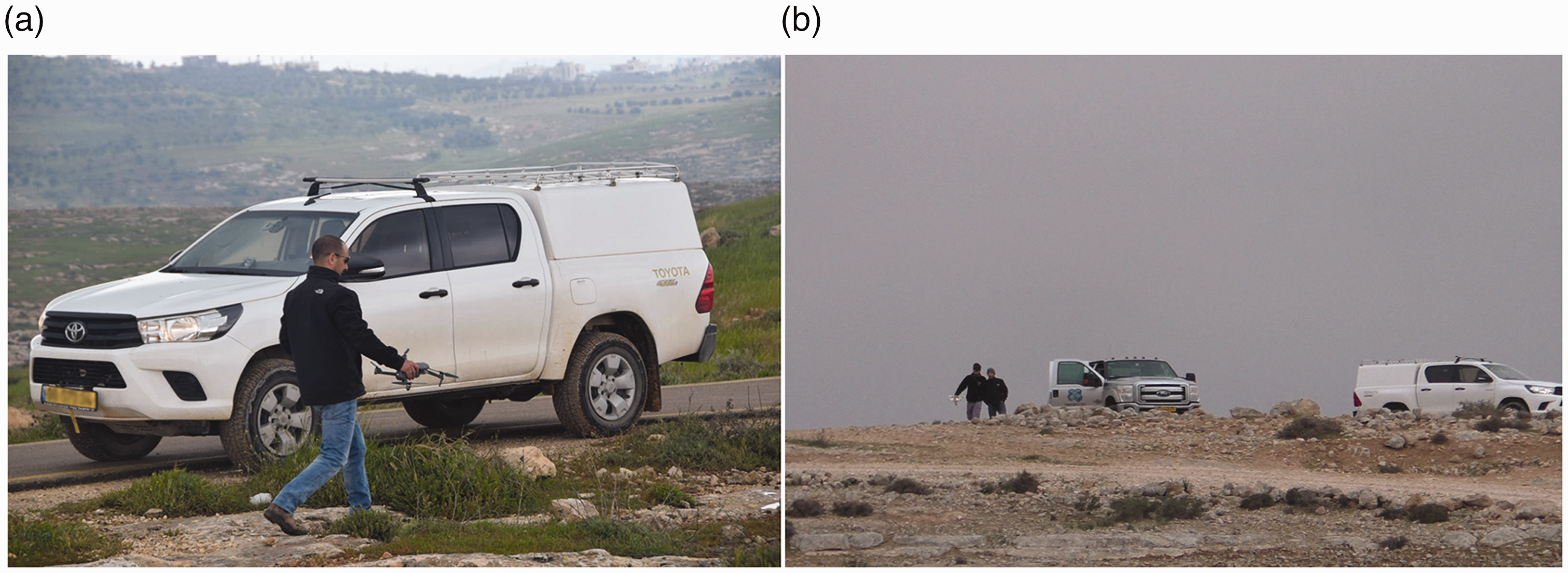
(a) ICA employee flying a drone (photo, Susiya resident, 17 March 2019 Susiya); (b) Regavim and ICA employees flying drones at South Hebron Hills (Video recording, resident of Tuba, 29 January 2018, Tuba).
Finally, it is important to keep in mind that we are not arguing these novel modes of surveillance are able to completely dwarf Palestinian ways of acting against and upon the accelerating modes of dromoelimination. For instance, in Susiya, as is the case in similar sites throughout the West Bank (see Joronen, 2021), such eliminatory speed has been countered with speedy construction – of building as fast as possible to create, as one resident explained, ‘an already existing structure that would prevent the ICA issuing a stop-work order’ and hence force them to impose ‘a demolition order that could be delayed’ while ‘providing people with minimal help, ensuring the basics’ (Interviewee, 2018). These counter-temporalisations, as we discuss in detail in the next section, help in further underlining the operational complexity of dromoelimination, particularly its ability to align politics around the question of speed.
Administrative and juridical accelerations
Regavim’s consistent call against the inefficient and weighty demolition procedures of the ICA started to finally pay off, when in June 2018 the assistant of the Minister of Defence, Kobi Eliraz, assured Regavim’s representatives and their parliamentarian counterparts in a Knesset Committee meeting that the ICA is drafting a plan to counter what they termed Palestinian ‘conquest’ efforts in Area C (Ministry of Defence, 2018). 2 Indeed, two months later, this plan took its form in Military Order 1797, which grants CIU representatives the power to issue demolition orders for any unauthorized structures (completed or uncompleted), if Palestinian parties were unable to provide proper building permits within 96 hours after receiving the notification order. If no appeals with attached permits were filed within the timeframe, notified structures could be immediately demolished (see B’Tselem, 2018b). Military Order 1797 thus obliterated the previous distinction between structures detected while/after being built, but also significantly hampered the appeal process by making it conditional to building permits that are close to unattainable. Accordingly, the order provided a new tool to skip procedures (‘statuses’) previously required for implementing final demolitions, and hence, significantly decreasing the possibilities for Palestinians to ‘buy time’ and decelerate demolition processes through appealing mechanisms.
Interestingly, when human rights organizations appealed to the HCJ to annul the Military Order 1797, the HCJ’s dismissal of the petition (in April 2019) relied heavily on previous court decisions that Regavim (and other settler organizations) were parties at (HCJ, 2018b). In these previous cases, though the demands for destroying Palestinian structures were rejected, the HCJ did take a stricter position regarding ICA’s slow enforcement-pace, especially in relation to unauthorized constructions categorized as ‘priority’ (see HCJ, 2010, 2018a). This decision further illustrates how Regavim’s years-long lobbying work in the Knesset and petitioning to the judicial system has been able to catalyse new legal and political conditions for dromoelimination. At the same time, it also shows how such conditions paved the way for a development of new acceleratory functions of elimination, such as the Military Order 1797, which Regavim now utilizes to further pressure the ICA to intensify its demolition pace (see Regavim, 2021). Almost immediately after the HCJ authorized Military Order 1797, residents of Susiya started to feel the tangible effects of the new speed of elimination: It’s terrifying, it’s really terrifying, just yesterday they demolished a few houses in al-‘Aroub refugee camp using this military order, but also in many other places in the Southern Hebron Hills in the last period. Now it is really hard, if you construct something, you don’t have the possibility of appealing its demolition, and you get 96 hours’ notice only! For example, if they give us the order on Thursday, on Sunday the ICA’s bulldozers may already be on their way! (Susiya resident, 2019) Before 2012 there were demolition orders, but they were not implemented regularly. What made Susiya’s existential problem more imminent than ever is because of Regavim. […] Before Regavim, the Palestinians used to appeal against demolitions, the court would normally issue an interim injunction, and it took time until the ICA executed the demolitions. But when Regavim entered to the game, it would constantly challenge the interim injunctions and pressure the court to demolish. […] Regavim is a sort of subcontractor and an amplifier. (Mishriqi, 2017, 2021)
Since then, however, the Israeli state has postponed these demolitions multiple times, primarily due to international pressure and as means to ‘dilute’ the political and legal ramifications that a conclusive mass expulsion could engender in the international arena. It is not a mere side note that this pressure has followed Susiya residents’ continuous efforts to launch, together with their Palestinian counterparts, and Israeli and international allies, multiple campaigns addressed to various foreign parties, governments, international bodies and non-governmental organisations. Without such advocacy campaigns and international visibility, Susiya’s lawyer asserts, ‘Susiya would have disappeared long ago’. This, as the lawyer continued, has made it clear that ‘the legal case has transformed into a purely political one; now, it is the hands of the state of Israel to approve the demolition of Susya or not’. Parallel to this transformation, Regavim has also switched to magnify its eliminatory speed into domestic and international political channels. This includes continuous pressure on actors opposing the demolition of Susiya and lobbying key Israeli political and military personnel (Hakol Hayihudi, 2018); launching of campaigns condemning countries and organizations that provide humanitarian aid/support to Susiya (Regavim, 2018, 2019b); and sending letters to decision-makers in countries that opposed Susiya’s destruction to refrain from their positions (Smotrich, 2015), and so on.
As the discussion above shows, Regavim’s interventions – i.e., political pressure, data collection and appeals to HJC – have succeeded, not only in laying bare the subordination of the legal to the political, but also in accelerating, compressing, and exhausting the legal processes of (dromo)elimination in Susiya. As Mishriqi aptly put it, it is now the Israeli state that is ‘buying time’ for a more ‘favorable international political climate’ to demolish Susiya. However, for the residents of Susiya the danger of a once and for all destruction is constantly hanging in the air, and at any appropriately deemed moment Israel may give a green light for destroying the village. This time there would be no more ‘time’ to ‘buy’ – acceleration would have depleted time altogether.
On settler entrepreneurship and depleting time
Whether done through legal and administrative proceedings or by providing innovative tools, outsourced services and forms of collaboration, Regavim, as our discussion in the previous section shows, has a key role in accelerating the eliminatory functions of the state. In this section we wish to turn back to further our discussion of two overlapping fronts of dromoelimination: the dynamic functions and the conditions of acceleration. Regarding the former, we want to further elaborate the role of Regavim as a ‘settler entrepreneur’, whose intensifying speed of operation, we argue, constantly challenges the restrictive measures of the state, often to the point of transforming them. This transformative role bears striking similarity to that of the capitalist entrepreneur, which through innovation constantly aims to break the barriers that limit the prevalent circulation of capital. Through the discussion of such settler entrepreneurship, however, our aim is to also move on to think the way in which both, the eliminatory drive and the everyday Palestinian struggle in Susiya, have become centered around what we call the ‘depleted time’. Depleted time, we argue, is a condition established by the accelerating eliminatory speed, something that engenders new senses of urgency and modes of everyday struggle, thus revealing the tight entanglement of Israel’s settler colonial project to the politics of eliminatory speed.
Historically, as both critics and proponents of capitalism recognize, the capitalist entrepreneur has constituted an accelerative force that, through innovation, constantly aims to break through the prevalent ‘limiting barriers’ of capitalism (e.g., Deleuze and Guattari, 1987; Schumpeter, 1959). In the economic milieu, a temporal tension thus emerges between the fast entrepreneurial speed and the more systemized and regularized circulation – between the innovative production of new frontiers, and the maintaining of economic equilibrium (and steady accumulation of surplus value) through state planning, treaties, anti-monopoly legislations, calculations and so on (for more, see Foucault, 2010). Primarily, this tension arises due to the potential of entrepreneurial speed to abruptly break the existing ‘limiting barriers’ of capitalism. By bringing forth the unknown and unpredictable, entrepreneurial innovations thus carry the risk of inducing drastic disruptions and ruptures within economic equilibrium – ruptures that might instigate radical socio-political changes or generate negative effects on the growth and expansion, even on the very functionality of capitalism itself (see Glezos, 2012; Harvey, 2006: 117). To mitigate these risks of entrepreneurial speed, the capitalist ‘managerial class’ constantly introduces restrictive practices that, by constraining, re-channeling, decelerating and even completely halting the acceleratory entrepreneurial speed, aim to maintain a relatively controllable and predictable economic equilibrium and surplus accumulation (see Glezos, 2012: 93; Harvey, 2006: 146–147).
To some extent a similar relation to speed and limits also characterizes the settler entrepreneurial role of Regavim. By constantly inventing and circulating innovative surveillance techniques, flexible data collection, organizational models, political agendas, and legal interpretations, it too aims to accelerate Palestinian elimination beyond the ‘limits’ and ‘barriers’ of prevalent state conduct. The intensifying operations of Regavim, in other words, do not speed up elimination through steadily proceeding acceleration, but by constantly seeking novel ways to break the prevalent limits of eliminatory speed. However, when in capitalism the role of innovation and speed are closely entwined to capital accumulation and market expansion, in the context of settler colonialism they work to serve the purpose of elimination. Accordingly, Regavim’s speedy eliminatory rhythm engenders a tension with the relatively steady (creeping/incremental/slow) and balanced eliminatory rhythm of Israeli state bodies, which through more weighty and lengthy procedures, such as HCJ hearings or the ICA’s Appealing Committee proceedings, restrict and mitigate Regavim’s eliminatory speed.
State bodies, however, should not be seen as unanimously aligned to slow down settler entrepreneurial acceleration. Firstly, the slowdown is part of balancing the entrepreneurial speed, of engendering controllable equilibrium of elimination. This was well illustrated by the Susiya court case in 2018, after which the state, despite the HCJ decision to favor the demolition of (most of) Susiya, has until today refused to carry out the mass demolition due to the fear of negative legal and political reactions in the international arena. In short, excessive acceleration might risk the eliminatory equilibrium that is better gained through tactically balanced eliminatory pace. Secondly, and more crucially, the restrictive and decelerative practices of the state were simultaneously paralleled with various adoptive practices that, albeit in a more controlled manner, worked to channel Regavim’s accelerative velocities into state’s eliminatory mechanisms. Again, the adoption was not straightforward, but catalyzed after fractious and even conflictual dynamics. This was well reflected in the ICA’s adoption of Regavim’s drone-based surveillance model, but also in the state’s more recent outsourcing of Area C surveillance practices to settler organisations. In similar vein, Regavim’s continuous and restless efforts against the ICA’s weighty and slow administrative proceedings (and Palestinians’ ability to ‘buy time’) paid off when the new Military Order No. 1797 limited Palestinian appeals to 96 hours and thus subjected Palestinian construction to significantly quicker demolition pace.
Taken together, these breaks in the prevalent balance of eliminatory speed manifest a situation where the accelerating speed starts to function as a condition against which Palestinians need to align their everyday practices and modes of resistance. Dromoelimination, in other words, did not only gradually drain empty Palestinian efforts to ‘buy time’ as discussed in the previous section; it also re-centered Palestinian struggle for everyday spaces (housing, farming, livelihood and decent living) around what we call the ‘depletion of time’. Depletion of time, hence, names a condition where the accelerating eliminatory speed constantly breaks the prevalent pace of elimination to the extent of centering the politics of dromoelimination around this restless but gradual exhaustion of time. Here the Palestinian struggle against dromoelimination turns into a way of navigating through the transforming eliminatory temporalities.
The way the depletion of time started to condition the politics of speed was well exemplified in the ways Susiya residents dealt with the growing effects of Regavim’s accelerative speed. At first, to avoid Regavim’s immanent surveillance and its ability to detect construction in real-time, Susiya residents started building or maintaining their premises as fast as possible. By responding to quick detections with speedy construction, they were able to avoid stop-work orders, which would have prevented villagers from using the constructed premises, while simultaneously enabling quicker implementation of demolition orders. Such acceleration of construction, however, became less relevant in 2018 after the Military Order 1797 obliterated the distinction between finished and unfinished constructions, and significantly reduced the Palestinian possibilities to buy time through administrative appeals. Similar temporal exhaustion was also engendered through judicial proceedings, especially after Regavim succeeded, through various legal acts, to significantly narrow down Susiya residents’ attempts to decelerate legal proceedings. By the year 2018 most interim injunctions and all alternative master plans were rejected by the HCJ and the ICA, rendering Susiya’s destruction dependent on the final approval of the Israeli government. By breaking one barrier after another these intensified temporalities of elimination thus made spaces of everyday life in Susiya increasingly vulnerable to a depleting time, and hence, forcing Palestinians to urgently seek new (decelerating, time-buying, accelerating) temporalities of everyday struggle.
Conclusions
In this article we have shown, by focusing on Regavim, how the settler entrepreneurial speed works to accelerate the pace of elimination in Palestine. We called such accelerative politics ‘dromoelimination’ – an elimination through speed – which dynamic functions and conditions we took under further scrutiny. Regarding the former, we focused on various legal, administrative and surveillance operations of Regavim in the village of Susiya, showing in detail how Regavim’s modes of acceleration functioned vis-à-vis creeping, incremental and slow functions of Israeli state bodies. By developing various technical means – innovative surveillance tools, outsourceable workforce, joint legal proceedings, flexible data collection, etc. – but also by engendering various dynamics – from collaboration and provision of services to ways of challenging and pressuring state bodies – the operational model of Regavim managed to re-set, barrier after barrier, the prevalent state eliminatory limit and speed into intensified modalities. Dromoelimination, we further showed, significantly transformed Palestinian life and struggle against elimination – that is, by making Palestinian spaces increasingly vulnerable to what we called the ‘depletion of time’. Dromoelimination, in other words, is not merely about certain dynamic functions of power; it also names a process of motility, where Palestinian spaces become increasingly conditioned by the intensified temporalities. Such accelerative depletion of time constitutes, not necessarily a new planetary ontology of ‘darkening worlds’ and ‘depleted earth’ as summoned by Virilio and Heidegger, but a more localized channeling of spatial politics around the acceleratory speed of dromoelimination.
It is by looking at the state-settler dynamics and the everyday Palestinian struggle with the intensified forms of eliminatory speed that we wish to further suggest a certain refocus in researching settler colonialism. Settler colonialism, we propose, is not only a spatial rearrangement of population/land relationships – a structural elimination of the indigenous inhabitants of colonized territories (see Jabary-Salamanca et al., 2012; Wolfe, 2006). Settler colonialism should also be seen as a process of speed, where the pace and rhythm – accelerations and decelerations, pauses and transformations – comprise key formations that are interwoven with space-making functions of elimination. In addition to questions of space and land, we argue more focus should be paid on the rhythm, pace, and speed of settler colonial elimination. Secondly, there remains a need to further bridge research on settler colonialism with works focusing on capitalist logics and political economies of violence (e.g., Coulthard, 2014; Englert, 2020; Getzoff, 2020; Medien, 2019). As our own discussion shows, settler-capitalism is not merely an alliance, where elimination feeds the interests of capital and capital the needs of elimination. Capitalism and settler colonialism can also coalesce through figures like the ‘settler entrepreneur’, where differing functions of power metamorphose into novel formations. These metamorphoses, especially the way they are related to alterations of speed, can help expanding the ongoing discussions that in geography and cognate disciplines call for more nuanced and engaged analyses of power, governing and settler colonialism in Palestine (and beyond) (e.g., Hammami, 2019; Harker, 2012; Joronen, 2019; Rabie, 2021). It is precisely the notion of dromoelimination that provides a way to look at power in its motility – in its movement of making and unmaking settler colonial time-spaces. Considering this destructive dromoeliminatory movement keeps intensifying in Palestine today, there seems an urgency for an anticolonial, life-affirming, and time-emancipating counter-movement.
Footnotes
Acknowledgements
The authors would like to thank the colleagues at the Space and Political Agency Research Group (SPARG) at the Tampere Universy for their comments on earlier drafts of this paper, and to express their deep gratitude to the residents of Susiya and to lawyer Quamar Mishriqi for accepting to share their life experience and professional insights respectively.
Declaration of conflicting interests
The author(s) declared no potential conflicts of interest with respect to the research, authorship, and/or publication of this article.
Funding
The author(s) disclosed receipt of the following financial support for the research, authorship, and/or publication of this artcile: This work was supported by Academy of Finland (Grant Numbers: 308228, 322025).

Notes
References


