




Abstract
This paper addresses what it means to live with acutely restricted access to the city in the process of seeking urban asylum in post-apartheid South Africa. Our concept of apportionment specifies the gendered and racialised diminishment of space and time in the context of exclusionary and everyday violence. We focus on how the delineation and reduction of space and time is feminised, through the working lives of refugee and asylum-seeking women from the Democratic Republic of the Congo who live in Cape Town. Their embodied experiences incorporate the resonance of war in the Democratic Republic of the Congo, further sharpening their careful movements across Cape Town’s segregated geographies. Drawing on our conversations with non-governmental organisations and self-employed women over a nine-month period in 2020, we highlight how the deferral of refuge compounds precarity, significantly affecting women and those who are sexually minoritised. In connecting how state apportionment maps onto urban apportionment we reveal how an ecology of violence – of spatialised segregation, xenophobia and sexual violence – establishes a corporeal power that constrains access to the city. Crucially, these women deploy counter practices of apportionment and their precisely attuned navigations add to our understanding of the agile repertoires of working the city.
Introducing apportionment
We meet with Tété on a pavement near Salt River Station, just a mile from Cape Town’s city centre. Tété has set up a pavement shop in front of an alleyway where she sells small bags of peanuts and dried fish. The space Tété claims is makeshift and is made so that it can be quickly set up and just as quickly dismantled. She has occupied her workplace for over a year, and was given provisional permission to use the pavement by a proprietor who runs a busy supply store adjacent to the alleyway. Tété talks about her business: The owner of the shop makes a favour for me, so I can use this pavement. I don’t pay for it. I work Monday to Saturday, it’s good. I sell mostly to foreigners. I came to this country when I was sixteen. When we left the Congo, this one run here, this one there. I ran away because of fear. I came in 2006, and I’m twelve years now in Cape Town. I stayed first in the location, but it was a hundred per cent too dangerous, and in 2008 there was too much xenophobia … We moved to Salt River but the rent here makes me too stressed.
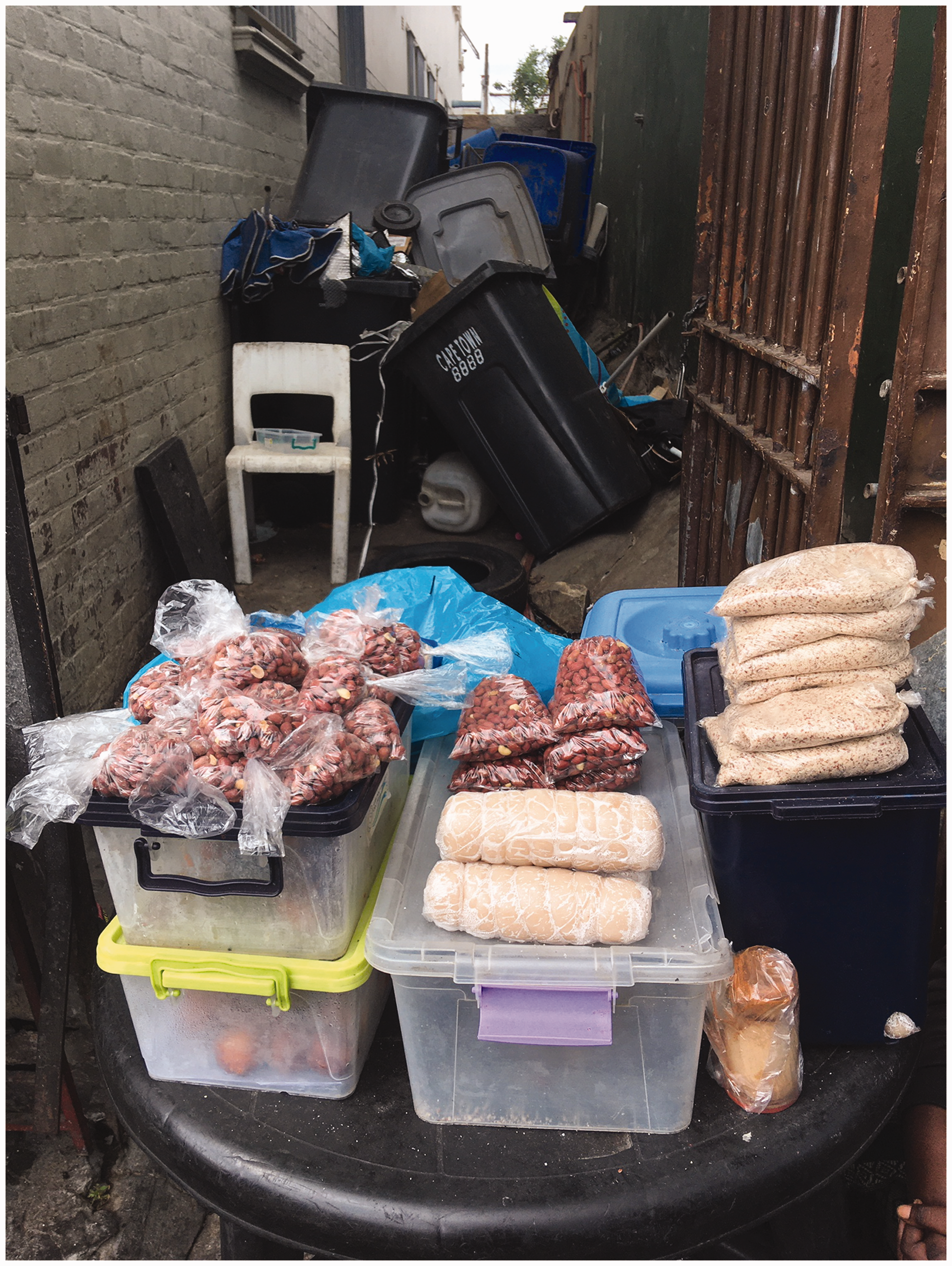
Tété’s place on the pavement in Salt River, Cape Town 2020.
We therefore highlight the need for a concept such as apportionment to specify the discriminatory processes by which space and time are not only delineated but also diminished in seeking urban asylum. Our emphasis extends to understanding how asylum-seeking women deploy their tactics of apportioning their space, time, resources and emotions to endure and circumvent restrictions. Although apportionment might be usefully applied in understanding varied racialised, gendered and feminised processes and navigations of violence in which space and time is diminished, the process of accessing urban asylum foregrounds particular considerations. Our research reveals that apportionment is a compounded process, in which the deferral of citizenship status haunts the limited access to life and livelihoods. We see the deathly nature of slow violence as less space and less time becomes available to negotiate access to the state and city (Bhagat, 2018), a process exacerbated by the unfolding Covid-19 pandemic. Here it is important to understand how state apportionment maps onto urban apportionment, further delineating the spatio-temporal dimensions of precarity in ways that are particularly acute for women and those who are sexually minoritised (Camminga, 2019). Finally, we see the counter practices (Mountz, 2011) of apportionment adopted by asylum-seeking women as exacting and precisely attuned navigations across the city. These counter practices – of stringent budgeting and the artful allocations of multiple responsibilities – bring an important addition to the agile repertoires of working the city as captured in the masculine and youthful articulations of the hustle (Matlon, 2011; Thieme, 2018).
The apportioned city and the gendered life of urban asylum
Our concept of apportionment renders visible the acutely gendered delineation of space and time, highlighting how discriminatory asylum systems intersect with segregated urban systems, thereby differentiating (im)mobile subjects. We focus on the feminised processes of how space and time become stringently apportioned in the context of curtailed asylum and unstable work in Cape Town. Our interactions with non-governmental organisations (NGOs) and self-employed women from the DRC over a nine-month period in 2020 reveal that apportionment is simultaneously an instrument of discrimination that limits access to the city and state, and an attentive and exacting practice of negotiating access. In tracing the women’s intimate practices of living with violence (Datta, 2016) through their careful budgeting of space and time, we aim to draw out gendered understandings of the ‘spatio-temporality’ of urban segregation and precarity (Smith and Vasudevan, 2017: 211). We build on feminist perspectives on the gendered nature of insecure citizenship and livelihoods (Kihato, 2013), gendered embodiments of navigating violent national and urban borders (Maluleke, 2018), and everyday social and familial struggles against insecurity (Matsipa, 2017; Northcote and Dodson, 2015).
Significantly, the instrument of temporary asylum permits in South Africa accommodates a system of asylum outside of the confinements of the camp. However, protracted processes of asylum review and permit renewals regulate differentiating forms of spatio-temporal (im)mobility, acutely reinforcing discrepant access to space, work and support (Bhagat, 2018). Despite legislated commitments to the due processing of asylum claims as enshrined in the South African Refugee Act 130 of 1998, the abyss between policy and practice is evident in how the asylum system is administered through the discretionary determinations of street-level bureaucrats (Landau and Amit, 2014). In a harrowing chronicle of an overburdened system accompanied by state cuts and under-resourcing (Amit, 2011), erratic bureaucratic processes are shown to sustain significant backlogs, incongruities and injustices (Amit and Kriger, 2014). We situate apportionment in a politics of asylum governance in which rights are conferred but protection is deferred, and where limited access to the city echoes across multiple aspects of urban life (Georgiou et al., 2020), including the policing of space (Vigneswaran, 2013) and the right to work (Crush et al., 2015; Nyamnjoh et al., forthcoming).
Our focus on women who have come from the DRC to South Africa highlights how the affective resonance of a protracted war in the DRC sharpens their careful movements across Cape Town’s historically segregated geographies and national context of xenophobia. Most of the women we spoke with had arrived in South Africa in the years following the end of the first civil war in the DRC in 2003, a six-year period marked by intense armed conflict coupled with extensive sexual violence (Baaz and Stern, 2013). They arrived into a context of heightened sexual violence and misogyny in South Africa, prompting considerations of how gendered embodiments of violence travel across space (Conlon, 2011). In tracing the apportionment of space and time, we ask how discrepant access to refuge and the city shape differentiated asylum seeker and refugee groups (Bhagat, 2018; Camminga, 2019). Feminist perspectives on the geopolitics of (im)mobility across national and urban space, reveal how quotidian practices of sustaining life are part of the transgressive struggles within the exclusionary violence of asylum constraints (Mountz, 2011). As Sutton et al. (2011) show in the context of South Africa, deferral is integral to the migration system, where waiting is ‘an organisational procedure’ on the part of the state (2011: 36), and ‘out-waiting, as a form of “outwitting”’ is deployed as a tactic of circumvention on the part of asylum seekers (2011: 31). We are mindful of apportionment a possible ‘counter-topography’ of asylum deferral (Mountz, 2011) practised as a way of negotiating access to the city. By observing feminised practices of budgeting, we explore how space and time are carefully apportioned to work the city and juggle relations across workplaces and homeplaces.
A methodological reflection
Apportionment requires a methodological orientation attuned to grounded experiences. Drawing primarily on an ethnographic approach, we engage with narratives and repertoires to ask what we can learn about the structures and transgression of violence through gendered apportionment. We conducted conversations and observations with seven women from the DRC, all of whom are self-employed and one of whom had stable refugee status, to show a distinct yet acute picture of the South African refugee and asylum seeker experience. We also engaged with NGOs involved in the policy and support arenas of immigration, asylum and the right to work, to connect our specific findings with wider impacts of precarious refuge and work. Our research further builds on a member of our research team’s long-standing engagement with diasporic African communities in Cape Town. Of the seven women initially interviewed, six were engaged with on a number of occasions between February and September 2020, allowing us to follow their apportionments of space and time in relation to unfolding circumstances including the emergence of the Covid-19 pandemic. In this paper, we focus on Tété, Mary and Cilia’s experiences. Tété’s work revolves around her pavement trade in prepared foods. Mary works on commission for a hair salon owner who operates out of a container at Cape Town’s central station. Cilia is the only one whose asylum claim translated into refugee status, and she works in a small office run by family and friends, engaging in the remittance of goods and money between Cape Town and the DRC.
Our research period stretched from January to September 2020, and the emergence of the Covid-19 pandemic and the resounding social impacts that ensued demanded ongoing ethical and pragmatic engagements. On March the 26th a strict 21-day period of lockdown resulted in the closure of non-essential retail, while accommodating a permit policy for informal food trade explicitly oriented to South African citizens. Those without formal citizenship or refugee status fell outside of the circuits of state support. We underscore, however, that this paper is not explicitly about the intersections of Covid-19 and refuge, but rather an engagement in the everyday continuum of precarity and what it means to sustain a livelihood in the uneven rhythm of ‘ambient and unexpected adversity’ (Amin, 2013: 141). The practice of conducting research into the experiences of lives and livelihoods under profound strain is not neatly resolved in formal ethical procedures, and as our research context rapidly altered, we struggled with how to recognise our profoundly differing situations and heightened emotional involvements (Oliveira and Vearey, 2020). From the end of March to early August, we shifted our contact to calls and texts on WhatsApp, bringing our respective domestic spaces and interior reckonings of the lockdown closer into the field. We also engaged in support strategies and solidarity networks that emerged beyond the limits of a planned research project. Our early field encounters across an array of workplaces were crucial for seeing how spaces and livelihoods were shaped through friendships, proximities to family and children and intercultural interfaces. In contrast, our interactions over mobile phones surfaced a more intimate sphere, through one-to-one conversations about fear, hope and household strategies to make it past the lockdown period.
Analysing apportionment in three parts
The core of our paper is structured in three parts. We start by locating the apportioned city in Cape Town, recognising a ‘spatial unevenness’ in which ‘entangled discriminations of race, class, and sexuality’ and gender, shape highly differentiated access to the city for varied asylum seeker and refugee groups (see Bhagat, 2018: 155, on LGBT+ asylum seekers; and Camminga, 2019, on transgender refugees). The splintering logics of discrimination in Cape Town have accrued over long histories of settler colonialism and apartheid governance. We explore how the ‘spatio-temporality’ of racial segregation (Smith and Vasudevan, 2017: 211) in Cape Town unfolds in its urban geographies of historic centers of privilege and under-resourced peripheries that compound increasing inequalities. Important nuances and transitory zones across these terrains are inhabited by varied diasporic groups, where strategies are developed to stay safe and to claim and shape the socio-cultural landscape (Steinberg, 2015; Owen, 2014). Census data from 2011 indicates that residents born outside of South Africa constitute 3.5% of Cape Town’s population. People from the DRC comprise Cape Town’s third largest migrant group at 6.5%, one which continues to increase, and where the diasporic community is largely concentrated in parts of the city motivated by avoiding xenophobic violence (Rule, 2018).
Second, we expand on an extended ecology of structural violence in post-apartheid South Africa where multiple social sorting persists. We aim to connect our research participants’ experiences of xenophobia to how ideas of foreignness historically emerge and persist, outlining how the state shapes transient subjects. We point to the regulatory regimes of ‘irregular’ citizenship and ‘irregular’ employment endorsed by migrant labour law under apartheid. Biopolitical formations of power continue to subject both the urban poor and forced migrant to profoundly racialised and gendered forms of irregularity, producing their shared precarity and transient subjectivities (Naicker, 2016). This connects with how exclusionary regulatory power focused through migration and refugee law works as an affective power through the material and psychological production of irregularity (van Onselen, 2019). Further, the persistence of systematic and rhetorical xenophobia has targeted perceived ‘foreign’ and ‘irregular’ traders in urban areas (Crush et al., 2015), incorporating how both the unofficial and official policing of migration works by ‘criminalising mobility’ (Vigneswaran, 2013: 123). Such pervasive harassment permeates the formal and informal policing of pavements, market stalls and shops occupied by varied migrants. Even while conducting an interview on a pavement in Salt River, a member of our research team was approached by a self-appointed car guard, who was quick to admonish her for her ‘foreign’ status, asking her for her papers and threatening to call the police. As our research participants show, the pervasive nature of this xenophobic violence profoundly shapes their decisions of where to live, where to work and when to travel.
Third, the intimate repertoires of apportionment refined by the women are integral to understanding the gendered budgeting of a working life. We attend to ‘the meaning and feeling’ of how the everyday embodiment of violence and precarity is negotiated, where, ‘home, domesticity, relationships and quotidian lives are employed to map their experiences’ (Motsemme, 2004: 909). During our fieldwork, our research participants expressed their journeying across multiple forms of border, evoking their feelings of discomfort, respectability and responsibility. Their engagement in ‘creatively textured sites’ that are multi-transactional (Matsipa, 2017: 31), are assiduously balanced in marking out areas that need to be avoided. In order to make work, women, and particularly those with unstable status, learn how to traverse these discrepant spaces. Their everyday practices further highlight the cultural interconnectivities between domestic and work arrangements (Nyamnjoh and Rowlands, 2013) and public and private space (Datta, 2016). Space and time are firmly apportioned to juggle getting by while attending to household needs. All of the women we spoke with have children although not all live with their children, as households frequently become dispersed in processes of war, flight and cross-border movement. Through practices of budgeting, we engage with the integral relations of workplace and homeplace and the combined practices of care and work.
Locating the apportioned city in Cape Town
In locating apportionment in the urban context of Cape Town, we make connections with the intersecting historic violence(s) in South Africa, where multiple prohibitions – on women, on sexual minorities, migrants, and the urban poor – intersect. The biopower of social and spatial sorting on the part of the state is etched in the lacerations of South Africa’s divided landscape and citizenry (Chari, 2008). Historic governmental strategies condition the racial as well as heteronormative categorisations of belonging in space (Bhagat, 2018), affecting the deployment of ethnic networks to claim space (Steinberg, 2015) and ways of being within unstable urban intermixtures (Landau, 2009). When Tété first arrived in Cape Town, she lived in what she refers to as ‘locations’ or township peripheries. She then moved to Salt River closer to the city centre, but her relocation was not by choice and was a direct response to xenophobic spates of violence in 2008. Her movements across the city highlight how differential urban access is spatially constructed and mirrors the historic production of racial and class segregation during apartheid. When we met with William from the non-profit organisation PASSOP (People Against Suffering, Oppression and Poverty), he articulated the fraught process of finding a safe place to live in the city. PASSOP is a community-based organisation focused on fighting for the rights of asylum seekers, refugees and immigrants in Cape Town. From their small office located in the foreshore of Cape Town’s Central Business District, significant time and energy is invested in advising on how to navigate the asylum process and city life. William clarifies that the perilous geography of Cape Town is compounded by a pre-existing landscape of violence, limiting access on the basis of citizenship status and income: Finding a place in the city depends on your financial status. Each and every migrant prefers town because it’s safer, but it’s not affordable. Dunoon, Philippi, Nyanga [all designated townships], those are the dangerous places available to them. Lack of documents affects their ability to get proper leasing agreement.
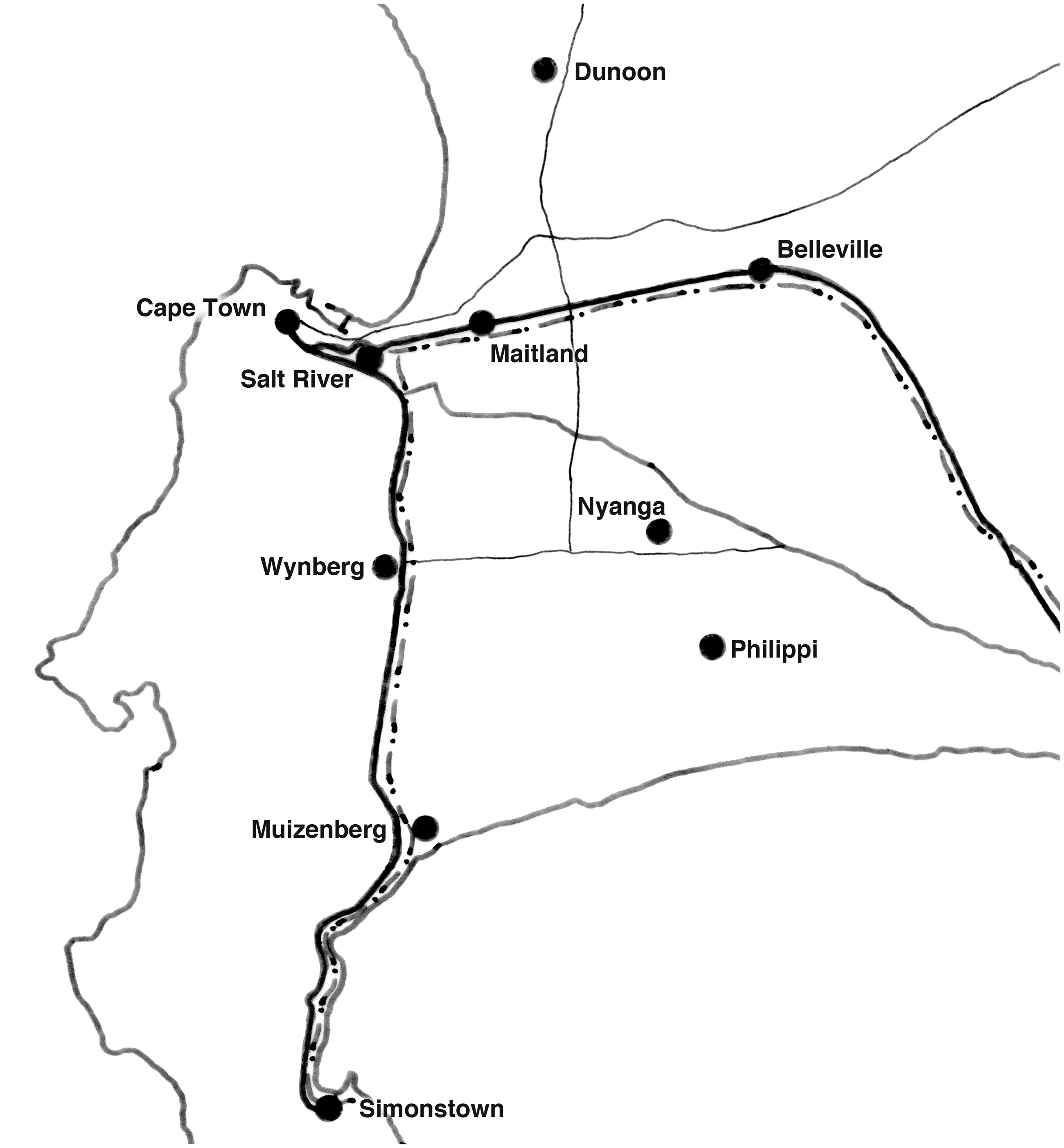
Schematic map of the Cape Town Metropolitan area.
Salt River is located in the primary north–south transport axis in which part of our research locates. This historic metropolitan spine remains an active transitory infrastructure of transport routes and public transport interchanges where focused hubs of transaction economies have emerged. Because Woodstock–Salt River was designated under apartheid as an area for manufacturing and light industrial, it escaped some of the strictures of the Group Areas Act and accommodated varied claims to space. Since the late 1990s, a slow process of gentrification has occurred, largely in the Woodstock area in relation to direct routes into the CBD, whereas parts of the Salt River area that abut the railway line have escaped more pervasive gentrification. As an interstitial area, it has provided rental space in the city for migrant groups, and while migrant settlement patterns within Cape Town’s metropolitan axes have been described as concentrated, closer examination suggests how access in these spaces is produced between and among varied social actors (Tayob, 2019). One way of surviving in this increasingly buoyant property market is through subletting shared and subdivided space. We think through the spatial nature of these practices as part of a wider urban process of claiming strategic urban space (Rubin et al., 2020) that is not with its exploitations and the intimate navigations between affordability and safety that it incurs.
Between the active hubs of Salt River Station and Cape Town Central Station we met with women engaged in different forms of self-employment. Key to their narratives of life and livelihood are their careful movements across the city. The everyday formations of xenophobia and femicide in South Africa require exacting calculations of how best to avoid violence, and demand vigilant navigation across the cityscape. Tété’s desperate reference to ‘too much xenophobia’ at the start of this paper, demands that we heed Maluleke’s (2018) concern that xenophobia is seldom examined in terms of its gendered affect, and we explore how women’s strategies to be safe are spatialised. Tété’s move out of the townships following xenophobic attacks in 2008 was followed by her relocations in Salt River, where she is required to pay between two-and-a-half to three times the equivalent rental they would pay in the townships. While it was recounted that a monthly rental for a room in the township, ‘is about R1000’ (70 USD), rooms rented in Salt River are rented from R2500 (175 USD). Tété clarifies, ‘Me, I stay in one room with three kids and my husband. It’s R3000 each month. All foreigners stay here.’ Making the monthly rental payment is a constant juggle, since work and earnings are unstable. Tété explains that her weekly profits are variable, ranging from R200 to R450 in a week, and in a month she hopes to earn around R1500 (105 USD). To put this in context the ‘National Minimum Wage’ rate set by the South African Department of Employment and Labour in February 2020 is R20.76 per hour (1.25 USD), yielding R150 per day (10 USD), or more than twice what Tété earns. When we ask Tété how she balances saving her capital for her shop while meeting rental payments and buying food for her family she says, ‘I eat half, half I keep.’ She spends around R500 a month on food for the family, and her husband’s piecework that brings in around R2000 goes towards the rent.
There are various trade-offs that Tété makes as part of the apportionment process, including working in close proximity to home and sending her kids to what she regards as better schools. One way in which affordability is maintained in sought after space in areas perceived to be safer, is through subdivisions in order to meet the demands of the urban property market. Owen, for example, describes how working-class migrants from the DRC who live further down the north-south axis in Muizenberg, develop a system of ‘bed-space’ and ‘sleeping in rotation’ (2014: 34). For Tété and her household of five, sharing one room translates into the shrinking of personal territory, where relaxation, homework, eating, sex and changing, are all confined to this tight space. Such sub-divisions are part of substantial shifts in the small-scale rental housing sector in South Africa, including the prominence of subdividing and renting out of additional space on the part of both homeowners and small-scale rentiers (Rubin et al., 2020). These varied subdivisions of domestic space interact with the housing market and produce dense spatial arrangements of urban life.
However, there are complex nuances to the increase of shared domestic space and shrinking of private space, which requires cultural and gendered understandings as revealed in our conversation that follows. Tété acknowledges that working in close proximity to home has yielded significant advantages, allowing her to effectively budget her time between her pavement and household spaces. Tété also talks about her desire to make a better life for her children. She tells us about her eldest child who she describes as a good student: I finish here in the afternoon at 3.30. My daughter is home from school then. I want to be home for her to do the homework. The homework is hard, and she must have a nice time to do it.
How the ecology of violence shapes apportioned space and time
When my asylum document is finished, I must go to the Home Office. I get six months. You must go at 4 o’clock in the morning. Maybe you can then enter at 10 o’clock. The children must also have a paper. It is very difficult to renew because everyone is standing outside in the rain or sun.
Mary came to Cape Town in 2009, leaving the DRC when she was in the last year of her schooling. Her account of the disruptive nature of having to continually validate her asylum status is integral to South Africa’s asylum system, and the women we spoke with repeatedly referred to being tethered to the erratic bureaucratic processing of permit renewals. The ‘South African Refugee Act 130 of 1998’ lays out a threefold sequence of permits: from the registration of arrival (a non-renewable Section 23 permit); to the registration of the asylum claim (a six-month Section 22 permit with possible six-month renewals in order to assess asylum status); to the recognition of refugee status (a Section 24 permit allowing a two-year stay that is then subject to regular renewal). A refugee holding either a Section 22 or 24 permit is, in theory, entitled to work, as articulated in the provision that, ‘a refugee is entitled to seek employment’. Yet within the statutory coherence of the sequencing of permits, is a system overwhelmed with ongoing uncertainty (Amit, 2011; Amit and Kriger, 2014). In our conversation with Vince at PASSOP, he confirms that while the NGO works with migrants from all over Africa, their office is frequented mostly by those from the Congo (DRC), Zimbabwe and Malawi. Vince describes the experience of having to regularly renew an asylum or refugee permit: Vince: Renewing the permit is generally a nightmare. It’s never a one-day thing. It also depends on where you renew your papers, since you must return to where they were first issued. If you have since moved you have to go back. This costs money and time which few people have. And if you are running a business it’s a knock. Researcher: It cannot be renewed in Cape Town? Vince: Wherever you filed your asylum is where you have to renew. And sometime offices get closed, which causes more complications. When there was a refugee centre in Cape Town, permits were issued for up to four years or a minimum of six months. With a permit of up to four years migrants were able to access the bank, open an account, and get a loan. But for most, at the end of the four years, they were given a short-term permit that caused a loss in the bank account for some. In 2012 the Cape Town office in Maitland was closed. Those who came to Cape Town after 2012 had to go to Joburg, Durban or Port Elizabeth to start the process. Applicants are only accepted at the refugee reception offices on certain days [ … ] to get a Section 22 permit. That means that, if for example you are a pregnant woman, you would have to travel while pregnant. Some women have to do this with newly born babies. They often have to wait outside the office from very early in the morning, or sleep outside overnight. Even once you have that permit, you likely have to travel back and forth to renew it. [ … ] This kind of travel is precarious, and means that refugees are less likely to be able to stay in permanent employment because who is going to give you time off – often at least a week or more – every couple of months, to renew a document that many employers don’t know much about (cited in Moult, 2019: 44).
In December 2019 the South African government tabled the Refugee Amendment Act, substantially curtailing the grounds for applying for refugee status. William, who works with Vince, comments particularly on the implications for gender and sexuality: William: With the new law that came through in December, it’s very difficult to claim asylum status based on politics: there must be other issues. In our work, 85-90% of who we see, is where asylum is based on politics. Vince: We’ve also noticed that it is harder for women to come out [on their sexual orientation], and it’s also harder to report a [sexual] violation.
From this understanding we think though the specific ways in which xenophobia infiltrates the day-to-day life of refugee and asylum-seeking women in South Africa (Maluleke, 2018). From the pavement of her itinerant shop, Tété tells us, They don’t want us. This country, she don’t like us. Sometimes the law enforcement comes here and chases us. The owner of the shop says, ‘No, I give her permission to be outside my shop’. The shop owner is nice. I’ve lived here for ten years, so she knows me now and she knows my problems.
The violent, organised xenophobic attacks that occurred across South African cities in 2008, 2015 and 2019, have been primarily directly at street traders. Varied perspectives on the systemic nature of orchestrated xenophobia include how anti-immigrant rhetoric is circulated through the elite hierarchies of the media and state with antecedents in apartheid power structures (Nyamnjoh, 2006). These extend to manipulations of localised political power struggles in contexts of inequality (Misago, 2019). In the longue durée of insidious categorisations of belonging in apartheid South Africa, the restrictive categorisation of belonging through the regulation of migration and labour offers a further significant perspective. Neocosmos (2006: vi, 2) exposes ‘the centrality of citizenship in understanding the phenomena of xenophobia’ within historic state practices of aligning racialised designations of belonging with foreignness and irregularity. Neocosmos (2006) traces the connected formations of the ‘foreign native’ and ‘native foreigner’ in South Africa’s deep dependency on and subjugation of inter- and intra-national labour, exposing continuities within the biopolitics of work and citizenship in post-apartheid South Africa. Such regulatory regimes are underscored by institutionalised ethno-racial categories and uneven applications of the law that have a postcolonial continuity (Mamdani, 2012). The twofold effect is that ‘irregularity’ is tied to both a nativist construction of citizenship and a pejorative construction of work outside of formal employment. In South Africa, the right to work for migrants, asylum seekers and refugees as expressed in self-employment, is endorsed in rights (Fish Hodgson, 2020) and case law (De Jager, 2015), but remains volatile in public discourse and policing (Vigneswaran, 2013).
Irregularity is a governmental mode of maintaining outsider status that mediates the life and livelihoods of refugee and asylum-seeking women. This emotive, orchestrated fragmentation of what it means to be human permeates a public and explicitly urban sphere of hostility, with xenophobia integral to the maintenance of everyday bordering. Within this ecology of violence, the establishment of refugee and asylum impermanence in the day-to-day discretionary administration of South African refugee law, pulls refugee and asylum-seeking women into an intimate relationship with the state (Oswin and Olund, 2010). This legal, material and psychological intimacy exerts affective and corporeal power, constituting gender in how and on what grounds asylum is claimed and legislated. Gendered apportionment is further feminised through the conditions of waiting for permit renewals, while negotiating a working life across the city.
Apportionment and the budgeting of a working life
We met Mary at the station deck, a large concrete platform above Cape Town central station. The station deck is a large area comprised of many repurposed shipping containers, hosting a mix of business activities, from cooked and fresh food, to clothing, and hair styling. The deck is managed by the City of Cape Town who administers the informal trading permits. When we met Mary, she was sitting in a strategic position and holding a small poster with images of various hairs styles to catch passers-by. Mary came to South Africa in 2009, and on arrival in Cape Town she was informed that the station deck was a good place to find work. She explains: Mary: It’s hard to get a shop here. Most of the shops are foreigners. For these shops here you pay R1250 for a month for a salon, and those ones back there, where there is no water, you pay R800. Researcher: And do you work on commission for a salon? Mary: If I get a customer, I bring her to the salon. For R100, I will get R10. I get maybe five people in a day. Friday and Saturday is better. Researcher: How often do you come in to work? Mary: I come three days a week. I can only come in between my husband’s work. My husband is security. My son is two years. If the father is working at night shifts and is off in the day, then I can come. The father will look after him. We also have an older boy. Lots of Congolese do salons, but really most people don’t own the salon, they take a place in the salon and must pay. If a plait is R100, then you take R60 for yourself and give R40 to the owner, or sometimes its 50/50.
While gender and foreign status intersect to produce available work, travelling to work to avoid danger en route is a further consideration. Both Mary and Cilia mention to us their careful choices around modes of transport and travel times when getting to work, with the price of safety given priority above the cost of the ticket. Train travel is faster and cheaper than travel by bus, but riskier. Cilia tells us about her journey between home and work, I live in Plumstead and I use the bus to get to work. I pay R11.50 one way, but it depends on the timing, from 9am to 3 pm it’s cheaper to travel. The train is R8, but the bus is safer.
Cilia came to Cape Town following her husband who was a soldier in the DRC, and clarifies that they selected Cape Town because, ‘The violence is everywhere, but here it is less, and we live in the urban area, not the location.’ Of all of the women we spoke with Cilia is the only one with both refugee status, and a tertiary education, having obtained a bachelor degree and worked as an accountant in the DRC. Her class and status positions make visible for us the discrepant nature of access to the state and the city across varied refugee and asylum seeker groups. As conversations with Cilia’s story unfolded across 2020, we saw the crucial significance of her access to state support in a period of unexpected uncertainty. When Cilia first arrived in Cape Town she found work in a factory for three years, but her wages remained low and she struggled to look after her children. Together with family members, she now works in a micro business where she has more flexibility. They export and import small goods between the DRC and Cape Town, including anything from a pressure cooker to a TV to food. Their one-room office is located in a run-down modernist tower black on the foreshore of Cape Town’s CBD. When Cilia’s husband arrived in Cape Town in 2005, he was granted full refugee status, which subsequently extended to Cilia and their children. Despite studying for a degree in economic development at the University of the Western Cape, he struggled to find work, and was eventually employed in a hotel reception. In a phone conversation with Cilia in May 2020, she confirmed that they were coping in lockdown because of regulated protections that they were entitled to. Her husband’s employment contract entitles him to access the Unemployment Insurance Fund, from which he was given R4000 in April and then paid by the fund again in May. In addition, Cilia received a R300 child support grant from South African Social Security Agency for each of her four children for every month of lockdown, and in May the state added an additional once-off R500 carer’s allowance. Because of the linked recognition of refugee status and of formal employment, Cilia’s family’s position during lockdown was markedly different to Tété’s or Mary’s.
Tété, had to close down her cooked food stall from late March to early June. She expressed her acute situation over the phone, ‘Right now, me I am not selling, my husband is not working. Eish! This lockdown should end quick. It’s gonna kill us’. She confirmed that her landlord had cut the rental payment by half and although they had met the payment in April, they were unable to meet it in May. Tété clarifies, ‘I have me R800. I don’t have food, I don’t have money for rent. So I must buy food, I must pay rent. The problem is with rent for me … The rent make me too stressed.’ Tété was unable to claim for any state grants and like many in her position, has had to rely on support schemes run by emergent solidarity campaigns and established activist groups. Tété’s account reveals how the insecurity of her status and right to work affects her urban citizenship. Through the ‘wearing down of life’ (Smith and Vasudevan, 2017: 212) it becomes evident how exclusionary and everyday violence differentially pervades the quotidian life of refugee and asylum-seeking women. Through tracing the day-to-day budgeting of a working life, we advocate for an understanding of apportionment as an adaptive repertoire, but one punctuated by stringency and careful navigation in a context where human status is overtly regulated on the basis of citizenship and gender.
Conclusions: The gendered apportionment of asylum, work and violence
Our idea of apportionment is expanded through the grounded struggles, juggling and trade-offs that refugee and asylum seeking-women from the DRC make in Cape Town. Their practices, formed in response to exclusionary and everyday violence that limits their access to state and city, are carefully attuned to navigating and living with violence and uncertainty (Datta, 2016). Our paper analyses apportionment as simultaneously an exclusionary condition of limited access to rights and resources that positions the racialised and gendered migrant as the pejorative outsider; and as an embodied repertoire refined by migrant women to negotiate the liveability of their lives across national and urban borders. We have considered the particular ways in which apportioned livelihoods unfold through how space and time is differentially allocated and lived, helping us understand the intersectional nature of urban precarity, and women’s claims to the city through their day-to-day reckonings with violence.
In concluding we reflect on three ways in which gendered apportionment helps us to see the feminised processes of living with the discriminatory structures of state and city. First we turn to historically locating the city, connecting the structural impositions of racialised and classed segregation with contemporary claims to safe space in a context of extant xenophobia. Claiming a place in the city requires paying a premium for strategic areas regarded as relatively safe. These negotiations entail balancing the diminishing nature of one’s domestic space and paying a high rental, despite limited earnings. We learn how the process of apportionment is acutely classed in that premium access negotiated through meagre earnings is particularly onerous. This spatial precarity is revealed by Tété, whose foothold in the property market is tenuously based on the extraction of a high-value, cash-in-hand rental to secure her relative safety, without reciprocal contractual safety nets. Further, the strategy to share space is feminised in the arrangements of densely occupied domestic space over which co-residents have limited control. Here the fear of sexual violation is addressed in strategically arranging daily routines and proximities between workplace and homeplace.
Second, we connect apportionment to irregularity as a governmental mode of maintaining outsider status, one that mediates the everyday life and work of refugee and asylum-seeking women. We build on how asylum impermanence is disciplined by the day-to-day discretionary administration of South African refugee law, highlighting the legal, material and psychological intimacy that pulls asylum-seeking women into an intimate relationship with the state (Oswin and Olund, 2010). The visceral and psychological processes of waiting for recognition is sustained precisely in the constant requirements of an unstable citizenship and its everyday allotted and diminished space and time. The wider reach of an ecology of violence based on xenophobia further conditions their everyday negotiations to avoid official and unofficial policing. This underscores Maluleke’s (2018) assertion that we need more detailed understandings of how xenophobia affects women and their everyday negotiations of belonging in the city. We have emphasised the need for the specific analysis of how space and time are apportioned.
Finally, the prosaic practices integral to the budgeting of a working life not only shows the fluidity between public and private space and life (Datta, 2016), but also adds differential layers of embodiment to our understanding of the capricious practices of working the city. The notion of the hustle as a means of contending with precarious working realities tends to be articulated through masculine and youthful repertoires. Apportionment suggests another array of repertoires, also agile, but embodied by women through modalities of stringent budgeting, the artful juggling of multiple responsibilities and the persistent pursuit of small and essential claims to space. We think through the entangled nature of ‘ambient and unexpected adversity’ (Amin, 2013:141) to position the impact of the Covid-19 pandemic on the lives of the women we spoke with, noting how crucial class and citizenship status are for holding life together. We record that Tété’s hard won savings were eroded in the first weeks of lockdown, and her household was placed under extreme pressure without access to state support. Tété has returned to her shop on the pavement in Salt River, where she continues to make life and livelihood workable. Her apportionment can be understood as a feminised process, in a profoundly discriminatory context of (im)mobility that extracts significant sacrifice, and as an attuned repertoire of working the city.
Footnotes
Acknowledgements
The authors would like to thank the editor and reviewers for supporting us. We are immensely grateful to our research participants for sharing their time and insights. Thank you to Caroline Skinner at ACC and Alana Potter and Kelebogile Khunou at SERI for co-hosting our workshop, which provided a key steer in our thinking.
Declaration of conflicting interests
The author(s) declared no potential conflicts of interest with respect to the research, authorship, and/or publication of this article.
Funding
The author(s) disclosed receipt of the following financial support for the research, authorship, and publication of this article: This work was supported by the Leverhulme Trust (grant number PLP-2017–189).