



Abstract
Legal geographers have recently highlighted the importance of attending to the interaction of time and space to understand law and its enactment. We build on these efforts to examine the spatiotemporal influences over the processes by which asylum claim determination procedures in Western industrialised countries seek to reconstruct past events for the purposes of deciding refugee claims. Two ‘common-sense’ beliefs underpin this reconstruction: that the occurrences leading to a fear of persecution can be isolated and that the veracity of an asylum claim is objectively independent from the process of uncovering it. We critically interrogate these assumptions by conceptualising the fears of people seeking asylum as Deleuzian ‘events’. Basing our argument on 41 interviews with people who have previously claimed asylum in the United Kingdom and firsthand accounts of asylum appeals, we explore the folding together of asylum ‘truths’ and the spatiotemporal processes by which they are arrived at, arguing that refused asylum claims are not simply detected by the process – they are produced by it.
Introduction
Who can be considered a refugee? According to Article 1(A)2 of the United Nations’ 1951 Convention, a refugee is a person who has fled their country due to a well-founded fear of persecution for reasons of race, religion, nationality, membership of a particular social group or political opinion. A person who is legally considered a refugee, therefore, is usually someone who has sufficiently proven their well-founded fear to an authority. Such an authority might be a supra-governmental organisation such as the United Nations High Commissioner for Refugees or the immigration and asylum department of a national government.1,2
In countries that are signatories to the convention, the two major moments that accompany the refugee determination process are usually an interview with a government representative and, if the initial decision based on the interview is appealed, a legal reconsideration by a judge. In 2016, Europe made more decisions about refugee status based on asylum interviews than ever before. Over 1,100,000 such decisions were made, of which just over 60% awarded some form of status recognition to the applicant (Gill and Good, 2018). In 2017, the number of decisions based on appeals also exceeded previous European records. Nearly 300,000 such decisions were made, with some form of recognition accorded to the appellant in over 30% of cases (Gill and Good, 2018).
The key challenges that people seeking asylum face during these two stages is to narrate their experiences in such a way that their cases appear credible and eligible to the officials and the judges presiding over the process. Like other legal decision-making systems, the asylum process operates under the assumptions that a past event or series of events can be determined, verified as truthful and either matched or contrasted with the legal definition of a refugee. Our aim is to critically interrogate these assumptions by attending to the fears people experience(d) – not by considering them as happenings locked in the past but by conceptualising these fears and their circumstances as ‘events’ (Deleuze, 2004). This approach argues for a need to trace the processes and practices in the present that interpret, mould and transform our understanding of the past.
Historical investigations are a quintessential function of the law. Courts, as well as other systems of dispute resolution, regularly contend with competing versions of the past and are expected to decide which version to accept. We hypothesise that the spatiality of legal systems broadly defined – including their spatial imaginaries and vocabularies, as well as more concrete spatialities such as the architecture and layout of interview rooms and courthouses – acts to both constrain certain possible reconstructions of the past in the present and promote others. We join with other legal geographers in foregrounding the spatiotemporalities of law, and in particular in thinking through how time and space can be theorised together in legal geography (Braverman et al., 2014; Valverde, 2014, 2015). We make these arguments by ‘eventalising’ the asylum process. Eventalisation can be performed in order to undermine common-sense thinking and banal generalisation about the current state of affairs (Colebrook, 2002), or to contest what are seen as ‘bare facts’ (Fraser, 2010). It means rediscovering the connections, encounters, supports, blockages, plays of forces, strategies and so on, that at a given moment establish what subsequently counts as being self-evident, universal and necessary. In this sense, one is […] effecting a sort of multiplication or pluralization of causes. (Foucault, 1996: 277–278)
We begin by setting out the key conceptual resources that facilitate our re-reading of asylum determination, drawing on Deleuze’s theory of event and recent interpretations of his work. Next, we set out the asylum policy context in Britain. Following a description of our methodology, we go on to characterise the spatiotemporal politics of recall that takes place and which people seeking asylum must navigate and overcome as they seek to put forward their asylum claim.
Multiplicity and actualisation
Space-time in legal geography
A central tenet of legal geography is that law is always ‘worlded’ in some way: space is inescapably constitutive of law and its enactments (Blomley, 2016; Braverman et al., 2014; Delaney, 2015; Philippopoulos-Mihalopoulos, 2018). Thus, the principal concern of legal geographic scholarship is in revealing and interrogating the countless ways in which ‘law makes space’ and ‘place makes law’ (Robinson and Graham, 2018). Often this takes the form of attending to the co-constitution of everyday life and legal logics and influences (Sarat and Kearns, 2009). Another direction in which socio-legal scholars and geographers have taken their examination of the co-constitution of law and space, however, is towards the formal machinery of legal systems, including phenomena like hearings, police interviews, courts and trials (see, for example, Mulcahy, 2010; Simon et al., 2016). Legal ethnographers have also animated our understanding of the internal dynamics of courtroom spaces (Rock, 1993), the flows of files and other materials through courts (Latour, 2010) and the micro-geographical arrangements of tables and chairs in hearing rooms (Griffiths and Kandel, 2009). But courts are changing spatially – they are digitising for example, with implications for how court processes are experienced (Rowden, 2018), and international courts are gaining influence and attracting media coverage. These changes have provoked a renewed engagement between legal geography and legal systems that often dwells on the performative significance of court processes (Jeffrey, 2019).
There is also increasing awareness of the importance of time to legal experiences and access to justice among socio-legal scholars. Court and juridical processes are often concerned with what happened or, as Valverde puts it, the specific temporalities of ‘who done it’ (Jeffrey, 2019: 12). Attributing blame, determining credibility and consistency of accounts, and investigating prior actions are inherently temporal because they necessitate that decision-makers and the court delve into the past. Greenhouse’s (1996) seminal intervention established the ways in which law is not passive with respect to time but actually creates and orders it through a set of techniques including time limits, commencement dates and eligibility periods. More recent work has emphasised the need to move beyond ‘container notions of time’ in order to foreground the co-produced entanglements of time and justice (Beynon-Jones and Grabham, 2019), even if justice systems are often insensitive to the effects of their own scheduling (Cohen, 2018). Delaney (2015), for example, reminds us that the law is a process (not a thing) and that, as such, it involves ‘numerous actors, divergent institutional settings, competing ideologies, interests, motivations, and capacities unfolding over time’ (p. 101). As a result of this becoming of law, the potential for ‘slippages, mistakes, mis-transmissions … and all manner of evasions’ (p. 101) is introduced. In other words, the very temporality of the law makes it contingent and provisional.
Despite the advancement in conceptualisations of law and time, however, Valverde (2015) argues that legal geographers can and should increase efforts to bring time and space together as they consider the legal. She notes that geographers have long-recognised the challenges and dangers (not to say the impossibility) of considering space without attending to time. Valverde’s frustration is that legal geography has only engaged with time superficially: primarily by considering historical spatial configurations of law in space. Part of the problem is the counter-posing of space to time, rather than attending to their mutuality in the production of everyday realities. As a result, the very theorising of space and law that legal geographers have undertaken ‘marginalises the temporal’ (Valverde, 2015: 58). All too often ‘time is reduced to history’, argues Valverde (Valverde, 2015: 55), which overlooks other aspects of ‘temporality’s many flows and dynamics’ (Valverde, 2015: 53). There is consequently a need to not only find the means with which to understand the effects of temporality in legal spaces (Braverman et al., 2014) but to theorise space and time together in investigating legal phenomena (Valverde, 2015).
Valverde (2015) offers Bakhtin’s concept of the chronotope which explicitly considers time and space simultaneously and is sensitive to the influence of one over the other. This exposes the ways in which assemblages such as courtrooms are not merely spaces, but specific ‘spatiotemporalities’ (Valverde, 2015: 70). Courtrooms, Valverde explains, are only courtrooms at particular times when the court is in session. An alignment of legal time and legal space must occur in order to produce the court, and the court cannot be understood either spatially or temporally in isolation.
A small but growing set of literature also focuses on the role of time and space in the context of asylum and law. Gorman (2017) has examined how shifting interpretations of the definition of refugees function as a means of ‘interpretative control’ (Gorman, 2017: 36). By examining the legal cases of two Salvadorean men whose claims for asylum in the United States were determined in the 1980s, Gorman is able to show how legal decision-makers tactically reinterpret legislation as a way to ‘respond to presence of specific groups of asylum seekers within the U.S. to prevent legalisation and deter future migration’ (Gorman, 2017: 44). As such, her work underscores the temporal plasticity and pliability of the law, demonstrating how it is far from stable in either time or space. In addition, Coutin’s (2011) work examining the history of access to political asylum by Central Americans arriving in the United States during the 1980s and 1990s, as well as the deportations they experienced in the 2000s, traces what she terms the law’s ‘archaeology’. By attending to the ‘complex temporal character’ (Coutin, 2011: 570) of law, Coutin is able to draw attention to the way legal phenomena interact with legal pasts and futures by influencing legal innovations, being retroactively reinterpreted in light of new developments and ‘in the case of court decisions and statutes, [being] projected into the future’. Most valuably for our work, Coutin highlights the role of anticipation: ‘Examining how law is constructed over time’, she writes, ‘reveals the multiple ways in which law not only seeks to address the present but also reconfigures the past and haunts the future’ (Coutin, 2011: 592).
It is this view of the law as a temporally complex entity that precipitates multiple interactions and effects across past, present and future that we take up in this paper. We throw into relief the spatiotemporality of the processes of recall and prediction in legal settings by utilising Deleuze’s concept of the event. We see this as a complementary conceptual starting point to Valverde’s chronotopes (Valverde, 2014, 2015). Our argument is that the bearing of both the past and the future on the present can be better understood through the theory of event. In addition to temporal, these processes are also always spatial. Recall and prediction are spatially constrained and produced by the legal settings in which they take place, thus distributing agency concerning the process of remembering to more actors than solely the recaller. It might, then, be said that our contribution is to recognise that recollection is a particular type of chronotopic process within legal studies. In order to fully develop the analysis, however, we refer most frequently to Deleuze-inspired concepts in what follows, since these allow us to simultaneously hold on to the multiplicities of the past and articulate the ways in which the physical state of affairs in the present affects understandings of what has previously occurred. We develop this argument further in the following section, where we introduce the event.
Event
The concept of the event has been used to challenge the notion of irrefutable facts that have come to dominate common-sense accounts of the world (Fraser, 2010). For Deleuze (2004), an event does not refer to the physical action of an occurrence, rather it is the expression of the physical state of affairs such that the latter gains meaning – a particular value or sense (Williams, 2008). Sense in this case refers to the boundary between things and words, yet can be reduced to neither (Halewood, 2009). Deleuze draws on Bréhier’s example of a knife cutting through skin in order to make this distinction clearer: When the scalpel cuts through the flesh, the first body produces on the second not a new property but a new attribute, that of being cut. The attribute does not designate any real quality … it is, to the contrary, always expressed by the verb, which means that it is not a being but a way of being. (Bréhier, 1928 in Deleuze, 2004: 8)
The event can be said to arise out of a state of affairs in the world and have corporeal causes, yet care must be taken not to consider the event as wholly caused or constituted by these. Concerning famous historical events, such as the 9/11 attacks on the twin towers and the Pentagon (Lundborg, 2011), the pre-existing social, cultural, economic or political conditions and even the specific world-changing physical occurrences fail to capture the ‘eventfulness’ of these moments (Anderson and Holden, 2008). Attending solely to these circumstances would falsely plot such events on path-dependent timelines, thereby failing to attend to the various ways of becoming that these events have, could have and will undergo (Kaiser, 2012). The productivity of the event must instead be taken into account; sense is not a faithful representation of a singular reality that is ‘out there’, passively waiting to be observed and reproduced (Lundborg, 2009).
Deleuze views the event as being dynamic and creative; the event does not exist, rather it ‘subsists’ (Halewood, 2009). For the past or future to become linked to a present and a singular becoming to be translated into a form of ‘being’ (Lundborg, 2009), a process of actualisation must occur from the domain of the virtual (Beck and Gleyzon, 2016). The virtual here refers to ‘a realm of potential’ (Massumi, 2002: 30, emphasis original). This realm of potential includes the ‘ideas’ or ‘multiplicities’ that set out the many ways in which a society, language or state of affairs can exist (Protevi, 2009), as well as the affective intensities that could become triggered in the present (Kaiser, 2012). In turn, the process of actualisation refers to the ‘will’ for an individual action or expression to emerge from the potential and the means with which the potential is translated into what is (Lundborg, 2009; Massumi, 2002).
The requirement for the event to become actualised does not, however, mean that it exists outside of time. Deleuze (2004) instead maintains a distinction between two dual spatiotemporal figures: Aion and Chronos – with the pure event residing in the former. Aion is conceived as being a line that travels in both directions at once, between the future and the past, while always eluding the present. As a result, it can be said that the event never takes place in the present, instead the event is ‘always and at the same time something which has just happened and something which is about to happen; never something which is happening’ (Deleuze, 2004: 73). In contrast to Aion, Chronos is understood as circular and is the time of interlocking presents. Despite their dualism, however, these two temporalities are not opposed to each other, rather they (inter)relate to each other paradoxically (Cockayne et al., 2020 discuss this interrelation of dualisms through the spatial figure of the Möbius strip). Thus, while the event subsists in the paradoxes of the virtual, the temporal actualisation of the event and the realisation of an event takes place in the present time of Chronos – requiring its ‘incarnation into the depths of acting bodies and its incorporation in a state of affairs’ (Deleuze, 2004: 73). Put another way, the past does not simply become the present such that it is separate from the present; instead, past (and future) become contained in the present (Colwell, 1997).
The virtual, however, can never be fully contained. As a result, the translation of the potential into what is does not define the event in static terms – bound forever in space and time – far from it (Colwell, 1997). Instead, there always remains a part of the event that has not been grasped in its actualisation (Lundborg, 2011). While there is the capacity for an event to become actualised in new ways from the virtual, the event ‘retains an openness to reinventions’ (Fraser, 2010: 73). In choosing to understand asylum decision-making in terms of multiplicity, actualisation and eventalisation, therefore, our aim is to demonstrate the ways in which a person’s ‘well-founded fear’ is not locked into the past but is a process of becoming, as it is connected to various new bodies and settings throughout the asylum seeker’s legal and physical journeys in the UK.
In utilising the event as a lens through which to understand asylum decision-making, we follow Kaiser’s (2012) assertion that what can be considered an event need not only refer to well-known historic or revolutionary occurrences. Berlant (2011), for example, has criticised the often-melodramatic language that is frequently used by event theorisers to describe shattering moments of (global) change and which, as a result, frequently overlook aspects of the event that are subtle or even ordinary. Moreover, events do not unfold separately from the reach of government, instead ‘what constitutes an event as event is enfolded with the life of apparatuses, so that nothing a priori can be said about ‘the event’ and its relation to government’ (Anderson and Gordon, 2017: 164, emphasis in original). At times, the event can produce only incremental change, especially where the transformative potentiality of the event is quickly secured by state apparatuses to control and minimise its potential (Kaiser, 2012).
Credible subjects
Although each asylum claim in the UK is treated as unique, all claims will pass through the same initial stages of the asylum determination procedure. Following a person’s request for asylum, they will be scheduled for a ‘screening interview’. In most cases, only general information concerning the applicant and their fears of persecution are sought at the screening interview. Following the screening interview, people seeking asylum can expect to conduct an ‘asylum interview’ during which they will be expected to answer detailed questions concerning their reasons for claiming asylum, as well as background questions to demonstrate they are from where they say they are from.
Following these interviews, a Home Office caseworker will provide the government’s decision in writing on whether an asylum claim meets the requirements for refugee status. Every person seeking asylum is entitled to appeal a negative decision made by the Home Office before a judge. In the UK, this takes place at the Immigration and Asylum Tribunal. According to official statistics provided by the UK government, the average success rate at appeal between 2015 and 2020 (inclusive) was 38.2% 3 (a significant increase on the average between 2010 and 2014 of 26.7%). In other words, almost two fifths of the government’s refusal decisions that were contested between 2015 and 2020 were found to be inaccurate.
The burden of proof is notionally relatively low in asylum claims. The person seeking asylum needs to prove only a ‘reasonable degree of likelihood’ of future persecution (Thomas, 2011: 42). While errors of law are handled at the Upper Tribunal (for example, if it were accepted that an interpreter during the appeal was biased), both the credibility of the person seeking asylum and whether or not their fear fits within the boundaries of the Refugee Convention are the key deciding factors at the initial asylum decision making stage and at the First-Tier Tribunal (see Figure 1). 4 A person’s credibility is determined through an assessment of the likelihood that their fears of persecution, as recounted in the asylum interview, are genuine. Authenticity is frequently measured through consistency or, rather, a lack thereof. Home Office caseworkers are required to analyse asylum interviews and search for inconsistencies in the narrative account, or to search for inconsistencies between the person’s recollection of events and information contained in Country of Origin Information documents, the screening interview, other statements made to Home Office officials or information contained in documents held by the person seeking asylum (Home Office, 2015).
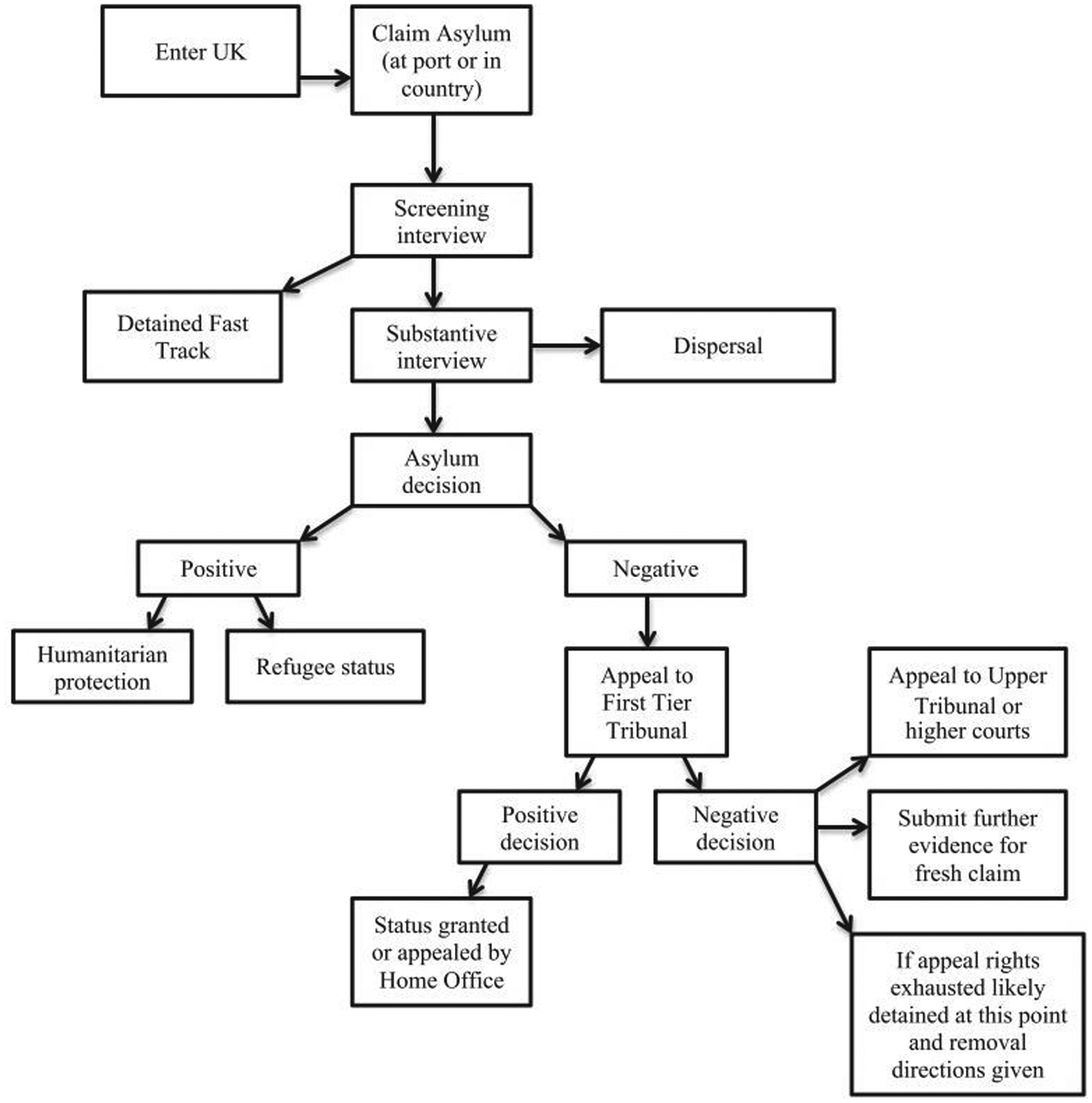
Asylum determination process in the UK (Burridge and Gill, 2017).4
There have been numerous challenges against the Refugee Convention and how it is applied in Western states – to the extent that some consider the overly-stringent enactment of immigration law to be producing a ‘spectacle of migrant illegality’ (De Genova, 2013: 1180). Researchers have critiqued the ‘categorical fetishism’ of the Convention and the requirement for claimants to prove that they as individuals are personally at risk (Crawley and Skleparis, 2018). As Coutin (2001: 63) remarks, asylum law as it is applied makes highly problematic ‘assumptions about agency, the individual, and the state that derive from liberal theory’. Our work builds on these critiques, unsettling the assumptions that support the asylum determination process.
Methodology
We draw on interviews with 49 adults who had either sought or were still seeking asylum in the UK between 2014 and 2015 from a wide range of different countries, such as Uganda, Sri Lanka, DR Congo, Iran and Eritrea Men and women were roughly equally represented in the sample and the majority were in their 20s or early 30s. The majority of the interviews took place in London, Glasgow and Bristol. Gaining access to these interviewees was challenging. We were, however, able to capitalise on over a decade of advocacy and refugee activism in the UK to arrange a series of interviews, which then also allowed us to snowball from these contacts to the rest of the research participants.
Most of the participants that we interviewed had received some form of legal support, though they were not necessarily represented at their appeal by a lawyer. Some participants, for example, mentioned lawyers assisting them during their substantive interview or meeting lawyers to discuss their case prior to appealing. Others talked about multiple solicitors and barristers they had dealt with, sometimes over the course of several hearings (for example, if hearings had to be adjourned). Given these sources of complexity in the interviews, it is not always clear whether our interviewees had legal representation during the hearings. Determining the proportion of appellants in general in the UK that obtain legal representation is also challenging. While legal aid statistics published by the Ministry of Justice include the overall cost of legal aid, the proportion of asylum appeals that have legal representation is not published. Burridge and Gill (2017), however, provide Freedom of Information Request data that shows an average rate of being unrepresented of 21.4% at all First-Tier Tribunal asylum appeal hearings between January 2011 and December 2012, which gives some indication of the likelihood of being unrepresented among asylum appellants in the UK in the early 2010s. 5
In addition to interviews, we observed 10 appeal hearings from the public viewing areas of three UK immigration and asylum tribunals. Although asylum appeal hearings can be viewed by the public, judges can decide to hold a hearing behind closed doors where the appellant is considered to be particularly vulnerable. Our presence was therefore always made clear to the court upon arrival and clerks would inform judges beforehand which cases we would be observing. Where possible, appellants were asked if they objected to our presence in the courtroom. In each case, it was made clear that our interest was in the court procedures, rather than the facts of their asylum claims. We had no formal role in the hearing aside from observation and were powerless to affect either the outcome or the proceedings in any systematic way.
Observers are uncommon at appeal hearings in the UK (with the exception of law students), however, and judges, legal representatives, interpreters, ushers and security staff may all have been on their ‘best behaviour’ as a result of our presence. Indeed, ‘courtwatching’ has been likened to a form of inverse surveillance used in order to reduce incidents of bias or discrimination by activist groups in various settings (Gill et al., 2014; Gill and Hynes, 2021 ) and, although we remained as inconspicuous as possible, our constant note-taking may have positively altered peoples’ behaviours and actions in the courtroom (Faria et al., 2019). It is also possible, however, that government representatives may have wished to ‘put on a show’ for those observing, performing their roles with more vigour as a result. Following one particularly tense hearing in which the appellant’s credibility was repeatedly called into question, for example, the Home Office Presenting Officer (HOPO) was keen to engage researchers in an informal discussion of their cross-examination tactics after the hearing. It is also possible that our presence may have unintentionally increased appellants’ anxiety, despite our efforts to make clear that our interests were in the court procedures rather than their reasons for claiming asylum. Researchers were occasionally included in the informal conversations that take place between legal representatives and Home Office representatives in the courtroom before judges arrive (appellants were always ignored during these conversations), although at other times we were also ignored completely.
Well-founded fear as event
In what follows, we identify some of the spatiotemporal conditions in the present that can affect the way that events are actualised during asylum determination processes, with a particular focus on how the past and anticipated futures subsist within the present. We then reflect on the ‘stickiness’ of particular actualisations, meaning the difficulty of overturning certain versions of events once they are sedimented.
Actualising the event
The spatiotemporal condition and circumstances of the person seeking asylum can affect their recollection of the events that have led to their migration in multiple, profound ways. If their traumatic experiences were recent at the time of their interview, for example, then the two can be experienced as part of the same overwhelming episode. Marley, who fled Uganda in 2003, described the event of his fear and fleeing as a series of movements over which he had little control and had no predetermined goal in mind. In his account, the movements and moments of the flight, arrival and interview blend together. Heathrow airport’s loudspeakers, government questioning and his experiences in the ‘torture house’ are expressed almost in the same breath: I was in the torture house for about a year. It was gruesome. […] Then [the friends of my uncle] organised my trip, I didn’t even know where I was going. I wasn’t explained anything and was put on a plane. My mind is blowing up, I didn’t know anything. I landed in a huge airport much different from the one I flew up from. Big Heathrow, walking in and there’s speakers everywhere. It hits you and you walk out in the cold and ‘Waaauuw’! And […] everything smelled good and unusual to me. Funny silly things. For someone to come into this overwhelming culture and to be thrust with questions, without even letting them take a rest […] it was just straight away and then ‘Bam!!’ […] it was quite threatening, the interview! […] As a human being, there’s no way you can concentrate with everything happening around you so fast. [i]mages and words do not seem to bear any kind of resemblance. What is seen cannot be articulated in a satisfactory way as words suddenly become inadequate when trying to make sense of what has happened. There is a crack between words and images, and between content and expression.
For Marley, both the new cultural context and the timing of the interview so soon after he arrived in the UK made it hard for him to concentrate and remain coherent during his interview with the Home Office. For others that we spoke to who were interviewed quickly after claiming asylum, their mental states at the time of claiming meant that they struggled to engage fully in the process. I started getting like scared, getting panic attacks … My hands were shaking so much that I couldn’t do anything, I couldn’t even hold … paper in my hand. I wasn’t in the right frame of mind to do anything, [it was] just too draining to do anything. I didn’t have a clear mind, I lost my confidence, lost my concentration.
Around a third of our interviewees also spoke about destitution or homelessness around the time of their asylum interviews. Walking to attend government interviews whilst destitute, or whilst living in places where privacy is not guaranteed, affects the degree of legal, mental, physical and emotional preparation that can be undertaken beforehand. One Ugandan woman in her late 30s recalled that she: Went to my first interview […] then from there […] I had nowhere to stay, […] I was staying in a toilet and from there the Red Cross they took me to sleep in [charity funded accommodation]. I was there for 3 weeks and from there they took me to [temporary government funded accommodation], they gave me a room, I stayed with two people in the room. From there I went to big interview. It was difficult.
The influence of the mental and physical health of people seeking asylum over their abilities to narrative their claims casts a shadow over the legal expectation that they should be consistent across their accounts, which are often given many months apart from each other. Actualisation of past events via the process of recall emerges as precariously contingent upon the spatiotemporalities of the life of the recaller, including their housing situation, the recentness of their experiences and the headscapes they occupy. Actualisations, then, are not simply intentional and purposeful but arise at the intersection of the demands of the present situation and the virtual structure of the past. Even when we intentionally dredge up a memory we do not have control over the way in which the various elements are actualized. (Colwell, 1997, unpaginated, ) [T]hey didn’t even give me any information, they just came up [and said]: ‘Today they are going to do your interview’. But I said, ’You were supposed to give me at least a couple of hours, maybe 12 hours or 24 hours’.
In conceptualising the asylum claim through the lens of event, we can also note temporal inconsistencies in the procedures that attempt to govern asylum events. Here, we refer to imagined future(s) of the event that are anticipated at the point of the initial asylum interview and Home Office decision (see Anderson, 2010; Anderson and Gordon, 2017). Specifically, the future appeal of an asylum determination is anticipated during the asylum interview affecting the actualisation of the event in the present. As around three quarters of refused asylum claims are appealed in the UK, the actions and logics in the present are deployed with regard to an imagined future that exists virtually alongside the present.
There are at least three ways that the future asylum appeal subsists in, and affects, asylum interviews. First, our interviewees reported a high degree of proceduralism in the interview. Questions had to be asked in a certain way so that the judge presiding over the future hearing would not dismiss the interview as non-conforming. Adhering to a protocol is an important way to uphold the rights of those seeking asylum, but it can also make for a mechanical, cold and unfeeling interview. [It] was such a traumatic interview, my first interview, they asked everything on that form for 3 or 4 hours […] it was so gruelling.
Second, the knowledge that most asylum seekers’ cases would be checked seemed to license dubious behaviour at the interview stage. In particular, our interviewees reflected on why they were not asked about certain aspects of their story. Key questions were often omitted by those conducting the interviews (concerning, for example, rape or torture) – with the apparent assumption being made that interviewees would volunteer information concerning past physical or sexual violence at the end of the interview when they are asked if they have anything to add. This arrangement of the interview is detailed by Brian, who was a victim of torture before fleeing Nigeria: [T]he whole interview was tailored, was controlled by the officer that was asking me questions […] She wasn’t asking me anything about medical, she wasn’t asking me anything about torture. So I didn’t know that I can actually tell her.
A third, very different, way in which the possible future appeal affected the way interviews were conducted concerned the depth of questioning at the time of the interview. Specificities about certain narrow aspects of asylum seekers' accounts were sometimes harvested in such detail that it became almost impossible to avoid contradiction in a second rendering of the narrative at the appeal stage. One interviewee described his two-day interview as an ordeal: The first, big interview was two days [long], and the second day [was] like torture … The interpreter said, ‘Don’t be afraid.’ [I said] ‘I am not afraid I am exhausted. Completely.’
The difficulties that asylum claimants experience highlight the ways in which versions of the event are created through the interview process as well as the spatiotemporal conditions of the present that people seeking asylum must negotiate. As the event becomes governed and anticipated (Anderson and Gordon, 2017), a particular narrative is created rather than discovered by Home Office interviewers. Pasts and future subsist in this process. Furthermore, as we demonstrate in the following section, the sedimented version of the event can be hard for appellants to overturn at a later stage.
Stickiness or the sedimentation of non-credibility
During the course of our research, we became aware that, if an asylum claim actualised in a particular way, it was often very difficult to reverse – especially if the case or the asylum seeker’s credibility were cast into doubt. One such way non-credibility became sedimented – or sticky – was through mistakes in interpretation. People seeking asylum often have to narrate their experiences through an interpreter during their interviews, but there are endemic problems with interpretation, stemming largely from the fact that states are the ones paying for interpretation services. For example, the interpreters were sometimes inaccurately matched to the language of the applicant 6 and at other times lacked the cultural knowledge necessary to carry out the interpretation effectively (Gill et al., 2016). One interviewee recalled realising why they had been struggling in the asylum system for several years as a result of their initial screening interview (which contained statements that contradicted their later accounts). They had conducted their interview in Farsi, but had learnt English in the intervening period. When they returned to the transcript of their initial interview, they noticed a series of important mistakes. ‘When I learnt some English, I looked at it again, and said to myself, but I didn’t say this!’
Sixty-eight percent of initial decisions, based on asylum interviews, were refusals in Britain in 2017 (Blinder, 2019). In the event of such a refusal the person seeking asylum is sent a ‘refusal letter’ from the UK Home Office detailing the reasons for their rejecting of refugee status. Refusal letters predominantly focus on the inconsistencies found in the asylum seekers’ narratives and the reasons why the Home Office finds the claimants to not be credible (BBC, 2018, 8 May). Decision-makers at the Home Office are subjected to significant time pressure to make decisions, issue refusal letters and hit targets. Refusal letters can consequently be rushed and sometimes copied from previous cases (The Guardian, 2019).
A poor asylum interview or a harsh refusal letter can crush an asylum claim outright. While between 62% and 86% of refused applicants chose to appeal their negative initial decision annually between 2004 and 2016 – that leaves up to 38% a year that did not (Blinder, 2019). This is related to restrictions over Legal Aid provision. If government-funded legal representatives lose too many cases, then they may be barred from government funding in the future. Representatives
7
are therefore required to only represent cases which they believe have a good chance of success (i.e. 51% or higher, see Gibbs and Hughes-Roberts, 2012). Being stuck with a harsh refusal letter can consequently reduce a person’s chances of finding a legal representative to assist their asylum appeal and thereby reduce the likelihood of appealing at all. These consequences are discussed by David, an asylum seeker dispersed to Sheffield following his asylum interview. I was sent [to] Sheffield, [where I met] a solicitor […] We didn’t even go to the court; she told me, ‘Your case is not even 50/50, so I can’t work with you’ […] I said, ‘I haven’t even told you my story, you don’t know anything about nothing, why do you say it’s not even 50/50?’ She said, ‘I just saw the report [refusal letter].’ […] I said, ‘With the Home Office it was hard for me to give data, I didn’t even know what I’m doing, I didn’t even understand they’re asking me questions and you have to answer words like you are not comfortable to’ […] She said, ‘No I don’t take it.’ I tried more than 15 [solicitors].
For those that do appeal a negative asylum decision the appeal at the First-Tier Tribunal is, in theory, a chance to untangle the narratives produced in early stages of the process and de-sediment the sense of the event that has been established. Appellants might use the appeal to clarify the chronology of the event, explain why there are discrepancies in their account or provide new information. Some of our participants were proud that they had spoken up for themselves and addressed some of the inaccuracies in their claim at their appeal. The majority, however, described problems that inhibited their attempts to counter-actualise the event, revealing that much of the politics of the initial decision also characterises the appeal.
Confusion about the legal process and the people involved in the hearing, about their rights, and about court etiquette were common. Every figure except the appellant is usually a repeat player who is very familiar with the proceedings. Many did not know who the various parties were in the room or that they could ask for a break during the hearing (Gill and Good, 2018). Many doubted the judge’s independence. Asylum tribunals are also often experienced as highly formal spaces. There is a raised dais upon which the judge sits; a coat of arms on the wall and the language used by the various actors is formal (even if not always respectful). The intense stress appellants experience as a consequence of the opacity and formality of the process, combined with its gravity, can result in mental blanks during hearings. ‘They ask you a question and you get panic, a panic attack. When you panic you can’t say what you would like to say’, a former appellant told us. Some felt that their ability to receive verbally transmitted information was consequently impacted. ‘I was stressed … I wasn’t even listening properly, my head was buzzing’ another remembered. Others reported forgetfulness, resulting from the formal and unfamiliar setting of the appeal: Before I [went] to that court I had so [many] things to say, but when I was there it was all completely […] out of my brain, I didn’t remember anything to say […] Because of the situation. It was really stressful and nervous and for me it was a really big issue. I forgot everything . . .
Key to Deleuze’s writings is that there is always the possibility to reconfigure the meaning assigned to an occurrence (Mackenzie, 2008). But the interrelationship between the psychological pressure of the appeal, the formal setting, and the temporal architecture illustrates the contingency of actualisation, as well as attempted counter-actualisations, upon the spatiotemporal conditions of the legal process. Key pieces of misinformation or misunderstandings become ‘sticky’ in the run-up to the appeal, and in the hearings themselves, constraining the types of truth that can be produced and the type of recall that is possible. Since asylum appeals are effectively the last chance an appellant has to counter-actualise their claim, 8 they are also the mechanism that blocks future attempts at revisiting and further counter-actualising the event.
Conclusion: To hear, or to listen
Legal geographers are searching for new concepts that are capable of fusing attention to the simultaneous influence of space and time in the construction and performance of law (Braverman et al., 2014; Valverde, 2015). In this article, we have ‘eventalised’ the asylum determination process in the UK as a way to connect the material conditions of the present with the production and interpretation of the past and the anticipation of the future. Drawing on Deleuze and his interlocutors, our starting point is that there is no common-sense, straightforward determining link or causality between what has occurred to make a person seeking asylum flee their country of origin and the sense of the event as it is actualised in the form of a legally intelligible asylum claim. We have shown that the past is inseparable from the contextual, temporal and spatial conditions of its recollection in legal settings. Our work therefore provides a window onto the competing spatiotemporal influences over the contested process of (re)construction of previous events for the purposes of legal investigation and deliberation in the present and in so doing aims to broaden the scope of geographers’ and legal scholars' attention to time-space in the study of legal phenomena.
We see three ways that work on the event can inform studies of legal processes such as refugee status determination.
The form that the event takes in the present depends not only on the way it is expressed but also on the material, political and economic conditions in which this actualisation occurs and the actors (both human and non-human) that it comes into contact with. As a result, it can be said that the event that leads a person seeking asylum to make an asylum claim should not be thought of as a static entity – fixed in time – that can be and represented in the present ‘untouched’. The sense of the event is subject to change depending on the state of affairs in the present. This state of affairs can become subject to contestation: there is a ‘politics of actualisation’ (Lundborg, 2011). Nevertheless, the power asymmetries that exist between the individual and the state in the present continue to influence which actualisations become established as truth or fact.
Subsequent efforts could attend to the ways in which the future is virtually present in asylum appeals. Some of the cases we learned about or observed centred not on what had happened in the past but on what was likely to happen to the person seeking asylum in the future if they were removed from the UK. For many appellants who had been in the UK a number of months, for example, their claims were focused on activist work they had conducted since arriving in the UK through online activism the attendance of demonstrations (so-called 'sur place' claims). In these cases, appeals centred on whether or not the government in their country of origin would likely be or become aware of their actions if they were returned, and the likelihood that this awareness would lead to persecution. Similarly, as Gorman (2017) has shown in the context of precedent-setting asylum cases, anticipated futures can have a strong effect on the approaches of legal parties in the present. The spatiotemporal conditions in the present that we have established as important in shaping actualisations of the past in legal processes may well also be important in shaping legal understandings of risk and anticipation of potential future harm.
While the arguments in this paper are aimed at providing legal geographers with a tool for unpacking the spatiotemporal dynamics of legal decision-making, they also speak to forced migration studies. The result of applying these arguments is a reading of asylum determination that disrupts two fundamental beliefs at the centre of asylum determination systems, namely that a true, well-founded fear of persecution is ‘uncovered’ during the determination process and, second, that a true claim can survive the trials of the determination process through its authenticity. Instead, we argue that the sense of what has occurred previously – the credibility and deservingness of the claim – does not wholly pre-exist the telling. Through this work, it becomes imperative to view the determination process, actors encountered, time-spaces of the places of law, imagined futures and pasts as part-constitutive of the event as it unfolds. Our argument therefore offers a tool with which to destabilise the liberal position of the bounded individual claimant as the subject of law derived from liberal theory (Coutin, 2001). While we must not lose sight of the agency of the claimant, there is an urgent need to recognise the active role of the spatiotemporal legal ecology in which the claim becomes actualised. The consequence of not attending to the agency of that which is otherwise relegated to the background is for law to remain blind to the perverse reality it has created, namely that law in its enactment is complicit in producing multiplicity, whilst simultaneously expecting and proclaiming singularity.
There is violence inherent to the closing off of possible actualisations of events. In this case, people seeking asylum are being failed by the determination process and the legal structures designed to allow them to appeal a failed claim. To express the need for asylum is a complex and emotive process that includes the potentially-treacherous re-presentation of memory. Yet, as Behrman (2014: 14, law merely hears the refugee in the language of the legal claim [ … but] listening is what is required, and for that we must be able to translate from the full narrative presented to us by those claiming asylum, even if that means acknowledging expressions of persecution and fear that do not necessarily fit with our own.
Footnotes
Declaration of conflicting interests
The author(s) declared no potential conflicts of interest with respect to the research, authorship, and/or publication of this article.
Funding
The author(s) disclosed receipt of the following financial support for the research, authorship, and/or publication of this article: This work was supported by the Research Councils UK (Economic and Social Research Council (ES/J023426/1)), Macaulay Development Trust (E000676-00) and The European Research Council (StG-2015_677917 (acronym ASYFAIR)).