




Abstract
Based on ethnographic fieldwork conducted aboard a cargo boat on Colombia’s Magdalena River, and on historical accounts of fluvial transport, this article examines the racial formations on which logistics depends. Logistics is organized around flows at the heart of capitalist modernity, which are made possible by labour regimes whose racial underpinnings have both persisted and changed over time. Tracking continuities and divergences in riverboat work along the Magdalena River, I propose that our understanding of logistics is enriched by attending to historical articulations of race and labour. Inspired by scholars who reckon with the afterlives of racial slavery as well as by those who track precisely how that legacy unfolds in geographically and historically situated ways, I propose the analytic of situated afterlives, which focuses attention on the persistence of racial hierarchies and on their perpetual instability.
I’m awakened by the piercing blast of a warning siren. A few moments later, two diesel marine engines begin to roar. My bunk starts to vibrate, its metal frame clanging against the wall. I quickly orient myself and then glance at my watch. It’s just before 5 o’clock in the morning and I’m lying in my berth on a commercial riverboat belonging to one of Colombia’s oldest fluvial transport companies. I pull myself out of bed, throw on some clothes and ascend to the upper deck. The captain, catching sight of me, barks out a friendly good morning: Buen día, Profe. ¿Cómo amaneció?
For nearly one hundred years, the shipping company he works for has been plying the Magdalena River, which connects Colombia’s Andean interior to its Caribbean coast (Figure 1). The company owns a fleet of 13 towboats, which guide convoys of barges upriver and down. These barges, when lashed together by wire cables, resemble the landing strip of an aircraft carrier, and they can transport all manner of things, from dry bulk on their decks to liquid cargo in their tanks. The towboat I’m on, one of the company’s most formidable vessels, frequently powers convoys of eight barges, sometimes more.
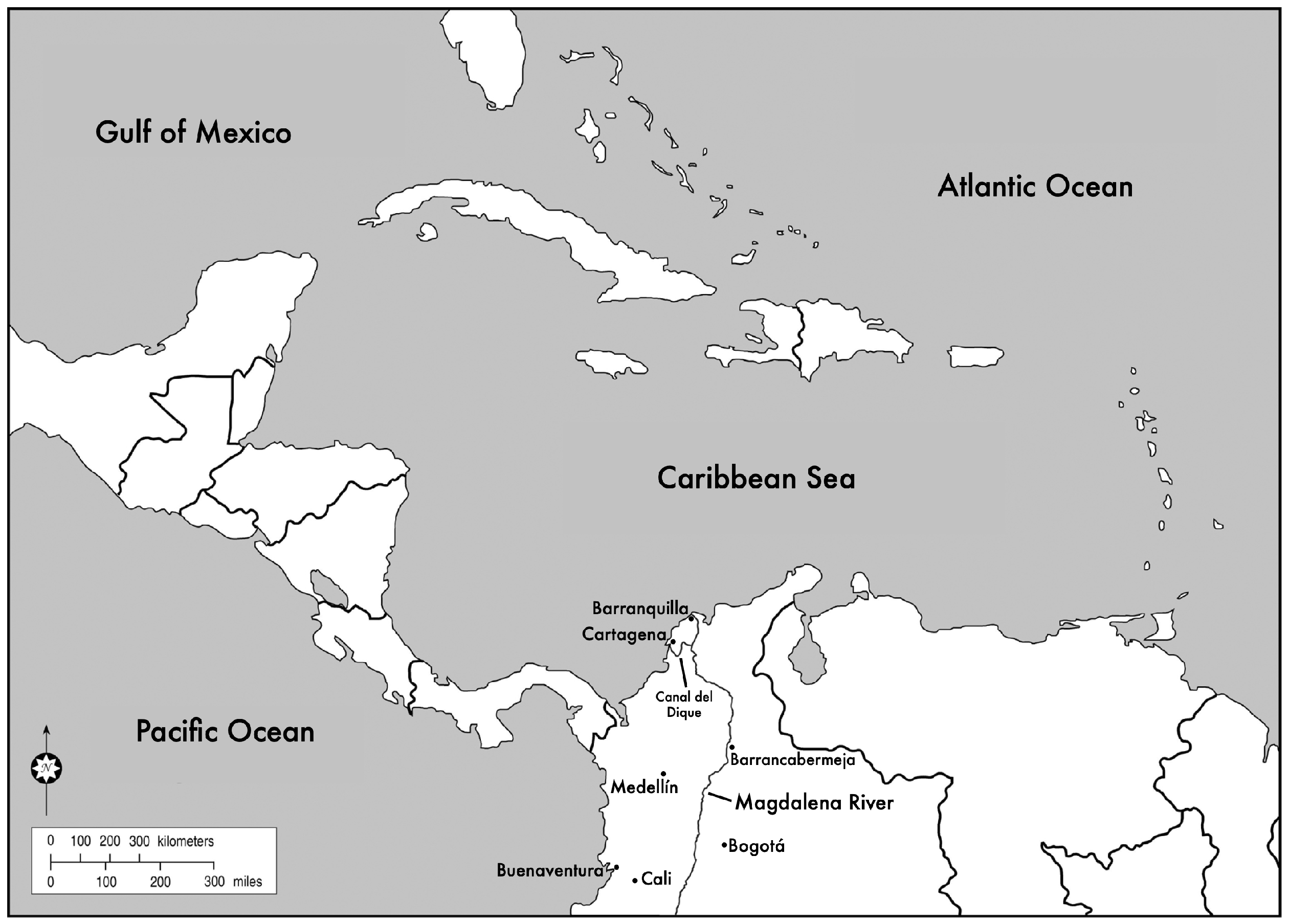
Map of the Magdalena River and its wider maritime geographies.
The crew consists of the captain, one helmsman and three pilots who take turns navigating and steering; six deckhands who perform all manual labour and one boatswain who oversees their operations; four mechanics responsible for the engines and other equipment and two cooks who prepare meals and manage supplies. These 18 men (and riverboat crews are invariably male) live and work together in close quarters – the towboat is 10 metres wide by 36 metres long – for 21-day shifts, followed by seven days of shore leave. While onboard, crewmembers work from sunlight to sundown or, when conditions permit, around the clock. Though most hail from the Magdalena River’s lower reaches and not strictly the coast, all are costeños – the racialized category of regional affiliation attached to the inhabitants of northern Colombia’s tropical lowlands. 1 The regional-cum-racial identity of these workers is not incidental to the work they perform – indeed, the articulation of race and labour has long been a defining feature of commercial transport along the Magdalena River. 2
On days like these, the captain begins by issuing orders to the boatswain and head mechanic. While the crew’s maneuvers follow a well-recognized chain of command, they are ultimately determined by the technological specifications of the vessel, the environmental conditions of the river and the commercial imperatives of the shipping company and its clients. This company is one of a handful moving cargo between Barranquilla and Cartagena on the Caribbean coast and Barrancabermeja approximately 630 kilometres inland. A key component of the distribution network linking Colombia to overseas sites of production and consumption, the company’s operations are calibrated by the logic of logistics, which seeks to control the movement of goods through space, on time. The work performed by the crewmembers onboard exemplifies the human labour that powers the logistics industry – an increasingly important domain of contemporary capitalism worldwide.
Today is an ordinary day for the riverboat crew, except that we’re not yet on the river. We’ve spent the last two days floating in the Bay of Cartagena while our barges were being emptied of 60,000 barrels of crude oil. We are now making our final trip between an anchor buoy, where we had tied up overnight, and the loading pier of Ecopetrol, the state oil company. Jutting out into the bay, the pier is an assemblage of hoses, pipes, valves, pumps and walkways, which connects to a vast refinery complex – Colombia’s second largest after the one in the riverport of Barrancabermeja, where these barges were filled 10 days ago. Now that the last drops of oil have been sucked out, the towboat will reassemble its convoy of empty barges and repeat the same journey again. The daily rhythms of riverboat work add up to an endless cycle of movement along the same stretch of river between Colombia’s oil capital and its main transshipment port.
From my perch on the towboat’s upper deck, I take one last look at this peculiar waterscape – a critical link in the petroleum industry supply chain. Immediately visible are the gas flares and distillation columns of the oil refinery and the maritime tankers being filled just offshore. Through the acrid haze, I can also make out other components of the logistics network connecting Colombia to international markets: the ship-to-shore cranes of nearby container terminals; the towering silos and floating docks of a cement plant; the refrigerated storage facilities of food importers; the gated offices and warehouses of a duty-free zone; a security checkpoint manned by the Colombian Navy’s marine infantry. I can see Cartagena’s skyline glistening on the horizon some 20 kilometres away, while the logistical infrastructures surrounding me here are nearly invisible from its exclusive hotels and luxury boutiques. The day there has yet to begin, whereas the crew onboard has been active for hours – a microcosm of the relationship between the capital accumulation expressed in the city’s built form and the logistical labour on which it depends.
Our convoy of towboat and barges, once discharged and reassembled, begins to cross the bay and ascend the Canal del Dique – a waterway dug initially by the Spanish in the sixteenth century to connect the strategic seaport of Cartagena to the interior. As we navigate through the suffocating heat and dense vegetation, I’m reminded of the backbreaking work that went into digging the canal, whose chief objective was to reduce travel times between Spain’s mainland colonial possessions and its transatlantic fleet. This work was performed initially by enslaved indigenous and African labourers, and it was their descendants who powered the rafts going to upriver mines and plantations and returning with valuable goods to be loaded onto galleons bound for Europe. Along the banks, remnants of haciendas built by white settlers testify to the importance of the river as a conduit for the expansion of racial capitalism in the Americas. Beginning in the colonial period and persisting to the present day, articulations of race and labour have structured the work of fluvial transport, which now occupies a central role in Colombia’s burgeoning logistics industry.
Based on ethnographic fieldwork conducted aboard a commercial riverboat, and on historical accounts of riverboat work, this article examines the racial formations on which logistics depends (De Lara, 2018; Khalili, 2020). Logistics is organized around the flows of goods, vessels and workers at the heart of capitalist modernity, and these flows are made possible by labour regimes whose racial underpinnings have both persisted and changed over time. Tracking continuities and divergences in the domain of fluvial transport along Colombia’s Magdalena River, I propose that our understanding of logistics is enriched by attending to historical articulations of race and labour. My analysis is inspired by scholars who reckon with the afterlives of racial slavery (Hartman, 2007; Mbembe, 2017; McKittrick, 2013; Sharpe, 2016), as well as by those who track precisely how that legacy unfolds in geographically and historically situated ways (Arias and Restrepo, 2010; Chari, 2017; Hall, 1980; Hart, 2002). Rather than pitting these perspectives against each another, I seek to engage them simultaneously through the analytic of situated afterlives, which focuses attention on: (1) the constitutive relationship between systems of racial hierarchy and capitalist economic orders on a world-historical scale and (2) the shifting contours of this relationship across space and time. 3 To give this analytic empirical substance, I ask: How are race and labour articulated historically along the Magdalena River, and how do these historical articulations shape the work of fluvial transport today?
In the wake of logistics
This article opened with a view from the deck of a commercial riverboat. Usually located at the periphery of cities or in the transport corridors connecting them, such logistical infrastructures are often less visible than other hubs of capitalist activity. Drawing on fieldwork conducted along the shipping route connecting the interior of Colombia to overseas markets, I argue that our understanding of capitalism shifts when logistical infrastructures become the point of reference (Toscano and Kinkle, 2015). For example, the social world of the vessel I boarded disrupts conventional representations of the global economy, which often depict a network of nodes and vectors through which things move quickly and smoothly. Locating ourselves amidst the logistics industry, we see that this frictionless space of continuous circulation is a fantasy of the industry itself (Chua, forthcoming). Stefano Harney and Fred Moten call this ‘the fantasy that capital could exist without labor’ (2013: 90). According to this fantasy, they argue, ‘[l]ogistical populations will be created to do without thinking, to feel without emotion, to move without friction, to adapt without question, to translate without pause, to connect without interruption’ (2013: 91). Though this logistical fantasy may be partially fulfilled in certain sites and situations, from the deck of the riverboat it appears more an aspirational goal than an accomplished fact.
The importance of paying critical attention to logistical infrastructures is underscored by Charmaine Chua, Martin Danyluk, Deborah Cowen and Laleh Khalili, who argue that – in ‘its pursuit of speed, efficiency, reliability, and flexibility’ – logistics draws upon historical configurations of power that have long underpinned capitalist modernity (2018: 625), or what Aníbal Quijano (2000) calls ‘coloniality’. They note that although the ‘logistics revolution represents a paradigmatic shift in the operations of capital, it also marks the continuation of centuries-old processes of imperial circulation and colonization’ (Chua et al., 2018: 19). In particular, the ‘Atlantic slave trade, which depended on a network of intercontinental commodity chains, was a precursor to present forms of large-scale, integrated capitalist production’ (Chua et al., 2018: 20). Achille Mbembe goes further, stating that ‘the systematic risks experienced specifically by Black slaves during early capitalism have now become the norm for … all of subaltern humanity’, in a process he calls ‘the becoming Black of the world’ (2017: 4–6). 4 If Mbembe’s point has validity, then histories of Atlantic slavery bring into fuller view the articulation of race and labour inherent to modern logistics.
Works of art and literature have long opened up critical perspectives on the racial underpinnings of capitalist modernity. Frequently cited is the 1840 painting by J. M. W. Turner commonly known as ‘The Slave Ship’, but originally entitled ‘Slavers Throwing Overboard the Dead and Dying, Typhoon Coming On’. This painting was based on the true story of the Zong – an eighteenth-century slaver whose captain dumped his perishing human cargo overboard so he could collect insurance money. This painting’s initial exhibition coincided with an anti-slavery convention held in London, and has ever since, as Paul Gilroy puts it, ‘provided so much moral ballast for the indictment of racial capitalism’ (2018: 17; cf. 1993: 13–14). Likewise, Cedric Robinson argues that the Africans who died on slave ships like Turner’s represented ‘one profoundly tragic measure of the extent to which the development of the capitalist world system depended on labour its metropolis could not produce’ (2000: 118).
From Herman Melville’s (2003, 2016) Moby-Dick and Benito Cereno to C. L. R. James’ (2001) Mariners, Renegades and Castaways, ships transporting human and other cargo have given rise to radical perspectives on modern capitalism and its dark underbelly – racial slavery (Linebaugh and Rediker, 2012). The same is true for images like Turner’s, or recent artistic engagements with related themes, such as Sondra Perry’s ‘Typhoon Coming On’, which in the words of a critic ‘reboot[ed] the Zong massacre for the present day’ (McLaughlin, 2018), or Kara Walker’s ‘Middle Passages’ and ‘Fons Americanus’ and Ellen Gallagher’s ‘Bird in Hand’ and ‘Watery Ecstatic’. By aesthetically immersing us in the racialized depths of hydro-history, these writers and artists perform ‘wake work’, the analytic Christina Sharpe gives us for interrogating ‘the continuous and changing present of slavery’s as yet unresolved unfolding’ (2016: 14; Hartman, 2007: 6). Following Sharpe, I ask what a view from a commercial riverboat ‘calls on “us” to do, think, feel in the wake of slavery’ (2016: 20).
Returning to the logistics industry at the heart of the global economy, we might then recognize its genealogical antecedents. According to Harney and Moten: Modern logistics is founded with the first great movement of commodities, the ones that could speak. It was founded in the Atlantic slave trade, founded against the Atlantic slave … From the motley crew who followed in the red wakes of these slave ships, to the prisoners shipped to the settler colonies, to the mass migrations of industrialisation in the Americas, to the indentured slaves from India, China, and Java, to the trucks and boats leading north across the Mediterranean or the Rio Grande, to one-way tickets from the Philippines to the Gulf States or Bangladesh to Singapore, logistics was always the transport of slavery, not “free” labor. (2013: 92)
In contrast, riverboat histories in the Americas – while also deeply entangled with settler colonialism, plantation economies and enslaved workers – shed light on aspects of logistical labour that transatlantic slavery and its oceanic itineraries do not. For example, Mark Twain’s (1984) autobiographical account of his days piloting steamboats on the Mississippi River, as well as his fiction, both centre on fluvial (not maritime) vessels to highlight the imbrication of localized racial orders and transnational circuits of capital (Le Menager, 2004). Likewise, historians demonstrate the centrality of riverboats to the racialized political economy of American imperial expansion (Johnson, 2017) and reveal the racially structured forms of oppression and solidarity among their crews (Buchanan, 2007). Riverboat histories also point to the paradoxical mix of movement and stasis, of circulation and fixity, of freedom and confinement, that frequently characterizes the lives of transport workers – akin to what Kimberley Peters and Jennifer Turner call ‘carceral mobilities’ (2017). While seafarers experience similar working conditions, the comparatively understudied world of riverboat workers deserves further consideration (Anim-Addo et al., 2014: 344). Moreover, if the transoceanic containership commonly epitomizes global logistics, the commercial riverboat floats along the margins – that is, at a distance from the ‘the heart … of the contemporary logistical order’ (Schouten et al., 2019: 780) – but is just as central to the operations of capital (Mezzadra and Neilson, 2019). In what follows, I offer a historical and ethnographic account of fluvial transport along the Magdalena River to examine the racial underpinnings of logistics, their historical foundations and their contemporary manifestations. The analytic of situated afterlives helps illuminate how the constitutive relationship between racism and capitalism both persists and changes over time.
Historical articulations of race and labour
From the early-sixteenth century to the mid-twentieth, Colombia’s Magdalena River was the primary artery of trade and travel between the Andean interior, where the major cities of Bogotá, Medellín and Cali are located, and the Caribbean coast, the main gateway to Europe and North America (Sanín, 2005; Zavala, 1961). For over 400 years, the river was fundamental to the modern/colonial project in the Americas, which depended on the ability to move people (labourers, merchants, travellers, settlers) and goods (gold, silver, sugar, tobacco, coffee, bananas, oil) between the mainland and the sea. Most foreign imports also entered Colombia through the river’s mouth and were distributed from the ports lining its banks, which for a time were some of the most dynamic and prosperous places in the Americas (Bocarejo Suescún, 2018; Posada-Carbó, 1996: 6).
Beginning with the initial Spanish expeditions of the 1530s, however, those seeking travel or transport along the river encountered un río difícil (‘a difficult river’), due to its suffocating climate, winding course, shifting channels, seasonal variations, rapid current and abundant obstructions (Márquez Calle, 2016). Along with some technological solutions, such as new watercraft, the main strategy for overcoming these difficulties was an exceptionally brutal labour regime. While the indigenous inhabitants of the river basin had utilized simple canoes, or piraguas, the Spanish colonizers introduced a larger vessel called the champán, a covered dugout, and the bongo, a wooden raft, both of which could carry greater volumes of goods (Posada-Carbó, 1989). These were manned by teams of boatmen (bogas) conscripted through the encomienda system, which the Spanish used throughout their empire to control indigenous labour (Gilmore and Harrison, 1948). Bogas were forced to pole and row for hours on end in impossibly harsh conditions, and in no time the Indian population along the river had almost entirely died out (Fals Borda, 1979: 45A).
Once the indigenous boatmen had succumbed to what Orlando Fals Borda calls their ‘fatal service’ (1979: 45A), Spanish colonizers began importing enslaved labourers from Africa to replace their now-decimated workforce (Márquez Calle, 2016: 35). However, the same conditions were endured by the bogas negros – the ‘Black boatmen’ who dominated the vocation from the seventeenth century onward – and many of them eventually met the same fate as their indigenous predecessors. Yet the labour supply could now be replenished by the steady flow of human chattel crossing the Atlantic Ocean and arriving in Cartagena – the leading slave port in New Granada (Barbary and Urrea, 2004: 72). With its insatiable appetite for cheap labour and its propensity for destroying bodies with extraordinary speed, transport and trade along the Magdalena River were foundational to the long, bloody history of racial capitalism in the Americas. Transoceanic exchanges of enslaved people and the commodities they produced were closely tied to the movement of bodies and goods up and down this inland waterway.
Despite the importance of bonded labour to early-colonial fluvial transport, by the late eighteenth century the work of bogaje was performed mostly by free people of African descent, who had concentrated in large numbers along the Magdalena River (Bonil-Gómez, 2018). Though some had escaped slavery, most had been granted or had purchased their freedom through lawful means, and yet their racialization as negros (Blacks), mulatos (mixed African and European ancestry) or zambos (mixed African and Indian ancestry) gave them uncertain legal and political status (Bonil-Gómez, 2018). Bogas also suffered harsh discrimination in colonial society at large: in the early 1800s, Sergio Solano notes, ‘bogas occupied the lowest level on the scale of social recognition and prestige’ (2003: 41). This continued throughout the nineteenth century, as bogas were routinely subjected to what Rory O’Bryen (2017: 2) calls ‘ritual dehumanization’ in cultural and political discourse (Arias Vanegas, 2007; Martínez-Pinzón, 2011; Villegas, 2014). They were accused of living outside the norms of society and in violation of the authority of Church and Crown, since bogas led itinerant lives along a notoriously ungovernable river, were ambiguously subject to legal jurisdictions, and mostly escaped the control of colonial authorities (Bonil-Gómez, 2018; Solano, 2003). However, as Bonil-Gómez shows, the legal and political status of bogas was a contested affair, and one they themselves had a hand in shaping (2018: 188). In advocating for their collective interests on the basis of their occupation, ‘bogas were trying to forge and defend their personal autonomy in the form of spatial mobility, and the time to cultivate social relations’ (Bonil-Gómez, 2018: 190).
Bogas fought for spatial and temporal freedoms, as these freedoms were inherent to their work. They were accustomed to moving fluidly between towns along the riverbank, sometimes stopping even for weeks at a time (Peñas Galindo, 1988). Accounts written by travellers commented uniformly on the interminable hours of grinding physical work but also on the flexible timetable of riverboat journeys (Solano, 2003: 42). Solano argues that bogas did not draw boundaries around work and leisure: they sang and drank while they navigated, and often stopped mid-journey for rest or pleasure irrespective of their clients’ wishes (2003: 42). The autonomy possessed by bogas was related to the fact that they customarily received payment for their services in advance, which allowed them to complete their contract on their own terms, since only they possessed knowledge of the complex environment in which they worked. This afforded bogas a sense of superiority over their patrons, who they could easily manipulate to ensure their work was valued properly (Solano, 2003: 43). Indeed, the entire Viceroyalty depended heavily on the boatmen of the Magdalena River – without their labour, the colonial economy would have ceased to function (Bonil-Gómez, 2018: 186; Villegas, 2014: 157).
Fluvial transport took on renewed importance in the movement for independence from Spain. In recognition of the river’s importance for the nascent nation’s future, Simón Bolívar issued an early decree granting a Colombian engineer of German origin, Juan Bernardo Elbers, a monopoly concession to develop steamboat navigation (Gilmore and Harrison, 1948). At a moment marked by what Francisco Ortega (2016) calls the sense of ‘precarious time’, improving river transport was seen as an urgent project of political consolidation that could integrate a sharply divided young country (Villegas, 2014: 151–152). That project was both a geographical and a racial one, as political and intellectual elites sought not only to create a unified territory out of a fragmented collection of regions but also a unified identity for a nation composed mainly of people of heterogeneous mixtures of indigenous, African and European ancestry (Wade, 1993: 8–11). Though mestizaje (or hybridity) was often espoused, it was based on an underlying racial and regional hierarchy that privileged the lighter side of the mestizo spectrum and the Andean highlands over the coastal lowlands (Appelbaum, 2016; Wade, 1993).
These racial and regional anxieties were fundamentally linked to aspirations of progress, development and modernity (Appelbaum, 2016; Wade, 1993). And due to its strategic importance as a conduit between Colombia and the wider world, the Magdalena River and its peoples featured prominently in these debates (Leal, 2010; Martínez-Pinzón, 2011; O’Bryen, 2017). Flowing from the characteristically white temperate highlands to the predominantly Black and mestizo tropical coast, the river was seen as both a racialized measure of civilization and an infrastructural fix for underdevelopment (Leal, 2010; Villegas, 2014). Nineteenth-century letrados (members of learned society), such as Liberal parliamentarian José María Samper, saw the boga as both a hindrance to civilizational advancement and an obstacle to the flow of commerce, and sought ways to ‘erode the boga’s monopoly over river transport’ and erase these humiliating ‘reminders of Colombia’s “barbaric” past’ (Martínez-Pinzón, 2011: 22; O’Bryen, 2017: 2–3). According to the economic and political imperatives at the heart of early nation-building efforts, interventions that sought to improve fluvial transport were inseparable from prevailing racial taxonomies and regional inequalities (Villegas, 2014: 155).
Invoking free-market doctrines, private merchants and public officials united in their attempts to remove hindrances to industry and trade, ‘fixat[ing] on boatmen’s dominion over navigation as a major obstacle to commercial progress’ (McGraw, 2014: 73). As in the colonial period, bogas in the mid-nineteenth century continued to exercise control over timing and compensation, effectively setting ‘the tempo of the nation’s commerce’ through work stoppages and strikes, while enjoying spatial mobility and rejecting the deference expected of racially subordinated populations (McGraw, 2014: 77–79). To temper bogas’ grip on navigation, commercial boosters lobbied the national government to institute a regulatory system that, according to Jason McGraw, ‘rendered boatmen the country’s most heavily policed workforce’ (2014: 74). Although this system was eventually dismantled by the abolitionist movement, which saw it as constricting labour freedoms, the racially inflected regulation of boatmen was simply devolved to local authorities. Their jurisdiction was always limited, however, and river merchants eventually resorted to steam technology to resolve the problem bogas supposedly posed to free trade.
Steamboats, once introduced, did come to play an important economic role by facilitating the trade of tobacco and quinine, the nation’s first export crops and eventually coffee – the commodity that would fuel Colombia’s modernization drive (Horna, 1982: 35–36). Though the vapores, as they were called, were not immune to the river’s navigational obstacles and by no means replaced the older vessels, they reduced freight costs and shipping rates by increasing the pace of commerce and communication, thereby boosting exports and profits (McGraw, 2014: 91). They also brought with them an air of sophistication: as one observer put it, the ‘luxurious and comfortable’ steamboats were ‘objects of modern civilization’ compared to the canoes and rafts, which for him were ‘memories of the past’ (cited in Posada-Carbó, 1989: 3). So, too, republican elites hoped that the consolidation of steamboats in the 1870s and 1880s would displace the ‘the coarsest of our national types, the boga … a tall, muscular man of colour, savage in his customs, and sole rival of the caiman’ (Vergara y Vergara [1867] 1957; cited in O’Bryen, 2017: 2). Throughout this period, Colombia’s hopes of becoming a modern, independent nation were inextricably bound up with fluvial transport and with the racialized labour on which it depended.
At first, the arrival of vapores did not greatly change the labour regime along the river. Most steamboat companies were based in the port of Barranquilla at the mouth of the Magdalena and hired crews from there or from upriver towns (Solano, 2003: 38). Though some were recruited from Cartagena’s maritime workforce, the majority descended from bogas with extensive experience in fluvial transport and an established ethos of spatial and temporal flexibility (Solano, 2003: 36). These continuities were strengthened by the fact that, to be hired, one had to be endorsed by (or related to) an existing crewmember. And while it was common for bogas to affiliate with specific steamboats, as before they were contracted only for a single voyage. Equipment repairs, commercial fluctuations and environmental conditions could leave them temporarily idle but this afforded them time to dedicate to other economic activities (Solano, 2003: 44–45). During this moment of significant technological change, the articulation of race and labour along the river remained relatively stable.
Things began to shift around the turn of the twentieth century as the Colombian state sought again to regulate riverboat work amidst a rapid increase in people employed in the trade. 5 Decrees were issued that endowed steamboat captains with increased authority and that deployed fluvial inspectors to enforce equipment and labour standards and to keep detailed records of commercial activities (Solano, 2003: 40). These regulatory requirements, which increased steadily throughout the first half of the twentieth century, aspired to transform notoriously capricious riverboat workers into reliable contributors to the national good. The capital-intensiveness of steamboats also altered the relationship between bogas and vessel owners, who were now members of the white elite and, in some cases, English, German or American investors (Solano, 2003: 52).
At this point, a new labour regime began to unsettle the one that had been in place since the late eighteenth century, when bogaje became the province of free persons of African descent. 6 Whereas bogas had never been under direct supervision of boat owners, captains and officers now served as representatives of steamboat companies and began to impose strict discipline, establish regimented schedules and limit time in riverports. Though some payment was still doled out to crews in advance, the majority was distributed once the vessel reached its destination, which significantly reduced workers’ bargaining power and temporal flexibility. Steamboat technology added another dimension of labour control, since it required less contact between crewmembers and riverine populations, especially after wood-burning boilers were replaced by internal combustion engines and fuel was made readily available along the riverbank. Riverboat work remained exceedingly strenuous but now demanded less knowledge of the river, which made the job accessible to a wider population.
The racial articulation of this new labour regime also shifted, as the category of boga itself began to disappear. This was partly due to the change of physical activity; the term, after all, had referred to the act of rowing. But this shift also reflected a wider trend after Independence, whereby racial taxonomies were increasingly supplanted by regional typologies (Appelbaum, 2016). The latter, while continuing to signify racial and cultural difference as well as occupational aptitudes and to enable subtle forms of discrimination, nevertheless held out the promise of liberal values, such as equality and inclusion (Arias Vanegas, 2007). Indeed, steamer crews themselves advocated for new monikers that carried less negative connotations, opting instead for labels mainly derived from seafaring, such as tripulante, navegante, marinero and buquero (Solano, 2003: 49). These designations, they hoped, would distance their vocation from its racialized proximity to Blackness – a shift they had reason to think would translate into less discrimination, if not higher wages. Many also emphasized their identities as costeños or ribereños (from the Caribbean coast or Magdalena valley), but these regional categories still positioned riverboat workers within a hierarchy that implied disadvantages within the labour market and in Colombian society at large.
Despite expectations, steamboats continued to struggle with the river’s physical conditions and shipping traffic regularly ground to a halt. A series of bloody civil wars throughout the nineteenth century had also regularly hampered navigation, as vessels were seized by opposing factions, converted into warships and subsequently damaged or destroyed (Safford, 1965: 525). But the real downfall of steamboat transport – indeed of commercial shipping in general along the river – came in the mid-twentieth century as navigation was hampered by complex socio-ecological factors, investment was directed to roads and railways and the Pacific port of Buenaventura took precedence for key exports (Posada-Carbó, 1996: 5). Nevertheless, a few shipping lines managed to sustain their operations, albeit with new equipment. Returning to an ethnographic engagement with the crew of the commercial riverboat introduced in the opening section, I will now consider how the historical articulations of race and labour along the river shape Colombia’s burgeoning logistics industry today.
‘It’s in our blood’
During the seven days it would take us to reach our upriver destination, and in subsequent interviews, I spoke at length with crewmembers about their work. While onboard, most conversations took place in the towboat’s wheelhouse. This is the domain of the captain and his pilots, and the shipping company’s head office had instructed me to remain there during waking hours. I could visit other parts of the vessel, with permission and if accompanied, though my options were limited. The towboat’s engine room, where the mechanics work, was deafeningly loud and oppressively hot. The flat expanse of the barge convoy, where the deckhands perform most of their tasks, was off limits on account of safety protocols. An obvious place to chat – or so I thought – was the galley where everyone eats, but meals are taken mostly in silence under the grainy glow of a wall-mounted television. Fortunately, the wheelhouse provided ample opportunity to converse with crewmembers, and not only the captain and pilots as others frequently pass through. The room was air-conditioned, protected from both blazing sun and torrential rain, and a stack of plastic chairs beckoned visitors. Despite these modest comforts, the more time I spent in the wheelhouse, the more I came to understand the paradoxical combination of freedom and confinement riverboat workers often spoke about when discussing their jobs.
The crews labouring on the Magdalena River’s shipping lines live itinerant lives, spending much more time on the boat than they do anywhere else. ‘This is our home’, the first pilot told me. ‘For twenty-one days straight we live and work on the boat, moving upriver and down. Don’t get me wrong – I look forward to shore leave. But when I go home [switching now to the river town of Malambo] I feel lost, unsure what to do with myself. When we’re working, we’re constantly in motion’. Though crewmembers frequently lamented their separation from family and friends, many described their perpetual state of movement with words like ‘flexibility’ and ‘freedom’. Their mobility is highly constrained, however, and the tight quarters of the vessel are only the beginning. Leaving the boat is prohibited, unless authorized by the captain for a specific task, and no stops are allowed in river towns or ports during the journey. The head mechanic once referred to this as being ‘trapped on the move’.
The simultaneous itineracy and immobility inherent to this labour regime reflects the historical linkages between fluvial transport along the Magdalena River and the manpower of enslaved Africans and their emancipated descendants. These workers were both infinitely transportable and tightly controlled; they could be moved anywhere but were everywhere subjected to extreme discipline. On the river, they were made to travel incessantly but according to strict limitations. The emancipated people of African descent who powered riverboats in later years also experienced a contradictory mix of freedom and confinement. They enjoyed spatial mobility and temporal flexibility, and yet they were fixed socially within rigid and discriminatory racial hierarchies. Though riverboat work changed significantly throughout the twentieth century, the logistics industry remains indebted to the articulations of race and labour that have powered fluvial transport for centuries.
My time spent in the wheelhouse gave me insight into the constrained mobility of riverboat workers, but it insulated me from many of the everyday dangers they face. Accidents and injuries are fairly common and multiple health and safety hazards are ever present. The tanks of the barges are filled with highly flammable liquid cargo. The convoy is lashed together by heavy steel cables winched to extreme tautness. The heat and humidity of these tropical lowlands are beyond compare. The filtered river water consumed onboard is potentially toxic (muy pesado, or ‘very heavy’, they warned me). A casual misstep around the vessel’s edge will lead to almost certain death. Riverboat work is most physically taxing for the deckhands who perform all onboard manual labour, and its gruelling demands clearly take a significant toll on their bodies. The two oldest deckhands are in their 50s; their co-workers, decades younger, marvelled at how they had lasted so long. The mechanics working below deck in the towboat’s engine room face other adversities, such as asphyxiation and deafness. When asked about these conditions, many expressed concern, but always alongside a sense of pride. ‘No one else can do the work we do’, an experienced deckhand told me; ‘it’s in our blood’.
In conversations with crewmembers, and with managers back on land, I was often struck by frequent connections drawn between the peculiar qualities of riverboat work and the physical composition of those who perform it. According to long-standing racial ontologies, which once determined questions of value in slave markets throughout the Americas, the bodies of riverboat workers are assumed to be naturally suited to enduring extended periods of time in harsh conditions. The category of boga, which for centuries was used to identify boatmen, referred simultaneously to their professional occupation, geographical origin and racial extraction. Bogas were typed by Spanish colonizers and criollo elites as evolutionarily closer to tropical nature, and therefore genetically predisposed to riverine labour and its associated hardships. Though that category is uncommon today, the vocation of riverboat worker remains tied to the same river towns and the associated regional-cum-racial identity of their inhabitants (boatmen generally self-identify as costeños, and those from the river basin as ribereños). As before, they are widely believed to be constitutionally fit for riverboat work.
This strategy of labour exploitation and control is also a point of distinction invoked by workers themselves. After all, it keeps the profession in the family, often quite literally. New recruits must still be vouched for by current crewmembers and strong kinship ties exist among the crew. On the boat, over a quarter of the workers hailed from the river town of Yatí (in the area bogas once called home) and considered themselves relatives. The strict association of boatmen with Blackness, condensed in the category of boga, has loosened and riverboat workers are no longer uniformly dark-skinned or of African descent, nor are they necessarily subject to the same level of discrimination. Yet their regional-cum-racial identity remains central to their occupation – both in practices of labour recruitment and management, and in the experience of committing one’s body to this arduous vocation. These genealogical systems of kinship and capability continue to support the articulation of race and labour along the Magdalena River.
The work of the captain and his pilots, though less physical, is considered equally hereditary. Detailed knowledge of hydrological conditions and navigation techniques is said to be the inborn property of river people, passing automatically through generations. Though one hones these skills on the job, the inherent capacity to master the vocation is believed to be inherited from an older male relative (a father or an uncle). The captain I came to know is an exception to this rule: he was born in a coal mining village and raised in a regional capital far from the river. His upbringing, accent and appearance all marked him as broadly costeño but not ribereño, as he lacked fluvial pedigree; indeed, his prodigious aptitude for commanding the vessel was seen as an anomaly. Like his team of helmsman and pilots of riverine origin, however, the captain relied upon his intrinsic talent for navigation and made infrequent use of charts, radar and other technological aids. Navegamos a lo empírico, they often told me, referring to the inherent knowledge and skills inherited from elders and refined through experience.
Locating the capacity for certain types of work in the hereditary body is fundamental to the labour regime structuring the logistics industry along the Magdalena River. However, it also makes riverboat workers relatively difficult to replace and affords them some control over their time. Until recently, they were given three days of shore leave every two months. Their trade union, Sintranaviera, fought for better conditions and they are now entitled to seven days off for every 21 days of work, though holidays are non-existent (operations continue on Easter and Christmas, as I discovered during Semana Santa or Holy Week). And while the speed and predictability of riverboat journeys are central preoccupations of the shipping company, as throughout the logistics industry, riverboat workers are rarely held responsible for slowdowns or stoppages. Difficult stretches of river might delay the convoy significantly; traversing just a few kilometres per day is not uncommon when water levels are low or where sedimentation is pronounced. In these cases, the captain and crew use their intimate relationship to the river and inimitable command of the vessel to rebuff pressure and avoid sanctions from the head office in Barranquilla. Not only do they refer to their ability to see the sandbars impeding navigation and feel the boat as its hull runs aground. They also assert their intrinsic talent for determining whether the convoy’s draft is shallow enough, the towboat’s propellers strong enough and the water levels steady enough for the journey to proceed. According to the articulation of race and labour at work along the river, their lighter-skinned managers are inherently unable to object.
That said, the bargaining power and temporal flexibility possessed by earlier generations of bogas have been significantly reduced. The timetables of riverboat journeys are now dictated by the management of the shipping company rather than by rivermen’s ability to determine the pace and rhythm of their work. When temporal fluctuations do occur, they are due to factors beyond the control of the captain and crew. Opportunities for rest or diversion are limited to the time between shifts or to the moments in which their labour is not needed. The latter is especially true for deckhands, who can be called upon at any time to perform specific maneuvers, whereas the captain and pilots take turns at the helm as do mechanics in the engine room. Deckhands are always on call, and when the vessel goes into 24-hour operation, they are effectively on duty around the clock. During my journey onboard, I often engaged in exchanges on the passageways of the towboat’s upper deck or in the kitchen – two places crewmembers linger during breaks – only to find the conversation interrupted abruptly by a call from the captain conveying an order. The towboat is under constant CCTV surveillance and the captain (or whoever is at the helm) has a live feed of what is happening in key locations around the boat. The video transmission (or at least a record of it) is also available to the shipping company’s main office, giving management near total oversight of its workforce. Only in small ways are riverboat crews able to manipulate time for their own benefit within a labour regime that, in spatial and temporal terms, is reminiscent of the plantation or the prison.
This is especially evident in riverboat workers’ orientations towards the future. During my journey, formal interviews and casual conversations frequently touched on the impossibility of predicting or determining what would happen next. Hopes for advancement do exist for some, especially those like a young helmsman, who had quickly worked his way up through the ranks. Most crewmembers got their start as deckhands, or in the company’s shipyard, and were eventually tapped for promotion. They are grateful to their employer for the possibility of a decent life and trust that this will continue. But the rhythms of work lie mainly beyond everyone’s control; hence crewmembers constantly invoke the will of God (si Dios quiere, con el favor de Dios) when discussing the future. These phrases are used commonly throughout Colombia to reference both proximate and distant temporal horizons that lack certainty, and are not unique to riverboat work. But for crewmembers, almost all work-related events are of this sort. Will we arrive in port tomorrow? Will you visit family during your next leave? Will you be promoted to captain? Will you eventually earn enough to build a house? Consistently, the answers to questions like these reflect uncertainty and unpredictability. To the extent that the future can be anticipated, it contains more of the same: journeying up and down the same stretch of river, transporting the same products, adhering to the same schedule.
Meanwhile, the Colombian state sees fluvial transport and the logistics industry as keys to future prosperity. While the economy depends less than it once did on the Magdalena River (the trucking industry has dominated the logistics of trade since the mid-twentieth century), development plans increasingly hinge on its port terminals and shipping lines (Corredor and Díaz Barragán, 2018). Echoing earlier moments in which imperial or national fortunes were tied to the river, the plan to improve navigation and increase trade now promises to advance Colombia forward to a new stage of history (Delvalle Quevedo, 2017). When the plan was announced in 2012, President Juan Manuel Santos invoked the founder of the nation, Simón Bolívar: ‘He knew that the Magdalena River should be the main axis for the country’s development, and we’re making that dream come true’ (El Heraldo, 2014). The vice president, Germán Vargas Lleras, then the government’s standard bearer for infrastructure, was equally optimistic in his regular Tweets, while other officials used words like ‘revolutionary’, ‘transformative’ and ‘salvation’ (Semana, 2015a). Jorge Barragán, president of the consortium initially awarded the contract, called it ‘a pact to create a new country’ (Semana, 2015b). While some critical perspectives were voiced by academics and environmentalists, the mainstream media covered the navigability plan in similar terms (Rodríguez Becerra, 2015). Seen from the capital city, and in the eyes of the political and economic elite, the country’s future appears to depend on logistical labour even as riverboat workers themselves fit awkwardly within that future. Government and industry experts I spoke with argued that these workers rely on outdated, unprofessional and inefficient navigational techniques; they must be retrained or replaced if fluvial transport is to meet ambitious projections. In official imaginaries of the future, riverboat workers are both essential and expendable: the promise of prosperity is predicated on their labour, and this prosperity may well pass them by.
Situated afterlives and fluvial futures
Within the formations of racial capitalism that have long underpinned the modern/colonial project in the Americas, transport and trade along the Magdalena River have enabled resource extraction and wealth accumulation. From the colonial period to the present, regimes of racialized labour have powered the movement of boats and the shipment of cargo between the Andean interior and the Caribbean coast. The traffic in goods, vessels and bodies along the river has empowered and enriched the owners of capital – the mostly white elite who control the means of production and circulation – and these unequal relations persist in Colombia’s burgeoning logistics industry. An analysis that shifts its orientation to infrastructures of logistics, such as the commercial riverboat, draws attention to these centuries-old patterns and to the concrete work accomplished by the articulating principle of race within accumulation regimes that create value from and simultaneously deepen racial difference and inequality. However, articulations of race and labour in the domain of fluvial transport do not always unfold in predictable ways. The analytic of situated afterlives, which examines the constitutive relationship between racism and capitalism on a world-historical scale and the shifting contours of this relationship across space and time, helps conceptualize the links between past, present and future without teleological assumptions.
Following Sharpe’s analytic of ‘wake work’, which draws our attention to a ‘past that is not past’, I have sought here ‘to occupy and to be occupied by the continuous and changing present of slavery’s as yet unresolved unfolding’ (2016: 13–14). By positioning myself, empirically and analytically, in the wake of logistics, I have endeavoured to track the historical antecedents and racial underpinnings of an industry at the heart of contemporary global capitalism. As Mbembe puts it: ‘It would be a mistake to believe that we have left behind the regime that began with the slave trade and flourished in plantation and extraction colonies. In these baptismal fonts of modernity, the principle of race and the subject of the same name were put to work under the sign of capital’ (2017: 13). Yet a historically informed and ethnographically detailed account of logistical labour, past and present, suggests that this regime has not continued unchanged throughout time. Stuart Hall’s calls for specificity are apt: ‘Racism is not present, in the same form or degree, in all capitalist formations: it is not necessary to the concrete functioning of all capitalisms. It needs to be shown how and why racism has been specifically overdetermined by and articulated with certain capitalisms at different stages of their development. Nor can it be assumed that this must take one, single form or follow one necessary path or logic, through a series of necessary stages’ (1980: 338–339).
The history of fluvial transport and trade along the Magdalena River contains both continuities and divergences, and the linkages between racial slavery in the past and logistical labour in the present are not straightforward. In the contemporary moment, riverboat work partly reflects the articulation of race and labour forged in the early colonial period, but it also bears traces of shifts the occupation subsequently underwent. In particular, riverboat workers themselves have partly destabilized their long-standing association with ‘Blackness’ as the expendable raw material of capital accumulation – in Mbembe’s terms, the ‘body of extraction’ (2017: 18) – all the while becoming more deeply embedded in a labour regime characterized by strict discipline. As Hall notes, racially structured social formations are often contradictory: the articulating principle of race can solidify hegemony or foment resistance (1980: 342). Though the vocation of riverboat worker has changed since the days of racial slavery, the articulation of race and labour remains integral to the business of fluvial transport today.
Extended to the infrastructures of global logistics, this implies that it remains essential to reveal the numerous ways in which capitalism continues to reflect the racialized labour regime forged in the crucible of colonial rule across the Americas (Quijano, 2000). As fluvial transport along the Magdalena River is increasingly positioned as a lynchpin of Colombia’s economic future, understanding its historical antecedents becomes all the more important. Yet we must consider the ethical and political implications of likening the present world order to certain paradigmatic historical phenomena. The analytic of situated afterlives focuses attention on the persistence of racial hierarchies but also on their perpetual instability. This is not to celebrate the emancipatory agency of riverboat workers, but rather to point out that logistics works with and through racial formations, but never in entirely stable ways. And while the afterlives of racial slavery remain palpable in the logistics industry, and certainly deserve critical interrogation, tracking processes of change may be equally important to the goal of imagining and creating a different future.
Footnotes
Acknowledgements
I am infinitely grateful to the captain and crew for welcoming me on the boat and for their subsequent kindness on land. I presented earlier versions of this article at the University of Toronto and the University of California, San Diego, where generous audiences helped me hone the argument. Thanks to the organizers and participants of two workshops, Labouring Urban Infrastructures at Durham University and Urban Limits at the London School of Economics, for productive discussions. I may have never made it aboard without the assistance of Lina Quiñones, while Katherine Dawson helped guide the article into port. I am particularly indebted to three anonymous reviewers for their extraordinarily insightful and constructive comments.
Declaration of conflicting interests
The author(s) declared no potential conflicts of interest with respect to the research, authorship, and/or publication of this article.
Funding
The author(s) received no financial support for the research, authorship, and/or publication of this article.