




Abstract
Urban spaces are reconfigured as digital technologies are increasingly embedded into cities. While existing research has considered the role of urban actors in implementing digital technologies as part of the smart urbanism framework, it has insufficiently considered the role that urban space plays for individual stakeholders and the implications this has for how they contribute to digital cities. This article therefore explores the converging interests of urban actors in mediating digital technology adoption in urban space. It draws on literature on the spatial impact of digital technologies, digital urban growth, and urban governance theory to frame the agency of urban actors to mobilise resources and collaboration to protect their interests. The paper provides insight into how interests in digital technology adoption and in the use of urban space intersect in a middle-sized European city – Tallinn, Estonia – and how these interests converge between local key stakeholders in local governance. Based on a thematic analysis of interviews, it is argued that the potential of digital technologies to dislocate functionalities from physical urban space should be understood against the backdrop of local actors’ interests. It is therefore suggested that smart urbanism should be understood as a framework through which actors of the city attempt to seize the benefits of digital technologies without compromising their interests in urban space.
Introduction
Digital technology adoption is transforming cities worldwide (Haefner and Sternberg, 2020; Kitchin and Dodge, 2014). The convergence of these technologies with urban infrastructures (Tilson et al., 2010) has led scholars to increasingly examine how digital technology adoption is changing urban functionality, such as transportation, retail, industry or real estate, in urban spaces (Afradi and Nourian, 2022; Aslesen et al., 2019; De Falco, 2019: 670). One long-standing concern in this transformation has been the potential of digital technologies to substitute or decouple functions from urban space (Autio et al., 2018, 76–77; on the example of shopping see: Shi et al., 2019), substantially transforming activities in cities (Cairncross, 1997, 2002; Tranos and Nijkamp, 2016). While radical predictions of disappearing cities as a consequence have not been realised (Cairncross, 2018; Moriset and Malecki, 2009; Tranos and Nijkamp, 2016), city governments, technology companies and other stakeholder bodies are increasingly engaged in digital technology adoption to pursue the benefits associated with these technologies (Nambisan et al., 2017; Taylor Buck and While, 2017: 515).
This paper follows recent work on viewing digital technologies in cities through smart urbanism research. The smart urbanism framework has sought to uncover how digital technology intersects with urban governance to legitimise powerful urban imaginaries about sustainability, efficiency and technology-led uses of city space (Luque-Ayala and Marvin, 2015; Vanolo, 2014). The practices and purposes behind smart urbanism have been found to vary between urban contexts and the different rationalities of actors (Chang et al., 2021; Sadowski, 2021). This view has decentred, but not disregarded, technology from analysis of smart urbanism and shifted focus on the ways it is used to maintain or transform relationships of power between actors (Chang et al., 2021).
Recent research in smart urbanism has considered agency in the context of urbanisation of technology (e.g. Rosen and Alvarez León, 2022; Sadowski, 2021), utilising digital technologies to shift relations of power (Chang et al., 2021) and rationales for urban technological innovation (While et al., 2021). However, this work has insufficiently considered the role that urban space plays for stakeholders in urban governance and the implications this has for how they contribute to digital cities. Understanding this agency and their interests is crucial in grasping why some activities are decoupled from urban space while others are not. Research is needed to understand how urban actors, understood here as local stakeholder bodies strategising and controlling resources, mediate the potentially substitutive effects of digital technology. This paper seeks to fill this research gap by examining how influential urban actors promote digital technology adoption while protecting their own urban space related interests through urban governance.
Two questions are explored: (1) how interests in digital technology adoption and making use of urban space intersect and (2) how these interests converge between local stakeholders in local governance. The paper examines the case of Tallinn, the middle-sized capital city of Estonia. Tallinn aspires to be renowned as ‘a city of science, innovation, and experimentation, where both local and international companies introduce new products and services to the market’ with one strategic goal being ‘to develop innovative future technology solutions and encourage their testing and implementation within the urban space’ (City of Tallinn, 2023). Tallinn has also been recognised as an early example of smart urbanism (Sarv and Soe, 2021) and has witnessed a rapid growth of high-tech sectors in information and communication technology, biotech, and financial and telecom services (Miörner et al., 2019: 24).
The article begins with how cities are being transformed by digital technology adoption, followed by a discussion of a digital growth logic. It draws on urban governance theory and urbanisation of technology capital to conceptualise the agency of urban actors in local technology governance. The methodology section describes the selection of interviewees, the interview process, and the merits of thematic analysis as a method to uncover local interests related to digital technology. The role of digital technology in actors’ interests is presented through four themes: digital technology in strategic management; digital technology in local economic development; digital technologies in testbedding; and digital technology in mobility as a flagship industry. The discussion/conclusion section discusses the implications of the findings on the agency of urban actors in mediating the effects of digital technology and suggests that smart urbanism should be understood as a framework through which stakeholders attempt to seize the benefits of digital technologies without compromising their interests in urban space.
Digital technology, cities and urban space
Digitalising cities and urban space
Through a digital transformation of urban governance, software-based digital technology has been enabling change in how the activities of individuals, companies and institutions are conducted. It has been argued that urban spaces as physical sites for work, innovation, leisure or commerce are transformed through digital technologies and digital media that enable near-ubiquitous digital communication and interaction (Afradi and Nourian, 2022; Moriset and Malecki, 2009).
Digital technology has material effects on physical infrastructures of cities and regions (Kitchin and Dodge, 2014: 12). An extensive economic geography literature on digital technology adoption in cities has discussed the implications of digitalisation for the urban economy, uses of urban spaces and centralising and decentralising effects of ICT (Audirac, 2005; Dadashpoor and Yousefi, 2018; De Falco, 2019; Haefner and Sternberg, 2020; Kong and Woods, 2018; Luque-Ayala and Marvin, 2015). These studies have pointed out how digital technologies have become infrastructural – forming a base upon which other activities take place – in an increasing amount of social and institutional contexts (Tilson et al., 2010). ICTs as digital technologies generate benefits for urban economies and create new urban structures (Tranos and Nijkamp, 2016). They have permeated virtually all sectors of the economy and transformed existing functions (Haefner and Sternberg, 2020; Moriset and Malecki, 2009), while also enabling entirely new sectors and industries and a shift away from a material-based economy in some contexts (De Falco, 2019).
Organising the effects of digital technologies on cities has proved a complex conceptual challenge. One approach has abstracted four parallel processes transforming urban functionality: (1) substitution, where functions coupled with physical space are replaced by ‘e-functions’ in digital spaces; (2) complementarity, where frequency of all functions increases; (3) modification, where functions coupled with physical space are altered on the influence of ‘e-functions’; and (4) neutrality, where no significant transformation takes place (De Falco, 2019; Shi et al., 2019). This approach has introduced some subtlety by enabling the examination of activity-specific changes rather than assuming a uniform direction for the entire city. Cities are subject to centralising and decentralising processes simultaneously as a result of ICT (Audirac, 2005). Studies have found that activities touched by digitalisation, such as remote work (Zhu, 2012) or ‘virtual’ clustering of companies (Salvador et al., 2013), are complementary rather than substitutive (Moriset and Malecki, 2009).
De Falco (2019) argues that the literature on the effects of digital technology adoption has usually employed either an urban constructive or a destructive inferential approach. The first approach assumes mutual reinforcement between urban functions performed in physical space and e-functions performed in so-called digital space. In contrast, the destructive approach assumes their incompatibility. These approaches imply different futures for a city. The constructive approach has posited that e-functions will not significantly replace physical functions, pointing instead to an enrichment of urban functionality. The destructive inference approach has assumed that functions relying on geographical proximity and physical contact, for example, shopping, commerce, leisure or work, are increasingly digitised and decoupled from physical space. According to some scholars, the latter hypothesis implies a diminishing significance of cities as dense and diverse places (Dadashpoor and Yousefi, 2018) or their profound transformation (Cairncross, 1997).
In detailing the constructive and destructive effects of digital technologies De Falco (2019) does not elaborate on the nature of digital spaces. However, to be credible, claims on the substitutive or decoupling effects of digital technologies on urban functionality need to point out how and where urban functionality is being transformed to. Some work has understood ‘virtual’ space as interactions in digital networks (Batty, 1997; Moriset and Malecki, 2009). Critics of the urban destructive approach have been careful not to treat ‘virtual’ space as a separate ethereal realm and have instead highlighted the spatial dependence of virtual connectivity and interactions (Tranos and Nijkamp, 2013). Physical space and the interaction space of digital networks should therefore be understood as hybrid rather than exclusive (Laguerre, 2005: 1–2).
Ash et al. (2018) distinguish between geographies through, produced by and of the digital. Geography through the digital refers to how new geographical knowledge and understanding of space is produced through digital applications. Geography produced by the digital refers to how digital technologies intertwine with a political economy to create new hybrid geographies. In the context of cities, these hybrid geographies may be understood as a ‘fourthspace’ of smart urbanism, which ‘reflects a new blend of everyday spaces that merges the digital with the analogue, the online with the offline, and the public with the private’ (Kong and Woods, 2018: 695), enabling the reordering of relationships of power. Geography of the digital, Ash and others argue, while conceptualised through virtual metaphors such as cyberspace, has more recently been grounded in actual spatialities. Spaces are being increasingly mediated by and experienced through digital interfaces (Ash et al., 2018), where ‘virtual’ and physical elements are superimposed (Afradi and Nourian, 2022). In the context of cities, digital technologies therefore need to be viewed through a hybrid lens.
Urbanisation of digital technology
Much recent work on the impact of digital technologies on urban life has been conducted as smart urbanism research (Ash et al., 2018; Kong and Woods, 2018; Sadowski, 2021). Minnery (2007) argues that the most significant actors in urban governance are those connected to the urban territory, often the city government, local private sector and citizen-community. It has been argued that smart urbanism increasingly blurs roles between sectors and implies new actors, for example multinational technology firms, that are less constrained by one given local context (Caprotti, 2019: 2476; Kong and Woods, 2018; McNeill, 2015). The role of universities as development partners has also been highlighted (Huggins and Prokop, 2017; Nam and Pardo, 2011: 287; Paskaleva et al., 2021).
Urban governance has been altered by digital technology and smart urbanism. In particular, the changing role of the private sector has been subject to debate. It is argued that technology capital has been urbanising and putting pressure on institutional power relations. Through platform urbanism, applying the logic of digital platforms is altering the roles on oversight of city governance, operation of city services, and ownership of city space (Sadowski, 2021). In return, city governments seek the benefits of circulation and investment of digital technology capital and of increased attractiveness and spillovers for local economic growth and urban renewal (Alvarez León and Rosen, 2020; Sadowski, 2020). This has blurred sectoral roles and implied a ‘shifting sovereignty’ between stakeholders mediating the effects of digital technology on urban space. By expanding the logic of the digital platform to functions of city governance, digital technology has become increasingly mixed with urban space to support new hybrid models for extracting profit.
Based on an emergence of a potent digital variation of the urban growth machine, Rosen and Alvarez León (2022) argue that technology firms increasingly shape urban growth processes and spatial outcomes through digital accumulation logic that embeds information technology with urban infrastructures. Contrary to earlier assumptions about disappearing cities (Cairncross, 1997, 2002; Tranos and Nijkamp, 2016), the logic of urban digital growth implies an opposite tendency. This is due to new avenues for capital accumulation: extending long-standing land development and industrial attraction strategies to promote urban growth and increase exchange values; new possibilities for capturing land-related profit beyond traditional land development and intensification strategies; new opportunities for intermediaries to emerge and profit; and new digital renderings of the city that affect land-related value and perceptions of place (Rosen and Alvarez León, 2022).
As part of digital accumulation strategies, technology companies make cities digitally measurable, representable and controllable (Sadowski, 2020, 2021; Shaw, 2020). They increasingly operate between the city and digital renderings of it, which lends them agency as digital mediators (Rosen and Alvarez León, 2022). For example, companies in digitalising real estate or mobility sectors act as information intermediaries and seek new avenues for extracting value from urban land through digital integration. Platform urbanism does not necessitate land development but is based on benefitting from densities and interaction networks that characterise cities (Barns, 2020).
Power dynamics and governance arrangements between the city government and private technology companies are therefore a key area in understanding how urban space is transformed through digital technologies.
Conceptualising agency through urban governance theory
With the introduction of smart urbanism, understanding digital technology adoption and its effects in cities has gained a stronger critical political framing (Kitchin, 2015: 132; Luque-Ayala and Marvin, 2015; Shelton et al., 2015: 14). Importantly, it has enabled a closer examination of the (political) roles played by urban actors participating in the adoption of digital technologies (Kong and Woods, 2018). This has shifted focus to the agency and decision-making of local government, firms, organisations and social groups. In an actor-centred approach (Markusen, 2003: 417) to smart urbanism, these urban actors, motivated by different interests, can be therefore understood as mediating the adoption and implementation of digital technology in cities.
The agency of institutions and organisations in mediating the effects of digital technology adoption can be framed through the urban governance theory framework (see: Hohn and Neuer, 2006: 295). Pierre (2014) argues that the urban governance framework is related to urban regime theory but is better suited to the European context. They argue that it more adequately considers institutional hierarchies and embeddedness, economic globalisation and networkedness as well as the emergence of new types of actors and issues in urban politics. Like urban regime theory, the urban governance framework is premised on the need for urban actors to band together and jointly mobilise and coordinate resources to advance a collective objective, such as promoting digital technology adoption (see for example: Chang et al., 2021). According to Stone (2005), urban coalitions, consisting of actors with converging interests, provide a capacity to act and bring resources to bear on the identifying agenda. For the purposes of this paper, agency in mediating digital technology adoption in the city may therefore be framed as the potential of actors to mobilise other actors of relevance and to utilise institutional resources to realise a digital agenda. The capacity to develop a digital city is contingent on coordinating converging and diverging interests in a coalition (Pierre, 2014: 873–874).
An urban governance framing of smart urbanism decentres but does not disregard technology. It instead shifts the focus on the actors and institutional arrangements shaping digital technology adoption (Chang et al., 2021; Markusen, 2003: 23). According to Stoker and Mossberger (1994), this points to an analysis that emphasises the interdependence of governmental and nongovernmental forces in meeting economic and social challenges. As different configurations of the governance process point to participation and influence by different actors, it is important to consider the economic, political, and ideological framework within which smart urbanism is embedded (Pierre, 1999). An important step is identifying a particular project, an agenda or a collective response to a problem around which support is mobilised. Another step, then, is to identify key institutions and actors taking part in the project and the financial, organisational, cultural and other types of resources they involve (Stone, 1993). Urban governance theory assumes that local governments cannot reach their goals without external resources from societal partners (Pierre, 2014), which points to identifying collaboration around digital technology adoption. Concurrently, societal partners such as private sector firms need regulatory involvement and institutional resources from the public sector (Mossberger and Stoker, 2001). Local economic development usually plays a key role in the political economy and activities of the private sector carry both explicit and implicit political significance for urban governments and coalitions (Mossberger and Stoker, 2001; Pierre, 2014). In the context of this paper, this points to the influence and resources of actors supplying digital technologies or supporting their adoption. Through the lens adopted here, it can be argued that the interests of these actors shape how digital technology is embedded in urban space locally and the effects it produces for activities in urban space.
Data and method
Data for the empirical part of this paper was collected in Tallinn, the capital city of Estonia in the Baltics, where about 452,000 inhabitants of the country’s total population of 1.33 million live (City of Tallinn, 2022; Statistics Estonia, 2022). The data consists of 12 interviews which are presented in Table 1. As during the interview process multiple interviewees referred to a new city-wide Tallinn Development Strategy 2035, the new strategy document was also used to complement the interviews. Interviewing was selected as a data-collecting method to capture local contextual and relational characteristics (Kvale, 2007: 21). These factors are necessary to understand the formal and informal interactions and meanings of digital urban governance in Tallinn. Interviewing enabled the interviewees to communicate their situated understandings about the role of their own organisation as well as other notable organisations in Tallinn (Kvale, 1996). The interviews were carried out with representatives working for the City of Tallinn, two science and business campuses, a telecom company, TalTech university and two citizen-community organisations. The interviews took place remotely between January and May of 2022 apart from one interview conducted in person. The starting point for selecting the interviewees was to include local government, the private sector and local civil society (Minnery, 2007) as well as universities (Paskaleva et al., 2021), with the goal of comparing sector-specific views and motivations on local digital development.
Identifying code, roles and organisations of the interviewees.
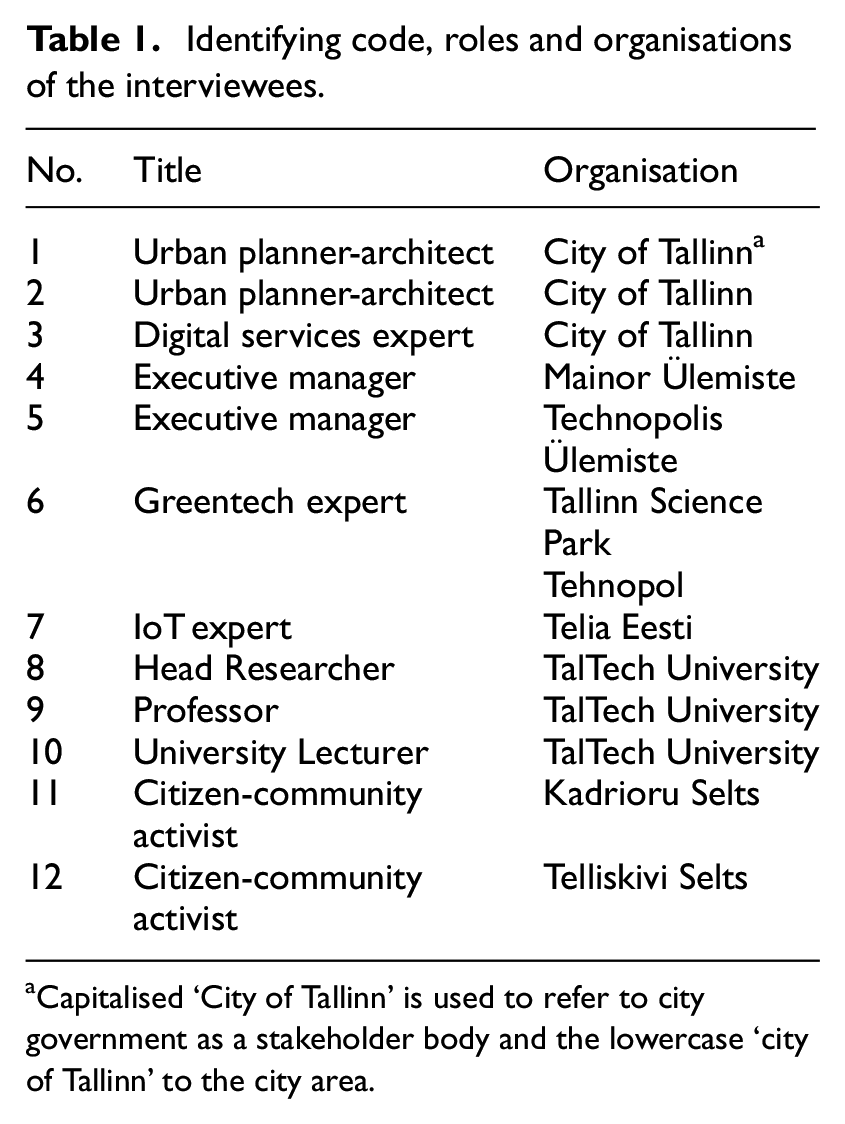
Capitalised ‘City of Tallinn’ is used to refer to city government as a stakeholder body and the lowercase ‘city of Tallinn’ to the city area.
The interviewees, representing the local professional landscape, were contacted based on their role in their respective organisations and presumed knowledge about local urban development and the organisations and institutions involved. This presumption was based on organisational seniority and the relevance of digitalisation to their work. Some interviewees were referred by other interviewees as having expertise related to the selected topics.
While certainly helpful to the research aims of this paper, it was not assumed that the organisations represented by interviewees would necessarily be considered key by other interviewees in the context of a digital city. The interviews were semi-structured but the participants were encouraged to introduce related topics that they would consider relevant. Interviews were transcribed and analysed with a qualitative thematic analysis approach, which can be used to construct recurrent patterns of meaning, that is, themes, based on interpretations of textual data (Braun and Clarke, 2006; Evans, 2018). This approach provides the tools and a workflow to make sense of and group subsets of collected data in such a way that insight for the main research questions can be produced. Its strength is flexibility across a variety of contexts and data, and it is suitable for both generic and methodology-specific approaches (King and Brooks, 2018). The actor-focussed urban governance lens on smart urbanism described in the previous section was used to identify participating actors, their interests, agency and resources involved in promoting digital technology adoption in Tallinn. The process for analysing the interviews went as follows: familiarising with the data, selecting relevant extracts, giving relevant extracts a brief descriptive code, grouping extracts, and analysing groups. The findings presented below are structured around four themes: digital technology in strategic management; digital technology in local economic development; digital technologies in testbedding; and digital technology in mobility as a flagship industry, which represent interests in digital technology in the city.
Mediating digital technology and urban space in Tallinn
Digital technology in strategic management
Tallinn’s city government has taken a stronger role in local urban governance by introducing strategic planning to align the collective objectives of the city’s stakeholders. Digital technologies play a newfound role in this effort. In 2021, the mayor-led city government established the Strategic Management Office (SMO) to: plan and measure performance … [and] set the KPIs (key performance indicators), all the sub-strategies for the City, for example Digital Tallinn. (Interviewee #3)
Tasks of the SMO include integrating different areas of urban development, including general spatial planning, coordinating local smart city development and ‘planning the big picture all over Tallinn’ with ‘every decision and every plan going through them’. (Interviewee #11) within the city planning organisation. Around the time of the restructuring, a new ‘Tallinn Development Strategy 2035’ replaced the previous strategy from 2009 to further gather the local actors behind a collective agenda. Indicative of the rapid ‘digitalisation’ of the City’s ambitions as part of strategic management, it is noteworthy that the new strategy features the word ‘digital’ 26 times and ‘smart’ 36 times while the previous strategy mentioned neither. In the new strategy, digital technologies, including the city’s smart city programme, serve especially to develop the local business environment. The transition towards integrating technology to city governance has been rapid: 10 years ago, understanding of digitalisation and automation from the city government perspective was totally different. … [Now] everything that is online and everything that offers automation and digital services has really grown. And the City has also understood it. (Interviewee #8)
Digital technology in local economic development
Companies focussing on digital technology have become an integral part of Tallinn’s economic development strategy. A science park expert noted a growth in local start-ups after the online communication service Skype, developed in Tallinn at Science Park Tehnopol, was sold to Microsoft in 2011: This was a very important [event] in the field of start-ups because the Skype builders became rich overnight and started to reinvest their resources to build new Skypes. (Interviewee #6) I would think about beginning to fit a new digital economy versus an old industrial economy. This has really changed rapidly, 10 years ago the innovation side was way more traditional in most fields. These new economy start-up companies [and] [small and medium-sized enterprises] have really entered the game. (Interviewee #8)
Since Skype, the city has witnessed a rapid emergence of a new ‘digital economy’, where urban technologies play a major role. Prominent companies, such as the autonomous robot delivery company Starship Technologies founded with Estonian Skype funds, mobility platform company Bolt, autonomous vehicle company Auve Tech or Internet of Things (IoT) platform company Krakul, have focussed on urban integration of digital technologies. For example, while focussing on mobility services in general, Bolt benefits from ‘dense urban cohabitation’ as articulated by Barns (2020).
While adoption and innovation of digital technology are included in Tallinn’s development strategy, successfully governing these goals has required city government to cooperate with the local business and the technology sector. It has also required tying promoting digital innovation with supporting the local entrepreneurship ecosystem. As part of this support, a City expert advocated for supporting cluster-based cooperation as part of local economic development (see Madaleno et al., 2022).
[The City is] the key driver of urban development, and the regulatory part comes from that side but … I would say that [for] innovation activities and new solutions that are globally attractive, the business and technology sector is the most important actor [as] the City is not that strong in boosting research and innovation itself. (Interviewee #8) The city cannot build all these new systems and the city environment [alone]. [It] needs to set the playground where entrepreneurs can help the city to build up the systems. This is the ecosystem that is important. (Interviewee #6) Working under the same roof with a project, cluster-based cooperation, this is where you can make success story immediately. It’s like a science park and all these incubators [that] we have. (Interviewee #3)
Digital technology optimism has penetrated local decision-making, and motivation for promoting digital technology is fuelled by a competitive mindset by the decision-makers: On the SMO or the city planning level, even talking about digital solutions or innovation, there are always political decisions behind them. (Interviewee #3) Social acceptance towards innovation … is quite high. These decision-makers … are also often tech-savvies. They like to brag about [innovation in Tallinn] when they are meeting with other cities. This is what runs this cycle of innovation. (Interviewee #6)
Tallinn guides technology innovation by exploring technological solutions with the private sector, for example through the Committee for Innovation which discusses ‘challenges in the future [and] the new technologies we can implement in the city’ (Interviewee #3). However, Tallinn’s relatively small size limits its attractiveness in the eyes of large multinational companies. There are limited cooperation possibilities with multinational technology companies who ‘are not interested in making joint projects or making their own developments [in Tallinn]’ (Interviewee #3). While global companies are not available for joint projects: people are using their products. … Those companies don’t really have an impact on the infrastructure, but … on the end-users. The digital platform communicates with the infrastructure provided by the locals. … Global products are used locally [but] the leverage is not on the side of the local officials. (Interviewee #7)
Local authorities have therefore needed to find other ways to leverage the potential digital technologies locally, for example by supporting local testbedding. In seeking benefits from digital technology, the City has increased support for local innovation and start-ups.
If we want to … make sure that the city is growing in terms of [technology innovation] … the City really needs to support such activities to make sure that they are continuous. If we don’t have these resources, it [would be] very Eastern Europe type of planning things. You have politicians who say [they’re] very innovative and at the same time you don’t have the resources and the brains. (Interviewee #3)
Digital technologies in testbedding
Testbedding is increasingly carried out as an experimentative practice at the intersection of smart city governance and urban space (While et al., 2021) and is also a central element of Tallinn’s innovation and marketing strategy for a smart digital city. It is a way for city government to support local entrepreneurship while ensuring that benefits from digital innovation are maximised to the city itself. The city is presented as an ideal testbed for digital technologies (e-Estonia, 2018, 2020), as exemplified by the City’s innovation platform slogan ‘Think globally – test in Tallinn’ (e-Estonia, 2020). The goal to promote technology testbedding is also codified in Tallinn’s development strategy: Fostering the development of new solutions of future technology and their (test) implementation in the city environment (e.g. pilot projects of self-driving cars, over-the-air free Internet, smart solutions for the residents and guests of Tallinn). (City of Tallinn, 2020)
Testing in Tallinn is hoped to foster the growth of digital technology companies locally and to increase the attractiveness of the city globally. A science park expert argued that Tallinn is a very good testbed city.
Estonia is a very good testbed and this is very much true because Estonians have openness for new solutions. … When [Estonian mobility platform company Bolt] started their service in Tallinn, it was a big success because we are respectful of technology. (Interviewee #6)
However, local experimentation with digital technologies is not always carried out without resistance: Communities have quite openly told us [to] please direct all these finances [on digital participation] that you invested in creating real space for us. (Interviewee #2)
A university researcher (Interviewee #10) argued that most noteworthy technology-related developments in Tallinn are happening with regards to mobility services, automated vehicles and traffic management as well as smart buildings and house automation, all fields existing at the intersection between digital technology and urban infrastructure/urban space, typical of smart urbanism (Vanolo, 2014). Companies in these fields represent instrumental value for local business park developers, who attract high-value digital technology companies by leveraging land value.
Most of the innovation is happening as a combination of the ICT sector and start-ups growing from the old, spinning out from existing financial institutions. [These companies] will grow for the next 10 to 15 years. … That’s the source of our future client portfolio as well. … If you read the studies regarding the sectors where most jobs are created, … one of them is this ICT sector. (Interviewee #5) [This] has been our goal from the beginning. We are embedding many of the most important IT companies in the campus and … that was deliberate work to get the biggest anchors into the campus who would then spin off the new ones. We convinced the biggest IT players to move their headquarters to the campus. The rest kind of happened by itself. (Interviewee #5)
Approximately 90% of land in Tallinn is privately owned, which limits how much the City can plan the adoption of digital technologies in different areas of the city and gives a more significant role to the market/developers (Ruoppila, 2007). According to an SMO urban planner this ‘doesn’t leave [them] very much land with which to make spatial decisions, meaning that most of this spatial development is developer-led’ (Interviewee #2).
One of the areas where tests by the City are carried out is the campus area of science park Tehnopol, a joint foundation between the City, TalTech University and the Republic of Estonia. Digital technology is made relevant through instruments such as the ‘Tallinnovation’ competition organised by Tehnopol and funding decisions are made by the city council.
The Tallinnovation program [funds] the different solutions that can deliver [the City’s] expectations. They are testing these solutions also in the Tehnopol business campus, as [the City] is one of the founders of Tehnopol, and also [testing] in the city. (Interviewee #6)
Some business campus developers, most notably those in Ülemiste City, have taken testbedding as a part of their toolkit to increase the value of their land. This represents a shift to a new digital growth logic (Rosen and Alvarez León, 2022). Motivation behind digital technology adoption for these companies has therefore been a search for new mechanisms for increasing land value. The developers are well positioned to make this shift due to the control over their land assets: [Large] owners have been quicker or cleverer than the City to build and run those environments. This possibility to have a slightly larger area to run, it’s helpful there. … This is going far beyond the built environment [as] they are curating the cocktail of the services. … Attractiveness of the area is supported by each little stakeholder or renter. (Interviewee #1) [Our] aim [is] to build [and] to offer a test city or testbed service. (Interviewee #4) We have stated that this kind of opportunity is available and when they have an interest, they [can] come to us and test it. Usually it requires a certain level of investment from our side as well, so that testing can be carried. (Interviewee #5)
The developers positioned campus testbedding, such as that of autonomous mobility, as also benefitting Tallinn and Estonia more broadly, implying a mutual multiscalar interest between the developers, the City and national government to support testbedding in these areas.
Features tested in the campus would be later on influencing not only Tallinn, but maybe something [that] will be done in Estonian other cities in general. (Interviewee #5)
Digital technology in mobility as a flagship industry
Digitalisation of mobility concerns both local economic development and testbedding in Tallinn and has been a dominant theme in the development of Tallinn’s digital economy. It is claimed to stem from responses to urban problems: Mobility and intelligent transport solutions … definitely have had the most innovation projects, both from [the] business side, but also from the City side. (Interviewee #8) Innovation development is not that much triggered by technology or solutions as such but it’s actually triggered by urban problems. … Pretty much every day you have more people that produce waste that demand for energy, the demand for mobility, demand for social service services and so on. (Interviewee #8)
A prominent example of digitalised mobility is Bolt, an Überesque Tallinn-based mobility platform company founded in 2013, which has now become multinational, operating in 45 countries. The growth of Bolt has not only benefitted its shareholders but also other stakeholders indirectly: From our point of view, … our ‘unicorns’ like Bolt … generate a lot of [economic] value, [bringing] people from abroad to Estonia to work, so that our economy can grow and develop. (Interviewee #4)
It was also noted that services offered by Bolt do not represent global innovation per se as ‘Bolt has done something that [exists] also in other countries. It’s not local development’ (Interviewee #12). However, the platform-based micromobility service offered by Bolt was considered to be ‘really changing urban space, maybe even the urban fabric or structure’ (Interviewee #1). Bolt’s business model is a prime example of platform urbanism (Sadowski, 2021) in mobility and ‘a prime example of an IoT use case where something old was refurbished through technology’ (Interviewee #7). This means seeking efficiency through digital platform integration but not substituting travel as the basis for profit. Bolt seeks flexibility and to avoid regulation to make travel more efficient but, being a mobility company, never wants to eliminate it altogether: [No matter] what kind of business you take, is it the car sharing, taxis or food delivery, something is moving through space. The easier, the better the conditions for Bolt to operate in the city, the better their business [and] the more profitable, because the time spent on the road will be less, it will be used efficiently. (Interviewee #7)
Autonomous mobility was anticipated as the next step/intensification of Tallinn’s digital mobility paradigm. This has raised mutual interests for intermediaries such as Ülemiste City developers or the city government and also for TalTech University as well as local technology companies such as Auve Tech, which is developing autonomous vehicles. To maintain its market share, Bolt would also need to seriously engage with autonomous mobility.
Estonia and Tallinn are quite well developed with the self-driving bus and car development, [with] the university providing it as well. This will be a totally new and, I believe, a very good service, [that] builds Estonia and Tallinn’s visibility or image. (Interviewee #4) I say [autonomous mobility] is a must for [Bolt] because they are one of the biggest stakeholders in the mobility matter. (Interviewee #7)
Discussion and conclusion
The previous findings section provided insight into stakeholder interests in Tallinn where digital technology adoption and making use of urban space intersect and how interests converge in urban governance between these stakeholders. The findings illustrate increased significance of urban technologies in urban governance, typical for smart urbanism (see for e.g. Kitchin, 2015: 132; see also: Chang et al., 2021; Kong and Woods, 2018; Luque-Ayala and Marvin, 2015; Odendaal, 2021). This significance is expressed in four thematic findings: digital technology in strategic management; digital technology in local economic development; digital technologies in testbedding; and digital technology in mobility as a flagship industry. These interests reflect mechanisms in digital urban growth that create and reproduce place-based connections in cities, reproduce the significance of urban space and, in so doing, represent attempts to harness the many possibilities enabled by digital technologies. This idea is supported by earlier findings on the benefits of digital technologies in cities (Afradi and Nourian, 2022; Aslesen et al., 2019; Duvivier et al., 2018; Haefner and Sternberg, 2020).
The integration of digital technology into collective city development goals reflects transforming urban governance (Sadowski, 2021). Technology does not often play the main role in these goals but is instrumental in the realisation of these goals (Chang et al., 2021). Strategic goals involving digital technology serve to enhance local economic development. One of these is supporting place-based entrepreneurship around digital technology adoption. Testbedding is a way to allow entrepreneurial experimenting in urban space to develop new mechanisms for extracting profit from urban space, and to channel newfound digital growth potential in digital technologies locally (Rosen and Alvarez León, 2022). Stakeholders supporting testbedding, such as city governments with interests in local economic development or business campuses with strategies seeking to extend the ways to generate value for their land, can attempt to guide the effect of digital technologies selectively by influencing the development process of these technologies. Capitalising on the digital growth logic may eventually lead to the creation of ‘flagship industries’, such as digitalising mobility, that present multifaceted benefits beyond the technology itself. For example, it may be a way to reposition and market the city globally, which seems to be the case in Tallinn. Digital platform mobility business is a prime example of urbanisation of technology capital (Sadowski, 2021) – flexible, scalable and relatively free from a given urban context, but benefitting from urban densities (Barns, 2020) and strongly rooted in travelling the physical space. This is also the case for autonomous mobility, which seems a logical next step for urban technology capital among other developments such as autonomous robotic experimentation (While et al., 2021).
Whether digital technologies serve to dislocate or decouple functionalities from urban space should also be understood against the backdrop of local actors’ interests. It is suggested here that smart urbanism should also be understood as a framework through which actors attempt to seize the benefits of digital technologies without compromising their interests in urban space. A few arguments can be made to support this claim. As Luque-Ayala and Marvin (2015) have argued, smart urbanism (as a framework for digital technology adoption) has ‘emerged at the intersection of visions for the future of urban places, new technologies and infrastructures’ (p.2105). Smart urbanism as an idea is also compatible with the logic of digital growth and accumulation. As the findings illustrate, there is already a large market for smart urban solutions in many cities. Compromising the urban element of these solutions would be disadvantageous and unprofitable for influential actors pushing for more digital urban technologies.
However, this approach has limitations as urban governance mostly concerns stakeholders who are willing or available to cooperate. This is often not the case for multinational technology companies whose products are only used and consumed locally and local stakeholders might not be able to fully harness the positive effects of these digital technologies in local governance. Furthermore, while urbanising technology represents an expanding industry (Rosen and Alvarez León, 2022; Sadowski, 2021), it does not account for all new digital business. Urban technology governance also has clear uncertainties. For example, the findings presented how Science Park Tehnopol, supporting development of local technology companies, also incubated Skype, which has arguably substituted some forms of travel by enabling remote communication. In the same way as Skype was created, Tallinn’s approach to local economic development supports the growth of new digital businesses regardless of whether they aim for the local or global market and creates more possibilities for the creation of digital technologies enabling substitution of urban functionality.
This paper has sought to understand the intersecting interests of local stakeholders as actors guiding the effects of digital technology adoption in the city. In so doing, it has drawn on work on the spatial effects of digital technology, literature on digital urban growth and urban governance theory. Based on a thematic analysis of qualitative data seeking to understand intersecting interests, it is suggested that research on digital technologies in cities would benefit from conceptualising smart urbanism as a framework in which urban actors attempt to benefit from digital technologies without compromising their interests in urban space. Despite potential in digital technologies, smart urbanism governance therefore seems unlikely to support a ‘virtual’ substitution of core urban functionality. However, future research should continue to examine the spatial effects of digital technologies and the logic of digital accumulation on the spatial configuration of urban functions.
Footnotes
Acknowledgements
The author wants to express appreciation to the anonymous reviewers for their insightful and constructive comments in developing the paper.
Declaration of conflicting interests
The author declared no potential conflicts of interest with respect to the research, authorship, and/or publication of this article.
Funding
The author disclosed receipt of the following financial support for the research, authorship, and/or publication of this article: The project was funded by the Future City Professorship project partners (including Mainor OÜ, Mainor Ülemiste, Telia Eesti, Ericsson Eesti, TalTech, and the City of Tallinn).
