




Abstract
As the Israeli genocidal war drags past 700 days in Gaza, the temporality and rhythms of daily life have been dismantled, with a complete lack of linearity and plannability. In tracing how the settler colonial project in Palestine weaponises time through checkpoints, permit regime, court bureaucracy, and different colonial actors, the temporalities of attrition and slow violence in Gaza reached their most acute form after October 7. Drawing on 15 interviews from Gaza and other materials, the article narrates the development from the slow temporalities into the ruined temporalities of current Gaza through Israeli entrapment and scarcity-making. Centring people's experiences, the article reveals how queuing for survival has become the centre of daily life, featuring exhaustion, humiliation, and anticipatory dread, as it’s overlapping affective intensities. Temporal ruination, I argue, is (i) the collapse of time's coherence under conditions of siege, entrapment, and infrastructural annihilation; (ii) a deliberate tactic of domination that renders daily life unstructured, unpredictable, and uninhabitable; and (iii) an affectively saturated state marked by exhaustion, humiliation, and anticipatory dread. In conclusion, I highlight the microgestures people attempt that can neither remedy ruin nor redeem annihilation, but instead fleetingly interrupt their colonial logics.
Introduction
‘There can be no orderly sequence of time. You see it in our children who seem to have skipped a phase of growth or achieved an out-of-season maturity in one part of their body or mind while the rest remains childlike’. (Said, 1999: 25)
What does it mean to dwell in a place where hours pass with hunger, dread, and killing? What can be said of time when the future is unknown, the present is fraught with exhaustion and suffering, and the past is loaded with grief and pain? As the Israeli genocidal war drags past its 700th day in Gaza, the temporalities and rhythms of daily life have been shattered: an utter lack of linearity and plannability. Daily life has become centred around queues and lines (crowds) for necessities such as food and water. People faint while waiting in the queue or when airdrops fall like bait, and panic within the so-called ‘distribution zones’, or death traps. With an increasing death toll of 66,005 Palestinians killed, including 17,492 children, more than 111,588 people injured, and more than 14,222 missing and/or presumed dead (AJLabs, 2023), people live under constant surveillance in a place deemed unlivable even before this unseen wave of destruction (UN, 2018; UNOCHA, 2024). People have waited for this to end for months, during which they have not only waited for a crust of bread and a drop of water but also waited to sleep and to dwell safely. All this waiting unfolds amid and due to an all-consuming famine, that claimed the lives of at least 440 people (AJLabs, 2023), meticulously engineered by Israel and backed by its supreme court (Gordon & Haddad, 2025). The UN has refused to hand this aid to Israel for the very reason that the latter uses it as bait (UN, 2025), in which, per soldiers’ testimonies, gathering people in ‘aid’ areas and shooting them as a ‘killing field’ (Haaretz, 2025).
The current living circumstances do not allow for any room future planning other than ‘where should we go?’, amid unstoppable calls for displacement, enforcing an exhaustive and debilitating present. This paper contributes to and extends the growing body of literature on temporalities in Palestine. Existing scholarship has richly documented the modalities, paces, and intensities through which Israeli colonial power manipulates Palestinian time, be it through the checkpoint regime in the West Bank, the bureaucratic logics of house demolitions, court delays, arbitrary arrests, or other forms of temporal obstruction enacted by state and military apparatuses (Abourahme, 2011; Golańska, 2022, 2023; Joronen & Griffiths, 2019; Hammami, 2015; Handel et al., 2024; Joronen, 2017; Peteet, 2017; Stamatopoulou-Robbins, 2021; Tawil-Souri, 2011, 2012a, 2017; Rijke & Minca, 2018). These studies have shown how time becomes a medium of control and subjugation. Drawing on that, this paper shifts the focus on Gaza, discussing temporalities under genocidal violence, and how it shifts from the modalities of slowness and siege, and those of spectacular violence, into a ruined temporality. Timely interventions raise critical questions about the shifting forms of settler colonial violence and their enduring objective: elimination (Bshara, 2025; Segal, 2025; Veracini, 2025). In conceptualising different temporalities of Gaza, these fast alterations reveal the extreme, violent, and distinct temporal conditions in Gaza. In this article, I discuss how the current condition in Gaza materialises what I term temporal ruination: a violent settler colonial disfigurement of time through the destruction and disruption of temporal structure and expectations, coupled with an exhausting affective toll. What Israel has been doing in Gaza has created a fragmented, chaotic temporal reality that undoes the coherence of duration itself. Central to this are two mechanisms: entrapment and scarcity-making, which Israel enforced to work in tandem to orchestrate infrastructural elimination (Dader & Joronen, 2025) and induce an all-consuming famine. Within this reality, the ‘queue’ 1 of waiting is less a bureaucratic delay than a volatile space of everyday life and its necessities.
The article unfolds in four sections. I begin by tracing how the settler colonial project in Palestine weaponises time through checkpoints, permit regime, court bureaucracy, and different colonial actors, narrowing it down to temporalities of Gaza between siege and rounds of escalation in the last two decades. In the second section, I explicate the intensification from the slow temporalities of the siege and those of spectacular violence into the ruined temporalities of current Gaza through two colonial techniques: entrapment and scarcity-making. Drawing on 15 interviews from Gaza city, in the third section, I unpack the lived realities and affective intensities of temporal ruination. Through people's narratives, the section reveals how prolonged queuing, fainting, fighting, and scrambling for survival in sites of food and aid distribution unfold not as isolated events, but as entangled and escalating affective intensities. These are not discrete experiences but overlapping affects of exhaustion, humiliation, anticipatory dread; affective signatures of a temporality violently and repeatedly undone. In the final section, I shift the focus into how Palestinians attempt to dwell amid such conditions through fragile, situated gestures of persistence: religious invocations, small acts of mutual care, fleeting reorganisations of space and routine. These are not escapes from ruination, but ways of dealing with it – a politics of endurance that can neither remedy ruin nor redeem annihilation, but instead fleetingly interrupts their colonial logics.
The interviews took place in Gaza city when feasible, in different places of dwelling where Palestinians took shelter at different moments from September 2024 until late November 2024. As a Palestinian from Gaza with my family still dwelling there since the beginning of the genocidal campaign, my positionality has been of an utmost importance to the framing and the immediacy of this research. My daily communication with my family and friends living under and through eliminatory conditions, daily updates from social media and news, and my knowledge and experience of living in Gaza, coupled with my research diaries and notes all have enriched my perspective and knowledge by complicating and expanding my understanding of the place's temporal and spatial dynamics, where I have lived most my life. It has also deeply affected and augmented the structure of my analytical lens through which I explore questions of waiting, time, survival, and endurance – those of waiting food, evacuation orders, aid queues, network and telecommunication connections, and ceasefire news and so on of an ongoing waiting to stability and solace. Adding to these layers of attachment to Gaza and its changing reality, I collaborated with a research assistant, who conducted 14 interviews, preceded with one interview I conducted with him being one of those having been living those circumstances. With my first interview, we both attended to the ethical considerations of safety, consent, accessibility, anonymousity, and ensuring that conversations with people take place in a minimally disruptive space as possible within their shelters.
Settler colonial time-politics in Palestine
People wait at airport gates, train stations, hospitals, government offices, and for daily errands, ubiquitously experienced, as Hage (2009: 23) notes, ‘We’ve all gone through periods of intense waiting’ (see also Jeffery, 2008). But what is peculiar in settler colonial contexts like Palestine is that waiting is a ‘stalled time’ rather than a passive interlude (Hage, 2009), and as something designed to completely rupture day-to-day life, it is ‘hardly equivalent to the mundane waiting of ordinary life’ (Peteet, 2017: 141). Settler colonial powers weaponise time versatilely to advance their aims, which lies in eliminating the native to secure and advance territorial expansion (Barakat, 2018; Salamanca et al., 2012; Sayegh, 2012; Wolfe, 2006), because their aim is simply ‘incompatible with the continued existence of the “native population” in the coveted country’ (Sayegh, 2012: 209). This elimination process is structural and ongoing rather than an event (Wolfe, 2006; 2008), but also nonlinear structure, taking different paces and intensities as it goes on (Ghantous, 2020; Tawil-Souri, 2017). It is a process that incorporates spectacular violence as well as a slow one, given the ‘multi-nodal’ nature of the settler colonial process (Wakeham, 2022). Over time, the process of elimination mutates, receding from direct violence into bureaucratic and infrastructural mechanisms that advance the native disappearance through logistical and spatial means, or what Wolfe (2008: 123) calls ‘spatial sequestration’.
In Palestine, the living reality manifests the time constraints laid out by the Israeli forces. In her work on mobility and space, Julie Peteet (2017) extensively shows that Israel has joined the colonial tradition of seizing native time to coloniser time, rendering Palestinian life increasingly precarious ‘through temporal engineering’ (p. 141), manifesting this temporal warfare through a constellation of similar yet distinct tactics. Therefore, to speak of temporal violence in the Palestinian context is to speak of settler colonialism's mastery over the native's time via a multitude of colonial actors, institutions, and technologies (Ghantous, 2023: 75). Settler colonial time-politics in Palestine manifest through a wide array of temporal manipulations and modulations that blur the boundaries between the spectacular and the mundane, the immediate and the chronic: bureaucratic delays, infrastructural degradation, and spatial fragmentation (Berda, 2017; Daher-Nashif, 2021; Peteet, 2018; Joronen, 2017; Stamatopoulou-Robbins, 2021); sudden bursts of spectacular violence; slow violence (Nixon, 2011; Rabie, 2021); checkpoints, ID regimes, and ongoing bureaucracies (Tawil-Souri, 2011, 2012a; 2012b; 2017), all contributing to a temporal architecture, a lifeline and a logic to settler colonial spatial rule, governing not only where Palestinians move, but when and how they endure (Weizman, 2007).
In the West Bank, for instance, checkpoints, Hammami (2015) argues, are material expressions of Israel's broader necropolitical and biopolitical governance, spurred by logics of elimination. These spaces discipline Palestinian mobility and subject daily life to arbitrary, chaotic, and unpredictable rhythms, rendering the experience of movement itself a site of suffering, humiliation and control (Peteet, 2017). They spatialise settler colonial time as disruption of life's basic predictabilities, which hinges on and permeates to other daily activities, as Tawil-Souri (2017) frame it through the ‘checkpoint time’, that is an unsettling experience that diminishes the sense of time and space, through an array of material, affective, and technological actors that force, control, dominate, and modulate Palestinian time into ‘Israeli time’. The checkpoint exists to instil a deep existential and political instability to Palestinian bodies (see Rijke & Minca, 2018). Adding to that, Joronen (2021a) further introduces the idea of ‘slow wounding’ as distinct from the binary of slow versus spectacular violence. Drawing on Povinelli's (2011) concept of ‘quasi-events’, that is, ongoing, chronic conditions that hurt without climax or resolution, Joronen (2021a) emphasises how settler violence through settlement policies operates not only through direct assaults but also through the sedimentation of harm in daily life. Further elaborated as bureaucratic entanglements and legal limbos surrounding house demolitions, Joronen (2017) shows how Israel produces systemic precarity as a form of governance, as much as calibrating humanitarian crises as a ‘regime of governance’ (Peteet, 2017: 151). In parallel, Golańska (2022) looks into settlement encroachment and the pace, dynamics, and nature of Israeli policies through what she terms ‘slow urbicide’, gradually producing experiences of placelessness and non-belonging (p. 126). She further marks an implicit distinction with ‘fast urbicide’, which refers to tactics such as aerial bombings, drone strikes, and infrastructure detonation, as in the case of Gaza (p. 127). These overlapping tactics of spatial and temporal violence are exemplary of settler colonialism's adaptability: from drawn-out suffocation to abrupt annihilation, mutating through bureaucratic, spatial, and logistical means (Wolfe, 2006). The lines between slow and fast violence in Palestine are blurred as they are interchangeably adopted to fragmenting space, dominating time, and engendering chronic waiting (Peteet, 2017). With all these manifold ways of controlling Palestinian space-time, Ghantous and Joronen (2022) argue that settler colonial violence is better understood as a process of speed, which can be slow, fast, abrupt, rhythmic, urgent, depleting, and eventful. They posited that ‘what makes settler colonial elimination functional in the first place is the ability to govern differences in motility’, as the intensified and accelerative eliminatory paces of dromoelimination seize the time during which Palestinians can reflect, plan, and claim justice, undermining the capacity to inhabit or imagine futures (p. 395).
In Gaza, by contrast, Israel has imposed a different approach of control – an asphixatory approach through ‘choke points’ since 2005 (Puar, 2017: 135). They designated Gaza a hostile territory (Agha et al., 2024), becoming a laboratory of settler colonial violence. Thereafter, Gaza witnessed more extreme and direct forms of violence (Peetet, 2017). The Israeli border and sky control of the Strip has engendered a new form of colonial control, with the complete absence of settlers (Pace & Yacobi, 2021), imposing an ongoing siege, closing off the borders and enforcing suffocating conditions through slow infrastructural violence. Such a shift in controlling Gaza served as part of a wider spatial logic through enclave formation, as unilaterally withdrawing from Gaza has spatially and functionally ruptured and isolated the Strip from other Palestinian enclaves, maintaining and strengthening Israeli control over all borders (Falah, 2005). This enclavisation is at the heart of the Israeli settler colonial complexion of ‘divide and conquer’ (Abdulla, 2016), a separatist mainstream Israeli ideology, with the most prominent case of separatism is ‘the encirclement of Gaza, trapping more than 2 million Palestinians behind high fences’ (Pressoewenstein, 2024: 72), regularly attacking with brute force such as in 2008, 2012, 2014, and 2021, and several rounds of escalation in between. Such rounds of warfare operated through logics of acceleration and destruction; a fast warfare through aerial bombing, destruction of critical infrastructure, and various forms of bombing and destruction (Golańska, 2022). The dynamics of spectacular violence also included the ‘roof knocking’ military tactic, a branding of Israeli ‘ethical concerns’ (Joronen, 2016), enforcing a suspension of temporality, placing all the responsibility on the inhabitants of the targeted house. On the other hand, they laid the ground for more control operating via slow violence dynamics by delaying post-war ‘rebuilding’ plans and not allowing enough building materials, under the pretext that such materials are ‘dual-use’ (Beaumont, 2014, para 2). As such, the Gaza Strip has witnessed the dynamics of both violence oscillating between slow and fast, manifested through siege, regular destruction operations, and border control, which manifested a stifling temporariness imposed through infrastructural fixes (Salamanca, 2011). This siege has profoundly shattered the temporal fabric, enforcing prolonged suspension and bare survival (Amir, 2021; Khader, 2014; Medien, 2018), attempting to sustain life just enough while concealing decades of orchestrated containment, infrastructural degradation, and occupation. Gaza was already temporally constrained, oscillating between emergency and obsolescence, extending the infrastructure of isolation under the guise of logistics and care, through caloric calculations, limitations on sea fishing, and meticulously calculated access to water and electricity (Butt & Butt, 2016), keeping the population at the edge ‘to the breaking point’ (Weizman, 2012: 87). In so doing, Israel maintained several precarities, aiming to keep the life in Gaza always at stake (see Joronen, 2021b).
Temporal ruination: Entrapment and scarcity-making
Exceeding 700 days of genocidal violence, Gaza's temporal conditions extend far beyond the modalities of settler colonial slowness and spectacular violence. What unfolds currently is a manifold of temporal forms of violence: the brute force of indiscriminate bombing, the recurring ‘evacuation orders’, forcing constant displacement from one place to another, and the extreme conditions and blocking of food, water, and shelter. What makes the temporal conditions in Gaza distinct from spectacular and those of slow and attritional violence is that the fast, abrupt, rhythmic, urgent, depleting, eventful pace(s) of various multi-layered forms of violence all coexist together. This materialises the extreme form of dromoelimination, producing a ruined temporality, where people are stuck amid exhausting survival and unstoppable erasure – temporalities of collapse, saturation, and incoherence, which I call temporal ruination. The entanglement between bombardment, forced displacements, infrastructural elimination, and scarcity-making produce temporalities so breathless and unlivable, that the ability to ‘dwell’ recedes into looking for shelter under fire constantly and looking for necessities through life-risk journeys. The temporal markers, the daily and the annual, which shape the very structure of life there – including but not limited to Eids, Ramadan, the start of the school and university years – are engrossed by such depleting and deadly conditions. These temporal markers no longer unfold as they once did, as it pertains to people's attempts to escape elimination, secure survival, and navigate the affective intensities in between, precluding the possibility of sustainable living or any sense of dwellability.
Through enforcing tighter siege and reaching infrastructural elimination, that is, ‘pulverisation of entire neighbourhoods and the deliberate targeting of hospitals and shelters…and annihilation of life-supporting water treatment, electricity, and food chain infrastructure’ (Dader & Joronen, 2025: 889), Israel turned Gaza into a death trap and famine laboratory. Such strategies stretch moments of deprivation, accelerate terror, suspend futurity, and obliterate daily rhythms. As people's narratives show, what works today to secure food or water is likely to fail tomorrow; life has become improvised and contingent, all under the constant dread of bombing and killing. Under such spatial suffocation and material deprivation, what can be said of time? How do temporal experiences unfold when the population is forced into living such choking conditions? How do we define livable time when a whole nation is attacked in its totality? Such inquires do not yield answers but mark the contours of temporal ruination, where time has become so stuck, so accelerated, and so erased all at once that movement itself embodies this contradiction. People's lives have become centred around surviving, which means constantly looking for shelters, food, and water under fire, amid destruction, and running from ground invasions and tanks shells. People are forced into constant, contingent motion with no pause and under immanent risks. ‘We were dragged by the Israelis, from one area to another, through the streets, pulling our children along with us. Some of our children were injured, others martyred. We suffered as we fled from one place to another. We go to the place they name “safe”, and they bomb it. There is no safe place left’.
In this testimony, a father narrates the lived reality of Gaza's temporal ruination: a life orchestrated to perpetual, survival-oriented endeavour, in which space and time collapse into a spectrum of risk, unending. Entrapment and scarcity-making are the main engines driving this temporal collapse. As mentioned before, one of Israel's long-adopted strategies is enclave formation, separating West Bank cities through checkpoints, separation wall, isolated completely from Gaza, keeping the Strip spatially disconnected in the last two decades. Since October 2023, Israel embarked on enclaving the Gaza Strip even further from within. They entrapped the population through sealing off escape and forced displacement with indiscriminate bombing creating kill zones under the guise of humanitarian corridors or ‘safe zones’ that are anything but safe. In tandem, they made scarcity so extreme through structural and continuous attempt at dismantling the means of life through blocking water, food, shelter, medicine, and any attempt to secure them. Both tactics render the Gaza Strip into what people describe, a death trap, a space where every attempt to dwell or endure is met with new layers of violence, deprivation, and unpredictability. Through destructive and annihilatory military force, Israel has systematically enforced a spatial redrawing of the Strip to encircle Palestinian populations to push them out, as repeatedly stated by Israeli politicians (Aljazeera, 2023; CNN, 2024a; FRANCE 24, 2025). Simultaneously, they carpet bombed residential areas, critical infrastructure, hospitals, schools, bakeries, and universities, meticulously and architecturally mapping and squaring Gaza into numbered and/or alphabetised blocks, giving them full control in forcefully and continually displacing the populations through issuing of evacuation orders at an extraordinary scale (see Figure 1). Israeli military forces reinforced the borders of Gaza and established wide buffer zones, approximately around more than 50% of the territory (Associated Press, 2025). They established the Netzarim Corridor at the centre of Gaza, which halved the Gaza Strip into two parts (CNN, 2024b), currently referred to as the South and the North of Gaza. In this corridor, Israel installed two checkpoints with facial recognition and automatic guns, at the intersection of the North-South arteries, to mark any Palestinian crossing, biometrically (Weizman, 2024, preface), colonial techniques and manifestations that existed in the West Bank long before (Nashif, 2017).
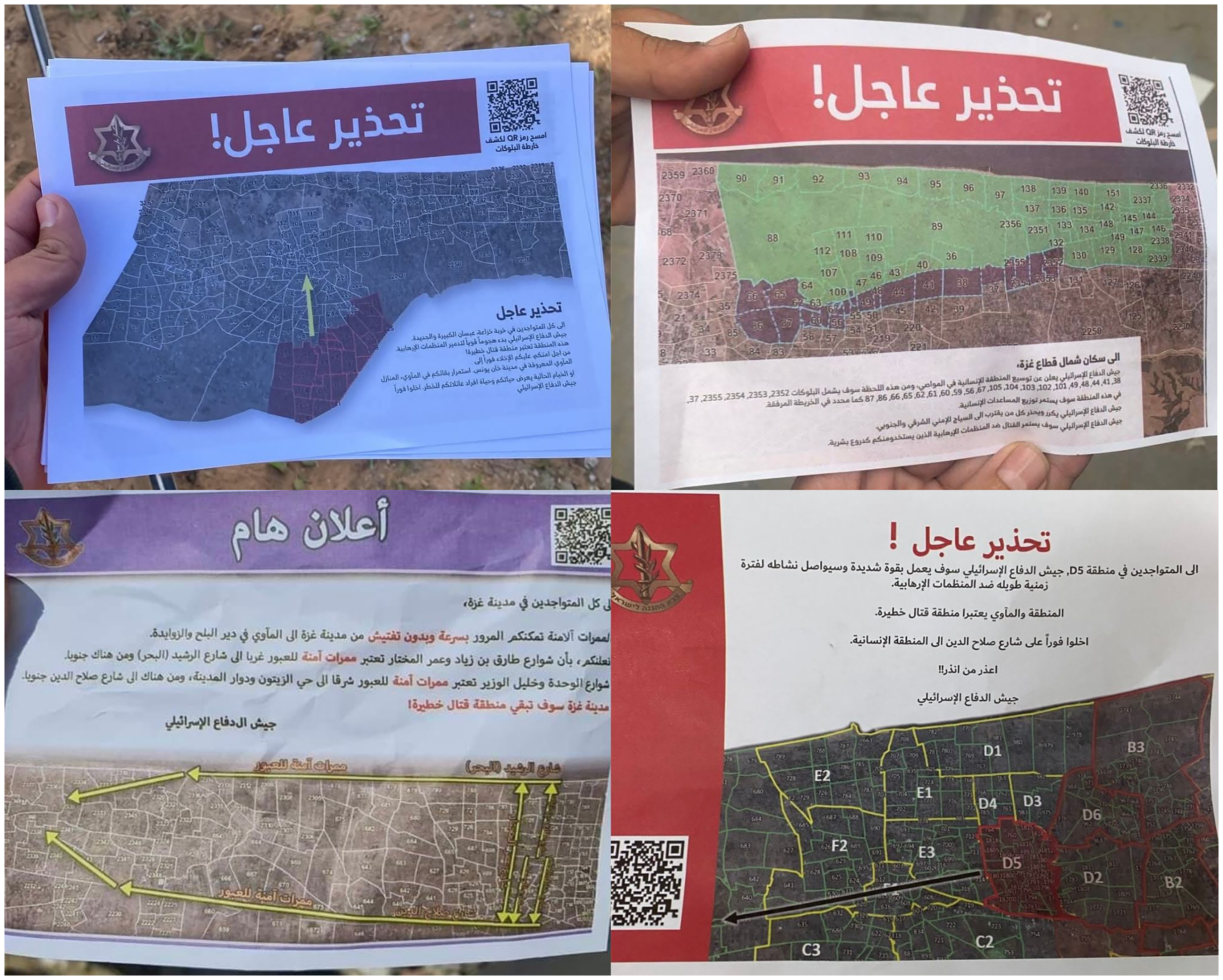
Leaflets of evacuation dropped on the population. Credit: Mohammad Abu Tawela.
In so doing, Israel has rendered the strip into ‘the most accomplished model of enclavization, [emphasis added] concentration, and abandonment that works through the logic of maximum control and minimum responsibility’ (Ghantous, 2024, para. 2, see also Li, 2006), making Gaza more and more uninhabitable (UN, 2025) to force Palestinian into so-named ‘voluntary’ displacement. This ambition mirrors the settler colonial logic of Zionism, which has long sought to secure the land without Palestinians (Khalidi, 1997; Said, 1979a, 1979b; Sayegh, 2012). As several scholars have further demonstrated, this logic is maintained through spatial erasure, displacement, and infrastructural control (Dana & Jarbawi, 2017; Masalha, 2023; Weizman, 2024). These spatial alterations, enclaving, and destruction through heavy military presence, roadblocks, and ongoing surveillance of key streets like Salah al-Din Street 2 , have forcefully entrapped the population of Gaza within these fragmented enclaves.
Concurrently, Israel intensified weaponising deprivation as a means of control, maintaining scarcities always, paradoxically, available, as a second strategy to entrapment in materialising genocidal violence and temporal ruination. Rooted in Israel's long-standing tactics of siege and infrastructural strangulation (Butt & Butt, 2016; Dajani, 2025; Salamanca et al., 2012; Weizman, 2012), this strategy has reached unprecedented extremes since October 7, 2023. Through the systematic obliteration of food chains, water systems, energy grids, and medical infrastructure (Dader & Joronen, 2025), Israel systemically engenders all-encompassing famine conditions. In February 2024, famine reached such an extreme that people desperately started grinding animal feed to produce flour and make bread, to eat parsley, if available, cook mulberry leaves, and other wild plants like mallow and nettles. With conditions worsening and systemically maintained, this year, people started turning pasta into flour to make bread, through soaking dried pasta in water and then kneading it to make a dough. They also sometimes resorted to lentils with similar ideas, ‘anything that would feed the children’, shared a mother in central Gaza.
Humanitarian access is almost always blocked or tightly controlled, reducing aid to a tool of colonial governance rather than a means of relief (Bhungalia, 2023, 2015; UNOCHA, 2025). Israel makes sure people are forced into hours-long queues for flour, bread, or water, only to leave often empty handed as supplies run out (Euro-Med Human Rights Monitor, 2024). Concomitantly, the prices of basic goods such as sugar or vegetables have skyrocketed by 500% or more (Aljazeera, 2024), making even purchasing what is scarcely available impossible. As one woman reflected, ‘Life has become humiliation. Even food and water are hard to come by’. Current Israeli scarcity-making is unprecedented, catastrophic, and malevolently evolving, as they repeatedly bombed humanitarian convoys and trucks, shot at and blocked, and used them as bait. Most recent conditions in Gaza register with intensity the intentional creation of humanitarian aid sites as death traps, shooting civilians daily with nearly 1400 killed (UN, 2025). Adding to these violent conditions, Israel has been arming gangs to steal aid, claim control and foment chaos amid humanitarian aid spaces (Najar, 2025). With current conditions defining everyday life in Gaza, Palestinians are forced to risk their lives at distribution sites that have become killing grounds, as people are gunned down while simply trying to survive amid one of the world's worst humanitarian crises.
As interlocking settler colonial tactics, Israel adopted, maintained, and intensified entrapment and scarcity-making to hinder and erase Gaza's temporal and spatial possibilities for survival, and consequently, advancing ethnic cleansing and elimination. While entrapment confines Palestinians within shrinking, bombarded spaces through siege, displacement, and infrastructural obliteration, scarcity-making strategy ensures that within these spaces, the conditions for life and daily needs of food, water, medicine, and shelter are deliberately and continuously withheld, destroyed, or made violently fragile. Hence, living becomes confined to constant attempts to survival, that is, a contour of temporal ruination. One woman described the situation after being displaced constantly ‘I have been displaced with my family more than 8 times, and every time we go to a place, we have to start from scratch. Everything from scratch’, ranging from finding mattresses, to securing clothes, food and water, as she adds ‘then we start looking for our food… my husband goes for the flour, one of my sons goes with his father, one goes for water, and another goes for food parcels’. The reality of leaving everything one has built behind and run with their bodies to a shelter to start from scratch marks a cyclical temporality that repeatedly ruptures and ruin conditions for continuity and dwelling and prevents its recovery. Within these ruined temporalities, people speak of lives lived in fragments between exhausting survival and ongoing elimination. Each evacuation order and displacement journey redraw the contours of time, engendering affective depleting intensities.
The affective intensities of temporal ruination
‘The queue wasn’t just about waiting. It was a corridor of sorrows, where every step led to a more painful story’. Alaa Radwan
In grappling with temporal ruination, people speak of exhaustion, humiliation, and anticipatory dread as defining features to their living situation. Such affective intensities engulf everyone in Gaza and even extend to those outside with varying relationalities and attachments, while helplessly witnessing their loved ones experiencing the deadliest and most degrading living circumstances. The ruination of the temporal fabric in Gaza through entrapment, and its constant displacement along with the extreme scarcities, carpet indiscriminate bombing, and infrastructural elimination – multi-layers of totalising colonial violence that ruptures and eliminates – establishes these affective intensities as a systemic infrastructure of affect (Bosworth, 2023; Thrift, 2004), an affective economy (Ahmed, 2004), in city under totalising and eliminatory violence for more than 700 days, where recurrence of exposure reconstitutes what it means to endure (see Berlant, 2011). In Gaza, consequently, affective intensities are not excesses to political violence, instead, they are the channels through which violence is lived; they stick to bodies, accumulate, and de-structure the very capacities to endure and dwell. While each affective intensity speaks further to various scholarly strands in affect theory: anticipation/fear as theorised to embodied orientations and futurities (Ahmed, 2004; Joronen et al., 2021; Massumi, 2010), humiliation as an affective force that expose, oppress, and dehumanise (Abusalem & Dader, 2025; Ghantous et al., 2026; Negrao et al., 2005), exhaustion as a modality of depletion (Deleuze, 1996; Dawney & Jellis, 2023; Puar, 2017; Todd, 2023), and affective atmospheres more broadly as collective conditions shaping experience (Anderson, 2017; Berlant, 2011; Thien, 2005), they emerge as byproducts of genocidal violence through entrapment and scarcity making, wherein temporal ruination functions simultaneously as intentional of a destruction at scale.
People recount instances of bodies fainting not only from hunger and exhaustion but also from anticipatory dread of the conditions fraught with volatilities and perils. One of the key consequences and manifestations of scarcity and entrapment has been daily queuing and waiting to secure daily necessities, as bluntly put by a Palestinian man saying that ‘Our whole life has become queues’, while another added ‘It has become a matter of livelihood’, which all interviewees stressed that they have queued in excess of a hundred instances, mirroring an everydayness of scarcities, famine, lack of resources, coupled with fear, uncertainties, exhaustion, humiliation, and anticipatory dread. Therefore, the queue is far beyond a simple line of waiting; it is a symbol of the systemic deprivation, and that it has become a matter of livelihood and daily occurrence for more than 700 days. People wait bodily, uncertainly and affectively for food, for water, for flour, for rice, for all the daily fundamental needs that Israel continuously prevents. Queuing and the affective waiting that comes with it constitute the brunt of people's narratives; they have shared their experiences, featuring many corporal and mental affective intensities of anticipatory dread, humiliation, exhaustion, fainting, and in many cases, death or witnessing killing. While these intensities are experienced through deeply felt bodily and emotional states, they remain inseparable from the Israeli systemic and deliberate orchestration of scarcity and entrapment. These affective intensities do not unfold in isolation; they are entangled within the spaces of temporal ruination, whether in the wait for bread, the dread of displacement, the chaos of airdropped aid, or the death traps of humanitarian distribution points.
In schools and tent camps, for instance, the soup kitchen lines strongly manifest affective states of humiliation and exhaustion, where entire families are dependent on irregular and unreliable soup kitchens that take place across Gaza by individuals and certain relief organisations. Outstretching arms with empty pots, people's faces drown amid the crowd, waiting for minimal portions that would mitigate the ghost of hunger, coupled with exhaustive and survivalist competition, as the amount of food is never enough for the crowd. What happens in such spaces is a representation of and speaks to the collapsing bodies and the heightened desperation, all hinging on insufficient temporal relief. It is where the Israeli-induced hunger materialises in embodied and spatial form, in which people's desperation for surviving food, along with heightened crowdedness, chaos, and physical exhaustion. One woman described the situation at their shelter: ‘several children were burned due to the crowdedness when gathering for the soup kitchen. Yesterday, the dish was an eggplant meal, and people rushed so frantically that four children were burned’. These scenes (see Figure 2) are steeped in humiliation and exhaustion suffused with long waiting, severe hunger, and the ever-present fear and anticipatory dread of being bombed or forced to evacuate at any moment. Humiliation and exhaustion are not necessarily expressed emotions but deeply embodied experiences. As one man put it, ‘the struggle to secure a basic meal is indescribable’. Attempting to convey the lived reality, he further added, ‘You must stand in queues to get a plate of food or a loaf of bread. It is exhausting and humiliating’. In the context of genocidal violence, where people are engulfed in forced dependency on necessities, public exposure to hunger, panic, and systemic deprivation, the bodies carry the weight of this imposed sustained suffering, both collectively and individually. Therefore, humiliation extends beyond a fleeting emotional response; it solidifies into a deeply affective condition, as does exhaustion. One woman, describing the collective affective state, said ‘People are extremely tense and broken. They feel suffocated. They are not used to this’.
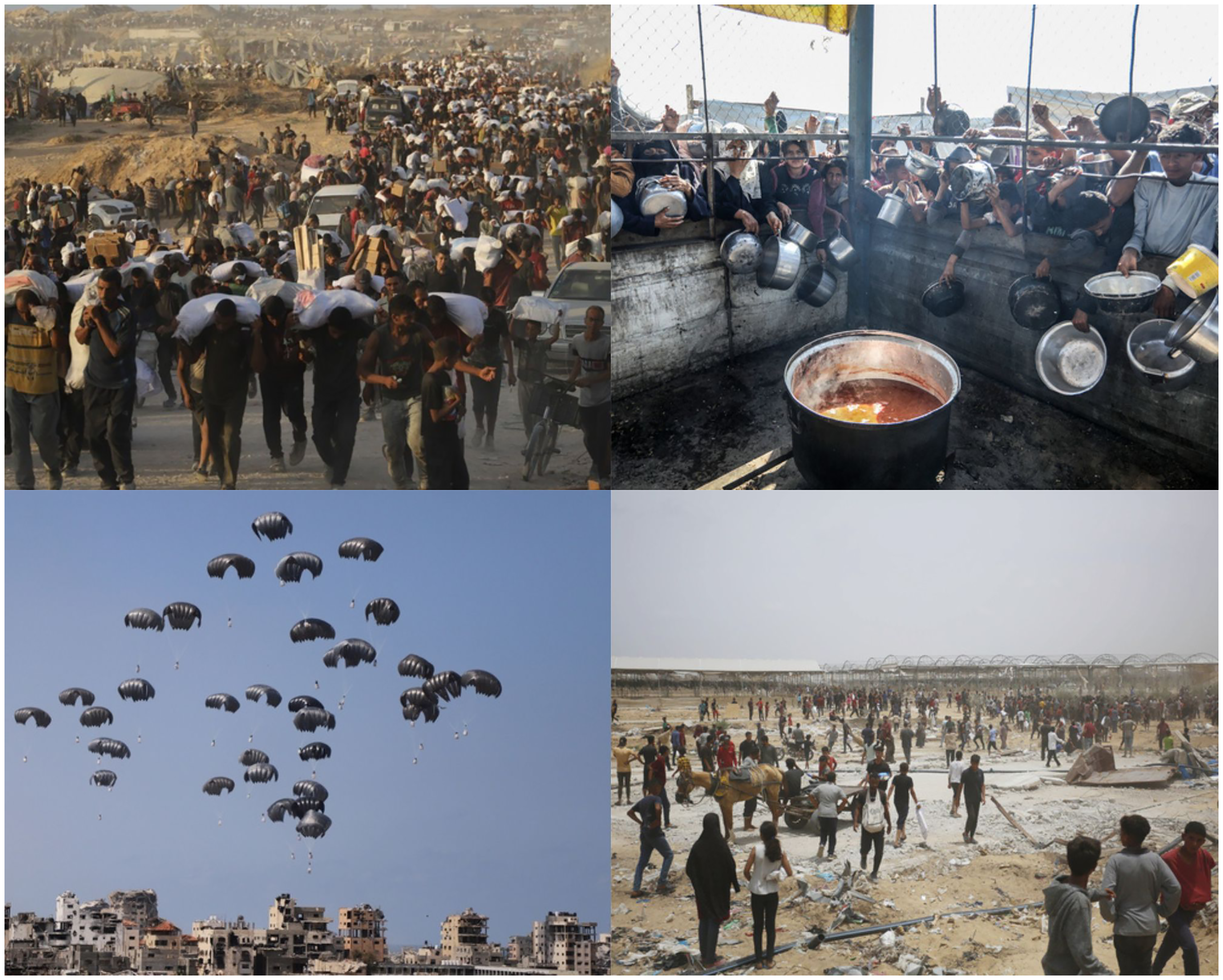
Spaces of waiting in Gaza, airdrops, Streets queuing, Distribution spots, Soup Kitchen. Image ©Anadolu Ajansi; reproduced by permission.
Beyond the shelter, people queue in the streets, where the chaos and exposure are greater, fear is more acute, and exhaustion is exacerbated. The endless queues for water, food parcels, gas and other essentials require not only physical labour but also enduring relentless anticipatory dread and humiliation of public desperation. Given the time-consuming complexion of queuing, entire families divide responsibilities, as several interviewees reflected on. One woman shared ‘my husband goes for the water and flour, and my kids go the soup kitchen in the school, and I go to the bakery when they operate’, placing the bodily and affective toll on every member of the family, inseparable from the living conditions, designed and maintained by Israel. Similarly, a mother who queued for bread in front of bakeries over a hundred instances, shared her experience, ‘When I stood in the queue, I was never safe. The bakery could be bombed at any moment because they were bombing bakeries at that time. I was risking my life, and when I sent my son, I risked his life too. And it happened when I sent him, as a fire belt [carpet bombing] hit the surrounding area when he was there’. ‘The first time I stood in a bread queue, the crowd was so overwhelming that I fainted among the people. My blood pressure dropped because I went on two days without eating to save food for my daughters. I was standing and the next thing I knew I was collapsing. People woke me up with water and started asking what was wrong when I told them I had a sudden drop in blood pressure’. The period I suffered the most was when we went to Al-Nabulsi Square when there was no flour. I lost my closest friends there. The last time I went, during the massacre where 120 people were martyred, I was there with my two sons. My sons are grown men, not much younger than me. I was with them there. That's what made me turn back and return that day; otherwise, I would have been martyred with the others. I was afraid for them and pulled them back. But my closest friend was martyred that day. He was carrying a bag of flour. A bullet penetrated his back and exited his chest. When we went to get him, we found him holding the bag of flour, covered in blood. At another time, we were waiting for aid and flour when a tank blocked and cornered us. We were trapped for a while, the tank right above us. I swear, the drones were above us for about 15 minutes, firing over our heads. At that moment my son won’t just tell his children about it, but his grandchildren too. That moment, I will never forget. I swear, I felt like he was going to crawl back to me out of fear. He was holding onto me, terrified. Every time I remember that moment, I ask myself, “Where was my mind?” We were doing that out of hunger, and we did not even realize it.
What has been narrated and analysed so far reveals the turbulent, incoherent, and fractured intensities of affect that consume life in Gaza. People's accounts evoke a dense, recursive condition of affective excess that constitutes the very experience of dwelling amid temporal ruination. People are stuck to endure the sustained suspension and sabotage of liveable time through the continuous attacks on life and its totality; daily life revolves entirely around securing bread, water, food, with no space for futurity, plannability, or dwellability of daily life in any meaningful sense. While anticipation is a way to ‘tame the unknowability of the future’ (Järvi, 2023: 177; see also, Joronen et al., 2021), currently in Gaza the anticipatory dread means bracing for what never arrives, and for what does come and kill. It also evokes ultimate humiliation, as one man said, ‘I would rather starve than go to the aid spots’, the way Israel weaponises aid to humiliate, to exhaust, and to kill. Another stressed that ‘We were ready to face death without knowing it was death, just because we were hungry and needed to feed ourselves’. These conflicting existential bodily and affective threats show the grave reality in Gaza, where one is caught between feeding their hungry children by going to humiliating and death journeys and staying hungry, watching their children starve to death.
Such temporalities have become uninhabitable, as it is too saturated, too disfigured, too violently unstable to live through. These extreme moments in people's narrative often marked not by calendar dates 4 , but by periods of scarcity and violence. Instead of saying ‘February 2024’, when famine reached its most acute form, people referred to it as ‘the famine period’. Similarly, when flour-related massacres intensified and became more present than other forms of violence, people referred to it as ‘the Nabulsi period’ 5 . Such temporal markers, revolved around survival, replaced the daily rhythms of life in Gaza before – manifestations of collective suffering, were repeatedly mentioned across multiple interviews, reflecting how the lived experience in such conditions reshapes the very structure of time itself. In this analysis, I located the affective texture of temporal ruination, and these include: (a) anticipatory dread, where waiting is fraught with fear of bombing, violence, and most importantly leaving empty handed, (b) exhaustion, as hunger, heat, and fear, and constant displacement because of entrapment drain the capacity to stand, speak, or endure such living conditions, and (c) humiliation as a condition, not a fleeting individual feeling, but a structure of being under constant surveillance and threat, denied, and publicly exposed. These intensities constantly blur and entangle, as one person in one day would go to humanitarian aid spots, queue for water in-take, and quest haphazardly looking for food sources, and at any moment could get an evacuation order that would force them to go to a new place starting all over, layering and accumulating exhaustion, exposure, humiliation, hunger, and anticipatory dread. To this end, what the queue reveals is not only the logistical condition of siege but the colonial mastery of temporality itself. Temporal ruination here is not a side-effect but a core condition, one that ruptures any continuity of time and forecloses the possibility of dwelling. Therefore, to wait in Gaza is to dwell on the move, zig-zagging all day from one place to another, within temporalities that have been so fractured, so immobilised, so attacked, so stuck, so incoherent that all of the temporal daily markers that once shaped life in Gaza – education and work, domestic and social life, economic activity, religious and cultural life, infrastructure-based daily rhythms – no longer unfold as they once did, sabotaging and destroying the coherence of livable time and the possibilities that enable dwelling. All daily rhythms now are centred around survival and flicker through people's efforts to escape elimination, secure survival, and endure the affective intensities that saturate the in-between (see Aldahdouh et al., 2025; Dader & Joronen, 2025).
Dwelling in temporal ruination: Tracing time from the ruins
Through the interviews, many gestures and attempts at coping with the temporal ruination existed. Spiritually and more socially, religious invocations (duaa) are very common, featuring as expressions of yearning and hope but more commonly as tools to stabilise panic. Hope can be a modulation of affective relations that can either sustain life or defer its transformation (Anderson, 2006); expressions of hope and resignation, ‘Allah has decreed this for us, and we have to be content’, capture a logic of submission to the ‘greater will’ that was less theological than existential and speak more to the current conditions. Majority echoed: ‘Inshallah, relief is close’; ‘I pray that we don’t have to stand in queues anymore’; ‘Alhamdulillah, we are under threat from every direction’. These statements function less as solutions than as affective anchors, subtle fragile ways to endure the exhausting conditions. One man observed, ‘Mentally, it is even harder to endure. That's why we place our hope in Allah for relief soon’. The spiritual is thus not redemptive, but mediating: a way to temporarily bear a world unravelling in real time. This soon-ness speaks to the very core of temporal ruination that people are left with nothing but a spiritual hope that mitigates, if any, the heaviness of it all. According to Anderson (2006), this hope is not future-prudent; rather, it is a structure of momentary feeling that dwells in the unknowable and the indeterminacy of the situation. It is inseparable from how Israel weaponise futures/futurity, engendering explicit and tacit control over Palestinianness, be that space, bodies, or everyday life (Joronen et al., 2021).
Other manifestations of mitigating these conditions took the form of collective care that seeks to support and alleviate the affective intensities of temporal ruination. Social ties offer fleeting relief, which are even strained by scarcity and violence. During the daily waiting times, people form spontaneous solidarities and bonds: sharing food, if doable, carrying injured strangers, helping women and children in the queues, all various ways to stitch senses of community surfaced in people's narratives. ‘When you feel for people and try to help them as much as possible, it creates a sense of family’, one man reflected; ‘We are a family’, a woman shared her experience living in a school among the displaced. While survival amid these conditions featured competition, chaos, and violence, it also features not as much cooperation, in a way that the social fabric often thins to the edge of rupture, as time modulation and twisting drains the sense of togetherness (Tawil-Souri, 2017), let alone under temporalities of annihilation. These gestures, while significant, remain constrained by the very conditions they seek to alleviate. As reality conditioned with rupturing temporalities and social bonds, these micro gestures do not undo the violence of settler colonial power, but they interrupt its totalising force vulnerably and contingently – as fragile counter-temporalisations.
While endurance, adaptation, and Sumud all are importantly at play in the context of Gaza's ruined temporality, it is important to contextualise Sumud as an embodied, ad hoc, and improvisational labour of surviving within, rather than outside, the temporal ruination. As Ghantous (2020: 64) observes, Sumud arises as a tactic of negation against elimination, one shaped ‘on adaptation capabilities to cope with the difficulties of living under constant banishment and elimination’ of the shifting colonial tactics. But in Gaza, the settler colonial violence no longer relies on bureaucratic control and zoning only but also on saturated bombing, starvation, and infrastructural collapse – active annihilation of every aspect of life. Against this backdrop, the mentioned gestures, such as duaa, helping strangers, organising the queue, do not redeem the destruction but instead strongly mark a fragile social endurance forged within its utter wreckage, very far from undoing the temporal ruination, but the endurance of what Berlant (2011) name as impasse-living, that is, a living condition where people are stuck. An endurance presented as it happens beyond any imperative to celebrate it (Dawney & Jellis, 2023), but with an imperative to acknowledge the ways people make of the spaces of suffering livable lives (see Bruno, 2024; Dader et al., 2025). As such, these gestures resonate with what Lancione and Simone (2021: 970) term ‘dwelling in liminalities’, which is an unsettled mode of inhabiting the uninhabitable. They argue that the small, everyday ways people survive and adapt in spaces of elimination should be attended to, as this ‘endurance is not to be reduced to a discourse of capacities’. As such, these gestures are practices of remaining-within, a dwelling inside ruptures. They inhabit the now of ruination without a stable relation to a before or after. What they offer, then, is a minor grammar of endurance, a way of holding life open amid its ongoing annihilation.
Conclusion
To live every minute of every day on edge, bodily and affectively, in a space of ongoing annihilation surpasses any definition of livable time. To carry the weight of anticipating bombing and death markers in every possible way, thinking of how to secure food in death traps, contemplating where to run and from which source of death to escape, and to be kept in a loop of unknown turbulences and loss from every direction of life define what it means to dwell under annihilation. Such crushing, totalising colonial violence and orchestration of ruin define a life only confined to survival, with no room beyond that – survival marked with affective excess of pain, exhaustion, suffering, death, fear, humiliation, to name just a few of the indescribable. What I unpacked in this article is an oversimplification of what temporal ruination feels like to experience. In naming temporal ruination of life under elimination, it does not advance a stable analytic nor static temporality rather an analytical approximation and an attempt to name what resists naming, framing temporalities of suffering that are so saturated, so entangled with affective signatures that no language or conceptual apparatus can fully account for. Drawing on people's voices and narratives and research diaries, engaging with and speaking to literature on Palestinian temporalities, I have argued that Gaza's temporality is actively disfigured. Through entrapment, scarcity-making, and infrastructural annihilation, Israel creates a living condition in which time becomes incoherent, uninhabitable, and cruelly unstructured that daily temporal anchors in Gaza no longer unfold as structured daily rhythms, but slip by amid collapsing institutions and relentless violence, eclipsed by the urgency to survive and the weight of ongoing loss. I have also highlighted how people grappling with temporal ruination speak of entangled affective intensities: exhaustion, humiliation, and anticipatory dread, which do not unfold in isolation; they circulate and accumulate, seeping into the rhythms of everyday and extending to those living outside Gaza. Acts such as queuing for aid or navigating death spaces are the centre of everyday life in Gaza, as they are not only spatial practices but temporal ones, enacting a condition of unending suspension, turning the present into a battleground for survival with a foreclosed future.
Exploring such temporalities in Gaza contributes to the broader debates on temporalities literature in Palestine (Ghantous & Joronen, 2022; Peteet, 2017; Tawil-Souri, 2017), central to understanding lived experience, resistance, and spatial politics. It also resonates with scholarship examining the entanglement of affect and temporality, concepts like affective sovereignty (Nabulsi, 2025), and cyclical temporality (Abu Hatoum, 2021), and how land, memory, and affect intersect in resisting colonial linearities (Anderson, 2017; Nabulsi, 2025). Furthermore, the article speaks to relational and embodied structure of affective temporalities (Ho, 2021; Monstadt, 2022; Thien, 2005), situating Palestinian experiences within broader geographical debates on time, affect, and space. The discussion also opens the space for further inquiry into how affective intensities intersect with temporalities of ruination in Gaza – how they overlap, reinforce, and unsettle one another. The constant deterioration of living conditions in Gaza speaks volumes about how temporalities are actively ruptured. The way certain Israeli atrocities become foregrounded at different moments does not suggest that others have ceased to drain people's lives. For instance, when media attention centres on hunger during the ongoing genocide, it does not mean that killing has ceased; likewise, when the killing of aid seekers is the focus, it does not imply that hunger or bombardment has stopped. Since day one, all these forms of genocidal and annihilatory violence – hunger, displacement, ground invasions, aerial carpet bombardment, and the targeting of aid seekers – have struck people simultaneously. However, the media's shifting focus, zooming in and out across different moments, creates the illusion that these violences do not coexist. This is precisely what the concept of temporal ruination seeks to illuminate, and it invites further research into how life unfolds under the annihilation of time and space. How do people navigate education? How does the health system function? How do women and children live, how does pregnancy and birth unfold, how do those who have lost their families dwell alone? How do people with disabilities or chronic illnesses survive amid famine and displacement? How do the elderly endure? How do people dwell in tents in scorching summer and harsh winter? How do they manage dumps and diseases with lack of hygiene amid ecocides? These questions, and many more, point to life aspects that no longer unfold as they once did – each marked by the ruptures of temporal coherence under conditions of ruination.
Footnotes
Acknowledgements
The author would like to show his gratitude and unconditional support to the people of Gaza, and those who shared their stories from Gaza. He appreciates the time and effort of his colleagues at the Geographies of Coloniality and Everyday Violence Research Group (GOCEP), and the May Days seminar related to SPARG research group. Special thanks to his supervisors, Mikko Joronen and Derek Ruez and to Wassim Ghantous who read and commented on the earlier drafts of the paper.

Ethical approval
This project has been reviewed by European Research Council Executive Agency (ERCEA) and the Ethics Committee of Tampere Region (Statement 131/2023 concerning the statement request 59/2023: Dwelling with crisis: home at spaces of chronic violence/HOMCRI).
Funding
The author disclosed receipt of the following financial support for the research, authorship and/or publication of this article: Funded by the European Union (ERC, HOMCRI, 101087950).
Declaration of conflicting interests
The author declared no potential conflicts of interest with respect to the research, authorship and/or publication of this article.
Data availability
Interview data is not publicly available. List of already publicly available data used in the article is available upon request.