




Abstract
Reproduction has been the privileged site of post-colonial eugenic politics through which the future national body is regulated in racial terms. Nikolas Rose argues that new forms of liberal eugenics have replaced traditional state biopolitics. In the current bioeconomy, it is no longer the state but active consumers that make (racialized) reproductive choices. The market of assisted reproductive technologies (ART) in Mexico serves as an empirical case to argue that the liberal eugenics practiced in this market recasts rather than replaces traditional state biopolitics. This becomes evident in (1) the racialized access to surrogacy programs in Mexico and (2) in giving higher value to white sex cells, while (3) devaluing the genetic traits of non-white women through the selection and classification processes of reproductive laborers. Analyzing the transnational geographies of surrogacy markets in Mexico, the article investigates how future bodies are whitened through biomedical practices and consumer choices that are shaped by and simultaneously reinforce (post-)colonial imaginaries of white desirability.
Introduction
The article intervenes in recent discussions about how new developments in the fields of biomedicine and life sciences have altered biopolitics. In the wake of these developments, Rose (2007) diagnoses in his book “Politics of Life itself” a transformation from a Foucauldian understanding of biopolitics (Coleman and Grove, 2009; Foucault, 2008; Lemke, 2001), where the state is the central actor in shaping the future of its population (Su Rasmussen, 2011), toward a “new liberal eugenics” driven by the consumer choices in a new bioeconomy. In short, he identifies a shift from biopolitics toward bioeconomies. In contrast to Cowen and Smith (2009), who argue in their article “From the Geopolitical Social to Geoeconomics” that the geoeconomy recasts rather than replaces geopolitics, Rose claims that the age of state biopolitics is over. Drawing on the empirical case study of the Mexican surrogacy industry, this article sheds light on the manifold ways in which everyday practices in this new bioeconomy are entangled with state biopolitics.
The article asks how (post-)colonial imaginaries of white hegemony and the desirability of white(r) bodies are negotiated, (re-)produced and challenged through the everyday choices of consumers and providers of gestational surrogacy in Mexico. Following Strathern, who argues that “the future seems increasingly trapped by present choice” (Strathern, 1992: 61), I examine how the marketing and everyday practices of the Mexican surrogacy industry values and evaluates bodies according to their racialization, and the way these decision-making processes and everyday practices are shaped by (post-)colonial imaginaries of white superiority. The “figure of the child” (Edelman, 2004) who comes to live thanks to assisted reproductive technologies (ART) 1 serves here as the corporeal manifestation of how future bodies will look like. While Edelman argues that the figure of the child deprives “other” bodies for the sake of perpetuating the “same” (white) bodies, this article shows how in the context of Mexico (assisted) reproductive practices of the present assist people's desire for white(r) offspring. 2
The article proceeds as follows: It first outlines Rose's and Braun's arguments about the current transformation from biopolitical eugenics toward liberal eugenics in the context of the rising bioeconomy. In a second step, it reviews current debates in geography about whiteness and futurities. Drawing on empirical research of Mexico's surrogacy business, I question in the third section how the way whiteness is (re-)produced, desired, and valued in this industry is linked to biopolitical ideas of white hegemony. I explore the ways in which whiteness is (re-)produced in this market through (1) the racialized access to surrogacy programs in Mexico, (2) the different value given to differently racialized sex cells, and (3) a racialized division of reproductive labor between white(r) egg donors and non-white surrogate mothers.
From biopolitics to bioeconomies: race, eugenics, and future bodies
In his article, “Biopolitics and the molecularization of life,” Braun (2007) engages with the question how biopolitical regimes of modernity have been replaced by the individual management of genetic risks in the context of a fast growing bioeconomy. Drawing on Rose's (2006) book “The politics of life itself,” Braun (2007: 11) makes the argument that: The difference between “old” eugenics and what some have today labeled “liberal” eugenics, then, can be seen as the difference between state-led programmes that in the past sought to produce a particular population with particular traits and capabilities, and the ethical decisions of individuals in the present, who are exercising “choice” in reproductive matters. Although forms of pastoral power clearly shape these reproductive choices, the state remains neutral.
“Old” eugenics are embedded in what Foucault termed “biopolitics.” It is worth going back to his original definition of the term as it explicitly lists “race” as the last item of what biopolitical governmental practices include: […] biopolitics, by which I mean the attempt, starting from the eighteenth century, to rationalize the problems posed to governmental practice by phenomena characteristic of a set of living beings forming a population: health, hygiene, birthrate, life expectancy, race … (Foucault, 2008: 317).
In short, since the beginning, eugenics has been about “racial improvement” with the aim to make more beautiful bodies for the future (nation). The careful control of both white and non-white women's sexuality was a central part of this eugenic agenda. Eugenics developed as a “national, gendered, racialized, and a class-specific project […] for improved natality and selective sterilization” (Stoler, 1995: 31). In Agamben's (1998) and Mbembe's (2003) reading of Foucault, biopolitics is closely linked to everyday racisms and acts of (post-)colonial violence which include forced sterilization and incarceration of what the state considered as degraded bodies (non-white, homosexual, working class, rural, and ill lives).
In response to such a rather negative reading of biopolitics, there has been a recent call for a “positive critique of biopolitical discourses” (Blencowe, 2011) that circles around “care of life” (Hannah, 2011; Ojakangas, 2005). Such an affirmative biopolitics seeks to highlight the positive, emancipatory, empowering, transformative, and life-affirming dimension of Foucault's understanding of biopolitics. It is in this vein that Rose and Braun differentiate old eugenics from new forms of liberal biopolitics: In the era of “ethopolitics” (Rose, 2007) the new “molecular biopolitics” no longer involves a state-led biopolitics of population, but rather the self-management of newly responsibilized individuals. This “transformed biopolitics” operates according to “logics of vitality, not mortality” (Rabinow and Rose, 2006: 211). Anxieties about morbidity and mortality are reframed within an ethos of hope, anticipation and expectation (Adams et al., 2009; Franklin, 1997).
This moral economy of hope is also an economy in the more traditional sense: On the one hand, the hope for innovation to treat, cure or improve one's body stimulates investment and results in a fast growing bioeconomy. On the other hand, recipients of bio-medical interventions are consumers, “making access choices on the basis of desires, shaped not by medical necessity but by the market and consumer culture” (Rose, 2007: 20). In such a liberal notion of choice, individuals think of themselves as active masters of their own life, body, and health, choosing from a wide menu of options, cures, and techniques of self-improvement in search for a better future.
The fertility industry is frequently picked as one particularly apt example to show how biology is no longer accepted as fate but health and life are now designed on demand. Private fertility clinics epitomize “the promise of improvement of almost any aspect of human vitality on request at private clinics for those who can pay, purchased on the internet” (Rose, 2007: 20). In the view of feminist scholars, the fertility industry has produced new subtle form of eugenics (Almeling, 2010; Elster, 2005; Quiroga, 2007; Roberts, 2009) that “compromises choice for donors and exacerbates hierarchies of human value based on stratified norms of race, ethnicity, economic class, and gender” (Daniels and Heidt-Forsyth, 2012: 720).
Reviewing how the term eugenics has been used in this feminist body of work on assisted reproductive technologies, Rose (2007: 69) concludes that: “Seldom, if ever, are the actions or judgments of any of the actors in these practices shaped by the arguments that the nation is somehow weakened geopolitically by the presence of ‘diseased stock’ within the population.” He rejects the use of the term eugenics as these practices are not concerned with the quality of race but are rather forms of “self-government” imposed by “the obligations of choice, the desire for self-fulfillment, and the wish of parents for the best lives for their children” (ibid.). At first sight, the individual choices of intended parents and medical practitioners in the global fertility industry seem to have little to do with eugenic state-led programs but circle around the wish for healthy, beautiful, and successful offspring. However, my analysis of the Mexican surrogacy industry shows how these individual choices are embedded in and shaped by post-colonial discursive imaginaries of white desirability.
While Rose (2007: 39) recognizes the “tensions between the intensifying somatic ethics in the West […] and the inequities and injustices of the local and global economic, technological and biomedical infrastructure to support such a somatic ethics,” he does not look into the question how the global spread of the bioeconomy affects reproductive consumers and laborers in economic, political, and social contexts outside of what he refers to as advanced liberal democracies. It is in this vein that Braun (2007: 8) develops his critique of Rose's account, revealing how “biopolitics has merged with geopolitics” through neo-colonial and neo-imperial interventions in the Global South in the name of public health and bio-security. Waldby and Cooper (Cooper and Waldby, 2014; Waldby and Cooper, 2008) further show how ethopolitical decisions rest not only upon the interventions discussed by Braun but also upon the clinical labor of women's racialized bodies living in the Global South who supply their reproductive services and body parts for a global reproductive market.
This paper seeks to contribute to current debates on biopolitics, race, and eugenics by linking the intimate choices of intended parents with global regimes of reproduction. Engaging with “the global intimate” (Mountz and Hyndman, 2006; Pratt and Rosner, 2006) that characterizes reproduction in the Mexican surrogacy market, this paper argues that liberal eugenics performed in the new bioeconomy does not displace state biopolitics but rather transforms it.
Geographies of whiteness: past, present, future
Geographies of whiteness have developed in response to and in close dialogue with critical whiteness studies (Dyer, 1997; Frankenberg, 1993). According to Baldwin (2012: 174), geographies of whiteness are spaces, places, landscapes, natures, mobilities, bodies, etc. that “are assumed to be white or are in some way structured, though often implicitly, by some notion of whiteness.” While geographies of race have traditionally focused on the spatial segregation of minority groups (Peach, 1975), the focus turns increasingly “toward more racially unmarked and normative places and landscapes” (Bonnett and Nayak, 2003: 301). Whiteness is no longer the “(white) point in space from which we tend to identify difference” (Carby, 1992: 193), but it is recognized that “we are all ethnically located” (Hall, 1992: 447). Revealing that “some ethnicities have historically been more marked than others [… and] have taken on heightened visibility in particular times and places” (Jackson, 1998: 100), critical race studies show that whiteness has a history and geography as well.
Geographies of whiteness analyze whiteness as a location of structural advantage (Koopman, forthcoming), of race privilege in a whitened global economy. They show how geographical dynamics of accumulation are thoroughly racialized (Bonds, 2013; Roberts and Mahtani, 2010) in the sense that whiteness continues to be biopolitically exalted while the racially marked body (as non-white) is economically cheapened (McIntyre, 2011; Wright, 2006). Whiteness needs to be understood as a global phenomenon that has gained momentum as a symbol of success in a neoliberal global economy. As the “‘fun, free and flexible’ lifestyles of neoliberalism have been connoted as white and western” (Bonnett and Nayak, 2003: 309), whiteness is reproduced as a desirable identity through everyday economic and cultural practices.
Nash (2012: 670) calls for extending the focus of critical geographies of race/whiteness toward the ways in which race as a category of difference is produced through “bio-cultural discourses that combine or switch between ideas of embodied (or traditionally racial) similarity and difference through blood, genes, or shared descent and ideas of culturally transmitted shared heritages or practices connections.” Aiming to advance an understanding of the “bio-political geographies of difference” (Nash, 2012: 671) that result from recent developments in the field of biomedicine, this article explores how whiteness is (re-)produced through the present scientific, economic, social, and cultural everyday practices of the Mexican surrogacy industry. It takes up Baldwin's (2012) challenge to explore geographies of whiteness not just as a function of the past but of the future, suggesting that assisted reproduction is one site through which we can study how reproductive futures and geographies of whiteness co-constitute each other. Against the backdrop of Mexico's (post-)colonial biopolitics, I sketch in the following how whiteness is (re-)produced through a “biomedical mode of reproduction” (Thompson, 2005) in the surrogacy market.
The reproduction of whiteness in Mexico's surrogacy market
I expect changes will happen again, they may prohibit surrogacy in Thailand as India did, so that's why I am always trying to set up companies in different countries. Now we are going to step into Mexico. We have already opened an agency in Cancun (interview CEO of surrogacy agency, Tbilisi, Georgia, August 2013). Advertising gay surrogacy in Mexico.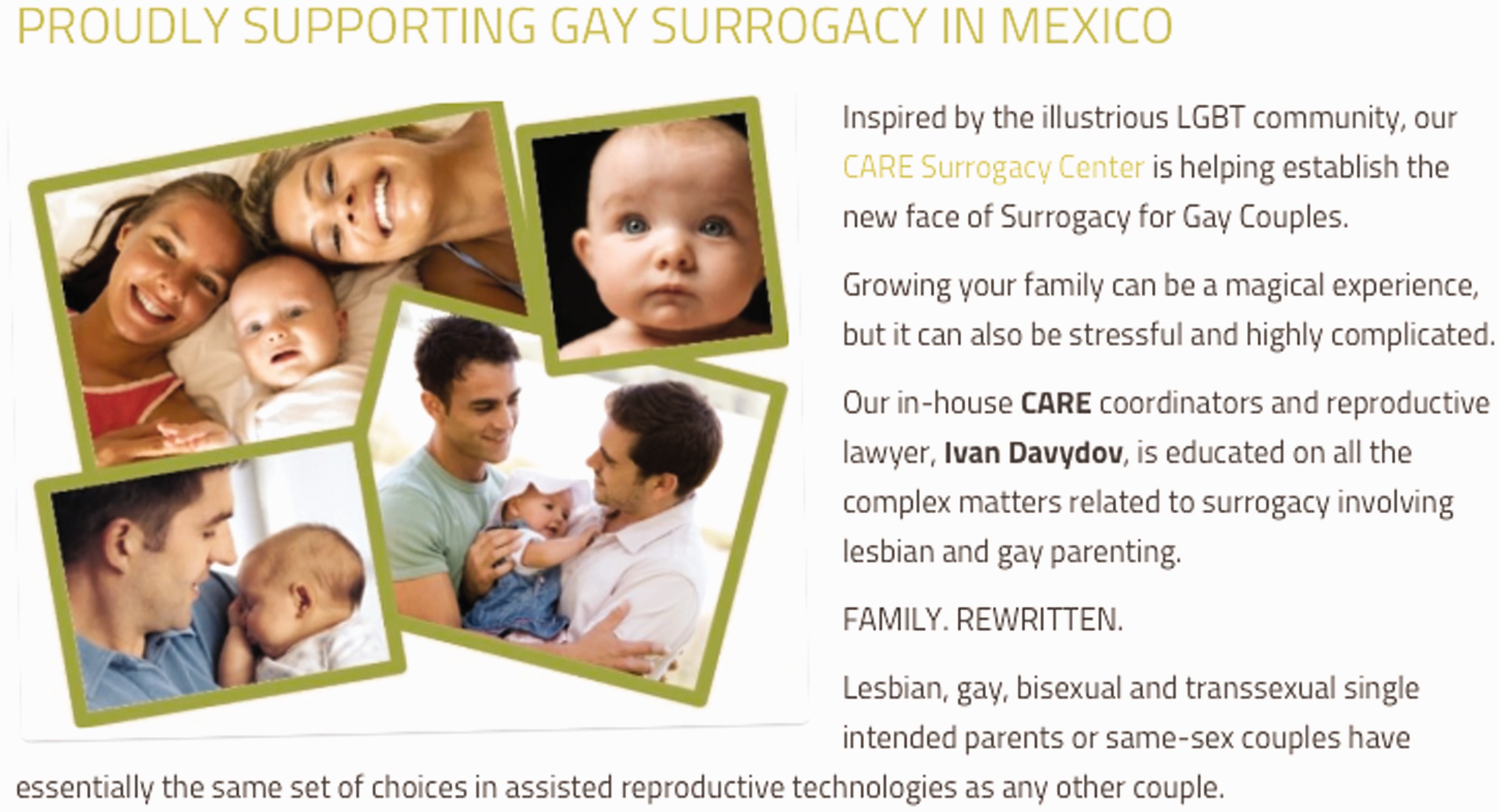
The rise of the surrogacy industry in Mexico has benefited from an already existing medical tourism infrastructure. Fertility clinics are often located in the hospital complexes of private health care providers (Figures 2 and 3). US companies have entered the Mexican health care market after NAFTA opened Mexico up to wholly foreign-owned health insurers and providers (Fisk, 2000). In consequence, Mexico is blossoming as a destination for medical tourism—especially for patients from the United States of America and Canada (Judkins, 2007; Nunez et al., 2014).
Private hospital Angeles in Mexico City where fertility clinic is located. Hospital Angeles in Villahermosa where fertility clinics is located.

What is special about gay surrogacy is that for building a family the intended fathers do not only need a surrogate who gestates their baby but also an egg donor. In contrast to traditional surrogacy where the same person provides her oocytes and gestates the baby, gestational surrogacy—which has become the norm—separates these two reproductive roles. This means that the woman who gestates and gives birth to the baby has no genetic tie to the baby. In short, three different actors are involved in a gay surrogacy arrangement: a single man or a gay couple from which one provides the sperm, an egg donor, and a surrogate mother. To show how Mexico's surrogacy industry produces white futures, I engage in the following with each of these three groups. Characterizing the commissioning parents, I first reveal how racialized and classed access barriers to the surrogacy market produce a white socio-spatiality. Second, my analysis of egg donor (banks) asks how particular donors become desirable for the commissioning gay men. Finally, focusing on the surrogate mothers, I question how non-white lives and their reproductive labor are made invisible through surrogacy arrangements.
The article draws on ethnographic research conducted from December 2013 until April 2015 (a total of six months in four stays). Inspired by laboratory studies (Latour and Woolgar, 1979) and the ethnographic approach of feminist science and technology studies (Knecht, 2012; Thompson, 2005), the (ongoing) study combines ethnographic research with interviews and analysis of social media. Ethnographic research took place in fertility clinics, surrogacy agencies, and surrogate housing in Mexico City, Cancún, Villahermosa, and Puerto Vallarta as well as at conferences and exhibitions of assisted reproductive technologies and surrogacy in Mexico City, Munich, Madrid, Barcelona, and London (for questions of access and ethics, see Schurr and Abdo, 2015). One hundred sixteen interviews were conducted in these different places with 21 physicians, 5 biologists, 11 psychologists/nurses responsible for egg and sperm donors, 15 agents of reproductive tourism, 10 CEOs of surrogacy agencies, 19 intended parents, 21 surrogates, and 14 egg donors. The interviews that lasted between 40 minutes and 3 hours have been recorded, transcribed, and analyzed with the qualitative data software Maxqda according to Mayring's (2003) qualitative content analysis.
Desiring white happy families: racialized access to surrogacy programs
The most ironic thing is that we have the law for surrogacy since 1996 but Mexicans cannot access this technology because it is too expansive and many people don't even know that it exists. Even more, the gay community in Europe and the US, they know much more about it. In the year and a half that I work here [in the surrogacy agency], only two Mexicans have been going through the program. I mean, Mexican by nationality, still they were rather güero (white), you know, people with money [gente con plata] and travelling all the time to the US, so far we haven't had any ‘normal’ Mexicans, you know, mestizos. Our clients are mainly gays from Europe, USA, and Australia, so, mainly white people (interview journey coordinator, Mexico City, December 2013).
The fact that the interviewee distinguishes between white Mexicans, mestizo Mexicans, and white Western people and hence gives race and skin color such an important role in characterizing his clientele already shows the importance of race as a social marker of difference in the Mexican society. Colonialism created the category of “Indians” as much as “Spanishness” or “whiteness” in order to establish a social and political order (Stoler, 2002). Racial categories did not only classify people with regard to their skin color but rather stood for their place within society. The label “Indian” described and describes until today not only an “inferior, degraded race,” but also a “set of circumstances—poverty, exploitation, and an internalization of the colonial norm—that shaped the lives of native peoples and informed their very understanding of their place in the imposed colonial order” (Fisher and O'Hara, 2009: 6). Generations of race mixing made the Spanish casta system unsustainable and feudal-like ideas about blood lineage were gradually replaced by informal discourses about physical appearance (Martinez and de la Torre, 2008). In Mexico, mestizaje, referring to both biological and culture mixture, was introduced as a new ideology as part of nation-building. It sought to “glorify its indigenous heritage and distance itself from Spain and Europe” (Telles, 2014: 20), but mestizaje has rather turned into a racialized biopolitics that desires to whiten the future body of the nation. Mestizo, hence, has turned into Mexico's “unmarked national category” (Telles, 2014: 220). The average Mexican, or the “normal Mexican” as the surrogacy agent in the quote above points out, is a mestizo. The racial marker mestizo, however, comprises people of actually different skin colors and is far from being a uniform category. As Telles (2014: 11) highlights, the “quasi-national category of mestizo […] may hide much physical or skin color variation and thus distinct racialized experiences.”
As Wade (2001: 849) points out, the post-colonial project of mestizaje holds out the promise of improvement through race mixture for individuals and for the nation: everyone can be a candidate for mixture and hence [racial], moral, and social uplifting.
The quote reveals the aspirations associated with the project of mestizaje, the desire to become a whiter nation through mixing. To “pass” from one racialized casta or identity into another has been possible since colonial times, mainly through changing professions, acquiring wealth or an urban lifestyle (de la Cadena, 2000). The (post-)colonial desire to “pass” toward “whiteness” is still a goal for many Mexicans. While the word güero originates from the Spanish word huero (empty) from the phrase huevo huero (empty egg that as lost during incubation) to refer to people with fair complexion or with blond hair, it is now often used in Mexico to refer to Western foreigners in general and US-Americans in particular and has come to stand for someone with money and a lifestyle many Mexicans aspire toward (Winders et al., 2005). It is telling how the surrogacy agent conflates those different racial markers with other identity categories such as nationality, class, and sexuality.
Three issues were constantly brought up in conversations about commissioning parents in Mexico: First, that even though surrogacy in Mexico costs only a third of what it costs in the US, it is out of reach of most Mexicans. Surrogacy is considered “something that only güeros would do” (interview journey coordinator, September 2014), Mexicans might be curious and inquire but in the end they won't pay. This assumption is closely entangled with Mexico's postcolonial heritage: most interviewees conflate race and class in a way that characterizes Mexico's (post-)colonial history. Skin color is used as a criterion for how someone's economic position is valued and how the person is hence treated. Dating back to the colonial racialized casta system, skin color still serves as an important economic and social marker in contemporary Mexico: “those with lighter skin were more likely to be employed in high status jobs” (Telles, 2014: 76). In short, güeros (white people) are more likely to have the financial means to pay for such an expansive endeavor. As the reference to the few rich Mexicans who have actually contracted a surrogate suggests, however, one can also become white(r) through one's economic position and status. Access to the private spaces of surrogacy agencies and fertility clinics that are often located in the white, Western spaces of US-owned hospitals (Figures 2 and 3) performatively whitens one's body in a similar ways as the access to private education, an expansive car or a house in a gated community.
The fact that foreign patients are referred to as güeros (whites), independently of their actual skin color shows how race serves as surrogate for class and nationality in Mexico's post-colonial society. What's paradoxical about this discourse of the white gay men as the ultimate rich consumer is that within the Western gay community the market of surrogacy is highly stratified with regard to class. Only those who cannot or do not want to afford surrogacy in California or other US-American states, which are considered as “safer” options for the fact that surrogacy laws are in place and the process well-organized but where surrogacy three times more expansive, travel to countries such as Mexico. In short, Mexican surrogacy providers consider a white, Western gay community as their main clientele without taking into account the manifold classed and raced differences within this community.
Second, when fertility doctors and surrogacy agents argue that surrogacy programs are better sold to Americans or Europeans than to Mexicans, they often refer to Mexico's population problem and the fact that somos muchos (we are so many). Driving around with an IVF doctor in Mexico City while discussing possibilities for Mexicans to access surrogacy, he explained to me: Look at all the traffic – we are just too many. We don't have to think about how to make more babies with ART or surrogacy like you Europeans, for us the question is how to control fertility (field notes December 2013).
Third, doctors and surrogacy agents often complain that “people here in Mexico have so little education, they don't understand what assisted reproductive technologies are, they think that in surrogacy you have to have sex with the men” (interview IVF physician, July 2014). Following a postcolonial logic that associates technology with modernity and progress, IVF doctors portray those who are financially able and medically dependent to use assisted reproductive technologies as white and modern. Medical infertility is directly linked to a Western lifestyle where procreation is delayed for the sake of a successful career: “Infertility is rather a problem here in the city, in D.F., with all those women who now want to pursue a career” (interview IVF physician, December 2013). (Post-)colonial discourses of reproductive othering manifest themselves in the way IVF doctors spatialize in-/fertility into a white core with low fertility needing modern technologies for reproduction and an indigenous periphery with high fertility that procreate in a “traditional” way. Postcolonial dichotomies between modern/traditional also saturate discourses about social infertility: “people are so traditional here, they are not as progressive as in Europe, where it is normal that two men have a baby” (interview surrogacy agent, April 2015). Issues of gay rights are considered symbols of an advanced liberal society and the denial of reproductive rights for gay men are hence understood as a sign of backwardness and under-development. Stating that “we defend human rights, we defend the most fundamental right to build a family—no matter whether you are straight or gay” (interview CEO surrogacy agency, August 2014), surrogacy agencies discursively stage themselves as defenders of human and reproductive rights for homosexual people. At the same time, surrogacy agencies have rightly identified the gay community as “good consumers” due to their high purchasing power. As Drucker (2011) highlights, market-friendly gay identities have emerged out of two-income households among better-off gays. While consumption has long been crucial for gay identities, the “purchase” of a baby follows for many as a logic next step after the political victory of gay marriage. Painting the picture of the “global (white) gay men” as the ultimate consumer in the market of surrogacy, the Mexican surrogacy industry not only racializes the access to their surrogacy services, but also denies the existence and reproductive desires of non-white gay men. The gay spaces of the Mexican surrogacy industry are hence implicitly white space as they reproduce white(r) bodies/lives more frequently than non-white lives. When talking about reproductive rights of gay men in the context of surrogacy, it is often overlooked that this sexed space is still mainly a white space. 3
The present racialized access to fertility clinics turns the fertility market in Mexico into a white socio-spatiality, the selection of egg donors on the basis of their race contributes to whitening the future babies produced with the help of assisted reproduction. Analyzing the racialized practices of classifying and commodifying sex cells and their providers, the next section shows how white futurities are created in Mexico's IVF laboratories.
White sex c/sells: producing and commodifying racially purified bodies
I can definitively say with my gay couples the blond and blue eyes is very very popular. To be honest, everybody wants blond hair and blue eyes, that is the popular choice. I mean we do have our dark hair dark eyes beautiful girls who do get selected, but most of the time, you know, the human brain is being conditioned to believe bond hair, blue eyes, tall, is beautiful. I think we have been all sort of brainwashed through media with this Hollywood ideal of what beauty is (interview CEO of a travel egg donor agency, Barcelona, May 2015). Yes, actually, the clinic has a flyer that specifies the requirements to become an egg donor: a certain stature, white skin (tez blanca), light eyes (ojo claro), thin. It appears logical because the majority of clients are Americans or foreigners. It is not about being racist but the majority of the clients have white skin and they want their baby to look like them. Because if you are white (güera) and your baby is dark-skinned (morenito), what are the people going to say? So that's why they are mainly looking for girls with fair skin (interview egg donor, Cancún, June 2014).
The quote seems to echo Rose's distinction between a state biopolitics which improves the national stock through racist policies and liberal eugenics, where consumers choose a certain sex cell donor and make a personal choice about their desired child. The racial matching is considered a “natural” process as it makes the family look “natural.” Choosing an egg donor with the same skin color ensures that the child could “pass” as a genetic child.
Many doctors highlight that “I understand that if you have the money, you prefer a donor who is beautiful, good looking, tall, with white skin and blue eyes over a donor who is ugly and morenita.” As the quotes show, the IVF doctors and owners of egg donor agencies value egg donors frequently on basis of their skin color: being white(r) is associated with beauty and worth, whereas donors who are considered more morenito (dark-skinned) are described as ugly and not desirable. Explaining that “here in Mexico those who are güero (white), who have light eyes (ojo claro) are considered of better, más fina (both high quality) race,” an egg donor makes a direct link to Mexico's (post-)colonial eugenic politics. The higher market value of white(r) sex cells in Mexico's egg donation programs hence needs to be considered a function of “desire, fantasy and [(post-)colonial] imaginaries of race” (Waldby and Cooper, 2008: 66).
Even though the business with international egg recipients is grounded in what Rose has called liberal eugenics, the everyday practices of those who select egg donors for the clinic's sex cell banks are deeply shaped by (post-)colonial ideas of white desirability. Recruiting fair-skinned Mexican models is one successful strategy of Mexican clinics to respond to the individual consumer wishes of international clients and to (post-)colonial imaginations of desirable bodies (Figures 4 and 5). Another is to fly in white egg donors, as the director of an egg agency from the Republic of Georgia, with branches in Mexico, Ukraine, USA, India, and Thailand explains: Do you know what makes Caucasian egg donors so valuable? The main surrogacy destination was India, now it is Thailand and Mexico, but the parents from Australia, America, Europe, they don't want a Thai or Mexican donor, they want a Caucasian donor. The demand for Caucasian egg donors is so high that the best business is to fly Caucasian egg donors from Georgia and Ukraine to Thailand, India or Mexico (interview, Tbilisi, August 2012).
Advertisement of a fertility clinic in Cancun: Looking for the perfect (white) egg donor. Looking for the perfect donor on Facebook.

It is now common practice in Mexico's international fertility and surrogacy industry to fly egg donors from South Africa, East Europe, or North America to the medical tourism destinations such as Cancún or Puerto Vallarta to harvest their eggs. As the pictures of white babies on the advertisement of travelling donor agencies (Figures 6 and 7) and the price differences for different kind of egg donors suggest, the international market for oocytes in Mexico has brought into being a racialized order in which white(r) egg donors are considered more desirable. Race is turned into a commodity, to be purchased from the menu of gamete banks. The international market of egg donation makes the body (parts) of Mexican women cheaper, while giving more value to white(r) bodies as the quote from a Mexican egg donors suggests: “many people come to Mexico to buy things that are cheaper, stolen, fake. I feel like the reason why they pay us so little has to do with that” (interview egg donor, Cancún, January 2014). In fact not just white oocytes but also white sperm are in high demand. Parry (2015a) discusses how (white) US sperm has become a “desirable commodity” through processes of qualification (Callon et al., 2002), singularization and evaluation. While Parry does not interrogate the role race plays in the global sperm market, it is revealing to question how sex cells become qualified in racial terms to show how race is rather the outcome than the basis of laboratory practices: During my first visit to a Mexican IVF laboratory, one biologist explained to me in detail how sperm is washed, quantified through counting the number of sperm, qualified through looking at the morphology of the sperm and then prepared for cryopreservation in the clinic's sperm bank. Before storing the sperm sample in the nitrogen tank, the sperm bank, she put the sperm sample in a vial with a white cap. I asked her why. She seemed surprised by the question and answered ‘Because the donor is white’ – it seemed obvious to her that in order to prevent any ‘racial miss-matching’, the sperm samples were stored according to the race of the donor, white for Caucasian donors, black for Afro-American, red for indigenous donors (field note, December 2013).
New Life's travelling donor program. The agency ‘Traveling donors' offering their service.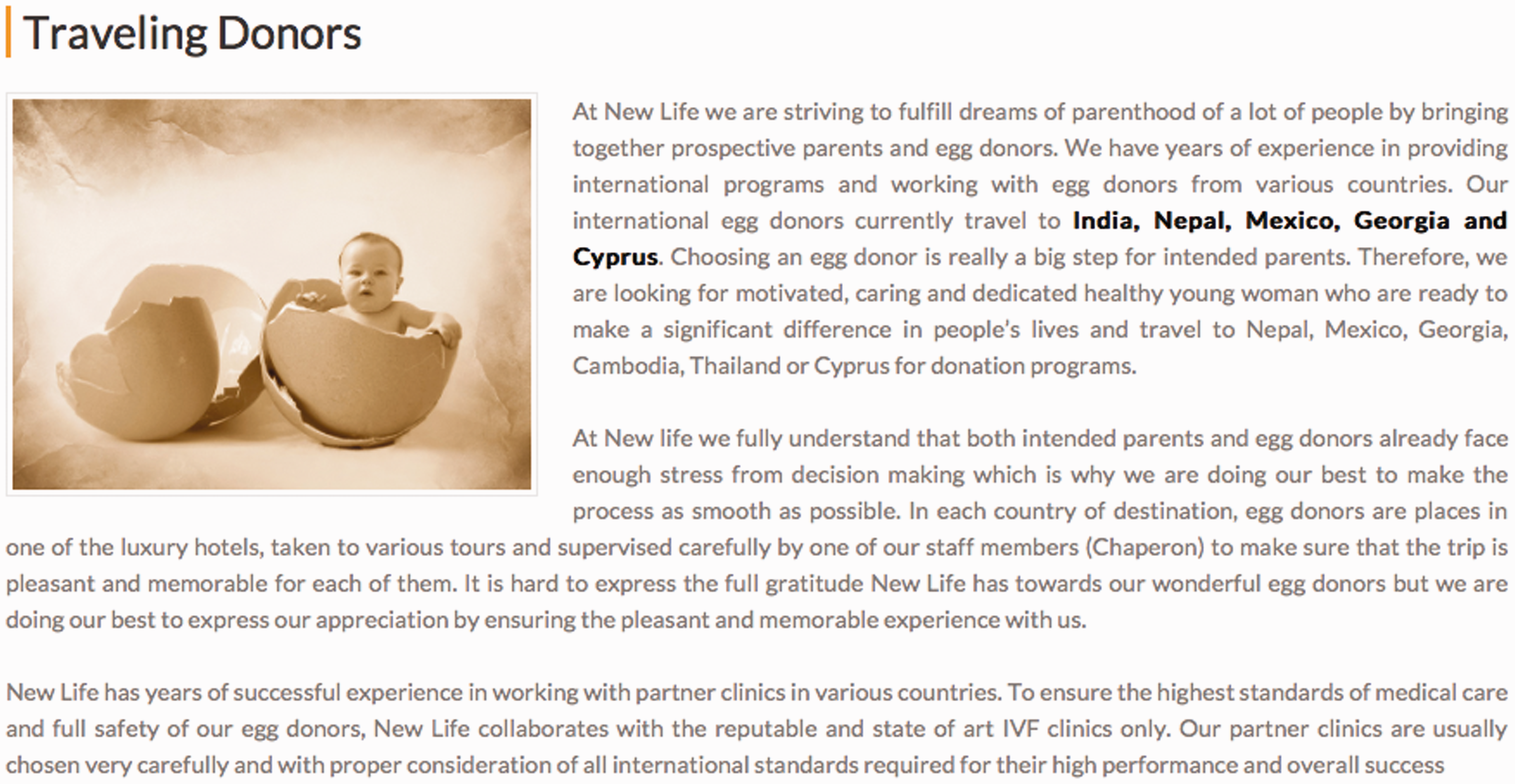

In short, infertility doctors, biologists, surrogacy and egg bank agents as well as intended parents actively participate in reproducing the hegemony of whiteness in the present. Assigning value not mainly to the donor, but to the potential white Wunschkind (desired child), whiteness is constructed as the desirable future. As Baldwin (2012: 184) highlights, such a focus on the relation between whiteness and futurity enables us “to see more clearly the extent to which the pull of whiteness into the future reconfigures what is to be valued in the decades ahead.” The differential value of white and non-white sex cells and bodies translates into a stratified market in Mexico's surrogacy business. Looking into the racialized division of labor between egg donors and surrogates, the next section further explores how whiteness is reproduced at the expense of non-white lives.
Disposable non-white lives: the racialized division of labor in Mexico's surrogacy business
Intended parents often spend hours, weeks, or even months to choose the “right” egg donor in the large databases of international gamete banks. This careful selection process stands in stark contrast to the selection of the surrogate mother. In Mexico's emerging surrogacy industry, intended parents cannot choose “their” surrogate but the surrogate agency matches them with whatever surrogate is available. Asking such an surrogate agency about their criteria for accepting women in their surrogate program, their director emphasized: “As they don't leave any genetic mark in the baby, the parents are not so concerned about their (physical) features. The only thing that matters is that they are healthy, that they don't drink alcohol or smoke and that they have a child of their own.” When further inquiring about the differences between surrogates and egg donors, she explained to me: “the egg donors are beautiful women, middle class, with some education. The surrogates are on average poorer, more chapparitas (short woman), most of them are single mothers” (interview, Villahermosa, January 2014).
In this division of reproductive labor between surrogate mothers and egg donors, racial formations are thoroughly intertwined with transnational regimes of reproduction. Racialized forms of stratified reproduction emerge in which “reproductive tasks are accomplished differentially according to inequalities that are based on hierarchies of class, race, ethnicity, gender, place in a global economy” (Colen, 1995: 78). In the global intimate spaces of surrogacy, apparently intimate practices of reproduction are embedded in global power structures and stratified regimes of reproduction (Pratt and Rosner, 2006). Intimate acts such as conception now take place in the laboratory; the sperm and egg providers are not co-present in the very act of conception. The relationship between the intended parents and the surrogate mother is stretched across space and frequently contact is mediated through the clinic or surrogacy agency. It is often just in the moment of birth that a more intimate relationship emerges when intended parents and surrogate mothers actually meet face to face (Lustenberger, forthcoming).
Comparing the reproductive labor of oocyte donors and surrogates shows that the reproductive material of egg donors is differently valued and rewarded than the gestational services of surrogate mothers (Parry 2015c). Egg donors are rewarded on the basis of their physical appearance; the value given to their body is linked to post-colonial imaginaries of white beauty. Surrogates, by contrast, are paid a fixed “compensation” that only varies if they gestate twins or if they gestate a baby created through the sperm of an HIV-infected donor. The money they earn is a compensation of the time spent as surrogate, not for the medical risks they run or the value parents assign to their future Wunschkind.
Both through the selection process and the compensation, egg donors are constructed as “unique” bodies that are highly desirable and hence valuable whereas surrogate mothers’ bodies are exchangeable and to a certain degree disposable. While the surrogate mother produces a very valuable product through her nine months of “labor”—the desired child—her own body becomes disposable after she has delivered the child or if in the course of the surrogate program, she turns out to not be able to gestate an embryo. In a similar way as the female maquiladora workers Wright (2006: 2) has studied, the surrogate mother is in fact “quite valuable since she […] generates widespread prosperity through her own destruction.” The value lies in the future, in the child she will pass to the intended parents after birth, the value of fulfilling their dream of a happy family life. At the same time, her body and subjectivity are devalued by reducing her to her reproductive capacity and womb as one surrogate points out: “The administrator of the surrogate housing never calls us with our names, she just says ‘she is the surrogate’ as if we were incubators” (interview surrogate mother, July 2014). The objectification of surrogates’ bodies takes place through descriptions such as “incubators,” “ovens,” “rented womb,” but also through the technological colonization of their bodies. Just as during colonial times when sexual relations between Spanish colonizers and native women were common, international surrogacy uses Mexican women as laboring bodies without establishing lasting kinship relations. Through the use of a white egg donor, their gestational contribution to the life of the baby is veiled. The objectification of the surrogate mother has been enforced since the technological development of gestational surrogacy. In contrast to traditional surrogacy where the surrogate donates her own gamete to the conception of the baby—and where her own race still matters to the makeup of the future baby—gestational surrogacy makes it possible to separate the labor between egg donor and surrogate, which makes the race of the surrogate mother irrelevant.
What surprised me during my fieldwork is the love, tenderness, and admiration with which the surrogate mothers speak about the surrogate child they have given birth to. They are obviously delighted by the “white beauty of my baby” (interview surrogate, Villahermosa, September 2014). The whiteness of the baby also whitens the body of the surrogate. Presenting her white baby on her Facebook profile, the surrogate performatively whitens her own life by showing her kinship connections to a white family. At the same time, the whiteness of the baby serves as a strategy to facilitate the emotional separation process, “as it would be weird, if I suddenly had a white child” (interview surrogate, September 2014). The racial markedness of the baby is decisive for kinship claims made in the transnational spaces of the surrogacy market. His/her whiteness relates the baby to the intended parents—genetic ties define the future of families. In so doing, a biological account of race and its inheritability through the transmission of the genetic material of gametes veil the intimate gestational tie of the baby with the surrogate created through nine months of labor. Gestational surrogacy makes it possible to maintain the racial purity of whiteness while reducing the costs of surrogacy through outsourcing the nine months of labor to contexts like Mexico where non-white women offer their reproductive services at a cheaper price than in the United States.
Hence, whereas at first glance the indifference of intended parents toward the racialized body of the surrogate can be explained through the logic of liberal eugenics where the parents are just concerned with those bodies and practices that shape the genetic make-up of their child, the sum of all these individual decisions result in a global division of reproductive labor. While transnational surrogacy arrangements do not aim to improve the racial body of a particular nation, they contribute to the (re-)production of a postcolonial politics of reproduction that values white(r) lives over non-white lives. When linking current forms of racialized reproduction in the Mexican surrogacy industry to Mexico's ongoing biopolitical attempts to reduce the fertility of indigenous bodies, it becomes clear how liberal eugenics in the bioeconomy of surrogacy is shaped by and simultaneously reinforces postcolonial state biopolitics.
Conclusion
This article has aimed to contribute to recent debates in geography about biopolitics, race and the future, asking how the emergence of transnational surrogacy arrangements affect reproductive consumers and laborers in surrogacy markets located outside of what Rose (2006) calls advanced liberal democracies. Engaging with the way whiteness is (re-)produced and desired in this transnational market, I have revealed how apparently liberal forms of eugenics enacted through new pastoral powers and individual consumer choices are entangled with the eugenic logics of Mexico's state biopolitics. Highlighting how whiteness not only stands for a certain skin color but rather serves as a surrogate for economic status, financial affluence, nationality, and class belonging in this market, I have pointed out how past imaginaries of colonial hierarchies persist until today and shape access to and the consumption of assisted reproductive technologies in Mexico.
To conclude, I would like to summarize the three main issues that show how liberal eugenics in the current bioeconomy of assisted reproduction are entangled with the eugenic logics of state biopolitics. First, discourses of in-/fertility in Mexico are infiltrated with a (post-)colonial logic that distinguishes between the undesired hyper-fertility of non-white bodies and the lacking fertility or infertility of white bodies. As long as state biopolitics continue to regulate and control the fertility of particularly racialized bodies in Mexico, the surrogacy industry is entangled in a (post-)colonial politics of racialized reproduction by using the reproductive capacities of those women whose children are not desired as citizens of the Mexican nation for gestating the babies of (white) commissioning parents.
Second, many of the tools of a eugenic biopolitics such as the classification and hierarchization of bodies, a visual economy, or racist public commentaries can be encountered in the Mexican surrogacy industry. While these tools are not employed to improve the national stock, they nevertheless define the future norms about desired bodies and races, about who counts as beautiful, healthy and valuable enough for reproduction. The economy of fertility marketing relies on visual signals—the white, angelic bodies of donors for example. When these signals are indexed as proxies of race, they spark judgments of people and their racial identity. Racial difference is not just produced through these biopolitical tools—such as the everyday practices of classification and categorization in the laboratory—but also hierarchized. While the motives for classification between state biopolitics and the consumer driven fertility clinics clearly differ, they both result in assigning value to bodies on basis of their racialized identity.
Third, Rose claims that new forms of liberal eugenics have come to replace biopolitics in advanced liberal democracies. The basis of this new ethopolitical order is the increasing individualization and commercialization of health care. Countries such as Mexico have been affected by neoliberal policies through the IMF's structural adjustment programs, which have cut down public expenditure for health care and health insurance. In contrast to Western citizens who have the financial means to make decisions about the genetic make up of their children in order to maximize their beauty, wellbeing, and health, the majority of citizens in Mexico are excluded from this ethopolitical order. Rather, the lack of access to (public) health care, the denial of their political right to health and reproductive choices have “forced” them to offer their bodies and reproductive labor in the surrogacy market in the first place. Even through they might make informed and conscious decisions about their participation as reproductive laborers in this market, their “choices” are restricted through economic constraints and lacking employment opportunities resulting from neoliberal reforms. While Rose's argument about a transformation from state biopolitics to liberal eugenics might describe the reality in advanced liberal democracies, this article cautions against any eurocentrism and universalism inherent in such a diagnosis. As the increasing transnationalization of health care evidences, geographies of health are no longer restricted to national territories but expand across international borders (Greenhough et al., 2015; Parry et al., 2015). In the fast growing markets of medical and reproductive tourism, health care and procreation have turned into a transnational phenomenon. Hence, we need to carefully analyze the entanglements of different logics and everyday practices of biopolitics of the present to understand how the increasing transnationalization of reproduction shapes the reproduction of future bodies in a post-colonial world.
Footnotes
Acknowledgements
First, I would like to thank the surrogate mothers, egg donors, intended parents, and the staff at the fertility clinics, surrogate houses, and surrogate agencies in Mexico that shared their experiences, emotions, thoughts, and business strategies with me. I am profoundly grateful to Laura Perler, Martin Müller, colleagues at the University of Bayreuth and Graz where I presented preliminary versions of this article and three anonymous reviewers for their generous and thoughtful feedback and suggestions. Finally, thanks to Sara Smith and Pavithra Vasudevan for sparking my engagement with race, biopolitics, and the future through their session at the 2014 AAG meeting in Tampa and their invitation to participate in this special issue.
Declaration of conflicting interests
The author(s) declared no potential conflicts of interest with respect to the research, authorship, and/or publication of this article.
Funding
The author(s) disclosed receipt of the following financial support for the research, authorship, and/or publication of this article: This work was supported generously by the “Society in Science—The Branco Weiss Fellowship.”