




Abstract
The main objective of this work is to synthesize and evaluate magnetite (Fe3O4) nanoparticle-based ferrofluids for reducing the viscosity of an extra heavy crude oil. The carrier fluid of the nanoparticles was synthesized using an engine lubricant recycled from the automotive industry and hexadecyltrimethylammonium bromide as a surfactant. Fe3O4 nanoparticles were synthesized by coprecipitation method. The effect of the concentration of nanoparticles in the viscosity reduction degree was determined for dosages between 0 and 50,000 mg/L. Different dosages of carrier fluid were evaluated between 0 and 10% v/v. The effects of the amount of brine emulsified, temperature, time, and shear rate were assessed. Overall, the results showed that viscosity and shear stress of extra heavy crude oil could be reduced up to 81 and 78% in the presence of ferrofluid, respectively. The rheological behavior of extra heavy crude oil in the presence and absence of ferrofluid was assessed by Cross, Ostwald-de Waele, and Herschel-Bulkley models.
Introduction
The increase in global demand for petroleum fuels and the decrease in supply from conventional reservoirs has stimulated in the global oil industry the advancement in technologies for the exploitation of reservoirs of heavy crude oil (HO) and extra heavy crude oil (EHO) (Ali, 1974). HOs and EHOs are those with API gravities less than 20 and 10°, respectively, and represent about 70% of total petroleum resources in worldwide (Alboudwarej et al., 2006). Viscosity is the property that most affects production and recovery operations with values between 20 cP and more than 1 × 10⁶ cP (Alboudwarej et al., 2006; Curtis et al., 2003), which complicates its production and pipeline transportation, due to its poor fluidity and high pressure differentials generated. Among the different compounds of crude oil, asphaltenes are usually most responsible for the high viscosities in HO and EHO. Asphaltenes can be defined as the most polar fraction of crude oil that are insoluble in alkanes (such as n-C5, n-C6, and n-C7) and soluble in aromatics (such as toluene, benzene, and xylene) (Adams, 2014; Luo and Gu, 2005; Mullins et al., 2012). The location of the heteroatoms such as O, S, N inside asphaltene molecule grants a highly polar characteristic that provides self-associative properties (Franco et al., 2015a), which lead to the formation of large aggregates whose average size increases as asphaltene concentration increases to form a viscoelastic network and therefore dramatically increase the viscosity (Akbarzadeh et al., 2007).
In searching for economically viable options to locate these crude oils in viscosity conditions required for its production and subsequent transport, and thus meet the production volumes projected by the market, different methods to reduce the viscosity of this kind of crudes have been used. These methods include practices at subsurface conditions such as thermal processes in enhanced oil recovery (EOR) and “cold” processes including injection of solvents and light crudes (Islam et al., 1992; McGuire et al., 2016; Picha, 2007), in situ deasphalting (Jamaluddin et al., 1996; Mokrys and Butler, 1993), and nanoparticle-based treatments (Taborda et al., 2016; Zabala et al., 2016). At surface conditions other techniques have been proposed like heating (Davletbaev et al., 2014), dilution (Alomair and Almusallam, 2013; García Zapata and De Klerk, 2014), oil in water emulsions (Alfonso and Drubey, 2008; Md. Saaid et al., 2014; Nguyen and Balsamo, 2013; Sharma et al., 1998), partial upgrading (Colyar, 2009; Luhning et al., 2002; Motaghi et al., 2010), annular flow (Bobok et al., 1996; Ghosh et al., 2009; Oliemans et al., 1987; Poesio and Strazza, 2007), and electromagnetic fields induction (Tao and Xu, 2006).
However, there is a need to develop new and cost-effective technologies because some of the previously mentioned methods do not have good perdurability, they are expensive, or environmentally harmful (Escojido et al., 1991; Jamaluddin et al., 1996). In this order, and due to its exceptional properties, nanoparticles have taken particular interest in the oil industry in stages such as exploration, drilling, EOR methods, refinery processes, water treatment, and crude oil transportation, among others (Ali et al., 2015; Bennetzen and Mogensen, 2014; Betancur et al., 2014; Franco et al., 2013a, 2014, 2016; Giraldo et al., 2013a; Guo et al., 2015; Hashemi et al., 2014; Riaza et al., 2014). Nanoparticles have different morphologies such as spherical, tubular, or irregular shape and are characterized by having a small size between 1 and 100 nm with a high ratio of surface area/volume, high dispersibility, and selectivity to capture high molecular weight compounds such as crude oil asphaltenes (Franco et al., 2013b; Lövestam et al., 2010). Additionally, these materials can be constituted by a given material enabling them to obtain specific physical qualities and functionalized on its surface according to the needs (Franco et al., 2015b).
Nassar et al. (2015) employed commercial nanoparticles of SiO2, Fe3O4, and Al2O3 for the asphaltenes adsorption and reduction of the mean aggregate size. In general, the authors found that the asphaltene adsorption process is quick and that the nanoparticles decrease the average size of asphaltenes aggregates in different degrees depending on their chemical nature. Betancur et al. (2016) synthesized magnetite nanoparticles for adsorption of asphaltenes extracted from an EHO. The authors obtained that nanoparticles were capable of adsorbing up to 61 mg/g of asphaltenes and reduce up to 39% average aggregate size because the interaction of asphaltene–nanoparticle becomes greater than that of asphaltene–asphaltene. Therefore, it can be expected that as the nanoparticles are included in the asphaltenes aggregation system the average aggregate size of this decreases, inhibiting the formation of the viscoelastic network for reducing the crude oil viscosity.
In this sense, only Zabala et al. (2016) reported the use of oil-based nanofluids for viscosity reduction in “cold” processes by static and dynamic laboratory tests and subsequent application to field conditions for HOs and EHOs. The authors report that the nanoparticles with more adsorptive capacity toward asphaltenes are more efficient in the viscosity reduction of crude oils evaluated with percentages of 99% for low nanofluid fractions of 3% v/v. Furthermore, by analysis of relative permeability curves, the authors find that the nanofluid used besides reducing viscosity can change the wettable condition of the porous medium to a water-wettable state. In field applications, including nanofluids resulted in an increase of oil production rate of 280 and 310 bbl in the case of heavy and extra heavy oil fields, respectively.
However, until now there are no studies in the specialized literature that report the use of ferrofluids for HOs and EHOs viscosity reduction. Ferrofluids are stable dispersions of magnetic nanoparticles in the presence of surfactant in determined carrier fluid (Kothari et al., 2010). In the oil and gas industry, ferrofluids have been used in various applications such as improved flow surfactants in EOR processes (Cocuzza et al., 2011), imaging of fractures (Sengupta, 2012), corrosion inhibitors (Rahmani et al., 2014), and mobilization of residual crude oil by viscosifying displacement fluid and reducing interfacial tension (Matteo et al., 2012; Soares et al., 2014). One of the greatest advantages of ferrofluids is that in the presence of an external field, the magnetic moments of each nanoparticle in the ferrofluid will align along a preferential direction according to the applied field, keeping the mechanical behavior of fluids and allowing to control its flow by convenience through the manipulation of the magnetic effort (Kothari et al., 2010; Saint-Martin de Abreu Soares, 2015). Hence, it is expected that by adding ferrofluids to HOs and EHOs, the flow conditions of this type of unconventional hydrocarbons could be controlled and optimized at both surface or subsurface. Additionally, due to the magnetic character of the nanoparticles, these could be recovered, regenerated, and reused after the process is performed (Betancur et al., 2016). Therefore, the objective of this study is to evaluate for first time the effect of the addition of ferrofluids in EHO viscosity reduction. The nanoparticles were synthesized based on the coprecipitation method. The nanofluids were prepared using an oil residual and anionic surfactant and blended with the nanoparticles. Rheological tests were performed under different conditions of time, water content, temperature, and shear rate. Ferrofluids were prepared using magnetite nanoparticles and an engine lubricant recycled from the automotive industry. In addition, the interaction of asphaltene–Fe3O4 nanoparticles was studied through batch mode experiments and the adsorption isotherm was obtained. This study is expected to generate a better overview about the application of ferrofluids in the oil industry and to improve the mobility of HOs and EHOs at surface or reservoir conditions.
Materials
The crude oil used was an EHO with 6.4° API at 289 K and saturated, aromatic, resins, and asphaltenes contents of 15.02, 18.62, 49.86, and 16.50 wt%, respectively. For the preparation of brine, KCl (99.5%, PanReac, Spain) and deionized water were used. Nanoparticles of Fe3O4 were synthesized by the method of coprecipitation (Lu et al., 2007) using HCl (37%, Emsure, Germany), NH3 (25%, Emsure, Germany), and salts of FeCl2 (99.9%, PanReac, Spain) and FeCl3 (99.9%, PanReac, Spain). Magnetite nanoparticles obtained have a spherical morphology and average particle size, surface area, and Curie temperature of 40 nm, 66 m2/g, and 805 K, respectively. Details of the characterization and method of synthesis of Fe3O4 nanoparticles can be found in a previous study (Betancur et al., 2016). Engine oil recovered from a local lubrication center was used, which was recycled, and together with hexadecyltrimethylammonium bromide (CTAB) (99.9%, PanReac, Spain) integrate the carrier fluid of ferrofluid. n-heptane (99%, Sigma Aldrich, USA) and toluene (99.5%, Merck GaG, Germany) were used for evaluating the interaction between asphaltenes and the Fe3O4 nanoparticles.
Methodology
Evaluation of the Fe3O4 nanoparticles–asphaltene interaction
The interaction between the synthesized nanoparticles and the asphaltenes was evaluated through adsorption isotherms and measurements of the mean particle size of asphaltenes aggregates. For this, batch adsorption experiments and dynamic light scattering measurements were made, respectively. n-C7 asphaltenes were isolated from crude oil using n-heptane as precipitant and following a standard procedure described in previous works (Franco et al., 2013b). Batch adsorption experiments were conducted at 298 K according to the method described by Guzmán et al. (2016) using an Genesys 10S UV−Vis spectrophotometer (Thermo Scientific, Waltham, MA) for a solution volume-to-adsorbent mass ratio of 10 g/L and for different initial asphaltenes concentrations (Ci) in toluene between 0 and 4000 mg/L. The amount adsorbed (
Also, DLS measurements are performed for determined changes in the mean aggregate size of asphaltenes in the presence of the Fe3O4 nanoparticles. DLS experiments were conducted for a fixed concentration of 1000 mg/L of asphaltenes in a solution of 60% v/v of toluene and 40% v/v of precipitant (n-heptane) using a NanoPlus-3 particle analyzer from Particulate Systems at 298 K (Nassar et al., 2015). A dosage of 10 g/L of nanoparticles was employed and measurements were taken by triplicate.
Ferrofluid preparation
Viscosity and density of recycled engine oil, carrier fluid, and ferrofluid at 298K.

Emulsions preparation
The emulsions of water in crude oil (W/O) were prepared with EHO and brine at a concentration of 2 wt% of KCl in deionized water. Brine was added to the crude oil under constant stirring for 60 min at room temperature and 32,000 r/min to reach concentrations of 10 and 20% regarding the total volume. Drop size of the prepared W/O emulsions was determined by optical microscopy using a microscope RPL3B (Microscopes INDIA, India). The drop size distribution of dispersed brine in the continuous phase of crude oil was obtained using the tpsDig software (Rohlf, 2006) and Microsoft Excel.
Viscosity and rheology measurements
Viscosity measurements (μ) and rheology were performed in a Kinexus – Pro + rheometer using a GAP of 0.3 mm with serrated plate–plate geometry optimal for high viscous material measures. Measurements were made at different shear rates in a range from 0 to 100 s−1 for EHO with various dosages of carrier fluid, nanoparticles between 0 and 50,000 mg/L, and emulsified brine from 0 to 20% v/v. Additionally, measurements were obtained in a temperature range between 298 and 318K. The viscosity of the samples was recorded for six days at a constant shear of 1 s−1. The viscosity reduction degree (VRD) was determined according to equation (1) (Hasan et al., 2010)

Modeling
Arrhenius equation
Arrhenius equation (1887) is a mathematical expression that can be used to model the change in viscosity as a function of temperature with high accuracy. A generalization supported by the equation is that for the reagents transformed into products, it is necessary to acquire a minimum amount of energy first called activation energy at a given temperature value. In Equation (2) Arrhenius model proposed is presented

Rheological models
Ostwald-de Waele, Herschel-Bulkley, and Cross rheological models (Nik et al., 2005) and their respective variables.

To determine which model described better the experimental behavior obtained the root-mean-square error definition (RMSE%) was used, determined by equation (6) (Giraldo et al., 2013b)

Results
In the following sections, the results of the evaluation of the asphaltene–nanoparticle interaction as well as viscosity and rheology tests for EHO evaluated in the presence and absence of nanoparticles, ferrofluid, and water emulsified are presented.
Adsorption isotherm of n-C7 asphaltenes and evaluation of mean aggregate size
The interaction between nanoparticles and the EHO asphaltenes is a primary parameter for understanding the driven mechanisms of viscosity reduction. Figure 1 shows the adsorption isotherm of n-C7 asphaltene over the Fe3O4 nanoparticles surface at a fixed temperature of 298 K. From Figure 1 it can be observed that adsorption isotherm follows a Type Ib behavior according to the most recent IUPAC classification (Thommes et al., 2015). These systems are characterized for representing high affinity in the adsorbate–adsorbent couple, mainly in Henry’s region at low values of CE. It can also be observed that nanoparticles can adsorb up to 1.13 m2/g of n-C7 asphaltenes, indicating that the number of individual asphaltene molecules in the bulk solution is reduced and hence, their interaction with other asphaltenes is limited. This affirmation is corroborated by the DLS measurements, where it was observed that after 24 h when the system can be considered at equilibrium (Nassar et al., 2015), the mean aggregate size of asphaltenes change from 1017 ± 25 nm for the system in the absence of nanoparticles to 601 ± 25 nm after nanoparticles inclusion. Results are in agreement with those reported by Betancur et al. (2016) and Nassar et al. (2015), who studied the effect of nanoparticles in the kinetics of asphaltene aggregation/fragmentation and found that the mean particle size of asphaltene decreased drastically in the presence of the evaluated materials.
Adsorption isotherms of n-C7 asphaltene over the Fe3O4 nanoparticles surface at a fixed temperature of 298 K.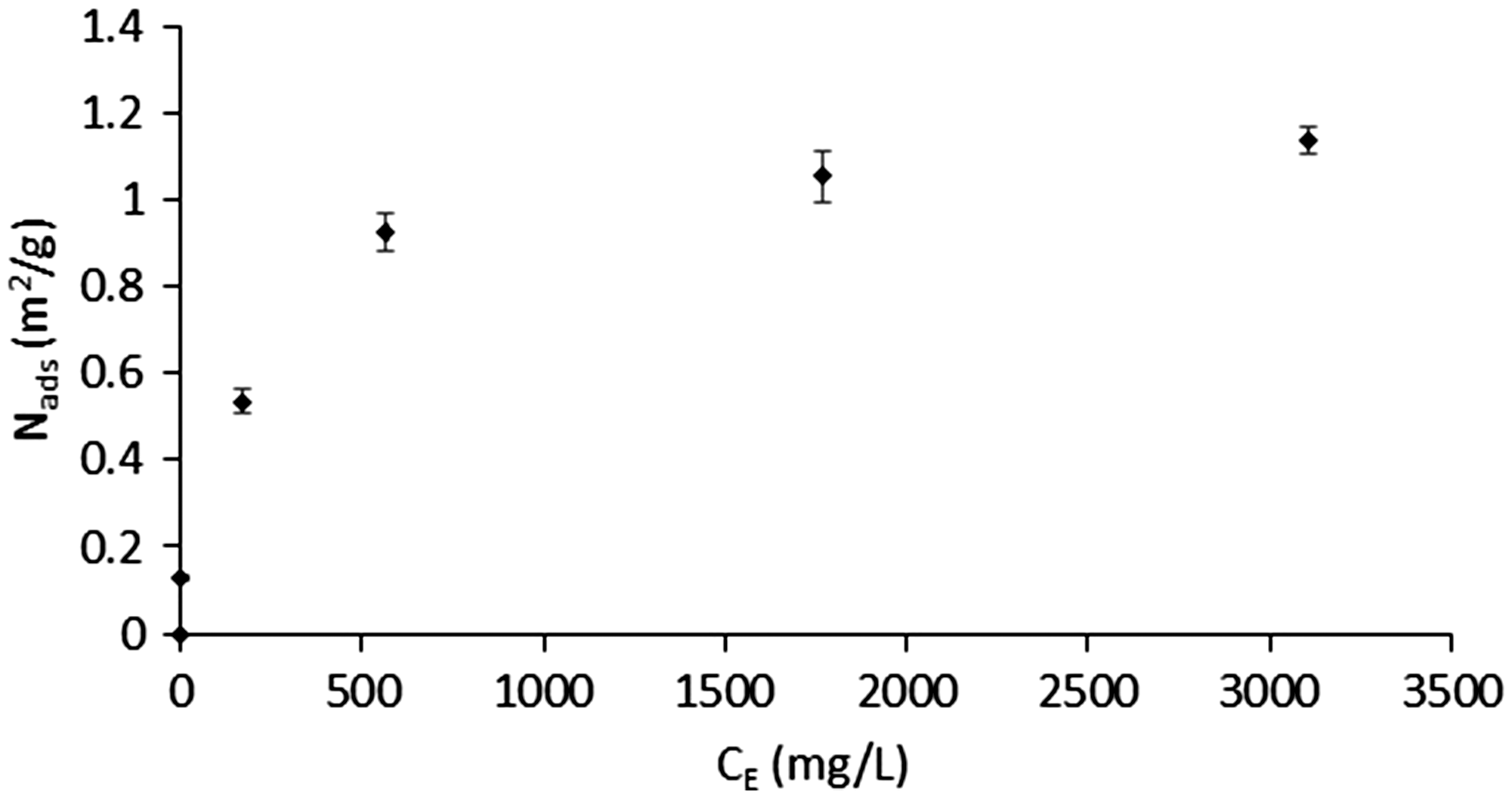
Effect of nanoparticles addition
In Figure 2 the effect of the addition of Fe3O4 nanoparticles in EHO viscosity at different concentrations of nanoparticles between 0 and 50,000 mg/L for a fixed temperature of 298 K and a shear rate of 1 s−1 is shown. Due to the high content of asphaltenes present in this EHO (16.5 wt%), they can self-associate, forming larger aggregates to constitute then a viscoelastic network, which is responsible for the high viscosity up to 25 kP at evaluated conditions (Akbarzadeh et al., 2007). Figure 2 shows that for concentrations of 500, 1000, and 1500 mg/L of nanoparticles, the oil viscosity decreases as the dosage of the material increases with reductions of 8, 12, and 20%, respectively. This decrease could be due to as the number of particles increases, the adsorption of asphaltenes on the nanoparticles surface is favored (Figure 1), inhibiting the formation of large aggregates and the subsequent generation of the viscoelastic network. However, for a dosage of 50 g/L an adverse effect on viscosity is observed, and may be because magnetite nanoparticles in high concentrations tend to aggregate due to its magnetic characteristics, forming clusters and decreasing its surface area per mass unit as well as its adsorptive capacity, being unable to inhibit the tendency of the asphaltenes to aggregate each other (Nassar et al., 2015).
EHO viscosity in presence and absence of Fe3O4 nanoparticles at concentrations of 500, 1000, 1500, and 50,000 mg/L at 298 K and constant shear rate of 1 s−1. EHO: extra heavy crude oil.
Effect of ferrofluid in EHO viscosity
After evaluating various concentrations of nanoparticles, a recommended dosage of 1500 mg/L at carrier fluid concentrations between 0.15 and 10% v/v was selected. In Figure 3 EHO viscosities are presented for a fixed dosage of 1500 mg/L of Fe3O4 nanoparticles and different dosages carrier fluid. It should be noted here that in this type of experiments the ferrofluid (carrier fluid + nanoparticles) is prepared before including to the oil. Figure 3 shows that as the concentration of carrier fluid increases, the VRD increases with values of 21, 35, 51, and up to 75% for dosages of 0.15, 1, 5, and 10%, respectively, and even reductions of one order of magnitude in the latter case are observed. This may be due mainly for two reasons: (i) dispersion of nanoparticles in the carrier fluid and therefore an increase in the available area for interacting with asphaltenes and (ii) the dilutive effect of the carrier fluid. The CTAB was included in the formulation of the ferrofluid as many of the nanoparticles applications at reservoir conditions require the preparation of the fluid on the surface before injection. However, in the possible scenario of in situ preparation of ferrofluid, the use of CTAB as a surfactant could be avoided due to asphaltenes would act as dispersing agents of the nanoparticles.
EHO viscosity in presence and absence of ferrofluid with fixed concentration of 1500 mg/L of Fe3O4 and carrier fluid concentrations of 0.15, 1, 5, and 10% v/v at 298 K and constant shear rate of 1 s−1. EHO: extra heavy crude oil.
In Figure 4, the individual effect of each component of ferrofluid in reducing the viscosity of EHO for dosages of nanoparticles and carrier fluid of 1500 mg/L and 10% v/v, respectively, is shown. It is observed from Figure 4 that the VRD increases in order Fe3O4 nanoparticles < carrier fluid < ferrofluid, with values of 20, 50, and 75%, respectively. These results indicate that the diluent of the carrier fluid significantly reduces the viscosity of the selected EHO. However, it is observed that the addition of ferrofluid generates a synergistic effect on the VRD by obtaining a value 5% greater than that compared with the addition of the individual effects of the ferrofluid components. Additionally, the results show that a similar VRD can be obtained by adding 5% v/v of ferrofluid (Figure 3) compared to 10% v/v carrier fluid, obtaining viscosities of 12.1 and 12.3 kP, respectively.
Evaluation of ferrofluid effect and its individual components in EHO viscosity at 298 K and constant shear rate of 1 s−1. Nanoparticle dosage: 1500 mg/L; carrier fluid dosage: 10% v/v. EHO: extra heavy crude oil.
Effect of brine content in oil viscosity reduction by addition of ferrofluid
Effect of brine addition in EHO viscosity
Two EHO samples were evaluated with brine contents of 10 (W10) and 20% v/v (W20). In Figure 5, the change in EHO viscosity versus time by adding 10–20% v/v brine at 298 K and constant shear rate of 1 s−1 is shown. As shown in Figure 5, EHO viscosity increases as the water content in the system increases. These results are consistent with those obtained by Arhuoma et al. (2009), Johnsen and Rønningsen (2003), and Kokal (2005), who evaluated the effect of the amount of water in the behavior of the viscosity of W/O emulsions for HOs from Saudi Arabia, North Sea, and Canada, respectively. The increase in EHO viscosity may be due to the gradual strengthening of interfacial film produced by asphaltene rearrangement, inhibiting coalescence of the drops of the dispersed phase. Due to the formation of this rigid film at the interface, the drops of the dispersed phase behave as hard spheres, and the emulsion takes similar behavior to a liquid–solid dispersion (Schorling et al., 1999). Fluid viscosity with shear thinning behavior as presented by emulsions (see Figure 12) is dependent on the drop size of the dispersed phase, the latter being inversely proportional to the drop size and proportional to the interfacial tension (Otsubo and Prud’homme, 1994). Additionally, emulsions stabilization may be in part due to the content of KCl in the brine, generating an electroviscous effect which arises from the overlap of the layers, becoming more significant the higher the electrolyte concentration (Tadros, 1994).
Effect of brine in W/O emulsions for brine contents of 10 and 20% v/v at 298 K and constant shear rate of 1 s−1.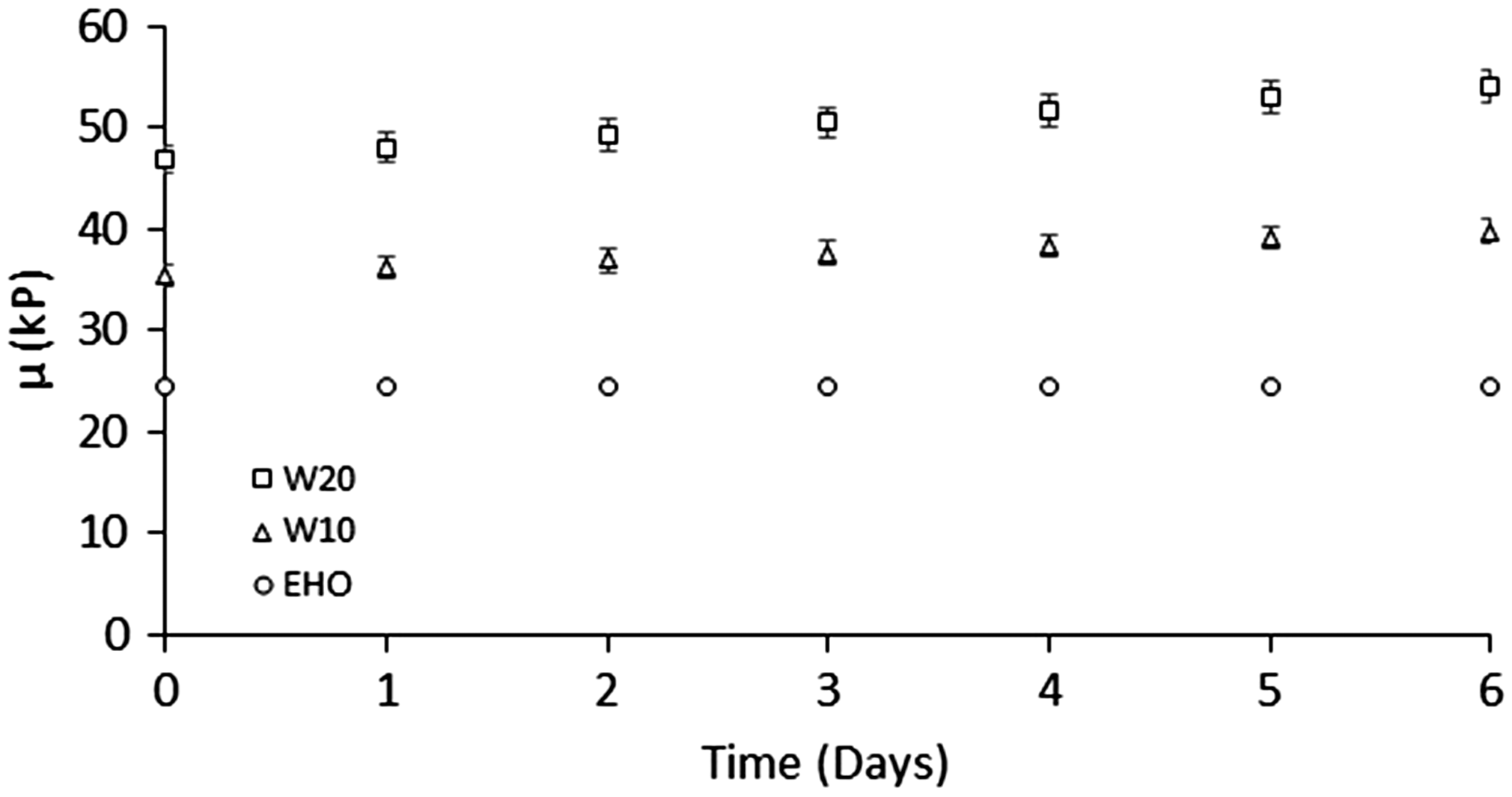
In Figure 5 it is observed the increase in viscosity of W10 and W20 samples as a function of time. When the viscosity of the samples is measured at the moment after preparation, it increases from 25 kP to 36 and 47 kP for W10 and W20 in comparison to anhydrous EHO, respectively. However, on day 6 an increase in viscosity of 12–16% compared to day 0 is observed, reaching values of 40 and 54 kP for W10 and W20 samples, respectively. This increase in viscosity could be due to as the average drop size of the dispersed phase decreases, the viscosity of the emulsion increases (Otsubo and Prud’homme, 1994).
Figure 6 shows the drop size of brine in the W/O emulsion at 10 and 20% v/v measured the same day that emulsions were prepared. The drop size distributions are typical of a tight emulsion (Kokal, 2005), where the values of the average drop size (d50) were similar with values of 4.5 ± 0.5 µm in both W10 and W20 samples. However, the distribution width of W20 is smaller compared with that of W10, which along with the amount of brine present in the emulsion explains greater viscosity values for the W20 sample (Kokal, 2005).
Drop size of the dispersed phase in W/O emulsion and their respective distribution at day 0 for (a), (b) W10, and (c), (d) W20.
Figure 7 shows the evolution of d50 value for the brine drops size as a function of time for W10 and W20 samples. From Figure 7 it can be observed that for both W/O emulsions, the mean drop size decreases as time increases. This behavior may be due to the redistribution of asphaltenes in crude oil being located at the brine–oil interface, strengthening the interfacial film, and hindering the aggregation and subsequent coalescence of the dispersed phase (Schorling et al., 1999), which along with the unadsorbed asphaltene reorganization produces a significant increase in the viscosity of the samples (Figure 5).
Mean brine drop size in emulsion W/O 10% v/v and 20% v/v for six days.
Effect of nanoparticles and ferrofluid addition in the viscosity of emulsions
In Figure 8 the viscosity of the samples W10 in the presence and absence of Fe3O4 nanoparticles and ferrofluid is presented at a temperature of 298 K and shear rate fixed 1 s−1. Similarly, results of viscosity and for W20 samples in the presence and absence of nanoparticles and ferrofluid are included in Figure S1 of the Supporting Information document. It can be seen from Figure 8(a) that the viscosity of the emulsions decreases as the concentration of nanoparticles increases. Similar results are observed for W20 sample in Figure S1(a). The greatest VRD is observed after six days with values of 6, 10, and 18% and 7, 11, and 19% for W10 and W20 samples with dosages of 500, 1000, and 1500 mg/L, respectively. Additionally, to the effect of nanoparticles in inhibiting aggregation of asphaltenes, they could interact at the brine–oil interface by weakening the interfacial film for enhancing the coalescence of the drops of the dispersed phase, generating an increase in the drop size of the disperse phase. In Figures 8(b) and S1(b), it can be observed that the viscosity of W10 and W20 decreases considerably up to one order of magnitude in the presence of ferrofluid and exhibit a VRD of 81 and 80%, respectively. This reduction could be due to the diluent effect of the carrier fluid along with the influence of addition of nanoparticles into asphaltenes aggregation system and positioning at the oil–brine interface.
Effect of nanoparticles and ferrofluid in the emulsified oil with 10% brine at 298 K and constant shear rate 1 s−1.
In Figure 9 the drop size of the dispersed phase at brine percentages of 10 and 20% v/v in emulsion with EHO at day 6 is presented. Figure 9 shows that after addition of nanoparticles in the emulsion the drop size increases regarding the samples in the absence of nanoparticles (Figure 7) with values of 3.4 and 3.8 µm, representing increases of 31 and 27% for W10 and W20 samples, respectively. Also, the CTAB included in the ferrofluid formulation will locate at the oil–water interface due to its ionic nature and could contribute to the emulsion destabilization through changes in the electrostatic interactions between dispersed phase droplets (Xin et al., 2013).
Brine drop size and their respective distribution at day 6 for (a), (b) W10, and (c), (d) W20 samples W/O emulsions after being treated with Fe3O4 nanoparticles at a fixed concentration of 1500 mg/L.
Shear rate effect
Shear rate effect in extra heavy oil viscosity in presence and absence of nanoparticles and ferrofluid
In Figure 10 the shear rate effect on viscosity for the selected EHO at 298 K is presented together with the rheological models evaluated. In Figure 10 the typical non-Newtonian behavior of this type of fluid is observed as viscosity changes by increasing the shear rate. Additionally, in Table 3 the rheological parameters of Ostwald-de Waele, Herschel-Bulkley, and Cross models at 298 K are shown. The selected models describe well the experimental data, being the Cross model that presents the best fit according to the value of RSME%.
Effect of shear rate on EHO viscosity at 298 K. The symbols are the experimental data, and the lines represent the Ostwald-de Waele, Herschel-Bulkley, and Cross models. EHO: extra heavy crude oil. Rheological parameters of Cross model for EHO in the absence and presence of 1500 mg/L of magnetite nanoparticles, 10% v/v carrier fluid, and 10% v/v of ferrofluid at 298 K. EHO: extra heavy crude oil.

In Figure 11 the experimental results of (a) viscosity and (b) shear stress as a function of shear rate for EHO before and after treatment with the ferrofluid as well as each one of its components are shown. Results of the obtained parameters for the Cross rheological models evaluated are listed in Table 3. Also, parameters for the Ostwald-de Waele and Herschel-Bulkley models are shown in Table S1 of the Supporting Information document. In all cases, the Cross model described the experimental data in a right way with RSME% < 6%. It is observed from Figure 11 that after treatment with the individual components of the ferrofluid, the pseudoplastic behavior prevails. However, for the sample treated with the ferrofluid, the viscosity is lower in the entire range of shear rate evaluated in comparison with the individual components. For a fixed value of shear rate of 100 s−1 the trend of viscosity follows the order EHO > 1500 mg/L of nanoparticles >10% v/v carrier fluid > 10% v/v ferrofluid, with values 3.21, 2.60, 1.61, 0.50 kP, respectively. The results confirm the synergistic effect between the nanoparticles and the carrier fluid in reducing the viscosity of the HO and is supported by the results of the Cross model (Table 3).
Effect of ferrofluid and each of its components on (a) viscosity and (b) shear stress of EHO at 298 K as a function of shear rate. The symbols are the experimental data, and the solid lines represent the Cross model. EHO: extra heavy crude oil. Comparative average viscosity reduction for the best dosage of nanoparticles and ferrofluid at 298 K and a fixed shear rate value of 1 s−1.

In Figure 11(b) the behavior of the shear stress is shown, and it can be observed that it increases as shear rate increases (Hasan et al., 2010). The shear stress increases significantly at low shear rates, reflecting the viscoelastic behavior of EHO. Hence, it can be said that there are no significant phenomena of disaggregation of asphaltenes. At higher shear rates, the shear stress overcomes the value necessary for propitiating the asphaltenes desegregation, which may explain the constant values for shear rates > 30 s−1 (Pal, 1996).
In Tables 3 and S1 the obtained parameters of rheological models for EHO in absence and presence of ferrofluid and treatment with each one of its components are presented. The flow behavior indexes (n and nH) show if the fluid has a Newtonian behavior when values close to 1.0 are obtained. Values < 1 are typical of pseudoplastic fluids (Nik et al., 2005). Consistency indexes (K and
Shear rate effect on emulsified EHO in presence and absence of treatment
Similar results are obtained for the emulsified samples in comparison with the crude oil in the absence of water. In Figure S2 of the Supporting Information document, the rheological behavior of W10 and W20 samples at 298 K both in absence and presence of treatment with 1500 mg/L of magnetite nanoparticles and 10% v/v of ferrofluid is shown as a function of shear rate together with the Cross model fitting. It is observed from Figure S2 that treatment with nanoparticles effectively decreases the viscosity of the samples in the range of shear rate evaluated. These results could lead to lower demands on energy needs at surface or well conditions, with reductions of shear stress up to 17 and 78%, and 18 and 76% for W10 and W20 in the presence of treatment of 1500 mg/L of Fe3O4 nanoparticles and 10% v/v of ferrofluid, respectively.
Parameters of Cross rheological model for W10 and W20 samples in absence and presence of 1500 mg/L magnetite nanoparticles and 10% v/v of ferrofluid at 298 K.

Figure 12 summarizes the VRD obtained for EHO, W10, and W20 samples after treatment with Fe3O4 nanoparticles and ferrofluid, achieving considerable reductions for the latter. Higher degrees of viscosity reduction up to 81% are obtained for the emulsified samples by using a ferrofluid based on low-cost materials.
Temperature effect on the EHO viscosity in the presence and absence of treatment
Figure 13 shows the rheological behavior of EHO before and after treatment with ferrofluid at a dosage of 10% v/v and for temperatures of 308–318 K. It can be seen in Figure 13(a) that for a fixed shear rate of 100 s−1, the viscosity decreases with increasing the system temperature up to 84 and 81% for EHO in absence and presence of treatment with ferrofluid at 308 K with values of 0.94 and 0.35 kP, respectively. Same observations can be made for samples at 318 K with viscosity reductions of 97 and 96%, respectively. It is noteworthy that the oil viscosity in the presence of ferrofluid at a temperature of 308 K is close to that without ferrofluid at 318 K, indicating the effectiveness of treatment regarding energy saving for mobilization of this kind of hydrocarbons. From Figure 13(b) shear stress reductions due to the effect of temperature on EHO and ferrofluid inclusion are observed with values of 63 and 88% at 35 and 318 K, respectively.
Effect of ferrofluid and temperature in (a) viscosity and (b) shear stress of EHO at 308 and 318 K. The symbols are the experimental data, and the solid lines represent the Cross model. EHO: extra heavy crude oil.
Parameters of Cross rheological model for EHO in absence and presence of treatment with ferrofluid at 308 and 318 K.

EHO: extra heavy crude oil.
Figure 14 shows the temperature effect on viscosity of crude oil for shear rate of 1 s−1, together with the Arrhenius model. Similarly, in Figure S3 of the Supporting Information document change in viscosity for shear rates of 10 and 50 s−1 is shown. Also, in Table 6 the parameters evaluated by the Arrhenius model are presented. From Figures 14 and S3 it can be seen that at the three different values of shear rate selected, the viscosity of the EHO in presence and absence of the ferrofluid decreases exponentially as temperature increases. Also, Arrhenius model described the experimental data accurately, with RSME% values lower than 10%. Increase in shear rate values leads to decreases in the activation energy (Table 6). The same situation is observed when comparing EHO before and after treatment at a fixed value of shear rate.
Temperature effect on the rheology of EHO with and without ferrofluid for shear rate of 1 s−1. The symbols are the experimental data, and the solid lines represent the Arrhenius model. EHO: extra heavy crude oil. Parameters of Arrhenius equation for EHO viscosity in the presence and absence of ferrofluid for temperatures of 298, 308, and 318 K. EHO: extra heavy crude oil.

Results indicate that with the inclusion of the ferrofluid, a substantial decrease in the thermal requirement for enhancing the transport/production of HO and EHO with a cost-effective treatment could be reached.
Conclusions
Successfully, the synthesis and evaluation of a magnetite nanoparticle-based ferrofluid for viscosity reduction on EHOs were made. It was observed that nanoparticles are able to adsorb asphaltenes and reduce their mean aggregate size. Obtained adsorption isotherms showed a Type Ib behavior according to the IUPAC, indicating the high affinity between the couple asphaltene–nanoparticle. Ferrofluid was prepared using CTAB and engine lubricant oil recycled from the automotive industry, giving an added value to a typical residue of the sector. The ferrofluid was efficient in reducing viscosity, with reductions of 75, 81, and 80% for the extra heavy oil and emulsified oil with 10 and 20% v/v of brine. Reductions in the shear stress of 65, 78, and 76% were also observed, respectively. Cross model successfully reproduced the experimental data with RSME% lower than 6%. The extra heavy oil and the selected W/O emulsions showed a pseudoplastic behavior. However, when ferrofluid is included and the temperature is increased, a Newtonian-like behavior was observed. Additionally, it was noted that the inclusion of the nanoparticles in the carrier fluid has a synergistic effect in the extra heavy oil viscosity reduction, leading to higher VRD than those obtained by the addition of the individual components of the ferrofluid. Results open a wider landscape about the use of nanotechnology in the oil and gas industry with a low-cost and cost-effective implementation.
Footnotes
Acknowledgements
This work was recognized with the “Francisco Rodríguez-Reinoso” award for the best contribution by a junior researcher during the “III Workshop on Adsorption, Catalysis and Porous Materials” held in Bogotá, Colombia on 29–31 August 2016.
Declaration of Conflicting Interests
The author(s) declared no potential conflicts of interest with respect to the research, authorship, and/or publication of this article.
Funding
The author(s) disclosed receipt of the following financial support for the research, authorship, and/or publication of this article: The authors thank Colciencias and Universidad Nacional de Colombia—Sede Medellin for the financial and logistical support in the realization of this investigation.

References
Supplementary Material
Please find the following supplemental material available below.
For Open Access articles published under a Creative Commons License, all supplemental material carries the same license as the article it is associated with.
For non-Open Access articles published, all supplemental material carries a non-exclusive license, and permission requests for re-use of supplemental material or any part of supplemental material shall be sent directly to the copyright owner as specified in the copyright notice associated with the article.
