




Abstract
Multi-walled carbon nanotubes (MWCNTs) encapsulated by polyaniline (PANI) were synthesized by in situ polymerization. Scanning electron microscopy (SEM), Fourier transform infrared (FT-IR) spectroscopy and thermal gravimetric analysis (TGA) were used to characterize the synthesized composites (O-MWCNTs/PANI), and the surface area was calculated by the Brunauer–Emmett–Teller (BET) method. The removal capacity of alizarin yellow R (AYR) with O-MWCNTs/PANI was further investigated. Experiments were conducted to optimize the adsorption conditions, including contact time, pH, initial concentration of AYR and temperature. The results showed that the maximum adsorption capacity for AYR was 884.80 mg/g. The adsorption kinetics and the adsorption isotherm could be better described by the pseudo-second-order model and the Langmuir isotherm, respectively. Energy changes revealed that the adsorption process was exothermic and spontaneous in nature. Additionally, the O-MWCNTs/PANI showed higher adsorption capacity than pristine MWCNTs or PANI. Therefore, O-MWCNTs/PANI would be applied as an efficient adsorbent for the removal of dye from water.
Introduction
In recent years, a large quantity of pollutants containing dyes and pigments from the waste water pose a great threat to environmental safety. Dyes are categorized according to their chemical structure (mainly according to the structure of conjugated system) as azo, phthalocyanine, anthraquinone, indigo, nitro and nitroso methane dye (van der Zee and Villaverde, 2005). Among dyes, azo dyes characterized by the presence of one or more azo bonds (–N=N–) are the largest and most versatile class of dyes. It is reported that more than half of the annually produced amount of dyes (estimated for 1994 worldwide as one million tons) are azo dyes (Santos et al., 2003). These dyes have been widely used in various industries like food, textile, cosmetic, paper, paint, printing and pharmaceutical (Gholivand et al., 2015). In this work, alizarin yellow R (AYR), a mordant dye, which is applied in the dyeing of wool and nylon, was chosen as the absorbate, and its maximum adsorption wavelength is 370 nm (Salman et al., 2011).
Discharge of waste water containing dyes into natural ecosystems is aesthetically and environmentally unacceptable because of the strong persistent color and high biological oxygen demand loading (O’Neill et al., 1999). Some synthetic dyes possessing complex aromatic structure are carcinogenic for aquatic life and difficult to biodegrade (Fewson, 1988; Fu and Viraraghavan, 2001). Moreover, the dye residues can result in allergies and skin irritation in humans, via bio-accumulating in fauna and transferring to higher food chain (Bajc et al., 2011; Kooh et al., 2015). Therefore, the removal of dyes from industrial effluents becomes a major environmental challenge. So far, various biological treatments and physicochemical methods have been extensively investigated for removal of dyes from waste water, such as photocatalysis (Hoffmann et al., 1995; Rahman et al., 2013), chemical precipitation (Kadirvelu et al., 2003), electrochemical degradation (Rajkumar et al., 2007; Sirés and Brillas, 2012), ozonation (Mahmoodi, 2013), advanced oxidation processes (Guimaraes et al., 2012), membrane filtration (Unsal et al., 2015; Zularisam et al., 2006) and adsorption (Thommes and Cychosz, 2014; Yan et al., 2014). However, these techniques have their own limitations, including the excessive usage of chemicals, accumulation of secondary concentrated sludge, expensive plant requirements and high operational costs. Compared with the other techniques, adsorption has been found to be a superior technology for the dye-polluted water treatment, due to the high efficiency, relative simplicity of design, easier operation without harmful residues and the low operational cost (Wang et al., 2014). Nowadays, various materials as adsorbents, with high adsorption capacity, have been applied to remove dyes from water.
Carbon nanotubes (CNTs) have been proven as promising adsorbents for removing various environmental pollutants due to their unique quasi-one-dimensional hollow structure, high specific surface areas and good chemical and thermal stability (Tasis et al., 2006; Thommes and Cychosz, 2014). Moreover, their adsorption capacities and dispersibility could be increased by introduced different functional groups onto their surface, such as hydroxy (Chen et al., 2015), carboxyl group (Sang et al., 2012), polymers (Xie et al., 2005) and so on. Among which polyaniline (PANI) has attracted great attention in the world of research due to their well-behaved electrochemistry, easy protonation reversibility, excellent environmental stability, ease of doping, less energy requirement, good dispersion and abundant of amino (Konyushenko et al., 2006; Wei et al., 2014). Recently, multi-walled carbon nanotubes (MWCNTs) doped with PANI have been used to remove dyes from aqueous solutions (Ayad and El-Nasr, 2010).
The objective of this work is to investigate the adsorption behavior between the PANI-modified MWCNT composites and AYR. Fourier transform infrared (FT-IR) spectroscopy, thermal gravimetric analysis (TGA), scanning electron microscopy (SEM) and Brunauer–Emmett–Teller (BET) were used to characterize the properties of the materials, and the role of some adsorption conditions such as contact time, initial pH values and solution temperature was studied. The adsorption isotherms, adsorption kinetics, adsorption thermodynamics were also investigated. Compared with the pristine MWCNTs or PANI, MWCNTs modified by PANI composites exhibited higher adsorption efficiency.
Experimental
Materials and reagents
MWCNTs (specific surface area 80–140 m2/g, diameter 20–40 nm), the purity of which was more than 97%, were purchased from Shenzhen Nanotech Port Co., Ltd. Aniline monomer and AYR were supplied by Tianjin Guangfu Technology Development Co., Ltd. Ammonium persulfate was obtained from Tianjin Hengxing Chemical Reagent Co., Ltd. All chemicals were of analytical reagent grade and used without further purification, and all the solutions were prepared by deionized water.
Preparation of oxide MWCNTs
Five hundred milligrams of raw MWCNTs were ultrasonically treated with 50.0 mL of nitric acid for 10 min. Then the mixture suspension was stirred by magnetic and refluxed at 120℃ for 24 h, which produced carboxyl groups at the defect sites of MWCNTs and thus improved the solubility of the MWCNTs in hydrochloric acid (HCl) solution. After cooling to 20℃, the product was filtered through a 0.45 µm PTFE membrane and washed with deionized water until the pH was neutral, then dried under a vacuum at 60℃ for 24 h.
Preparation of PANI grafted O-MWCNT (O-MWCNTs/PANI)
The oxide MWCNTs (O-MWCNTs)/PANI composites were synthesized by in situ chemical oxidation polymerization. First, 2.5 mL of aniline monomer was dissolved in 50.0 mL; 0.6 mol/L HCl solution and 400 mg of O-MWCNTs were added into the solution and ultrasonicated for 30 min at room temperature to obtain uniform dispersion of the O-MWCNTs, then transferred into a 250 mL flask with an ice-bath. Second, a solution containing 5.7 g ammonium persulfate, an initiator for the polymerization reaction of aniline monomer, and 25.0 mL deionized water was slowly added dropwise into the suspension with constant magnetic stirring at a reaction temperature of 0℃–5℃ for an additional 3 h. Then, the resulting green suspension was filtered and rinsed several times with HCl, deionized water and acetone, respectively. Finally, the O-MWCNTs/PANI were dried under a vacuum at 60℃ for 24 h. Neat PANI was synthesized via the same steps without the O-MWCNTs, and the PANI coated MWCNTs (MWCNTs/PANI) was prepared following the same steps with the additions of raw MWCNTs. Figure 1 shows the process for the modification of the MWCNTs.
Schematic diagram of the modification of the MWCNTs.
Characterization methods
Microstructure and morphology of the absorbents were measured by using a SEM (MIRA3 TESCAN). FT-IR spectroscopy was conducted on a Nicolet 6700 FT-IR spectrometer. Thermogravimetric analysis (TGA) was recorded on a SDT Q600 V8.0 Build 95 thermal analyzer in the temperature range of 25℃–600℃ with a heating rate of 10℃/min in argon media. The specific surface area of materials was determined by a BET method on a JW-BK132F apparatus at 77 K by N2 adsorption–desorption isotherms.
Adsorption studies
A series experiments were conducted to study the influence of crucial parameters like contact time, pH, temperature and initial dye concentration. The absorbance (at 370 nm) of AYR solution was measured by using a UV/VIS spectrophotometer. Prior to the measurement, a calibration curve, to estimate the concentration of AYR, was plotted over a range of standard AYR solutions.
To study the kinetic adsorption, the flask fitted with 20.0 mL dye solution of initial concentration of 100.0 mg/L, and 5.0 mg of adsorbent was shaken for different contact time (0 to 50 min) at 25℃ in a shaking thermostatic bath. The concentration of dye solution was determined at different contact time. Each data point was acquired from an individual flask. The dye adsorption capacities of adsorbent were calculated according to the following equation

The effect of solution pH on dye removal was investigated by mixing 5.0 mg of O-MWCNTs/PANI to a dye solution of 200.0 mg/L in separate experiments at different pH levels (6–10). The pH was adjusted using HCl (0.10 mol/L) and NaOH (0.10 mol/L) solutions. Agitation was done for 2 h, and then the final dye concentrations were measured.
For adsorption isotherm, 20.0 mL of dye solutions of different concentrations (100.0–350.0 mg/L) were continuously shaken with 5.0 mg of adsorbent for 2 h to obtain complete equilibrium at 25℃, 35℃ and 45℃, respectively. Then, the residual concentration of AYR in the supernatant was tested.
Adsorption kinetics
The adsorption kinetics is one of the most important parameters for evaluating the adsorption efficiency. Three principal kinetic models, the pseudo-first-order, pseudo-second-order and intraparticle diffusion model (Robati, 2013), were used in this study to interpret the kinetic experimental rate, and predict the rate-limiting step.
The pseudo-first-order equation is expressed as

The pseudo-second-order reaction is based on the weight of absorbate adsorbed on the adsorbent and is represented as the following form

The intraparticle diffusion model is expressed as

Adsorption isotherm
A series of experiments was carried out to study the adsorption behavior of AYR on O-MWCNTs/PANI. The most common adsorption models were used to analyze the experimental data, namely Langmuir, Freundlich isotherms and Dubinin–Radushkevich isotherm (Dada, 2012; Garbovskiy, 2016). The Langmuir adsorption isotherm presumes that monolayer adsorption takes place at specific homogeneous sites of the adsorbent. The model of Langmuir isotherms was applied for the adsorption equilibrium as follows

The Freundlich isotherm is a fairly satisfactory empirical equation which can be used for multilayer adsorption that involves heterogeneous surface energy systems.
This isotherm is generally given by

The Dubinin–Radushkevich isotherm applied to distinguish the physical and chemical adsorption is expressed as


The mean free energy E (KJ/mol) can be computed using the following relationship

If the value of E is less than 8 KJ/mol, the adsorption process is physical in nature. If it is higher than 8 KJ/mol, the adsorption process is chemical.
Adsorption thermodynamics
Thermodynamic studies were conducted to explicate the mechanism of the adsorption (Chowdhury et al., 2011). Different thermodynamic parameters such as standard free energy (




R (8.314 J/mol·K) is the gas constant, and T (K) is the absolute temperature. The values
Results and discussion
Characterization of absorbent
The uniform deposition of PANI on the MWCNTs is demonstrated by SEM, which shows the typical core–shell structure of coated MWCNTs (Figure 2). It can be clearly observed that the surface of O-MWCNTs/PANI (Figure 2(b)) is smoother than the surface of pure PANI (Figure 2(c)). It may explain why the adsorption capacity of O-MWCNTs/PANI is higher than that of pure PANI. Compared with the O-MWCNTs (Figure 2(a)), we conclude that the aniline monomer is uniformly polymerized on the surface of the O-MWCNTs and forms a shell of tubular composite.
SEM images of (a) O-MWCNTs; (b) O-MWCNTs/PANI and (c) PANI.
FT-IR spectra of O-MWCNTs, O-MWCNTs/PANI and pure PANI were showed in Figure 3 in the range of 500–4000 cm−1. The characteristic stretching vibrations of υ(OH) and υ(C=O) at 3440 cm−1 and 1752 cm−1 appear in FT-IR spectrum of O-MWCNTs, which would be an important active site for adsorption of aniline monomer onto O-MWCNTs for the further in situ polymerization reaction (Feng et al., 2003). For the O-MWCNTs/PANI and pure PANI, the peak at 1290 cm−1 is due to the stretching vibrations υ(C–N) of the amide (Zhang et al., 2004). The peaks at about 3400 cm−1 are attributed to the stretching vibration of the secondary amine υ(–NH–). In additional, the comparison of the FT-IR spectra of O-MWCNTs with O-MWCNTs/PANI and pure PANI nanocomposite illustrates that new bands are appeared at 1466 cm−1 and 1560 cm−1 which are assigned to C=C stretching vibrations of the quinoid and benzenoid rings on the PANI chain, respectively (Wu and Lin, 2006). It indicates that PANI was covalently attached to the O-MWCNTs. The functional groups can increase the adsorption capacity of material by providing more adsorption sites. Further, the peaks in the pure PANI at 1107 cm−1 and 1239 cm−1 are attributed to the Ar-N-Ar and –N=Q=N– stretch (Q is the quinoid ring), respectively. However, these two peaks in the O-MWCNTs/PANI shift to 1103 cm−1 and 1235 cm−1, the red-shift indicating the favorable interaction between the PANI and O-MWCNTs. In other words, with the existence of O-MWCNTs, the ability of electron delocalization on the PANI chain was strengthened. It is another reason which verifies that the adsorption capacity of O-MWCNTs/PANI would be better than that of pure PANI. These peaks, illustrating the successful coating of the PANI on O-MWCNTs, are the typical peaks of PANI.
The FT-IR spectra of O-MWCNTs, O-MWCNTs/PANI and PANI.
The TGA, identifying the thermal stability of materials and the amount of polymers grafted onto the MWCNTs, was conducted on a thermal analyzer in the temperature region of 25℃–600℃. In Figure 4, the TGA curves of the O-MWCNTs, O-MWCNTs/PANI and PANI are presented. The weight loss below 200℃ should be owing to the deintercalation of water in external surface and internal pores or cavities. The PANI decomposed almost entirely at about 470℃, illustrating that about 35.1 wt% of PANI was loaded on the surface of O-MWCNTs. Moreover, the BET-specific surface areas of MWCNTs, O-MWCNTs/PANI and PANI are 90.749, 59.623 and 59.203 m2/g, respectively.
The TGA curves of O-MWCNTs, O-MWCNTs/PANI and PANI.
Effect of pH
The pH of the solution, an important controlling parameter in the adsorption process, could affect aqueous chemistry and surface binding sites of the adsorbents. Therefore, in order to study the effect of initial pH on the removal of AYR, experiments were conducted in the pH range of 6.7–10.0. It can be seen from Figure 5 that the quantity of adsorption increased with increasing the pH value from 6.7 to 8.5 and then decreased when the pH value increased from 8.5 to 10.0, that is, the optimal adsorption ability exhibited at pH = 8.45.
Effect of pH on the adsorption of AYR by O-MWCNTs/PANI at 25℃.
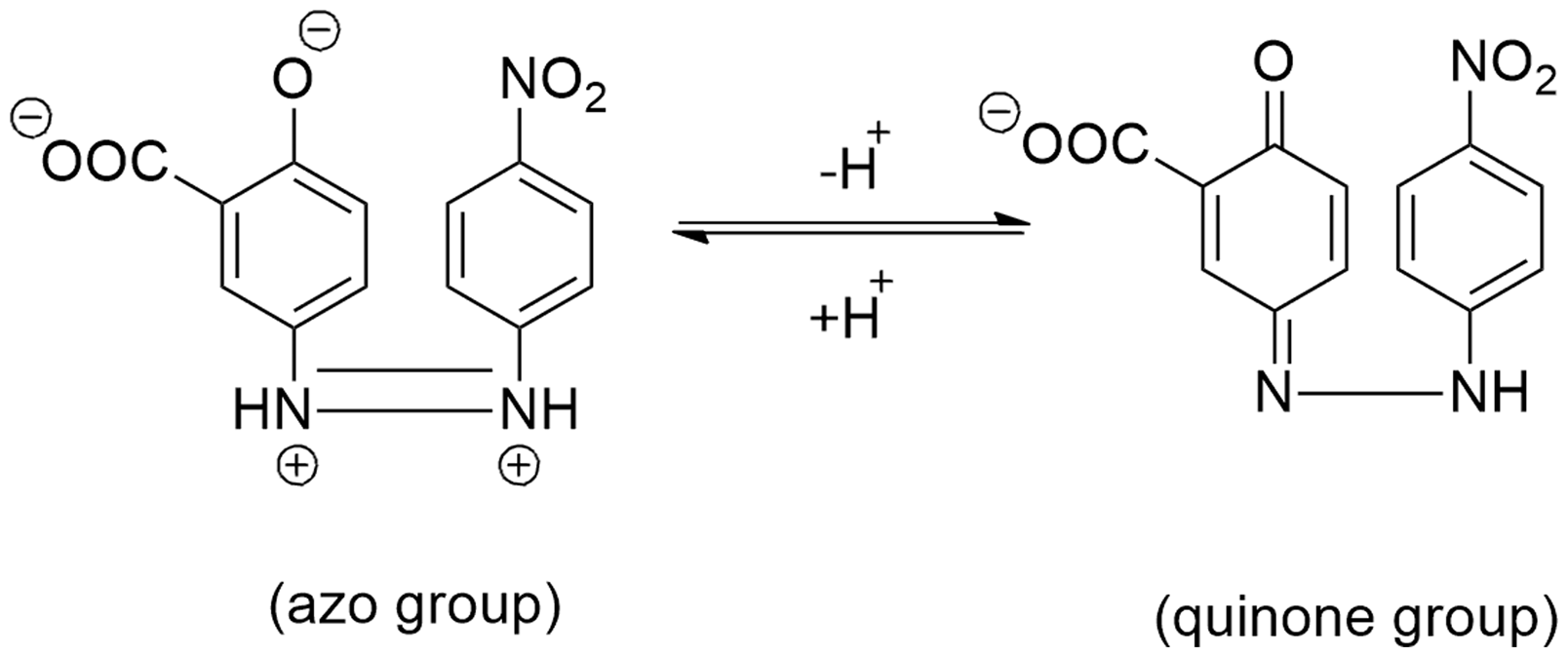
This trend can be explained by considering the structure of the dye and the absorbent. Research shows that PANI could selectively adsorb dyes in different forms, that is, protonated PANI emeraldine salts (ES) could preferentially adsorb anionic dyes and deprotonated PANI emeraldine base (EB) for cationic, respectively (Ayad and El-Nasr, 2010). Figure 6 shows the different forms of PANI and their conversion mechanism. Compared with the PANI-ES, the PANI-EB is easier to selectively adsorb AYR, owing to the electrostatic interactions between the functional groups in dye and PANI-EB. With the increase of the pH value, the PANI-ES was gradually transformed into PANI-EB which contributed to increasing the adsorption capacity, that is, at pH < 8.5, the quantity of adsorption increased with the pH value increasing. Meanwhile, AYR containing azo group was converted into AYR with quinone group, which became anionic dye (Figure 7). Therefore, at pH > 8.5, the quantity of adsorption decreased because the negatively charged PANI-EB provided fewer effective sites for adsorption, owing to the increase of the repulsive forces. Thus, the removal of AYR from aqueous solutions should be conducted at the pH 8.5.
Conversion mechanism between the protonated PANI emeraldine salts (ES) and the deprotonated PANI emeraldine base (EB). Conversion mechanism between the AYR containing azo group and the AYR with quinone group.
Adsorption kinetics
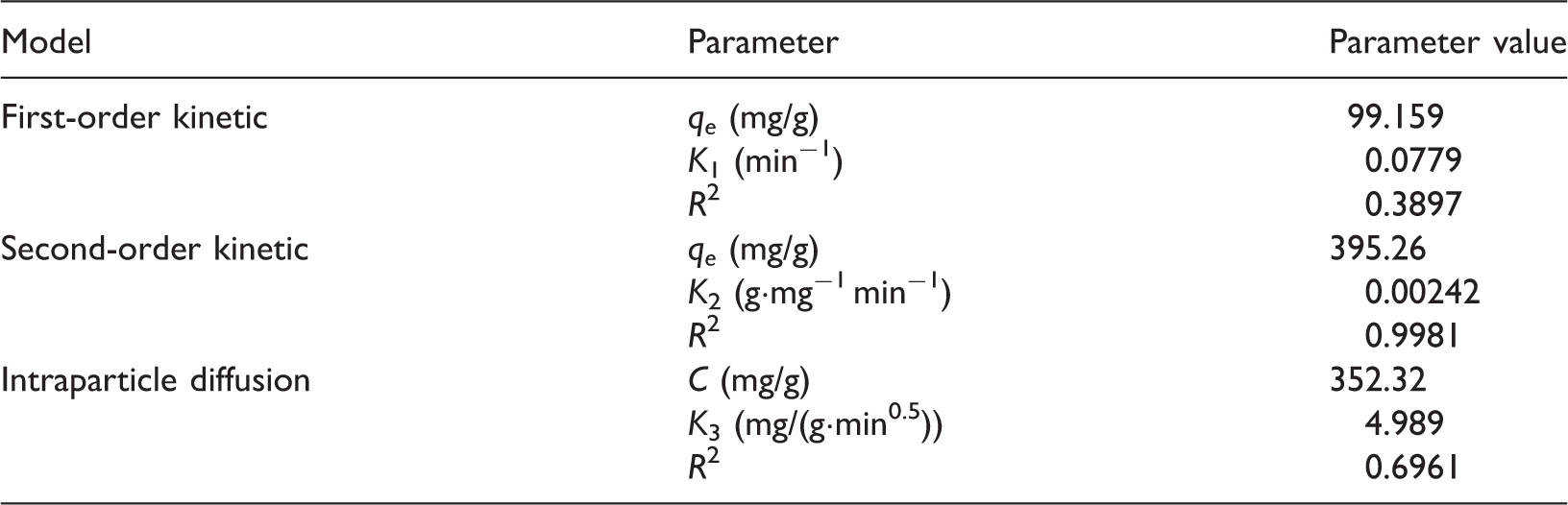
The study of contact time for the adsorptive removal of AYR dye from aqueous solutions is essential, because it is important to determine the time duration required to obtain complete equilibrium, and the results are shown in Figure 8(a). As can be seen from Figure 8(a), when the contact time was increased, the amount of adsorbed dye was drastically increased during the first 5 min, which illustrated that the O-MWCNTs/PANI could rapidly adsorb AYR. After the first 5 min, the quantity of adsorption gradually increased between 5 and 50 min and no longer changed, which indicated the equilibrium reached, and the quantity of adsorption was at the maximum value. Therefore, all experiments’ agitation time were set for 120 min.
(a) Effect of time on the adsorption of AYR onto O-MWCNTs/PANI; (b) Pseudo-second-order kinetic for the adsorption AYR onto O-MWCNTs/PANI and (c) The fitting line of intraparticle diffusion model.
Kinetic parameters for the adsorption of AYR.
Adsorption isotherm
Fitting results with Langmuir, Freundlich and Dubinin–Radushkevich isotherm for AYR.

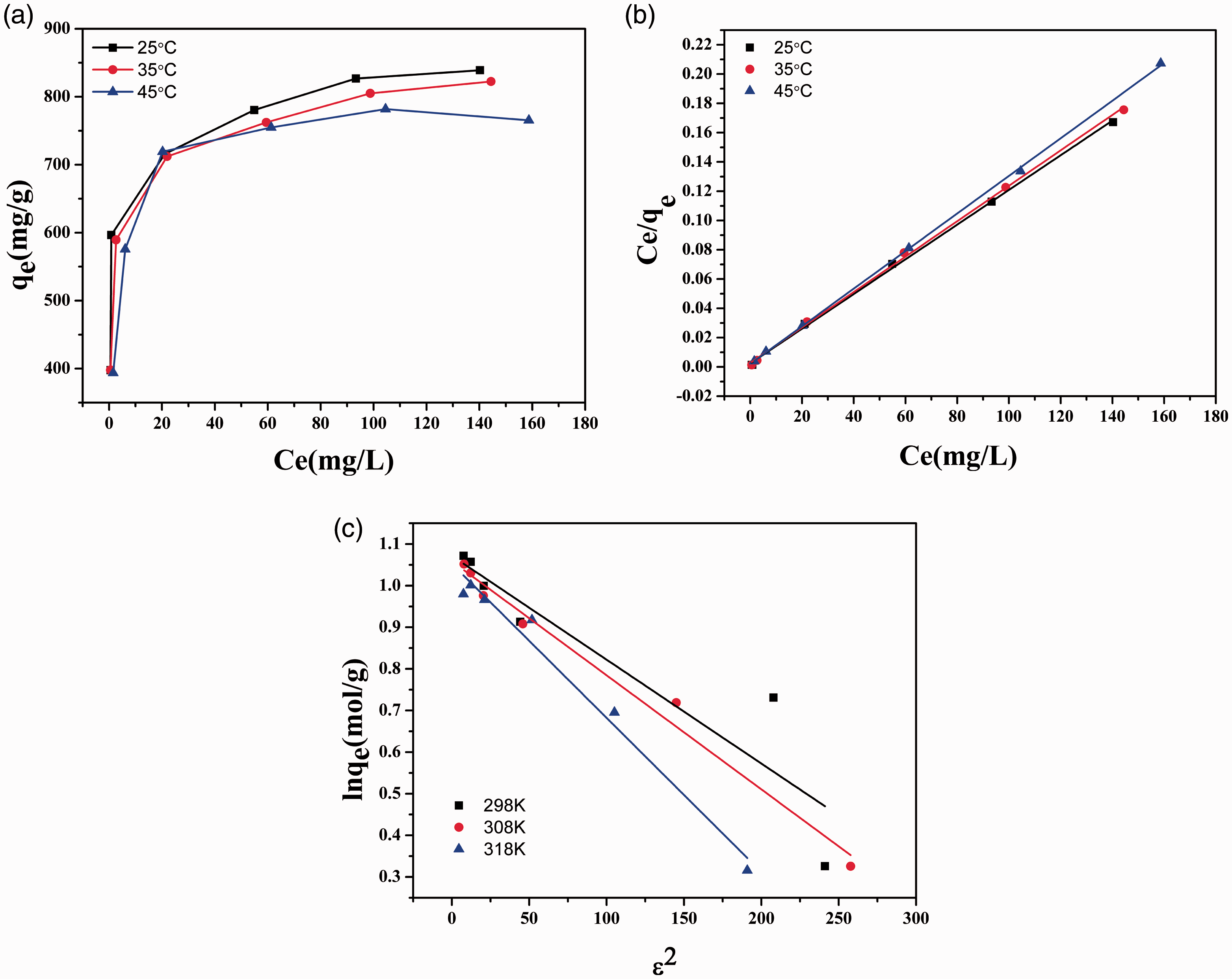
(a) Adsorption isotherms of AYR; (b) Langmuir isotherms for the adsorption of AYR by O-MWCNTs/PANI and (c) Dubinin–Radushkevich isotherms for the adsorption of AYR onto O-MWCNTs/PANI.
Adsorption thermodynamics
Thermodynamic parameters for the adsorption of AYR onto O-MWCNTs/PANI.

Moreover, negative
Contrast experiments
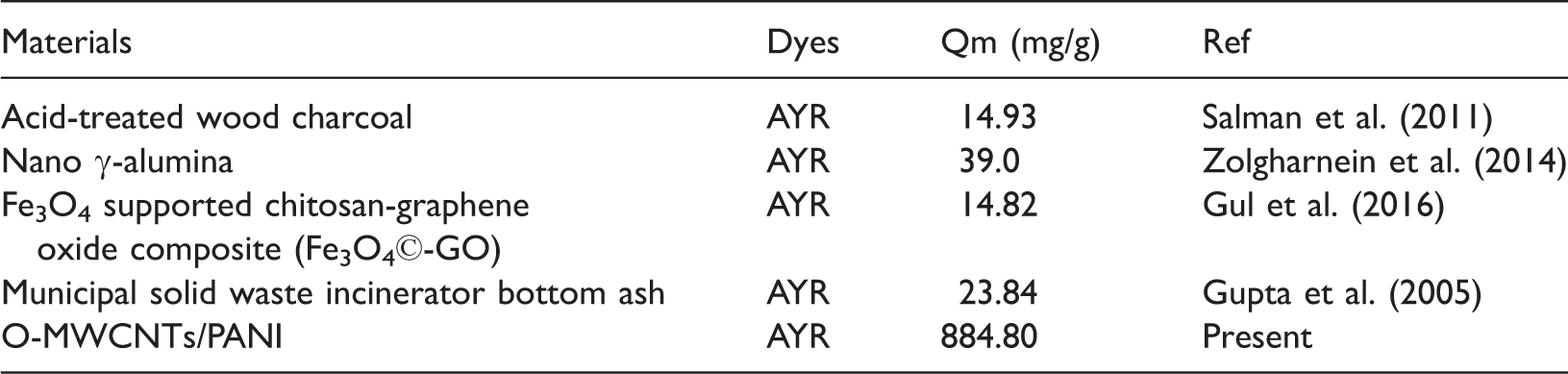
The contrast experiment was investigated by fitting the flask with 20.0 mL dye solution of initial concentration of 50.0 mg/L and 5.0 mg of MWCNTs, O-MWCNTs, MWCNTs/PANI, O-MWCNTs/PANI, respectively. For another contrast experiment, 20.0 mL of dye solutions of 200.0 mg/L were continuously shaken with 5.0 mg of PANI and O-MWCNTs/PANI. It can be seen from Figure 10(a), because of the higher dispersity and more emerging active sites of the O-MWCNTs/PANI, the adsorption capacity of which was higher than those of the other three absorbents. Although the BET-specific surface area of O-MWCNTs/PANI was lower than MWCNTs, the ability of the electron delocalization contributed to the more efficient adsorption and higher adsorption capacity. Meanwhile, due to the lower surface area of O-MWCNTs, the adsorption capacity of which was lower than that of MWCNTs (Vuković et al., 2010). In Figure 10(b), the adsorption capacity of the PANI (566.8 mg/g) and the O-MWCNTs/PANI (715.8 mg/g) was presented. Obviously, owing to the existence of O-MWCNTs, the ability of the electron delocalization on the PANI chain was strengthen, and the adsorption capacity of O-MWCNTs/PANI was superior to that of PANI. A comparison of the present O-MWCNTs/PANI with some other absorbents is shown in Table 4, which indicated that the adsorption capacity of O-MWCNTs/PANI is higher than the other potential adsorbents (Gul et al., 2016; Gupta et al., 2005; Salman et al., 2011; Zolgharnein et al., 2014).
(a) Contrast adsorption experiments at the initial concentration of 50.0 mg/L: (1) r-MWCNTs, (2) O-MWCNTs, (3) MWCNTs/PANI and (4) O-MWCNTs/PANI and (b) Contrast adsorption experiments at the initial concentration of 200.0 mg/L: (1) PANI and (2) O-MWCNTs/PANI. The adsorption capacities of several adsorbents for AYR. AYR: alizarin yellow R; O-MWCNTs/PANI: oxide-multi-walled carbon nanotubes/polyaniline.
Conclusion
The O-MWCNTs/PANI were successfully obtained and fully characterized. The adsorption of AYR onto the O-MWCNTs/PANI was investigated, and the result showed that O-MWCNTs/PANI could effectively remove AYR from aqueous media. The O-MWCNTs/PANI exhibited a high adsorption capacity of 884.80 mg/g for AYR at an initial concentration of 300 mg/L. The adsorption kinetics showed that the experimental data could be better explained by the pseudo-second-order kinetics model. Adsorption isotherm processes indicated that the Langmuir isotherm was good for explaining the AYR adsorption. Furthermore, thermodynamics parameters revealed that the adsorption process was exothermic and spontaneous in nature. Hence, it can be concluded that O-MWCNTs/PANI are an effectively absorbent for removing AYR from water. However, for large-scale adaptation, the cost effectiveness of the adsorbent needs to be further reduced.
Footnotes
Declaration of Conflicting Interests
The author(s) declared no potential conflicts of interest with respect to the research, authorship, and/or publication of this article.
Funding
The author(s) disclosed receipt of the following financial support for the research, authorship, and/or publication of this article: This work was supported by the National Natural Science Foundation of China (No. 21571191 and No. 21471163) and Provincial Natural Science Foundation of Hunan (2016JJ1023).