




Abstract
Across the globe, new forms of democracy have been hailed as key to addressing the most existential crises facing society. In the face of democratic malaises such as polarisation and disenchantment, as well as systemic crises such as climate change and structural injustice, deliberative innovations are proliferating. We explore the contribution a specific form of artistic practice – participatory performance – can make to democratic renewal. While the current focus of democratic innovations has been an institutional design approach creating small-scale spaces for citizen engagement, we argue an arts-based approach to democracy returns to a focus on the large-scale public sphere as an important locus of democracy. Through an in-depth case study of The People’s Palace of Possibility, a participatory performance touring the United Kingdom 2020–2024, we explore what ‘mode of connection’ or political culture between citizens – for Hannah Arendt the defining dimension of the public sphere – participatory arts promotes. We find that the artistic dimension of this work promotes critical democratic renewal by inviting a reflective, playful, imaginative, and collective way of engaging citizens on systemic issues such as climate change and structural injustice.
Keywords
Introduction
Throughout the most stringent lockdowns of the COVID pandemic (between 2020 and 2022), an arts company based in Sheffield, The Bare Project, was busy posting out an interactive theatre piece across the United Kingdom. This ‘performance’, which came to audiences through a series of letters and packages, was called The People’s Palace of Possibility. Through these letters, the 600 people who took part were introduced to a dystopian future in which ‘The Consensus’ had proclaimed ‘the glorious end of history’, and ‘now that everything is so perfectly balanced and well-adjusted’ to critique the system or to imagine alternatives is both ‘dangerous and naïve’. Audiences were then invited (through a series of online puzzles and/or phone calls) to join an underground movement of ‘Palace Citizens’. This collective sought to challenge ‘The Consensus’ through contributing their fears and visions for the future to The Palace Archive, online and over the phone, as well as through tiny acts of ‘utopian vandalism’ in their local area. For example, one package (see Figure 1) contained a lump of chalk and an audio walk, and as audiences did the audio walk, they were instructed to write policies they wanted to see in the world on the pavements and walls of their area. Hundreds of people sent in photos of their ‘vandalism’ to the Palace Archive, including radical, nuanced, and sometimes silly policy ideas – ‘Abolish Tuition Fees’; and ‘Free Dog Food’. This archive continues to grow online.
After the lockdowns eased, The Bare Project then toured a live version of The People’s Palace of Possibility – a giant multi-coloured geodesic dome, complete with a live community radio station in a potting shed (Figure 2). The Bare Project stayed in each tour location for a month, working with local artists and activists and inviting people to eat together, to get creative, and to share their ideas for how the world could be among friends and strangers.
In this article, we argue that this kind of participatory artistic practice can constitute a form of democracy by contributing to a reflective, creative, and inclusive public sphere of collective engagement with systemic political issues. This gives it relevance to current political theory and activism in which systemic crises, such as climate change and its links with systemic exploitation and oppression, are seen to be entwined with a simultaneous crisis of democracy, and thus to demand democratic renewal in response. ‘Democratic renewal’ is an umbrella term capturing any attempts to ‘reimagine and strengthen democracy’, typically in response to current challenges to the functioning of contemporary liberal democracy (Choukeir, 2023: 3; see also Hendriks et al., 2020). Within this, the specific discourse and practice receiving the most attention with regard to the politics of climate change has been the explosion of ‘democratic innovations’ over the last decade, such as participatory and deliberative forums, which are ‘new practice[s] consciously and purposefully introduced in order to improve the quality of democratic governance’ (Geissel, 2012: 164; see also Dryzek, 2010; Elstub and Escobar, 2019; Smith, 2009). New forms of citizen participation and deliberation of this kind have been hailed in relation to both climate change (Blue, 2017; Dryzek and Niemeyer, 2019; Glaas et al., 2022; Willis et al., 2022) and structural injustice (Curato et al., 2019; though see also Drake, 2023). The new climate movements, notably Extinction Rebellion, have called for deliberative citizens’ assemblies to define national climate policy; and climate assemblies have been held at various levels of governance all around Europe (Cherry et al., 2021).
Addressing challenges such as climate change and structural injustice extends the purview of democratic renewal from seeking to ease current problems of disenchantment and polarisation or informing specific policy reforms to encompassing deep, systemic social transformation. However, this expectation for new forms of democracy to transform society at a systemic level has coincided with the growth in practice of democratic innovations of a particular kind – designed, delineated, policy-focused events, often initiated or sponsored by authorities – which arguably risks their assimilation into status quo politics, at the cost of the underlying theories’ original critical import from which systemic change could emanate (Böker, 2017). 1 We argue a renewed focus on the broad, dispersed, open-ended, and inclusive public sphere as the locus of democracy understands these designed innovations as a potentially useful, but also limited contribution to democratic renewal. Alongside it, another type of intervention – socially engaged art – is fruitful for fostering a different dimension of democratic change. This engages the dimension of democratisation as a shift in the political culture, in the sense of ‘the informal and unsteered norms, expectations, meanings, and customs’ that drive how people see and interact with each other in the public sphere (Böker, 2017: 34). Our contribution is to highlight how arts-based practices can fulfil an important, so far under-recognised role in democratic renewal alongside more prominent democratic innovations. The importance of the former in particular is their potential to address the deep, systemic crises of current societies. Specifically, we show that artistic practice, like The People’s Palace of Possibility described above, can contribute reflective, playful, imaginative, and collective elements to a reinvigorated public sphere, providing a channel for a form of democratic engagement potentially better able to elicit the fundamental changes in outlook that can inspire not just policy-, but system change.
In the next section, we develop the theoretical basis for our argument, conceptualising democracy at the level of the public sphere. The section ‘Participatory performance as democracy’ introduces arts-based practices, especially socially engaged performance, as a possible alternative site of democracy. On this basis, the section ‘The People’s Palace of Possibility as a democratic space’ describes our case study in detail and outlines our methodology. The section ‘Four democratic elements of participatory theatre’ discusses our findings of reflective, playful, imaginative, and collective elements of engagement and how these contribute to fostering an Arendtian public sphere. The final section concludes with our argument that arts-based practices can be thought of as sites of democracy, with the potential to contribute to systemic political reflection of the kind theorised by Hannah Arendt and Jürgen Habermas.
Democratic renewal at different levels: From democratic innovations to the public sphere
Amid the high interest in participatory and deliberative democratic renewal, the strongest current is now an institutional ‘design’ approach to democratic innovations such as citizens’ assemblies, participatory budgets, town meetings, and other forms of citizen participation (Felicetti, 2021; Fung, 2003; Saward, 2021; Skelcher and Torfing, 2010). Constituting ‘‘reformist tinkering’ rather than ‘revolutionary reform’’ (Fung, 2003: 339), design is invoked as ‘the intentional creation of plans to solve a problem’ (Saward, 2021: xiv; 35–36), and these innovations as ‘actual constructive efforts’ for democratic renewal (Fung, 2003: 339). Such purposive democratic innovations are small-scale, and designed in this manner on the grounds that this allows practitioners to control the quality of democratic engagement, such as their representativeness and the deliberative style of communication.
The focus on purposive problem-solving design represents an evolution of democratic theory (and innovative practice) away from earlier traditions of democratic thought that situated an emancipatory role of democratic engagement in the public sphere. Arendt (1958) deplored the rise, in modern states, of a ‘social’ sphere governed by the market context of commodity exchange and economic self-interest, which ‘conquered the public realm’ (Arendt 1958: 41) by transforming the space of politics ‘into a pseudospace of interactions in which individuals no longer ‘act’ but ‘merely behave’ as economic producers, consumers, and urban city dwellers’ (Benhabib, 1997: 4). Similarly, Habermas (1989) criticises the way in which the public sphere as the realm of ‘critical public reflection’ (Habermas 1989: 29) and ‘problematization’ of issues not previously questioned (Habermas 1989: 36) transformed through the marketisation of culture and discussion (Habermas 1989: 164) into a ‘vehicle for political and economic propaganda’ (Habermas 1989: 175). For Arendt and similarly Habermas, it is only in the public sphere that freedom emerges from people ‘acting’ together in the condition of plurality that is the essence and condition of all politics (Arendt 1958: 7). Thus, the public sphere is not a specific physical or institutional space, but whatever space where people ‘act’ together in this sense.
A reinvigoration of an Arendtian public sphere would be significant from a standpoint of redressing the democratic malaises, but also for making possible the freedom for societies to determine radically new futures (as implied by systemic critiques of current society). For Arendt, as the public sphere allows people to create something in common, public action is ‘creative and culture-forming, allowing for ‘unexpected beginnings’ toward new ways of life or of seeing the world’ (Calhoun, 2017: 29; see also Walsh, 2011: 125–129), which can then be ‘revolutionary’ in bringing about new societal conditions (Joas, 1996: 115–116). This action depends on people’s initiative and is only possible in conditions of collectivity and plurality (Calhoun, 2017: 29). This becomes clear where Arendt’s concept of ‘action’ is juxtaposed with ‘work’. According to Arendt,
[w]orking implies having a clear purpose or end (a product) in mind, determining and calculating the means necessary to achieve it, drawing up a plan and subsequently executing it, following particular rules and procedures [and] [t]he results of work are [therefore] predictable (Borren, 2020: 164).
This is not political because it does not take place in a condition of plurality, and it is not based on initiative, which are constitutive elements of political action able to transcend power and engender change: ‘Action has no given end like work and always constitutes a surprise, an interruption in the course of events’ (Borren, 2020: 165). In line with Robert Cox’s (1981) juxtaposition of ‘critical theory’ with ‘problem-solving theory’, for Arendt, a pluralistic public sphere that is uncontrolled in the sense of allowing for people’s own initiative and resulting surprises is a precondition for the kind of political action that – like critical theory – ‘allows for a normative choice in favour of a social and political order different from the prevailing order’ (Cox 1981: 128). To this extent, nurturing pluralistic and free, open-ended engagement in the public sphere may promise a form of democratic renewal particularly relevant to the context of systemic crisis, beyond what the typically problem-focused and controlled nature of democratic innovations is able to engender.
With this in mind, we are interested in the potential of arts-based practices to contribute to the public sphere by creating open spaces for creative and spontaneous engagement with systemic political issues. Artistic practice has a significant history of contributions to democratic theory, from the symbiosis between Athenian theatre and democratic forums (Neelands, 2015), to Arendt herself acknowledging the arts as a key component of the public sphere (Canovan, 1985), to arguments for the role of applied theatre in building a ‘sensory democracy’ (Ryan and Flinders, 2018). In response to Iris Marion Young’s (2000) call for alternative approaches to political discourse, this growing body of literature argues that artistic practice can offer a ‘shift away from unproblematised notions of objectivity and rationality, toward a twofold aesthetic turn: careful critique of the subtler forms of power which circulate through political discourse, and increasing consideration of more ‘aesthetic-affective’ forms of expression as relevant to political discourse’ (Ryan and Flinders, 2018: 16). In parallel, the field of democratic innovations has become interested in the contributions that artistic values such as playfulness and creativity can make to these. Asenbaum and Hanusch (2021; see also Love and Mattern, 2013) highlight the democratic potential of arts-based practices such as creative policy labs to enhance inclusivity and deep engagement, but also caution against the risk that spaces like these allow technocratic control to supersede democratic empowerment where input is overly ‘controlled, channelled, and filtered’ (Asenbaum and Hanusch, 2021: 6).
In agreement with both the potential and the risks, here we take a different direction by theorising the specific values of participatory arts not as another form of democratic innovation, but rather in relation to the transformative potential of a revived public sphere. Our focus in this article is a performance which, although (to an extent) designed and controlled, is not directed at solving a problem, as in designed democratic innovations (Saward, 2021), but rather at acting as a stimulus toward an active public sphere, (only) in which the real democratic action can happen. Understanding democracy as something that (potentially) happens wherever people ‘meet across difference and power’ and ‘meaning is made’ (Beausoleil, 2021: 7), it places the emphasis of democratic renewal not so much on institutional design or the role of a specific body of people than on ‘a mode of connection among them’ (Calhoun, 2017: 26). The inclusive publicness of this societal realm, situated in civil society yet addressing the state (Calhoun, 2017: 24), makes possible unique forms of democratic engagement. For Habermas, this is ‘rational-critical debate of private people . . . [that is] not directly subject to the cycle of production and consumption’ (Habermas, 1989: 160) and instead driven by a ‘parity of “common humanity”’ as the basis of the ‘authority of the better argument [asserting] itself against that of social hierarchy’ (Habermas, 1989: 36). Contra the current emphasis on designed democratic spaces small enough to allow for the quality of discourse to be controlled, these potentials unique to the public sphere suggest this ‘complex, multilayered, and somewhat anarchic’ space must not be sidelined as a central site of democracy (Chambers, 2009: 333), for the decisive critical layer of democratic renewal may elude precisely this kind of control (Böker, 2017).
The emphasis on democracy as a particular ‘mode of connection’ (Calhoun, 2017: 26) is in line with conceptions of democracy as a political culture (which thus may give rise to an Arendtian public sphere). For example, John Dryzek (2017) differentiates deliberative democracy as small-scale forums from its conceptualisation at the level of the polity as a whole. The polity lens introduces the society-wide political culture, or indeed ‘multiple deliberative cultures’ (Dryzek 2017: 623), as a level at which deliberative democracy can manifest itself. Echoing the Habermasian notion of the public sphere as a politicised civil society, a deliberative democratic political culture has been described as one in which citizens of a polity, by and large, adopt a ‘deliberative stance’ of mutual respect and openness towards one another (Dryzek 2017; Owen and Smith, 2015), and in relation to formal authority (and indeed other sources of structural power) act as a ‘democratic watchdog’ (Chambers, 2000: 203) exerting ‘ongoing critical scrutiny’ of political authority (Böker, 2017: 26). Combining these deliberative norms, a deliberative democratic political culture overall can then ‘be imagined as one with high levels of citizen-led critique and disruption of authoritative acts and discourses; but within a simultaneous culture of toleration, inclusiveness and acceptance of the justificatory process’, regardless and outside of any particular institutional contexts (Böker, 2017: 34).
In the following, we suggest a so far undertheorised potential for arts-based practices to play a role in fostering and offering space for this public sphere and the democratic political culture. Arendt herself suggests a role of art and culture as a channel towards the democratisation of the public sphere, to the point that ‘art and politics . . . are interrelated and even mutually dependent’ (Canovan, 1985: 624). Inspired by these theoretical claims, as well as more contemporary claims for socially engaged arts as a form of ‘sensory democracy’ (Ryan and Flinders, 2018), the remainder of this article explores the potential of arts-based approaches to create foundations for Arendtian ‘action’ and ‘new beginnings’ in the public sphere.
Participatory performance as democracy
To build on this theoretical avenue with concrete empirical insights, it is necessary to bring democratic theory into interdisciplinary dialogue with theories and the different dimensions of art itself, and their political relevance. Our case study, The People’s Palace of Possibility, is an example of ‘socially engaged art’ or ‘participatory arts’. The term ‘participatory arts’ refers to artistic work which involves people in both or either the development of and/or presentation of artwork. This work is also generally characterised by an engagement with social or political issues, often blurring boundaries between protest and art. Classic examples of this kind of artwork include Jeremy Deller’s restaging of the Battle of Orgreave in 2001, or Guy Debord’s ‘happenings’ as part of the arts collective Situationist International in the 1960s (Bishop, 2012). The term ‘participatory arts’ is now widely used within both the visual and performing arts sectors (closely linked with terms such as ‘applied theatre’, ‘relational aesthetics’, and ‘socially engaged arts’). The term indicates an emphasis on participation and collaborative approaches to art making which challenges notions of hierarchical authorship and addresses social and political issues.
Theatre theorist Annie Sloman argues ‘these movements [referring to canonical participatory performance movements Theatre of the Oppressed, Theatre-in-Education, and Poor Theatre] aimed to break down conventional theatre and art, change the relationship between audiences and art, and support social change’ (Sloman, 2011: 43). Mirroring Arendt’s distinctions between ‘work’ and ‘action’, it is important to note that the artistic aims of participatory arts are often not focussed on the creation of a specific output (e.g., a sculpture or a play), although this may be part of the work, but are focussed on the process of creation and relationships and interactions between people. Fundamentally, ‘instead of supplying the market with commodities, participatory art is perceived to channel art’s symbolic capital towards constructive social change’ (Bishop, 2012: 12).
While art as a whole has been theorised politically across the whole spectrum: from an instrument for manipulating the masses to maintain a given social order (Adorno, 1991), to the ultimate ‘reservoir for human freedom’ that, unlike other realms in society, ‘does not conform to [the] external forces of influence’ that threaten critical reflectiveness (Skees, 2011: 916, 921), participatory art as one subcategory is defined specifically as a resource and starting point toward constructive social change. In other words, this is an artform with clear conceptual overlaps with the public sphere theorised by Arendt, and relevant to democracy’s potential to engender deeper systemic political impacts.
This approach to artistic practice (and the use of the terms ‘socially engaged practice’ and ‘participatory arts’) has seen increasing popularity in recent years. Just as democratic theory has taken culture into its purview, so does this recent attention demonstrate a renewed energy for a ‘participatory turn’ within the artistic community (Matarasso, 2019). At times, this is oriented towards widening participation in the arts, and this is often referred to within the sector and the literature as ‘cultural democracy’ (Belfiore et al., 2023; Matarasso, 2019). However, this work is not only limited to widening participation or ‘outreach’; these relational, participatory artworks are also increasingly recognised as aesthetically valuable in themselves (e.g., the Turner Prize winners Array Collective in 2021). As we will demonstrate in relation to our case study, this trend could have an important role to play within the creation of a critical public sphere through fostering playful, imaginative, reflective, and collective democratic spaces. 2
Previous investigations within Theatre Studies, Cultural Theory, Art History, and (increasingly) Political Studies have explored the democratic potentials for the arts. Often they focus on the emotional power of arts, storytelling, and theatre – particularly its role in the promotion of empathy/sympathy – sometimes in positive ways (Nussbaum, 2013; Ryan and Flinders, 2018), but often also in exploitative ways (Ahmed, 2014). Others have explored the use of art in stimulating discussion or encouraging other forms of political engagement (Wiederhold, 2013); or explored theatre as ‘a rehearsal for the revolution’ (Boal, 1979) – a prefigurative or ‘utopian’ site in which ‘one can experiment with the possibilities of the future in ways that shine back usefully on a present that’s always, itself, a process’ (Dolan, 2010: 13). Examining the political work of live performance, Beausoleil (2021: 154) argues that ‘artistic practice can offer a critical and creative opportunity for the public to observe, reflect, and experiment, so that we might see and ask anew how we do and might live’. This echoes Arendt’s own description of theatre which she describes as ‘the political art par excellence’, as for her it was the only space in which ‘the political sphere of human life is transposed into art’ (Arendt, 1958: 188). Our research into The Bare Project’s performance installation The People’s Palace of Possibility builds on this work with an interdisciplinary and empirical exploration into the democratic potential of participatory performance and how it contributes to the creation of a reflective, playful, and imaginative public sphere of collective engagement with systemic political issues.
The People’s Palace of Possibility as a democratic space
The People’s Palace of Possibility (henceforth The Palace) was a participatory performance which asked how we find hope and energy for the future when we feel so much anger and despair about the world today. It was originally conceived by The Bare Project theatre company in 2019, but, due to the pandemic and social distancing, initially delivered as a postal and digital artwork in 2020 (as outlined in the introduction). This version consisted of several packages received by participants over the course of a roughly 2-month period for each ‘tour date’, which followed the story of Rose (the protagonist) discovering a secretive society called ‘The People’s Palace of Possibility’. This postal/digital version engaged with over 600 participants, who heard about the piece via local arts centres and community networks. Once participants had signed up, they were invited to recruit ‘someone you have disagreed with’ to take part with them. In this way, The Bare Project aimed to reach beyond usual arts-going audiences, which, according to audience survey responses (53% identified as never having engaged in a participatory artwork previous to their engagement with The Palace), was successful.
Between June 2023 and July 2024, the company toured a live version of The Palace to London, Caithness, Rotherham, the Isle of Wight, and Doncaster. This installation consisted of a large, multi-coloured geodesic dome and a collection of interactive exhibitions in surrounding sheds and rooms. This structure would appear in a public space in each of these locations for roughly 1 month and included a co-curated programme of performances, live music, workshops, and conversations. A key part of each residency was the Palace Radio, which broadcast interviews with participants onto a live radio station. There was also a weekly Palace Feast – an interactive performance event in which the company told the mysterious origin story of The Palace and collected recordings of conversations about hope, fear and the future over a shared meal.
Methodology
Our methods were qualitative and practice-based, including surveys, semi-structured interviews, analysis of audience contributions to the project, as well as our own reflections on our involvement in the activities and performances which made up this artwork. Our sample was drawn from participants of The Palace from across the United Kingdom (all locations mentioned in the section above) with support from The Bare Project team. Research participants for interviews and surveys were self-selecting via an email sent around to all participants (from The Bare Project) asking them to complete a survey and inviting them to attend an interview for the purposes of this research after their participation in the postal version of The Palace. We had 54 survey respondents and interviewed 15 participants about their experiences of taking part in the project. 3 All research participants were adults, over the age of 18, although one interview participant discussed their experience of taking part with their child. The majority of participants defined themselves fairly or significantly politically engaged (on a scale of 1–5, 92% ranked themselves a 3 or higher). The interviews and surveys were conducted by research assistant Dr Emily Westwell, with support from Dr Marit Hammond. We include here direct quotes from audio recordings sent in by participants as part of the artwork (which are publicly accessible online on the Palace Archive website), from interview transcripts, and from qualitative survey responses. 4
Our methodological approach to the case study combined the traditional social science methods outlined above with practice as research. We chose this approach to better understand the potential of participatory performance through methods adopted within visual and performing arts practices. Practice as research ‘pursues a hybrid inquiry combining creative doing with reflective being . . . it indicates the uses of practical creative processes as research methods’ (Kershaw and Nicholson, 2011: 64). This approach involves using artistic artefacts within the data sets analysed for this research. It looks to the process of ‘creative doing’ as a form of knowledge generation. The ‘practice is the core method of engaging with one’s research hunches or questions: it would not be possible to engage in the research unless you undertake practice. The practice is designed to investigate, respond to or directly address research questions, or experiment with hunches’ (Mackey, 2016: 480). To take on this methodological approach, much like other embedded methodologies such as action-based research or autoethnography, the researcher must occupy a dual role as an active participant (or artist in this case) as well as a researcher. Dr Malaika Cunningham is both a political theorist and an artist with The Bare Project.
This positionality is what made a practice as research possible: The artistic development of the work was intertwined with the development of this research. The process of creating The Palace included discussion and creation time with other artists, testing the piece with audiences, reflecting on aesthetic choices, successes, and failures, reconfiguring the work, and refining it. Being a part of this process informs this research. This was a two-way process as the artistic creation of The Palace also included research into democratic theory and the work of Hannah Arendt and many of the contemporary theorists referenced in this article.
We acknowledge that this positionality, like any embedded approach to research, comes with the risk of normative assumptions toward the perceived success of The Palace as a site for democracy. This is mitigated by the shared authorship of this study, as well as the intention of this research – which are to better understand the intersections between the aesthetic and relational qualities of participatory theatre and building a democratic culture. Honest and critical reflections are a crucial part of this inquiry and for the future success of work at the intersections of art and democracy, both artistically and academically. This approach was also informed by the evaluation practices of The Bare Project during the development of The Palace, which used the FailSpace Methodology 5 (developed at the University of Leeds – Jancovich and Stevenson, 2023).
Four democratic elements of participatory theatre
The theoretical literature on the public sphere suggests a possible avenue toward democratic renewal of a critical and creative kind that goes beyond institutional design. Instead, we argue, with Arendt and in line with conceptions of deliberative democracy as a political culture, that democratic renewal can be understood also as the emergence of a certain ‘mode of connection’ between citizens, as the precondition for spontaneous, citizen-led, critical-disruptive political action. Since this suggestion on its own remains rather abstract, we employ our empirical case study, based on Arendt’s own suggestion that artistic practice is ‘mutually dependent’ with politics in producing such a mode of connection in the public sphere (Canovan, 1985: 624), of The Palace to explore how concretely this artform may foster such a ‘mode of connection’ relevant to democratic renewal.
We analysed the data collected using a grounded theory approach, allowing key themes to emerge from transcripts, survey responses, and artistic artefacts, rather than imposing a pre-determined hypothesis. Our open coding process (Bryman, 2016) revealed four key elements of this work that are salient to fostering a critical democratic public sphere. The data show that The Palace (1) encouraged reflexivity on social and political issues; (2) fostered a spirit of disruptive playfulness; (3) offered a space for imagination towards systemic political alternatives; and (4) built a sense of collectivity among participants. In the following sections, we articulate how the artwork achieved this and why these elements are important to the Arendtian public sphere conception of democratic renewal.
Reflection
Inspired by Theatre of the Oppressed (Boal, 1979) methodologies, The Palace took the reflective role of storytelling a step further by casting the audience as participants (or, in the parlance of the performance, ‘Palace Citizens’) within the piece. From their position within the narrative, they were invited to reflect on themselves as political agents, as well as social and political subjects within their real lives, intentionally blurring the lines between reality and fiction.
. . . being a [Palace] Citizen is being a person who actively participates in not only the change, but also in creating the reality. Even though it wasn’t real, but it was about creating reality . . . Sometimes I feel like we don’t really know what our rights are and what we actually can do. . . . here [within the Palace] it was more about, ‘Yes you can go out and just scream on the top of your lungs that, ‘I want this policy to be in place’ (A26062022).
For many participants, reflection on their political identities tipped over into action through ‘the small acts of utopian vandalism’ invited by the postal version of the project. For example, one package contained an audio walk and a lump of chalk (pictured in above, Figure 1). Part of the audio walk invited participants to write their responses to the question: ‘if you could write one law or policy, what would it be?’ onto the pavement or walls of their neighbourhood (see, e.g., Figure 3). Many of these responses were then uploaded onto The Palace Archive website and can still be viewed there (2024). Notably, 70% of survey respondents completed this task.
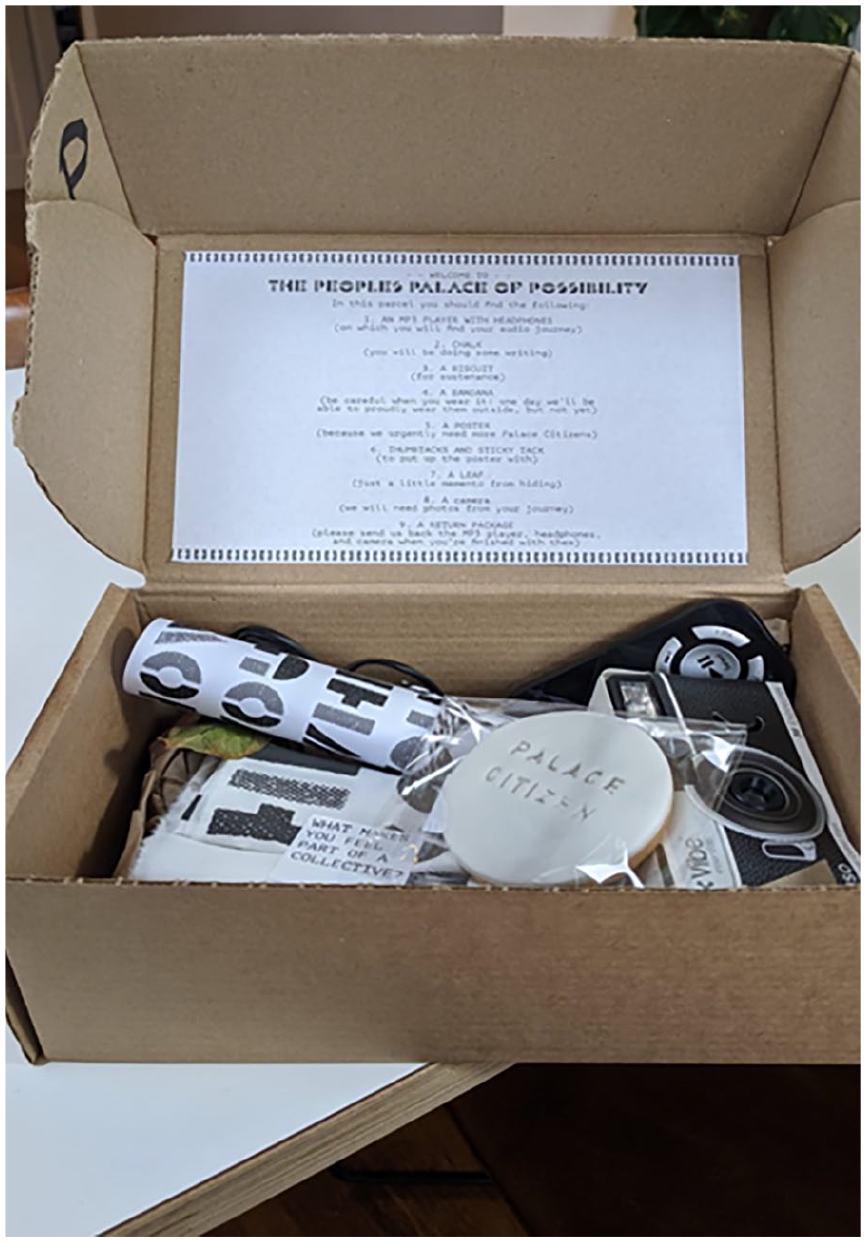
Photo of one item of post from the postal version of the Palace 2020–2022.
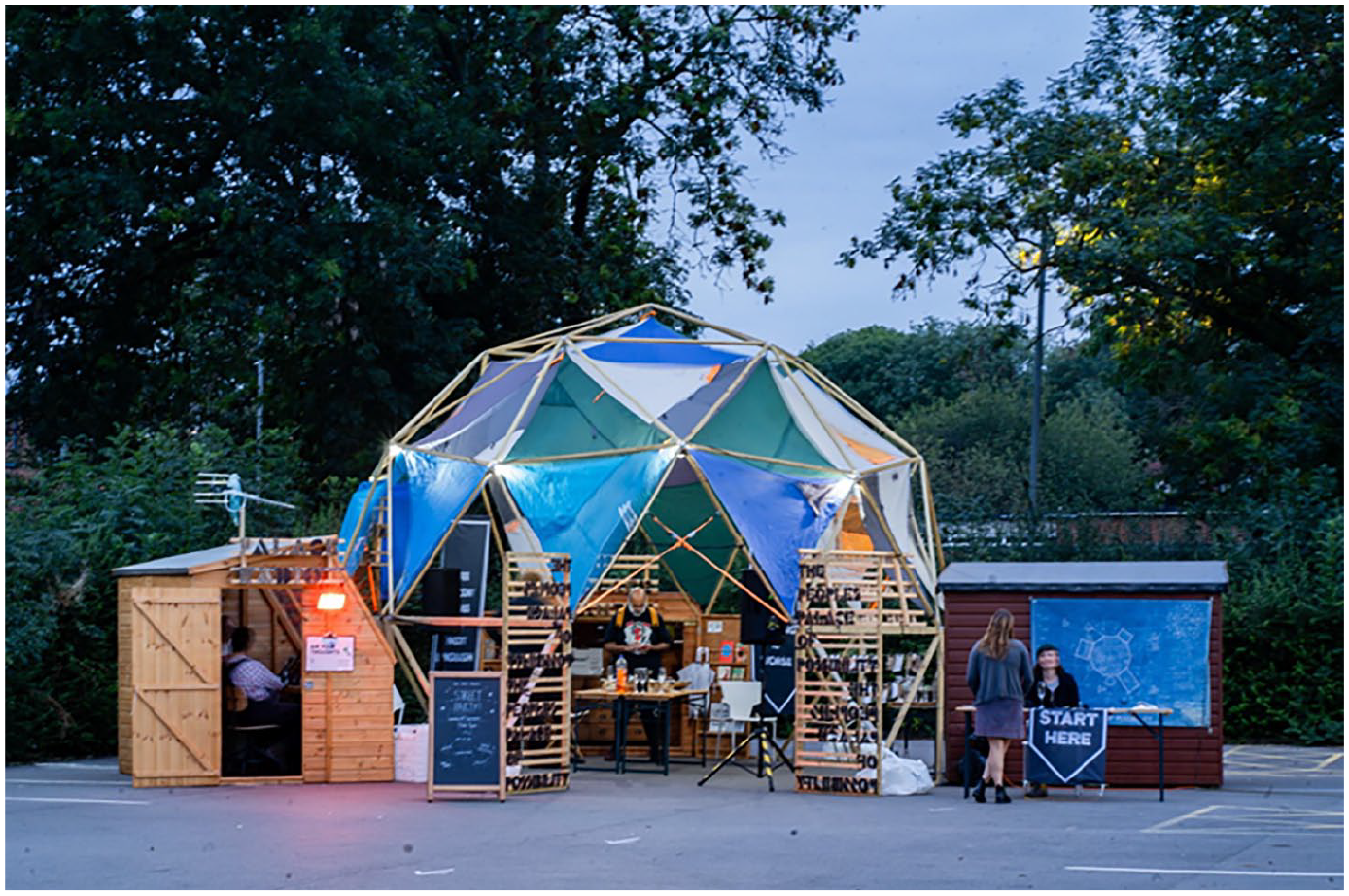
Image of the Palace installation in Rotherham September 2023. Photo by Tom Dixon.
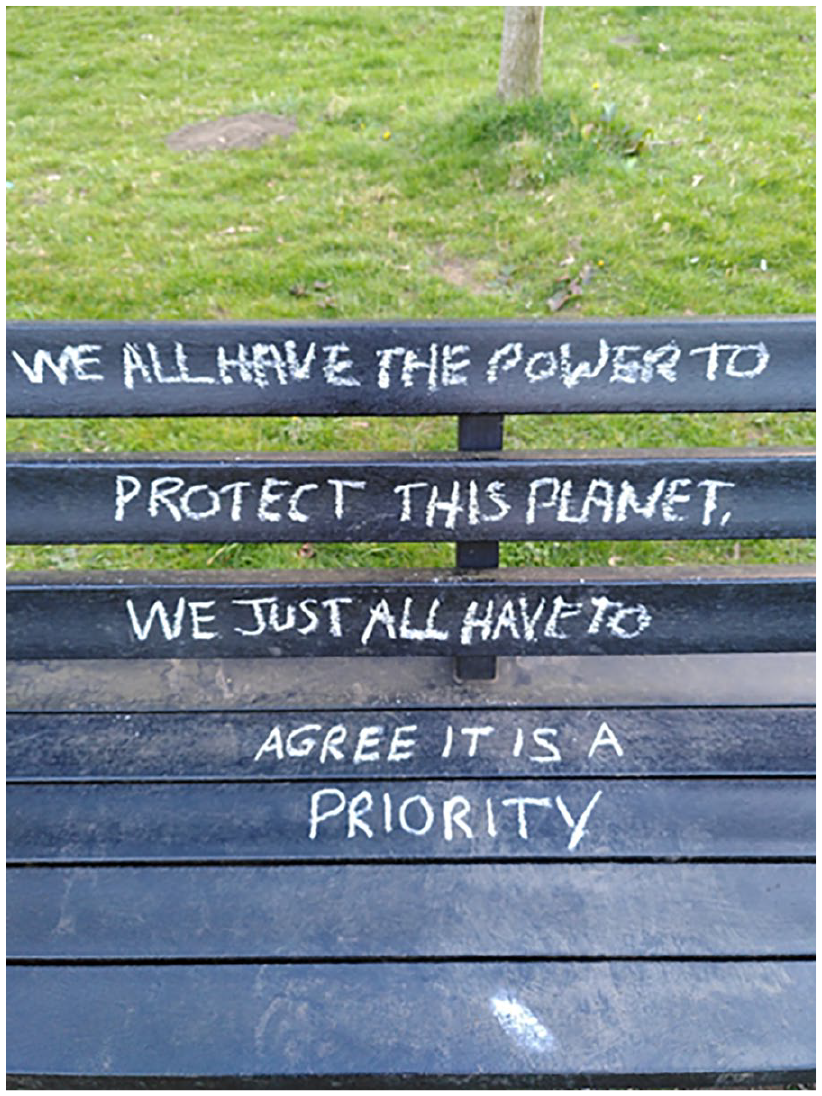
Image sent into the Palace Archive by a participant of their own chalk graffiti on a park bench.
Many commented on how this made them feel ‘rebellious’, ‘naughty’, and ‘empowered’. The perceived transgressive nature of the act lent itself to reflection on political identity. For example, one participant was too nervous to use the chalk on their initial walk and eventually decided to go out very early one morning to write their policy on a wall near their house. They spoke of how they generally thought of themself as a political person, but how in doing this project, they noticed how they tend to ‘avoid talking about certain situations where actually I don’t speak up against stuff’. This project challenged their own sense of themselves as a political person:
. . . if I’m not prepared to challenge somebody who I am quite close to on something or have a discussion about something a bit contentious, what is my political belief about, really? I think I am still working through that at the minute (J16062022).
Throughout the postal and live versions of the piece, participants commented on the rarity of being given an opportunity to reflect on their political views and visions for the future. Participants commented on how they appreciated being given the opportunity to voice their views, as well as to hear others’ opinions. One participant described The Palace as an alternative to ‘the traditional models of having meetings, and then you go to the certain meetings and then only one person being allowed to speak and things like that, and sometimes people’s voices and opinions can get missed’ (D08062021).
This directly links back to the importance of spaces for open-ended reflection, as opposed to specific, pre-set policy agendas, in fostering action in a democratic public sphere. For example, one audience member reflected that, ‘with The Palace it was thinking, well, what’s the practical reasons for changing things? And it was quite good, really, just to have a think about them, things like universal basic income and things like that, wasn’t it?’ (D08062021). The project itself contained no specific content related to the notion of a universal basic income (UBI); yet, it was a recurring subject of discussion among participants throughout the project. Through this audience member’s engagement with The Palace (and the contributions of other participants), he began to think more about this policy agenda: ‘like people’s ideas and audio will have an impact on your life, or sometimes to spark an idea and think, especially what is universal basic income or some of the other ideas that were looked at . . .’ (D08062021).
For 40% of survey respondents taking part in The Palace, their engagement also led them to have conversations with friends and/or family about politics and society outside their involvement with the project, demonstrating the potential for these short-term interventions to have wider social impact in terms of building an Arendtian public sphere across a ‘web of human relationships’ (Walsh, 2011: 129).
Playfulness
The playfulness with which the invitations for disruption were given was a key part of the artistic design, as well as the political ambitions of this project. Playfulness is beginning to be acknowledged as an important part of political engagement. Asenbaum and Hanusch (2021) acknowledge participatory theatre as a particularly salient arena for democratic playfulness, which can help us let go of our ‘serious and responsible personas’ and engage us on a more sensory level.
Furthermore, a spirit of play may also encourage and sustain engagement among participants. As Honig (2013: 228) argues,
that centre of orderly politics is actually deeply dependent on the energy and animation and frankly, the fun, that come from gathering together around issues that are affectively charged . . . they also provide the imagination and fantasy of possible and alternative futures that bring people into politics, sweep them up into movements or give them a reason to participate.
6
For many, the initial motivation to get involved with The Palace was because it ‘seemed fun’, ‘it seemed a bit different’, or ‘I wanted to do something creative’. This sense of enjoyment and intrigue also motivated people to continue participating; to return to The Palace for multiple events, or to continue to respond to the packages which arrived through their door.
Political and social changes are slow and complex and, arguably, to sustain a broad and diverse engagement, this work must be enjoyable. As we shall see later, much of this sustained engagement comes from the social aspects of the work, that is, building connections between people. However, it is also rooted in fostering a sense of playfulness and joy through which citizens are better able to sit with complexity and sustain engagement over time (Cunningham et al., 2025). For most participants, engaging with The Palace was fun, and this enabled sustained engagement (over a number of events/interactions) and was key to bringing people to the piece in the first place.
The Palace further showed that playfulness can also be useful in terms of supporting the kind of disruption needed to critique a systemic status quo, as through humour and play there can be greater safety in disrupting norms:
. . . I was like ‘Am I allowed to actually write on something?’ Will someone come and tell me like ‘No, you girls go and never come back’ or something? . . . And then I was like, ‘No, I will just take this chalk and write and nothing bad will happen if I write somewhere, I am not doing anyone any harm!’ (A26062021).
Boal (1979), founder of Theatre of the Oppressed, argues that there is symbolic and prefigurative power in the symbolic act of disruption – even within the fictional and playful space of artistic projects and performances. He argues that
it is a transgression in itself and is a symbolic transgression of all the other transgressions he has to make. Because, of course, if the oppressed is going to fight not to be oppressed, inevitably he is going to make some sort of transgression (in Morelos, 1999).
For Boal, the political value of these disruptions and transgressions comes from the act of entering the space of ‘meaning-making’ (i.e., the stage), and altering the outcomes of the story depicted. Similarly, in The Palace, the invitation for these ‘tiny acts of utopian vandalism’ offered a playful opportunity for protest and to voice political feelings – to change the story in ways which prefigured the change participants wished for beyond the fiction. This participant describes their autistic son’s 7 experience of the piece: ‘I think it was the first time he’d sort of sat down and critically thought, ‘Well if I don’t like that, if I did this, how might it change something, and what might happen?’’ (RU09062022).
The invitation for disruption in The Palace is made safer for participants due to its playfulness and its situation within a narrative; yet despite its fictional status, the act itself is a political gesture and may prefigure other forms of political engagement. Notably, 33% of survey respondents reported undertaking other community/political activities as a result of their engagement with The Palace.
Imagination
This playful disruption is also invited and supported by the imaginative qualities of the piece. The fictional aspects of The Palace, and its arresting physical design, took participants outside of their everyday lives, and from this position, some were then better able to imagine alternatives. Engaging within a fictional world, rather than one specifically focused on a fixed policy agenda, allowed for system-level demands on how society could be structured such as ‘Free Food for All’ and ‘Open Borders, No Passports’. In a ‘palace’ of ‘possibilities’ those who took part were invited to reflect on their visions for society, rather than limited to what seemed reasonable or possible within current structures.
The Palace was partially inspired by the work of Levitas (2017), who presents utopian thinking as a method by which to reimagine what is possible in our society; ‘a beacon of hope and possibility, calling us to account and standing in judgement over the present’ (p. 13). Levitas argues that utopian thinking can support us in reframing radical ideas (like those posited by participants in The Palace) as genuine possibilities, which ‘can be reconstructed as political goals to work toward’ (Cunningham, 2020: 52). By using the term ‘utopia’, Levitas implicitly critiques the narrative that alternatives to the status quo are naïve and unrealistic. She argues that radical, impossible, and outlandish ideas – such as (by definition) utopias – are all necessary for democracy, as it is through our exploration of these ideas, and our attempts to enact them, that political change can occur.
Within The Palace, this was framed as an opportunity to imagine alternatives based on what change you wanted to see in the world – both in conversation with others (in the live version) and in more personal reflections/sharing ideas online (in the postal version). As one participant commented, ‘there is no right or wrong answers for these questions because they are so creative and imaginative and dealing with complex issues’ (M200922).
This visioning of alternative futures is also an important aspect of action within the public sphere. Arendt discusses the importance of imagination in relation to communication, as well as within her interpretation of Kant’s ‘enlarged thinking’ (Arendt, 1992), as a means of understanding (and even embodying) the needs, desires and ideas of others within the public realm. ‘By the force of imagination it makes the others present and thus moves in a space which is potentially public; in other words it adopts the position of Kant’s world citizen’ (p. 43). This kind of imagination is critical to pluralism. Tyner’s (2017) examination of Arendt on imagination also draws out a concept of ‘bounded imagination’ in which we have ‘a capacity to imagine a new world altogether where the actors under judgment could have acted differently or the world as it exists can look differently’ (p. 524). The ‘bounded’ nature of the Arendtian political imagination is that it must be bound to a collective reality – it ‘needs to be responsive and communicable to a plurality of voices to avoid its destructive potential’ (p. 525) and slip into a totalitarian pursuit of a utopian vision. For Arendt, imagination was key to the action of the public sphere, yet it was also dependent on the pluralism of the public sphere to keep it ‘bounded’ and not totalitarian. While imagination is necessary for democracy and political change, it must also allow for the preservation of future democratic imaginings: so that ‘even as actors seek to change the world around them . . . they must do so in a way that preserves the possibility of future actors making their own changes in the world’ (p. 533).
Related to this balancing act described by Arendt, the balance between escapism and imagination was a recurring conversation between the artists creating the work, as well as among participants. This is well articulated in this interview:
I love using imagination for escapism and I actually think sometimes it is so needed, but then [in The Palace] knowing I was escaping but it wasn’t to like a magical, mystical world, like Harry Potter-esque . . . it’s like it was a world of what we want this current one to be, and that was what was really nice (G18062022).
While the fictional quality of the piece aims to open an opportunity for more radical notions of change and alternative possibilities, to maintain a political and social relevance, it must also be rooted in lived realities and oppressions faced by those taking part. We cannot drift into an entirely ‘magical, mystical world’ yet still provide imaginative opportunities to explore the ‘world we want this current one to be’.
Collectivity
A deliberative political culture requires a simultaneous emphasis on plurality and collectivity. As in the Arendtian public sphere, the citizens gathered are not united because they think alike, or are bounded to a political consensus, but because ‘there is a mutual commitment to the continuance of the same public world’ (Canovan, 1985: 297). Participatory performance projects like The Palace offer a space in which people can exchange views on our shared ‘public world’, and even when disagreement occurs, see themselves as part of the same collective (Babbage et al., 2021). As one participant put it in an audio recording sent in during the postal version of the piece: ‘. . . even if we don’t know it, we’re all part of the same collective working to make things better, we just haven’t quite figured that out yet’.
The Palace fostered a sense of connection between strangers (although often transient and brief) and, for some, invited new political conversations to occur between friends and family beyond the performance itself (as demonstrated in survey responses). This is unsurprising for the live version of the piece, which actively gathered people together over food or through creative activities with this explicit aim.
However, this sense of connection was also achieved for many in the postal version, which took place remotely during the lockdowns of the COVID-19 pandemic in 2020/21.
. . . she [Rose – the protagonist] was giving me and others an opportunity to contribute to this something good, and by good I’m not talking about making a massive difference to the world . . . I think it was more about, yeah, that feeling of togetherness at a time when everyone is so far away from each other or can’t interact with each other or can’t get close to each other (G18062022).
The ‘togetherness’ this participant speaks of in this extract is linked to ‘contributing to something good’ – a key part of the connection felt with the other participants of the project was in reference to the sense of others, strangers, also thinking about how to ‘contribute something good’. For G, the way in which The Palace fostered a sense of togetherness was closely linked to a sense of a ‘commitment to the same public world’ (Canovan, 1985: 297). This was echoed in other interviews. For example,
It’s a feeling of belonging and doing something . . . So it was me feeling part of something . . . I was making a contribution (D18052021).
This is not to say that all participants agreed upon how to change society, or what this ‘something good’ was. Indeed, the variety of contributions and views was commented upon by G and other interviewees with reference to getting beyond ‘echo chambers’:
. . . on social media everyone is in their own echo chamber, aren’t they? . . . but also sometimes feel like there aren’t opportunities to speak to other people . . . and I think that it was just nice knowing that there were people beyond my own echo chamber that felt the same as me. I mean, it’s not even like sharing my own opinion; it wasn’t about my opinion (G18062022).
And,
. . . all the different audio diaries and things were quite interesting. It was interesting for what the project was trying to do, which I think was to have a kind of conversation about politics, because it’s a bit fractured at the moment with all of your different echo chambers and who you follow on different social media sites. So, it was quite interesting to see what people actually were thinking about and wanted to change after the pandemic (D08062021).
Both these interviews suggest that the opportunity to hear the views of strangers beyond their own ‘echo chambers’ was a key part of the sense of connectivity of the piece, despite these views occasionally being at odds with their own opinions. This connects again to Arendt’s (1958) notion of a public sphere in which the pluralism of views is paramount (p. 58).
Building a sense of collectivity is often discussed in relation to the civic role of theatre (Dewey, 2005 [1934]; Love and Mattern, 2013; Ryan and Flinders, 2018). As theatre theorist Jill Dolan (2010: 10) writes,
Audiences form temporary communities, sites of public discourse that, along with the intense experiences of the utopian performatives, can model new investments in and interactions with variously constituted public spheres.
This sense of a temporary community was clearly felt by a number of audiences and participants for The Palace, in a way which fostered a sense of shared purpose, as well as openness to differing opinions. What these responses point to is a kind of practical example of what Ryan and Flinders (2018) refer to as ‘sensory democracy’, which looks to more embodied forms of listening and exchange (in contrast to adversarial political debate), and the value of liminality in ‘more effective learning about ‘self’ and ‘other’ and in creating spaces or moments in which new political ideas can germinate’ (p. 113). One participant, during a radio interview in the live Palace, reflected on the Palace Feast (the performance event pictured in Figures 4 and 5) and the impact of those gatherings,
that it was almost like mycelium, you know – the way mushrooms grow through the soil – slowly, slowly spreading and connecting, and every once in a while, you can see little eruptions of mushrooms (Doncaster Palace Radio, July 2024).
The connections made among strangers within the Palace were not about building new social relationships, or even necessarily agreeing on a course of action regarding a specific political issue, but forming a temporary sense of collectivity. Events like these strengthened civic relations for participants which, in indirect ways, ripple out to other forms of action and opportunities for change (like a mycelium network allowing for disparate and seemingly random ‘eruptions of mushrooms’).
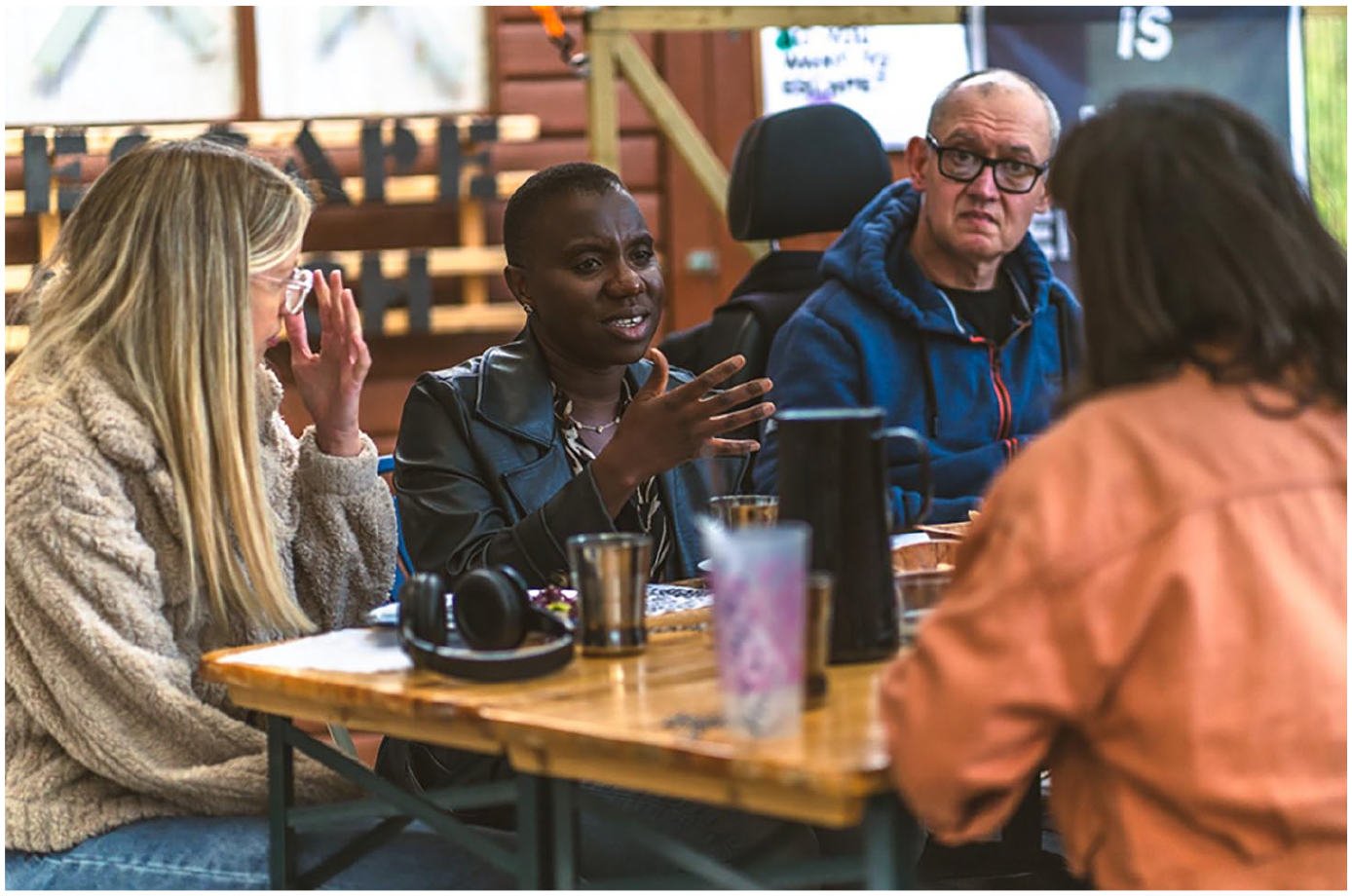
Participants gathered at a performance-based meal in The Palace in Doncaster in July 2024. Photo by Tom Dixon.
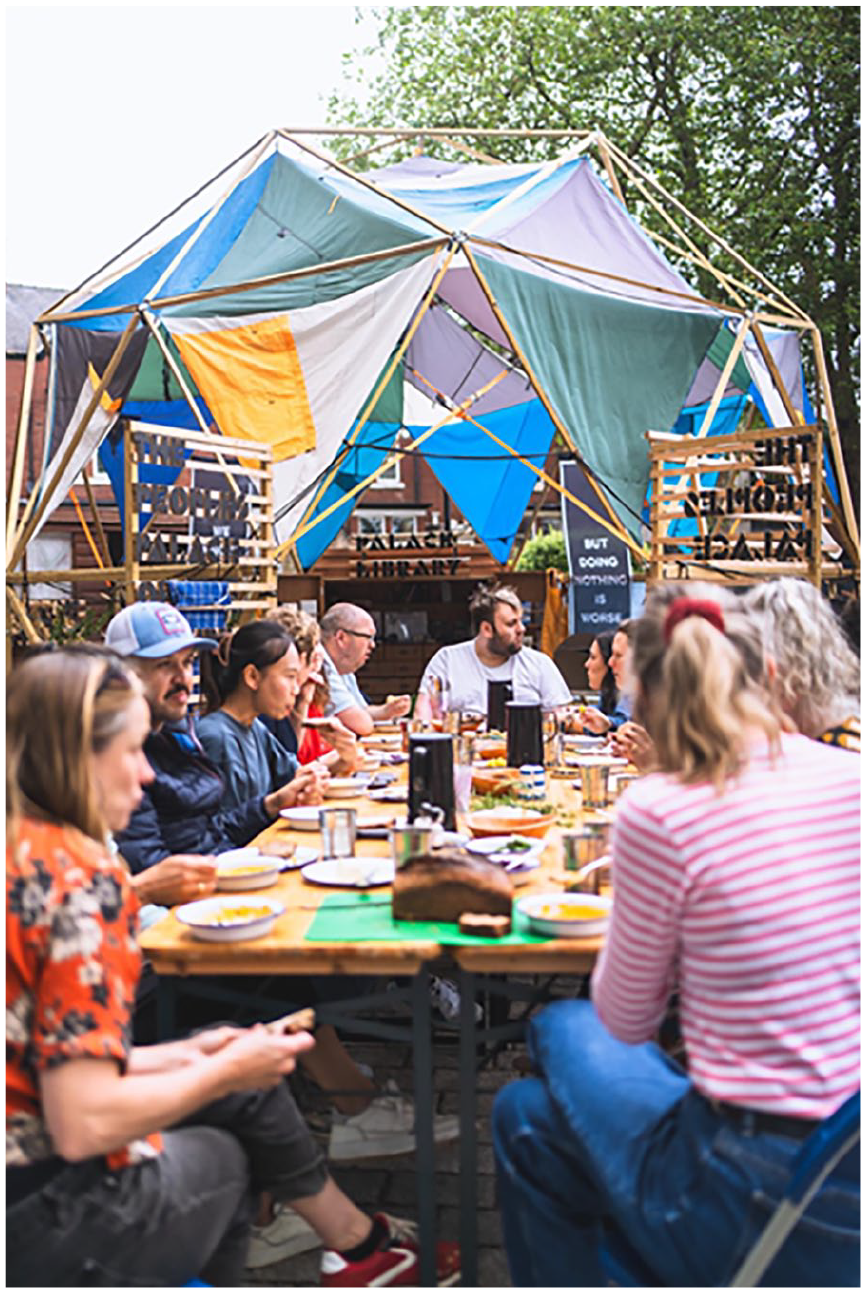
Participants gathered at a creative workshop and meal in Doncaster in July 2024. Photo by Tom Dixon.
Limitations
Alongside the opportunities afforded by participatory performance works like The Palace, it is also important to acknowledge their limitations.
First, the reach of this work is neither representative nor broad. The Palace did reach beyond the UK’s usual performing arts audiences (as demonstrated by survey results indicating that 53% of the postal version audiences had never engaged with interactive arts prior to this project), who tend to be white, educated to degree level, and over 50 (Torreggani, 2022). However, this work is generally characterised by small participant numbers and The Palace is no exception. Between 2020 and 2024, across 11 locations, both the postal and live versions have engaged with only 1500 people (estimated based on The Bare Project’s audience records) directly as participants and audiences.
Second, for some, this approach to political engagement was off-putting or alienating. Some participants reported feeling that the playful and creative approach to political discourse made it harder to engage with the political content of the piece. For example, one survey respondent commented: ‘I think that the project could have been an opportunity to explore political thinking and action but seemed to focus more on jokey playfulness’, and another commented that the ‘project was too weird for me to connect with’.
Playfulness, engagement with strangers, and imaginative political visioning are not common occurrences for adults in public spaces and an initial wariness, confusion, and self-consciousness were common. The company took pains to explore routes for low-key and easy initial engagements to overcome some of these barriers (such as 5-minute audio walks to introduce the project at the door of the live version). However, for some audiences and participants, the dramatic and playful aesthetic and tone were enough to put them off entirely.
Conclusion
Arguments for democratic renewal via a reinvigoration of the public sphere may often seem – particularly next to the current experimentation in practice with democratic innovations – to remain an abstract, theoretical argument. As an attempt to remedy this, this case study offers a tangible example of an activity that can nurture a democratic and critical mode of connection through participatory performance. It demonstrates the fruitfulness of creating open, and open-ended, participatory spaces for citizens to engage in creative and critical collective discussion, on political issues yet at a distance from formal policy-making processes. Drawing on art (rather than institutional design) and focusing on the open, anarchic public sphere (rather than controlled, policy-focused spaces) can add an important piece to the overall mosaic of democratic renewal by creating spaces that are less controlled and channelled, and instead, in line with Arendt, more open, experimental and inviting of citizens’ own initiative.
While the political role of art has been theorised across a wide spectrum, from the pinnacle of human freedom to itself an instrument for social control, we find the specific subcategory of participatory performance to constitute a thus far overlooked, potentially powerful site of democratic renewal. Insofar as its artistic quality facilitates a reflectiveness, playfulness, imaginativeness, and collectivity in how citizens connect with each other and engage with political issues, participatory art contributes important elements to the reinvigoration of the kind of critical-disruptive public sphere Arendt theorises to be the place from which ‘new beginnings’ for society can emerge: the system-level social change needed to address systemic crises such as climate change or structural injustice.
These qualities, and the public sphere dimension, are thus important elements of democratic renewal. Arts-based practices such as The Palace can fill a gap, not by replacing or competing with conventional forums, but by changing the wider context in which these take place and are theorised. Even though each artistic performance or installation may still be limited in scale and direct impact, its significance must be understood as contributing to such a public sphere, at which level the overall revolutionary potential lies. Rather than having to design a specific functionalist setting to generate a certain democratic impact, Arendt – and an immersion in the world of the arts – reminds us that citizens’ most powerful political influence may well stem from their very organic, situated imaginations, which can alter the very course of development of a society despite, or precisely because, they take place at more distance from formal policy processes.
Footnotes
Appendix 1
Live Version (each tour date lasted 3 weeks).

| Dates | Location | Venue / Organisation Partner |
|---|---|---|
| June 2023 | Toynbee Studios Whitechapel London |
Artsadmin and ArtClimateTransition |
| August 2023 | Caithness Highlands Scotland |
Lyth Arts Centre |
| September 2023 | Mowbray Gardens Library Rotherham |
FLUX Rotherham & Children’s Capital of Culture |
| May 2024 | Ventnor Isle of Wight |
Ventnor Exchange |
| June–July 2024 | DANUM Gallery Doncaster |
Doncaster City Council |
Acknowledgements
This research would not have been possible without Tim Jackson and the team at The Centre for the Understanding of Sustainable Prosperity. Thank you for connecting us and supporting this research. We would also like to thank Emily Westwell for her support in data collection, and Holly Ryan, Nicole Curato and the journal’s anonymous reviewers for providing invaluable feedback on earlier drafts of this paper. And finally, thank you to The Bare Project team and all the Palace Citizens who built The People’s Palace of Possibility.
Funding
The author(s) disclosed receipt of the following financial support for the research, authorship, and/or publication of this article: The financial support of the Economic and Social Research Council (Grant Nos: ES/T014881/1 and ES/M010163/1) is gratefully acknowledged.
