




Abstract
This article seeks to contribute to the electoral and party politics debate in three main ways. The first is the claim that parachuting politicians into districts in which they have no prior connections is not a nomination practice that is the exclusive preserve of plurality electoral systems, nor does it necessarily engender the critical reaction of carpetbagging in the United States or ‘captain’s picks’ in Australia. Second, the practice of parachutage is tied to the personalisation literature but, in contrast to this literature, the article views [parachute] personalisation and party as complementary and mutually reinforcing rather than contradictory. Parachute personalisation serves party-based representative democracy rather than attenuates it. Third, the article questions the undue focus in the personal vote literature on a candidate’s personal-vote-seeking attributes. Rather, in concentrating on the transferability of the parachute vote as an electoral resource, the generic term ‘personal vote’ is viewed as comprising a mélange of party-vote-earning attributes – inter alia name-recognition and reputational status as a party office-holder – and personal-vote-earning attributes – name-recognition from outside party politics (sport, music, etc.). The central question addressed runs: When and why in an intraparty preference voting system – Finland is the focus – is parachute personalisation practised and with what result?
Introduction
Parachuting candidates at the behest of the party leadership into ‘safe seats’ in constituencies (districts) in which the parachuted candidate has little or no prior association is a practice routinely associated with single-member plurality systems such as Australia (Evans and McDonnell, 2022), Canada (Koop and Bittner, 2011), France (Dolez and Hastings, 2003), the United Kingdom (Baxter, 2014), and the United States (Galdieri, 2019), where they are known as carpetbaggers. In contrast, this article explores the strategy of ‘parachute personalisation’ – that is, the redeployment of the personal vote of politicians from their ‘home constituency’, where they will have an established personal support base, into open-list, multi-member constituencies in which they will have had little or no prior association, and in which they will face competition from candidates of the same party (co-partisans) with established local roots. The focus in short is on the transferability of the personal vote and the extent to which it will ‘travel’ across districts. Drawing on the Finnish case, the central question runs: When and why in an intraparty preference voting system is parachutage personalisation practised and with what result?
To the best of our knowledge, this is the first study to set the practice of parachuting politicians in the context of an intraparty preference voting system and to tie the phenomenon to the personalisation literature. It proceeds from the supposition that the incentive for parties to parachute preferred candidates into constituencies in which they have had no prior association will be greatest in single-member, plurality voting systems where there is a supply of ‘safe seats’. In contrast to plurality system parachutage, open-list PR voting systems – Finland is the case-study – would seem to represent a least likely case for parachutage since in multi-member constituencies parachuted candidates will face competition not only from rival partisans but fellow-party candidates on the party slate who will likely have strong local roots. In short, there are no safe seats and the outcome cannot be guaranteed.
Drawing on the experience of parachutage over the nine Finnish general elections between 1991 and 2023, the case made is that as a nomination strategy, it is in the party’s interests to parachute the personal vote when (1) it is likely better to realise the politician’s full vote potential to the benefit of the party list in the constituency of transference and (2) it is likely to produce an electoral increment in maintaining or increasing a party’s level of representation in the constituency of transference. However, the electoral value attached to candidate ‘localness’ will mean that in practice only the personal vote of high-profile politicians – in particular party chairs – is likely to be successfully parachuted.
The structure of the article follows the tried and trusted path. The first section sets parachute personalisation in a broad electoral system context, tying it to the wider literature, while the case selection explains the focus on Finland as an intraparty preference voting system. A section on party nomination strategies leads to two hypotheses on parachutage, which are tested in the ‘Methods and results’ section where the main results are also presented. The discussion profiles a number of high-impact parachutes while the ‘Concluding remarks’ section revisits open-list systems as a least likely case of parachutage and sum up on the Finnish case. Note that throughout this article, the American term ‘district’ and British term ‘constituency’ are used interchangeably.
Parachute personalisation in its electoral system context
Plurality system parachutage
The practice of parachuting candidates is by no means new. The term parachutage, it appears, was first used in France in 1951 (Chemin, 2022; Dolez and Hastings, 2003) although the practice existed long before that. However, it needs to be understood in its electoral system context. Thus, the starting point in this article is the presumption that the incentive for parties to parachute preferred candidates into constituencies in which they have had no prior association will be greatest in single-member, plurality voting systems where there is a supply of safe seats – defined by the Australian Electoral Commission as those in which the winning party gains over 60% of the vote. The parachute may be a question inter alia of launching the political career of an ambitious young graduate, a former ministerial adviser or finding a safe seat for an MP whose constituency has become marginal as a result of boundary changes. It may be designed to enhance ethnic minority representation or to facilitate ballot access for indigenous peoples. Whatever the motivation, the outcome in safe seats is secure.
The types of parachuted candidates will of course be contextual and circumstantial. Koop and Bittner (2011) note that in the Canadian Liberal Party between 1997 and 2009, 50% of parachuted candidates could be considered star candidates (household names) while a broadly similar proportion were diversity candidates, that is, women, immigrants, visible minority groups, or Aboriginal peoples. Focusing on indigenous candidates in Australia, Evans and McDonnell (2022) distinguish between two routes to nomination. The partisan route involves a person who has served as a grassroots’ member for at least 1 year, who then runs as a candidate having gained the endorsement of the local branch party. The parachute route involves persons with little or no background in the party – possibly a personality from sport or entertainment – being given a ‘tap on the shoulder’ from a leading party figure, possibly the prime minister, and then imposed on a constituency largely irrespective of the wishes of the local party. Widely referred to as ‘captain’s picks’, these are candidates for whom the selection process is manipulated or possibly bypassed altogether.
As a result, plurality system parachutage has been generally viewed in a negative and critical light, as a case of an overbearing and patronage-dispensing central party imposing its favoured nominee over and above a worthy local candidate and the wishes of the local party. As McAllister noted in the Australian context, ‘Voters don’t like candidates being parachuted in by the central party’ (Chrysanthos and Maley, 2022). Referring to the 2022 Australian general election, Murphy (2022) concludes that ‘captain’s picks and carpetbagging are not something the electorate is prepared to take any more’. In the British context, Baxter (2014) was similarly unambiguous when referring to Labour Party practice: ‘The policy of parachuting in candidates from Westminster to a safe party seat somewhere so that the person is essentially guaranteed power is poisonous’.
In contrast to plurality system parachutage, the open-list PR voting system would seem to constitute a least-likely case of airlifting candidates, primarily because in multi-member constituencies they will face competition not only from rival-party candidates but, more pertinently, from fellow-party candidates running on the same party slate (Dodeigne and Pilet, 2021) who will have strong local roots (‘localness’). Selb and Lütz (2015: 331) note that ‘for a candidate in Switzerland the challenge is not to be ahead of candidates from other parties but to be ahead of candidates of the same party’. As a disillusioned former Finnish Social Democrat parliamentarian put it, ‘The most surprising thing I learnt from election campaigning was that my fiercest rivals were MPs from the same party and same constituency as me’ (Kemppainen, 2015). In short, there are no ‘safe seats’ and the outcome of the parachute is uncertain. How, then, can parachute personalisation be understood and defined in systems where ‘party districts’ rather than constituencies are the candidate nomination units and where, within party districts, municipalities put up preferred candidates, mostly based on a record of municipal service?
Parachute personalisation
Parachute personalisation is best located within the comparative personalisation literature, albeit differing from it in important respects. Thus, the broad thrust of the personalisation of politics output, simplifying only a little, has been that personalisation comes at a cost to political parties (Karvonen, 2010; McAllister, 2009). Pedersen and Rahat (2021) contend that ‘behavioural personalisation’ is premised on a perception that the political actions of politicians are ‘oriented towards independent political individuals rather than collective entities’. They add that the ‘personalization of representation’ (cf. Colomer, 2011) involves the promotion of issues more important to individuals than the promotion of the party programme. Throughout this literature, there is a tendency to juxtapose person and party and view them as polar opposites. True, Pruysers et al. (2018: 14) hold that ‘the relationship between party and personalization is not necessarily zero-sum and political parties may engage in a personalization strategy’ but they do not say how and the point is not developed.
This article, however, views person and party as complementary and their interests running in tandem. Thus, Rahat and Kenig (2018: 237) cite Arter (2014: 467) on the celebrification of Finnish politics that parties may adopt a personalisation strategy of nominating celebrity candidates who attract personal votes and that ‘despite the appearance of reduced partyness in the electoral process the personal vote of celebrity candidates has ultimately been a resource in party hands and has served to consolidate rather than attenuate party-based representative democracy’. This article views parachute personalisation in a similar light.
Put another way, when set in the context of an open-list PR electoral system – where the preference provision is mandatory or optional – parachute personalisation is viewed as a party nomination practice involving the strategic redeployment of a representative’s personal vote from his or her ‘home district’ to a constituency in which he or she has had no prior association, but where the relocation would be expected to yield an electoral increment for the party list. From a party management perspective, parachute personalisation, then, involves ‘importing’ the personal vote so as to maximise the party vote.
In concentrating on the transferability of the parachute vote as an electoral resource, it is important to specify what is meant here by the ‘personal vote’. There seems to have been an element of undue bias on this in the electoral studies literature, which defines the personal vote purely or largely in terms of that proportion of the candidate vote that derives from his or her personal-vote-earning attributes (Shugart, 2008; Zittel, 2017). In this article, however, the generic term ‘personal vote’ is viewed as comprising a variable admixture of party-vote-earning attributes – inter alia name-recognition and reputational status as a party office-holder at national and/or municipal level – and personal-vote-earning attributes – name-recognition from outside party politics (sport, music, the media, etc.). It follows that for a successful relocation a parachuted politician should at minimum have a recognisable partisan name outside the home constituency and possess the appropriate personal merit.
Personal-vote maximisation is fully enabled when there is nothing to prevent party politicians with national name-recognition running in any number of constituencies – as in Sweden, where, in addition, a personal vote option was introduced for the 1998 general election. The minor parties in particular have exploited this multiple candidacy provision, running their leaders in numerous districts. In 1998, the Swedish Christian Democrat chair Alf Svensson ran in every constituency and the party secured its best-ever national poll of 11.8% (Arter, 2024). At the 2022 Swedish general election, the Christian Democrats’ chair, Ebba Busch, stood in all 29 constituencies: her personal vote amounted to over one-fifth of the party vote in all of these constituencies and she obtained 22.4% of the Christian Democrats’ total national poll. The same year, the Sweden Democrats’ leader Jimmie Åkesson headed a national slate of candidates that ran in every constituency and the party gained over one-fifth of the overall vote. Earlier, multiple candidacy was possible in Finland both within constituencies and between constituencies and a tradition of this form of parachutage may have contributed to the perceived legitimacy of the practice.
It should be noted here that the practice of parachute personalisation in open-list systems is not without reputational risks to the parachuted candidate. In contrast to plurality voting systems, there are no ‘safe seats’ in open-list multi-member constituencies. In the United Kingdom, there are/have been constituencies that have been held continuously by the same party over a sustained period. The Electoral Reform Society has referred to ‘super safe seats’, meaning those that have been won consistently by one party such as the so-called ‘red wall’ seats in the Midlands and North of England which have [until recently] traditionally backed the Labour Party.
In closed-list systems, when parties rank-order candidates at the selection stage, there may be de facto ‘safe list seats’ and high-profile politicians, guaranteed re-election, will be used as ‘list pullers’, as in the Netherlands (Andeweg, 2008) and elsewhere. However, where there is an open-list PR system, the resultant competition between candidates of the same party makes the notion of a safe seat unintelligible. Intraparty defeats may be commonplace, with an incumbent parliamentarian unseated by a co-partisan challenger.
Case selection
Finland is viewed as a particularly suitable case for the study of parachutage under PR electoral rules because (1) it has a history of a form of the phenomenon under the pre-1970 electoral arrangements, which permitted multiple candidacy both within (until 1959) and across (until 1969) constituencies, and (2) the present intraparty, single preference voting system does not prevent a candidate ‘owning’ a significant personal vote from being relocated to a constituency in which he or she has had no prior association. Taking these two points briefly in turn.
Although widely neglected in the political science literature, the practice of parachuting personal votes has a long history in Finland. It is in fact as old as mass democracy itself, dating back to the 1906 electoral and parliamentary reforms when Finland was still a Grand Duchy of the Czarist Russian empire. The reforms enfranchised all men and women over 24 years who were also eligible to run as candidates for election to the new 200-seat unicameral Eduskunta. Under the open-list PR voting system, the lists run by civic electoral associations valitsijayhdistykset – in practice the political parties – contained three candidates, mostly a mix of local individuals and a high-profile ‘name’ parachuted in from outside the constituency, the latter the so-called ‘general candidate’ (yleisehdokas). The candidate was ‘general’ because electoral associations were permitted to run several lists as an electoral alliance across the different areas within a district and the ‘general candidate’ would appear on all of them (Tarkiainen, 1971). Multiple candidacy within districts and the deployment of a ‘general candidate’ allowed the district party executive to ‘steer’ the candidate selection process in desired directions, as well as mobilising the popular vote.
Multiple candidacy between constituencies allowed for the parachuting of the personal vote of established politicians into several constituencies simply to boost the party vote there. True, a multiple candidacy strategy was not the rule. In 1958, only 3.1% of all candidates stood in more than one constituency and this had fallen to 1.6% in 1966. Equally, in the aforementioned year, the Communist Party’s general secretary, Hertta Kuusinen, an MP since 1945, stood in four constituencies – Helsinki and Uusimaa in the south and the up-country districts of Kuopio east and Vaasa east – polling a combined total of 26.9% of her party’s total national vote. While multiple candidacy was abolished in 1969, parachuting personal votes as a nomination strategy has been sustained by the rule that, notwithstanding the decentralised and inclusive nature of the selection process (Arter, 2021a), the central party reserves the right to nominate a small proportion of top-up candidates on the lists selected by the district parties. In view of the longevity of the practice, moreover, it is perhaps not surprising that personal-vote parachuting does not have the negative connotations of the likes of the ‘captain’s picks’ in Australia. It is neither resented nor resisted by most voters.
Today, Finland employs a ‘personalised electoral system’ (Renwick and Pilet, 2016) which, distinctively in a European context, requires citizens to opt for a single candidate on a party list, the concomitant intraparty competition then incentivizing personal vote-seeking and, through the ‘ownership’ of a personal vote, the potential for parachutage. The extent of the personalisation or individualisation of candidate campaigns stands out in comparative perspective. Campaigns are personalised in that they are organised, and funding raised by the individual candidate – not the local party – backed by a dedicated campaign team (tukiryhmä) which will include activists over and above partisans. There is an interesting parallel here with Ireland where, as Gallagher and Marsh (2004: 414) have noted, ‘many politicians have a personal network of friends and supporters who may or may not be integrated into the party organisation, which often plays an important part at election time’.
Candidates will compete with co-partisans for a personal vote. The voter’s choice may be fashioned by the candidate’s party-vote-earning attributes – typically a record of municipal council service since the practice of cumul des mandats is endemic in Finland (Arter and Söderlund, 2023) – or personal-vote-earning attributes, typically name-recognition from outside the world of politics such as sport, ‘soaps’ or fashion. The open-list voting system has fed, albeit not directly caused, a celebrification of electoral politics, and at the 2023 general election, celebrity candidates included a former long-jumper, footballer, basketball player, and ice-hockey star. However, while the personal vote is a composite artefact that reflects in varying measure a candidate’s partisan credentials and personal attributes, the wider point is that citizens cast a dedicated individual vote that, from a party management standpoint, represents a potentially valuable and transferable resource.
Summing up so far, most Finnish MPs are local MPs. Their primary electoral constituency (Arter, 2021b) is the home municipality and its surrounds. Indeed, the value of localness as a vote-earning attribute is reflected in the fact that at the June 2021 local government elections, the serving prime minister, three former prime ministers, over four-fifths of incumbent parliamentarians, nine-tenths of the cabinet, and several Finnish members of the European Parliament sought and gained a municipal council seat (Arter and Söderlund, 2023). The vast majority of Finnish MPs in short could not successfully be parachuted and would not want to be relocated away from their home soil. As a party nomination strategy, therefore, parachutage is in practice restricted to candidates with ‘nationalness’ – that is national name-recognition – which would be expected to trump localness in the voting decision.
Potential parachute politicians in contrast will be elected members of parliament (national or European) who will have a pre-existing personal vote-base that can be airlifted from the home constituency to another in which there has been no prior association when it is advantageous for the party to do so. Celebrity candidates recruited from outside the world of politics may possess future parachute potential but first they must gain election and this is usually in a constituency in which they have at least a loose connection.
Party nomination strategies
Party nomination strategies are legion, contingent, and, given the decentralised nature of the selection process, district-based, and first and foremost they will reflect the logistics of the M-P balance in the district. A calculus based on M (district magnitude) – the allocation of seats to a district – and P (party magnitude) – the party’s share of those seats at the previous general election – will go a long way to determining the choice of nomination strategy. Three such strategies warrant a mention.
First, all things being equal, constituency party selectorates will employ a balanced list strategy, configuring a slate of candidates that reflects the sociodemographic characteristics of the district. They may well discreetly seek to maximise co-partisan rivalry – intraparty candidate competition – and the aggregate list vote by running a male and female candidate in the same town, for example, or recruiting a celebrity ‘name’ from outside the world of politics.
Second, in small-M, low-P districts, parties may well incline towards a lead candidate strategy. Thus, in a small-M up-country district, a minor party in that district, although not necessarily so nationally (typically P = 0/I), will be incentivized to seek an electoral alliance (vaaliliitto) – purely a technical arrangement without policy substance – with one or more of the competitor parties, while urging their supporters to concentrate their votes on the lead candidate. While the aggregate poll will determine the allocation of seats to the electoral alliance, candidates are returned on the basis of their individual votes. The success of this strategy will, of course, depend entirely on the solidarity of the party vote for the lead candidate, something which cannot always be assumed.
The third of the party nomination strategies is premised on a perception of the personal vote as a transferable resource. There are two likely scenarios. First, party selectorates will consider the merits of a personal-vote parachute strategy in large-M, low-P districts where the recruitment of a ‘magnet candidate’ from outside the constituency might be expected to mobilise the party’s limited support. Second, a personal-vote parachute strategy may be attractive in large-M, large-P (party stronghold) districts where the parachuted candidate’s personal vote could be expected to achieve its full potential.
The key to understanding the incentive to parachute personal votes, then, lies in the M-P equation. While there is considerable regional variation in party magnitude, there is still greater divergence in district magnitude across the 12 mainland constituencies, ranging at the 2023 general election from M = 6 in Lapland to M = 37 in Uusimaa in the hinterland of the capital city. There is no formal national qualifying threshold for parliamentary seats in Finland – unlike the 4% barrier in Norway and Sweden or 2% in Denmark – but the large variation in M has meant a striking disparity in the hidden electoral threshold or the minimum proportion of the vote needed to gain a seat. In 2023, the hidden threshold in Uusimaa was 2.8%, whereas in Lapland it was 14.3%.
All in all, the large M in Uusimaa (M = 37) and the capital Helsinki (M = 23) – which together elect nearly one-third of the 200 MPs – coupled with the low electoral threshold, have meant that in practice general elections are won and lost in these two constituencies in the Finnish ‘deep south’. It is no coincidence that in the 15 Finnish general elections since 1970, on only two occasions has the candidate polling the highest individual vote nationally not stood in either Helsinki or Uusimaa. Consequently, it is in the ‘deep south’ that for both high-P and low-P parties the strategy of parachuting the personal vote would seem best deployed so as to realise its full potential and enhance the party’s overall performance in the constituency. ‘Importing’ the personal vote would maximise the party vote and the seat-return.
Hypothesising on parachutage
In this section, we present hypotheses relating to the most likely type of politicians to be parachuted. Potential parachuters, it is assumed, will have in common that they are politicians with a substantial personal vote from a foregoing general election, presidential election, or European Parliament election. They may be unlikely significantly to increase their personal vote in the ‘home constituency’, particularly when this is a small-M district, but will have the potential to increase it and/or the number of party seats when parachuting into a new, larger-M constituency. Four types of politicians might appear to meet these criteria: party chairs, cabinet ministers, members of the European Parliament, and possibly some rank-and-file parliamentarians.
Party chairs
In an era of highly personalised politics (Poguntke and Webb, 2005; Rahat and Ofer, 2018), it is the party chair (leader) that is very much the face of the campaign and he or she will invariably be a cabinet minister when the party is in government. Even though, unlike Sweden, multiple candidacy is no longer permitted, there is evidence that the party leader is an influential determinant of voting behaviour outside the constituency in which he or she is standing (Kestilä-Kekkonen and Söderlund, 2014) and that citizens would have voted for him or her had it been possible. It follows from a management perspective, therefore, that the party leader’s personal vote is potentially transferable.
Cabinet ministers
Unlike Norway, Sweden, or Estonia, there is no incompatibility rule in Finland requiring ministers on appointment to relinquish their seats in parliament and be replaced by a deputy from the same party. Cabinet ministers, including the prime minister, continue to hold an Eduskunta seat and they are expected to attend to their constituency duties. Over and above the extra workload involved in constituency service (Arter, 2011), two factors would appear to militate against parachuting members of the cabinet. First, ministers are appointed largely on a regional basis – sometimes following a vote in the parliamentary group – and precisely because of their regional credentials (and likely unrest among party members in the region) there will be little incentive to parachute them to a constituency in another part of the country. Second, junior ministers in particular are relatively rarely the electoral assets that are party leaders and there may be a considerable risk in a parachute. Ministers who are, or have been party, chairs would seem the exception.
Members of the European Parliament
There is nothing preventing serving members of the European Parliament (MEPs) from standing in Finnish general elections. If elected, they must then decide whether to serve out their term of office in Brussels or to resign as an MEP and take up their parliamentary seat. For European Parliament elections, Finland serves as a single national constituency and, subsequent to the British exit from the European Union, it is represented by 14 MEPs. The number of serving MPs who stand for the European Parliament is relatively high in Finland – nearly 16% in the 2024 European Parliament election – although for a significant minority the aim is not perhaps to become an MEP. Rather, it is to remain an MP by running a strong euro-campaign and then trading off an enhanced personal vote at the next parliamentary election. Parachuting MEPs – seeking a return to domestic politics – has been a feature of Finnish general elections this century. Some return to their former constituencies; others parachute their personal vote to where the party needs it most. In short, elected to the European Parliament with a national mandate and a substantial personal vote, returning MEPs represent a potentially valuable and transferable electoral resource for the political parties.
Members of parliament
For most MPs, a sizable share of their personal vote will be anchored in their own locality and, as noted earlier, ‘localness’ is viewed by voters as an important vote-earning attribute. A few MPs gain an ‘issue identity’ by dint inter alia of their opposition to the controversial closure of a local/regional facility (the maternity wing of a hospital or a teacher training college) or their vocal rejection of a development project with deleterious environmental implications. Others gain wider name-recognition through appearances on a popular television show, a magazine interview, or media coverage of an amorous relationship. Some will ‘make the news’ simply with a bold statement on a topical or sensitive question of the day – immigration, gender recognition, or whatever. All in all, however, it is in the individual MP’s interests – and possible promotion prospects – to be known within the party and among voters as an effective constituency representative and there will be little incentive to relocate or be relocated.
On the basis of the foregoing discussion, two hypotheses seem in order:
H1: Parachuted candidates will have national name-recognition and a substantial personal vote in their ‘home constituency’ from an earlier general election.
H2: Parachuting candidates will produce an electoral increment –seat maintenance or seat–gains – for the party list in the constituency of transference.
Methods and results
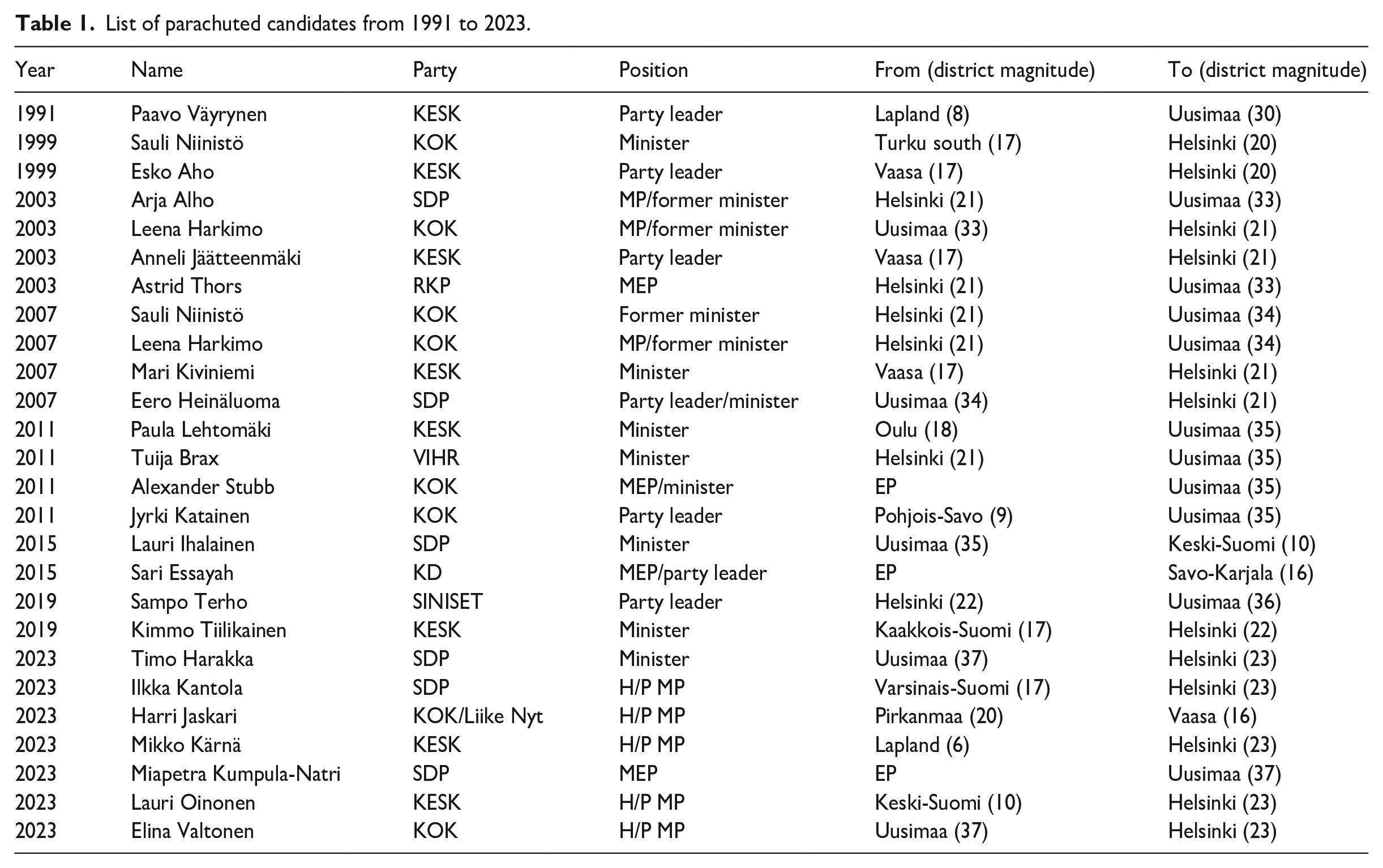
Drawing on the official Statistics Finland data for nine general elections between 1991 and 2023, and covering all the party lists in the 12 mainland Finnish constituencies (n = 984), Table 1 presents a list of 26 parachuted candidates, their status as politicians, together with details of their ‘home constituency’ and constituency of transference. It is evident that parachuters comprise mainly past and present cabinet ministers (13), party chairs, that is, party leaders (7), and high-profile members of parliament (5) while, in addition, four MEPs have parachuted back into the domestic political arena in a constituency in which they have not previously stood. As posited in H1, parachuted candidates have mostly enjoyed national name-recognition, not least as party chairs. Indeed, party chair parachutage has been a striking feature of electoral politics in Finland. Note here, too, that only those party chairs relocating from an up-country constituency are included, since the majority of party chairs have from the outset represented one of the two large-M constituencies of Helsinki and Uusimaa. Three party chairs that have been up-country parachutes, and made a telling difference to the overall election result, are profiled in the next discussion section.
List of parachuted candidates from 1991 to 2023.
However, to address H2 we need to seek to gage the impact of parachutes on the election outcome at the list level. To do so, multiple regressions are run with two dependent variables: (1) the share of seats won by the party list in the constituency, and (2) the change in seat-share between time t and t - 1, the preceding general election. Each of these variables, however, tells only part of the story since, over and above list-seat maximisation, parties strive to optimise their constituency vote-share. Consequently, a relative variable is needed to control for variation in district magnitude.
The main independent variable is the number of parachuted candidates on the list and this varies from 0 to 2, four lists containing two parachuted candidates. Candidates are considered parachutes, however, only once; if they run again in the same district, they are considered established candidates. The models developed also include additional control variables. Since they test two different phenomena, the control variables vary from one model to the other. Three control variables are used when considering list-seat share: (1) the total number of lists competing in the district; (2) turnout, which is added to account for the general election trends in a given district; and (3) a measure of district magnitude so to account for the so-called ‘hidden’ electoral threshold, that is the minimum list poll required for a party to win a seat.
While ministers or party chairs who have a sizable personal vote might be incorporated into the model, they form part of the ‘parachutes’ variable, meaning that including another variable would introduce a serious bias into the estimations. In relation to the dynamic measure, the control variables deal with the changes at the district level. The first one is related to demographic changes and, thus, to the number of additional votes available. In Finland, the allocation of seats between the districts (M) is readjusted before every election. Hence, a variable measuring the change in M between the two elections is added to the model. Second, turnout can also change significantly from one election to the next, with the attendant ramifications for the nature of interparty competition. Party dummies are included to control for any party effect.
Since elections are constituency-based, all lists competing in the same district are related. To account for this, the models include robust (sandwich) standard errors clustered by districts. Finally, all analyses also include election year-fixed effects to control for time factors. They should also account for the probable heterogeneity in the data and, thus, the correlation with the residuals. The results are in Table 2.
The impact of parachutes on seats won by party lists.
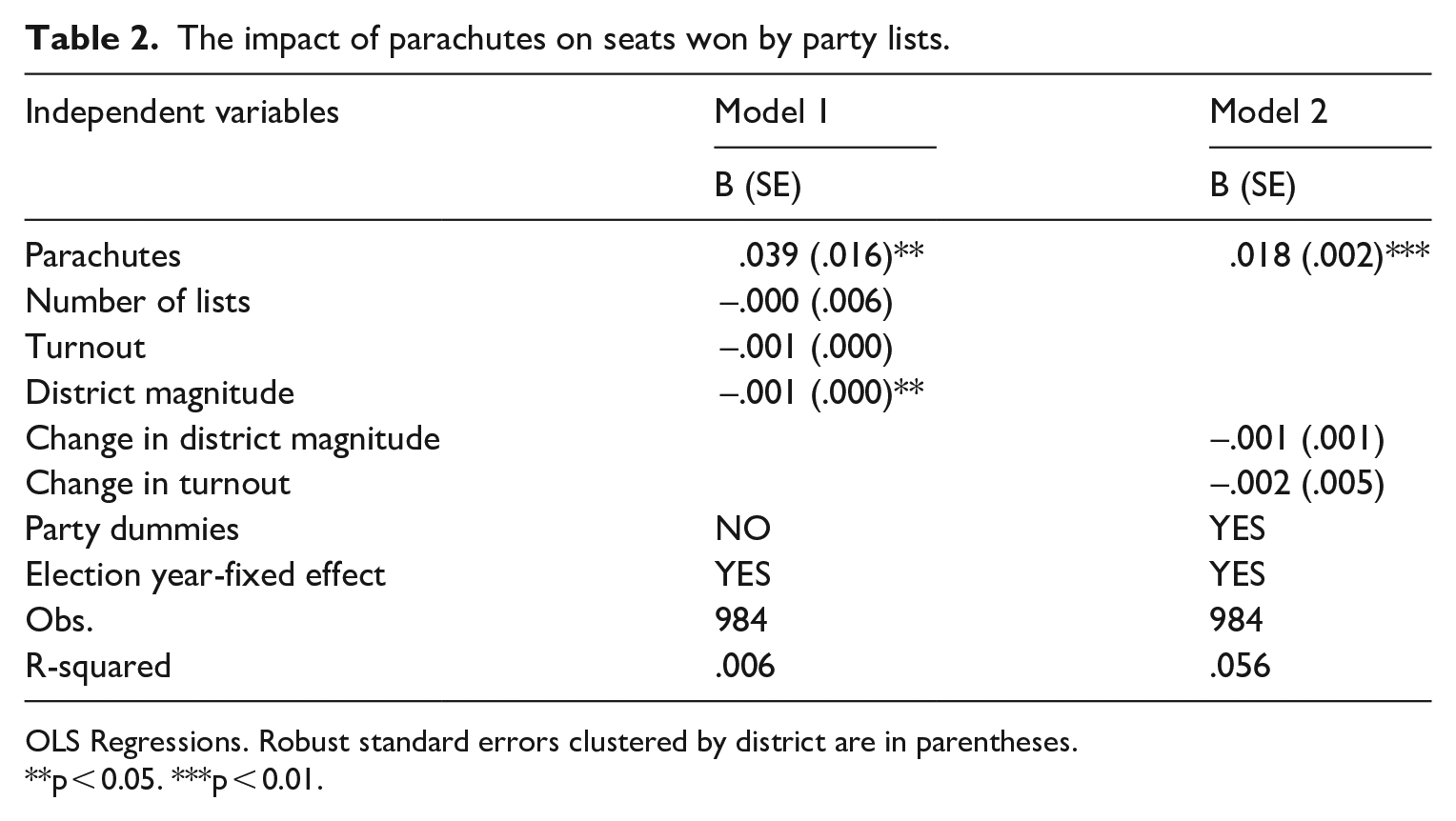
OLS Regressions. Robust standard errors clustered by district are in parentheses.
p < 0.05. ***p < 0.01.
When assessing the overall impact of parachutage, the results reveal a positive trend both in terms of list-seat gains (model 2) and list-seat shares at a given election (model 1). The findings are thus consonant with H2 in showing that parachutes routinely lead to a seat increment from one election to the next. Although not strictly part of the hypothesis, the findings also reveal that parachutes have a ‘one-time’ effect on the electoral performance of parties. More specifically, they indicate that by parachuting candidates, a party can not only acquire more seats, but also improve its performance from the previous election. In order to better appreciate the effect of parachutes highlighted in model 2, we plot the predictive margins of parachutes (Figure 1).
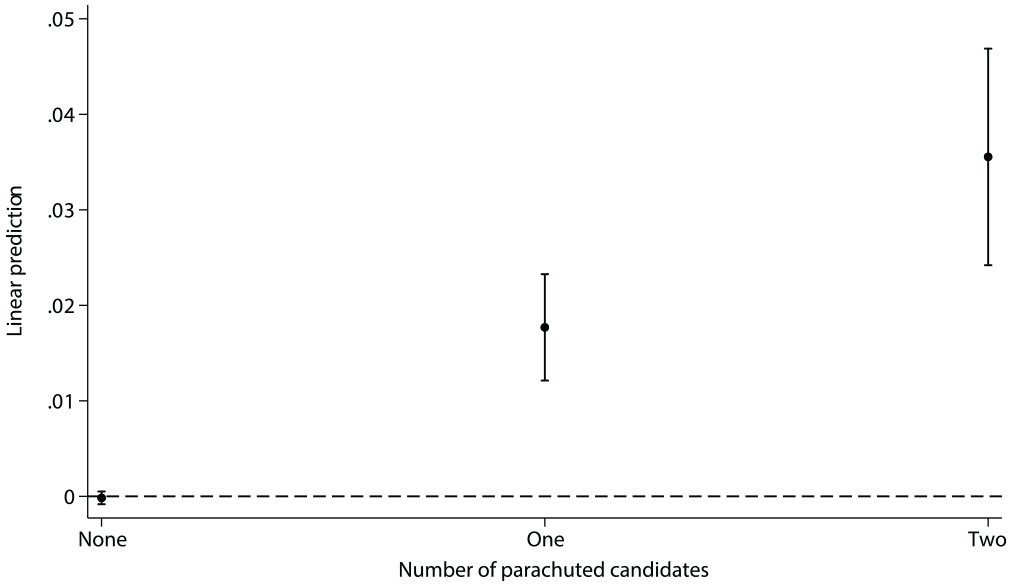
Predictive margins of the number of parachuted candidates (with the 95% confidence intervals).
On the left are lists without any parachuted candidates. They do not see their performance change from one election to the next. The lists with one (centre) and two (right) parachuted candidate(s), however, witness an electoral increment. True, the size of the ‘parachute effect’ remains low, which is hardly surprising given this is only one of several party nomination strategies and alone is insufficient to produce dramatic electoral change. Yet, the article shows that there is a significant and positive trend.
Does parachutage matter?
Not all parachutes of course deliver an optimal outcome. However, all but one of the National Coalition and Centre party chair parachutists relocating to Helsinki/Uusimaa over the research period received a significant electoral increment from the move and may even be said to have had a decisive impact on the overall election result. We noted above that parachutes must be analysed and understood contextually – each has its own logic – but as the cases of Sauli Niinistö, Anneli Jäätteenmäki and Jyrki Katainen illustrate, parachutes can make a difference.
Sauli Niinistö
It took Sauli Niinistö, the Finnish president between 2012 and 2024, three attempts to gain election in the south-west constituency of Turku north in 1987, although by the 1995 general election he had attracted a personal vote more than twice that of the next best-supported National Coalition candidate in the constituency. The previous year Niinistö had been elected party chair and his media profile was further enhanced, albeit in tragic circumstances, when shortly before the 1995 general election his wife was killed in a car crash. Niinistö served as a minister – mostly minister of finance – between 1995 and 2003 and at the 1999 general election he parachuted into the Helsinki constituency where he won almost 36% of the National Coalition’s total in the constituency and more than double that of his closest party colleague. Narrowly defeated as his party’s presidential candidate in 2006, Niinistö parachuted again the following year, this time to the neighbouring constituency of Uusimaa, where at the 2007 general election, he attracted the highest individual vote ever obtained by a candidate in a Finnish general election (60,563), 45.2% of the National Coalition’s total vote in the constituency and virtually 10% of the National Coalition’s national vote.
Anneli Jäätteenmäki
Anneli Jäätteenmäki, Finland’s first female prime minister, was elected to the Eduskunta in 1987 and served as the minister of justice between 1994 and 1995. She established herself as a leading Centre politician in the party stronghold of Vaasa constituency, polling 11,932 personal votes at the 1999 general election – 15.3% of the party’s vote in the constituency. Following her election as the party’s first female chair in 2002, Jäätteenmäki was parachuted into the Helsinki constituency for the 2003 general election and gained a seat with 15,704 individual votes, a figure that represented virtually three-fifths (59.4%) of the total Centre vote in the capital city. She spearheaded one of the most adversarial campaigns in recent Finnish history, including using leaked official documents to accuse the Social Democratic prime minister Paavo Lipponen of giving the US president George W. Bush – at a White House meeting in December 2002 – the impression that Finland, [then] a militarily non-aligned state, supported the US-led coalition against Iraq. Gender was perhaps on Jäätteenmäki’s side as, too, her position as opposition leader at a time when Lipponen’s so-called ‘rainbow coalition’ (which ranged from the post-communists to the National Coalition) had been in power since 1995 and people sought a change. In any event, Jäätteenmäki’s personal-vote tally pulled in a second Centre MP for the capital – the first, and thus far only time this has happened – and Pertti Salovaara entered parliament with a very modest 1600 votes. Jäätteenmäki’s parachutage had wider electoral consequences: Salovaara’s election gave the Centre a one-seat majority over the Social Democrats and enabled the Centre to lead the process of coalition formation.
Jyrki Katainen
Jyrki Katainen, who was elected the National Coalition chair in 2004, polled half his party’s vote in the small, up-country constituency of Pohjois-Savo (M = 10) at the 2007 general election and this represented 8.5% of the total Pohjois-Savo vote. He served as minister of finance between 2007 and 2011 and in 2010 he announced that ‘for family reasons’ he would run in Uusimaa in 2011. There, he almost doubled his 2007 Pohjois-Savo vote. There were good reasons for Katainen’s parachute candidacy. There was potential for Katainen significantly to increase his personal vote. He was a high-profile minister (and party chair) and the National Coalition’s vote in Uusimaa was approximately 7 times greater in Uusimaa than Pohjois-Savo. Uusimaa was also the party’s strongest constituency and, courtesy of Niinistö’s massive personal vote, the National Coalition won 11 of the 34 Uusimaa seats in 2007. Crucially, however, Niinistö was not standing in 2011 and ‘names’ were needed to plug the gap. Indeed, in addition to Katainen, the MEP Alexander Stubb, who between 2008 and 2011 was Finnish foreign minister (and was elected Finnish president in 2024), was ‘parachuted’ in and achieved a personal vote approaching double that for Katainen. For the first time ever in 2011, the National Coalition became the largest Eduskunta party and it managed to retain its 11 seats in Uusimaa although the district magnitude increased by 1 to 35.
Concluding remarks
This article makes three main points. First, and a novel contribution, is the claim that parachuting politicians from their ‘home constituencies’ into a district in which they have not previously run, or had prior connections, is not a nomination practice that is the exclusive preserve of plurality electoral systems, nor does it necessarily engender the critical reaction of carpetbagging in the United States or ‘captain’s picks’ in Australia. Rather, the focus has been on parachuting politicians in an open-list, multi-member PR electoral system – in this case Finland – in which voters are obliged to cast a ballot for an individual candidate on a party list. While candidate recruitment is inclusive and decentralised in Finland, parachuting is facilitated by the rule that the central party reserves the right to nominate a small proportion of list candidates over and above those selected by the district parties.
Second, parachutage is tied to the personalisation literature, but in contrast to this literature the article views [parachute] personalisation and party as complementary and mutually reinforcing rather than contradictory. A parachute will serve personal ends – contributing to a longer-term career goal or whatever – but also serve party needs in reinforcing a constituency list slate.
Third, the article questions the focus in the ‘personal vote’ literature on a candidate’s personal-vote-seeking attributes. Rather, in concentrating on the transferability of the parachute vote as an electoral resource, the generic term ‘personal vote’ is viewed as comprising a mélange of party-vote-earning attributes – inter alia name-recognition and reputational status as a party office-holder – and personal-vote-earning attributes – name-recognition from outside the world of party politics. It follows that for a successful relocation a parachuted politician should at a minimum have a recognisable ‘partisan name’ outside the home constituency and/or be a ‘household name’ from earlier achievement in skiing, athletics, or the entertainment industry.
The empirical work focused on the incidence of parachutage over the nine Finnish general elections between 1991 and 2023. It was predicated on twin assumptions. First, the supposition was that in reality only leading politicians would possess genuine ‘parachute potential’ and hence included in this category were all party chairs (leaders), cabinet ministers, high-profile MPs and MEPs over the research period. Note here that a distinction was made between parachuted politicians with a pre-existing district vote-base and ‘celebrity candidates’ recruited from outside the world of politics, who do not meet the prerequisites for parachuting. Second, it was thought most likely that the parachuter’s direction of travel would be towards the two mega-districts of Uusimaa and Helsinki in southern Finland where the significantly larger electorates and low effective thresholds create conducive conditions for personal-vote/list-seat optimisation.
The evidence presented in the article points in three complementary directions. First, it testifies to the institutionalisation of party chair parachutage in Finland: the personal vote of party chairs (leaders) appears able to bridge districts, enabling parties to remain strong in strong constituencies and to remain represented in weak constituencies. The incentive to parachute party leaders from up-country districts to the capital city and its hinterland appears consonant with the heightened personalisation of politics, reflected in their participation in the numerous televised ‘party leader debates’ over the course of the increasingly tortuous campaigns preceding general elections.
Second, while the parachute personalisation strategy has been used judiciously and relatively sparingly, our findings indicate that, in line with our second hypothesis, parachutes routinely produce an electoral increment – seats gained or maintained – when compared with a party’s performance at the foregoing general election.
Third, and by extension, parachute personalisation matters and indeed can have a decisive impact on the overall election result – as the cases of Niinistö, Jäätteenmäki, and Katainen have demonstrated.
Equally, when viewed from a purely pragmatic party management perspective, parachuting a politician might well be considered a last resort when the first option of putting together a balanced list proves problematic. Particularly in a high-M, high-P constituency, a parachute strategy may be deployed – and personal votes ‘imported’ – to compensate for anticipated electoral deficit factors such as the retirement of a long-serving ‘name’ or to serve as a bulwark against a strong head wind in the opinion polls. Then, the selection of a parachute politician might be expected to heighten intraparty competition between the local candidates on the party slate and ultimately increase the aggregate list vote. The low effective threshold in high-M districts, increasing the realistic prospects of election, would also serve to stimulate co-partisan competition.
Finally, three caveats should be noted. Clearly, the pursuit of a personal-vote parachute nomination strategy cannot be allowed to risk a P-1 outcome – that is, the loss of one or more seats in the parachuted politician’s home constituency – and, accordingly, parachutes are most likely to leave from a strong party-support district. Second, not all parachuted politicians are elected in the constituency of transference or expect to be elected. The strategy may be to seek to trade off the fading reputation of a former minister and relocate him or her in the hope of an electoral dividend, however modest. Finally, not all parachutes are ‘long haul’ starting out from a small(er) up-country district and heading south. The prima facie puzzling incidence of ‘short-haul’ parachutes – Uusimaa-Helsinki-Uuusimaa – is probably best explained as a combination of party needs and personal ambition.
Lacking safe seats, and marked by intraparty candidate competition in multi-member constituencies, the open-list PR electoral system would appear a least-likely scenario for parachutage. Yet, parachute personalisation is an integral part of the Finnish political culture, neither resisted nor resented by voters. It is one of a number of party nomination strategies which, in intraparty preference systems, appear an under-researched topic. They do not lend themselves to ready quantification and inevitably involve a measure of ‘interpreting the management’s mind’ – that is, essaying how the central party and district ‘selectorate’ work to configure a list of candidates that will maximise the party vote. Finland, however, is hardly likely to be a sui generis case and while this article has focused on parachute personalisation in one open-list system we wager (and future research could confirm) that where dedicated personal votes are cast, parties will seek to use them and move them to their best possible advantage. Personal votes will serve rather than attenuate party-based representative democracy.
Footnotes
Funding
The author(s) received no financial support for the research, authorship, and/or publication of this article.
