




Abstract
Does ideology prevent social movements from resorting to violence? Structuralist, organisational, or political economy theories are widely agnostic on the relationship between ideology and the use of violence. In contrast, this article argues that founding ideologies indirectly shape social movements’ long-run decisions regarding the use violence, primarily by influencing the kind of individuals who join the movement to begin with. A path dependency develops as new members reinforce the initial ideology, as individuals who might tip the ideological-organisational equilibrium towards utilising new tactics join other organisations instead. Over time, ideology morphes from being initially an endogenous factor into an exogenous constraint how the group can behave. The article compares the mainstream Egyptian Muslim Brotherhood (MB), al-Jama‘a al-Islamiyya (IG) and the Jihad Organisation (JO), studying individual biographies, the groups’ recruitment patterns and their corresponding ideologies. The article thereby explains why the MB, with some minor exceptions, remained committed to non-violent activism, in contrast with the JO that resorted to violent means only and the IG that applied both violent and non-violent means. In the conclusion, the article addresses cases in Algeria and Madagascar to indicate the relevance of this argument beyond Egyptian Islamist movements to future comparative work.
Introduction
The rise of ISIS and other Jihadist groups since the Arab Uprisings of the mid-2010s has perpetuated the research interest in various Islamist groups (Salafi or otherwise) and their relationship to violence (Abrahms, 2018; Cavatorta and Merone, 2017; McCants, 2016; Walter, 2017). Structuralist explanations for why groups do or do not employ violent means to achieve their political goals, consider violence to be the natural result of repression of social grievances (Lichbach, 1987; Tilly, 1978). Organisational approaches theorise violence as the result of an organisational fragmentation or intra-rebel group competition (Krause, 2017; Pearlman, 2011; Shapiro, 2013). These theoretical approaches focus on organisational or structural features at the expense of engaging with a group’s ideology and membership. It raises the question why groups would invest significant resources in the production of treatises and endure costs for credible signalling if ideology – as some suggest – is nothing but cheap talk (Walter, 2017). But how does ideology matter in explaining the use of violence? Why do some of the Islamist groups resort to violence while others do not? I synthesise these questions to this article’s research question whether ideology prevents social movements from resorting to violence.
Expanding on literature that explores the link between ideologies and use of violence in civil wars (Leader Maynard, 2019; Sanín and Wood 2014; Thaler, 2018), I argue that the founding ideologies establish a downstream equilibrium between the audience and the group’s behaviour whether to use violence or not. During the group’s foundation at a specific political opportunity structure (POS), the group’s ideology is endogenous as the leadership uses the ideology instrumentally to attract a constituency. As the group matures, the group’s ideology turns into an exogenous factor and a self-selector for membership. The group’s distinct constituency holds or develops through socialisation vested interests and convictions in the goals of the group and thereby constrains how the group can behave. A path dependency develops as the founding circumstances of these groups generate an organisational-ideological explanation for the later use of violence. This ideological-organisational path dependency goes beyond Jeremy Weinstein’s argument about how economic structures shape organisations and how access to external funding sources determines a group’s use of indiscriminate violence (Weinstein, 2007). With minor exceptions, none of the three groups received external financial support, indicating that political economy approaches do not provide answers to this question.
To empirically trace this mechanism, I conduct a controlled comparison between three Egyptian groups, the mainstream Muslim Brotherhood (MB), al-Jamaʿa al-Islamiyya (Islamic Group, IG) and the Tanzim al-Jihad (Jihad Organisation; JO). These groups took diametrically opposed positions regarding the use of violence. While the IG and the JO (eventually) teamed up in 1981 to assassinate the Egyptian President Anwar Sadat, the mainstream Egyptian MB refrained from using violence, with some exceptions before the 1960s. In the conclusion, I briefly introduce cases from Algeria and Madagascar to demonstrate how my argument travels beyond Egypt.
Building on Mill’s method of difference, the three groups are ‘most similar’ cases for comparison. They were all Islamic activist groups in a general sense and were exposed to the same macro conditions in Egypt between the 1970s and 1990s while not necessarily at the same time, such as economic opportunities, political freedom, and repression, but took divergent approaches towards violence (see Table 1) (Seawright and Gerring, 2014). For instance, the MB was repressed in the 1950s and 1960s but mostly spared from 1974 to 1990. However, a comparison of these three cases still wields plenty of opportunities to analyse the ideological-organisational foundations and their downstream effects on the behaviour of the groups. While other scholars have explained each organisation’s particular development (Al-Arian, 2014; Ibrahim, 2016; Mitchell, 1993; Mulana, 2018), I instead show why the Brotherhood is not the IG and the JO not the Brotherhood. A Social Movement Theory (SMT) framework allows to compare the POS of the groups’ formations, ideologies, and recruitment patterns (Della Porta, 1995; Della Porta and Diani, 2006; McAdam et al., 2001). While an SMT framework runs risk of being too vague for deriving causal inference, the three-fold frame lends itself to process tracing of comparative cases.
Repression and violence.
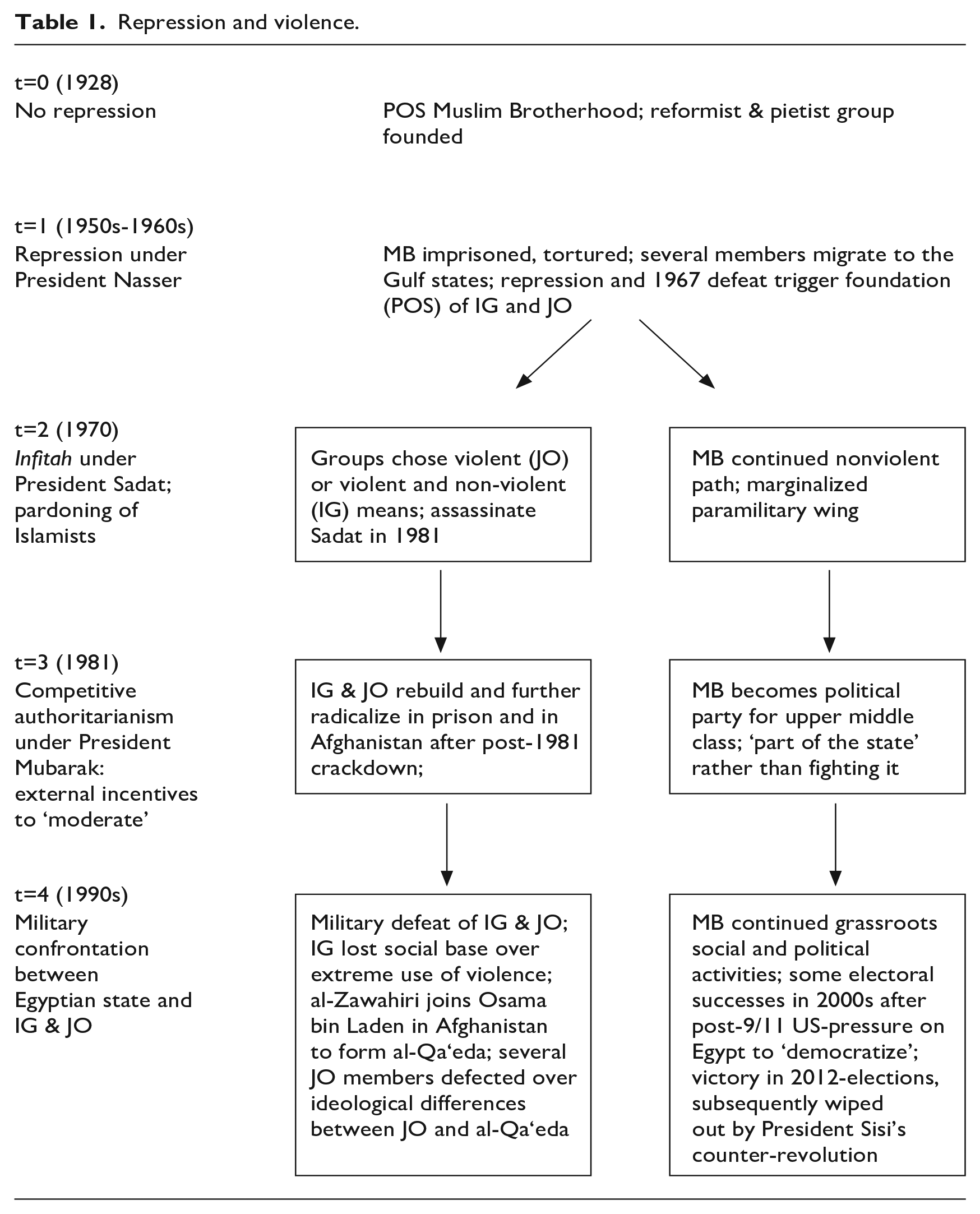
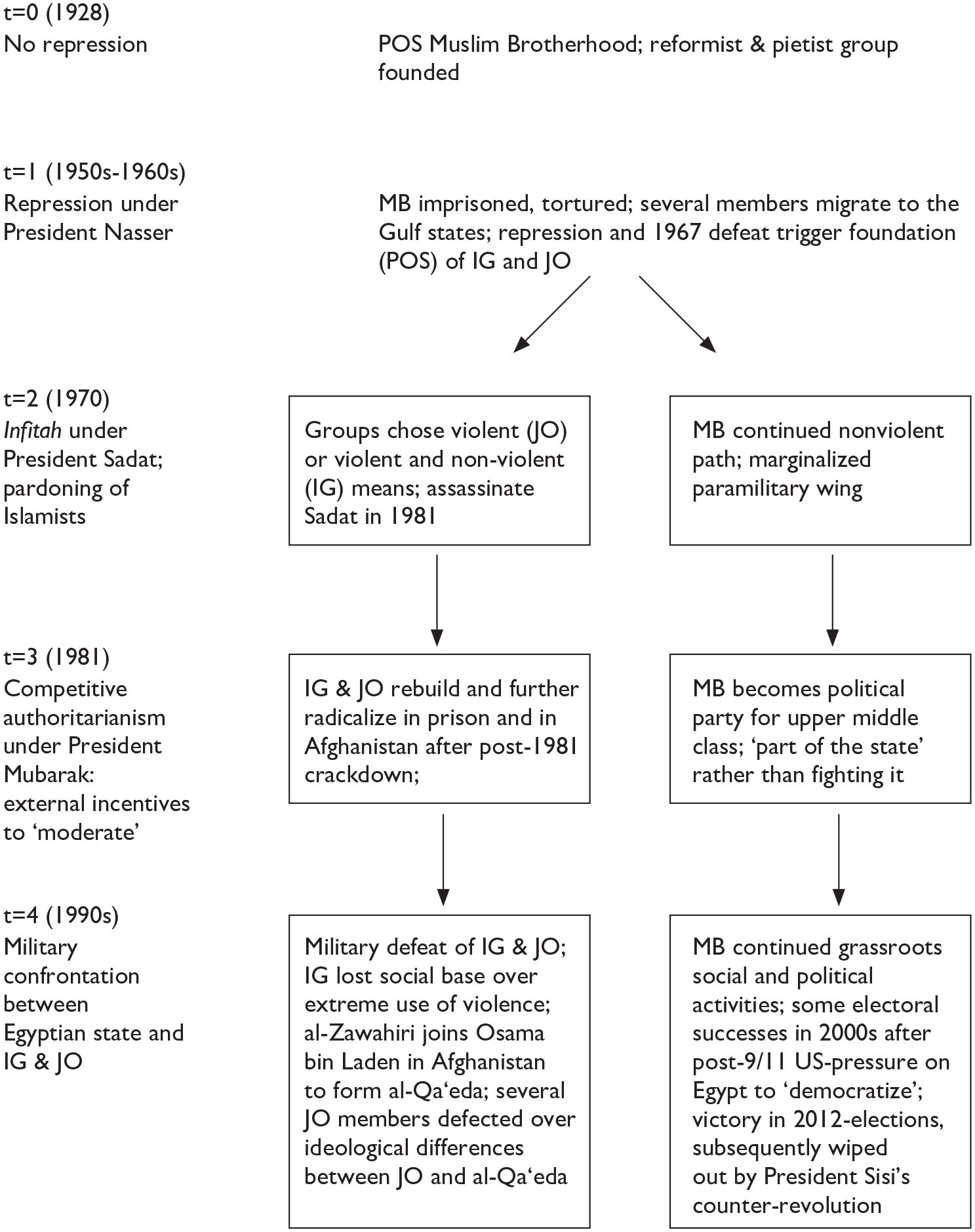
I recognise the objection to treating the three groups as independent, operating in the same field. The groups interacted with each other and competed for resources, particularly for committed members. Furthermore, the IG and JO learned from the Brotherhood’s historical experience which indicates that these groups share an overlapping history that we must appreciate to make claims about the relationships between ideology, organisation, and the use of violence. A case in point for this overlap is the influential Islamist ideologue Sayyid Qutb. Qutb was a member of the MB, and his experience, intellectual production, and debates over them were a product of the intellectual milieu of the Brotherhood and his imprisonment. But notably, Qutb’s late writings were particularly influential on JO and IG to sanction violence against the Egyptian state. Thus, they were distinct groups, but their histories overlapped, they developed in competition and occasional collaboration with each other, they were influenced by Sayyid Qutb to different degrees and subject to repression at some point of their existence.
And yet, despite these historical overlaps, we can observe significant differences in their behaviours. Indeed, JO and IG were obsessed with the MB, constantly distinguishing themselves from them. But why did JO and IG emerge as separate groups from the MB? Why not simply bandwagon with the largest group once the post-repression MB was re-established by 1974? Ironically, the objection to treating the three groups as independent actors highlights an important element of this article’s argument, that groups have to continuously distinguish themselves from competitors to satisfy the expectations of their constituencies to not tip over the organizational–ideological equilibrium within the group. If an important motivation for IG members was to join the IG because the IG was different from the MB, the IG could not easily adopt MB methods or goals without alienating their constituency. Thus, this article recognizes the overlapping history of the groups but disaggregates their ideologies, organization, and recruitment tactics to explain the diverging behaviour towards the use of violence.
This article makes a three-fold contribution. First, the ideological–organisational path dependency shows how existing structuralist, organisational, or strategic arguments fall short of explaining how ideology influences political behaviour and the use of violence. Contradicting expectations of the literature, the article shows that the three groups showed consistent behaviour, that is, whether or not to use violence, despite two exogenous shocks: The organisational exogenous shock of repression in the 1960s did not turn the MB into an all-violent group, and the strategic exogenous shock of the political opening in the 1980s did not lead the groups IG and JO to renounce violence. Second, the article reconciles the camps who consider ideology as either exogenous (non-instrumental) or endogenous (instrumental) by introducing the time dimension to the model. A group’s ideology turns from an endogenous factor in the beginning – it is instrumental for the leadership to recruit an audience – to exogenous – the audience poses exogenous constraints to how the group can behave. Third, and building on the previous point, the article resolves binaries that predict an audience of either true believers or lemmings who just do as they are told. I show that internal politics in rebel groups matter and that the audience constrains the rebel leaders in their choices as much as the other way around. It matters to study individual biographies in their context, recruitment patterns, and ideologies to explain the use of violence (Drevon, 2022: 6).
Existing explanations
Following the rise of Islamist groups as political actors since the 1960s and 1970s, scholars engaged with the political theory of various Islamist movements (Clark, 2006; Fandy, 1994; Kepel, 1986). In this article, I refer to Islamism as Islamic activism and ‘Islam as a modern ideology and political program’ (Cook, 2017: xviii; Hegghammer, 2010: 3). It can be understood as an ‘anti-secular religio-political ideology and interrelated holistic lifestyle orientation which insists that any aspect of individual and collective human life must strictly follow God’s supposed will’ (Müller, 2014: 1; Thurston, 2016).
Employing this actor-centred definition of Islamism translates into recognising Islamists as social movements, which comes with a significant advantage (Lacroix, 2011: 6). It highlights the plethora of varying political goals and behaviours of the different Islamist groups instead of relying on religious actor labels such as Salafi or Wahhabi (Hegghammer, 2010: 4f). For example, the spectrum of Salafi groups ranges from politically submissive Salafis (such as the Madhkalis or Jamis) to militant Jihadis. As Thomas Hegghammer has shown, the rationale of Islamist groups can be as diverse as state-oriented, nation-oriented, pan-Islamist Umma-oriented, morality-oriented, or sectarian (Hegghammer, 2010: 6). As we can identify both violent and non-violent groups in each category, the rationale itself does not inform us about a group’s beliefs about violence. Groups can deploy violent or non-violent means for instance to acquire state-power or correct public morale. While groups rarely represent ideal-types of a category, we can, anticipating the empirical findings of this article, classify the mainstream Egyptian MB as ‘reformist’ and ‘pietist’ (state- and morality-oriented, non-violent) and the JO as socio-revolutionary (state-oriented, violent: ‘fights for state power against a Muslim regime perceived as illegitimate’). The IG as a blend of vigilantist (morality-oriented, violent: ‘use violence to correct moral behaviour of fellow Muslims’; the IG also relied on non-violent preaching) and socio-revolutionary (state-oriented, violent). The typology is productive as it establishes an analytical link between the ideology, political goals, and the means of a group. It therefore helps to observe the group’s long-run approach towards violence. It does not, however, help to explain why a group resorts to violence while another does not.
Scholars have developed explanatory frameworks for exploring the relationship between social movements and violence. In an organisational approach, Wendy Pearlman argues that it was in the first place the fragmentation of a group that facilitated the use of violence (Pearlman, 2011). Only cohesive movements could provide coordination that non-violent protest requires while organizational fragmentation generated factional competition and incentives for violence (Pearlman, 2011: 2, 7f). Following Pearlman, we would expect that widespread imprisonment should weaken the cohesion and central command and control of a group, causing an increase in the use of violence. But during President Nasser’s repression in the 1950s and 1960s, for instance, large parts of the MB leadership and members were arrested but the MB did not turn to violence. In fact, the opposite happened. While it took until the 1970s to complete, the MB over time solidified its non-violent approach, ostracised its paramilitary wing and individuals inclined to violence left the MB to join militant groups instead. And several of these MB splinter groups did turn to violence (e.g. the 1965 group) (Al-Arian, 2014: 153). The MB rather suffered the loss of committed members than tipping over the ideological–organisational equilibrium by turning into a militant organisation.
Ches Thurber focuses on the group’s structure of social support. He argues that groups whose base of support is ‘limited and segmented from the rest of society and the regime along ethnic, religious, or other social cleavage will feel compelled to turn to armed force’ (Thurber, 2015: 17f). The IG, for example, was indeed segmented from security services and state bureaucracy along a core-periphery divide, which contributed to an escalation of violence between IG and the state. For Thurber’s approach to hold, we should have observed the JO, a group that consisted of functional elites and military officers, to use social overlap with society and regime to create elite defections for non-violent mobilisation but we have not. Instead, the JO became a group which rested its activity on violence only.
Peter Krause argues that the use of violence in nationalist movements was a function of competition and relative power (Krause, 2017). Krause finds that the smallest and weakest groups within nationalist independence movements were more likely to employ escalatory violence to rise in the movement’s hierarchy in contrast with hegemonic movements with one dominant group to achieve statehood. While there is evidence that there were inter-group tensions, particularly towards the MB by the other two for the Brotherhood’s moderate stances, this did not lead to violent clashes. The MB did not take up arms, and the JO and the IG even cooperated to assassinate President Sadat in 1981.
The terrorism and democracy literature explores whether open political space leads to increased or reduced levels of violence (Chenoweth, 2013; Ron, 2001). It suggests that democracy and the opening of the social space demobilises violence. But the empirical evidence is contradictory. Although the 1970s under President Sadat offered more social space for the Islamist groups, the decade witnessed a significant uptick in violent activity by the IG and the JO while at the same time the MB solidified their non-violent behaviour. The IG and the JO built up violent capacities when they were granted the space to act, leading to violent clashes with leftist groups on university campuses, the enactment of the Hisba practice to police public morale, and more intensive violence against Coptic Christians running liquor stores (IG). The groups moved on to infiltrate the Egyptian army in preparation of a coup attempt, to assassinate President Sadat in 1981, and to attack the Egyptian embassy in Pakistan with explosives in the 1990s (JO). The opening-curbs-violence hypothesis is limited because it disregards the repression in Egyptian prisons previous to the opening in the 1960s which facilitated radicalization and the establishment of networks among violent individuals. 1 Thus, the previously presented approaches were widely agnostic on the relationship between ideology and the use of violence. This is puzzling, given that the political science literature on civil wars engaged extensively with the link between ideology and violence (Hoover Green, 2016; Leader Maynard, 2014; Sanín and Wood 2014; Thaler, 2018).
Argument and mechanism
Drawing on the civil war literature, I suggest, therefore, to re-introduce the study of the groups’ ideologies. I follow Thaler (2018), building off of Sanín and Wood (2014) and Thaler (2012), in defining ideology as ‘relatively clear, coherent sets of beliefs or ideas that define a constituency and what sociopolitical goals and actions should be pursued in that constituency’s interests, at times with prescriptions as to the strategies best suited for achieving these goals’ (Sanín and Wood, 2014; Thaler, 2018: 17, 2012). Rather than as a fixed programme to guide people, I understand ideology as binding individuals with varying interests and degrees of commitment together as constituency and creating limitations through an internal equilibrium of ideology and constituency, how far the organisations can change their goals and means in the future.
This article argues that the founding ideologies establish a long-run equilibrium between the group’s choice of strategy regarding violence and its membership. As the ideology develops in response to a specific POS, it attracts a corresponding constituency into the group which in turn reinforces the ideology and subsequently binds the group how it can behave. A path dependency develops as the founding circumstances of these groups generate an ideological, rather than structural or organisational, explanation for the later use of violence. 2 Highlighting the downstream effects of repression, the MB was not repressed at their foundation (t = 0) but long after the group’s formation (t = 1) which evidently led the mainstream MB not turn to violence. While not immediately subject to repression themselves, the JO clusters were founded in response to repression of fellow Muslims (t = 0) paving the way for a violent group (t = 1). This is not to say that groups do not make mere strategic choices to react to short-term developments. The IG for instance avoided anti-state violence in 1974–1977 as a move of strategic reordering to rebuild their social base. This did not, however, alter their stable ideological–organisational equilibrium as a violent group, participating in the assassination of President Sadat in 1981. A group with a non-violent ideological–organisational equilibrium, on the contrary, would not strategically turn to violence which would upset the equilibrium and potentially endanger the existence of the group as committed members might defect. The article demonstrates that the distinction between instrumental and non-instrumental ideology is not absolute but that the camps can be reconciled. The ideological–organisational path dependency creates an internal equilibrium between ideology and constituency as ideology turns from an endogenous (instrumental) at the foundation of the group to an exogenous (non-instrumental) factor over time as the group matures. Ideology then serves as self-selector for membership.
The groups’ constituencies are not arbitrary, however. They have in common that none of them belong to the religious elite, having successfully recruited middle- or upper-middle-class individuals from institutions which used to be the strongholds of the Marxist youth in the universities’ most elite faculties, such as medical and engineering, rather than religious institutions (also see Gambetta and Hertog, 2016). There are important differences, however. Upon foundation, the groups attracted, in general, devout upper middle class (MB), ardent lower middle class in Upper Egypt (IG) or revolutionary constituencies largely from the military and functional elite (JO). 3 By joining the respective groups, individuals committed to these causes and were socialised accordingly, for instance to reform society from the bottom-up (MB) or to overthrow the allegedly illegitimate government (JO). Thus, path dependency sets in when members collectively develop specific expectations about the purpose of the group. The group cannot easily change the cause (and means) it has committed to without losing credibility which might cause members to leave and join another group (Oppenheim et al., 2015). A constituency of ardent individuals who harbour deep resentment against the regime is much more likely to be attracted by revolutionary aspirations. Through further recruitment and socialisation into the group, the groups develop an ideological–organisational stickiness, prone to the use of violence (and for non-violence vice versa). This is not to say that a group’s behaviour remains unchanged until the end of time (Leader Maynard, 2019: 646; Drevon, 2022: 2). New POSs can alter the equilibrium in a group, provided that there is a substantial generational or ideological change, ranging from the re-interpretation of existing sources to new intellectual production.
Discussion
The origins of Islamist activism in Egypt: The MB
School-teacher Hassan Al-Banna (d. 1949) founded the Brotherhood in Ismaʿiliyya in 1928 in response to the colonial presence of the British, which explained why the MB was present particularly in the Canal Zone and those parts of the country that were exposed to British occupation and not in the entire country (Frampton, 2018: 11f; Mitchell, 1993). Anti-colonial nationalism dominated the general political context and the European domination of the Islmaʿiliyya shaped al-Banna’s political theory in which he identifies the external colonial power as the main enemy (Kepel, 1986: 37). Al-Banna’s anti-Western and anti-colonial stance was not only informed by British colonial political power but also Protestant evangelical missionaries in the Nile valley. Beth Baron collected numerous reports of incidents caused by enthusiastic evangelical proselytizing attempts and how opposing evangelicals became a central goal of the reform organization – which later became the MB – that al-Banna and his friends started (Baron, 2014: 118). It shows that the missionaries not only kicked off al-Banna’s Islamist activism but that the MB also imitated the missionaries’ tactics to win popular support, such as building schools for boys and girls and welfare institutions helping to construct factories or set-up a branch of Muslim Sisters to counter the ‘Bible women’ (Baron, 2014: 133). The MB was a new form of religious reformist propagation, particularly in urban areas while the country-side remained associated with Sufi (Catholic) domination. The MB’s POS was inclined to an anti-colonial reformist Islamisation of Egyptian society, rather than to a revolutionary overthrow of the incumbent regime.
To show how an ideological–organisational path dependency developed that reinforced the MB’s gradualist character, we ought to consider the MB’s relationship with politics, violence, and recruitment.
First, politics: For al-Banna, the political system was a natural result of society, and therefore, achieving political change required social change first (Fayed, 2017: 245). Particularly in its early days, conditioned by the POS, the Brotherhood championed gradual social reform, preaching and religious education, advocating for a gradualist Islamisation of society, starting with the individual, then the family, the community, and eventually, the government (Johnston, 2007: 40). Although the Egyptian monarchy held parliamentary elections since 1924, the Brotherhood only got involved with politics by 1939, participating in the parliamentary elections in 1942 and 1945. Subject to substantial debate in the field, the reason may have been that the group was only politicised over time or that al-Banna merely made a strategic decision to join politics when the group had the means to do so (Fayed, 2017: 245; Mitchell, 1993: 103). In either case, al-Banna rejected any revolutionary aspiration, after all. 4
Second, violence: The pre-1960s MB did resort to violent means in form of its para-military wing, the ‘Secret Apparatus’ (al-jihaz al-sirri), officially known as (al-nizam al-khass: ‘Special Section’) which has been established at some point between the 1930s and the 1940s and was only dissolved by the 1960s (Hegghammer, 2020: 42; Kamal, 1989: 22, 149–195; Lia, 2006: 78ff; Mitchell, 1993: 31;). An outbidding competition between the MB and the nationalist Wafd party led to clashes between the groups’ youth in 1946, the first incident in a 6-year period with violent clashes (Mitchell, 1993: 48). In 1947/8, al-Banna sent a battalion of militarily-trained Brothers to fight in Palestine under the command of the Egyptian military, as the Palestinian cause had mobilised the MB due to its anti-British and anti-Zionist sentiments for more than a decade (Mitchell, 1993: 56f). At the same time, the MB’s ‘secret apparatus’ conducted violent attacks, particularly against the British, and the Egyptian police in the Suez Canal between 1946 until the British withdrew (Frampton, 2018: 191; Hegghammer, 2020: 42). While al-Banna’s rhetoric sanctioned a broad definition of both violent and non-violent forms of Jihad, he did not advocate for the overthrow of the state and avoided confrontations with the state (Frampton, 2018: 38).
A subsection (‘Muhammad’s Youth’) split from the MB in 1939, adopting a more radical approach and using violence against the British. If the use of violence was merely a strategic decision, the MB should have sanctioned violence to avoid losing committed members. In contrast, the MB organisation suffered a loss of committed members rather than changing ideologically. The mainstream Brotherhood viewed the violent episodes in the 1930s and 1940s as insubordination of the Secret Apparatus rather than as al-Banna’s orders (Frampton, 2018: 146).
The episodes of violence in the 1940s and 1950s gave way to repeated accusations that the Egyptian Brotherhood accepted violence under the table if it served their interests (Trager, 2017). The Brotherhood indeed maintained some ambiguity in this matter (Haykel, 2016: 73). For example, MB leader Muhammad al-Ghazzali condoned the assassination of the anti-Islamist publicist Faraj Fawda in 1992 – not conducted by the Brotherhood though – prioritising the Brotherhood’s opposition to artistic and philosophical freedom over the acceptance of the parliamentary system (Meijer, 2009: 27f).
Thus, it is worth exploring historical episodes in which the MB did not opt for the use of violence although it would have advanced their goals. First, the moderate Hasan al-Hudaybi succeeded al-Banna, who was assassinated in 1949, likely by the Egyptian state, as the Brotherhood’s supreme guide in 1950 and aspired to dissolve the Secret Apparatus which he viewed as liability (Hegghammer, 2020: 42; Kamal, 1989: 84). While it took until the late 1960s to dissolve the unit entirely, al-Hudaybi had weakened its influence significantly (Al-Hudaybi, 1977; Zollner, 2008: 23). This is particularly noteworthy, given the mounting repression from 1954 until President Sadat’s opening policies in the early 1970s.
If imprisonment and torture were the sole decisive criteria for the use of violence, we should have seen the MB develop into a violent-prone group. Instead, the ideological–organisational path dependency proved resilient against repression. The group created a culture of mihna (ordeal), a collective feeling of victimisation by the state, which cherished endurance of violence and repression (Hegghammer, 2020; Ranko and Yaghi, 2019: 72f). Thus, the MB developed internal mechanisms to cope with repression rather than changing its ideological stance on violence. There are two major instances to underline this claim. First, after the MB supported the 1952 revolution of the Free Officers movement, Nasser blamed a 1954 assassination attempt on his life on the Brotherhood and arrested vast numbers of Muslim brothers or pushed them into exile, particularly to Iraq, Syria, and Saudi Arabia. The savage torture in the Egyptian prisons alienated some Muslim brothers to leave the path of non-violent Islamic activism and created the POS for the violent JO and IG. The MB, however, doubled down on its reformist path. Muslim brothers who opted for violent resistance against the state were successfully challenged, marginalised or excluded from the group to maintain the groups rejection of violence. If the MB had accepted the zealous members’ violent strategies, these members would not, arguably, have left the organisation. Under Sadat’s opening policies, the MB leadership was given amnesty after some 20 years in prison to cautiously rebuild their movement. Despite the lack of senior leadership and fragmentation, the MB showed a remarkable continuity. While there was a great deal of internal debate how to revive the movement, the group maintained its clear anti-militant stance (Al-Arian, 2014: 82f, 96, 172). The ideological resilience of the MB, not to turn to violence despite fragmentation and two decades of imprisonment, provides corroborating evidence that the ideological–organisation equilibrium has an important impact on a group’s relationship with violence.
A competing explanation for the Brotherhood’s decision not to turn to violence in the 1960s is a tactical choice as a violent campaign may have been a suicide mission for the organization. In this reading, refraining from using violence was an organizational survival move rather than a result of the ideological–organizational equilibrium. And while this is a plausible explanation, there are two arguments that favour the ideological–organizational explanation. First, as shown above, Brotherhood members who favoured the use of violence left the organisation. If this was a mere short-term tactical choice, we might have assumed that committed members would have stayed for future violent operations. Second, and more importantly, a mere tactical choice would imply that the organization had a violent comeback when the repression decreased since we could reasonably assume that a tactical choice of non-violence would serve the purpose of surviving an episode of existential threat to subsequently switch back to their default mode of violent conduct. The strategic rebuilding of the IG and JO in the late 1970s in preparation to assassinate President Sadat is an example for tactical non-violence. The MB, however, did not have a violent comeback subsequently. Thus, it is rather unlikely that this was a mere tactical choice. However, this is not to say that this article draws a direct line between al-Banna and this decision in the 1960s. Instead, the new Brotherhood leader Hasan al-Hudaybi’s book Preachers not Judges further entrenched non-violent activism in the organization. It is an episode of a critical juncture that speaks to how an organization can produce and integrate novel intellectual production into their intellectual frameworks to stabilize the ideological–organisational equilibrium.
Second, subsequent to the brief interlude as leading the Egyptian government under President Mohammed Mursi (r. 2012–2013), the new Egyptian military-led government cracked down mercilessly on the Brotherhood, wiping it off the map of Egyptian politics. In 2013, a new generation of young Muslim brothers demanded to break with the MB’s stance of non-violent activism and to fight the state. As a significant number of senior leadership were arrested or fled into exile, the MB had to replace some 65% of its leadership, with many young Brothers voted into office who questioned the non-violent approach (Fahmi, 2018: 2). But rather than unleashing a violent campaign against the state, the MB fragmented over this issue, which produced a hung leadership struggle between the exiled historical leadership that rejected violence and a competing new leadership embracing violent means by re-defining the ideological foundations of the group. With only a small number of militant brothers – but a significantly larger group of defecting brothers to Jihadi groups – and a historical leadership that maintained control over the organisation, the group did not flip to militancy despite the incentive to do so. This episode showed how the new leadership almost tipped the equilibrium. It demonstrates that ideology does not dictate a group how to behave but that the equilibrium between ideology and organisation determines a group’s behaviour. The rapid replacement of a vast number of leaders of a group might well lead to the re-interpretation of ideological foundations and changing behaviour over time if the new leadership has the capacity to do so. The historical leadership prevented the group from turning violent for ideological and power-political reasons as they likely would have lost control over the group. While not exhaustive, these were temptations for the MB to embrace violence to advance their interests. It demonstrates how the group’s ideology morphed from being an endogenous factor at the foundation to an exogenous factor which constrained its behaviour, preventing it from turning to an all-violent force. The group rather lost a significant number of committed members to militant groups rather than altering the ideological–organisational equilibrium.
Third, constituency and recruitment: 5 The founder al-Banna recruited from both the working and middle classes, particularly professionals in the Canal Zone and Delta (Baron, 2014: 121). And while agrarian workers were not entirely absent from the Brotherhood’s supporters, they were underrepresented compared with employees in commerce, government bureaucracy, and the professions (Fandy, 1994; Ketchley et al., 2022: 24; Mitchell, 1993: xiv FN 23; Reed, 1993). While the early MB recruited to some degree from the working classes as well, the successive evolution of the MB, particularly subsequent to the 1970s, solidified it as representative of a structure for urban social and professional advancement (Stein, 2011: 865). This largely supports the classification of the MB as a middle-class organisation, inclined towards reformism rather than revolution (Kepel, 2006). The constituency of the MB has been a consistent advocate for a reformist, mostly non-violent, course of action.
In the 1980s, the MB succeeded in translating its middle-class constituency into electoral gains, as Hosni Mubarak’s competitive authoritarian system allowed them to participate as political party in elections (Brownlee, 2007; Levitsky and Way, 2010; Stein, 2011). The Brotherhood benefitted from its professional middle-class base which provided political expertise that the young members who were co-opted from the Islamist student movement in the 1970s collected in professional syndicates. They were competent beyond demanding the implementation of the shariʿa, in pressing social issues such as curbing unemployment, inflation, or corruption. Rejuvenated with newly co-opted IG student members, the Brotherhood managed to establish links to student movements on campus and to win elections in the medical, engineer’s, or pharmacists’ syndicates in the 1980s (Al-Arian, 2014: 85; Meijer, 2009: 25f).
This section identified the gradualist character of the mainstream MB. Established as a force to gradually Islamize society and state, the Brotherhood survived two major external shocks. First, despite the savage repression and imprisonment of its leadership in the 1950s and 1960s, the group did not flip to violence. Instead, militant individuals defected to join Jihadi groups. It speaks to the resilience of the ideological–organisation equilibrium that prevented the group from turning to violence. Second, as a result of the post-2013 repression that led to a replacement of the majority of its leadership, the group fragmented over the question of the use of violence. It shows how the ideological–organisational equilibrium was almost tipped over. The influx of a large number of new violent-prone leaders and members led to a renegotiation of its ideological foundations to sanction violence that was only prevented by the exiled historical leadership. It created a hung organisation, lacking a clear ideological (what is the relationship to violence?) and organisational (which of the two leaderships is in charge?) equilibrium, leading members to withdraw or to join other groups.
The diffuse re-birth of Islamism in the 1970s: Activism beyond the MB
After the repression of Islamist currents under Nasser, two main drivers revived and diversified the Islamist camp in the 1970s. Internationally, the Arab defeat against Israel in 1967 was perceived not only as a military defeat but of the entire developmentalist Arab republics and Nasserism itself (Fahmy, 2017). Second, Nasser’s successor President Sadat opened the social and religious space for Islamists to balance against communist groups, particularly on university campuses, as he turned his back on Nasser’s socialist policies. It created the space for and facilitated an Islamic revivalism in Egypt, especially among university students (Al-Ansari, 2001; Ibrahim, 2016: 302). The early 1970s saw a diffuse Islamist camp as the various new streams were ideologically underdeveloped and lacked senior leadership. Over time, they grew into maturity, defining goals and ideologies in response to and by influencing Egyptian and international politics.
In contrast with the MB, militant groups emerged in the 1970s, too. The repression and torture of Islamists under Nasser in the 1960s radicalised many Islamists and facilitated the emergence of violent socio-revolutionary Islamist groups, which strove for toppling the regime and replacing it with an Islamic state. Clandestine groups formed all over Egypt. The rather disorganized groups consisted of alienated students, appalled by the regime’s violence against fellow Muslims and infuriated by the 1967 defeat (Drevon, 2022: 51; Wright, 2002). Ideologically, socio-revolutionary Islamists, particularly the JO, were significantly influenced by Sayyid Qutb’s most radical book Milestones in which he identified all current regimes in Muslim lands as infidels that needed to be fought (Calvert, 2018; Qutb, 1964: 283). Qutb assessed that the jahili (idolatrous condition; a state of pre-Islamic ignorance) regime challenged God’s sovereignty (hakimiyya) by ruling through man-made law and subjecting Muslims, including himself, to torture. By declaring the incumbent regimes infidels (takfir), Qutb considered peaceful reforms a spent force and sanctioned jihad against them to establish an Islamic state, implementing the Divine right of hakimiyya (Ibrahim, 2016: 301). Qutb’s elaboration on the twin concepts of hakimiyya and jahiliyya was a productive cognitive map for these individuals and groups to condemn the existing regimes in the Arab world and to authorise violent rebellion against them (Haykel, 2009: 48, 50). His writings resonated with Islamists who were radicalised in prison and even others who were not arrested themselves. In fact, most of the people who became Qutb’s followers in the 1970s had not experienced repression but considered the repression a hideous crime that had wrested the regime of its legitimacy. It indicates that there is no direct link between imprisonment and militancy. Prison and torture created a constituency for radical ideologies who otherwise would not have existed and who found their gospel in Qutb’s Milestones.
The JO
What came to be known as the JO by the late 1970s, was a merger of multiple separate clusters whose earliest cell was formed by the former al-Qaeda leader Ayman al-Zawahiri in the upper middle-class Cairo suburb of Al-Maʿadi in 1966 (Calvert, 2018: 283). The group was driven by religious zeal and was convinced that the main reason for the country’s trouble was the non-implementation of the Islamic Shariʿa, aiming to replace the secular Egyptian government with an Islamic caliphate (Ibrahim, 2016: 302f; Wright, 2002). Born in the early 1950s, the founding members were teenagers at the time who knew each other from school and gathered in mosques for reading Islamic texts, engaging with the Salafi theologian Ibn Taymiyya (d. 1328) whose books significantly influenced them. Furthermore, Qutb’s work, Milestones in particular, as well as Qutb’s suffering and execution in 1966 contributed significantly to Zawahiri’s politicisation, the development of his political ideology, and the foundation of the socio-revolutionary group.
The activist Islamist practice of excommunication (takfir) of Muslims who do not perform the required Islamic acts and Muslim regimes that do not apply and rule by Islamic law gave the socio-revolutionary Islamists the tools to voice political criticism (Haykel, 2009: 40). The takfir principle sanctions violence against the regime (or individual) that is deemed non-Muslim and therefore legitimates (even demands from Muslims) the armed rebellion (Jihad) against the excommunicated state. On the organisational level, JO was influenced by Qutb’s elitist-vanguardist logic (taliʿa), similar to other armed (left-wing, Guevarist) vanguardist groups that resulted from single-party regimes repressing political participation in the 1960s (Pierret, 2017: 143; Thaler, 2018: 49f). It took until 1980 for the JO clusters to produce their own ideological production when one of their leaders.
Muhammad ʿAbd al-Salam Faraj provided with his pamphlet Al-Jihad al-Farida al-Ghaʾiba (Jihad: The Neglected Duty) the ideological tools to condense Qutb’s and Ibn Taymiyya’s writings into instructions to overthrow the contemporary regime. He argued that the neglect of Jihad was the reason for the humiliation of the Muslim nation (Umma). With the pamphlet, Faraj sanctioned violence against the state as it was governed by ‘infidels’ refuting any non-violent means. While the arguments were not new to the Jihadi scene, Faraj was the first one to condense the arguments in a book and apply them to the regime (Ibrahim, 2016: 306).
The JO recruited its followers mainly from Lower Egypt (Cairo and the Delta) and was unified in 1979 with three other socio-revolutionary Jihadi groups whose numbers multiplied by the mid-1970s. Al-Zawahiri and his cluster who met in school aspired to expand membership by recruiting specifically army officers, such as ʿIsam al-Qamari and ʿAbbud al-Zumar, to prepare for a military coup which they saw as the most effective way to topple the regime. It took until the late 1970s that like-minded socio-revolutionary groups discovered each other, including Al-Zawahiri’s cluster. Four of them merged into what became known as the JO (aka Egyptian Islamic Jihad) under the leadership of Kamal Habib and Muhammad ʿAbd al-Salam Faraj (Drevon, 2022: 67f). The JO did not unleash its violent campaign against the state immediately, however, and spent a good part of the 1970s with recruitment and capacity building. The group attempted to infiltrate the army before initiating the military coup (Ibrahim, 2016: 303–305; Zayyat, 2004: 21).
The JO’s recruitment patterns differ starkly from the urban middle-class MB. The officers joined the JO rather than any other group because they hoped for launching a coup against the regime. Thus, underlining the argument of this article, the long-term affiliation of the JO to violence can be traced to its constituency’s ideological convictions and recruitment for conducting violent attacks against the state. Individuals who were inclined to revolution and violence joined the JO rather than the reformist MB, reinforcing the JO’s socio-revolutionary ideology. 6 In fact, Ibrahim (1980: 434f) cites in his study of imprisoned Egyptian Islamists in the late 1970s the disillusionment among young Islamists about surviving members of the Brotherhood as a motivation to find their own organisation.
The IG
Like the JO, the IG is a product of the diffuse Islamist mobilisation in the 1970s. The IG started off to become the dominant Islamist student movement in the country by acting as umbrella organization for various shades of Islamist movements until 1976. Two aspects eventually led to the fragmentation of the group along ideological lines. First, Jihadist attacks against state institutions by other groups as well as President Sadat’s socio-economic reform projects and rapprochement with Israel facilitated internal debate how to position the group and brought the growing disagreements between the various strands into the open. Second, as newly established student movement, the IG lacked senior leadership which led a significant number of IG leadership and members to join the MB in the second half of the 1970s. With most of the student leadership co-opted into the MB, the student movement split along ideological lines by the late 1970s, Salafi and Jihadi students starting to organize their own student groups, eventually forming the militant IG (Al-Arian, 2014: 155).
Thus, it was not before 1978 that the IG moved beyond its role as umbrella organisation, with a particular stronghold in Upper Egypt (Assiut, Minya) (Al-Arian, 2014: 171; Mulana, 2018: 3). Influenced by Sayyid Qutb and Salafi theologians such as Ibn Taymiyya, the group adhered to a theology that not only proscribed a distinct dress-code but also the use of force to change inappropriate non-Islamic behaviour (Mulana, 2018: 4). The IG mobilised its constituency with a focus on social justice and religious practice, rather than transnational pan-Islamist causes (such as the MB) or the excommunication (takfir) of the Egyptian government (JO), appealing to university students from the lower and middle working classes. The vast number of IG’s followers were from among the poor, but most leaders benefitted from upwards educational mobility, coming from modest backgrounds (see the former IG member’s autobiography: Al-Berry, 2016: 7, 94). Upper Egypt’s feudal socioeconomic hierarchy was cracked open through upwards educational mobility to universities which created a good part of IG’s constituency, contrasting with the MB’s urban elite. The IG, however, did not accept just any young man into their ranks:
Thus someone who was well-spoken, well organized in his daily routine, family-oriented, and obedient to his parents would always be sympathetic, but would never go beyond that limit. The ardent individual, however, who loved adventure and harbored a deep sense of resentment, would be more likely to commit himself, if he showed any understanding of our cause. (Al-Berry, 2016: 94)
This account from the late 1980s shows how the revolutionary ideology had developed into an exogenous factor, as organisational self-selector who joins the IG.
The early IG used both non-violent and violent society-centred tools, Daʿwa (preaching) and Hisba (moral policing), to spread its message. The practice of Hisba, or al-amr bi-al-maʿruf wa’l-nahy ʿan al-munkar (Enjoining Good and Forbidding Evil), has been an important duty in IG’s understanding of Islam, similar to the Hanbali-Wahhabis in Saudi Arabia with whom the IG had great affinity (Al-Anani and Malik, 2013: 59f; Stein, 2011: 868). As the IG did not shy away from applying the Hisba ‘by the hand’ (bi-l-yad) to correct what they saw as un-Islamic behaviour, such as by leftists on campus, Coptic Christians’ liquor stores and mixing of genders – which resonated with social conservatism in Upper Egypt – the IG conducted society-centred violence. Furthermore, the group possessed strong anti-Christian and anti-Sufi sentiments which are common among various Salafi groups (al-wala wa’l-bara). The IG exploited this concept and forced its members to cut off all relationships with those who did not share their beliefs (Al-Berry, 2016: 13–15). Thus, the high in-group-out-group distinction sanctioned society-centred violence and increased the group cohesion through costly signalling, significantly raising the cost of defection. To hold the balance between violent and non-violent means, the IG leadership kicked out even accomplished brothers if they posed a threat to the group’s ideological coherence. Former member Al-Berry reports how the leadership beat up and probably killed a ‘Brother of “81”’ – an honourable term for those IG members involved in Sadat’s assassination – who exclusively advocated for armed confrontation with the regime (Al-Berry, 2016: 101). The group turned against its members, rather than accepting a threat to its internal equilibrium. The ideology served as internal organizational mode to bind the individuals together to create a cohesive revolutionary group.
IG’s extensive Hisba practice against Marxists and Nasserites – outbidding their leftist competitors (Pischedda, 2018) – led to clashes with the leftists and eventually with the state. Towards the late 1970s, the IG had become notorious for intimidating students and citizens, breaking up cultural festivals, preventing singing or forbidding mingling of the sexes (Meijer, 2009: 14f). The IG’s Hisba practice reached horrific levels of violence, as former IG member Al-Berry (2016: 92) reports:
Who would have expected that two Christian men would have dared to have sex with two female Muslim university students? The [IG] brothers didn’t hesitate when it came to those two. They beat one of them to death and broke the other’s back, then cut off one of his ears. If such mixing had been prevented in its initial stages, things would never have got to this point. As custodians of the society, as guardians of its morals, as those who sought its good, this was our special role.
The IG’s hands-on interpretation of Hisba is a potentially subversive practice as the ‘policing’ challenges fundamental tasks of the state. It became a violent competitor to the state’s institutions rather than an immediate violent attack against them. The inevitable push-back by the state against IG’s Hisba practice in the late 1970s expanded IG’s society-centred violence into the realm between IG and the state. Supporting Thurber’s argument, this escalation was exacerbated by the exclusion of Southerners from the police force and law enforcement (Thurber, 2015). The retaliatory violence was culturally sanctioned as ‘vendettea’, rather than religiously, since ‘the ideas of an eye for an eye and of the blood feud are sacred to those from Egypt’s south’ (Al-Berry, 2016: 81). Thus, IG’s Hisba practice, the state’s push-back and IG’s retaliatory violence led to a cycle of contention and the IG to start to train with weapons in the hills of Assiut in Upper Egypt (Meijer, 2009: 14f). It forced the IG to look for allies in the late 1970s to broaden their social base in Lower Egypt. Rejecting the MB as too soft and law-abiding, the socio-revolutionary IG turned to the JO.
Violent escalation and tactical co-operation
The IG and JO were created as clusters and organisations with a militant ideological–organisational equilibrium during times of relative freedom in the 1970s. In addition to immediate factors in the 1970s that I discuss below, the inclination towards violence was a delayed reaction to repression under President ʿAbd al-Nasser in the 1960s, inspired by Sayyid Qutb’s late writings that held an outsized influence on IG and JO. Draconian repression under Nasser followed by complacency and tactical co-operation under Sadat created the groundwork and space for radicalised groups that, equipped with Qutb’s writings, considered non-violent activism a spent force. This not only provides contradicting evidence for the openness-curbs-violence hypothesis which would have predicted the emergence of non-militant groups instead (Ron, 2001). It also explains the groundwork for the assassination of President Sadat in 1981. While the assassination was initially not part of the IG’s agenda, the years between 1979 and 1981 offered three main incentives for the socio-revolutionary Islamist groups to attempt to topple the regime. First, Sadat’s unpopular economic policies and his peace treaty with the ‘Zionist enemy’ Israel boosted the popularity of the groups which led Sadat to dissolving all religious student associations and even banned the niqab on campus in 1979 (Mulana, 2018; Wright, 2002: 6). Second, the Iranian revolution of 1979 had created an ‘atmosphere of possibility for Islamists’ (Stein, 2011: 866). Third, Sadat, facing significant levels of discontent for his economic, social, and foreign policies, launched a crackdown against Islamist, secular opposition groups, intellectuals, journalists, and writers (Stork, 1981; Wright, 2002). The crackdown created an urgency for the IG and JO to act. In the late 1970s, JO leader Faraj and Karam Zuhdi, a leader of the military wing of the IG, agreed to co-assassinate Sadat, to overtake government premises and announce the coup on TV (Al-Berry 2016: 85; Ibrahim, 2016: 306). A cell around army recruit Lieutenant Islambouli assassinated Sadat at a military parade on 6 October 1981 (Stork, 1981). Two days later, the IG attempted to violently take control of the governorate Assiut and to incite the population against the regime. However, inciting a public revolution failed, the perpetrators and most members of IG and JO were killed or arrested (Ibrahim, 2016: 306).
The alliance between IG and JO did not indicate reformed ideologies but mere tactical co-operation. While the tactical co-operation covered up the stark differences between IG and JO, the groups quickly separated in prison over questions of leadership, ideology, and tactics. As it became clear that the IG and the JO clusters would not merge, JO was formed in prison as an organisation as ‘Islamic Jihad’. It maintained its elitist-vanguardist structure striving for a military coup, infiltrating the army and operating in secrecy. The IG on the contrary prioritised their public work in the streets, mosques, and universities through Daʿwa and Hisba (Ibrahim, 2016: 307; Wright, 2002). This included violence against and even killing Christians, raiding their shops to seize money for cars, guns, and equipment. Thus, leadership infighting and the ideological–organisational equilibria proved resilient and prevented the merger.
The ideological–organisational equilibrium of both groups remained intact despite the repression – just like the MB in the 1960s – and despite the arrests or executions of leaders and members. In prison, IG leaders produced intellectual treaties for the IG for the first time. While the MB had renounced violence after the crackdown in the 1960s, the IG reinforced its commitment to Daʿwa, Hisba, and Jihad. Thus, at a time when the MB became the political party of the professional devout middle class in Mubarak’s Egypt, the imprisoned IG leadership laid the groundwork for future violence (Al-Berry 2016: 29-31, 45; The Islamic Group, 1984).
For rebuilding the groups, several JO and IG members went into exile to the Jihadi borderland of Afghanistan and Pakistan in the second half of the 1980s (Hegghammer, 2020: 264f). Several members, leading figures, and potential new young recruits travelled to Afghanistan via Pakistan to join the Jihad against the Soviet Union. The JO recruited fighters with combat and organisational experience and continued their elitist-vanguardist recruitment for waging Jihad in Egypt. In 1987/88 the JO was fully rebuilt (Ibrahim, 2016: 310). It kept their focus on Jihad only, stressing the concepts of takfir and hakimiyya and therefore reinforced the main difference between themselves and the IG which engaged with social and economic issues, too.
With both groups rebuilt, ideologically mobilised and with combat experience from Afghanistan, the ‘calm’ 1980s in Egypt came to an end. The early 1990s saw a wave of violence, with the IG assassinating Christians and Rifaʿat al-Mahgub, the Head of the Egyptian Parliament in 1990 (Cowell, 1990) and targeting tourism, theatres, and bookstores what they perceived as ‘Western culture’ (Wright, 2002). The government responded with a violent crackdown which exposed the increased capabilities of both of the groups as members confessed under torture their combat training in Afghanistan (Ibrahim, 2016: 317). Between 1992 and 1995, at least 471 Islamists were killed, around 30,000 arrested, and severe economic consequences imposed on their families. In response, the JO attacked the Egyptian embassy in Islamabad with explosives, killing the perpetrator and 16 other people, and wounding 60 (Hegghammer, 2020; Wright, 2002: 456).
By 1997, the IG’s and JO’s activities had died down and al-Zawahiri had announced the end of JO’s campaign 2 years earlier. The IG had lost the backing of their constituencies as the price was too high to be sustainable. JO fragmented under the continuous pressure by the regime. Al-Zawahiri and others decided to return to Afghanistan to join Osama bin Laden’s Al-Qaʿeda group as survivalist move (Hegghammer, 2020: 357f; Hirschman, 2004). This reflected a significant change as Al-Qaʿeda’s Global Jihad – attacking the United States – differed from JO’s struggle against the local regime. In fact, several JO members rejected the merger for ideological reasons of fighting ‘the distant enemy’ and refused to join Al-Qaʿeda, including al-Zawahiri’s brother Mohammed who had played an important role in the JO but left the group shortly after the merger (Wright, 2002). The group’s ideology had developed into an exogenous factor that limited Al-Zawahiri’s choices without shaking up the balance of the group’s internal equilibrium and alienating significant parts of the constituency.
The imprisoned historical leaders of the IG on the contrary, launched a non-violence campaign in 1997, to entirely denounce violence, as they were at risk of losing their constituency altogether. With the exception of the bloody attacks in Luxor in November 1997, killing 58 tourists and 3 Egyptians by IG members who had not received news of the non-violence initiative, the group turned away from violence. The group’s social and religious activism allowed the group to maintain a raison d’être, and it was rebuilt to become a minor political force in post-2011 elections. The JO pursued a similar path in 2004, denouncing violence with Dr. Fadl touring the prisons to spread the word. However, this initiative was fiercely rejected by the Afghanistan-based JO-turned-Al-Qaʿeda members such as al-Zawahiri, demonstrating the militant ideology–membership equilibrium of the newly built Jihadist group. In the Egyptian theatre, both groups were militarily defeated.
Conclusion
This article offered an explanation in how far ideology prevents groups from using violence by developing the concept of a path-dependent ideological–organisational internal equilibrium. The evidence demonstrated that the groups proved resilient against external shocks; the MB did not turn violent despite repression and arrests in the 1960s while the JO and IG did not moderate in the political opening of the 1980s. It begs the question, however, how to explain changing behaviour, such as non-violent movements and groups turning violent and how the framework can travel beyond Egypt (for instance, see Belgioioso, 2018; Della Porta and Diani, 2006; White, 1989). In the appendix replication data set of her study of terrorism tactics in mass mobilisation, Margherita Belgioioso provides two case studies of mass civil resistance campaigns that turned to terrorism, the Madagascan Active Forces Mass Civil Resistance (1991–1993), and the Islamic Salvation Front (FIS) Mass Civil Resistance in Algeria (1992) (Peace Research Institute (PRIO), 2018). In the Madagascan case, peaceful demonstrations and general strikes were organised in protest against fraudulent elections and political repression under Commander Didier Ratsiraka. After significant government repression, terrorist attacks were conducted against state targets. Similar to Egypt in the 1970s, violent groups emerged from a non-violent mass movement that was, however, previously not organised as a group. Thus, there was no coherent leadership directing the group or an ideology that the protesters had committed to when joining the demonstrations. There were few path dependencies or group equilibria if any that prevented the emergence of violent groups. A merely loosely organised mass civil resistance movement does not inform us about the future use of violence due to the lack of ideological-organisational coherence of the movement. And while it may be the case that the government’s repression forms the POS of violent groups, we find that the explanatory power of my framework diminishes with decreasing cohesiveness of a movement. A solution may be a comparison between violent and non-violent groups derived from the same movement, acknowledging the blurriness of membership and ideology in social movements.
The Algerian case differs from the Madagascan case as a non-violent group, rather than a diffuse movement, turned violent (Kepel, 2006: 159–184, 254–275). The Algerian government had reacted with electoral manipulation and repression to the electoral success of the FIS, a non-violent political party. The government also arrested a large number of activists and the FIS leadership in 1991 which led to the fragmentation of the FIS, with some members arguing for the use of violence. However, the FIS dismissed both apolitical Salafis and militant radicals from the group to maintain its moderate political tone (Dalacoura, 2011: 105). The FIS’ reluctance to turn violent led several members to defect to join militant groups, many of which led by Algerian veterans of the Afghan Jihad. The defection from FIS continued for several years, and in May 1994, even former FIS leadership joined the major violent Jihadist group GIA (Armed Islamic Group), a move that was fiercely criticised by the FIS leadership in prison and abroad (Dalacoura, 2011: 107–109). Eventually, massive government repression and significant inter-group competition also led the FIS turn to violence by forming the Islamic Salvation Army (AIS), however, with the goal of forcing the government into negotiations with FIS. Appealing to the pious middle class, AIS distinguished themselves from the GIA that aimed at overthrowing the government and building an Islamic Caliphate, similar to the Egyptian JO (Kepel, 2006: 254–260). The FIS showed a remarkable ideological–organisational resilience for several years before the changed POS – defined by continuous heavy handed repression – and a constituency that partly altered its preferences to demand violent measures and continuously defected from FIS, shifted the ideological–organisational equilibrium. It now allowed for tactical violence against the state in conventional war, not terrorism, while adhering to the strategic goal of solving the conflict through negotiations.
The Algerian case supports two findings of this article. First, the stickiness of the FIS’ ideological–organisational path dependency forced the group not to turn violent in the early 1990s although capable members and even leadership defected to join militant groups. This episode is not dissimilar from the Egyptian MB in the 1960s, showing that the group accepts the defection of committed members rather than risking a threat to its equilibrium of constituency and ideology. However, the Algerian case also speaks to the limits of the ideological–organisational equilibrium as the continuous repression by the state and the outbidding competition with the GIA altered the preferences of FIS’ members to use violence. Second, the Algerian case underlines that studying individual biographies matters as individuals with radical inclinations were the first to defect and join militant groups. This resonates with the finding of this article that individual inclinations towards violence partly determined if a recruit joined the MB or the JO, or in the Afghan case ʿAbdallah ʿAzzam’s Services Bureau or bin Laden’s Al-Qaʿeda group. This perpetuates the group’s position towards violence and builds up members’ vested interests in the causes that the leaderships cannot easily trade for tactical gains.
Engaging with the ideological–organisational path dependency highlights that theorising members as true believers or lemmings blindly following their leaders are equally flawed. The article shows that internal politics in rebel groups matter and that the members’ interests and convictions, deeply held long-standing believes or learned in group socialisation, constrain the rebel leaders just as much. It demonstrates that it matters to study group members’ biographies and the socialisation processes for understanding the down-stream effects on the use of violence. It is a challenge to the framework presented in this article that groups oftentimes lack a fully fledged ideology from day 1, as it takes time to establish founding fathers, interpret, or even write books. Such maturation processes are interdependent between recruitment of members, ideological development, and reacting to political events. Going forward, we ought to run broader empirical tests in how far the mechanism can explain the change of political behaviour, too, for instance by studying the biographies in a given influx of new members, how leaderships can credibly develop new charters or re-interpret founding documents without violating the internal equilibrium between membership and ideology.
Footnotes
Funding
The author(s) received no financial support for the research, authorship, and/or publication of this article.
