




Abstract
Research suggests that nonviolent resistance (NVR) campaigns are more successful in deposing dictators than armed rebellions. However, ousting dictators is only the first step in the process of democratization. After deposing an autocratic regime, societies enter a transition phase where they must learn to consolidate the gains of democracy and bargain about the new rules of the democratic regime. But even if free, fair, and competitive elections are held, indicating a successful transition to democratic rule, uncertainty about its stability remains salient. In the period that follows, either democracy survives and proves to be resilient, or an autocratic backslide occurs. In this article, we analyze the effect of NVR campaigns on the survival of democratic regimes. Building on the literature on modes of transitions and nonviolent resistance, we argue that those democratic regimes that come into being as a result of a NVR campaign are less prone to democratic breakdown. The main mechanism which produces this effect is that the organizational culture of NVR campaigns spills over to the subsequent democratic regime fostering conditions favorable for democratic survival. We test the effect of NVR campaigns on democratic regime survival using survival analysis and propensity score matching. The results show that democratic regimes that experience NVR during the transition phase survive substantially longer than regimes without NVR.
Introduction
Since the so-called Arab Spring, there has been a growing interest in the causes and consequences of nonviolent resistance (NVR) campaigns. These campaigns mainly involve unarmed people, using a combination of peaceful tactics such as strikes, sit-ins, and demonstrations to achieve political goals. Resistance campaigns associated with the Arab Spring considerably differed with regard to their use of violence. Whereas the Jasmine Revolution in Tunisia and the Egypt Revolution are usually considered as predominantly nonviolent, the initially nonviolent protests in Libya and Syria soon evolved into armed rebellions, which led to thousands of deaths. In terms of successful transition to democracy, the record of these cases is mixed. Uprisings in Tunisia, Egypt, and Libya led to the ousting of long-term dictators, but at the time of writing, the Syrian uprising did not manage to depose the regime of Bashar al-Assad. 1 Furthermore, ousting dictators is only the first step in the process of democratization. After deposing an autocratic regime, societies enter a transition phase where they must consolidate the gains of democracy and bargain about the new rules of the democratic regime. But even if free, fair, and competitive elections are held, which indicate a successful transition to democratic rule, uncertainty about its stability remains salient. In the period that follows, either democracy survives and proves to be resilient, or an autocratic backslide occurs.
In this article, we build on the literature on modes of transitions (e.g. Munck & Leff, 1997) and on the literature on nonviolent resistance (e.g. Chenoweth & Stephan, 2011) to analyze the effect of NVR campaigns on the survival of democratic regimes. Whereas the former assumes that the characteristics of the transition process can have long-lasting effects on the stability of the resulting democracy, the latter argues specifically that the recourse to nonviolent means is superior in challenging autocratic regimes and increases the odds of democratic consolidation down the line. We argue that those democratic regimes that come into being as a result of a NVR campaign are less prone to democratic breakdown compared with democracies that were the result of violent resistance or those which were installed without any kind of resistance movement. The main mechanism which produces this effect is that the organizational culture of a NVR campaign spills over to the subsequent democratic regime fostering conditions favorable for democratic survival.
Our article advances the literature on NVR and democratization in three ways. First, previous studies either analyzed how democracy changed after a resistance campaign occurred or looked at the outcome of different transition modes without considering how resistance campaigns influenced transitions to democracy. By contrast, our approach is based on a systematic data collection that links resistance campaigns to events of democratic transitions. Second, in contrast to previous studies that look at a snapshot of the level of democracy, we analyze the whole process of democratic survival. Third, we use multiple statistical methods (i.e. survival analysis and propensity score matching) to account for confounding factors and alternative measurement of key variables to ensure the robustness of our findings.
The results of our empirical analysis indicate that democratic regimes that experienced NVR during the transition phase survive substantially longer than regimes without this characteristic. NVR during the transition process reduces the hazard of democratic breakdown by more than 50%. This research may inform the policy debate about whether it is useful for external actors to support resistance campaigns. As noted by Chenoweth, ‘The nature of the struggle [for democratic change] can often give us a good idea of what the country will be like after the new regime takes shape’ (Chenoweth, 2011).
The rest of the article is organized as follows. In the second section, we review related literature on democratic consolidation and nonviolent resistance campaigns. We build on these previous studies to develop our own theoretical approach to the relationship between NVR campaigns and democratic survival, which we describe in the third section. In the following section we describe our research design for the empirical analysis. Results are presented, and then in the final section we discuss the findings of the empirical analysis and highlight areas for further research.
Related literature on nonviolent resistance and democratic survival
Although the study of NVR has a long tradition – its intellectual history can be traced back to Etienne de la Boétie (1975 [1574]) in the 16th century – its explicit link to democratization is relatively new. The academic debate about NVR was initially dominated by Gene Sharp (1973) and focused on resistance against foreign occupation (Sharp, 1959). Historical events such as the (partly nonviolent) struggle against apartheid in South Africa (Zunes, 1999), the first Palestinian Intifada (1987–93; Crow, Grant & Ibrahim, 1990; Stephan, 2003) and the mostly peaceful transitions in Eastern Europe after the end of the Cold War (Hadjar, 2003) spurred a rethinking of resistance, not only against foreign occupation, but also against authoritarian rule.
The empirical investigation of the effects of NVR on democratization was initially confined to descriptive and historical case studies. Practical lessons learned from these cases were compiled as guidelines for implementing NVR strategies (Helvey, 2004) or bringing down dictators (Sharp, 2008). The first large-scale comparative study was conducted by Ackerman & Karatnycky (2005) who analyzed 67 nonviolent and violent democratic transitions using data from Freedom House. They find that countries improved in terms of political rights and civil liberties more substantially after nonviolent transitions compared with violent transitions. Johnstad (2010) replicated the study of Ackerman and Karatnycky using different data to measure the level of democracy. His results support those of Ackerman and Karatnycky, showing that ‘nonviolent mass action’ more often leads to an increase in the level of democracy than violent strategies (Johnstad, 2010: 475). However, in their empirical analysis neither Ackerman & Karatnycky (2005) nor Johnstad (2010) account for confounding factors that influence both the form of transition and the level of democracy after the transition. Furthermore, these studies only analyzed the level of democracy at a fixed point in time after the transition or looked at whether democracy persisted for a given time period.
Chenoweth and colleagues (Chenoweth & Lewis, 2013; Chenoweth & Stephan, 2011) have made an important contribution that systematizes research on NVR and provides more accurate data. The authors compiled detailed data on 323 resistance campaigns in their Non-Violent and Violent Conflict Outcome (NAVCO) database. The main result of their analysis is that nonviolent campaigns have a higher probability of success than other forms of resistance. Campaign success refers to whether the campaign is able to achieve its goals, which often include regime change and transition to democracy (Chenoweth & Stephan, 2011: 39–40). Using NAVCO data, Celestino & Gleditsch (2013) also found that NVR campaigns increase the odds of transition towards democracy in autocratic regimes.
The main mechanism for the success of NVR campaigns is that these campaigns attract a greater number of participants than any form of violent resistance. As argued by Chenoweth & Stephan (2011), NVR campaigns are more attractive to large segments of the population compared with violent forms of resistance, due to their less extreme means. They offer ‘an opportunity to people to participate with varying levels of commitment and risk tolerance’ (Chenoweth & Stephan, 2011: 37). Related to the question of democratic survival, Chenoweth & Stephan (2011: 213) found that NVR campaigns have a significant and positive impact on the probability of a democratic regime persisting five years after the end of conflict. However, Chenoweth & Stephan (2011) only compared the level of democracy in a country after nonviolent and violent campaigns, respectively. Thus, they do not link resistance campaigns with events of democratic transitions and correspondingly also do not consider those cases where democratization was initiated without the influence of a resistance campaign. Furthermore, similar to the empirical studies by Ackerman & Karatnycky (2005) and Johnstad (2010), their analysis only captures the presence of democracy during a short time period after the end of a campaign and therefore does not address the whole process of democratic survival.
As this review of NVR literature shows, previous research largely ignored the long-term repercussions of resistance campaigns. We suggest that research on democratic consolidation provides material to systematically address this issue. There is a growing literature in comparative politics seeking to explain the quality and durability of democratic regimes. While research on the quality of democracies essentially compares existing empirical manifestations of democratic regimes to an ideal type of democracy (e.g. Diamond & Morlino, 2004; O’Donnell, Cullel & Iazzetta, 2004), studies on the durability of democracy address the question of how newly established democracies manage to survive (e.g. Linz & Stepan, 1978; Svolik, 2008; Ulfelder, 2010).
In this article, we focus on explaining the durability of democratic regimes, which we refer to as democratic survival. Conversely, this also refers to explanations of how democracies break down. In general, scholars distinguish three forms of democratic breakdown: (1) executive coup, where a democratically elected government or a faction of the government extends its rule via unconstitutional means and begins to govern autocratically, (2) coup d’état, where actors from within the armed forces depose the elected government, and (3) popular rebellion, where the elected government is toppled by the masses (e.g. Ulfelder, 2010: 3). The main mechanisms that lead to these kinds of democratic breakdown are the erosion of the regime’s democratic legitimacy (Diamond, 1999) and a decreasing commitment of the political elite towards the maintenance of democracy (Linz & Stepan, 1978).
Regarding the causes of democratic breakdown and survival, previous empirical studies focused on socio-economic factors such as economic conditions (Aleman & Yang, 2011; Boix & Stokes, 2003; Svolik, 2008) and redistribution (Acemoglu & Robinson, 2006; Boix, 2003; Reenock, Bernhard & Sobek, 2007) as well as institutional arrangements such as presidential or parliamentary systems of government (Limongi et al., 1996; Stepan & Skach, 1993) and the legacy of the preceding autocratic regime (Cheibub, 2007). In addition, researchers stressed the importance of political instability in the past (Maoz, 1996: 202; Sing, 2010: 445), demographic factors like the overall size of the population (e.g. Gurses, 2011: 173) and urbanization (Przeworski & Limongi, 1997: 158), and the geographic diffusion and spillover of democratic ideas and norms (Boix, 2011; Gleditsch & Ward, 2006).
Notably, research on democratic survival also emphasizes the relevance of the mode of transition. The transition process is interpreted as a founding moment of a democratic regime which strongly influences its prospects of survival (e.g. Guo & Stradiotto, 2010; Munck & Leff, 1997). This argument draws on the idea of path dependence, suggesting that different modes of transition ‘set a society on a path that shapes its subsequent political development’ (Munck & Leff, 1997: 343). However, there is only limited empirical evidence on whether different modes of transitions actually influence the survival rates of democratic regimes in a path-dependent way. The only quantitative study on this subject is by Guo & Stradiotto (2010). Using data on 57 regimes, the authors distinguish four different transition modes: conversion, cooperation, collapse, and foreign intervention. The results of their empirical analysis suggest that a cooperative transition process increases both the quality (measured in terms of the Polity score) and the duration of the democratic successor regime. However, their categorization of transition modes does not account for how resistance campaigns influenced the transition process. Although analytically the literature on modes of transition highlights the relevance of opposition movements and resistance campaigns (e.g. Munck & Leff, 1997), empirical studies that systematically measure this phenomenon are lacking.
This review of related literature suggests that there is promising theoretical and empirical work on the consequences of NVR for democratization as well as the relationship between modes of transition and democratic survival. However, no study explicitly links the two phenomena and systematically tests with comprehensive data whether a transition that was achieved by the means of a NVR campaign is beneficial for the long-term survival of a newly established democracy.
Theoretical approach: How nonviolent resistance benefits democratic survival
We conceptualize the relationship between NVR campaigns and democratic survival as a path-dependent process. Our unit of analysis is the political regime, which refers to the system of government in a state. As specified by Skaaning, a political regime is an ‘institutionalized set of fundamental formal and informal rules structuring the interaction in the political power center (horizontal relation) and its relation with the broader society (vertical relation)’ (Skaaning, 2006: 13). Since our main interest is the survival of democratic regimes, we use a categorical classification of regime types, only distinguishing between democratic and autocratic regimes. Our definition of democracy is drawn from Ulfelder (2010) who elaborates on the theoretical work of Robert Dahl (1971). Ulfelder defines democracy as a regime type where ‘citizens freely and fairly choose and routinely hold accountable their rulers’ (Ulfelder, 2010: 4). He distinguishes four dimensions that characterize a democratic regime, namely representation, contestation, freedom, and inclusion. Representation is present when elected officials rule the regime. Contestation means that elections are fair and competitive. The dimension of freedom relates to the respect for civil liberties and inclusion means that citizens are able to participate in government (Ulfelder, 2010: 4–5). We consider all regimes meeting these criteria as democratic regimes and those not meeting them as autocratic regimes.
When switching between these two categories, regimes experience a transition event, that is, a change of regime type. The transition phase is a period of radical change, where the design of the political order is being renegotiated. With regard to the direction of the transition events, we consider two different forms. First, democratic transition refers to the transition from an autocratic regime to a democratic regime. As described by Siaroff (2008: 274–277), these democratic transitions may come about in different ways. The ruling elite of an autocratic regime may intentionally decide to democratize (e.g. when a military government returns to the barracks), or the process of democratization is initiated by negotiation between the autocratic regime and opposition groups. Autocratic regimes may also collapse because of external or internal pressure, for instance if a dictator goes into exile because of mass protest, losing a civil war or when foreign powers conquer an autocratically ruled state and impose a democratic system. Second, events of democratic breakdown or autocratic backslide refer to the transition from a democratic regime to an autocratic one. The focus of our analysis is on the survival of democracy after a democratic transition occurred, that is, how long a regime remains a democracy and avoids democratic breakdown.
For the definition of resistance campaigns we follow Chenoweth & Lewis (2013: 417), who specify resistance campaigns as an enduring mass-level phenomenon where multiple actors pursue a common political goal. To qualify as a resistance campaign, a movement has to organize at least two different collective action events with at least 1,000 participants within one year. To distinguish between ‘primarily’ violent and ‘primarily’ nonviolent resistance campaigns Chenoweth and Lewis refer to the participants in the campaigns and the means of their resistance. They code a resistance campaign as nonviolent if participants are mostly unarmed civilians who have not directly threatened or injured the physical welfare of their political opponents. All other resistance campaigns that do not meet these criteria are defined as violent (Chenoweth & Lewis, 2013: 418). With regard to the influence of resistance campaigns on democratic transitions, we assume that either democracy came about without the influence of a resistance campaign or that democratic transitions were the results of either violent or nonviolent resistance campaigns, respectively. We assume that transitions that were shaped by NVR systematically differ from transitions that were shaped by violent resistance or occurred without the influence of a resistance campaign.
To specify the causal relationship between transitions shaped by NVR and democratic survival, we build on the concepts of path dependence and critical junctures. Political transitions can be seen as critical junctures, which inaugurate a new path for the political system of a society. Seeing the transition phase as a critical juncture implies that societies are in a historical situation where the choices of political actors will have a lasting impact (Capoccia & Kelemen, 2007: 341; Soifer, 2012: 1572–1573). As suggested by the literature on modes of transition (Guo & Stradiotto, 2010; Munck & Leff, 1997), decisions taken by political actors in the course of the transition process shape future political development. NVR campaigns, by shaping the mode of transition, set the subsequent democratic regime on a path which is favorable for democratic survival.
To express our understanding of path dependence in formal terms, we follow Page (2006: 88) and consider democratic survival to be a dynamic process, which is observable at discrete time periods (i.e. years). These time periods are indexed by integers, t = 0, 1, 2, 3 (…). At each time period the dynamic process produces an outcome, which can take two different values, D or A. Either democracy survives (D) or a democratic breakdown occurs (A). The initial outcome at t 0, the starting point of the process, is D, representing the transition event. After the transition event, we observe a sequence of Ds until the outcome is A (e.g. Dt 1, Dt 2, Dt 3, At 4), which indicates democratic breakdown. Whether we observe D or A in each time interval is determined by a probability distribution, that is, a random variable that takes value D with probability p and value A with probability q = 1–p. We argue that if NVR shapes the transition process, it increases the probability of generating the outcome D in each of the subsequent time periods. Thus, we consider two different paths, one with NVR and one without NVR. Let pnvr denote the probability of observing D on the first path where the transition process was shaped by NVR and pnonvr denote the probability of observing D on the second path where the transition process was not shaped by NVR. We contend that at each time period of the survival process pnvr > pnonvr . Correspondingly, we assume that NVR increases the odds of survival relative to the counterfactual scenario, that is, the odds of survival for the same regime without NVR during the transition process.
We argue that democratic regimes that evolved out of a NVR campaign establish certain constraints and incentives that prevent actors from straying from the democratic path. These constraints and incentives are best expressed in terms of a civic political culture that spills over from the NVR campaign to the subsequent democratic regime. Civic culture has been demonstrated to have a stabilizing effect on the resilience of democracy (Almond & Verba, 1963; Inglehart, 1997). As noted by Chenoweth & Ulfelder (2015: 3), ‘civil resistance relies on mass mobilization, diverse participation, and opponent loyalty shifts as its primary mechanisms of change’. Therefore, these campaigns develop a culture of compromise to balance their constituent interests. Due to the relative lack of internal sanctioning mechanisms, NVR campaigns constantly need to reaffirm their legitimacy and will be responsive towards signs of discontent among the rank-and-file. This particular organizational culture of NVR movements helps to shape a democratic political culture that values compromise and cooperation after transition (Della Porta & Diani, 2006: 21; Sharp, 2005: 428). We expect NVR campaigns to induce spillover effects on the subsequent regime through three channels: (1) involvement of campaign participants in democratic politics, (2) avoiding political polarization and divisive struggles over the past, and (3) fostering an active civil society.
The first mechanism is that veterans of the NVR movement may get directly involved in politics. Once voted into parliament, or when assuming governmental or administrative posts, they can use these offices to advance their ideals. For example Jerzy Regulski, an activist in the Polish Solidarity movement, became minister of local government reform in the first government after the democratic transition in 1989. Once in power, Regulski advanced major decentralization reforms, which were inspired by Solidarity’s idea of ‘the self-governing republic’. The reforms empowered local councils and communities and led to democratic municipal elections in May 1990 (Regulski, 2003). On an organizational level, a NVR movement can spawn political parties or watchdog institutions like NGOs or media to monitor the state of democracy from the outside (Della Porta & Diani, 2006: 138). This involvement represents a constraint for political elites in that any divergence from the new democratic path would encounter resistance, both within state institutions and from among society. For instance, after leading the protests that contributed to the ousting of Serbian President Slobodan Milosevic in 2000, several leaders of the Otpor movement were elected to parliament or took advisory positions in the new government. At the same time, Otpor acted as a civil society watchdog of the political class before reorganizing itself as a political party (Joksic & Spoerri, 2011).
The second mechanism refers to how nonviolent transitions induce a culture of cooperation and compromise and thereby reduce political polarization and power struggles. We assume that NVR-induced transitions produce more inclusive regimes where all relevant groups, even previous elites, are included in the democratic process as long as they commit to the norms and rules of democracy. This reduces the risk of what Goldstone & Ulfelder (2004: 15) refer to as ‘factionalized political competition’ where the political process is dominated by a winner-takes-all logic. One of the most important causes of polarization is the struggle over the past (Gibson, 2002). A NVR movement will not be faced with demands to investigate crimes against humanity perpetrated by its members during the transition phase. Violent revolutions, by contrast, are confronted with the dilemma of whether to put war criminals on trial, thereby antagonizing the movement’s own members, or whether to forego attempts at reconciliation, thus undermining its legitimacy as a representative of the people.
For instance, Namibia’s democratic consolidation process still suffers from the violence conducted during the struggle for independence. After independence in 1990 the SWAPO-government enacted a blanket amnesty covering all crimes during the liberation struggle, including detaining, torturing, and killing in SWAPO prison camps during the so called ‘spy hunt’ between 1983 and 1989. The so called ‘detainees’ from these camps formed the core of the political opposition challenging the SWAPO-created image of the heroic independence struggle still forming the basis of SWAPO’s legitimacy (Metsola, 2010). In the wake of the National Assembly and presidential elections in 2009 the opposition party Rally for Democracy and Progress (RDP) contained several ex-detainees who demanded recognition of these crimes. SWAPO responded to this challenge with serious authoritarian tendencies that underline the burden of its violent legacy. SWAPO members used hate speech and propaganda, denouncing members of the RDP as traitors. Moreover, they restricted the campaigning of the RDP in SWAPO strongholds and initiated attacks on RDP members, rallies, and party centers (Melber, 2010).
A nonviolent transition also avoids several dysfunctionalities that armed movements bequeath to democratic regimes. First, armed groups are in a de facto veto position relative to civilian political actors after transition (Cunningham, 2011). Second, the former armed groups may see themselves as a revolutionary vanguard that deserves certain prerogatives in the democratic system they brought about. Embaló (2012) recounts how the role of the guerillas in the independence struggle of Guinea-Bissau continues to have a lasting effect by legitimizing a privileged position of the military in national politics. Third, armed actors accrue conflict-specific skills, which are useless in a peacetime economy. Another example, highlighting the dysfunctionalities that violent resistance can engender, is the Zimbabwean party ZANU-PF and its leader, Robert Mugabe, who constantly refer to their role in the struggle for independence to legitimize their privileged access to political and economic power (Levitsky & Way, 2012: 874–876). Through keeping ‘violence specialists’ from the levers of power, NVR avoids destabilizing pressure by imposing negative externalities on the threat or use of force in domestic politics.
The third mechanism relates to the positive effect of NVR on the role of civil society in the subsequent democratic regime. NVR publicizes techniques of non-violence and spreads ideals of mass mobilization, which will facilitate peaceful resistance in the future (Sharp, 2008: 53). It also leaves behind an active civil society which will be prepared to defend democracy against signs of erosion – as Tarrow puts it, ‘activism begets future activism’ (Tarrow, 1998: 165). After having ousted President Marcos in the so called ‘people’s power revolution’ – a nonviolent mass movement including one million protesters in 1986 – Philippine civil society was successfully mobilized again in 2001 against President Estrada. Estrada was confronted with corruption allegations and demands to step down. After Estrada rejected the demands, a broad coalition under the leadership of the Catholic Church mobilized up to three million people for a second people’s power movement forcing the president out of office (Landé, 2001). Similarly, Ekiert & Kubik (2001) describe how Solidarity in Poland fostered a ‘rebellious civil society’, whose main features were an increase in the number of civil society organizations and a continuation of protest activity against government policies. After the transition to democracy, protests, organized by civil society organizations, became an institutionalized method for articulating grievances and thereby advanced democratic consolidation in Poland. In sum, these arguments lead us to the following hypothesis:
Hypothesis: Democratic regimes that experienced NVR during the transition phase survive longer than democratic regimes that did not experience NVR.
Research design
Using data from Ulfelder (2012) on political regimes and data on resistance campaigns provided by Chenoweth & Lewis (2013), we created a dataset that combines Kaplan-Meier survivor function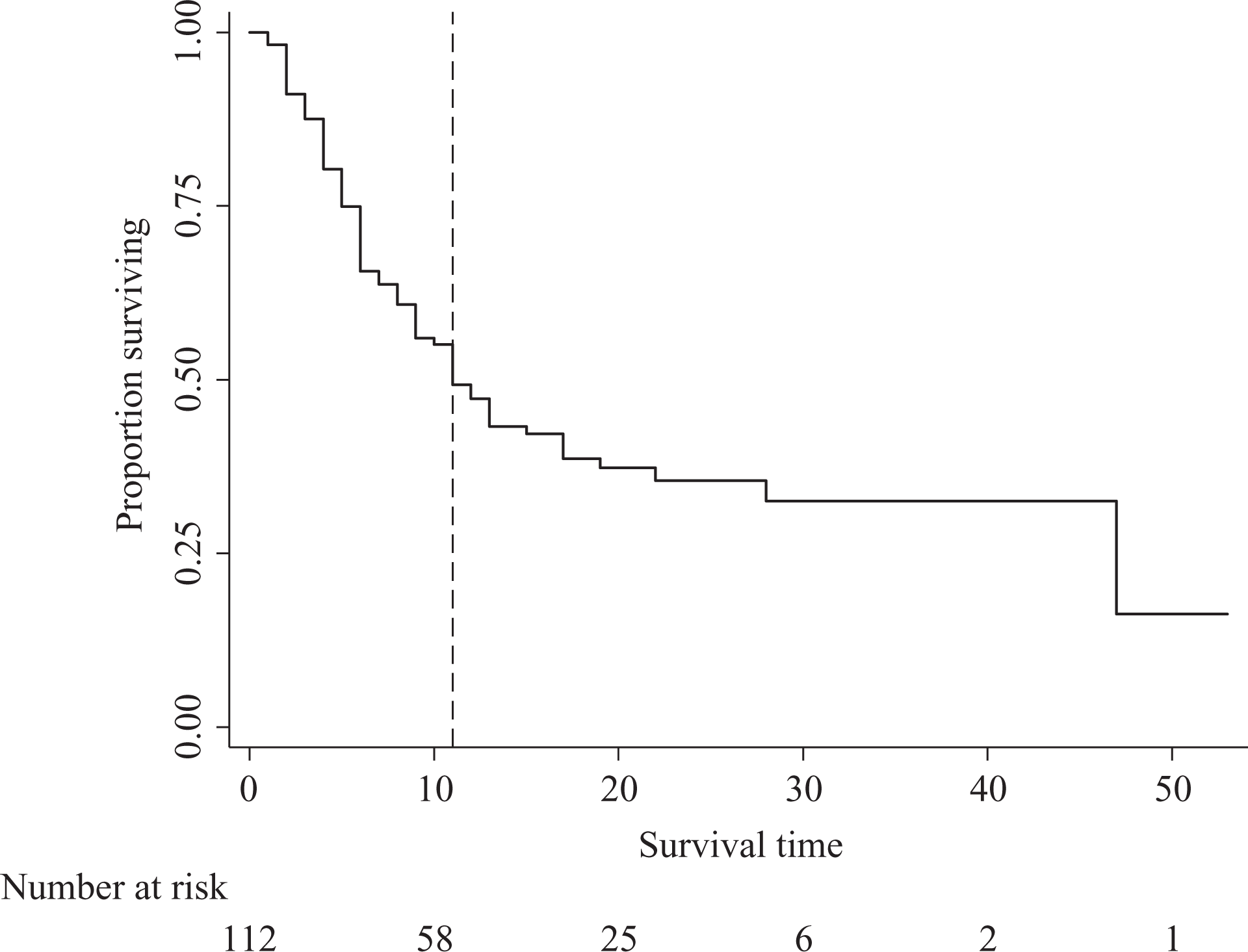
Dependent variable
The dependent variable in our analysis is the survival of democratic regimes, which corresponds to the duration until a democratic breakdown occurred. The respective information on democratic regime survival and the timing of democratic breakdowns is taken from Ulfelder (2012). Our sample consists of 112 democratic regimes out of which 69 experienced a democratic breakdown. Accordingly, 43 regimes are right-censored, which means that they did not experience a failure event until the end of the year 2010. 2 Figure 1 describes the survival time of all regimes in our sample, using a Kaplan-Meier survivor function.
Figure 1 shows the proportion of regimes that survived at each time period. As shown here, many regimes fail within the first ten years after the transition. This is illustrated by the steep slope of the survival line during this time period. As highlighted by the dashed line, the median survival time is 11 years. Thereafter, the survival function flattens which means that the remaining regimes in the sample fail at a lower rate.
Independent variable
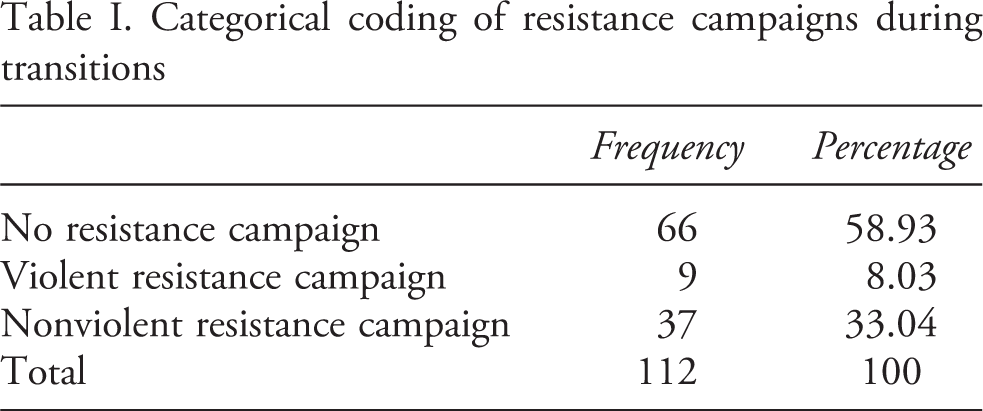
Our hypothesis states that this survival function is substantially affected by the presence of a NVR campaign during the transition phase of these regimes. To measure the existence of a NVR campaign during the transition phase of a democratic regime, we use data from Chenoweth & Lewis (2013). We coded a campaign as relevant for the transition process if it was present in the year of the transition or the year before the transition and aimed at political change of the incumbent autocratic regime. 3 We distinguish between (1) regimes whose transition process was induced without a resistance campaign (NoR), (2) regimes whose transition process was induced by a violent resistance campaign (VR), and (3) regimes whose transition process was induced by a nonviolent resistance campaign (NVR). Table I describes the frequency distribution of these categories.
Table I shows that few regimes in our sample experienced violent resistance campaigns during their transition phase. More than half of the sample consists of regimes that came about without any resistance campaign and about one-third of the cases represent transitions from autocracy to democracy that were induced by a NVR campaign. Figure 2 shows the results of a Kaplan-Meier estimation of survivor functions for these three groups of regimes.
Categorical coding of resistance campaigns during transitions
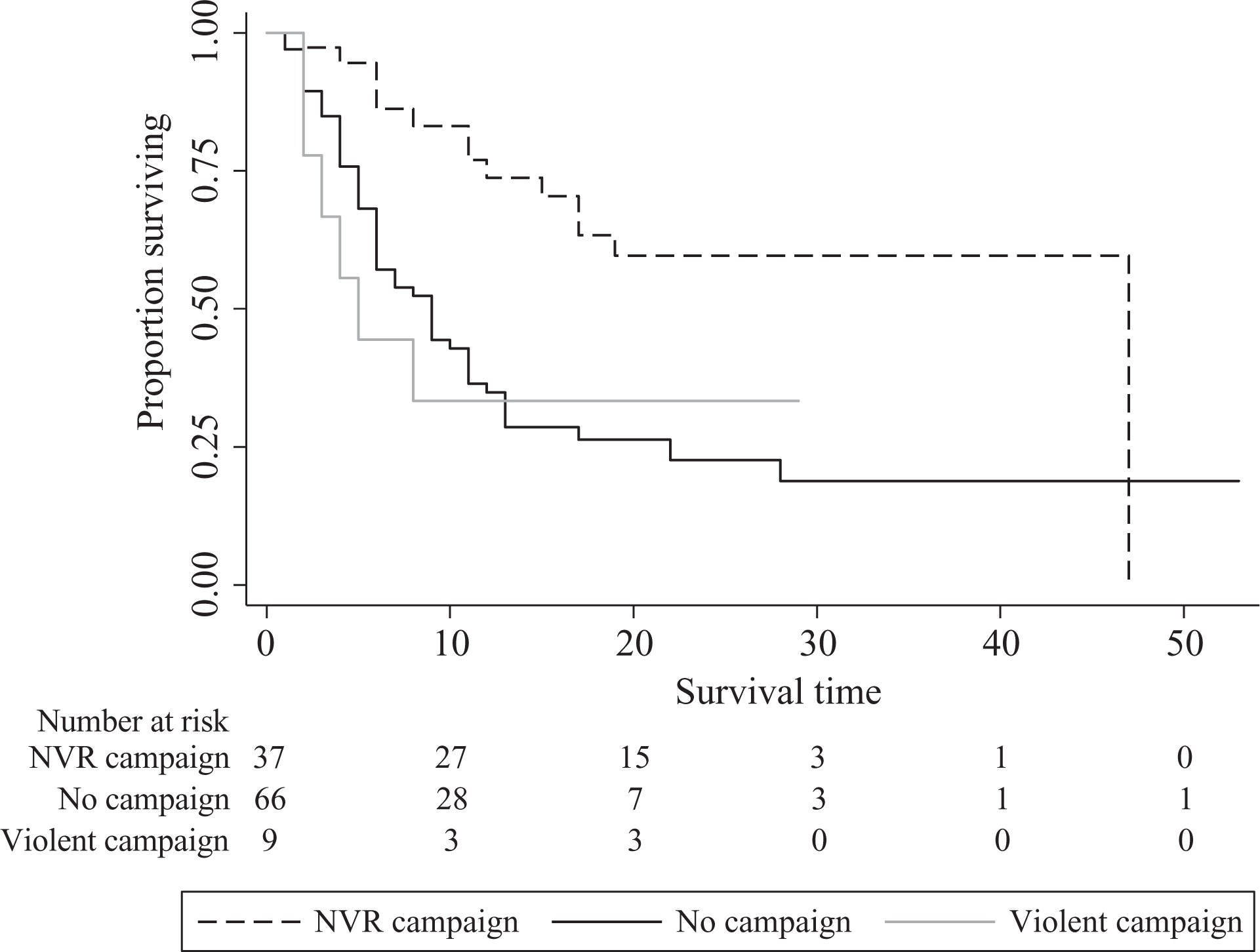
Kaplan-Meier survivor functions by campaign type
The logic of Kaplan-Meier estimation matches our theoretical model of path dependence; survival rates for different groups represent the respective path that was chosen. As shown in Figure 2, the survival functions for regimes without resistance campaigns and regimes with violent resistance campaigns are very similar. Furthermore, the lines cross which indicates that there is no significant difference in regime duration between these two groups. However, regimes that experienced NVR during the transition phase survive longer than regimes without this attribute. Regimes with violent resistance campaigns involved in the transition process have a median survival rate of just five years. In regimes where the transition process was not influenced by a resistance campaign the median survival rate is nine years. By contrast the median survival rate of regimes where transition was induced by NVR is 47 years. This result already indicates that NVR during the transition phase substantially increases the survival time of the subsequent democratic regime. For the statistical analysis that follows, we use a binary coding of the presence of NVR during the transition phase, that is, the variable NVR, which takes the value 1 if the transition process was induced by a nonviolent resistance campaign and 0 otherwise.
Additional covariates
In order to address the problem of confounding, that is, characteristics which presumably influence the onset and success of NVR campaigns and at the same time affect subsequent democratic regime survival, we include several additional covariates in our statistical models. We focus on those covariates that were identified as most important in previous studies on democratic survival and resistance campaigns. Specifically, we rely on the results of a sensitivity analysis conducted by Gassebner, Lamla & Vreeland (2012) who identified GDP per capita, neighboring democracies, previous instability, and a military legacy as the most robust predictors of democratic survival. Additionally, we add measures of total population and urbanization, because they are featured in numerous studies on the onset of NVR campaigns and democratic survival (Aleman & Yang, 2011; Chenoweth & Lewis, 2013; Gurses, 2011; Maeda, 2016). Furthermore, population size and urbanization also relate to the potential number of participants in resistance campaigns, which is one important mechanism for the success of these campaigns, as the results by Chenoweth & Stephan (2011) suggest.
To account for economic conditions, we use measures of the level of GDP per capita. The dataset we use to measure these variables is an updated version of the Expanded Trade and GDP Data compiled by Gleditsch (2002). The variable Military legacy indicates whether a military regime was present before the transition to democracy. Using data from Geddes, Wright & Frantz (2014) we created a binary indicator, which takes the value 1 when the respective democratic regime is preceded by a military regime and the value 0 otherwise. To measure Previous instability we use a variable counting the number of previous regime changes that occurred in the country since independence. The data are taken from Ulfelder (2012). To measure how widespread democracy is in the geographic environment of a regime, we use the variable Neighboring democracies, which is simply the proportion of states that are democratic in the region. 4 Total population refers to the overall size of the population. Urbanization is defined as the percentage of the population living in cities with more than 100,000 inhabitants. For the measurement of both variables we use the National Material Capabilities dataset version 4.0 (Singer, 1987). The variables GDP per capita, and Total population are transformed using natural logarithms.
Estimation of treatment effects
To test our hypothesis, we rely on two alternative estimation procedures. First, we use Cox proportional hazards models with time-varying covariates to estimate how the hazard rate of democratic breakdown depends on the presence of a NVR campaign during the transition phase of a regime. To address problems of selection bias and model dependence, we adopt a second estimation procedure. Using propensity score matching, we pre-process the data in order to match regimes where democratization was induced by NVR with similar regimes where NVR was not relevant. Afterwards, we analyze the matched data with Kaplan-Meier survival curves and Cox proportional hazards models.
Empirical analysis
Cox proportional hazards models with time-varying covariates
For the estimation of models with multiple covariates, we use the Cox proportional hazards estimator, which can be described by the following equation:

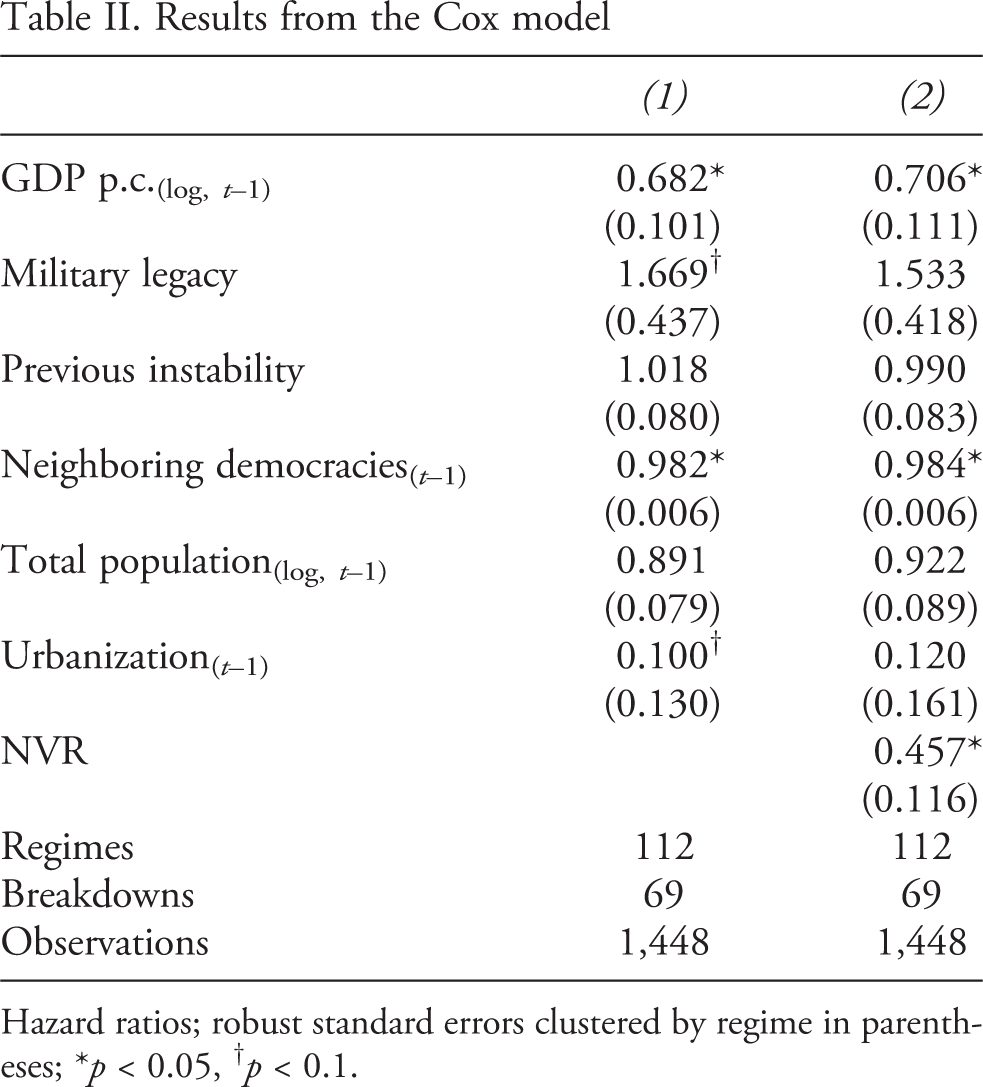
The expression h(t) denotes the hazard rate. The expression h 0(t) represents the baseline hazard which is defined as the hazard for the occurrence of democratic breakdown if all covariates are zero. The values of the covariates are denoted as X 1, X 2,…, XN and the expressions β 1, β 2,…,βN stand for the coefficients which are meant to be estimated by the model. Whereas Xi represents the values of a time-fixed variable (e.g. our measures of NVR campaigns) for a specific regime included in the sample (denoted by i), Xit represents the values of a time-varying variable for a regime included in the sample at a specific point in time (denoted by it). The hazard of regime failure thus depends on the values of time-fixed and time-varying covariates. Therefore, we use a pooled data structure. Regime histories are broken down into discrete time intervals (regime-years) which are treated as different observations. Whereas our key independent variable measuring the presence of NVR campaigns during the transition period is time-constant, some of the control variables vary across time periods and thus warrant this data structure. Regarding the confounding variables described above, GDP per capita, Total population, Urbanization, and Neighboring democracies are measured as time-varying covariates. 5 Results from the Cox model are reported in Table II.
Results from the Cox model
Hazard ratios; robust standard errors clustered by regime in parentheses; *p < 0.05, † p < 0.1.
The results from Model 2 show that NVR reduces the hazard of democratic breakdown by more than 50%. Among the control variables only GDP per capita and neighboring democracies are statistically significant. Increasing the GDP per capita by one logarithmic unit leads to an approximate 30% reduction in the hazard rate. Thus, in states with a high level of economic wealth democratic breakdown is less likely. The results for the variable Neighboring democracies indicate that each additional percentage point of democratic regimes in the region reduces the hazard of democratic breakdown by almost 2%. 6
Matching estimates
With matching methods the goal is to compile a balanced sample where regimes with a transition process induced by NVR and regimes without this condition are as similar as possible. The basic idea is that if two subjects are sufficiently similar on observed covariates but differ in terms of treatment assignment, then the selection process of treatment assignment is ‘as good as random’ (Sekhon, 2009: 495). We use a procedure proposed by Austin (2014), which combines propensity score matching with survival analysis to estimate treatment effects. The approach is implemented in three steps. First, we estimate the propensity score, that is, the probability of NVR induced transitions, using a set of observed covariates. The propensity score essentially summarizes all observed factors that influence the probability of treatment assignment (Guo & Fraser, 2010: 132–135). Second, we match cases on the propensity score to create a new dataset consisting of matched pairs of treated and control cases. In order to ensure the robustness of the results, we follow the suggestion by Austin (2014: 1245–1247) to apply multiple different matching schemes, namely (1) greedy nearest neighbor matching, (2) greedy nearest neighbor matching within a caliper, and (3) optimal pair matching. Third, we analyze the effect of NVR on democratic survival using the matched samples.
For the estimation of the propensity score model, we use all covariates shown in Model 2 in Table II. A crucial requirement of propensity score matching is that covariates were measured before treatment assignment and are not influenced by treatment assignment (Stuart, 2010: 5). Therefore, we use a cross-sectional data structure. We analyze spells of democratic survival as a whole and estimate the propensity score of NVR induced transitions with covariates measured one year before the transition process. 7
Using the estimated propensity score, we created three matched samples. The greedy matching scheme created a sample of 74 observations, that is, 37 treated subjects (NVR) were paired with 37 untreated subjects (no NVR). With the caliper matching scheme, we ended up with a sample of 68 observations. Three treated subjects were dropped because no suitable match was found among the untreated subjects given the restriction imposed by the caliper size. Finally, the optimal matching scheme created a matched sample of 74 observations consisting of all 37 treated and 37 untreated subjects.
Next, we evaluate how well the different matching schemes achieve the goal of creating a balanced sample of treated and untreated subjects with regard to the confounding variables. Figure 3 shows standardized differences between the means of regimes with and without NVR induced transitions for each covariate. 8
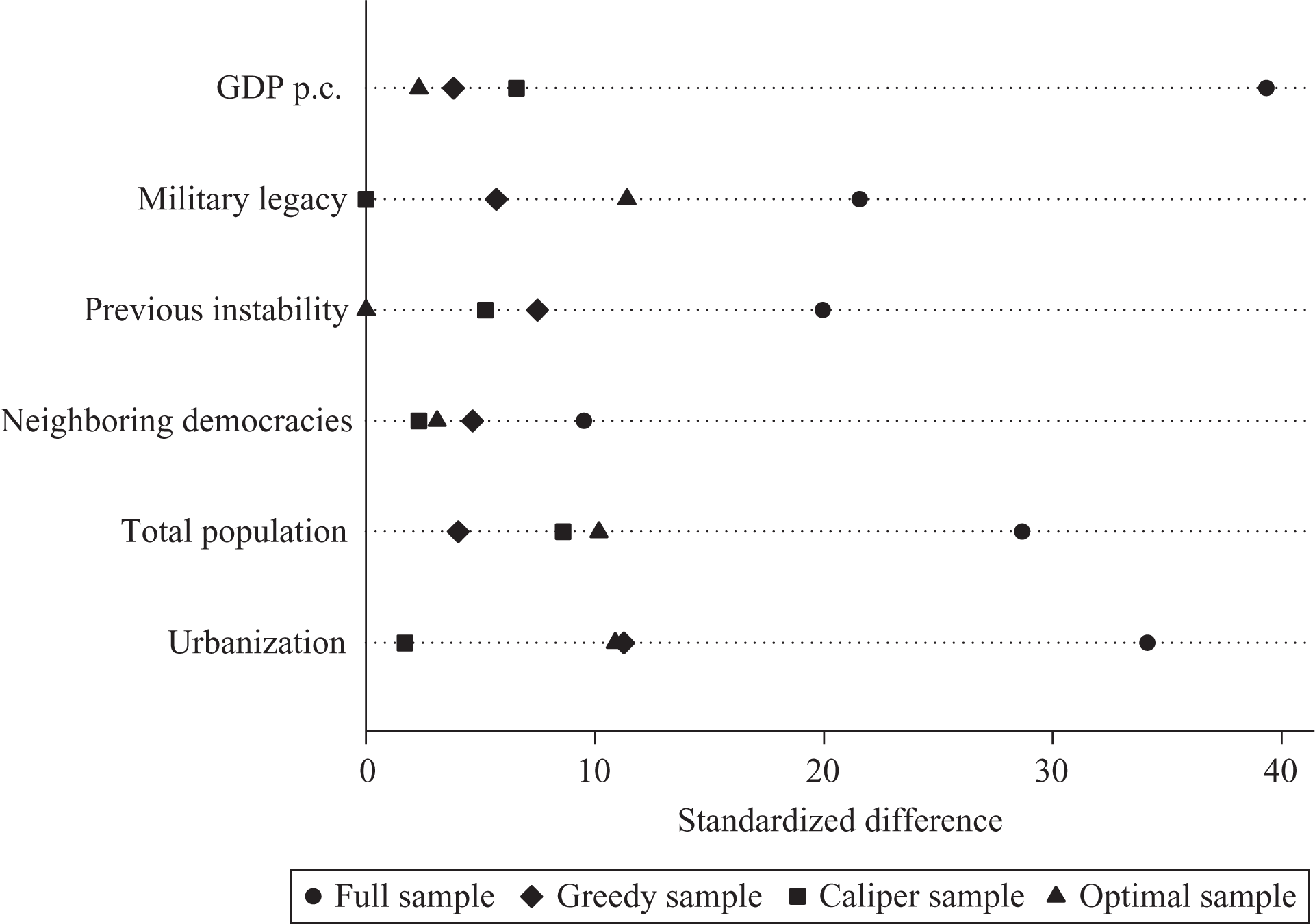
Standardized differences for different matching schemes
As shown in Figure 3, all matching schemes substantially reduced bias among the covariates, when compared to the full sample. The mean bias among covariates in terms of standardized differences is 25.5% in the full sample. With the different matching procedures the average bias was reduced to 6.1% in the greedy sample, 4.1% in the caliper sample, and 6.3% in the sample created with the optimal matching scheme.
In Figure 4 we report Kaplan-Meier survival curves for the three matched samples. As shown, across all samples, regimes with NVR induced transitions on average survive longer than regimes without NVR. This is also confirmed by a log rank test stratified on matched pairs.
The dashed line indicates the treated group of subjects that experienced NVR during the transition phase. The solid line indicates untreated subjects that did not experience NVR.
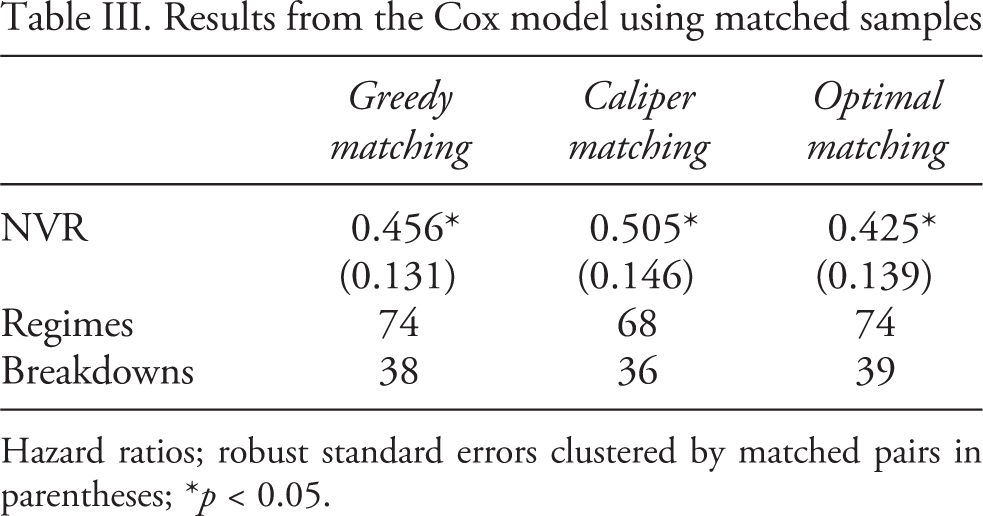
Next, we estimated Cox proportional hazards models for the three matched samples. In order to account for the matched structure of the data, we use robust standard errors clustered by matched pairs. The results are reported in Table III.
As shown in Table III, the effect of NVR on democratic survival is statistically significant across all samples.
9
However, the magnitude of the effect differs across the different matching schemes. With the greedy matching scheme the reduction of the hazard rate is estimated as 54%. When caliper restriction is applied the estimated effect is a 50% reduction of the hazard rate and when using the sample created by optimal matching the Kaplan-Meier survival curves by NVR presence for different samples Results from the Cox model using matched samples Hazard ratios; robust standard errors clustered by matched pairs in parentheses; *p < 0.05.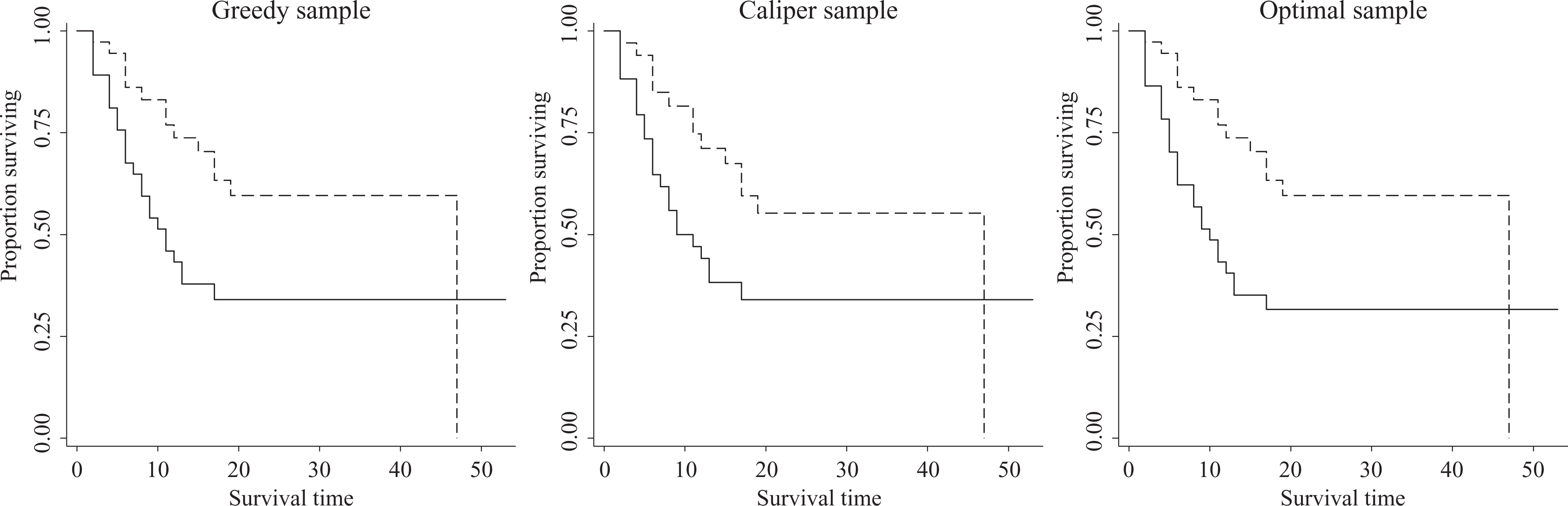
Robustness of the results
In order to test the robustness of our findings, we replicated the whole analysis described above using the Autocratic Breakdown and Regime Transitions dataset compiled by Geddes, Wright & Frantz (2014) as an alternative measure of democratic transition and survival. The main finding – that NVR induced transitions are beneficial for democratic survival – is robust to the use of alternative measurement. However, our tests indicate that with the Geddes, Wright & Frantz data the effect of NVR on democratic survival diminishes over time. 11
Discussion and conclusion
In summary, the results of the empirical analysis support the hypothesis that democratic transitions that were induced by NVR campaigns are beneficial for the survival of democracy. The results of Cox models with panel data and time-varying covariates suggest that there is a substantial and statistically significant positive effect of NVR campaigns on the duration of democratic regimes. Similar results are obtained when using different samples of matched pairs, which were balanced for multiple potential confounding variables. Therefore, we conclude that there appears to be a systematic pattern in the survival of democratic regimes which relates to the presence or absence of NVR campaigns during the transition phase. Accordingly, our results support claims that the mode of transition influences the prospects of democratic consolidation, even in the long term. Or, in other words, there is something that we call a ‘democratic dividend of nonviolent resistance’. This also lends support to the notion of political transitions as critical junctures that lead to new, path-dependent trajectories in a country’s political development. NVR campaigns increase the odds of a political system not only transitioning to democracy but also of keeping this democracy alive for a longer period.
These results have important practical implications for democracy promotion. External support for elite-led top-down transitions and support for violent groups to oust dictators appear to be ineffective strategies for long-term democratic consolidation. Sustainable democracy promotion requires support from a broad base of civil society actors, which demand and bolster democratic institutions and rights in a peaceful way.
As always, some caveats are in order. First, some of our tests indicate the potential that the effect of NVR on democratic survival is diminishing over time. Thus, while our results generally show that NVR has a long-lasting positive effect on democratic survival, they are inconclusive regarding the question of how long exactly the effect lasts. Second, we only analyzed regimes which became democratic after 1955, thereby excluding long-term democracies that experienced their transition prior to that year (e.g. France and USA). Therefore, we do not know whether our results are affected by the omission of these long-lived democracies. Third, we have only measured the persistence of democracy, not its level of consolidation. We thus cannot interpret the results with regard to the question of whether democracies with NVR during the transition phase develop a higher quality of democracy than other democratic regimes. We understand these caveats mentioned above as directions for future research in order to substantiate our theoretical arguments further.
Footnotes

Acknowledgements
We are grateful to Cemal Öztürk, Lena Pohl, and Katrin Grätz for their outstanding research assistance and to Margit Bussmann, Véronique Dudouet, and the anonymous reviewers for their insightful comments and suggestions.
Funding
Funding by the Priority Research Area ‘Transformation of Contemporary Societies’, University of Duisburg-Essen and Deutsche Forschungsgemeinschaft is gratefully acknowledged. Felix S. Bethke is grateful for support and funding from the Centre for Global Cooperation Research. Markus Bayer acknowledges funding from the Trajectories of Change Scholarship provided by the Zeit Stiftung.