




Abstract
This article explores the manifold lineages of crisis and revolt currently afflicting the Islamic Republic of Iran, most recently bursting forth in the 2022/2023 national uprisings where women-led mass protests and forceful rejection of mandatory veiling laws captured global attention. This interdisciplinary piece of research, bringing together several different theoretical approaches and historical literatures, interrogates and reflects upon what I call following Stuart Hall a ‘conjunctural crisis’ along the four major axes of (1) gender oppression and social reproduction; (2) the ethnocentric, dominative, and centralising nation-state and the still unresolved ‘ethno-national question’; (3) ‘religious democracy’ and the impasse of the Reform movement; and (4) authoritarian neoliberalism and the Islamic Republic’s political economy of predation. The article aims to show not only how these distinct crises have longer and more complicated lineages than might initially appear to be the case but also demonstrate how they have mutually constituted and shaped one another over the course of several decades, constituting part of a larger political and social system. Moreover, it aspires to provide a systematic and historically contextualised account of ongoing emancipatory struggles for democratic rights and liberation in today’s Iran.
Introduction
On the 16 of September 2022, a 22-year-old Kurdish Iranian woman by the name of Mahsa Jina Amini died while in the custody of the Islamic Republic of Iran’s Guidance Patrol (Gasht-e ershad), better known to Euro-American readers as the ‘Morality Police’. Pictures of the young woman’s limp and lifeless body spread like wildfire across the Internet and social media. Unlike previous high-profile deaths in custody, Amini’s death sparked widespread protests beginning in her hometown of Saqqez in Kurdistan, Iran, rapidly spreading to Tehran and its environs, and with varying tempos encompassing huge swathes of the country. Women protesting for their basic human and civil rights are hardly novel to contemporary Iran. However, women’s visible role at the forefront of national protests and their enactment of a panoply of courageous acts of civil resistance in direct confrontation with the Islamic Republic’s security forces, left much of the world mesmerised, at least for a time. According to one data-driven analysis, between 16 September and 11 November, at least 1158 of 1265 protests were led by women (Wintour, 2022). Their repertoires of contention included violation of the law of the land, the defiant removal of the headscarf in public, both individually and collectively, the cutting of one’s hair, the public burning of headscarves, the chanting of anti-government slogans, the destruction of symbols of state power such as photographs of Ayatollah Khomeini and Ayatollah Khamenei, the founder and incumbent Supreme Leader of the Islamic Republic, respectively, the torching of the offices of Friday Prayer leaders, knocking turbans off the heads of unsuspecting clerics, the attack and incineration of the erstwhile home turned museum of the founder of the Islamic Republic, Ayatollah Khomeini, graffiti and propaganda to the end, if only temporarily, of appropriating public space, among others.
For a brief time, the world was turned upside down, as school children defied teachers and ran officials out of their schools, crowds of young men and women chased down the police, and people took control of their streets and local neighbourhoods. The overflowing youthful exuberance of the protestors also immediately caught the spectator’s eye, as high-ranking security personnel reported the average age of protestors arrested was a mere 15 years old (‘Asr-e Iran, 1401). The cascading series of protests were composed of what Asef Bayat (2017: 106) has called ‘social nonmovements’, emerging through a variety of online, interpersonal, and informal networks, in combination with more established social movements of various political and ideological persuasions, coalescing around the core slogan of ‘Women, Life, Freedom’. The provenance of this electrifying slogan resided in the charismatic writings of the imprisoned former leader of the Kurdistan Workers’ Party, Abdullah Öcalan, and the militant theorising, activism, and organising of Kurdish feminists in the Kurdish-dominated People’s Defence Units (YPG) and Women’s Protection Units (YPJ) in north-eastern Syria. Following Jina’s tragic death, ‘Jin, jiyan, azadi’ (Women, life, freedom), resounded across Kurdish-majority cities and its Persian translation, zan, zendegi, azadi, rapidly spread to tens of cities and towns throughout Iran. The broad orientation and ethos of the uprising, moreover, had a distinctly this-worldly character, centring women’s rights and bodily autonomy, the right to human dignity, the desire for a ‘normal’ life and wish to openly experience joy and mundane everyday pleasures without threat of sanction or reproach from the forbidding and puritanical Islamist state (Moaddel, 2015).
Despite coming to symbolise the movement and constitute its political and normative core, many other slogans proliferated and were echoed across the country. Several continued to centre gender and the oppression of women in forthright and unambiguous ways: ‘We are all Mahsa, come on and fight!’, ‘You are lewd, you are dissolute, I am a free woman!’, and ‘Cannons, tanks and guns won’t work anymore, tell my mother that she doesn’t have a daughter!’ Other prominent slogans harboured distinct valences, some of which frontally called for an end to dictatorship or called for unity in the face of the state’s efforts to sow division along ethno-sectarian lines. These included ‘Death to the dictator!’, ‘Death to Khamenei!’, ‘Death to the Oppressor, whether it be Shah or Leader!’, ‘This year is the year of blood, Seyyed Ali [Khamenei] is overthrown!’, ‘From Zahedan to Tehran, I sacrifice myself for Iran!’, ‘Kurdistan, the graveyard of fascists!’, ‘Islamic Republic, we don’t want!’, ‘Bread, labour, freedom, council government (hokumat-e showra’i)!’, ‘Referendum, referendum, this is the chant of the people!’, and ‘Cannon, tank, rocket, mullahs get lost!’ The variety of slogans and the social classes and constituencies which mobilised around them clearly speak to the systemic nature of the indictment and refusal of the structures and apparatuses of oppression and exploitation which perpetuate structural violence against women, ethnic minorities, and the working classes under the Islamic Republic.
In this article, I provide an interpretive-theoretical framework through which to understand the manifold crises which generated the conditions for these historic and multifaceted uprisings. I argue that the Islamist social order and authoritarian neoliberal regime which govern Iran are confronted by the accumulation of at least four systemic contradictions. These include (1) the crisis of gendered social control and social reproduction; (2) the crisis of the nation-state, specifically as a dominative Persian and Shi’i-centric, centralising and homogenising force; (3) the crisis of ‘religious democracy’ and the defeat of the Reform movement; and finally (4) the crisis of authoritarian neoliberalism and the Islamic Republic’s political economy of predation. Unfortunately, due to limitations of space, I will only be able to address geopolitical challenges and the international dimensions of the crisis in passing. Nor will I be able to explore the ongoing environmental crisis with the attention that it sorely deserves, despite the fact that it is inextricably bound up with issues and questions related to crises (3) and (4). The article will discuss each one of these crises, albeit schematically, and show how at specific points and junctures different crises overdetermine others. I contend that the uprisings, which have varied in intensity and breadth during this period, represent a ‘unity of a conjuncture’ in which these manifold contradictions come together to confront the Islamic Republic as a major challenge to its stability, legitimacy, and conditions of reproduction as both a political system and social order (Althusser et al., 2015: 463). The intention is not to definitively proclaim whether we have in fact already witnessed a ‘revolution’, but rather delineate the uprisings’ distinct lineages in multiple systemic social, economic, political, and ideological contradictions; contradictions and crises, which if left unaddressed will almost certainly generate the conditions for further generalised crises and revolts in the months and years to come. Indeed, one likely outcome, at least in the short-term, is the prolongation of sustained conditions of crisis, while emergent social forces struggle to cohere or build up the necessary social power to realise their revolutionary aspirations in the face of entrenched and recalcitrant repressive, ideological, political, and socio-economic state apparatuses.
This article, furthermore, aims to synthesise and bring together several different literatures which have often been siloed off from one another and rarely speak to each another in the scholarship on contemporary Iranian politics and society. This ‘Great Refusal’ and multi-faceted social struggle advanced on several fronts no longer affords us such a luxury and compels scholars to bring the scholarship on women and gender, ethno-national and religious minorities, democracy and authoritarianism, class and political economy, together into a more comprehensive and systematic analysis. Rather than the initiative of any one scholar or research programme, it has been concrete social and political struggles where people ‘reject the rules of the game that is rigged against them’ (Marcuse, 1969: 5), which have necessitated this conjoining and critical intersection of disparate and siloed fields of scholarly research. Finally, it is hoped that such an analysis will not only adumbrate the lineages of this conjunctural crisis, but throw into stark relief the challenges, obstacles, and hard limits that this hitherto fragmented and disorganised movement of civil resistance must confront in its desire and ambition to dislodge a regime configured in the mould of the Islamic Republic (Levitsky and Way, 2022: Chapter 6).
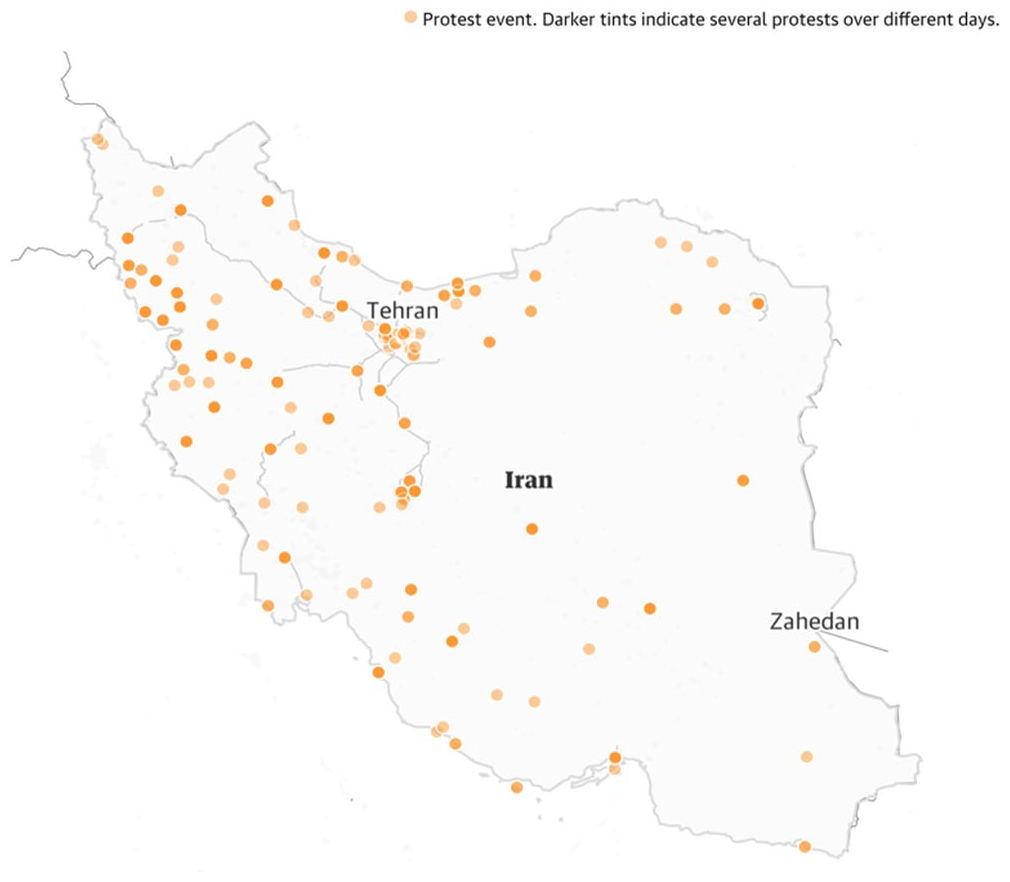
Map of Iran outlining the geographical spread of the protests on 14 October 2022 (De Hoog and Morresi, 2022).
Overdetermination, contradiction, and conjunctural analysis
Louis Althusser in his classic 1962 essay, ‘Contradiction and Overdetermination’, helps us to think through how a given social formation might experience manifold contradictions; contradictions which destabilise and hinder the aforesaid formation’s ability to produce and reproduce itself economically, politically and ideologically. Althusser’s critique upbraided notions of ‘simple contradiction’ and ‘expressive totality’ and rejected what he held to be the malign vestiges of Hegel’s thought in the early Marx. Specifically, he was taking aim at the idea that all social contradictions were merely epiphenomenal or pale reflections of the basic contradiction between capital and labour or the forces of production and relations of production. Althusser (2005: 106) sought not only to demonstrate Marx’s own break with the Hegelian dialectic but also show how Marxist theory could avoid the pitfalls of economism and technological determinism. Rather than see the contradiction between capital and labour as mechanically reflected in the superstructure, Althusser (2005: 110) furnished a new conception which sought to understand ‘the relation between determinant instances in the structure-superstructure complex which constitutes the essence of any social formation’. Drawing on Engels’ correspondence, Althusser argued that the forms of the superstructure, encompassing the state, law, culture, education and much else besides enjoy both specificity and autonomy within a given mode of production. As he says, the economic dialectic is never active in the pure state; in History, these instances, the superstructures, etc. – are never seen to step respectfully aside when their work is done or, when the Time comes, as his pure phenomena, to scatter before His Majesty the Economy as he strikes along the royal road of the Dialectic. From the first moment to the last, the lonely hour of the “last instance” never comes (Althusser, 2005: 112).
Building on this theoretical legacy, Stuart Hall (2021: 69) insisted on understanding social formations as an ‘ensemble of relations’, possessing a complex unity characterised by ‘determining’ and ‘dominant’ instances. In moments of revolutionary rupture, we observe an accumulation of various contradictions peculiar to different economic and political structures and practices. Systemic crisis and revolutionary rupture must therefore be understood as overdetermined and the coming together of multiple contradictions, rather than simply determined by any single contradiction. Each level or practice is understood to be part of ‘a complex, structured whole, structured in dominance’ by capitalist social relations while enjoying relative autonomy. It is in this respect that Hall (2021: 86), following Althusser, speaks of ‘structural’ rather than ‘sequential’ causality. In understanding ‘the necessary complexity of the social formation of advancing capitalism and of relations between its different levels’, the analyst must uncover ‘the functions which, specifically, the superstructures “perform” in relation either to the maintenance and reproduction, or the retardation of the development, of capitalist social relations’ (Hall, 2021: 75). Thus, any analysis that aims to understand the conditions under which a social and political system produces and reproduces itself must take eminently seriously the capital-labour relation, as well as grapple with the relations and apparatuses of the state and civil society, ideological forms, and their corresponding forms of social consciousness (Hall, 2021: 82). As Hall (2022) convincingly argues, the contradictions traversing a social formation cannot exist outside of class relations and class struggle, but this is not tantamount to assuming that the principle contradiction between capital and labour generates all others. Althusser (2020: 1) himself held a comparable position when he attested to the central importance of ‘the concrete analysis of the concrete situation’, where class struggle remained a defining feature of life under capitalism.
‘Conjunctural crises’, for Hall, were never solely economic or economically determined ‘in the last instance’. Such crises ‘arise when a number of contradictions at work in different key practices and sites come together – or “conjoin” – in the same moment and political space’ (Hall, 2017: 317). In such moments, we observe a ‘condensation of contradictions, each with its own specificity and periodisation’ (Hall, 2019: 197). It is my contention that the uprising in Iran amounts to just such a crisis even though it is still not clear what new settlement and condensation of social forces will ultimately emerge in this latest mobilisation of mass discontent and civil resistance. The struggles of women in the face of oppressive laws, gendered governmentality and exploitative regimes of social reproduction, ethno-national and religious minorities’ rejection of the accumulated effects of structural violence, economic underdevelopment, and systemic discrimination, and the urban and rural working poor’s revolt against deteriorating conditions and intensified rates of exploitation, co-constitute one another in historically determinate and specific ways requiring further interrogation and unpacking (Bannerji, 2015: 113).
The crisis of the gender regime
Women’s role in society and women’s bodies have always been politicised and fought over by successive governments, political regimes. and patriarchal norms and practices, in the context of modern Iran. Under Reza Shah, shari’ah courts were abolished at the expense of the Shi’i clergy and European dress and cultural forms were actively promoted. Most notably, by the mid-1930s, the chador or long black, enveloping veil, was actively discouraged and stories of women having veils torn from their heads in public became widespread (Rostam-Kolayi and Matin-Asgari, 2014). Reza Shah, taken with Mustafa Kemal Atatürk’s revolution from above and violent fashioning of the Turkish nation-state out of the ruins of the Ottoman Empire, sought to build a strong Iranian state in which patriarchal gender relations would be modernised in tandem with the imperatives of authoritarian state-building. In the words of Afsaneh Najmabadi (1991: 49), the ideal woman would now be expected to be ‘modern-yet-modest’.
While the reign of Mohammadreza Pahlavi (1941–1979) can be broken up into discrete periods, for the sake of space and brevity, I will focus on two key developments following the Shah’s so-called White Revolution, which it should be said, is itself best understood as a ‘passive revolution’ or ‘revolution-restoration’, incorporating and repurposing more radical demands that had been championed by subaltern political and social movements in the preceding decades (Gramsci, 2000: 266; Hassanpour, 1994). Land reform stood at the heart of the latter, but one of the six-points enunciated in the referendum on the revolution was women’s suffrage. The latter was vociferously opposed by a large swathe of the conservative clergy, albeit to little effect at the time (Randjbar-Daemi, 2021). This would be compounded by the Family Protection Act of 1967, which gave women equal rights to divorce, child custody in the event of the death of their husband and placed limits on polygamy. Abortion was legalised in the first trimester with the permission of the husband in 1973 and contraception was made widely available through the efforts of the Ministry of Public Health (Hoodfar, 1994). These reforms amounted to substantive top-down legal reforms even if they disproportionately benefitted upper- and middle-class women. For example, infant mortality rates remained high due to inequitable distribution and access to public services (Hoodfar, 1994).
The Shah was overthrown in the revolution of 1978–1979 by a broad front of liberals, religious nationalists, militant Islamists, Marxist-Leninists, bazaar merchants, and striking oil workers. Despite the diverse and variegated political field it was the formidable and austere Shi’i cleric, Ayatollah Ruhollah Khomeini (d. 1989), who rapidly emerged as the revolution’s paramount leader and who in the lead up to the revolution had deftly sought to mobilise and rally women to the revolutionary cause (Paidar, 1995: 214). During the revolutionary build up, there was little to no indication that mandatory veiling or the abrogation of specific women’s rights was envisioned as part of the post-revolutionary system. However, upon Khomeini’s return, both his rhetoric and that of his political allies soon began to shift. Still lacking fully fledged hegemony or the capacity to marginalise rival political contenders, clerical-led Islamist forces sought to remake Iran’s gender regime in their own image. On 6 March 1979, Khomeini declared that women would have to be veiled when they entered or worked in government ministries (Matin and Mohajer, 1392; Moghissi, 1996: 140; Nategh, 1986). This was met with huge and iconic protests over the course of 6 days, by predominantly, but not only, middle-class and educated women against the prospect of mandatory veiling. Apart from objecting to a disconcerting turn in the unfolding of the revolution, many protestors sought to forcefully make the case for women’s legal and substantive equality and rights. The protests were met with violence and intimidation by pro-Khomeini Islamist forces and the chant, ‘either hijab or a smack in the head!’ Many women refused to be intimidated and despite unremitting pressure continued to found women’s associations and groups in spaces and institutions where dissent remained possible, above all, the universities. Many of their demands not only called for the protection of existing rights, but their expansion and deepening to include economic and social ones as well (Moghissi, 1996: 141). This led to a tactical retreat on the part of the Khomeinists, albeit one that would not last long. The Islamists effectively mobilised Islamist women to rally on behalf of the new political and social order in formation, giving exemplary expression to Spinoza’s (2007: 6) oft-quoted quip, ‘they will fight for their servitude as if they were fighting for their own deliverance’. Tehran’s Red-Light District, Shahr-e now, had been burned down by Islamist forces at the end of January 1979 and was finally demolished in mid-1980. With the elimination of the lion’s share of liberal and leftist political competitors by June 1981, the Majles passed a law punishing women who refused to comply with state-enforced veiling in 1983 (Sedghi, 2007: 207). Ever since, the laws in favour of mandatory veiling have proven indispensable to the policing of women’s political activism and dissidence and have provided a convenient pretext to harass, intimidate, assault, and imprison women activists from across the ideological spectrum.
This policing of public space was complimented by the conquest of the legal sphere. The suspension of the Family Protection Act in February 1979 revoked several women’s rights and personal entitlements in the domestic sphere. Men regained the exclusive right to divorce, and polygamy was legally sanctioned according to the writ of traditional Shi’i-Islamic jurisprudence. On 2 October 1979, Islamic family legislation was ratified by the Revolutionary Council (Showra-ye enqelab) which included a husband’s right to forbid his wife from taking up employment. Henceforth, women would have to ascertain permission from male kin to work, travel, study and change their place of residence. In the event of divorce, the father was given the right of custody to female children over the age of seven and male children over the age of two. Contraception and abortion were prohibited (Poya, 1999: 68). On 3 March 1979 a decree forbade women judges from working (Poya, 1999: 65).
In July 1981, the ghesas law (Bill of Retribution) replaced established civil laws. Severe punishments including lashings and stoning to death would now be executed for transgressions ranging from the refusal of the state-imposed dress code to adultery (Poya, 1999: 69). The age of marriage was reduced from 18 to 9 years old (Sedghi, 2007: 207). The Islamist remaking of the political, cultural, legal and educational spheres were at times contradictory as we shall see, but there is little doubt among feminist scholars that it marked a major advance in the oppression of women and LBGTQ+ peoples (Afary, 2009; Moghissi, 1996). Indeed, one could make the even stronger claim that the violent imposition of the new gender regime was not only an indispensable part of the Islamists’ envisioned social order, but that it was in a sense essential to their struggle to cohere a politico-ideological bloc against rivals, hegemonise the political field, and assert their control over public space.
The Islamist state apparatus has pursued a range of coercive and legal strategies to compel women to conform to conservative Shi’i-Islamic jurisprudential norms, regulations and practices of marriage and motherhood. Even where it has sought to mobilise women in support of the Islamic system and appealed to archetypal Shi’i women such as Imam Hossein’s sister, Zeinab, or the Prophet Mohammad’s daughter, Fatemeh, women remained to a large extent defined by their roles as obedient wives and devoted mothers (Shahidian, 2002). The sexual division of labour was defined in essentialist terms. Though women were permitted to work, their primary role was that of homemaker, while men were expected to be breadwinners, a view that has been held by even the more ‘enlightened’ of religious reformists (Sorush, 1378). Even though conservative gender norms and the sexual division of labour prevailed before the Islamic Republic, the Islamist state consciously strove to regulate women’s bodies, sexuality, and labour in ways that conformed to the state-centred ordinances of Islamic jurisprudence. This does not of course mean that Iranian women of diverse backgrounds including religious or even pro-regime ones have simply accepted these patriarchal impositions. Indeed, a great many have consistently pushed back or reinterpreted the symbolic and ideational resources of the revolution itself to make all manners of citizenship demands upon the state (Mir-Hosseini, 2000; Saeidi, 2022).
Islamist regulation of women’s lives, bodily autonomy, and sexuality has proven to be compatible with capitalist social relations prevailing in Iran. Just as ‘housewifization’ and the keen surveillance and policing of women in public was readily amenable to the Islamic Republic’s peculiar brand of Islamist populist authoritarianism. The ‘double shift’ of unwaged domestic labour not only continued to be unvalued and unrecognised (Federici, 2019; James, 2012; Loc, 2046; Mies, 2014: Chapter 4) but was commonly naturalised as God’s law. Domestic labour and the reproduction of labour power was a duty, and state-backed punitive sanctions were at the disposal of husbands and fathers for wives and daughters who came up short. Today, it is not unusual for middle class and more affluent families, to employ precarious working class women, who have been compelled to migrate from smaller provincial towns, to perform menial tasks around the home as part of the ‘global care chain’ for negligible renumeration (Fraser, 2017). It is in instances such as these that we observe the condensation of women’s oppression, economic exploitation, and, on occasion, ethnicized forms of structural violence.
Women have made some advances since the 1979 revolution, particularly in terms of literacy and educational attainment, and the Islamic Republic has contributed to the expansion of mass literacy, as well as public and private university education (Kadivar, 2022: 230). Several scholars of note have also argued over the years that the post-revolutionary state made education a feasible option for women coming from conservative religious households. For example, women’s literacy stood at 46% in 1976 compared to 99% in 2021. Moreover, between the academic years of 1991/1992 to 2006/2007, the share of women students enrolled in public universities rose from 28% to 58% (Elmi, 2009). These achievements were, however, undermined by perennially low labour participation rates, a mere 14% in 2021, lack of job opportunities for women commensurate with their skills and levels of education, and high unemployment among urban women (Bahramitash and Kazemipour, 2011: 140). The absence of programmatic solutions on this front has constituted an enduring source of discontent and obstacle to upwards social mobility; another instance where capitalist social relations of exploitation can be said to be overdetermined by the contradictions of the Islamic Republic’s own gender regime.
Following the Iran-Iraq War through to the mid-1990s, the Islamist state had advocated for family planning but underwent a major rhetorical and policy shift in the mid-2000s, when an ardently pro-natalist position came to be adopted by Conservatives, also known as ‘Principalists’ (Osulgarayan). The Supreme Leader, Ayatollah Khamenei, for whom this has become a foremost issue of concern, even went as far to repudiate previous support for family planning. Conservatives, much like their counterparts elsewhere, reasserted their core commitment to the patriarchal and heteronormative nuclear family as a bedrock of a ‘healthy’ and ‘well-ordered’ society. The deep tension between a highly educated female population condemned to unemployment, the informal sector, or unsatisfactory employment was largely relegated to academic debate in favour of a biopolitics in which women’s roles as wives and mothers in service to the Muslim nation had become a defining and existential preoccupation. This contradictory relationship between a growing educated female population with aspirations and desires at odds with the conservative Islamist social agenda has been simmering for decades and is at this point increasingly irrepressible.
Population growth and increased fertility rates today constitute a strategic pillar of Ayatollah Khamenei’s aspirations for the Islamic Republic and Principalist ambitions for the theocratic-populist system’s emergence as a major geopolitical and economic power in West Asia and beyond. Khamenei (2014) is fully apprised of the looming crises posed by an aging population with the median age set to exceed 40 years old by 2050, necessitating firmer control and regulation of women’s reproductive labour. Rather than tackle the severe economic hardship and class inequalities which have prevented many young Iranian men and women from forming families, bearing and rearing children, Principalist lawmakers have sought to provide targeted financial incentives to encourage certain heteronormative and shari’ah-conforming archetypes of marriage, childbearing, and family co-existence (Leyne, 2010; Reuters Staff, 2010). Most recently in November 2022, President Raisi signed off on the law for the Protection of the Family and Rejuvenation of the Population (qanun-e hemayat az khanevadeh va javani-e jami’yat) with a dedicated taskforce comprised of ministers and other officials, charged with confronting what they see as a looming crisis for the reproduction of the Islamist capitalist order itself. The law intends to provide a variety of economic incentives to families with newly born children including access to housing and low-interest loans (Biranvand, 1401). This is while the law sets about restricting women’s access to free contraception, making the legal route for abortion even more gruelling than it had been previously, and criminalising the production and distribution of materials which contravene the country’s fertility and population laws. Despite representing a regressive assault on women’s bodily autonomy and the mild gains they have made through their careful circumvention and quiet refusal of unfavourable and discriminatory laws; such laws will continue to have a forceful presence in conservative circles insofar as they remain in many ways integral to the reproduction of the regnant social order. Just as they provide another example of the ways in which neoliberal authoritarian and conservative pro-natalist social reproductive policies limiting women’s freedom and autonomy powerfully converge.
Feminist and women’s rights activists were proactive in thinking through ways to advance their objectives throughout the late 1990s and early 2000s and had built on the sacrifices, embodied knowledges, and strategies of survival and perseverance from the preceding generation that had survived the desolation foisted upon them in the aftermath of Islamist victory and the human catastrophe of the Iran–Iraq War (Behbahani, 2014: Chapter 2). One notable campaign by women’s rights activists in the mid-2000s, the One Million Signatures Campaign, deployed a range of repertoires to advance the cause of women’s legal equality and make claims for reform of the patriarchal and discriminatory legal system. Established in August 2006, the One Million Signatures campaign had witnessed the disappointing culmination of President Mohammad Khatami’s second term in office and the election of the controversial populist, Mahmud Ahmadinejad, to the seat of the presidency.
Despite widespread disillusionment among the urban upper-middle and middle classes which had voted for Khatami’s Reformist government in two consecutive elections, the One Million Signatures campaign restricted its ambit to the area of gradual legal reform and achieving women’s formal legal equality (Rivetti, 2020: 156). This objective would be pursued by, among other things, reminding the Iranian state of its legal obligations as a signatory to several international human rights conventions and building up a network of volunteers through convening workshops with individuals who could then proceed to gather signatures in face-to-face interactions with the general public (Alikarami, 2019: 237). The movement was split between those who were of the view that the campaign should directly engage politicians and the political system to dispel suspicion and the likelihood of a state-led backlash against it, while others were convinced that the campaign should continue with its ‘social’ (as opposed to a more explicitly ‘political’) agenda and continue to gather signatures until it had sufficient momentum to pressure the government to enact legal reforms conducive to the furtherance of women’s legal equality.
The campaign grabbed national and international attention and the proactive involvement of prominent figures such as the Noble Laureate, Shirin Ebadi, the feminist activist, Parvin Ardalan, and student activist, Bahareh Hedayat, among others. A child of its time, it for the most part traded in an NGO-centred liberal feminism, which held that institutional and legal change would emanate from dedicated individuals organising from within ‘civil society’. Needless to say, the campaign was not tolerated by the state and security apparatuses for long and several activists were arrested by the authorities. Despite these setbacks, the campaign sought to engage factions within the political class, foremost, women associated with Reformist political elites. This option soon dissipated too as the scale of arrests was ramped up and 33 women’s rights activists were arrested outside of a courtroom in which fellow activists were on trial (Alikarami, 2019: 242). Throughout the 2000s, new forms and configurations of gender segregation and governmentality were also being established and calibrated, including women only parks and ‘entertainment hubs’ (Shahrokni, 2020: 3). Even as concerns around service provision began to inform the attitudes and endeavours of policymakers (Shahrokni, 2020: 5), the state’s coercive apparatus of gendered policing and social control remained a constant, ever ready to make its ominous presence felt.
By 2014, the political terrain had dramatically shifted as both the Reform movement and its successor in the Green Movement had been essentially gutted. It is in this context of authoritarian closure that Ma’sumeh ‘Masih’ Alinejad, who currently works as a journalist/activist in the employ of Voice of America’s Persian service, launched the ‘My Stealthy Freedom’ campaign. The campaign which built upon the already existing active everyday resistance of millions of women to gendered state violence and governmentality, called upon women to express their objections vis-à-vis the Islamic Republic’s mandatory veiling laws by wearing a white headscarf on Wednesdays. The ‘White Wednesdays’ campaign quickly gathered steam and grew at an exponential rate and its demands and support for more direct kinds of action escalated and radicalised with each passing month. In late 2017, 31-year-old, Vida Movahed, removed her headscarf and tied it to a stick while standing on a utility box in Revolution Street (khiyaban-e enqelab) in Tehran. Standing in complete silence while hoisting her veil up in the air, Movahed’s image soon became iconic as she was dubbed the ‘Girl of Revolution Street’. For her defiance, she would be arrested and sentenced to a year imprisonment. But her courageous act soon saw other women striving to replicate her action who in time came to be known collectively as the ‘Girls of Revolution Street’ (dokhtaran-e khiyaban-e enqelab). ‘My Stealthy Freedom’ and the ‘Girls of Revolution Street’ both advocated civil disobedience, public defiance, and non-compliance with oppressive mandatory veiling laws outflanking and plunging into irrelevance more gradualist and institutional struggles for the reform of gender discriminatory legislation. From exile, Alinejad walked her own path loudly calling on Western powers to assume a more confrontational stance with the Islamic Republic, jettison the diplomatic track, impose comprehensive economic sanctions and publicly embraced President Trump’s US Secretary of State and former CIA-director, Mike Pompeo (Palladino, 2019). More importantly, as a new generation of women and men who had only ever lived under the Islamist social order came of age, and as the prospects for the success of gradualist and reform-oriented strategies declined, the attraction and prevalence of civil disobedience with respect to mandatory veiling laws and imposed gender segregation and confrontation with representatives of the state correspondingly grew.
These strategies of civil resistance came into full bloom following the death of Jina Amini. Defiance of state law and the gender regime reached an intensity that had not been seen since the first year of the revolution. Civil resistance and non-compliance with laws deemed oppressive and illegitimate had already gained considerable currency among sectors of disaffected women and the coercive state apparatus’s deep investment and willingness to use repression further polarised public opinion and, at least initially, strengthened the resolve of many protestors to resist the gender regime, as a central pillar of the Islamist social order. In this way, resisting the gender regime and the Islamic Republic in its totality became indissociable. Moreover, the galvanising effect of the protests around the gender regime were themselves shaped by, but also clearly inflected other contradictions afflicting the system and were intertwined with growing discontent around a litany of political, economic and ethnic oppressions and acts of violence.
Heavy-handed policing as well as the targeted and indiscriminate use of violence by the security forces and plainclothes militias have rightfully received the lion’s share of public attention. Such open acts of state violence, however, have long been accompanied by other forms of governmentality and social control, including surveillance and facial recognition in private cars and on public transport, punitive fines, sanctions, and threats to remove various social privileges (Donya-e Eqtesad, 1401; Strzyżyńska, 2022). As adumbrated above, the rich variety of repertoires deployed by women, from burning hijabs in public to simply sitting in a café or walking down the street without the veil, proved profoundly disruptive to the prevailing social order. The ‘disruptive power’ harboured by such acts and repertories of protest was and remains considerable by virtue of their ‘interdependent power’ and ability to disrupt many other areas of social life through their refusal to comply with the norms and laws which both maintain and reproduce the Islamist social order (Fox Piven, 2011: 211). The women-led protests not only disrupted the flow of daily life but as alluded to above came to symbolise the rejection of manifold other oppressive and exploitative political and economic structures under the Islamic Republic.
At a rhetorical and performative level, a ‘chain of equivalence’ emerged linking up women’s demands for gender equality and an end to the misogynistic and patriarchal social order with demands for democratic self-government, demands for civic equality and ethno-national autonomy and/or self-determination, and demands for social justice; drawing an antagonistic frontier between ‘the people’ and an elite caste who claim to rule in the name of God, Islam, and the Hidden Imam (Laclau, 2005). While the uprising managed to capture the imagination of individuals and groups beyond its core base of support of downwardly mobile and disaffected middle class and lower middle-class youth and to some extent converged with longstanding and simmering discontent among the working poor in Iran’s increasingly impoverished provincial cities and towns, they were only relatively briefly able to sustain collective action and found it difficult to exercise the kind of social power that would be necessary to bring daily life to a grinding halt. I will address this issue and the obstacles to labour organising in strategic sectors of the Iranian economy in the section entitled “The crisis of authoritarian neoliberalism.” This is, however, only a preliminary assessment and more detailed empirical research will be needed to accurately determine the demography, geographical scope, locations, and kinds of contentious practices, as well as class background of the protestors.
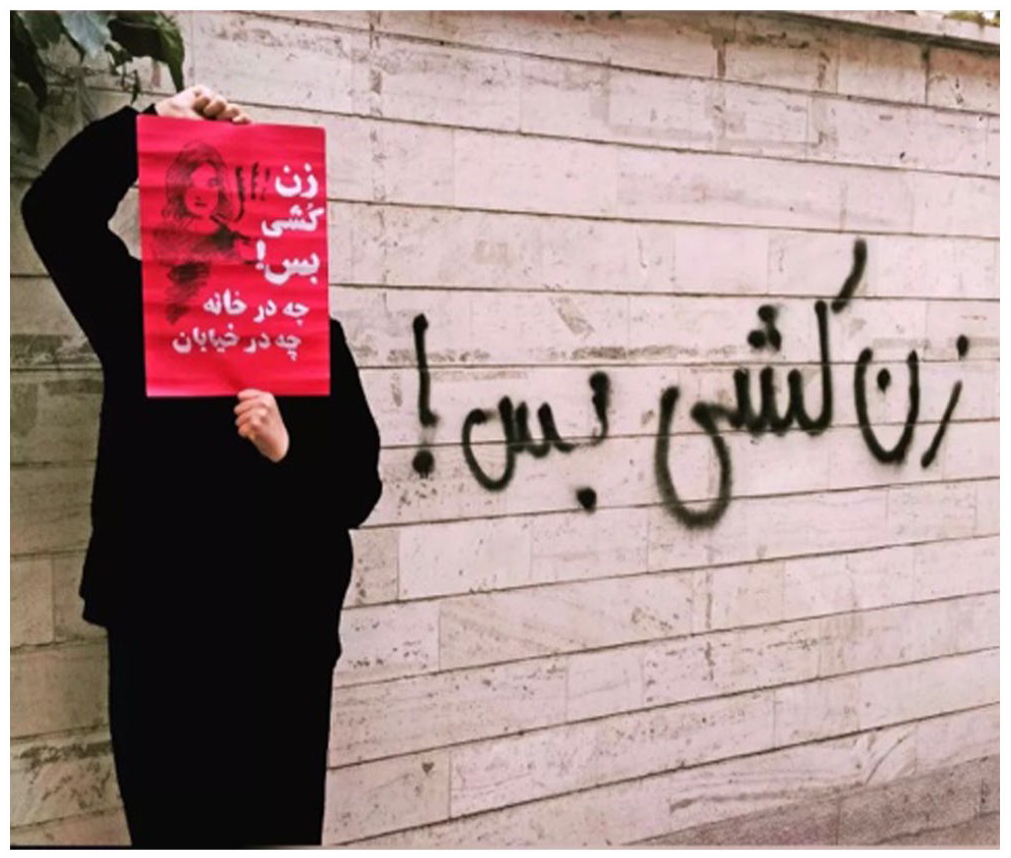
Woman holds up poster stating ‘Enough Femicide! Whether in the home or in the street!’
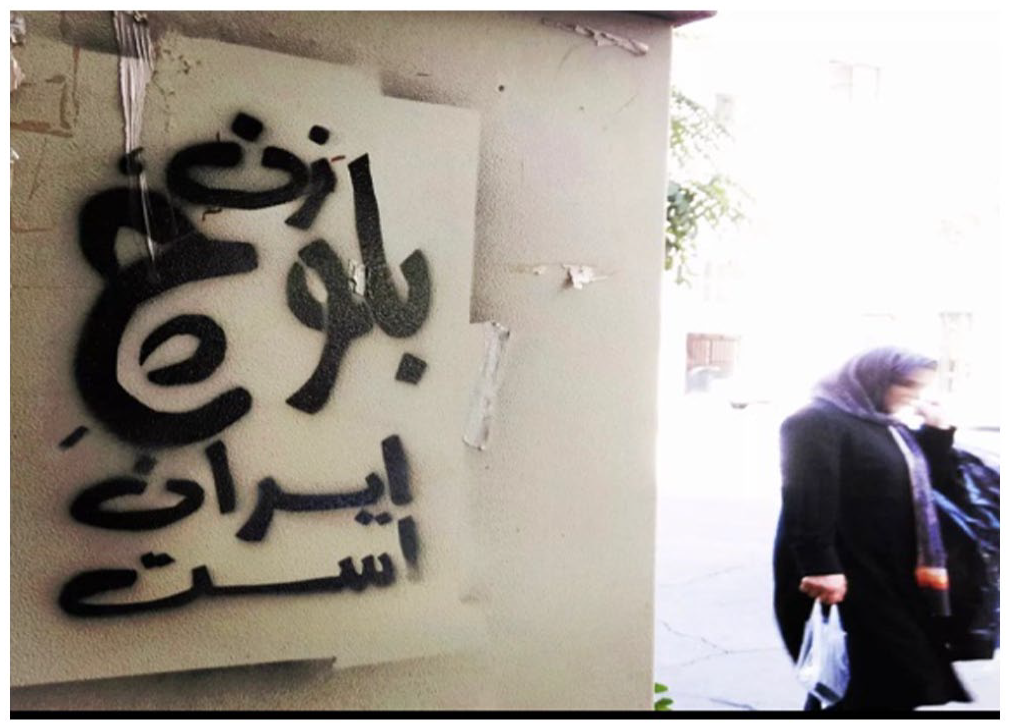
Graffiti stating, ‘Women, the Baluch of Iran’.
The crisis of the nation-state
The death in custody of Jina Amini brought into the open another deep-seated contradiction within the Islamic Republic, namely, the structural violence and underdevelopment/de-development of the periphery in conjunction with the ongoing ethnonational question. According to multiple reports, the name her parents had given her, ‘Jina’, a Kurdish name, had not been allowed to be recorded on her birth certificate. For many Kurds, the fact that she came to be internationally known as ‘Mahsa’ only went to confirm decades of national oppression (setam-e melli) and ethnic discrimination which they have hitherto endured at the hands of the Iranian state. The protestation of mandatory veiling and women’s oppression, the senselessness of what many regarded as essentially an extra-judicial killing, and the palpable sense of ethno-regional discrimination contributed to the breakout of protests in her hometown of Saqqez and ensured their spread to Kurdish-majority cities across western Iran. In this article, due to issues of space, I have chosen to focus on Iranian Kurds and the Kurdish national question and unfortunately will be unable to explore the historical and contemporary conditions of another ethno-religious minority which has faced severe repression during the 2022/2023 uprisings, namely, Baluch Sunni Muslims, which predominately reside in Sistan-Baluchistan province. I hope to incorporate an analysis of the latter into future research.
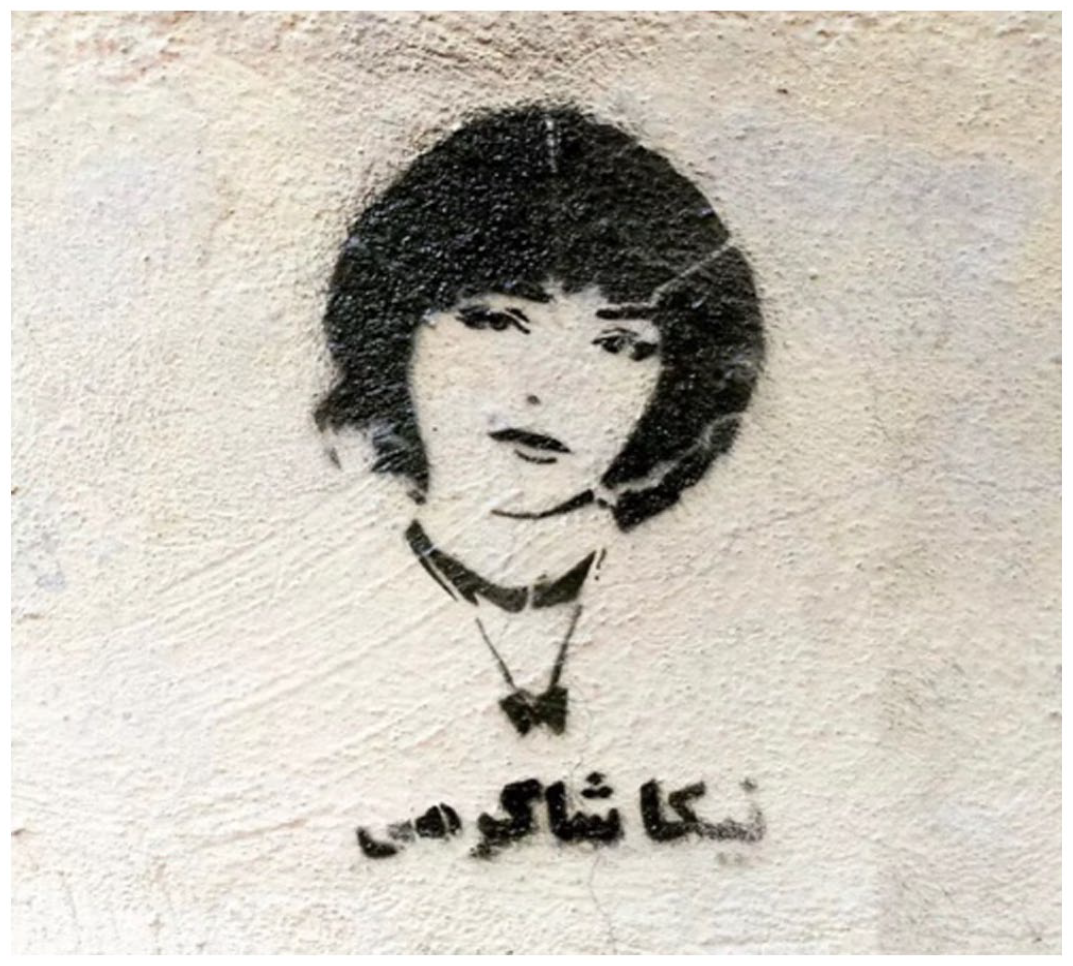
Graffiti commemorating the 16-year-old protestor, Nika Shakarami, who was killed by the Islamic Republic’s security forces in September 2022.
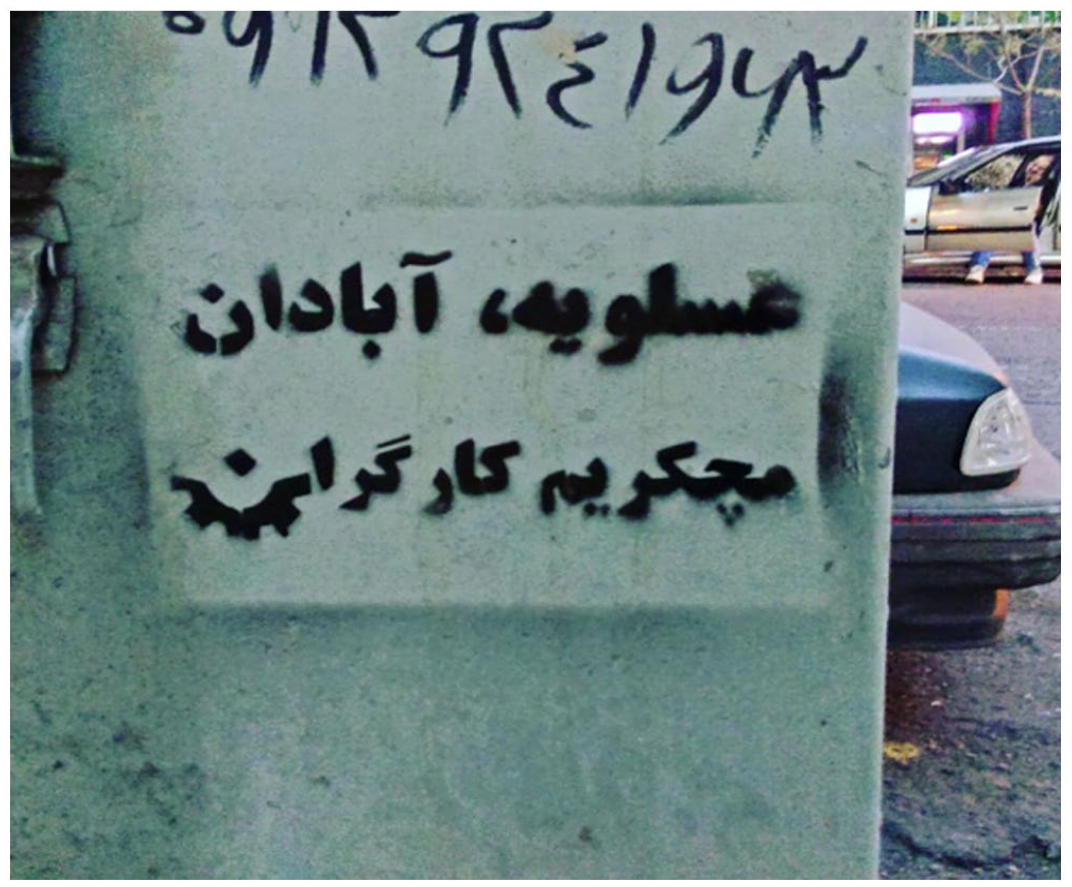
Graffiti stating, ‘Asaluyeh, Abadan, thank you workers’.
While efforts towards modern state building had been made by the Qajars in the latter part of the 19th century, it was with the assumption to power of a Persian Cossack Brigade officer by the name of Reza Khan that rapid and unrelenting centralization took place. I will not recount that story which has been exhaustively analysed by historians such as Stephanie Cronin, Afshin Marashi and Arash Khazeni, among others, but it is essential to recount three features of this process which are important for understanding what I call the crisis of the centralising and hegemonic nation-state.
Reza Khan while at the helm of the Cossack brigade, subsequently Minister of War and Prime Minister, and finally dictatorial monarch, set about ‘unifying’ the vast and diverse territories of Iran through the military whose reform, consolidation and transformation he oversaw and spearheaded (Cronin, 1997). The systematic and concerted exercise of violence and deracination of regional challengers, rebellions, mutinies and popular mobilisations preceded Reza Khan and Seyyed Zia’s 1921 coup but continued apace thereafter (Cronin, 2010). Deep-seated systemic forces and authoritarian nationalist fervour spurred the drive to neutralise all challenges to the state’s monopoly on violence. The forced sedentarization of tribal-pastoral nomads including Kurds, Bakhtiaris, Qashqa’is, and Shahsevans, among numerous others, was also part of this process and reflected the Pahlavi order’s desire to be seen as both ‘civilized’ and on the path to becoming ‘modern’. These long-established forms of social life and organisation were seen as an intractable and anachronistic impediment to the implacable advance of progress. Of equal importance was the necessary separation of pastoral nomads from the means of subsistence, thereby compelling them to sell their labour power in newly emerging industries, as well as the fast developing oil sector situated in the neo-colonial enclave in the southwest of Iran where proletarianized Bakhtiari and Arab tribesmen constituted the lowest rung of the racially stratified labour market (Atabaki, 2013). In this regard, the transformation and reconstitution of ethnic difference and segmentation were part and parcel of the efflorescence of capitalist social relations in country.
This process of centralization and expansion in state capacity also entailed the seizure and remaking of the juridical-legal and educational domains which had hitherto been the province of the traditional clergy, the building of infrastructure such as the Trans-Iranian railway and telegraph communications integral to the formation of national markets, the establishment of a modern police force indispensable for the regulation and protection of private property rights and a burgeoning regime of capital accumulation (Abrahamian, 2018: 72). State centralization and industrial development at the expense of the periphery would continue with alacrity during the reign of Mohammadreza Pahlavi and defined the orientation and approach of technocrats based at the Plan and Budget Organisation (Bostock and Jones, 1989; Cabi, 2020: 342).
Finally, this multi-faceted process of nation-state building sought to hegemonize through instruments and mechanisms of consent and coercion a specific and confected normative Persian identity and corresponding cultural practices, whereby other cultural practices which failed to conform to this normative Persian identity were systematically demeaned, prohibited, and erased. This included everything from prohibitions on the teaching of non-Persian languages and ‘ethnic’ dress and the mandating of ‘European’ dress, to bans and stigmatisation of religious ceremonies and practices. As Rasmus Christian Elling (2013: Chapter 1) has convincingly argued the minoritisation of Kurds, Baluchs, Arabs, and Azeri Turks did not take place against an actually existing and self-conscious ‘Persian majority’. Rather, it is best seen as an elite driven authoritarian revolution from above based on a selectively contrived normative identity and ‘imagined community’ akin to nation-making and state-building projects pursued and executed elsewhere (Anderson, 2006; Hobsbawm, 1983).
The reasons why and how two regimes as ideologically and politically different as the Pahlavi monarchy and the Islamic Republic have promoted and perpetuated comparable political attitudes, strategies and forms of governmentality geared around the centralising nation-state vis-à-vis ethno-national peoples of a ‘periphery’ of its own making has befuddled scholars for decades. Again, drawing on Hall we can understand Iranian state and society as a social formation in which ethnicity and ethno-religious identification and ascription have found themselves articulated in and through social, political, and ideological structures. The status and vicissitudes of hegemonic and subaltern forms of ethno-national identity cannot be understood apart from a specific historical set of economic and social processes, relations, and struggles, unless one is prepared to imbue ethnicity with a ‘single, unitary transhistorical character’ (Hall, 2019: 175).
It must be stressed that political and civil resistance of various hues has been a constant in Iranian Kurdistan. Moreover, before diving into the history and conditions of contemporary Kurdish mobilisations, it is crucial to acknowledge that both the Pahlavi and Islamic Republic’s policies and conduct have been undoubtedly conditioned by the transnational dimension of Kurdish struggles for self-determination across the twentieth century, divided as they were among the invariably hostile nation-states of Iran, Iraq, Turkey and Syria. National claims across the borders of insecure nation-states were seen as real threats to these states’ fragile self-image, in addition to their sovereign claims to control, manage, regulate, and expropriate peoples, territories, markets, and natural resources. The Simko Shikak revolt of 1918–1922 and the brief interlude of the Mahabad Republic, which swiftly fell to the Iranian military following the withdrawal of Soviet forces in late 1946, mark two major political mobilisations of Kurdish peoples prior to the 1979 revolution. Where the first was predominantly defined by the preoccupations and ambitions of tribal elites, the latter more clearly and self-consciously propounded and advanced ethno-national demands for an autonomous Kurdish nation-state (Cabi, 2020: 342; Hassanpour, 1994). The strengths and weaknesses of these political formations have been explored by scholars elsewhere and need not detain us here (Koohi-Kamali, 2003: Chapter 3; Vali, 2014). Both were unforgivingly repressed by military forces marshalled from the centre, though in the case of the Simko Shikak revolt the central state was still very weak and in general disarray, where leaders and provincial landowners still exercised formidable influence. In the second case, namely, that of the Mahabad Republic, more than two decades of Pahlavi rule had massively augmented the central state’s coercive apparatus and capacity for internal repression and policing of the social order. This capacity would only further increase during the reign of Shah Mohammadreza Pahlavi (1941–1979) and was used to brutally curb the stirrings of Kurdish political reassertion in the decades that followed.
The Shah’s co-optation of long-standing demands for land reform and women’s suffrage in the ‘White Revolution’ did not leave Kurdistan unscathed. Previous initiatives from above and grassroots mobilisations from below saw the exponential expansion in access to, for the most part, Persian and Shi’i-centric education in Kurdistan. Significantly, the process of land reform, however inadequate profoundly unsettled long-standing relations of landlord and peasant, much as it had elsewhere across rural Iran (Hooglund, 1982). There was a steady growth in the salaried middle class comprised of teachers, civil servants and healthcare professionals coupled with a precipitous increase in dispossessed peasants, casualised workers, seasonal workers, child labourers, and the urban poor (Cabi, 2020: 344).
Following the 1979 Revolution, there were high hopes that a new chapter in relations between Kurdistan and the central government might be inaugurated and aspirations for cultural and political autonomy finally realised. Societies or jami’yats were founded throughout the majority of Kurdish cities taking on many of the responsibilities left vacant by a state in disarray (Cabi, 2020: 347). Established Kurdish political organisations such as the Kurdistan Democratic Party of Iran (KDPI), the newly founded Komala Party of Iranian Kurdistan, the Society of Militant Women of Saqqez, as well as highly esteemed religious leaders such as Sheikh Ezzeddin Hosseini, sprang into action and used the opening created by the Pahlavi regime’s dissolution to mobilise and reinvigorate their political networks, infrastructure and mobilising capacities (Vali, 2020: Chapter 7). Early demands presented by city councillors and prominent political activists in Mahabad during March 1979 included self-determination within the framework of Iran and calls for the new government to address the deleterious socio-economic conditions long prevailing in Kurdistan (Cabi, 2020: 347). The KDPI continued to abide by their slogan of ‘democracy for Iran, autonomy for Kurdistan’, while the rapid increase in the popularity of Komala, whose Marxist-inspired views on women’s oppression and staunch advocacy for the political and social rights of women, spurred forward women’s participation and their role in the movement (Cabi, 2020: 349; Mojab and Hassanpour, 2021).
It was clear that Khomeini and fellow Islamists sought to de-emphasise ethnic and ethno-national differences in the name of Muslim fraternity and centre a clerically dominated Shi’i Islam in its stead, often sneaking a heavy dose of Persian-centrism surreptitiously in through the backdoor (Entessar, 2017: 307). This dynamic would find itself partially codified in the new constitution when Persian was made the official language of the country, even as ethnic/national (qawmi) language rights were formally recognised and permitted for use in the press and mass media. Notably, while teaching the literature of other ethno-national languages was permitted, instruction in Persian was strictly compulsory, with few exceptions allowed (article 15) (Elling, 2013: 175). Unsurprisingly, the referendum on the constitution which made no concessions on the contentious matter of Kurdish autonomy was boycotted across Kurdistan (Entessar, 2017: 310).
The fractious political order which was still very much in flux set about quickly confronting the Kurdish mobilisation both to avoid setting a precedent and neutralise a formidable pole of political and social organisation out of step with the Islamists own priorities and vision (Cabi, 2020). The crude instrument through which this was achieved was none other than the nascent Islamic Revolutionary Guard Corps (IRGC), which prior to that point had been an ensemble of small, ill-equipped, and poorly trained militias. The militias were bound together by their fealty to Khomeini’s leadership and the sense of a common enemy, but they were also in many ways flung together despite some noteworthy ideological differences by the unanticipated victory of the revolution. Repeated clashes beginning as early as March 1979 and outright conflict in August 1979 characterised the relationship between Kurdish forces and the IRGC as the Khomeinists sought to bring a crucial border region under their control and eradicate a broad array of political organisations and movements that remained recalcitrant in the face of the prospect of Shi’i Islamist domination.
Likewise, in August, the infamous ‘hanging judge’, Sadeq Khalkhali, was dispatched to Kurdistan by Khomeini where he oversaw the peremptory execution of 22 individuals in Saqqez on thoroughly opaque and tendentious grounds. Further mass executions were carried out in the village of Qarna near Oshnaviyeh, among several others (Cabi, 2020: 351). Kurdistan’s brief window of expansive freedoms and democratic experimentation increasingly found itself overcast and under siege. The militarisation of the region continued apace as the Islamists consolidated their power in the capital and elsewhere in the country following the November 1979 US-embassy hostage taking and resignation of Bazargan’s relatively moderate Provisional Revolutionary Government. By 1980, the Islamists felt confident enough to retake this redoubtable bastion of opposition in its entirety and unleashed a bloody reign of terror, whose proportions still require a thorough accounting.
Even though as Marouf Cabi has shown, Kurdish armed resistance to the Islamic Republic continued throughout the 1980s (Cabi, 2022), and the impact of the Iran–Iraq War on this strategic border region had left deep scars, the late 1990s saw renewed efforts by certain elite factions to engage Kurdish and other ethnic minorities for purposes of electoral mobilisation. Reform-minded and independent Kurdish electoral candidates regularly saw their credentials rejected and political activists were persistently harassed and arrested. In April 2001, during the Reformist Khatami presidency, the Kurdish governor-general of Kurdistan, Abdullah Ramazanzadeh (1997–2001), was charged by the Special Court for Public Officials with the ‘dissemination of lies’ for his criticisms of the Guardian Council’s nullification of the elections in two Kurdish constituencies, Baneh and Saqqez (Entessar, 2017: 315). Such challenges and obstacles were certainly not exclusive to Kurdistan, even if their intensity was heightened by the dynamics of structural violence and systemic discrimination which have long characterised Kurdistan’s relationship to the centre. An emergent ‘development-security nexus’ has been unable to overturn consistent patterns of underdevelopment that have continued to be reflected in significant disparities in the levels of literacy, poverty rates, and life-expectancy found in Kurdistan and Sistan-Baluchistan (Elling, 2013: 56; Lob and Habibi, 2019: 273). Both of these provinces have consistently ranked among the lowest of Iran’s provinces in per capita income as well as on the Human Development Index (Lob and Habibi, 2019: 271). Peaceful protest and the expression of grievances against such oppressive and unequal conditions is disciplined, policed, and when deemed necessary, brutally repressed by the heavy and disproportionate concentration of security officials and military personnel in Kurdistan, as many as 200,000, according to one estimate (Moradi et al., 2022: 11). This militarised ‘state of exception’ is justified in terms of preserving ‘national security’ and in the name of combatting separatist militancy and Salafi-Jihadi terrorism.
Another crucial matter which I alluded to above was how ascriptive ethnic identities were intertwined with processes of class stratification and the ways in which proletarianized Kurds find themselves propelled into specific, precarious and often highly dangerous forms of labour. In Kurdistan, this has been exemplified by the case of the Kurdish kolbers, who carry as much as 80 kg on their backs across perilous borderlands from Iraq or Turkey into Iran. This dangerous and frequently deadly cross-border labour (kolberi) has been one of several responses to deteriorating economic conditions and dwindling opportunities for social advancement in Kurdistan (Moradi et al., 2022). According to a report published by the British Home Office as many as 170,000 Kurdish people make their living as cross-border labourers and between 2020 and 2021, an estimated 370 kolbers were killed or injured by border officials (Home Office, 2022: 7). In this precarious and securitized form of labour, which is regularly accused of smuggling contraband and other illicit materials, we observe how a determinate set of capitalist relations readily exploit pauperised and proletarianized Kurdish labour, while subjecting them to state violence as Kurds because of the assumed threat they pose to ‘national security’.
Apart from kolberi it is also common for proletarianized Kurdish workers to act as seasonal and migrant labourers travelling long distances to other Iranian cities to eke out a living and support their families (Soleimani and Mohammadpour, 2020: 749). To paraphrase Stuart Hall, we might say in the Iranian case that ‘ethnicity is a modality in which class is lived. It is also a medium in which class relations are experienced’ (Hall et al., 1978: 374), as objective conditions and experiences of class solidarity are stratified, fractured, fractioned and disorganised by the political and economic structures of capital. I stress ‘a’ modality because class exploitation in the Iranian context, like elsewhere, finds itself articulated in myriad ways, some of which I will address in the final section entitled “The crisis of authoritarian neoliberalism.” The complex and evolving relationship between ethnic oppression and class stratification cannot be fully explored here nor should it lead us to ignore other questions around class stratification and oppression endogenous to Kurdish society itself or deny the ‘relatively autonomous’ effectivity enjoyed by ethnicity and mobilisations geared around ethno-national demands or the dynamics of securitization. It is however crucial to understand the deeply intertwined nature of these two political and social processes, if we are to better grasp the depths of discontent which have generated an enduring culture of solidarity and resistance in this region.
Since the start of the protests in mid-September 2022, Kurdish towns and cities, such as Sanandaj, Mahabad, Saqqez, Marivan, Bukan, Javanrud, and Baneh have seen some of the most sustained protests against the Islamic Republic in its entirety and they have been met once again with violent and militarised responses by the authorities (Hafezi, 2022). The disproportionate number of casualties of Kurdish and Baluch Iranians and the utilisation of lethal violence in response to the 2022/2023 uprisings further underwrites the conditions of structural violence which orients the centre and central state to border provinces populated by ethno-national and religious minorities (Amnesty International, 2022a; Human Rights Watch, 2022). Finally, reports of IRGC deployments to Kurdish-majority towns have once again raised the spectre of the incipient years of the Islamic Republic. In light of this troubled history it should come as no surprise that, the underlying grievances around political freedoms, democratic self-determination, and economic well-being, remain unaddressed and ensure further protests, if not generalised revolt later down the line. It is in the Kurdish uprising that we see how the contradiction of the nation-state is conjoined and overdetermined by the contradictions of the gender regime, exploitative labour regimes, and the democratic deficit.
The crisis of ‘religious democracy’
We now turn to the democratic contradiction and crisis of legitimacy assailing the Islamic Republic’s theocratic-populist system. The Islamic Republic can be understood as an example of a hybrid authoritarian regime comprised of nonelective and elective institutions, whereby the former in conjunction with powerful security and military institutions, regularly seek to dominate and shape the outcomes of the latter (Levitsky and Way, 2010). The Islamic Republic has enjoyed moments of inter-elite competitiveness which several scholars have argued has historically imbued the political system with a degree of flexibility and resilience (Harris, 2017; Keshavarzian, 2005; Lob, 2018). This ‘competitiveness’ has, however, found itself increasingly eroded and divided among an ever-diminishing circle of Khomeinist elites, that is, elites which broadly accept and work within the parameters of the constitutional order and contested ideological framework delineated by the late Ayatollah Khomeini, and his successor, Ayatollah Khamenei. I will analyse further below this exclusion of Reformist and centre-right elites and the social classes and constituencies they strive to cohere and represent, and its corrosive effects on state legitimacy and the state’s capacity to reproduce social relations of domination and consent.
The constitution of the Islamic Republic is comprised of dictatorial, oligarchic and formally ‘democratic’ institutions. These include the Office of the Supreme Leader (Daftar-e maqam-e mo’azam-e rahbari), the Guardian Council (Showra-ye negahban), Assembly of Experts (Majles-e khebregan-e rahbari), Expediency Discernment Council (Majma’-e tashkhis-e maslahat-e nezam), and the presidency and Islamic Consultative Assembly (Majles-e showra-ye eslami). Iran’s elective institutions enjoyed a significant degree of inter-factional competition between 1997 and 2017, and unlike other authoritarian political systems such as those historically found in Ba’thist Iraq or Syria, the outcomes of presidential and parliamentary elections were not pre-determined or given in advance. Therefore, in electoral contests popular preferences and authoritarian manipulation both had a role to play (Schedler, 2006: 2). The elections of Mohammad Khatami and Hassan Rowhani to the presidency in 1997 and 2013, respectively, stand out in the Iranian case.
Anyone remotely familiar with Iranian electoral cycles is apprised of the decisive role of the Guardian Council and its prerogative to disqualify candidates on opaque and seemingly arbitrary criteria. This tutelary power over elections works in concert with the ‘repressive state apparatus’ where the full weight of the law and coercive power of the state proscribes and persecutes the remaining vestiges of political parties and organisations outside of the Khomeinist fold. This has given rise to the pervasive idiom of ‘insiders’ (khodi’ha) and ‘outsiders’ (gheyr-e khodi’ha), an often fluid and intangible dividing line understood by all Iranians on a visceral level (Pahlavan, 1377). Nevertheless, very few, in the final analysis, are completely immune to the depredations of arbitrary and personalised power exercised by the Supreme Leader and the hydra-headed security apparatus. Even politicians who had previously occupied some of the highest offices in the post-revolutionary era have not been insulated from arrest or imprisonment, when they have been deemed to have transgressed broadly understood, albeit uncodified red lines. Domination in potentia in the republican sense of non-freedom popularised by Quentin Skinner and Philip Pettit is a lived reality of ordinary citizens and civilian politicians alike, even if the latter have far greater leeway (Pettit, 1997: Chapter 2). The process of criticism, marginalisation and disillusionment among the political class despite existing in earlier periods, really gathered pace following the disputed 2009 re-election of Mahmud Ahmadinjead and the Leader’s decision to openly side with the incumbent. In addition to the insights afforded by competitive and electoral authoritarianisms, we must try to understand how various Khomeinist factions gravitate towards, if not mechanically map on to, different class fractions and accumulation strategies.
In more abstract terms, the political system prima facie seeks to reconcile two distinct forms of sovereignty: divine sovereignty embodied in the notion of velayat-e faqih or the Rule of the Islamic Jurist and popular sovereignty, a legacy of the 1979 revolution. Both Reformists and the Right have sought to describe the constitutional arrangement of the Islamic Republic as a ‘religious democracy’ (mardomsalari-ye dini). The former has sought to emphasise and augment the depth of the popular-elective component after their own fashion (Khatami, 1372), while the latter has insisted that the role of the people and elected institutions must ultimately conform to the will of God and the final determinations of the Supreme Leader. As Khamenei himself recently phrased it in a speech on the 32nd anniversary of Khomeini’s death: ‘religion must rule, and in this rule, the people must be present; this is what religious democracy means, and this derives from the letter of Islam’ (Khamenei, 1400). On this interpretation, ‘the people’ have a role to play in expressing their approbation of the system, but legitimacy in the final analysis does not emanate from them; a position long espoused by Khamenei’s favoured Rightist ideologue, Ayatollah Mohammad-Taqi Mesbah-Yazdi (d. 2021) (Mesbah-Yazdi, 1377).
By 1983, the post-revolutionary political system had systematically eliminated, driven into exile, and excluded nearly all political organisations and groupings that were openly antagonistic to the Khomeinists. Through the mid-1980s and 1990s, inter-factional electoral competition among Khomeinists came to predominate. With the dissolution of the Islamic Republic Party (Hezb-e jomhuri-e eslami) and failure to build a one-party state (Chehabi, 1991), parliamentary and presidential elections became an arena for Khomeinist factions with distinct social, political, and economic programmes to vie for power, albeit under the watchful eye of the Leader’s office, and the immense power it wields through the nonelective institutions of the judiciary, Guardian Council, and Expediency Discernment Council. The Leader’s office is further buoyed by its control over an array of political-economic and ideological state apparatuses including revolutionary religious foundations, religious, and ideological propagation institutes, country-wide Friday Prayer leaders, and the state broadcaster IRIB. In principle and according to the writ of the constitution, the Leader is commander-in-chief over the Islamic Revolutionary Guard Corps and the Organisation for Mobilisation of the Oppressed, better known as the Basij militia, though their function and modus operandi are more complicated in practice.
The benefits of the carefully managed competitive authoritarian system, in which electoral outcomes have not always been a foregone conclusion, was that it furnished the political system with a limited, though not inconsequential ideological pluralism, satisfying the political aspirations and ambitions of various factions within the Khomeinist political class. At the same time, inter-factional electoral competition had the power to mobilise the electorate, or at least a significant part of it, generating apparent legitimacy for the revolutionary political system or nezam as it is often referred, while ensuring that vertical relations of power, patronage, and influence remain fundamentally unchallenged (Alamdari, 2005; Keshavarzian, 2005; Moslem, 2002).
The elections for the Fourth Majles in 1992 are widely understood to be a watershed in which the Guardian Council unabashedly began to deploy its prerogative of approbatory supervision (nezarat-e estesvabi) to disqualify candidates associated with the ‘Khomeinist left’. Following the ignominious and in many ways devastating outcome of the Iran–Iraq War and death of the revolution’s incomparably charismatic leader, Rafsanjani and Khamenei, the new president and Supreme Leader, respectively, not only saw the Khomeinist left as political adversaries but also an inconvenient nuisance with the means and resources to stymie their plans for regional normalisation and economic ‘liberalization’. In subsequent years, this prerogative of the Guardian Council increasingly became a cudgel to wield against political and factional opponents by the Leader and his allies in the clerical establishment and security apparatus. The drive towards authoritarian closure and narrowing of the political field, however, was not linear or unidirectional and, at crucial moments, societal pressure from the middle and working classes and various social movements played a decisive part in altering the calculus of ruling elites. In May 1997, the former Minister of Culture, Hojjat al-Islam Mohammad Khatami, was elected with an electoral landslide on a platform committed to uphold the rule of law, advance civil and political rights guaranteed under the constitution, and empowering civil society. The victory as well as its scale came as a surprise to the Right aligned with the Leader’s office and the Leader himself, as well as the Khomeinist left who would later go on to rebrand and style themselves as Reformists (eslahtalaban) (Ansari, 2019; Randjbar-Daemi, 2018; Rivetti, 2020; Sadeghi-Boroujerdi, 2019).
Among Reformists there were notable political and ideological disagreements, with a junior cohort of politicians such as Mostafa Tajzadeh and Sa’id Hajjarian harbouring grander ambitions to remake the state and leverage their considerable voting bloc, into deeper institutional reforms (Sadeghi-Boroujerdi, 2019: Chapter 7; Tajbakhsh, 2022). The most notable achievement in this regard was the first town and village council elections convened in 1999, which evaded the Guardian Council’s vetting process due to the lack of remit as well as their sheer scale and magnitude. Through these elections, it was believed that the Reformists might be able to further consolidate their electoral gains and to remake the state in their image (Tajbakhsh, 2022). In conjunction with these initiatives, in his second term, Khatami would pursue the so-called Twin Bills, which aimed to expand the president’s executive power and restrict the Guardian Council’s power to disqualify electoral candidates. Both unable and unwilling to mobilise extra-parliamentary social movements, such as the women’s movement or actively support the formation and growth of independent labour organisations, Khatami would be forced in humiliating fashion to withdraw the Twin Bills, and 80 sitting Reformist MPs would be disqualified from standing for parliament again in 2004 (Sadeghi-Boroujerdi, 2019: Chapter 7). Khatami and the Reformists’ obvious preference for institutional politics and distrust of non-institutional political actors and movements beyond their direct purview and supervision, not only made it easier for entrenched and nonelective centres of power to stonewall their own political project but arguably facilitated or at least paved the way for their subsequent political marginalisation as well.
As previously mentioned, the contentious and much disputed presidential re-election of Mahmud Ahmadinejad (2005–2013) gave rise to mass protests under the banner of the Green Movement in the summer of 2009. It marked the single largest internal crisis to blight the Islamic Republic since 1981. The chief demands of this predominantly urban middle class movement remained within the parameters set by the constitution and prevailing norms and rules governing inter-elite electoral competition. These included demands for an impartial and transparent vote recount, nullifying the election results and reconvening the presidential election, all evocatively encapsulated in the slogan, ‘Where is my vote?’ Remarkable scenes of hundreds of thousands of protestors walking in silence to protest what they adamantly held to be a fraudulent election were caught on mobile phones and circulated on social media platforms such as Facebook and Twitter for the first time. Ruling class cleavages came into stark relief like never before and the ostensible leaders of the movement, Mir Hossein Mousavi and Mehdi Karrubi, a former Prime Minister and Speaker of Parliament, respectively, as well as Mousavi’s wife, Zahra Rahnavard, a political and intellectual figure in her own right, were placed under house arrest in 2011, where they remain till this day. The mass protests were brutally repressed over a period of months, creating a new generation of political prisoners and exiles in its wake. But this highly disruptive and destabilising episode has since come to be interpreted in terms of the Leader’s ever-growing personalisation of power, the decisive and irreversible entry of the IRGC into electoral politics, and the final casting out of the Reformists and withdrawal of future opportunities to contest high office.
The election of the centre-right politician, Hassan Rowhani, to the presidency did not reverse this trend, and instead his administration had to contend and advance its political programme on this very same terrain. Moreover, despite his repurposing of the elements of previous Reformist pledges and promises, there was at bottom no substantive commitment to democracy or desire to open the electoral field to broader contestation. The conclusion of the Join Comprehensive Plan of Action (JCPOA) between Iran and the P5 + 1 acted as a short-lived reprieve and stimulated the hopes of many Iranians for greater economic prosperity and better relations with the US and Europe. While undoubtedly a landmark diplomatic accord and important precedent, the JCPOA stood little chance of impacting the Islamic Republic’s overall authoritarian trajectory. Moreover, when the Trump administration, after years of threats and sabre-rattling, finally abandoned the JCPOA in May 2018 and began to prosecute a ‘maximum pressure’ campaign, at the heart of which stood the application of comprehensive economic sanctions, the hopes of Iran’s middle classes for substantive political reforms and economic prosperity were brutally dashed. According to one prominent economist’s analysis, since 2011, eight million Iranians have descended from the middle class to the lower middle-class and four million have been added to the ranks of the poor, with rural poverty doubling since 2010 (Salehi-Isfahani, 2022). It would be erroneous and misleading to attribute this decline in its entirety to US-led sanctions. Nevertheless, ample evidence demonstrates how a concerted policy of economic strangulation first pursued with alacrity by the Obama administration and subsequently by the Trump and Biden administrations has been a significant factor in contributing to it (Fayazmanesh, 2013; Salehi-Isfahani, 2022).
The 2021 presidential race which saw the election of the ultra-conservative cleric Ebrahim Raisi, a figure directly implicated in mass prison executions in 1988 (Mohajer, 2020), was widely regarded as having been engineered by the unelected Guardian Council which had disqualified Reformist and even centre-Right candidates en masse from standing in the race. Such overt and unabashed electoral authoritarianism, as well as the disillusionment and apathy with the centre-right administration of Hassan Rowhani (2013–2021), resulted in the lowest voter turnout for presidential elections in the Islamic Republic’s history, a paltry 48.48%, compared to 73.33% in 2017, a mere 4 years previously. The brazenness of the electoral interference and widespread perception that the Leader and his allies were firmly committed to ensure a Raisi victory at any cost were clearly a major factor in the relatively poor turnout and pronounced a lack of confidence in the integrity of the electoral process.
Lacklustre voter turnout and the contentious nature of Raisi’s electoral campaign and ultimate victory, also informed the Principalists’ approach to the question of ‘bad hijab’, namely, women perceived to be either very loosely abiding by the country’s mandatory veiling laws or openly flouting them. Raisi and his allies were ideologically committed to pushing against this long-standing trend, but also saw their advance of a more punitive approach as an effective way of cohering and mobilising their own bloc of supporters around a key fault-line in Iran’s very own ‘culture war’. It is in this context, shortly after his election, that Raisi passed a decree on 15 August 2022, known as the Hijab and Chastity law, a mere month before Amini’s death in custody, which included fines for women held to be violating the law and the firing of government employees whose social media profiles failed to conform to state-enforced dress codes. In instances such as these, we clearly observe the palpable intersection of authoritarian political closure and intensified gendered social control and oppression.
The crisis of authoritarian neoliberalism
Upon the founding of the Islamic Republic, Ayatollah Khomeini and his clerical lieutenants had espoused an eclectic ideology of Islamism, clerical supremacy, Third Worldism, and populist redistributive policies. As documented by Ervand Abrahamian, Khomeini had cannily co-opted elements of the ideological and political zeitgeist in which the revolutionary and egalitarian pronouncements of anti-colonial liberation movements as well as socialist and Marxist-Leninist organisations had been pervasive. Instead of appealing to the revolutionary proletariat, the Ayatollah invoked the Quranically inspired vocabulary of the ‘oppressed’ (mostaz’afin) against the ‘arrogant’ (mostakberin) (Abrahamian, 1993). This eclecticism and the populist bargain which emerged following the revolution was enshrined in the Islamic Republic’s constitution where one can still find broad pledges to various social welfare provisions (article 43) and the nationalisation of ‘all large-scale and major industries’ (article 44). The clear outcome of a class compromise. At the same time, powerful elements within the mercantile capitalist class had been a prominent source of support for the revolutionary clergy (Ashraf, 1988). Avowed proponents of mercantile capitalist interests had a powerful presence in the political class and included organisations like the Islamic Coalition Society (Jam’iyat-e mo’talafeh-ye eslami), the Society of Islamic Associations of Guilds and Bazaars of Tehran, and their affiliated newspaper Resalat. But as Arang Keshavarzian has persuasively argued it was hardly the bazaar or bazaari class writ large that can be said to have partnered with the new revolutionary state, but rather a specific constellation of political-mercantile interests defined by the institutional context of the Islamist state itself, still very much in formation. Increasingly, the bazaar as a corporate entity found itself alienated and distanced from the likes of the Islamic Coalition Society and encountered repeated obstacles in its attempts to enter the field of institutional politics and have its interests represented more directly (Keshavarzian, 2009: 226). Thus, we can say only in the broadest of terms that the Islamic Republic has sought to walk a fine line between a powerful statist and developmentalist impulse, politically aligned conservative mercantile interests, and increasingly, as we shall see, the growing parastatal sector.
The populist bargain advanced by the Iranian state in its first decades was one in which labour was vertically integrated and where an array of social constituencies and pressure groups, the best-known example of which are war veterans and their families and the families of ‘martyrs’, were structurally positioned as recipients of government largesse, even as they too enjoyed agency and made demands on the state. It was never an abiding concern to empower labour or shift the balance from capital to labour. The war period had been overwhelmingly defined by an Islamist war-Keynesianism, namely, total mobilisation for the purposes of the war effort twinned with an avowedly Islamist developmentalist drive, accompanied by rationing as well as an austere ethos of self-sacrifice. As powerfully demonstrated by Eric Lob, the Islamic Republic and, perhaps most notably, the Construction Jihad (Jehad-e sazandegi) stewarded ‘faith-based development and welfare in an effort to Islamize the state and society’ and ‘attempted to Islamize the provinces and villages while seeking to improve their infrastructure, health care, education, electrification, water, agriculture, and industry’ (Lob, 2018: 114, 2020). This was while the state had outlawed all forms of independent labour organising and activism after 1982–1983 in the name of eradicating counter-revolutionaries (Jafari, 2021). By the time the regime had consolidated its position in the post-war period, the social power and leverage of labour to even hold on to the fast-disappearing vestiges of the populist bargain quickly unravelled (Ayubi, 1995: Chapter 6). The tightly controlled and managed state alternative, the so-called Workers’ House (Khaneh-ye kargar), exercised some leverage due to the efforts of regime loyalists in the revolution’s first decade (Kalb, 2022), but it proved fundamentally inadequate and incapable of forestalling the ensuing self-imposed structural adjustment advanced by powerful political factions and aligned class fractions.
Despite mobilising millions, including millions of women (Farzaneh, 2021), the devastating impact of the Iran–Iraq War (1980–1988) would mar the life chances and opportunities of successive generations and the effects of the conflict were geographically unevenly distributed, where border regions experienced the worst of it; some of which are yet to recover (Ehsani, 2016). The Islamic Republic had dedicated as much as a third of its national budget to the war effort, suffered 160,000 casualties, and bore $450 billion in damages to its cities, ports, oil facilities and other vital infrastructure (Lob, 2018: 129). Compounded by the country’s political, diplomatic, and economic isolation, a powerful wing of the political class around the newly minted President Akbar Hashemi Rafsanjani (1989–1997) advocated for the mass privatisation of state-owned enterprises. Though this endeavour was unsuccessful on its own terms, it marked the coming hegemony of a specific kind of neoliberal ‘common sense’ among much of the political class. For the New Right (rast-e jadid) exemplified by the Executives of Reconstruction (Kargozaran-e sazandegi) around Rafsanjani, privatisation would serve several objectives. It would generate economic growth and employment and thereby diminish if not neuter demands for greater democratic participation and accountability and create buy in and opportunities for allies and constituencies that had remained loyal throughout the Islamic Republic’s first turbulent decade. In 1994, the Fourth Majles passed a law authorising the government to sell state-owned enterprises in various ways, where war veterans and their families would receive favourable treatment (Vahabi, 2016: 281). The New Right with Rafsanjani at its helm sought to encourage private partnerships with foreign capital as part of this accumulation strategy. This was reflected geopolitically in calls for normalisation with the Gulf states which had financially supported Iraq during the 8-year war, as well as efforts to mend fraught relations with European states where agents of the Islamic Republic had brazenly assassinated several prominent political opponents, including the Shah’s last Prime Minister, Shapur Bakhtiar (d. 1991) and two general-secretaries of the Kurdistan Democratic Party of Iran, Abdolrahman Qassemlu (d. 1989) and Sadeq Sharafkandi (d. 1992).
Another important configuration of institutions and processes characterising the political economy of the Islamic Republic relate to the so-called revolutionary foundations (bonyads). The first falls under what Mehrdad Vahabi has fittingly called ‘booty capitalism’ and the second conforms to David Harvey’s notion of ‘accumulation by dispossession’ (Harvey, 2003: Chapter 4; Vahabi, 2016: Chapter 6). The revolutionary foundations and various other parastatal organisations founded or established over the course of the first decade of the Islamic Republic’s existence, the best known of which are the Headquarters for the Execution of the Imam’s Order (Setad-e ejra’i-ye farman-e emam), which controls several foundations under its umbrella (e.g. the Barakat Foundation, 15 Khordad Foundation), the Foundation of the Oppressed of the Islamic Revolution (Bonyad-e mostaz’afan-e enqelab-e eslami), the Foundation for Martyrs and Veteran Affairs (Bonyad-e shahid va omur-e isagaran), and the Foundation of Astan-e qods-e razavi based at the shrine of Imam Reza in Mashhad. These foundations initially accumulated vast resources through the seizure of the property and assets belonging to the ancien régime, such as the Pahlavi Foundation, Pahlavi-era industrialists and erstwhile elites who had fled the country, and even religious minorities such as the perennially persecuted Bahais (Stecklow et al., 2013). Hence, booty capitalism was driven forward by the Khomeinists’ monopoly on violence, facilitating expropriations through which ‘endless accumulation requires the endless accumulation of political power’ (Harvey, 2003: 140). The case of the Mashhad shrine is distinct insofar as it has historically enjoyed the status of a religious endowment or waqf long before the revolution, but its modus operandi and role in the political economy of the contemporary Islamic Republic overlaps to a considerable degree with the others.
The revolutionary foundations, more akin to mega-conglomerates, fall under the direct supervision of the Leader and his appointees. The foundations purport to support the welfare of the Muslim community as the Leader and his functionaries interpret it, but remain a capitalist enterprise in which profit, corruption, and rent-seeking going hand-in-hand (Behdad, 2000: 127). They enjoy autonomy from both the government and the traditional clergy. While the Islamic Consultative Assembly, Iran’s parliament, enjoys de jure oversight over the foundations and their activities, in actuality, it possesses very little. They have been exempted de facto from general auditing. In 2008, the parliament voted to prohibit itself from monitoring those organisations under the Leader’s control without his express permission, nor are the foundations subject to the scrutiny and directives of the Central Bank or Ministry of Finance (Vahabi, 2016: 279).
The range of services and economic activities in which the foundations engage is too vast to explicate in any detail here. But they include everything from the production of basic foodstuffs such as bread and dairy products to mining, shipping, tourism, manufacture, industrial production, petrochemicals, agriculture, banking and finance, and tourism. On the one hand, the foundations act as engines of expropriation through the ongoing confiscation of the properties of ‘undesirables’ and the extraction of protection fees (Stecklow et al., 2013), while on the other, distributing goods and benefits to ‘deserving’ constituencies parallel to the civilian government. In the words of Vahabi (2016: 280), the warfare state in Iran was not replaced by a universal secular welfare state; it was superseded by a parastatal religious sector comprised of bonyads [foundations] . . . the bonyads absorbed the state’s social function and hindered the development of a universal welfare system under the name of Islamic charity and fraternity.
In 2006 Khamenei, issued an executive order reinterpreting article 44 and called on the government to relinquish 80% of its shares in state-owned companies (Harris, 2013: 46; Pesaran, 2011: 178). In 2010, more than 300 state-owned enterprises were transferred out of the state sector or were promised to soon be transferred and in December of that year the Iranian parliamentary commission on privatisation reported that out of 70 billion USD of assets only 13.5% had gone to the private sector (Harris, 2013: 46). It ultimately transpired that the overwhelming majority of shares went to the bloated parastatal sector, including religious foundations, IRGC-linked firms and holding companies, pension funds and President Ahmadinejad’s ‘justice shares’ scheme. Therefore, not only have parastatal foundations been exempted from privatisation themselves but they have explicitly benefitted from the manner in which the process has been executed, as state-owned companies have been moved from public ownership into the murky parastatal sector. When put all together we clearly observe how the parastatal sector has not only engaged in booty capitalism through the confiscation of the assets of the Pahlavi regime, private citizens and an ever-growing list of ‘undesirables’ but also set about hollowing out state capacity and commodifying erstwhile public services and common goods as well. It is in the case of the latter that we see the creation of ‘the sociopolitical preconditions for the expanded reproduction of capital’ (Brenner, 2006: 98) and concomitant deterioration in the life chances of millions of Iranians in turn.
The parastatal sector has become so prevalent that Iranian commentators coined the neologism khosulati, combining khosusi (private) and dowlati (government), to describe this process of ‘pseudo-privatization’. The aforementioned processes are also integral to understanding the financialization of Iran’s political economy where in recent years 15 million people have obtained the required ‘stock code’ to enter the market, in addition to the 49 million, predominantly low-income individuals in possession of ‘Justice shares’, often directly implicating their owners in the actions and performance of the parastatal sector. Following the US withdrawal of the JCPOA inflation spiralled from 8% to 34% in 2020/2021 only hastening this process as many Iranians sold liquid and illiquid assets to buy shares on the stock exchange (Ziya and Vatanka, 2020).
The uneasy and often compromised relationship between the civilian government and powerful foundations has burst into the open on numerous occasions. During Rafsanjani’s second term, the chairman of the Foundation of the Oppressed, Mohsen Rafiqdust and his brother, Morteza Rafiqdust, were implicated in a notorious embezzlement scandal (Ansari, 2019). More recently, under the Rowhani administration there was more outspoken criticism of the foundations and their outsized role in the economy (Donya-e Eqtesad, 1396; ILNA, 1397). Either way, there is little doubt that the foundations have facilitated the immense accumulation of political and economic power in the hands of these parastatal institutions, their ability to dispense patronage, target and favour certain social constituencies over others, and promote the ruling Islamists’ social agenda, most recently, for example, in the advancement of pro-natalist policies (Bonyad-e mostaz’afan, 1401).
As indicated above, the IRGC emerged as another major economic actor in the aftermath of the Iran–Iraq War when it was initially mobilised for purposes of post-war reconstruction. Its engineering wing, the Construction Headquarters of the Seal of the Prophets (Qarargah-e sazandegi-ye khatam al-anbiya), founded in 1990, has played a decisive part in the construction of public works, including railways, highways, and dams, as well as crucial infrastructure in the oil and gas sector (Ostovar, 2016: 146). In more recent years, Khatam al-anbiya has turned its attention to building shopping malls, restaurants, and golf resorts (Faucon and Engel Rasmussen, 2019). The sheer breadth of its activities is evident from a perusal of Khatam al-anbiya’s website and publications, but due to the considerable opacity regarding its operations, accurate assessments of its true economic weight in various sectors of the economy are difficult to determine.
Apart from public works, industry, and commercial enterprises, the IRGC oversees a growing military-industrial complex, developing advanced weapons systems, from ballistic missiles to drones. Cast in the language of self-reliance, the IRGC’s capacity to produce various weapons systems is understood as essential to deterring superpower and regional foes, above all, the United States and Israel (Gawdat and Ehteshami, 2021: 91; Sadeghi-Boroujerdi, 2017), but has also become an accumulation strategy in and of itself, a trend found elsewhere in the MENA region (Marshall, 2021). Iran’s military-industrial complex most recently sparked controversy when it was reported that Iranian-made drones had been supplied to Russia during its ongoing occupation and war in Ukraine (Reuters Staff, 2022a). The wider geopolitical context is not insignificant either, as heightened cooperation with Russia is commonly understood within the context of a Leader and IRGC-led strategic ‘turn to the East’ where a highly securitised and authoritarian capitalist model in which the IRGC and parastatal sector play a central role, had decisively supplanted the alternative political and economic vision of their factional rivals among the Executives of Reconstruction and Reformists.
It is essential to note that different interests compete across the IRGC and its manifold military, political and economic institutions, as they do in any military-industrial complex. Widespread perceptions and daily encounters with the representatives of the IRGC’s vast web of business interests and economic operations, its unaccountable and authoritarian interventions in the political arena, and practical pursuit of accumulation strategies of dispossession, have become major sources of resentment and discontent for much of the Iranian public. The IRGC’s shooting down of Ukraine International Airlines Flight 752 on 8 January 2020 killing all 176 passengers on board became emblematic for many of the organisation’s incompetence, autocratic attitude, and evasion of even a modicum of accountability for its actions.
There has been considerable debate and disagreement within the political class with respect to how neoliberal policies and deregulation were best executed and how certain accumulation strategies advanced the interests of competing political and ideological forces in domestic power struggles as well as when it came to contending with various geopolitical challenges. Thus, while the Reformists and New Right epitomised by the Executives of Reconstruction continued to insist upon what they regarded as economic liberalisation and the necessity of creating a suitable environment for what they termed the ‘real’ private sector and foreign investment, principalist/conservative factions aligned to the parastatal sector and military-security apparatus were sceptical and hostile to deepening economic relations with European powers for both security and politico-economic related reasons, seeing them as threats to ‘national security’ and potential competitors in rent-seeking activities. For the latter constellation of political forces, securitization, and untrammelled accumulation became two mutually reinforcing sides of the same coin. Borrowing from Adam Hanieh’s insights regarding the class politics of the GCC states, it is important to stress that both of these different factions and their allies should be understood as competing wings of Iran’s capitalist class, serious disagreements over their preferred strategies for capital accumulation and Iran’s geopolitical orientation to the world, notwithstanding (Hanieh, 2021).
More problematically, the drive to privatisation has been accompanied since 2005 by sweeping subsidy reform. Leading economists such as Djavad Salehi-Isfahani have defended the measures on the basis that they would deliver more egalitarian outcomes, insofar as the state would cease to subsidise the fuel consumption of the wealthiest while those on lower incomes would receive redistributive cash payments instead (Salehi-Isfahani et al., 2015). Such a view fails however to situate this policy programme in the longer sweep of elite waged class struggles and politics in the recent history of the Islamic Republic. The process of subsidy reform can and should also be understood as different elite constellations’ and associated class fractions’ consensus on rolling back entitlements and already meagre protections provided by the state. This process of disentitlement, a decisively political decision in the face of spiralling budget deficits, came into full view in November 2019 when the Rowhani administration further decreased subsidies on fuel without even a redistributive cash payment scheme in place to compensate the poorest strata of Iranian society. The subsidy reform therefore acted as a regressive tax on the working poor and informal sector workers, sparking huge protests across the country. Again, in what has sadly become a familiar story, these poor people’s protests were brutally repressed resulting in hundreds of deaths. Amnesty International has confirmed 321 deaths (Amnesty International, 2022b), while Reuters placed the death toll in the region of 1500 based on three anonymous sources within the Ministry of Interior (Reuters Staff, 2019). Whatever the precise figure, the Islamist state has proven itself willing and ready to deploy deadly force against Iran’s working classes and provincial urban poor on a scale which the wealthier parts of Tehran have hitherto been spared. This dynamic also saw itself played out in the judicial arena following the peak of the latest round of protests having subsided. The fact that the first four protestors executed following the 2022/2023 uprisings, namely, Mohsen Shekari (23), Majidreza Rahnavard (23), Mohammad Mehdi Karami (22), and Mohammad Hosseini (39), were all young men hailing from Iran’s working poor, is hardly an accident.
Another part of Iran’s authoritarian neoliberal order has been the precaritization of labour, which is closely entangled with the expansive role of parastatal entities, as well as the subcontracting and rent-seeking practices they have engendered. As documented by Mohammad Maljoo, the post-war reconstruction period saw the massive casualisation of labour contracts from 6% in 1989 to 90% in 2017 (Rivetti and Maljoo, 2017). Crucially, casualization and short-term contracts have impacted key strategic industries such as the oil, gas and petrochemical sectors. Estimates contend that between 64% and 75% of all oil workers are on temporary contracts (Kadivar et al., 2021). Under Khatami’s Reformist administration workshops employing five or fewer workers were excluded from the state labour law ratified in 1990. This temporary measure was further extended and the Labour Minister at the time, Safdar Hosseini, went on to exempt workshops with 10 or fewer workers from labour law regulations. This temporary measure was then made permanent in 2007 by the Court of Administrative Justice, in effect stripping a considerable proportion of Iranian workers from the right to collectively organise and consolidate their bargaining power (Maljoo, 2014; Rivetti and Maljoo, 2017).
Casualization across the public and private sector and the effective absence of legal protections have not only led to deteriorating work conditions but have also driven down wages and intensified the levels of exploitation to which workers are subject. Widespread casualization coupled with the unrelenting repression of independent labour organising has systematically eroded the ability of workers across various sectors, from primary and secondary education to agriculture and heavy industry, to organise and partake in collective bargaining. This is not to say that workers have been passive or acquiesced to their plight. The activities of the Syndicate of Workers of the United Bus Company, Haft Tappeh Sugar Cane Mill Labour Syndicate, and Coordinating Council of Teachers Syndicate, testify to the contrary. But such attempts to organise collectively and across sectors have had to bear an extremely heavy cost and thus hindered the ability of workers to come together on a broader class-basis.
Following Amini’s death and the breakout of protests, contract workers at a major petrochemical complex in Asaluyeh in Bushehr province went on a series of discontinuous strikes throughout mid-October and mid-December, and there were reports of similar strikes at the Kangan and Abadan oil refineries (Reuters Staff, 2022b). These strikes, however, were not sustained to the dismay of many who without much thought had imagined a replay of the oil worker strikes of the 1979 revolution, the assertion of ‘dual power’, and a final nail in the coffin of the Islamic Republic. While there is video evidence of workers expressing solidarity with the protestors, much analysis barring notable exceptions (Jafari, 2019), had shorn the oil and petrochemical workers of their wider context, and ignored the dynamics at work in previous cycles of strike action. There was also negligible attention to the fragmentation of energy sector workers due to the ascent of casualization and temporary contracts, the role of private and parastatal subcontractors, and the dearth of strike funds to provide subsistence-level support for workers and their families with the advent of strike action. This is not to say that greater cross-sectoral labour organising will not happen or that there have not been some victories by Iranian workers in recent years, but the obstacles, informal, and institutional, to labour organising and the activities and processes necessary to engender class solidarity are all too real.
Conclusion
This article did not set out to analyse Iran’s 2022/2023 uprisings in all their complexity, a task that will require further research and data collection. Instead, it pursued an exploration of the historical lineages of what amounts to a conjunctural crisis and the coming together of various contradictions which have afflicted the Islamic Republic as a political system and social formation. Some of these contradictions have longer lineages and precede the establishment and institutionalisation of the Islamic Republic, while others have been transfigured and intensified by the regimes of governmentality and capital accumulation crafted and pursued by the theocratic-populist order’s political elites and capitalist classes. Any understanding of the 2022/2023 uprisings with its manifold layers of discontent and revolutionary fervour must come to grips with the contradictions of the gender regime and social reproduction, the centralising and hegemonic nation-state, the democratic deficit, the predations of authoritarian neoliberalism and their mutually constitutive articulations in the context of Iranian state and society. Many intricacies, events, and dynamics have been omitted or given only cursory attention in the above article. In emphasising the conjunctural nature of the current crises I have sought to demonstrate not only how these analytically distinct processes are profoundly connected in the Islamic Republic as both a political system and social formation, but their structural and systemic character as well. A historically informed approach has the capacity to delineate the distinct temporalities of these crises, as well as discern continuities and breaks between revolutionary social forces of the past and the coalescence or condensation of new ones still in formation in the present. New alignments between Persian-speaking, Kurdish, and Baluch feminist activist networks, broader Kurdish political mobilisations, and social nonmovements composed of socially liberal and downwardly mobile young people, as well as their overdetermination by deepening class struggles waged on a variety of fronts across Iran’s provinces, will continue to burgeon and grow. Moreover, while we are clearly witnessing the condensation of new and radically-oriented political and social forces demanding transformative change of the political and social system from below, given the entrenched and deeply institutionalised nature of the structures, institutions, and interests they must surmount, it appears that this protracted conjunctural crisis will persist with regular flareups and revolt, rather than give rise to a definitive revolutionary rupture, at least in the short term.
Footnotes
Acknowledgements
I would like to extend my immense gratitude to Elizabeth Evans for nudging me to write this paper in the first place as well as the timely and assiduous way in which she and Catherine Hyland oversaw the review process. I would also like to express my deepest thanks to Ervand Abrahamian, Adam Hanieh, Golnar Nikpour, Afshin Matin-asgari, Siavush Randjbar-Daemi, Eric Lob, Djene Rhys Bajalan, Nazanin Shahrokni Sebastian Budgen, Khodadad Rezakhani, Lucia Pradella, Peyman Jafari, Leyli Behbahani, and three anonymous reviewers for reading an earlier draft of this article and providing insightful comments and constructive feedback. Finally, I would like to thank Nima Tootkaboni with whom I had countless conversations regarding events in Iran as they were unfolding in real time. We not only exchanged many insights and observations during this period, but more importantly, he was a source of sincere friendship during a time of both great exhilaration and tragedy.
Funding
The author(s) received no financial support for the research, authorship, and/or publication of this article.
