




Abstract
Executive Summary
This paper reports on a study that examines how gender has been referenced in United Nations (UN), supranational and state documents on forced migration over the past 40 years. It is motivated by the premise that humanitarian protection discourses reflect broader institutional priorities and ideologies and may therefore expose gaps that reveal the relative importance given to the category of gender. The evidence presented below is the result of an extensive review of policy documents on Afghanistan, Kurdistan Region-Iraq (KRI), and Sri Lanka contained in the Refworld database. 1
The study sought to understand how gender is mentioned in terms of 1. governmentality — a top-down policy preference, which emphasizes the management of humanitarian protection; 2. empowerment — a bottom up policy preference, which emphasizes self-actualization and self-determination: we seek to understand how agency is expressed, including how opportunities for participation feature in policy discourse; 3. inclusion — the scope of coverage of different gender categories in policy discourse; and, 4. differentiation — the particularization of needs, wishes, and demands made by women, men, and girls and boys in displacement settings.
The paper finds: • Where gender and displacement are discussed together, there is greater emphasis on governmentality, which crowds out other objectives, including advancing opportunities for gender empowerment and participation. • Internally displaced persons (IDPs) tend to be treated as an operational challenge alongside security and peacebuilding. The nature of their displacement is implicit in these documents, associated within the recurring themes of land, violence, empowerment, and livelihoods. The documents mention violence, but do not widely cover maternal, sexual, and reproductive health. • The documents offer little insight into the identities of the displaced — whether female, male, children, or members of LGBT communities — and are mostly silent on their specific protection needs.
Overall, the paper finds remarkably little integration of gender within the humanitarian literature on forced displacement. In spite of much advocacy by the UN, the concept of gender has not been effectively disaggregated to address the specific needs of IDPs, especially in the discussion of children. This paper argues that taking gender seriously means recognizing how protection needs may be shaped by power relationships, and how policy and practice would be enhanced by a more nuanced understanding of how vulnerabilities and opportunities are structured by gender and the specificities of the displacement context. It recommends that the United Nations High Commissioner for Refugees (UNHCR) and partner UN agencies continue to find opportunities to bring humanitarian policy on gender and forced displacement into conversation in order to strengthen protection. To this end, it suggests that the concept of gender should be disaggregated to address the specific needs of displaced people, to reflect the wider range of identities of displaced people, and to foster opportunities for their empowerment, and participation.
Introduction
In March 2018, the United Nations Refugee Agency (UNHCR) updated its Age, Gender and Diversity Policy. While the agency has been collecting data on sex and gender for many years, this document signaled a shift in its institutional priorities. The revised policy reflected a long-standing ambition: to “incorporate the capacities and priorities of women, men, girls, and boys of diverse backgrounds into protection, assistance, and solutions programs”; and, to establish the practice of including country-level and gender disaggregated protection and solutions strategies for beneficiaries of diverse backgrounds (UN High Commissioner for Refugees [UNHCR] 2018a).
The idea that the language of humanitarian assistance should inform the design of policy and reflect the diversity of those in need emerged more than 30 years ago (UNHCR 1991, 1992). Scholars attribute the source of change to the 1985 Third World Conference on Women, followed by the 1990 declaration from UNCHR’s Executive Committee of the High Commissioner’s Programme (known as EXCOM) and the landmark UNHCR publication, Policy on Refugee Women (UNHCR 1990), which catalyzed reform within the UN (see: Young 2002; Fagen 2003; Buscher 2012). The production of guidelines on the protection of refugee women (1991) and refugee children (1993), further acknowledged that women had specific gender concerns, reflecting power imbalances, including “protection against manipulation” and lost agency in camp settings, where they faced additional risks in the absence of traditional social protection systems. These problems were addressed in the Guidelines on Prevention and Response to Sexual and Gender-based Violence (UNHCR 2003). Importantly, this collection set the scene for operational investment with the UNHCR establishing the posts of Senior Coordinator for Refugee Women (1989), and Refugee Children (1992), and introducing regional advisors. Today, the agency houses a dedicated unit on gender equality within its Division of International Protection and has committed resources to ensure the protection of women and girls in particular (See UNHCR 2023).
Within UNHCR there has been significant progress in the development of gender-informed policy. In the 1970s, the agency promoted gender equality. By the 1990s, it championed “gender mainstreaming” (Fagen 2003), while the introduction of a People-Orientated Planning (POP) training and framework expanded the idea of gender to include women, men and children in a basic needs tool (UNHCR 1992, 2002).
Yet, discussions on empowerment-based approaches, only took root after the 1991 Guidelines on the Protection of Women were replaced by a 2008 Handbook, which identified how rights- and community-based approaches could work together to advance gender equality (See UNHCR 2008b). Statements on good practice were followed by the publication of country-specific reports and sectoral studies on hearing and amplifying the voices of survivors, protectors, and providers.
This article explores how shifting understandings of gender have informed humanitarian protection discourses. It recognizes that the way humanitarian data and policy are framed reflects broader institutional priorities and ideologies, including the logic of governmentality, which emphasizes the management of displaced populations (Blitz 2021). Yet, the notion of management also introduces some contradictory messages, advocating protecting and strengthening agency on the one hand, and presenting displaced people as dependent beneficiaries on the other. This dissonance can be found, for example, in rapid population estimates, vulnerability assessments, and profiling approaches (Young 2002).
To date, there has been no systematic analysis of how the UNHCR’s gender frameworks has informed humanitarian discourse. The most widely cited independent evaluations, namely the Valid International (2002) and the Women’s Commission for Refugee Women and Children (2002), are more than 20 years old, and exclude IDPs.
To address this gap, between 2019 and 2020, we conducted a review of policy documents on gender and displacement over the previous 20 years. We scrutinized the Refworld database to identify policy documents published by UNHCR, national governments, international and national NGOs, and other providers in Afghanistan, Kurdistan Region-Iraq (KRI), and Sri Lanka. Humanitarian agencies have delivered protection services to diverse displaced populations in these areas over decades. While KRI is an autonomous region within Iraq, it has many qualities of a state, including responsibilities for the protection of IDPs.
We chose Refworld since it is the most comprehensive database that incorporates official documents, academic articles, and reports, and allowed us to search by predefined categories and to conduct free text searches. Documents consulted included UN plans and programs, national policies, and operational assessments by UN agencies and non-governmental institutions (NGOs). Although our search was open, almost all the documentation was available only in English. Moreover, with respect to the KRI, there were only two Arabic language publications. This is a feature of Refworld, which only permits a search in Arabic, Chinese, English, French, German, Italian, Portuguese, Russian, and Spanish. None of the local languages relevant to our study were included (e.g., Pashto, Dari, Sinhala, Tamil, Kurdish). It is possible, but unlikely that our study overlooked relevant, untranslated documents from national governments, local NGOs, and displaced persons. That said, it should be acknowledged that the paucity of documentation in other languages in Refworld indicates a source of bias within the UN humanitarian system.
The article reviews academic debates over the place of gender in UN policy discourse, describes the study’s methodology, summarizes findings for each of the sites, and provides a comparative analysis of discourses on gender and displacement. After suggesting explanations for the variation in findings, it offers recommendations to bring gender and displacement into conversation with each other and to improve the design of humanitarian protection policy.
Academic Discourses
Scholarly attention on the place of gender in displacement contexts was limited until relatively recently, expanding largely on the back of migration studies (Kofman 2021). Concerns regarding labor inequality, family structure, and transnationalism dominated academic inquiry (Huang, Yeoh, and Rahman 2005; Hoang & Yeoh 2015.), while girls were rendered largely invisible in bureaucratic, media, and academic discourses of refugee-generating situations (Nordstrom 2008). Moreover, the way women and girls have been depicted presents an inauthentic picture, which appeals to humanitarian donors (Fiddian-Qasmiyeh 2014). Elsewhere, gender studies of displacement mirrored the representation of women as victims, instead of heroines, losers instead of winners (Brown 1997).
Within forced migration, any attention to gender largely meant promoting the inclusion of women. Absent from these discussions was an analysis of power as found within cotemporaneous feminist scholarship in other fields (Hyndman 2010). Biewener and Bacqué (2015) argue that until then 1970s, the language of “women’s empowerment” was known principally to religious and governmental organizations and was associated with emancipatory movements, in the United States, until it was embraced by scholars in South Asia (Banerjee 1995), before entering mainstream development discourse (Rowlands 1998). Yet, some feminist scholars argue that in practice, the notion of gender empowerment was devoid of meaning (Cornwall and Brock 2005).
Major studies on UN humanitarian operations provided little insight into gender within the context of displacement (Loescher 2001). The inclusion of gender in the literature on displacement tended to follow the institutional evolution of the UN system, most importantly the 1995 Beijing Platform for Action (1995) and the expansion of sectoral agendas associated with specific UN instruments and agencies, which were then reflected in landmark publications. The most significant reports include the World’s Women and the State of the World’s Children and the follow-up Beijing Declaration and Platform for Action: Beijing+5 Political Declaration and Outcome (UN Women 2014). Although some of these documents considered the gendered experiences of displacement, coverage was inconsistent.
Academics both followed and critiqued this train of policy, with feminist scholars identifying gaps in normative frameworks and raising questions about the organization of power within the UN system (Young 2002; Fagen 2003; Buscher 2010). Hudson (2010) condemned the utilitarian manner in which women’s rights were securitized within the UN system, point out that women feature only when they are seen as essential to establishing international peace and security, an approach which necessarily limits women’s participation.
Over the past 15 years, forced migration studies have revealed a resurgence of interest in gender, including studies on children and agency (Rosen and Twamley 2018), experiences within the camp setting (Krause 2021), sexualities and the protection of sexual minorities (Shuman and Bohmer 2014), and the role of non-governmental organizations (NGOs) (Szczepanikova 2010). This resurgence has generated rich empirical studies, both historical and contemporary (Altınay and Pető 2016), and fresh accounts of intersectional and feminist approaches to the study of forced migration (Ball 2021). They have also generated evidence of displaced people successfully repositioning themselves and breaking-out of their marginalization (Schwiertz 2021).
This article investigates how gender has been treated in policy discourse. For analytical purposes, it distinguishes between agency-affirming and instrumental accounts of gender. We note, for example, that Biewener and Bacqué’s (2015) approach to empowerment, which emphasizes self-actualization stands in opposition to governmentalist approaches where displaced people are “dependents” under the protection of states or international agencies. The manner and scope of such coverage is important, since, as Krystalli, Hawkins, and Wilson (2017)argue, the ways in which gender is understood necessarily influence the design of policies regarding women, which can lead to maladaptive coping strategies. Hence, we examined documents that discuss gender from different perspectives including:
(i) governmentality: a top-down policy preference, which emphasizes the management of humanitarian protection;
(ii) empowerment — a bottom up policy preference, which emphasizes self-actualization and self-determination;
(iii) inclusion — the scope of coverage of different gender categories in policy discourse;
(iv) differentiation — the particularization of needs, wishes, and demands made by women, men, and girls and boys in displacement settings (Figure 1).
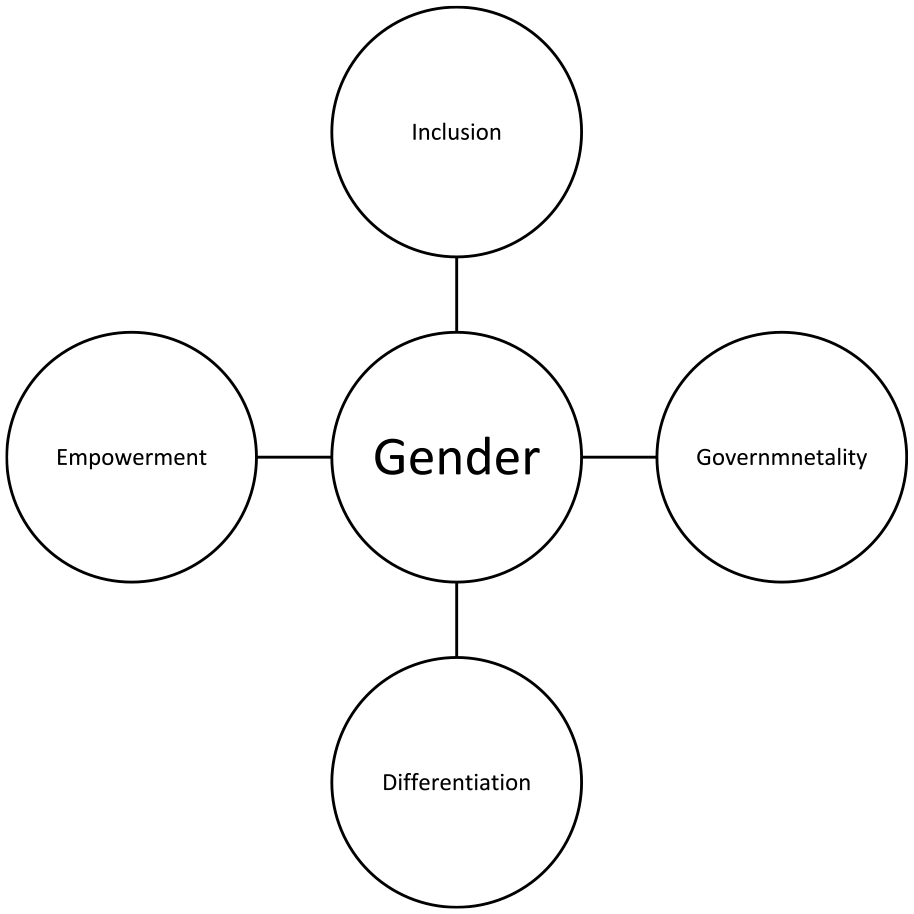
Gender Policy Preferences.
We recognize that forced migrants face a multitude of challenges and that descriptions of power should not be reduced to gender alone. The interplay of political, racial, and religious persecution affects women, and men (Edwards 2010), as well as their agency in making decisions based on these causes (Arbel, Dauvergne, and Millbank 2014).
Methodology
Much policy discourse includes both categories of refugees and IDPs, often in the same document. However, while refugees are present in the KRI in large numbers that is not the case for Afghanistan and Sri Lanka. We have therefore narrowed our interest to focus on IDPs.
Afghanistan has been a site of conflict for over two decades and the population of displaced people includes many different ethnic groups (See United Kingdom Home Office 2004a; UNHCR 2008a). Before the return of the Taliban to power in August 2021, there were over 4 million IDPs, including former refugees who returned, both voluntarily and under repatriation agreements from neighboring host countries (See UN Human Rights Council 2017b). According to the UN Office for the Coordination of Humanitarian Affairs (OCHA), around 327,000 people were displaced in 2020, 80 percent of whom were women and children.
The Data provided by the Kurdistan Regional Government (KRG), indicates approximately 698,902 IDPs (United Kingdom Home Office 2014). Many ethnic and religious minorities have been displaced due to the actions of Islamic State, including gender-based persecution and violence targeting women (Bengio 2014, UNHCR 2018b, United Kingdom Home Office 2004b).
Sri Lanka also houses a longstanding displaced population. More than a million Sri Lankans in the Northern and Eastern provinces experienced multiple and protracted displacements during the 30-year Civil War, while its final stages created 300,000 IDPs who were transferred to camps in Vavuniya District. Since 2009 the Sri Lankan government has been working to resettle the IDPs (See UN Human Rights Council 2014a, 2014b).
Inclusion and Exclusion Criteria
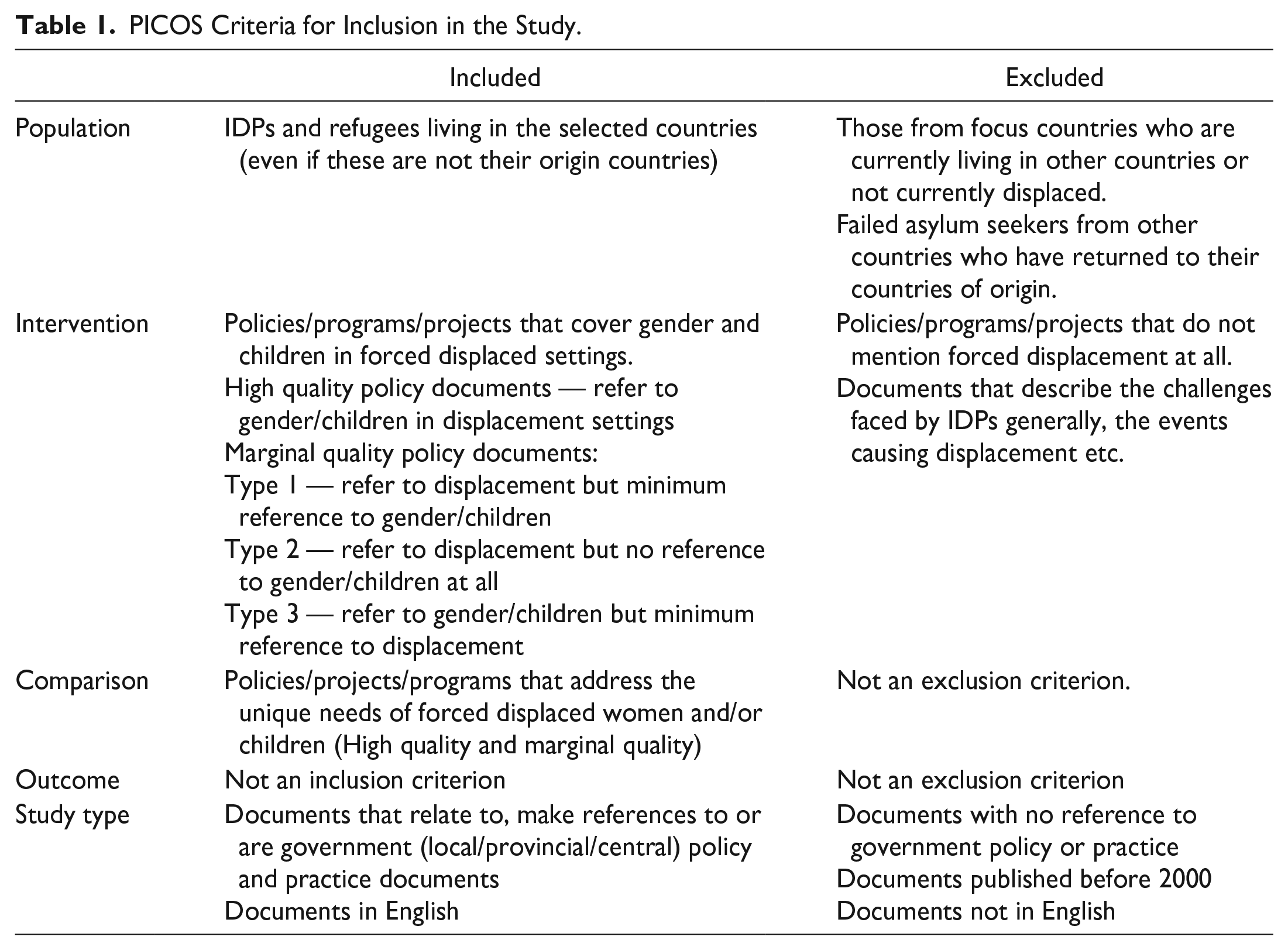
We deployed a PICOS model (population, intervention, comparison, outcome, and study design) as suggested by Methley et al. (2014). Table 1 below presents the conditions for inclusion in the study.
PICOS Criteria for Inclusion in the Study.
Search Strategy
We used Refworld as our search tool. However, the search function in Refworld does not permit long search strings. Consequently, we used an R program to augment Refworld’s search functionality, which enabled us to run a series of short searches for all countries, remove any duplicates, and download all the results into an Excel sheet. The search terms were:
inequal*+displace*
empower*+displace*
gender+discriminat*+displace*
gender+mainstream*+displace*
gender-based+persecut*+displace*
gender+persecut*+displace*
gender-based+violen*+displace*
gender+violen*+displace*
sex*+violen*+displace*
persecut*+sex*+orient*+displace*
gender+identi*+displace*
skill*+displace*
empower*+displace*
settlement+displace*
The country teams then filtered the studies. First, we selected documents on forced displacement in the relevant country; second, we selected documents that either discussed pre-existing policy or provided recommendations regarding displacement and humanitarian management; third, we searched for discourses that revealed gender-sensitive themes, women-focused discussions, and relevant policy suggestions (Figure 2).
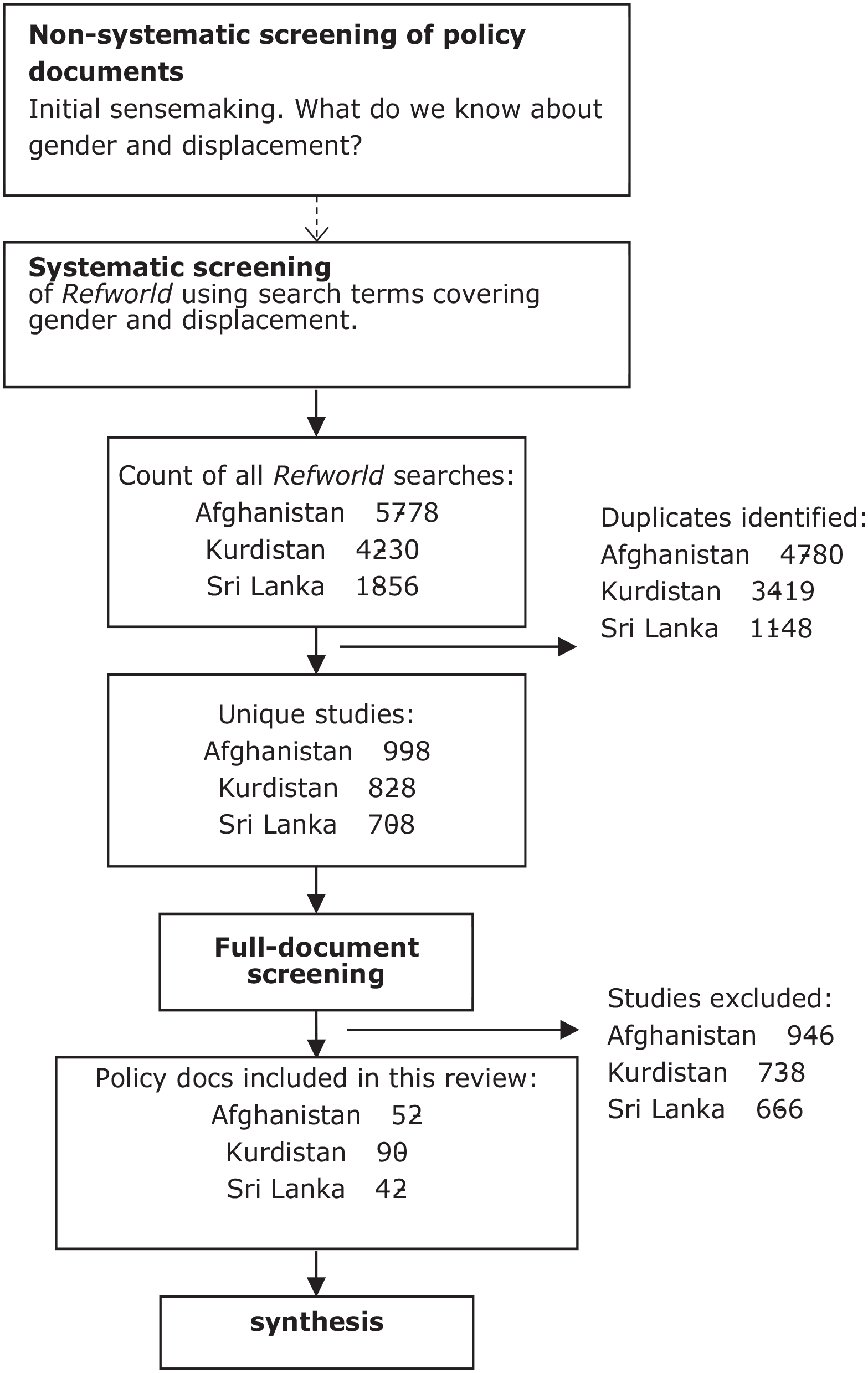
Methods Used.
Findings
Afghanistan
Until August 2021, Afghanistan was under the governance of UN and international forces. Unsurprisingly, discussion of humanitarian policy focused on the political and operational challenges of governance (Government of Afghanistan 2013). Some 52 documents (5 percent of a total of 998 documents) were included based on the themes outlined above. Most covered socio-political and statistical data rather than policy initiatives. However, the study identified some progressive developments, including the introduction of legal language to address displacement, with particular emphasis on displaced women.
Themes
Documentation covered policies on forced migration, general policies on gender and children, and policies related to gender and children in the displacement context. A small number referred to national policies that focus explicitly on the management of displacement, for example, the Framework of National Responsibility and Guiding Principles on Internal Displacement. The policies referred to in these documents prioritize the development of legal protection frameworks (Brookings Institution and University of Bern Norwegian Refugee Council 2010). The Afghanistan National Development Strategy for 2008-2013 (ANDS) similarly discusses a basic framework for IDPs to facilitate their reintegration and aligns with the program of the Afghan Ministry of Refugees and Repatriation.
Other policies, including the Refugee Return and IDP (RRI) Sector Strategy on socio-economic development, hardly mention gender. Similarly, the Framework for Durable Solutions, an exhaustive guideline for formulating policies toward land allocation for IDPs, tracking and registering them, does not provide information on how policies are informed by gender. Similarly, we find the discussion of programs like the National Solidarity Program is general, and the focus on providing security to IDPs, and facilitating their local and political reintegration (Brookings Institution & University of Bern 2010). Others discuss the adoption of national policies toward IDPs, on types of aid on offer through the unilateral efforts of international non-governmental organizations (INGOs) and the Department of Refugees and Repatriation.
Policy Sources: A Comparison
Few reports relevant to our study were published by the Afghan government. Gender features mostly in publications by INGOs, but these tend to focus on Afghans seeking asylum abroad (UNHCR 2001, 2007, 2008), and the use of Dublin II transfer arrangements (Amnesty International 2010), rather than protection challenges within Afghanistan. One finding by Amnesty International (2017) concerns the failure to implement policy on IDPs. Some UN reports refer to the lack of a national refugee law, and asylum system. Identification policies and provision of IDP certification (including ID cards) is also an important theme (UNHCR 2018c). In the early 2000s, several UN reports on the security situation in Afghanistan under Taliban rule identified larger problems facing Afghan women and provided recommendations that eventually led to crucial developments regarding the protection of women’s rights in Afghanistan (UN Sub-Commission on the Promotion and Protection of Human Rights 2000; UN Human Rights Council 2014b, 2017b). Reports by the US State Department mention legal and social practices that are detrimental to women’s rights and identify violence against women, human trafficking involving women and children, and a lack of opportunities for women (United States Department of State 2009, 2011, 2014). These reports also highlight displacement issues, including the lack of monitoring of IDPs and shortage of centers for displaced women.
Policy and Implementation
Two relevant documents include the Elimination of Violence against Women Law (EVAW) enacted in 2009, and the National Policy on Internally Displaced People, which came into force in 2013 (Government of Afghanistan 2013). INGOs also produced key documents. For example, Amnesty International published a report in 2014 that evaluated the Karzai government’s efforts regarding the protection of women’s rights and concluded that more thorough implementation was required (Amnesty International 2014, 2017). Reports from the Human Rights Commission identified the higher risks facing women and children (UN Human Rights Council 2014b, 2017b). The literature also points to insufficient implementation at the provincial level. An earlier UN Human Rights Council (2014) report on practices in 2013, discussed the impact of conflict on children and women including detention, the threat of violence, and the human rights challenges facing the new government. In addition, some documents provided insight into legal aspects regarding women’s rights, identifying archaic constitutional provisions and laws, which identified the need for foreign NGOs to advance advocacy efforts and assist the Ministry of Women’s Rights in Afghanistan (International Crisis Group 2003).
Discourses on Displacement in Selected Documents
National and INGO policy reports emphasize rehabilitation and the protection of displaced people generally and displaced women and children in particular. Discourses on IDPs recommend targeting resources, gender sensitive programs, and stakeholder collaboration to implement national policies and provide durable solutions.
Discussion of Gender-Related Policies
There was little discussion on gender, children, and LGBTQ+ issues in displacement settings. Several sources featured the keywords “displacement” and “gender” but there was no substantive engagement with these themes, and no data provided. One key document reviewed was the EVAW Law, but generally, the discussion treated gender issues as outside the domain of IDPs. Rather, the documents focused on the prevalence of issues facing women and girls, especially in terms of violence and discrimination. Only a handful treated these themes in the context of forced migration and displacement. Similarly, only a few documents focused on gender specific policy needs — while many documents provided data on violence toward women, girls, and children, some even including women IDPs or refugees (See MOWA 2019).
Other gender specific policies emphasized the need for reforms to improve women’s rights in both public and private (UN Sub-Commission on the Promotion and Protection of Human Rights 2000; United States Department of State 2009, 2011, 2014; UN Human Rights Council 2014, 2017). There is a brief mention of trafficking of women, and a cursory discussion of women’s health related policies in the context of policy initiatives taken by the government, or international organizations to improve education, sexual, and reproductive health and to provide services like the Basic Package of Health Services across various districts of Afghanistan (Echavez et al. 2014; UNICEF 2014).
Women and children are largely treated as a single category. This is problematic for two reasons. First, this formulation treats women and children solely as vulnerable groups. Second, it fails to acknowledge that the gendered experiences of girls and boys differ, especially in the context of displacement and forced migration in conflict and post-conflict society. For example, the conflation of girls and boys does not distinguish between experiences as diverse as conscription of young boys into armed forces or militant groups and the forced and early marriages of girls. Some documents included much data on rape of females and sexual abuse of boys (“bacha baazi”) by older men, unrelated to internal displacement.
Kurdistan
Out of 811 documents on KRI only 97 (12 percent) were included, the majority containing detailed descriptions of gender-related policies in a displacement context, interventions, programs, and projects either related to the government or international organizations. Most refer specifically to KRI, but some covered proximate Kurdish areas under the control of the Iraqi government (United Kingdom Home Office 2016). Many documents do not specify if the responsible agent is the Government of Iraq or the KRG. Since most IDPs are in KRI, the assumption is that the target audience is the KRG.
Themes Covered
The main emphasis of almost all included documents is IDPs. With respect to the government of Iraq, the documents speak to policy failure. By contrast, documents regarding the provision of humanitarian assistance within the KRI identify positive outcomes both in camp settings and outside. They mention the issue of women and children in general, in the context of the work of international agencies such as UNHCR, Norwegian Refugee Council, UN Committee on the Elimination of Discrimination Against Women (CEDAW), and the UK government.
The other significant area is the reports by UK Home Office, UN Assistance Mission for Iraq (UNAMI), and NGOs, which present a general picture of the past and present political and human rights situation in Iraq, KRI, and the neighboring countries. Some cast light on legal and administrative issues regarding gender and age. For example, a report by Minority Rights Group International (2016) explains that in the father’s absence, displaced women are unable to hold documentation either for themselves or their children due to the patriarchal nature of the Iraqi documentation system. One report by the Norwegian Refugee Council refers to national policies and the legal framework in Iraq, including policies related to women, and provides an update on the situation of IDPs and displaced women (Norwegian Refugee Council/Internal Displacement Monitoring Centre [NRC/IDMC] 2007).
Policy Sources: A Comparison
The reporting on KRI overwhelmingly considers the prevailing conditions of IDPs, rather than the policies and plans that affect them. Among UN reports, only 15 percent were included in this review and only 2 percent of documents by the Government of Iraq. Reports by INGOs and government bodies of foreign countries account for the rest of the included documents (37 percent). INGOs published more reports on gender and displacement than any other source, and while they have the highest rejection rate (241 reports), there were also the most classified as “very important,” the major sources being Human Rights Watch, Amnesty International, International Crisis Group, Minorities at Risk, and Freedom House.
Not surprisingly, the US government was a prominent author. Documents by the US Department of State, US Department of Labor, Congressional Research Service, and the US Commission on International Religious Freedom, as well as the UK Home Office, constitute 55 percent of reports by foreign government agencies.
Among UN Agencies, the UN Assistance Mission for Iraq (UNAMI), UNHCR, and UN Security Council are the key sources contributing to approximately 69 percent of total publications by UN agencies. With 14 reports, UNAMI is the main source of key reports followed by the UK Home Office and UNHCR with 12 reports.
The oldest document reviewed was published in 1993 and the most recent in 2019. The most frequent focus (30 percent) of key reports is human rights and IDPs’ profile in Iraq, followed by displacement policies including national and other organizations’ policies (25 percent), assistance to IDPs (20 percent), children and women (7 percent), and displacement/gender-related policies in KRI (5 percent). The other areas (13 percent) are reconciliation and coexistence, conflict recovery, refugees, UN and NGO partner response to continuing humanitarian need, UNDP’s Equal Access to Justice Project, and country reports on various topics related to the conflict such as displacement, resettlement, human rights, etc.
Policy and Implementation
The reviewed documents contain comprehensive details on the status of refugees and IDPs in KRI as well as in Iraq, but very little on policy. Those sections that mention policy mostly relate to refugees and IDPs’ health, education, and housing, and recommend initiatives for local governments. There are also references to IDPs’ rights to participate in decision-making as recorded in the Government of Iraq (2008), National Policy on Displacement. Likewise, one of UNHCR’s (2008) Rapid Needs Assessments, while acknowledging the role of KRG in facilitating IDPs’ movement in Erbil and Sulaymaniyah, urges the government to ease residency requirements and reduce or eliminate the fee for documentation.
Discourse on Displacement in Selected Documents
The reviewed documents mainly focus on resettlement, health, and education. Regarding national, local, and INGO levels, all the documents emphasize support and the protection of women and children, as being more vulnerable in the context of radical-religious political groups and militias, especially since the emergence of ISIL in 2014. Most of the INGO and national reports urge the Iraqi government and KRI to develop durable programs regarding gender sensitive issues such as child marriage, honor killing, and female genital circumcision.
Displacement policy was not widely discussed. A few documents provided recommendations, although it is not certain if they have been implemented. No policy recommendations were provided regarding the influx of IDPs during the ISIL crisis. Among these documents, only the UK Home Office suggests a strategic plan on displacement in Iraq by including KRI (United Kingdom Home Office 2004b).
Discussion of Gender-Related Policies
The review indicates that there are many ambiguities and unresolved areas in terms of gender-related displacement, including of children and rainbow communities. The reports on displaced populations are generally descriptive and provide insufficient detail about the lives of those at risk. In all the documents, female and child IDPs are discussed within the broader frame of refugees and migration. Although some reports highlighted the keywords “children,” “displacement,” and “gender,” they hardly engaged with these subjects.
Sri Lanka
Out of the 708 documents assessed in the systematic review process for Sri Lanka, only 42 (6 percent) were included as they contained detailed descriptions of displacement-related policies, plans, programs, or projects. Though conflict-induced displacement has been central to the civil war in Sri Lanka since 1990, over half (22) of the included documents were published after 2006, indicating an increase in policy discussions on the rights of IDPs toward the end of the conflict and after its conclusion in 2009.
Themes Covered
Displacement is the primary focus of nearly half the key reports, followed by gender, children, human rights, and UNHCR operations in Sri Lanka. The other main focus areas are UN and NGO partner responses to continuing humanitarian needs in Sri Lanka, and country reports by UN agencies on topics such as displacement, resettlement, human rights, and humanitarian aid. Key documents such as the National Policy on Reconciliation and Coexistence (2017) look into reconciliation and coexistence among various ethnic groups in Sri Lanka, while reports such as Sri Lanka’s National Framework for Relief, Rehabilitation and Reconciliation (2002) focus on conflict recovery, resettlement, and reconciliation.
Policy Sources
UN agencies are the primary sources, followed by INGOs and ministries of the Government of Sri Lanka (GoSL). Among UN agencies, UNHCR has the highest number of key reports, and the Norwegian Refugee Council’s Internal Displacement Monitoring Centre (NRC/IDMC) has the most publications among INGOs. While reports by the government accounted for only 17 percent of included documents, overall the government’s publications contained a higher level of displacement-related policy discussions than those by others and generally referred to its own policies.
Policy and Implementation
Recent policies on IDPs discussed in the documents cover their needs comprehensively. However, the extent to which these policies have been implemented and benefited IDPs is not clear. Various projects aimed at IDPs indicate that housing and livelihood needs are priority areas (UN Human Rights Council 2017a).
Discourses on Displacement in Selected Documents
All the documents examined refer to displacement-related policies to some extent; 45.2 percent make high-level references, 38.1 percent make medium-level references, while 16.7 percent make low-level references. Among these documents, the National Policy Framework on Durable Solutions for Conflict-Affected Displacement published by the Government of Sri Lanka in 2016, six years after the end of the war, is the foremost policy document that covers the wellbeing and rights of IDPs in Sri Lanka. It commits the government to providing durable solutions to IDPs in the form of return to places of origin, local integration, or relocation in other areas of the country. This policy is referred to in other key documents such as the national report mentioned above.
Apart from the Government of Sri Lanka’s policy of providing durable solutions to conflict-affected IDPs, another key policy that has a significant bearing on IDPs is the UN Guiding Principles on Internal Displacement (UNGPID) (UNHCR 1998). This framework is referred to in several documents by the NRC/IDMC, UNHCR, and Amnesty International. While some of these documents provide detailed explanations of various principles in the UNGPID, others discuss it as a basis for developing policies on IDPs on durable solutions (See: Brookings Institution and University of Bern 2010).
Apart from policies that apply to IDPs in general, most key documents discuss programs and projects that provide targeted aid (shelter, food, medicine, livelihood assistance) to various groups of IDPs. For example, national reports submitted by the Government of Sri Lanka to the UN Human Rights Council in 2012 and 2017, refer to various donor assisted housing programs for IDPs.
Discussion of Gender-Related Policies
While all included documents refer to displacement-related policies to some extent, discussion of gender-related policies is sparse. Sixteen (38 percent) make no reference to gender-related policies, while only six make high levels of references.
Out of the 26 included documents that reference gender-related policies and plans, 61 percent discuss gender in relation to displacement. The others discuss gender-related policies in different contexts, such as the Campaign to End Violence against Women (CEVAW) (See Government of Sri Lanka 2016), the Domestic Violence Act, implementation of the National Commission on Women (UN Committee on the Elimination of Discrimination Against Women [CEDAW] 2015), and the establishment of Women and Children Desks at police stations across the country (UN Human Rights Council 2014). The latter do not address issues uniquely faced by IDP women.
However, even the gender policies that we categorized as displacement-related do not entirely focus on displaced women. Rather, they focus on all women in conflict and post-conflict situations. They cover, for instance, policies and programs such as establishment of sexual and gender-based violence help desks in hospitals in areas affected by the conflict, providing legal aid to war widows, and vocational training programs for female ex-combatants and women who could not continue their education due to conflict (CEDAW 2015). Most conflict-related gender policies treat IDP women as one category of vulnerable groups among others, such as children, persons with disabilities, and elderly persons. Programs and projects looking exclusively at IDP women are limited, covering (for example) vocational training programs for displaced women and sexual and gender-based awareness programs. However, recent policy documents on conflict-affected communities in Sri Lanka seem to pay more attention to the gendered needs of IDP women. For instance, the National Policy on Durable Solutions for Conflict-Affected Displacement, has a subsection on displaced and displacement-affected women. It covers their land rights, rights to livelihood opportunities, healthcare needs, and rights to physical safety and security.
Analysis
The above discussion reveals that where gender and displacement are discussed together, there is a greater emphasis on governmentality. Displacement policy is dominated by a top-down discourse that reflects the legal structures of humanitarian protection policy and the international instruments that shape it. This policy framework may give rise to a dependency culture in which national actors defer to international actors. It presents displacement as a problem to be fixed, not a widely shared condition of the human experience-
Furthermore, the emphasis on governmentality shines a light on the ways in which gender and displacement relate to other policy areas and the hooks used to draw them into official discourse. Displacement is also treated within the recurring themes of land, violence, empowerment, and livelihoods, though here the relationship between gender and displacement is implicit. Violence is mentioned; however, key issues such as maternal, sexual, and reproductive health are not widely covered. For example, in Afghanistan there is an account of programs on maternal/reproductive health, but with no connection to policy.
Problems arise when we probe deeper to explore the scale, and scope of coverage. Examining the three cases, it is clear that the policy documents consulted offer little insight into the identities of these displaced people — whether they are female, male, children, or members of LGBTQ+ communities, and their specific protection needs. We see this problem in the introduction of comprehensive national policies and plans, which focus on state-building, in Afghanistan. Equally, where the 2016 Sri Lankan policy indicates some steps in the right direction, the policy could be expanded to reflect the needs of women and children, in particular.
The above discussion also informs our understanding of what is meant by “gender inclusion.” In spite of UN advocacy, gender tends to be treated as a separate area of concern from displacement. Meanwhile notions of gender have grown broader, as illustrated by the review of UN policy, and have fed into media and public discourse and into development policies. Yet neither displacement nor gender is consistently included in this body of UN policy discourse. The sins of omission are most telling. Displacement in the KRI remains a matter of governmentality. Displacement is dealt with alongside earthquakes, and in this context, gender as a topic is an exception.
The specificities outlined above, and the protection challenges they raise, apply to both national and local governance systems. For example, there are significant differences with respect to land governance between Afghanistan and Sri Lanka, which impact gender inclusion, participation, and the like, but these cultural and political systems are barely mentioned even though they determine access to resources and the realization of rights.
Where gender is mentioned in displacement discourse, it tends to sit in the gray area, and is treated alongside incidents of violence. While these themes do not apply specifically to displaced people, gender equality measures are present in the policy literature reviewed. Similarly, the focus on land reform is most relevant to economic development, and in this content, the fact that IDPs are mentioned at all provides the seeds for further elaboration of policy.
Afghanistan
With respect to Afghanistan in particular, the four-part rubric of governmentality, empowerment, inclusion, and differentiation is only partially useful. We note the Ministry for Refugees and IDPs is not even mentioned among the key partners for development. While sexual violence toward women is mentioned, violence toward males is notably absent from policy discussion even though these documents record the threat posed to “bacha baazi” (“dancing boys”). The most we can say is that that policy discourse is dominated by development-centric plans, not overt rights-based policies, which open the door to empowerment. The vast majority of the documents studies address different policies. While some recognized gaps in effective delivery, and were critical of the Afghan government, we find an overwhelming top-down tone to the governance of IDPs. This may not be surprising, given that Afghanistan has been treated as an international dependency, and much interest has been on state-building and the installation of governance structures.
Kurdistan
In KRI, publications peaked between 2013 and 2015, which coincides with the ISIL/Daesh invasion in 2014, and its consequences. The highest number of relevant reports was in 2015 (89; with 88 in 2014). The vast majority of documents focus on the management of displaced people, especially in camps, and operational issues. Displaced people tend to be treated under the umbrella of vulnerable groups — IDPs, then women and children. There is little disaggregation by displacement status, or by gender. In spite of the fact that women in KRI enjoy a greater degree of equality than in other parts of the Middle East, they play a minor role in this body of writing. Just one document mentioned gender-based abuse in IDP camps, and the role of Islamic State (ISIL), during that time.
Sri Lanka
Much of the discussion on Sri Lanka focused on policy implementation. It is still unclear from these documents if key policies mentioned have been or are being properly implemented. While the documents allude to progress, they do not deal much with gender, but focus on the broader transition from war. In Sri Lanka we also note a bifurcation of discourse: documents on gender tend not to cover IDP issues, while issues related to women and children are not discussed with respect to displacement. Thus, policy discourse does not connect gender and displacement. This could be due to the fact that different ministries cover these areas, but this then points to a failure to take on long established international agendas regarding women and gender.
Conclusion and Policy Recommendations
Unlike the fields of women’s studies/gender and international development, this article records remarkably little integration of gender — whether through the lens of inclusion or empowerment — in discourses on displacement. Although UN agencies may have diversified their data collection methods, official policy discourses do not reflect the call to present disaggregated and more comprehensive discussions of the ways in which gender bears on the experiences of forced displacement.
We suggest that taking gender seriously means recognizing how protection needs may be shaped by power relationships, and how policy and practice can be enhanced by a more nuanced understanding of the ways in which vulnerabilities and opportunities are structured by category of gender and the specificities of the displacement context.
While our three sites offer different entry points into the study of forced displacement given their trajectories from war to peace, there are some commonalities, including the bifurcation of discourses. As noted above, the inclusion of gender in discourses on displacement tends to present displaced people as victims, vulnerable individuals, or part of a collective problem rather than as agentic rights-bearers.
Examining this policy discourse through the lens of gender, reveals important, underlying patriarchal assumptions about the place and position of IDPs, their perceived needs and capacity for self-determination, which bear on other aspects of policy, for example, the design and delivery of health and education services. Governmentalist approaches do not build resilience, and the mere inclusion of gender does not tell us much about the quality of their lives, the rights they enjoy, or chances of a dignified existence, even under conditions of protracted displacement.
Policy Recommendations
UNHCR and partner UN agencies must continue to find opportunities to bring humanitarian policy on both gender and forced displacement into conversation with each other, in order to strengthen both arenas for protection.
Within UNHCR reporting and data, the concept of gender needs to be disaggregated to address the specific needs of displaced people and to reflect the wider range of identities of displaced people — whether they are female, male, children, or members of LGBTQ+ communities.
Rather than emphasize displacement as a problem to be managed, national actors should take into account alternative discourses that reflect the language of inclusion and empowerment, which affirms the rights of displaced people.
To advance information sharing and equitable partnerships with humanitarian knowledge producers, UNHCR should upgrade Refworld’s language filters to permit searches of material in other national and local languages.
Afghanistan
Policy frameworks should be designed more specifically to cater to the gendered narrative prevalent in Afghanistan; especially now when women and members of LGBTQ+ communities are excluded from participation and at great risk.
The volatile political situation in Afghanistan has a direct impact on policies toward gender and displaced people, including the prospect of new flows. The UNHCR and its partners should emphasize the creation of strong social safety nets to protect vulnerable categories of people, especially on the borders of Afghanistan.
Kurdistan Region
The KRG government should consider UN Resolution 1325 in the design of reintegration policies to ensure that women are further engaged in the return and reintegration process.
National and regional policies should focus on restorative justice, including de-stigmatization and the need for compensation, which is a key demand of those directly victimized by extremist groups.
Government and policy-making authorities in Iraq and Kurdistan Region should be decentralized in order to be more connected to local community needs, including the protection of displaced people. A first step would be to re-institute meaningful local government, for example, provincial councils.
In order to protect those at risk from violence, and with a view to building confidence and trust in security providers, representatives of displaced groups should be included and integrated into local security forces.
Climate change may result in further displacement in Iraq. Both national and regional level governments should introduce legislation and policies that address the humanitarian impacts of climate-induced displacement and their differentiated effects by gender.
Sri Lanka
The Sri Lankan National Policy on Durable Solutions for Conflict-Affected Displacement (2016), contains a subsection on displaced and displacement-affected women, representing a significant step toward including the needs of IDP women in Sri Lankan policy discourse. This example should be emulated in other IDP-related programs and project documents to ensure that the distinct requirements of IDP women are fulfilled.
IDP policies should feature meaningful and actionable gender sensitive clauses and the operation of these policies should be implemented at the ground level.
There should be more targeted programs on displaced, resettled, and relocated women that recognize their specific needs. These should include programs on sexual and gender-based awareness, vocational training and non-formal education, as well as the creation of sustainable livelihoods.
Footnotes
1
Refworld is a tool created and maintained by the United Nations High Commissioner for Refugees (UNHCR). It is the only publicly available database providing access to global and comprehensive collections of national legislation and jurisprudence relating to refugee law. It also contains UNHCR country reports and documents from other sources, such as country profiles and assessments, handbooks and training manuals, research papers, and human rights reports.
Declaration of Conflicting Interests
The author(s) declared no potential conflicts of interest with respect to the research, authorship, and/or publication of this article.
Funding
The author(s) disclosed receipt of the following financial support for the research, authorship, and/or publication of this article: This work was supported by the AHRC under Grant AH/S004025/1 and is an output of the GCRF Gender, Justice and Security Hub (AH/S004025/1). This work was funded by the Global Challenges Research Fund.
