




Abstract
Digital election campaigning has undergone increased levels of scrutiny in recent years, with numerous calls for improved transparency. One key innovation has been the creation of online advertising archives offered by social media platforms such as Facebook, Google, and Snapchat. In this article, we compare what we know about digital campaigning in the United Kingdom from official election returns and Facebook and Google’s online advertising archives. We analyse whether both transparency sources provide agreed standards of completeness, consistency, accuracy, and accessibility. We find that – despite the United Kingdom having an effectively world-leading transparency regime – this is not the case. We therefore consider a number of potential reforms to increase knowledge of the workings of campaigns at the national level.
Introduction
In recent years, there has been significant attention devoted to the question of how digital technology is used in election campaigns. To date, consideration has been given to the potential for (and the existence of) digitally mediated foreign interference, voter suppression, misinformation, and microtargeting (Gorton, 2016; Howard et al., 2018; Jamieson, 2013; Nickerson and Rogers, 2014). While some scholars have argued that these diagnoses represent ‘moral panics’ that distract from more important structural transformations in the online world (Jungherr and Schroeder, 2021; see also Miller and Vaccari, 2020), there is nevertheless considerable interest in responding to these trends, with numerous policy proposals for digital campaign reform at national and international levels (European Commission, 2021; The Electoral Commission, 2018; Senate (Honest Ads Act)).
Against this backdrop, we focus on a prevailing tendency to propose transparency as a means of mitigating concerning trends. Proposed by policymakers (Dommett, 2020), platform companies (Leerssen et al., 2019), and civil society groups (Privacy International, n.d.), transparency intuitively appears to be a ‘self-evident good’ (Etzioni, 2010: 389), and yet it is less clear what new forms of transparency are desired and where existing resources fall down. This line of questioning is vital to minimise unintended effects (Cucciniello et al., 2016; Fenster, 2015; Grimmelikhuijsen and Meijer, 2014; Meijer, 2013: 431; Portes et al., 2020; Worthy, 2010) and ensure effective transparency reform. While some existing analyses have begun to examine the deficiencies of particular transparency initiatives (i.e. electoral records (Dommett and Power, 2019) or advertising archives (Edelson et al., 2018)), within this article, we make the case for a more holistic approach that considers the strengths and limitations of the transparency ecosystem. This approach seeks to recognise the distribution of power beyond state authorities to non-state actors and notes that information from multiple, not singular actors is key to understanding phenomena such as digital campaigning.
In line with this rationale, within this article, we evaluate the strength and limitations of existing transparency resources by asking: ‘what can we know about digital campaigning from currently available transparency sources within the UK?’ This question enables us, at the micro level, to unpick the dynamics of digital electoral transparency encountered in the United Kingdom and to recommend improvements that could be made to the transparency ecosystem. However, at a second more macro level, this analysis leads us to argue for a more holistic approach to transparency and leads us to reflect on the requirements for this form of multi-actor approach.
Case study
This article utilises a case study of the UK General Election 2019. The United Kingdom offers an informative case because the principle of electoral transparency is entrenched within existing institutional structures and systems of oversight. Indeed, the Electoral Commission (n.d.), created via the Political Parties, Elections and Referendums Act (2000) (hereafter PPERA), works to ‘promote public confidence in the democratic process and ensure its integrity (no date), and its work is seen to be world leading in this space (Power, 2020: 130). While other countries such as Canada and the USA possess similar characteristics (Committee on Standards in Public Life, 2021), we discuss the United Kingdom as an instrumental case study, in which ‘a particular case is examined mainly to provide insight into an issue, or to redraw a generalization’ (Stake, 2008: 121).
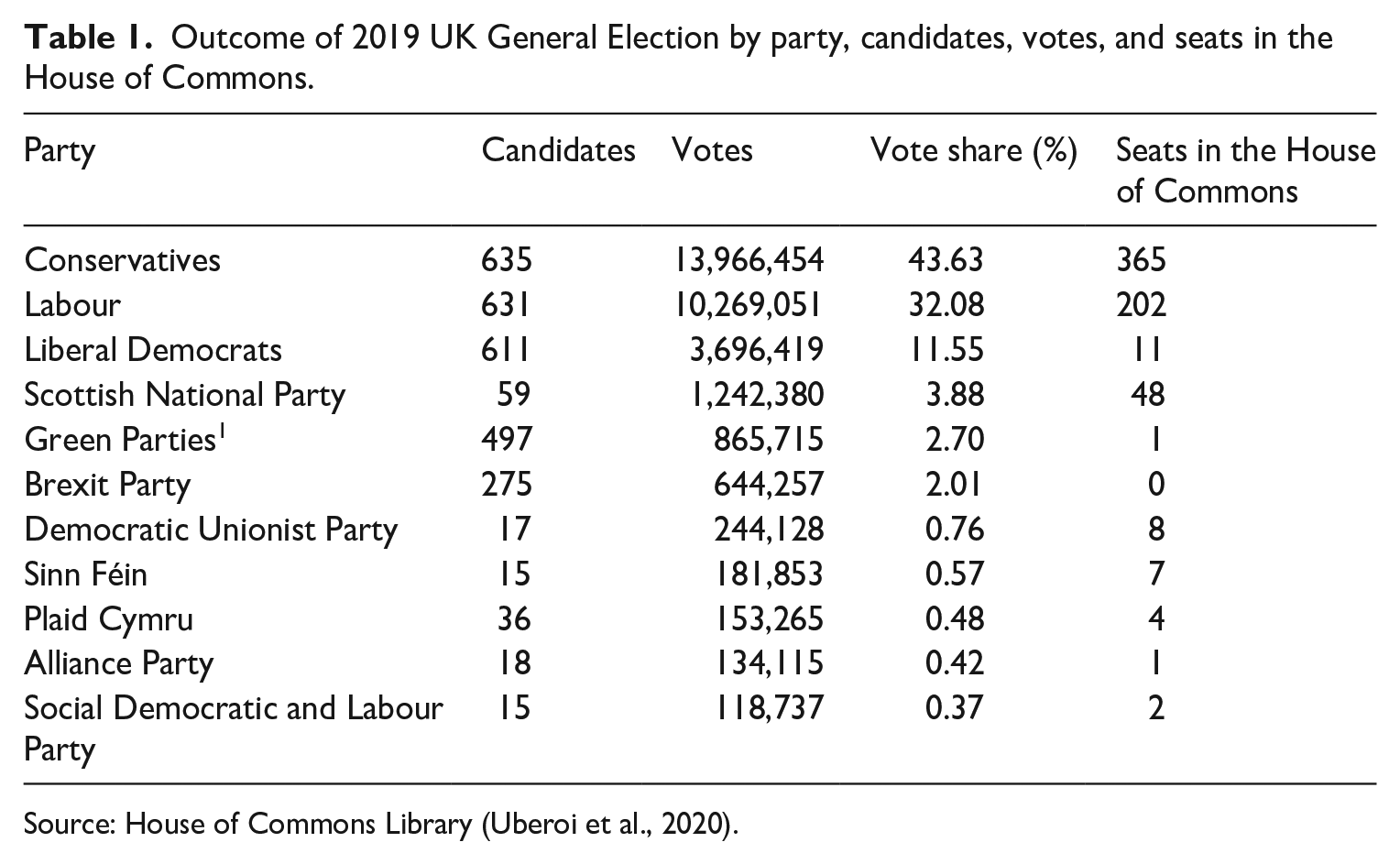
National elections in the United Kingdom are conducted under a first-past-the-post electoral system. As a result of this, national politics is dominated by two parties: the Conservatives and Labour. They have largely alternated as the party of government since the Second World War, though with periodic episodes of coalition government (2010–2015), confidence and supply agreements (2017–2019) and minority power (1974). This means the UK system is often talked of as exhibiting two-party politics. Though Webb and Bale (2021: 15) more accurately describe it as ‘moderate multipartyism’, which reflects the relative strength of nationalist parties (such as the Scottish National Party and Plaid Cymru) and effective ‘third’ parties such as the Liberal Democrats, the Greens and (at least until 2019) the Brexit Party/United Kingdom Independence Party (see Table 1).
Outcome of 2019 UK General Election by party, candidates, votes, and seats in the House of Commons.
Source: House of Commons Library (Uberoi et al., 2020).
For the purposes of our analysis, we concentrate on information available about the 2019 UK General Election. This marked the first domestic election in which both official electoral returns and social media platform archives were available. In particular, we focus on the Electoral Commission’s spending return databases for parties and non-party campaigners and the advertising archives created by Facebook and Google in 2018. While not the only transparency resources available to those interested in digital campaigning, previous research has shown these to be pivotal to efforts to understand campaigning online (Dommett, 2021). Our review was conducted in early 2022 and, hence, reflects practice at that moment in time. 2 Engaging with existing academic theory that has highlighted the lack of uniformity in transparency resources (Heald, 2006), we consider what these sources do and do not reveal about digital campaigning.
The current transparency regime
The concept of transparency is commonly heralded within policy-making circles as capable of reducing corruption and boosting trust by allowing external oversight of previously opaque practices (Berliner, 2014; Etzioni, 2010; Kunicova and Rose-Ackerman, 2005). Digital campaigning is seen to be particularly ripe for enhanced transparency because there is evidence of increasing amounts of time and resources being devoted to this activity internationally (Gibson, 2020; Harker, 2020; Jungherr et al., 2020), but little available data about what exactly is happening online. As Dommett and Power (2019: 1) have argued ‘[r]esearchers, regulators and policy makers alike have . . . faced significant challenges in gaining information about, let alone systematically analysing, digital campaigning trends’ due to a lack of transparency and barriers to data access. In this context, we first ask what we can know about digital campaigning from the two main available resources in the United Kingdom: official electoral returns and social media platform archives, before turning to discuss their pitfalls.
Our two resources differ in a number of ways. Official election spending returns represent a well-established transparency mechanism. The current regime, set out in PPERA, has existed since 2000 and is overseen by the Electoral Commission, who analyse spending returns and provide a public archive. Notably, this disclosure regime focuses on political finance, providing information about the resources and spending of actors active within the electoral period. It therefore provides data on any donations to a political party (or non-party campaign) above or aggregate to £7500 in a calendar year, or for candidates £1500. In addition, information is available about spending at elections by both parties and non-party campaigners, with invoices or receipts for payments above £200 available for download from the public archive. These invoices are categorised under 10 headings (see Figure 1) that provide a broad overview of the different kinds of activity that money is spent on (these categories differ slightly for non-party campaigns). Importantly for this article, actors are not required to declare spend on digital campaigning as a separate form of campaigning activity.
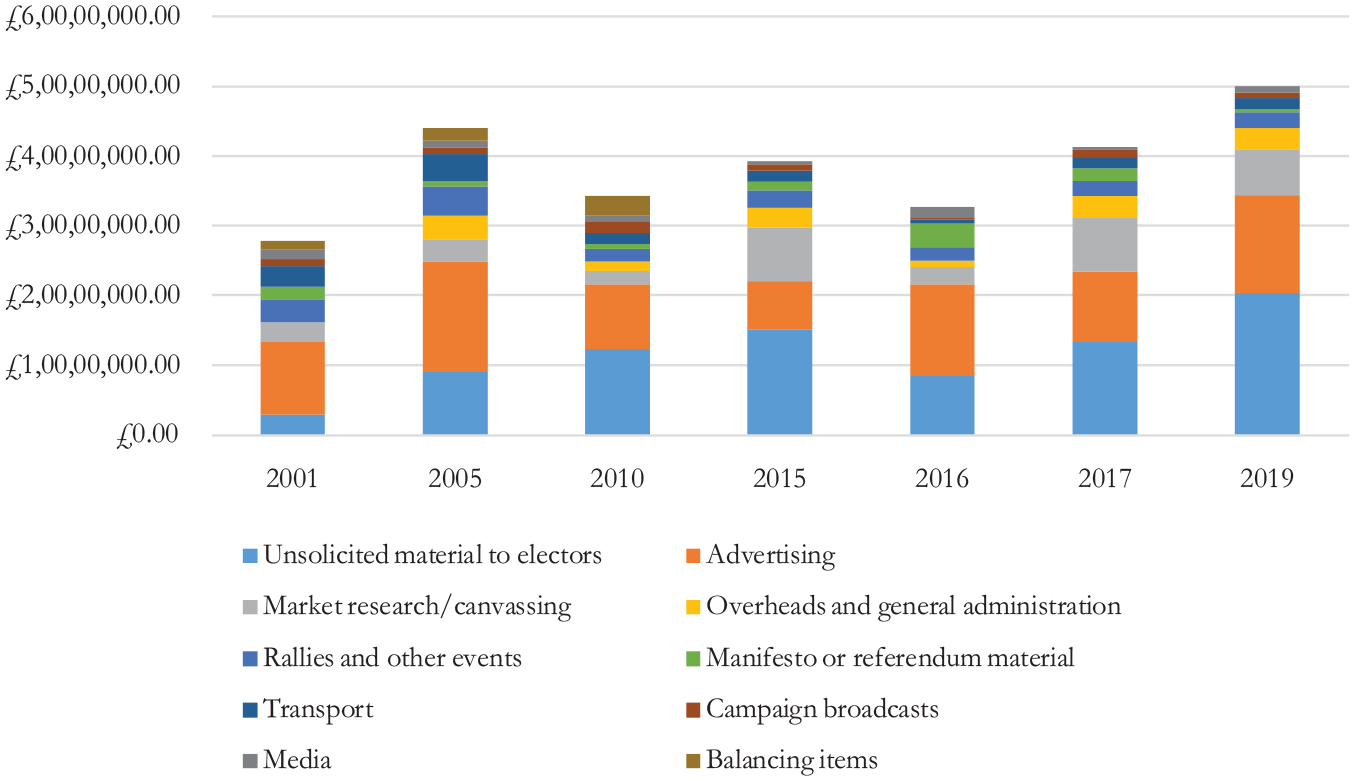
Declared UK election spending totals 2001–2019 showing classification of spending.
It is, however, possible to extract some useful insight in this area. Following efforts by the Electoral Commission in its 2018 report calling for increased transparency in digital campaigning, it is possible to conduct a key word search of the main digital advertising platforms to estimate the amount of money being spent online (The Electoral Commission, 2018). Updating their analysis to scrutinise spending at the 2019 General Election we can see that 53.96% of advertising spend was declared as occurring on Facebook, Google, Twitter, or Snapchat (see Figure 2) – representing an exponential rise from the 23.9% of total advertising spend evident in 2015.
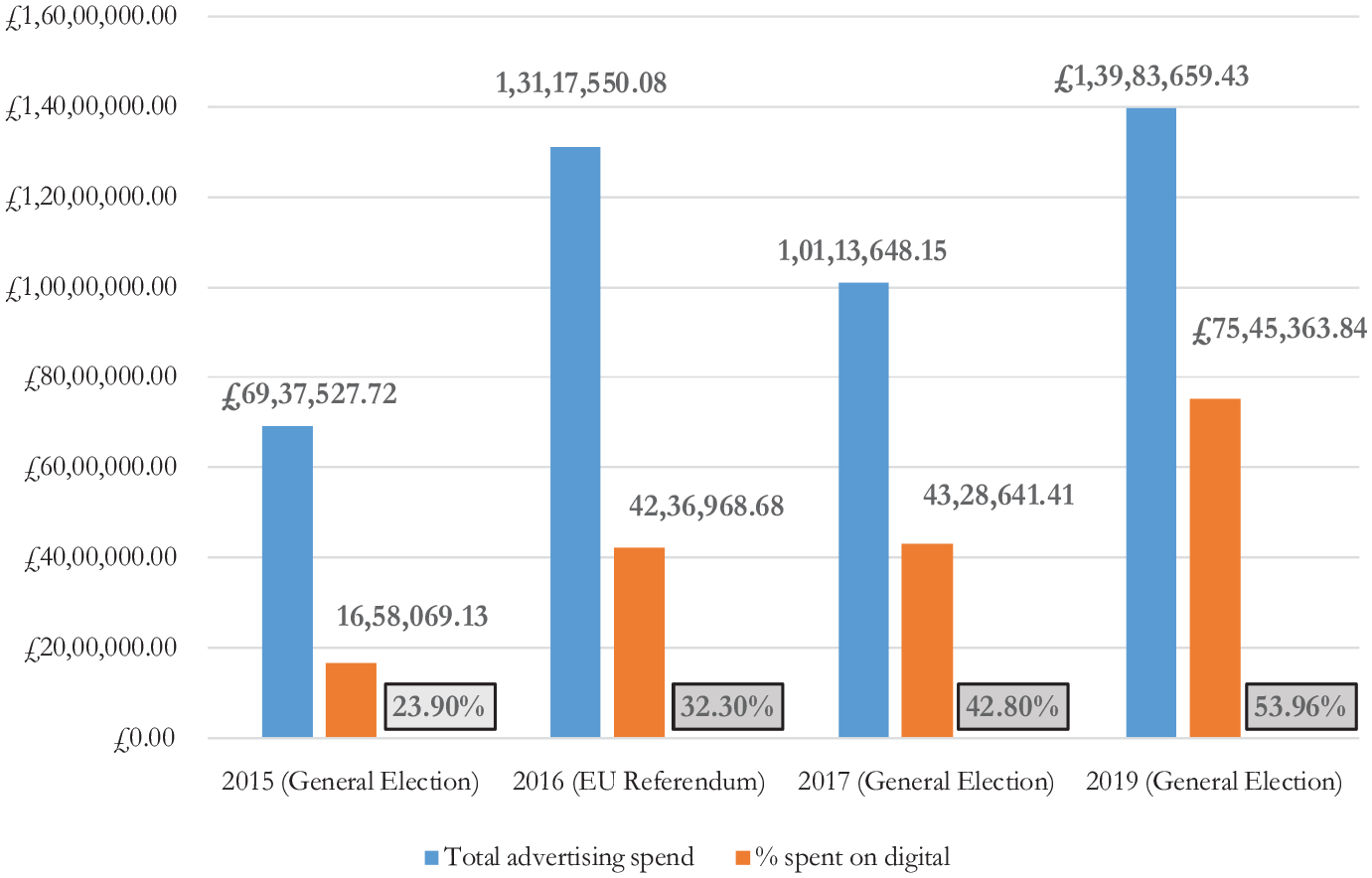
Advertising spend on digital, 2015–2019.
Similarly, when looking at spending by non-party campaign groups, official returns suggest that 88 non-party organisations were active in the election and exceeded reporting thresholds. While these actors spent less money on digital advertising platforms than parties, we can once again see growth in spend (see Figure 3), rising from 1.7% of total non-party outgoings in 2015 to 28% of total non-party spend in 2019. 3
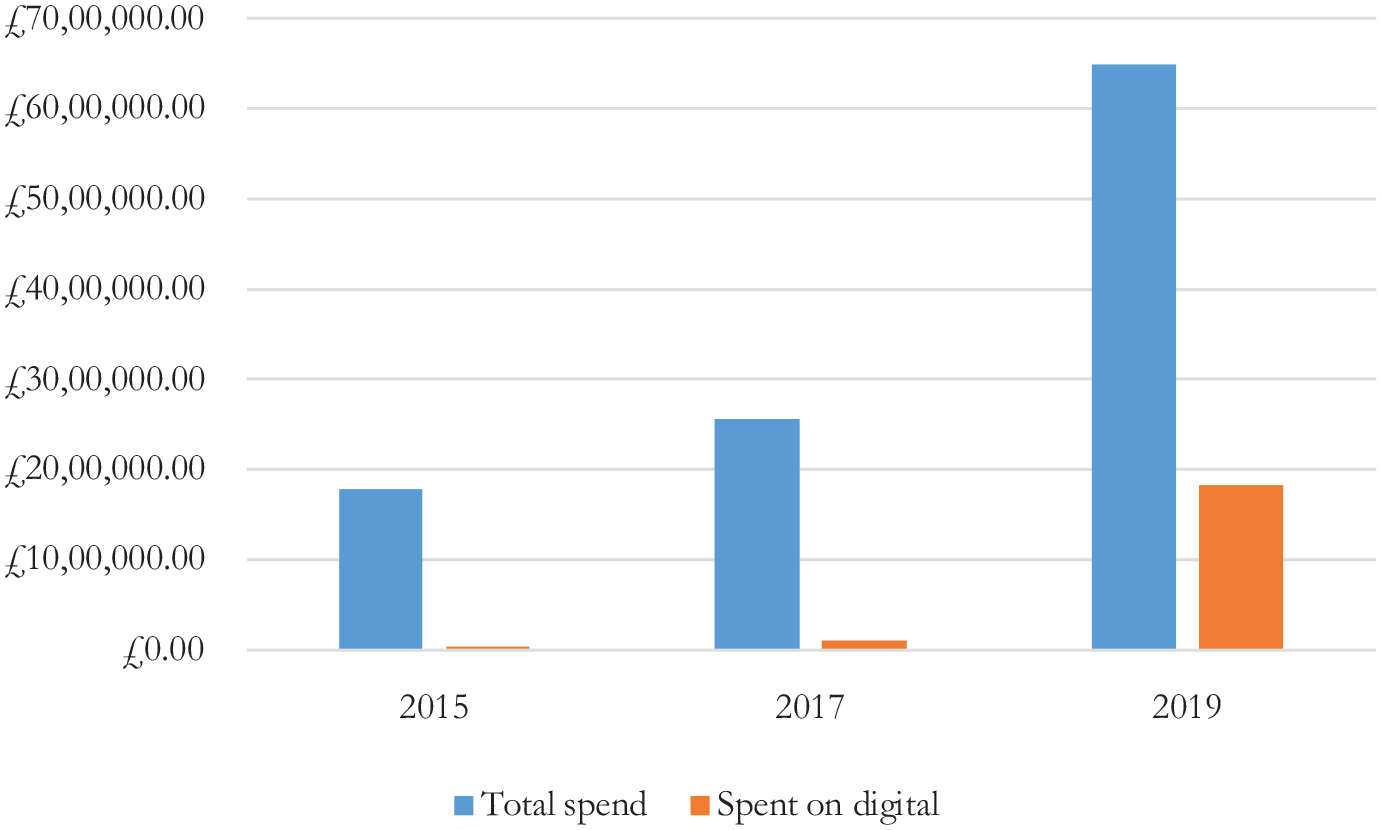
Non-party spend on digital as a proportion of total spend, 2015–2019. 4
This provides some insight into an element of digital campaigning activity, but as the Electoral Commission (2018: 4) themselves have suggested, the data ‘does not show the full picture of digital advertising at elections and referendums’ (see also Dommett and Power, 2019) – a point examined further in the next section.
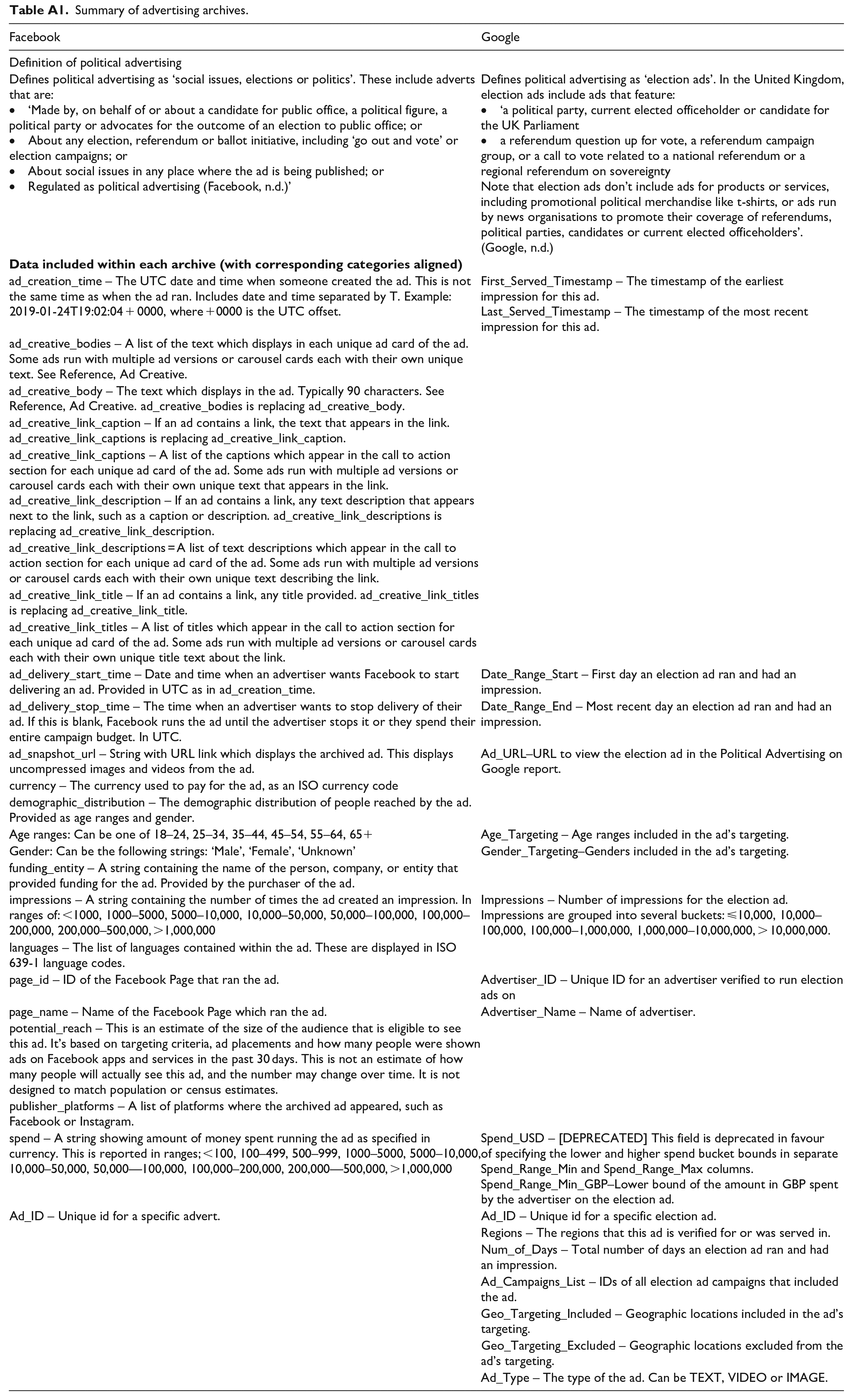
In contrast, social media political advertising archives are relatively new phenomena created in 2018, with Facebook launching their archive in May and Google in August. These resources are available as a publicly searchable archive via a web browser, or an application programming interface (API). Rather than being focused exclusively on finance (although some information about spending is available), these archives provide more information about advertising content placed online within and beyond election campaigns. Importantly, the archives differ in precise form (Leerssen et al., 2019: 2–3), meaning that different companies’ archives do not include the same information (having, for example, different definitions of political advertising), and the data provided about content is not consistent – traits that have been widely critiqued (Edelson et al., 2018; Sosnovik and Goga, 2021; Ofcom, 2021). These archives have also evolved over time, creating further variations. At present, the data provided by both platforms offer a different insight into the use of political advertising at elections and is outlined in Table A1 in the appendix.
Utilising these data, it is possible to identify who was placing adverts, how often, how these varied, what was spent, how often they were seen, and who paid for them. This information is available in real-time, allowing journalists and academics alike to report on digital campaigning. Indeed, at the 2019 General Election several media outlets – such as the BBC, the Financial Times, and Sky – offered digital campaigning dashboards and daily reporting using this resource (Dommett, 2021). Academics have utilised these archives to offer further analysis. Pioneering this work in the United States, Edelson et al. (2018: 1–2) used these resources to estimate the total number of impressions generated and the amount spent by sponsors of adverts. Meanwhile, in the United Kingdom, Dommett and Bakir (2020) have explored the activity (in terms of the number of adverts and spend) of different actors within single political parties and the activity of groups other than parties at elections. Similarly, Power and Mason (2023) used the Facebook API to analyse how parties campaigned online during the 2019 general election. They found that – contrary to some assumptions surrounding the effects of online ‘echo chambers’ (Gibson, 2020; Pariser, 2011) – political parties did not campaign towards an easily persuadable (i.e. partisan) electorate.
These resources, therefore, make it possible to gather some insight into digital campaigning at elections. And yet, while they provide a window into this activity, they also have a number of limitations. In the next section, we consider the weaknesses of both, particularly engaging with the idea that transparency archives should exhibit certain core attributes to maximise their utility. This idea has been advanced by Vishwanath and Kaufman (2001: 43) who suggest that transparency initiatives should be ‘fair, reliable, timely, complete, consistent, and presented in clear and simple terms’, and by Michenera and Bersch (2013: 238–239) who indicate a need for them to be disaggregated, verifiable, accurate, reasonably complete and found with relative ease. Drawing on these ideas, we consider whether these archives provide, first, ‘complete and consistent’ insight into digital campaigning, and second whether they are ‘accurate and accessible’. Offering this analysis, we evaluate the attributes of each of these resources in isolation and combination, using this analysis to consider whether changes to the current transparency regime are required.
Complete and consistent?
For a transparency archive to have utility, it is widely accepted that it must contain complete information and offer consistent data to allow a thorough and reliable exploration of a given phenomenon. In the world of regulating political finance, for example, Karl-Heinz Nassmacher (2003) considers transparency to be the keystone of the ‘magic quadrangle’ of party funding. He further suggests that any form of transparency will be ineffective if the disclosed information is not ‘accurate, publicly available and comprehensible to potential users’ (Nassmacher, 2003: 144). Reviewing our two sources we find a number of shortcomings that make it impossible to gain a clear and consistent understanding of digital campaign activity.
First, looking at both resources, the available data are far from complete. The Electoral Commission only provides data on actors who meet registration thresholds and who spend over £200. As digital campaigning is recognised to be a relatively cheap activity (Franklin Fowler et al., 2021), it is probable that spending happens under this threshold that is not being captured. Social media archives do provide some insight into spend under £200, however, these resources focus exclusively on advertising. Given that online campaigns have been shown to utilise memes (McLoughlin and Southern, 2021), websites (McDowell-Naylor, 2019), hashtags (Polonski, 2019), social media profiles and posts (Walsh, 2019), viral content, videos, mobile applications, and influencer campaigns (among many others), advertising archives cover only a fraction of possible digital campaigning content. Even when it comes to political advertising, previous studies have highlighted limitations in the type of data provided through archives. They do not, for example, contain complete information about targeting parameters (Ofcom, 2021: 38) or ‘reflect the full range of information platforms possessed’ (Dommett, 2021; see also Kirk and Teeling, 2022: 10), meaning that many questions about advertising on these platforms cannot be answered.
Intersecting with this absence of complete information, challenges also emerge around a lack of consistency. Looking first at the Electoral Commission database, it is possible to provide some further insight into digital campaigning activity by looking at the invoices submitted by each supplier. In contrast to the approach taken above where a simple keyword search of major digital service providers was conducted (i.e. searching for Facebook, Google, Snapchat, and Twitter), each individual invoice submitted by a supplier can be opened to determine whether there is evidence of digital campaigning activity. Adopting this approach, it is possible to find other forms of digital campaigning activity, or to identify ‘digital intermediaries’ who are performing digital campaign services (see Dommett and Power, 2019: 262; see also Dommett et al., 2022). For example, invoices provided by the company Small Axe Communications show that they charged the Labour Party £17,500 for ‘Facebook advertising’, £2,625 for a ‘Facebook advertising placement fee’, £870 for ‘social advertising spend’, and £130 on ‘social advertising placement and optimisation’ (Table 2).
Breakdown of Small Axe Communications spending at the UKPGE 2019.
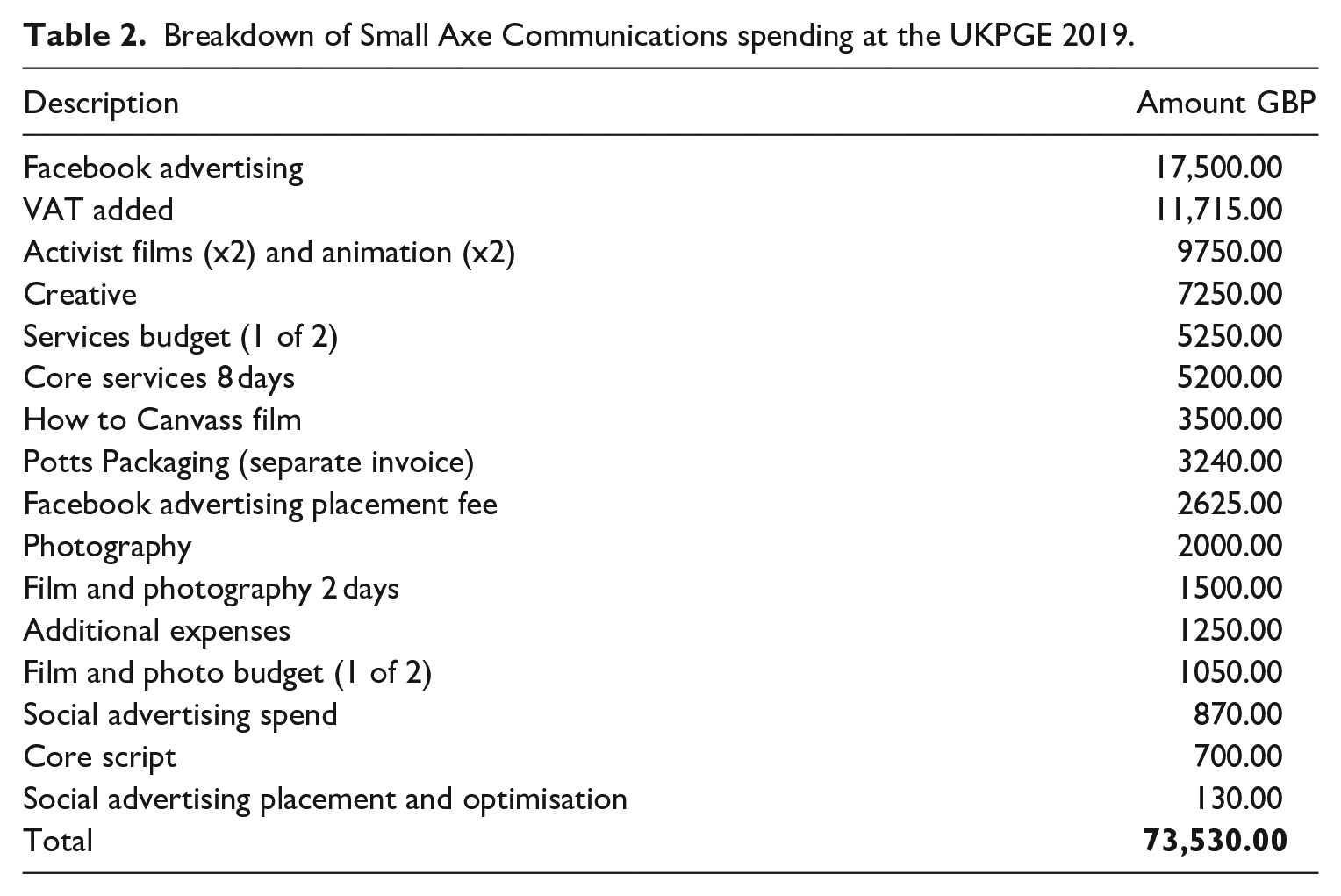
The invoices provided by the Electoral Commission therefore appear to provide some more complete information about digital campaigning activity, but questions of consistency emerge, as the quality and clarity of invoices submitted to the Electoral Commission vary dramatically (see Dommett and Power, 2022). For example, invoice #68161 lists ‘ongoing consulting fees’ for £15,000 and then ‘development of online properties’ for £12,478.93. However, it is far from clear what ‘online properties’ constitutes, and whether this is related to digital campaigning activity. Similarly, invoice #66618 describes ‘implementing strategic message vision through various communication channels’, yet it is unclear if these ‘communication channels’ include digital media and hence constitute digital campaigning.
Moreover, invoices from the same company can vary dramatically. For example, looking at invoices for Facebook spending, invoice #64811 from the non-party campaign group ‘Led By Donkeys’ contains little information beyond that it was for ‘Facebook Ads payment’, followed by 16 pages of redacted ‘Transaction IDs’. In contrast, a ‘Best for Britain’ invoice (#64660) contains information on the kinds of ads placed (e.g. ‘Shape_Votes_OnTheLine; ‘Shape_Votes_Decision_Gen), the date range that these ads were placed between, and the number of impressions. While the Electoral Commission archive can therefore sometimes be used to identify who is providing digital campaign services, and what exactly is being done for what cost, the inconsistency of returns prevents this from being done uniformly.
In a similar way, there are challenges around the consistency of the material provided in advertising archives. Our own analyses of this resource and evidence from the existing literature reveal these archives to be unreliable and inconsistent. At the most basic level, as outlined in Table A1 in the appendix, the two archives do not contain consistent information, but rather include different material (with Google offering a far more restrictive definition of what constitutes a political advert) and different data provided about each piece of archived material. This makes it impossible to compare with these platforms and to build up a comprehensive picture of the extent, nature, and impact of digital advertising on these platforms.
In addition, even within every single archive, there are inconsistencies in how data are provided. When downloading data from the archives, there can be variations in the information collected dependent on which interface is used and when data are downloaded. Kirk and Teeling (2022), for example, describe how they ‘found several discrepancies between the information extracted from Facebook’s Ad Library (API access) and the Ad Library Report (no API access). At times, there were more adverts listed for an advertiser than appeared in the Ad Library. For example, more adverts were listed for Andrew Doyle than appeared on his page. In one case, an advert from April 22 to April 26 2019 ran without a sponsor name and a disclaimer was not collected by either method’ (Kirk and Teeling, 2022: 7). Similarly, a review conducted by Ofcom, the United Kingdom’s communications regulator, found, [t]here were unexplained differences in the data provided by platforms. We collected data from multiple sources from each platform’s ad repository. When we attempted to match the data on ads across different sources, we found some differences. For example, the list of advertisers from the Facebook Ad Library API did not exactly match the list of advertisers found in the Facebook Ad Library Report CSV files. These differences were not explained in any documentation and could potentially undermine the correct interpretation and use of the underlying data. (Kirk and Teeling, 2021: 22–23)
Earlier analyses conducted in the United States have also highlighted inconsistencies in how advert sponsors appear in the archive (Edelson et al., 2018: 4). Such insights suggest not only that different social media archives fail to provide the same kind of information but also that the information that is provided is not consistent and hence reliable in capturing activity on a given platform. From this perspective, both archives demonstrate considerable limitations with regards to completeness and consistency.
Accurate and accessible
Turning to our second two criteria, existing studies have also indicated the importance of accurate and accessible information. In their study of disclosure statements, Chaiken et al. (1989) argued that an information shortcut can only be effective and efficient insofar as the heuristic is both accessible and activated in an individual’s mind. Once again, we find evidence that the data available from these resources often contain inaccuracies, are not simple to access, and are often accessible only after a period of considerable time.
Looking initially at accuracy, within the Electoral Commission database we find three types of accuracy deficit. First, the database itself often contains misreported spending data. Returning to the example of Small Axe, we find a mismatch between the reported spend to the Electoral Commission (£67,680) and the spend as calculated by looking at the invoices themselves (£73,530). This is because one of the invoices (#67569) was declared at a total amount of £5850 when the invoice in question stands at £11,700. These discrepancies are likely the result of simple human error, or in the allocation of party and candidate spending (but this allocation remains entirely unclear). Therefore, they raise further challenges in drawing inferences from these data. Second, the database also contains many invoices which are simply blank and that provide no information. The clearest example of this is if we look at the returns provided by the Welsh nationalist party, Plaid Cymru, the vast majority of which simply link to a blank A4 side of paper (see, e.g. #64360). Finally, there are a number of instances where parties and non-party campaigns have not submitted invoices as legally required. That is to say, there is no invoice (either blank or uninformative) provided for spending that occurs over the £200 reporting provision. 5 Cumulatively, these occurrences create inaccuracies within the data that make it hard to systematically examine digital campaigning activity.
In a similar manner, with social media archives, we find two examples of inaccurate practice. First, there are those where the data reported were simply not correct. As relayed by one journalist at the BBC ‘midway through the campaign, we figured out that the information that Google transparency report gave us about digital ads was not entirely accurate. And they said, ‘“Yeah, that is the case”’ (Dommett, 2021). It is also apparent that while not representing an inaccuracy in terms of an error, the use of banded reporting criteria means that precise information is not available about advertising activity. The consequence of this is that it prevents those using this resource from establishing an accurate picture of what was spent on advertising. As highlighted by Dommett and Bakir (2020), for example, it becomes necessary to report ‘average spend’, creating an estimate that does not provide an accurate picture of actual spend. It is also interesting to note that questions have been raised about the ability of users to check the accuracy of social media archives, because of the lack of access to the raw data these companies possess (Ofcom, 2021: 38; See also Dommett, 2021). Such inaccuracies make it difficult to come to precise conclusions from this data and render it unreliable.
In addition, accessibility matters. With regards to the two data sources, while searchable archives are made available to the public, we are aware of no studies that have examined the extent to which individuals are aware of, yet alone utilise these facilities. In terms of the Electoral Commission database, it can be challenging to locate, and the resource has a reputation for not being user-friendly. Indeed, a recent Committee on Standards in Public Life (CSPL) review of electoral regulation found that ‘navigating in this online space can be difficult’ and recommended that the Commission should ‘as a priority, focus resources on upgrading their website . . . so that it is as user friendly as possible’ (Committee on Standards in Public Life, 2021: 104).
The social media archives are similarly not actively promoted to users, and there is no clear pointer to this resource. For example, on Facebook, while users can click the ‘why am I seeing this ad’ button that appears on advertising content on their newsfeed, they are not presented with a link to the advertising archive, but are instead provided with some basic descriptive information and links to alter their ad preferences. There is a link to the archive in the ‘Page transparency’ box that is found on each advertiser’s page, but this requires a user to actively click on this option and then to select the ad archive. Similarly, on Google, it is possible to click on search ads and select ‘about the advertiser’ and then ‘learn about the advertiser’ to then be directed to a page which has a link to the political advertising archive. The pathway to these resources is therefore long, and while this can be mitigated by a direct search for the resource, there is little evidence that users know to search for these archives. Where social media archives do appear to differ is in relation to accessibility for researchers, as both companies operate APIs, whereas the Electoral Commission data can only be downloaded as a .csv file which does not contain the links to invoices. However, researchers using these social media APIs have to undergo a verification process which at Facebook includes submitting identity documents (Ofcom, 2021: 13–14) and where approval is often lengthy and not guaranteed (Dommett, 2021).
Questions of accessibility are also related to timeliness and the ability of a user to access information when it is most pertinent. In this regard, we see a marked difference between the sources. While advertising archives provide effectively real-time disclosure, PPERA allows political parties and non-party campaigners 6 months to report their spending if it is over £250,000 (if under £250,000 the requirement stands at within 3 months). This means that spending returns are often not available to the general public until long after the election has been held and, for the 2019 general election (though there were some contributing factors due to the COVID-19 pandemic), complete returns were not made available until well over a year after polls closed. COVID-19 aside, the aforementioned CSPL report looked comparatively at this disclosure regime and found that ‘six months for the biggest spenders at elections . . . is towards the higher end of the range’ (Committee on Standards in Public Life, 2021: 81). As such they recommended that reporting periods should be considerably shorter and, to match the reporting requirements for candidates, suggested that all donations and campaign expenditure should be submitted within 35 days of an election. From this perspective, those interested in studying digital campaigning become heavily reliant on social media archives for live insights and monitoring, with little official information available until many months after the event.
Discussion
As the above comparison has highlighted, there are a number of strengths and weaknesses with both the Electoral Commission database and the social media advertising archives. While there are many reasons to critique these resources, we begin by recognising the insights they provide into digital campaigning and its role in modern election campaigns. In a rapidly evolving media environment, both the Electoral Commission database and social media company advertising archives have helped to reveal the increased money being devoted to – in particular – online advertising, and they have helped to identify who is placing content, and give a rough picture of what is being spent. These insights are particularly laudable in the case of the Electoral Commission database which was created before the emergence of digital campaigning and understanding of the need to disaggregate digital spend. While our analysis has highlighted flaws in this particular resource, we begin by noting that the ‘official story’ (Webb and Keith, 2017) provided by these data does help to offer some insight into the rise of digital campaigning.
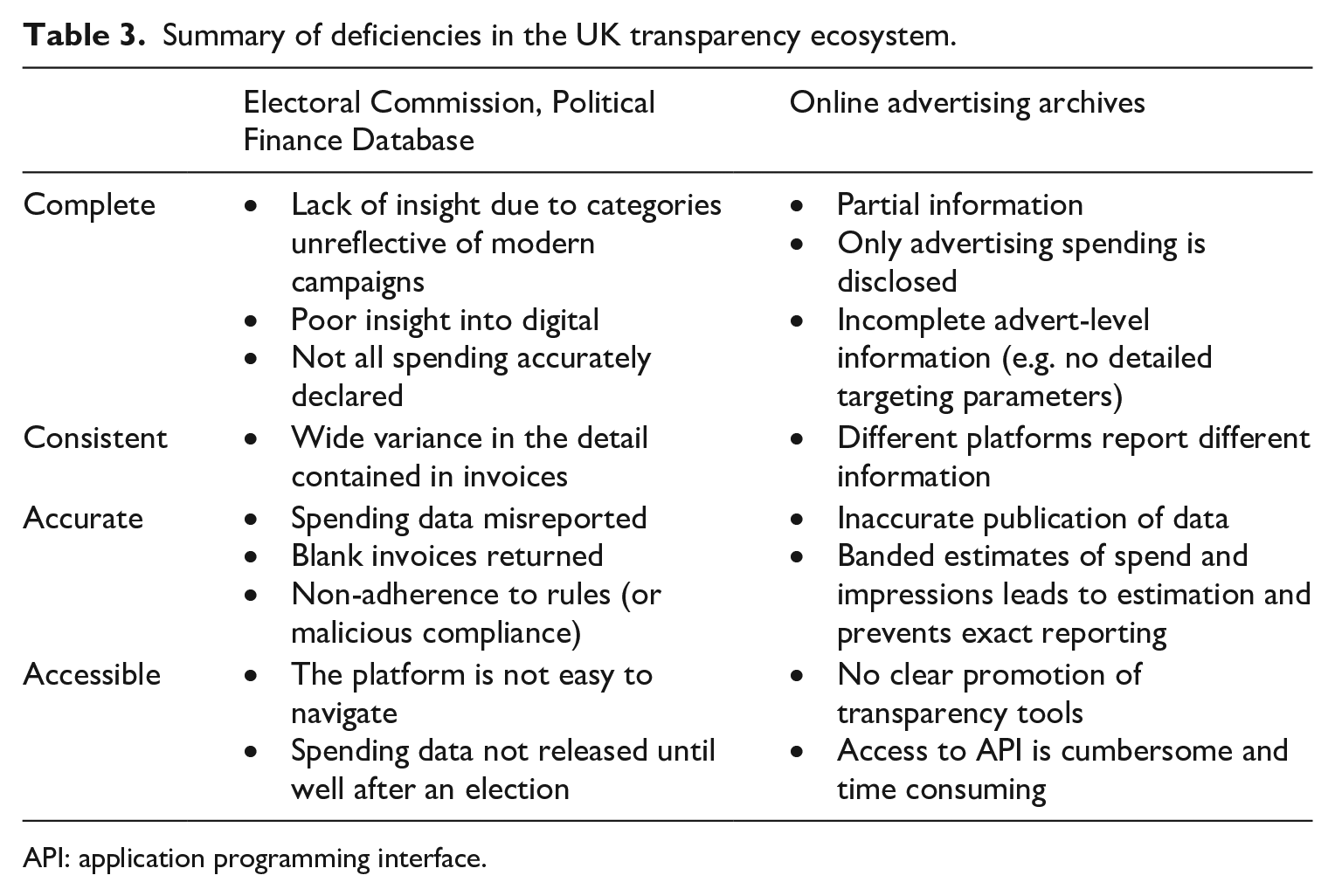
When pairing this resource with new social media advertising archives researchers – in academia, journalism, and civil society – have been provided with a powerful tool for studying activity in the online world. Offering information in almost real time, these archives have provided insight into how groups use these platforms to forward their political agendas, providing detail of the content being circulated, the sources of campaign material, and the resource being devoted to digital advertising campaigns (among other data). The value of this can be seen in the work of numerous journalists and commentators who have highlighted examples of concerning practice and held campaigners to account. When it comes to understanding digital campaign activity observers do not therefore completely lack tools by which to understand what is happening online. And yet, as our analysis above has revealed, there are numerous problems with these resources that relate to their capacity to provide complete, consistent, accurate, and accessible insight into activity in this realm (see Table 3).
Summary of deficiencies in the UK transparency ecosystem.
API: application programming interface.
In terms of whether they are complete, we have shown that both the Electoral Commission resource and the advertising archives only provide a partial picture. The Electoral Commission does not provide systematic insight into different types of campaign activity due to the lack of a differentiated ‘digital’ spending category, and its spending thresholds mean that not all spending is being declared – a dynamic that is significant given the relatively inexpensive nature of digital campaigning. Furthermore, the social media advertising archives provide insight into only one form of digital content, leaving many other elements of digital campaign activity opaque. Moreover, the information they do contain is often far from complete, with, for example, missing detail about targeting parameters, making it impossible to gain a complete picture of what is happening online.
When considering whether these resources are consistent, we found further issues. When trying to understand how much political actors spend on digital campaigning, the Electoral Commission database varies considerably in the type of information contained within invoices, making it impossible to draw consistent inferences from this data source. This too is the case for advertising archives which, at a very basic (and definitional) level, are designed to capture different information, which is inconsistent depending on which interface was used, and when the data were downloaded.
We also assessed whether these resources were accurate and, within the Electoral Commission data, found three distinct issues: the misreporting of spending data, the returning of blank invoices, and the non-adherence to the rules (where invoices were not available for spend over £200). When we investigated the advertising archives, we found that journalists had reported instances where the data published were simply not accurate. Second, we suggest the banded approach to the presentation of spending prevents researchers from drawing a clear and accurate picture of campaign activity, instead having to rely on estimates of ‘average spend’ (Dommett and Bakir, 2020).
Finally, our analysis also shows that these transparency resources are not altogether accessible. The Electoral Commission website, for example, has been critiqued for being hard for users to navigate and spending returns are often not made available for many months after elections. Similarly, digital platforms provide no clear promotion to users of said platforms that the archives exist and access to the company APIs include a lengthy verification process which sometimes requires the submission of identity documentation.
Taken together, these issues reveal that when used in isolation, or when combined, these resources leave many aspects of digital campaigning opaque. It is therefore impossible to fully understand what is happening, what is being spent, who is campaigning, and what campaigning techniques are being utilised.
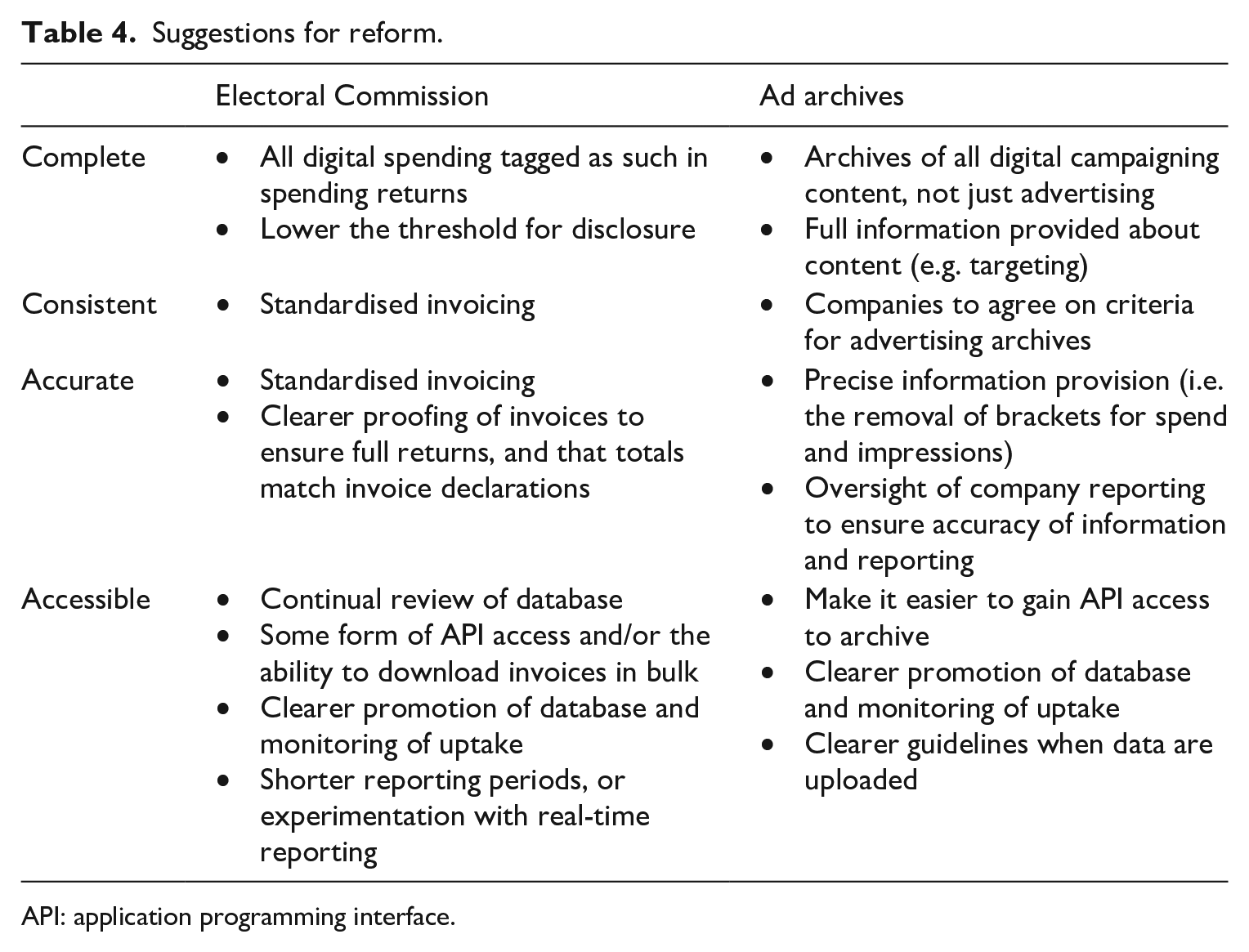
Reaching these conclusions, we argue that at the micro level, our analysis offers detailed insight into how digital campaigning transparency may be improved (see Table 4). Taking each of our four headings in turn, we argue, first, that these existing transparency archives can be made more complete in a number of ways. When it comes to the Electoral Commission, we believe that digital spending can be more effectively distinguished from other forms of campaign activity by requiring campaigners to assign a tag declaring digital spend when making election returns. The Electoral Commission (2018) themselves have acknowledged that the current categories are out of date and no longer reflect useful information for users. As part of a wider ‘category review’, we therefore argue that digital spending should be declared to allow for the easier identification of digital campaigning activity. In addition, we believe there is a case for lowering the threshold for spending returns, particularly when it comes to when an invoice is required.
Suggestions for reform.
API: application programming interface.
In terms of the ad archives, we argue that to make this resource more complete, additional types of online campaigning activity should be recorded. At present the archives are confined to advertising, meaning there is little detail about other forms of digital campaign activity. While some platforms do provide other resources – such as Facebook’s CrowdTangle platform – the lack of a single, uniform, and widely accessible tool for observing digital campaign activity makes it presently impossible to gain a complete understanding of what is happening online. In moving to develop such a resource, we also argue that there is a need for more complete and granular detail to be provided about content (e.g. targeting parameters). At present social media companies do not provide public access to the information they hold citing privacy concerns (for more see Tromble, 2021), and there is a need to develop new ways to ensure more comprehensive disclosure of what is happening online.
Second, turning to changes that could help to make information more consistent, the Electoral Commission could produce standardised invoice templates which would allow for clarity of information, and further reduce the administrative burden on campaigners. These invoices could, for example, include information about the type of campaign material, when it was fielded, who it was targeted at – providing more detailed information about digital and non-digital campaign activity alike. Similarly, online platforms and companies can make their information more consistent by employing a common definition of what constitutes a ‘political advert’ and formatting their archives in a more consistent way. This would help to ensure it is possible to compare across archives, but it would also be valuable for social media archives to echo the criteria outlined by the Electoral Commission to ensure that digital campaign activity apparent on these platforms and declared through invoices could be meaningfully compared.
Third, in regard to the accuracy of submissions, for the Electoral Commission, a process of standardising invoicing will help to reduce the rate of inaccurate submissions. This outcome could also be promoted by a more thorough ‘proofing’ of the returns by Electoral Commission staff (potentially aided by external researchers) to help reduce instances of human error. For the social media advertising archives, there should be a ‘precise information provision’, which would remove the use of the banded approach to the reporting of spend and impressions. There should also be more oversight of company reporting by external researchers and regulators such that, similarly to the Electoral Commission returns, human error and simple inaccuracies are more likely to be captured (a process similar to that conducted by the European Regulation Group for Audiovisual Media Services would be advisable (ERGA, 2019)).
Finally, to improve the accessibility of transparency resources, the Electoral Commission should run a process of constant review of the database itself such that it can be improved as necessary and reflect the realities of modern campaigning. There may also be a case for some form of API access (as there is with returns to the Federal Election Commission) or, at the very least, the option to download invoices in bulk. Alongside this, the Commission might consider more clearly promoting the database as a tool – beyond it merely being something (largely) used by journalists, academics, and interested organisations. Finally, legislation should require shorter reporting time periods, but near real-time disclosure should also be explored (as it has been, with some success, in territories such as British Columbia and Queensland). Online advertising archives should, on the other hand, make it considerably simpler to gain API access. Like to the Electoral Commission database, the archives themselves should be more widely promoted and uptake monitored. Finally, clear and consistent guidelines should be forthcoming when data are uploaded.
At a second, more macro level, our analysis offers a wider insight into the study of transparency as a policy response more generally. As outlined in the introduction, many existing analyses have tended to discuss specific transparency resources in isolation – critiquing electoral records or advertising archives. In contrast, our analysis suggests the value of a more holistic approach that seeks to recognise the different insights available from different actors, and the ways in which different data sources can be combined. This type of analysis mirrors the established notion of distributed governance, whereby numerous actors in the public and private sphere now shape governance practices. And yet, to date, little attention has been paid to questions of how transparency resources from public and private or commercial sources could be developed and used in concert. Indeed, at present, there is little collaboration between official electoral management bodies (such as the Electoral Commission), online platforms and their attendant advertising archives – but this need not be the case.
In calling for a greater degree of granularity in terms of digital spend, it might well be that returns to the Electoral Commission include specific information – or are linked functionally to – elements of advertising archives. This would reduce the regulatory burden on (often) volunteer campaigners, and provide much clearer insight into the ways in which these campaigns use platforms, but also the role of digital intermediaries in elections. Such collaboration between actors could help to address transparency deficits, but improvements could be made without such direct ties. In this manner advertising archives could seek to supplement rather than replicate existing state resources, helping to expand the insights available. These archives do not therefore need to provide the same kind of information, but there is potential to entwine these resources to allow a clearer picture of digital campaigning to be built up. Considering transparency in the round, therefore, we argue that new questions can begin to be asked of those providing transparency resources, particularly with regard to collaboration and synergy.
Conclusion
In this article, we set out to explore the insights available from existing transparency resources about digital campaigning. In the face of much public concern about recent electoral practices, there have been growing calls for increased information to be disclosed about what is happening online. To develop an appropriate response to this trend it is, however, necessary to more fully understand the strengths and weaknesses of the current disclosure regime to identify the precise form of change that needs to occur. Within this piece, we have reviewed the two primary transparency resources available in the United Kingdom – the Electoral Commission spending return database, and the advertising archives provided by Facebook and Google. Identifying a range of strengths and weaknesses with these resources, we have argued that there is a case for improving their completeness, consistency, accuracy, and accessibility. These insights are likely to be of value to regulators and policymakers within and beyond the UK case. By articulating the set of principles that should underpin transparency, we have foregrounded important questions about how material is rendered transparent and made accessible and meaningful. These ideas can be exported to a range of different contexts, helping to improve our understanding of digital campaigning in countries with established or less-developed transparency resources. In this way, it is possible to move beyond often vague calls for increased transparency to ensure that reform can deliver tangible and informative change.
Footnotes
Appendix
Summary of advertising archives.
| Definition of political advertising | |
| Defines political advertising as ‘social issues, elections or politics’. These include adverts that are: • ‘Made by, on behalf of or about a candidate for public office, a political figure, a political party or advocates for the outcome of an election to public office; or • About any election, referendum or ballot initiative, including ‘go out and vote’ or election campaigns; or • About social issues in any place where the ad is being published; or • Regulated as political advertising (Facebook, n.d.)’ |
Defines political advertising as ‘election ads’. In the United Kingdom, election ads include ads that feature: • ‘a political party, current elected officeholder or candidate for the UK Parliament • a referendum question up for vote, a referendum campaign group, or a call to vote related to a national referendum or a regional referendum on sovereignty Note that election ads don’t include ads for products or services, including promotional political merchandise like t-shirts, or ads run by news organisations to promote their coverage of referendums, political parties, candidates or current elected officeholders’. (Google, n.d.) |
|
|
|
| ad_creation_time – The UTC date and time when someone created the ad. This is not the same time as when the ad ran. Includes date and time separated by T. Example: 2019-01-24T19:02:04 + 0000, where +0000 is the UTC offset. | First_Served_Timestamp – The timestamp of the earliest impression for this ad. Last_Served_Timestamp – The timestamp of the most recent impression for this ad. |
| ad_creative_bodies – A list of the text which displays in each unique ad card of the ad. Some ads run with multiple ad versions or carousel cards each with their own unique text. See Reference, Ad Creative. | |
| ad_creative_body – The text which displays in the ad. Typically 90 characters. See Reference, Ad Creative. ad_creative_bodies is replacing ad_creative_body. | |
| ad_creative_link_caption – If an ad contains a link, the text that appears in the link. ad_creative_link_captions is replacing ad_creative_link_caption. | |
| ad_creative_link_captions – A list of the captions which appear in the call to action section for each unique ad card of the ad. Some ads run with multiple ad versions or carousel cards each with their own unique text that appears in the link. | |
| ad_creative_link_description – If an ad contains a link, any text description that appears next to the link, such as a caption or description. ad_creative_link_descriptions is replacing ad_creative_link_description. | |
| ad_creative_link_descriptions = A list of text descriptions which appear in the call to action section for each unique ad card of the ad. Some ads run with multiple ad versions or carousel cards each with their own unique text describing the link. | |
| ad_creative_link_title – If an ad contains a link, any title provided. ad_creative_link_titles is replacing ad_creative_link_title. | |
| ad_creative_link_titles – A list of titles which appear in the call to action section for each unique ad card of the ad. Some ads run with multiple ad versions or carousel cards each with their own unique title text about the link. | |
| ad_delivery_start_time – Date and time when an advertiser wants Facebook to start delivering an ad. Provided in UTC as in ad_creation_time. | Date_Range_Start – First day an election ad ran and had an impression. |
| ad_delivery_stop_time – The time when an advertiser wants to stop delivery of their ad. If this is blank, Facebook runs the ad until the advertiser stops it or they spend their entire campaign budget. In UTC. | Date_Range_End – Most recent day an election ad ran and had an impression. |
| ad_snapshot_url – String with URL link which displays the archived ad. This displays uncompressed images and videos from the ad. | Ad_URL–URL to view the election ad in the Political Advertising on Google report. |
| currency – The currency used to pay for the ad, as an ISO currency code | |
| demographic_distribution – The demographic distribution of people reached by the ad. Provided as age ranges and gender. | |
| Age ranges: Can be one of 18–24, 25–34, 35–44, 45–54, 55–64, 65+ | Age_Targeting – Age ranges included in the ad’s targeting. |
| Gender: Can be the following strings: ‘Male’, ‘Female’, ‘Unknown’ | Gender_Targeting–Genders included in the ad’s targeting. |
| funding_entity – A string containing the name of the person, company, or entity that provided funding for the ad. Provided by the purchaser of the ad. | |
| impressions – A string containing the number of times the ad created an impression. In ranges of: <1000, 1000–5000, 5000–10,000, 10,000–50,000, 50,000–100,000, 100,000–200,000, 200,000–500,000, >1,000,000 | Impressions – Number of impressions for the election ad. Impressions are grouped into several buckets: ⩽10,000, 10,000–100,000, 100,000–1,000,000, 1,000,000–10,000,000, > 10,000,000. |
| languages – The list of languages contained within the ad. These are displayed in ISO 639-1 language codes. | |
| page_id – ID of the Facebook Page that ran the ad. | Advertiser_ID – Unique ID for an advertiser verified to run election ads on |
| page_name – Name of the Facebook Page which ran the ad. | Advertiser_Name – Name of advertiser. |
| potential_reach – This is an estimate of the size of the audience that is eligible to see this ad. It’s based on targeting criteria, ad placements and how many people were shown ads on Facebook apps and services in the past 30 days. This is not an estimate of how many people will actually see this ad, and the number may change over time. It is not designed to match population or census estimates. | |
| publisher_platforms – A list of platforms where the archived ad appeared, such as Facebook or Instagram. | |
| spend – A string showing amount of money spent running the ad as specified in currency. This is reported in ranges; <100, 100–499, 500–999, 1000–5000, 5000–10,000, 10,000–50,000, 50,000—100,000, 100,000–200,000, 200,000—500,000, >1,000,000 | Spend_USD – [DEPRECATED] This field is deprecated in favour of specifying the lower and higher spend bucket bounds in separate Spend_Range_Min and Spend_Range_Max columns. |
| Ad_ID – Unique id for a specific advert. | Ad_ID – Unique id for a specific election ad. |
| Regions – The regions that this ad is verified for or was served in. | |
| Num_of_Days – Total number of days an election ad ran and had an impression. | |
| Ad_Campaigns_List – IDs of all election ad campaigns that included the ad. | |
| Geo_Targeting_Included – Geographic locations included in the ad’s targeting. | |
| Geo_Targeting_Excluded – Geographic locations excluded from the ad’s targeting. | |
| Ad_Type – The type of the ad. Can be TEXT, VIDEO or IMAGE. | |
Acknowledgements
We would like to thank Michela Palese for her very helpful comments on a first draft of this paper.
Funding
The author(s) disclosed receipt of the following financial support for the research, authorship, and/or publication of this article: We would like to acknowledge the support of the Leverhulme Trust in funding this research as part of grant RPG-2020-148 ‘Understanding Online Political Advertising’.
