




Abstract
This article examines how politicians’ conflict framing strategies in online campaign advertisements affect citizens’ political participation in a multi-party context. We rely on a unique combination of innovative research methods to do so, including a four-wave panel survey, a content analysis of Facebook browser-tracking data and a mobile experience sampling survey with data donations. All data were collected during the 2021 Dutch general elections. We find that conflict framing can discourage citizens from engaging in low-effort forms of political participation, such as discussing politics, signing a petition and visiting political websites. The results show that conflict frames can demobilize citizens because they lower enthusiasm and are perceived as less informative. Our study provides insights into the potential unintended consequences of using conflict framing as a campaign strategy in a multi-party setting.
Political parties increasingly advertise online during election campaigns (Stier et al., 2018). To appeal to voters, political parties need to stand out in an information-dense environment and strategically choose how to frame their messages (Hänggli and Kriesi, 2010). They can promote themselves and their ideas, interact directly with citizens or criticize their opponents and contrast their political agenda to those of competitors (Haselmayer, 2019; Stier et al., 2018). This latter strategy is sometimes referred to as conflict framing. The aim of this study is to investigate how voters’ political participation is affected by political elites’ emphasis on political disagreement and criticism of their opponents or the status quo.
Conflict is a central element in campaign messages and news coverage and has been found to have mixed effects on political participation. Some scholars have found that negativity and conflict increase distrust and lower overall turnout rates (Ansolabehere et al., 1994; Kleinnijenhuis et al., 2006; Krupnikov, 2011; Lau and Rovner, 2009), while others have shown that it boosts electoral support, informs citizens and signals importance, thereby mobilizing citizens to participate in politics (Bjarnøe et al., 2019; Brader, 2005; Geer, 2006; Schuck et al., 2016). What these studies have in common is that they have by and large focused on the United States despite the fact that conflict and negativity in political debate are widespread across political systems (Walter and Nai, 2015). An understanding of how conflict framing in (online) communication of political actors affects political participation in a multi-party context is noticeably missing from the literature. The studies that have been conducted in multi-party settings primarily investigate determinants and targets of conflict frames (e.g. Haselmayer and Jenny, 2018; Walter, 2014); very few have investigated the impact of conflict frames on citizens. In particular, the effects on forms of political participation other than voting have largely been ignored (Walter and Van der Eijk, 2019). Moreover, the mechanism underlying the (de)mobilizing effects of conflict frames remains unexplored. This article aims to fill these gaps.
Exploring the effects of conflict framing outside of the US context is crucial as trends found in a presidential, highly polarized, two-party system cannot be easily transposed to a system characterized by multiple parties, coalition governments and consensus seeking (Haselmayer, 2019; Walter, 2014). A meta-analysis on uncivil conflicts in political debates, for instance, shows that the effect of incivility on political participation is more negative in European countries compared with the United States (Van’t Riet and Van Stekelenburg, 2022). On one hand, since consensus and cooperation are crucial in multi-party settings (Lijphart, 1999), conflicts might be viewed as more alarming by voters and could potentially disengage them. On the other hand, when there are many competing parties that often have closely aligned political agendas, conflicts may be even more crucial in providing voters with the knowledge to cast an informed vote, showing them what is at stake and, thereby, mobilizing them to become involved in politics (Bjarnøe, 2022). We aim to explore how citizens are affected by conflict framing in a multi-party context by conducting two studies using a unique combination of data: a four-wave panel survey, browser tracking data and a mobile experience sampling survey with data donation.
In the first study, we investigate how conflict framing affects participation. We conduct a four-wave panel survey in the Netherlands to study participants’ political participation in the run-up to the 2021 parliamentary election. We also perform a content analysis of the political ads these participants received on their Facebook pages, collected via a browser tracker. This enables us to investigate the effect of real ads received by participants in their natural setting. In addition, because we adopt a longitudinal design, we can study variations in ad content during the different waves and how that impacts political participation.
In the second study, we aim to shed light on how conflict (de)mobilizes. We investigate citizens’ direct perceptions and emotions about conflict frames using a Mobile Experience Sampling Method (mESM) approach. With an mESM approach, we can capture respondents’ immediate reactions to political ads in their natural setting and in real time (Otto et al., 2020b). In this way, we can assess the short-term effects of exposure to ads without having to conduct an experiment in an artificial environment. Although it is sometimes assumed that conflict mobilizes citizens because it shows them there is something important at stake (Geer, 2006), we know little about citizens’ perceptions of conflict. Some studies have found that political advertisements can elicit strong emotional responses, such as anger, fear and enthusiasm (Gross and Brewer, 2007), which may, in turn, influence political behaviour (Lecheler et al., 2013). Together, the current studies offer some important insights into the effects of conflict frames and the mechanisms underlying these effects.
Conflict Frames in Campaign Messages and Negative Campaigning
This article focuses on elite use of conflict framing. Framing is a debated term for which many different conceptualizations exist (Cacciatore et al., 2016). In this article, we focus on emphasis framing, examining variations in what information is presented, rather than variations in how equivalent information is presented (i.e. equivalence framing; Cacciatore et al., 2016). Emphasis framing is generally understood as a process in which a (political) actor describes an issue by highlighting a ‘subset of potentially relevant considerations’ while leaving out others (Druckman and Nelson, 2003: 730). By emphasizing certain elements either in text or images, politicians try to influence the media’s and citizens’ perception of a political issue and thereby change citizens’ opinions and behaviour (Chong and Druckman, 2007). Since frames tend to result from negotiated and contested interpretations of issues (Matthes, 2012), the conflict frame is widely used. Generally, a conflict frame ‘emphasizes the points of divergence between conflicting parties’ (De Vreese et al., 2001: 109). Conflict frames are mostly studied as a mediating phenomenon, such as when a journalist emphasizes conflict between politicians or juxtaposes views of different political parties as a means to capture audience interest (De Vreese et al., 2001). However, politicians also use framing and often do so strategically (Entman et al., 2009). Previous research has shown that politicians adopt conflict frames in their online communication (Silva, 2020; Van der Goot et al., 2022). For instance, they might emphasize competing issue positions and disagree with or directly blame and reproach another political actor (Bjarnøe et al., 2019). Conflict frames can be useful for political parties. Providing citizens with information on distinct and conflicting party positions helps them make a well-informed choice about which group best aligns with their political beliefs (Levendusky, 2010). Political parties might also want to adopt conflict frames because it makes them more likely to receive news coverage (Matthes, 2012) and allows them to influence the frames the media adopt (Entman et al., 2009). Therefore, it is crucial to study the use and effect of conflict framing in campaign communication.
A related and widely studied concept is negative campaigning. Negative campaigning refers to the use of negative or critical messages about an opponent’s views or character and is contrasted with positive campaigning, which involves self-praise and promotion (Geer, 2006; Lau and Rovner, 2009). A key feature of negative campaigning is thus talking about the opponent. Some studies operationalize negative campaigning as uncivil personal attacks, disregarding any attacks aimed at issue positions (e.g. Nai, 2013). However, scholars generally agree that the concept of negativity also includes less intense issue-based attacks (Haselmayer and Jenny, 2018; Walter, 2014). A similar concept is contrast advertising (Meirick, 2002), in which a candidate compares themselves directly to an opponent with the goal of putting themselves in a more favourable light (Fridkin and Kenney, 2004).
The concept of negative (or contrast) campaigning overlaps with that of political conflict frames. Blaming or attacking another party is both a negative campaigning strategy and a conflict frame (Bjarnøe et al., 2019). However, while the concept of negative campaigning is limited to direct attacks from one politician or party to another, conflict framing is more encompassing. Conflict framing also includes messages which emphasize competing viewpoints without mentioning specific opponents as well as disagreements with politically unaffiliated individuals or groups (Bjarnøe et al., 2019; Semetko and Valkenburg, 2000). However, given that conflict in the political realm often involves one political actor attacking another, it is useful to borrow insights from negative campaigning literature. Nonetheless, we deliberately focus on conflict framing, as this concept allows us to investigate all conflicts, regardless of whether the political opponent is identified, vaguely implied or not mentioned at all. Especially, in a multi-party system where there are many political opponents and coalitions need to be formed after elections, parties might benefit from highlighting competing issue positions without being explicit about who it is they disagree with. While the effect of conflict framing in the news media on political participation has received scholarly attention (Bjarnøe, 2022; Bjarnøe et al., 2019; Schuck et al., 2016), the influence of strategic conflict framing by elites remains unexplored.
The (De)Mobilizing Potential of Conflict
As conflict is inherent to politics (Schattschneider, 1960) and central to political communication strategies (Haselmayer, 2019), studies have sought to better understand how negativity and conflict affect electoral preferences, political participation and turnout (see Lau and Rovner, 2009; Nai and Walter, 2015 for extensive literature reviews). No clear consensus exists on the effects of conflictual language. One of the central questions in the literature on conflict framing, elite polarization and negative campaigning has been whether conflicts mobilize or demobilize citizens.
According to normative ideals of democracy (e.g. participatory and deliberative models; Strömbäck, 2005), an involved and active citizenry is crucial; political participation helps ensure the responsiveness of politicians and allows citizens to directly influence political decision-making (Verba and Nie, 1972). While it is crucial to understand the extent to which conflict fosters or discourages active involvement in politics, research findings are thus far inconclusive. Some studies have found no influence at all (e.g. Stevens, 2009), whereas others have found a mobilizing or demobilizing effect.
Previous studies conducted in two-party systems have found that negative campaigns (Haselmayer, 2019; Lau et al., 2007) as well as conflict frames (Bjarnøe, 2022; Bjarnøe et al., 2019; Schuck et al., 2016) can contribute to citizens’ involvement in politics. If citizens see it as a natural and necessary part of democracy, conflict may be perceived as a sign that the political process is functioning well. Moreover, a conflict frame can provide citizens with the knowledge necessary to cast an informed vote by presenting differences between parties on relevant issues (Schuck et al., 2016). Direct attacks aimed at the character or issue position of a particular politician can also be informative as they showcase any shortcomings that may otherwise go unnoticed (Geer, 2006). Furthermore, a conflict frame often carries a negative valence, which can spark interest in politics and trigger involvement (Geer, 2006; Schuck et al., 2016), whereas the opposite of conflict, consensus, might be less mobilizing as it signals that everything is already settled. This mobilizing potential seems to hold in a variety of political settings. A cross-country comparative study conducted in Europe confirmed that conflict frames in the media increase turnout (Schuck et al., 2016).
However, research also indicates that conflict can demobilize (Ansolabehere et al., 1994; Kleinnijenhuis et al., 2006; Rogowski, 2014). Ansolabehere et al. (1994) found that turnout rates in the United States were negatively affected by negative campaigning. If criticism both lowers the probability of someone voting for the target of the attack and does not successfully increase the probability of someone voting for the sponsor of the attack, it will decrease overall voter turnout. A study by Kleinnijenhuis et al. (2006) on conflict-oriented news found that conflict can foster distrust of politicians, which can, in turn, make people less likely to engage in politics and go out and vote. In a multi-party system, it may seem less likely that turnout rates would be affected by negative campaign strategies or conflict framing because people can choose from a wide variety of viable candidates. However, since multi-party systems often have a tradition of coalition governments and a political culture of consensus-seeking (Lijphart, 1999), conflict might be more disliked, causing citizens to become more cynical and less involved in politics.
While most studies on conflict framing assess its consequences by measuring traditional and institutional means of political participation (e.g. vote choice; Lau and Rovner, 2009; Nai and Walter, 2015), some scholars argue that we need to study other engagement opportunities as well (Theocharis and Van Deth, 2018). Political ads are important in this respect. Previous research suggests that citizens who are exposed to more television campaign advertising not only vote more often but are also more informed and engaged (Freedman et al., 2004). Citizens can become politically active in numerous ways, for example, by contributing to campaigns, signing petitions or engaging in political discussions both off- and online. These forms of political participation also function as important indicators of how well a democracy is functioning (Theocharis and Van Deth, 2018). In this study, we consider political participation in a broad sense. Although there is no clear consensus on the behavioural consequences of conflict framing, the empirical evidence seems more supportive of mobilization theory (e.g. Lau and Rovner, 2009). We therefore make the following hypothesis:
H1: The greater the exposure to political ads with conflict frames, the higher the likelihood of political participation.
The Mediating Role of Perceptions and Emotions
Considering the inconsistent findings outlined above, it is important to shed light on the mechanisms that might explain how the framing effect operates. As previously argued, it is thought that conflictual messages are mobilizing because they are attention-grabbing and inform citizens about politicians’ standing relative to other political actors (Geer, 2006; Schuck et al., 2016). Because negativity inherently attracts attention (Pratto and John, 1991) and because conflict between political actors has a high news value (Galtung and Ruge, 1965), it is assumed that conflict frames are interesting and exciting, and thereby cause citizens to become more involved in politics. Conflicts also highlight that there is something at stake, which may motivate people to talk about politics and cast a vote (Schuck et al., 2016). In addition, it is assumed that conflict frames are perceived as informative. According to Geer (2006), campaigns that showcase the issues on which parties disagree can help inform voters: ‘The reasoning is that when candidates spell out their differences more clearly, voters will be able to make decisions that are consistent with their own preferences on policy’ (Geer, 2006: 46). In this way, conflict frames can signal that there are different electoral options, provide useful information and inspire citizens to cast a ballot (Schuck et al., 2016) or potentially become politically active in other ways.
Despite the theoretical rationale, we lack firm evidence that citizens indeed perceive conflict frames to be informative or appealing. As many studies rely on experimental designs (Lau and Rovner, 2009), we know little about citizens’ evaluation of real-life advertisements. An exception is a study by Sides et al. (2010), who analysed the informativeness of negative campaigns and found that citizens separate their evaluation of the tone of campaigns from the usefulness of the campaign. The authors conclude that negative campaigns are therefore not viewed as more informative. However, Sides et al. (2010) focused on the overall impression of the campaign and did not consider direct reactions to campaign messages. We therefore follow the theoretical rationale in our hypotheses:
H2: Conflict frames in political ads are perceived as more informative (H2a) and interesting (H2b) than non-conflict frames, and informativeness (H2c) and interestingness (H2d), in turn, positively affect political participation.
We also consider the role of emotions. Traditionally, studies have sought to explain framing effects in terms of cognitive processes (e.g. Chong and Druckman, 2007). More recent research shows that exposure to a news frame can spark emotional reactions, and such reactions are likely to mediate the effect of framing on behaviour (Lecheler et al., 2013). Emotion is generally understood as a ‘mental state’ that is ‘short-lived, intense, and directed at some external stimuli’ (Nabi, 1999: 295). Research has focused on a wide variety of different kinds of emotions. While emotions are often categorized quite broadly in terms of valence (negative or positive, for example, Marcus, 2000), some scholars point out that different discrete emotions are associated with different action tendencies (e.g. Nabi, 1999) and that it is necessary to distinguish between, for instance, anger, anxiety and disgust and between hope, joy and enthusiasm. There is currently no consensus in the literature on which emotions should be studied. Nevertheless, in the empirical studies that seek to determine which emotions mediate the effect of political campaigns on political participation, three emotions stand out: anger, anxiety and enthusiasm. These emotions are explored because they are thought to be mobilizing and political campaign ads tend to be designed to evoke them (see, for example, Brader, 2005; Cho, 2013; Valentino et al., 2011; Weber, 2013). The conflictual language in campaigns appeals in particular to negative feelings of fear and anger (Brader, 2005), as we will discuss below. We therefore follow previous research and explore the mediating effect of anger, fear and enthusiasm.
Negativity and conflict news frames have been found to elicit strong emotional responses (Gross and Brewer, 2007; Lecheler et al., 2013). Gross and Brewer (2007) found that the conflict frames put forward by journalists in news articles provoked anger. As explained by the authors, if you already have a clear idea of which side of a dispute you prefer, it can be frustrating to read about disagreements (Gross and Brewer, 2007). In other studies, anger evoked by campaign ads mobilized citizens to vote or engage in other political activities (Valentino et al., 2011; Weber, 2013). Anger is often associated with a strong belief that one can influence a situation and a clear idea of whom to blame (Nabi, 1999), which increases the likelihood of action being taken. Other research shows that conflict can also evoke feelings of fear (Cho, 2013). If political competitors extensively discuss how alarming it would be if their opponent got elected, this may fuel anxiety. There are competing views regarding the most likely effect of this anxiety on behaviour. As anxiety is associated with uncertainty and an inability to assign blame, it may cause avoidance behaviour (Nabi, 1999; Valentino et al., 2011). However, uncertainty can also elicit deep information processing and increase political interest (Marcus et al., 2000), thereby fostering action. Empirical evidence is also mixed. While Brader (2005) did not find a relationship between fear and vote intention, Valentino et al. (2011) found that anxiety decreased ‘costly’ forms of participation, such as attending rallies, and sparked ‘cheaper’ forms, such as political discussion.
Whether conflict frames also elicit positive emotions has received far less attention (Lecheler et al., 2013). As some individuals are better at tolerating conflict and even enjoy it (Testa et al., 2014), it may arouse positive emotions in some. Seeing that a candidate is fighting for a cause that you identify with could generate enthusiasm. This enthusiasm could then stimulate greater interest and involvement in politics (Brader, 2005; Cho, 2013). Similar to anger, enthusiasm leads to a heightened sense of personal control and thus causes people to take action rather than avoid it (Weber, 2013). Findings from an experiment by Brader (2005) showed that enthusiasm cues in campaigns strengthened people’s interest in the campaign and their willingness to vote. Given the inconsistent findings regarding fear, we have formulated hypotheses regarding anger and enthusiasm and have formulated a research question for fear:
H3: Conflict frames in political ads lead to increased anger (H3a) and enthusiasm (H3b) compared with non-conflict frames, and anger (H3c) and enthusiasm (H3d) positively affect political participation.
RQ1: Does fear mediate the effect of conflict frames on political participation?
Method
We rely on a unique combination of data collected within the framework of a larger research project focusing on the 2021 Dutch parliamentary election campaign (Otto and Kruikemeier, 2023). The Netherlands provides an exemplary case of a multi-party system with a coalition government (Andeweg and Irwin, 2005). As the Dutch electoral system is one of the most proportionally representative systems in the world and because new parties can easily gain access to office (Andeweg and Irwin, 2005), many different parties compete for votes. In the 2021 parliamentary election, 37 parties participated and 17 got elected (Kiesraad, 2021). We divide our research into two separate studies (see Figure 1).
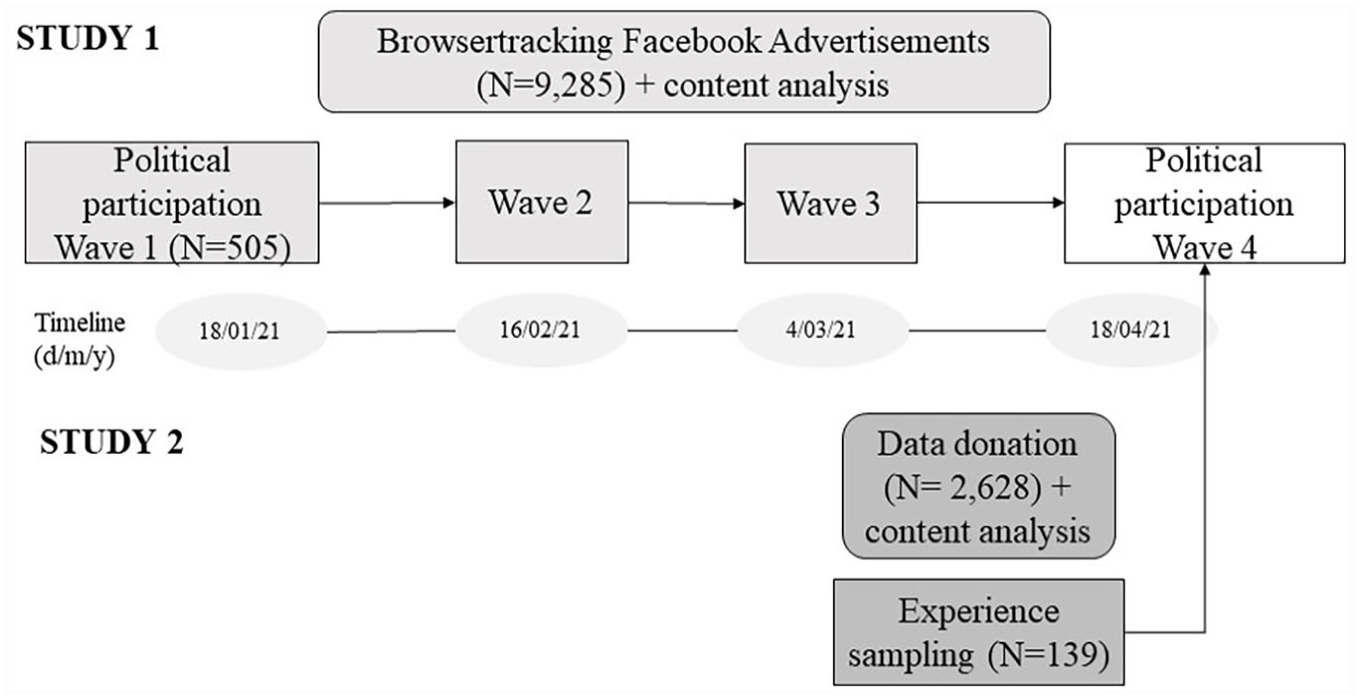
Data Collection of Studies 1 and 2.
In the
In the second study, we combined part of the aforementioned survey data with data collected using a mESM and data donation to measure the mediating role of perceptions and emotions. mESM involves asking participants to provide self-reports through their mobile devices on their feelings and thoughts or other aspects of their daily life at multiple points in time. As participants respond to questions in their natural setting and in real-time, it provides an accurate representation of participants’ natural reactions (Van Berkel et al., 2018: 3).
Between the third and final wave of the panel survey, we asked 150 respondents who participated in Study 1, by means of mESM, to upload (i.e. donate) online political ads they encountered during the day and to answer a few questions regarding their immediate reaction to them, including their perception of the ads as well as their emotions (see for a similar approach, Otto et al., 2020b). Participants could upload a maximum of three screenshots/pictures of online political advertisements per day. In total, 2628 pictures were uploaded by 139 respondents. Importantly, although participants received some instructions that outlined what we meant by political ads, they decided themselves what they considered to be a political advertisement. Pictures that were too blurry or that did not contain an online political ad were excluded during the coding process, resulting in a final sample of 2023 pictures. Two new student coders coded conflict framing in political ads from the mESM data, and the same member of the research team double coded 10% of the data to determine inter-coder reliability (Krippendorff’s α = 0.70 for the presence/absence of a conflict frame).
Measures
Political Participation
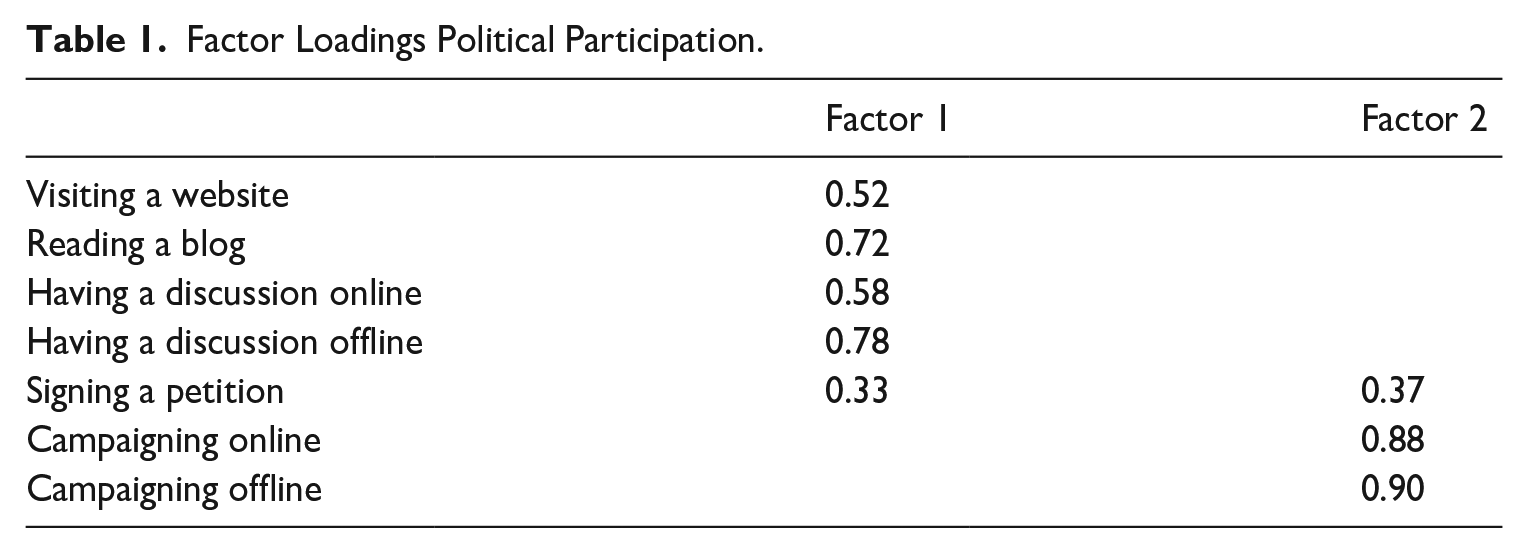
To measure voting (intention), participants were asked in the first three waves if they would vote if elections were held today, and in the last wave if they voted (1 = yes; 0 = no). Participants also indicated how often they had engaged in the following seven participatory activities in the previous 2 weeks 2 (from 1 = Daily to 5 = Never): (1) visited a website of a political party; (2) read a political blog; (3) had an online political discussion; (4) had an offline political discussion; (5) signed an online petition; (6) actively campaigned for a political party online and (7) actively campaigned offline. While some studies exclude political information seeking from their analysis of political participation (Van Deth, 2014), others emphasize its importance and include it (Bakker and de Vreese, 2011). Considering that almost everyone intended to vote (except for one or two people: M = 0.99, SD = 0.097), we concentrated on other forms of political participation. For the political participation measure, we conducted a principal component analysis with oblique rotation. This analysis showed two underlying factors (see Table 1). Based on factor loadings and following the research of Knoll et al. (2020), we created two separate indexes. The participatory activities were grouped according to the effort that must be put into them. We therefore labelled the first factor as low effort (M = 1.72, SD = 0.65) and the second as high effort (M = 1.14, SD = 0.49). The item ‘signing a petition’ did not have a sufficient loading on either one of the factors, but as signing a petition is an important act of political participation (Knoll et al., 2020; Theocharis and Van Deth, 2018) and because the inclusion of the item increased the internal consistency of the low-effort participation measure (Cronbach’s α = 0.67), we included it in our low-effort scale. All scales were inverted such that 1 indicated low participation levels and 5 indicated high participation.
Factor Loadings Political Participation.
Exposure to Conflict Framing
To measure conflict framing, we adopted coding questions used in previous studies assessing the effect of conflict framing on political participation (Bjarnøe et al., 2019; Schuck et al., 2016). However, because these studies investigated newspaper articles, we slightly altered the coding to fit the context of political campaign messages (see for a similar approach: Dekeyser and Roose, 2022). We coded whether advertisements contained: (1) two or more opposing or conflicting sides of an issue or problem; (2) any conflicts/differences/contrasts between political actors and (3) any criticism or attack on a political actor (e.g. a specific politician or party, the government, the opposition or a cluster of parties or politicians). While conflict framing broadly includes criticism or attacks directed at essentially any person or group, we used more restrictive measures in our coding and specified that the targets had to be institutionalized political actors and not social groups like rioters, or multinationals. If one or multiple of the conflict types were present, it was coded as a conflict ad. Importantly, we did not take into account different rhetorical styles of conflict (e.g. uncivil vs civil conflict). We did, however, conduct a robustness check to see if the effects would hold when relying on different operationalizations of conflict frames, that is, conflict frames in which a political opponent is directly attacked, and conflict frames without a direct attack.
For our first study, we created a count measure of the total number of conflict ads a respondent was exposed to per wave (M = 0.81, SD = 3.67, minimum = 0, maximum = 72), 3 as well as calculating the percentage of political ads they received per wave that were conflict ads (M = 15.31, SD = 21.65). For our second study, in which we considered the presence or absence of a conflict frame, 23% of the pictures were found to contain a conflict frame, and people on average saw around five ads (M = 5.61, SD = 5.21, minimum = 0, maximum = 20).
To assess whether the effect of conflict ads was moderated by participants’ like or dislike of the party which generated them, we split the dependent variable into two variables: exposure to conflict ads created by parties that a participant is likely to vote for and those created by parties they are less likely to vote for. To construct this measure, we relied on vote propensity. In each wave, participants indicated for 18 political parties, the likelihood they would ever vote for that party on an 11-point scale (from 1 = never to 11 = ever). We classified parties above the threshold of 8 as parties that the respondent favoured. Since this threshold is somewhat arbitrary, we repeated the analyses with different cut-off points (6, 7 and 9). We used this information to measure the number of conflict ads received per wave from political parties that respondents reported they were likely to vote for (parties that scored an 8 or higher) in that particular wave (M = 0.12, SD = 0.69, minimum = 0, maximum = 11) as well as the number of conflict ads coming from parties that they were less likely to vote for in that wave (M = 0.69, SD = 3.37, minimum = 0, maximum = 72).
Emotions
To measure emotions, we used the mESM. Similar to the methods used in experiments, it captures participants’ emotions immediately after exposure to a political ad (Otto et al., 2020b). Directly after they uploaded an advertisement, we asked respondents about their emotions. Specifically, respondents were asked the following question: ‘How do you feel about the advertisement you just uploaded?’ They were asked to indicate the extent to which the ad made them feel angry (M = 1.94, SD = 1.51), afraid (M = 1.45, SD = 0.97) and enthusiastic (M = 2.74, SD = 1.67; Otto et al., 2020b). All emotions were measured on a 7-point scale (1 = did not feel . . . at all, 7 = felt very . . .). Experimental studies have used similar question wordings (e.g. Lecheler et al., 2013). An advantage of mESM is that the data are collected in a real-world rather than in an artificial setting, and we are able to collect data regarding a larger number of ads over a longer period of time (Otto et al., 2020b).
Perceptions
Perceptions towards the ads were measured in a similar way to the emotions. For each of the political ads respondents uploaded, they had to indicate on a scale ranging from 1 (not at all) to 7 (very much) the extent to which they thought the ad was informative (M = 3.09, SD = 1.69) and interesting (M = 3.10, SD = 1.69).
Controls
We controlled for political knowledge, campaign interest, political efficacy (Quintelier and van Deth, 2014), participants’ demographics (gender, age, education level), general political orientation (on a left to right and a conservative to progressive scale) and the total number of ads a respondent was exposed to per wave (see the online appendix for more information on the control variables).
Results
Study 1: Findings
First, we examined general trends in the data. Figure 2 shows the number of ads participants received on their Facebook feeds in the run-up to the election. As can be seen in the figure, there was an increase over time in the number of conflict ads. The first peak in the number of conflict frames can be explained by (1) an important election debate held on television on 26 February in which the leaders of the six largest parties participated and (2) a television interview broadcast on 4 March in which the party leader of the Christian democrats proposed to shorten unemployment benefits, which triggered angry responses among right- and left-wing parties (RTL Nieuws, 2021). As our sample is not fully representative of the Dutch population, and parties try to target specific voters, we also inspected the number of conflict ads participants received from different parties. Figure 3 shows that a variety of different parties used conflict framing; its use was not limited to, for instance, opposition parties or radical right-wing parties, who are known to use more conflict framing (Van der Goot et al., 2022) and negative campaigning (Valli and Nai, 2020). We see that it is used by opposition parties from the left (e.g. PvdA, GroenLinks) and (right-wing) government parties (e.g. VVD, CDA, D66), as well as opposition parties from the right (e.g. FVD).
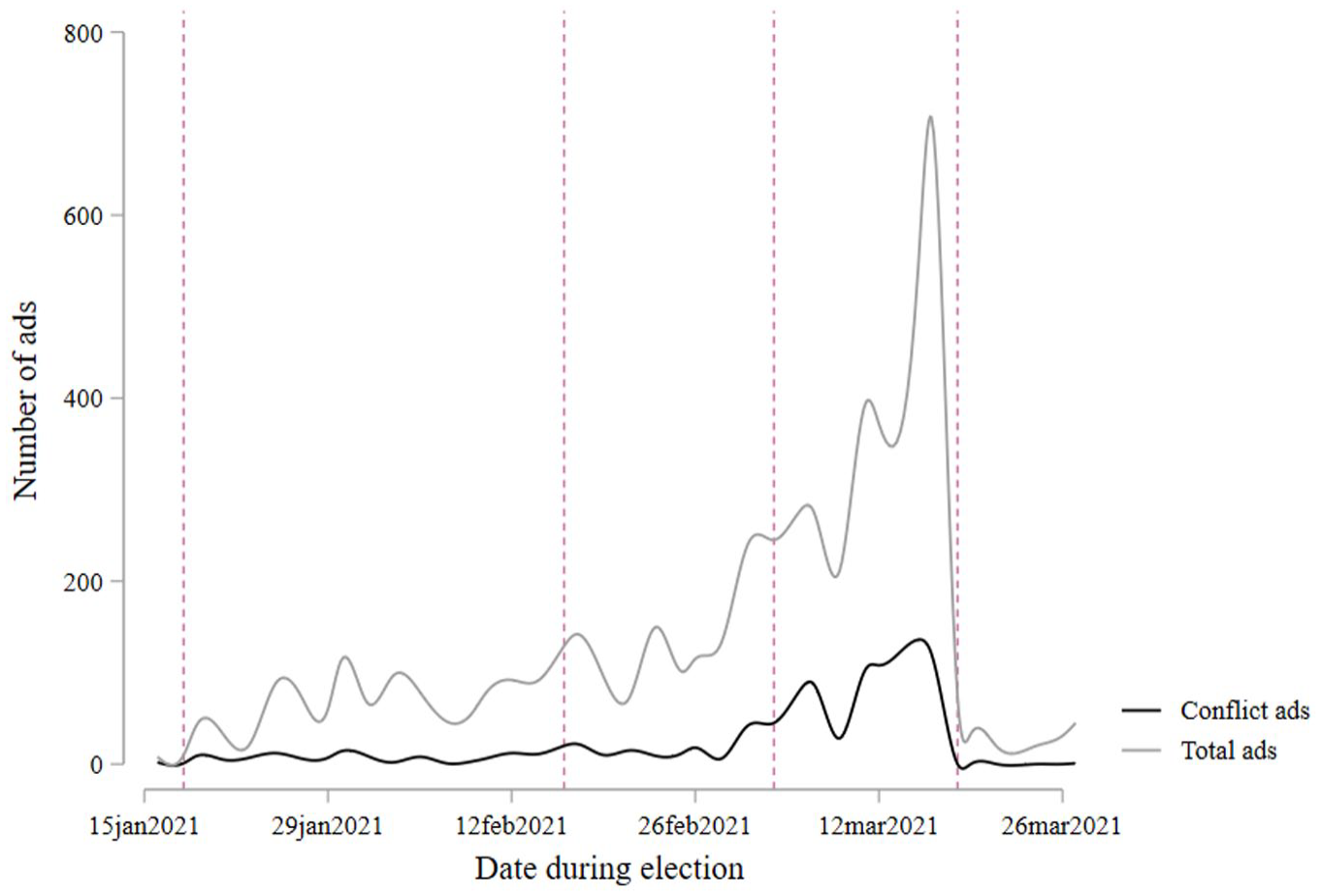
Number of (Conflict) Ads Collected by the Browser Tracker.
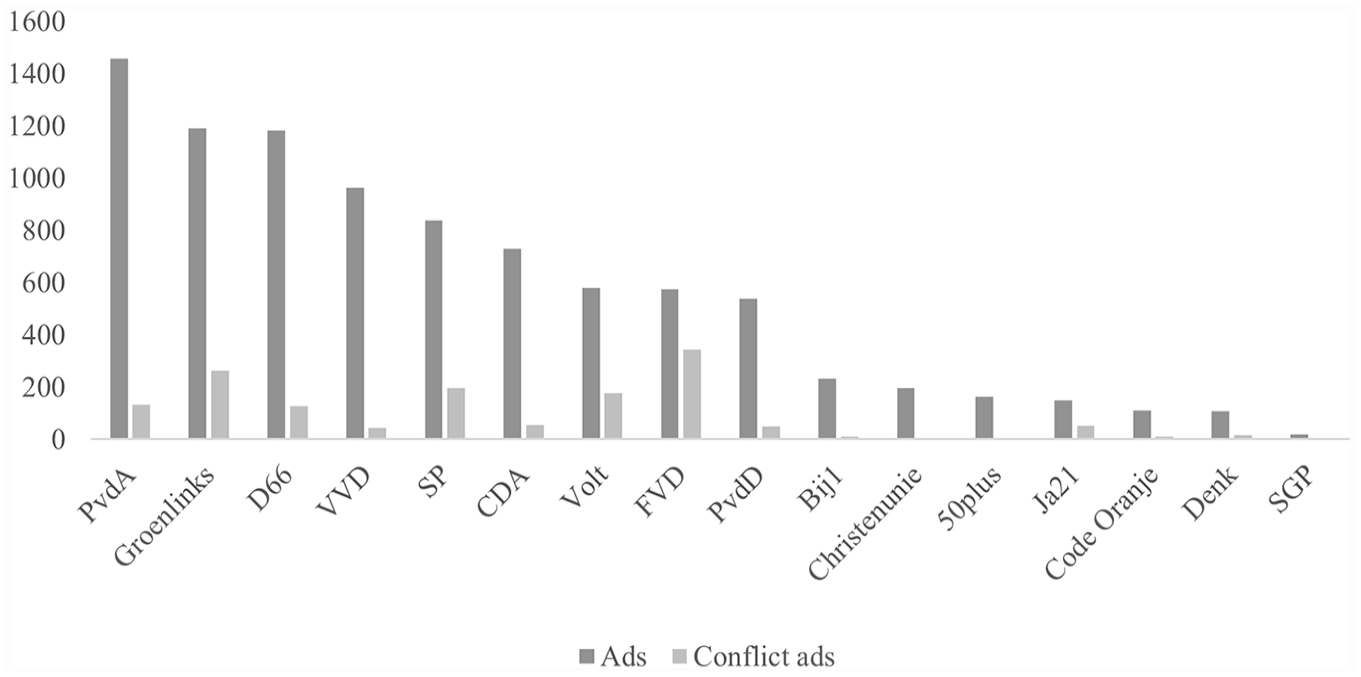
Number of Ads and Share of Conflict Ads per Party.
Second, we analysed the effect of exposure to conflict ads on political participation. Our dataset has a panel structure, meaning that each participant is nested in a wave. We ran panel models with random effects and controlled for demographics, political attitudes, the waves and lagged dependent variables. With the lagged dependent variables, we controlled for political participation in the prior waves. This allowed us to analyse changes in these variables over time. Importantly, the conflict ads participants encountered could have been from parties they favoured or not. In a second step, we considered how party preferences impact the results.
The results of the analyses are presented in Table 2. We found that if the exposure to the number of conflict ads increased the likelihood of low-effort forms of political participation decreased by 0.017 on a 5-point scale. When we examined the percentage of ads that were conflict ads, we found a non-significant negative effect. Regarding high-effort forms of participation, we found no significant effect of exposure to conflict frames. These findings contradict H1 in which we predicted that conflict ads would increase participation. If anything, we found that conflicts had a demobilizing effect when it comes to low-effort forms of participation. This suggests that when the general climate of political debate is conflictual, people are turned off and less likely to participate. However, the effect is small.
Effects of Conflict Ads on Different Forms of Political Participation.
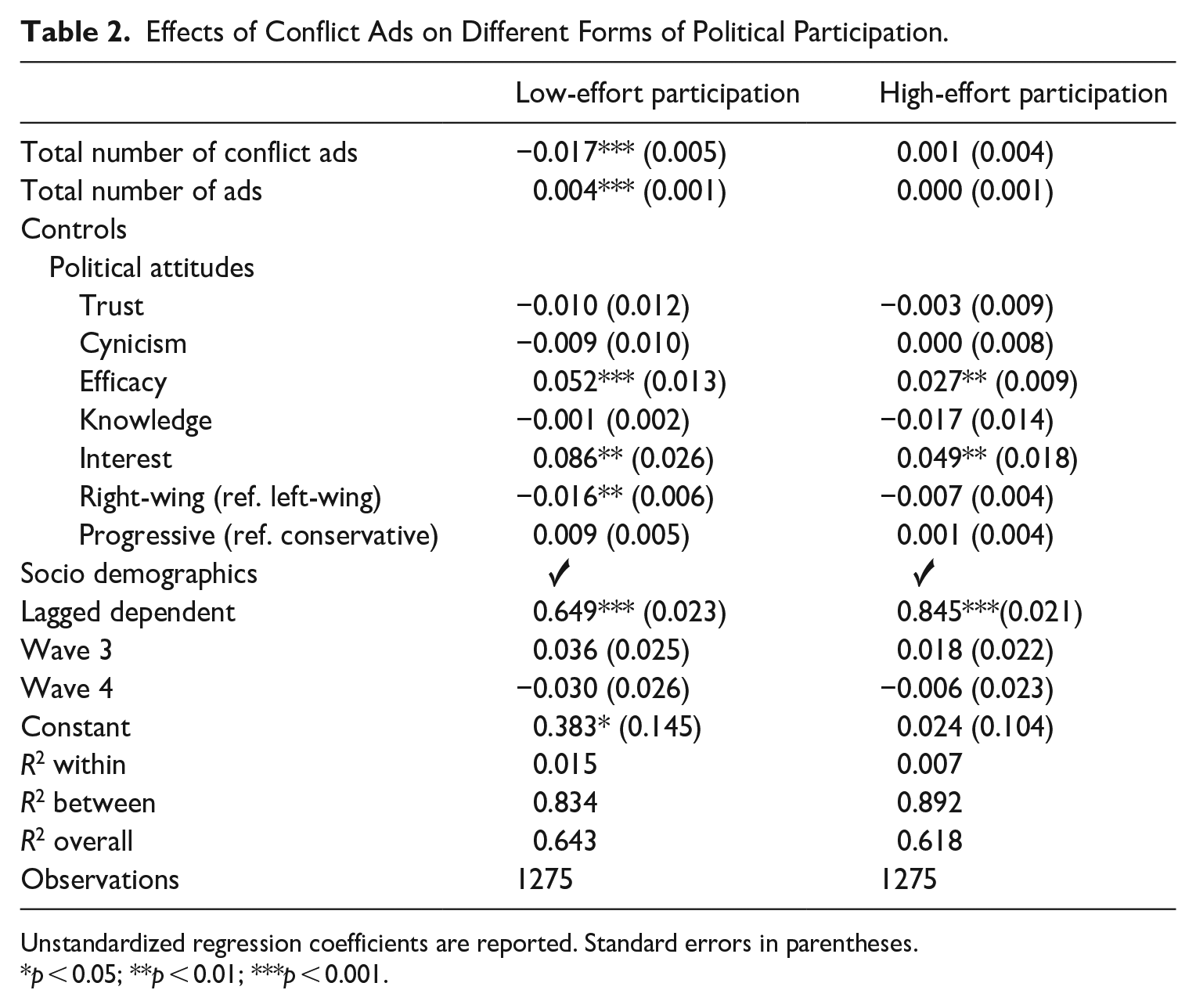
Unstandardized regression coefficients are reported. Standard errors in parentheses.
p < 0.05; **p < 0.01; ***p < 0.001.
Considering that our operationalization of conflict framing includes aspects of negative campaigning, we conducted a robustness check to assess whether results remain similar when we focus on negative campaigns only or on conflicts without direct attacks. To do so, we considered the separate effects of conflict ads in which a political opponent (a politician, political party or the government) was mentioned or not (Krippendorff’s α = 0.87). Since the definition of negative campaigning is saying something (negative) about one’s opponent (Geer, 2006), we considered conflicts in which the opponent was mentioned as negative campaigning and considered the remaining conflicts as conflict framing. The results showed that the effect of negative campaigns (mentioning an opponent) on political participation (b = −0.023, p < 0.05) was similar to the effect of conflict frames (that do not mention an opponent; b = −0.021, p < 0.05). The results are reported in the online appendix.
Furthermore, as can be seen in Table 3, the negative effect on low-effort forms of political participation only holds for conflict ads that came from parties that participants reported they were less likely to vote for. When the number of conflict ads from disliked parties increased, the likelihood of low-effort forms of participation significantly decreased by a factor of 0.019 on a 5-point scale, with the remaining variables controlled. This result suggests that people are particularly demotivated to participate in politics when they see ads from parties they dislike. 4
Effects of Conflict Ads Split by Political Affiliation on Low-Effort Political Participation.
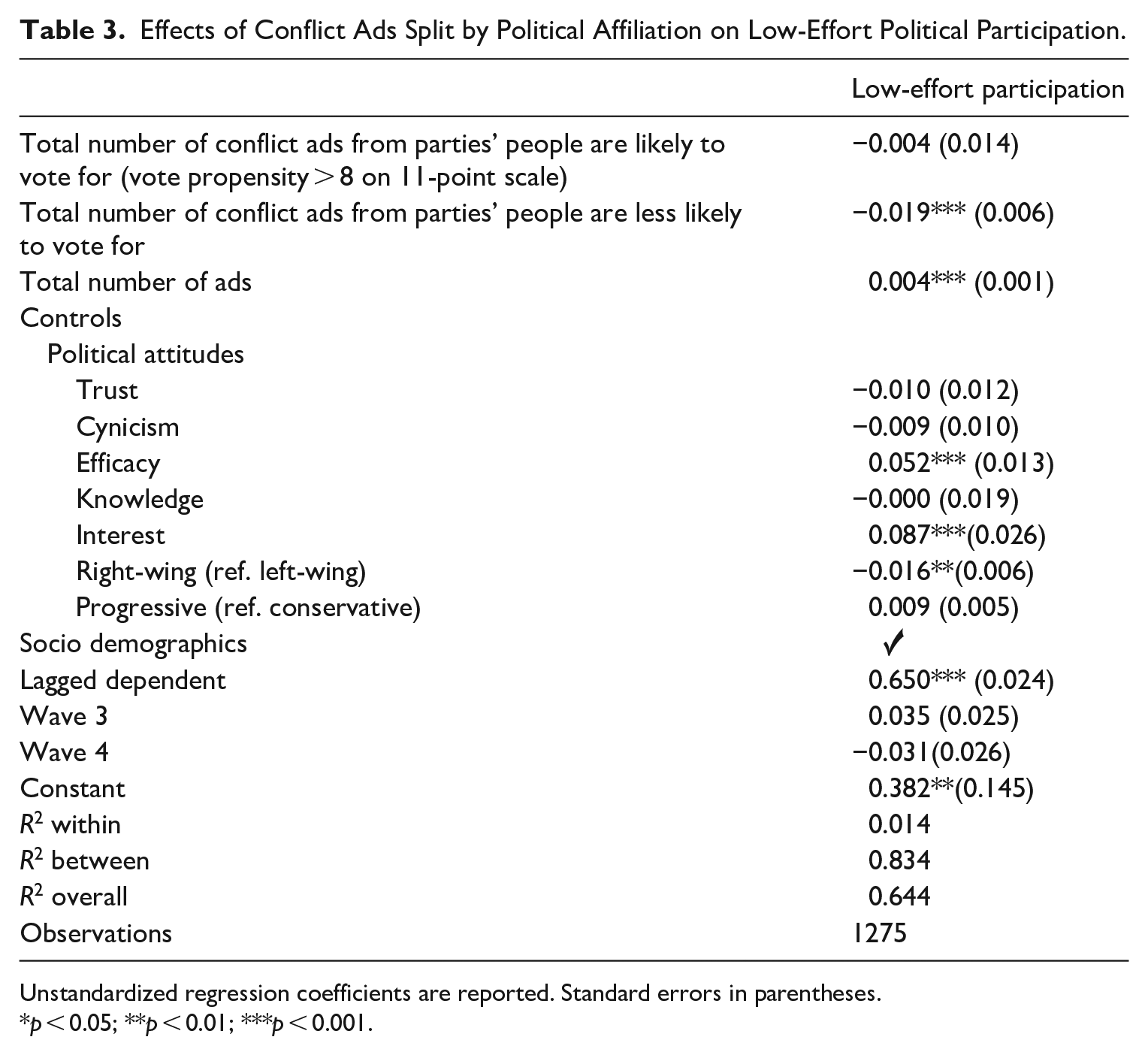
Unstandardized regression coefficients are reported. Standard errors in parentheses.
p < 0.05; **p < 0.01; ***p < 0.001.
Study 2: Findings
To assess how perceptions and emotions about conflict ads mediate the effect of conflict frames on low-effort participation, we used multilevel generalized structural equation modelling (GSEM) in STATA. As the content of the ads and the perceptions and emotions about the ads were measured on the level of the ad, while political participation was measured on the level of participants, we applied a multilevel model whereby we considered ads to be nested in individuals. Before examining the separate mediation effects, we analysed the effect of exposure to conflict frames on low-effort forms of political participation without taking into account mediator variables. We found a marginally significant direct negative effect (b = −0.060, p = 0.076, with the following fit statistics: Akaike information criterion (AIC) = 3448.49, log likelihood: −1710.24, df = 145), confirming the results of Study 1.
First, we considered perceptions of ads (Figure 4). 6 We found a significant negative indirect effect of conflict frames on political participation through informativeness (b = −0.013, p = 0.0345). Conflict frames were perceived as less informative than ads without a conflict frame, which contradicts H2a. In addition, we found that the informativeness of ads affected low-effort forms of participation positively (Figure 4). Because conflict ads were perceived as less informative, exposure to them made participants less likely to get involved in political activities. This means we need to reject H2c. Whether participants perceived an ad as interesting had no indirect effect (b = −0.007, p = 0.217). Conflict frames were perceived as less interesting (b = 0.34, p < 0.001), but the extent to which participants found an ad interesting did not affect their political participation. Both H2b and H2d can thus be rejected.
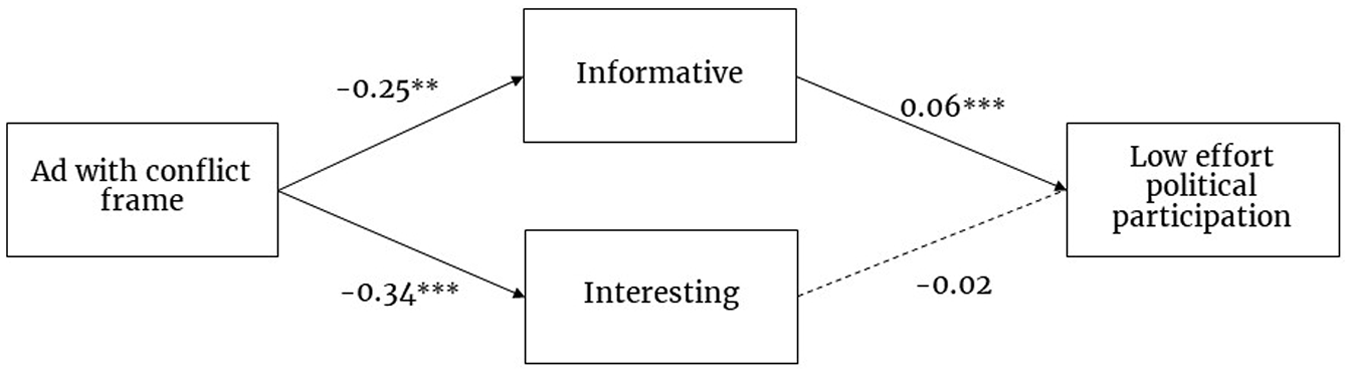
Mediation Model for Perceptions.
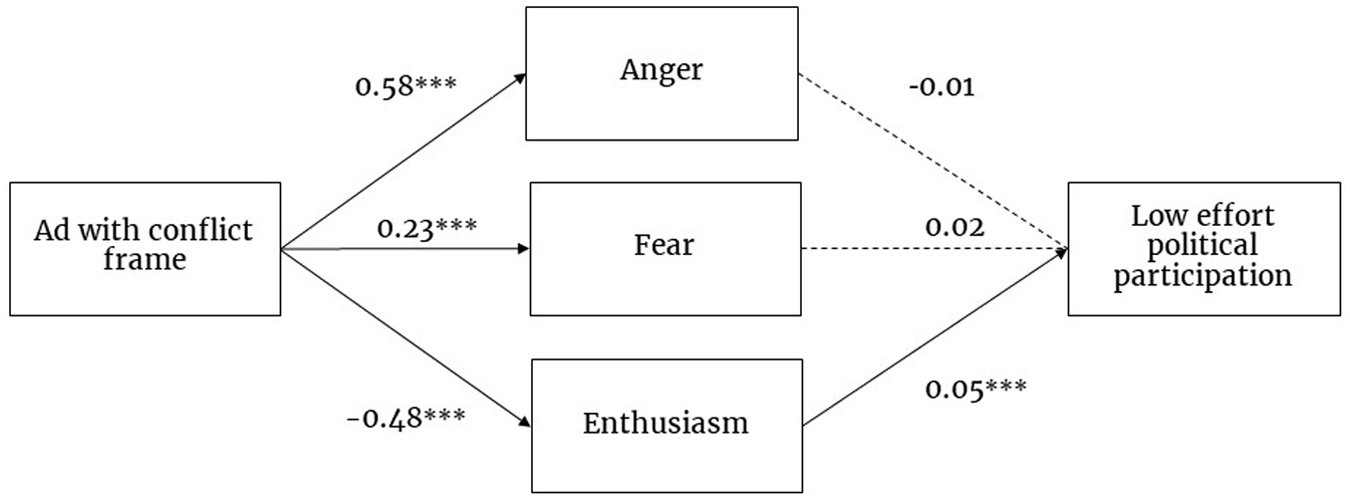
Mediation Model for Emotions.
Turning to H3a, we did not find a significant indirect effect of conflict frames on political behaviour via anger (b = −0.08, p = 0.248). Feelings of anger after viewing an ad with a conflict frame were 0.58 points higher on a 5-point scale than after viewing an ad without a conflict frame, which aligns with H3a. These feelings of anger did not contribute to higher levels of political participation. This is contrary to our expectations (H3c). Because anger is associated with a heightened feeling of control, we expected anger to mobilize participants. However, the anger triggered by conflict frames failed to do so in our study.
Enthusiasm had a significant negative indirect effect (b = −0.024, p < 0.001). Enthusiasm after viewing an ad with a conflict frame was 0.48 points lower than after viewing an ad without a conflict frame (contradicting H3b). This reduced enthusiasm decreased the likelihood of political participation. Although enthusiasm mediated the effect of conflict frames on political participation, it did so in the opposite direction to what we had predicted (contradicting H3d). Participants became less enthusiastic about conflict frames and subsequently participated less in politics.
Fear had no significant indirect effect (b = 0.006, p = 0.188). Feelings of fear after viewing an ad with a conflict frame were 0.23 points higher than after viewing an ad without a conflict frame. However, fear did not affect political participation (b = 0.02, p = 0.171). 7
Conclusion
In this article, we sought to explore how and why conflict framing in political advertising affects political participation in a multi-party setting. Unlike other studies (Geer, 2006; Haselmayer, 2019; Lau and Rovner, 2009; Schuck et al., 2016), we failed to find that conflict frames mobilize citizens to become politically active. If anything, our results show that it demobilized citizens to engage in low-effort forms of participation, such as engaging in a political discussion, signing a petition or visiting a political website or blog. This effect, however, only held for ads from disliked parties. When participants were exposed to conflict ads from parties that they were not very likely to vote for, they were less likely to participate in politics.
This small demobilizing effect can partly be attributed to citizens’ immediate reactions to conflict frames. Because conflict frames suppressed enthusiasm and were not seen as informative, they reduced citizens’ political involvement. Considering that it has been argued that negative campaigns contain more information than positive campaigns (Geer, 2006), it is interesting that we found that ads were not perceived as more informative by voters. Furthermore, we also found that conflict frames were seen as less interesting and induced feelings of anger and fear.
The multi-party context may have played a role in the particularity of the findings. While political fights and polarization are very common in a two-party system, they may be experienced as more worrying in a multi-party system where consensus is central and where the forming of a government and decision-making depend on compromise and cooperation among different parties (Lijphart, 1999). When there are so many different parties competing, finger-pointing and mutual blaming may be viewed by the public as a waste of time. Consequently, citizens may become more cynical of politics, grow further removed from it, and feel discouraged from getting politically involved (Kleinnijenhuis et al., 2006).
We are not certain why participants saw conflict ads as less informative than ads without conflict. Perhaps conflictual language can distract people from the actual substantive information that parties are trying to convey. While some argue that negative campaigning contains more issue information (Geer, 2006) and that conflict frames clarify political issues (Schuck et al., 2016), others argue that by focusing on conflict, politicians draw attention away from substantive information (Silva, 2020), causing people to perceive conflict ads as less informative.
This study has some limitations. We primarily investigated social media campaigns. While online campaigning strategies were important during the 2021 elections given that offline campaigning was largely impossible due to COVID-19 restrictions, campaign efforts, of course, also extend beyond social media platforms. We did not account for political conflicts that participants came across on television, for instance. Although attack ads on television are uncommon in the Netherlands (Walter, 2014), televised election debates and political news may include conflict frames that could influence participation. Moreover, in the first study, we relied solely on data from Facebook. Although Facebook is widely used by political parties to target voters, other platforms such as Instagram and Twitter are also important (Bossetta, 2018). Future studies could investigate whether the findings of Study 1 hold when multiple platforms are taken into account.
Additionally, while we primarily focus on the effect of conflict framing in our study, we also draw on literature on negative campaigns. While conflict framing and negative campaigning are distinct phenomena, there is considerable overlap in the way they are measured. We therefore believe that integrating the concepts can help us understand how political conflictual language in a broad sense can affect citizens’ political behaviour and attitudes.
We also did not consider a number of possible moderative variables, such as rhetorical style. It has been argued, for instance, that uncivil and harsh conflicts produce different effects than civil conflicts. Otto et al. (2020a), for example, found that uncivil conflicts by political elites in the media lowered citizens’ intention to participate in political discussions, while civil conflict did not significantly decrease or increase this intention. It is therefore worth exploring whether variations in conflicts bring about different effects. However, since incivility is largely in the ‘eye of the beholder’ (Herbst, 2010: 3), such an investigation would require assessing whether participants perceive particular ads as uncivil.
Finally, we want to stress that the sample was not representative of the Dutch population. This is mainly due to the adoption of a novel method and the focus on Facebook users. While the initial sample of the survey reflected the Dutch voting population accurately, the sample of participants who also installed the browser tracker was slightly biased. Although we believe we have sufficient variability in our key independent and dependent variables to study the relationship between exposure to conflict ads and political behaviour, a more representative sample is needed for solid generalizations.
Nonetheless, our study provides insights into the effects of conflict framing in a multi-party setting. As conflict is an inherent part of politics, our findings carry value for a wide range of scholars studying electoral processes. While negative campaigning and conflict framing are often used by political parties because of their assumed benefits (Lau et al., 2007), an increase in the negativity of campaigns might also have unintended negative consequences for citizens and democracy at large. Our findings suggest that conflict frames are unable to energize citizens and may even have a small demobilizing effect because they are viewed as less informative and depress enthusiasm. Although we only found a small demobilizing effect, our results suggest that conflict frames may not be evaluated positively by citizens in a multi-party setting and might induce feelings of fear and anger. From a normative perspective, this finding is not encouraging, given that citizens’ positive attitudes towards politics and their involvement in a range of political activities are essential elements of a vibrant democracy (Theocharis and Van Deth, 2018). Thus, while political parties might want to employ conflict frames for individual gain, our research suggests that an increase in their usage may have negative implications for democracy beyond their direct effect on electoral outcomes.
Supplemental Material
sj-docx-1-psx-10.1177_00323217231178105 – Supplemental material for The Online Battlefield: How Conflict Frames in Political Advertisements Affect Political Participation in a Multiparty Context
Supplemental material, sj-docx-1-psx-10.1177_00323217231178105 for The Online Battlefield: How Conflict Frames in Political Advertisements Affect Political Participation in a Multiparty Context by Emma van der Goot, Sanne Kruikemeier, Rens Vliegenthart and Jeroen de Ridder in Political Studies
Footnotes
Acknowledgements
The authors would like to thank Michael Hameleers for his help during the revisions, the two anonymous reviewers for their constructive feedback and Roos van Riel, Amber de Wit and Roeland Dubel for their assistance with manual coding.
Declaration of Conflicting Interests
The author(s) declared no potential conflicts of interest with respect to the research, authorship and/or publication of this article.
Funding
The author(s) disclosed receipt of the following financial support for the research, authorship and/or publication of this article: The study was funded by NWO Nederlandse Organisatie voor Wetenschappelijk Onderzoek (Grant number: 406.DI.19.055) and NORFACE Joint Research Programme on Democratic Governance in a Turbulent Age (Grant number: 822166).

Supplementary Information
Additional supplementary information may be found with the online version of this article.
Contents
Control variables
Robustness check
Table A1. Robustness Check: Effects of Different Conflict Ads on Low Effort Participation.
Figure A1. Robustness Check: Mediation Model Perceptions of Negative Campaigning.
Figure A2. Robustness Check: Mediation Model Emotions Towards Negative Campaigning.
Notes
Author Biographies
References
Supplementary Material
Please find the following supplemental material available below.
For Open Access articles published under a Creative Commons License, all supplemental material carries the same license as the article it is associated with.
For non-Open Access articles published, all supplemental material carries a non-exclusive license, and permission requests for re-use of supplemental material or any part of supplemental material shall be sent directly to the copyright owner as specified in the copyright notice associated with the article.
