




Abstract
This study examines the personality traits of candidates for the Swiss government and how they are related to the candidates’ electoral chances. Switzerland as a paradigmatic consensual democracy is an ideal test case to examine the connection between the specific pattern of a democracy and the government personalities that fit it. We argue that the cultural and institutional setting of the Swiss Government increases the electoral chances of kinder and gentler personalities. To test this, we estimate regression models on a new data set of candidates covering all vacancies in the Swiss government between 1982 and 2020. Our results reveal that candidates with a higher level of agreeableness do enjoy an advantage in the electoral process for Swiss consensus government.
Introduction
The selection of members of the government is one of the most important political events with far-reaching consequences. The ministers not only make important political decisions for the society and economy of a country but are also important role models for the population, ensuring the legitimacy of public policy. The selected members of government thus constitute an important link between the preferences of voters on one hand and the administration that implements public policy on the other hand (Laver and Shepsle, 1994). ‘Hence, ministerial selection in coalition governments is an important phenomenon to study when we aim to understand democratic politics and governance’ (Bäck et al., 2016).
Existing research suggests that the probability of selection to government is related to a candidate’s seniority and network in parliament, social background factors such as education, gender, age, as well as institutional rules (e.g. Blondel and Thiébault, 1991; Dowding and Dumont, 2009; Laver and Shepsle, 1994). In this study, we consider one previously unexplored determinant in ministerial selection: the personality of the candidates. During the last decades, numerous studies have appeared dealing with the effects of personality on political ideology, political interest and knowledge, party affiliation, aspects of political participation, and so on (e.g. Ackermann et al., 2019; Best, 2011; Fatke, 2019; Freitag and Zumbrunn, 2022; Gerber et al., 2011; Mondak, 2011). In addition, various contributions study the personality traits of elites in general (Caprara and Silvester, 2018), of legislators (Hanania, 2017; Klingler et al., 2019; Nørgaard and Klemmensen, 2019), elected officials (Joly et al., 2019), US Presidents (Barber, 1972; Rubenzer et al., 2000; Rubenzer and Faschingbauer, 2005; Simonton, 1986, 2006) or of municipal candidates (Freitag et al., 2019; Scott and Medeiros, 2020). The fact that the media describes the candidates as friendly, hardworking, conscientious, ambitious, and so on in the run-up of the elections (Freitag, 2017: 27) highlights the relevance of personality. However, the field remains sparsely researched in general (Schafer and Smith, 2020) and hardly any previous research has taken into account the role of different personality traits for government office. This is the research gap we address. We aim to answer the following question: What is the role of personality when it comes to the selection of government members and how do successful candidates for a national executive office differ in terms of their personality traits from the non-successful politicians?
We investigate these questions for the case of Switzerland where the national parliament, the so-called Federal Assembly, forms the electoral body for the government (Church, 2004; Linder and Mueller, 2021; Vatter, 2020a). It exercises its right to form the government at both the beginning of a new legislative period and when a member of the government, the so-called Federal Council, leaves office due to resignation or death. However, we limit our analysis on the elections of new government members, as the re-election of incumbents at the beginning of new legislative periods is the rule.
In an international comparison, the electoral competences of the Swiss parliament are extensive (Sieberer, 2010: 75ff.). First and unlike in countries as Belgium, Ireland, or Italy, the number of candidates is not restricted, at least not in the first ballot. In principle, all Swiss citizens with political rights at the federal level are eligible, though members of government must not hold a parliamentary mandate at the same time. Second, the legislative does not only elect the Prime Minister (which is in fact a non-existing position in Switzerland), but all seven (equal) members of government, the Federal Councillors. The election takes place individually and consecutively for each seat in government. Four of five candidates for each vacancy are quite common, while even higher numbers occur (Altermatt, 2019). Prior to the election, the parliamentary groups (parties or a group of parties) decide whom to nominate as their candidates. This nomination process concerns mainly the parliamentary group of the resigning member of government as the new member usually belongs to the same party as the predecessor. However, during the last two decades, other parliamentary groups have increasingly started to nominate candidates as well. Nominated candidates enjoy a more promising starting position as they usually gain most of the votes of their own parliamentary group. In addition, they receive more media attention (Vatter, 2020b: 83). However, every now and then, parliament prefers to elect non-nominated persons. Since 1960, this was the case in about 20% of all elections, which affected the Social Democratic Party in particular (Rhinow et al., 2016: 477). Thus, the Swiss parliament’s role is not limited to confirming a candidate previously determined by other bodies. Rather, – and this is the crucial point – the Swiss legislative has a real choice and thus exercises a strong form of ex ante control (Cheibub et al., 2015). Third, while some countries like Germany demand for higher approval, the election of the members of government only requires more than half of all valid votes, giving the parliament more flexibility and scope for action. In sum, Switzerland is an ideal case for our empirical analysis because of the presence of a substantial number of candidates, the stability of the electoral and party systems over time, and most importantly, the high discretion that the Swiss legislative enjoys in choosing the members of Swiss government.
Focussing on a legislature with strong electoral competences, our article offers a possible answer to the question of which personal characters a parliament selects if it actually exercises its electoral power over the government in a context of multipartism, coalition government, and heterogeneous cultures, which is typical for most European countries. From this, possible conclusions can be drawn for other European states that are looking for alternative forms of government to the prevailing parliamentary system with weak legislatures, which have come under increasing pressure.
Our study is based on a unique dataset covering the characteristics of all candidates for the Swiss government from 1982 to 2020. The core of the dataset are the personality traits based on the five-factor theory (McCrae and Costa, 2008). To our best knowledge, this is the first self-assessment of national government members and candidates with regard to their personality traits (‘Big Five’) worldwide. 1 In addition, the dataset comprises various socio-demographic, institutional, and political characteristics.
The remainder of our article is structured as follows: In the following section, we introduce the theoretical background and our leading hypothesis. Subsequently, we explain our methodology followed by the presentation and discussion of our results. We finish with concluding remarks.
Theoretical considerations
Personality and political success
Our analysis of personality traits is based on the five-factor theory of personality (McCrae and Costa, 2008), an established and well-known concept in psychology. This theory states that five main characteristics (‘Big Five’) make up the personality of each person: openness to experience, agreeableness, extraversion, conscientiousness, and neuroticism. Openness implies interest in new ideas and experiences. Agreeable persons are characterised by a friendly and considerate behaviour towards others while low scores for this trait correspond to a competitive and assertive conduct. Extraversion manifests itself by a high degree of sociability and talkativeness. Conscientious persons work hard and thoroughly while their counterparts tend to be more careless and risk seeking. Neuroticism corresponds to a lack of emotional stability. Thus, neurotic persons react sensitively on stress and get easily worried while low scores for neuroticism indicate a high resilience. Each of these traits represents a continuum. While the rank-order of the Big Five stays stable over an individual’s lifetime, single traits are more or less pronounced at different ages (Roberts and DelVecchio, 2000; Roberts et al., 2006).
Examining the relationship between personality and political success, we can draw on research linking the Big Five to career success. There are several entry points where career and personality traits may be related. On one hand, personality can have an influence on the choice of a particular career, with both the applicant and the recruiting agency evaluating the match between personality and job characteristics. Personality traits can also determine career success (in terms of occupational status or salary). Finally, social behaviour mediated by personality traits can shape job performance (Judge and Kammeyer-Mueller, 2007). Previous studies have provided mixed results on the effect of the Big Five on career success. Especially for openness for experience, the findings are inconsistent (positive effect: Judge et al., 1999; negative effects: Bozionelos, 2004; Seibert and Kraimer, 2001). Considering neuroticism, there seems to be at least a tendency (negative effect: Judge et al., 1999; no effect: Bozionelos, 2004; Seibert and Kraimer, 2001). Turning to the other three traits, the results are more telling. For extraversion and conscientiousness, findings are predominantly positive (Melamed, 1996; Rawls and Rawls, 1968; Seibert and Kraimer, 2001; Wilmot and Ones, 2019) while agreeableness tends to impede career success (negative effect: Boudreau et al., 2001; Judge et al., 1999; no effect: Bozionelos, 2004; Seibert and Kraimer, 2001).
Studies examining the influence of personality on the success of politicians often use electoral outcomes as a corresponding indicator. Some research focuses on comparing the personality traits of elected politicians with those of the population as a whole, in order to draw conclusions about whether politics attracts people with certain personality traits. In line with the research focusing on career success, several studies find politicians to be more extraverted than the general public (Best, 2011; Hanania, 2017; Nørgaard and Klemmensen, 2019; Rubenzer et al., 2000; Scott and Medeiros, 2020). For the other personality traits, the results are less clear. For example, Hanania (2017) and Nørgaard and Klemmensen (2019) find US and Danish legislators to be more conscientious than the general public, while Best (2011) states the opposite for German politicians. Other studies compare the personality profiles of winning and losing candidates for political offices with diverging conclusions. For Belgium, Joly et al. (2019) report slightly more preference votes for legislators who exhibit lower levels of agreeableness while emotional stability is positively correlated to the number of preference votes. Both findings are in line with the majority of results connecting personality traits to career success. However, Nai (2019) reveals emotional stability to be negatively associated with electoral results. And while Nai (2019) reports a positive effect of openness to experience on electoral success, Scott and Medeiros (2020) claim the opposite.
We argue that the inconsistent results for the personality structure of political elites may partly be due to different cultural features and institutional incentives of the respective political systems. If we compare, for example, the political institutions of the United States with those of Switzerland, we can see clear differences. In the United States, two major parties compete for power, and they are very distinct from each other. Cooperation across party lines has become increasingly rare in recent decades (Andris et al., 2015). Against this background, it does not come as a surprise that US Congress members who exhibit high levels of agreeableness display highly partisan behaviours at the same time (Ramey et al., 2017). In their institutional environment, it is reasonable to seek support primarily within one’s own party, while cooperative behaviour across party lines is hardly likely to promote one’s own concerns.
In Switzerland, the political institutions promote different incentives. According to Lijphart (2012), Switzerland is a prime example of a consensus democracy with a high degree of power sharing. The current system of proportional representation in elections to the lower house forms one aspect of this power sharing, which results in a high degree of party fragmentation in parliament (Ladner et al., 2022: 411). This, in turn, implies that the votes of one’s own party are not sufficient to make it to the government. Rather, each candidate needs to convince representatives of other parties of his or her suitability for the office. The parties, in turn, anticipate this circumstance when it comes to nominating candidates. Individuals who cultivate a very confrontational and polarising political style towards their colleagues of other parties have a difficult position and reduce their electoral chances under these circumstances.
With reference to the Big Five theory, we assume agreeableness to be of paramount importance in the selection of Swiss government members. High scores on agreeableness are associated with cooperative, social, trustful, and kind behaviour (McCrae and Costa, 2008). Research on the effect of staffing decisions shows that the minimum measure of team agreeableness has a significant impact on team performance (Bradley et al., 2013; Peeters et al., 2006). Even one disagreeable teammate may be enough to disrupt the working climate and has the potential to lower team performance (Bell, 2007: 603; Stewart, 2003: 184). While governments can be conceptualised as teams in general, this is especially true in the Swiss case. The Swiss government is a non-hierarchical college with seven executive members with equal rights. Its representatives usually stem from four different parties covering a broad ideological spectrum from right-wing populist to social democratic (Vatter, 2020b). Within government, the principle of collegiality is essential. The members of government make their decisions together as equal partners. ‘Whatever their party may think they have to get the agreement of the college’ (Church, 2004: 118). As a rule, decisions are meant to be taken unanimously. Moreover, the public expects members of government to uphold the opinions of the body even if they personally disagree with it (Vatter, 2020a). This institutional and cultural setting requires the individual members to have the ability to work in a team, willingness to compromise, and empathy, while idiosyncratic loners do not fit in (Altermatt, 2019). Following the famous and controversial statement by Lijphart (2012: 294) on the characteristics of consensus democracies, we expect ‘kinder and gentler’ ministers in the Swiss government. Thus, our main hypothesis states that the candidates’ chances of being nominated and elected to Swiss collegial government rise with increasing levels of agreeableness.
Alternative approaches
We combine the personality traits under investigation with a number of control sets, which stem from alternative theoretical approaches to explain the selection success of government ministers.
Social background characteristics are often considered to characterise elites and have turned out to affect ministerial selection in a number of studies (Baumann et al., 2019; Blondel, 1985; Escobar-Lemmon and Taylor-Robinson, 2009; Fischer and Kaiser, 2009; Fleischer and Seyfried, 2015; Goddard, 2019; Kerby, 2009). Correspondingly, the core idea of the social background approach is to identify and describe characteristics that make up for the political elite as a distinctive group (Verzichelli, 2018: 363). With regard to Germany and generalisable for many other countries, Fleischer and Seyfried (2015: 506) state that members of government are ‘predominantly male, of senior age and have obtained high educational degrees’ (see also Fischer and Kaiser, 2009). Accordingly, we control for age, gender, and education.
Another strand of literature on ministerial selection relies on the principal agent approach by Jensen and Meckling (1976; for example, Bäck et al., 2016; Fleischer and Seyfried, 2015; Seixas and Costa, 2019). This approach states that the election of the members of the government (agents) by the parliament (principal) implies a delegation of competences (Strøm, 2000). This delegation, however, raises problems: Once the agents are in charge, the principal can only insufficiently control their actions. Incomplete information or a limited recruiting pool may lead to adverse selection. To make sure to select ‘good types’ (Fearon, 2012), the legislative is in need of screening mechanisms. Therefore, it is of great advantage if the candidates are members of the electoral body so that the MPs can realistically assess their positions and characteristics. Alternative screening mechanisms relating to the policy preferences and the leadership qualities of a candidate is the experience as leader of her own party on the national level (Fleischer and Seyfried, 2015: 505). Thus, we control for the tenure as MP as well as for the experience as a national party leader.
Moreover, we control for institutional context characteristics (De Winter, 1991; Dowding and Dumont, 2009). We assume that electoral chances rise with the number of MPs that represent the same canton as the candidate (Bacher et al., 2003: 428). Furthermore, we check whether representatives of the linguistic minorities face worse voting chances, since German-speaking representatives have a majority in parliament (Bacher et al., 2003: 428).
Data and methods
Our study is based on a dataset covering the characteristics of all candidates for the Swiss government from 1982 to 2020. During this period, there were 31 elections leading to new office holders. We consider candidates those who received at least 10 votes in the first ballot for a vacant seat in government and whose names and number of votes are recorded in the Official Bulletin. We chose the cut-off of at least 10 votes because candidates who receive fewer votes in the second or subsequent ballots drop out (Art. 132 para. 4 Parliament Act). Moreover, in almost all cases, the Official Bulletin summarises candidates receiving less than 10 votes under the ‘various’ category, making it impossible to identify them. In total, we see 116 candidacies for the period under investigation. Several persons were running more than once. Thus, the dataset comprises 101 candidates. All candidate scores refer to the respective election. For some variables like tenure as MP or age, this implies diverging scores for candidates who ran for office more than once. Appendix A and B show the operationalisations of all variables and their descriptive statistics.
Out of the 101 candidates, 16 had already deceased at the time of our analysis. For the remaining 85 candidates, we conducted a written survey in April and May 2020, asking candidates about their personality traits. Persons who did not react to our request received a reminder at the beginning of May 2020. We measured the Big Five according to the 15 items’ inventory of the socioeconomic panel comprising three items relating to each trait (SOEP BFI-S; Dehne and Schupp, 2007, see Online Appendix 1). Compared to more comprehensive measurements of the Big Five, the shortened version can be more easily implemented in surveys (Ackermann et al., 2019: 581). On a 7-point scale, the respondents made a self-assessment of their own personality traits. The response rate was 67%. For deceased candidates or those who had not participated in our survey, we conducted external assessments by two or three experts. They used the same 15 items’ inventory and the 7-point scale as the candidates doing a self-assessment. The external assessments by experts in Swiss politics and political psychology are based on extensive media coverage and biographical information about the respective candidates and all experts assessing the same candidate used the same collection of media reports. For the external assessments, we achieved a Krippendorf’s alpha of 0.74.
To sum up, our dataset comprises Big Five data on 101 candidates resulting mainly from self-assessments and to a smaller extend on expert ratings. Using analysis of variance (ANOVA) tests and Cohen’s d, we checked whether the Big Five data differ for the two kinds of data collection. We do not see significant differences for extraversion, conscientiousness, and neuroticism while we find significantly higher scores on agreeableness and openness for candidates doing a self-assessment (Table 1). These results are in line with those of Marcus and Schütz (2005) who find responders to their survey to be more agreeable and open for new experience than non-responders while they do not discover differences for the other three traits. For agreeableness, the analyses of Rogelberg et al. (2003) and Lönnqvist et al. (2007) produce corresponding results.
Big Five profile for candidates with external versus self-assessments: means, standard deviations, and effect sizes.
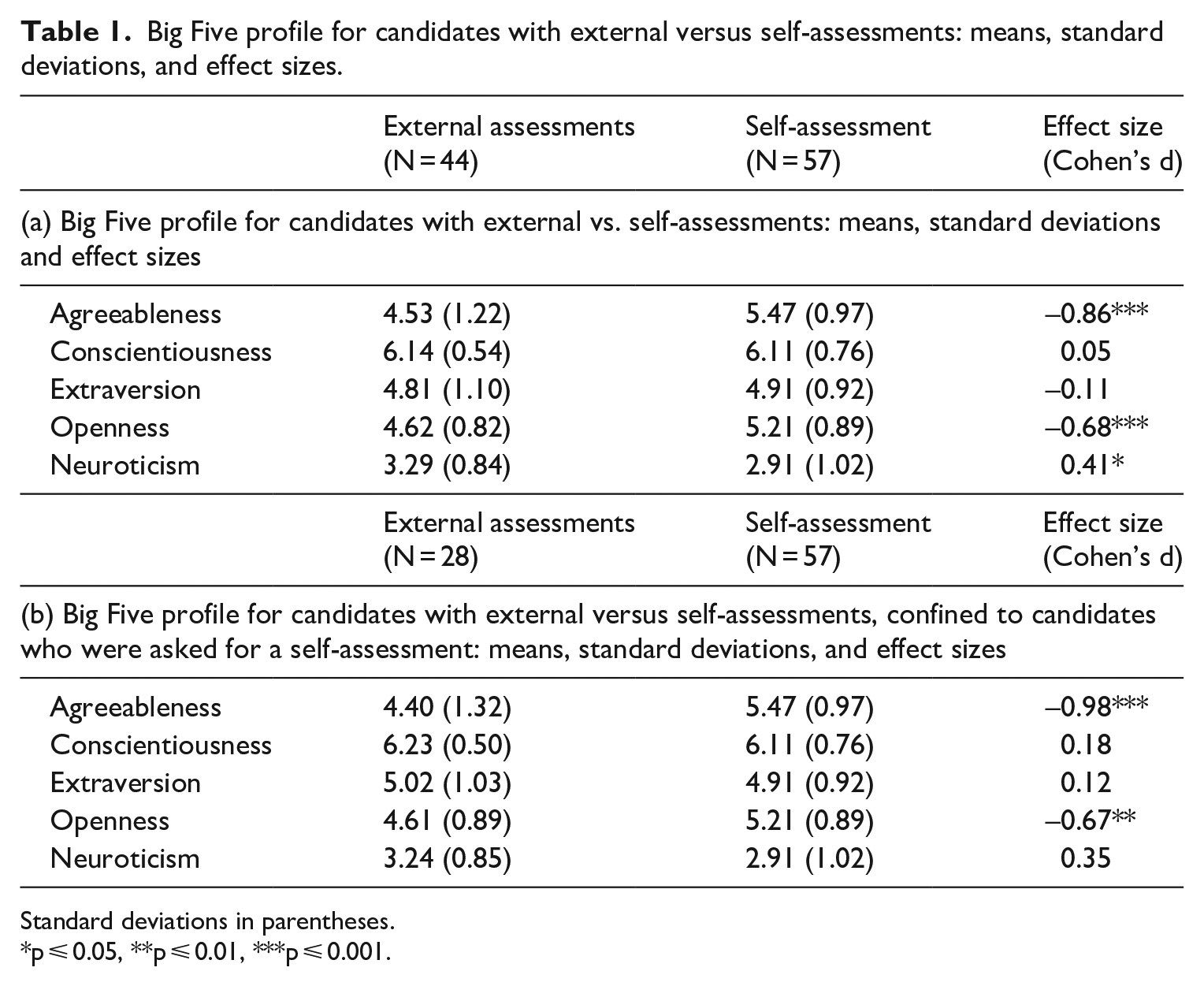
Standard deviations in parentheses.
p ⩽ 0.05, **p ⩽ 0.01, ***p ⩽ 0.001.
In addition, we arranged for external assessments on 16 randomly selected candidates for whom we had self-assessments. 2 For these 16 individuals, we obtained an overall Krippendorff’s alpha of 0.67. This is in line with meta-analyses by Connelly and Ones (2010) and Vazire (2010) who show that personality assessments by self-report and external observers for the same person overlap substantively. The greater the familiarity with the person being evaluated and the more information about him or her, the higher the agreement (Allik et al., 2016). This makes us confident that the different types of data collection do not bias our Big Five measurement. Furthermore, a confirmatory factor analysis reported a good model fit with the hypothesised five factors (see Online Appendix 2).
The other variables for our analysis result from a large amount of socio-demographical and political information on the candidates extracted from media coverage, official documents, and biographical analyses (e.g. Altermatt, 2019). As our first dependent variable (nomination) is binary, we use logistic regressions. For our second dependent variable (share of votes received), we calculate linear regressions. Several candidates ran more than once, thus, we cluster the standard errors by the personal identifier. Due to the relatively small number of observations, we use the bootstrap procedure with 1000 resamples for each model as a nonparametric approach (Mooney, 1996).
Analysis
We carry out our analysis in three steps. We start with a descriptive look on the personality traits of the candidates, asking whether the personalities of nominated and not nominated candidates differ from one another. In a second step, we analyse whether personality traits affect candidates’ nomination chances. Finally, we examine the relationship between personality and electoral success.
Starting with a descriptive view on the personality traits for all candidates, nominees, and elected government members, we can see that the median values for four traits lie in the upper half of the scale. The only exception is neuroticism with median values of three. Conscientiousness scores are highest with median values of about six. Another peculiarity is that we do not observe any score in the lower half of the scale for this trait. If we compare the three subgroups, the median values are usually quite similar for each trait, respectively. For neuroticism, the boxes almost look the same. In contrast to this, we see a decrease of variance from all candidates to the nominated and from the nominated to the elected for openness. Thus, it seems that in each selection step, candidates with relatively extreme scores for this trait get sorted out.
As a second step, we ask whether the personality traits of candidates for the Swiss government are connected with nomination. Out of the 116 candidacies in our dataset, 61 were nominees of their respective parliamentary groups. We calculate two models. The first one only comprises the Big Five as independent variables. In addition, the second model incorporates the control variables we explained in section ‘Alternative approaches’. 3
For model 1 (Figure 2(a) in Appendix D), we can see a positive effect of agreeableness, which backs our main hypothesis. Furthermore, model 1 supports the view of the international literature stating that high-ranked politicians stand out for high levels of extraversion (Best, 2011; Hanania, 2017; Nørgaard and Klemmensen, 2019; Rubenzer et al., 2000; Scott and Medeiros, 2020). For the other three personality traits, we do not see any significant effects. From model 2 (Figure 2(b) in Appendix D), we can conclude that our control variables do not alter the effect of agreeableness on nomination chances, while extraversion is no longer significant.
In a third step, we turn to electoral success as dependent variable, measured as the share of votes received. From model 3 (Figure 3(a) in Appendix D) comprising only the Big Five as independent variables, we can learn that agreeableness is not only positively related to nomination but also to electoral success. For the other personality traits, we do not see significant effects. The picture hardly differs if we add the control variables explained in section ‘Alternative approaches’ (model 4, Figure 3(b) in Appendix D). Again, agreeableness is the only personality trait with a positive and significant result. However, if we add nomination as another control variable (model 5, Figure 3(c) in Appendix D), agreeableness is no longer relevant. Given the fact that nomination is partly influenced by personality traits (models 1 and 2), it is plausible to argue that the nominee status incorporates some of their effects, leading to the reduced relevance of agreeableness in model 5.
The other control variables do not reveal much explanatory potential. Only the number of parliamentary seats representing the candidate’s canton (electoral district) relates positively to nomination chances in model 2. We find no effects for the other control variables. As a robustness check, we recalculated our analysis using multilevel models as for example Nai (2019) did. The results presented here hardly change in this case. Apart from this, we tested if the personality traits interact with some of the control variables (gender, status as an MP or a party leader, being member of a party on the right or left edge of the political spectrum, year of election), but we did not find relevant interactions.
To sum up, our models reveal that agreeableness connects to both nomination chances and electoral success of candidates for the Swiss government as stated in our main hypothesis. Its positive effect remains visible and significant even if we take a number of control variables into account. Only in the last model explaining electoral success, agreeableness is no longer relevant. This is a plausible result given that we included nomination in this model which is itself positively related to agreeableness.
Conclusion
In democracies, government holds the effective political power. Consequently, it is important to understand which personalities enter the government. Despite the vast studies on ministerial selection, ‘little research has explored the question of which individuals become cabinet ministers. All too often, answers to “who gets a cabinet seat?” have started and stopped at the party level, leaving the question of “who is the who?” unanswered’ (Smith and Martin, 2017: 157).
At the same time, politics gets more and more ‘personalised’ and political science has increasingly turned to questions regarding the role of personality in recent decades. However, we still know little about the relevance of personality traits of politicians aspiring an executive office. With this study, we aim to close this research gap a bit by examining the personalities of candidates for the Swiss government. Switzerland is an illuminating case, as we can use the example of a paradigmatic consensual democracy with a collegial government to examine the connection between the specific pattern of a democracy and the government personalities that fit it. Moreover, the Swiss parliament as electoral body has a strong say in this matter. In other European countries, the selection of ministers often takes place behind the closed doors of coalition talks and the electoral body is restricted to rubber-stamp the negotiated decisions of the party leaders. In contrast to this, the Swiss Parliament usually has the real possibility to choose among several candidates for each vacancy.
With respect to our first research question of who is nominated for office, we see that the parties tend to select persons who show higher levels of agreeableness. This result is in line with our main hypothesis, as the principle of collegiality is central to the work in the non-hierarchical Swiss government where all seven members are equal. Thus, candidates must be able to cooperate with the other member of government and be willing to compromise. The results also hold if we consider electoral success as dependent variable. This reiterates the importance of personality traits for the analysis of ministerial selection (Nai, 2019: 852). Accordingly, future studies of electoral success of government ministers should consider the personality traits of the politicians running for office in addition to the usual explanatory approaches.
We are positive that our results do not simply stem from the fact that agreeable people are popular in general (Wortman and Wood, 2011). Rather, previous research has shown that different personality traits are associated with politicians’ electoral success depending on the context (Joly et al., 2019; Nai, 2019; Scott and Medeiros, 2020). Agreeableness did not turn out to be a success factor in these studies, but rather a stumbling block (Joly et al., 2019). Thus, we assume that advantages of personal traits in ministerial selection may depend on the specific patterns of a democratic system. While Switzerland, a prime example of a consensus democracy with a collegial multi-member government, needs above all team players as well as agreeable and conscientious personalities in government, these traits may be less important in majoritarian democracies. Rubenzer et al. (2000: 414), for example, report a negative correlation between agreeableness and historian ratings of greatness for the US presidents. Other authors (Lilienfeld et al., 2012; Watts et al., 2013) corroborate this result by showing that boldness associated with psychopathy and grandiose narcissism correlate with several performance indicators for the same subjects of investigation (Rubenzer et al., 2000; Rubenzer and Faschingbauer, 2005). Future research should therefore evaluate the specific personality features in governmental nomination and selection across different institutional and organisational patterns of democracies.
Second, future research should also examine the ‘so what’-question (Lijphart, 2012: 255). Our study indicates that institutions can foster different types of leadership, which can affect representation and policy outcomes in different ways. Do affable and conscientious ministers prove more effective than more disagreeable and narcissistic members of government do? Could it be that the presence of specific personalities or a specific mix of different characters at the heart of government affects the quality of public policy and governance? Given the fact that there is evidence of different personality traits (conscientiousness, agreeableness, and emotional stability) being positively related to team efficiency (Williams and Allen, 2008), this seems to be plausible. If personal traits of ministers do indeed make a difference for the performance of a democratic system, then our findings raise potentially profound questions for the design of political systems. For political scientists as well as politicians and voters, it is thus important to understand why ministerial nomination appears to favour a specific personal character and whether this has any negative or positive effect on governance. We conceive this to be an important question for future research from both a theoretical and an empirical viewpoint.
Supplemental Material
sj-docx-1-pol-10.1177_02633957221116507 – Supplemental material for Kinder and gentler ministers in consensus democracies? Personality and the selection of government members
Supplemental material, sj-docx-1-pol-10.1177_02633957221116507 for Kinder and gentler ministers in consensus democracies? Personality and the selection of government members by Martina Flick Witzig and Adrian Vatter in Politics
Footnotes
Appendix A
Appendix B
Appendix C
Appendix D
Acknowledgements
The authors would like to thank the team of the Chair of Swiss Politics and Mila Bühler for their great support during the external assessments. We are grateful for Sarah Steinmann’s assistance in the process of data collection.
Funding
The author(s) received no financial support for the research, authorship, and/or publication of this article.

Supplementary Information
Additional supplementary information may be found with the online version of this article.
Contents Appendix 1: Big Five Survey. Appendix 2: Confirmatory Factor Analysis for Big Five Personality Traits.
Notes
Author biographies
References
Supplementary Material
Please find the following supplemental material available below.
For Open Access articles published under a Creative Commons License, all supplemental material carries the same license as the article it is associated with.
For non-Open Access articles published, all supplemental material carries a non-exclusive license, and permission requests for re-use of supplemental material or any part of supplemental material shall be sent directly to the copyright owner as specified in the copyright notice associated with the article.
