




Abstract
On 26 September 2021, Germans elected the 20th Bundestag. This election was special in many ways. The article analyses the electoral campaign, voting behaviour, turnout, and the formation of a new coalition government by using a gender and intersectional lens. Against the conceptual background of descriptive, substantive, and symbolic representation, we outline the implications of the election for gender and intersectional politics in the new German Bundestag and the government. In descriptive and symbolic terms, we find higher numbers of women (and of minorities) in the Bundestag and its leadership as well as in government; in substantive terms, we observe the presence of ‘critical actors’ and the commitment to progressive politics in the new ‘Ampel’ coalition. Hence, we see at least a chance for change in several key policy areas and social progress in the next 4 years.
Introduction
On 26 September 2021, Germans elected the 20th Bundestag. After 16 years in office, Chancellor Angela Merkel became the first incumbent to voluntarily step down announcing in October 2018 that she would not run for re-election. The results are remarkable in several ways (Figure 1). After many years, the Social Democratic Party (SPD) won a relative majority of the votes (25.7%) and the Greens achieved their best election result at the federal level (14.8%). The right wing populist Alternative für Deutschland (AfD) lost more than 2% (10.3%). The biggest loser were Merkel’s Christian Democrats which lost 8.9% age points compared to 2017 representing an all-time record low of 24.1%. What used to be called Volksparteien (catch-all parties), the SPD and the Christian Democrats (CDU/CSU), jointly won less than 50% of the votes. In sum, even if the voting behaviour shows some established long-term trends of dealignment, the 2021 elections ‘ploughed’ the party system (Schmitt-Beck, 2021: 16), making it more volatile, fragmented, and polarised, but less segmented in terms of options for coalition-building.
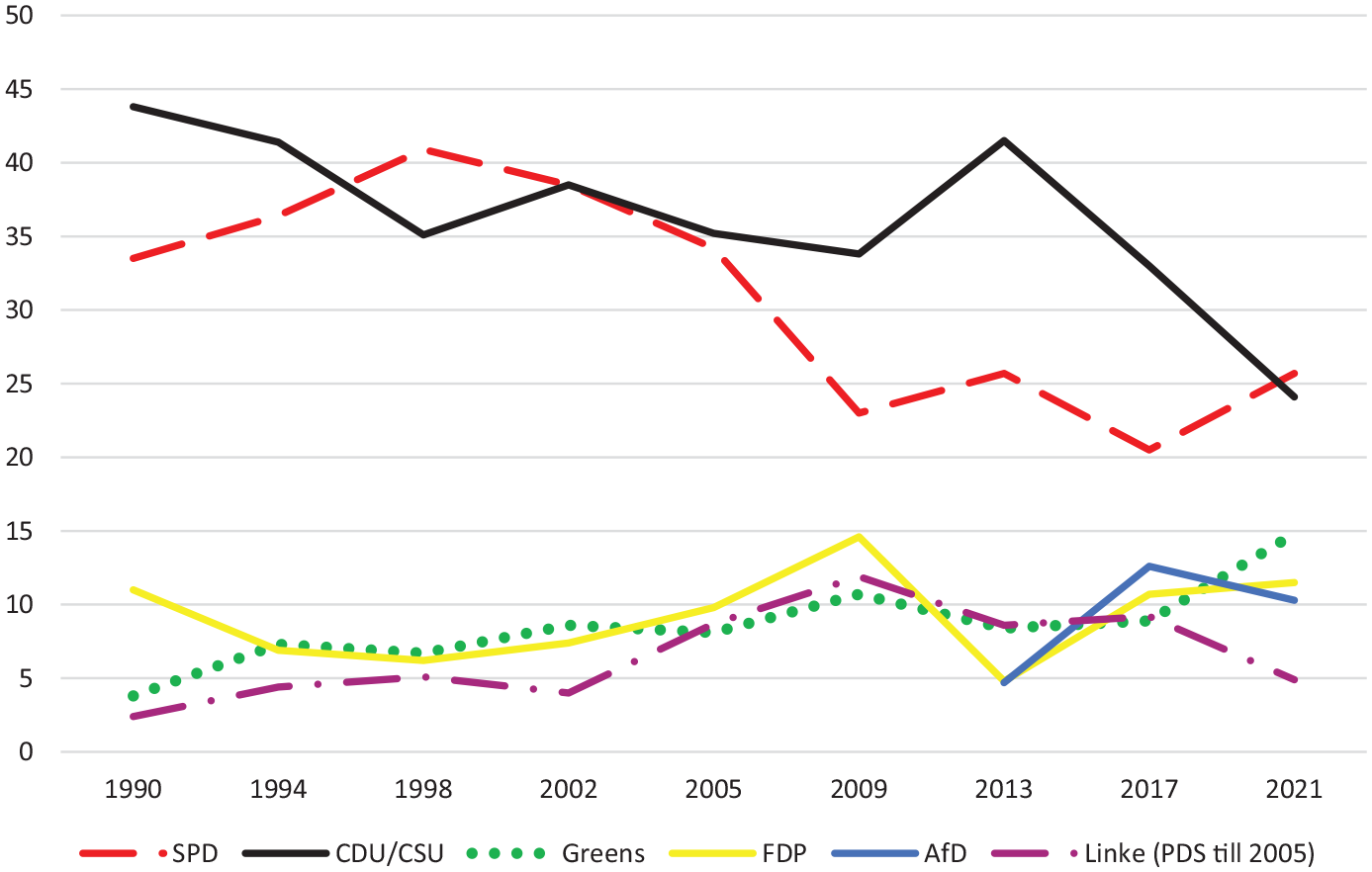
Federal elections results 1990–2021 (in %).
The election paved the way for the first Ampel 1 coalition government on the federal level between two left parties (Social Democratic Party, SPD, and the Greens) and the centrist-liberal Free Democratic Party (FDP), which took office on 8 December 2021.
In this assessment of the 2021 German federal election, we draw from the women and politics literature to ask the following: After 16 years with a conservative government at Germany’s helm, what does the change to a left-leaning government mean for women’s representation? We approach this question from two angles: first, we explore women’s descriptive representation in the new Bundestag with a particular eye towards intersectionality. We argue that the end of the Merkel era has brought about new opportunities and challenges for the political representation of women and minorities. Given strong evidence that leftist parties have more women and minorities in parliament and have adopted electoral quotas early on (Beckwith, 2010; Krook, 2010), we expect the 2021 election leads to greater descriptive representation of women and minorities in the Bundestag and the new cabinet. Second, we consider the potential for the inclusion of women interest legislation (substantive representation) under the new government coalition. Because left parties are generally more likely than conservative parties to represent women’s interests (Och and Williams, 2022), we expect the coalition agreement between the SPD, the Greens, and the FDP will include several women- and diversity-sensitive policies. Finally, we argue that the FDP, a centre-right liberal party opposing affirmative action policies, will dampen representational effects of women and minorities.
Our assessment starts (1) with a brief literature review aimed to situate the analysis of the 2021 Bundestag election in the context of the women and politics literature. The remaining parts follow election logics from campaigning to coalition-building; (2) a content analysis of gender and intersectional issues in party programmes and electoral campaign materials; (3) an analysis of the 2021 gender gap in electoral behaviour and the final election results from a descriptive representational perspective; (4) an assessment of the potential for symbolic representation after the 2021 election; and (5) a content analysis to determine the extent of substantive representation of the 2021 coalition agreement. We conclude with a brief discussion of our analysis.
Literature review
Utilising Pitkin’s (1967) concept of representation, we analyse the 2021 election along the descriptive, substantive, and symbolic dimensions of representation. 2 First, descriptive representation: Women constitute half the population; hence, they should be represented in politics according to their numbers. The Bundestag has not yet reached political parity but the issue has been fiercely discussed since the centennial of women’s suffrage in 2018. Past research focuses on the barriers women face when running for office and means to overcome them. Research illustrates that electoral systems have the most profound impact: proportional electoral systems elect almost twice as many women than majoritarian systems (Norris, 2006). This finding also bears out in the German mixed member system where more women are elected through the proportional tier than through the majoritarian one (Ahrens et al., 2020: 58–61).
Electoral gender quotas were identified as the most effective means to increase women’s descriptive representation (Franceschet et al., 2012; Krook, 2010). In Germany, only voluntary party quotas exist; the Greens, the Left, and the SPD with the strongest quota regime have the highest representation of women in the Bundestag (Davidson-Schmich, 2016). Women of ethnic minorities, by contrast, rarely benefit from gender quotas, unless they are systematically combined with an ethnic quota (Bird, 2016; Hughes, 2011). Germany has also no ethnic quotas. Minority women, particularly those with a visible migration background, 3 nevertheless benefit from voluntary party quotas combined with informal party strategies and ideologies supportive of ethnic diversity (Jenichen, 2020; Markowis, 2015; Wüst, 2014), demonstrating that ‘equality and diversity can sit in tandem even when quotas do not’ (Murray, 2016: 595; see also Celis et al., 2014). This ‘multiple advantage’ effect can also be found in other countries (Mügge and Erzeel, 2016). Especially in centre-left parties, minority women benefit from a quota-driven ‘elevator effect’, which helps to ‘promote the limited women present to positions of authority within the party’ (Davidson-Schmich, 2016: 16). Some scholars, therefore, suggest that in Germany, primarily, the centre-left parties employ an informal ‘dual quota’. However, they also point out that nominating an immigrant-origin woman ticks two boxes, leaving more space for white men (Hossain et al., 2016; Markowis, 2015). That is why party leaders are more inclined to nominate women when trying to diversify their party lists. Another reason for the ‘multiple advantage’ of female politicians with migration background may be that racist stereotypes portray immigrant men, especially those with roots in Muslim-majority countries, as more threatening, associating them with violence and crime, whereas women are depicted as victims in need of protection (Hughes, 2016). Given the success of the SPD and the Greens, we can expect that the Bundestag has become more diverse after the 2021 federal election.
Second, substantive representation: Women have unique lived experiences which need to be represented in political debates and policy-making. Women politicians are more likely than their male counterpart to advocate for traditional women’s issues such as education, family, and children and are more likely to support feminist and gender equality (Piscopo, 2011; Swers, 2005; Thomas, 1991). We see in Germany that women are more likely and more comprehensively speaking to women, families, senior, and youth matters (Xydias, 2014). Likewise, immigrant-origin members of parliament (MPs) tend to include more social and migration-related topics (Donovan, 2012; Wüst, 2017) and some studies found that lesbian, gay, bisexual, transgender, and intersex (LGBTI) representatives follow a similar pattern (Bönisch, 2021). Overall, descriptive representation of women is linked to their substantive representation. Yet, the drivers of substantive representation are widely debated ranging from partisanship where left-leaning parties are thought to be more open to advancing women’s policies (Bieber, 2022; Lühiste and Kenny, 2016), critical mass (Saint-Germain, 1989; Thomas, 1994), critical actors (Childs and Krook, 2009) to velvet triangles (Abels and Mushaben, 2012; Woodward, 2004), and more. We therefore assess the representation of gender equality and ethnic diversity issues in the 2021 federal election, both the electoral campaigns and the coalition agreement.
Third, symbolic representation: Once in office women serve as role models who encourage more women to run for office; seeing women in office increases women’s political interest, efficacy, and participation (Alexander and Jalalzai, 2020; Hinojosa et al., 2017; Zetterberg, 2009). Liu and Banaszak (2017) show that a higher number of women in cabinets increases women’s political participation. In this sense, having a female chancellor for 16 years in addition to women in other visible roles, such as Ursula von der Leyen and Annegret Kramp-Karrenbauer, should have impacted the symbolic representation of women (Mushaben, 2022). In an interesting twist to the symbolic representation of women, we illustrate that all Chancellor candidates (in)directly were compared to Merkel who was held up as the ideal stateswoman. Thus, in the 2021 election campaign, Merkel served as a role model against which all candidates were measured. Also, the allocation of women ministers to more ‘masculine’ portfolios is important in symbolic terms and studies illustrate this is more likely when parties and their voters have more progressive gender attitudes (Goddard, 2019). Thus, we can expect that this will also play out in the new German government.
Finally, these three representative dimensions are mutually constitutive rather than exclusive. For instance, symbolic representation is linked to, but more than just an effect of descriptive representation (Lombardo and Meier, 2019). And descriptive representation is often seen as favourable for substantive representation; yet, the former does not automatically translate into the latter one (Childs and Krook, 2009). In what follows, these three dimensions guide our assessment of the German electoral cycle from campaigning to coalition-building.
Election campaign
The nomination of three chancellor candidates and the lack of an incumbent was an absolute novelty. In all previous elections, only the two major parties (CDU/CSU and SPD) nominated candidates. But approximately 1 year ahead of the 2021 elections, election polls showed the Greens in second place polling around 20% prompting the Green Party to announce their own chancellor candidate in April 2021. Annalena Baerbock 4 joined Olaf Scholz (SPD) and Armin Laschet (CDU) on the campaign trail. Baerbock, a self-declared feminist, became the second woman ever to be nominated for chancellorship besides Merkel. The SPD remains the only major party that has never nominated a woman as chancellor candidate in its more than 150 years history.
The German campaign trail witnessed high voter volatility, turning the elections (see Figure 2) into a wahlpolitische Achterbahnfahrt 5 (Schmitt-Beck, 2021).
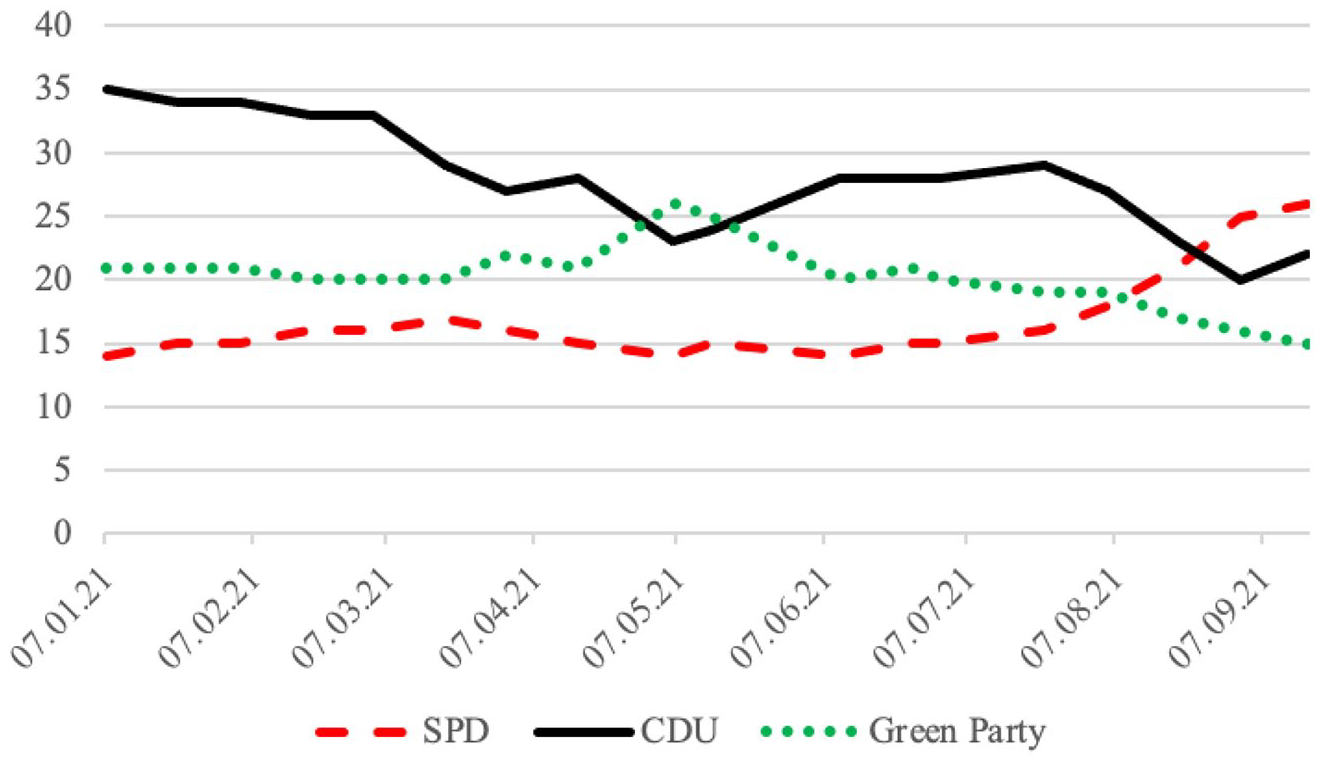
Election polls ‘sunday question’ January to September 2021.
Gendered symbolic representation was a major driving force in the person-focused election campaign and its coverage, be it on TV, radio, in newspapers or in social media. For example, Scholz promised in a tweet in November 2020 to appoint a parity cabinet. Even CDU candidate Armin Laschet, known for his disinterest in gender equality issues (Klassmann, 2021), under pressure from a political scandal committed to secure a parity cabinet if elected (Der Spiegel 2021). In contrast, Baerbock’s commitment to a parity cabinet was never questioned due to the Greens long commitment to parity politics (Ahrens et al., 2020). This clear commitment to a parity cabinet from all candidates was an absolute novelty.
All three candidates were explicitly or implicitly compared to Chancellor Merkel, often questioning their charisma as a future leader. We argue that the role model effect associated with the symbolic representation of women was expanded beyond encouraging other women to run for office. Instead, Merkel’s shadow loomed so large that her leadership style served as the role model for a newly gendered way to look at leadership qualities. Laschet was depicted as unfit for chancellorship after inappropriate laughing during a visit to the catastrophically flooded regions in autumn while Baerbock was accused of ‘pulling the women’s card’. Scholz’s SPD even launched a campaign showing him with the famous ‘Merkel-Raute’ and the slogan ‘Er kann Kanzlerin’ (He can Madame Chancellor). As the only female candidate, Baerbock was at the centre of misogynistic attacks revealing deeper underlying structural resistances to gender equality in politics. Baerbock’s ability to lead was put into question with hate speech, false quote accusations and fake nude pictures, the latter a first in German elections (Focus Online, 2021a). Polls reported her as least capable but most likeable among the three candidates (Schröder, 2021).
Baerbock’s treatment differed considerably from what Merkel had to deal with in previous elections putting in question the assumption behind the symbolic representation of women that women in leadership positions will lead to a more hospitable and inclusive political arena for succeeding women. Unlike Merkel, Baerbock is a young mother of primary-school children and constantly had to answer how she would reconcile private and political life if elected – a question never posed to her male competitors Scholz or Laschet. For weeks, Baerbock was accused of plagiarising parts of her recent book, while similar accusations for Laschet and Scholz barely made it into the media (Zeit Online, 2021a). The final question addressed to Bearbock during a quasi-obligatory campaign trail interview with the public broadcaster ARD (Sommer-Interview) was how she would explain to her children ‘why climate change prevention measures were not adopted because the Greens failed to enter government due to avoidable failures of their mother’. In stark contrast, Laschet was asked where he would watch the European football championship final and which team he supported, while Scholz had to answer if forming the next government would become as difficult as after the 2017 elections.
On the campaign trail, gender issues such as gender gaps in pay, pensions, care work and leadership positions or the massive gendered effects of the COVID-19-pandemic received relatively little attention. Instead, the AfD and some CDU/CSU-politicians, among them CSU-leader Markus Söder, mobilised against the so-called ‘Gender Asterisk’ 6 asking universities to avoid ‘gender-laws’ 7 and ‘gender tickets’ 8 (Focus Online, 2021b). This campaign tactic indirectly targeted the left parties which commonly use the ‘gender asterisk’.
Likewise, structural racism, transphobia, antisemitism, or ableism and associated inequalities received little attention. However, racist attacks and threats to immigrant-origin candidates were for the first time publicly discussed. Several media outlets reported hate speech and racist attacks towards immigrant-origin candidates and exposed that no party was prepared to properly protect and support their candidates. The severity of attacks, for instance, led Tareq Alaows, Green direct candidate, to withdraw from his candidacy.
The results of the 2021 election
Gender and intersectional gaps in voting behaviour
Women make up 51.7% of the electorate while immigrant-origin voters represent roughly 13%. Women vote at the same rate as men while immigrant-origin voters vote less than non-immigrant-origin voters. Overall, German voters exhibit a gender and generational gap in favour of the centre-left parties (see Table 1; Bundeswahlleiter 2018; Jesse, 2018). In addition, it is important to consider educational background and East-West differences.
Share of votes (in %) by party among male and female voters 2021.
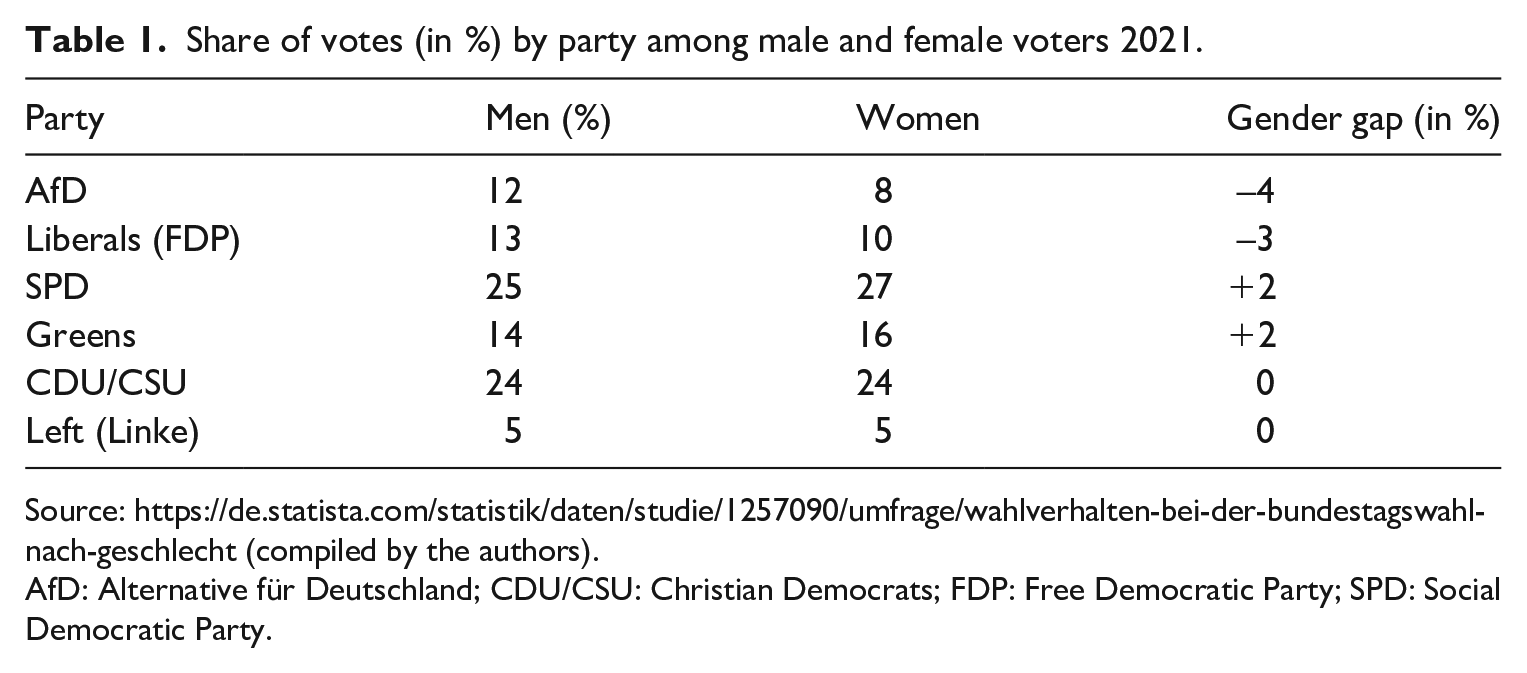
Source: https://de.statista.com/statistik/daten/studie/1257090/umfrage/wahlverhalten-bei-der-bundestagswahl-nach-geschlecht (compiled by the authors).
AfD: Alternative für Deutschland; CDU/CSU: Christian Democrats; FDP: Free Democratic Party; SPD: Social Democratic Party.
In 2021, the AfD remains a ‘male party’ having the largest gender gap among all parties. The AfD was most successful among middle-aged men and people with either a low or medium level of formal education, especially in rural areas, who fear that their standard and style of living are jeopardised. In contrast, more women voted for the Greens than men with an even bigger gender gap among women below the age of 30 (Neu and Pokorny, 2021: 10). Yet, having the first female Green candidate did not feature prominently in their decision to vote for the party. The older electorate is more likely to vote for the SPD or the CDU/CSU. Compared to the 2013 and 2017 elections, the conservative party lost especially among women aged 30–44 (Neu and Pokorny, 2021: 9). The SPD, in contrast, made ‘above-average gains’ among older women (60+; Neu and Pokorny, 2021: 9). These findings are, by and large, in line with international observations about a move from a ‘traditional gender gap’ to a ‘modern gender gap’ (see Inglehart and Norris, 2003). It also confirms the longer trend that women, on average, prefer more centrist parties and shy away from radical parties.
For other minority groups, we still lack reliable data. Among LGBTI voters, Hunklinger et al. (2021) illustrate (based on a self-selected sample) that the Greens would have won the majority of votes (52.6%) due to their strong advocacy politics in favour of LGBTI rights. Other data from local elections illustrate that there is, nonetheless, also a degree of ‘homonationalism’, that is, LGBTI voters who vote for nationalist, populist parties (Hunklinger and Ajanović, 2022). Voters of immigrant-origin are today a substantial, but not a homogeneous part of the electorate. In 2021, some parties offered campaign material in languages other than German to attract these voters. Traditionally, the CDU/CSU focuses more on ethnically German immigrants from the former Union of Soviet Socialist Republics (USSR; so-called Russlanddeutsche). While we do not have yet data for the 2021 elections, in the past (cf. Wüst, 2017: 295), Russlanddeutsche were more likely to vote for conservative parties, including for the AfD (Spies et al., 2022). The centre-left parties are addressing other immigrant groups and have advocated more inclusive citizenship and diversity policies. In the past, especially Turkish origin immigrants often voted for the SPD (Wüst, 2004). Yet, overall volatility is also increasing in the immigrant-origin electorate.
Gender and intersectional analysis of the election results
Is the new German Bundestag more descriptively representative? Analysing its composition in terms of gender and other categories of difference reveals that Germany’s legislature has become younger 9 and slightly more female and diverse (Deutscher Bundestag, 2021). The share of women has slightly increased from 30.7% to 34.7%. This rise is best explained by the increase of votes for the SPD and the Greens, two parties with traditionally higher numbers of women among their candidates compared to the CDU/CSU, AfD, and FDP (Figure 3).
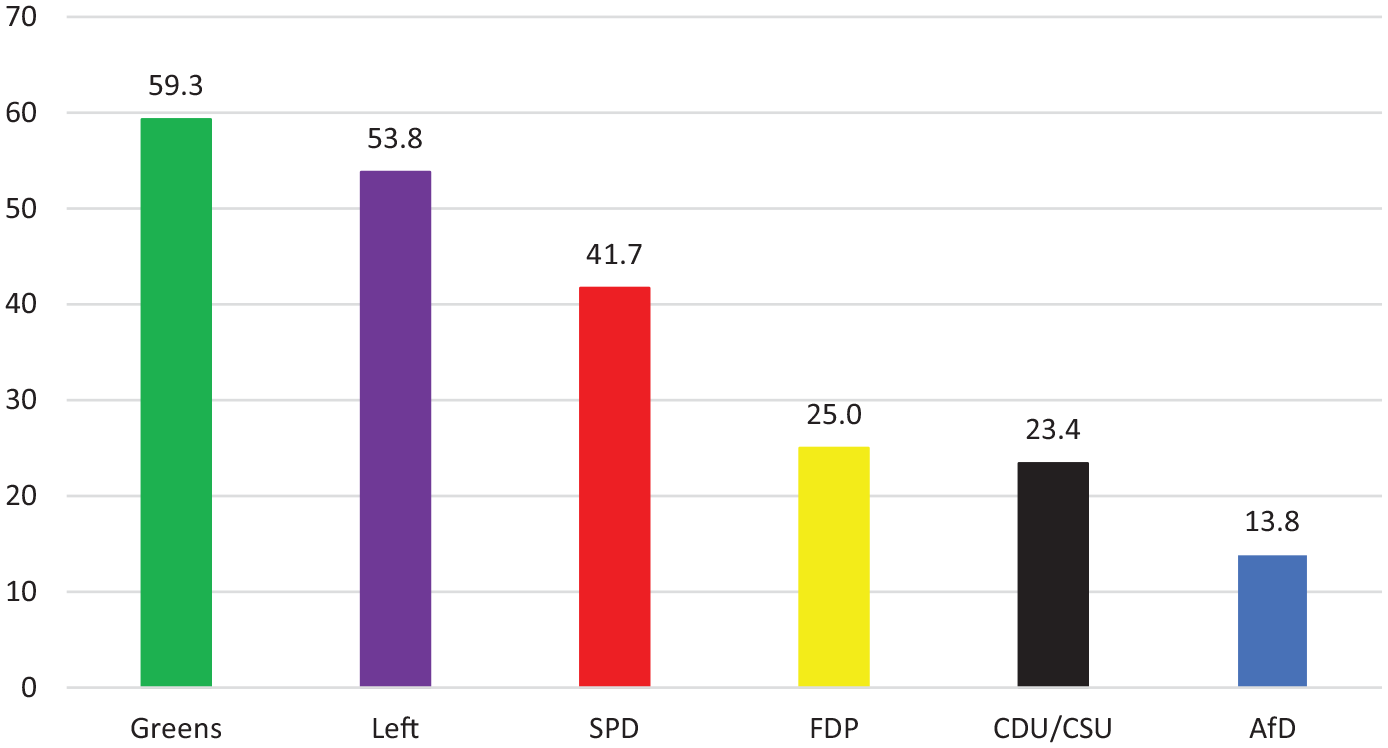
Share of women in the 20th Bundestag by party.
Gender quotas explain these differences. Most major German parties use a voluntary party quota for positioning women on their party lists for elections. However, these quotas vary in mode and size. While the Greens, the Linke (the Left), and the SPD use a zipper system in which women and men alternate on the list (50% of women on Green and Left party lists, 40% on SPD lists), the CDU fields only 33% of women on their party lists and does not apply an ordering rule. The FDP and the AfD, including until recently the CSU, oppose gender quotas. Until recently, most parties applied these quotas only to their party lists and not to single-member districts (SMD; so-called first vote). Accordingly, parties which traditionally win the most SMDs (CDU, CSU, SPD) nominate fewer women in SMDs (Ahrens et al., 2020: 58–61; Bieber, 2022; Davidson-Schmich, 2014; Davidson-Schmich and Kürschner, 2011). In addition, women often end up in unwinnable SMDs (Ahrens et al., 2020; Bieber, 2022). For example, the CDU still undermines its own ‘quorum’ of 33% for SMDs (Bundeszentrale für politische Bildung, 2021) and is more likely to nominate men in ‘winnable districts’. In 2021, in total, 26.1% of successful SMD candidates were women, but only 17% for the CDU (Fortin-Rittberger and Kröber, 2021: 39; see also Bieber, 2022).
Given this situation, the most promising solution to the stagnation of women’s representation in Germany would be the introduction of a legislative gender quota which requires nomination of 50% of women and men plus a zipper system for all parties and for both party lists and SMDs. The constitutionality of quota laws in Germany, however, is contested. Proponents and opponents fiercely argue about what is superior: the state’s constitutional obligation to actively promote gender equality (Article 3, two German Basic Law) or the freedom of parties (Article 21: Laskowski, 2018; Röhner, 2018). Notably, the regional states of Brandenburg and Thuringia legislated zippered party lists in 2019; both quota laws were rejected by the regional constitutional courts. The federal constitutional court has never ruled about legislative gender quotas; indeed, such law was neither proposed nor adopted by any federal government to date. Parity proponents insist conflicts between parity legislation and party freedom are solely constructed, because gender quotas would not limit parties’ programmatic freedom or choices of candidates at large, particularly since party competition would not rely on single candidates, let alone their sex (Berghahn, 2019; Laskowski, 2018). Legislative gender quotas would require considerable changes to electoral laws. Suggested changes during the last legislature were immediately rejected as undue by then-President of the Bundestag Wolfgang Schäuble (CDU), who chaired an electoral reform commission (Ahrens and Lang, 2022). Mobilisation around parity legislation has not ceased and, as detailed further below, is included in the coalition agreement of the new government.
The 2021 election results paint a mixed picture for LGBTI politicians. The overall representation of publicly out LGBTI people decreased from 6% to 3.8% (Mügge and Özvatan, 2021). The Greens have the highest share (7.6%), followed by the SPD (6.3%), FDP (4.3%), AfD (1.2%), CDU (0.5%), and the Left (0%). There are 22 men, six women and, for the first time, two transgender women and one bisexual woman among the LGBTI MPs. LGBTI MPs in the SPD, the FDP, and the CDU are all men. While the sole LGBTI MP in the AfD is female and the five women LGBTI MPs are Green MPs (Warnecke and Hofmann, 2021).
The share of parliamentarians with a ‘migration background’ has increased from 8.2% to 11.3% (Mediendienst Integration, 2021). This increase is best explained by the larger seat share of the Greens and SPD, which are more open to candidates with a migration background than the CDU/CSU and FDP (Jenichen, 2020; Wüst, 2014). 10 Given that about one quarter of Germany’s population now has a migration background (Statistisches Bundesamt 2021), this group too remains underrepresented.
Germany’s official term migration background disguises important differences. The German Statistical Office uses the following definition: ‘A person has a migration background if they themselves or at least one of their parents did not have German nationality at birth’ (Statistisches Bundesamt, 2021: 3; own translation). This definition lumps together a very heterogeneous group, which can be seen as problematic because, at best, it incorrectly implies that all citizens with a migration background are subject to similar dynamics of discrimination. At worst, it makes racist discrimination invisible (Jenichen, 2020). This issue becomes clear when looking more closely at the group of immigrant politicians in the new Bundestag. More than 40% of these MPs have roots in other European countries (without Turkey), while about 23% have a Turkish background, the largest immigrant group in Germany, and only three representatives are black (which nevertheless is an increase from the previous Bundestag; see Mediendienst Integration, 2021). It is also telling that most MPs with roots outside of Europe represent the SPD, the Greens, and the Left, whereas almost all members with a migration background that represent the CDU/CSU and FDP have a European background. Hence, even though the rising numbers of representatives with migration background are good news for diversity in the Bundestag, this number tells only half the story in relation to the integration of non-European immigrants and their direct descendants into German politics.
The proportion of female members of parliament with migration background is much higher than among MPs without migration background, 48% versus 32% (Mügge and Özvatan, 2021). This demonstrates that female immigrant-origin politicians benefit from both party gender quotas and the attempt – primarily by the SPD, the Greens, and the Left – to create more ethnically diverse party lists. In contrast, in parties that do not apply gender quotas, such as the FDP and the AfD, women are considerably underrepresented in both the immigrant and the non-immigrant groups. Also, the proportion of women among MPs with a Turkish or other non-European migration background is with 56% much higher than the 34% of women among MPs with roots in other European Union (EU) countries or the United Kingdom (Mügge and Özvatan, 2021), suggesting that racist stereotypes that portray non-European immigrant women as less threatening than their male counterparts have affected candidate selection in the 2021 federal elections.
To conclude, the 2021 Federal election has led to a slight increase in descriptive representation, but women and minorities remain underrepresented.
The new Bundestag and the new government
The most obvious change in the new Bundestag is that no longer a female chancellor will sit on the government bench. Things look differently regarding descriptive representation in the Bundestagspräsidium 11 (Bundestag praesidium). The president of the Bundestag is the second highest office holder in constitutional terms – after the federal president. The Bundestag president oversees the daily parliamentary operations including chairing plenary sessions, deciding who is allowed to speak, enforcing time limits, and ensuring a professional atmosphere and tone of the Bundestag. For the first time since 1998, the Bundestag president is a woman. This is the result of intense lobbying among women in the SPD, who – being the biggest party group – had the right to nominate the president. The SPD women’s caucus (Arbeitsgemeinschaft sozialdemokratischer Frauen, ASF) made it clear that they expect equality concerns to play a strong role (Tagesschau, 2021). In the end, Bärbel Bas (SPD) was nominated and won the vote; Bas assumed her role on 26 October 2021 and in her inaugural speech, she referred to the need for better representation of women in politics. Bas is joined by four women vice presidents nominated by the SPD, CDU, Greens, and the Left, leaving the FDP and AfD as the only parties nominating male candidates (ZDF, 2021). While the male FDP nominee was elected, the AfD candidate failed. A woman majority praesidium is a novelty and there is some speculation what this could mean for a more women-friendly Bundestag. For example, hopes are high that the praesidium will be tougher on misogynist rhetoric in the Bundestag which is common from the political right, particularly the AfD. In addition, four of nine chairs of the six party groups in the Bundestag are women (Greens: two women, Left and AfD: one woman out of a dual chair) – another record (Deutscher Bundestag, n.d.).
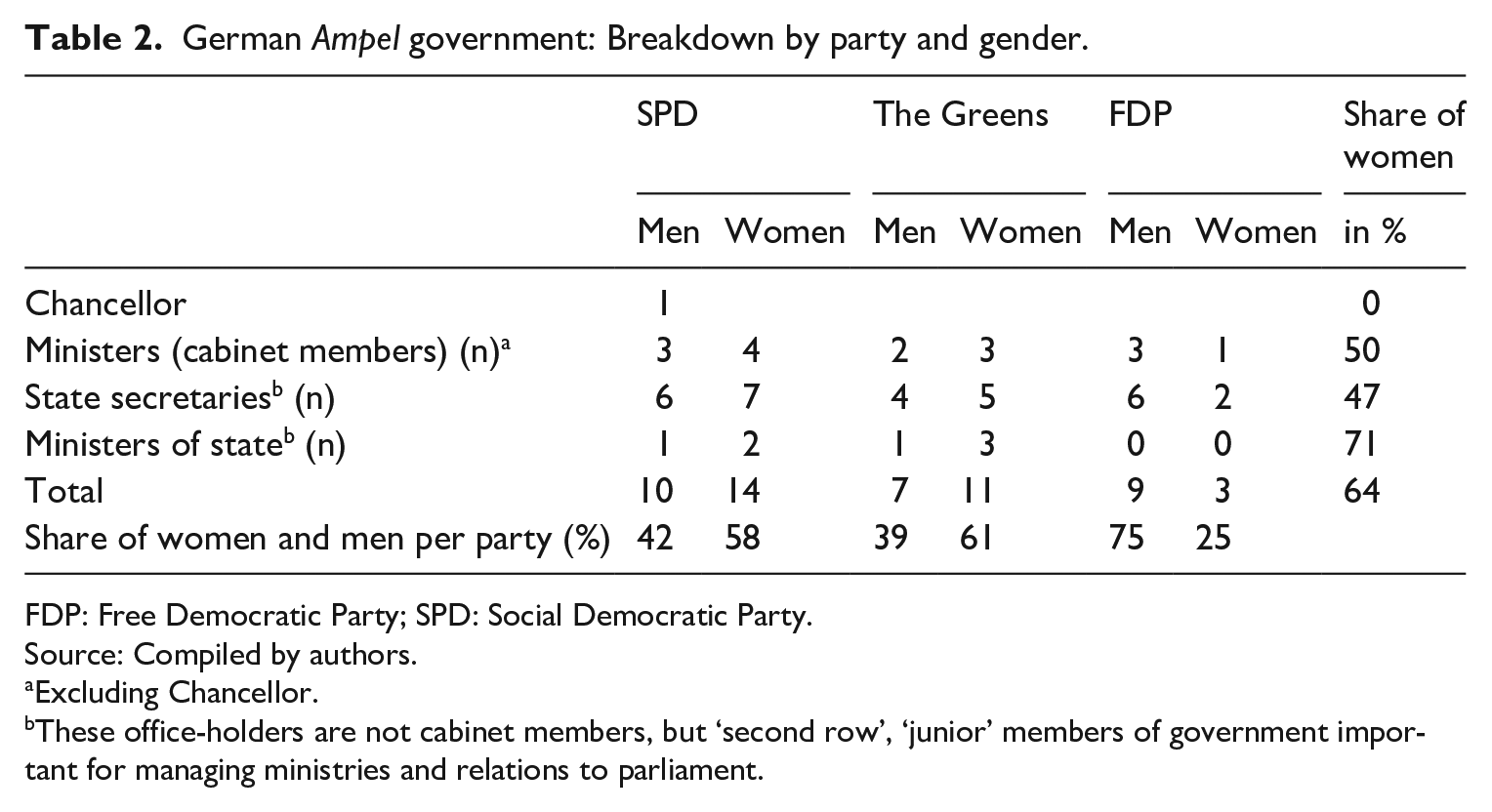
The cabinet consists of 15 ministers (SPD: 6, Greens: 5, FDP: 4) plus the head of the federal chancellery and the chancellor himself (see Table 2). Scholz announced early on that he wanted a gender-parity cabinet. After some back and forth, most notably with the reluctant FDP, Scholz delivered on his promise: for the first time, Germany has a gender-parity cabinet (Bennhold, 2021). Besides numbers, a key question is whether women have been appointed to powerful and important cabinet posts, such as finance, foreign affairs, defence, or labour, rather than to the so-called pink portfolios with little financial and personnel power, such as families, women, education, or the environment (Escobar-Lemmon and Taylor-Robinson, 2005; Och, 2017).
In line with theory, women from SPD and Greens hold powerful positions in the new cabinet. Most notably, they are in charge of many ‘masculine’ portfolios, that is, all security and diplomacy-related portfolios are held by female cabinet members: Baerbock (Greens) is the first woman minister of foreign affairs while Lambrecht (SPD) serves as the third woman defence minister in a row. Faeser (SPD) is the first woman to head the powerful interior ministry, and Schulze (SPD) is leading the ministry for international development cooperation. Chancellor Scholz stated: Security will lie in the hands of strong women in this government [. . .] Women and men account for half the population each, so women should also get half the power [. . .] I’m very proud that we have succeeded in realizing this. (Bennhold, 2021)
In contrast, the FDP assigned only one woman (Stark-Watzinger) to the less powerful education and research portfolio while two men (Lindner, Buschmann) occupy powerful cabinet positions (finance, justice), and the third man (Wissing) the ‘masculine’ technology and traffic portfolio. This confirms our expectation that progressive gender attitudes among parties and their voters affect portfolio allocation (Goddard, 2019). Simultaneously, the traditional ‘pink portfolios’ remain: women head portfolios such as women and family affairs, environment and consumer protection, and education.
German Ampel government: Breakdown by party and gender.
FDP: Free Democratic Party; SPD: Social Democratic Party.
Source: Compiled by authors.
Excluding Chancellor.
These office-holders are not cabinet members, but ‘second row’, ‘junior’ members of government important for managing ministries and relations to parliament.
The new cabinet is also different in other respects. Its members are much younger (with the youngest ministers being 40 years old), and they have, in total, 17 children still in kindergarten or primary school, emphasising issues of reconciliation. Finally, we also see the first minister of immigrant-origin, the second generation Turkish–German Cem Özdemir (Greens) as minister for agriculture.
The new government and its coalition agreement
As a left-leaning coalition, we expect the new government to better represent the interests of women and minorities than the previous CDU-led governments (Och and Williams, 2022). We explore substantive representation by analysing the adopted coalition agreement of SPD, the Greens, and the FDP, particularly regarding Gesellschaftspolitik, 12 and discern indeed several women- and diversity-sensitive policies.
Due to strong disintegration in the CDU – given their worst electoral outcome ever in German history – it soon became clear that an Ampel coalition was the most likely option, and exploratory talks (Sondierungsgespräche) started among the potential coalition partners. On 7 December 2021, SPD, Greens, and FDP signed the 177-pages coalition agreement (SPD, Bündnis’90/Die Grünen, and FDP, 2021). Next to a separate chapter on gender equality, including subsections on combating gender-based violence, economic equality, and reproductive rights (SPD, Bündnis’90/Die Grünen, and FDP, 2021: 114–116), the agreement mainstreams gender in several other parts. The coalition agreement also contains a subsection on diversity, which promises reforms regarding civil society participation, German citizenship, Muslim/Jewish/Queer lives, and commits to combating racism and securing anti-discrimination (SPD, Bündnis’90/Die Grünen, and FDP, 2021: 116–121).
The Merkel-led governments subsumed gender equality under family policies and often paid less attention to gender equality not related to (child)care or labour market issues (Auth and Peukert, 2022; Henninger and Von Wahl, 2018). The new Ampel coalition seems to overcome this limitation and this shows in the coalition agreement which speaks to substantive representation of women throughout. Chapter II proposes to restart the parliamentary commission on electoral law reform and extends its task to discuss parity and legal frameworks (SPD, Bündnis’90/Die Grünen, and FDP, 2021: 11. The coalition agreement also includes measures to promote parity in leadership positions, and to a lesser degree for diversity, in other sectors, research and sciences, public health organisations, foreign policy, the cultural, and the finance sector. Yet, the FDP due to its opposition to affirmative action will be the biggest hurdle in the coalition when it comes to any kind of quota regulation.
Gender-based violence – a central topic of women’s substantive representation – is a more prominent issue than in the past with a stronger commitment to implementation of the Council of Europe’s Istanbul Convention and more and reliable funding for shelters for victims of domestic violence (SPD, Bündnis’90/Die Grünen, and FDP, 2021: 114, 147). The agreement addresses intersectional aspects and mentions explicitly women with disabilities, women refugees, queer persons, men victims of domestic violence, and victims of sexualised violence in sports.
Employment and social policy constitute a large part of the coalition agreement and specific gender and intersectional aspects are picked up at several points. One of the biggest steps is a new minimum wage of €12/hour (now €9.60) with women likely benefitting in large numbers (Wirtschafts- und Sozialwissenschaftliches Institut (WSI), 2021). Other elements like easier labour market access for refugees and people with disabilities, combatting the gender pay gap of still 20%, part-time vocational training for mothers of young children, reforming the tax splitting system for married couples, or supporting household-related services particularly for single parents and elderly care speak of a progressive Gesellschaftspolitik. LGBTI rights and citizenship rights receive major attention in the subchapter on diversity (SPD, Bündnis’90/Die Grünen, and FDP, 2021: 116–121). The German Transsexual Act will be replaced by a right to self-determination as opposed to depending on a medical decision, a massive change compared to the small steps adopted under Merkel (Von Wahl, 2022). Married lesbian couples are automatically recognised as legal parents to their marriage-born children. The coalition agreement also proposes abolishing the contested Article 219a of the Penal Code, which forbids advertisement 13 for abortions. A new citizenship law shall ease naturalisation and allow dual citizenship (SPD, Bündnis’90/Die Grünen, and FDP, 2021: 118); both issues were strongly rejected by the CDU/CSU in previous governments. The changes in citizenship will potentially also affect the discussed problematic ‘migration background’ category. Finally, the agreement contains a commitment towards a stronger human rights based foreign policy, including a focus on women’s rights, and a commitment to a ‘feminist foreign policy’.
Conclusion
The outcomes of the German federal elections are remarkable in many ways. First and foremost, they mark the end of the ‘era Merkel’. The now Altkanzlerin (former chancellor) was dominating German politics for 16 years as Chancellor and had been in German politics for 30 years. The ‘Merkel bonus’ for the CDU is gone with the CDU experiencing its worst electoral outcome in its history. Second, the first ever Ampel government has been established at the federal level. From a gender and intersectional perspective, this brings along new opportunities, but many impediments are still in place. We have analysed these developments through the lenses of the descriptive, substantive, and symbolic representation. Regarding descriptive representation, we can observe slightly higher numbers among women and diverse MPs in the Bundestag, and even more so in the new government, making the new Bundestag and government more representative. This is due to the electoral shift towards centre-left parties – the Greens and the SPD – in the Bundestag and in the cabinet, which traditionally have more women among their ranks. This hints at the limiting effects of the electoral system and of voluntary party quotas, highlighting the continuing need for electoral reform and legislative candidate quotas. Both the Greens and the SPD have long recognised these needs, and we expect that the issue will remain front and centre in the coming years.
We also have a higher number of minority MPs, parity in ministerial positions and a high number of female ministers in ‘masculine’ portfolios, and the Bundestag praesidium is majority-female. Again, we find a split between the centrist-liberal FDP which delegates only about a quarter of its political positions to women and the centre-left SPD and Greens where women hold more than 50% of decision-making positions. What is more, several female ministers and MPs identify themselves as feminist and have a feminist agenda. Thus, it is more likely that the German government coalition includes women representatives who will use their voice and institutional positions to push for greater substantive representation. In any case, their presence is a major step forward with respect to symbolic representation.
Finally, we also show that women’s issues and the recognition of diversity in society take a prominent place in the coalition agreement. This is an important and positive development in times where an extremist anti-gender AfD is gaining grounds, and where women and minorities bear the burden of the continuing COVID-19 pandemic. However, on fiscal and economic issues, the policy positions among the three coalition partners diverge, which will affect and define the room for manoeuvres in other policy sectors. Which policy projects will be tackled first and which will be successful, remains to be seen in the next 4 years.
Footnotes
Acknowledgements
The authors thank the Politics Editors and the two anonymous reviewers for their helpful comments that improved their thinking and argumentation. They would like to thank Mirjam Zillober for her most valuable support in data collection.
Declaration of conflicting interests
The author(s) declared no potential conflicts of interest with respect to the research, authorship, and/or publication of this article.
Funding
The author(s) disclosed receipt of the following financial support for the research, authorship, and/or publication of this article: Petra Ahrens’ work was supported by the Academy of Finland Research Fellowship number 338556.
