




Abstract
Recent literature on the centre–periphery debate in European politics has produced a wide range of composite paradigms of regionalism, nationalism, and populism and nativism. A number of these definitions, however, tend to overemphasise the importance of populism by either framing it as a core ideology or by conflating it with the nationalism or regionalism of a specific party. This article makes three innovative contributions to populist studies by sustaining an ideational approach to populism and its combination with regionalist and nationalist ideologies. First, the article addresses the varied and at times conflicting composite paradigms of regionalism, nationalism, and populism by proposing a minimalist ‘populist regionalist’ and ‘populist nationalist’ conceptual framework; this places the emphasis on the type of nationalism and regionalism (left- or right-wing, civic or ethnic) to which populism and (potentially) nativism are attached. Second, by emphasising a clear distinction between populism and nativism, the article adds to a growing field of literature which aims to address the problem of ‘populist hype’. Finally, the contribution of a brief comparative case study illustrates how populism represents a key link between nationalists and regionalists ranging from the far-left to the far-right which are otherwise separated by nativism.
Introduction
Over the past decade, the centre–periphery debate in European politics has grown in prominence, with the recent literature analysing ‘the intersection of territoriality, ethno-politics, and populism’ and how nationalism, regionalism, and populism can be mixed covering ‘a large range of ideological orientation on the left-right-axis’ (Heinisch et al., 2020). In order to examine various movements, there has been a proliferation of composite paradigms of regionalism, nationalism, and populism and nativism, a number of which tend to overemphasise the importance of populism by either framing it as a core ideology or by conflating it with the nationalism or regionalism of a specific party. This article instead develops a minimalist framework which disentangles these components and which can be broadly applied to regionalist and nationalist movements that range from the far-right to the far-left and engage with populism. Accordingly, the following research question will be addressed in this article: To what extent does a framework of populist regionalism and populist nationalism enable the examination of similarities between ideologically heterogeneous regionalist and nationalist parties?
Addressing this question benefits not only scholars of populism but also those of regionalist/minority nationalist and majority nationalist parties. With regard to populism, the article contributes to a growing field of literature which seeks to tackle the issue of ‘populist hype’ and warns that an inaccurate use of the term populism may lead to the euphemisation and legitimisation of the far-right (Glynos and Mondon, 2016). A clearer demarcation of populism from nativism will help contribute to such efforts.
As for studies on regionalist and nationalist parties, this framework emphasises the semantic ordering of ‘populist regionalism’ and ‘populist nationalism’ (rather than regionalist populism or nationalist populism). This ordering underlines that parties must be defined primarily by the civic or ethnic features of their core ideologies of regionalism or nationalism, and only secondarily by populism and/or nativism. The framework provides a tool to disentangle these ideologies and examine how populism and nativism offer nationalist and regionalist parties across the political spectrum specific ways of mobilising voter support.
Following this ‘Introduction’, the article is divided into three sections. The first section examines existing composite paradigms of regionalism, nationalism, populism, and nativism.
The second section provides a case study of the far-right Lega in Italy, and three Catalan autonomist parties, each of a different ideological leaning, but which all backed Catalan independence in the 2017 referendum: the centre–right Convergence and Union coalition (CiU), the left-wing Republican Party of the Left (ERC) and the far-left, Popular Unity Candidacy (CUP). The results of this case study form the basis of a framework to examine populist nationalist and regionalist discourses of movements which range from the far-right to the far-left.
The third and final section discusses this article’s finding and proposes how the framework can be developed further in order to further our understanding of how populism combines with and is potentially a result of different articulations of regionalist and nationalist ideology.
Populist regionalism and populist nationalism
The following section unpacks the concepts of nationalism and regionalism, populism, and nativism before examining how existing paradigms combine these components
Nationalism, regionalism, nativism, populism
Nationalism, regionalism, nativism, and populism are defined here as ‘thin-centred’ ideologies ‘which alone are unable “to provide a reasonably broad, if not comprehensive, range of answers to the political questions that societies generate”’ (Freeden, 1998: 750). The thin-centredness of these ideologies and the fact that they are articulated around an us–them dichotomy makes them ‘easy to combine’ (Barrio et al., 2020: 90).
State (or majority) nationalism is ‘widely considered as a thin ideology which prioritizes national divisions over other political issues and promotes the own nation vis-à-vis other nations’ (Freeden, 1998: 929) and is ‘at the basis of the (putative) nation-state: the nation is presented as the prerequisite social entity and used to justify the state’s raison d’être’ (Heinisch et al., 2020: 7). State nationalism also advocates for ‘the centralisation of power in a sovereign state (i.e. the unification of territory, language, culture, and tradition)’ and the prevalence of national culture ‘over the many regional/local cultures and identities of pre-modern societies’ (Martinelli, 2018: 14).
Conversely, regionalism ‘politicizes the specificities of the population living in a certain sub-state region vis-à-vis the population of the state as a whole’ (Heinisch et al., 2020: 927). Regionalist parties have been defined as political parties that ‘(a) demand more regional power [are] . . . neither (b) organized on a nation-wide scale nor . . . (c) possess the ambition to represent the interests and people over, of and in the whole territory of a country’ (Mazzoleni and Mueller, 2017: 5–6).
What such minimal definitions tend to belie, however, are the oft blurred lines between regionalism and nationalism for parties such as the SNP, Plaid Cymru, and Catalan autonomist parties (Keating, 1996: 4). In an attempt to tackle this overlap, De Winter and Tursan (1998: 5) coined the term ‘ethno-regionalism’ to describe parties which were united by ‘a sub-national territorial border’ and ‘an exclusive group identity’ and which ‘endorse a nationalism whose core is based on ethnic distinctiveness and territorial claims within established states’.
Hepburn (2009), however, preferred the term Stateless Nationalist and Regionalist Parties (SNRPs) to emphasise the goal of ‘sub-state territorial empowerment’, and the advancement of ‘the particular interests of the stateless territory – be it referred to as a region, nation, people or Heimat’ (p. 482). While recognising the useful contribution of such debates, this article opts for a minimalist and functional approach taken by Heinisch which asserts that ‘stateless’ or minority nationalism’ can be best described as an ‘internal subcategory of regionalism’ (Heinisch et al., 2020: 927).
It should not be taken for granted that nationalism is ‘regressive and anti-democratic’ nor that ‘regionalism mostly embraces diversity’ (Barrio et al., 2020: 90; Katsambekis and Stavrakakis, 2017: 393). Instead, ideological orientations can be measured along two lines. First, in terms of social and economic policy, research has demonstrated how nationalist and regionalist parties can be identified on a broad sliding scale ranging from the far-left to the far-right (Halikiopoulou et al., 2012; Heinisch et al., 2020; Masetti and Schakel, 2015). Second, nationalism’s and regionalism’s inclusionary or exclusionary nature can be examined using the civic versus ethnic dichotomy (De Cleen and Stavrakakis, 2017: 309; Van der Zwet, 2015).
It has been argued that civic regionalism and nationalism are inclusionary in that they entail newcomers ‘living within [. . .] territorial borders and respecting civic values’ and are ‘premised on an ideological commitment to a common destiny and government through shared civic institutions’. On the contrary, ethnic regionalism and nationalism have been argued to use more exclusionary criteria for membership of the region and nation, involving a ‘shared language, culture, ethnicity, traditions and history’ (Franco-Guillèn and Zapata-Barrero, 2014: 263; Lecours, 2000).
This dualism has come under intense scrutiny in recent years, with scholars demonstrating the problems which emerge when such categories, rather than being treated as ideal types, are applied too strictly (Jeram et al., 2016: 1231; Keating, 1996: 7; Miley, 2007: 25–27). Such issues include overlooking how the category of ‘civic nationalism obscures racialised patterns of exclusion within civic nations’ which rely on the construction of an ‘other’ (Tinsley, 2018: 347). Furthermore, there may be ‘slippage’ between the two types of nationalism as they may coexist, or civic nationalism may have evolved from ethnic variants (Brubaker, 1999; Tinsley, 2018).
While bearing such limitations in mind, I argue that the civic/inclusive-ethnic/exclusive dualism outlined above can, nevertheless, act as a useful heuristic tool to analyse how nationalist and regionalist parties articulate dimensions of their ideology, with the caveat that certain dimensions must be considered as ‘transversal’ that is, potentially belonging to both categories (Franco-Guillèn and Zapata-Barrero, 2014; Van der Zwet, 2016).
A case in point is language. A civic and more inclusive interpretation of this dimension maintains that language can be learned and, rather than a barrier, represents a bridge to belonging to the nation or region. Furthermore, the opportunity to learn language may be linked meeting other civic and inclusive criterion for belonging such as adhering ‘to rules and institutions’ and obtaining residence’ (Van der Zwet, 2016: 1245). On the contrary, alongside other more objective criteria such as birth, race, ethnicity, and ancestry, an ethnic interpretation of language would consider it as ‘a core feature of peoples’ identity’ thus meaning that ‘those who are unable to speak that language’ will not belong to the region or nation (Van der Zwet, 2016: 1246). Linked to these more ethnic and exclusionary conceptions of the nation/region is a key ideological element of nativism.
Nativism has been referred to as an ideology which centres around a horizontal positioning between natives and ‘foreigners’ (Hervik, 2016: 796) ‘an intense opposition towards an internal minority on the ground of its foreign connections’ (Riedel, 2018: 20), or ‘an ideology based on nationalist sentiments separating natives from the foreigner’ (Riedel, 2018: 20). Bosniak (1997: 282) also labels nativism an ‘ethnonational bias against immigrants’.
This article adopts Mudde’s (2019) definition of nativism as an ‘ideology’ which consists of ‘a combination of nationalism and xenophobia’ and holds that states should be inhabited exclusively by members of the native group ( ‘the nation’) and that non-native elements (persons and ideas) are fundamentally threatening to the homogenous nation-state (p. 27).
However, I challenge Mudde’s (2019) assertion that nativism can be ‘non-racist’ (p. 19) as its inherently racist nature is represented by its portrayal of immigration as an invasion ‘by either a new culture/civilisation or a multicultural mix’ which threatens to defile or destroy the ‘original’ or native population’ (Mondon, 2015: 144). Indeed, throughout history, the category of immigration has often substituted for the notion of race (Balibar and Wallenstein, 1991: 20).
Betz’s (2019) claim that nativism ‘extends populism’s appeal horizontally, set up as a conflict between the people, largely defined in ethnocultural terms and the Other’ (p. 132) is similar to Brubaker’s (2020) conception of populism and nationalism, in which he argues that that populist discourse is mutually constituted by ‘vertical opposition to those on top and horizontal opposition to outside groups or forces’ (p. 55). With such a definition, ‘populists’ exclude groups such as ‘potential low-status migrants and refugees, also represented as ethnoracially or ethnoculturally different’ (Brubaker, 2020: 13).
I instead support the notion that such a ‘“thick” definition of populism [. . .] creates problems in that it no longer covers all populist politics and relies on a hegemonic interpretation of nationalism as exclusionary and/or of a far-right nature’ (De Cleen and Stavrakakis, 2020: 318). (Katsambekis and Stavrakakis, 2017) propose a clearer differentiation between populism and ‘nationalist (xenophobic, racist) discourses’ claiming that the central theme is not the staging of an antagonism between a ‘people’ and an ‘elite’, but rather the opposition of an ethnic community with its alleged dangerous ‘others’. However, as previously mentioned, nationalism is not always xenophobic and/or racist; therefore, nativism, if defined correctly by referring to its exclusionary nationalist, xenophobic, and racist components, is a more useful term when drawing distinctions between a horizontal ‘in-out’ exclusionary dichotomy and populism’s vertical people versus elites dichotomy.
It is true that populist far-right/radical right parties not only construct ‘the people’ against an elite but also a ‘as a homogeneous group based on ethno-cultural or racial traits . . . [which] . . . contest a liberal democratic vision of society’. However, rather than being an ‘extension of populism’ this particular ‘contestation of a liberal-democratic vision of society flows from the particular articulation of nativism with the logic of populism, not from populism itself’ (De Cleen et al., 2018: 654).
It has become commonplace in the literature to acknowledge that populism ‘is marked by a high degree of contestability’ (Moffit and Tormey, 2013: 382). Indeed, a large degree of this contestability is due to debates over whether to conceptualise populism as a strategy (Weyland, 2001: 14), a political logic or discourse (De Cleen et al., 2018; Katsambekis, 2017; Laclau, 2005), a political style (Moffit and Tormey, 2013), or a (thin) ideology (Mudde and Rovira Kaltwasser, 2017; Stanley, 2008). I adopt a view of populism as a ‘thin-centred ideology’ which views ‘society as separated into two homogeneous and antagonistic groups, ‘the pure people’ versus ‘the corrupt elite’ (Mudde, 2007: 23). This recognises that populism ‘has a restricted morphology, which necessarily appears attached to – and sometimes is even assimilated into other ideologies’, which in this case are regionalism or nationalism (Mudde and Rovira Kaltwasser, 2017: 6). Through these ideologies, populists aim to open up the political process promoting plebiscitary methods such as referenda and ‘as an instrument to overcome the power of “the elite”’ (Mudde, 2004: 559).
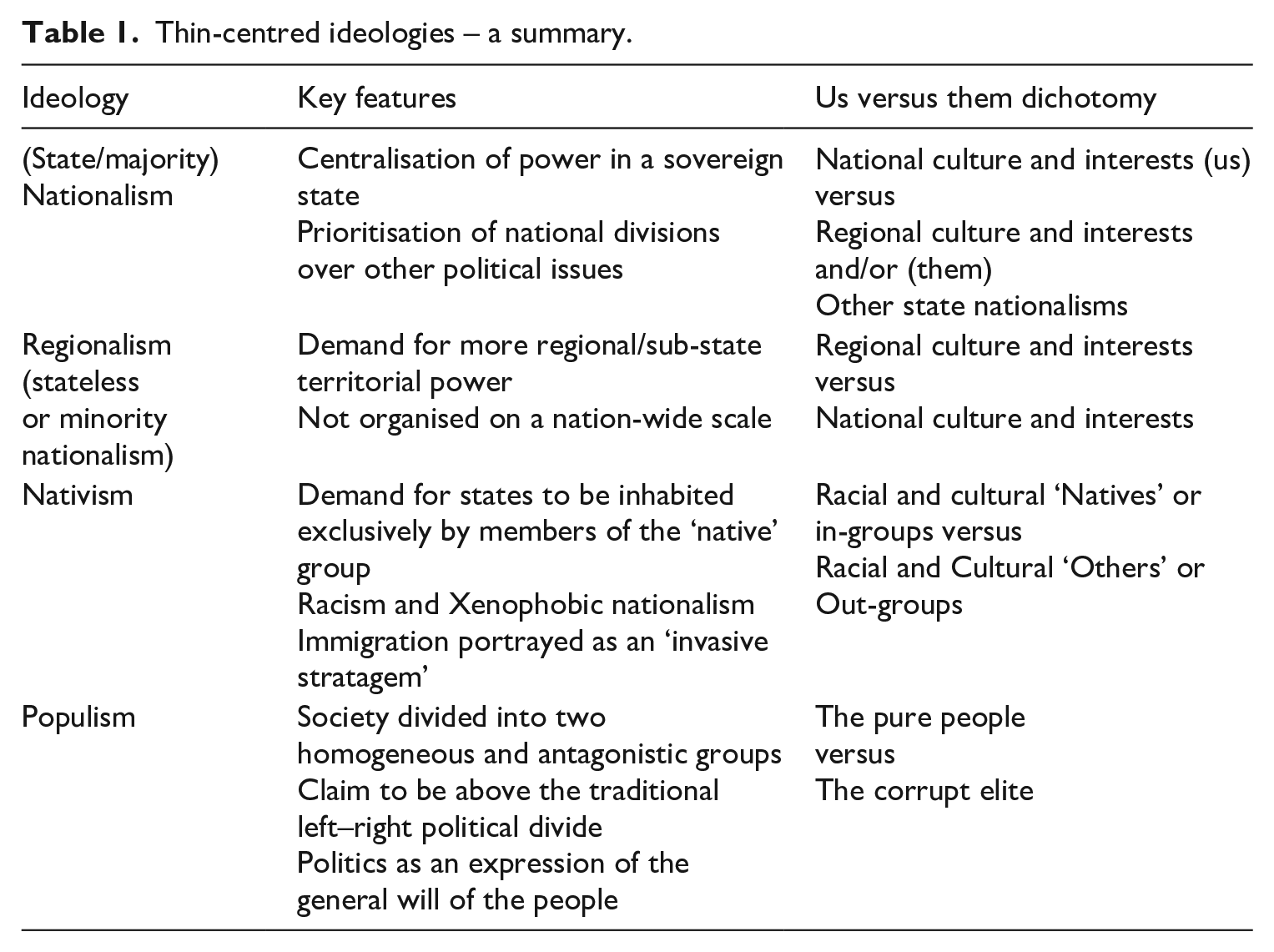
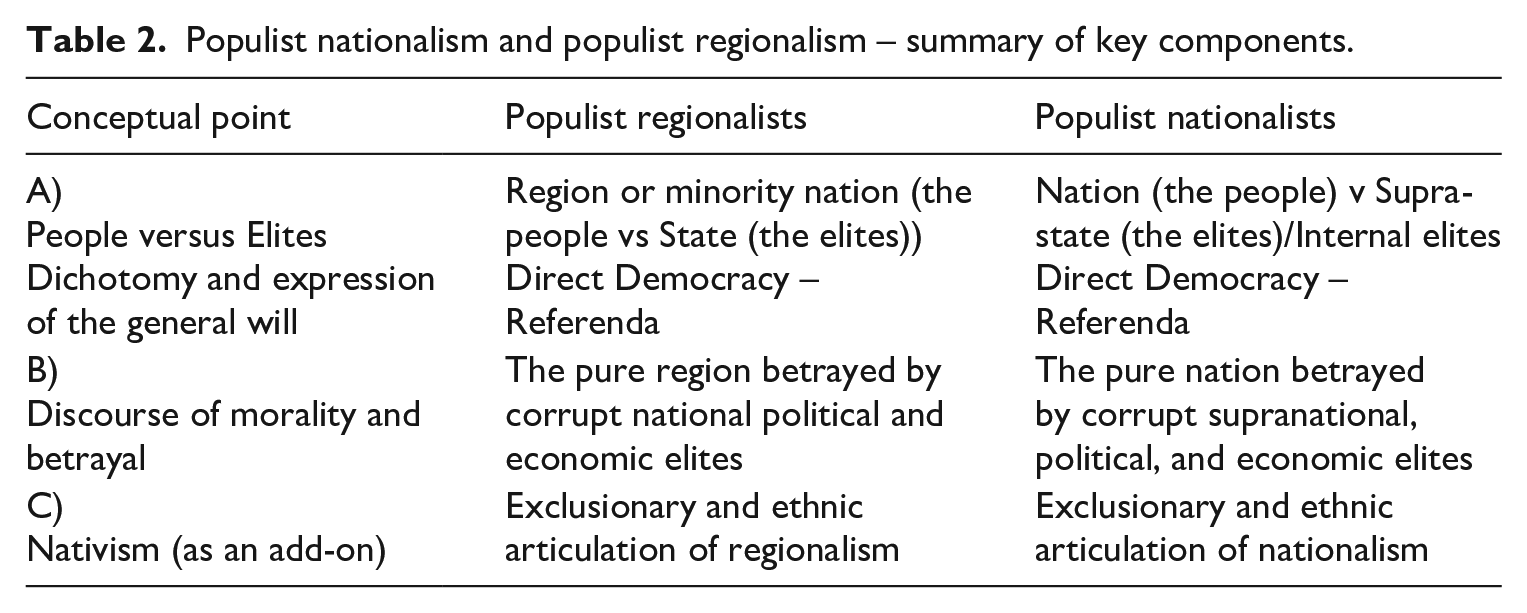
Having discussed the thin-centred ideologies which will form the conceptual framework of populist regionalism and populist nationalism, Tables 1 and 2 illustrate and summarise these concepts.
Thin-centred ideologies – a summary.
Populist nationalism and populist regionalism – summary of key components.
Existing paradigms and debates
The following paragraphs examine existing composite paradigms which involve a combination of nationalism or regionalism with populism and/or nativism.
An influential framework of ‘regionalist populism’ was used first by Biorcio (1991) to describe the Lega Lombarda of the late 1980s/early 1990s and later refined by McDonnell (2006: 127) to refer to the way in which the Lega Nord juxtaposed ‘honest hard-working and simple-living northern Italians’ against ‘a series of dangers orchestrated by . . . powerful enemies’. While Spektorowski (2003) used ‘exclusionist ethno-regional populism’ to describe the Lega, the term regionalist populism has gained significant traction in scholarly discussions of more centrist and left-wing movements in recent decades. Masetti (2020) has examined ‘neither left nor right’ and ‘left wing regionalist populism’ of Plaid Cymru and the SNP, Solska (2020) has opted for the term ‘progressive regionalist populism’ to examine of the left-wing Silesian Autonomy Movement. A further paradigm of developed by Gamper Sachse (2018: 580–581), and applied to the Catalan autonomist movement is ‘democratic populism’, which involves a blend of populism with a ‘a civic-territorial ideal type of nation’. Newth’s (2019: 385–390) semantic reordering of the paradigm into ‘populist regionalism’ aimed to emphasise a populist form of regionalism rather than a regionalist form of populism, thus reinforcing the ‘thin-centredness’ of populism while highlighting the role of regionalism as a core ideology. However, this was limited to examining only radical right movements due to the prominent position of nativism in its conceptual framework (Newth, 2019).
In terms of nationalism and populism Miller-Idriss’ ‘populist nationalism’ focuses not on the similarities between nationalism and populism but ‘nationalist movements and identities which draw on populist strategies’ (Miller-Idriss, 2019: 20). However, Miller-Idriss’ (2019) claim that all forms of nationalism ‘are all rooted in . . . exclusionary . . . understandings of belonging’ naturally means that this populist nationalist paradigm naturally focuses more on radical right and far right movements (p. 19–20). The fact that Miller-Idriss also refers to her theory as ‘nationalist populism’ (rather than previously stated populist nationalism) inadvertently also shifts the focus from nationalism to populism as the core ideology and acts as an example of often conceptual ‘slippage’ within paradigms. Such reversal is present also Lopez-Alves and Johnson (2019) Populist Nationalism in Europe and the America’s, which, in contrast to the paradigm represented by the book’s title, contains a chapter which discusses ‘National Populisms’ in Spain.
Indeed, ‘National populism’ or ‘nationalist populism’ is a term which has gained a certain currency over the previous decades (Taguieff, 1995, 2016). Pantazopolous (2017: 206), has referred to the rise of the Greek radical left and radical right as a national-populist phenomenon, at times suggesting that (all) populism can only be national-populism, which means that populism cannot exist without a close linkage or even identification with some kind of nationalism’ (Katsambekis and Stavrakakis, 2017: 393). As with the aforementioned ‘regionalist populism’, however, the semantic ordering of the words and the claim that ‘populism becomes an ideology [. . .] like the others’ reflects a conflation of populism with nationalism itself, and its depiction as a core ideology. (Pantazopolous, 2017: 207).This was recently argued by both Eatwell and Goodwin (2018: ix), who claim that National Populists ‘prioritize the culture and interests of the nation . . . neglected . . . by distant and often corrupt elites’, and also by Ivaldi and Dutozia (2020) to refer to the French Front National. Meanwhile, Brubaker (2017: 1192, 2020), has claimed that ‘national populists . . . bring the vertical and horizontal registers together by characterizing ‘the elite’ – political, cultural, or economic – as ‘outside’ as well as ‘on top’.
With regard to paradigms which combine populism and/or nationalism with nativism, Mondon (2015) examined Front National and UKIP as ‘populist nativist parties’ (PNPs) and, in so doing, encouraged a greater separation between the two concepts of populism and nativism. While ‘nativist nationalism’ was used by Zaslove (2011) to describe the policies of the Lega Nord towards both southerners and foreign migrants in the early 1990s, Albertazzi et al. (2018) also refer to the latest incarnation of Matteo Salvini’s Lega, as a ‘nativist nationalist’ party which forms a component of its broader identity as part of the populist radical right. In addition to this, a further composite framework of ‘regional nativism’ and ‘regionalist nativism’ has been used by Betz and Habersack (2020) to analyse the rise of the far-right AfD in East Germany, building on Betz’s previous work (Betz, 1994, 2017) which argues for a close ideological relationship between populism and nativism.
This review of a cross section of the literature on existing composite paradigms of populism, nationalism regionalism and nativism has revealed two key issues. First, the common semantic ordering of ‘regionalist populism’ and ‘nationalist’ or ‘national populism’, portrays populism as a core ideology and/or discursive feature of regionalist and nationalist movements. Second, many paradigms have been developed with a particular party in mind, thus limiting the possibility for such frameworks to be applied elsewhere without being considerably reformulated. Both factors underline the need for a revised and more broadly applicable framework.
An inductive analysis of the Lega (Nord) and the Catalan autonomist movement
The following paragraphs present an inductive analysis of how the concepts discussed above manifest themselves in ideologically heterogeneous regionalist and nationalist parties.
The case study compares ethnic articulations of nationalism and regionalism from the far-right Lega (Nord) and civic articulations of regionalism of Catalan parties – the far-left ‘Popular Unity Candidacy’ (CUP) centre–left, Republican Party of the Left (ERC), and the centre–right Convergence and Union (CiU). What emerges is the role of populism in forming a link between civic and ethnic forms of nationalism and regionalism ranging from the radical left to the radical right, while highlighting the role of nativism in acting as a key differentiating factor.
Context and rationale
This sub-section provides a brief overview of the parties examined in the case study. The Lega, while now a nationalist party under Matteo Salvini, was formerly a regionalist/minority nationalist party under Umberto Bossi between 1991 and 2013, fluctuating between calls for federalism, secessionism, and devolution (Cento Bull, 2015). The Lega rode the crest of the wave of anti-party sentiment following corruption scandals in 1992, demanding a federalist transformation of the Italian state. Populism and nativism have always formed a key part of the Lega’s discourse, and the party has been coalition partner in no less than five coalition governments from 1994 to the time of writing (Fella and Ruzza, 2013). The Lega, under both Umberto Bossi and Matteo Salvini has therefore been a key contributor to Italy’s image as ‘the promised land of populism’ (Tarchi, 2015: 273).
The Lega is used in this case study as an example of both populist regionalism and populist nationalism. It is not the purpose of this case study to examine the change of the Lega from a regionalist to nationalist movement (Albertazzi et al., 2018). Instead, both Bossi’s and Salvini’s Lega have been chosen here to highlight the consistency of populism and nativism in party discourse and compare the ethnic articulation of its core ideology with the more civic articulations within the Catalan autonomist movement.
While propaganda produced by the CiU has been chosen to illustrate Catalan populist regionalism, this coalition party ultimately split over holding a referendum on Catalan independence. One of its component parties, Democratic Union of Catalonia (UDC), disbanded. The other, Democratic Convergence of Catalonia (CDC), was refounded as the Catalan European Democratic Party (PDeCat), the party of deposed Catalan President Carles Puigdemont. This was followed by the formation of ‘Junts pel Sì’, which was subsequently rebranded as ‘Junts per Catalunya’ (Barrio and Field, 2018: 714).
It should also be noted that rather than populism forming a central part of these parties’ discourse, as is arguably the case for the Lega, there has instead been a ‘populist drift’ in the discourses of Catalan autonomist parties which coincided with a process of ‘outbidding’ each other in terms of secessionist demands between 2012 and 2017 (Barrio et al., 2020: 88; Barrio and Field, 2018: 714; Barrio and Rodriguez-Tereul, 2017: 1785).
As a result, ‘in 2015, all of the Catalan nationalist parties . . . defended Catalonia’s independence. These were the same parties that backed the October 2017 referendum and subsequent declaration of independence, (Barrio and Field, 2018: 714).
Having established a brief history of the movements in question, the remaining paragraphs of this section illustrate both similarities and differences between ideologically heterogeneous populist regionalist and populist nationalist movements.
Case study
For the Lega and the Catalan autonomists, populist regionalism and populist nationalism have been defined by their regionalist and nationalist ideologies, demonstrating how ‘by itself, populism can offer neither complex nor comprehensive answers to the political questions that modern societies generate’ (Mudde and Rovira Kaltwasser, 2017: 6).
With regionalism and nationalism acting as the specific ideology behind targeting an elite, a key link between the Lega and two of the Catalan autonomist movements in question is revealed through a cross-examination of propaganda in which ‘the people’ and notions of reclaiming freedom and sovereignty are placed at the centre of each movement (Figures 1 to 4).

Available at: https://www.leganord.org/12-il-movimento/42-i-manifesti?start=1 (last accessed 6 May 2020).
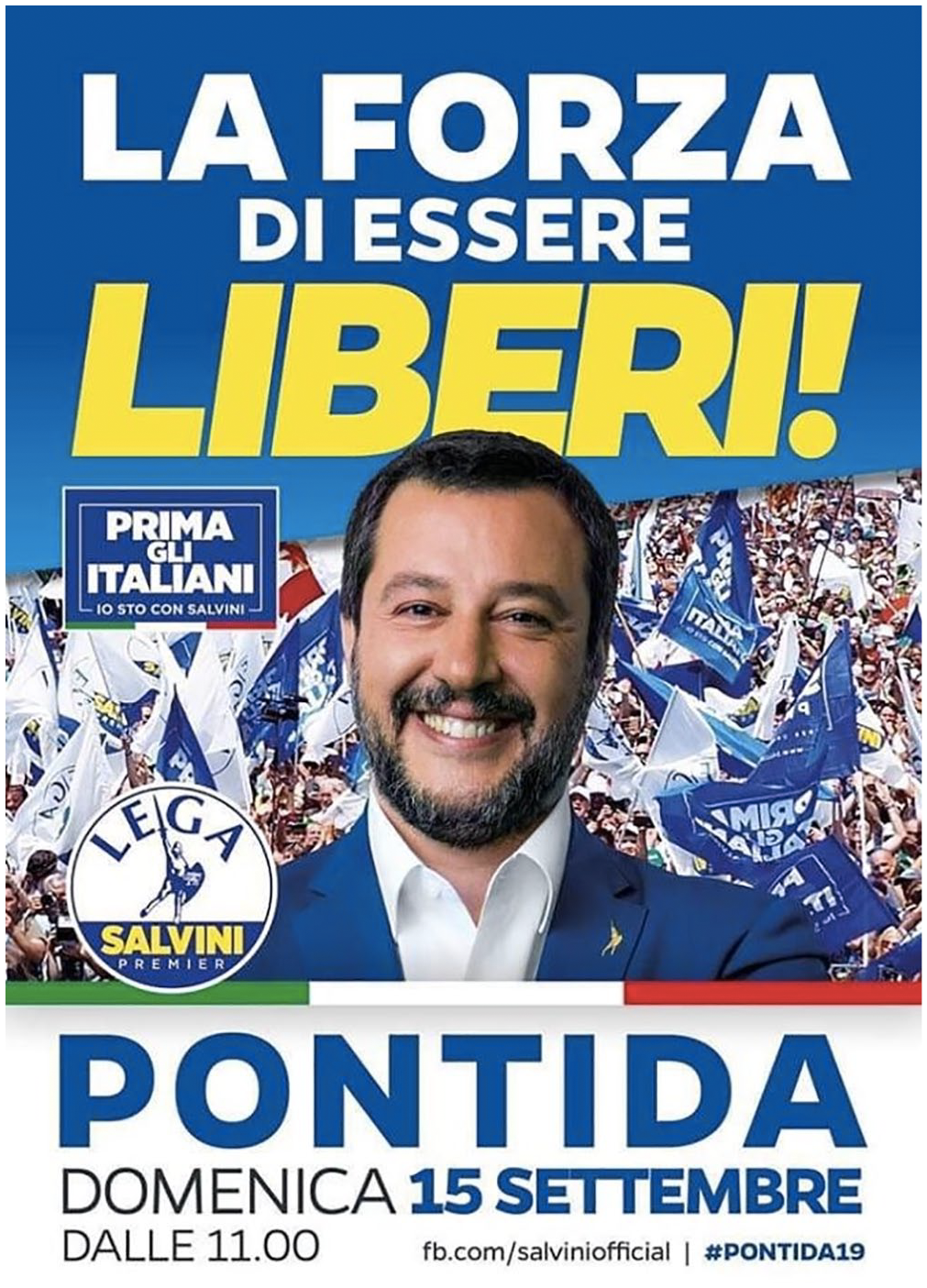
Available at: https://www.facebook.com/legasalvinipremier/photos/-la-forza-di-essere-liberi-domenica-15-settembre-tutti-a-pontida19/2568573073185603/ (last accessed 6 May 2020).
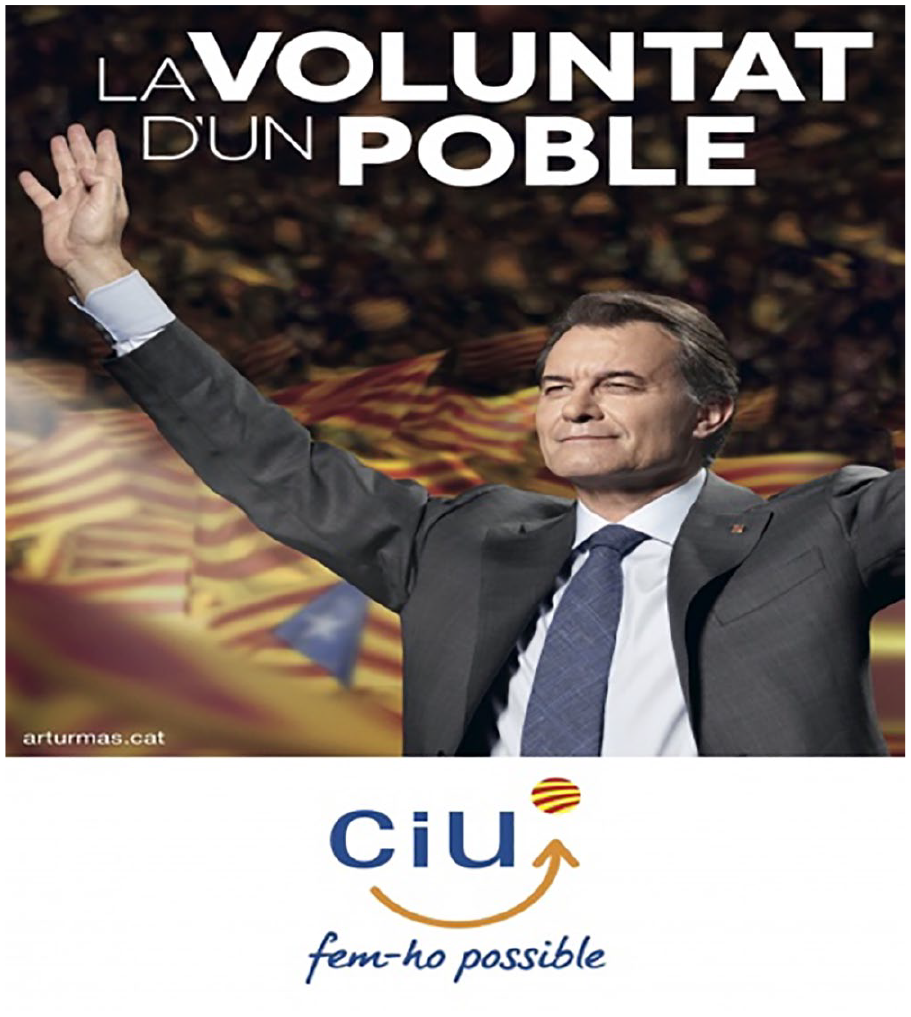
Available at: http://www.archivoelectoral.org/campana/2012-espana-regional/308/imagenes/ (last accessed 7 February 2020).

Available at: http://www.archivoelectoral.org/campana/2012-espana-regional/308/imagenes/ (last accessed 7 February 2020).
While Bossi’s statement of ‘further from Rome, close to you’ signals a distance from the Roman elites and a closeness to the North Italian people, Salvini emphasises to a greater extent a notion of a popular general will being behind a ‘strength to be free’ from both internal and supranational elites.
Tying together both populist regionalists and nationalists from the left to the right is the impression of popular will driving claims for national and regional sovereignty. What links both the CiU’s and the CUP’s more civic form of populist regionalism, to the populist regionalism and nationalism of the Lega is an emphasis of the ‘will of the people’. Indeed, the CiU’s slogan prior to 2012 ‘was ‘La voluntat d’un poble’ [The will of a people]’, showing similarities to the CUP’s slogan ‘És l’hora del poble’ [It is the time of the people]’ (Ruiz Casado, 2019: 8). These slogans reflect a key feature of ‘the opposition of the Catalan people to the Spanish State and its political class’ and ‘a constant appeal to the will of the Catalan people’ (Barrio et al., 2020: 94).
For Catalan populist regionalism the ‘emphasis on direct and plebiscitary forms of democracy’ and therefore ‘the call to follow the people’s will’ is underlined by Barrio et al. (2020: 95) as one of the elements which has seen the shift of Catalan independence parties towards populism. The reliance on referenda and emphasis of popular sovereignty was expressed through the motto of ‘the right to decide’ and it has been argued that the referendum was the ‘quintessence of democracy’ and through this ‘independentism has achieved . . . an experience of popular sovereignty’ (Gamper Sachse, 2018: 580–584).
Both the CiU and the ERC ‘agreed to call for an independence referendum in November 2014’ (Barrio et al., 2020: 93). However, it was the far-left CUP which was instrumental in mobilising support for the referendum simulation on 1 October 2017 with populist slogans such as ‘No fareu callar la veu d’un poble’ [You will not silence the voice of a people]’ (Almodovar, 2017; Ruiz Casado, 2019: 12).
Referenda have always been at the heart of the Lega (Nord)’s political message since its birth with the party pledging referenda on local taxes and laws throughout the late 1980s and early 1990s on independence in 1996 and more recently in Lombardy and Veneto on greater regional powers. Such commitment to direct democracy continues with Salvini promising at the party’s annual rally at Pontida to hold a series of referenda on government initiatives in a bid to return sovereignty to the people (Camilli, 2019).
A further link between the populist regionalism and populist nationalism of Catalan movements and Bossi’s Lega and Salvini’s Lega is a discourse of morality of pure people of the region or nation and its betrayal by the corrupt elites.
One of the most widely recognised slogans of the Lega Nord is that of ‘Rome the Thief; (Roma Ladrona), which crudely depicts a southern matriarch stealing the golden egg being lain by the exploited and hard-working north. Similarly, the ERC and the CiU echoed these claims and since the 2010s have employed ‘slogans such as “the subsidized Spain is living from the productive Catalonia” or “Spain steals from us”’ (Moreno-Almendral, 2018: 133). Further to the moral component of these posters which highlight the corrupt nature of the political elites and their betrayal of the regional people, a ‘relevant added feature of these campaigns has to do with the bad manners and mocking political style in which they were presented (Barrio et al., 2020: 95)’. The Lega’s Basta Euro campaign under Salvini, shifted this centre-periphery debate to a supranational level using similarly crude and mocking political tone with his ‘Basta Euro’ campaign, in which he dubbed the Euro a ‘crime against humanity’ (Cento Bull, 2015: 212).
While these examples by no means signal an equivalence in the broader aims of the Lega and those of Catalan autonomists, it highlights how populism as a thin-centred ideology forms a significant link between the left and the right. The propaganda examined reveals how the populist regionalism and populist nationalism across the political spectrum portrayed the political elite as ‘in cahoots with the economic elite, and putting “special interests” above the “general interests”’ (Mudde and Rovira Kaltwasser, 2017: 13); Figures 5 to 7.
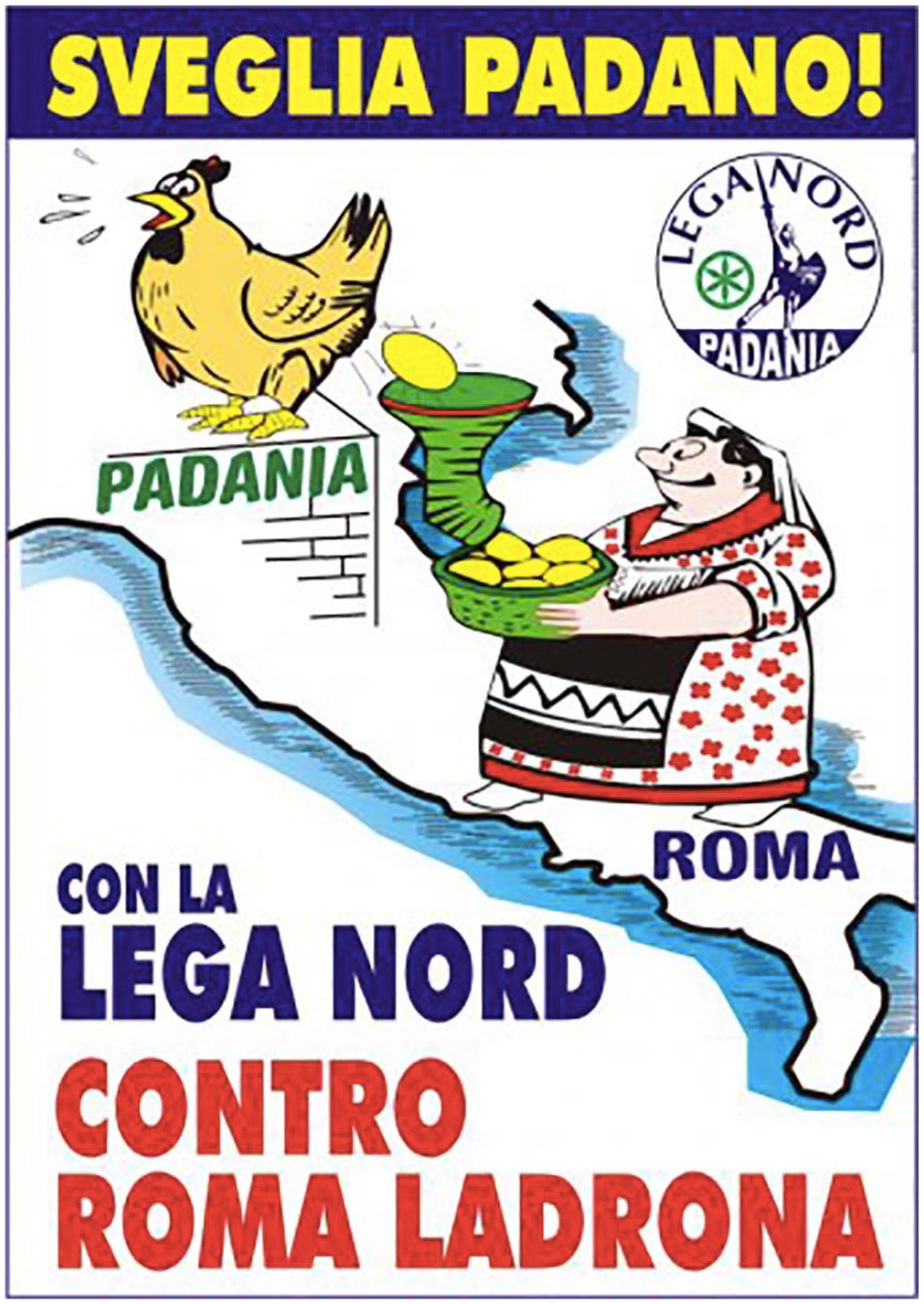
Available at: https://www.leganord.org/12-il-movimento/42-i-manifesti?start=1 (last accessed 6 May 2020).

Available at: http://locals.esquerra.cat/documents/butlleti-desquerra.pdf (last accessed 6 May 2020).

Available at: https://slideplayer.com/slide/10788351/ (last accessed 6 May 2020).
However, while populism can act as a link between ideological heterogeneous nationalist and regionalist movements, nativism instead acts as a key dividing line.
The Lega’s regionalist and nationalist ideology has always articulated a nativist hostility towards both internal others (southern Italians) and external others (foreign migrants) (Newth, 2019). The Lega under Bossi continuously defined (North) Italian identity against an ‘other’ and invoked the invasion stratagem, be it from threats from Muslim, Chinese, or Turkish invaders (Woods, 2009). A key element of this nativism has been an association of (North) Italian identity with Catholicism with which it is claimed certain cultures, races, and religions, in particular those of Islam, are incompatible (Garau, 2015). Tied in with this is the impression that ‘stopping the invasion’ is the virtuous course of action. Indeed, comparison of Lega propaganda under Bossi and Salvini reveals continuity of this nativist discourse with Salvini’s similar pledge to ‘stop the invasion’ if elected in national elections in 2018 (Figures 8 and 9).

Available at: https://www.leganord.org/12-il-movimento/42-i-manifesti?start=1 (last accessed 6 May 2020).

Available at: https://www.facebook.com/legasalvinipremier/photos/con-il-governo-salvini-stop-invasione-meno-8-sab-2402-ore-15-a-milano-4marzovoto/1731364726906446/ (last accessed 6 May 2020).
Within the Catalan autonomist movement Nativism has been ‘historically marginal’ (Barrio et al., 2020: 91), but has tended to manifest itself through more ethnic conceptions of language. Such instances can be seen when Catalan is ‘employed as a means to evaluate a newcomer’s moral worth’ (Codò and Garrido, 2013) and also in regionalist discourse such as that of the CiU which in 2006 instigated ‘a campaign to ‘force’ immigrants to speak Catalan in public spaces’ (Jeram et al., 2016: 1231).
Nevertheless, the aforementioned marginality of such discourse is evident in how Catalan minority nationalist parties consensually define Catalonia as a ‘land of welcome’ (terra d’acollida) emphasising ‘the idea that Catalonia is a land that has received immigrants throughout its history’ (Carlà, 2017; Franco-Guillèn and Zapata-Barrero, 2014: 269).
Indeed, the CiU ERC and CUP have all presented immigration as ‘an opportunity to construct a project and take advantage of diversity’ (CUP, 2012; Franco-Guillèn-Zapata-Barrero, 2014: 276). The ‘Catalan way of integration’ was part of a plan initiated by the centre–right CiU in 2001 and further elaborated by a left-wing administration involving the ERC in 2006. This plan ‘balanced respect for the diversity derived from migration and the need for a sense of belonging to the Catalan community’, aiming to infuse migrants with a sense of belonging to the Catalan community by developing the idea of resident citizenship, and embracing multiculturalism as part of Catalan culture’ (Carlà, 2017: 1107–1108).
Despite the previous insistence on ‘forcing’ migrants to speak Catalan, the CiU later oversaw a migration plan in 2014 which both promoted Catalan as tool of social cohesion and fostered knowledge of migrants’ languages (Carlà, 2017). This concern with ‘the integration process of immigrants’ differentiates Catalan populist regionalism it from the more exclusionary project of the Lega (Franco-Guillèn-Zapata-Barrero, 2014: 264).
Populist regionalism and populist nationalism: A framework
The results of the case study above are here used to derive a framework of populist nationalism and populist regionalism. This emphasises populism’s thin-centred nature, the role of direct democracy, a dichotomy between the ‘pure people’ and the ‘corrupt elite’, and nativism as a potential add-on to far-right articulations of both populist nationalism and regionalism.
People versus Elites Dichotomy and expression of the general will
This feature of populist nationalist and populist regionalism equates ‘the people’ with the ‘sovereign’ nation or region. By doing so, populist nationalist and populist regionalist parties claim to represent the expression of the general will of the people in reclaiming sovereignty from elites.
While the semantic ordering of populist nationalism and populist regionalism and the emphasis placed on nationalism and regionalism has been presented as a potential weakness of the paradigm as it ‘could stretch from left to right’ and potentially mean ‘Scottish Nationalists would find themselves in the same camp as the Hungarian Jobbik movement’ (Eatwell and Goodwin, 2018: 80), I believe this argument should be turned on its head.
Indeed, as demonstrated by the case study, this flexibility is a strength in that it highlights how populism’s thin-centred nature means it is attached to different articulations of regionalism and nationalism. Analysis of propaganda from the CUP, the ERC, the CiU, and the Lega (Nord) has shown that while both populist nationalist or populist regionalist parties can ‘create specific blends’ of regionalism, nationalism, and populism that ‘take a right-wing or left-wing (or neither left nor right) colour’, the dichotomy between the people and the elites will always be present (Masetti and Schakel, 2015: 21).
While in terms of populist regionalism, this dichotomy ‘can be equated with region (or minority nation) vs state (or minority nation) and vice versa’, for populist nationalists it may be equated to ‘nation’ versus supra-state (e.g. EU) or nation versus internal elites (e.g. liberal media, parliament), while it may also target ‘national parties and cultural elites’ (Heinisch et al., 2020: 6–9).
Both populist nationalist and populist regionalist parties aim to return popular sovereignty to a ‘lost heartland’ (Taggart, 2000), often proposed through plebiscitary or direct democracy such as referenda, which portrays the people ‘as the ultimate source of legitimacy’ (Barrio et al., 2020: 88). Such ways of claiming ‘direct links between the people and its leaders’ allow for populist regionalist and populist nationalist demands to be articulated in a way which appears to be responding to the general will (Barrio et al., 2020: 88). This idea of the monolithic view of the general will can be articulated in phrases such as ‘the right to decide’ or ‘the will of the people’.
Discourse of morality and betrayal
This aspect of populist nationalism and populist regionalism accounts for how such movements justify their calls for a return of national or regional sovereignty. Populist nationalists and regionalists ‘often argue that the elite is not just ignoring the interests of the people; rather, they are even working against the interests of the country’ or the region (Mudde and Rovira Kaltwasser, 2017: 13).
Within this argument, the essence of the people as region or nation is ‘purity and authenticity’ defined in ‘moral terms’ (Mudde, 2017: 29–30). Inherent in this is the idea that the elite are corrupt and ‘have willingly chosen to betray’ the people ‘by putting the special interests and inauthentic morals of the elite over those of the people’ (Mudde, 2017: 30). This argument may come in different forms; however, due to the fact that populists often ‘define the elite in economic terms’ and relate ‘the ultimate struggle between the people and the elite to economic power’, financial arguments often play a role (Mudde and Rovira Kaltwasser, 2017: 13).
As inferred from Salvini’s ‘Basta Euro’ campaign, populist nationalists, may ‘accuse the political elite of putting the interests of the EU over those of the country (Heinisch et al., 2020: 13) or may move centre–periphery arguments to supranational level against larger institutions, such as the EU arguing that such corrupt elites are impinging not only on national sovereignty but also national economic growth and enterprise (Albertazzi et al., 2019: 662).
Populist regionalism, on the contrary, may manifest itself in the betrayal and exploitation of richer regions to subsidise poorer areas or what has been labelled elsewhere as ‘bourgeois regionalism’ that is, ‘grievance of exploitation by state policies that directly (territorial transfers) or indirectly (welfare) drag resources from the wealthy (and supposedly hard-working) region to send them to other poorer (and supposedly self-indulgent) region’ (Masetti and Schakel, 2015: 867). Indeed, these arguments were common to the populist regionalism of the ERC, the CiU, and Bossi’s Lega Nord. However, such a discourse of betrayal may also be present in populist regionalism of poorer regions exploited by the corrupt elites, as in the case of anti-austerity populism from the SNP and Plaid Cymru (Masetti, 2020). Claims of betrayal by a corrupt elite may also be ‘expressed through a ‘coarsening of political discourse’ and a crude and/or mocking political style, including ‘use of slang, swearing, political incorrectness and being overly demonstrative and ‘colourful’ (Moffit and Tormey, 2013: 389). Such crudeness is clearly demonstrable in the slogans and imagery used by the ERC, the CiU, and the Lega Nord, all accusing the central state of committing an act of theft.
Nativism
Nativism – a separate concept to populism – can act as an add-on to both populist nationalist and populist regionalist ideologies of a more right-wing variety and particularly in terms of those which might also be classified as populist radical right (Mudde, 2007). With regard to populist nationalism, it is in its more exclusionary and ethnic articulations that ‘nativism equips the nation-state with a ‘national identity’ by which to fashion its people by positing a ‘we’ whose identity is simply incommensurable with everything external and ‘alien’ to it’ (De Genova, 2016: 234).
In terms of populist regionalism, nativism can also emerge as a result of a combination of regionalism and xenophobia, if the region is viewed in exclusionary terms and involves a process of ‘othering’ which ‘relies on an ‘us-them distinction’ (Newth, 2018).
One clear benchmark for measuring the nativism within a populist nationalist or populist regionalist party is their stance on immigration and in particular whether the region and nation is either promoted through a civic criterion of belonging as a ‘land of welcome’ or, conversely, whether it is protected through more ethnic criteria and portrayed as a ‘land of fear’ (Carlà, 2017; Franco-Guillèn, 2016: 1306).
While the former implies that immigration is viewed as a positive phenomenon, contributing both economically and culturally to society while the challenges it entails are manageable . . . negative or exclusive stances include reluctance to accept the arrival and settlement of newcomers, who are perceived as problematic and threatening for society (Franco-Guillèn, 2016: 1306).
Regionalist and minority nationalist parties ‘with a positive stance towards immigration tend to portray a civic [. . .] discourse’ (Franco-Guillèn and Zapata-Barrero, 2014: 279). On the contrary, therefore, a more exclusionary attitude towards immigration and racial/cultural others is more likely to be linked to an ethnic discourse. This distinction is highlighted by the more civic and inclusionary articulations of regionalism in the Catalan case and the more ethnic and exclusionary articulations of regionalism and nationalism in the case of Bossi’s and Salvini’s Lega.
On one hand populist regionalists and populist nationalists promoting an ethnic discourse may accuse elites ‘of systematically giving preference to non-natives [. . .] when in reality, preference should be accorded to the native population’ (Betz and Habersack, 2020: 112). On the other hand, these parties may present immigration as an invasion due to fears of ‘replacement’, and also through demands to put the interests of the ‘native population’ first, that this invasion should be stopped (Betz and Habersack, 2020: 112).
The benefits of a minimalist framework
The framework developed in this article has placed emphasis first and foremost on the articulation of nationalism and regionalism to which populism is attached. This approach allows for an examination of how the core ideology of the movements in question influences a movement’s populist and nativist discourse. A case study comparing Catalan autonomist parties ranging from the far-left to the centre–right with the far-right Lega (Nord) has highlighted how these parties all employ a populist discourse of a moral region/nation being betrayed by a corrupt elite and promote the ‘general will’ of the people via direct democracy.
The framework derived from this inductive analysis responds to the research question posed in the introduction, allowing for sharper illustration of the similarities in how ideologically heterogeneous regionalist and nationalist parties organise and mobilise support through populism while treating nativism as an add-on component, which is more applicable to populist regionalists and populist nationalists on the far-right, that is, an ideological manifestation of exclusionary nationalism and regionalism with more ethnic features . The civic discourse of ‘land of the welcome’ for immigrants, while so central to the identity of the CiU, the ERC, and the CUP, would instead be anathema to the ideology of either Bossi’s or Salvini’s Lega.
This article, by offering an initial conceptualisation, has not only contributed to a less euphemised use of populism by separating it from terms with which it is often conflated such as nativism, but has provided a generalisable framework on which future studies can build both within the field of populist, nationalist and regionalist studies.
While populism may not always be a central feature of nationalist or regionalist movements, it may nevertheless be articulated through its core ideologies as a logical conclusion of an ‘us’ versus ‘them’ dichotomy. This framework can be further tested by applying it to other nationalist and regionalist parties ranging from the far-left to the far-right. With the reemergence of regional and sub-state fractures in the wake of Brexit, further potential questions which need to be addressed include how have populist (and nativist) demands been articulated by both regionalist and nationalist actors, including the Brexit Party, the SNP, and Plaid Cymru, in the British political sphere? In addition, beyond Europe, how can the framework developed in this article be applied to political actors in Latin America? Future research which makes use of the terminology and framework in this article to respond to the questions cited above, and beyond, would contribute to developing a more nuanced and articulated understanding of regionalist and nationalist parties, in any given nation or region, which engage with populism and/or nativism.
Footnotes
Acknowledgements
The author thanks Professor Catherine O’Rawe and Dr Amy King for inviting him and the participants and for their helpful comments and feedback. Thank you to the anonymous peer reviewers and editor for their constructive and helpful comments and advice. Huge thanks are also due to Dr Aurelien Mondon and Dr Silvia Xicola-Tugas for their invaluable comments on earlier drafts of this paper.
Author’s note
This paper was first presented at an Italian Department Research Seminar at the University of Bristol in October 2019.
Funding
The author(s) received no financial support for the research, authorship, and/or publication of this article.
