




Abstract
This article investigates whether engagement in school or university, such as being the speaker of class, a member of a student council, and so on, has an impact on political participation and political trust. Following interactionist socialisation theory, engagement during adolescence should develop ideas of citizenship, democracy, and political participation. Schools and universities are arguably key institutions as they can promote democratic decision making in the classroom. This strengthens democracy by increasing experienced political efficacy and through internalizing democratic principles (‘learning democracy’): by acting democratic, one becomes a democratic citizen. My findings show that respondents who experienced democracy in school or university indeed tend to vote and engage even in contentious forms of political participation more often. Also, the experience of democratic practices in school and university increases trust in political institutions. Moreover, trust in political institutions, in turn, increases the likelihood of voting, but not of engaging in other forms of participation. Thus, early democratic experiences seem to foster vivid and participatory democracy without streamlining people into passive participation. The article provides empirical evidence from nine European countries and an additional glance at young cohorts based on online panels.
Keywords
Introduction
Comparative politics (Bara and Pennington, 2009; Lijphart, 1999; Lijphart and Schmidt, 1997) as well as foreign policy practice (Carothers, 2004; Dahinden, 2013; Lawson and Epstein, 2019; Schimmelfennig and Scholtz, 2008) usually conceptualize, measure, and engage with democracy in terms of the development of political systems. Thus, the focus lies mostly on characteristics like majority rule, division of power, protection of minorities, and institutionalised party competition. However, democracy is also considered a principle lived and carried out by citizens: Political philosophers from Rousseau to Habermas have insisted on the citizen as the constituent of democracy (Thompson, 2010), the consent of the governed (Cassinelli, 1959; Cohen, 1997; Habermas, 1992), and the important role of their mœurs (De Tocqueville, 1990 [1835]: 299f). From its beginning, research on political attitudes has indeed described the importance of ‘civic culture’ for the performance and stability of democratic societies (Adorno et al., 1950; Almond and Verba, 1972). Since democracy, like any ethics, is not just ‘natural’ behaviour (Aristotle, 1818: 50), learning democracy is key. Moreover, democratic citizenship ‘refers to the present and future capacity for influencing politics’ (Thompson, 2010: 2). Thus, experiencing participation in direct or indirect ways of political deliberation and decision making ensures not only (input) legitimacy and coercion but also the very functioning and stability of democratic societies. If people are not involved in the political process, they might be more open to anti-democratic and populist campaigns, posing a threat to the stability and functioning of democratic systems. Democracy promotion (e.g. Carothers, 2004; Dahinden, 2013; Lawson and Epstein, 2019; Schimmelfennig and Scholtz, 2008) and civic education (Callan, 1997; National Council for the Social Studies, 2017; Ostrom, 1998) aims at stabilizing societies by establishing democracy in society not only in terms of political institutions. How to enable people to be democratic and mature citizens is then a recurrent task for civic and political education in particular. But what helps people to become active and democratic citizens?
Based on the literature on civic education and interactionist theory of socialisation, this article argues that learning democracy through direct engagement during school and university education is one key to this question. The research question thus is whether such engagement has positive effects on the likelihood of people engaging in politics as well as on political trust. Taken together, these effects of learning democracy are then expected to enable and stabilise democracy. Theoretically and to explain these effects, learning democracy (cf. Dewey, 1916) needs to be conceptualised following interactionist theory (going beyond resource-based approaches): doing, experiencing, and being exposed to democratic practice in young age, in fact – and going back to Mead (1934) – acts of communication between individuals, establish norms and identities via ‘role-taking’ and ‘role-making’ (Turner, 2001). Using a unique comparative dataset on political participation covering France, Germany, Greece, Italy, Poland, Spain, Sweden, Switzerland, as well as the United Kingdom and including additional sub-samples of young people, the article tests whether participatory engagement within school or university and therefore the direct experience of and socialisation in democratic practices indeed has such positive effects on citizens in terms of voting, less formal confrontational and non-confrontational participation, and political trust.
The article aims at deepening our knowledge on the effects of democratic experience in school and university (in addition to civic education), providing timely empirical evidence for nine European countries, and underlining the importance of such engagement for democratic societies. More importantly, it offers detailed insights into the relationship between experiencing democracy in education, political trust, and different forms of participation showing that early democratic experiences indeed help to foster vivid and participatory democracy without streamlining people into passive participation. After carving out the theoretical framework and presenting formal hypotheses, the methods section introduces the data and methodological approach. The article proceeds by presenting the results followed by a discussion and some conclusive remarks that point at the importance of learning democracy through direct engagement both as a topic for further study and for education policy.
Learning by doing – From Aristotle to Mead
The departure point of this study is the general insight that against the democratic promise of equality, political participation is demanding, most importantly in terms of resources (Brady et al., 1995; Marien et al., 2010; Verba et al., 1995; Weßels, 2018): People with higher incomes, higher educational attainment, and social capital engage more often than people who are less affluent in these respects. This contributes to democratic deficits as the democratic promise of equality as citizens is breached by the inequality of actual participation (see for the same argument and an impressive empirical account of voting in Germany, Schäfer, 2014). Research has further emphasised that education can have different effects and is not just a question of formal acquisition (which could, theoretically, be broadened) open to everyone. To the contrary, it not only provides knowledge, but it also distributes social positions creating an ‘uneven political playing field’ (Nie et al., 1996). Thus, education has socialising effects. However, education is not defenceless against such inequality reproduction – some education systems indeed are much less socially pervious than others (Godin and Hindriks, 2018; Johansson and Causa, 2011; OECD, 2010: 181ff, 2018) and social mobility exists in all countries (even in more unequal ones like France and the United States), therefore, this is not an automatism.
Beyond the structure of education systems, of concern is also the content of education and the curricular and extra-curricular democratic socialisation of (young) citizens. The importance of civic education has been emphasised repeatedly not least by John Dewey (1916), who developed a rigorous philosophical foundation of such claim. Civic education, in the view not only of this tradition, is more than learning about technicalities of the political system (Galston, 2001; Johann, 2012; although political knowledge is a prerequisite for active citizenship as well; see, for example, Popkin and Dimock, 1999). More importantly, Aristotle (1818: 50) already argued that any ethical action must be learned by doing, that is, unlike natural actions (e.g. seeing and hearing) but like a craft: ‘Thus, by building we become builders, and by playing on the harp, we become harpers. Thus too, by acting justly we become just, prudent by acting prudently, and brave by acting bravely’. One may add, by acting democratic, we become democratic. In school and university, therefore, the difference is exactly between educational attainment (i.e. learning facts about the political system) and actually taking part in decision making and deliberative discussion.
In the tradition of Dewey and his pragmatist emphasis on ‘learning democracy’, interactionist socialisation theory is instructive since it assumes that individuals establish identities via interaction and through societal experience (Mead, 1934: 182) by ‘role-taking’ and ‘role-making’ (Turner, 2001). Berger and Luckmann (1967: 129) have differentiated primary socialisation, that is, the dialectic process of individual identity formation and externalisation of the world from this identity, from secondary socialization. The latter is of further interest here and conceptualised as principally open-ended and encompassing ‘the internalization of institutional or institution-based “subworlds”’ (Berger and Luckmann, 1967: 138). Secondary socialisation understood as the ‘acquisition of role-specific vocabularies’ then includes first and foremost the ‘internalization of semantic fields structuring routine interpretations and conduct within an institutional area’ as well as ‘“tacit understandings,” evaluations and affective colorations of these semantic fields’ including normative, affective, and cognitive components (Berger and Luckmann, 1967). The engagement in school or university, for example, as speaker of class, by organising an event with a political topic, or attending a students’ meeting thus opens the opportunity to form the identities of democratically engaged citizens, practice democratic participation and deliberation, and learn about democratic principles. Likewise, the institutional opportunity structure for democratic socialisation must be given, which refers to what Habermas (cf. Habermas, 1983, 1991: 25) called accommodating settings (‘entgegenkommende Lebenswelten’).
Pedagogic scholarship provides us with evidence to support such claims. Studies emphasise that experiential education is most effective for achieving democracy learning because ‘students respond to experiences that touch their emotions and senses of self in a firsthand way’ (Damon, 2001: 141). Moreover, joining youth voluntary associations in particular with regard to ‘community service, representation, speaking in public forums, and generating a communal identity’ affects future political participation (McFarland and Thomas, 2006). Joining associations plays an important part in the socialisation into political milieus and for whether young adults vote at all (Thomas and McFarland, 2010). The school, in particular, is an important institution in the development of civic education (Torney-Purta, 2002). And still, students may identify as citizens, but often ‘their grasp of what it means to act as citizens is rudimentary and dominated by a focus on rights, thus creating a privately oriented, passive understanding’ (Conover and Searing, 2000: 108). For example, Spannring et al. (2008) have shown that, although with variations across countries, engaging in the school, for example, as speaker of class has significant effects of young adults later engaging politically.
Following the interactionist theory of how democratic awareness and activity is learned, this article, thus, wishes to test whether engagement in democratic decision making during adolescence and the primary period of political socialisation within the institutional setting of the school or university helps to establish and consolidate ideas and practices of citizenship, democracy, and political participation. In the following, I shall specify hypotheses that test and go beyond the existing findings in the literature. This will deepen our knowledge on the effects of democratic engagement in school and university, provide timely empirical evidence for nine European countries, and underline the importance of such engagement for democratic societies.
If we assume that people are learning by doing, we can argue further that such engagement during adolescence and the period of political socialisation helps to grow ideas of citizenship, democracy, and political participation. We must also assume that voting is a ‘not so simple act’ (Dalton and Wattenberg, 1993). It not only requires political knowledge but also the ability and not least the will (or the idea of civic responsibility) to engage in voting. We can assume the same for other forms of political participation since participating in protests, contacting a politician, boycotting, and so on, all require not only that one has some sort of knowledge but also feels the need and responsibility to take action. Therefore, democratic engagement in school or university increases the likelihood of voting in national elections (hypothesis 1) and participating in other, confrontational and non-confrontational political activities (hypothesis 2).
Beyond participation, complex modern societies also need trust to function. Political trust reflects the belief of people that political institutions function properly (Listhaug and Ringdal, 2008). It is seen as a prerequisite for democracy as trust allows for lower transaction costs, predictability of actions, citizens’ compliance and ethical reciprocity, and legitimacy (see contributions in Braithwaite and Levi, 1998; Hetherington, 2007). Practising democratic decision making in the educational system should enhance political trust since young people are not only learning about politics but also experience efficacy and how pluralist politics work. Thus, the experience of democratic practices in school/university increases trust in political institutions (hypothesis 3).
As already argued, trust is essential for governance and facilitates participating in institutionalised politics. Findings by Torney-Purta et al. (2004) suggest that political systems need a certain threshold of trustworthiness to foster civic and political participation. While the case for voting is straightforward (people with low trust in institutionalised politics tend to abstain from voting), things are more complicated for participating in protests and other forms of political engagement. In many cases and depending on the (national) context, people may take to the street because they distrust political institutions (Braun and Hutter, 2016). Therefore, political trust mediates the effect of experiencing democracy in school/university on voting (hypothesis 4). However, I will not find such an effect of experience-fostered political trust for contentious forms of political engagement (hypothesis 5). The relationship between experiencing democracy in education, political trust, and different forms of participation is thus expected to be particularly interesting because experiencing democracy may lead to higher voting rates due to increased political trust and at the same time learning through democratic engagement also increases more contentious forms of political engagement conveying mistrust or at least criticism of political institutions.
Due to the composition of the data set at hand, which includes three sub-samples for the general public, young adults between 18 and 24, and young adults between 25 and 35, I will also be able to test assumptions about cohort and/or age effects. On one hand, democratic disciplines and civic education have probably advanced over the years. On the other hand, the effect of engagement in school/university may lose importance over the life course. Younger respondents may still remember better what they experienced, while for older respondents, more recent experiences are more important for their daily lives today. Therefore, for young respondents, the effect of experiencing democracy in school/university on voting (hypothesis 6a), less formal political participation (hypothesis 6b), and political trust (hypothesis 6c) should be stronger.
Data and methods
To test these hypotheses, in the analysis below, I use survey data covering nine European countries, namely, France, Germany, Greece, Italy, Poland, Spain, Sweden, Switzerland, and the United Kingdom (see the introduction to this special issue as well as Giugni and Grasso, 2020). The uniqueness of this survey lies in its focus on youth participation and quotas for young people: In addition to a representative sample of about 1000 respondents per country, the survey contains about 1000 additional respondents per country for the age group 18 to 24, and another 1000 per country for the age group 25 to 34, totalling in a sample size of 27,446. This enables additional analyses for the young cohorts across countries strengthening both the explanatory power and future relevance of the results presented.
The main independent variable of the following analysis is political engagement during school or university, measured with the following question and with six options to be answered with yes or no: ‘Have you ever done any of the following at school/university?’ Answer categories included ‘Been a member of a student council’, ‘Had a function as a speaker for the class’, ‘Attended a students’ meeting’, ‘Taken an active role in such a meeting’, ‘Participated in a protest movement at school’, ‘Organized a political event at school’, and ‘None of the above’. The six answer categories load on one factor (polychoric confirmatory factor analysis) with a Cronbach’s alpha of .64. I consider all such forms of engagement a learning experience and thus form a simple additive index. Figure 1 provides an overview of the mean across countries. Greek respondents seem to have engaged more frequently than other Europeans, while the Swiss and French have less experience at school/university.
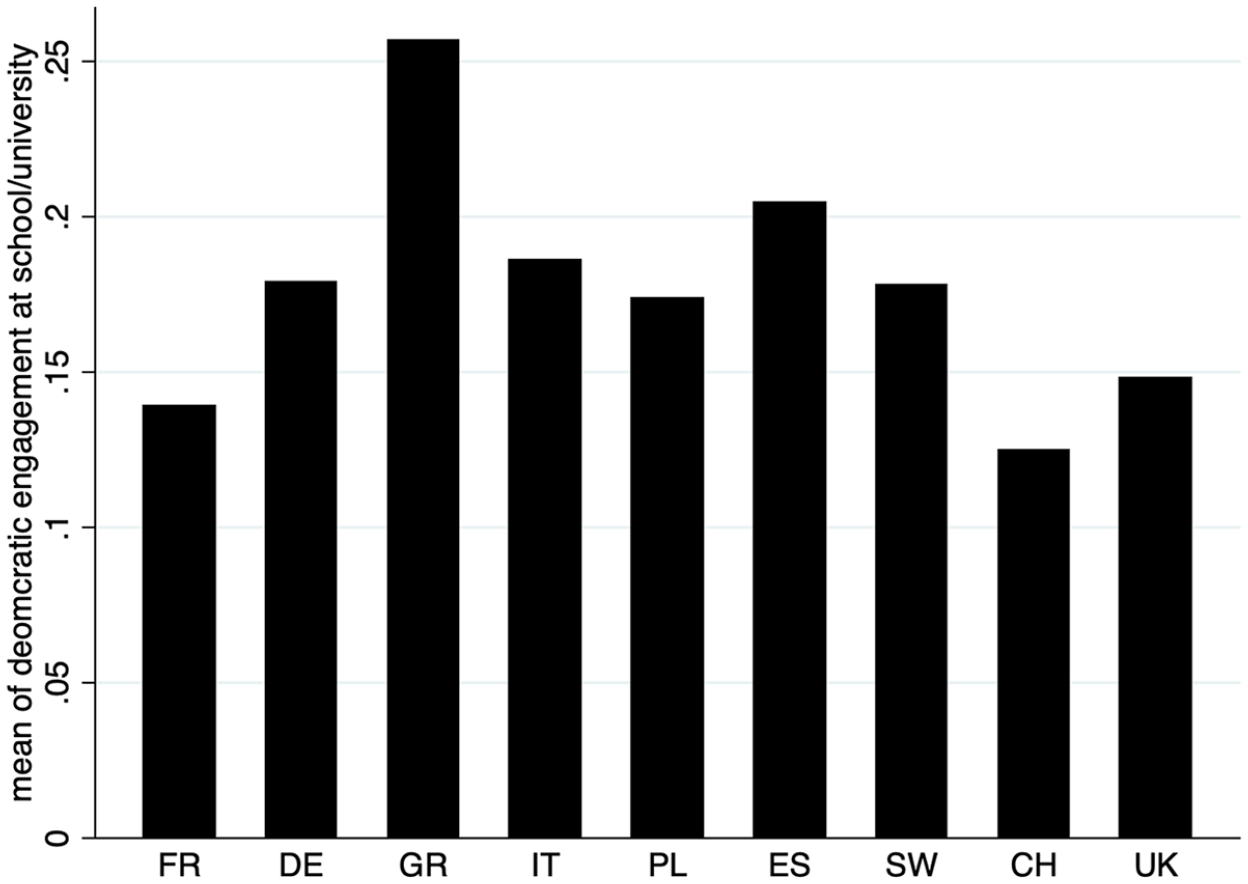
Democratic experience in school/university across countries (means).
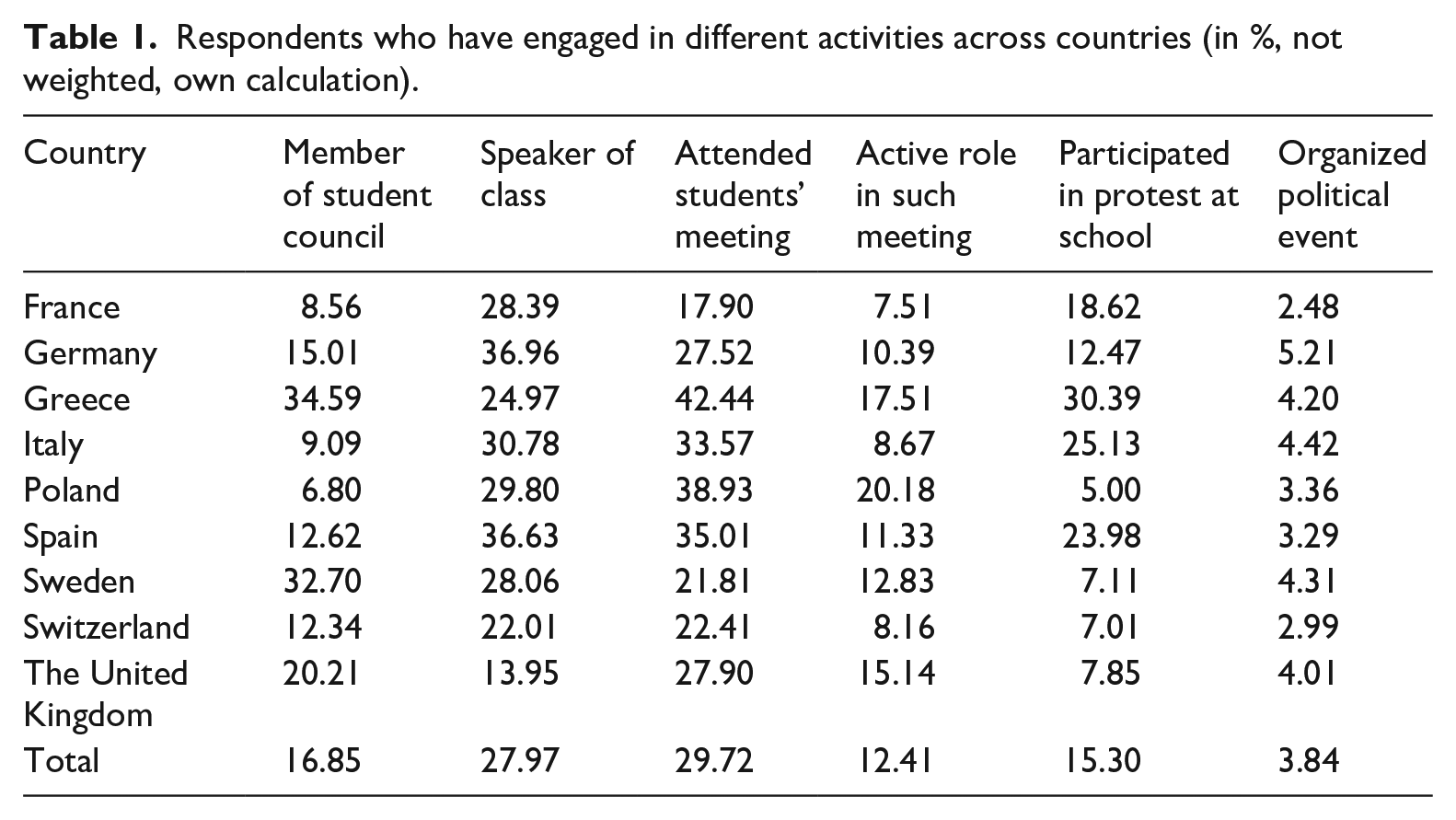
Looking at the frequencies per activity (Table 1), the differences between countries become even more apparent and offer a first glance at different national contexts: Respondents from Greece and Sweden are most likely to have been a member in a student council; in Spain and Germany, every third respondent has been a speaker of class; and in the Southern (and most crisis-ridden) countries Italy, Greece, and Spain, I find the highest rate of protest participation. Such protest in school/university is particularly low in Poland, Sweden, Switzerland, and the United Kingdom, while in France, Sweden, and Switzerland, attending meetings is reported least. Context or rather, existing opportunities have for long been acknowledged as an important explanation for participation (e.g. Kriesi, 2004). For democratic learning experiences, first of all, the existing opportunities are relevant. In Germany, for example, speaker of class is a highly institutionalised phenomenon. In Greece, student unions seem to be particularly active, providing organisational opportunity structures for young people. 1 Chevalier (2019) has shown that more inclusive economic citizenship and individualized (instead of familiaristic) social citizenship produce higher levels of political trust among the young. These and other political and also macroeconomic circumstances (that interact with individual-level factors like grievances, see Grasso and Giugni, 2016) build the context for engagement at school and university. While I cannot go into details further, these considerable differences between countries caution us in my analysis and I will address national contexts when discussing the results. Moreover, below I will calculate the models for the young cohorts as well as for each country separately.
Respondents who have engaged in different activities across countries (in %, not weighted, own calculation).
In my analysis, I wish to test the impact of engagement in school and university on three dependent variables considered relevant for democracies. First of all, voting in national elections may be the most straightforward form of political participation. Respondents were asked the standard question, ‘Did you vote at the last national election?’ Second, there are many other forms of political action through which people can voice their opinion and participate in the public formation of political contest, including, among others, taking part in demonstrations, joining boycotts, contacting politicians, and signing petitions. These forms of participation are less connected to formal decision-making processes but can be considered an integral part of a vivid democratic society. Respondents were asked, ‘There are different ways of trying to improve things or help prevent things from going wrong. When have you last done the following?’ The questionnaire allowed for 10 different activities to specify if and when the respondent engaged and the items were combined in an index for engagement in the last 5 years (loading on one factor, Cronbach’s α = .76). For the purpose of further differentiating my results, I separately calculated the models for subscales of buy/boycott (consumerism, Cronbach’s α = .66), confrontational (Cronbach’s α = .65), and non-confrontational (Cronbach’s α = .64) modes of participation (see Appendix 1). The last three alpha values are relatively low. However, from a theoretical point of view, the separation into three indices is warranted. Models with single items as dependent variable produce similar results. Last but not least, principal factor analyses revealing one factor for each scale also justify this choice.
Third, I assumed that learning democracy by actively engaging in democratic practices during school or university education builds political trust. Political trust was measured with the standard question, ‘On a score of 0–10 how much do you personally trust each of the following institutions?’ and respondents answered this for 12 institutions including the national parliament, the European Union (EU), the police, trade unions, and so on (see Appendix 1 for list). Again, I summarised these items in an index loading on one factor (Cronbach’s α = .93).
For the analysis, I first calculated regression models for each dependent variable. As control variables, I included the respondents’ sex as a check for gender inequality; age to account for any changes of socialisation or value systems over time; and income, experienced deprivation, education, and father’s education to account for the resource dependency of political participation (Brady et al., 1995; Grasso, 2013, 2018; Verba et al., 1995). Moreover, I included three measures for political knowledge to control for political literacy and a left-right self-placement scale (0–10) for ideological differences (see Appendix 1 for the recoding of all control variables). Last but not least, I included country fixed effects (dummies). Results are reported for the full comparative data set as well as country-by-country. Complementary calculations for the two young cohorts are described in the text to save space. In a second step, I employed structural equation modelling to test whether political trust mediates the relationship between democratic engagement in school/university and political participation.
The effects of experiencing democracy in school and university
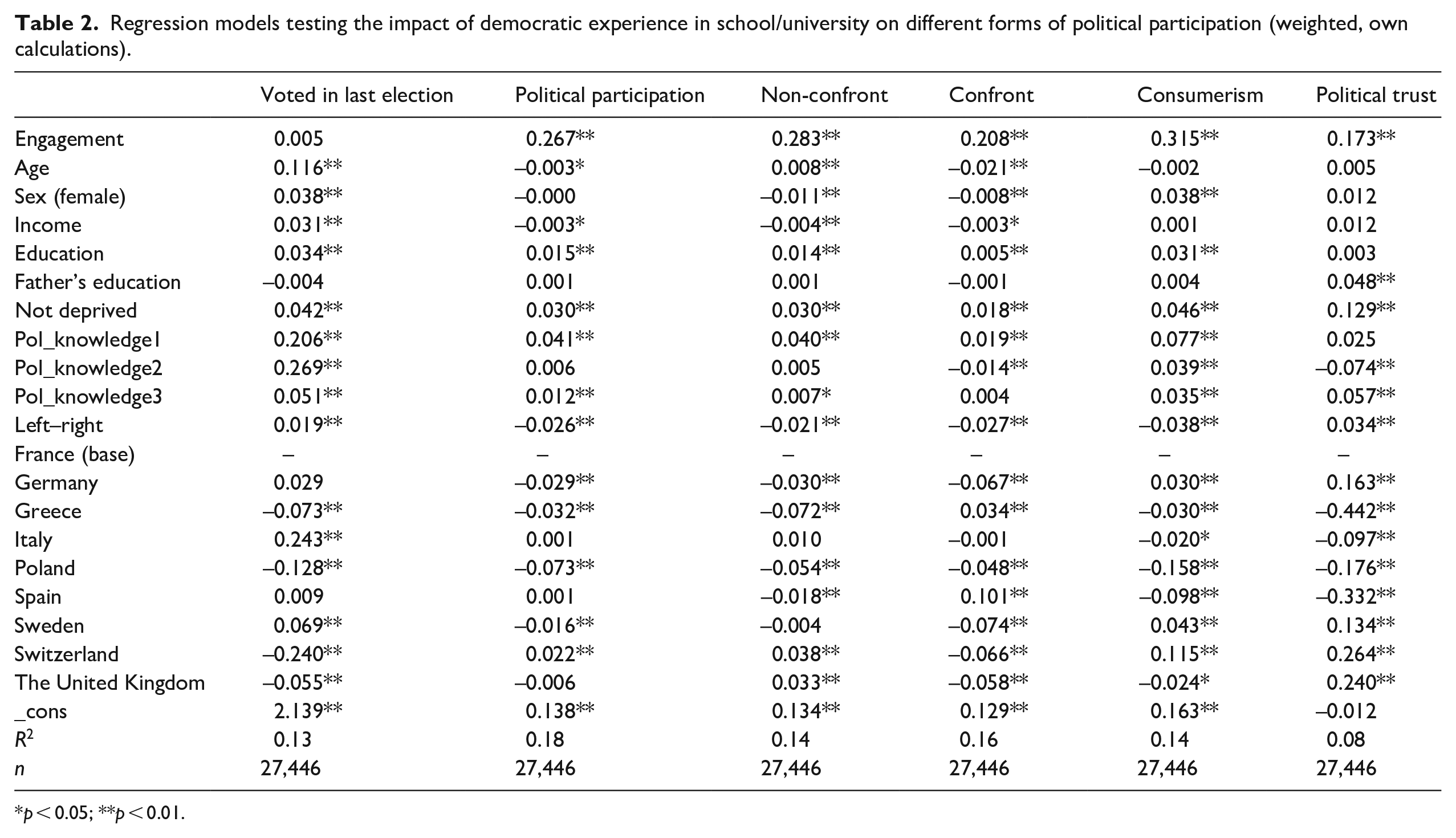
In the theoretical section, I assumed that experience with democratic forms of participation during school and university would increase both, the likelihood of voting and of engaging in other forms of participation. As Table 2 shows, I find evidence only for the latter corroborating hypothesis 2, but not hypothesis 1. This is probably to some part to be explained by the higher overall percentage of people voting compared to taking part in less institutionalised forms of participation. Moreover, voting may be less demanding in terms of norms and democratic learning than other forms of participation. If we compare different forms of (non-voting) political participation, we see that the effect of engagement in school/university is somewhat smaller for confrontational than for non-confrontational and consumerist activity. These forms of participation, therefore, seem to be more dependent on having ‘learned’ to engage. This is further supported by the positive effects of education and political knowledge – including the negative effect of (one item of) political knowledge on confrontational participation. The latter indicates that political knowledge leads to participation but not necessarily confrontational. Being able to afford certain goods and services (absence of deprivation) increases participation while leaning left increases less formalised participation and leaning right increases voting slightly.
Regression models testing the impact of democratic experience in school/university on different forms of political participation (weighted, own calculations).
p < 0.05; **p < 0.01.
Looking at the seventh column of Table 2, we note that democratic engagement in school or university correlates with political trust, too. Thus, in school or university, people not only learn to make themselves heard. With this also comes higher trust in political institutions. Here we can confirm earlier findings in the literature that higher educational attainment correlates with higher trust (e.g. Schoon et al., 2010). Still, it seems that it is not only about a higher level of education but also about what experiences a person makes during school and university in terms of democratic engagement. Therefore, we can corroborate hypothesis 3. Moreover, trust is particularly dependent on reported deprivation but not resources (income, education, father’s education), implying that subjective relative deprivation is more important than objective deprivation (Yoxon et al., 2019). Moreover, the relatively low R2 of the models presented suggests that other individual factors (e.g. authoritarian personality or self-efficacy) would increase their explanatory power.
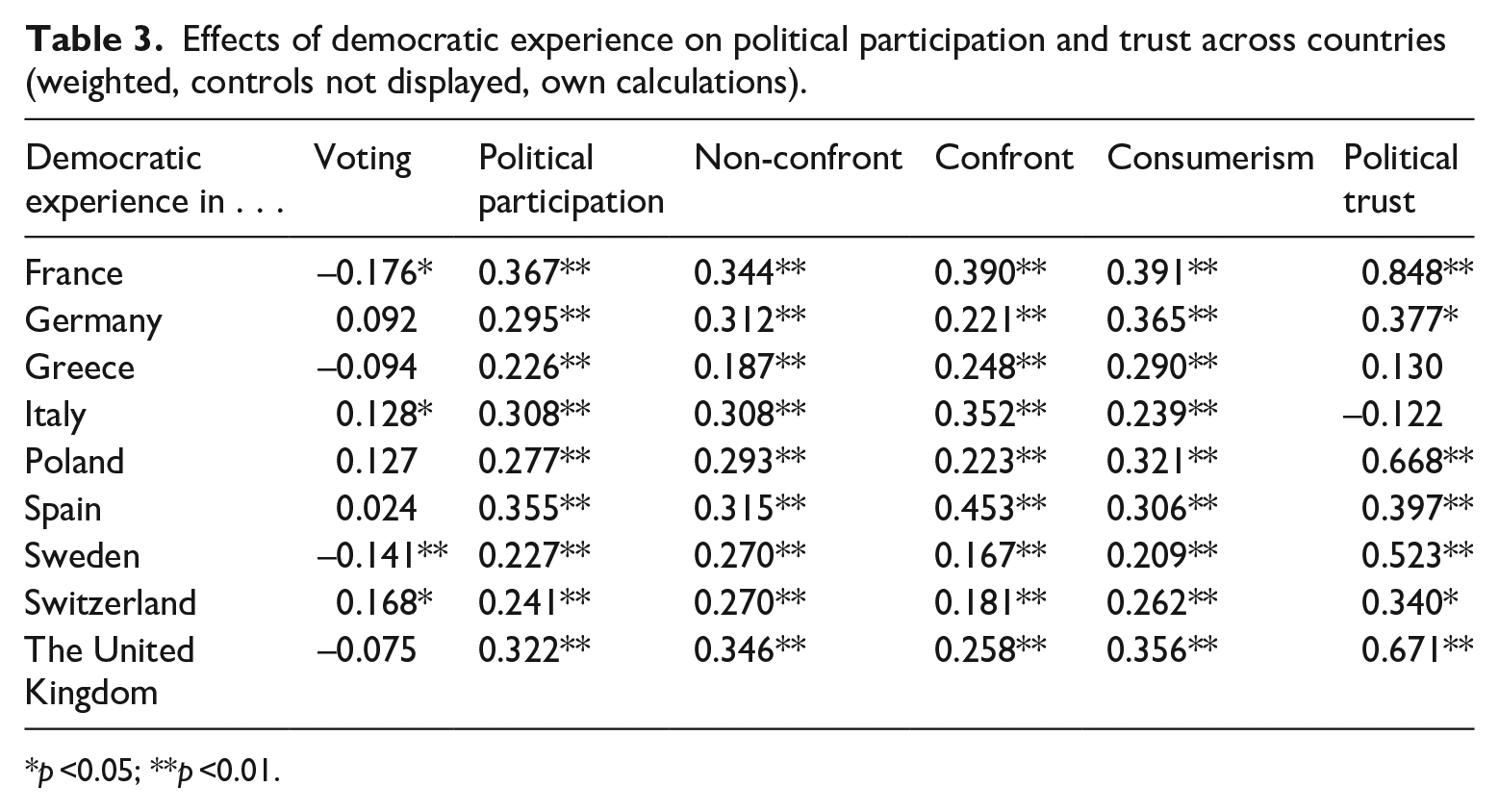
Looking at country effects, being a citizen in Greece, Poland, Switzerland, or the United Kingdom is associated with less voting. Being a citizen in Greece, Spain, Italy, or France, on the contrary, is associated with higher confrontational participation, which is in line with what we know from the literature (e.g. Grasso and Giugni, 2016). Consumerism is more common in not only Switzerland but also Sweden and Germany. Non-confrontational participation is associated with living in Switzerland and the United Kingdom. France (the base outcome) seems to have the liveliest political culture. Living in Germany, Sweden, Switzerland, or the United Kingdom increases trust, while living in Poland, Spain, Italy, or Greece limits trust. These relatively large country effects point again at the importance of political opportunities, which asks for further research in this area. Regarding my hypotheses, however, it is of particular interest, whether there are country differences of the effect of engagement in school or university (which was highest in Greece, see above) on different forms of participation. For this purpose, I calculated the regression models for each country separately. In Table 3, I report the coefficients for my main independent variable.
Effects of democratic experience on political participation and trust across countries (weighted, controls not displayed, own calculations).
p <0.05; **p <0.01.
There are three central takeaways: First, in Sweden and France, engagement decreases voting, while in Italy and Switzerland, it increases voting. In the remaining countries, the effects are not significant. I, therefore, reject hypothesis 1. Second, regarding other forms of participation, my analyses produced consistent results across all countries. This seems to imply that, regardless of national context, people with democratic experience at school are more active as democratic citizens (hypothesis 2). Third, in most countries, democratic engagement in school or university increases political trust, too, except for Greece and Italy. In Poland, the United Kingdom, and France, the coefficients for trust are highest. Thus, hypothesis 3 has to be modified because, regarding political trust, the national context seems to matter. For becoming an active democratic citizen, it matters much less, however. This implies that it helps to develop a critical and if the national context warrants it, contestation-affine democratic self-esteem.
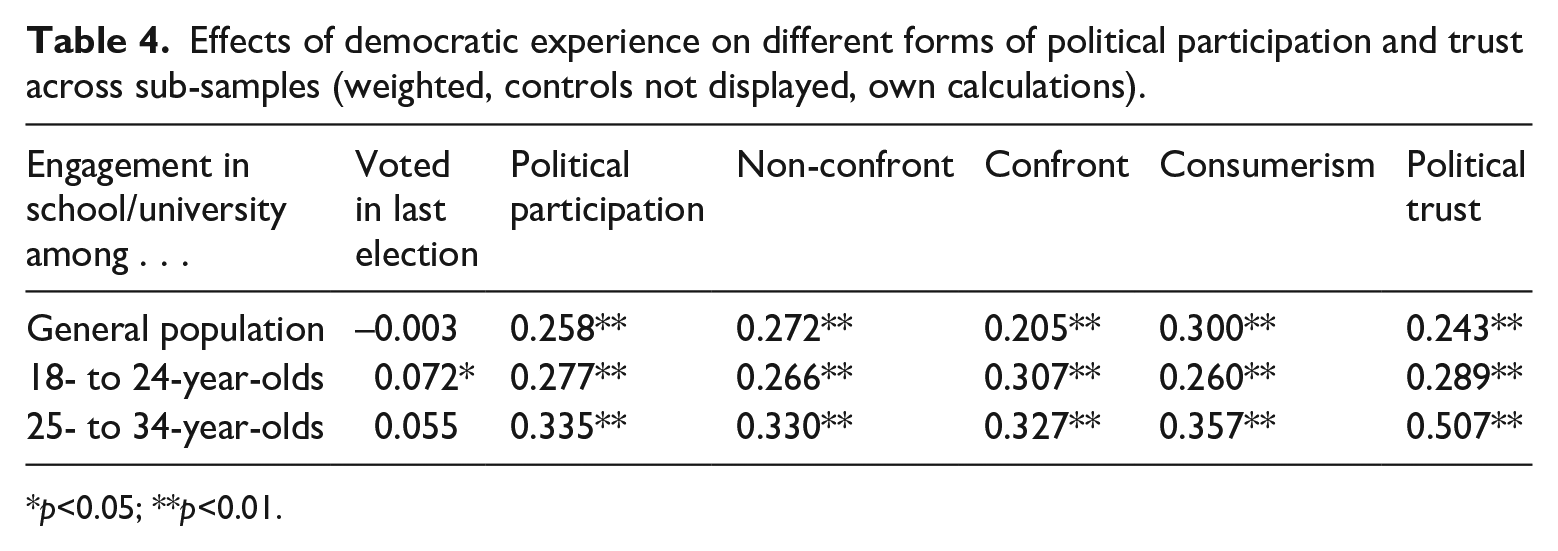
Comparing the cohorts of 18- to 24-year-olds and 25- to 34-year-olds with each other as well as with the general population sample, I can corroborate my results with some minor variations (Table 4). Coefficients of democratic experience are slightly higher for the group of 25- to 34-year-olds across models (except voting). In the youngest group, some 18-year-olds may not have yet started to be politically active (the survey asked about activity in the past 5 years), while in the overall population, probably other life experiences become more important relative to school or university experiences or engagement back in time was not as relevant. The coefficient for political engagement on trust is equally highest for the 25- to 34-year-olds (and a bit higher for 18- to 24-year-olds) compared to the general population. I can, therefore, corroborate hypotheses 6a to 6c.
Effects of democratic experience on different forms of political participation and trust across sub-samples (weighted, controls not displayed, own calculations).
p<0.05; **p<0.01.
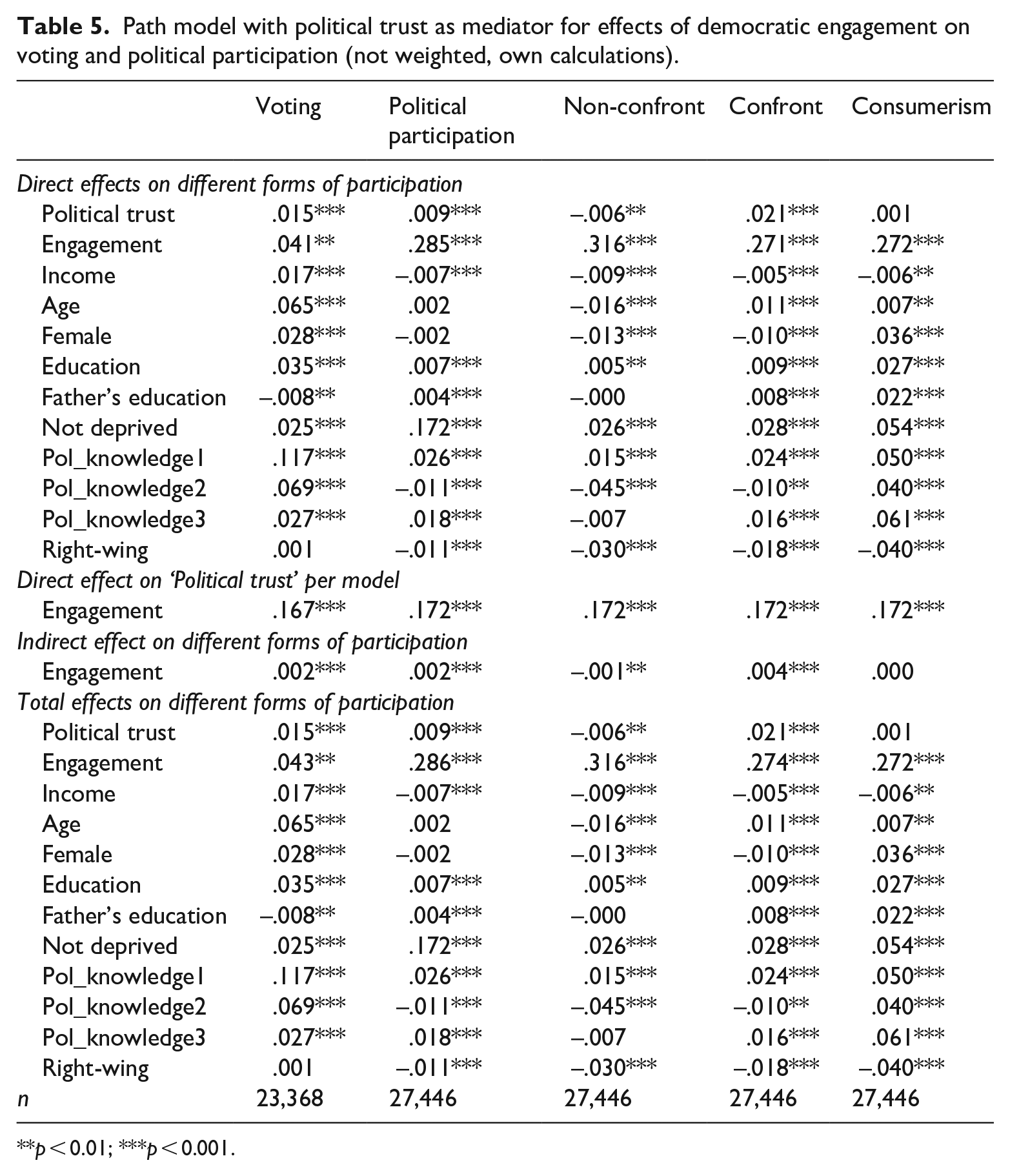
In the last step, I used a structural equation model (SEM) to test for a possible mediation effect of political trust regarding democratic experience in school/university and political participation. Such a mediation effect would be particularly interesting concerning the relationship between engagement in school/university and becoming a democratic citizen in the sense of active participation theorised in this article. For all models in Table 5, the root mean square error of approximation (RMSEA) is 0.06 and, hence, only acceptable (Hu and Bentler, 1999). Pclose (0.000) suggests a very high probability that the RMSEA is indeed not below 0.05 which would indicate a good fit. 2 Meanwhile, the results in Table 5 indicate that while trust is (as already shown above) increased by democratic experience in school/university, this does not necessarily increase voting or other forms of participation. Trust has only a small effect on political participation and the effect of democratic engagement on political participation is direct rather than mediated through political trust.
Path model with political trust as mediator for effects of democratic engagement on voting and political participation (not weighted, own calculations).
p < 0.01; ***p < 0.001.
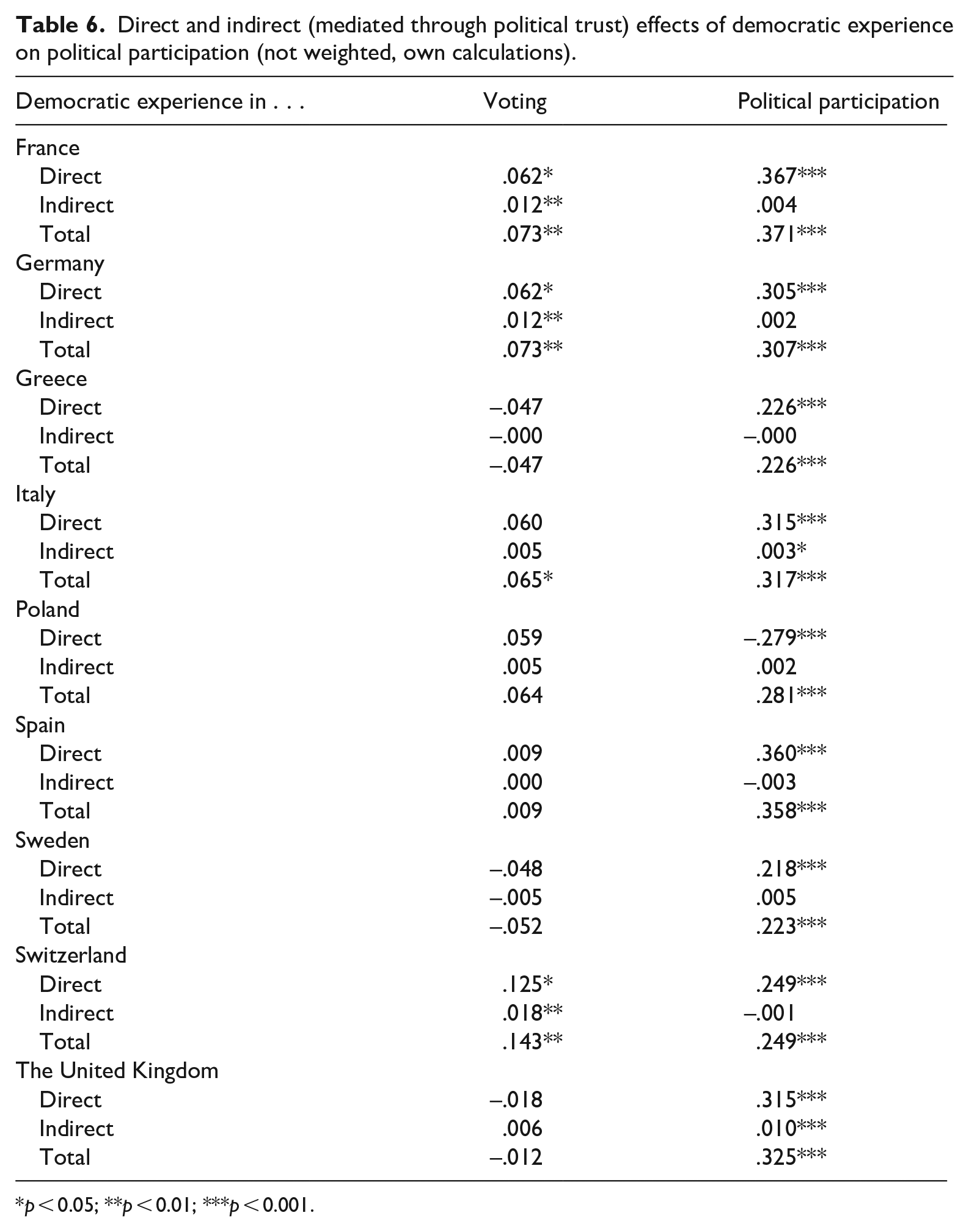
While the indirect effects presented in Table 5 are very small, this could be different in some countries because political trust is affected differently (see last columns of Tables 2 and 3) and also distributed differently. Therefore, I calculated the path models for all countries separately. Table 6 provides an overview of country-specific mediation effects for voting and the summary variable of political participation. In France and Germany, the indirect effect of engagement on voting mediated through political trust explains 16% of the total effect (here the goodness of fit indices of the SEMs also give better results). In Switzerland, too, the indirect effect occurs to be significant and explains 12.6% of the total effect. Thus, for these three countries, I can corroborate that trust mediates the effect of democratic engagement on voting. For all other countries, however, I have to reject the hypothesis. For the political participation summary variable, only in Italy and the United Kingdom, I find a small significant indirect effect. These indirect effects only explain 1% and 3%, respectively, of the total effect. Therefore, I reject the mediation hypothesis.
Direct and indirect (mediated through political trust) effects of democratic experience on political participation (not weighted, own calculations).
p < 0.05; **p < 0.01; ***p < 0.001.
Discussion and conclusion
To sum up, learning democracy through direct engagement in the school or university has, as expected, notable effects on whether citizens later engage in voting or other forms of political participation, and on the establishment of political trust. For voting, this effect is only visible in Switzerland and Italy, while in France and Sweden, there is even a negative relationship. However, for other forms of participation, I find consistent support of my hypothesis. That democratic engagement in school and university is inconsistently related to voting could result not only from country-specific contexts but also from the fact that voting is much wider spread among the population than other forms of political participation. Moreover, I would argue based on my findings that voting is less related to learning democracy. Notwithstanding that in representative democracies, voting is crucial, the hard test for democratic citizenship is additional political participation. Citizens engage for (what they perceive as) the collective good and in the public formation of politics more frequently if they have ‘learned’ engagement in the school/university previously. Thus, strengthening democracy, following Dewey, relies on civic education. This should not stop at curricular attainment of political knowledge. On the contrary, it is the actual experience that was shown here to be an important factor for developing democratic citizenship.
While democratic engagement during school or university strengthens political trust, and in some countries, trust mediated the effect on voting, trust does not work as a mediator in the case of political participation. This underlines what I just argued: apparently, those diverse forms of political participation have not the same relationship to trust as the highly institutionalised and formal act of voting has. In other words, people engage in less formal political participation without increased trust in the political system. This proofs a stand-alone effect of democratic engagement. Hence, I show that the relationship between experiencing democracy in school/university, political trust, and different forms of participation is particularly interesting. I observe some appeasing effect (experiencing democracy leading to higher trust and electoral participation), but at the same time, learning democratic engagement also increases contentious forms of political engagement which can be conceived of as voicing criticism of political institutions or the way things work. The literature on modern democratic theory appreciates such an active and controversial engagement of citizens as essential for the stability of democracies.
My findings also suggest that national context matters. When I calculated country-specific models, apart from corroborating my general findings, some peculiarities arose: While in Italy and Switzerland I find the hypothesized positive effect on voting, in Sweden and France, engagement at school/university decreases voting. Effects in the rest of the countries remain insignificant. My finding that, across countries, engagement increases non-confrontational as well as confrontational forms of participation seems to imply that regardless of the national context, people who have experienced democratic engagement are more active as democratic citizens. This points at the important role of contextual factors like political opportunity structures, macroeconomic factors, and their interaction with individual factors (Grasso and Giugni, 2016). Moreover, while in most countries, democratic engagement in school/university increases political trust, this is not the case in Greece and Italy. In Poland, the United Kingdom, and particularly in France, the coefficients for trust are highest. In sum, for political trust and voting, context matters, but for becoming an active democratic citizen in the sense of other forms of political participation less so. To put it in a nutshell, through democratic engagement in school/university, citizens are not indoctrinated to support the political institutions. We find reasons to believe that they develop critical and contestation-affine democratic self-esteem.
My study leaves some questions open. The models presented only explain a small part of the variance in political participation and trust. The literature already provides accounts that self-efficacy, personality traits, and other factors also need to be considered. Most likely, these factors also interact with the central variable investigated here, that is, democratic experience in school/university. Moreover, while the present study shows that democracy learning has an impact, we cannot see how and what exactly is learned. For my interactionist argument, though, this is also relevant. Future studies could and should therefore dig deeper, for example, by using qualitative approaches.
Learning democracy through direct engagement in school/university should draw more attention both by academic scholarship interested in democracy and participation as well as by educators. Regarding the former, the process of how citizens are formed, what experiences are most important, and what other factors may intervene should not be left to pedagogic studies. As my findings show, the effects of learning democracy on participation and political trust outweigh traditional variables like educational attainment or income by large. Therefore, political sociology generally should take these experiences more serious. On a theoretical note, interactionist theory seems to give important insights. These, however, need to be deepened through further research, for example, by utilizing studies in the classroom and applying qualitative methods. From my findings here, I can only point at the correlation that supports my theoretical argument that – paraphrasing Aristotle – by acting democratic, citizens become democratic.
Regarding the practical use of my study, the findings underline the importance of civic education for democracy. More specifically, the findings point at the importance of establishing opportunity structures for learning democracy by doing. This includes the opportunities of engagement which are already in place in most countries, for example, the opportunity to elect a speaker of class and student councils or participating in meetings, space, and time for (extra-curricular) political activity. In general, I argue, it is about cultivating accommodating settings (cf. Habermas, 1991: 25). Thereby, all students should participate and experience democratic decision making and recognition of their role within the group and, later, as citizens. This seems not simply to result in citizens agreeing to their political system. More likely, democratic experiences foster active and even challenging engagement with politics, the very essence of democracy. The Fridays for Future movement provides a timely example: Young people with access to higher education and, arguably, more opportunities seem to lead the charge (see De Moor et al., 2020).
Footnotes
Appendix 1
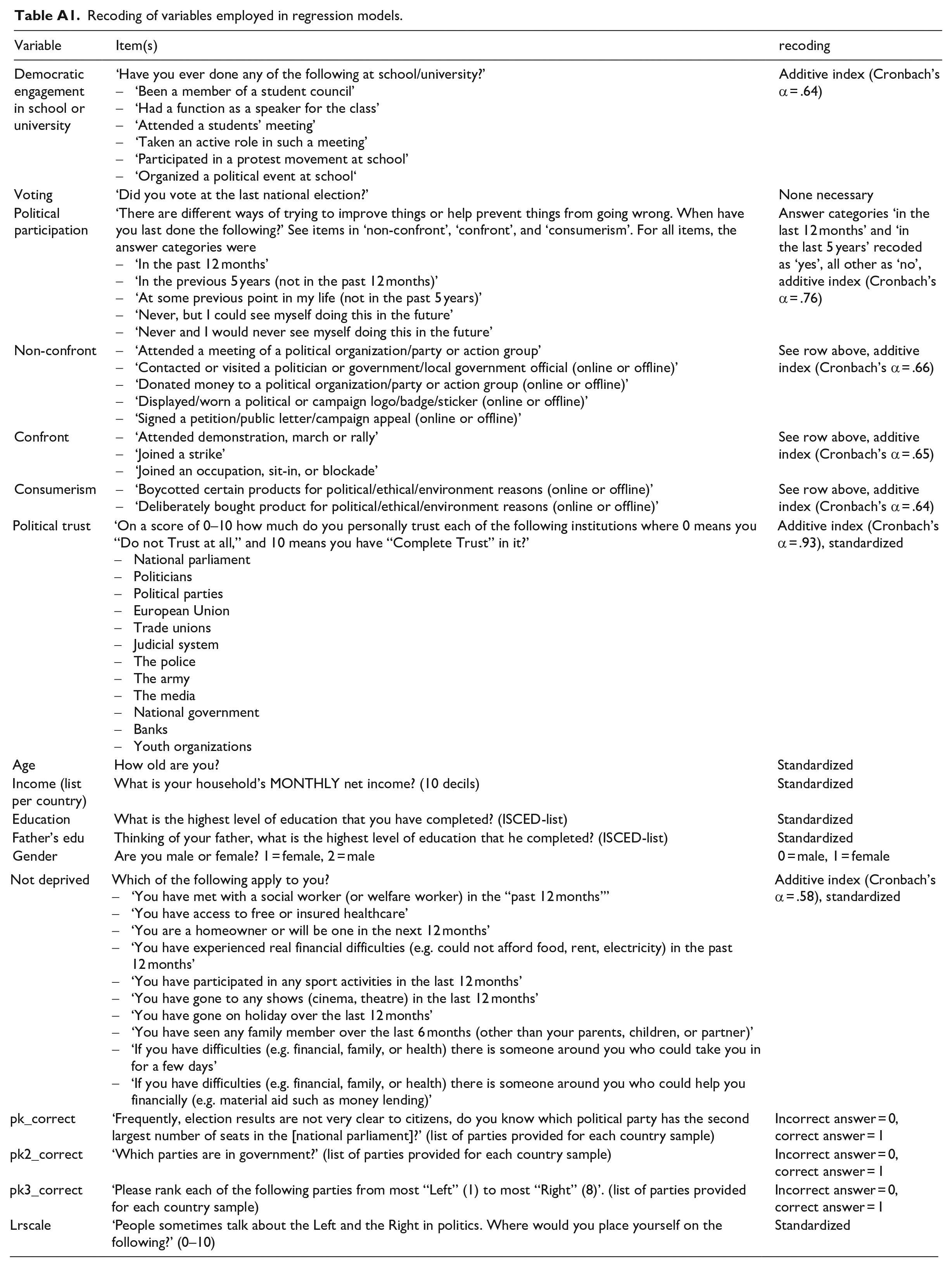
Recoding of variables employed in regression models.
| Variable | Item(s) | recoding |
|---|---|---|
| Democratic engagement in school or university | ‘Have you ever done any of the following at school/university?’ - ‘Been a member of a student council’ - ‘Had a function as a speaker for the class’ - ‘Attended a students’ meeting’ - ‘Taken an active role in such a meeting’ - ‘Participated in a protest movement at school’ - ‘Organized a political event at school‘ |
Additive index (Cronbach’s α = .64) |
| Voting | ‘Did you vote at the last national election?’ | None necessary |
| Political participation | ‘There are different ways of trying to improve things or help prevent things from going wrong. When have you last done the following?’ See items in ‘non-confront’, ‘confront’, and ‘consumerism’. For all items, the answer categories were - ‘In the past 12 months’ - ‘In the previous 5 years (not in the past 12 months)’ - ‘At some previous point in my life (not in the past 5 years)’ - ‘Never, but I could see myself doing this in the future’ - ‘Never and I would never see myself doing this in the future’ |
Answer categories ‘in the last 12 months’ and ‘in the last 5 years’ recoded as ‘yes’, all other as ‘no’, additive index (Cronbach’s α = .76) |
| Non-confront | - ‘Attended a meeting of a political organization/party or action group’ - ‘Contacted or visited a politician or government/local government official (online or offline)’ - ‘Donated money to a political organization/party or action group (online or offline)’ - ‘Displayed/worn a political or campaign logo/badge/sticker (online or offline)’ - ‘Signed a petition/public letter/campaign appeal (online or offline)’ |
See row above, additive index (Cronbach’s α = .66) |
| Confront | - ‘Attended demonstration, march or rally’ - ‘Joined a strike’ - ‘Joined an occupation, sit-in, or blockade’ |
See row above, additive index (Cronbach’s α = .65) |
| Consumerism | - ‘Boycotted certain products for political/ethical/environment reasons (online or offline)’ - ‘Deliberately bought product for political/ethical/environment reasons (online or offline)’ |
See row above, additive index (Cronbach’s α = .64) |
| Political trust | ‘On a score of 0–10 how much do you personally trust each of the following institutions where 0 means you “Do not Trust at all,” and 10 means you have “Complete Trust” in it?’ - National parliament - Politicians - Political parties - European Union - Trade unions - Judicial system - The police - The army - The media - National government - Banks - Youth organizations |
Additive index (Cronbach’s α = .93), standardized |
| Age | How old are you? | Standardized |
| Income (list per country) | What is your household’s MONTHLY net income? (10 decils) | Standardized |
| Education | What is the highest level of education that you have completed? (ISCED-list) | Standardized |
| Father’s edu | Thinking of your father, what is the highest level of education that he completed? (ISCED-list) | Standardized |
| Gender | Are you male or female? 1 = female, 2 = male | 0 = male, 1 = female |
| Not deprived | Which of the following apply to you? - ‘You have met with a social worker (or welfare worker) in the “past 12 months”’ - ‘You have access to free or insured healthcare’ - ‘You are a homeowner or will be one in the next 12 months’ - ‘You have experienced real financial difficulties (e.g. could not afford food, rent, electricity) in the past 12 months’ - ‘You have participated in any sport activities in the last 12 months’ - ‘You have gone to any shows (cinema, theatre) in the last 12 months’ - ‘You have gone on holiday over the last 12 months’ - ‘You have seen any family member over the last 6 months (other than your parents, children, or partner)’ - ‘If you have difficulties (e.g. financial, family, or health) there is someone around you who could take you in for a few days’ - ‘If you have difficulties (e.g. financial, family, or health) there is someone around you who could help you financially (e.g. material aid such as money lending)’ |
Additive index (Cronbach’s α = .58), standardized |
| pk_correct | ‘Frequently, election results are not very clear to citizens, do you know which political party has the second largest number of seats in the [national parliament]?’ (list of parties provided for each country sample) | Incorrect answer = 0, correct answer = 1 |
| pk2_correct | ‘Which parties are in government?’ (list of parties provided for each country sample) | Incorrect answer = 0, correct answer = 1 |
| pk3_correct | ‘Please rank each of the following parties from most “Left” (1) to most “Right” (8)’. (list of parties provided for each country sample) | Incorrect answer = 0, correct answer = 1 |
| Lrscale | ‘People sometimes talk about the Left and the Right in politics. Where would you place yourself on the following?’ (0–10) | Standardized |
Funding
The author(s) disclosed receipt of the following financial support for the research, authorship, and/or publication of this article: This project was funded by the European Commission under H2020 (grant agreement no. 727025). The Swiss part of the project was supported by the Swiss State Secretariat for Education, Research and Innovation (SERI) under contract number 16.0103. The opinions expressed and arguments employed herein do not necessarily reflect the official views of the Swiss Government.
