



Abstract
This article investigates Haifa Port’s carceral and mobile geographies by examining how Israel is being re-made, rebranded, and harnessed as ‘safe and secure space’ for the transits of global capital. The article contends with ports as key protagonists of empire, situated in an enduring and ongoing history of colonial routes and route-making that are raced and moving with/through the transits of colonised bodies and commodities. Haifa Port – and Israel itself – are examined as nodes in a matrix of global colonial-capitalist relations, moulded to an essential geographic rationale, in which everything moves and must continue circulating. Yet, in exploring the specific dense and durable materialities of Haifa Port – and the racial logics of the settler colonial state – the article also works to understand that which becomes contained and fixed in particular sites, spaces, bodies, and lives. This also helps point to whom and what sits outside them – vulnerable and threatening to Israel’s participation in global economic circuits and orders.
Introduction – A series of port revelations
The exciting history of the State of Israel is interwoven with Haifa Port, and therein is our future as a central economic engine and as a bridge to peace in the Middle East . . . Our innovative technology, professionalism and efficiency give us hope that in a future of peace, Haifa Port shall become the entry and exit gateway for all the countries of the Middle East. (Haifa Port Publicity Brochure, Haifa Port Company (HPC), 2019: 2)
The above quote, which appears on the first page of Haifa Port’s publicity brochure (pictured below, in figure 1), is keen to point out that Israel’s largest deep-water port is deeply entangled in Israel’s sense of self, and vice versa. Planned, funded, and built by the British Mandate (Norris, 2013), it opened for business on the Mediterranean’s northern coast in 1933. It has been a key target and site of Zionist/Israeli nation-building, ever since: 1 It became an anchor for the Zionist Labour Union (the Histadrut) since Zionist leaders first sought to replace Arab labour monopolies at the port in the 1930s. It was home base to the clandestine missions of the ‘Palyam’ (the pre-state naval militias), famed for their sabotage of British ships and ‘daring rescues’ of Jewish refugees from British detention camps in the 1940s. It was also a key site of Palestinian expulsion in 1948, as Haifa’s Arab residents were syphoned by Jewish militia units into docked ships that transported them northward into Lebanon (Masalha, 2012); and it was the first point of encounter for the flow of Jewish immigrants from the Middle East, North Africa, and Europe, who came to replace them.
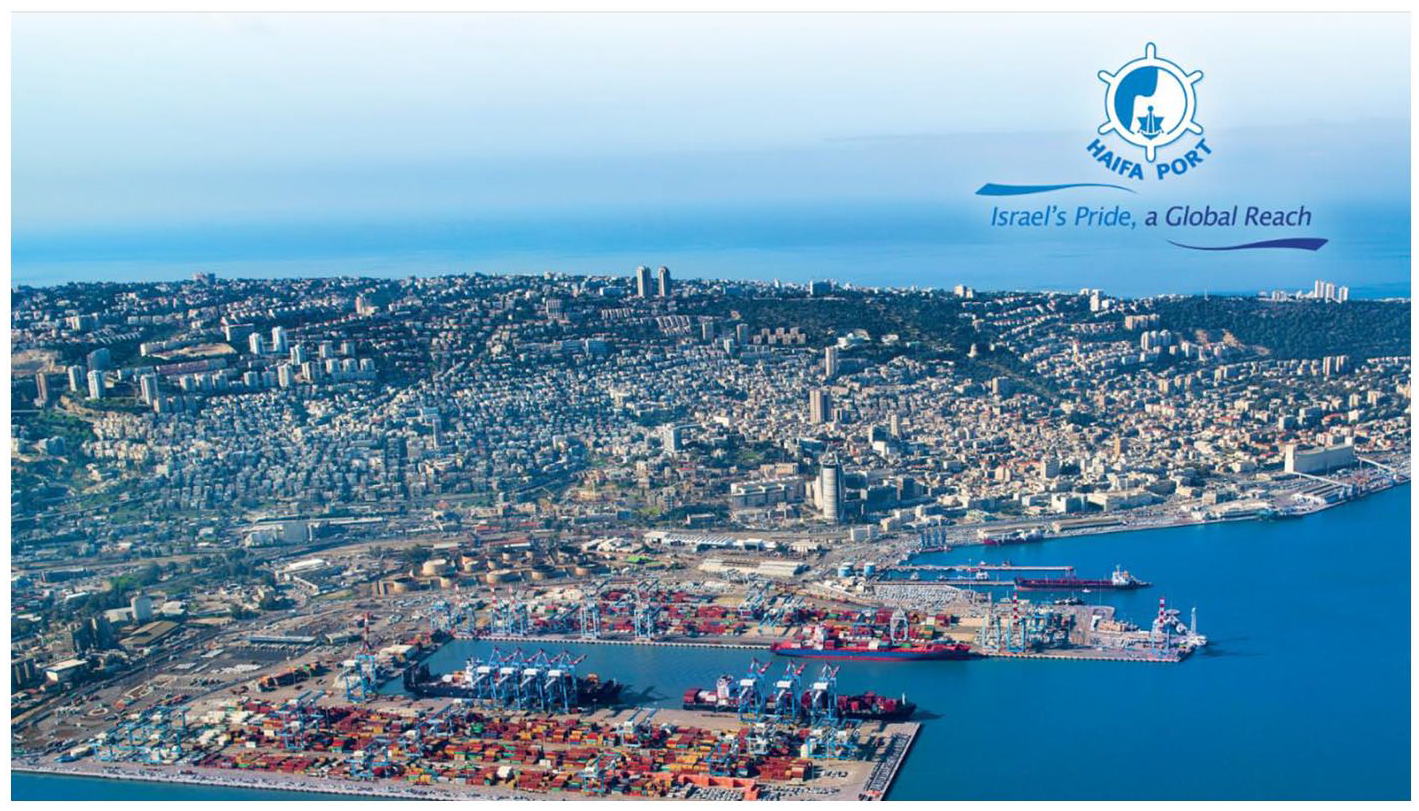
Cover of the Haifa Port Publicity Brochure, 2019 (Haifa Port Publicity Brochure, HPC, 2019).
These gestures towards fundamental moments in Israel’s national memory are what drew me to Haifa Port, with its trajectory as Israel’s ‘national pride’ – another trope from the brochure – tied to this past. Particularly as Israeli officials and port spokespeople have projected and translated this past into an imagined global present and bright future, as one of the world’s most efficient, technologically secure, and green ports (HPC, 2019; Merk and Dang, 2012; Port Technology International (PTI), 2015). This is a future that includes seeing the port, and thus Israel, as an integral ‘gateway for all the countries of the Middle East’. A provocative idea, given Israel calls itself a ‘villa in the jungle’ (Bar and Yosef, 2013; Yacobi, 2016: 2), a racial discourse and practice famously materialised through the capture and containment of Palestinian bodies and compounded in ever-evolving high-tech fortifications along intentionally undefined borders (Weizman, 2012). Thus, while Haifa is imagined as a space of/that flows, it is quite literally grounded in a past, present, and future reality of carceral limits (Chua, 2018). This paradox points to Haifa as a significant site for examining the enduring story of Israeli – and global – colonial and capitalist mobile and immobilising logics, and one I am particularly interested in exploring in this article.
This article makes three claims, stemming from these seemingly contradictory threads of material groundings and fantasy flows. First, that Haifa Port, like all contemporary ports, offers a window into the centrality of maritime infrastructures to the movements and emplacements of colonial and capitalist relations, and the violences that make and sustain them. More than 80% of goods traded globally still physically travel through maritime routes, the equivalent of 11 billion tonnes of cargo in 2018, and make up 70% of the global economy (UNCTAD, 2019); Israel itself channels 99% of all its imports and exports by sea (Zuckerman, 2018). Moreover, with China’s 2013 launch of its ‘Belt and Road Initiative’ (BRI), a massive global infrastructure project to bring together over 10,000 km of land and sea networks, a country’s capacity to hinge its transport infrastructures to these channels has been deemed integral to its survival (IMF, 2017). This means modern ports are fundamental political sites, despite their invisibility in relation to more spectacular frontlines of contention. In fact, they are increasingly built to be invisible, so they can continue to do the necessary work of circulation, without disruption (Appel, 2019; Larkin, 2013). I argue that it is important to interrogate Haifa Port as a conduit and container of both Israeli and global politics, and thus reveal the carceral practices needed to make Israel ‘flow’.
My second claim sees the intentional grappling of Haifa Port to global capitalist infrastructures as harnessing older, imperial routes; a practice that inheres across contemporary trade and transport regimes and continues to structure geo-economic relations (Cowen, 2020; Khalili, 2020). Given Haifa’s enchantment with its past, I argue that following these routes in the present requires investigating their histories as part of colonial jurisdictions, governing logics, racialised movements, and modes of conquest (Karuka, 2019). In Haifa itself, zeroing in on how bodies, materials, and practices circulated through and in relation to British imperial terrain clarifies how these became fixed but also unmade in the particular operations and ideologies of the Zionist settler colony in Palestine.
This brings me to my final claim that these colonial flows get captured in and rearticulated as Israeli space to shape the country’s/the port’s present (as fortress) and future (as gateway). Moreover, it is these contradictory yet co-existing geographic logics that turn Haifa/Israel into secure space for the movements of global capitalism. By examining both historical and current reports from the Organisation for Economic Co-operation and Development (OECD), World Bank, and other global institutions, it is clear that decades of producing and relying on a racialised, classed, and gendered system of spatial hierarchies, both within and well-beyond its borders, projects – and ultimately sells – Israel as an advanced, high tech, and secure state on global stages (Clarno, 2017; Dana, 2020). Inspired by Cowen’s (2014) Deadly life of Logistics, the article unveils Israeli modes of policing and violating borders, as moulding to the needs of global interlocutors of logistics, trade, and transport industries (and vice versa). As Cowen (2014) explains, contemporary capitalism’s acute dependence on the unceasing and unending flow of goods across vast and unevenly connected global supply lines is always vulnerable to threats, which are inherent to such a system. I argue that this makes Israel seem particularly appealing to an industry that is, accordingly, constantly seeking newer, smoother, cheaper, and faster ways of contending with and bypassing the holes and tears of capitalist geographies (Bernes, 2013).
These claims offer several interventions, foremost against mainstream analyses of ports as neutral sites that are at the same time urgent and necessary for the workings of national and global economies (Kessides, 2004; OECD, 2015). More specific to the site of Haifa, the article challenges political and scholarly work that abstract Israel’s economic and infrastructural terrain from violence circulating elsewhere in, through, and by the country. While clearly a trope of those figures seeking to normalise Israel as part of regional flows, 2 this can also be the case with those seeking to do the opposite. Many scholars of settler colonialism in Palestine offer powerful explorations of the violence produced on Palestinian territory and against Palestinian bodies, including through spotlighting infrastructure. 3 Yet, this work has the potential to restrict analysis of colonial relations to the sites and practices that directly manage, contain, and disrupt Palestinian life and space, even as it does excellent work to unveil Israel’s carceral practices. Informed by the growing scholarship on critical logistics, infrastructure, and geo-economics – alongside Indigenous and postcolonial studies – I shift attention to Haifa Port as integral to and generative of raced and colonial relations in Palestine/Israel, because of its paradoxical relationships to both circulation and securitisation. 4 This article builds on 3 years of research at the port (2018–2021), including multiple field visits, participant observation of port activities, and dozens of interviews, alongside Haia Port’s own commercial, planning and financial documents, British and Zionist archival materials, as well as reports from across the maritime transit sector. On this basis, I extend the prism of settler colonial machinations to include both infrastructures that enable movement and those that block them (Byrd, 2011; Massey, 2005).
The article does this through the following roadmap: In the next section, I situate Haifa Port conceptually and materially within past and contemporary national, global, colonial, and capitalist geographies. I then shift to a more empirical reading of Haifa Port, as a site through which to unpack these complex and productive spatial-temporal relationships. Over three sections, I interrogate the history, present, and future of Haifa Port’s regulatory, labour, and physical infrastructures. I tease out the necessary groundwork put in place to open Haifa Port to global economic circuits, while state practices of closure, racial striations, and securitisation are maintained on the ground; both of which sustain the political economy of the settler colonial state as part of international capitalist flows. The article concludes with a short epilogue about the port’s future, in the shadow of an increasingly global Israel in a ‘New Middle East’.
Ultimately, the article contributes a window into the fantasies and frictions of national and global infrastructural circuits, revealing Haifa Port as a site built with and through violence, as well as a site that facilitates and circulates violence. Bound up with Israel’s colonial and racial geographies, the violence of the port, like the state in which it is fixed, easily hides through an assemblage of physical, technological, and managerial infrastructures (Latour, 1993; Ong and Collier, 2005). This article explores the tangible and virtual materials that give the port shape, make it ‘work’, and enable that which is otherwise grounded in a particular place, to take part in a world of flows. In so doing, it asks how such processes – which need, produce, and normalise the erasure and replacement of Palestine – disappear from view, as they are secured and branded as fundamental to global trade, governance, and development.
Enduring and durable lines – the colonial and capitalist (infra)structures of Haifa Port
Like all colonial and capitalist configurations, the geography of Haifa Port was neither a divine nor natural gift (Said, 1993; Spillers, 1987). Yet, the idea of Haifa as ‘a natural outlet of Palestine’, evolving, seemingly miraculously, into one of the world’s ‘most valuable gateways’ (Casto and Dotson, 1938: 344, 346), traverses much of the development and historical materials on the port. 5 The erasure of an imperial political calculus in the evolution of Haifa Port – and the larger narrative of how Israel is harnessed to global capitalist circuits – is part of what this article seeks to contest. Over the next pages, I follow Haifa Port through its multiple lifeworlds, as a way to reconnect and make visible the colonial forces that made, structure and endure in this particular port, and in the larger national and global flows and blockages in which it participates. This involves tracing the past and present materials, labourers, funders, regulators, and beneficiaries of its infrastructural terrain, as well as those displaced, contained, and brutalised by its presence. As recent work on colonial railroads and maritime causeways demonstrate, in attending to the concrete journeys of infrastructure, we are also following the concrete journeys of colonial conquest and the incarceration of Indigenous space and life (Cowen, 2020; Karuka, 2019).
We begin with Khalili’s (2020) advice to look for the sea’s enduring and durable lines, as current shipping routes consistently follow historical pathways, made secure and passable through the journeys of imperial seafarers. Haifa was conjoined to the sea through the British Mandate’s desire to stamp their presence on the Palestinian/Middle Eastern landscape. As Herbert and Swope (1989: 314) point out,
in the more prosaic, but no less far-seeing, debates in Whitehall, with their emphasis on British commercial interests and Imperial defence, Haifa was seen as a key not only to the eastern Mediterranean but to the Middle East as a whole.
Haifa Port was intentionally gauged out of the sea to become a concrete manifestation of British imperial imagination. As new material infrastructures were built to re-write the direction of traffic 6 – a destructive impulse that ultimately killed off other local gateways to the sea (Jaffa and Acre are two such casualties) – the British carved out Haifa Port as a hub of empire (Bernstein, 2000; Norris, 2013; Shamir, 2022).
Yet, while Haifa is imagined here in spectacular terms (as figure 2 helps articulate), it was also remarkably unexceptional in its treatment as part of a string of British entrepots across the region. By the opening of Haifa Port in 1933, the British empire had already established port-cities as essential symbols and anchors of its maritime power (Ramos, 2010). Incursions of British capital, soldiers, and maritime infrastructures had been burrowing their way into the Middle East and North Africa for over 50 years. First in Aden (1837), which acted as fuelling station and strategic outpost for British military and trade ships traversing the Indian Ocean (Barak, 2020), then in Egypt, where the British financed (and then repossessed) the most-important maritime passage in the world, the Suez Canal (1869). As oil deposits were discovered and increasingly replaced coal in British fleets and industries, one after another, states along the Persian Gulf were brought into the fold, with the British establishing treaties, exchanging protection for exclusive trading rights (Khalili, 2020). By 1922, the Mandate in Palestine made the set complete, giving shape to the more streamlined, cheaper and more extractive mode of colonial management that constituted British imperial holdings in these later phases of empire (Lowe, 2015).
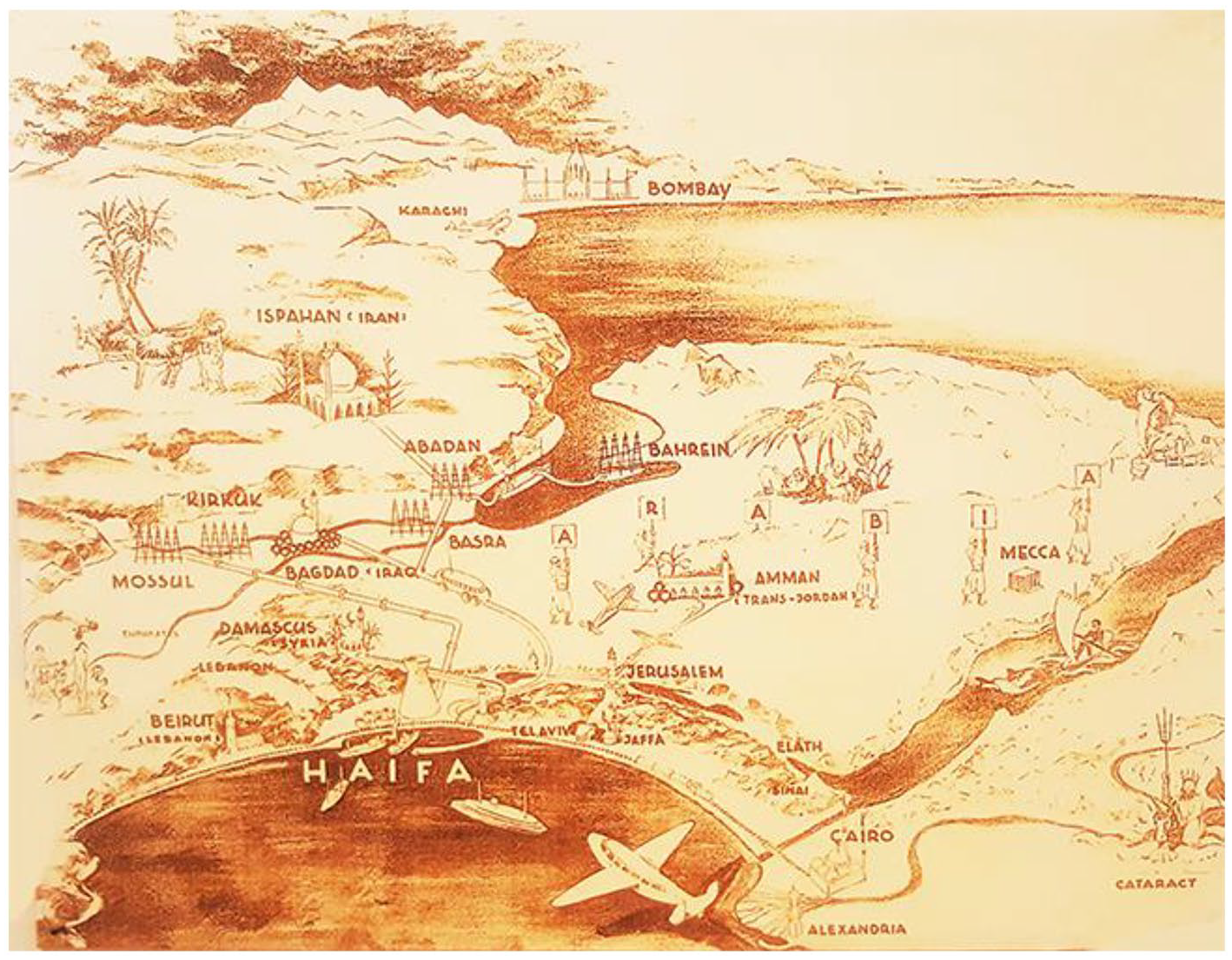
Haifa as Gateway to the East, Image by a ‘British illustrator, 1930s Mandate Period, Haifa Municipal Archive’ (available at: http://www.yoaview.com/Yoaview/SITE/?action=showobject&sn=2_871).
Positioning Haifa Port as a node along a line of imperial stations is fundamental to understanding how it operates and relates to the world I am investigating. The port, despite its densely physical presence – with its gargantuan cranes, locked gates, and concrete berths – is highly relational (Chua, 2018; Cowen, 2014). To use Khalili’s (2020: 34) poetic conceptualisation, the port ‘ripples’ with the circuits and circuitries of global capitalism; what happens in one effects and transforms other nodes along the line, but also that which sits outside these lines. In Benton’s (2010: 2) work on the legal infrastructures of colonial sovereignty, she argues, ‘empires did not cover space evenly but composed a fabric that was full of holes, stitched together out of pieces, a tangle of strings’. These holes in space cultivated and enhanced highly uneven political processes that produced and conceived of territories and bodies beyond the pale of settlement as dangerous and threatening, drawing racialised lines between them (Fanon, 2004 [1963]; Mezzadra and Nielson, 2013). Built as ‘infrastructures of reaction, as attempts to control the future’ (Karuka, 2019: 40), the colonial port was made to hold those strings together, connecting but also securing critical points of transit; a project made especially concrete in Haifa, as it was designed with dual purpose, as both a naval base and shipping hub (Shamir, 2022). From here, concentrations of military, legal, and governing powers organised and pacified surrounding waters, lands, and peoples, holding imperial space against the sovereignty and resistance of those Indigenous and racialised others who might challenge them (Benton, 2010; Lowe, 2015). Thus, with the port channelling capital and colonial flows along limited and narrow spatial corridors, the veins of local lives and territories were also transformed; recalculated in a literal materialisation of risk and safety, threat and security (Chua, 2018).
At the same time, the port is and has always been more than its relationship to global forces. As sites that both enabled and controlled the movement of things and people, and as sites affixed to land, even as they were turned to the sea, they were also deeply tied to and mired in the national/local spaces in which they were embedded. From all accounts, Haifa Port fed the city around it and became a magnet for an influx of people and politics. Between 1922 and 1946, the city’s population grew from 22,634 to 145,430, becoming home to new transits and concentrations of commerce, investment, infrastructure, and development (Norris, 2013). For two decades, Haifa hummed with the rhythms of union activism, Palestinian and Zionist nationalisms, British, Jewish, and Arab capitalists, and the noise of ships, railroads, and the uneven performances of human life (Lockman, 1996; Mansour, 2006; Seikaly, 2015). Thus, when Haifa/Palestine was cut off from the region in 1948, the city effectively died without access to its hinterland routes (personal interviews, JM, 2016; RB, 2016). And yet, Haifa Port survived. In fact, Haifa Port’s survival in many ways generated and was generated from the enclosure of Palestine, manifesting as part of Israel’s self-declared and self-imposed carceral geographies. Like all ports, it was made into an outlet and a site of capture, tied to a physical and imaginative geography that needs enclosure to make things flow (Chua, 2018).
These earlier configurations of race, colonialism and capitalism intersect in the following sections, where I trace the space being made for Haifa Port within contemporary trade and transit corridors, or what Jasper Bernes (2017) calls ‘a world of walled flows’. Bernes’ phrasing helps conceptualise Haifa amid a cartography of highly secure and controlled global channels. As Cowen (2014) argues, these corridors operate through two key, intersecting logics of capitalism: circulation and containment, or in infrastructural terms, flows and blockages. Adding to this, Pasternak and Dafnos (2018) claim they are also foundational to settler colonial governance, jurisdictional sovereignty, and the making of white, settler space. Building on these ideas, I follow the infrastructural terrain undergirding the modern settler colonial state (aka Israel), and the way these contradictory logics travel through Haifa.
The view from Haifa Port
Patchwork geographies – Making the ground ready
At present Israeli ports are almost exclusively dedicated to serving the Israeli market, with only a relatively small amount of international transhipment trade . . . However, this was not always the case and Israel’s Mediterranean ports are well-located to serve neighbouring countries’ trade with the West. (Israel Ports Strategic Development Plan, 2006–2055, Israel Ports Company (IPC) and Royal Haskoning, 2006: 27)
In February 2005, the Israeli state announced three new ‘borders’ to the world. The first of these was expressed through visceral images of soldiers dragging screaming settlers from the newly sealed-in Gaza Strip (Perugini, 2019). The second made its appearance more quietly in Israeli government protocols, as a final route for the West Bank Separation Wall was approved by cabinet officials (BBC News, 2005). The third barely registered beyond those directly affected, in part because it was made through bureaucratic sleight of hand, as the protracted outcome of years of backroom gambits between port managers, government ministers, and neoliberal financial planners (Zuckerman, 2018); and in part because it sat in the shadows of these other, more violent border-making moments. I am speaking of the decision to restructure Israel’s ports into three separate operational companies (with the state retaining ‘landlord status’), and thus allegedly laying the foundation for new opportunities for profit-making, speculation, and competition. Haifa Port’s ‘global reach’ locates its rebirth in this moment, when it was allegedly unshackled from government protections (Zuckerman, 2018) and opened up to the new capitalist idols of circulation and flow, alongside and constitutive of the closure and containment instigated further south and east.
Bringing these three borders together does important work towards understanding the relationship between material closures and regulatory or jurisdictional openings in settler colonial relations (Pasternak and Dafnos, 2018), and the importance of thinking of situated practices as part of much larger, but still thin geographic patchworks. Brought together, they visibilise the making of Israeli ground ready for its future, as part of key infrastructures of transformation, in/through which (racial) capitalism is and could be contained and circulated (Karuka, 2019). In later sections, I consider the material conduits that secure, connect but also cultivate and excise the holes and tears in (inherently uneven) colonial and capitalist landscapes (Bernes, 2013). However, here, I am looking at how these ruptures in 2005 – between the port companies, as much as between Israel and Gaza, or Gaza and the West Bank – in addition to producing new limits to Palestine, became an important step towards reconfiguring Israel/Haifa Port as part of a burgeoning ecosystem of circulation. Again, it points to ruptures and flows, blockage and movement, carcerality and mobility as always simultaneously present, in the making of capitalist circuitries (Chua, 2018).
In 2005, the forcing of Haifa Port into direct operational competition with its previous partners was not an isolated event, but part of national and global calls to restructure and privatise all government-owned enterprises. As Hanieh (2003: 16) contends, by the early 2000s, Israel was reeling from a long and protracted recession; a crisis triggered primarily by its expenditure on containing the Palestinian Intifada and ‘compounded by a global economic downturn’. Picking up on a process that had begun in the 1990s (alongside the promises of Oslo), Israel’s then-Finance Minister, Binyamin Netanyahu, developed an Economic Recovery Plan intended to cut US$2.4 billion in government spending from welfare packages, public services, and especially the wages of state employees. The linchpin of this plan was the push to shed state assets and open key Israeli industries to private capital (Nitzan and Bichler, 2002). Based on recommendations by the International Monetary Fund (IMF) and in accordance with conditions set out by US loans and military grants, one after the other of Israel’s major national monopolies fell under the rubric for privatisation (Dana, 2020). 7
In Haifa Port, the process towards privatisation took much longer (in 2021, it is finally near completion). The same 2005 legislation that inaugurated the severed port authorities also included a detailed plan for introducing private actors into the port, with the expectation that by 2020, the private sector would be the majority shareholders (IPC and Royal Haskoning, 2006). The plan included the negotiated release of a third of its workforce, alongside heavy investment in advanced technologies and infrastructure, and was geared towards making the port efficient, streamlined, lean, and therefore competitive in the Mediterranean basin, as well as ‘attractive to private operators’ (IPC and Royal Haskoning, 2006: 6). Until 2005, the ports were allegedly turned inward, highly dependent on Israeli trade. The rationale was to shift the vantage of Israel’s ports to the global; to reconfigure the port-space, its hinterland connections and mode of working, from ‘national port’ to ‘international transhipment hub’ and to be born again as ‘Gateway to the West and to the East’ (IPC and Royal Haskoning, 2006: 27).
Opening/alienating Haifa was part of a domino of infrastructural transformations in Israel, that harnessed international standards, technologies, and biases with the idea of reshaping the country’s supply chain relations, in accordance with what has been called a ‘revolution in business logistics’ (Bernes, 2013; Chua, 2018; Cowen, 2014). Ongoing since at least the 1960s, the field of logistics has undergone extraordinary growth in the last two decades ‘fuelled by innovations in transportation and warehousing, the restructuring of production and management relations, new ways of selling products, and a global assault on labour’ (Danyluk, 2017: 3). Its infrastructural footprints proliferated in the global adoption of Just-in-Time production and distribution philosophies, which conceptualises the flow of goods and circulations of capital as crucial to economic growth. Any stagnation or stoppage in these flows is deemed a danger to the health of national and global economies, and thus capital/goods must keep moving at all costs (Cowen, 2014). Logistics became both method and rationale for the organisation and securitisation of supply chains, as a comprehensive, singular system of constant movement (Chua, 2018).
Like the port, making logistics ‘work’ is a highly political act. After decades in which large-scale development projects had dissipated, from 2003 onwards a plethora of OECD, World Bank, and IMF reports have promoted the idea of physical infrastructures – organised around the needs of a global logistics ecosystem – as the proxy benchmark of a country’s capacity for growth and stability. 8 This has led to the building of extensive (and expensive) port, rail, and road infrastructures across the Global South, with private and public investment funnelled into fixed sites and controlled channels that can be surveyed and secured at all costs (Danyluk, 2017). It has also triggered the cultivation of systems and spaces reordered towards the containment of disruption and the figuring of particular groups and places as ‘unsafe’ and ‘threatening’ to these integral circulations. As Cowen (2014: 56) argues, ‘disruption is the Achilles Heel of global logistics systems . . . While these models of security prioritize flow, they are organised through new forms of containment’.
This takes us back full circle, to an evolving line connecting Haifa’s contractions and expansions in 2005, to an expanding fortress of walls, security check points, high-tech surveillance, and military personnel snaked along Israel’s edges and scaffolded deep within Palestinian territory, in 2021. Logistics rationales and technologies inherently produce ecosystems of confinement alongside a complex chain of flows that both traverses and entrenches borders (Chua, 2018). New sites, violences, and techniques of displacement inside and outside national territory, necessarily accompany the production of allegedly safe and secure causeways for the traffic of goods and capital. When we look at Haifa Port, the West Bank Security Wall and the enclosure of the Gaza Strip together, we can see how they feed and produce one another, articulating a seemingly endless circulation between the generation of new vulnerabilities and points of disruption, which in turn need to be defended and patched. In the next section, I explore these mobile and carceral circuits through the scale of Haifa’s labouring bodies, to think with how these circulations become sedimented in and flow with Zionist delineations of space and race.
Haifa’s labouring bodies – The raced relations of the settler colonial port
We must entrench ourselves in every field of economic endeavor in the land of Israel, and the conquest of the sea is vital . . . No Jews are as capable when it comes to seagoing professions, and none could occupy these positions as swiftly, easily, and naturally – and inexpensively – as the Jews of Thessaloniki. (Baruch Uziel, ‘Jewish Immigrants from Thessaloniki – Bother or Blessing?’, Haaretz, 1931; cited in Srougo, 2003: 88)
In this section, I consider the carceral violence of Haifa Port’s border infrastructures through the lens of labour. As Lowe (2015) argues, racialised lines of dislocation, displacement, belonging, and containment are constituted in the lives and experiences of those who encounter and work in the (colonial) port. In this section, we follow the labouring bodies of Haifa Port, as they move with and in relation to the uneven transits of empire (Byrd, 2011), generating but also reproducing and refining seemingly durable and enduring infrastructures of race, class, and gender in Palestine.
To do this work, I focus on Haifa’s front-line dock workers and operations teams; those whose primary concern is the loading and unloading of ships, and who physically control the valve through which goods flow in and out of the port (Chua, 2018). While it is difficult to trace the racial makeup of Haifa’s labourers with any statistical accuracy, my own observations from visits and conversations at the port point to the overwhelming presence of middle aged, Ashkenazi (European/white) Jewish men, with strong links to the national trade union (the Histadrut). Many attained these roles through family ties or through their military service in the naval forces, and after decades in their jobs, hold onto salaries well-above the national average (Personal Interviews, AS, 2021; YM, 2018). 9 With the capacity to funnel, arrest and even sabotage circulation through the port, this particular labour-group has retained immense collective power over Israel’s economic supply lines (Personal Interviews, ZR, 2016, 2020; YM, 2018, 2021; AF, 2020, 2021; YZ, 2021). As many of my port interlocutors also mentioned, they are permanently fixed to Haifa, literally holding the port captive in its attempts to build towards its future (personal interviews, ZR, 2016, 2020; YM, 2018, 2021; AF, 2020, 2021); a practice they seemed to have inherited and which I now try to trace.
Haifa, like all ports, has always been a site of capture – hoarding as much as circulating capitalist materials – and, because of its importance at the helm of colonial infrastructures, a key site to be captured (c.f. Chua, 2018). It is therefore unsurprising that the history of the Zionist conquest of Haifa travels directly through the port’s labouring front lines. This follows a fundamental logic of Zionism in which the capture – and settlement – of land required the capture of labour flows, which in turn produced the material displacement and replacement of Indigenous Palestinian labourers (Englert, 2020). In its first decades in Palestine, Zionist colonial ideology was honed through the accumulation of Jewish agricultural settlements, known as the Kibbutz Movement. However, by the time the British Mandate launched its modern port in Haifa, the Zionist Movement’s focus had already turned to urban centres, with increasing numbers of Jewish immigrants being syphoned into the coastal cities, alongside new flows of capital and development. With British support, the drive to penetrate and capture the labour market from Arab workers also spread (Norris, 2013), and the port quickly became a strategic target. Yet, by 1933, a few Jews had managed to gain a foothold in the maritime industries and made up only 10% of Haifa Port’s workforce.
Like most Mandate enterprises, Haifa Port was managed by British interlocutors. However, the port’s physical labour force was almost entirely sub-contracted out to Haifa-based Arab middle-men, who in turn recruited their workers from the ever-growing supply of cheap labour migrating through new pipelines of British conquest across the Levant (Bernstein, 2000). The main supply came from a constant turnover of workers from the Hourani region of Syria, supplemented by Egyptian Sa’idi (originally Sudanese) workers. This latter group was given the most backbreaking work of loading and unloading coal steamer ships, much as they had been doing in the Suez Canal (Cohen- Hattab, 2019). 10 The more entrenched, Haifa-based Palestinian workforce had already begun refusing the long hours, starvation wages, and precarity of port-based work (Bernstein, 2000). Thus, when the Zionist Movement sought to infiltrate the port, it needed to contend with a division of labour that had already been commodified and raced, according to British colonial circuits of labour (Norris, 2013). These material divisions easily intertwined with the evolving racialised discourses of Ashkenazi Jews, in their new encounters with Eastern/Ottoman Jews in Palestine, the Balkans, the Middle East, and North Africa, who were deemed less white, less European, and less Zionist than themselves (Hayoun, 2019). They became the solution to the conundrum of Haifa Port’s capture and triggered an oft-mythologised head-hunting mission led by Abba Hushi, the head of Haifa’s Labour Council, to Thessaloniki, the Greek–Jewish Port (Israel History Channel, 2011). There he found a vulnerable Sephardic 11 workforce, experiencing extensive anti-Semitic violence and acute impoverishment in the wake of political and economic shifts after the fall of the Ottoman Empire (Peleg, n.d.).
According to Srougo (2018), Hushi’s efforts to import a feasible replacement for cheap, exploitable Arab/Sudanese labour meant discursively and materially reshaping the Thessaloniki longshoreman into their (racialised) equivalent. He writes,
The Jews here spend their lives doing things even the Arabs can’t do back home . . . the workers carrying the coal . . . were as blackened by it as the Egyptians from Port Said who work in Haifa. But the Thessalonikans are better workers. (cited in Peleg, n.d.)
As becomes clear across his memoirs and letters, this articulation of the Thessaloniki-Jew as a ‘blackened worker’ should be read the way Hushi seems to have intended it: as fundamentally, even inherently, racialised and classed and thus a perfect re-imagining of ‘Oriental’ Jews to fit the needs of the European/Zionist project in Palestine; they emerge from the Port of Thessaloniki, already ‘blackened’ by both their labour and their poverty, ready for transport to the colony. According to Srougo (2018: 402), Hushi saw integral similarities between the poverty of the Thessaloniki Jews and the ‘socio-economic characteristics’ and ‘level of development’ of the Arab workers in the port, whom he felt had an unfair advantage in so far as their ‘standards of living’ and ‘social needs were minimal’. In exchange for immigration certificates, the Thessaloniki workers were coerced into draconian contracts that committed them to the same or worse conditions as their Arab counterparts; and, moreover, sought to permanently trap them in the port, when they began to resist this treatment. By 1935, the situation unravelled. Mounting clashes between the will of Zionist labour councils and those of the Thessaliniki workers lead to their eventual escape southwards to Jaffa and Tel Aviv ports, and the emptying of Haifa Port of its non-white Jewish workforce.
With Jewish claims on Haifa at risk, Hushi (re)turned to the Kibbutz movement – those already committed to the mission of land and labour capture – for solutions, claiming ‘from a social standpoint [the Thessaloniki workers] are poor human material in all senses. For that reason, we are trying to assemble pioneer forces for all the maritime occupations, with the help of the kibbutzim’ (cited in Srougo, 2018: 409). At the end of their ‘failed experiment’ in Thessaloniki, the Haifa Council wanted workers ‘dedicated and loyal to the Histadrut, that know the mission they must carry out, and that will succeed in this work and in the joint working life with the Salonicans to influence them and teach them’ (cited in Cohen-Hattab, 2019: 117).
In 1935, Kibbutz ‘Plugat HaYam’ (the Sea Company) was founded in Haifa, and its workers were channelled directly into the port’s key occupations (Cohen-Hattab, 2019). The same movement, also known as the ‘Palyam’ (which I discussed above, in the ‘Introduction’), inevitably fed the maritime arm of the Jewish pre-state militia. This same group later became the Israel Defence Force’s navy unit, which was founded at and continues to dock at Haifa Port. It feels uncoincidental then, that the contemporary port remains the captive holding ground for so many ex-navy men.
Haifa’s labour infrastructures travel with the grain of colonial threads, from brown to white bodies, precarious to unionised workers, civilian to military workers, imperial to settler colonial governance. However, in taking a moment to consider the movements of the Thessaloniki port-workers, the story becomes messier. It speaks to how physical labour, alongside the circulations of colonised subjects, racialised certain bodies and certain classes to make the imperial project work; a process which continues to structure labour relations between European, Mizrahi (Sephardic), and other (non-white) Jews, as well as Palestinian and foreign workers in the present (Englert, 2020; Kaminer, 2019). In Haifa Port, pre-existing lines of race and class intersected with and became entrenched in the project of Zionism, which turned Arab labourers into a threat to be removed, and turned Jewish workers, blackened by coal and allegedly accustomed to poverty and hard labour, into their racialised replacement. Yet, through Thessaloniki resistance to the racial striations of Jewish labour, the port underwent another phase of moral and physical capture, by a whiter, more Zionist labouring body.
With Palestinians and brown Jews long ago excised from Haifa’s docks, the contemporary port’s front lines continue to resonate as a Zionist stronghold (or ‘national pride’, as we have learned from the promotional brochure). This is made more material with Israel’s naval forces sitting just metres away from the port’s control towers. In the next section, I rethink Haifa’s racial transits through what it might mean to normalise this acutely Zionist story-line as integral to maritime circuits, and the infrastructural fantasy giving Haifa Port/Israel its new ‘global reach’.
Infrastructures of the future – The fantasy of a secure port
Haifa Port is the leading port in the ‘Start-Up Nation’ and stays true to Israel’s strengths by being a technologically ‘smart’ port. It is a leading player, innovative in its operations, with a continuing passion for developing tools to serve the maritime community. (Port Technology International (PTI), 17 September, 2019)
In this final section, we travel from the physical, regulatory, and labour infrastructures of past and present, into an imagined future in which Haifa/Israel can be re-made, rebranded, and harnessed as ‘safe and secure space’ for the transits of global capital. In what follows, I trace the fantasy of such a corridor as another infrastructure of transformation, through the racialised political calculus needed to position Haifa/Israel as a sentinel for Middle East trade. Guided by an as yet, still-speculative infrastructure, this section works to reveal the entanglements between material and imagined geographies – and thus between knowledge and power, practice, and technique (Gani and Marshall, 2022) – in the making of seamless logistical lines across the holes and tears in global capitalist circuits. It is also inspired by Nivi Manchanda’s (2020: 27) Imagining Afghanistan, in which discursive regimes are deemed foundational to the making of the Pashtun into a ‘graveyard of empire’, and to the production of Afghanistan as a place where violence is inevitable and thus permissible. In what follows, I explore representations of Haifa as ‘the global port of the future’ as having tangible and dangerous effects on those deemed threatening to such a project (aka Palestine/Palestinians).
Israel’s volatile relationships in the region have produced extensive infrastructural gaps and blockages (personal interviews, AF, 2020, 2021). Thus, to make Haifa Port a hub of seemingly frictionless movement requires extensive political coordination, jurisdictional shifts, and high-level decision-making by international bodies, not to mention incredible faith that such a project could work and can galvanise the appropriate funds to support it. 12 These decisions operate through and generate multiple fictions. These include the World Bank metrics that paint Israel as a desirable economic partner, a site of extensive de-regulation and freedom (for capital) to move, and an easy place to do business and in which to invest (c.f. Tress, 2019; WBG, 2020). The OECD furthers this fantasy by promoting the relevance of innovation to driving ‘productivity, economic growth and development’, while shining a light on Israel as ‘the start-up nation’, with so much to offer (Moss, 2011). In another report, Israel is ranked as leading all OECD countries in Research and Development (R&D) investment in high tech start-ups and is among the most active in producing cutting edge Information and Communication Technologies (ICT) (OECD, 2017). The maritime industry has followed suit. Industry leaders and trade journals consistently point to Israel’s port communities as innovators of maritime tech, exemplified in their piloting of block-chain ecosystems, ‘Smart’ technologies and cyber security solutions (PTI, 2019; Smart Maritime Network, 2020). In this world, Israel is deemed central to the evolving needs of and threats to global circulation.
As Dana (2020) argues, there is a fetishisation of both Israel’s high-tech industries and military capabilities. These are fundamentally woven together through the circulation of expertise and hardware. For example, Israel’s elite military intelligence unit, ‘8200’, is infamous as a direct channel into high tech university programmes and jobs (as any ICT-based website’s staff pages can tell you). Moreover, more than 30% of Israel’s R&D investments are tied to security technologies that have been produced and tested through military practices (Al’sanah and Ziadah, 2020). These include artificial intelligence software, automated weaponry, and surveillance technologies that fortify Israel’s border security and are now being commodified and exported around the world (Manchanda and Rossdale, 2021). What tends to be erased in hailing the ‘miracle’ of Israeli tech (Bohbot and Katz, 2017) is that its competitive edge depends on its ability to contain and control human populations. Something for which it is often condemned but is also clearly celebrated, as its success in these industries points to.
The spectacle of Israel’s high-tech military experiments – kettled within the borders of the Gaza Strip and the West Bank – easily grafts onto the carceral logics Khalili (2020) and Cowen (2014) discuss as fundamental to maritime logistics. Both contain, concentrate, and displace violence outside the flows of supply chain networks, and onto ‘other’ sites and bodies, already deemed dangerous and insecure. Never is this more apparent than in the promotional video for Israel’s ‘Tracks for Regional Peace Project’, aspects of which appeared in then-US-president Donald Trump’s ‘Peace for Prosperity Plan’ (U.S. Government, 2020). 13 The project advertises a new and necessary corridor between the Mediterranean and Persian Gulf, with Haifa once again at the helm of a ‘land-bridge’ ‘connecting the Kingdom and Israel by rail and bypassing dangerous maritime routes’ (Galili, 2019).
The video (screenshots of which appear below, in figure 3) promotes a fantasy of smooth circulations between east and west, visualised by a red line that is constantly moving and expanding, closely followed by upwards moving arrows and billion-dollar figures. This is then contextualised with crude cartoon fire-bombs erupting outside the security of these new routes and signalling who and what threaten this vision of a ‘peaceful, moderate, coordinated and mobile’ Middle East. That is, Iran through its representational proxy, the Straights of Hormuz, and Somali ‘Pirates’ through Bab Al Mandab. Haifa Port/Israel presents the counterpunch to this picture, with its proven record of military expertise, cutting edge technology, and entrepreneurial success.
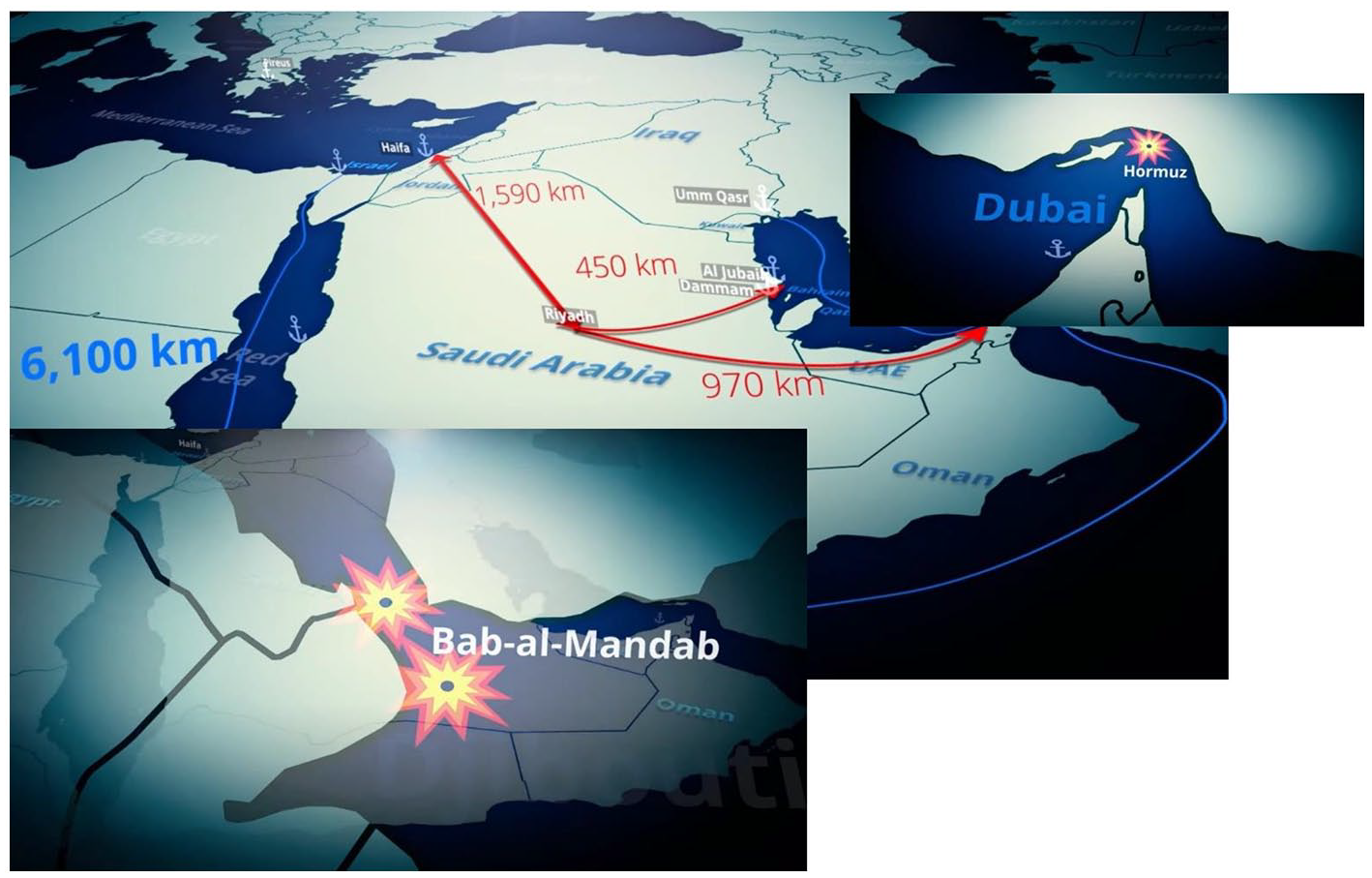
Screenshots from ‘Tracks for Regional Peace’ promotion video, Ministry of Foreign Affairs, Government of Israel, 2019 Available at: https://mfa.gov.il/MFA/VideoLibrary/Pages/Tracks-for-regional-peace-5-August-2019.aspx.
Simultaneous to this explosive action, the words ‘safer’, ‘faster’, and ‘cheaper’ flash multiple times across the screen; an intentionally unsubtle reminder of what Israel offers its new Gulf partners sitting on the other side of this dangerous terrain. In reckoning with these images, I come back to Manchanda’s (2020) Imagining Afghanistan. Gazing at the Middle East from the lens of empire – and the racial, gendered, and queer lines its epistemic regimes drew and draw around safety and security – she helps align these ‘Tracks’ with existing colonial anxieties and the material outcomes they produce in their wake. Imagining Israel – the villa, the island, the fortress, the settler state – organising and securing circulation in the region, produces the Middle East through its gaze, as a ‘jungle’ of dark, dangerous and uncontrollable spaces, bodies, lives, and politics (c.f. Yacobi, 2016: 2). The gesture towards Palestine – or rather, its erasure – feels tangible here.
For those who watched this video in 2019, direct transit routes through Saudi Arabia and the United Arab Emirates (UAE) seemed fantastical. Yet, in 2021, already more than a year since the UAE, Bahrain, Sudan and Morocco signed normalisation agreements with Israel, this seems much more concrete.
Conclusion/epilogue: The future of the Middle East – When a port’s wet dreams come true
The agreements that were achieved in the last two weeks with the Emirates, Bahrain – and we’re looking forward to other countries to join the agreement – is actually changing dramatically this sphere of being an island . . .. (Ofer Malka, Director General of the Ministry of Transport, September, 2020)
Here, I offer an epilogue in lieu of conclusion, as the story of Haifa Port continues to evolve. In January 2020, after 2 years of deliberation and more than 15 years since the process began, Haifa Port was put up for tender. By October 2020, an aggressive campaign was underway to attract potential buyers for 100% of the government’s shares in the port, with the sale’s completion expected by 2022 (Barkat, 2020) (see figure 4 for the full picture of what’s on offer). The terms of sale – which includes a ‘billion-dollar bonus’ – taste of desperation; or at least, this is how I read it, based on my years of conversations with port workers. This is because in 2013, the government announced tenders for two private container ports, within 5 miles each of Haifa and Ashdod Ports. The Shanghai International Port Group (SIPG) – one of the world’s largest port operators – won the bid to run the port near Haifa. My port interlocutors call it ‘the Green Monster’, as this is how it appears on planning documents and how they reckon with its impending impact on their lives and their port.
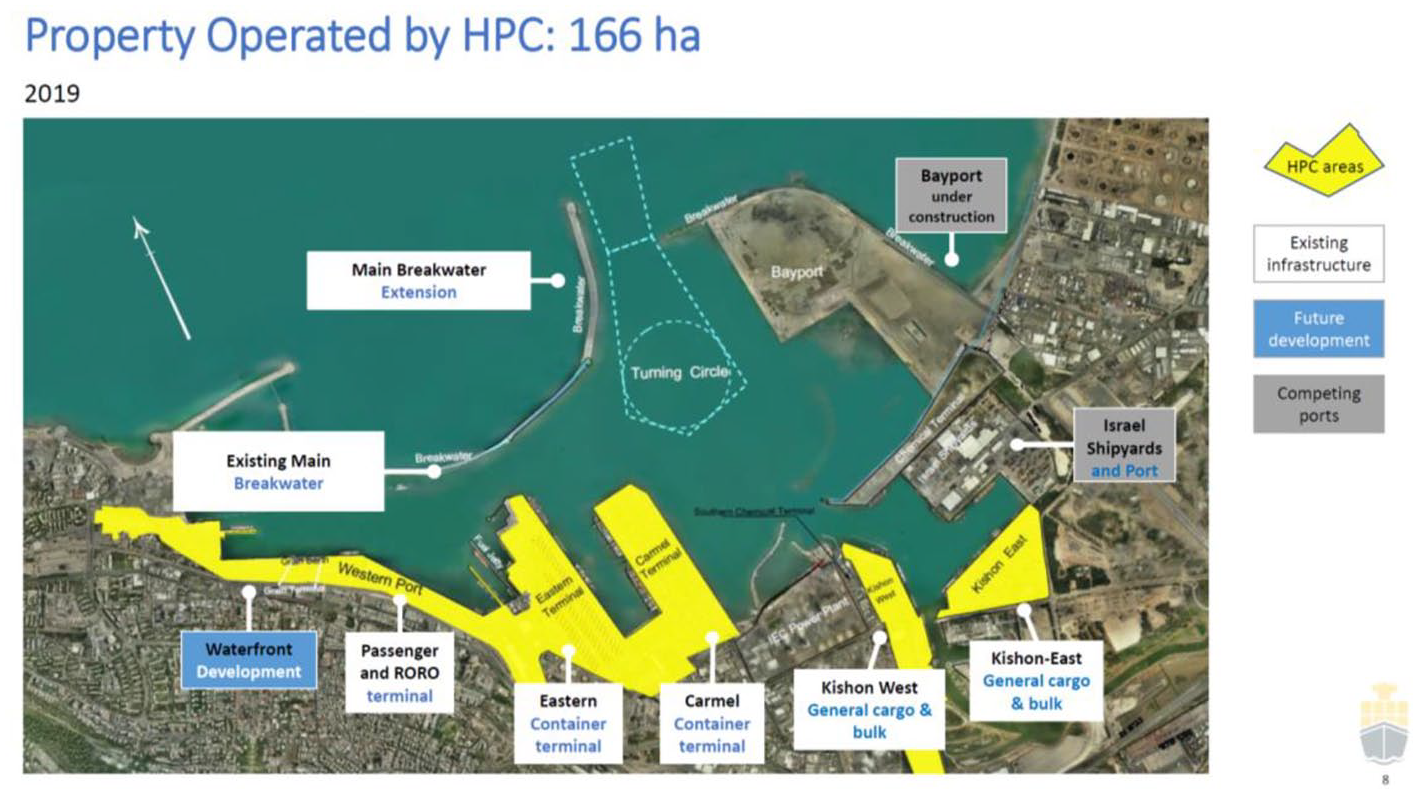
Map of Haifa Port’s assets (and competitors), Company Overview, Haifa Port Company (2020).
This other port is the wet dream of port managers: Built offshore, a kilometre of land raised from the sea, with the depth capacity for 18,000 teu container ships, and direct rail links built into it, the port was conceived and constructed ready for the unhindered, circulatory logics of the contemporary shipping industry (YZ, 2021). Most importantly, it will be semi-automated, run by a leaner, much cheaper labour force. Moreover, helmed by a global operator directly tied to China’s BRI infrastructure, it will be able to access a seemingly endless flow of allied shipping companies, port terminals and logistics teams, and offer services and prices with which Haifa would never be able to compete (AF, 2020; Ben-Gedalyahu, 2020). The new port, which is expected to syphon off nearly all of Haifa’s container traffic, feels like the end of the old port. With SIPG already in operation since September 2021, it is clear where the rush to sell was coming from.
This narrative has another twist. On 16 September, 1 day after Israel and the UAE officially signed their normalisation agreement, DP World (based in Dubai Port) – the largest terminal operator in the Middle East – announced its plans to partner with Israel Shipyards/DoverTower to make a bid for Haifa Port (Odenheimer, 2020, although it has since backed out of the agreement (AlJazeera, 2021). Less than a month later, the first cargo from the UAE arrived in Haifa, inaugurating the first ever direct shipping line between Israel and the Gulf. At the same time, new stories filter through the media every day of the state’s ongoing violence, strangulation, destruction, and incarceration against/within the Gaza Strip and the West Bank. Alongside this, plans for annexation and settlement growth in the West Bank continue (Aljazeera, 2020), while Palestinian communities located inside the Green Line (citizens of the state of Israel) suffer the long-term effects of containment, police violence, state neglect, and under-development (Shehadeh and Khalidi, 2014), and Palestinians in Jerusalem’s Sheikh Jarrah neighbourhood continue to fight their impending expulsion. The shine of Israel’s new infrastructure opportunities seems too bright to resist and helps efface calls for material change or solidarity vis-à-vis Palestinian experience on the ground. From here I conclude that as Israel - through either of these Haifa-based ports - is being chosen from a line of East Mediterranean competitors to helm these newly connected Middle East circuits, so too is its capacity to govern, secure, violate, and excise bodies and spaces deemed both surplus and dangerous to the project of constant movement.
The story I have told above through Haifa’s lifeworlds is intended to visibilise the multiple contradictory logics that make the fantasy of global maritime flows possible and concrete, including how Israel might fit and foment the particular violences they produce and contain (and vice versa). It has given me space to point to how a fortress and a gateway co-exist and necessarily co-constitute one another; how movement and non-movement, mobility and capture relate to and survive off one another; how fantasy infrastructures of the future reveal and reproduce geographies imagined and made tangible in the past; and how race/racialising practices are intertwined throughout. It has allowed me to follow the mobile and immobilising practices of colonial and capitalist landscapes through the multiple scales and transits of the racialised body, the fixed site of the port, the frontier-borders of the settler colonial state, the infrastructures of empire, the corridors of global capitalism and the materials of international governing bodies. Ultimately, Haifa Port offers new ways to conceptualise and understand the political assemblages at work in Israel’s infrastructural terrain, and the tangible, often violent, lines and holes it draws through life and space, in Palestine, the Middle East and beyond.
Footnotes
Acknowledgements
This paper has been in development for over three years, and its transformation from a workshop presentation to academic publication is thanks to a huge group of friends and colleagues. First, in addition to the two positive and acutely helpful reviewers, I’d like to thank Jessica Bier, Engin Isin and Laleh Khalili for their early readings of my paper, alongside members of SPIR’s Theory Lab (especially Liz Chatterjee, who pointed to some of the key puzzles that now shape my paper). But I am most grateful for Paul Highgate’s incredible (and semi-ruthless) editing skills, Sara Salem’s in-depth engagements (and support!) right when I needed them, and Nivi Manchanda’s almost weekly readings and re-readings, edits and re-edits, and without whom, I couldn’t have finished the paper.
Funding
The author received financial support for the research, authorship and publication of the article, from an ESRC New Investigator Grant, From Walls to Corridors: The Global Logistics of Israel’s HaEmek Railway’ (ES/S01439X/1). Initial research for the paper was also supported by a pilot grant from the Council for British Research in the Levant.
