



Abstract
We seek to disentangle the process through which some democratic polities ‘escape’ from neoliberal rule while others do not. We understand neoliberalism as the resulting equilibrium provoked by the restoration of class power that undermined the pro-labour policies of the post-war period. Why do some democracies enter a route of political experimentation that challenges the status quo while others remain ‘trapped’ in an orthodox neoliberal settlement? Our argument is that for a democratic polity to initiate a transition from neoliberal rule, there needs to be a crisis of neoliberal rule, a compelling alternative willing to contend for state power in national elections, and a reliable democratic settlement that allows the victory of the challenger – that is, the alternative – over the neoliberal rulers. This model will be discussed by examining the following three cases: Argentina, Greece, and Mexico.
Overview
In this article, we seek to disentangle the process through which some democratic polities contest neoliberal rule while others do not. Defined by a triad of liberalization, privatization, and deregulation, neoliberalism has shaped the contemporary world. Post-neoliberalism, conversely, can be understood as a revision of the aforementioned triad, which we define as a ‘transition’ from neoliberal rule. Why do some democracies enter a route of political experimentation that revises the status quo while others remain ‘trapped’ in an orthodox neoliberal settlement?
To be sure, we do not argue that ‘post-neoliberalism’ has the precise contours of a ‘new’ model. Moreover, the fact that we still need the word ‘post-neoliberalism’ – a prefix before a prefixed word – bear witness of the birthmarks of whatever emerges from the transitions we study in this article. As such, by ‘transition’ we simply refer to the launch of a revisionist path that deviates from orthodoxy, rather than to its crystallization in a non-neoliberal endpoint. In this sense, we understand post-neoliberalism ‘not as a complete break with neoliberalism, but rather as a tendency to break with certain aspects of neoliberal policy prescriptions, without representing a set of strict policies or a clearly identifiable policy regime’ (Ruckert et al., 2017). Endeavouring to identify how post-neoliberalism emerges in the first place, we propose that such a path arises from a specific combination of successive political dilemmas that accounts for either political change (a deviation from neoliberal orthodoxy) or continuity (‘non-transition’).
Our main argument is that for a democratic polity to initiate a transition from neoliberalism there needs to be (1) a crisis of neoliberal rule, (2) a compelling alternative willing to contend for state power in national elections, and (3) a reliable democratic settlement that allows the victory of the challenger – that is, the alternative – over the neoliberal rulers. By examining three semi-peripheral Western polities, we discuss how each case fits the model to a varying extent, thus explaining a different outcome (each of these a Weberian ideal type); a transition in Argentina, a failed transition in Greece, and non-transition in Mexico. We argue that the concept of ‘non-transition’ helps to explain why neoliberalism can persist despite challenges to its rule. Similarly, we argue that the concept of ‘failed transition’ is key to understand the inability of national contenders like SYRIZA to turn their national victory at the polls into victory over the neoliberal status quo.
The analysis of actual or potential terminal crisis of neoliberalism and the alternatives that might supersede it is not new. In Latin America, such has been the debate since the 1990s – the initial bell-ring being the Zapatista Indigenous uprising in Chiapas, Mexico, in 1994, and then the succession of left-wing national governments that began a few years later in several Latin American countries. The ‘left turn’ or ‘pink tide’ in the region has produced a copious amount of scholarship. In continental Europe and the Anglosphere, however, an analogous debate has emerged in the wake of the 2008 global financial crisis (GFC) – initially gaining momentum around movements such as Occupy or the indignados, then focusing on left-wing national contenders (SYRIZA in Greece, Podemos in Spain or the Corbyn-led Labour Party in the United Kingdom) or right-wing ones (Vox in Spain or France’s Rassemblement National).
By investigating the transitions and non-transitions from neoliberal rule, our contribution bridges the usual disciplinary boundaries of area studies – for example, Latin American studies, European studies. Neoliberal rule is a political species that expanded globally and so the variety of responses to it and its crises encompasses a worldwide set of cases. Just like neoliberalism is country-specific (i.e. it adopts a particular institutional shape in each country), the responses to it are neither uniform – yet, we aimed to account for this variation. Accordingly, we followed a comparative case study strategy, with a most-similar systems design, selecting cases that show similar input variables (Della Porta, 2008), which meant, for this research, semi-peripheral countries with recent transitions to democratic regimes but different outcomes in terms of challenging neoliberal orthodoxy or not. Of course, this case selection precludes generalization. In this respect, following Merton’s (1968) classic approach to theory construction known as ‘middle-range theory’, we do not aim to determine the essential feature or independent variable of post-neoliberal experiences everywhere else. Distant from any claims to grand theory, our goal is rather to present a no-nonsense model – by conceptualizing through empirical enquiry and vice versa – whose improvement (and, hopefully, generalization) would require extending the analysis to new case studies in order to critically re-evaluate the three dilemmas introduced here.
Our argument will be discussed as follows. In the second section, we will address the sample we selected, focusing on the starting point shared by the cases. Then in the third section, we will discuss the three cases through the model we have advanced, the main finding being that the interplay between neoliberal crisis and democratic reliability explains the critical conjuncture that a challenger of the status quo can capitalize to its advantage. In the fourth section, we will discuss the different paths under scrutiny and draw lessons for transitions from neoliberal rule. Finally, we will use the conclusions to outline the limits and merits of the model advanced in this article.
Requiem for transitology
In the glory days of transitology, Southern Europe and Latin America became emblematic cases of the so-called third wave of democratization. Illustrative of the transitions from authoritarian rule to democracy, the two regions became key components of the literature on democratization of the time (e.g. Linz and Stepan, 1996; O’Donnell et al., 1986). The fact that such democratic transitions intertwined with a process of neoliberal transformation did not go unnoticed by the leading scholars of the ‘third wave’. For instance, O’Donnell (1996: 14) lugubriously acknowledged that in mid 1990s Latin America ‘the present democratic governments are supporting, implementing, and maintaining policies under which the privileged sectors are faring very well’, including, for these sectors, ‘better access to policy-making than was the rule under military regimes’. An equivalent process emerged in Southern Europe, although here the neoliberal reform was embedded in a process of regional integration – that is, the European Union, whose common currency, the euro, seeks monetary and fiscal policy convergence. True, national governments in Southern Europe procrastinated structural adjustments, until the GFC prompted the European Union (EU) to constitutionalize neoliberal governance across national boundaries (Giannone, 2015).
In short, the last quarter of the 20th century saw both Southern Europe and Latin America undergo a double transition from authoritarian to democratic rule and from state-led economic development to neoliberal transformation. This is where similarities end and divergent paths begin. Beginning in the new century, South America entered a wave of ‘left turns’, the ‘pink tide’, that challenged the neoliberal status quo to varying degrees. Democracy remained in place, but its marriage with neoliberalism could no longer be taken for granted.
A reaction against the 1980s Washington Consensus of neoliberal economic policies imposed to Latin American governments by the US Government, the International Monetary Fund, and the World Bank, the left turn encompassed, at its height, the simultaneous presidential terms of Hugo Chávez (1999–2013) in Venezuela, the Kirchner (Néstor and Cristina) in Argentina (2003–2015), Evo Morales in Bolivia (2006–2019), the Frente Amplio in Uruguay (2005–2020), and Lula and Dilma in Brazil (2003–2016). The European scenario, for its part, began to change because of the GFC of 2008. Neoliberal rule, if still well entrenched, was no longer incontestable. In the aftermath of the 2011 Occupy movements, there emerged appealing left-wing outsiders in the electoral arena: SYRIZA in Greece, Podemos in Spain, and the Corbyn-led Labour Party in the United Kingdom. Of these, only SYRIZA was elected in government; however, once in power, its anti-neoliberal action paled in comparison to its Latin American counterparts, as will be discussed in the next section. For now, it suffices to note that the institutional constraints imposed by the European Union on the Southern European room for manoeuvre (e.g. the Greek one) has been stronger than the external obstacles faced by the Latin American pink tide.
Southern Europe, of course, has experienced neoliberal resilience despite the changing political atmosphere after 2008, which can also be said about important parts of Latin America, where Mexico stands out for its neoliberal continuity. This brings us to the key notion of ‘crisis of neoliberal rule’, which we understand in the sense of a political crisis where hegemony (in its consent-seeking dimension) is in danger. Notwithstanding the multiple forms a political crisis can take, in the specific cases of Argentina and Greece, such a crisis was catalysed by an economic collapse that paved the way to the successful challenge of left-wing alternatives to the status quo.
As can be observed in Figure 1, the riots of December 2001 in Argentina – right before the ensuing rise of Kirchnerism – were preceded by years of escalating economic contraction. The same can be also said of the Greek vicissitudes that preceded the rise of SYRIZA and its eventual electoral victory in 2015. In contrast, Mexico has experienced stable (if meagre) economic growth with no prolonged economic collapse. Such a context is not irrelevant when assessing the year 2006 in Mexico, when the left-of-centre was closer to electoral victory than ever before but ultimately failed.
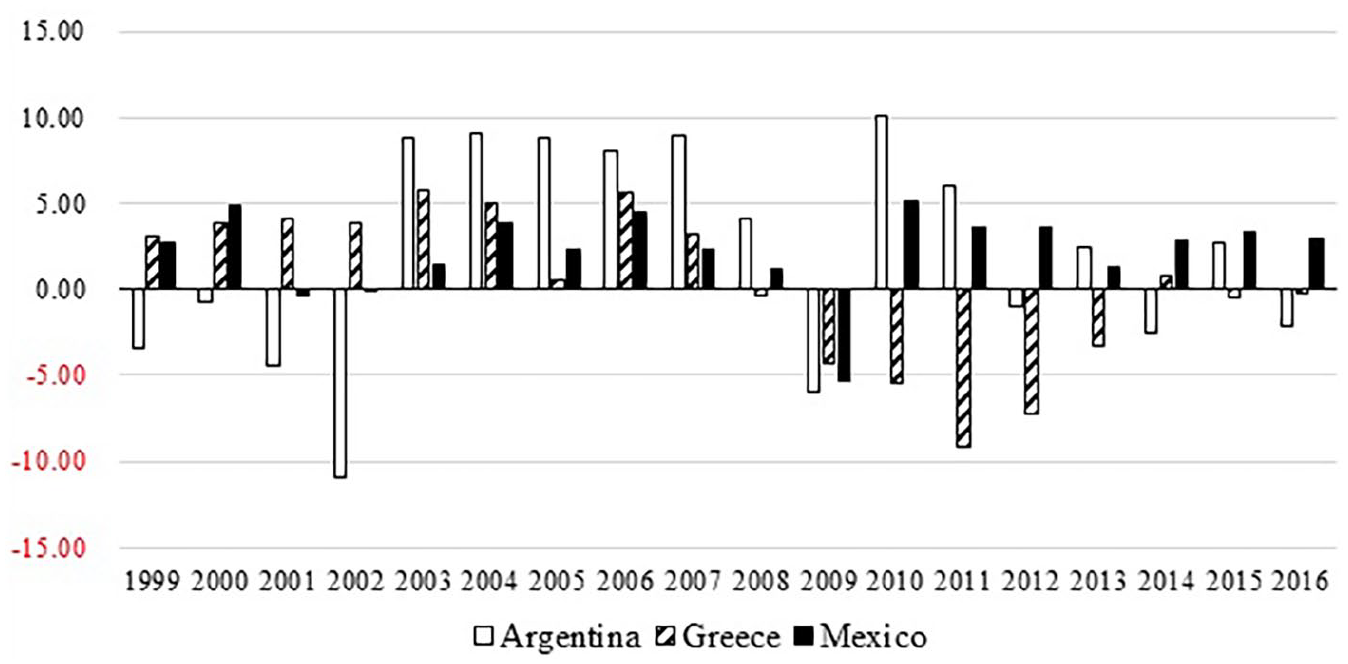
GDP growth (annual %).
Fortunes of neoliberal rule
As the formation of the demo-neoliberal alloy in Southern Europe and Latin America was not identical in every country, the particularities affected the different paths afterwards. In this sense, the endpoint of late-20th century transitology (i.e. democracy and neoliberalism) is also the starting point of a transition to somewhere else which has not yet fully emerged. Focusing not in a transition to, but a transition from, out three cases diverge in the emergence (in Mexico, non-emergence) of a post-neoliberal path – that is, a path that continued in Argentina but was promptly cancelled in Greece. In this section, we will thus illustrate these cases in terms of (1) the domestic crisis of neoliberal rule, (2) the rise of a compelling electoral alternative, and (3) the quality of democracy. Fulfilling (or not) these criteria, we argue, weighs the possibility of escaping from neoliberal rule.
Non-transition in Mexico
After Mexico defaulted its debt in 1982, the World Bank ‘for the first time in its history, granted a loan to a country in return for structural neoliberal reforms’ (Harvey, 2005: 100). The wave of privatizations and financial and labour reforms that ensued contradicted the old nationalist economic approach of the ruling, Revolutionary Institutional Party (PRI, for its acronym in Spanish), whose rule dated back to the 1920s (Rodríguez Araujo, 2010). In its neoliberal turn, the PRI suffered a schism which prompted its left-wing out of the party to contend in the 1988 presidential election on an anti-neoliberal platform (Hernández Rodríguez, 2020).
The PRI lost the election, but electoral fraud shielded the neoliberal transition from an electoral defeat – that is, Mexico was still an authoritarian regime. Democratization would eventually take root later, in response to another, unexpected, anti-neoliberal challenge: the Zapatista insurrection. 1 Planned to coincide with the very entry into force of the North American Free Trade Agreement (NAFTA), on 1 January 1994, this armed irruption of Indigenous peoples from the highlands of Chiapas shook up Mexican politics and pushed the regime to strive for democratic legitimacy (Alanis, 2015; Gilbreth and Otero, 2001). As if adding fuel to a fire, at the end of that year the worst Mexican economic crisis in decades broke up, unleashing the ‘tequila’ effect across the globe in 1995–1996. Both the Zapatista uprising and the economic crisis created a critical juncture that stirred up elite’s fears for extended instability, prompting the transition to a competitive electoral system (Crespo, 2004). The government thus agreed to unbind the Electoral Federal Institute from it (hitherto part of the Ministry of the Interior), granted it autonomy, and gave away the organization to citizens (Alanis, 2015; Magaloni, 2005). In 1997, the PRI lost the majority in Congress for the first time, and in 2000, an opposition candidate (from the right) won the presidency. Democracy had finally arrived, while the economy kept along its neoliberal path.
We interpret these dynamics as democratization in Mexico being a top-down but reluctant response to channel political turmoil away from the political economy. It would then be until the dawn of the 21st century that Mexican politics caught up with South America in its mixture of neoliberalism and democracy. In this new political landscape, Mexican neoliberalism faced renewed turbulences in 2006. In the south-eastern state of Oaxaca, for instance, the teachers’ union installed a soviet-like proto-government in the state capital after protesting the PRI governor (Esteva, 2010). In that year also, the Zapatistas launched a nation-wide campaign to unite the (radical) left – that is, those to the left of the Revolutionary Democratic Party (PRD), the party led by the old-school PRI members that had split in 1988. The regime violently suppressed both the Oaxaca revolt and the Zapatistas campaign. Soon after, the PRD presidential candidate, Andrés Manuel López Obrador (AMLO), who initially led the polls for the upcoming general election, in the end, lost it by less than half-point percentage.
When compared with the crisis of neoliberal rule in Argentina and Greece, the Mexican crisis in 2006 was not as acute. The symptoms of mass upheaval were confined to some parts of the south-eastern region (especially Oaxaca) and thus away from the major cities. Also, that political turmoil did not coexist with an economic collapse akin to that in Argentina at the turn of the century or that of Greece after the 2008 GFC (see Figure 1). Of course, economic collapse is not the only form a neoliberal crisis can take. In fact, AMLO won the 2018 presidential election on a landslide within the same pattern of economic growth; however, in this occasion, an epidemic of violence, the worse in a century, concurred in undermining the status quo’s legitimacy. Such a situation paved the way to AMLO, a candidate long-known for his anti-neoliberal rhetoric.
What happened after 2006 and 2018? In response to a difficult year, and amid accusations of electoral fraud by the left, the regime launched the ‘war on drugs’ in December 2006. A short-term tactic to boost legitimacy, the war on drugs mutated into a long-term neoliberal strategy. It produced an environment where violent acts of political retaliation and/or economic dispossession could be attributed to crazy drug-cartels (Paley, 2015). Mexico’s social malaise caused by neoliberal rule was not followed by a pink tide, but by a punitive turn underpinning the status quo (Müller, 2016). Not surprisingly, the state’s efforts to insulate the political economy were not matched by parallel creativity to consolidate democratic rule. Mexico thus became a ‘violent democracy’ risking a transition to non-democratic rule (Schedler, 2014).
In this context, AMLO won the 2018 presidential election with over 53% of the vote. The crisis of neoliberal rule had reached a point where a challenger rose to power in Mexican democracy. Once in power, AMLO announced the rise of ‘post-neoliberalism’, but his policymaking has yet to catch up with rhetoric. In this regard, early diagnoses of AMLO’s takeover already signal a failed transition (Centeno, 2021; Ulfgard and Villanueva, 2020). Whether Mexico will crystallize as a new failed transition from neoliberal rule or at least a weak transition is yet to be seen given that presidents in Mexico rule for 6 years and new developments may still arise. For comparative purposes, our analysis focuses on the Mexican non-transition, which we hold valid up to 2018.
Transition in Argentina
In Argentina, democracy came before the full implementation of neoliberalism. Although it was the last Military Junta (1976–1983) who initiated the attack on the import substitution industrialization (ISI), it was until the presidency of Carlos Menem that neoliberalism was implemented in full force in 1991, after 15 years of high inflation. The onset was marked by the introduction of the new currency stabilization plan called the Convertibility Plan. This new radical monetary policy established a fixed peso-dollar exchange rate (1 ARG peso = US$1) and mandated that the country’s monetary supply should always equal the reserves held by the Central Bank (Azpiazu et al., 1998: 16). In effect, the plan curbed inflation and brought about general price stability. Such changes were eased by the approval, 2 years earlier, of the Law of State Reform that effectively deregulated the labour market and thus introduced the first flexible labour contracts. The former allowed the restructuring and privatization of almost every state-owned company as well as the administration of public services (Oszlak, 1997). The pro-reform coalition included the two main ISI actors – that is, the General Confederation of Labour (CGT) unions and the industrialists, who received privileges related to privatizations (Etchemendy, 2005).
During the 1990s, the golden years of neoliberalism, the conflicts between macroeconomic stability and the rise of unemployment and poverty remained underground, until it surfaced in the crisis of 2000–2001. Three factors contributed to this political explosion in Argentina.
First, the social effects of neoliberalism became apparent upon large sectors of the population. Despite the mediocre economic performance of the ISI model and the absence of a European-style welfare state, social protection in its different aspects was consolidated and important in Argentina, even though it was often conditioned by insertion in the labour market. Health, education, social security, and housing were provided or subsidized by the state (Novick et al., 2007). All of this meant that the levels of exclusion and poverty were low, which is why the unprecedented rise in unemployment (from 6.9% in early 1990s to 21.5% in 2000), labour informality (from 29.6% in 1991 to 37.3% in 2000), regressive distribution of wealth (Gini from 0.47% in 1995 to 0.53% in 2002) and high poverty rates (50% of the population was poor in 2002) was shocking and unbearable for most people (De Angelis, 2013: 37, 38).
Second, the process of resistance in Argentina mirrored the larger de-collectivization and crisis of traditional forms of solidarities (most notably, trade union and political parties) experienced in other parts of the world. However, Argentina produced a social movement whose extension and relevance in the struggles against neoliberalism represents a distinctive case: the mobilization of the unemployed, the piquetero movement, in reference to its typical tactic of protest, the roadblock (Svampa and Pereyra, 2003: 13). Such a movement initiated in 1996 originally in response to the privatization of the state oil company, Yacimientos Petrolíferos Fiscales (YPF), and the ensuing layoffs. Despite the context of social fragmentation and internal ideological and organizational differences, the disruptive actions of the piqueteros swiftly diffused to other sectors, both public and private, including teachers, students, civil servants, and pensioners. The roadblocks supplemented workers’ strikes as means of social protest and the unemployed became the main actor contesting neoliberal rule (Rossi, 2017: 83). While the piqueteros expressed and mobilized the grievances of the popular sectors, the middle class also protested in neighbourhood assemblies or banging the kitchen pots in collective mass demonstrations. Finally, in 2001, the popular sectors, the middle classes, and some members of the politico-economic elite, converged to put an end to the government of Fernando de la Rúa.
The third factor that explains the crisis of neoliberal rule was Argentina’s government defaulting its debt on 26 December 2001. The new, interim government that succeeded De la Rúa liberalized the currency exchange rate and the peso swiftly devaluated, which caused the demise of interim President Rodríguez Saá after only 8 days. However, by lifting the main anchor associated to neoliberal economics in Argentina, the Convertibility, the conditions for experimentation arouse, but only after serious economic hardship. The importance of Argentina’s break with Convertibility – both symbolically and institutionally – will be contrasted with SYRIZA’s failure to forge a Hellenic out-of-type transition.
As the crisis deepened in Argentina, an alternative willing to contend for state power developed. Referring to the governments of Néstor Kirchner (2003–2007) and Cristina Kirchner (2007–2015), kirchnerismo represented a compelling alternative because – as time would prove – it was ‘simultaneously a political movement and a political force that governed for 12 years’ (Natalucci, 2019). Once in government, Kirchnerism joined other Latin American countries (such as Bolivia, Ecuador, and Brazil) in tilting politics to the left in at least three important ways. First, it established a pact of consumption, introducing policies to stimulate the internal market; also, a pact of inclusion, through the expansion and innovation of social policies and social protection, such as the Universal Child Allowance; and third, a pact of sovereignty, increasing Argentina’s autonomy in foreign affairs, as opposed to previous subordination to the United States and the International Financial Institutions (particularly the IMF and the WB; Stefanoni, 2016). The most important policy changes would be introduced between 2008 and 2012, including the following three key re-nationalizations: the pension funds, Argentina’s flagship airline carriers Aerolíneas Argentinas and Austral, and 51% of the emblematic YPF company.
Also, some labour institutions were restored, such as the National Council for Employment, Productivity and the Adjustable Minimum Wage and the Collective Bargaining Agreement (Morris, 2019: 197). The National Council had remained inactive for 10 years and its reactivation pushed wages upwards. As for the Collective Bargaining, its revitalization brought back sector-wide disputes in which trade unions had more leverage to negotiate better deals; not surprisingly, trade union affiliation increased, such as collective bargaining and conflict (Delfini and Ventrici, 2016: 27). This overturn, a break with neoliberal wishes, reversed the tendency established in the 1990s to hold decentralized negotiations that had fragmented the labour movement. Therefore, the increased participation of wages as percentage of the gross domestic product (GDP) during Kirchnerismo is not explained by economic growth alone but especially by the reversal of labour flexibilization policies and the rise of the minimum wage within a re-unionized labour market (see Figure 2).
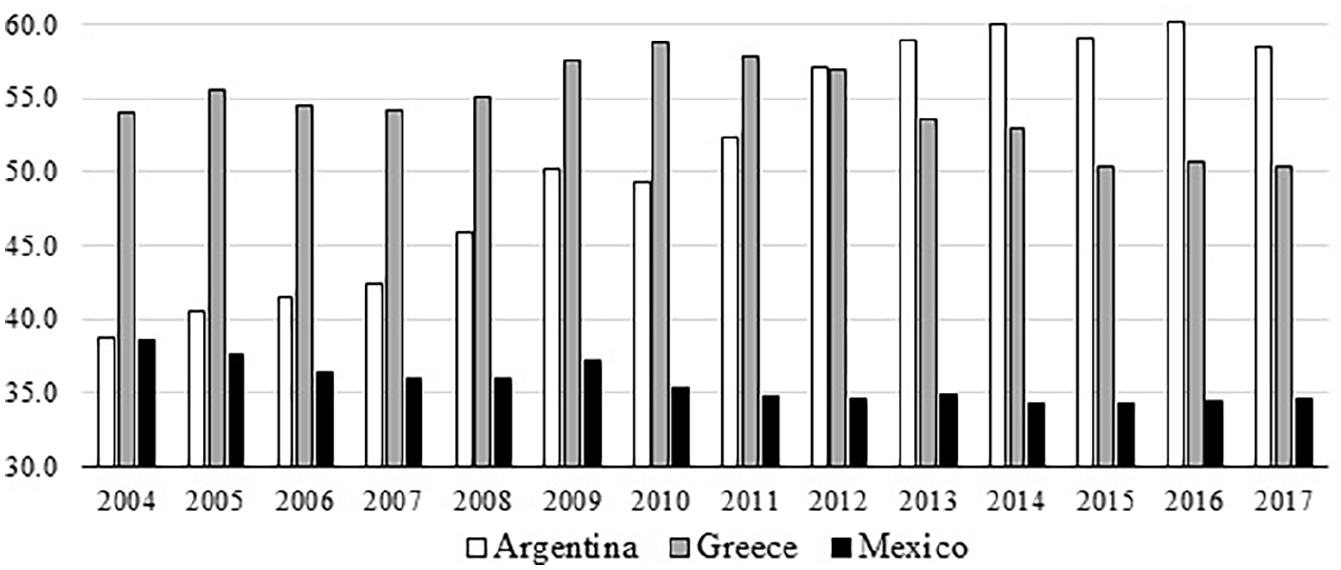
Labour income as a percentage of GDP.
Failed transition in Greece
In Greece, democracy came before neoliberalism. In contrast to Latin America, however, Greece had a two-layered neoliberal enforcement, just as the rest of Southern Europe (see Papadopoulos and Roumpakis, 2018). On one hand, the internal national establishment; on the other hand, the external supranational one, the European Union, which would prove to be the last resort of neoliberal continuity. Greece’s entry in the Eurozone in 2001 aimed to overcome the floatation of the national currency (Drachma), stabilize its fiscal and monetary policy, modernize its economy through structural reforms, and catch up with the employment and social protection standards of other Eurozone countries (Sakellaropoulos, 2007). Instead, it amplified the already widening asymmetries between Greece’s semi-peripheral economy and the core EU countries (Scharpf, 2013). Effectively, the Greek economy relied on low interest rates loans backed up by the European Central Bank (ECB), and opted for a debt-driven growth model that financed the government’s budget deficit which at the household level ‘compensated’ for declining saving rates (Lapavitsas, 2019). As the real economy did not yield enough streams of revenue, the sudden stop of credit flow from the EU at the end of 2009 exposed the Greek economy to a ‘twin deficit’ – that is, on the government’s budget and the country’s current account balance (Papadopoulos and Roumpakis, 2012).
In April 2010, the government of the Panhellenic Socialist Movement (PASOK), a social democratic party, formally sought financial assistance from what would be known as the troika of lenders (ECB/EC/IMF). Another option was to default, as advocated, among others, by the then PASOK-affiliated economist Yannis Varoufakis. This alternative was vehemently opposed by Trichet, the ECB president and architect of the Eurozone, as well as the Greek Prime Minister George Papandreou. For Trichet, a default would have undermined the Eurozone by fuelling a political explosion for bondholders of Greek debt, primarily European institutions (e.g. ECB), German and French pension funds. In the end, with debt restructuring out of the question, the Memorandum of Understanding (MoU) focused on cuts to the government’s budget by means of wage reductions, welfare cuts and further reduction of employment protection (see Papadopoulos and Roumpakis, 2012, 2018);
By 2015, Greek GDP had shrunk by 25% with a little signs for recovery in sight. The contestation in the streets directly targeted the EU for the austerity measures it imposed, but was also aimed at the political establishment that approved them in the Greek parliament. As argued by Papadopoulos and Roumpakis (2018), the ‘political contract’ that promised economic prosperity and social security through debt-driven growth strategies was suspended, and along with it trust in both national and European institutions. Soon after the implementation of the first austerity measures, Greek politics rapidly polarized along ‘pro-’ and ‘anti-’ austerity lines. Segments of the shrinking middle class mobilized, even if sparsely, in neighbourhood assemblies and town squares with protests peaking in the summer of 2011 with the emergence the Aganaktismenoi, the ‘indignants’ anti-austerity movement (Karyotis, 2016). The movement vehemently opposed austerity and neoliberalism, and called for national economic sovereignty, thus embodying a break with the political establishment. While the case of SYRIZA was rightly characterized as left-wing populism (Stavrakakis and Katsambekis, 2014), it is important to observe that Syriza, unlike Podemos in Spain, which was organically linked to the Indignados movement, was already an established political actor (Katsambekis, 2019).
The two electoral rounds in 2012 signalled a seismic shift in Greek politics as the support for the established ruling parties collapsed, even if they were able to set up a ruling coalition led by Antonis Samaras of New Democracy (conservatives). The new government introduced more austerity reforms, which SYRIZA capitalized thanks to its links with the grassroots and social movements, but at the same time, it had to rapidly put together a competent government plan (Tsakatika, 2016). The result, the ‘Thessaloniki programme’, heralded an anti-neoliberal agenda outlining, among others, the end of bailout agreements, putting a stop to EU directives, and restoring wages to pre-crisis levels, but remained shy of questioning Greece’s membership of the Eurozone. Instead, SYRIZA envisaged that its victory would swing the European political tide in favour of anti-neoliberal national governments, with Podemos in Spain as a close ally.
Finally, in January 2015, SYRIZA came short of a majority but together with a New Democracy-split party constituted the first anti-austerity government in post-GFC Europe. The coalition maintained its anti-austerity rhetoric and attempted to renegotiate with the troika the terms of the previous bailout agreements. However, this strategy backfired after 5 months of negotiations as rapport between the parts evaporated as so did money in the public purse. In June 2015, the SYRIZA-led government of Alexis Tsipras sought support from the lenders as Greece could not make the next IMF payment. In turn, the lenders proposed that any new bailout (loan) plan would necessitate further austerity measures or else Greece would be evicted from Eurozone.
In a defiant gesture, the SYRIZA government announced a make-or-break referendum on the continuation of austerity resulting in a momentous rejection (61.3% vote share) of the EU ultimatum. However, this referendum was a pyrrhic, merely symbolic victory of SYRIZA, which did not seriously consider leaving the EU. Facing a solid, non-compromising European economic governance, SYRIZA returned to the negotiation table, abandoned the defiant anti-establishment stance that had characterized its first term in office and shifted towards a discourse which became more managerial and attached to the working of the state apparatus (Katsambekis, 2019: 35). The implementation of the memorandum put serious limitations for SYRIZA to inspire a ‘pink tide’ across the EU member states. Au contraire, SYRIZA’s bluff and defeat reaffirmed the ‘iron-cage’ rules of neoliberal Europe and undercut Podemos’ appeal in Spain.
To begin with, SYRIZA had failed to present a plan to escape the ‘Eurozone straitjacket’ to the electorate. 2 Instead, SYRIZA agreed to become the vehicle of harsh austerity measures, including the humiliating transfer of valuable state assets to a privatization fund partly managed by the troika of lenders (see Pitsoulis and Schwuchow, 2017). Trying to heal its damaged legitimacy, SYRIZA then called for a new election in September 2015. With voter turnout at historical low (56.5%), the ‘pragmatist’ wing within SYRIZA remained in power and introduced, among others, cutbacks in pensions, an income-tax hike on middle classes, the liberalization of evictions and purchase of non-performing housing loans from vulture funds, and the privatization of public utilities (e.g. water) and infrastructure (e.g. airports). 3
A failed transition from neoliberal rule, the Greek case demonstrates that the constitutionalization of European economic governance places democracy in conditions where electorate mandates cannot break neoliberal underpinnings. After all, as the German Federal Minister of Finance, Schäuble (2011), has stated, ‘elections cannot be allowed to change an economic programme of a member state’, let alone referendums. The anti-neoliberal rule of SYRIZA was short-lived, although it is fair to recall that it lacked any significant political allies within the Eurozone. The misfortunes of SYRIZA derive, of course, from the weakness of the project itself, but also relates to internal conflicts such as the attempt of Tsipras himself to tame the role of social movements within the party (see Kouvelakis, 2016). The SYRIZA-led coalition implemented a progressive ‘parallel programme’ of social for the most vulnerable protection (for an overview, see Katsambekis, 2019), but the overall discourse shifted to a moralist agenda including anti-corruption and tax evasion and not anti-austerity.
In contrast to its own recent past, SYRIZA’s 2019 electoral campaign lacked any reference to either social movements or a radical alternative to neoliberalism. 4 Instead, it opted to campaign on a realist platform of programmatic priorities and interventions within the confines of European economic governance. Although SYRIZA managed to retain significant popularity even after losing the elections to neoliberal New Democracy, it has morphed into a consensual party (Markou, 2021) – that is, distant from channelling the demands of social movements, and thus, away from a pioneering, radical-left, alternative path. 5
Quality of democracy: The hero, the victim
We defined a transition from neoliberal rule as a revision of the triad of liberalization, privatization, and deregulation. As discussed in the previous section, only the Argentinian case fits this definition. In this sense, an important policy revision from orthodoxy was the reversal of the flexibilization of the labour market and its re-regulation. As a result, as can be observed in Figure 2, the share of GDP devoted to wages increased after the deviation from neoliberal orthodoxy (early 2000s). Even if this indicator is only a partial picture, we regard the ‘post-neoliberal hypothesis’ a strong one, given that the same indicator deteriorated in both Greece and Mexico in the wake of the GFC, while it increased in Kirchner’s Argentina. Such developments are consistent with the case-by-case discussion of the previous section. Remarkably, this happened during a time (2009–2015) when Mexico’s GDP grew more on average than Argentina’s (see Figure 1).
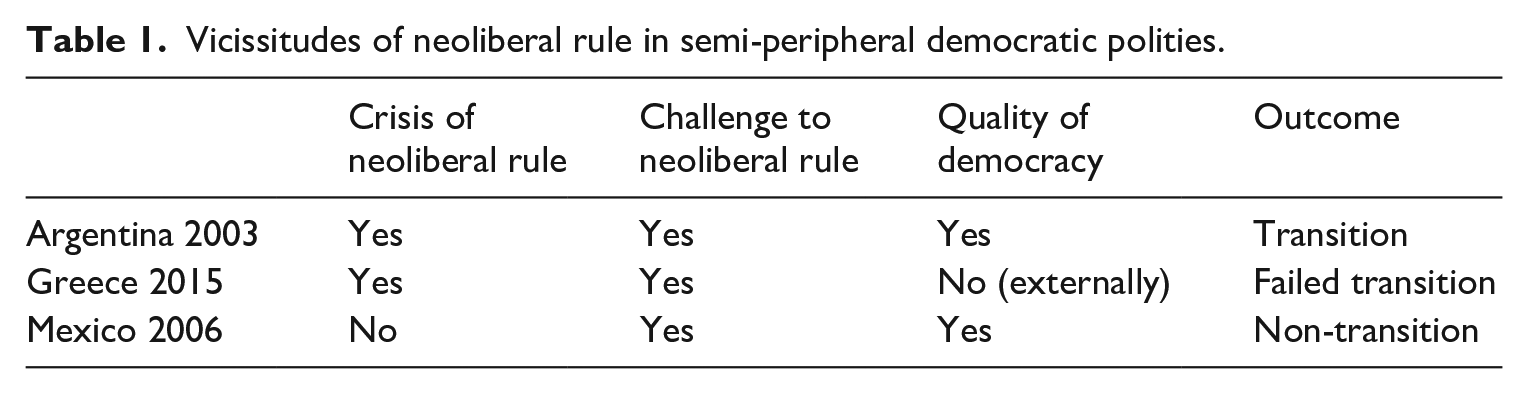
So far, we have argued that for a democratic polity to initiate a transition from neoliberal rule there needs to be (1) a crisis of neoliberal rule, (2) a compelling alternative willing to contend for state power in national elections, and (3) a reliable democratic settlement that allows the mandate of the challenger. While the cases of Mexico, Argentina, and Greece have all experienced challenges to neoliberal rule, their path has diverted because of the presence or absence of condition 1 or 3, as summarized in Table 1. In Argentina and Greece, the crisis of neoliberal rule – experienced as sustained negative economic growth – brought about the rise of left-wing political actors who took over state power. In contrast, the absence of a crisis of such proportions in Mexico, averted a similar outcome in 2006 (and delayed it until 2018). This said, the victory of the challenger in Argentina and Greece would prove a necessary but insufficient condition for transition.
Vicissitudes of neoliberal rule in semi-peripheral democratic polities.
At this point, the presence, nature, and political significance of a reliable democratic settlement become relevant to reappraise its quality since it evokes accountability, responsiveness, and competition (Diamond and Morlino, 2004). In old-school transitology, debates on the quality of democracy came after those on liberalization, transition, and consolidation. Discussing quality was rather understood as the ‘luxury’ of critique where and when democratic rule was already consolidated (Przeworski, 2010). For the study of transitions from neoliberalism, however, quality of democracy is a precondition because it plays a key role in the initiation or blockage of a transition from neoliberal rule. We thus regard such a role as an indication of ‘the state’s capacity to enforce its political decisions. No democracy can work if the state lacks the capacity to supervise democratic decision making and put its results into practice’ (Tilly, 2007: 15).
The theory of representative democracy thought that rotation in office and effectiveness of representation were key not only to prevent sliding into authoritarianism but also to secure good democratic governance. However, the consolidation of neoliberalism undermines the quality of democracy since – as in the Greek case – it reduces the scope of its action – that is, neoliberalism has depoliticized the political economy, taking it away from democratic politics and leaving it instead in the hands of a technocratic elite. In other words, rotation in office and competition is left alone when it is aligned to neoliberal orthodoxy – otherwise, pressures to block democratic-based anti-neoliberal policymaking swiftly ensue. The EU economic governance has gone even further in vaccinating neoliberal rule by asking all members states to constitutionalize it (Giannone, 2015).
Both in Argentina and Greece, democracy was consolidated enough to allow the victory of the anti-neoliberal challenger. Here, a distinction between the internal and external determinants of democratic rule is crucial to understand the ensuing divergence between the two. The Greek government under SYRIZA was constrained by the European Union to such an extent as to force it to withdraw its anti-neoliberal bluff. In contrast, the Latin American left turn – for example, the Argentinian government under Kirchner – did not face an external layer of neoliberal enforcement, as the Eurozone has been for Greece and others. The Latin American ‘pink tide’ thus had it easier to deviate from neoliberal orthodoxy and enter a route of experimentation. This is not to say that the United States did not try to erect an analogous external support layer in the Americas. However, when it did try to set up the first such bricks in 2005, it was too late. The regional left turn, already in motion, derailed such an attempt known as the Free Trade Area of the Americas.
In Mexico, a variety of factors not least the absence of an economic collapse akin to the Greek or Argentinian one, protracted the chances to bring about a victory over neoliberalism in 2006. It would not be until 2018 that the accumulation of economic and social problems eventually translated into the victory of an alternative that claimed to challenge neoliberal rule. But following the model, we propose in this article, that victory does not necessarily mean that neoliberal orthodoxy will be revised. Indeed, the deeper consolidation of neoliberalism in Mexico when compared to what was the case in South America, makes it more difficult to initiate a transition from neoliberal rule. And this is where the Mexican case resembles the Greek one, for the former is also embedded in a neoliberal framework that seriously constrains political options, including the constitutionalization of neoliberal rule. This said, the main obstacle in Greece is external, whereas the Mexican case is more internal. The prospects for a failed transition in Mexico are higher than was the case in Greece, given that AMLO’s leadership does not derive nor it relies on working-class grassroots mobilization, as was the case with SYRIZA for a time. In this sense, Argentina shows what may be the key difference: Kirchnerismo, which returned to power in 2019, is not merely a political party whose cadres run for office, but an actual part of the workers’ movement.
In this sense, the cases of Mexico and Greece show that routine rotation in office on its own adds nothing to the quality of democracy. Routine rotation without transition from neoliberalism has often led to disillusionment with political participation if not straight anti-politics attitudes. Rotation with transition from neoliberalism, however, like in the case of Argentina, reinvigorated political participation linked with the generation of new political identities (such as Kirchnerism), brought back political engagement and renewed democratic politics overall. While Macri’s 4-year government showed that transitions can be reversed, the victory of Alberto Fernandez in 2019 proves the vitality of transitional elements in Argentina’s polity. The transition from neoliberalism shifts the sentiment from ‘there is no alternative’ to ‘there is an alternative’ and this, in turn, positively transpires into political participation because the ideal of self-government of the people becomes an actual question of democratic struggle.
The debate on the quality of democracy, therefore, benefits from supplementing ideal-type definitions with historically grounded operationalization. The notion of transition from neoliberalism supplements such an operationalization with the dimension of power, linking the discussion on form with the one on content of contemporary democratic regimes. Wendy Brown (2019) argues that neoliberalism ruins democracy because it repels social justice claims through appeals to market freedom and morality. While it seems evident that neoliberalism leads to plutocracy and the undermining of the basic conditions for democratic rule, it is also important to identify the conditions that can reverse neoliberalism and initiate an out-of-type transition under the same democratic settlement. In all three cases, there was first a break in discourse, but it was only in Argentina where it translated into post-neoliberal policies. This was by no means a complete break with neoliberalism in the sense of radical overhaul of policy orientation or radical state-wide restrain of the power of capital but instead a tendency to break with aspects of neoliberal policy prescription (deregulation, privatization, liberalization). Yet, it proved, against Brown’s argument, that democracy can confront neoliberalism if the former means transition from the latter.
Closing remarks
In this article, we laid out the process through which some democratic polities deviate from neoliberal orthodoxy to post-neoliberal experimentation. We argued that the crisis of neoliberal rule is a necessary but not sufficient condition of transition. For the latter to occur (of course, within the boundaries of democracy as ‘the only game in town’), it is also necessary the emergence of a compelling electoral alternative to neoliberal orthodox continuity. At this point, the argument of this article is basically a no nonsense argument. However, this is also the point where a transition initiates or not. Is the quality of democracy high enough to allow the victory of the challenger? In Mexico, a liberalization of the economy that preceded political liberalization – which allowed deeper roots to neoliberalism – has inhibited the rise of a successful challenge to neoliberal orthodoxy. In contrast to the conditions of non-transition, an electoral victory of a non-orthodox alternative was easier in Argentina and Greece. However, again, even such a victory at the polls is a necessary but not a sufficient condition of transition. Are the external and internal constraints of a democratic polity a neoliberal iron cage? This is where Argentina and Greece diverge for the latter had the European Union actively impeding a transition from neoliberal rule – that is, a failed transition. In contrast, the Latin American pink tide – as the Argentinian case reviewed here – had more room of manoeuvre for political – that is, post-neoliberal – experimentation.
As such, this article raises a critique of the assumption that higher quality of democracy is the result of economic development. The political effects of the 2008 GFC deteriorated the quality of democracy in both the global North and South, compounded by the COVID-19 pandemic. The study we present shows that the quality of democracy can be enhanced in the ‘underdeveloped’ global South by working a transition out from neoliberalism, whereas it can be undermined even in the global North. By examining key cases from Latin America and Southern Europe, we found that the paradox of quality of democracy being both the hero – the possibility of escaping neoliberal rule – and the victim – such a quality being undermined by neoliberal constraints – marks the key contradiction between the two. Other key questions escape the scope of this article, regarding the conditions that may channel post-neoliberalism towards a non-neoliberal endpoint, which may be a contemporary iteration of a good-old debate: reform or revolution? Yet, for our current purposes, it suffices to show how contemporary democracy is deterred from trespassing the line drew by neoliberalism. This contradiction is in fact a dilemma; either democracy advances and dismantles neoliberal rule or neoliberal rule deepens and turns democracy into a meaningless ritual.
Footnotes
Acknowledgements
The authors would like to thank Ricardo Velázquez Leyer, Theo Papadopoulos and the anonymous reviewers for their insightful feedback throughout this project.
Funding
The author(s) received no financial support for the research, authorship, and/or publication of this article.
