




Abstract
Over the last two decades, scholars have investigated norms of citizenship by focussing primarily on ‘dutiful’ and ‘engaged’ norms. In the meantime, contemporary democracies have witnessed growing demands for more sustainable styles of living and increasing public support for authoritarian and populist ideas. These developments point to both a change and an expansion of conventional understandings and conceptions of what a ‘good citizen’ in a democratic polity ought to do. Specifically, they raise questions about whether demands for more sustainability and increasing support for populist ideas establish new facets of democratic citizenship, and if so, how they can be meaningfully incorporated into existing images of citizenship. This study provides a re-conceptualization of citizenship norms and empirically tests a new measurement instrument using original data collected in Germany in 2019. The empirical application of an expanded set of items demonstrates the existence of more variegated facets of norms of citizenship, including norms to safeguard a sustainable future and distinct populist facets emphasizing the relevance of trust in authorities and experts as well as reliance on feelings and emotions. Contemporary conceptions of citizenship thus go beyond conventional distinctions between dutiful and engaged norms of citizenship.
Introduction
What are desirable characteristics and behaviours of a ‘good citizen’ in a polity? While this question has occupied political philosophers and theorists throughout the centuries, it continues to be of utmost importance today. Growing and recurring concerns about an alleged disengagement from politics and civic life among the citizens of contemporary democracies have fuelled renewed debates about the role and relevance of democratic citizenship. As some observers have diagnosed, we witness an era of declining participation in which citizens increasingly feel detached from political processes and refrain from civic behaviours indispensable for democratic citizenship. The subliminal fear underlying most of these diagnoses is that such ‘an erosion of the activities and capacities of citizenship’ (Macedo, 2005: 1) will do nothing less than putting the long-term functioning and viability of democracy itself at risk.
In light of such far-reaching ramifications, the number of empirical investigations into democratic citizenship has grown steadily. Studies relying on comparative large-scale surveys have tried to provide a thorough and encompassing empirical picture about citizens’ perceptions and images of democratic citizenship across a broad range of contemporary democracies. Most of these investigations focus on citizens’ support for so-called ‘norms of citizenship’, that is, they deal with norms as ‘rules or expectations that determine and regulate appropriate behavior’ of citizens (Bell, 2013). In empirical political science, the normative perspective is usually emphasized by introducing a hypothetical ‘good citizen’ and exploring how important certain characteristics and behaviours of a ‘good citizen’ in a democratic polity are considered to be (Bolzendahl and Coffé, 2013; Copeland and Feezell, 2017; Dalton, 2008). Many studies rely on a distinction between ‘dutiful’ citizenship norms, on one hand, and ‘engaged’ (Dalton, 2008) or ‘actualizing’ (Bennett, 2008) norms, on the other. These two dimensions reflect an emphasis on social order, allegiance to the state, and participation through traditional democratic channels as desirable traits of the ‘good citizen’ (dutiful norms); or they focus on greater independence, social solidarity, and political activity in civic and non-traditional arenas (engaged/actualizing norms). This distinction seems to be generally accepted as a valid conceptualization of norms of citizenship and has been regularly applied in empirical studies to date (e.g. Bolzendahl and Coffé, 2013; Dalton, 2008; Oser and Hooghe, 2013). However, the continuous reliance on the same narrow set of items means that important, more recent understandings of citizenship norms may not have been sufficiently considered.
Research on ecological citizenship and sustainability highlights the increasing normative importance citizens place on the civic duty of sustainable living (Jagers et al., 2014). In virtually all advanced democracies, growing demands for more sustainable lifestyles and the protection of the environment and its resources have become highly salient and contested issues. An illustrative recent example for this development is the ‘Fridays for Future’ movement. It was able to draw on a vast number of citizens across the world sharing a normative conception that living in a ‘sustainable’ way, raising awareness for and mobilizing political action against climate change is something a ‘good’ citizen ought to do. 1
In addition, research on populism has advanced important arguments about the rise of new citizenship norms. These norms relate to the emergence of authoritarian populists with stark anti-media rhetoric, aimed to accentuate in- and out-group characteristics (Schulz et al., 2020) and emphasizing authoritarian positions in policy trade-offs (Zanotti and Rama, 2020: 3). They reflect citizens’ disappointment with how democracy functions in practice and an increasing anger and anxiety of rapid societal changes eroding long-standing cultural customs and habits (Rico et al., 2017). Taken together, such arguments suggest that the rise of populism emanates from, and triggers further, changes in the public’s perception of what a ‘good’ citizen ought to look like, including a greater emphasis on conformity to group norms (Inglehart and Norris, 2017), hostile media perceptions (Schulz et al., 2020), and authoritarian policy options (Zanotti and Rama, 2020).
These developments raise two questions: (1) Do the demands for more sustainability and increasing support for populist ideas establish new facets of democratic citizenship? If yes, (2) how can they be meaningfully incorporated into existing images of citizenship, such as dutiful or engaged citizenship?
The aim of the present study is to reassess the conceptualization and measurement of citizens’ support for norms of citizenship, paying particular attention to the rise of concerns about sustainability and populist ideas. Our research strategy (1) builds on a set of tried and tested items for measuring citizenship norms, (2) enriches and expands this set with newly developed items, and (3) tests the dimensionality underlying this expanded set of items to provide evidence on whether and how matters of sustainability and populism can be incorporated into existing conceptions of citizenship norms. The empirical test of this new measurement instrument is based on original data collected in Germany in 2019.
We start our explorations with an overview of the (expanding) role and relevance of norms of citizenship in modern democracies. An extended instrument and the arguments for including specific items are discussed in the two subsequent sections. The core part of the article deals with the construction of scales to measure distinct facets of norms of citizenship. The last section summarizes the most important insights and discusses the significance of our results for the future of democratic politics.
Norms of citizenship and democratic change
‘Conventional’ images of democratic citizenship
The term citizenship is used generously to describe a variety of things. From citizens’ perceptions of their rights and duties (e.g. Conover et al., 1991; Conover et al., 2004: 1038–1039; Marshall, 1950), and the idea of what the citizen’s role in politics should be; to specific attitudinal (e.g. trust in democratic institutions, tolerance towards others) and behavioural (political participation) manifestations considered essential for sustaining democracy. In political science, the concept of citizenship depicts two different relationships that define the status of a citizen in a democratic polity: (1) the relation between individuals and other members of a society (a ‘horizontal’ perspective) and (2) the relation between individuals and the institutions of government representing the state (a ‘vertical’ perspective) (cf. Cinalli, 2017: 35–70). In liberal institutions, the two are closely connected and ‘effectively protect the rule of law and guarantee individual rights such as freedom of speech, worship, press and association to all citizens’ (Mounk, 2018: 27). The notion of ‘norms of citizenship’ specifies the concrete norms and principles according to which these two relationships should be governed (Denters et al., 2007: 90). Accordingly, the focus is on normative – rather than behavioural or attitudinal – orientations and the associated question of ‘what people think people should do as good citizens’ (Dalton, 2008: 78 (emphasis added); see also van Deth, 2007: 402–403).
The notion of citizenship manifests itself first and foremost in the concrete behaviours of citizens, such as participation in elections or engagement in voluntary associations. However, these manifestations should be distinguished from the normative foundations of citizenship, which are presumed to (1) determine which concrete behaviours citizens are more or less likely to engage in; and (2) provide specific reasons for why they are doing so (Dalton, 2008: 77; van Deth, 2007: 403). In empirical research based on large-scale survey data, these normative underpinnings of citizenship are usually measured by individuals’ support for ‘norms of citizenship’.
Four dimensions of citizenship have been distinguished in this literature: autonomy, participation, loyalty/social order, and solidarity (Dalton, 2008: 78–79; van Deth, 2007: 409; Schnaudt, 2019: 85; Zmerli, 2010: 659). Autonomy refers to the image of a good citizen as someone who is well informed about the political process, self-critical, and open for discussing and exchanging different views about politics with fellow citizens. These characteristics and behaviours, mainly drawn from Habermas’ (1994) theories of discourse ethics and deliberative democracy, are seen as fundamental requirements for participating in the public sphere. As such, they have also been depicted as the critical and deliberative values of citizenship (Denters et al., 2007: 90–91) that are considered ‘essential to produce meaningful democratic participation’ (Dalton, 2008: 79).
Since democracy, citizenship, and participation are inextricably linked with each other (van Deth, 2007: 403–404), it is not surprising that participation is deemed another central ‘trait’ of a good citizen. It refers to the image of a good citizen as someone who actively participates in political and social domains (Dalton, 2008: 78; Denters et al., 2007: 91–92; Zmerli, 2010: 659). Such behaviours may include voting, signing petitions, or doing voluntary work in a cultural organization or local sports club. More recent accounts taking into consideration the emergence of digital media as forms of participation in their concept of ‘actualizing’ citizenship also put an emphasis on self-expressive participatory behaviours, as well as favouring ‘loosely networked activism to address issues that reflect personal values’ (Bennett, 2008: 14).
A third facet refers to characteristics that are usually subsumed under the label of loyalty or social order. Examples are acceptance of state legitimacy and the rule of law – without these the acceptance of democratic decisions would require force and violence, detrimental to the idea of (liberal) democracy as ‘deliberation’ (Habermas, 1994). Hence, a good citizen in a democratic polity is first and foremost someone who shows loyalty to the state and generally obeys its laws and regulations (Dalton, 2008: 79).
Whereas these first three facets represent ‘vertical’ relationships, solidarity establishes a fourth, ‘horizontal’ facet. It bears a direct relation to the notion of ‘social citizenship’ which ‘reflects an ethical and moral obligation towards others’ (Zmerli, 2010: 660). Accordingly, a good citizen is someone who looks after fellow citizens and provides support for those in need (Dalton, 2008: 79; Denters et al., 2007: 91), regardless of whether they belong to an ethnic or religious minority.
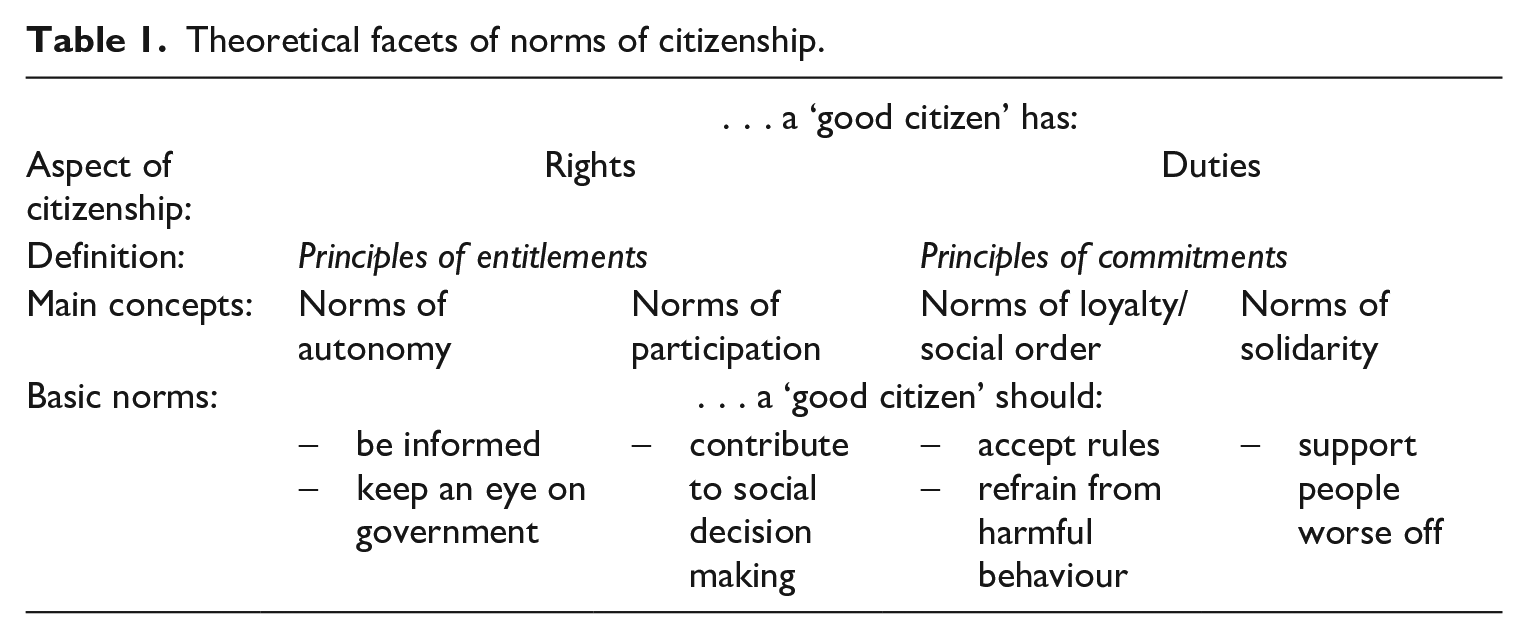
Taken together, autonomy, participation, loyalty/social order, and solidarity prescribe a plethora of normatively desirable characteristics and behaviours that, so far, have been considered an encompassing depiction of a good citizen in a democratic polity. The conceptual distinctions between the various aspects are summarized in Table 1. Starting with the classical distinction between rights and duties, the four main facets can be used for further specifications of two types of entitlements and two types of commitments. The bottom of the table presents examples of basic norms for each of the four facets distinguished.
Theoretical facets of norms of citizenship.
Sustainability and populism as new images of democratic citizenship?
Norms of sustainability
Existing studies document that support towards citizenship norms is changing (Oser and Hooghe, 2013) and that the concept itself evolves (Schudson, 1998). A notable strand of research developing largely disconnected from the norms of citizenship literature deals with ‘sustainability’ as a further facet of what a ‘good citizen’ should do. Understood mainly as ecological sustainability, the concept features particularly prominently in research on ‘ecological citizenship’ (e.g. Dobson, 2003; Micheletti and Stolle, 2012) and ‘lifestyle politics’ (de Moor and Verhaegen, 2020). The authors argue that, to tackle environmental challenges and climate change, citizens are obligated to decrease their personal ecological footprints. Thus, citizens are deemed responsible to act considerate with respect to natural resources, and to conserve them for future generations. Emphasis is put on consumption and lifestyle change by individuals. In this way, sustainable consumption is regarded as a central means through which individual citizens ought to do their share and take ethical and environmental concerns into account when engaging in transactions (e.g. Dryzek, 2005; Hobson, 2002; Seyfang, 2005). A ‘good citizen’, then, takes care of natural resources, and of environmental and ethical concerns more generally. 2
The norm to act sustainable is typically treated as a prescriptive ideal rather than one that is empirically observed among citizens (Zorell and Yang, 2019: 3–4). However, some studies have expanded or reoriented their focus to garner citizens’ own perspectives on sustainability as a collective norm. This includes measures towards general activities to protect the environment, recycling, or climate-friendliness (e.g. Ojala, 2015; Westheimer and Kahne, 2004). Some studies added single items covering citizen commitments for sustainability. Tying in with the focus on sustainable consumption, they include a single item referring to the duty to choose certain products over others for political, ethical, or environmental reasons (e.g. International Social Survey Programme (ISSP), 2004/2014). In line with the notion of ecological citizenship, the IEA International Civic and Citizenship Study 2016 expanded this to activities and efforts to protect the environment and conserve natural resources.
As a crucial finding of this last study, Schulz et al. (2018: 228–229) report that considering sustainability concerns is deemed to be (very) important for being a ‘good citizen’ by a considerable fraction of respondents. This aligns well with results from other studies like the ISSP, which trace increasing agreement among the public that a good citizen takes over social responsibility and cares for what s/he uses up and buys (e.g. Eder, 2017: 11–12). Apparently, vast majorities of citizens participate in recycling efforts worldwide and increasing numbers of people engage with ‘sustainable’ consumption (e.g. National Geographic Society/GlobeScan, 2014: 35ff). Although not engaging with these activities is, in principle, not costly for the individual, citizens engage because they seem to consider it the ‘right’ thing to do. As such, these activities therefore correspond with conventional images of social norms and norms of citizenship as normative prescriptions (Bicchieri, 2017: 14, 39).
Most discussions focus on environmental and, alongside, economic sustainability. Yet, a third and increasingly recognized facet refers to social sustainability, that is, the importance of preserving social and cultural heritages for sustainable development (Soini and Birkeland, 2014). Parts of the citizenry seem to re-celebrate their long-held core values and stir demands for conserving cultural identities. Moreover, research into ways to counter environmental degradation points to the importance of re-discovering, cultivating, and safeguarding old traditions (Altieri and Nicholls, 2017). Importantly, these aspects do not only represent individual convictions or notions of what is true, that is, (political) beliefs, but broader conceptions of what any good citizen should do. Hence, a thorough exploration of commitments for sustainability as norms of citizenship would cover three pillars: economic, environmental, and social/cultural sustainability.
Populist-authoritarian norms of citizenship
Citizens in Western societies increasingly opt for populist-authoritarian political alternatives. At the core of such ideas is (a) the challenging of established elites (such as ‘mainstream’ media, politicians, journalists, scientists) as legitimate authorities; while including (b) the argument that the only legitimate sources of political and moral authority in a democracy rest with ‘the people’, on whose representation these elites hold the monopoly (Norris and Inglehart, 2019). By attacking democratic norms and practices, populists seek to erode trust in legitimate authorities in liberal democracies. They invite citizens to reject elites of all kinds and to distrust mainstream political parties, the media, ‘experts’, and scientific evidence (Merkeley, 2020).
In line with authoritarian values and norms, populists tend to prioritize existing norms, such as the importance of security against disorder, and tap on ideas that are at odds with liberal democratic norms. These ideas relate to group conformity to preserve traditions and guard existing ways of life against abstract ‘others’ (Müller, 2016), or the need for loyal obedience towards strong leaders protecting the group and its customs, national, and cultural heritages (Norris and Inglehart, 2019: 6–8).
The rise and proliferation of authoritarian populism is important for the study of citizenship norms because they challenge the conventional understanding of these norms as liberal principles. Evidently, both dutiful and engaged citizenship norms entail aspects that speak to norms of loyalty/social order and autonomy. However, none of the items with which these facets are measured empirically speak to authoritarian populism.
Norris and Inglehart (2019) suggest that authoritarian-populist values and social norms may be shaped by specific period and life-cycle effects. This includes the financial crisis of 2008 and, more broadly, the rapid tendency of Western societies to become more socially liberal. Developments in issues related to survival (e.g. job security, declining income) and to the fast-paced process of economic, social, and cultural change have led parts of the population to feel left behind and strengthened feelings of resentment (Cramer, 2016; Fukuyama, 2018). They deeply reject the cultural values and social norms associated with these developments because they threaten their core values. Such processes, especially if they involve threats to survival, dominate people’s life strategy and open the way for new norms (Inglehart and Norris, 2017: 443).
Under these circumstances, people’s ideas of what a ‘good’ citizen ought to do in politics and society are tied to the normative idea of who should rule (Norris and Inglehart, 2019: 7). It contrasts ‘the people’ against ‘the establishment’ or elites as the true legitimate sources of political and moral authority. An updated notion of the concept of good citizenship then needs to include norms tapping into what or who is considered to be a source of authority, such as like-minded ‘ordinary people’ against the elite (Müller, 2016); and whom to be loyal to, for example, a capable strongman leader who can defend traditional values, beliefs, and ‘the will of the people’ (Müller, 2016; Inglehart and Norris, 2017). With the populist critique of liberal democracy as coming with elitism, such norms also include the rejection of processes that shift decision making to unelected technocrats, and thus further distance government from the people. Likewise, the media are seen as hostile (Schulz et al., 2018) with the potential to limit the power of the people by emphasizing an elite consensus instead of the interests or grievances of ordinary citizens. While the evolution of such norms would coincide with the emergence of ‘populist citizens’ (cf. Rovira Kaltwasser and van Hauwaert, 2020), they have so far not been tapped by existing conceptualizations and measurements (Schulz et al., 2018: 206). This leaves a gap in our understanding of how more recent conditions have shaped citizens’ perceptions and understandings of the features and characteristics of a ‘good’ citizen in a democratic polity.
Developing an extended instrument
The actual extent to which individuals in modern democracies endorse normatively desirable characteristics and behaviours of a ‘good citizen’ has been investigated by assessing citizens’ support for specific norms of citizenship. Many large-scale, cross-national population surveys have implemented corresponding survey instruments, such as the Citizenship, Involvement, Democracy (CID) survey in 2001 (van Deth et al., 2007), the European Social Survey (ESS) in 2002 (Schnaudt et al., 2014), and the ISSP in 2004 and 2014 (Scholz et al., 2017). However, questionnaire space in such large-scale surveys is restricted. Thus, measurement is usually confined to a relatively fixed and small number of ‘standard’ items. This hampers the ability of these surveys to adapt the measurement of citizenship norms to actual societal developments and changes in political landscapes.
We consider sustainability concerns and authoritarian populism as two increasingly salient phenomena in modern societies potentially changing conventional ideas about citizenship norms. Yet, these changes might imply expansions of available norms of citizenship in very different ways. An appropriate measurement instrument to explore these changes and expansions, therefore, should enclose conventional as well as new norms. In other words, two preconditions have to be met. First, the conventional facets of citizenship norms must be covered (autonomy, participation, loyalty/social order, solidarity). Second, norms explicitly covering support for sustainability and populist ideas have to be included.
For pragmatic reasons, the number of items for each facet should be relatively low. For measurement reasons, reliable conclusions about the dimensionality and structure of what is considered to be a ‘good citizen’ probably can be reached when about three items for each facet are available (either already used or newly developed). Making use of suitable existing, tried-and-tested items as much as possible allows us to connect our findings to previous research. Expanding the instrument with newly developed, theoretically informed items for aspects that have not been (sufficiently) covered before yields a measurement instrument that also covers more recent societal developments.
In what follows, we present such an extended measurement instrument. In line with scholarly debates on the ‘chameleonic’ nature of populism highlighting the need of populist ideas to be complemented with more substantial and more comprehensive ‘host ideas’ (van Hauwaert and van Kessel, 2018: 72), our discussion of items for populist citizenship norms is incorporated into the discussion of items pertaining to the four conventional facets of citizenship norms. Items capturing norms of sustainability are presented separately afterwards.
Norms of autonomy
Autonomy is usually operationalized by using one or two item(s): ‘forming one’s own opinions independently of others’ and ‘subjecting your own opinions to critical examination’. These items relate to the normative idea that being sufficiently informed and reflective about government affairs is required to be able to express and defend your interests and opinions. As such, they are conceptually connected with the role of mass media as political information environments that enable people to become informed. However, not only the quality of news seems to be declining (van Aelst et al., 2017), but also people’s trust in the media (Merkeley, 2020: 25). At the same time, citizens’ cynicism towards the media seems to increase (Schudson, 2019). These trends find voice in populists’ rhetoric about ‘fake news’, and the view that a ‘good citizen’ is not only someone who forms own opinions independently of others but also someone who actively distrusts media coverage and is cynical towards particular media outlets and their campaigns (Mazzoleni, 2008: 50–51), and who rather relies on gut feeling when judging what is true or false.
Donald Trump is probably the most vocal example of such ideas, but he is by no means alone in making these propositions. For example, the Law and Justice party in Poland unleashed attacks on mainstream media (Santora and Berendt, 2019); the populist left Syriza government in Greece, while in power, waged a fierce battle over TV licences raising serious concerns about media pluralism; and German media are often labelled as ‘the lying press’ (Lügenpresse) by the right-wing populist party AfD. Votes for these populist parties, in turn, appear to be importantly predicted by populist attitudes (Akkerman et al., 2014).
Hence, recent developments seem to relate to conceptions of autonomy, but they go beyond traditional conceptualizations. To cover these developments, we designed two items that tap into norms of autonomy but are more explicitly linked to being critical towards the media and more reliant on own perceptions of the world: (1) ‘not believing what the mass media say’ and (2) ‘relying on the gut feeling when making decisions’.
Norms of participation
Norms of participation are usually measured by referring to active engagement in politics as an important aspect of being a ‘good citizen’: ‘voting in elections’ and ‘being active in organizations and associations’. However, cynicism towards politics and, in particular, political parties and politicians has manifested itself with declining levels of electoral participation (Grasso, 2016; Hay, 2007). Many citizens believe that political elites do not listen to them (Coleman et al., 2008) and are not acting according to the needs of ‘the people’ but to their own interests. Populist rhetoric claims a supposed monopoly in enforcing the will of ‘the people’ (Mudde, 2004), reinforcing their supporters’ false consensus beliefs, that is, that their opinions are congruent with that of the majority. Acting politically ‘in the name of the people’, therefore, establishes an increasingly important virtue of a ‘good citizen’.
Again, these developments relate to traditional conceptualizations of participatory norms, but their concrete content goes beyond what is usually gauged. To capture this additional aspect while stressing the idea that it is the people – and not elites – who should rule, we add a new item covering the populist norm that a good citizen should ‘engage in politics to defend the people’s will’.
Norms of loyalty/social order
Two established items primarily capture dutiful aspects of citizenship like acceptance of state legitimacy and the rule of law: ‘never trying to avoid taxes’ and ‘always obeying the laws and regulations’. However, the general mistrust of politicians from traditional parties, intellectuals, and experts has been empirically connected to the populist worldview (Merkeley, 2020: 25). This opposes wide-spread demands for expert advice and expert-based approaches (e.g., public health, climate change) in policy making. Together, this suggests a changing position of citizens towards those involved in making political decisions and whom a good citizen should be loyal to.
Two newly designed items capture such positions towards ‘elites’. One captures normative approval of ‘listening to’ specialists who can offer expert knowledge on complex topics ranging from globalization and the economy, climate change or pandemics: ‘adhering to expert advice when making decisions’. The second captures the belief that elites are acting for the common good. It touches upon the same dutiful aspects of citizenship as the two standard items, but adds, as another important detail, citizens’ belief in and normative orientation towards the motives and actions of those in power to act in the name of the public interest and not, for example, in that of elites with ‘excessive’ wealth: ‘trusting in the commitment to the public interest of those in power’.
Norms of solidarity
The standard item for capturing solidarity is straightforward, asking about the importance of ‘being solidary with people who are worse off than yourself’. It certainly refers to the most general idea of solidarity. However, it can be doubted that rising hostility against migrants and growing religious and ethnic discrimination are covered by the rejection of this norm. Especially populist’s radical opposition towards migrants (a unifying element of right-wing populist parties, see Ivarsflaten, 2008), builds on the argument that they do so for the exploitation of welfare arrangements while not giving anything back. This radically opposes democratic ideas of equality, the protection of human rights, and universal solidarity. Considering accompanying suggestions about rising individualism and egoism in society, we complement the standard item with two newly developed items. These touch upon the costs and benefits a ‘good citizen’ faces with the balance between individual and societal costs and benefits – a ‘good citizen’ should (1) ‘make one’s own contribution to the benefit of society’ and (2) ‘not shape one’s own life at the expense of society’.
Norms of sustainability
For capturing norms of sustainability, existing studies tend to rely on an item referring to ‘buycotting’. Yet, this item only measures the consideration of sustainability aspects in the economic realm, whereas sustainability can be related to production and consumption, environmental, and cultural sustainability (Purvis et al., 2019: 681–682; see also our preceding discussion). Therefore, we conceptualize sustainability with buycotting as a first item: ‘buying specific products for political, ethical or environmental reasons’. We complement this with two items capturing the other environmental and cultural dimensions: ‘trying to protect natural resources’ and ‘striving to preserve the cultural heritage of the country’.
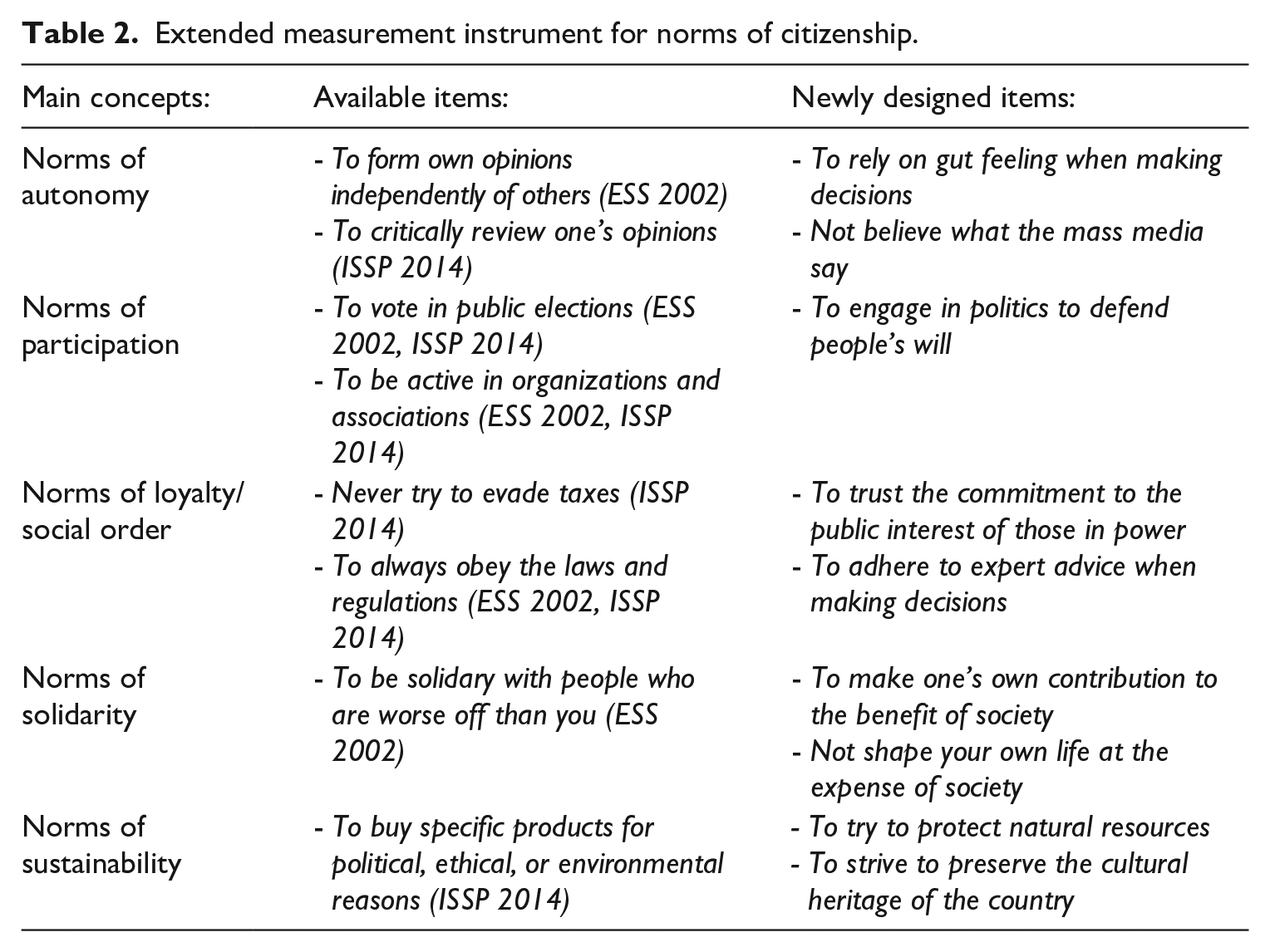
Table 2 summarizes all 17 items of our extended measurement instrument for norms of citizenship. This item battery is preceded by the following question: ‘What do you think, to what extent are the following things important to being a good citizen?’. Responses range from 1 ‘not at all important’ to 7 ‘very important’ (see Supplementary Information).
Extended measurement instrument for norms of citizenship.
Testing an extended instrument of norms of citizenship
To empirically test our extended instrument, we collected original data via an online access-panel in Germany. 3 The sampling frame consisted of a quota sample representative for the German population with regard to the distribution of age (18+), gender, and education (ISCED). The fieldwork period took place in March and April 2019, lasting about 4 weeks. One thousand forty-nine people participated and none of the respondents appeared to have any problems understanding the question wording or the task to assess the ‘importance’ of the 17 items: The average rate of missing answers across all 17 items amounts to 2.6%.
Germany is a particularly suitable case for our exploration. Longitudinal empirical evidence shows the gradual rise of citizens with self-expression values and the strengthening of political parties associated with ecological/sustainability beliefs (e.g. the Green party). This ensures that we can expect to capture some variation on the sustainability aspects. Moreover, as many other European countries, Germany has seen the sharp rise of a far-right populist party (AfD, Alternative for Germany), making it an ideal case to detect previously untapped populist citizenship norms. 4
Descriptive statistics
Figure 1 shows that, with one exception (‘trust those in power’), all items exhibit rather high average levels of support, ranging above the scale mid-point. This finding is in line with previous research highlighting a general and widespread support for norms of citizenship across advanced democracies (Denters et al., 2007; van Deth, 2007).
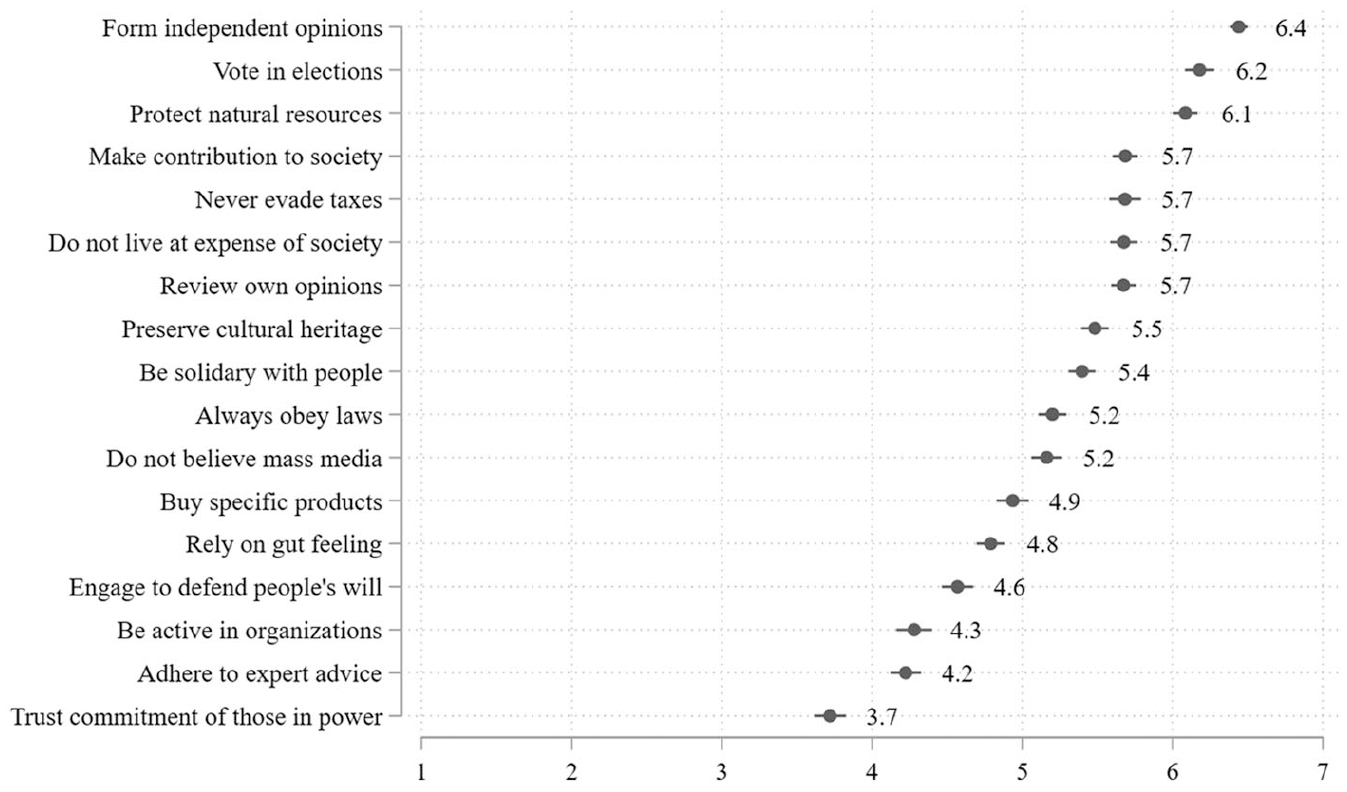
Support for norms of citizenship. Notes: Means with 95% CI (Nmin = 931).
At closer inspection, it is also evident that support levels for different norms do not seem to vary systematically between the different facets of citizenship identified earlier. Among the five items receiving the highest support, all facets of citizenship (autonomy, participation, loyalty, solidarity, and sustainability) are covered. What is more, all the newly developed items capturing populist aspects of citizenship (‘gut feeling’, ‘defend people’s will’, ‘expert advice’, ‘trust those in power’) are located at the lower end of the support spectrum.
Exploring the dimensionality of citizenship norms
The first goal in investigating whether and how sustainability and populist ideas can be incorporated in conventional conceptions of citizenship is to determine whether the commonly employed standard distinction between dutiful and engaged citizenship norms can be replicated with our data. We conducted an exploratory factor analysis (EFA) to investigate the structure of the seven tried-and-tested conventional items that have been part of the ESS 2002; the ISSP 2014, and that are still fielded regularly in other surveys (see Table 2). This analysis results in two dimensions, where ‘do not evade taxes’ and ‘obey laws’ represent the dutiful facet of citizenship, and the remaining five items engaged citizenship (results not shown). These findings show that there is nothing ‘exceptional’ about our data which could impede our ability to detect a meaningful structure underlying norms of citizenship. 5
Next, we use the full set of 17 items to investigate facets of citizenship. An EFA points to several items with high cross-loadings on more than one dimension. In a stepwise procedure attempting to obtain a set of items clearly loading on distinct dimensions, it turns out that the problems are caused by three items: ‘form opinions’, ‘review opinions’, and ‘do not live at expense of society’. This is a remarkable set of ‘problematic’ items. They all refer to individual responsibility and ‘horizontal’ relationships, but do not specify a topic or area (for instance, form your own opinion can be very differently assessed in scientific, culinary, or religious matters). That these items simultaneously load on different dimensions, therefore, shows that each more specific norm of citizenship can be accompanied by one or more of these items.
After excluding these items, the remaining 14 define a space with five factors (as indicated by a scree test; the eigenvalue of the fifth factor is 0.97). As Table 3 shows, these five dimensions follow conventional conceptual distinctions and can be labelled as (1) norms of participation, (2) norms of social and ecological sustainability, (3) norms of social order (duty), (4) norms of loyalty, and (5) norms of autonomy. 6
Exploring dimensions of norms of citizenship (EFA; factor loadings).
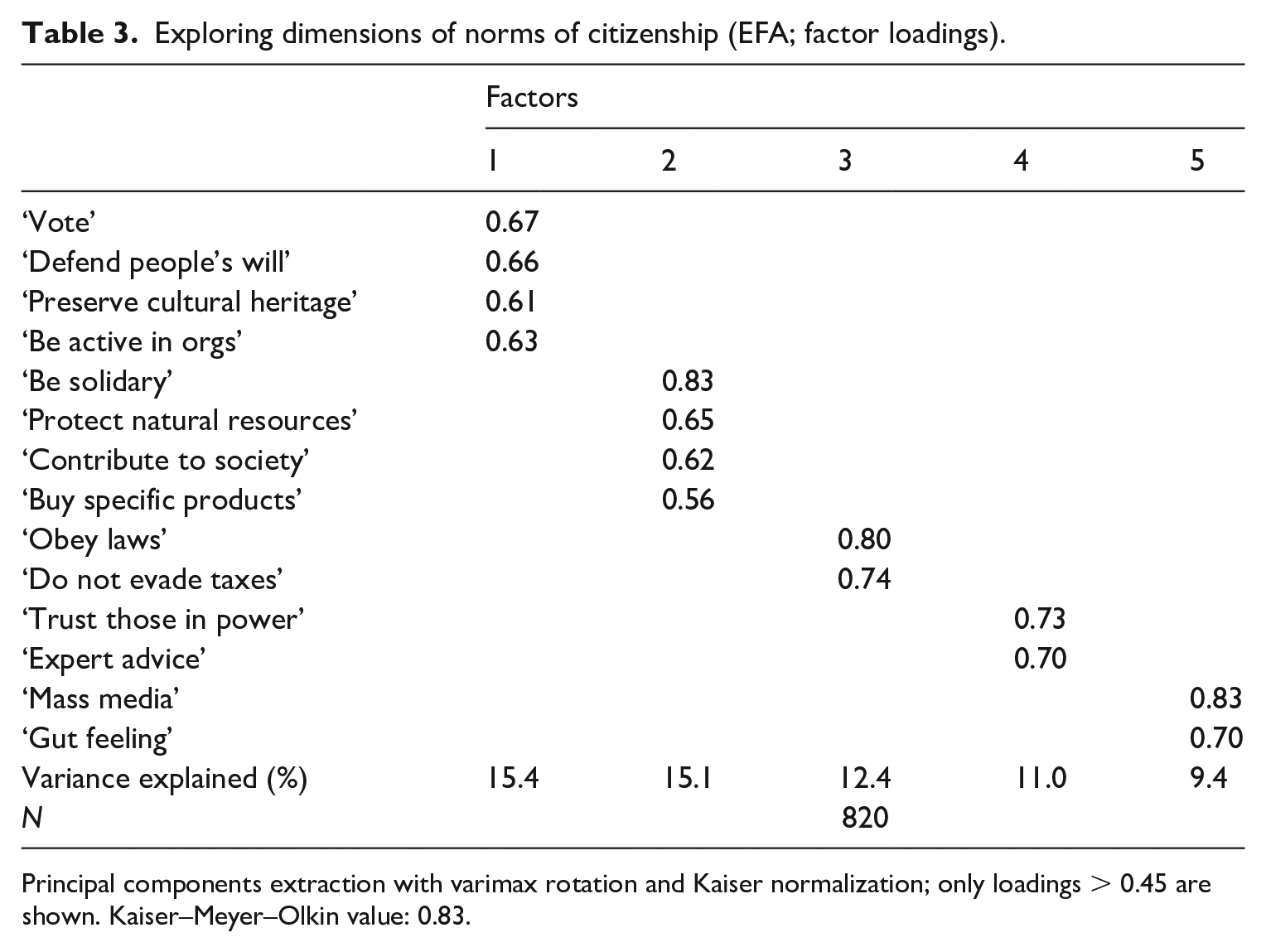
Principal components extraction with varimax rotation and Kaiser normalization; only loadings > 0.45 are shown. Kaiser–Meyer–Olkin value: 0.83.
Compared with previous research focussing on engaged and dutiful citizenship only, our expanded set of items thus brings to light a configuration of citizenship norms more closely reflecting conceptual distinctions (see Table 2). While engaged and dutiful citizenship is still captured in this configuration (Factors 1 and 3), we additionally observe distinct dimensions for the remaining conceptual facets. What is more, our results indicate an additional split between dutiful norms of social order (Factor 3) and norms of loyalty vis-à-vis authorities and elites (Factor 4).
Overall, and in the light of this study’s research objectives, two findings are particularly noteworthy: First, together with conventional norms of citizenship, norms referring to support for sustainability and populist ideas can be integrated into a coherent scheme of citizenship norms. Second, while norms pertaining to sustainability cluster together with conventional norms of solidarity, norms capturing populist ideas primarily relate to aspects of loyalty and autonomy. These results are also theoretically plausible. The duty to live sustainably is generally derived from the notion of intergenerational and cross-national solidarity and reflects citizen responsibility for the well-being of future generations. Populist ideas, in turn, touch upon the role of citizens as part of ‘the people’ vis-à-vis authorities and elites and the question of who should be entrusted with the authoritative allocation of values in a society. All in all, our findings thus underline that aspects of sustainability and populism can be meaningfully incorporated into existing conceptualizations of norms of citizenship. In doing so, they provide evidence for a broadening and expansion of citizenship norms not captured in previous studies. 7
Levels of support for citizenship norms in Germany
Figure 2 shows the distribution of support for the five main facets of citizenship norms among the German population in 2019. 8
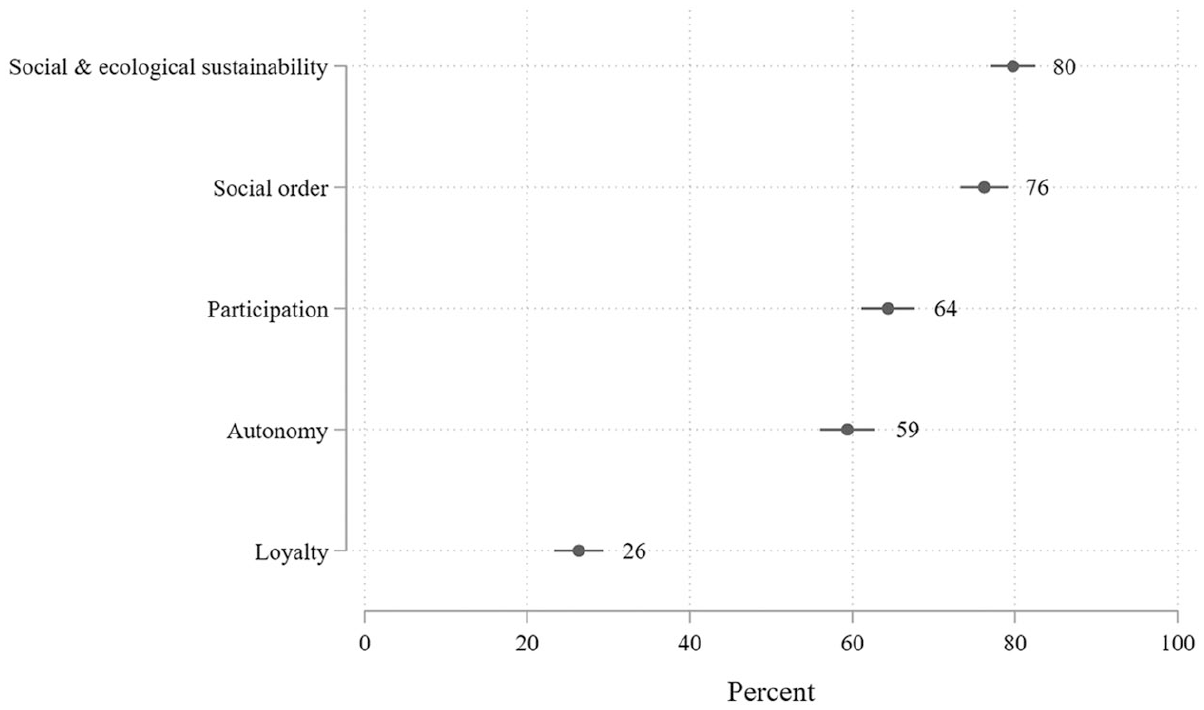
Support for five facets of norms of citizenship.
Support is highest for norms of social and ecological sustainability and social order, with 80% and 76% of respondents showing high support (values ⩾ 5 on the 7-point scale), respectively. Norms of participation are somewhat less supported but still receive high support by roughly two-thirds of respondents (64%). Most interesting, however, are the respective support levels for the two facets consisting of our newly designed items capturing populist notions of citizenship. Almost 60% of German respondents consider reliance on one’s gut feeling and emotions rather than mass media an important characteristic of a ‘good citizen’ (autonomy). This stands in stark contrast to democratic ideals of well-informed citizens and enlightened citizenship. Trust in the public commitment of authorities and adherence to expert advice as a fifth distinct facet of citizenship norms (loyalty) is supported by only a minority of respondents (26%). This finding indicates that most people consider it an important attribute of a ‘good citizen’ to retain a vigilant, independent – or even anti-elitist – role in a democratic polity.
Conclusions and discussion
Ideas about the ‘good citizen’ are very important for the persistence of democracy as they determine citizens’ expectations of and involvement in society. However, growing concerns about an alleged disengagement from politics and civic life among the citizens of contemporary democracies have fuelled renewed debates about the role and relevance of democratic citizenship. Conceptions of democracy and norms of citizenship seem to be changing, most notably when it comes to rising concerns about sustainability and the strengthening of authoritarian populism. Available instruments of norms of citizenship, however, do not cover these changes. To enable an accurate study of norms of citizenship, we expanded available measures with newly designed items. We then tested a set of 17 items empirically using a representative sample (gender, age, and education) of the German population including more than 1000 respondents.
Our findings reveal a more complex picture and empirical configuration of norms of citizenship than shown by earlier studies relying on the commonly employed distinction between dutiful and engaged citizenship. While this distinction could be reproduced, our expanded set of items clearly suggests the existence of additional, more diverse, and substantially supported facets of norms. Responding to our first research question, our study highlights the existence of five distinct facets of citizenship norms, which cover aspects of both sustainability and populist ideas and, in addition, correspond neatly with the conceptual underpinnings of citizenship norms identified in the literature: (1) norms of participation, (2) norms of social and ecological sustainability, (3) norms of social order (duty), (4) norms of loyalty, and (5) norms of autonomy.
With respect to our second research question, we find that sustainability is integrated within norms on solidarity. This fits in with the prescriptive ideal underlying the concept, according to which citizens should ‘do their share’ and live sustainably. Moreover, support for this dimension is highest, with a substantial 80% of respondents seeing sustainable living as a (very) important ingredient of being a ‘good citizen’.
Populist ideas, in turn, cluster among citizenship facets relating to loyalty and autonomy. This makes sense, as populist ideas tap into questions of who is best suited and can be (en)trusted to make decisions for the individual in society (‘the people’ vs ‘the elite’). While receiving lower support on average, these facets evidently constitute distinct dimensions in the five-dimensional space. Notable 59% of the German respondents consider reliance on one’s gut feeling and emotions rather than mass media an important characteristic of a ‘good citizen’. This conception of autonomy stands in stark contrast to democratic ideals of well-informed citizens and enlightened citizenship. Similarly, only one-fourth of the German population thinks that a good citizen ought to trust in the commitment of those in power and adhere to experts’ advice. This clashes with the core principle underlying representative democracy of entrusting the public interest to certain (s)elected people. Thus, while these aspects touch upon individual autonomy and loyalty as conventional facets of citizenship, they involve fundamental differences which are challenging for democratic co-existence: One of rising distrust or scepticism towards authorities and, generally, others than the self; (overtly) high confidence in own judgement; and ‘knowledge resistance’ (Klintman, 2019) grounded on crude ingroup–outgroup distinctions. With this, the two facets clearly reflect a set of norms that can reasonably capture the public’s increasing support for the populist agenda.
Populist conceptions challenge the conventional understanding of citizenship norms as liberal principles. Norms relating to sustainability, in turn, expand conceptions of civic action to private spheres. Our broadened conceptualization can help grasp and to understand how rising autonomy can but might not necessarily be related only to ideas linked to greater democratic emancipation, but also to the emergence of a set of attitudes more troubling for democracy. With this, the extended conceptualization can essentially inform discussions of means to promote or remedy developments in the citizenry, which might be fostering or threatening the long-term functioning and viability of democracy.
The quality of democracy is intrinsically attached to shared commitments to the polity and their values. Social and political participation, the attribution of legitimacy to those in power, and general respect for others are essential for sustaining liberal democracies. In such context, norms of citizenship are an invaluable tool for detecting changes in citizens’ perceptions of their roles and their position towards politics and fellow citizens. However, democracy is not set in stone, neither are norms of citizenship. They change, and our study provides empirical evidence for such change to be happening. Expanding and re-conceptualizing the concept of norms of citizenship are essential for adequately grasping the forces behind current and upcoming changes in the political landscape and the quality of democracy.
Supplemental Material
sj-pdf-1-pol-10.1177_02633957211031799 – Supplemental material for Revisiting norms of citizenship in times of democratic change
Supplemental material, sj-pdf-1-pol-10.1177_02633957211031799 for Revisiting norms of citizenship in times of democratic change by Christian Schnaudt, Jan W van Deth, Carolin Zorell and Yannis Theocharis in Politics
Footnotes
Funding
The publication of this article was funded by the Ministry of Science, Research and the Arts Baden-Württemberg and the University of Mannheim.

Supplementary Information
Additional supplementary information may be found with the online version of this article.
Notes
Author biographies
References
Supplementary Material
Please find the following supplemental material available below.
For Open Access articles published under a Creative Commons License, all supplemental material carries the same license as the article it is associated with.
For non-Open Access articles published, all supplemental material carries a non-exclusive license, and permission requests for re-use of supplemental material or any part of supplemental material shall be sent directly to the copyright owner as specified in the copyright notice associated with the article.
