




Abstract
Scholars who study populism from an ‘ideational approach’ consider populism as a set of ideas based on a moralised anti-establishment thinking and a strong people-centrist view of politics. From this perspective, at a theoretical level, populist attitudes have the following two main contrasts: pluralism and elitism. In this article, we investigate the ideological consistency of the populism-pluralism-elitism set of attitudes among voters. Analysing data from Flanders (N = 1444), we make three main contributions. First, we show that there indeed exists an internally consistent relationship between populism, elitism, and pluralism among voters. Second, we demonstrate that this consistency only holds for the most politically sophisticated citizens. And third, we show that the relationship between populist and elitist attitudes is much more nuanced than often assumed. We show that it is possible to empirically distinguish between ‘expertise elitism’ and ‘anti-populist elitism’, two forms of elitism which relate differently to populist attitudes.
In the shadow of an ever-growing volume of contributions that study populism either from a conceptual basis or from a party-based perspective, an increasing number of scholars focus on the so-called ‘demand’ side of populism, that is, on the opinions of individual voters. This literature follows an ‘ideational approach’ and thus considers populism as a set of logically consistent ideas that represents politics as a Manichean struggle between the homogeneous blocs of the ‘good people’ and the ‘corrupt elite’, with the goal of bringing the power back to ‘the people’ (Mudde, 2017; Rooduijn and Pauwels, 2011; Stanley, 2008). This literature on the ‘demand side of populism’ has resulted in the development of a number of different attitude scales (Akkerman et al., 2014; Castanho Silva et al., 2020; Hawkins et al., 2012; Schulz et al., 2018; Wuttke et al., 2020) that have been successfully used for both correlational (e.g. Van Hauwaert and van Kessel, 2018) and experimental research (e.g. Hameleers et al., 2018; Hawkins et al., 2020).
One characteristic of the expanding literature on this demand side of populism, however, is that it tends to treat populist attitudes as a standalone phenomenon (Bickerton and Accetti, 2017). In this article, and following Anne Schulz’s (2019: 8–13) work, we argue that in order to advance our understanding of the origins, meanings, and consequences of populist attitudes, it is important to assess (1) whether and (2) among which citizens populist attitudes are related to other ideas in an ideologically coherent way.
Scholars who focus on relationships between attitudes argue that understanding a constituting idea requires comprehension of the system in which that attitude is embedded (Daenekindt et al., 2017). Moreover, the level of attitude coherence as measured by the strength of the relationships between the ideological and/or attitudinal positions is considered to be a feature that affects both the stability and the resulting effects of the constituting ideological elements. Such variation implies that the meaning of an individual attitude (e.g. populism) may vary between different subgroups and that one misses this point if one studies attitudes in isolation. The specific relevance of this for populism becomes readily apparent.
First, some scholars have called populism a thin-centred ideology thereby suggesting that it can easily be combined with different ideological elements (Stanley, 2008). Translated to the level of voters, such an assumption raises the question as to whether populist attitudes actually correlate in any predictable and meaningful way with other varying views on politics (such as pluralism and elitism) or whether they are flexible and untethered. The latter question refers to a more fundamental issue. Although it is clear how populism, pluralism, and elitism relate to each other in theory (see further), we know very little about how these attitudes correlate among the general public. The few studies that have assessed the relationship between these concepts have led to inconclusive results (Akkerman et al., 2014; Hawkins et al., 2012). For example, at the voter level, research found a positive correlation between populism and elitism, while a negative correlation was expected (Akkerman et al., 2014).
Second, one of the most important insights from the literature on attitude coherence concerns the general weakness of the ‘ideological consistency’ of the public, in particular, those of the less educated (Converse, 1964; Lupton et al., 2015). This observation raises important normative questions concerning the general public’s capacity to grasp the complexity of – and ultimately, the meaningfulness of – representative democracy (Schulz, 2019: 10). Indeed, some scholars argue that populism is ‘an illiberal democratic response to undemocratic liberalism’ (Mudde et al., 2018: 1670) that ultimately poses a threat to democracy (Müller, 2014; Urbinati, 2014). Strategies that aim to address or combat populist attitudes will be different when populist attitudes are a standalone phenomenon compared to when they are embedded in a broader web of attitudes on representation and politics.
For these reasons, this article assesses to what extent support for populist attitudes fits within this broader web of attitudes. Approaching populism in this way will bring the literature on populist attitudes in line with the broader field of public opinion research. Refraining from doing so would imply that we assume that there is homogeneity among ‘the people’. We believe such an assumption not only hampers our understanding of populism, the more general assumption that there exists homogeneity in how the electorate reasons have been proven by previous research to be incorrect (Baldassari and Goldberg, 2014).
Based on data from a face-to-face survey in Flanders (N = 1444), our study makes three main contributions. First, we show that populism is consistently related to what the literature considers as its logical contrasts: pluralism and elitism. Second, we demonstrate that this attitudinal consistency only applies to citizens who are highly politically sophisticated. Third, we show that the relationship between populist and elitist attitudes is more nuanced than is often assumed. Specifically, we demonstrate that it is possible to empirically distinguish between ‘expertise elitism’ and ‘anti-populist elitism’, two forms of elitism which relate to populist attitudes in different ways.
How are populist attitudes ideationally embedded?
In this article, we examine the attitudinal embeddedness of populist attitudes and assess how this varies depending on people’s political sophistication. We focus on pluralism and elitism as these attitudes have been central in what scholars call the ‘ideational approach’ to populism (e.g. Hawkins and Kaltwasser, 2019; Mudde, 2004, 2017; Rooduijn, 2014). According to this approach, populism is closely related to two contrasting ‘sets of ideas’, namely elitism and pluralism (Akkerman et al., 2014; Hawkins and Kaltwasser, 2019; Mudde, 2004, 2017; Müller, 2015). We discuss both in order to reach specific expectations regarding their relationships with populism among the public at large.
Elitism is based on the idea that power should be concentrated in the hands of a few groups or individuals, whereas pluralism departs from the belief that power should be dispersed among a variety of groups rather than concentrated within the hands of a single, elite group. Hence, populism’s anti-elitism conflicts with the idea that elites should rule, and populism’s glorification of a homogeneous people is incompatible with the ideal of a pluralist society. When it comes to attitudes, it can therefore be expected that populism, pluralism, and elitism are closely but inversely related to each other and, as such, that they constitute an internally coherent system of beliefs.
Research thus far suggests that, indeed, populist attitudes are distinct from pluralism and elitism (Akkerman et al., 2014), but also that the relationship between populism and elitism is not as clear as has often been claimed (Akkerman et al., 2014; Caramani, 2017; Mohrenberg et al., 2019). Akkerman et al. (2014), for example, found that populist attitudes correlated positively with an elitist view of politics.
Theoretically, scholars have always been aware that populism and elitism share ideational elements. This becomes readily apparent when we consider one specific form of elitism, namely technocracy. Populism and technocracy both (1) perceive society to be divided into two antagonistic and homogeneous blocs (i.e. the elite and the people) and (2) plea for unmediated (or unconstrained) politics (see Bertsou and Caramani, 2020; Caramani, 2017). Regarding the latter, both populism and elitism share a deep distrust of party democracy and the politics of compromise: ‘Technocracy holds that there is only one correct policy solution; populism holds that there is only one authentic will of the people. In a sense, therefore, both are curiously apolitical’ (Bickerton and Accetti, 2017: 326). Populism and elitism are based on a trustee model of democracy; both assume that there is only one appropriate solution for societal problems and reject the notion of compromise. Therefore, we expect that elitism will only correlate negatively with populism if it contains a clear denial of a central role of ‘the people’, that is, an anti-people-centrist element.
The previous arguments have several implications for empirical research among voters. There is no a priori reason to assume that all forms of elitism will be negatively correlated with populist attitudes. Because populism and elitism partly overlap, it is important to work with scales that can disentangle the overlapping from the non-overlapping elements. We, therefore, distinguish the following two forms of elitism: (1) ‘expertise elitism’ stresses the absence of party democracy, and, therefore, overlaps with populism; and (2) ‘anti-populist elitism’ rejects the primacy of the will of the people, and is, as such, clearly opposed to populism. Whereas, the first is expected to correlate positively with populist attitudes, the latter is expected to be negatively correlated.
It is clear that populism and (all forms of) elitism are essentially non-pluralist. Pluralism contains not only a warning against the tyranny of the majority, but it also rests on the belief that an open confrontation of ideas and policy proposals is beneficial to society (Galston, 2002). Pluralists contend that in democracies power should be dispersed among a variety of groups rather than concentrated within a single elite group (Dahl, 1978). For pluralism, ‘the will of the people’ is deemed to be a myth not because people are politically incompetent but because people and their opinions are diverse and ‘[. . .] there is no simple way of getting from the plural to the singular’ (Weale, 2018: 9). In practice, then, pluralism boils down to procedural legitimacy, that is, the idea that legitimacy is not a static property of a policy but rather emerges during the application of procedures. As such, there is a strong tension within populism given that the latter pleads for an unmediated relationship between the people and their impact on politics. Therefore, we expect to find a negative correlation between support for pluralism and populism.
In sum, according to the literature, populism, elitism, and pluralism relate to each other in a highly consistent way and together form a triangular set of cogent beliefs. Populism’s glorification of a homogeneous people contrasts with pluralism’s focus on the existence of a multitude of groups with different interests (and hence, is expected to correlate negatively), whereas populism’s anti-elitism is incompatible with elitism’s assessment of the people as incapable and ignorant (see Schoor, 2020). Yet, it remains important to emphasise that in spite of these clear contrasts, elitism and populism also have characteristics in common: populism and elitism share a homogeneous understanding of in-groups and out-groups, and therefore, both heavily criticise the politics of compromise.
Political sophistication and attitude coherence
This article focuses on the relationships between, on one hand, populist attitudes and, on the other hand, elitist and pluralist attitudes in order to assess whether they are related in an internally coherent way within the public. There are, however, good reasons to expect that this will not be the case. More specifically, a broad literature suggests that political sophistication or competence moderates the degree of attitude coherence (Ansolabehere et al., 2008; De Vries et al., 2011; Freeder et al., 2019; Lupton et al., 2015).
More than half a century ago, Converse (1964: 54) argued that many citizens do not possess a full and encompassing set of beliefs: ‘A realistic picture of political belief systems in the mass public, then is not one [. . .] that presumes widespread ideological coherence; it is rather one that captures with some fidelity the fragmentation, narrowness, and diversity of these demands’. Hence, according to Converse, many citizens do not hold stable or consistent attitudes and are, therefore, incapable of following politics. Yet, Converse also argued that citizens exhibit vast differences (see Kinder, 2006). The less citizens know ‘what goes with what’, the less coherent their belief systems will be (Converse, 1964). Recent research has provided support for this idea. Lupton et al. (2015) demonstrated that elite attitudes are unidimensional and that with decreasing political sophistication, citizens’ attitudes begin to deviate from that one-dimensionality, ultimately leading to a lack of structure (what Converse called ‘non-attitudes’). These observations have several far-reaching consequences. First, it suggests that there is less stability regarding attitudes among the less politically sophisticated – when attitudes are more strongly embedded in a web of other attitudes, the latter ‘constrain’ the former (Jennings, 1992). Second, elite polarisation is most likely to be reflected within those who have a high degree of political sophistication, rather than low (Lupton et al., 2015). In addition, De Vries et al. (2011) showed that political sophistication enables voters to successfully link (EU) issue preferences to their voting choices. This may be especially important in the context of populism as it is often described as a ‘thin-centred’ ideology that has to be connected with a more encompassing ‘host’ ideology or set of issue preferences.
The preceding arguments justify focusing on the attitudinal embeddedness of populist attitudes. As the populism-pluralism-elitism set of attitudes exists as a rather consistent belief system at the elite level (i.e. parties that tend to be populist are often not pluralist or elitist, and parties that are pluralist tend not to be populist or elitist), it might well be expected that the populism-pluralism-elitism set of attitudes also exists as a consistent belief system within the public, but only among the more politically sophisticated.
The preceding discussion feeds into the debate about the origins of populist attitudes. One line of thought is that populist attitudes are supply-side driven and, as such, much more malleable. Rooduijn et al. (2016), for example, contend that support for populist parties is driven by political discontent, which in turn, is fuelled by the supply-side and particularly by the political message of a populist party (see also Van der Brug, 2003). These observations lead to the idea that at least for some voters’, populism may not exist independently from the messages they receive from political actors and, therefore, will not be embedded in broader web of attitudes but can be considered untethered. Empirical support for this idea can be found in Bertsou and Caramani (2020) whose latent class analysis based on three dimensions of technocracy and populist attitudes revealed six classes of voters. Three of them could be meaningfully interpreted (namely Technocrats, Populists, and Party-Democrats), but the remaining three classes, comprising more than 50% of respondents, had no clear ideational profile.
This discussion further underscores our general point: in order to better understand populist attitudes, we have to study its relationships with other political stances and representations and assess the possible moderating role of other factors such as political sophistication (and/or education).
Research strategy and context of the study
The preceding arguments lead to three crucial questions that we seek to answer in the empirical part of this article: Is populism embedded in a web of attitudes including elitism and pluralism in a theoretically meaningful way? Is the general pattern moderated by the level of political sophistication among voters? And do varying forms of elitist attitudes relate differently to populist attitudes? Our research strategy is threefold.
First, we assess the empirical relationships between populist, pluralist, and elitist attitudes. As indicated earlier, there are only a few studies that assessed the empirical relationships between these sets of ideas. Second, we contribute to the literature by going one step further than other studies. The literature on public opinion and the literature on the ideational approach to populism similarly suggest that these relationships may differ for certain parts of the population. We, therefore, assess these relationships for subgroups of voters who differ in political sophistication. We expect that if the relationships are logically consistent – as in that they are consistent in terms of the conceptual work on populism – this consistency will be among the most politically sophisticated voters. Third, we pick up where Akkerman et al. (2014) left off by assessing whether we can develop two elitism attitude scales that tap into the overlapping and non-overlapping elements of populism and elitism. Akkerman et al. (2014) measured elitist attitudes with three items. In conceptual terms, the first item (i.e. politicians should lead rather than follow the people) is clearly anti-populist as it downplays the role of the ‘the people’. To distinguish populist attitudes from mere anti-establishment thinking, the people-centrism component of populism is a crucial element. It is people-centrism which may render populism a politics of hope (i.e. ‘the hope that where established parties and elites have failed, ordinary folk, common sense and the politicians who give them voice can find solutions’ (Elchardus and Spruyt, 2016: 126). A denial of a central role for ‘the people’, however, is not present in the last two items (i.e. Our country would be governed better if important decisions were left up to successful business people; Our country would be governed better if important decisions were left up to independent experts). Both items refer to what Bertsou and Caramani (2020) call the belief in the expertise dimension of technocracy. There is no reason to assume that successful business people or independent experts would not listen to ‘the people’. Indeed, in Hawkins et al.’s (2012) analyses, the latter two items referred to a stealth democracy attitude which dovetails with a more technocratic elitism (Mohrenberg et al., 2019). The difficulty of designing a unidimensional scale for elitism was also demonstrated by a recent study in nine European countries. Bertsou and Caramani (2020) proposed four items that tapped into distinct aspects of elitism. However, after analysing the scales, only the two items that strongly rejected the primacy of the ‘will of the people’ could be kept (Ordinary people don’t know what policies are good for them; political leaders should make decisions according to their best judgement, not the will of the people). In our view, these items do not pinpoint generalised elitism (if this would ever exist), but rather a specific anti-populist form. One way to advance this discussion is to develop attitude scales for elitism that contrast in terms of whether they explicitly deny a central role of the people.
To sum up, we expect to find that (1) when it concerns elitist attitudes, anti-populist elitism can be distinguished from expertise elitism; (2) whereas anti-populist elitism is expected to correlate negatively with populist attitudes, expertise elitism is expected to correlate positively with populist attitudes; (3) support for pluralism is expected to correlate negatively with support for populism; and (4) the observed relationships will be more ideologically coherent among politically sophisticated or highly educated citizens when compared with politically less sophisticated or less educated citizens.
The study is conducted in Flanders (Belgium). Belgium is one of the few countries where voting is still compulsory. Voting for populist parties provides dissatisfied voters (who in countries where voting is not compulsory might not vote at all), a means to vent their discontent (De Lange and Akkerman, 2012). In addition, due to the low electoral threshold (5%), smaller parties can enter parliament relatively easily. Once in parliament, they receive funding that can be used for further (populist) communication strategies. It comes as no surprise that Flanders has a long history of predominantly right-wing populist parties (Pauwels, 2010). The Vlaams Belang, for example, is regularly described as a ‘textbook case’ of right-wing populism (Jagers and Walgrave, 2007: 334). In the most recent 2019 regional election, it received 23% of the vote and became the second largest party in Flanders. Besides the Vlaams Belang, the neo-liberal populist party Lijst Dedecker was quite successful between 2007 and 2010, but was removed from parliament in 2014 (Pauwels, 2010). The success of (right-wing) populism has also had spill-over effects to other politicians, even on the left. Indeed, Mudde (2004: 255), for example, called the former leader of the Flemish socialist party (SP) a populist. Gallina et al. (2020) considers the electoral breakthrough of the (former communist) left-wing party PTB-PVDA as evidence of left-wing populism in Flanders or Belgium. PVDA voters also score as high on populist attitudes as well as VB voters (Elchardus and Spruyt, 2016). The substantial ‘supply’ and ‘demand’ of right- and left-wing populism also led to intense public debates concerning representation and the working of democracy, leading, for example, to mediatised deliberative initiatives such as the G1000 in 2011 (Caluwaerts and Reuchamps, 2018). The preceding elements render Flanders a suitable test case to study the attitudinal embeddedness of populist attitudes among voters.
Data and measures
In order to answer our research questions, we rely on data from a face-to-face survey gathered in 2016 from 1449 Dutch-speaking inhabitants of Flanders, aged 18–85 (Mage = 50.42; SDage = 18.94). Respondents (51.0% female) were recruited by means of a probability sample on the National Register (response rate: 57.2%). Subsequent comparisons with population data revealed that young people, men, and the less educated were somewhat underrepresented in the sample. Therefore, weights based on the combination of gender, age, and education are used (highest weight equalled 2.32).
Populist attitudes were measured with the six items proposed by Akkerman et al. (2014). This is the most widely used measure to tap into populist attitudes. Scale analysis indicates that while it has its limitations, it does perform reasonably well (Castanho Silva et al., 2020). One extra item (e.g. politicians have often betrayed the people) suggested by Spruyt et al. (2016) was added. In this item, established politicians are bluntly accused of taking advantage of ‘the people’ and in this way, more explicitly introduces the (Manichean) moral aspect of the antagonism between the people and the elite (Cronbach’s Alpha = 0.807). Pluralist attitudes have not often been included in survey research, limiting the choice of items. We borrowed three items from Akkerman et al. (2014) (example item: in a democracy it is important to make compromises among differing viewpoints) and added a fourth because the original scale suffered from a rather low reliability (i.e. no opinion is undisputable. Therefore, it is good to balance difference opinions against each other; Cronbach’s Alpha = 0.720).
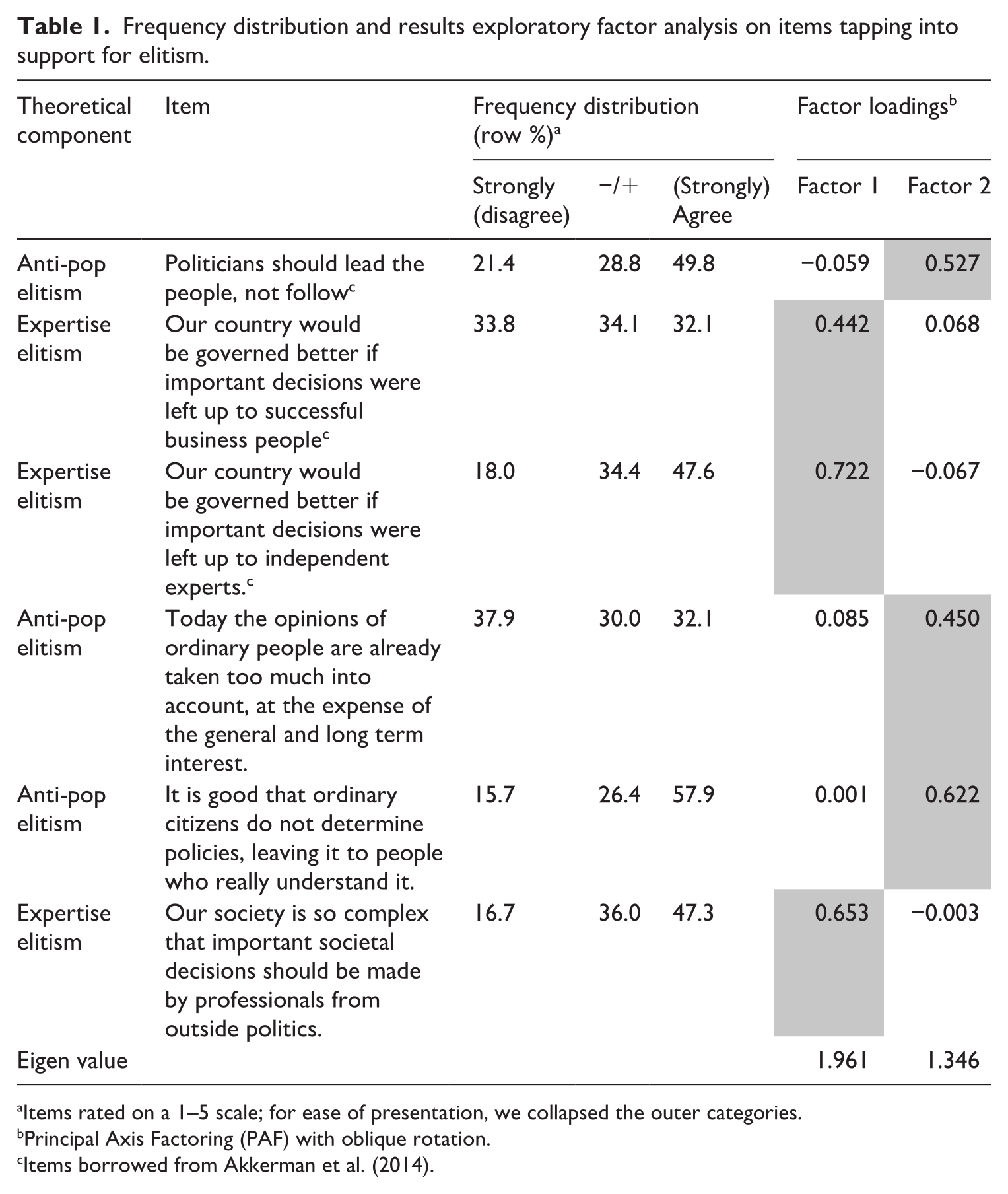
Regarding the measurement of elitist attitudes, we built on the scale used by Akkerman et al. (2014) and added three items to the original three items that were discussed earlier (Table 1). The extra items were formulated in such a way that the ensemble of six items would enable us to distinguish between a version of elitism that rejected the primacy of ‘the people’ in politics (e.g. Politicians should lead the people not follow; furthermore, ‘anti-populist elitism’) and a view of politics that did not mention the people at all, but celebrates experts and which shares with populism an anti-party sentiment (e.g. our society is so complex that important societal decisions should be made by professionals outside of politics). Following Bertsou and Caramani (2020), we call this dimension ‘expertise elitism’. Table 1 presents the frequency distribution of the six items. A first observation that stands out is the high proportion of respondents that agreed with the elitist statements. Indeed, nearly half of the sample agreed that politicians should lead the people, not follow – a clearly anti-populist statement. An even larger proportion (57.9%) of respondents supported the idea that it is good that ordinary citizens do not determine policies, leave that to people who really understand it.
Frequency distribution and results exploratory factor analysis on items tapping into support for elitism.
Items rated on a 1–5 scale; for ease of presentation, we collapsed the outer categories.
Principal Axis Factoring (PAF) with oblique rotation.
Items borrowed from Akkerman et al. (2014).
An exploratory factor analysis (PAF) with oblique rotation on the six elitism items revealed two dimensions with eigenvalues above 1 (1.961–1.346). The factor loadings of all items confirmed that the two underlying factors refer to the two expected versions of elitist attitudes.
Political sophistication is a broad concept that covers the following three elements: (1) the exposure to political information, (2) the intellectual ability to interpret and organise political information, and (3) the motivation to obtain and interpret information (Luskin, 1990: 335). In empirical research, this concept has often been operationalised based on factual political knowledge. Other scholars, however, argue for a broader operationalisation: ‘Sophistication [. . .] may be best thought of as a latent construct, with traits such as attention, interest, and knowledge as indicators’ (Miller, 2011: 578). They not only refer to the finding that factual knowledge is strongly correlated with other indicators of political awareness (Bartle, 2000: 41), but they also stress that interest, cognition, exposure, motivation, and performance interact and mutually reinforce each other. To cover such a broad conceptualisation of political sophistication, some scholars combine self-assessed measures with methods that assess factual political knowledge (Gallina et al., 2020; Lupton et al., 2015), or rely on people’s educational attainment (e.g. Enns and Kellstedt, 2008).
In this article, we follow this broad conceptualisation. As our data did not include a direct test of respondent’s factual political knowledge, we constructed an indicator for political sophistication based on the combination of (1) self-assessed political competence and (2) political interest. Four items tap into respondents’ self-assessed political competence or internal political efficacy – I know more about politics than most people around me, I usually have an opinion on political issues or events, Most political themes I barely understand [reverse coded], and Politics is too complicated for me to understand what is going on [reverse coded] (Cronbach’s Alpha = 0.802). Based on these items, a summation scale (0–100) was constructed. This scale turns out to be strongly and positively related to respondents’ political interest (one item 0–10; r = 0.702; p < 0.001). By means of principal components analysis, one dimension was abstracted based on self-assessed political competence and interest. Subsequently, we ranked all cases according to people’s score on this dimension and divided the sample in to three equal groups which enables us to compare the relatively less and most politically competent groups, whereby both groups are separated by a substantial medium group.
All data and syntaxes necessary to replicate our findings as well as descriptive statistics for the attitude scales are available in the Online Supplemental Appendix at the Open Science Framework (access via: https://osf.io/8ct6k/?view_only=712f2ea2388547028fd54a70253bdb4c).
Results
To study the relationships between the different attitudes, we first have to demonstrate that all attitudes could be distinguished in a measurement model. Therefore, a confirmatory factor analysis based on all of the items (including those tapping into populist and pluralist attitudes) was performed (Table 2). Each item loaded on one out of the four latent constructs, revealing an acceptable fit (RMSEA = 0.068; Upper limit 90% CI RMSEA = 0.072; P close fit = 0.000; CFI = 0.858; SRMR = 0.053). The fit of the baseline model could, however, be improved by specifying three covariances between the error terms of items that belong to the same scales (pop1-pop2, pop5-pop7, plu2-plu3; RMSEA = 0.051; Upper limit 90% CI RMSEA = 0.055; P close fit = 0.339; CFI = 0.919; SRMR = 0.054).
Factor loadings and error correlations of two CFA models on items tapping into populism, elitism, pluralism.

CFA: confirmatory factor analysis; CFI: comparative fit index; CI: confidence interval; RMSEA: root mean square error of approximation; SRMR: standardised root mean square residual.
Subsequently, we estimated the latent factor scores as identified by the CFA for the four attitude scales and used them in all further analyses. To assess whether correlations were moderated by political sophistication, we estimated a general linear model with populism as the dependent variable, the main effects of political sophistication (three groups/continuous), elitism or pluralism and an interaction term between both. This analysis provides an eta² effect measure (for the interaction term) that reflects the overall strength of the moderation effect. In this way, the results of the main analyses are directly comparable with those from the robustness check.
The correlation between non-populist elitist and expertise elitist attitudes was moderate and positive (r = 0.468; p = 0.000). This is theoretically consistent. It concerns two very different expressions (hence, no strong correlation) of a similar (hence, a positive correlation) idea, namely an elitist view on politics. When calculated for different levels of political sophistication, we found rather similar correlations (rs for the low, medium, and high sophisticated: 0.557, 0.474, 0.403, respectively; all ps < 0.001) which did not significantly vary between political sophistication groups (
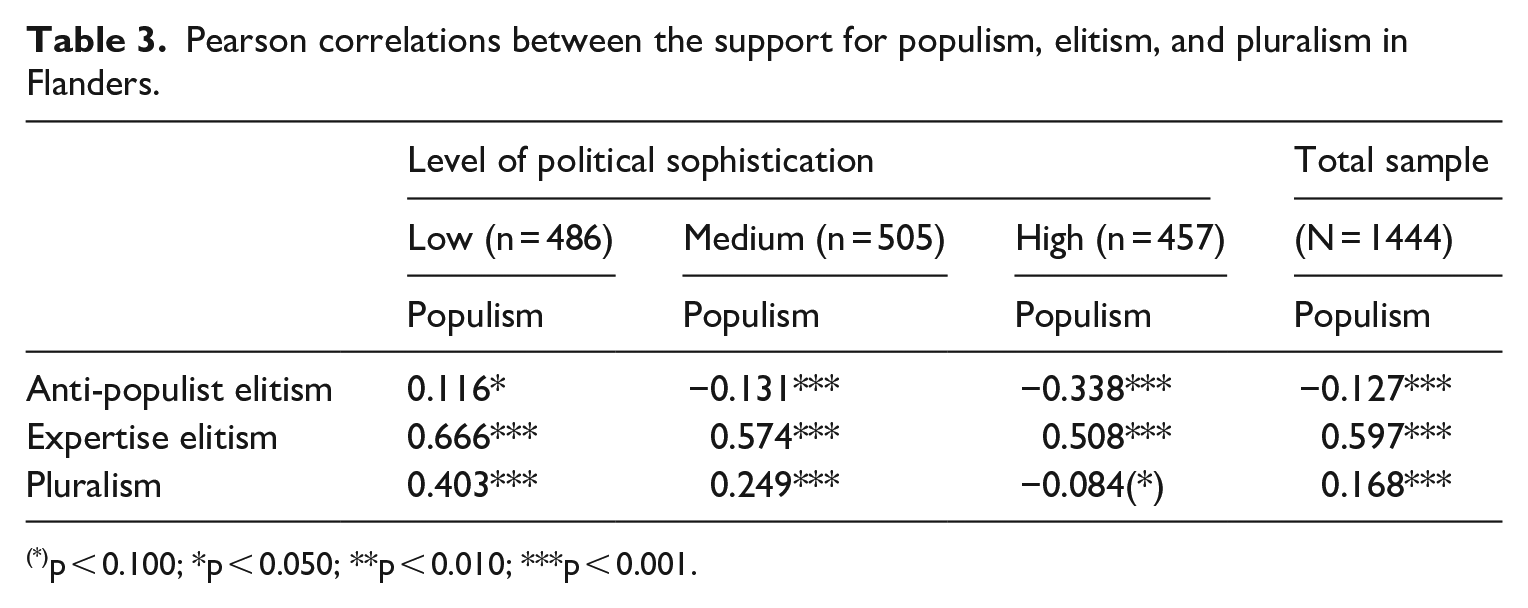
Table 3 reports the Pearson correlations between the three different attitude scales and populism. Three ANOVA models were used to test whether the relationships between elitist and pluralist attitudes, on one hand, and support for populist attitudes, on the other hand, varied across the three political sophistication groups.
Pearson correlations between the support for populism, elitism, and pluralism in Flanders.
p < 0.100; *p < 0.050; **p < 0.010; ***p < 0.001.
For anti-populist elitist attitudes, the correlations with support for populist attitudes varied substantially according to the level of political sophistication (
A similar pattern was found for pluralist attitudes (
We checked whether the categorisation of the political sophistication variable in three equal groups affected our significant conclusions. To that end, we re-estimated a univariate general linear model which included the main effects and an interaction term between the two variables (political sophistication vs anti-populist elitism-pluralism-expertise elitism) and entered political sophistication as a continuous variable. These results –
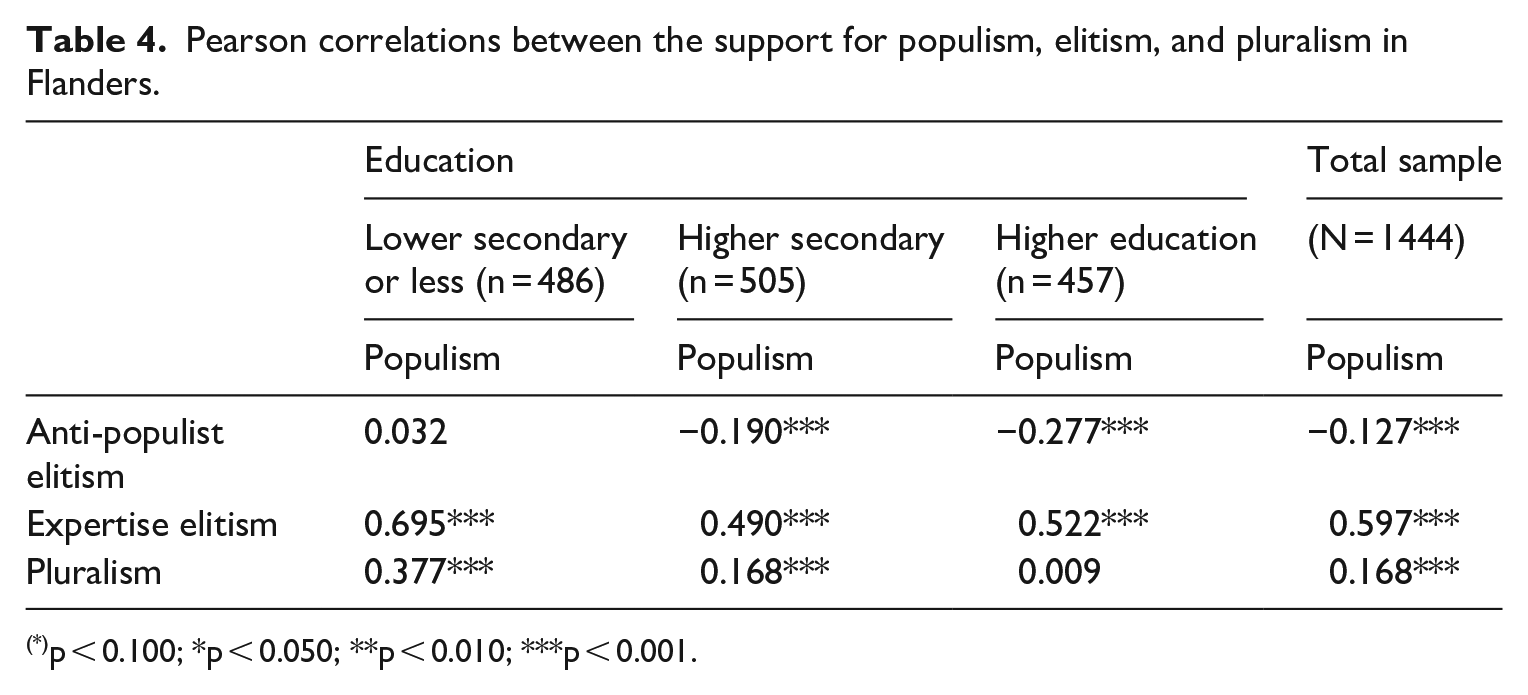
One of the drawbacks of focusing on political sophistication – especially when it is assessed in terms of factual knowledge which is often seen as the best way to measure it (Dassonneville, 2012) – is that many general surveys do not include this as a measure. However, as explained earlier, several authors argue for a broader interpretation of political sophistication (e.g. Enns and Kellstedt, 2008; Gordon and Segura, 1997). From this perspective, educational attainment can be used as a proxy to measure ‘respondents’ capability for abstract thought and integration, level of basic information, and tendency to view politics as important (Gordon and Segura, 1997: 141). People’s educational attainment is included in almost every survey and has been shown to be related to populist attitudes. Therefore, partially as an additional robustness check and to assess the wider application of our arguments, we re-estimated our models (Table 4) for different educational groups. We distinguished between (1) lower secondary education or less, (2) higher secondary education, and (3) higher (tertiary) education. The results are highly similar to those obtained when political sophistication was measured based on the combination of respondents’ self-assessed political competence and political interests. They also lead to the same conclusions.
Pearson correlations between the support for populism, elitism, and pluralism in Flanders.
p < 0.100; *p < 0.050; **p < 0.010; ***p < 0.001.
From a more general perspective, these results lead to two inferences. First, when studying the meaning of populist attitudes, it can be misleading to rely on correlations in the population as a whole. In terms of the attitudinal embeddedness, populist attitudes clearly mean something different among less politically sophisticated voters than among highly politically competent or interested voters. Second, in terms of ideological consistency, it is clear that among less politically sophisticated voters, the populism-pluralism-elitism attitude system can hardly be considered a consistent set of ideas. For the highly sophisticated voters, the pattern appears consistent, even though the strength of the correlations is only modest.
Discussion and conclusion
Previous research on populist attitudes has focused on how these attitudes should be measured, who holds these attitudes, and to what extent they explain voting behaviour. Yet, the question of how populist attitudes relate to their theoretical opposites – pluralist and elitist attitudes – remains largely unanswered. This is a critical gap. In order to understand populism as an attitude, it is essential to also assess how it is embedded within a larger set of attitudes about politics and political decision-making. In this study, we have examined whether populism on the demand side is indeed inversely related to pluralism and elitism. In addition, we have argued that it is crucial to (1) differentiate between various forms of elitist attitudes and (2) investigate whether these relationships are moderated by political sophistication. As such, our article aligns with a recent tendency in the literature that has shifted the emphasis from isolated attitudes and levels of support (i.e. what people think) to the attitudinal embeddedness of attitudes and questions concerning as to how people think. Such a shift provides an answer to the criticism that ‘populism has been treated as a stand-alone phenomenon’ (Bickerton and Accetti, 2017: 327).
At the empirical level, we contribute to the literature in two main ways. First, we distinguish between two different types of elitist attitudes. The existence of different types of elitism is evident from the theoretical work of scholars who focus on the relationship between populism and technocracy (Caramani, 2017). However, this has not been addressed in the literature on populism among voters (for an exception, Bertsou and Caramani, 2020; Mohrenberg et al., 2019). Our results show that two forms of elitist attitudes can be distinguished. First, we examined the view that puts the primacy on the role of experts in politics. This ‘expertise elitism’ was positively related with support for populist attitudes among all groups of voters. Theoretically, this makes sense given that both views rest upon a deep distrust of party politics. What renders it remarkable is that this was the only relationship that was not moderated by the level of political sophistication (see below). Second, a form of elitism that denies the central role of ‘the people’ (which we have called ‘anti-populist elitism’) correlated negatively with support for populist attitudes, but only among the medium and highly politically sophisticated. The combination of both observations, when interpreted through the lens of Philip Converse’s ideas on ‘ideological constraint’, suggests that the plea for political change and anti-party politics (both elements of populism and expertise elitism) are a much more constraining (i.e. binding and structuring) factor than the emphasis on the centrality of ‘the people’ (which is denied in anti-populist elitism). Again, this is consistent with Caramani’s (2017) claim that populism and technocracy are both hostile towards party politics.
Our second contribution at the empirical level is that we studied the moderating role of (self-assessed) political sophistication in the attitudinal correlates of populist attitudes. Our empirical results are in line with an established literature on the importance of political competence, knowledge, and sophistication (Lamprianou and Ellinas, 2019; Michaud et al., 2009). Political sophistication matters. At the most general level, and most importantly, our empirical research suggests that what support for populist attitudes at the voter level means may vary depending on people’s level of political sophistication. At least among those who perceive themselves as politically competent, we found that support for populist attitudes was related to other ideas, such as pluralism and elitism, in consistent ways. Much less consistency was found among the least politically sophisticated. Indeed, the great irony of our results is that precisely among the group that is most likely to support populist attitudes, the correlations with other ideas were least consistent. This strongly suggests that for these voters populism is more of a standalone attitude. This finding implies that (1) support for populist attitudes may have different meanings for varying subgroups of voters and (2) it may not be possible to find one single underlying cause of the support for populism.
Future research should follow a trend in the more general literature on populism (Bonikowski and Gidron, 2016) and the central focus of research on belief systems, as in, it should shift its focus from what populism is to how it works. We contribute to this by showing that further research on the origins and consequences of populist attitudes among voters should test possible moderating effects of political sophistication. This would bring the literature on populist attitudes more in line with the more general literature on public opinion research which has repeatedly shown that the assumption of homogeneity in attitude structure among the electorate has proven to be incorrrect (e.g. Baldassari and Goldberg, 2014).
Replicating our central findings may also provide an opportunity to overcome some limitations of our article. Although we feel confident about our measure of (self-assessed) political sophistication, it would be better to also include measures that tap into factual political knowledge (Gallina et al., 2020), especially because we know that the difference between both (sometimes called ‘the illusion of knowing’) is higher among the less educated (Park, 2001). Furthermore, especially in contemporary highly mediatised societies, unravelling political sophistication by differentiating between being uninformed and misinformed would allow for a better insight as to the exact moderating mechanism (Van Kessel et al., 2020).
At the theoretical level, our results direct attention to key questions that should be answered in order to further develop our understanding of what support for populism among voters really means. To develop a political psychology of the support for populism, one should address the question of whether support for populist attitudes among voters has an independent existence in voters (in the form of a coherent set of ideas) or rather originates from the activation of a latent (pre-)disposition. Both the existing literature and our results offer good reasons to believe that, for at least some voters (i.e. the least politically sophisticated), support for populism cannot be primarily seen as a ‘coherent set of ideas’. Hawkins and Kaltwasser (2019: 7) argue that while a subset of individuals in any population [our emphasis] is likely to apply their populist attitudes to every circumstance around them, most people require contexts that makes the activation of populist attitudes sensible, and interpretative help from other people who can catalyse this process.
We sketch two scenarios. The first brings us back to the role of the supply-side. It is possible that the activation (or even the construction) of populist attitudes occurs by way of the messaging from political parties or the media. It may be the case that those who are more politically sophisticated are more aware of the cues from these actors. One line of thought is that, for many, populism could be seen as a coping mechanism, as an answer to political problems. In this light, populism is cast as the politics of hope. It may be through the messaging from political actors, through the more politically sophisticated, that those who score higher on the populist attitudes scale have a more coherent view of the role of the people. From this perspective, populism may be seen as a ‘construction’. This is in line with the work of Laclau (2005) who argues that populist parties mobilise actors by identifying grievances, linking these with one another, and constructing the people or elite dichotomy in the process.
Contrastingly, if the supply side plays less of a role, then for a substantial part of the population, and, more specifically, the less politically sophisticated, it is possible that support for populist attitudes is the result of the activation of a disposition (rather than a consciously held attitude or world view). However, if this is the case then we need a theory addressing where this disposition comes from. The notion of (pre-)disposition is often used by sociologists and social psychologists as the theoretical vehicle to refer to the deeply socialised tendencies that render people sensitive to certain stimuli and predispose them to react to these stimuli in a predictable but often non-conscious way. Every theory in sociology and social psychology that relies on the notion of dispositions focuses on specific circumstances (mostly during childhood) that ingrain certain tendencies in peoples’ minds and bodies (see, for example, Bourdieu’s (1984) theory on habitus). Indeed, dispositions are thought to derive their relative stability from the fact that peoples’ living conditions create homogeneity in their encounters (i.e. who one meets and to what experiences one is exposed). In that light, support for populism seems very specific, political, and far removed from children’s (and adults’) daily lives to simply assume that it can be seen as a general disposition.
For a substantial section of the voters, it might make more sense to conceive of populist attitudes as a concrete manifestation of a deeper underlying attribution style or a perception scheme (such as conflict thinking, see Spruyt et al., 2018) or general ingroup/outgroup thinking). In that case, the question becomes whether we should focus on populist attitudes or on this underlying perception scheme, which would also include other attitudes such as ethnic prejudice, welfare chauvinism, or affective polarisation. This, again, underscores the starting point of this article, namely the importance of not studying the support for populist attitudes in isolation. A full understanding of the support for populism among voters will only be achieved by (1) systematically relating this support to other political ideas, opinions, and attitudes for (2) different fractions of the population.
Research Data
sj-docx-1-pol-10.1177_02633957211017763 – for Ideologically consistent, but for whom? An empirical assessment of the populism-elitism-pluralism set of attitudes and the moderating role of political sophistication
sj-docx-1-pol-10.1177_02633957211017763 for Ideologically consistent, but for whom? An empirical assessment of the populism-elitism-pluralism set of attitudes and the moderating role of political sophistication by Bram Spruyt, Matthijs Rooduijn and Andrej Zaslove in Politics
Footnotes
Funding
The author(s) received no financial support for the research, authorship, and/or publication of this article.

Supplementary Information
Additional supplementary information may be found with the online version of this article.
Author biographies
References
Supplementary Material
Please find the following supplemental material available below.
For Open Access articles published under a Creative Commons License, all supplemental material carries the same license as the article it is associated with.
For non-Open Access articles published, all supplemental material carries a non-exclusive license, and permission requests for re-use of supplemental material or any part of supplemental material shall be sent directly to the copyright owner as specified in the copyright notice associated with the article.
