




Abstract
The Lisbon Treaty introduced key institutional changes to increase the relevance of elections to the European Parliament (EP). Among these was the ‘Spitzenkandidaten process’, which was introduced with the aim to increase the visibility of the EP elections and mobilise more citizens to turnout to vote. This article investigates the effect that the debates among the Lead Candidates had on voters’ perceptions about candidates and policy issues. To do this, we administered a two-wave panel online survey to a sample of students from different European universities prior to the Spitzenkandidaten debates and directly after them, following the logic of a quasi-experimental research design. Following a difference-in-differences approach, we gauge the extent to which those respondents who were exposed to the debates increased their degree of information about the candidates and changed their perceptions about the candidates and their policy positions. The findings reveal that respondents who followed the debate felt significantly more informed to make up their minds about the candidates as well as to make their vote decisions, and show that the debate slightly improved their perceptions of the policy positions of those candidates who they had intended to vote for.
Introduction
For years, the European Union (EU) has been overshadowed by debates about its democratic deficit (Føllesdal and Hix, 2006; Moravcsik, 2002). One institution that featured prominently in these debates was the European Parliament (EP). Elections to the EP are considered to be second-order elections (e.g. Hobolt and Wittrock, 2011; Reif and Schmitt, 1980), as political contestation takes place mainly over national issues and parties seek to strategically position themselves against their competitors with an eye towards the next national election. Similarly, media coverage of European election campaigns tends to be low, focused on national political actors, and often displaying negative evaluations towards the EU (De Vreese et al., 2006). Not surprisingly, voters don’t feel sufficiently informed about the European policy positions of candidates and parties, nor are they very motived to participate (Franklin and Hobolt, 2011; Hobolt and Tilley, 2014). To mitigate these effects, scholars have suggested that EP election campaigns need to achieve more clarity on the policy positions of the candidates, and that the outcome of the elections must have tangible consequences, which voters can relate to (Mair, 2007). To achieve this, the suggestion was made that candidates should engage in televised debates and the appointment of the Commission President should be linked to the outcome of the EP elections (Hix, 2008). With the Lisbon Treaty, an opportunity for institutional reform was created, which stipulated that for the nomination of the President of the European Commission the results of the EP elections should be taken into account (Article 17(7) of the Treaty on European Union (TEU)). Subsequently, parliamentary groups have advocated that the European Council should be required to nominate the Lead Candidate (Spitzenkandidat) based on whomever is proposed by the dominant parliamentary group.
In 2014, for the first time, debates among the Lead Candidates took place. This procedure was expected to increase the visibility of the elections, help citizens choose the party that was closest to their preferences, and encourage more voters to participate (Christiansen, 2016; Hobolt, 2014; Schmitt et al., 2015). But, as we know, the 2014 elections did not fulfil these expectations. Overall, voting turnout was at a historical low, at 42.5%, and the election campaigns of the Europarties were not much different, when compared to the past (Braun and Popa, 2018; Hobolt, 2015). Some scholars have even found a polarising tendency in the interaction of EU assessment and candidate recognition, such that voters who were opposed to European integration were galvanized by the presence of Lead Candidates (Popa et al., 2016). In the wake of these results, some have advocated that the Lead Candidate procedure should be abandoned all together (Fromage, 2019).
Despite its seemingly limited effect, debates among the Lead Candidates again took place during the 2019 EP election campaign. The following questions arise: Did the 2019 Lead Candidates debate (again) have little effects on European voters? Was it a waste of time for candidates, parties, and voters alike? Or did it matter, and if so, for whom and how? Research on national political campaigns has amply shown that campaigning debates do affect voters, especially in regard to cognitive and political involvement as well as attitudes towards candidates and issues (e.g. Benoit et al., 2003; Benoit and Hansen, 2004). More specifically, in the European context, research on 2014 EP elections has suggested that the debates contributed to increase voters’ interest in the elections (Hobolt, 2014) as well as the likelihood that they would indicate a preference for a Lead Candidate (Gattermann et al., 2016). In addition, voters have been found to respond positively to what the candidates had to say, with some voters adopting more favourable views towards the EU (Maier et al., 2016).
It is against this background that this article investigates the effect that the 2019 Lead Candidates debate had on voters’ information about and evaluation of candidates and salient policy issues. More particularly, we will investigate the extent to which debate exposure might contribute to connect EU citizens with EP elections through the impact of the debate on two core attitudes connected to voting decisions: political cognition and perceptions about the candidates and their policy positions. Thus, our article will try to answer the following questions: First, did debate exposure influence the degree of awareness about the Lead Candidates and a subjective sense of information to make a vote decision? And second, did the debate influence attitudes towards the candidates among the audience generally, and more particularly, among the candidates’ potential voters?
Our article focuses on the debate that took place on 29 April 2019 in the Theather aan het Vrijthof in Maastricht. 1 The debate was held in English and could be followed either in person or through online live-stream via a YouTube channel. The debate was attended by 900 viewers in the venue and followed by over 130,000 online and potentially millions on social media. According to Politico, during the live-stream over 14 million individuals followed #MaastrichtDebate. Despite these figures, the salience of the debate was relatively low, considering that around 400 million citizens were eligible to vote in the 2019 EP election and that only 9 national stations live-streamed the debate. Notwithstanding this, we consider the low public salience of the debate to be an asset for our design, since it contributed to minimising the chances that responses were contaminated by widespread reports of the debate in the media.
Five candidates participated in the Maastricht Debate, namely Frans Timmermans (Party of European Socialists), Bas Eickhout (European Green Party), Guy Verhofstadt (Alliance of Liberals and Democrats for Europe Party), Jan Zahradil (Alliance of Conservatives and Reformists in Europe), and Violetta Tomic (Party of the European Left). The candidate for the European People’s Party, Manfred Weber, declined to participate excusing himself due to other commitments in his agenda. 2 The debate was focused on the following three key themes: the Future of Europe, Sustainable Europe, and Digital Europe. To analyse debate effects, we set up a quasi-experimental pretest–posttest study in which we reached young voters through a panel online survey. The survey instrument was applied before the debate and immediately after it.
This article begins with a review of the literature on election campaigns and debate effects on political agendas and voters. Next, we provide a detailed explanation of the methods employed, taking into account inherent limitations of the study. The empirical part tests two hypotheses regarding debate effects on individuals’ cognitive mobilization and evaluation of candidates’ positions on the three issues debated, and presents the results of our analyses. The implications of our findings are discussed in the ‘Conclusion’ section.
Debate effects on political cognition and attitudinal change
During EP elections, national parties organise and execute election campaigns to inform citizens about candidates and their policy positions (Marsh and Mikhaylov, 2010). These efforts can be expected to not be without effect. Literature on election campaigns has demonstrated that campaign-specific information helps voters to identify candidates of political parties and to differentiate their policy positions (Nadeau et al., 2008). Through learning, voters are able to form enlightened preferences for candidates and parties (Arcenaux, 2006). Studies investigating the relative impact of various media on voters’ salient issue knowledge further highlight the importance of individual candidates and debates. Previous literature found that voters obtain more salient issue information from candidates during debates than from the news (Benoit and Currie, 2001).
Debates among the Lead Candidates have led to a personalisation of European election campaigns. In a recent study, Gattermann et al. (2016) find that the Lead Candidates campaigning strategies foster ‘cognitive personalisation’ as an electoral effect, such that voters feel better informed about the candidates. Most of the debate literature agrees that debate exposure has a strong impact on the amount of information voters have, both objectively and subjectively. During a debate, candidates have the opportunity to make themselves known, discuss in detail their policy positions, and distinguish themselves from the other candidates. Given that voters are usually poorly informed at the beginning of political campaigns, especially in regard to EU matters, debates help them to form an impression about the candidates and issues (Baboš and Világi, 2018; Maier et al, 2018). After a debate, viewers have been found to have the subjective feeling that they are better informed than before and are more confident of their vote choice (Kaid et al., 2000). In this line of reasoning, we will test the following hypotheses on the debate effects on political cognition:
H1a. Exposure to the Lead Candidates debate will increase viewers’ ability to express an opinion about candidates and salient issues.
H1b. Exposure to the Lead Candidates debate will increase viewers’ ability to recognise candidates’ names.
H1c. Exposure to the Lead Candidates debate will increase viewers’ subjective perception of the degree of information they have to make vote decisions.
Besides political cognition, attitudinal change has also been found to be one of the most important effects of debate exposure. Previous literature has shown that debates usually contribute to change viewers’ opinion about the candidates, especially perceptions of the candidates’ personality and competence (e.g. Benoit et al., 2003; McKinney and Warner, 2013). Having the opportunity to directly compare the different candidates on the issues discussed, as well as to listen to competing positions, provides recipients with an invaluable vehicle for opinion formation and change. Thus, a likely effect of televised debates is that viewers alter their initial visions about the candidates depending on their performance during the debate. However, evidence suggesting that attitudinal change caused by debate exposure is the same for all attendants is far from conclusive. A large body of work, mostly in the United States, suggests that debates can only reinforce already existing attitudes rather than transforming them (for a summary, see McKinney and Carlin, 2004), as those who actively follow a political debate hold firm attitudes and predispositions towards the candidates. Individuals who feel closer to a particular party and/or are potential voters of it, are likely to think that their candidates are performing well at the debate and will thus reinforce their vote intention. As our sample is composed of young, well-educated voters, who usually hold strong attitudes towards politics, we expect to find a reinforcement effect of debate exposure on candidates’ evaluation mainly conditional on partisanship. Thus, our second hypothesis is as follows:
H2. Exposure to the Lead Candidates debates will reinforce voters’ positive evaluations of the different candidates and their policy positions among the respective potential voters, while the effect on other groups of viewers will be smaller.
Although the two effects of debate exposure we discuss in this article (political cognition and attitudinal change) are relevant factors for voting decisions, with the data at hand, it is uncertain whether these effects did carry over to the election day. Previous research has found that political communication (of the kind broadcasted during televised debates) produces mainly short-lived effects, as the public’s capacity for durable learning is quite limited and they tend to simply internalise the implications of such communication, while forgetting its details (Hill et al., 2013). More particularly, on the durability of debate effects, in a recent study on the televised debates that took place before the two German Federal Elections of 2009 and 2013, Lindemann and Stoetzer (2021) demonstrate that only 2 weeks after the debates, most of the observed effects (mainly in the form of increased candidate valence) on voting intention for both the Social Democratic Party of Germany (SPD) and the Christian Democratic Union of Germany (CDU) had disappeared. Although this issue cannot be tested empirically here, in the concluding section, we will discuss more in detail the lifespan of the two short-term effects of debate exposure analysed in the article.
Research design and data
The data for the analysis comes from a two-wave panel online survey. The pre-debate survey was administered in late February 2019, that is, 2 months before the Maastricht Debate. The online survey was initially distributed through an anonymous link that was sent by email to 628 individuals, mostly students from different universities in Europe. The link to the survey was also posted on social media, to allow for a wide response. Participants in the survey were asked to provide their email address, if they agreed to take part in a follow-up study. The post-debate survey was fielded immediately after the Maastricht Debate. The survey was again distributed by email among those individuals who had provided their email address in the pre-debate survey.
All the questions in our study asked respondents about the 6 aforementioned Lead Candidates, that is, the five who participated in the Maastricht Debate and Manfred Weber, who did not participate. Questions about Weber were used as a falsification or placebo test to assess the independence of results. In addition, the survey asked respondents about the candidates’ policy positions on the key themes of the debate, namely the Future of Europe, Sustainable Europe, and Digital Europe.
In total, 505 respondents filled out the pre-debate survey, out of which 345 provided their email addresses, and only 222 answered the post-debate survey. By demographics, the sample includes respondents from 25 nationalities, Germans being the most numerous (31.5%) then followed by Dutch (14%). A total of 76% of the respondents are students (36% in a Bachelor programme and 40.5% in a Master’s programme), and most of them (88%) are enrolled in social sciences’ studies programmes. The average age is 24.6, and 56% are women. Details on the composition of the sample can be found in Appendix 1.
Respondents were classified into the control and the treated group depending on whether they followed the Maastricht Debate or not. Those who indicated ‘that they had not attended the debate were assigned to the control group (21%), whereas those who did attend were assigned to the treated group (79%). Hence, the study adopts a quasi-experimental approach insofar as it lacks random assignment, that is, individuals are assigned to the condition (in this case, the debate) by means of self-selection, choosing for themselves whether to follow the treatment or not.
Our research design, however, suffers from several limitations. The first limitation has precisely to do with the absence of randomisation in the assignation of the two groups, which forces us to rule out any alternative explanation that might account for the observed effects that can be a consequence of the composition of the sample. 3 In our study, one possible explanation is that the treated group was more predisposed to be influenced by what they heard at the debate, because they held a higher level of interest in EU affairs and EP elections. The data, however, show that the treated group displayed similar attitudinal predispositions towards the EU and intention to vote in the coming EP elections than the control group before the treatment began. 4 Notwithstanding this evidence, the fact that the individuals in the control group refused to follow the debate through any available channel (i.e. in person in the venue or through online streaming) might be indicative of a lower interest than those in the treatment group, and hence, a different sample composition cannot be fully ruled out. 5 To minimise the existence of possible biases, we have included several control variables in the analyses. Second, the sample is far from representative of voters in Europe or even of young European voters. Our respondents were mainly students enrolled in Bachelor or Master’s study programmes, which usually goes together with a higher level of political knowledge than average voters. However, student samples are commonly used in experimental research and have been demonstrated not to entail important biases (Druckman and Kam, 2009). In addition, the provision of a control group helps to maximise the external validity of our analyses. 6 Third, the time span of our fieldwork is quite large, which may diminish the strength of the causal links reported in the analyses. Both the pre- and the post-debate surveys were in field about 2 months before and after the Maastricht Debate took place, respectively, which gave individuals plenty of time to talk about the event or read about it in the media. It is hence plausible that someone who answered the survey right after the debate was less affected by (potential) interpersonal or mass media communication at the end of the debate compared to someone who filled in the survey 3 weeks later. Although there is no way to fully rule out the influence of external effects on respondents, our data show that most respondents did indeed answer both surveys in the days immediately prior and after the debate. More precisely, 60% of respondents filled in the pre-debate survey 4 days prior to the debate and 44% answered the post-debate survey 2 days after the debate. Despite these limitations, our study provides important evidence to test the effects of the 2019 Spitzenkandidaten debates on European young voters.
Our analyses employ a number of dependent and control variables to test the two hypotheses outlined earlier. H1 provides the expectation that exposure to the Maastricht Debate would increase voters’ ability to express an opinion about candidates and salient issues (H1a), their ability to recognise candidates’ names (H1b), and their subjective perception of the degree of information they have to make vote decisions (H1c). To test H1a, we have summed up all don’t know answers available in the questionnaire to the different questions posed to respondents about the candidates and salient issues. These include items on favourability towards candidates, 7 evaluation of the clarity of their policy positions, 8 and the importance the candidates grant to the three key issues covered during the debate. 9 To test H1b, we used the response category ‘Unaware of name’, as an available option for the question posed to respondents to assess their favorability towards candidates. H1c has been measured with a question that asked respondents to express the extent to which they agreed with the statement: ‘You have all the necessary information in order to choose who to vote for in the next EP elections’, in which (1) indicates ‘Yes, totally’, and (4) indicates ‘No, not at all’.
H2 tests the expectation that debate exposure affects attitudinal change, both when assessing perceptions about candidates and their policy positions. The former attitude has been measured through the aforementioned question on favourability towards candidates in which (1) indicates that the individual is ‘Very favourable’ towards the particular candidate and (4) that she is ‘Very unfavourable’. The latter is measured with a question tapping into how clear respondents think that the policy positions of the candidates are on the three key issues, in which (1) indicates that the policy position of the candidate on that particular issue is ‘Very clear’ to the respondent and (4) indicates ‘Very unclear’. Although this measure does not fully capture how supportive respondents are of candidates’ policy positions, it helps to test the extent to which debate exposure contributes to changing individuals’ attitudes about candidates’ debate performance.
All our models include several covariates to control for possible effects of sample composition, such as sex, education, occupation, and ideology. To control for the time span of the fieldwork and the possibility that respondents may be ‘contaminated’ by interpersonal or mass communication when filling in the survey, we have included a variable tapping into the number of days between the debate and when respondents answered the post-debate survey. For all models related to cognitions or attitudes about candidates, we have additionally included a variable measuring whether participants and candidates are from the same country. This is to control for the possibility that respondents will be more motivated to learn about their co-nationals than about candidates with other nationalities.
Results
In order to analyse the effect of the Maastricht Debate on young voters, we specify a series of ordinary least squares (OLS) models in which we follow the logic of difference-in-differences (DD) analysis. DD models compare the average gain in the treated group with the average gain in the control group in two time periods (pre- and post-treatment), displaying the differences that are statistically significant. As Imbens and Wooldridge (2007: 1) state, this method allows removing biases in second period comparisons between the treatment and control group that could be the result from permanent differences between those groups, as well as biases from comparisons over time in the treatment group that could be the result of trends.
In other words, DD models tests the extent to which differences between the treated and the control groups, as well as within the treated group, in the pretest and the posttest can be mainly attributed to the treatment. To this end, we include an interaction term between two dummy variables, namely time (0 = pretest; 1 = posttest) and group (0 = control group; 1 = treatment group). All tables show the post-estimations of the outcome variable for the control and treated groups in period t0 (pretest) and period t1 (posttest), as well as the DD estimator and its statistical significance. The sample includes 444 individuals, that is, 222 respondents in the pretest and 222 in the posttest. The results of the full OLS models can be seen in the online Supplemental Appendix. 10
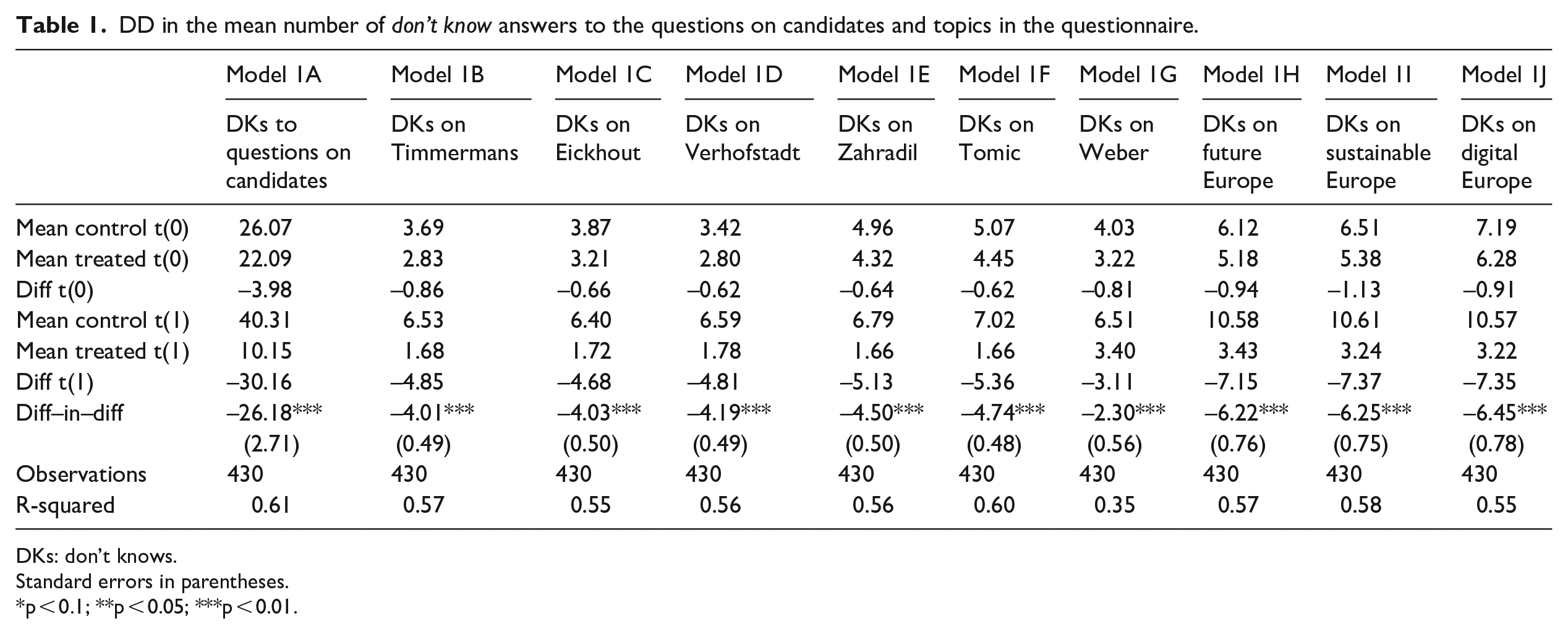
Tables 1–3 display the results of our DD estimations to test H1 on the effect of the Maastricht Debate on voters’ political cognition. The analyses provide ample support for our three expectations. Regarding H1a, Models 1A–1J in Table 1 show that the number of don’t know answers given by the treated group is always significantly lower than those of the control group after the debate, as well as lower than the no opinions given by the treated group in the pre-treatment period. Thus, prior to the debate, the control and treated groups respectively gave 26.1 and 22.1 don’t know answers on average to all the questions related to candidates. After the debate, the number of don’t knows reduced dramatically among the treated group to 10.2, whereas those by the control group increased to 40.3. This pattern holds independent of the particular candidate the respondents are asked about. Thus, for instance, when asked about Violetta Tomic, the candidate who obtained the highest number of don’t knows before the debate, both the treated and the control group displayed similar levels of inability to express an opinion about her (5.1 on average in the control group and 4.5 in the treated group). The debate contributed positively to improving knowledge about this candidate, dropping the number of no opinions by the treated group to 1.7, whereas those by the control group increased to 7 (see Model 1F). The effect on the cognition of any of the three key themes debated is similarly positive. The only exception to this pattern is found when we consider the number of don’t know answers given by the treated group when asked about Manfred Weber, as these remain basically unchanged between the pre- and post-treatment periods (3.2 against 3.4, respectively) and the size of the effect is about half of the effects for any of the other candidates. This no result indicates that the placebo test used to assess the reliability of answers about Weber worked as expected, that is, we can reasonably conclude that the number of opinions given about the different candidates and issues are not just random but are the consequence of a learning process after having witnessed the debate. Finally, as can be seen from Table A1 in the online Supplemental Appendix, the coefficient for our ‘time span’ variable is positive and statistically significant in all models, indicating that those who replied to the post-debate survey later tended to give a larger number of don’t know answers to the different questions in the questionnaire. Thus, social or media exposure did not seem to significantly contribute to improve the political cognition of respondents about the candidates and issues in the debate.
DD in the mean number of don’t know answers to the questions on candidates and topics in the questionnaire.
DKs: don’t knows.
Standard errors in parentheses.
p < 0.1; **p < 0.05; ***p < 0.01.
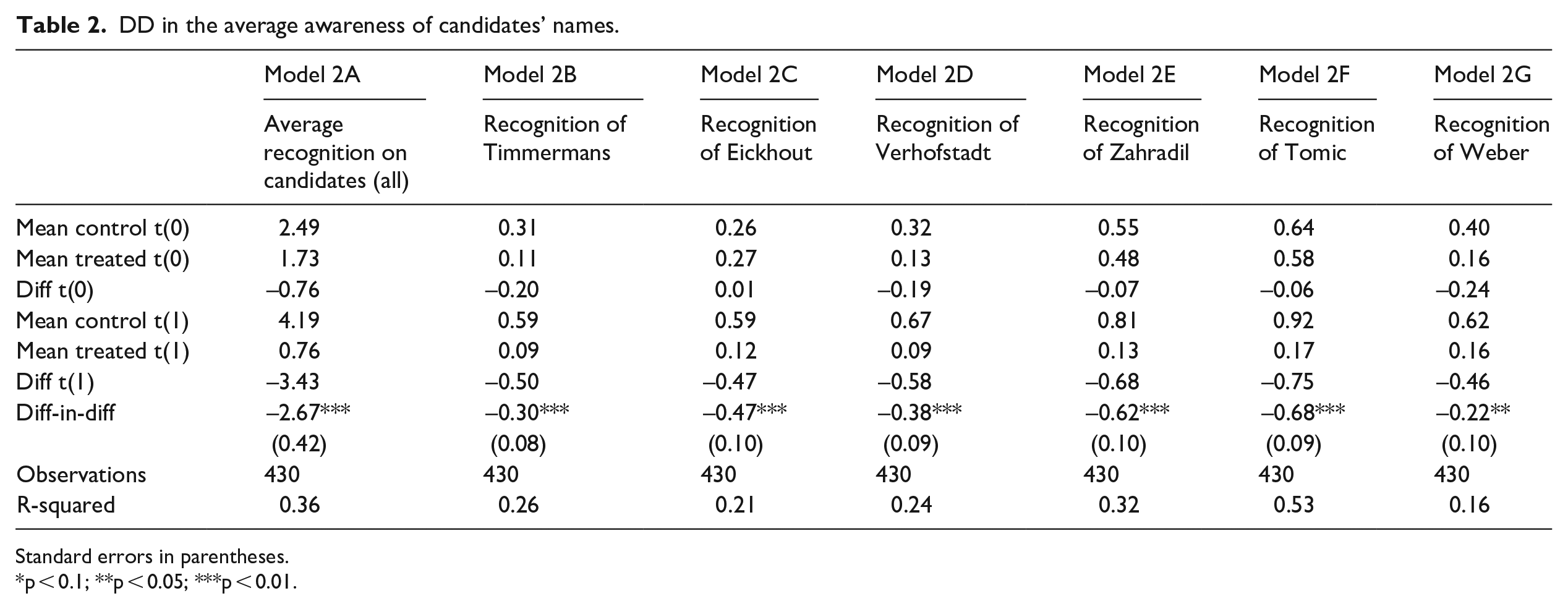
Our second expectation regarding debate effects on political cognitions concerns voters’ ability to recognise candidates’ names (H1b). Again, this expectation is generally confirmed in Table 2. Before the debate, respondents in the treated group were, on average, unaware of 1.7 candidates’ names (out of 6), whereas respondents in the control group were unaware of 2.5 names. After the debate, the treated group was unable to recognise only 0.8 candidates’ names on average, and the control group 4.2. This impact holds for all candidates, as indicated by a mean estimation closer to zero for the treated group after the debate in all models. The exception to this, again, is for Weber (Model 2G), for whom the effect of the debate in contributing to recognise his name remains unchanged.
DD in the average awareness of candidates’ names.
Standard errors in parentheses.
p < 0.1; **p < 0.05; ***p < 0.01.
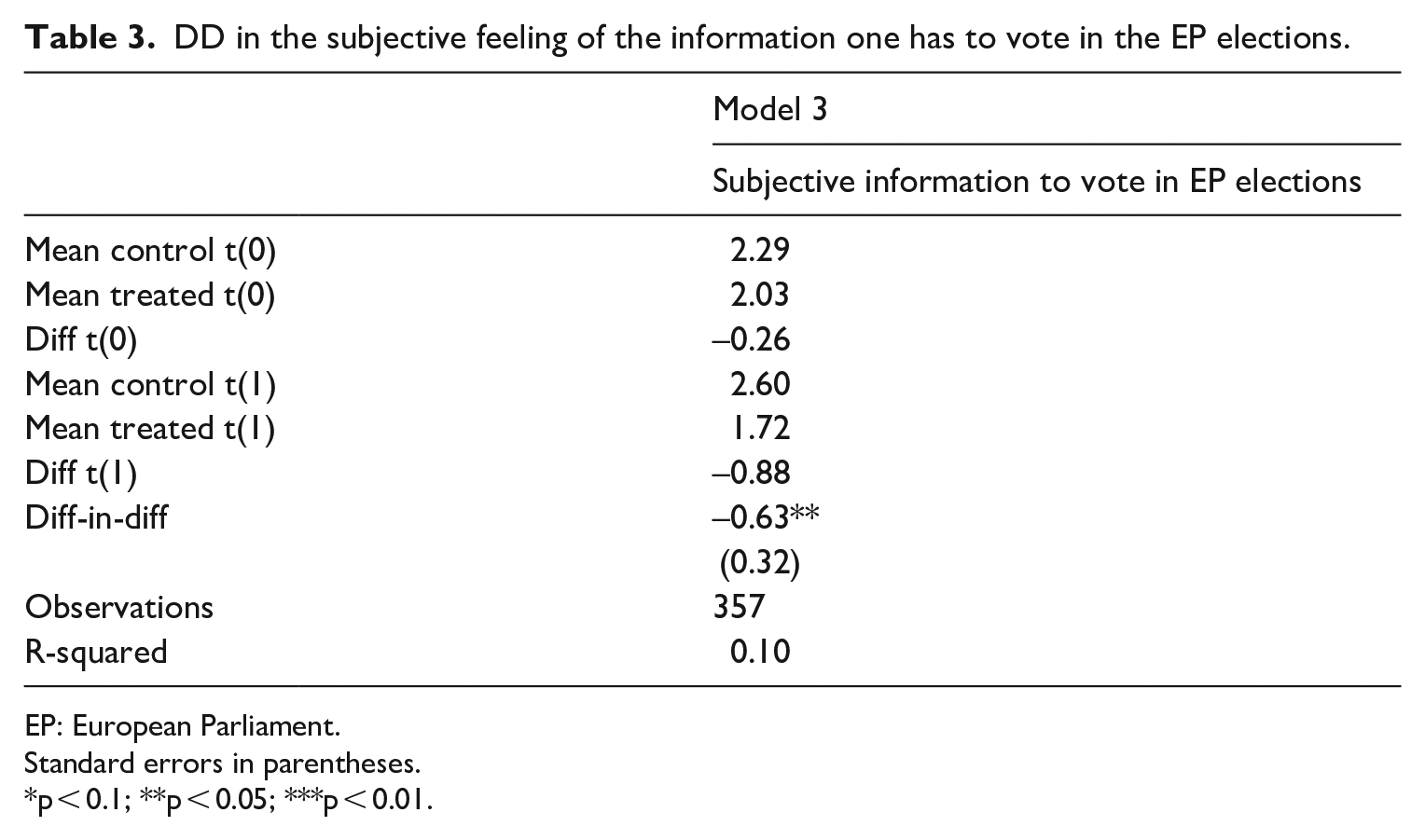
We also expect that exposure to the debate should increase the perceived level of information to make vote decisions (H1c). This is confirmed by our analysis. As displayed in Table 3, the level of subjective information in the treated group moves from 2.3 in the pretest to 1.7 in the posttest (in a 1–4 scale, where 1 means ‘Yes, totally’ (I have all the necessary information in order to choose who to vote for in the next European elections) and 4 means ‘No, not at all’). There is again no effect of the ‘time span’ variable, indicating that this increased perception of information stems mainly from debate exposure.
DD in the subjective feeling of the information one has to vote in the EP elections.
EP: European Parliament.
Standard errors in parentheses.
p < 0.1; **p < 0.05; ***p < 0.01.
Our second hypothesis states that debate exposure may lead to a more positive evaluation of candidates and their policy positions, expecting this attitudinal change to take place mainly among those individuals who already feel closer to the different candidates (H2). In other words, debate exposure should contribute to reinforce voters’ predispositions about the candidates and have no effect on other groups of voters, given the strong convictions towards politics that we expect to find among our particular sample of students. To test this, we compared the evaluations displayed by all respondents with the evaluations of candidates’ supporters in two aspects: general favourability towards the particular candidates and the clarity of their policy positions. We have used respondents’ declared voting intentions in the coming EP elections to group potential voters into the following seven party families: greens (N = 191), socialists (N = 86), people’s party (N = 36), liberals (N = 68), conservatives (N = 2), left (N = 12), and far-left (N = 11). Only six respondents had not yet decided which party to vote for and 14 declared no vote intention. Given the low numbers of potential voters of the people’s party, conservative, left and far-left parties and independents, we have focused our analyses on greens, socialists, and liberal voters. These respondents are potential supporters of the three main contenders in the Maastricht Debate, namely Eickhout, Timmermans, and Verhofstadt, respectively. Although we have no information about whether these potential supporters were aware of which parties the candidates were running for, we could reasonably expect that they would learn about candidates’ party affiliation during the debate. This hypothesis is tested by including a three-way interaction term between our two dummy variables (time and group) and a dummy variable tapping into voters’ intention to support one of the three aforementioned parties in the coming EP elections (i.e. socialist, green or liberal parties).
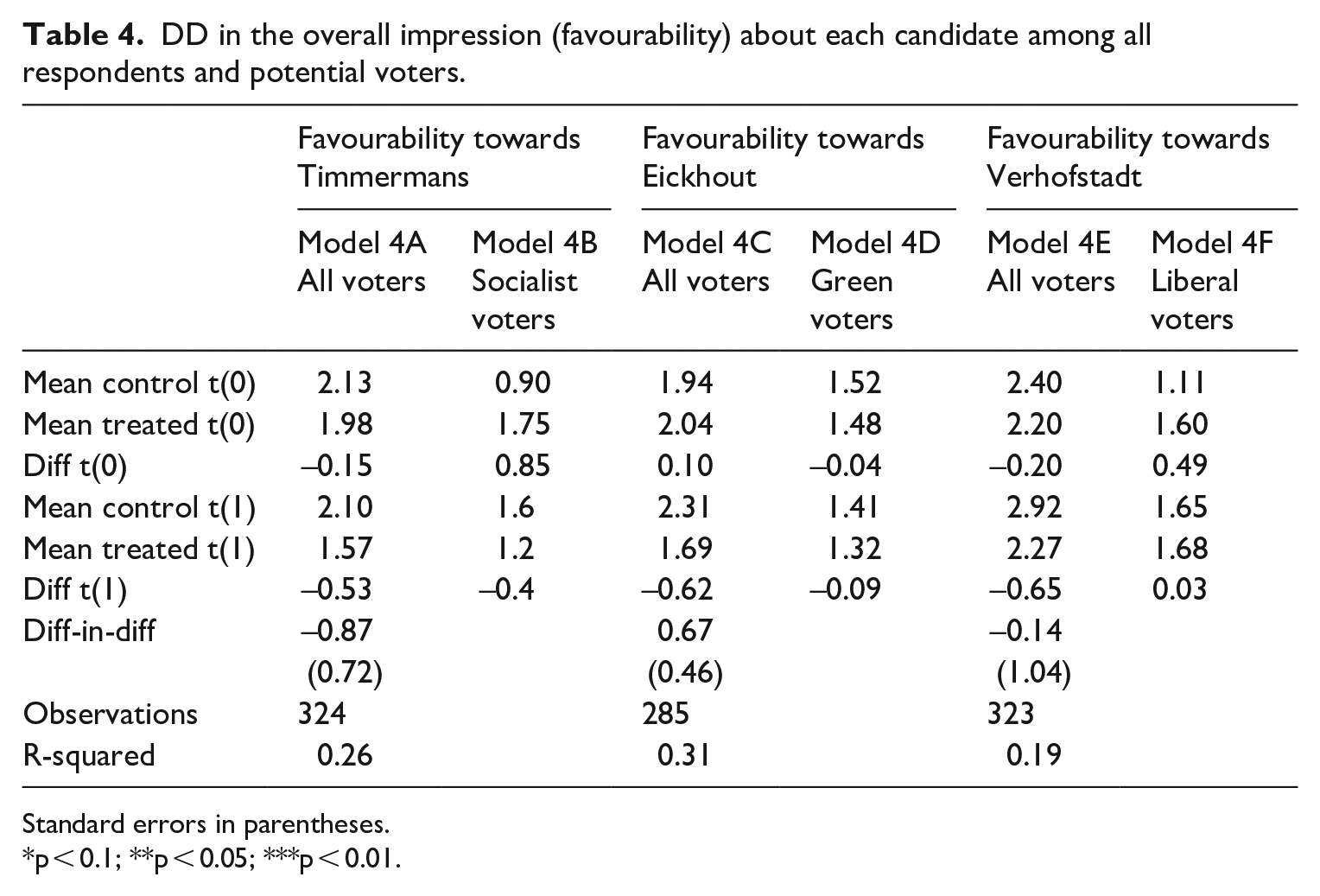
The data provide only very limited evidence to support this hypothesis. First, results in Table 4 show that following the Maastricht Debate did not contribute to improve the general perception of any candidate either among the entire group of respondents or among potential voters, as no DD coefficient in models 4A–4F reaches statistical significance at conventional levels.
DD in the overall impression (favourability) about each candidate among all respondents and potential voters.
Standard errors in parentheses.
p < 0.1; **p < 0.05; ***p < 0.01.
Second, we also find little support for our expectation regarding the impact of debate exposure on the evaluations of the clarity of candidates’ policy positions. Table 5 displays the opinions of all respondents and of candidates’ prospective voters on the clarity of positions in the three key themes of the debate. As can be seen from the results, attitudinal change about candidates’ policy positions does not occur uniformly across all policy areas, but only in some areas on which candidates seemed to more clearly define their particular positions during the debate in viewers’ eyes. Thus, the data show that respondents tended to appreciate more clearly Timmermans’ position on the theme of Digital Europe (Models 5E–5F), Eickhout’s positions on the Future of Europe and Sustainable Europe (Models 5G–5J), and Verhofstadt’s position on Digital Europe (Models 5Q–5R). However, contrary to our expectations, this change in perceptions takes place to a larger extent among the entire group of respondents than among candidates’ potential supporters. Thus, for instance, socialist voters improved their evaluations about the clarity of Timmermans’ position on Digital Europe in +0.7 scale points, whereas voters from other parties changed their perceptions about this candidate in +1 scale points. A similar pattern can be found in the evaluations about Eickhout’s and Verhofstadt’s clarity of policy positions among the two groups of voters examined. In addition to this, it is important to note that both socialist and green voters in the control group improved their assessment about the clarity of the policy position of Timmersmans and Eickhout, 11 respectively, even to a larger extent than the treated group (for Timmermans, +2.4 scale points in Digital Europe, and for Eickhout, +2.8 scale points in the Future of Europe and +3.3 scale points in Sustainable Europe). All in all, these results may indicate that all voters, and also particularly, candidates’ potential voters were able to discern more clearly the candidates’ policy positions along the campaign, and hence, there is no clear evidence to show that debate exposure was univocally instrumental in changing opinions about the candidates’ positions among respondents in the treated group.
DD in the evaluations of the clarity of candidates’ policy positions among all respondents and potential voters.
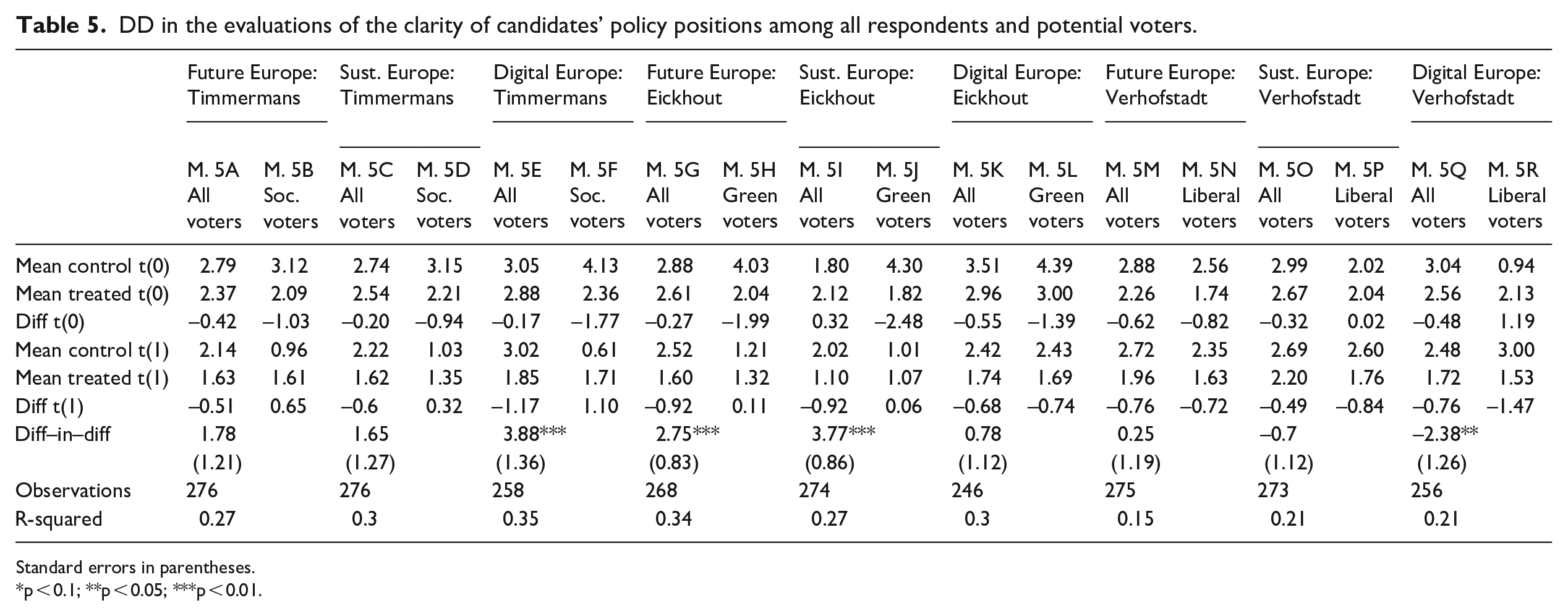
Standard errors in parentheses.
p < 0.1; **p < 0.05; ***p < 0.01.
Conclusion
This article investigated the extent to which the Maastricht Debate among the Lead Candidates had an impact on voters’ information about and evaluation of candidates and the key issues of the debate. The main finding of the article has been to show that debate exposure had a relevant impact on attendants’ political cognition. In particular, we have found that being exposed to the debate enabled attendants to express an opinion about candidates and salient issues (H1a), improved their knowledge about candidates’ names (H1b), and increased the subjective perception of the degree of information they had to make a vote choice (H1c). Second, we have shown that following the debate contributed to improve the evaluations regarding the clarity of the candidates’ policy positions both among potential voters and other groups of voters (H2). This attitudinal change, however, was limited to certain policy areas. Furthermore, we can deduce that the observed attitudinal change was not univocally caused by debate exposure but more generally by the political campaign and/or media exposure, as individuals in the control group improved, sometimes substantially, their evaluations of the clarity of the policy positions of the candidates they intended to support in the elections.
Two questions arise in the light of these results. The first has to do with the durability of the reported effects, that is, does debate exposure produce any long-term effects on attendants that may persist until the election day? With the data at hand, it is difficult to know whether the effects of the debate were lessened a month later and, hence, whether or not they affected actual electoral behaviour. On one hand, it is likely that the effect of the debate on the increasing capacity of respondents to recognise candidates’ names did make a lasting impact on individuals’ cognitive framework, as names have a certain endurance. Furthermore, we can expect that an improved ability to recognise candidates’ names might also have a positive effect on the inclination to cast a vote in the elections, as voters were able to ‘call by their names’ the candidates they were voting for. This expected translation of an improved ability to recognise candidates’ names into actual voting on election day may be supported by the subjective perception of being more informed to make a vote choice which respondents experienced after following the debate. On the other hand, however, given the complexity of the format, viewers might find it hard to pinpoint the specific policy position of the candidates after a 2-hour debate, which may inhibit them from taking a concrete vote decision.
A second question worth considering is how generalisable the findings are, that is, to what extent can the debate effects reported in the article be found among the general public? Although, in principle, one could expect that the sample composition (young, well-educated students) would make our respondents more susceptible to the experience of the debate, we would expect a stronger impact of the debate among the general population. Given the low levels of information voters usually have on EU issues, and more particularly on the Lead Candidates running for President of the European Commission, it is logical to expect improved rates of being informed about candidates’ names as well as more significant attitudinal changes among the public at large than among our sample of well-informed students.
Overall, our results draw a picture of relevant, yet limited, debate effects on voters’ perceptions of candidates and salient issues. Although most of the causal effects identified in the article are not conclusive due to the core limitations of our study (sample composition, long time span of the fieldwork), our general finding suggests that the Spitzenkandidaten debates do matter for shaping voters’ knowledge and perceptions about the Lead Candidates and their policy positions. The new format in which the Spitzenkandidaten debates were set up, organised around several main debates at strategic venues in Europe and broadcasted though online live-stream, did not fully succeed in attracting the public’s and media’s attention. All in all, only a fraction of the total EU population benefitted from the debates among the candidates. Hence, a much broader effort needs to be made by the media to cover this event so that its effects on political cognition and attitudinal change can reach a larger audience.
Supplemental Material
sj-docx-1-pol-10.1177_02633957211015231 – Supplemental material for Do Spitzenkandidaten debates matter? Effects on voters’ cognitions and evaluations of candidates and issues
Supplemental material, sj-docx-1-pol-10.1177_02633957211015231 for Do Spitzenkandidaten debates matter? Effects on voters’ cognitions and evaluations of candidates and issues by Irene Palacios and Christine Arnold in Politics
Footnotes
Appendix
Distribution of the control and treated group samples in the dependent variables before the debate.
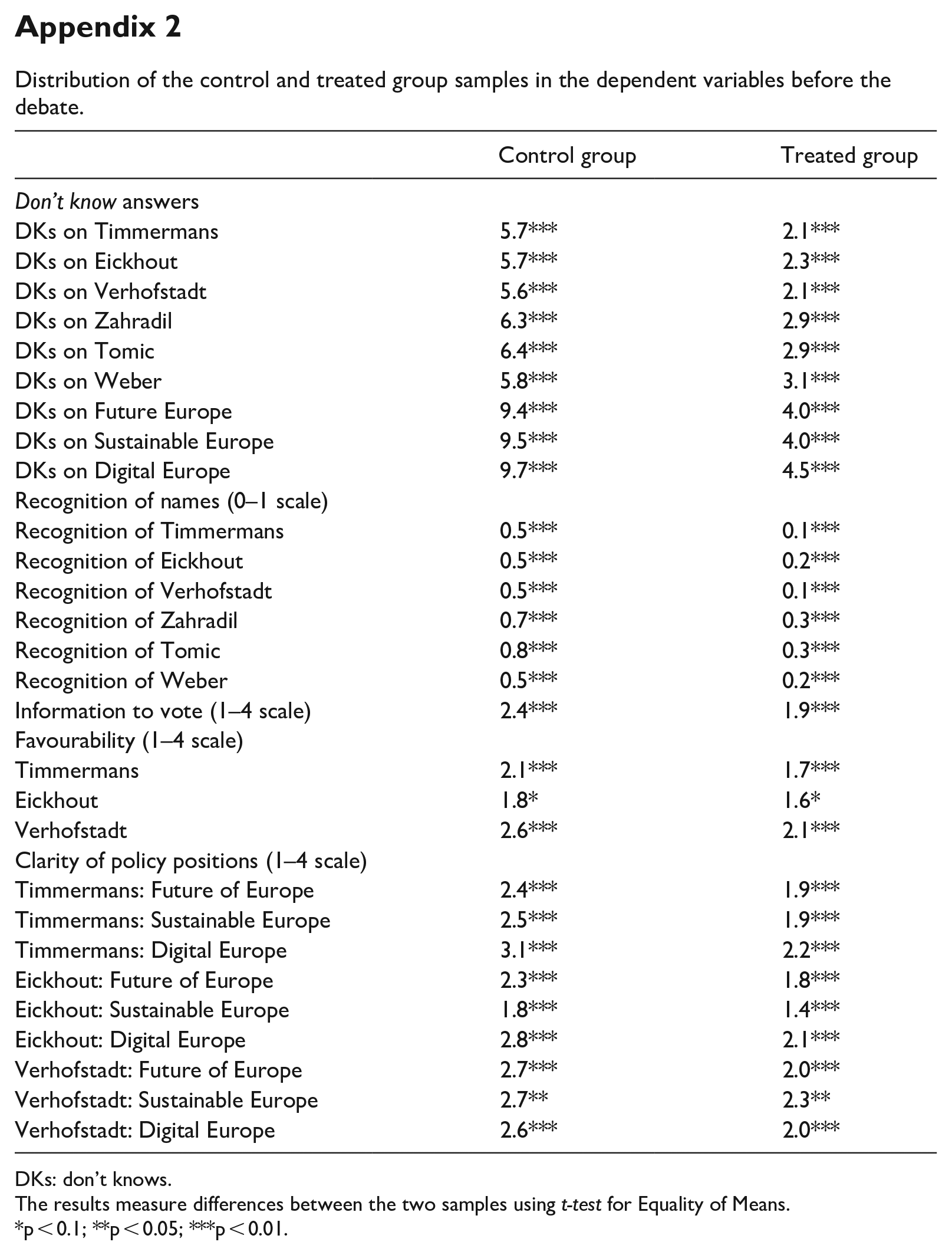
| Control group | Treated group | |
|---|---|---|
| Don’t know answers | ||
| DKs on Timmermans | 5.7*** | 2.1*** |
| DKs on Eickhout | 5.7*** | 2.3*** |
| DKs on Verhofstadt | 5.6*** | 2.1*** |
| DKs on Zahradil | 6.3*** | 2.9*** |
| DKs on Tomic | 6.4*** | 2.9*** |
| DKs on Weber | 5.8*** | 3.1*** |
| DKs on Future Europe | 9.4*** | 4.0*** |
| DKs on Sustainable Europe | 9.5*** | 4.0*** |
| DKs on Digital Europe | 9.7*** | 4.5*** |
| Recognition of names (0–1 scale) | ||
| Recognition of Timmermans | 0.5*** | 0.1*** |
| Recognition of Eickhout | 0.5*** | 0.2*** |
| Recognition of Verhofstadt | 0.5*** | 0.1*** |
| Recognition of Zahradil | 0.7*** | 0.3*** |
| Recognition of Tomic | 0.8*** | 0.3*** |
| Recognition of Weber | 0.5*** | 0.2*** |
| Information to vote (1–4 scale) | 2.4*** | 1.9*** |
| Favourability (1–4 scale) | ||
| Timmermans | 2.1*** | 1.7*** |
| Eickhout | 1.8* | 1.6* |
| Verhofstadt | 2.6*** | 2.1*** |
| Clarity of policy positions (1–4 scale) | ||
| Timmermans: Future of Europe | 2.4*** | 1.9*** |
| Timmermans: Sustainable Europe | 2.5*** | 1.9*** |
| Timmermans: Digital Europe | 3.1*** | 2.2*** |
| Eickhout: Future of Europe | 2.3*** | 1.8*** |
| Eickhout: Sustainable Europe | 1.8*** | 1.4*** |
| Eickhout: Digital Europe | 2.8*** | 2.1*** |
| Verhofstadt: Future of Europe | 2.7*** | 2.0*** |
| Verhofstadt: Sustainable Europe | 2.7** | 2.3** |
| Verhofstadt: Digital Europe | 2.6*** | 2.0*** |
DKs: don’t knows.
The results measure differences between the two samples using t-test for Equality of Means.
p < 0.1; **p < 0.05; ***p < 0.01.
Funding
The author(s) received no financial support for the research, authorship, and/or publication of this article.

Notes
Supplemental Information
Supplemental material for this article is available online.
Author biographies
References
Supplementary Material
Please find the following supplemental material available below.
For Open Access articles published under a Creative Commons License, all supplemental material carries the same license as the article it is associated with.
For non-Open Access articles published, all supplemental material carries a non-exclusive license, and permission requests for re-use of supplemental material or any part of supplemental material shall be sent directly to the copyright owner as specified in the copyright notice associated with the article.
