




Abstract
Rhetoric is a way to explain policy problem framing by recognising the practical necessity to persuade audiences in contextual situations. Modern slavery and human trafficking is a complex and emotive problem, simplified through rhetorical demands to motivate an audience of supporters. This article analyses rhetoric by 212 UK anti-trafficking and anti-slavery non-government organisations (NGOs) to uncover rhetorical practices and their effects on policy framing, supplemented by archival research to compare past and present anti-slavery oratory. Our data show NGOs use rhetoric to motivate supporters and promote a humanitarian problem frame, in opposition to a state-driven security frame. Findings confirm other research in identifying an emphasis on female victims and on sexual over labour exploitation. Past and present rhetoric are equivalent in terms of liberal, Christian values (ethos) and appeals to pathos through sympathy for victims. Historical rhetoric is distinctive in arguing for the equal human status of slaves, whereas contemporary activists argue victims are denied agency. Contemporary rhetoric represses the question of migration, whereas past rhetoric is more deliberative. Rhetoric varies with the requirements of persuasion related to contextual distance, between unlike humans in the past, but in regard to geographical distance today.
Introduction
The framing of policy problems is a key theme in public policy scholarship, with a variety of approaches proposed to explain it (see 6, 2018). Rhetoric is a productive way to think about the framing of problems, because it integrates the analysis of ideational framing with the practical imperative for orators and writers to persuade audiences. The problem of modern slavery and human trafficking is an exemplary case, given the emotive tone of discourse in this policy field, and its prioritisation on the crime policy agenda for international agencies and national governments. Research has shown that while the substantive problem is a complex mix of diverse issues, public sphere discourse reduces this complexity to simplified accounts. This framing effort arises from a strategy to link contemporary anti-slavery activism with successful, historical anti-slavery campaigns, in order to attract resources and promote the problem on the policy agenda. Through rhetoric, states, private-sector businesses, and non-government organisations (NGOs) engage in a politics of framing modern slavery.
While some studies have been conducted of government and regulatory agency anti-slavery discourse (Wilson and O’Brien, 2016), there is not yet an account of non-government activist rhetoric. This gap in the literature needs to be addressed, for two reasons. First, NGOs and activists outside parliaments have historically been crucial in anti-slavery reform, in framing slavery as a problem and in demanding abolition. This remains the case, with much third-sector activism taking place around the world, such that it constitutes an important political force warranting specific research attention. And, given that these activists make strong appeals to their historical anti-slavery predecessors, a comparison of past and present rhetoric will help us understand how contemporary activists generate continuities and divergences in anti-slavery politics. Second, while states have the most power to frame policy problems, in the anti-slavery case, it is the organisations outside the state that most strongly promote a humanitarian/human rights problem frame in contrast to the state and its migration–crime–security orientation (see Balch and Geddes, 2011; Goodey, 2008). Knowledge of the detailed texture of anti-slavery rhetoric within the humanitarian frame will contribute to a better understanding of modern slavery framing politics. We contribute to knowledge by examining the language of UK NGOs, introducing an original perspective via rhetoric analysis. We supplement this with a historical comparison of 19th-century anti-slavery 1 rhetoric in order to ascertain how activists respond to different contexts by creating interpretive continuity regarding the anti-slavery problem. The very fact of calling various exploitative labour relations ‘modern slavery’ already employs a rhetoric drawing on links with the past and makes strong moral claims about legitimate labour versus exploitation.
The article examines this rhetoric by answering three research questions. First, it aims to discover what rhetoric is used by contemporary NGOs in their anti-slavery and anti-trafficking campaigns. Second, we ask how slavery and trafficking problems and solutions are framed by this rhetoric. Third, we identify the similarities and differences between contemporary and historical anti-slavery rhetoric, with a view to understanding the persuasive appeals intended to generate the audiences’ sympathy for victims and motivate it to act. We demonstrate that slavery is a problem whose uneven contours require an appreciation of rhetorical framing.
Rhetoric and the problem of terminology
Scholarship and policymaking on modern slavery and human trafficking are difficult because they have to deal with two complex problems that defy easy answers. The first problem is empirical. Despite common usage of the terms and many countries enacting policy to criminalise these activities, there is little clarity about the problem. Weitzer (2015: 225) explains the definitional ‘quagmire’ surrounding its core aspects, including fundamental disagreements about whether transit is necessary in trafficking, whether consent is relevant, the distinction between smuggling and trafficking, the distinction between trafficking and slavery, the definition of exploitation, and the status of bonded labour. He rejects macro-level research almost entirely, arguing there is no evidence to support – and, in fact, contrary trends are equally likely – four of the main claims about the scope of the problem: the huge number of victims, its growing magnitude, its size relative to other forms of organised crime, and the prevalence of sex trafficking (Weitzer, 2015: 227). However, this contrasts with official accounts, which estimate the current numbers as only the tip of the iceberg (see Home Office, 2018; United Nations Office on Drugs and Crime [UNODC], 2016). 2 In sum, there is scant evidence of, or agreement about, most claims regarding the extent of modern slavery and human trafficking.
The upshot of this complexity is that there is no clear definition of exploitative relationships that can easily be classified as trafficking or slavery. Scholars agree that there is a ‘continuum of exploitation’ across a range of labour relations (Choi-Fitzpatrick, 2015; O’Connell Davidson, 2010; Skrivankova, 2010). However, the field is marked by contentious argumentation about exactly where along the continuum trafficking and slavery are positioned. Making such a judgement is difficult, given that the existence, in any given case, of three key conditions of slavery – involuntary work, exploitative economic conditions, and violence or the threat thereof – is often far from clear (O’Connell Davidson, 2010). Objective judgements about fair work often fail to account for contexts in which people make difficult decisions, choosing exploitative situations because they are preferable to conditions in their place of origin. Judgements about exploitation entail implicit normative assumptions about what constitutes fair employment along the continuum, varying in each case, despite efforts to fix definitions in criminal law. This uncertainty leads to an ever-increasing range of relationships being included, what Chuang (2014: 611) terms ‘exploitation creep’, resulting from: efforts to expand previously narrow legal categories – at least in terms of rhetoric and policy, but in some cases also hard law – in a strategic bid to subject a broader range of practices to a greater amount of public opprobrium.
The term slavery has crept into new facets of criminal behaviour, for example, bringing ‘county lines’ (referring to the movement of (usually) young people for forced drug dealing 3 ) under the umbrella of slavery, along with other types of forced criminality. While exploitation occurs across various crime types, there are few other similarities between such diverse activities and thus policy cannot but struggle to address these crimes under one coherent strategy.
A related empirical difficulty is the contextual factors pertinent to the manifestation and interpretation of slavery and trafficking as a new, global problem. Attention to slavery emerged from the post-1989 world of globalisation (Choi-Fitzpatrick, 2015; Simmons et al., 2018; Wilson and O’Brien, 2016), involving transnational organised crime taking advantage of more fluid national borders, including the opportunity to transport individuals into exploitative work for high profits. Fear of global mobility is the central problem, because it reduces the distance between the citizens of advanced capitalist nations and individuals from the developing world, and between these states and organised crime. Added to this are globalised production practices which utilise effectively reduced distances to outsource work across borders and employ exploitative practices that are illegal in advanced capitalist democracies. Exploitative labour is thereby brought closer to Western consumers because its value is contained in consumer products. This same argument was made against historical slavery, for example, in boycotts of slave-produced sugar.
Within the modern slavery and trafficking problem, political value contests emerged around who, and what, could be mobile. O’Connell Davidson (2010) rightly identifies a politics of mobility as central to legitimate conceptions of liberal freedom because it is a key means of distinguishing between individuals on moral grounds via the criminal law. She notes that liberal states have always restricted mobility for many individuals without legitimate employment or citizenship status. Mobility restrictions of the past were bound up with internal institutionalisation of capitalist labour markets in order to delegitimise welfare recipients, who were contained within workhouses. In contrast, contemporary mobility was largely problematised as an external threat to states, with trafficking constituting the illegitimate movement of people across borders, although it has since been extended to include movement within sovereign borders. Prime Minister Theresa May (2013), who introduced the UK Modern Slavery Act, emphasised its reach; ‘Modern slavery is a brutal crime which knows no boundaries’. Part of the global mobility problem is that trafficking and exploitation are easily hidden. She evoked liberal Enlightenment rhetoric in justifying government attention: ‘Together, we’re going to shine a light on slavery and its evil’. Politically, this is an easy win, given that few, if any, today would dissent from the view that slavery is undesirable. The government could trumpet its humanitarian credentials even while increasing security provisions that restrict human rights and movement.
While dismay at the exploitation of human beings is argued as the overarching concern (Bales, 2012), a key driver in the diffusion of anti-slavery/trafficking policies across countries is the short geographical distance between them. This problem of distance is construed by states within a crime-security frame. Simmons et al. (2018) found that the prevalence of roads connecting countries 4 prompted states to copy criminalisation policies to avoid negative policy externalities in the form of vulnerability to criminal activities, which might otherwise shift location from neighbouring, more tightly regulated states. This interacted with problem framing as organised crime against an alternative humanitarian frame, because the crime frame empowers the security arms of states, which are reluctant to take on further human rights legal obligations (Simmons et al., 2018: 255). This emphasises a relational dimension that runs against constructivist explanations that nation-states primarily mimic one another in following norms (see Meyer et al., 1997; Wendt, 1999). It points towards interdependent, relational connections as an alternative source of policy change, intersecting with normative problem framing to prompt policy action (Nordin et al., 2019). In this case, reduced distance prompts state policy responses to address criminal activity across borders and sets up a framing conflict in terms of security (minimise threat and exclude violators) versus humanitarianism (protect exploited victims). These contextual factors also point towards contemporary anti-slavery policy and activism differing from the past. Although there is some continuity in past and present slavery and anti-slavery politics – for instance, Choi-Fitzpatrick (2015) argues that current anti-slavery activism is continuous with the past, constituting a fourth wave of the abolitionist movement (see Nadelmann, 1990) – contemporary circumstances surrounding the global mobility of people and the reach of organised crime are very different contexts from historical trans-Atlantic slavery. Today, distance is the difference. And the politics of what that difference means is the territory of rhetoric. Hence, we employ an analytical framework in which the central construct is that rhetoric is the negotiation of distance in regard to problems (Meyer, 2017).
The first complex, empirical problem leads to the second, which is discursive. Given the contingency of meaning surrounding the concept of exploitation, a political dynamic is ever-present regarding problem definition. Discourse about the global estimates and extent of exploitation has been described as ‘hyperbolic’ (Weitzer, 2015: 239) and ‘rhetoric’ (Bunting and Quirk, 2017; O’Connell Davidson, 2010: 252; Sharma, 2005). Due to this indeterminacy, discourse is far from a simple matter of reporting on events. It reflects a constant necessity to argue problem definitions against alternatives. This effort is made in situated contexts in relation to audiences, for instance, by activists intending to rouse the public to action. Hence, our focus is on how NGOs practically endeavour, through rhetoric, to move audiences to see and act upon certain types of exploitation as slavery and trafficking. This is not to say that this language is false or manipulative, in the pejorative sense of the word ‘rhetoric’. Rather, we use rhetoric because it is the correct analytical term for situated discourse that incorporates figurative and argumentational efforts to persuade audiences about problem interpretations and possible solutions; that is, a rhetorical analysis of discourse emphasises the relational dimension of discursive exchanges. The theory of rhetoric utilised in this article focuses on how the content and performance of utterances negotiate social relations in regard to questions (Meyer, 2017). 5 In this context of many participants making rival claims about a problem and their capacities to deal with it, rhetoric is the means by which the dynamic of positioning is effected between political actors.
A rhetoric-focused approach to the analysis of anti-slavery discourse offers clarity about its nature. Rhetorical analysis explains as appropriate the many features of anti-slavery activism that have attracted exasperated commentary from critical scholarship. Focusing on rhetoric identifies the ways in which activists use language to make strategic moves: to increase awareness; to attract state and corporate funding (Musto, 2010; Warren, 2012), as well as public donations; to idealise offenders and victims, with disproportionate attention to sex trafficking (Wilson and O’Brien, 2016); to oversimplify the problem via emotionally driven narratives (Hua and Nigorizawa, 2010); and to enlist celebrities in the cause of combatting trafficking (Haynes, 2014: 30). But this is not unique. In the past, anti-slavery campaigners themselves attained something like celebrity status, famed for their passionate oratory and ability to inspire an audience to compassion for African slaves (Morgan, 2013; Turley, 1991). By normalising rhetoric, we take a different approach from scholars who separate rhetoric from anti-slavery practice (Bunting and Quirk, 2017). We argue that rhetoric is an appropriate dimension of political practice, intersecting the framing of problems and relational political dynamics in regard to them.
A study of anti-slavery rhetoric based on the questioning of problems and the practical negotiation of distance offers a useful framework, given the context of problematised global distances and the contested reality represented by distance across the continuum of exploitation. Altered distances describe the general condition of global politics and the role of rhetoric in negotiating the reality of a policy problem. A general definition proposes that ‘rhetoric is the negotiation of distance between individuals on a given question’ (Meyer, 2010: 425; see also Meyer, 2017). The introduction of distance in rhetoric theory allows us to integrate rhetoric studies with a relational conception of social exchange, because it shows how orators appeal across social distances, moving an audience by bringing the problem closer to them. In this case, rhetoric is used in defining slavery either as a crime or humanitarian problem, in making arguments about labour exploitation, and in persuading audiences to take an interest in, and be active about, a problem because it is close to them. Thereby, it helps to structure the policy problem (Finlayson, 2006; Hoppe, 2010), including the relative distance between alternative answers (what constitutes fair work) and the distance between policy actors’ value positions. Rhetoric concerns the contested construction of the problem in the distance between exploitation and moral acceptability and the distance between orator and audience through a highly moralised discourse.
In sum, we argue that rhetoric is quite naturally part of anti-slavery politics. The production of rhetoric is, in the first instance, grounded in the immediate demand for effective persuasion, rather than by reference to beliefs or ideologies. Studying anti-slavery politics as rhetoric offers analytical gains, moving beyond the dichotomous rhetoric/reality conception supposed in critical perspectives. Strong, emotionally charged language is found in many areas of criminal law and crime policymaking (e.g. youth crime, Goldson, 2010; drug policy, Seddon et al., 2008); rhetoric is used to construct political problems and respond with preferred solutions. And rhetoric links the contemporary context that situates the problem of trafficking and slavery in the speaker–audience relation via the parameter of distance, which is central to the contemporary politicisation of global mobility. We shall see that an explicit concern for distance is one of the main distinctions between past and present anti-slavery rhetoric.
Method
In order to sample the political rhetoric of UK NGOs, we searched for any organisations using the terms ‘slavery’, ‘slave’, and ‘trafficking’. 6 Given that government and public attention to slavery and trafficking is so great, anti-slavery rhetoric is now employed by a wide range of NGOs in order to gain a larger support base or access funding. What we want to discover is the anti-slavery rhetoric itself, generated by these organisations and through which all contribute to problem framing, regardless of the differential influence of individual NGOs upon policymaking and implementation.
We drew our sample by searching the UK Government Charity Register for organisations listing the above search terms in their aims (27 September 2017; https://www.gov.uk/find-charity-information), returning 241 organisations. Some entries were 2 or more years old, so we conducted web searches to confirm their status. Those that could not be verified as active were excluded, leaving a final sample of 212. From this, we compiled a textual dataset. We selected online text from their ‘About’ pages, mission statements, and their organisational strategy and policy. Only text pertaining to slavery and trafficking was included. Web page formatting was not preserved. Other information – for example, campaign material or reports made by the organisations – was excluded, which allowed us to maintain a clear focus on the main themes relevant to each organisation. For organisations without an Internet presence, we used their statement of activities in the UK Charity Register.
These texts were coded via an iterative process, informed by rhetoric concepts but also inductively generated from the texts themselves. Through descriptive coding via NVivo, we exhaustively coded each case for recurring terms and combined these into parent nodes that emerged from the iterative analysis. We also coded specifically for rhetorical appeals – ethos (values, ideas, and character), logos (reasons and rhetorical style), and pathos (emotions) – to classify the modes of persuasion.
The second element of the methodology is a historical comparison via an analysis of anti-slavery oratory and writings from the 19th century. Given the neo-abolitionist claims of contemporary NGOs, we chose these sources to compare past and present argumentation. This was comprised of three (mostly unresearched) datasets of work by prominent anti-slavery activists, sourced from the John Rylands Library (University of Manchester); the Rawson/Wilson anti-slavery papers 1820–1910; the Raymond English anti-slavery collection 1824–1886; and the H.J. Wilson anti-slavery collection 1761–1900. 7 Our analysis concentrates on the period after the UK abolition of the slave trade in 1807, both up until and after the abolition of slavery in 1833. Until 1833, activists were attempting to persuade a British audience to support total abolition, and an American audience post-1833. The archives report the activities of important anti-slavery activists George Thompson (London Anti-Slavery Society), Frederick Chesson (Star newspaper journalist), Mary Rawson (Sheffield Female Anti-Slavery Society), and Henry Joseph Wilson (Mansfield Co-operative Society, Liberal MP for Holmfirth). They include diaries, personal correspondence, original prose, pamphlets, lectures, and printed works. Our focus is on oratory and public argumentation, as reported in the diaries, supplemented by their asides and letters on argumentational issues and strategies. The archival records included detailed diary entries outlining the content of speeches, records of responses, and arguments between orators as well as newspaper reports of public events, and exchanges between advocates and opponents of abolition. With Internet technology, the medium of rhetoric has changed, but both cases represent, in their time, a representation of the persuasion of public audiences about the problem of slavery.
Data analysis and discussion
Analysis of web page rhetoric
The number of organisations (212) claiming political advocacy on modern slavery and human trafficking, or delivery of support to victims, shows the prevalence of concern for the problem. This covers a huge variety of organisations, from well-known, large internationally focused bodies, such as Anti-Slavery International, to very small local groups, such as Birchley St. Marys Third World Group (Merseyside). Anti-slavery activism is not the primary purpose of many of these organisations, but its inclusion in their aims shows the extent of public interest in the problem and its salience for audiences and funding bodies.
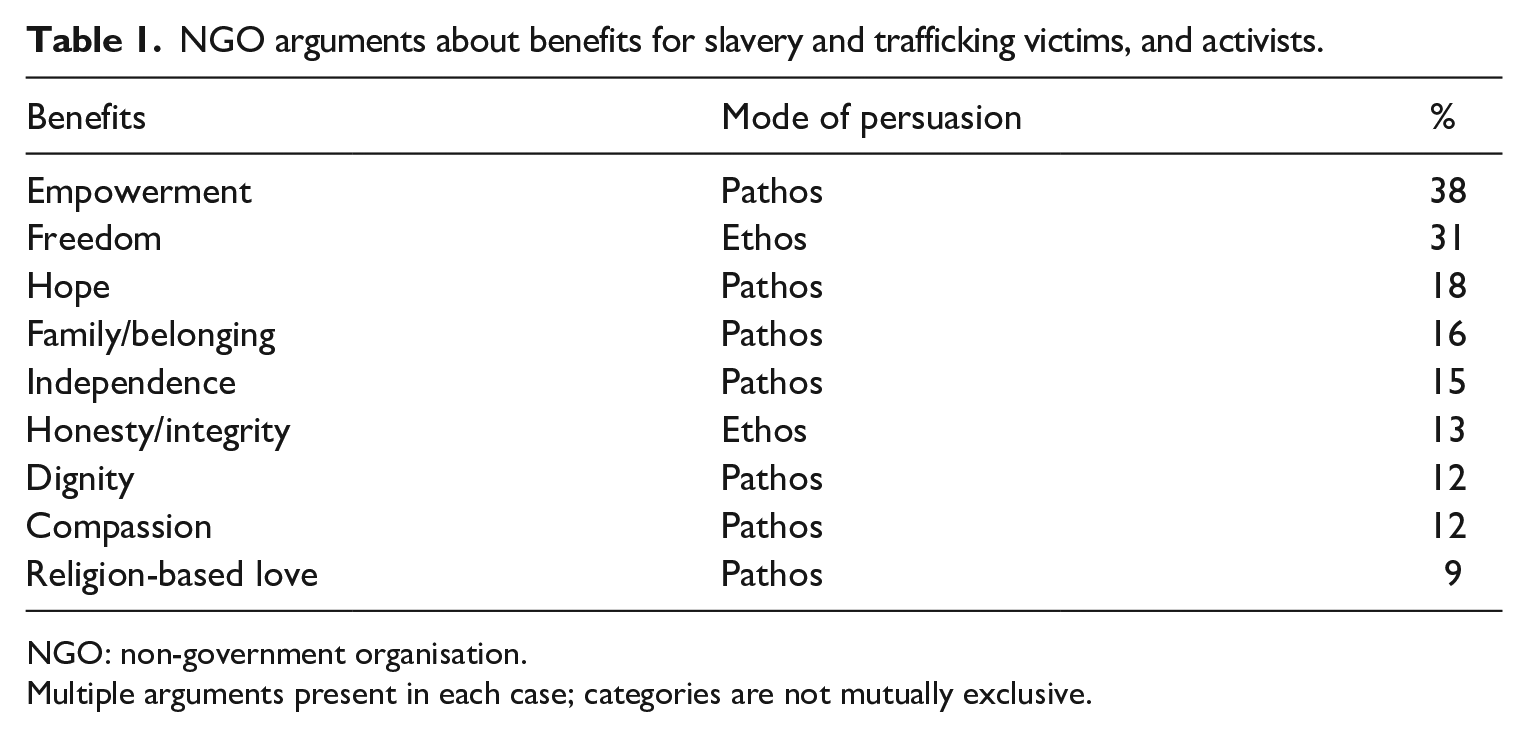
Table 1 shows that the most common appeals are based on pathos, in which the audience is motivated to hold positive feelings for victims, who would benefit from experiencing empowerment, hope, compassion, love, belonging, and dignity in the eyes of others. Ethos also features, in values of freedom and honesty/integrity. It is notable that logos is not present at all. These modes of persuasion confirm the highly emotional tone of activist rhetoric. They are also compatible with liberal Christian values. They aim to reduce the feeling of distance between audience and victim.
NGO arguments about benefits for slavery and trafficking victims, and activists.
NGO: non-government organisation.
Multiple arguments present in each case; categories are not mutually exclusive.
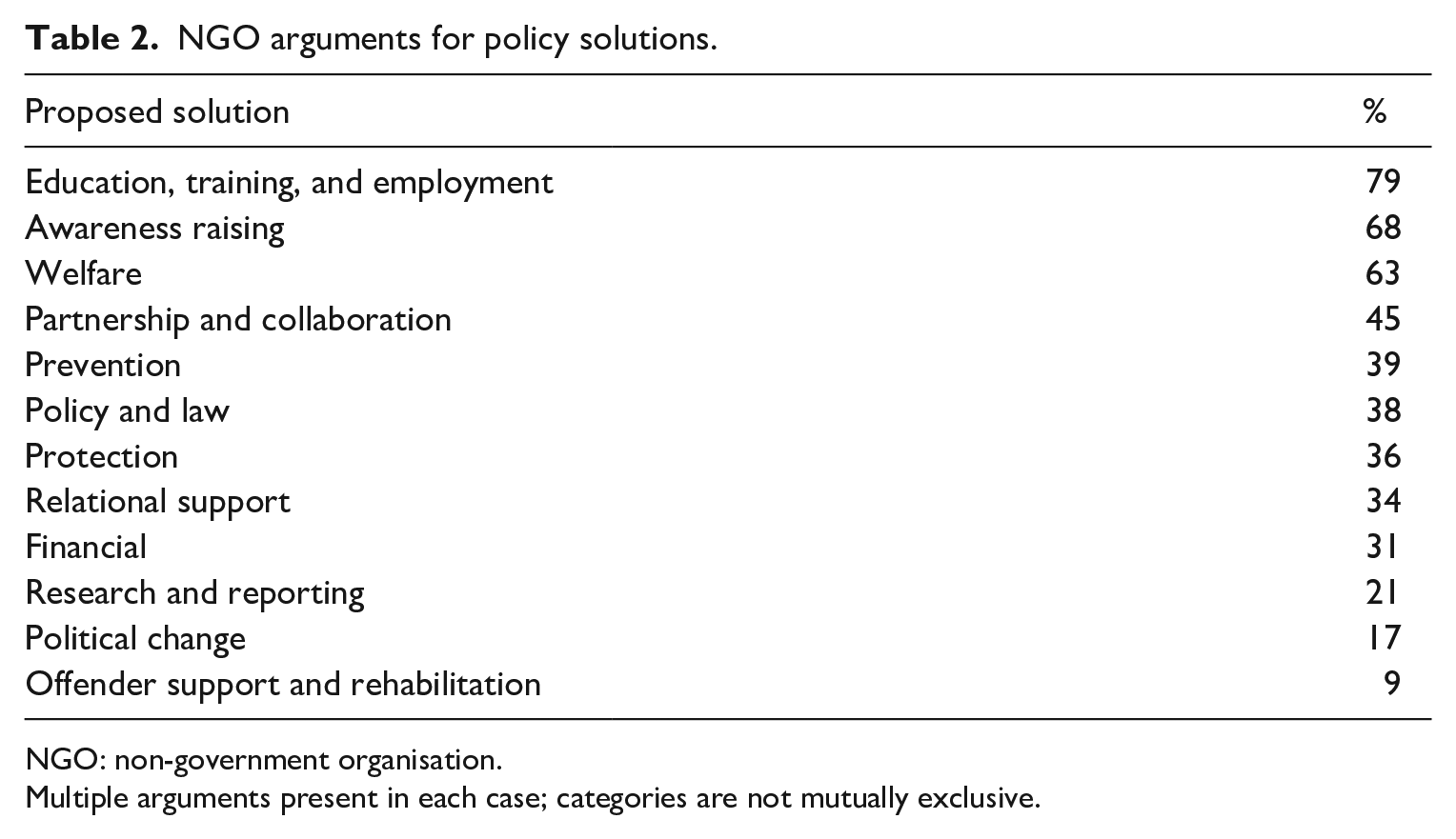
NGOs also advocated for, or claimed to provide, a range of solutions to the problems of slavery and trafficking. Being practical measures, all the solutions are in the logos mode. These are set out in Table 2.
NGO arguments for policy solutions.
NGO: non-government organisation.
Multiple arguments present in each case; categories are not mutually exclusive.
The most common solutions proposed were services offered by NGOs themselves, ‘education, employment, and training’, to find alternative, non-exploitative work. The third most common node, ‘welfare’, reflects a similar capacity for NGOs to provide humanitarian support to victims by raising money to help meet practical needs. In the same vein, another frequent node is ‘partnership and collaboration’, in which NGOs collaborate with government and across regional multi-agency networks to develop effective anti-trafficking measures. The second most common node, ‘awareness raising’, refers to the presumption that modern slavery is a ‘hidden’ problem, in line with government messages. For many organisations, simply raising awareness of the problem was argued to be sufficient to prevent it (ranked fifth), usually without making a clear argument about how this causality operates. While many organisations spoke of the desire to prevent or ‘abolish’ modern slavery, few defined this in terms of organised crime or security. Similarly, while some mentioned ‘offender support and rehabilitation’, it is unclear how these organisations would provide such services. The crime frame was, therefore, marginal to NGO rhetoric.
Descriptive coding of the texts confirms previous findings about anti-slavery discourse. The first finding is that rhetoric is overwhelmingly gendered towards females, even though empirical studies have found many male victims. When NGOs write about victims, survivors, or vulnerable people, the vast majority of these are women and girls, along with children in general. For the ‘victim’ node, this gender difference is a ratio of 8:1. Even when men and boys were mentioned, this was usually secondary to mentions of female victims. And while women were also often described as ‘survivors’, males were most likely to be described as offenders. Female offenders were sometimes mentioned, but always in relation to support, which is positive in terms of recognising that some women become involved in offending through previous victimisation or coercion in their intimate relationships with people who become their co-defendants (Broad, 2015; Siegel and De Blank, 2010).
A second key finding is that, as in other studies, NGO rhetoric adopts a heightened focus on sexual exploitation rather than other forms of forced labour. While web pages most commonly referred to ‘exploitation’ generally, we found that when specific references were made, sexual exploitation occurred at a ratio of more than double the references to labour or child labour exploitation. And this does not include references to sexual abuse, which were often used interchangeably with exploitation in general. In the cases that referenced human trafficking, this was heavily associated with sex, rather than forced labour (more than 3:1 ratio), with children mentioned in 51 cases, and with ‘slavery’ or ‘modern slavery’ in 80 cases. Labour trafficking was mentioned in only 33 cases.
Overall, the language of UK NGO websites commonly constructed problem definitions within a humanitarian/human rights frame. This frame encompassed many distinct facets, including exploitation, human trafficking, modern slavery, inequality, denied cultural expression, and poverty. Our finding supports research (Jordan, 2002) that has found the human rights frame dominates activist discourse, in contrast to the organised crime and security frame, which typically characterises state discourse. What is significant in the humanitarian frame is that explicit definitions of human trafficking were almost non-existent. The idea of forced movement is mostly left implicit and the complexity of reasons for migration is entirely unaddressed. Of the 137 cases that mentioned human trafficking linked to international movement, less than 30 also mentioned ‘migration’, ‘refugees’, or ‘asylum seekers’. And when these were mentioned, they were not often linked to trafficking. We infer that a politics of framing is operating here in producing a compassionate rhetorical appeal to readers, with limits placed on references to a more problematic and disputed migration debate that might open up the suggestion of autonomy and agency for individuals, who are depicted by NGOs solely in victim terms.
The humanitarian frame is also reflected in the solutions proposed by NGOs. These solutions deal primarily with support for victims (education, training, and employment; welfare; protection; relational support), services they may be able to provide. The other most advocated solution is ‘awareness’, reflecting on their own mobilising and publicity activities to highlight the problem to their audience. More than one-third of organisations mentioned ‘prevention’ or even eradicating the problem, but these also mentioned ‘awareness’ as a key way to do this. Yet, very few NGOs mention prevention in regard to tackling organised crime and corruption, by reforming business supply chains or addressing the underlying causes that compel people to migrate for employment. The crime and economic production problems associated with globalisation do not feature much in NGO rhetoric, even though they form a key aspect of UK government modern slavery policy.
Rhetoric analysis
While we can analyse language at the macro level to understand its main patterns, we should not detach this language from its immediate context – to persuade an audience about the importance and scale of the problem, and to move them to act, either by demonstrating their support, donating funds, or volunteering. Rhetoric analysis situates discourse in this context and illuminates how persuasion efforts structure problem and solution.
Orators aim to mobilise by stimulating the pathos of the audience. The first thing to note is that the term ‘modern slavery’ itself constitutes a powerful rhetoric, drawing a link between contemporary forced labour and injustices of the past, including to lauded anti-slavery campaigners. This term is relatively recent, appearing frequently only in the past decade and particularly since the UK Modern Slavery Act 2015. Before this, ‘human trafficking’ tended to be common usage, along with ‘forced labour’. Whereas human trafficking focuses on the illegal forced movement of labourers, the term ‘modern slavery’ evokes a stronger immorality, incorporating exploitation generally. However, there is no direct equivalence between slaves who were chattels, by legal contract, and contemporary exploitative labour conditions. But ‘modern slavery’ is not an empirical signifier, it is a powerful rhetoric that motivates audiences to care about a problem by inviting them to equate it with historical slavery. Indeed, suffering is a more powerful draw for audiences than other rhetorical appeals, for example, togetherness (Martin, 2019). ‘Modern slavery’ is a figurative symbol of exploitation and injustice, such that its vagueness is a rhetorical virtue rather than a hindrance. That slavery has long been outlawed effects a doubling of outrage, because it generates incredulity that it continues to exist. In short, usage of the term is a practical strategy for mobilising public support. Effective rhetoric makes the unfamiliar seem familiar by linking current problems to what is already known from history. The rhetorical reframing of the problem as slavery allows NGOs to link back to the ‘abolition’ movement, even though this makes little sense in the contemporary context. Consequently, some NGOs declare themselves to be ‘modern day abolitionists’. 8
Stimulating pathos in the audience is achieved by rousing outrage and anger against offenders, and by generating empathy and compassion for victims. This rhetorical dynamic is the same for past and present anti-slavery activists. They aimed to reduce distance between audience and victim via sympathy, and increase distance from the offender through anger. Hence, while presented in different styles, past and present rhetoric share many common features. As with all charity campaigns, stories of abuse and ill-treatment stir the sympathies of the audience, especially those focusing on women and children.
In an example from our archival research, the Reverend Richard Bickell (Wilson collection, 136) reported an account of a female slave who had two children removed and sold: This turned her heart within her, and impelled her into a kind of madness. She howled night and day in the yard; tore her hair; ran up and down the streets and the parade, rending the heavens with her cries, and literally watering the earth with her tears.
He described working conditions as ‘oppressive and merciless’ through the behaviour of overseers, with their ‘over fondness of flogging’ and their cruelty in the ‘wait for wounds to heal from lashing, before resuming’ (Wilson). We did, however, find fewer denunciations of offenders in the contemporary texts, whereas depictions of the brutality of slave-owners were a common feature of historical anti-slavery arguments. This points to the problem faced by historical campaigners, who had to defeat the popular and strongly argued narratives of slave-owners claiming their benevolence towards slaves. Proponents argued that Southern slaves under a paternalistic and loving slave-owner were better off than ‘Northern free Blacks’ or ‘wage slaves’ (Kolchin, 1995: 194), and better off than peasants in Italy or Ireland. They argued that slavery produced a humane, orderly, and conservative society, distinct from the selfish individualism, class conflict, social disintegration, and radicalism of the North. Fitzhugh even described free labour as ‘exploitation’, as but a chimera of freedom, much like the socialist critics of capitalism (Kolchin, 1995: 195). Today, these arguments are absent from rhetoric; slavery is already illegal and cannot be legitimated. Nonetheless, given the prominent UK media coverage of offenders convicted of modern slavery cases, it is interesting that NGOs focus more on the pathos of victim sympathy, rather than abhorrence at offenders.
This points to a more general distinction between the historical and contemporary cases: the basis of distance reduction is different. In the 19th century, the humanity of the slaves themselves had to be proven. Activists had to argue that slaves were human beings, equal to the audiences they addressed, either under God or in liberal–humanitarian terms. Even more important than exploitation and ill-treatment, slavery was argued to be degrading to slaves’ humanity and hence to humanity itself. We found that campaigners made frequent reference to the ontological reduction of slaves to animal status or to inanimate tools: ‘Another of the evils of slavery is, that the slaves are so degraded and depressed in the eye of the law as not to be considered persons, but mere animals or chattels’ (Rev. Bickell, 134); a slave is ‘deprived of his natural rights’, is ‘a mere beast of burden’, and ‘a mere instrument of profit’ (Wilson, 1825, Pamphlet); ‘I could hardly bear to see them handled and examined like cattle’ and ‘advertised like beasts for sale, and sold like beasts at a West-India Slave Market’ (Wilson); slaves are ‘fallen creatures’ (Sheffield Women’s Society GB133 MS 743).
In the contemporary period, the humanity of victims has been accepted, so in rhetoric it is no longer the focus. Today, the audience must be persuaded about the veracity of each individual’s claim of exploitation. Hence, agency is the question, that is, whether the victims were forced. In the historical case, there was no question of choice. Therefore, in contemporary slavery, to render the victim sympathetic, their agency must be rhetorically excluded, either deploying a story of force or, in cases where victims actively chose their employment, presenting them as deceived by offenders, duped into the choice by poverty or fear, and hence denied agency. Thus, they cannot be held responsible for being exploited. In many cases, this is empirically true. However, as we noted above, there are also more complex circumstances in which people choose exploitative labour for economic gain. In activist rhetoric, stories about victims mostly excluded altogether any possibility of their free choice.
Thus, the elephant in the room of modern slavery and trafficking rhetoric is migration. NGOs tend not to debate the question of forced versus free migration, nor raise the possibility that many UK citizens resent migrants arriving in the country and are sceptical of their claims of exploitation in order to gain asylum. This is markedly different from historical argumentation, when the pro-slavery case was very much alive. Archives show Thompson and Wilson constantly engaged in dealing with voices dissenting from their abolitionist views, evident in diary entries (which, admittedly, give us privileged access to their thoughts in ways that mission statements on websites do not). Thompson noted that critical members of a Margate audience ‘look upon the Anti-Slavery Society as officious intermeddlers in other men’s matters. I have to meet all sorts of objections – and to combat all sorts of prejudices’ (Kings Head, Margate, 29 September 1831). In the United States, he faced particular hostility, accused of being a monarchist (REAS 5, Speech at the New York meeting of the Anti-Slavery Society, 68), of illegitimately appropriating the cause of religion (by the New York Commercial Advertiser REAS 6, 7–8, ff.5v.-6r.), and of being a ‘foreign demagogue’ (by the Boston Commercial Gazette REAS 6, 34). Anti-slavery activists in the historical public sphere faced the constant task of advocating their case and dealing with dissenting opinion (Turley, 1991). But contemporary rhetoric is mostly one-way advocacy, rarely considering counter-arguments and leaving no room for doubt. Modern slavery rhetoric presupposes that the evil morality of these types of labour is unquestionable and, evoking equivalence with historical campaigns, one is supposed to be compelled to oppose any labour that is labelled as slavery but without questioning the underlying inequalities and consumer practices that support these activities.
Contemporary anti-slavery rhetoric is distinctive in its focus on ‘seeing’ slavery. Organisations aim to reduce distance by bringing the problem home to the audience. Audiences are assumed to be appalled by and opposed to slavery and trafficking, but are unawares, particularly of its proximity. Rhetoric renders the problem close enough to them, to care about it. This is a similar rhetorical logic to that explained by Aristotle (1995: II, 5, 1382b24-1383b12), in which an orator can make an audience feel fear by identifying an unexpected danger that is close. Whereas historical slavery was explicitly evident, in contemporary rhetoric, audiences are prompted to look and identify slavery which is ‘unseen’ (e.g. the anti-slavery NGO Unseen; https://www.unseenuk.org/) and close to home. The Adavu Project states, ‘we want to raise awareness about modern slavery in our local communities, to enable people to spot common signs and indicators, and to know how to respond and who to contact if they have concerns’. Stop the Traffik produces a ‘Spot the Signs’ guide ‘to enable people to recognise signs in their community and to share what they see’. The Unchosen NGO produces films and resources ‘to find out where slavery is hiding in your community, and what you can do about it’. And Voice of Hope reports an informal story of discovery by the organiser: I was out having coffee with a friend who said she had seen an article in the local paper about human trafficking in Stoke on Trent, ‘do you think it’s happening here’, she said. My only answer was, ‘research tells us it’s happening everywhere’.
Similarly, rhetoric regarding transparency in global business supply chains aims to bring home the effect of slavery in the production of consumer goods, even if it cannot be directly observed. These campaigns reflect government-led rhetoric about the hidden nature of slavery, for example, ‘Modern slavery is closer than you think’ (Home Office, 2014). But given that exploitative labour is easily hidden and retains high demand, like drug trafficking, the problem is unlikely to be ever totally repressed (see Nadelmann, 1990).
A similarity across the historical comparison is that the values put forward in both periods are those of liberal ideology, along with a strong current of liberal, reformist Christian values. Explicit argumentational appeals to Christianity are used to generate sympathy for victims and motivate the audience to action through appeals to pathos. The role of reformist Christians continues to be vital in the anti-slavery movement. The NGO Agape International Missions writes, ‘The love of Jesus Christ through His followers will defeat the evil of sex trafficking and sexual slavery’. A Way Out states, ‘We believe in the power of prayer and faith in our work among the most marginalised. Hope gives us a vision of a changed life. Faith helps us believe for it’. Care explains that ‘Human trafficking denies people their God given dignity, future and hope’. Evangelical charity Tearfund states, ‘We’re following Jesus where the need is greatest, working through local churches to unlock people’s potential and helping them to discover that the answer to poverty is within themselves’, while One25 Bristol explains its motivations as ‘Every woman matters. Let’s turn the red lights green . . . Founded on Christian values, One25’s ethos shapes a culture and practice based on the example, teaching and values of Jesus’. Typically, the Christian tone of historical rhetoric was much stronger. Quaker activism extolled the humanity of African slaves converted to Christianity (Pamphlet, London 1824; Wilson collection) and slavers were criticised by orators for preventing Christian slaves from religious observance, including being made to work on Sunday (Wilson Collection 1820, Insurrections, 55). Slavery in general was rejected as a ‘machinery of damnation’ (George Thompson REAS5, from The Liberator 18 April 1835) and said to ‘insult God’ (Sheffield Female Anti-Slavery Society, f.16v). Christian audiences were extolled to opposition as a binding obligation, because they would be committing evil if they did not act politically against it (Wilson Collection, Society of Friends 1820). The strongest Quaker condemnation was reserved for southern US churches supporting slavery: the Southern Church is so bound to the juggernaut of slavery – so entirely its property – that at its behest, it is ready to defy God, blot out His law, treat with contempt the practices of civilised life, and outrage every principle of humanity. Is it not an Infidel church? (Thompson, Manchester Anti-Slavery Union, Address to the Provisional Committee; REAS 9, ff65, 39)
These findings evidence a direct link between present and past anti-slavery activism, with similar liberal reformism and compassion at work in the motivations of activists. Concurrently, we found that larger, more professional organisations were much less likely to use explicitly religious rhetoric. Instead, they preferred language such as ‘shine a light’ which could be interpreted as Christian by such an audience, or as Enlightenment liberalism by atheists or non-Christians.
Conclusion
The shift in framing from ‘trafficking’ to ‘modern slavery’ has effected a rhetorical link to the past and created a sense of discursive coherence about varied forms of exploitative labour. This has impacted significantly upon the politics of this policy area. The rhetorical equivalence is based on common values but also glosses over important differences in the nature of the criminal exploitation of labour. Past and present rhetoric show the continued importance of Christian activists, albeit diluted in the present and marginalised by professionalised NGOs. Key differences in past and present rhetoric arise from different legal and political contexts, given that slavery was successfully legally abolished long ago, so that the persuasive task today is different. Whereas past audiences were persuaded that there was no ontological distance between themselves and slaves, today audiences are persuaded because contextual global distances have been reduced and slavery is now a problem close to them.
Beyond the scope of this article, we also speculate as to the efficacy of this rhetoric, given that while attention to exploitation as slavery and trafficking is welcome, its relationship to migration is not discussed. This allows negative public opinions towards exploited labourers who seek asylum to remain unexamined and unopposed, even if this is for fear of delegitimising victims’ claims for support. The same concern applies to the rhetorical predominance of concern for sex workers over male victims. This constructs the problem in limited ways that potentially weaken potential government and public attention to certain victims. However, given the necessity to motivate audiences through pathos, we anticipate that this is unlikely to change. Finally, a politics of attention is apparent in NGOs’ rhetoric in how they make competing claims to legitimacy, expertise, and deservingness of funding. This competition is exacerbated by competition for state funding and volunteer labour regarding a complex problem that has been, perhaps, rhetorically exaggerated in scope.
Footnotes
Funding
The author(s) received funding support of £4,966 from the John Rylands Research Institute (University of Manchester) for research into its archive collections.
