




Abstract
In divided societies and new democracies, clientelism (in the form of pork barrel) and ethno-politics appear to go hand in hand. It is apparent that politicians are incentivized to compete for support within their own ethnic groups, but does an ethnic link between voters and decision-makers influence how voters perceive and evaluate pork barrel practices? To address this question, we conducted a survey experiment (n = 1200) in ethnically heterogeneous Slovakia. The aim was to examine whether pork barrel politics implemented by a Slovak decision-maker and a Hungarian decision-maker are evaluated differently by Slovaks and Hungarians. The findings suggest that when individuals and decision-makers share the same ethnicity, individuals tend to maintain an equally positive level of trust and willingness to vote for the responsible decision-maker, even when the decision-maker implements a policy decision that does not benefit them. Nonetheless, shared ethnicity does not prevent individuals from being critical of the implemented policy decision itself.
Introduction
Compelling evidence confirms pork barrel patterns in the distribution of public resources across all kinds of democratic regimes (Kitschelt, 2000; Kitschelt and Wilkinson, 2007; Stokes et al., 2013). However, in divided societies and new democracies, clientelism and ethno-politics appear to go hand in hand. It has been shown that politicians are incentivized to compete for support within their own ethnic groups (Chandra, 2007; Dixit and Londregan, 1996), but how is this practice perceived and evaluated by voters across the ethnic groups represented in a country?
To address this question, we conducted a survey-embedded experiment (n = 1200) that captures a representative sample of the population in ethnically heterogeneous Slovakia, which has a roughly 8.5% Hungarian minority. The results suggest that when individuals evaluate decision-makers who share their ethnic identity, they tend to ignore decisions that do not benefit them and evaluate the decision-maker just as positively as if the decisions did benefit them. Nevertheless, shared ethnic identity does not prevent citizens from being critical of an implemented policy decision itself, nor does it make citizens more favourable when they perceive unfair distribution of public resources by an ethnically related politician. This conclusion constitutes a relevant contribution to the study of pork barrel politics, because it reveals which aspects of voter perception of this practice are moderated by the ethnicity of voters and decision-makers.
Theoretical framework
In democracies, political parties and politicians in office are increasingly willing to take advantage of targeted distribution of public resources. The institutional setup often motivates the ‘rulers’ – that is, political actors – to direct money from state budgets to recipients in a way that aims to improve their electoral prospects (Kitschelt, 2000). As a result, democratic accountability is supplanted by some form of distributive politics (Stokes et al., 2013) in which citizens are stimulated to exchange their votes in return ‘for direct payment or continuing access to employment, goods, and services’ (Kitschelt and Wilkinson, 2007: 2).
Even though distributive politics have attracted scholarly attention in the past, the literature has produced a fair amount of confusion. Terms such as ‘pork barrel’ politics, patronage, machine politics, or clientelism have been used interchangeably. Although each of these terms describes exchanges involving at least three types of actors – (1) patrons, who provide benefits; (2) brokers, who act as go-betweens; and (3) clients, who provide political support for receiving the patron’s goods (Mares and Young, 2016) – there are important differences between them.
While distributive politics can take numerous forms, we focus on pork barrel politics. Following Stokes et al. (2013), the concept of pork barrel refers to a non-programmatic distribution without conditionality: benefits are distributed to groups and take the form of public or club goods. As the consumption of public goods is, by definition, nonexclusive, the threat to exclude individual voters for failing to support the benefactor lacks credibility (Stokes et al., 2013). For this reason, such strategic targeting of groups sometimes carries a more formal label: ‘tactical redistribution’ (Dixit and Londregan, 1996). Thus, pork barrel provides a positive incentive for a group of voters, while not compelling patrons to strict monitoring requirements at the individual level.
Literature has identified numerous factors that can contribute to the development of distributive politics. One of the first considered when trying to explain variation across countries was ethno-cultural cleavage. However, despite initial enthusiasm the research has surprisingly moved away from studying the role of ethnicity in this regard. With recent exceptions (Corstange, 2016; De Kadt and Larreguy, 2018; Kramon, 2019), researchers have largely focused on ethnic brokers, and theoretical claims regarding ethnic-based distribution have rarely been empirically tested.
Scholars of divided societies and new democracies have observed that clientelism and ethno-politics appear to emerge together in these contexts. Posner (1998, 2004), talking of Zambia, called voters’ expectations of ingroup bias in these societies ‘an axiom of politics’. Beyond Africa, Kearney (1973) describes access to exclusive material benefits in Sri Lanka to also be mainly defined by kinship, community, or personal loyalty. However, this tends to be the case even in societies that are not predominantly defined in terms of ethnicity. Zappala (1998) presents empirical evidence suggesting a presence of ethnic clientelism in contemporary Australian political culture, where incorporating migrants into the political system has an important function. Similarly, Hale (2007) indicates that ethnic networks were associated with the selective distribution of public goods in the 1999 Russian legislative election.
Party/candidate-voter linkages based on ethno-politics have been identified as having implications for political competition and the quality of democratic functioning in a country. Despite politicians being incentivized to compete for support within their own ethnic groups (Chandra, 2007; Dixit and Londregan, 1996), this practice can be seen as unfair even to the group in question. First, it can suppress other crosscutting issues (e.g. economic divides or ideological disputes), often preventing important social matters from being put on the agenda, deliberated, and subsequently resolved. Second, ethnic politics is ‘much less subject to social mobility than adherence to occupational groups, economic sectors or classes, and social strata’ (Kitschelt et al., 1999: 59). People are not able to change their ethnic adherence, which can ‘freeze’ the ethnic structure of the electorate. Even the voters belonging to a ‘proper’ group may have very ‘little strategical choice but to vote for ingroup candidate’, although on many occasions they receive little or no gain (Kitschelt and Wilkinson, 2007: 51). Finally, this type of linkage can result in an insurmountable disadvantage for the people belonging to other ethnic groups, especially ethnic minorities who can remain disenfranchised because of the lack of access.
There seems to be a broad consensus that political elites are incentivized to compete for support within their groups, rather than across groups where sharply defined patterns of ethno-cultural separation exist (Horowitz, 1985). This separation makes facilitation of the contracting, monitoring, and enforcing of selective exchanges between politicians and citizens easier. By providing group members with ‘in-club’ goods, politicians make it difficult for voters to escape adherence to their own ethno-cultural community. As Chandra (2007: 99) puts it, ‘information about patronage transactions is processed and transmitted through a process that amplifies signals revealing the ethnic identities of the beneficiary and suppresses his non-ethnic identities’. In other words, political elites are motivated to play along ethnic lines in order to encourage voters to code beneficiaries of distributive politics within ethnic categories.
In line with this logic, the literature on the social psychology of inter-group relations and proponents of social identity theory (Tajfel and Turner, 1979; Turner et al., 1994) argue that adherence to group norms is fundamental for defining the boundaries between ‘in’ and ‘out’ groups. Findings from both cross-cultural and laboratory experiments support the prevailing view that ingroup bias and outgroup discrimination are motivated by preferential treatment of the ingroup (Balliet et al., 2014; Greenwald and Pettigrew, 2014; Yzerbyt et al., 2000).
Group interests and affiliation can conflict with individuals’ self-interests and, therefore, affect individuals’ perception of elites’ pork barrel behaviour. On the one hand, evidence from evolutionary psychology suggests individuals have aversion to political leaders who are believed to act from their own selfish ambition, and thus endanger the interest of the larger group (Bøggild, 2016; Smith et al., 2007). For this reason, acting from concern for group viability, individuals would favour a policy benefitting group members even if the outcome they experience is held constant. In addition, in the context of inter-group competition, elites’ engagement in pork barrel is likely to demonstrate group dominance which in turn reduces the risk of vertical exploitation from ethnically different leaders (Bøggild and Laustsen, 2016). On the other hand, there seems to be an important psychological benefit that individuals derive from being treated well (personally rewarded) by other group members. In this sense, the quality of treatment by ingroup authority conveys to individuals information about their value to the group (Smith et al., 1998). Selective pork barrel targeting, from which individuals personally benefit, can, thus, be interpreted as a sign of respect that shapes a person’s sense of self-worth (Tyler et al., 1998).
Applying these findings to pork barrel, ingroup bias and stimulated sense of belonging to the group should lead individuals to apply a double standard when they evaluate politicians responsible for the distribution of public resources, depending on whether or not they belong to the same ethnic group (Poppe and Linssen, 1999). This leads us to the two following expectations regarding individuals’ trust and willingness to vote for an ethnically related decision-maker:
H1 (‘trust’ hypothesis). If individuals share ethnicity with a decision-maker, individuals’ trust in the decision-maker remains unaffected by the decision-maker’s pork barrel practices.
H2 (‘willingness to vote for’ hypothesis). If individuals share ethnicity with a decision-maker, individuals’ willingness to vote for the decision-maker remains unaffected by the decision-maker’s pork barrel practices.
However, the response of individuals to ethnically motivated pork barrel practices might be affected by the degree to which they are the ones benefitting from such a distribution of public resources. If they receive the benefits, they may be increasingly likely to support such policy. Yet, if they witness the benefits being allocated to another ethnic outgroup(s), they may be prone to express their disapproval of such practices. Therefore, the third hypothesis examines whether shared ethnicity influences individuals’ evaluation of the implemented pork barrel policy – that is, the ethnically motivated distribution of resources:
H3 (‘support for the policy’ hypothesis). If individuals share ethnicity with a decision-maker, individuals are more likely to support the pork barrel policy distributing the resources along ethnic lines.
In addition, perception of pork barrel may be positively biased if individuals benefit from such practices. The literature supports (Braidwood, 2015; Brockner and Wiesenfeld, 1996; Tyler, 1990: 98–102), but also rejects such a reasoning (Bøggild, 2016; Lind, 2001: 59–60). Nevertheless, the conditions of our experiment require us to consider this factor. The reason is that our sample includes Slovaks and Hungarians all living in Slovakia. These respondents are presented with a mock-up story describing a Slovak decision-maker allocating funds to Slovakia, or a Hungarian decision-maker assigning money to Hungary (details are described below). In the former scenario, both Slovaks and Hungarians may feel they benefit. However, when resources are allocated to Hungary, Hungarians in our sample may be stimulated by their shared ethnic origins, but the Slovaks have no reason to appreciate such a policy. Due to this discrepancy, the analysis will examine whether the effect of shared ethnicity differs among Slovaks or Hungarians.
Context: Hungarian minority in Slovakia
Hungarians are the largest ethnic minority in Slovakia, inhabiting mostly the southern part of the country close to the Slovak-Hungarian border. In the most recent census from 2011, 458,467 people (8.5% of the population) declared themselves Hungarians (Statistical Office of the Slovak Republic, 2011).
It was crucial for contemporary political development that Hungarian elites managed to take an active part in the democratic revolution in 1989. Hungarian community leaders stepped forward with a well-articulated platform promoting democratic reforms and protection of minority rights (Gyurcsik and Satterwhite, 1996). During the democratic transformation, they established political parties (later merged into the Party of the Hungarian Coalition – SMK) that stressed ethnic identity and became a relevant political force with representation in the 1998–2006 government (Harris, 2007: 49). In 2009, a group of politicians left SMK and founded the party Most-Híd. Despite emphasizing its interethnic principle, a significant part of Most-Híd’s support comes from members of the Hungarian minority (Deegan-Krause and Haughton, 2012). Thanks to this, Most-Híd replaced SMK in the Slovak party system and became a relevant political force, taking part in the government during 2010–2012 and since 2016. Thus, the electoral decisions of the Hungarian minority have influenced, and continue to influence, politics in Slovakia.
There are several indicators that national identity is a relevant issue for the Hungarian minority in Slovakia. First, since the election in 1990, most have voted for parties along ethnic lines and regardless of other cleavages. While Most-Híd supporters are both Slovaks and Hungarians, the support of SMK, which maintains tight links with Prime Minister Viktor Orbán’s administration in Hungary, almost exclusively consists of ethnic Hungarians (Gyárfášová and Slosiarik, 2016). Concerning the relationship with Hungary, PM Orbán considers SMK his strategic partner in Slovakia, supports its activities and electoral aims, and Fidesz and SMK cooperate together (cf. Székely, 2018; Waterbury, 2016). Second, the minority prefers access to media that is broadcast in Hungarian. This includes not only media published in Slovakia, such as Új Szo (New Word), but also media originating in Hungary that primarily cover local Hungarian issues. The latter preference is mainly for television channels and it is a result of insufficient broadcasting in the Hungarian language by Slovak television stations (cf. Filep, 2017). In general, the Hungarian minority in Slovakia is retaining its strong ethnic identity and by doing so maintains substantial links to Hungary.
For historical reasons, a tension arose in post-1989 Slovakia between Hungarians seeking to expand their minority rights and Slovaks who questioned Hungarians’ loyalty to the country and its territorial integrity. This is a reference to the pre-1918 historical period when Slovakia was ruled by Hungary (as part of the Austro-Hungarian Empire), which left an indelible mark on the collective mentality of Slovaks (Paul, 2003). Especially during the 1990s, several Slovak parties used Hungarians as the main threat to mobilize their electorate (Duin and Pola, 2000). Even though Europeanization has weakened the ethnic tensions between Slovaks and Hungarians (Harris, 2007), a certain hostility between the two groups in their mutual interactions still exists. For example, in 2010, Hungary adopted a law that allowed Hungarians from other countries to apply for Hungarian citizenship. In a direct response, Slovakia enacted its own law to revoke the Slovak citizenship of those who obtain citizenship in another country (cf. Bauböck, 2010).
Another example occurred in 2009 when the president of Hungary announced he would visit Slovakia to unveil a statue of King Stephen, the founder of the Kingdom of Hungary that included the territory of Slovakia. Because the celebration was to take place on the anniversary of the 1968 Warsaw Pact invasion (which included Hungarian forces), Slovakia officially banned the Hungarian president from entering the country (cf. Petõcz, 2009). A more recent example is a law adopted in 2019 by the Slovak parliament that banned the playing and singing of national anthems other than the Slovak anthem, except on official visits by foreign representatives. The law led to a strong negative reaction from both the domestic Hungarian minority and Hungary itself, and was vetoed by the President (Tamkin, 2019). Although the level of tension between the Slovak majority and the Hungarian minority has declined substantially compared to the first decade after the collapse of the communist regime, it still exists and it mainly concerns issues of citizenship, national symbols, and the interpretation of history. Besides politics, it is also visible in other areas, notably at both domestic and international sports events that are accompanied by nationalist appeals from both the Slovak and Hungarian sides (cf. Spellman, 2019).
Data and methods
In order to study the role of ethnicity in the perception of pork barrel practices, we conducted a survey-embedded experiment. Our experimental design replicates and slightly adjusts Bøggild’s (2016) Study 1, which examines how fairness in the distribution of public resources and their benefits influence people’s evaluation of the decision-makers responsible for implementing these practices.
Bøggild’s (2016) research design presented respondents with a short text designed like a newspaper article from a national Danish daily paper, which described a fictitious European Union (EU) policy initiative investing additional resources in higher education. The text claimed that the initiative was a trial scheme, in which the chairman of the specified EU committee selected eight pilot EU Member States to test the potential impact of further investments in higher education. The experimental manipulation was done in two aspects: (1) the chairman either selected the pilot countries with a clear intention (i.e. with partiality) or randomly (i.e. impartially), which was supposed to test how respondents perceived the fairness in the distribution of public resources (Hibbing and Alford, 2004; cf. Bøggild, 2016); (2) on the second dimension, a Danish chairman included Denmark among the pilot countries or a Belgian EU representative included Belgium in the selection. This aspect tested the effect of benefitting from the resource distribution – since the experiment was conducted in Denmark, participants were expected to benefit if Denmark was included, whereas they would not benefit in the case of Belgium being selected. Based on the findings, Bøggild (2016: 907) was able to demonstrate that politicians face a complicated task: they are expected to provide their voters with favourable outcomes, yet a preferential distribution of public resources can damage their public image and result in lower trust and voter support.
With respect to the method, Bøggild’s (2016) experimental design constitutes a suitable method to examine people’s evaluation of a decision-maker engaged in pork barrel practices because it exposes participants to different intentions of the decision-maker and, at the same time, potential benefits for respondents, if the resources are distributed to their country. Moreover, in an ethnically heterogeneous context, it additionally allows the researcher to examine the role of ethnicity in people’s evaluation of pork barrel practices, if the ethnic background of the decision-maker is selected with respect to the dominant ethnicity and a large ethnic minority living in the country. That is exactly the case of Slovakia, which has an 8.5% Hungarian minority. Creating a similar mock-up situation with a Slovak and a Hungarian politician allows us to compare the responses to pork barrel practices among Slovaks and Hungarians (all of whom are residing in Slovakia).
At the beginning of the questionnaire, respondents were presented with one of four short texts describing a mock-up situation: A new EU grant scheme supporting education is about to be launched and it is necessary to select a few EU Member States to take part in the pilot round of the scheme. 1 Situating the story above national politics on the EU level decreases the possible bias resulting from the fact that respondents could bring their own partisanship/party affiliation into the evaluation of decision-makers. No contextual factors or political events should have affected the results in any specific direction.
Following Bøggild’s (2016) design, the experimental manipulation was based on a 2 × 2 factorial matrix. The first dimension was fairness of the distribution and the respondents were presented with a text in which the resources were distributed either fairly (the participating countries were selected randomly) or unfairly (the chairman of the Committee responsible for distribution intentionally included his own country in the pilot). The second dimension was ethnicity of decision-maker; this was either Slovak (with resources distributed to Slovakia) or Hungarian (with resources distributed to Hungary). The home country of all respondents was Slovakia and therefore if European resources were to be distributed to Hungary, none of the respondents should expect direct benefits, including members of the Hungarian minority. This resulted in four different scenarios. Each participant was randomly presented one of the texts.
Data collection and measures
Data collection was conducted during August and September 2018 by the Slovak survey agency FOCUS at our request. Respondents were recruited from the agency’s own panel for an Internet-based questionnaire which consisted only of our experimental material. The questionnaire was completed by 1200 participants (1089 Slovaks, 111 Hungarians, plus 48 other excluded nationalities); this constitutes a representative sample of the Slovak population based on gender, age, education, nationality, and regional dispersion of the population. Table 1 summarizes the experimental design and presents the numbers of respondents assigned to the experimental groups. Even though the sample includes a relatively low number of Hungarians, it reflects the actual share of Hungarians in Slovakia. We consciously decided to opt for a representative sample, because it allows us to infer our findings and conclusions to the whole Slovak population. We checked group characteristics in different dimensions (sex, age, regional dispersion, size of the city) to ensure that the random assignment of participants to each experimental condition worked as expected. The groups do not differ significantly along those dimensions.
Overview of experimental groups and numbers of respondents.
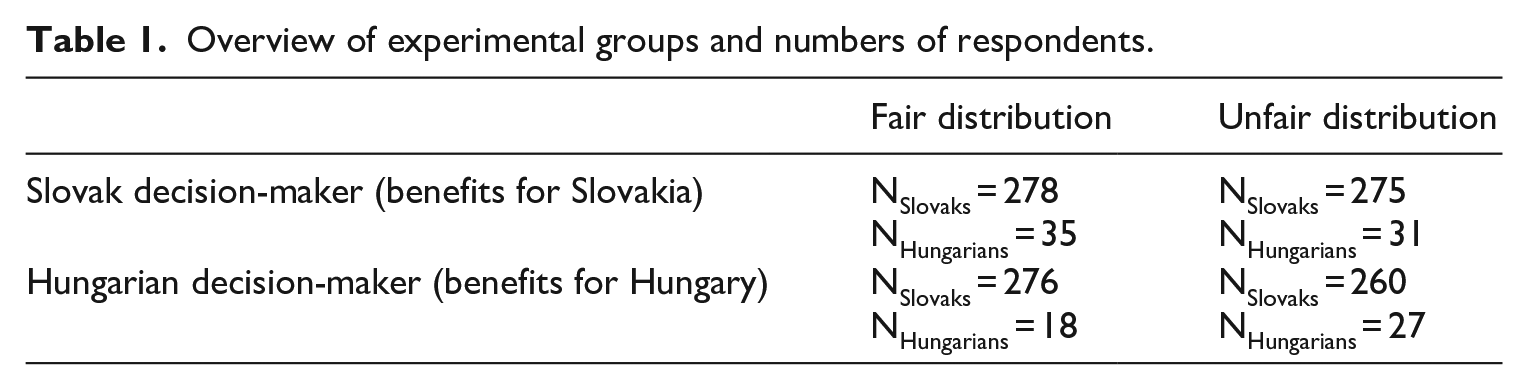
Three dependent variables – trust, willingness to vote for, and support for the distribution policy – were operationalized by three questions: Trust in the decision-maker was measured by the question, ‘How much trust do you have in a politician like [Martin Lukáč/Zsolt György]?’ Willingness to vote for a decision-maker was measured by the question, ‘To what extent would you be willing to vote in the elections for a politician like [Martin Lukáč/Zsolt György]?’ Finally, support for the policy was measured by the question, ‘To what extent do you agree with the EU politician’s decision about the educational trial scheme?’ This set of questions allows us to compare respondents’ evaluations of the decision-maker as a responsible actor (first and second questions) with their perceptions of the pork barrel practice as policy (third question). With all three questions, respondents were asked to answer using a 0–10 scale, on which zero represented ‘complete lack of trust’, ‘definitely would not vote for’, or ‘completely disagree’, respectively. Ten meant the opposite.
For every part of the analysis – trust in the decision-maker, willingness to vote for a decision-maker, and support for the policy – we estimate two sets of ordinary least squares (OLS) regression models. The first set always tests the effect of shared ethnicity when fairness and the ethnicity of the decision-maker are held constant. In these models, we entered a dummy shared ethnicity coded as 1, if the respondent and decision-maker from the mock-up story had the same ethnic background. However, as we will see, the results suggest that the effect of shared ethnicity is different between Slovaks and Hungarians. Therefore, we estimate another set of models examining the response of respondents to decision-makers via two- and three-way interactions between the three independent variables of decision-maker’s ethnicity, respondents’ self-declared ethnicity, and distribution fairness. Given the difficulty of interpreting the interaction terms (see Brambor et al., 2006), we always visualize the marginal effects of interaction terms in figures.
Analysis
The main goal of the empirical analysis is to examine whether the ethnicity of the respondents correlates with their different evaluations of the pork barrel practices as executed by either the Slovak decision-maker or the Hungarian decision-maker directing resources to their own respective countries. The analytical section consists of three parts focused on trust in a decision-maker, willingness to vote for a decision-maker, and support for the distribution policy. The point of departure for each part is the models (1–4) estimating the effect of shared ethnicity between respondents and the decision-maker. However, our sample includes Slovaks and Hungarians all living in Slovakia. Therefore, when the mock-up story states that the resources are distributed by a Slovak decision-maker to Slovakia, both Slovaks and Hungarians may feel they benefit from such a scenario. However, when the decision of a Hungarian politician allocates the funds to Hungary, Hungarians in our sample are stimulated by their shared ethnic origins, while the Slovaks have no incentive to favour such a policy. Due to this discrepancy, we estimate a second set of models (5–7), which allows us to separately examine the effects of shared ethnicity depending on whether the decision-maker is Slovak or Hungarian, thanks to inclusion of interactions between (1) the respondent’s ethnicity, (2) the decision-maker’s ethnicity, and (3) distribution fairness.
Trust in the decision-maker
The first set of models estimating the effect of shared ethnicity between individuals and a decision-maker is presented in Table 2. As expected, the effect of shared ethnicity is positively correlated with the degree of trust of individuals in a decision-maker. When the coefficients for shared ethnicity are analysed for the Models Trust 1 and Trust 2, the effect is roughly comparable even when we control for respondents’ ethnicity and distribution fairness.
Trust in decision-maker: estimates for shared ethnicity.
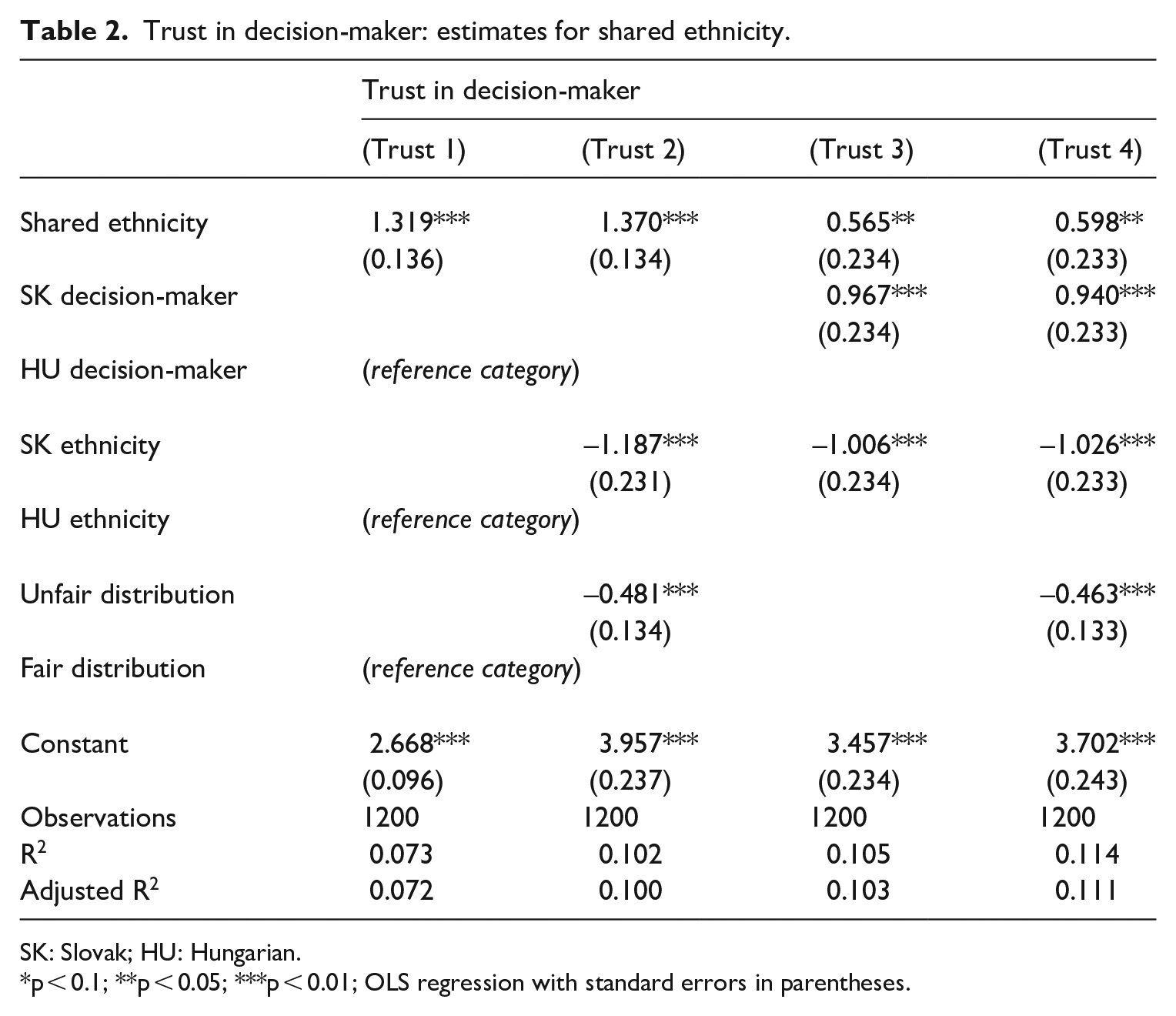
SK: Slovak; HU: Hungarian.
*p < 0.1; **p < 0.05; ***p < 0.01; OLS regression with standard errors in parentheses.
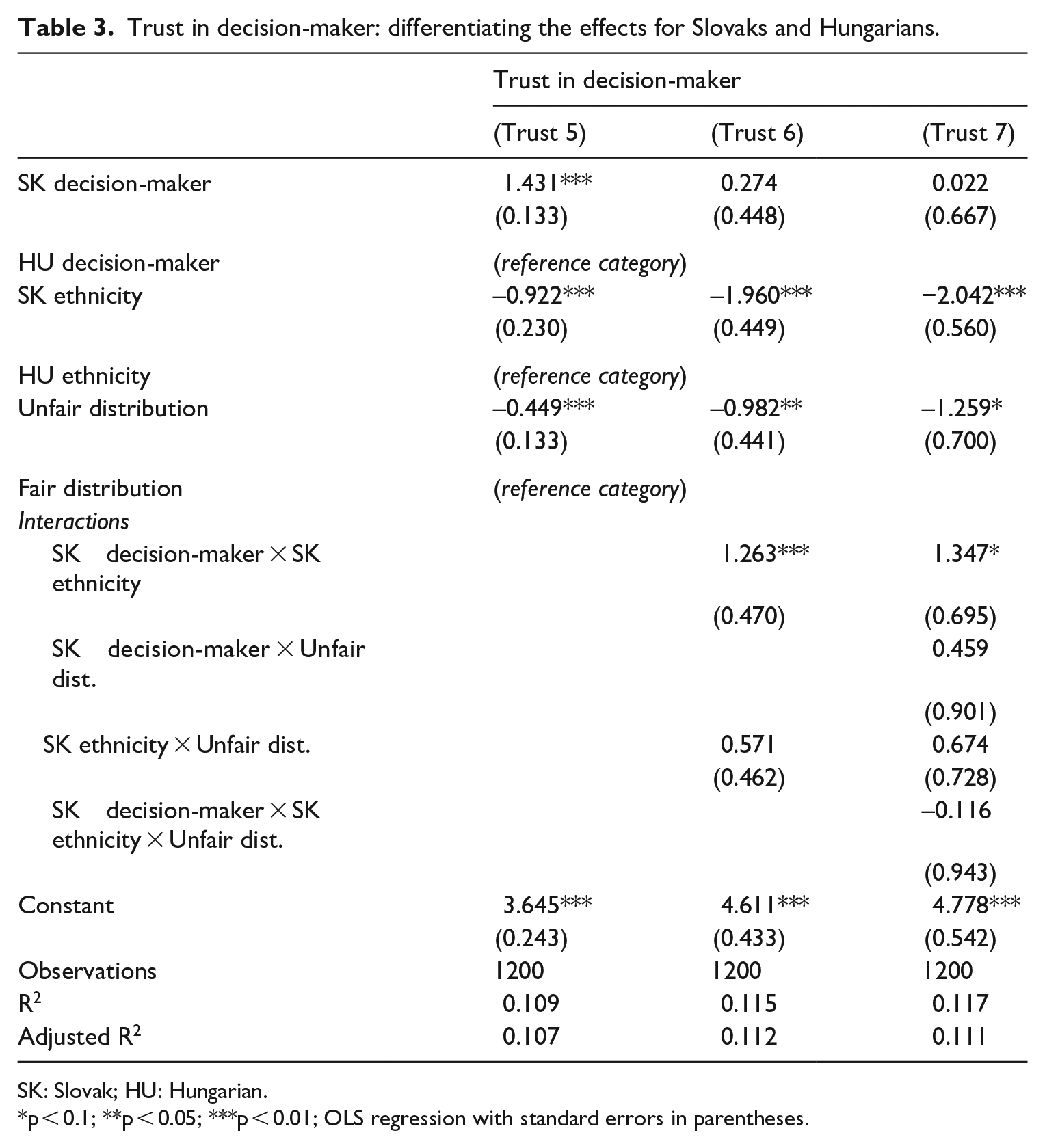
However, once the ethnicity of the decision-maker enters the models (see Models Trust 3 and Trust 4), the coefficients for shared ethnicity drop and their level of significance decreases from p < 0.01 to p < 0.05. This suggests that both shared ethnicity and the decision-maker’s ethnicity constitute relevant predictors; therefore, the analysis turns to the second set of models (see Table 3), which allows us to disentangle the effects to determine if they differ among Slovaks and Hungarians.
Trust in decision-maker: differentiating the effects for Slovaks and Hungarians.
SK: Slovak; HU: Hungarian.
*p < 0.1; **p < 0.05; ***p < 0.01; OLS regression with standard errors in parentheses.
Model Trust 5 indicates that if funds are allocated by a Hungarian decision-maker to Hungary, Slovaks are on average less trustful of the decision-maker (by roughly 1 point on an 11-point scale). Unfair distribution decreases the level of trust among Slovaks by an additional half a point. However, once the two two-way interactions between respondent’s ethnicity and fairness, and respondent’s ethnicity and the decision-maker’s ethnicity are included (see Model Trust 6), the statistical insignificance of the former and the statistical significance of the latter suggest that it is primarily the decision-maker’s ethnicity which explains the differences in the trust levels across the groups.
Results are similar in Model Trust 7. The effects are visualized in Figure 1, showcasing the main difference between Slovak and Hungarian respondents. The distribution of public resources by a Hungarian decision-maker to Hungary decreases trust among Slovaks by roughly 1.3 points (compared to the scenario in which the Slovak politician allocates the funds to Slovakia). Among Hungarians, the level of trust stays roughly the same regardless of whether the decision about the allocation of resources is made by a Slovak or Hungarian decision-maker.
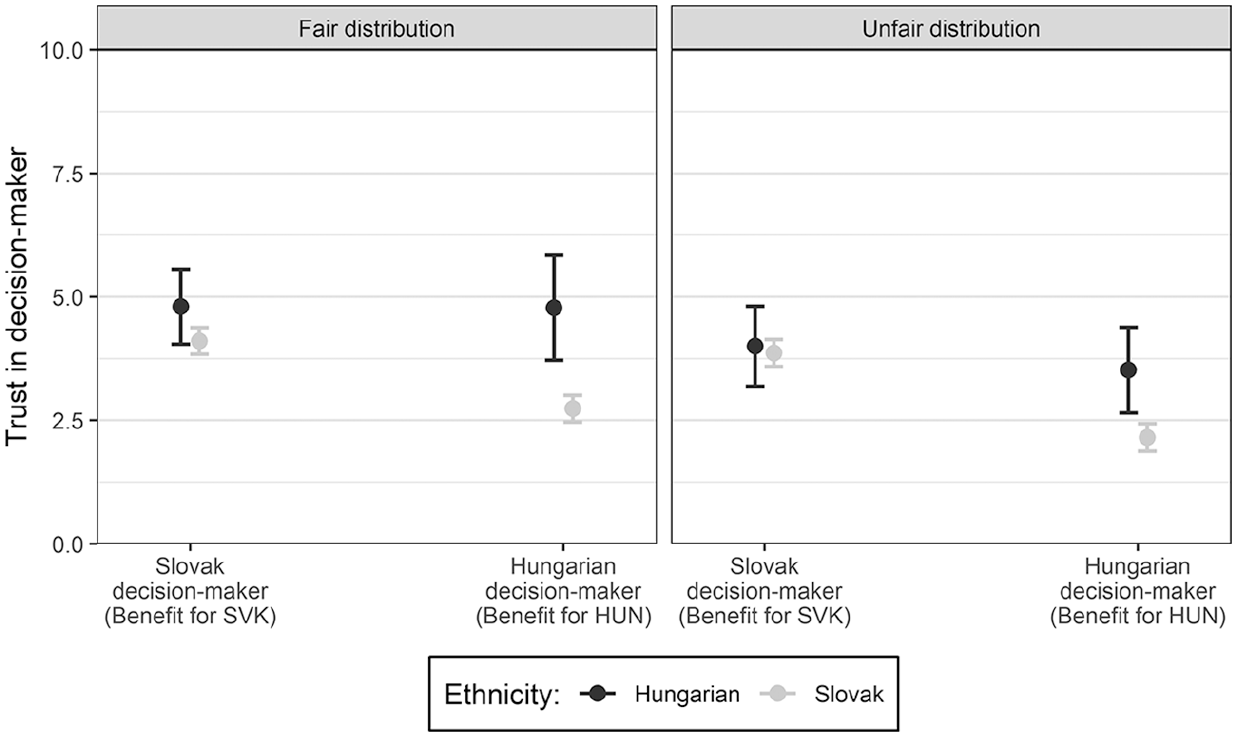
Trust in decision-maker (marginal effects of interaction terms in Model Trust 7).
The second factor – fairness of distribution – decreases the level of trust among all respondents regardless of their ethnicity by roughly 1 point (in Model Trust 6 at p < 0.05; in Model Trust 7, it is 1.25 points at p < 0.1). However, the interaction between fairness and respondents’ ethnicity remains statistically insignificant and therefore the respondents’ ethnicity does not seem to moderate the effect of fairness on the trust in decision-makers.
All these results provide strong and consistent support for the H1 ‘trust’ hypothesis and confirm that individuals who share the same ethnicity with the decision-maker tend to evaluate less critically the allocation of resources to an ethnically related kin-state. If it is not the case that ethnicity is shared, the trust level drops. This applies especially to ethnic minorities. In our experiment, Hungarians maintain a comparable level of trust in both Slovak and Hungarian decision-makers even though the decision by the Hungarian politician brings them no benefit (because they reside in Slovakia). This is in stark contrast to Slovaks, whose trust level drops once the resources are assigned by a Hungarian decision-maker to Hungary. However, shared ethnicity does not cause individuals to neglect unfairness in the distribution of public resources.
Willingness to vote for the decision-maker
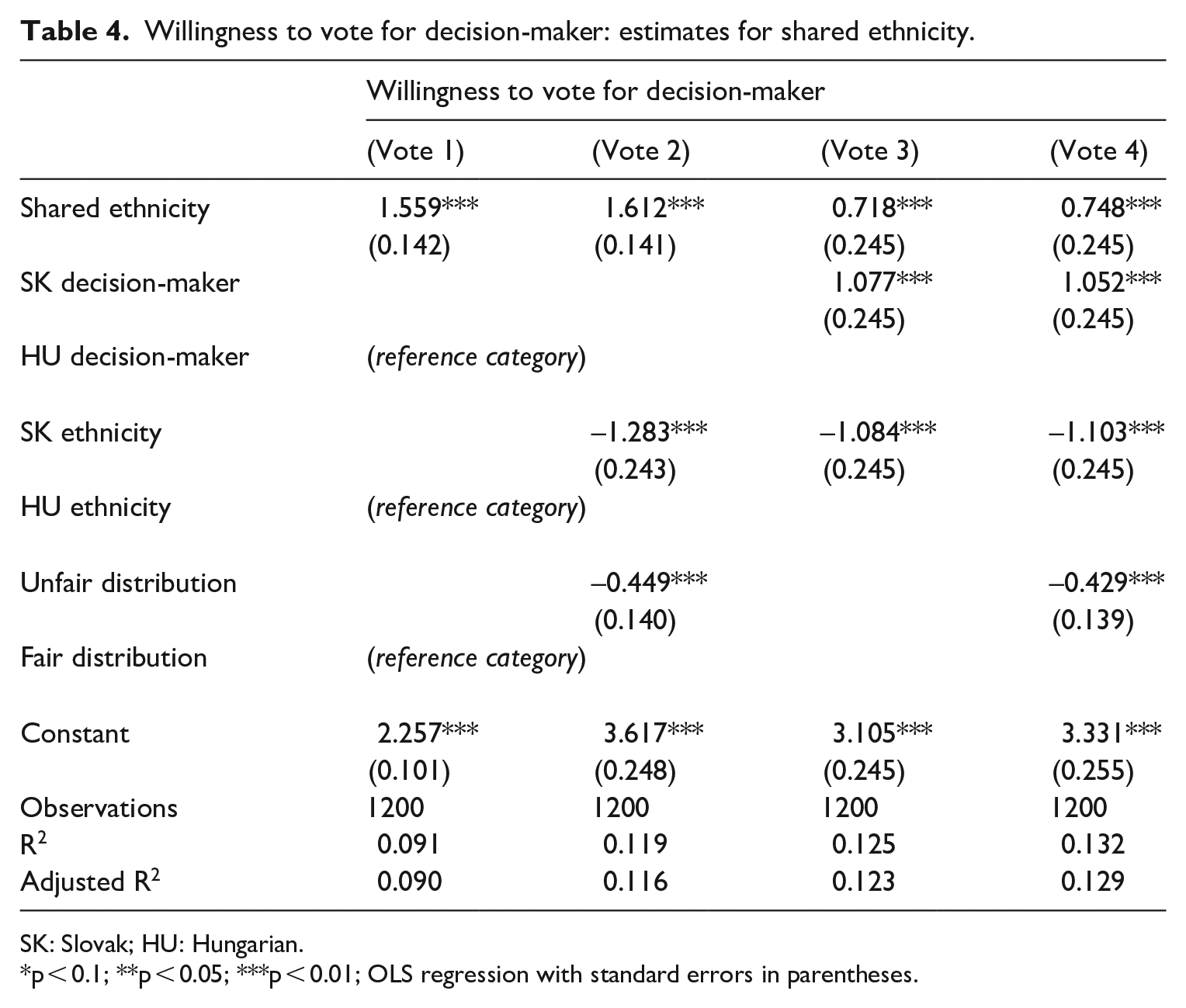
The second part of the analysis deals with respondents’ willingness to vote for a decision-maker responsible for the distribution of public resources. Results from the first set of models are analogous to those for trust – shared ethnicity increases individuals’ willingness to vote for a decision-maker even when distribution fairness and respondents’ ethnicity are controlled for (see Table 4; Models Vote 1 and Vote 2).
Willingness to vote for decision-maker: estimates for shared ethnicity.
SK: Slovak; HU: Hungarian.
*p < 0.1; **p < 0.05; ***p < 0.01; OLS regression with standard errors in parentheses.
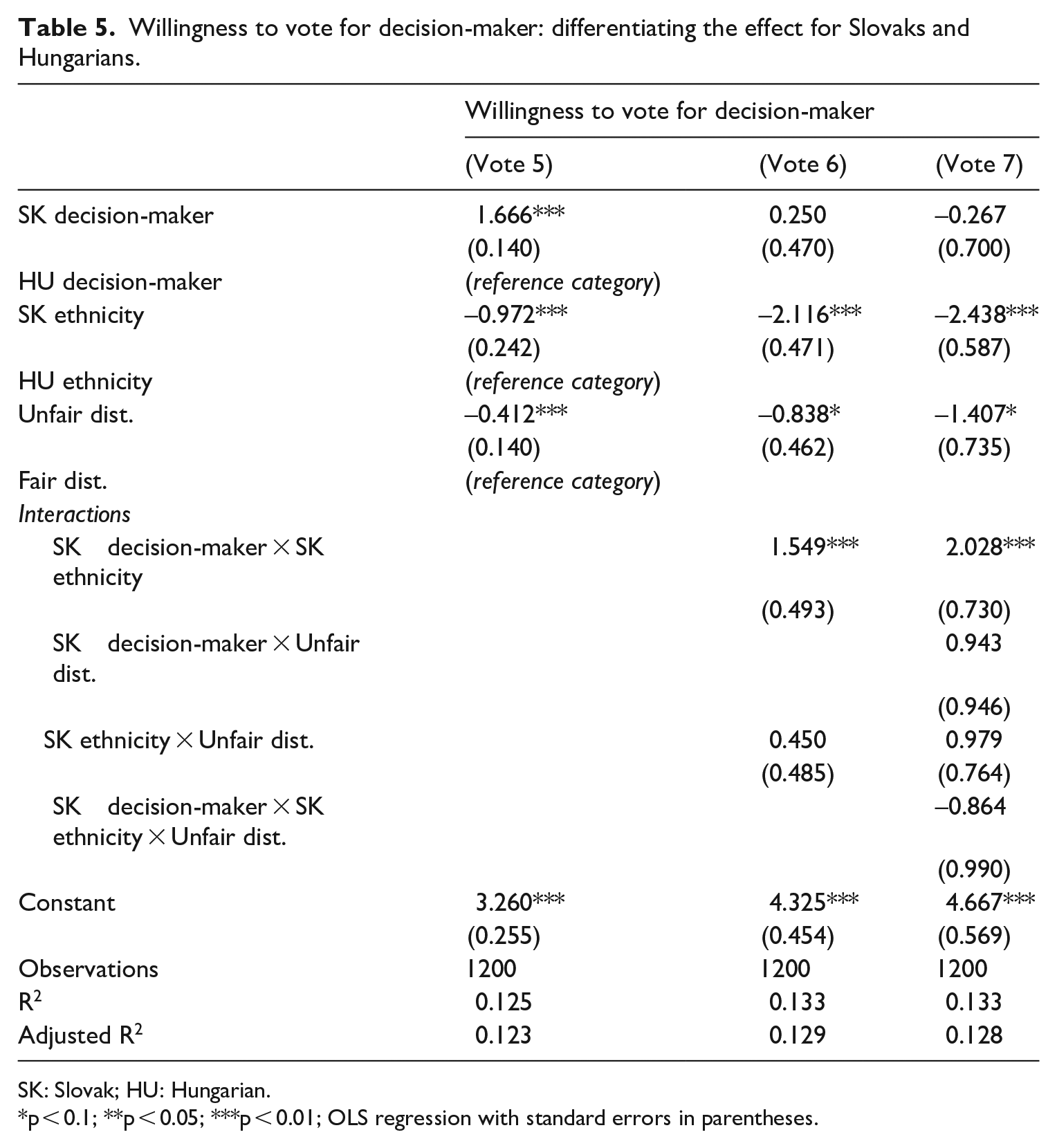
Yet, inclusion of the decision-maker’s ethnicity decreases the size of the effect of shared ethnicity (see Models Vote 3 and Vote 4), although the coefficients maintain statistical significance, unlike for trust. Therefore, in this case as well, we estimate the second set of models, which allows us to examine the separate effects of shared ethnicity among Slovaks and Hungarians (see Table 5). Model Vote 4 suggests that Slovak respondents, as compared to Hungarians, are less willing to vote for a politician such as the Hungarian decision-maker in our experiment who directs funds to Hungary (by roughly 1 point on an 11-point scale). Once the interactions are added, it becomes apparent that the willingness to vote for such a decision-maker is mainly driven by the interaction between the respondent’s ethnicity and the ethnicity of the decision-maker (see Models Vote 5 and Vote 6).
Willingness to vote for decision-maker: differentiating the effect for Slovaks and Hungarians.
SK: Slovak; HU: Hungarian.
*p < 0.1; **p < 0.05; ***p < 0.01; OLS regression with standard errors in parentheses.
Figure 2 visualizes the effects from the Model Vote 7 and demonstrates that the willingness to vote for such a decision-maker is roughly comparable across the groups on each side of the graph, unless the funds are assigned by a Hungarian politician to Hungary. In such a case, the willingness of Slovaks (compared to Hungarians) to vote for the Hungarian decision-maker drops (by roughly 1.5 in Model Vote 6, or 2 points in Model Vote 7; both at p < 0.01).
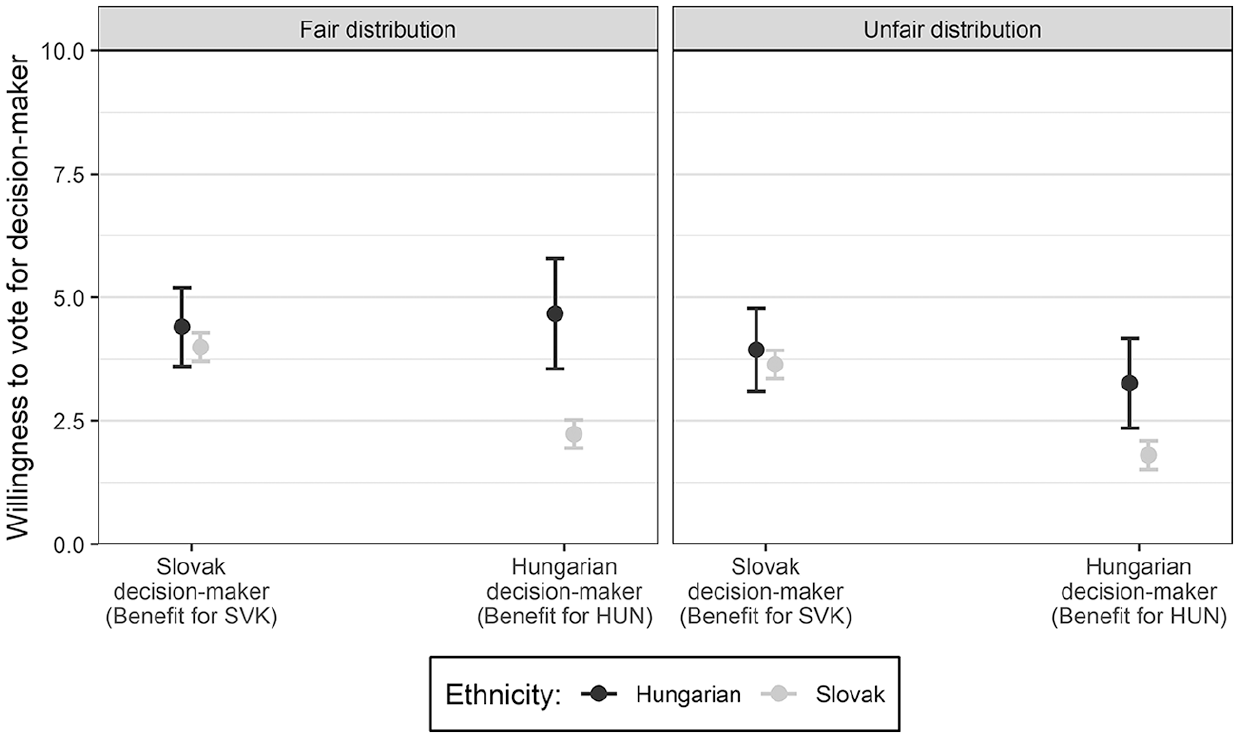
Willingness to vote for decision-maker (marginal effects of interaction terms in Model Vote 7).
Once the focus moves to fairness, the coefficients in the Models Vote 6 and Vote 7 indicate that the preferential allocation of funds decreases respondents’ willingness to vote for the responsible decision-maker by roughly 1 point (the exact coefficient is 0.8 or 1.4 points, respectively, both at p < 0.1). However, the interaction between fairness and ethnicity is not statistically significant and, therefore, we have to conclude that ethnicity does not moderate the effect of fairness on the respondents’ willingness to vote for the decision-makers across the groups.
Trends in the willingness to vote for a decision-maker are roughly comparable to the trust levels described in the analysis above and support the initial expectation. The ethnicity of Hungarian respondents keeps their willingness to vote on the same level regardless of whether funds are assigned to Slovakia or Hungary (their kin-state), even though the latter does not provide them any benefit. Contrarily, the Slovak respondents tend to turn their back on the decision-maker if Slovakia does not profit from the public funds. In addition, ethnicity does not increase respondents’ tolerance of the preferential distribution of public resources. Overall, implementation of an unfair policy decreases respondents’ willingness to vote for a decision-maker; however, the effect is roughly comparable across all groups regardless of their ethnicity.
Support for policy
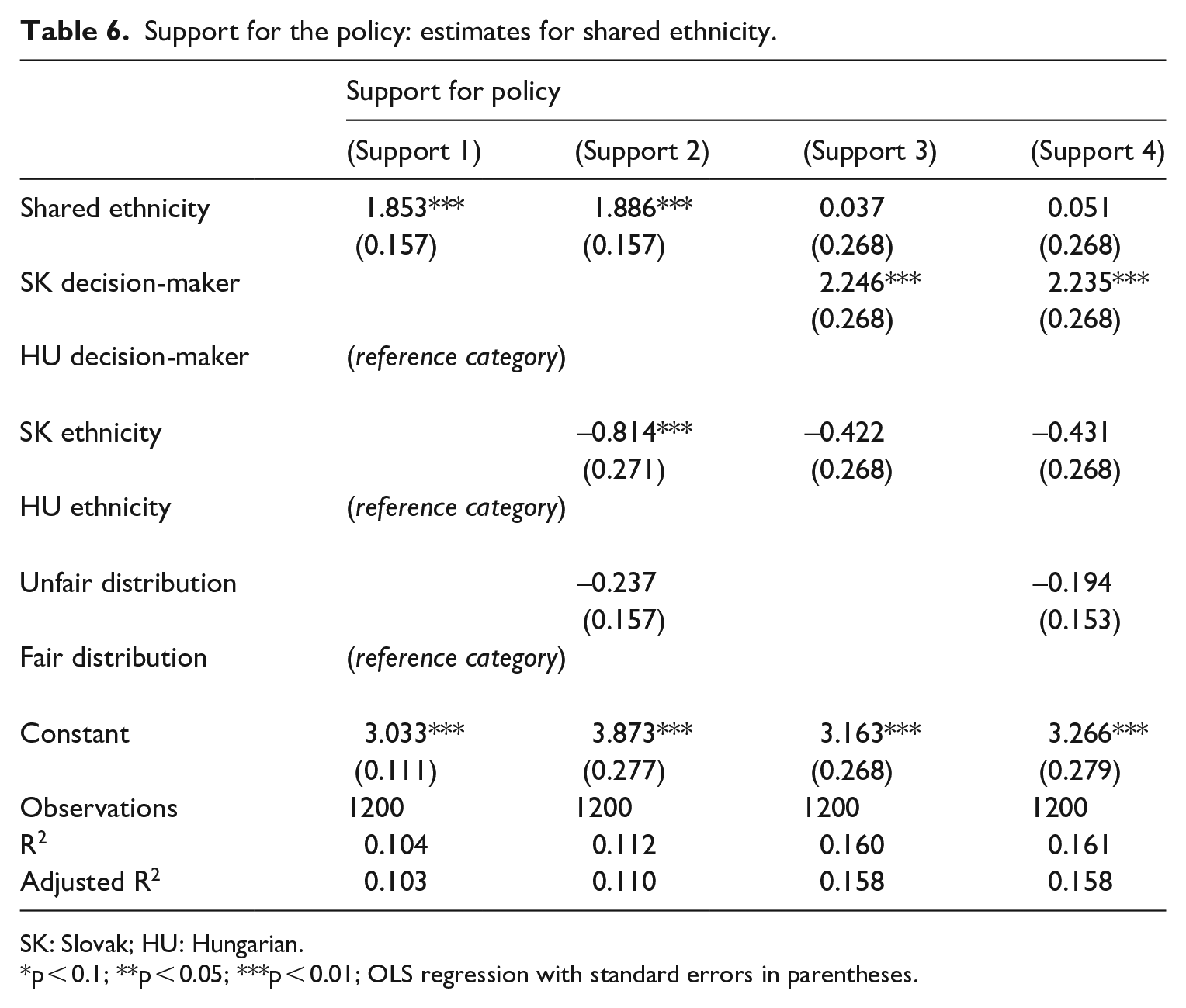
The last part of the analysis turns away from the evaluation of decision-makers and aims to examine participants’ support for the policy implemented by the decision-makers. The first set of models including the shared ethnicity dummy is presented in Table 6. Even though the coefficients for shared ethnicity from the first two models, Support 1 and Support 2, indicate that shared ethnicity may play a role in individuals’ evaluation of the policy, the coefficients lose statistical and substantive significance (due to decrease in size) once the ethnicity of the decision-maker is included in the models (see Support 3 and Support 4). This indicates that individuals’ evaluation of the policy is driven by the ethnicity of the decision-maker (and destination country for the allocated money, since decision-makers always select their own country). Again, an additional set of models is estimated to explore the differences across the Slovak and Hungarian ethnic groups.
Support for the policy: estimates for shared ethnicity.
SK: Slovak; HU: Hungarian.
*p < 0.1; **p < 0.05; ***p < 0.01; OLS regression with standard errors in parentheses.
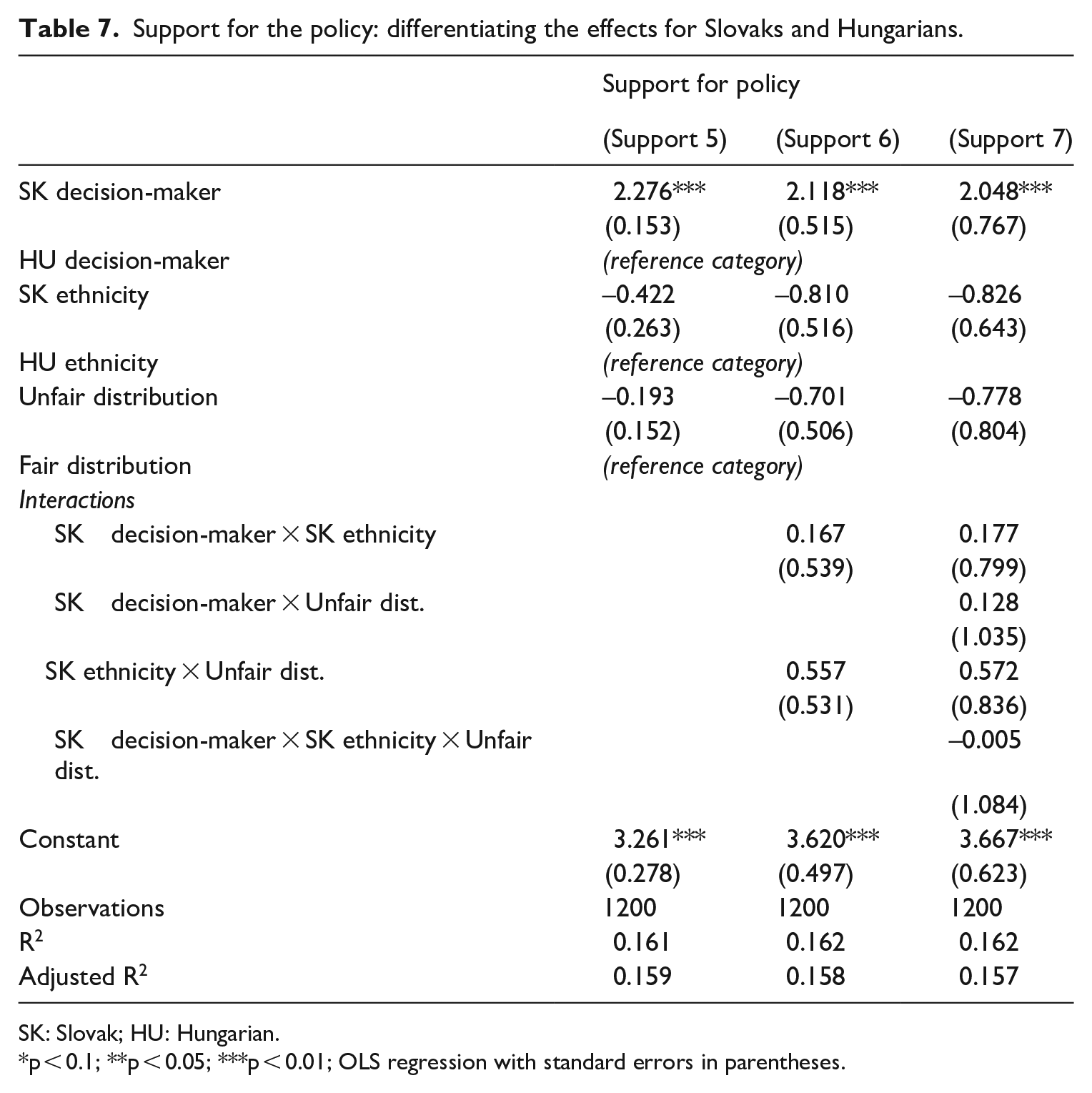
The results presented in Table 7 also indicate that support for the policy is always higher by more than 2 points (at p < 0.01) if the funds are directed to Slovakia based on a decision by the Slovak politician. This result also holds in the Models Support 6 and Support 7 and the estimates are comparable among Slovaks and Hungarians within the same groups. No other factor reaches statistical significance and therefore the results indicate that neither the respondents’ ethnicity nor distribution fairness influences support for the policy among respondents.
Support for the policy: differentiating the effects for Slovaks and Hungarians.
SK: Slovak; HU: Hungarian.
*p < 0.1; **p < 0.05; ***p < 0.01; OLS regression with standard errors in parentheses.
The results from Model Support 7 are visualized in Figure 3. In the two previous parts of the analysis, Hungarians were equally trustful and supportive of decision-makers regardless of their ethnicity. However, in this case, if the resources are directed to Hungary instead of Slovakia, the support of Hungarians for the distribution policy drops in a similar fashion as it does among Slovaks.
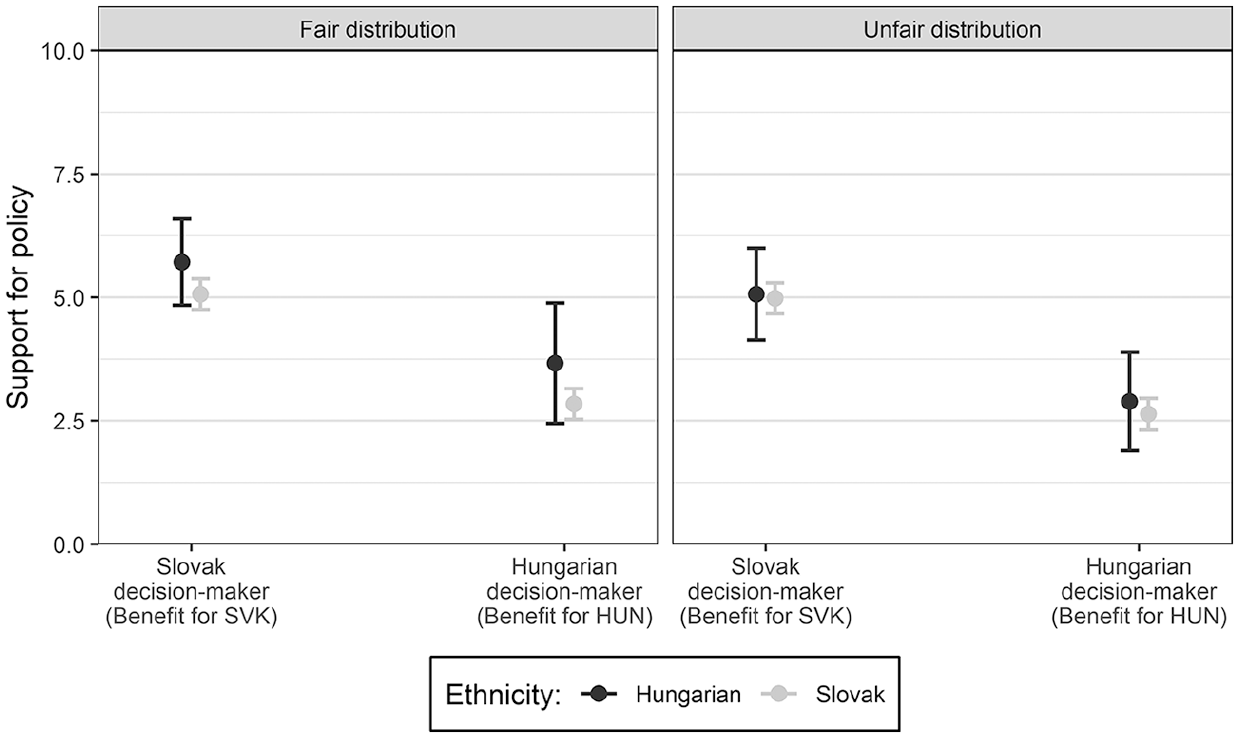
Support for policy (marginal effects of interaction terms in Model Support 7).
This discrepancy in the results actually reveals the role that ethnicity plays in the perception of pork barrel practices. If voters share an ethnic identity with a decision-maker, they tend to evaluate him less critically. This occurs even when the implemented decision allocates the benefits to their kin-state and leaves them and the country where they reside with no direct benefit. Such results warrant further discussion about why elites are likely to engage in ethnically targeted pork barrel spending even if the ethnic group does not gain materially. One potential explanation is that ingroup bias at the elite level manifests itself as decision-makers caring about the health of their group, and their own place in it, regardless of the outcome. As viability of the group and the individual’s place in it are largely indicated by the relative value of resource distribution decisions, elites are sensitive to ‘nonoutcome’ since they understand that groups in which no one cares about group health are likely to be at a disadvantage (Smith et al., 2007). An additional reason why elites might decide to disregard narrow electoral benefits can be derived from the informational theory of clientelism. Namely, that the targeted distribution of resources can be used as a signalling strategy as it influences larger constituencies of voters than only those who are directly targeted (Mares and Young, 2019), or simply signals the personal attributes of the politician, such as generosity (Foltz, 1977).
However, when it comes to the evaluation of the policy itself, members of the minority ethnic group become just as critical as their fellow citizens in the ethnic majority in the country in which they reside. This indicates that individuals tend to overlook decisions that do not benefit them when they evaluate decision-makers who share their ethnic identity. Nonetheless, a shared ethnic identity does not prevent them from being critical of the implemented policy decision.
Conclusion
In divided societies and new democracies, the implementation of pork barrel practices tends to follow ethnic divisions. Political elites aim to utilize the ingroup bias of the electorates sharing their ethnic identity with the intention of increasing their own popular and electoral support (Chandra, 2007; Dixit and Londregan, 1996). However, while this behaviour of elites is well-documented (Kitschelt, 2000; Kitschelt and Wilkinson, 2007; Stokes et al., 2013), little is known about the perceptions of citizens and whether a shared ethnicity with decision-makers makes the public more tolerant of inherently unfair pork barrel politics.
Therefore, we analysed data from an original survey experiment (n = 1200) in ethnically heterogeneous Slovakia. The goal was to examine in a hypothetical scenario whether pork barrel practices by Slovak and Hungarian decision-makers are evaluated differently among Slovaks and members of the 8.5% Hungarian minority.
The results revealed that when individuals and decision-makers share the same ethnicity, individuals tend to ignore unfavourable policy decisions when they are asked about their level of trust and willingness to vote for the decision-maker. However, this finding applies only to the personal evaluation of the decision-maker. When individuals are asked about their support for an unfair distribution of public funds, they are likely to be critical of the implemented policy decision itself regardless of their ethnic background. In our experiment, Slovaks and Hungarians alike were less likely to support biased distribution of public resources. Therefore, individuals may be more favourable in their evaluation of decision-makers with whom they share ethnic origins, but shared ethnicity does not blind their perception of ‘pork barrel’ practices and they are less likely to support such policies.
Footnotes
Funding
The author(s) disclosed receipt of the following financial support for the research, authorship, and/or publication of this article: This research was funded by the Czech Science Foundation (Grant no. GA18-16928S). Miroslav Nemčok‘s contribution was also made possible thanks to the generous financial support provided by the Finnish Cultural Foundation.

Supplementary Information
Additional supplementary information may be found with the online version of this article.
Online Appendix A: Experimental manipulation.