




Abstract
This study critically assesses the claim of the cartel party theory that the party in central office (PCO) has lost its powers to the party in public office (PPO) as parties have adapted to various changes in their operating ‘environment’. The study argues that a party’s tendency to adapt is conditioned by the party’s ‘genetic’ heritage: if the PCO assumed a prominent position during the party’s institutionalization, it can more likely stand against external pressures compared to a PCO that has been traditionally weak. The study compares the development (1983–2017) of two Finnish parties, which hail from polar ‘genetic’ traditions: a social democratic mass party and a conservative cadre party. The change of the party ‘environment’ has strongly supported PCO’s decay. Unlike earlier longitudinal studies on intra-party power balance, the study assesses all significant power dimensions and finds a contradictory development: while the distribution of leadership positions and resources increasingly favour the PPO in both parties, significant ‘genetic’ differences in the distribution of formal decision-making power have not diminished at all. If statutory regulations matter, the results suggest that the PPO cannot ‘insulate’ like the cartel model expects in parties where the PCO’s strong role has been strictly codified.
Introduction
This study critically assesses the claim of Katz and Mair’s (1995, 2002, 2009, 2018) cartel party theory that during the last quarter of the 20th century extra-parliamentary parties’ national-level decision-making and administrative organs, that is, the party in central office (PCO), weakened considerably vis-à-vis the party in public office (PPO, that is, MPs and cabinet ministers), as parties adapted to citizens’ declining societal engagement, the emergence of public party subsidies, and the birth of fast-paced, ‘governmentalized’, internationalized, and media-driven style of politics. In contemporary parties, the PCO should merely operate as the PPO’s service organization, while the PPO drives parties’ policy work.
As a theory, the cartel model has enjoyed popularity (not universal, though, see Kitschelt, 2000; Koole, 1996), but existing evidence leaves doubts over its accuracy. Following Katz and Mair (1993), quantitative longitudinal studies have attempted to establish the PPO’s growing dominance by examining relative changes in PPO’s and PCO’s control of resources, leadership positions, and statutory prerogatives. The early studies on resources found that in many democracies parliamentary parties’ finances and staff increased fast between the 1960s and early 1990s. The same studies, however, detected a coincidental, albeit slower, strengthening of central party offices that often continued to be larger (Heidar and Koole, 2000; Krouwel, 2012; Mair, 1994). A recent comparative study showed that PPO’s resources grew even faster between 1990 and 2010, although central party offices’ resources did not decline dramatically (Bardi et al., 2017). Overall, however, parliamentary parties’ resources have increased significantly during the past five decades, strengthening the PPO.
Another measure has focused on the control of parties’ leadership positions. Early studies suggested that MPs’ presence in parties’ national executive committees increased slightly between the 1960s and early 1990s, reflecting the strengthening of the PPO (Katz and Mair, 1993, 2002). A more recent study – which also covers the 1990s, on a smaller sample of cases – showed instead that party activists, not public officials, had become more prominent in several European countries’ national party executives (Detterbeck, 2005).
Finally, changes in party offices’ relative strengths have been assessed through parties’ statutory regulations. An early comparative study found that in 1990 extra-parliamentary party organizations were still dominant in leftist parties and intra-party power balances had not changed much since the 1950s (Gibson and Harmel, 1998). Later, an aggregated country-level comparison suggested that mid-elites’ grip on candidate and leadership selection is weakening (Scarrow et al., 2000). However, a recent comprehensive study showed convincingly that in regard to PCO/PPO power balance, Danish parties’ statutes did not change almost at all between the 1950s and the first decade of the 2000s, and instead they continued to reflect the parties’ origins and ideologies (Pedersen, 2010). Recent qualitative research, too, has suggested that intra-party power balance might still vary across parties (Enroth and Hagevi, 2018; Passarelli, 2015). In the Swedish social democratic party, the PCO even appears to have strengthened since the 1960s (Loxbo, 2013).
The evidence is mixed. The uncertainty over ‘the ascendancy of the party in public office’ stems, in part, from eclectic methodological choices. Individual studies have tended to focus only on certain power attributes. Thus, we do not know, for example, whether changes in party resources are always accompanied with parallel changes in leadership positions and statutory regulations – or whether the latter in fact remain stable. In light of the evidence, it seems possible that only one power attribute, party resources, has changed towards the cartel model. If so, the model demands a re-interpretation, as it suggests a more comprehensive change in intra-party power balance.
This study analyses changes in PCO/PPO power balance in Finland over a period when parties’ operating ‘environment’ changed rapidly from mass to cartel party era (1983–2017). It provides a timely update for the scant longitudinal evidence on intra-party power transitions. More importantly, the study contributes to the debates on the cartel party by assessing simultaneously all attributes of intra-party power (resources, leadership positions, and statutory power). Through a robust set of measures, the study provides a more comprehensive picture of the changes in intra-party power balance and a much-needed methodological benchmark for comparative research.
Theoretically, the study challenges the cartel model’s generalizing logic by emphasizing potential for ongoing inter-party differences. Notwithstanding few recent efforts (Gauja, 2017; Passarelli, 2015; Pedersen, 2010), studies have tended to emphasize general tendencies (Heidar and Saglie, 2003). The study acknowledges that instead of uniform adaptation and eventual convergence, parties may react differently to external pressures. Parties’ reactions can be conditioned by their origins (Duverger, 1967), institutionalized structures and practices (Panebianco, 1988), and primary goals (Harmel and Janda, 1994) (here colloquially referred to as party ‘genetics’).
The study focuses especially on the historical role of the PCO. It argues that if the PCO developed a powerful position during a party’s genesis and institutionalization, it will more likely withhold against cartelizing pressure than a PCO of a party, where PCO’s role has traditionally been weak.
The article asks, do parties where the PCO’s historical power position varies react differently, in re-distributing organizational power resources (money, staff, leadership positions, statutory power), when the parties face similar (cartelizing) external pressures? How do their reactions differ? And to what extent their internal power distributions continue to differ?
The study compares the development (1983–2017) of two parties: the Social Democratic Party of Finland (SDP) that hails from a PCO-dominated mass party heritage and the National Coalition Party (NCP), a descendant of a PPO-dominated cadre party tradition. The parties’ formation and evolution conform to historical party models. The parties’ internal power distribution differed still at the beginning of the research period (Borg, 1982; Mickelsson, 1999), which marked the apex of the mass party era in terms of party membership and local party activity (Mickelsson, 2007). Since the turn of the 1980s, the cartelizing pressures have strengthened very rapidly in Finland. Thus, it provides a good ‘laboratory’ for testing with robust measures if and to what extent party ‘genetics’ can condition party organizational development in the cartel party era.
The next section presents the study’s theoretical framework, asking why the cartel party theory expects the PCO to lose its powers and how party ‘genetics’ might condition the effect. The third section introduces the studied cases. It describes the parties’ formative organizational choices and development until the 1980s and the change of the party ‘environment’ since early 1980s. The fourth section describes the study’s dependent variable, methods, and data sources. To facilitate comparison, the study employs indicators that reflect the traditional dimensions of PCO/PPO power distribution (Katz and Mair, 1993). The fifth section assesses the parties’ organizational responses in 1983–2017.
The article concludes with a discussion of the results, which help to explain the contradictory findings of the earlier studies. The multi-indicator analysis reveals that in Finland party resources and leadership positions increasingly favour the PPO, but significant ‘genetic’ differences in formal decision-making power have not diminished at all. The contradiction reminds of Koole (1996) and Kitschelt’s (2000) critical reservations over cartel model’s claim on the ‘insulation’ of the PPO. If statutory regulations matter, in some parties the PPO cannot ‘insulate’ from the PCO unless the PCO relegates itself.
The change and persistence of intra-party power distribution
Why should the PCO lose its powers?
The PCO is a combination of extra-parliamentary party organization’s (EPO) national-level decision-making organs that include the party leadership and ancillary members from subnational parties and affiliate organizations, and the central party office. The PCO’s power stems from its resource coordination role (campaigning, communications, etc.) and its formally recognized status as the party’s highest decision-making unit. PPO refers to the group that represents parties through elections: MPs, cabinet ministers, and their support teams. The PPO manages state affairs and is the more visible ‘office’, but campaigning and intra-party decisions (candidate selection, etc.) tie it to the PCO (Katz and Mair, 1993). Intra-party power distribution refers to how important organizational power resources are distributed between ‘the offices’.
Cartel party theory’s logic of party evolution leans onto environmental adaptation theory where parties’ social, political, and technological operating ‘environment’ is the main driver of parties’ organizational choices, as it sets the context for inter-party competition. Parties’ internal distribution of resources changes when parties attempt to remain competitive in the face of ‘environmental’ changes (Harmel, 2002). Due to this logic, generalized party models expect all parties that operate in the same ‘environment’ to adapt in a relatively similar fashion and converge towards the dominant organizational model (Heidar and Saglie, 2003).
Five ‘environmental’ changes have pushed parties to mould their practices, structures, and resources in ways that weaken the PCO (Katz and Mair, 1995, 2002, 2009, 2018). First, the erosion of social classes and the adjacent weakening of mass political engagement should have decreased party activists’ attentiveness and legitimacy in intra-party decision-making. As class-based representation weakened, party activists’ claim over intra-party decisions eroded, while the MPs’ reach towards general electorates became more justified. Second, public party subsidies provided for the PPO resources that are independent of the party membership, which the PCO represents. In addition to subsidies’ sheer financial significance, PCO’s coordination role weakened and party organizations assumed a more electoral outlook, as the subsidies are often allocated according to parties’ electoral success.
Third, the increasing complexity of politics and its ‘governmentalization’ brought parties closer to the state apparatus and weakened the significance of intra-party policy processes. The formation of political agendas moved from party offices to public domains, and party activists’ capacity to monitor public officials, who assumed a more reactive role, weakened. Fourth, the internationalization of politics also pushed PPOs further from intra-party arenas and weakened the possibility of activist-driven policy input and monitoring. The fifth change, the mediatization of politics, eroded party activists’ control over relevant communication channels and increased publicity enhanced the PPOs’ prestige. The pace of new media politics also jeopardized PCO’s potential to oversee PPO’s conduct.
How party ‘genetics’ can condition parties’ organizational adaptation?
Intuitively, adaptation makes sense, as the need to maintain competitiveness is a crucial instinct for parties’ survival. However, although party models highlight change and convergence, parties rarely form or develop uniformly (Gunther and Diamond, 2003; Heidar and Saglie, 2003). A traditional notion tells parties are ‘conservative’: they favour their existing structures, and thus changing a party organization is hard. At least three factors have been associated with parties’ organizational ‘stickiness’: their origin (Duverger, 1967), the institutionalization of party structures and practices (Panebianco, 1988), and parties’ primary goals (Harmel and Janda, 1994). While analytically distinct, the factors are temporally and thematically interrelated.
According to Duverger (1967: xxiii), ‘[J]ust as men bear all their lives the mark of their childhood, so parties are profoundly influenced by their origins’. For Duverger, the most important factor that determines the development of the PCO/PPO power relationship in a party was the nature and locus of the elite that formed the party’s extra-parliamentary organization. When it was formed internally, by established parliamentary elites (i.e. the PPO), the PCO assumed a role of a weak electoral campaign organization with no political significance, led by MPs and few upper class–based activists who worked for personal spoils. This is the ideal-typical formation of the cadre party model. When the newly enfranchised groups (workers, farmers, etc.) built parties, the EPO typically emerged before the PPO. In these externally created parties, the rapid influx of activists, the enlargement of party bureaucracy, and the more permanent and comprehensive operating ethos that reached far beyond campaigning eventually produced an ‘external oligarchy’, a powerful activist-driven elite that located at the PCO. It derived its power from the vast membership and asserted it over the PPO through financial and campaign-related measures and by formalizing its role in the parties’ decision-making processes. This is the ideal-typical formation of the mass party model. Apart from differing birth logics (campaigning vs class representation) and social compositions (established upper class vs emerging underclass), the founding party models also differ in terms of democratic sentiment. As the mass party’s founding elite legitimized itself through the membership, not established class position, intra-party democracy (via representation by the PCO) developed into a fundamental organizational principle (Duverger, 1967: 182–185, 190–197.)
Most parties that formed during the 20th century adopted large, complex, and activist-driven or ‘thin’ and electorally driven organizational models (Gunther and Diamond, 2003; Krouwel, 2006). Pure cadre and mass parties obviously no longer exist, but if party’s origin can still affect the PCO/PPO power balance, as Pedersen’s (2010) study suggests, the distinction between parties that formed along these foundational models is an obvious place to seek differences. It is not, of course, the only significant distinction. Newer movements like the grassroots-leaning ‘new politics’ parties or leader-centric right-wing populist parties also developed distinct organizational ideals.
Perhaps even more important for ‘genetic’ resistance potential is the mechanism that ‘locks in’ the formative choices. Panebianco (1988: 6–9, 16–59, 245–246), who also emphasized the primacy of formative choices in parties’ organizational development, explained ‘lock in’ dynamic through a process of institutionalization. After a party is formed, the preservation of its organizational order becomes the leadership’s main objective. This ‘dominant coalition’, which controls the most important organizational resources, ties ‘contracts’ among the leadership (horizontally) and between the leaders and the core activists (vertically) to stabilize the organization. The ‘contracts’ consolidate incentive structures, which now reach beyond ideological matters – that are most important in parties’ genesis – to material and career-related spoils, which develop as the organization matures. As organizational reforms threaten the existing distribution of resources, they raise resistance. This is why party organizations tend to perpetuate in a form that they have institutionalized into. Minor adjustments happen all the time, but only a coincidence of a major external shock and internal turmoil can alter party organization’s fundamental power structure.
However, Panebianco (1988: 58–59, 173, 261) also acknowledged that the level of institutionalization varies between party types, and therefore some parties are always more prone to change. Parties that have rigid, strict, and formally structured central bureaucracies tend to institutionalize more strongly. In such parties, the PCO can dominate the PPO, but in weakly institutionalized parties the PPO tends to dominate, because the PCO possess no counterweight against it. Panebianco’s formulations contour Duverger’s models, but add clearer reasons for the persistence of the formative organizational choices.
Harmel and Janda (1994) connected parties’ propensity to change (and resist change) to their primary goals. They concurred that party reforms (organizational or political) usually ‘face a wall of resistance’ because they consume resources and undermine the ‘dominant coalition’. However, change is possible if an external pressure (for them, an abrupt shock) challenges the party’s primary goal (maximization of votes, offices, intra-party democracy, or policies). If, for example, a party that is primarily concerned with vote maximization faces a major electoral defeat, its leaders gain a reason and legitimacy to push for a reform, which restores the party’s capacity to win elections. A ‘dominant coalition’ can propose a reform if it reinforces its power position or advances the party’s primary goal. Because parties have different primary goals, their reactions to external pressures should differ. What motivates the leaders of a vote-seeking party might not do much for the leaders of a party, which prioritizes intra-party democracy, for example. There, a successful reform would require pressures that somehow threaten the members’ ability to influence the party’s decisions.
Harmel and Janda (1994) did not specify where parties’ primary goals come from and which types of parties adhere to specific goals, but they mentioned few revealing examples. The UK Conservative Party is ‘undeniably an electorally motivated party’, while the German SPD has ‘mixed primary goal (encompassing both electoral and membership concerns)’ (Harmel and Janda, 1994: 283). The former is a quintessential example of cadre party heritage and the latter an archetypical descendant of mass party tradition. Thus, vote maximizing appears to connect especially to cadre parties, while mass parties can also stress intra-party democracy. This comes close to Duverger’s notions of party types’ fundamental tasks (elections vs representation) and varying ‘innate’ democratic sentiment.
If these factors and dynamics matter, the pressures described in the cartel model were likely met by parties where PCO’s power varied. As the pressures undermined the role of the PCO, the parties’ reactions should differ. In parties of cadre party origin, the PCO assumed a role of a campaign organization with no political significance. These parties adopted a strong vote-seeking ethos. While the ‘contagion from the left’ and the ‘golden age’ of mass parties strengthened the PCO in cadre parties, too (Katz and Mair, 2002: 120–121), the ‘golden age’ lasted only two decades (1945–1965), and during it the adherence to mass party ideals was often merely rhetorical (Scarrow, 2015: 36–37, 67). If the PCO did not become dominant during this era, PPO’s dominance persisted – and was likely fortified in the era that followed (the ‘contagion from the right’; Epstein, 1967). The cartel party thesis highlights increased voter volatility, the dominance of public party money that is usually based on electoral performance and media-centeredness, and thus urges parties to transform into ‘electoral-professional’ ‘media agencies’ that have limited operations outside of the electoral and public realm. This ‘environmental’ change presented a threat and a reason to reform especially to parties whose primary goal is vote maximization and where the PCO should be least able to defend its position. For these reasons, these parties (H1) likely entered the cartel party era with a power balance that still favoured the PPO, (H2) adapted to the pressures swiftly, and (H3) continue to emphasize the status of the PPO.
Parties that formed along the mass party model appointed for the PCO also a strong political and representative democratic role, and the ‘golden age’ likely reinforced it. Thus, when the public office–dominated era began (after the 1960s), these parties’ PCOs likely possessed great resistance potential against reform-minded leaders. The pressure towards ‘electoral-professionalism’ has posed a different, more complex threat to the parties of mass party origin because they have also valued intra-party democracy, which ‘electoral-professionalism’ de-values. Instead of unreservedly endorsing the ‘media agency’ model, these parties have also been incentivized to maintain the powers of their PCOs, the main organizational manifestations of their ‘innate’ democratic spirit. Due to their historical power position, these parties’ PCOs have also been more capable of countering party leaders. For these reasons, these parties (H4) likely entered the cartel party era in a form that still favoured the PCO and (H5) they adapted much slower (if at all) and (H6) continue to appoint more power for the PCO.
The party cases and the changing party ‘environment’
The studied parties emerged and institutionalized much like ideal-typical cadre and mass parties. The NCP, the cadre party case, was formed in 1918 as a merger of two upper-middle-class cadre parties that descended directly from late 1800s diet factions that naturally had no need for extra-parliamentary organs. The merger’s majority partner, the Finnish Party, set up a three-tier organization (local, regional, national) in 1905, before the 1906 parliamentary reform, which introduced universal suffrage and the first general elections (1907). However, the party continued to emphasize the autonomy of its parliamentary party group (PPG), and local branches, which consisted of a few hundred passive members, only operated during elections. Until the 1950s, the ‘professor-statesman-leaders’ party was merely a combination of an independent PPG and a temporarily operating, loosely structured campaign network. The PCO had no significant powers. During the post-war era’s mass-organizing trend, the NCP formalized its organization and expanded. Nonetheless, the party’s defining characteristics, passive membership and dominant PPG, persisted until the 1960s, as the newfound PCO remained weak. In the late 1960s, elite that had matured during the ‘golden age’ strengthened the PCO. However, the main characteristics of NCP’s organizational culture, especially the high regard for the PPG, were still clearly visible in the 1970s (Borg, 1982; Leino-Kaukiainen, 1994; Mickelsson, 1999, 2007; Vares, 2008).
The SDP was formed in 1899 and developed a strong stratified mass organization well before the first general elections (1907). In 1906, it had 80,000 members and 1000 local branches, making it the largest social democratic party in the world relative to the size of the electorate. From the start, the party’s MPs were treated as delegates, whose task was to further the party’s programmatic objectives under core activists’ rigorous monitoring. From early 1910s to the turn of the 1930s, PPG’s annual reports were thoroughly inspected by central EPO organs and always submitted to a vote after heated debates. Until the mid-1900s, the reports continued to attract serious attention. After the wars, the party assumed a more electoral outlook and provided more autonomy for the PPG. Nonetheless, still in the 1970s, delegation-based intra-party representation was considered as the party’s fundamental norm, and PCO’s primacy vis-à-vis the PPG was never questioned (Borg, 1982; Mickelsson, 1999, 2007; Soikkanen, 1975).
While the pre-1980s societal developments mostly supported mass party ideals, later developments have pushed parties towards opposite direction, urging them to change towards the cartel model. Since the 1960s, Finland has experienced a more dramatic socio-demographical change than any other European country (Karvonen, 2014). The change reflects in citizens’ political activity. Average turnout has decreased by 15%, volatility has increased rapidly (Drummond, 2006), and party memberships have almost halved (van Biezen et al., 2012). While turnout and party membership are still, on average, higher than in most European countries, the decrease has been significant. Meanwhile, the Finnish parties have become almost entirely funded by public subsidies. Already by the turn of the millennium, Finnish parties were the most dependent on public subsidies in the world (Pierre et al., 2000) and financially independent from their members (Sundberg, 2003). As the subsidies are allocated according to parties’ electoral fortunes, vote-seeking logic dominates.
Due to the high level of public subsidies and the extremely flexible coalitional practice that has enhanced the ‘governmentalization’ of Finnish politics since the mid-1980s, Katz and Mair (1995: 17) considered Finland as one of the most likely countries to adapt to the cartel party model. The rapid mediatization of politics, which started in the early 1980s along with the decay of party press and the sudden commercialization of the national media (Herkman, 2011), has helped to ‘presidentialize’ Finnish politics (Paloheimo, 2005) and enhanced the position of parties’ public officials (Mickelsson, 2007).
Two ‘environmental’ changes have put Finnish parties’ in unique position in relation to the cartel party theory. Between early 1980s and 2000, a rare constitutional reform turned a president-centred semi-presidential regime into a parliamentary one. The reform strongly enhanced the role of the parliament and PPGs in an era which in other parts of Europe was characterized by ‘de-parliamentarization’ (Raunio and Wiberg, 2014). Along with the birth of highly consensual coalitional culture, the parliamentarization of the constitution gave birth to a strongly government-driven political practice, which undermined the political role of the PCO (Paloheimo, 2005).
The second unique change has been the rapid internationalization of Finnish politics after the collapse of Soviet Union. During the Soviet era, the president of Finland controlled foreign relations through personal agreements. Finland’s swift integration to the European Union (EU) after the collapse strongly empowered PPGs and party leaders in foreign affairs, which have in general increased considerably during the EU membership (Raunio, 2002). Overall, Finnish parties have faced several external pressures, which according to cartel party theory should weaken the PCO.
Methods and data
The study’s dependent variable is intra-party power distribution. In Katz and Mair’s (1993: 601–608) analytic scheme, it refers to the weight that each party ‘office’ carries in relation to other ‘offices’ at the intra-party arena. The weight signifies the level of independence, distinctiveness, and operating capacity of the ‘offices’. Three factors are especially important for producing these qualities: decision-making capacity, leadership positions, and financial and staff resources. Intra-party power distribution can be assessed by measuring the possession of these power resources by party ‘offices’.
Decision-making power refers to the capacity of party ‘offices’ to affect party policies, nominations, and so on (Katz and Mair, 1993: 606–608). Because informal decision-making power is hard to measure, studies usually focus on formal decision-making power by analysing party statutes. They may not correspond well with actual practices, but statutory regulations can also be viewed as reflections of parties’ underlying ethos and ‘insurances’ against elite’s unacceptable conduct (Katz and Mair, 1992: 6–8).
Here, the analysis of party statutes aimed to determine ‘whether the party in public office enjoys an independent position or is to some extent subordinate to the extra-parliamentary organs’ (van Biezen, 2000). Several important intra-party decisions were coded into separate indicators: to what extent can the EPO affect (1) government formation, the selection of (2) candidates and (3) the leader of the PPG, and (4) PPG’s policy stances? Also, the indicators measured to what extent (5) the EPO can monitor the PPG and (6) sanction MPs (for full coding scheme, see Supplemental Appendix 1). Values for individual indicators were determined on annual basis (for the years 1983–2017). Finally, the indicators were aggregated into a composite measure (EPO power index) to enable comparison over time and across parties. The measure reveals if and when PPOs’ autonomy has changed.
The cartel party thesis describes various mechanisms through which party activists’ control over the PPO should have weakened. The increasing complexity, ‘governmentalization’, internationalization, and mediatization of politics have distorted the representative linkage between party activists and the PPO by emphasizing the professional, reactive, and public character of modern governance. PPO’s increased demand for autonomy – coupled with party activists’ weakening legitimacy – should weaken PCO’s stance in intra-party decision-making. However, if party ‘genetics’ matter, the parties arrived to the cartel party era in different forms (SDP’s PCO was strong, NCP’s PCO was weak), and the balances have not changed much at all. Only NCP’s PCO, which strengthened somewhat during the ‘golden age’, should weaken.
The second power dimension concerns the control of leading party organs. It is typically measured by assessing MPs’ presence in them. The share of MPs reflects the prominence of the PPO in intra-party matters (Katz and Mair, 1993). Early studies focused on national executive committees, but parties are more likely controlled from the ‘“intersection” of several party “faces”’ (van Biezen, 2000). In Finnish parties, such organ is the party presidium. It is a joint leadership unit, which gathers the chairs, deputy chairs and general secretaries of the PCO and PPG, and the chair of the party council, a wider EPO organ that consists of central figures of the subnational parties. To increase analytic breadth, the study also measures the development of MPs’ presence in parties’ ministerial groups. Increased MP presence in these organs indicates the strengthening of the PPO.
The cartel party thesis claims that party activists’ legitimacy and presence in intra-party arena have weakened due to the erosion of party activism. At the same time, professionalization of politics has enhanced the role of MPs – who are seasoned experts in their policy fields – and mediatization has increased their celebrity and prestige. As a result, MPs’ presence in central party organs should increase over time. However, if party ‘genetics’ matter, the SDP’s core activists should try to resist the tendency.
The third power dimension concerns the distribution of the most important resources of party ‘offices’: money and staff. To provide context for intra-party developments, the study first presents the development of the overall financial strengths of ‘offices’ through the development of the PCO’s party subsidy and the PPO’s ‘office subsidy’ (years 1967–2017). Since their inception, the subsidies have clearly been the most important income sources of both ‘offices’ in both parties. Thus, they provide a reliable measure of the development of the overall financial strengths of party ‘offices’. Next, total staff numbers in parties’ central and PPG offices are used to assess intra-party developments. The study also measures changes in PCO’s functional orientation – from mass to ‘electoral-professional’ party – through the development of central party offices’ electoral spending.
Cartel party theory claims that as parties have penetrated into the state, their financial dependence of it has increased and this benefits especially the PPO, which is most closely associated with the state. Therefore, we should witness a clear increase in PPO’s resources and a coincidental stagnation or even decrease in PCO’s resources. As the PCO should now largely work for the PPO, we should also witness a change towards ‘electoral-professionalism’ in party organizations’ functional orientation. However, while an individual party cannot change the subsidies, it can still determine how it uses them. Thus, the SDP can and should resist the change, while the NCP should adapt fluidly.
The parties’ organizational responses
The parties’ formative differences echo clearly in the pre-1980s development of their formal decision-making power distributions. The SDP’s party council ratified statutes for the PPG already in 1907. The NCP’s parliamentary group drafted formal rules in 1976. By the 1950s, the SDP’s EPO organs had established a strong presence in the PPG. All members of the national executive committee and party council could attend PPG meetings freely. Before the Second World War, no EPO representative could freely attend the meetings of the NCP’s PPG. Later, EPO organs in NCP gained more rights in relation to PPG meetings (though not nearly as inclusive as in the SDP) and significant intra-party decisions, such as those relating to government formation. However, a key difference remained: in the SDP, all important decisions were to be made in the party council or, upon its approval, in the executive committee. In the NCP, the highest decision-making authority was shared between the PPG and the party council, and executive committee was omitted from the decision-making processes (Borg, 1982). The formal powers of the PCO’s main organizational manifestation, the party executive, differed significantly prior to the 1980s.
Figure 1 presents the composite measures that assess the development of EPO’s power over the PPG in SDP and NCP (for details, see Supplemental Appendix 1). As the ‘genetic’ model expected, no major changes have occurred. The SDP’s PCO has mostly retained its strong position, while the NCP’s PCO, which was much weaker already in the turn of the 1980s, has weakened faster. The differences between the parties are substantial.
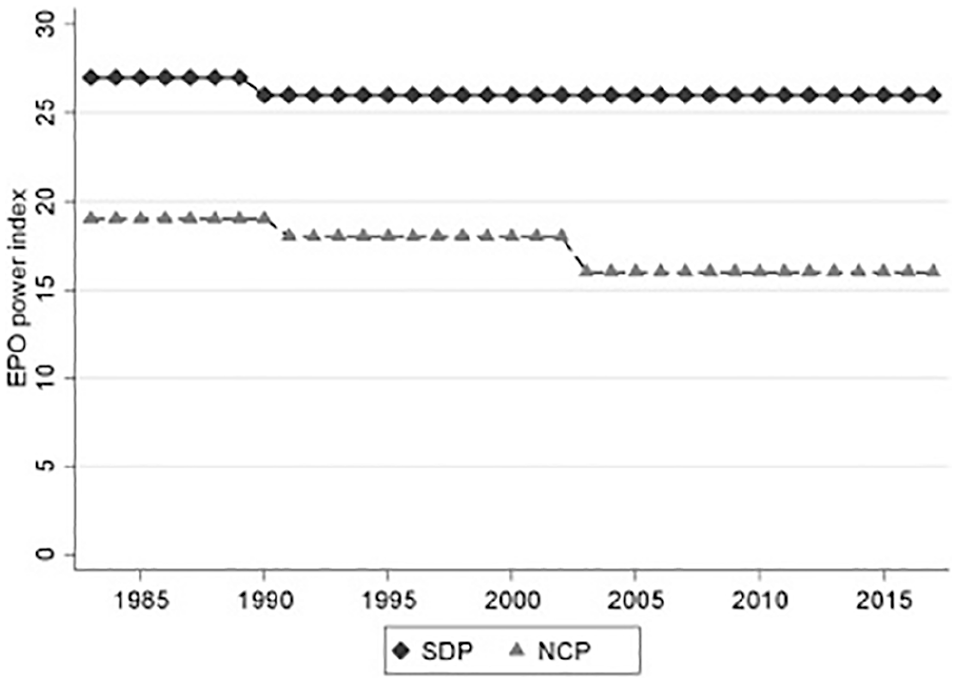
EPOs’ formal power over PPGs, 1983–2017.
They mainly relate to executive committees’ powers in government formation and the monitoring of the PPG. In all relevant decisions that relate to the process of government formation – on coalition’s composition and manifesto, and on ministerial nominations and portfolios – the SDP’s executive committee can still – and usually will – become the sole decision-maker (on the approval of the party council). In the NCP, the executive committee still has no formal role in the process. Similarly, all members of the SDP’s national executive committee can still freely attend the PPG’s meetings, while in NCP the ordinary members of the executive committee have never had this right.
A third source of significant differences concerns the policy link between the EPO and the PPG. It is also the power dimension where most changes have taken place. In SDP, the statutory formulations of the policy link have always echoed the mass party ideal: EPO organs craft policies and the PPG pursues them in parliament. Until 1990, the PPG even included a designated organ, the ‘initiative committee’, which supervised the proper functioning of the link. Its ejection from the statutes is the most significant change in SDP. In the early 1980s, at the apex of the mass party era, NCP’s statutory regulations on the policy link reminisced SDP’s rules, but with a more vague tone. In 1991, the PPG’s task to enhance the EPO’s political objectives was removed, and in 2003, all references to EPO’s programmatic goals were omitted from the statutes.
The continuing differences in these major intra-party prerogatives reflect the PCO’s different ‘genetic’ role in these parties. Statutory power is a significant power resource, because after it has been institutionalized, it is hard to re-distribute without the consent of the one who holds it. When formal statutes empower the PCO like in the SDP, they also provide an effective ‘insurance’ against the leadership’s reform initiatives. When the PCO is weaker, leaders can execute reforms more easily.
The second set of measures assesses MP representation in leading party organs, the party presidiums, and ministerial groups. According to the cartel party theory, the share of MPs should increase over time. However, as Borg (1982) has shown, MPs have always been well represented in Finnish parties’ leaderships. It is therefore not surprising that with one exception (SDP in 1992), a clear majority of presidium members (i.e. EPO and PPG chairs, deputy chairs and general secretaries, and the chairs of the party councils) have been MPs throughout the research period (Figure 2). The PPG leadership is naturally always composed of MPs, but the share of MPs in party presidiums is significantly higher because EPO leaders, too, are often MPs. The overtime average share of MPs is 73.5% in both parties. If PPGs’ general secretaries, who are salaried professionals and not elected in party organs (like the other presidium members), are excluded, the overtime averages rise to over 80%. Although the shares remain rather stable over time, a minor upward trend that is caused by increasing MP representation in EPOs’ deputy chair and party council chair positions exists. Party ‘genetics’ make no difference here.
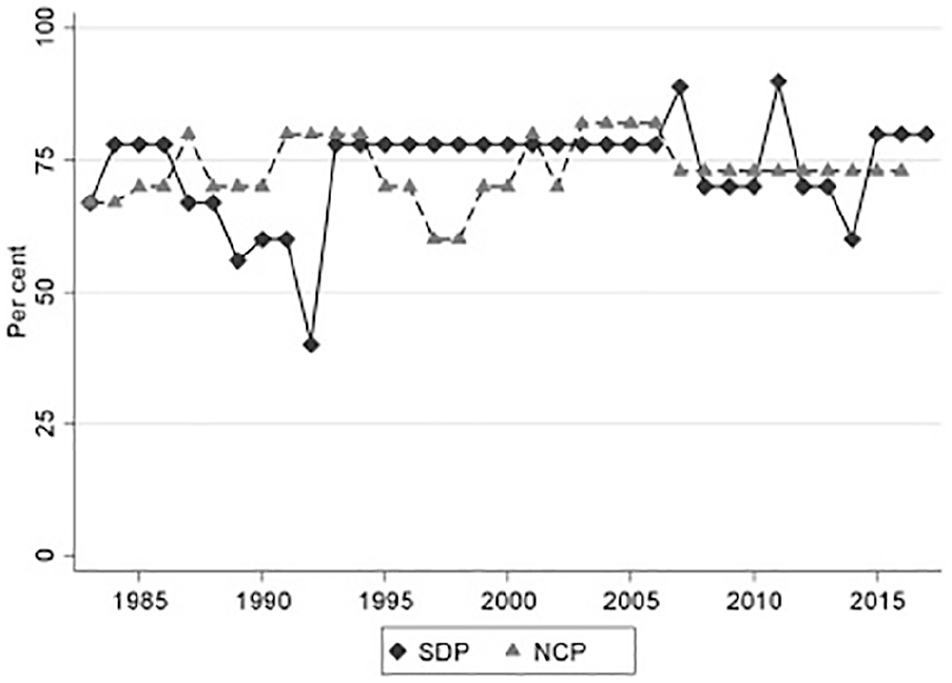
MP-based representatives in party presidiums, 1983–2017 (%).
A clearer trend exists in ministerial nominations that have landed on MPs. Prior to the 1970s, the nominations were characterized by the president’s strong influence, the fragmentation of the ministerial terms, and the commonness of non-political caretakers. MP position was not a ‘pivotal element in the ministerial path’: in 1917–1967, only 57% of nominees were MPs and around a third (31.3%) had zero parliamentary experience (Törnudd, 1975). In a president-dominated political system, government’s independent power was not substantial.
The parliamentarization of the constitution and the ‘governmentalization’ of political practice considerably increased the significance of ministerial groups (Paloheimo, 2005; Raunio and Wiberg, 2014). Almost coincidentally, MP-based nominations started to increase. Figure 3 presents the percentage of ministerial nominations per government, which landed on persons who acted as MPs. The figure represents well the development of both studied parties, as the SDP was included in 8 and the NCP in 9 of the 12 governments that operated between 1983 and 2017. Cabinet-based figures show that no significant differences exist between the parties. Party ‘genetics’ make no difference.
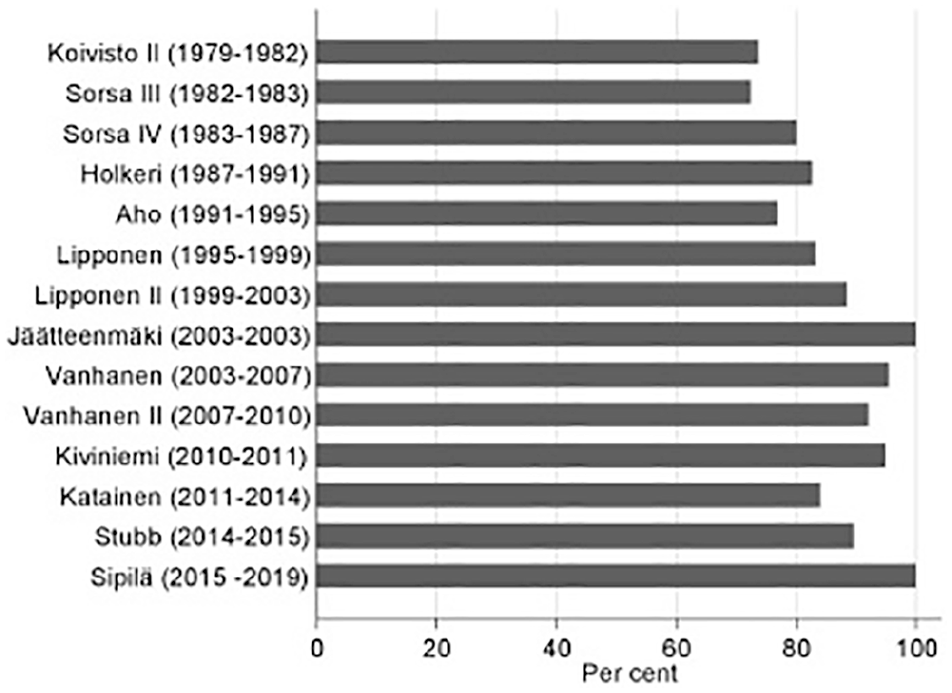
MP-based ministerial nominations per government, 1979–2017 (%).
In the 1970s, when the nominations were still strongly steered by the president, only 62% of nominations landed to MPs. Kalevi Sorsa’s IV cabinet (in office 6 May 1983 to 30 April 1987), the first in the ‘parliamentarized era’, raised MP representation significantly, up to 80%. Since the 1980s, the relative share of MP-based ministerial nominations per government has increased almost continuously. The minor decreases in the 2010s (Katainen, Stubb) result from mid-term changes in party leadership. In the 1990s, party leader’s ‘automatic’ cabinet position became the norm and sometimes the newly selected non-MP party chairs attained minister’s position. Overall, the ministers’ MP background has developed into a very strong norm in Finnish politics. Contrary to what the ‘genetic’ model expected, the SDP, too, has followed the trend at equal pace.
It should be noted, though, that ministerial nominations are not independent of other dimensions of intra-party power. Significant inter-party differences continue to exist in how the parties decide on ministerial nominations. In the SDP, the extra-parliamentary organs’ role continues to be crucial. Therefore, it could be argued that in SDP the increase in MP-based ministerial nominations has occurred because the party activists have allowed it to happen. Similarly, the EPO representatives of the party presidium (party chairs, the general secretary, and the council chair) are all directly selected in a major EPO organ, the party congress. Nevertheless, however, the observed trend clearly contours the expectations of the cartel model.
The third set of measures assesses the development of PCO’s and PPO’s finances and staff. The gross level of the EPOs’ party subsidy and the PPGs’ office subsidy has since 1967 been determined by MPs, and the subsidies have always been allocated according to parties’ electoral success. Since their inception, the subsidies have accounted for the vast majority of parties’ total incomes – on average nearly 80% in the PCO and almost 100% in the PPG. As no significant differences exist in the parties’ subsidy/total income ratios, the development of the subsidies reflects well the evolution of total resources of party ‘offices’ in both parties.
Figure 4 shows that the real value of the party subsidy has not changed much over time. While it freed the EPOs from seeking internal and external funding in the late 1960s, EPOs’ overall financial strength has not increased much. During the recessions of early 1990s and the turn of 2010s, major reductions were made to the subsidy.
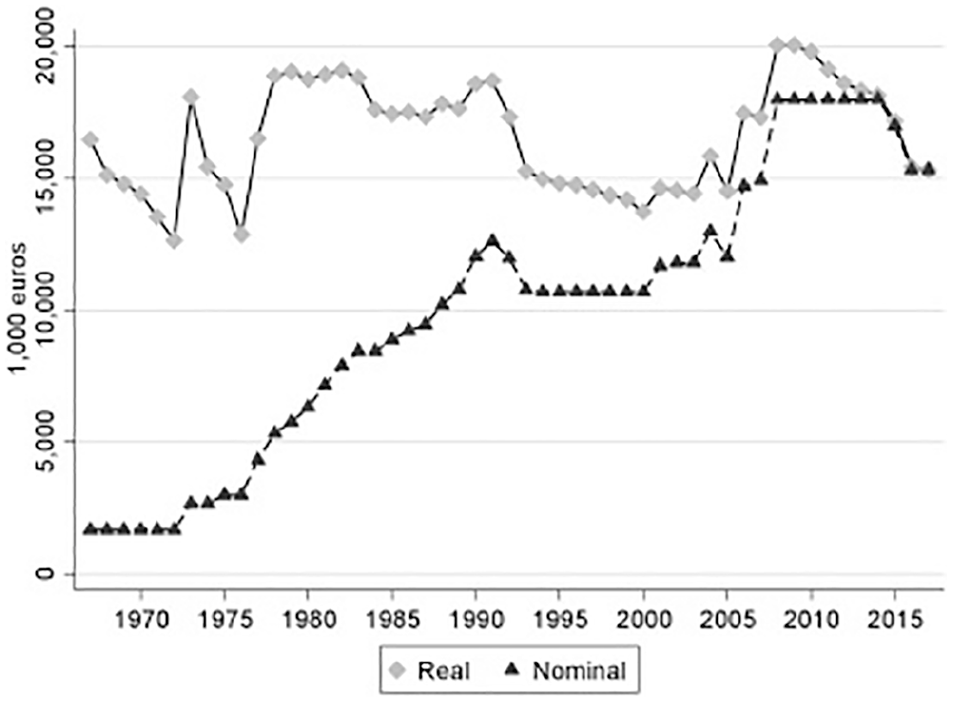
Party subsidy, 1967–2017.
A rather different development concerns the PPGs’ office subsidy (Figure 5). The first payment in 1967 was over 40 times smaller than the first party subsidy. The almost uninterrupted growth of five decades has increased its real value 10-fold. Today, it is only approximately four times smaller than the party subsidy. The PPO’s financial resources have clearly strengthened, while the PCO’s finances have stagnated, and the development relates directly to the actions of the majority of MPs. For example, during the great recession of the early 1990s, the Eduskunta, on the initiative of Esko Aho’s bourgeois coalition, cut party subsidy by 15% (in 1991–1995). Coincidentally, the office subsidy increased by 24%. The reform produced lasting effects on parties’ central and PPG offices.
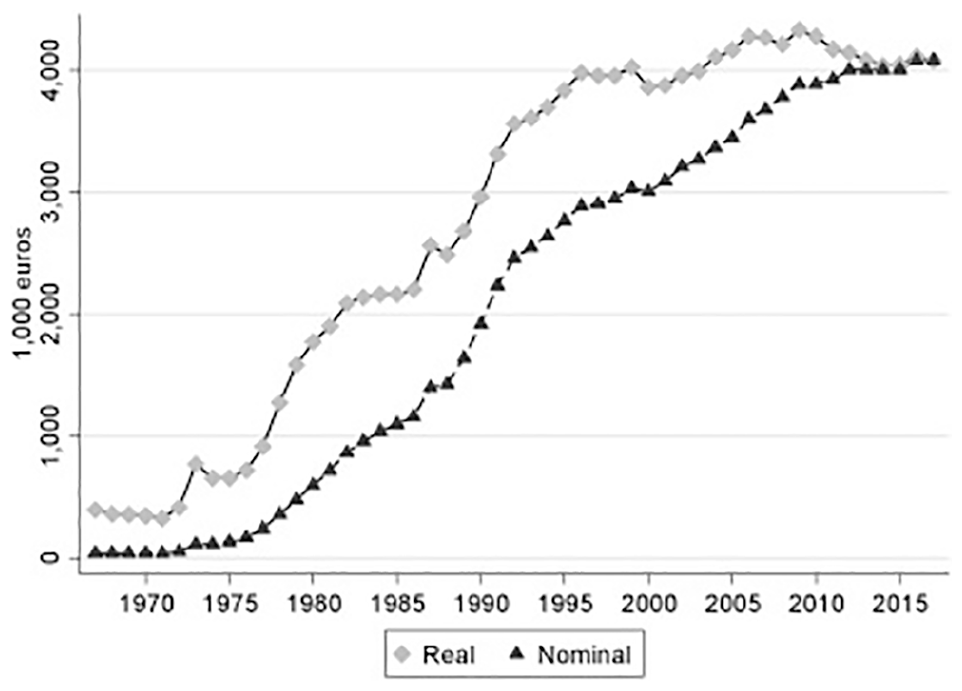
Office subsidy, 1967–2017.
Between the late 1960s and the late 1980s, Finnish parties’ central office staff increased 2.5-fold (Sundberg and Gylling, 1992). As Figure 6 indicates, since 1983 central party offices’ combined staff have undergone a 3.75-fold decrease. As was expected by the ‘genetic’ model, the SDP entered the research period with a considerably larger EPO office and the lay-off process was much slower compared to the NCP where central office staff decreased very rapidly after the aforementioned party subsidy cutback. However, despite party type–related differences in adaptation speed, in terms of staff the PCO has clearly weakened in both parties. When the party subsidy started to increase again at the turn of the millennium (Figure 4), central party office staff did not increase. Instead, parties’ electoral spending, which had slowly increased throughout the 1990s, especially in the NCP, leapt (Figure 7). The central party offices have become smaller and more ‘electoral-professional’ in both parties, but at varying speed. Overall, the change supports the cartel party thesis.
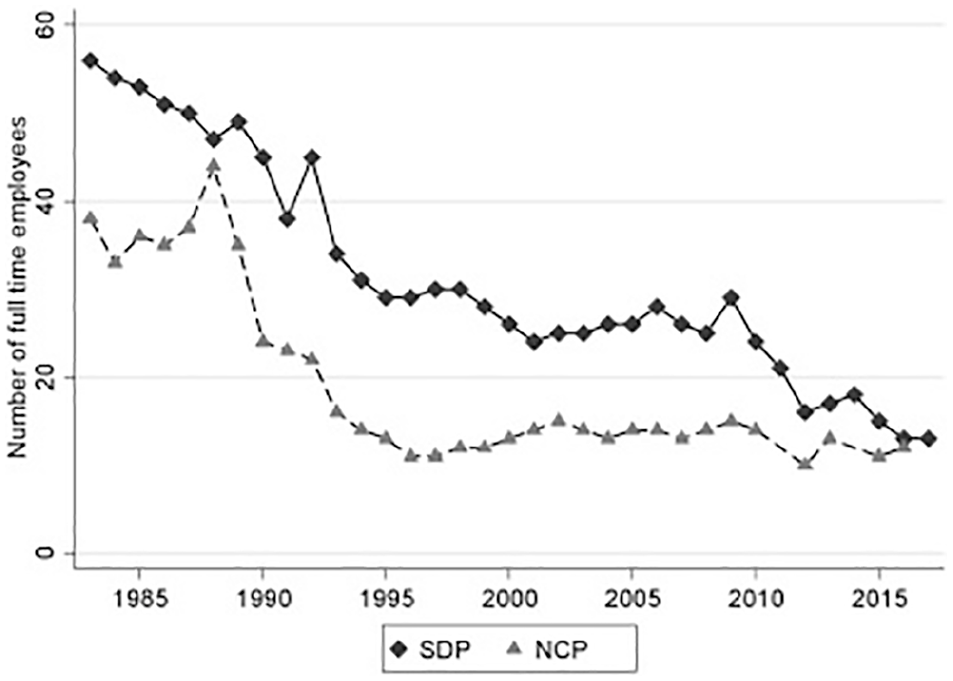
Full-time staff in parties’ central offices, 1983–2017.
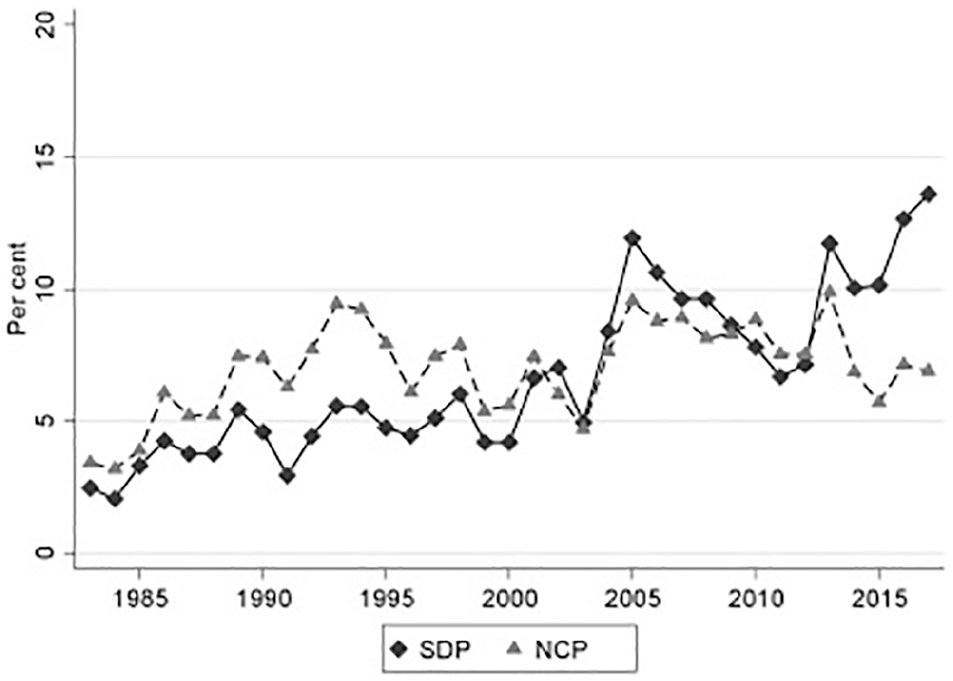
Central parties’ electoral spending (%/total expenditure), 1983–2017 (%).
Public subsidies also expanded PPG offices. In the early 1960s, they had no paid workforce at all – between the late 1960s and the late 1980s their staff increased threefold (Sundberg and Gylling, 1992). Along with the significant increase in the office subsidy, PPG offices continued to grow also in the 1990s, albeit rather slowly (Figure 8). In addition, since 1997 all MPs have received an allowance to hire a personal assistant. Overall, the resources of the PPO have increased considerably during recent decades, reflecting the predictions of the cartel model.
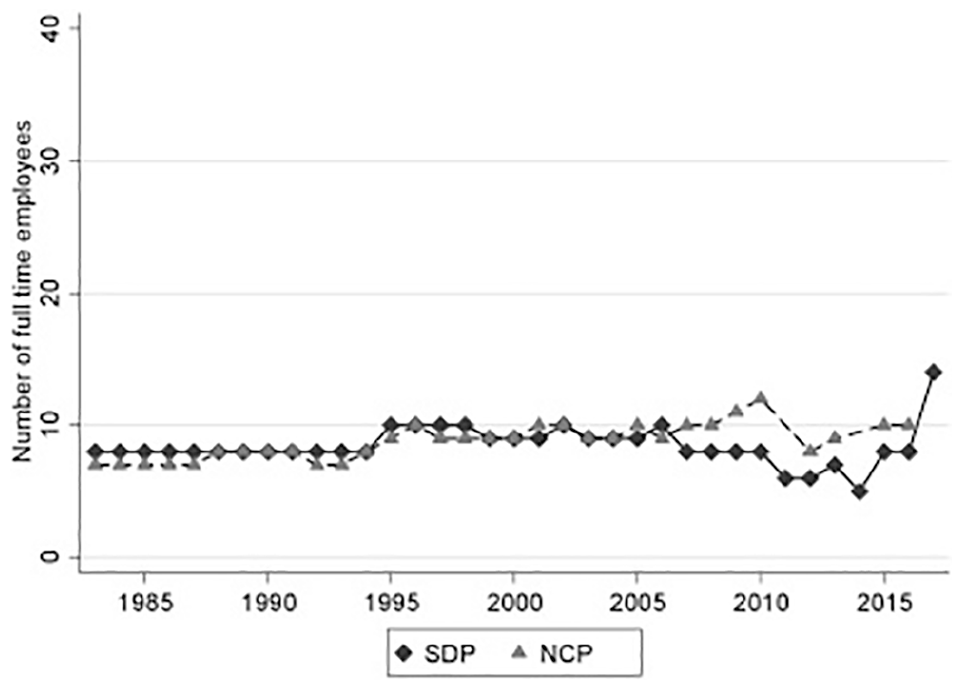
Full-time staff in PPG offices, 1983–2017.
Conclusion
Focusing on the development (1983–2017) of two major Finnish parties, this study examined whether parties’ ‘genetic’ heritage still condition the power balance between the party in central (PCO) and public office (PPO). Earlier longitudinal studies have mostly measured intra-party power balance through some specific power attribute (formal decision-making power, leadership positions, or resources). This has produced mixed results and uncertainty over the cartel party theory’s central claim that contemporary parties are dominated by the PPO (Katz and Mair, 2002). To provide a more robust test and a methodological benchmark for comparative studies, here the development of intra-party power balance was assessed with all the above-mentioned indicators.
Interestingly, this multi-indicator study, too, found a mixed development. As in earlier longitudinal studies (Gibson and Harmel, 1998; Pedersen, 2010), in Finland, too, the distribution of formal decision-making power varies significantly between ‘genetic’ party types and remains stable within the parties over time. The studied parties differed considerably before they encountered cartelizing pressures, and the pressures did not reduce the differences. Here, all ‘genetic’ hypotheses were confirmed: compared to the cadre party case (NCP), the mass party case (SDP) arrived to the research period in a power balance that clearly favoured the PCO (H1, H4), it adapted less (H2, H5), and it still appoints more power to its PCO (H3, H6). While this level of analysis cannot differentiate between specific ‘genetic’ factors (origin, institutionalization, primary goals), information on the parties’ heritages, combined with the findings, indicate a clear ‘genetic’ effect.
On the contrary, despite minor differences in the speed of change (which contour the parties’ ‘genetic’ differences), the development of the distribution of leadership positions and financial and staff resources clearly supports the cartel party thesis. In both parties, MPs have strengthened their hold of leadership positions and the PPO’s financial and staff resources have increased considerably, while the PCO’s financial resources have stagnated and staff resources have even decreased. Recent comparative studies have found similar developments (Bardi et al., 2017).
This study’s findings confirm the suspicions raised by earlier studies: the PCO/PPO resource distribution can change towards the cartel model, while the distribution of (formal) decision-making power remains stable. Therefore, the PPO’s ‘ascendancy’ can be much less comprehensive than the cartel thesis suggests – at least in parties where EPO organs have played a significant role. To confirm this tendency, wider comparative research is needed.
If statutory power matters, the PPO cannot ‘insulate’ from the PCO in parties where the PCO is powerful, as Koole (1996) and Kitschelt (2000) noted, because public officials remain tied to intra-party processes. As the PCOs typically control statutory regulations, the situation can change only if the PCO relegates itself, and this seems unlikely – and according to these empirical observations, rare too.
If statutory power is a primary power resource that can direct the use of other resources, changes in leadership nominations and the use of finances and staff can be said to happen on party activists’ approval. In the age of publicly funded parties, competent leaders and well-functioning party offices also serve the interests of the PCO. However, as the real effects of statutory powers remain controversial, more in-depth research in the vein of Loxbo (2013) and Gauja (2017) is needed to verify these linkages.
Supplemental Material
POL901422_appendix – Supplemental material for The ‘genetic’ effect: Can parties’ past organizational choices condition the development of their internal distribution of power in the cartel party era? Evidence from Finland, 1983–2017
Supplemental material, POL901422_appendix for The ‘genetic’ effect: Can parties’ past organizational choices condition the development of their internal distribution of power in the cartel party era? Evidence from Finland, 1983–2017 by Vesa Koskimaa in Politics
Footnotes
Acknowledgements
I thank the three anonymous reviewers for their insightful comments, which increased the quality of this paper.
Funding
The author(s) disclosed receipt of the following financial support for the research, authorship, and/or publication of this article: Academy of Finland, project number: 312676 and Academy of Finland project number: 316239.

Supplemental Information
Additional supplementary information may be found with the online version of this article.
Appendix 1: The coding of party statutes.
Author biography
References
Supplementary Material
Please find the following supplemental material available below.
For Open Access articles published under a Creative Commons License, all supplemental material carries the same license as the article it is associated with.
For non-Open Access articles published, all supplemental material carries a non-exclusive license, and permission requests for re-use of supplemental material or any part of supplemental material shall be sent directly to the copyright owner as specified in the copyright notice associated with the article.
