




Abstract
Past research has demonstrated lasting effects of important Supreme Court decisions on issue attention in the national media. In this light, the Court has served as an important agenda setter. We significantly expand on these findings by arguing that these salient Court decisions can raise the perceived importance of political issues and induce heightened, short-term policy attention in the broader political system. Using measures of media attention, congressional policy actions, and presidential policy actions, we utilize dynamic vector autoregressive modelling to examine the Court’s impact on issue attention in the macro policy system regarding tobacco and drug policy. Overall, this study suggests that the Supreme Court’s most important decisions might significantly affect broader issue attention in the American political system.
In this article, we argue that the US Supreme Court is an important agenda setter in the politics of two issues related to personal vices, tobacco and illegal drugs. By studying these two issues, our contribution heeds the call of institutional agenda-setting scholars to examine narrower policy areas as a means to flesh out the sometimes bewildering inter-connections on highly macro issues such as the economy (Delshad, 2012; Edwards and Wood, 1999; Eshbaugh-Soha and Peake, 2005). A key reason we choose to examine these vice issues of tobacco and the criminal prosecution of, or regulatory policy involving, illegal drugs is that the Court’s decisions related to these issues, often framed politically in terms of personal morality and the role of government, commonly dictate the boundaries of government regulation over individual discretion. Therefore, government action in these policy arenas can have an immediate and direct impact on the lives of ordinary citizens. Raising the federal minimum tax on cigarettes or classifying a drug as illegal is easily noticed by individuals, particularly compared to, for example, byzantine changes in trade policy. If citizens are more attuned to changes in regulation in vice policy, elected officials in Congress and the White House are likely to capitalize on the attention for personal electoral gain, and the media will be more likely to publish stories on the topic since it will draw public interest.
The results of our study of the US Supreme Court’s impact on the media and American elected officials, while an interesting case to study itself, also offers insight into what we might expect when analysing the national agendas of other nations with an unelected judiciary that exercises judicial review. Other nations that resemble the United States both by having a presidential or semi-presidential system of government and elected officials who respect the judicial review process include Costa Rica and France. Because of this close structural similarity, these two countries would be natural cases for further investigation of this kind of interbranch policy attention. While the interbranch interactions we discuss in our study are unique to a presidential system, even in parliamentary systems that respect judicial review, it is possible that parliaments would focus new attention on an issue after a major judicial review ruling. In any country with a respected constitutional court, an abrupt change in the constitutional interpretation of law could create a need for lawmaking. For this reason, it would be interesting to see whether national legislatures in Austria, the Czech Republic, Germany, Ireland, Italy, and the United Kingdom reacted to their constitutional courts’ rulings by refocusing attention in a policy area. All eight of the presidential and parliamentary democracies named here also have a free press, so it stands to reason that the news media in each of these countries could react to constitutional court rulings as well, generating the interactions between elected officials and the press that we report for the American case. Hence, the dynamics we consider can be of wide interest and potentially transfer to other democratic states with a free press and observed judicial review powers.
In this article, we proceed first by discussing our theory of how the US Supreme Court can affect the agenda of other policymakers and the news media. Second, we describe our data and the vector autoregression (VAR) models we estimate with them. Third, we describe our results for the tobacco policy system, and fourth, we describe our drug policy results. Finally, we discuss the implications of this for future policy studies.
Theory
The role that the Supreme Court can have in setting the policy agenda can be framed by punctuated equilibrium theory (Baumgartner and Jones, 1993). Generally speaking, policy change is gradual, with institutional friction making abrupt changes in policy a rare event. However, a punctuation in policymaking can occur when attention to the issue is at a heightened state. To this end, whenever the Supreme Court rules on a vice-related issue, it abruptly can change the degree to which government regulations affect individual discretion and thereby affect many Americans instantly. This can prompt the elected policymakers, Congress and the president, to react for a couple of reasons. First, a Court decision could disturb the policy equilibrium and produce new issues under the newly established case law. For these reasons, Congress and the president may be compelled to fill a policy vacuum in drug or tobacco policy by resolving these unanswered issues and determining what a new policy equilibrium should look like. Second, since vice issues like drugs and tobacco are readily significant to ordinary citizens, elected officials would like to publicly position themselves on these well-understood issues that directly affect many voters. In the event that the Supreme Court’s ruling has moved policy away from the public’s preferences, elected officials usually can nudge policy closer to the public’s preferences while staying within the boundaries set by the Court ruling.
This story of checks and balances of the judiciary by the legislative and executive branches can be illustrated with the case of tobacco. As Commissioner of the US Food and Drug Administration (FDA) from 1990 to 1997, David Kessler led the FDA to write new regulations to oversee tobacco. After slow development and extensive internal negotiations, the FDA developed a jurisdiction document that laid out the proposed tobacco regulations, which included advertising restrictions and were designed mainly to reduce the appeal and access of tobacco for children. After Kessler (2001: 303–333) and the FDA persuaded first Vice President Al Gore and then President Bill Clinton, the White House agreed to support the new regulations. Hence, a long stream of executive branch work culminated in regulations to prevent children’s tobacco use, a position popular even in tobacco-producing states (Fritschler and Rudder, 2007: 138–142).
When these regulations were legally challenged, the Supreme Court ruled 5–4 against the FDA in FDA v. Brown & Williamson Tobacco Corporation (2000), which was a devastating blow for major executive branch action on this issue. This decision prompted the executive and legislative branches to scramble to react and attempt to address the tobacco issue in this new context. After the Supreme Court killed the first set of regulations, the FDA turned instead to implementing an unfunded mandate. In particular, the agency wrote regulations that required states to achieve ‘access compliance rates by retailers’ to receive Substance Abuse and Mental Health Services Administration (SAMHSA) grants (Derthick, 2005: 161–162). In other words, states had to curb children’s access to cigarette purchases in stores in order to receive certain federal grants. Congress subsequently approved funding for this programme with the new mandate included. The Supreme Court may have wiped-out tobacco regulations, but Congress and the executive branch responded by moving policy closer to the publicly popular position of preventing minors from smoking.
An effect through the media
Past research shows that the news media are prone to cover an issue in response to a Supreme Court decision whenever the case changes political benefits for part of the population (Flemming et al., 1997, 1999; Ura, 2009). This suggests that vice issues are an area ripe for press reaction to Court rulings because any American could engage in a vice or could be subjected to a drug test, so the questions of individual liberty versus public morality are relevant for all. Whenever the Court rules on a vice-related issue, this balance of how much government may intervene in individuals’ private lives is affected, which means that political benefits for all individuals are called into question. Hence, reporters may easily be drawn to questions about regulating tobacco purchases or whether random drug tests are permissible when the nation’s highest court weighs in on these issues.
While a variety of studies have considered how US Supreme Court attention to an issue can generate media coverage of the issue (Flemming et al., 1997, 1999; Haider-Markel et al., 2006; Ura, 2009), this work can be expanded to consider how this Court–media relationship can affect issue attention in the macro political system across all branches of government. Gaining a thorough understanding of this Supreme Court–media nexus, including its potential impact on policy attention by the elected branches, takes on greater importance given the relative prominence of the Court as a vital policymaker and the news media as the predominant source of political information for citizens in the modern political system. We contend the Court’s decisions can exhibit a broader impact on issue attention in the macro political system – that particular cases can raise the perceived importance of political issues and induce heightened, short-term policy attention in the political system. This emerges both through the direct check-and-balance effect described before and through an indirect effect in which the media are intermediaries. That is, the Court’s most prominent decisions might influence the media agenda, which in turn can lead the elected branches to devote more policy attention to these issues (at least in the short run).
Existing research has illustrated how heightened media attention can influence citizen perceptions of which regulatory issues are most important in American politics at a particular point in time (e.g. Cook et al., 1983; Gonzenbach, 1996; Iyengar and Kinder, 1987; McCombs and Estrada, 1997; MacKuen and Coombs, 1981). When the media pay particular attention to certain policies and issues, the public tends to perceive those issues as politically important and deserving of further attention by leaders and elected officials. The elected branches might seek to capitalize on short-term changes in the perceived importance of such issues following the Court’s decisions, as the greater public awareness catalyzed by increased media attention should present an opportunity to better appeal to constituents and the general public (e.g. Edwards and Wood, 1999; Eshbaugh-Soha, 2005; Peake and Eshbaugh-Soha, 2008). This short-term policy responsiveness might enable the president and Congress to better appeal to the public for their own political and electoral benefit because of the heightened salience. Thus, when viewing the relationship at the macro level, important Supreme Court decisions might intervene into the broader political system to the extent that issue attention by both the news media and the elected branches of government might respond to the heightened (perceived) importance of the policy issues in those Court decisions.
Reciprocity among actors and total effects
Putting the direct and indirect components of our theory together, we argue that the Court’s ability to influence the media issue agenda might have a larger impact among the separation of powers in the American political system. Once the Supreme Court intervenes into the system with landmark decisions, the media, Congress, and the president may endogenously affect one another. In the extensive ‘who influences whom?’ literature, the dynamics of media, congressional, and presidential policy agenda-setting is deep and varied. The media, Congress and the president have all demonstrated the ability to influence each other’s actions and activities, dependent on factors such as presidential and congressional approval, whether the general policy domain is foreign or domestic, and specific issue areas such as economic, defence, or environmental policy (Baumgartner and Jones, 2009; Bond et al., 2003; Dearing and Rogers, 1996; Delshad, 2012; Edwards and Wood, 1999; Eshbaugh-Soha and Peake, 2005; Lovett et al., 2015; Rutledge and Larsen Price, 2014; Wolfe et al., 2013).
Scholars have long noted that the president is the single most influential actor in the American political system (Baumgartner and Jones, 2009; Jones and Baumgartner, 2005; Kingdon, 1997; Neustadt, 1990). Yet, studies have shown that the president’s influence on Congress is conditioned by the nature of the policy, approval ratings, and congressional party control (Canes-Wrone and De Marchi, 2002; Eshbaugh-Soha, 2005; Lovett et al., 2015). For example, Lovett et al. (2015) demonstrate that popular presidents can influence congressional policy attention though the influence is diminished during divided government. The success of presidential agenda-setting on Congress in domestic policy has been shown to widely vary by issue (Baumgartner et al., 2008; Delshad, 2012; Eshbaugh-Soha and Peake, 2005). On foreign policy, even though the president is Commander-in-Chief, presidents have demonstrated little influence on congressional actions and in fact have been shown to be particularly responsive to media attention (Edwards and Wood, 1999; Peake, 2001; though see Rutledge and Larsen Price, 2014).
Although the president has the bully pulpit, Congress is where policy initiatives become actual law. As the president’s ability to influence the congressional agenda is conditional, research also shows Congress rarely has a uni-directional influence on the president (Delshad, 2012; Flemming et al., 1999; Peake, 2001). Most research shows that Congress has no apparent effect on the president (Rutledge and Larsen Price, 2014) or that Congress and the president act as co-agenda setters where reciprocal relationships emerge (Edwards and Wood, 1999; Peake, 2001).
Intertwined with presidential and congressional agenda-setting is the role of the media. In the newsmaking process, the media often have a symbiotic relationship with Congress and the President (Cook, 1998; Denham, 2010; Jones, 2010). The media rely on the government for information, while the government relies on the media to communicate to the public and to other parts of the government. In institutional agenda-setting research, the media have been shown to set the agenda on certain policies (Edwards and Wood, 1999; Peake and Eshbaugh-Soha, 2008) and to follow Congress and the president at other times and with other policies (Jones and Baumgartner, 2005; Wolfe et al., 2013). Although the empirical evidence of the media’s agenda-setting ability is mixed, it is clear that the media play a central role in the complex American agenda-setting system (Wolfe et al., 2013).
In short, we argue that due to the importance of the Court’s decisions (and the broader institution itself) in the policy process, the media issue agenda will often respond in the short run to the issues considered by the Court, and elected officials may want to balance the Supreme Court by finding a new policy equilibrium. Furthermore, once Congress, the president, or the press react, we expect to observe endogenous agenda-setting effects where the news media, Congress, and the president are influencing each other’s actions. Our subsequent analyses test this argument, as we examine how these landmark Supreme Court decisions on illegal drugs and tobacco might have an extensive impact on issue attention in the political system.
The counterarguments
Our theory does contrast somewhat from two other important lines of work. The primary counterargument to our theory is stated well by Rosenberg (2008), who argues that the Supreme Court is largely constrained and cannot create substantial social change on its own. On several issues, Rosenberg finds that landmark Supreme Court cases were not driving forces for other actors in the policy system, be they elected officials or members of the mass public. During the Civil Rights Movement, for example, his study finds that there is no evidence that the Court served to ‘give the issue salience, press political elites to act’, generate widespread public support, or create new press coverage (Rosenberg, 2008: 156). On abortion and women’s rights, he finds no evidence of increased media coverage, salience, changes in public support or new support from elected officials in response to Court actions (Rosenberg, 2008: 245–246). In contrast to this argument, we argue that vice issues will behave differently and should be more prone to react to landmark decisions. This is because, unlike issues that directly relate to identity politics, vice issues relate to individual choices (of which many disapprove), and the degree to which government ought to regulate personal behaviour fits within the judicial branch’s purview of setting boundaries of civil liberties. Since the issue naturally fits in the Supreme Court’s jurisdiction, and since government regulation of personal choices affects all citizens, the Court is more likely to be a leader in vice politics.
Our theory also describes the Supreme Court as a first mover to which other branches of government and the news media respond. By contrast, several argue that judicial action is largely endogenous to the rest of the policymaking system. Caldeira and Wright (1988) show that the Supreme Court is more likely to grant a writ of certiorari when organized interests submit amicus curiae briefs either in favour of or opposing certiorari. Yates et al. (2005) show that the percentage of the Supreme Court’s decisions in a year that relate to criminal justice policy are positively associated with how much attention the president gives to criminal justice in the State of the Union address and the proportion of congressional hearings dedicated to the issue. However, in a complex argument that the high court drives its own choices, Baird makes a two-pronged observation on the Court’s agenda (Baird, 2007; Baird and Jacobi, 2009): the Supreme Court depends on litigants’ raising an issue to be able to weigh in on a policy area. However, evidence suggests that Supreme Court justices signal what kinds of cases they would be interested in taking-up in order to prompt like-minded policy entrepreneurs and litigants to bring a lawsuit that can be appealed up to the high court.
Again, we believe that our issue area – vice politics – is important to why the Court can be treated as a first mover. First, constitutional civil liberties provisions such as freedom of expression and freedom from unreasonable search and seizure put questions of personal vices more squarely in the constitutional court’s domain. Hence, it is more reasonable to think that the Supreme Court can find cases to make its mark before others weigh in. Second, Supreme Court rulings on vice are particularly rare. From 1981 to 2009, the Supreme Court ruled only 5 times on tobacco and 36 times on drugs, out of 3444 total cases. As a rarely occurring event, it is more likely that a new Court case on the issue will affect other actors in the system than emerge as a result of other actors’ behaviour. We now proceed to test our theory, which implies that the Supreme Court is an important catalyst on drug and tobacco policymaking, and the other actors in the system will affect each other.
Data
To test the exogenous and endogenous relationships between the three national institutions, the national media, and public opinion on illegal drug and tobacco issues, we have gathered an original dataset on related actions by the three branches of government and the media. Our three endogenous variables are congressional actions, presidential actions, and media coverage of the issue. We measure all of these variables and indicators for Supreme Court decisions by month because news coverage changes rapidly. This means that we need a close look at how issue attention by these actors changes in short order after a Supreme Court ruling. First, we measure media coverage as the count of the number of stories in the New York Times related to these topics by conducting a LexisNexis search by month. We employed a general search term using simply the issue name (‘tobacco’ and ‘drugs’), and our data include coverage from all news sections and departments of the Times. This data collection strategy has the advantage of capturing the general array of New York Times coverage related to these two social regulatory issues. 1 In total, the analysis includes 25,413 articles on tobacco and 37,453 articles on drugs.
We measure congressional action as the sum of the number of bills introduced, hearings held, and laws enacted in a given month on tobacco or illegal drugs, respectively. Congressional information is gathered using data from the Policy Agendas Project. We measure presidential action as the sum of the number of press conferences, executive orders, radio address mentions and national television address mentions in a given month on tobacco or drugs. These data are from the American Presidency Project at the University of California, Santa Barbara. 2 We note that this means that both direct actions (such as laws and executive orders) and intermediate attention (such as bill introductions, hearings and speeches) are treated as activity for both Congress and the president.
Figure 1 shows the total number of actions taken by Congress and the president from 1981 to 2010 on several different vice-related social policy issues. 3 As can be seen, drug policy far and away received the most attention from either branch of government. Tobacco was the second most-addressed issue. Alcohol, gambling and pornography each received some attention, in diminishing order. We also report the level of attention given by these branches to the specific drugs of cocaine and marijuana. Interestingly, these separate drugs alone received more presidential attention than either gambling or pornography, which further illustrates just how much more attention drug policy receives relative to other social policy issues. Hence, part of the reason we focus on tobacco and drugs in this analysis is because these issues clearly have been the most important to elected officials over three decades.
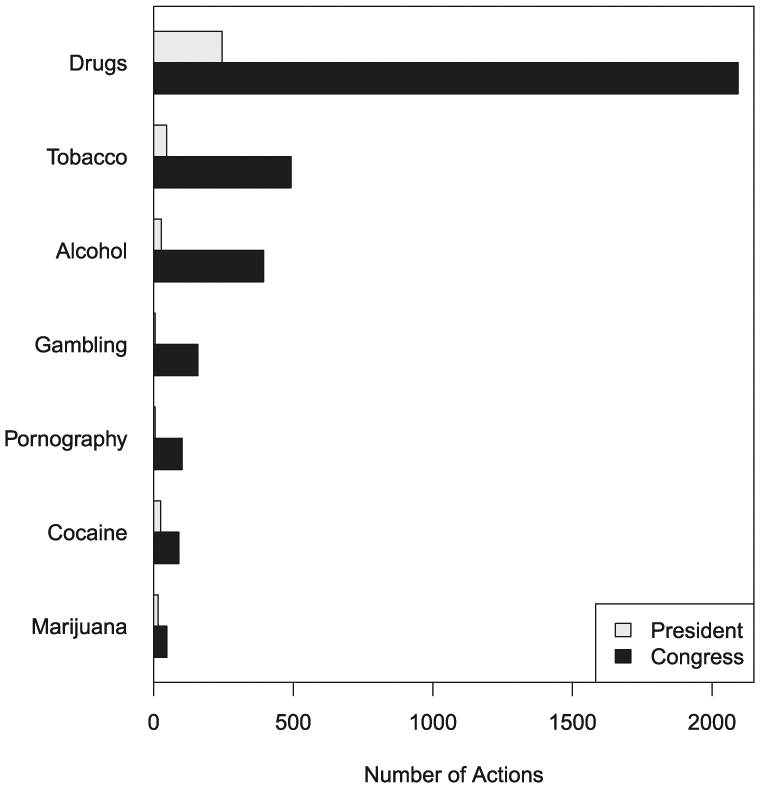
Total number of actions taken regarding seven vice issues from 1981 to 2010 by Congress and the president.
Turning to our exogenous variables, our primary hypothesis is that a major Supreme Court ruling related to tobacco or drugs will serve as an important treatment in the policy system, leading to increased news coverage, congressional attention and presidential attention. We treat Supreme Court cases as exogenous predictors because cases related to vice issues are rare events: substantively, this means that a rarely occurring event is an unusual disturbance in the policymaking system that really ought to be treated as an intervention that affects other political actors. Methodologically, a rarely occurring event is difficult to treat as endogenous because there is little variance to model. 4 We identify significant, landmark Supreme Court cases related to these social issues using Congressional Quarterly’s Guide to the U.S. Supreme Court (Savage, 2010). 5 Specifically, we included all cases where the prosecution or regulation of activity on the issues of tobacco or illegal drugs was a central component of the case dispute. 6 The CQ Guide offers a reputable resource that scholars have commonly used to identify the most legally and politically salient decisions by the Supreme Court. It is also the indicator employed by most previous studies of the Supreme Court’s impact on media issue attention (e.g. Ura, 2009). Following the logic of an interrupted time series design, we create a pulse indicator variable for each case, coded 1 in the month the case was decided and 0 in all other months. Finally, we control for public opinion by including Stimson’s Mood index of operational liberalism as a predictor. 7 It reflects the public’s aggregate liberalism, conceived as demand for ‘more’ or ‘less’ government intervention in the economy and social welfare.
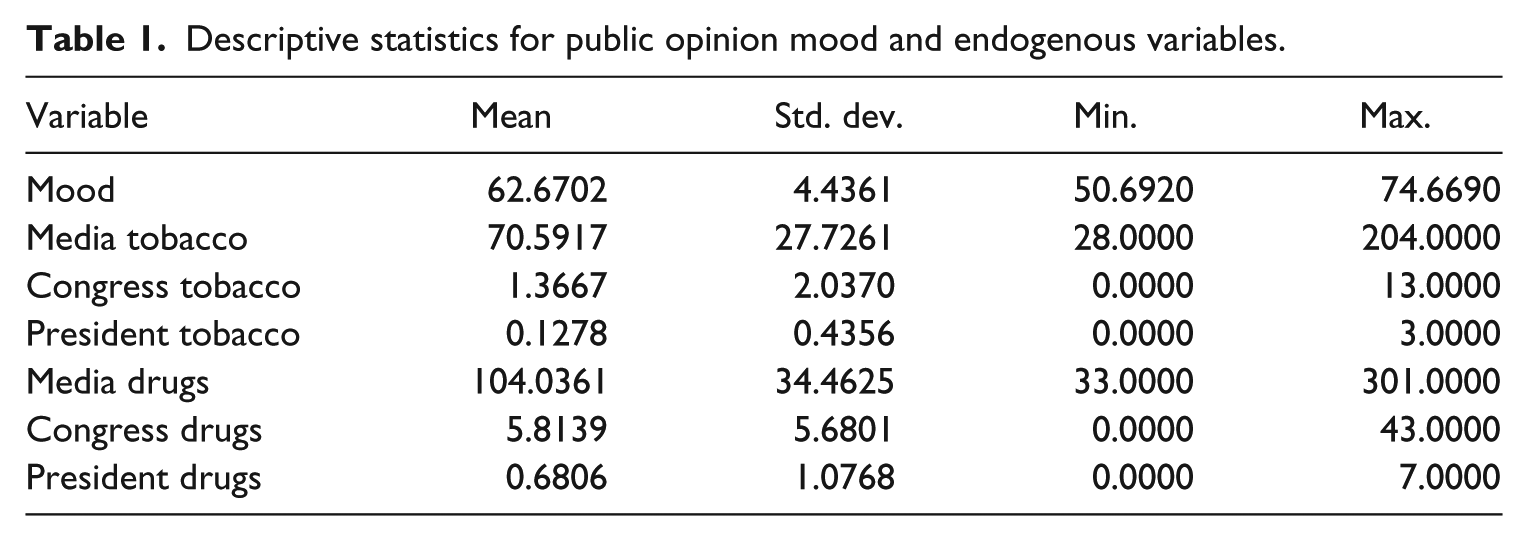
Table 1 shows the descriptive statistics, by month, for all of our continuous variables. Both drugs and tobacco receive at least some press coverage each month, as every time series has a nonzero minimum value. By contrast, there are many months in which neither Congress nor the president addresses a topic at all. Again, for all three endogenous variables – media coverage, congressional attention and presidential attention – attention to drugs has a noticeably higher mean level than attention to tobacco.
Descriptive statistics for public opinion mood and endogenous variables.
Methodology: Vector autoregression
To test our hypotheses, we specify a VAR model in which, for a given issue, the number of presidential actions, the number of congressional actions, and the number of New York Times stories for a given month are treated as endogenous variables. In other words, we model each of these variables as a function of their previous values and as a function of the other two variables’ previous values. The advantage of a VAR model is that it recognizes that many variables in a political system have the potential to be reciprocally endogenous. By estimating a system in which endogenous variables in lagged form can predict themselves and each other, a researcher subjects any test of a causal relationship to particularly high scrutiny that not only accounts for temporal patterns in each outcome but also partials-out the potential effects of all other endogenous variables in the system. In this way, VAR models take advantage of time dependence to remove all other possible explanations of a result in a way that few models can. We include 12 lags of each of congressional attention, presidential attention and media attention to allow for seasonal patterns of attention in the months of a year.
A real strength of our method is that we have the potential to show, for example, whether media attention affects presidential attention, and whether presidential attention affects media attention. In most cases, we find reciprocal causation among variables showing the need to use this kind of method. It is important to consider that media, congressional and presidential attention are all a function of each other because that means if a Supreme Court case affects one of these three variables directly, then it affects the other two indirectly. In other words, part of a variable’s effect emerges on account of feedback among the three outcome variables (Brandt and Williams, 2007: 45). For example, in our model of drug policymaking, the case of Employment Division v. Smith (1990) had a direct impact on congressional attention. In the drug model, congressional action affected attention by the president and the media. That means that future values of presidential and media attention (say in the months of May and June 1990) will respond to an increase in congressional attention in April 1990 (when the case was decided) because that month’s value of congressional attention is a predictor of these other variables. Therefore, there are many direct and indirect effects of Supreme Court cases in this model. A more formal specification of the model, as well as some of the math behind how an effect shows issue inertia over time, is presented in the online appendix.
Tobacco
First, we consider the system model of the tobacco issue. Table 2 presents the results of Granger causality tests. Here, and in Table 4, cell entries are F-ratios, with an asterisk indicating a significant result at the 90% confidence level. As the tests show, press coverage of tobacco policy is autoregressive: mathematically, for a series to be autoregressive means that the current month’s values of press coverage are similar to the past month’s values and seasonal patterns; substantively, this means that there is issue inertia in which the press’ attention to the issue depends on how much it has been focusing on the issue lately and how often it focuses on the issue seasonally. Media attention also significantly predicts future presidential attention to the issue. Congressional action also shows issue inertia with past tobacco attention affecting current attention, and Congress’ behaviour also shapes presidential attention. Finally, presidential action is autoregressive (indicating that presidential attention to tobacco shows inertia), shapes congressional action, and shapes press coverage of the issue. Hence, there are endogenous, or reciprocal, relationships among these variables such that they influence each other in a larger system. 8
Granger tests of causal effects for each endogenous variable on each other in system model of tobacco, 1981–2010.
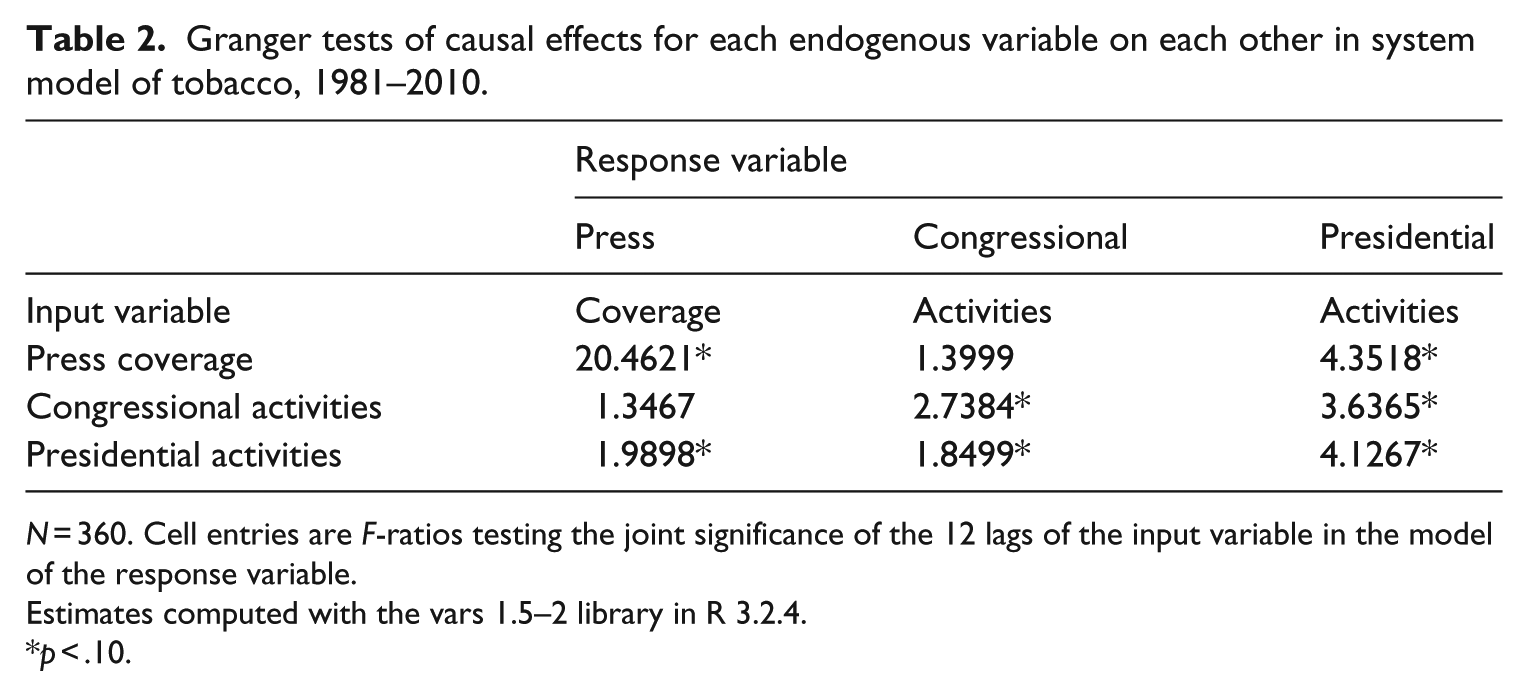
N = 360. Cell entries are F-ratios testing the joint significance of the 12 lags of the input variable in the model of the response variable.
Estimates computed with the vars 1.5–2 library in R 3.2.4.
p < .10.
Meanwhile, there were two landmark Supreme Court cases on tobacco during this time frame, and we can see that the Court directly pushed the three actors in the system to pay attention to the tobacco issue following one of them. Table 3 reports the coefficients from the equation of each of the endogenous variables for these two Supreme Court cases. Here and in Table 5, coefficients that are significant at the 90% confidence level are marked with an asterisk. The case of Lorillard v. Reilly (2001) does not have a discernible impact on any of the response variables, nor did public opinion Mood. However, the case of FDA v. Brown & Williamson Tobacco (2000) had a positive and significant effect on the outcomes of press coverage, congressional action and presidential action. Specifically, in the month of the Brown & Williamson case, the number of newspaper stories about tobacco increased by an expected 39 stories in response to the case alone, holding all other variables in the system constant. Congress took nearly an expected four more actions on tobacco policy in response to the case. Finally, we project that President Clinton took an expected two additional actions related to tobacco policy in response to this case.
Effect of exogenous variables in system model of tobacco policymaking.
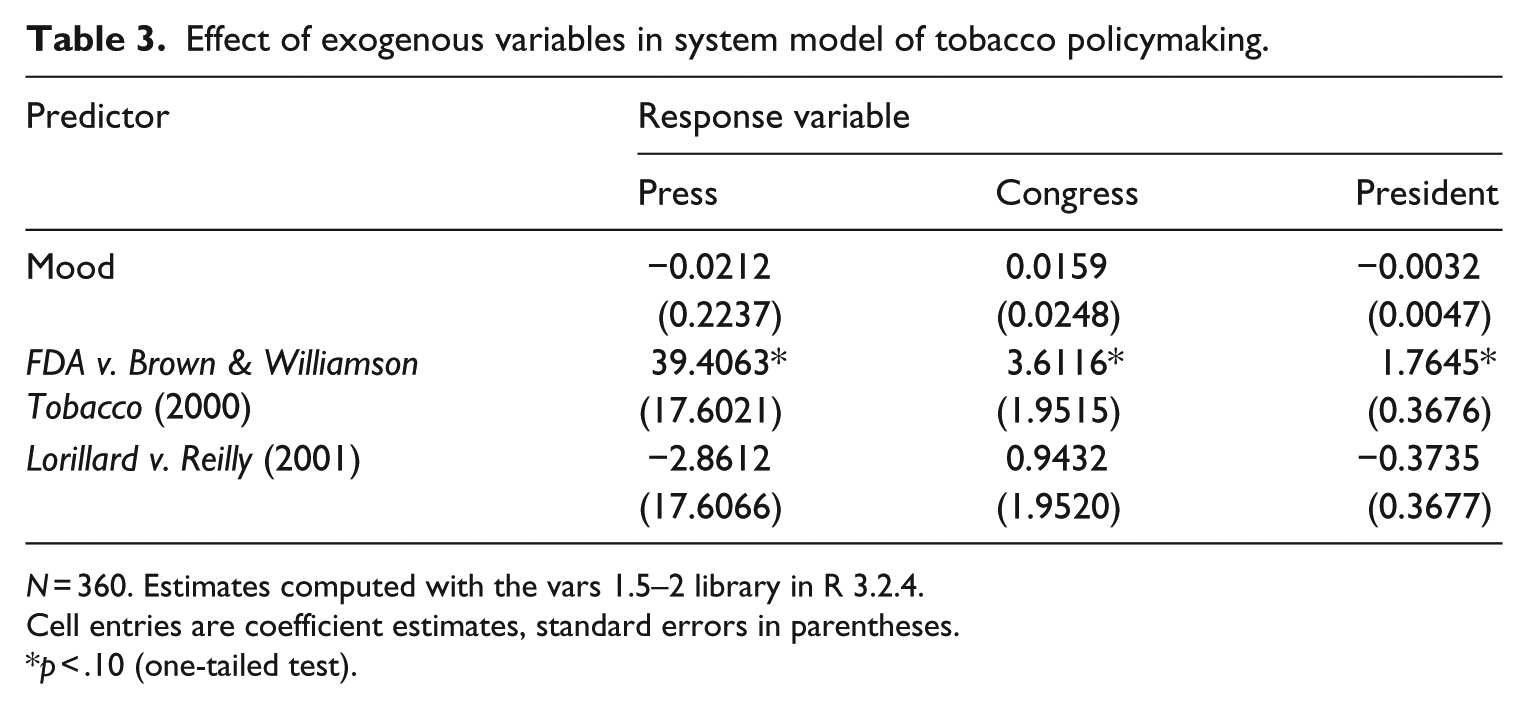
N = 360. Estimates computed with the vars 1.5–2 library in R 3.2.4.
Cell entries are coefficient estimates, standard errors in parentheses.
p < .10 (one-tailed test).
Beyond the events that happened in the month of March 2000, since a VAR produces a dynamic system, it is important to consider how the impact of the case unfolded over time. Figure 2 shows forecasted values of New York Times coverage of tobacco, congressional action on tobacco, and presidential action on tobacco. These forecasts rely on the values of the variables in the month before the case occurred, and then introduce the intervention of the case of FDA v. Brown & Williamson Tobacco to show how the forecasts respond to the case. The horizontal axis illustrates time from January to December 2000, again with March being the month of the case. Meanwhile, the vertical axis represents the predicted value of each of the three response variables in turn.
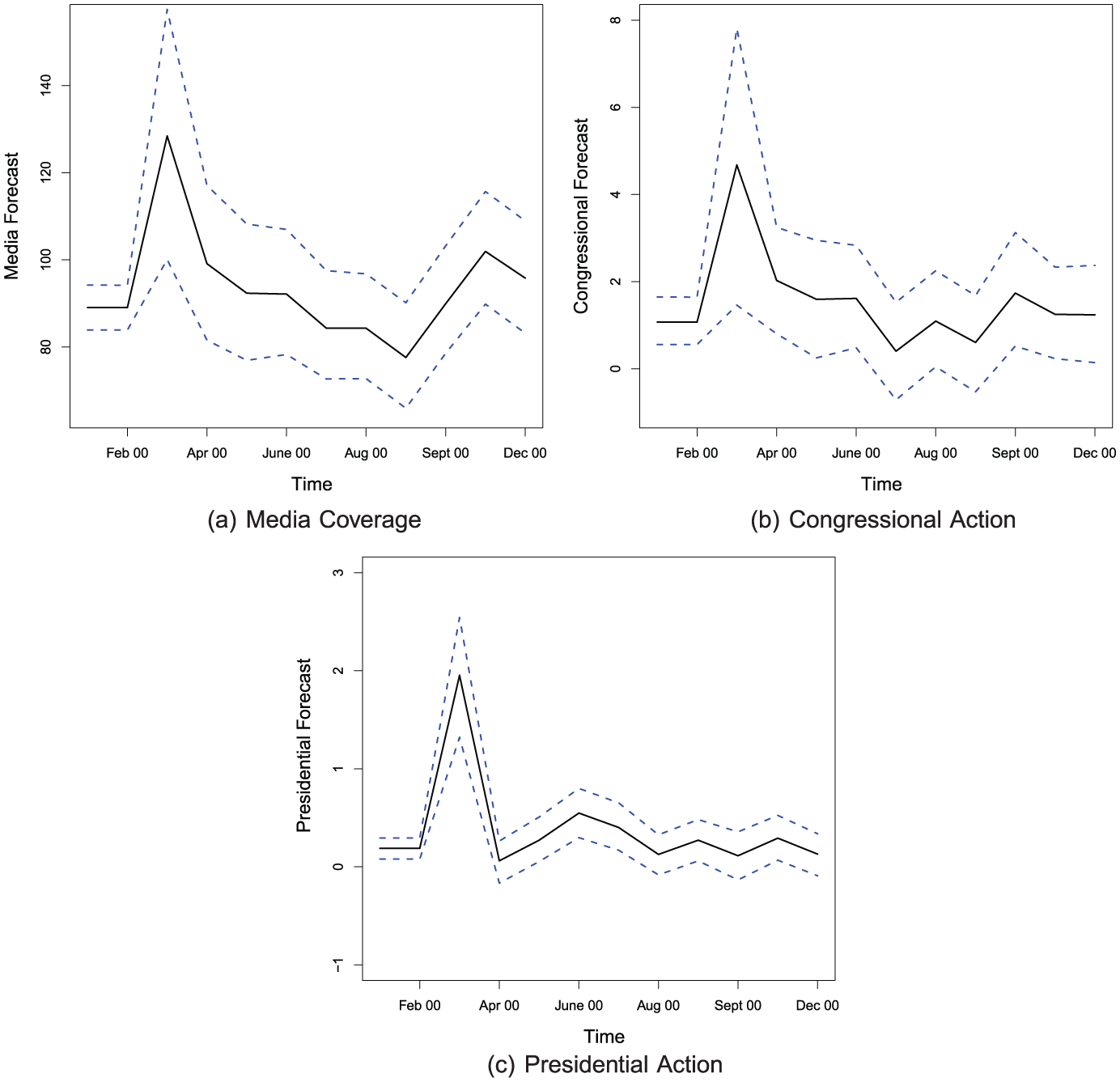
Predicted response of three endogenous variables for the decision of FDA v. Brown & Williamson Tobacco Corp. (March 2000) with 90% confidence intervals. Forecasts are computed using values at the end of the endogenous series.
As Figure 2 shows, all three variables did increase substantially during March 2000 when the case was decided. President Clinton’s attention to the issue is expected to have dropped immediately back to its prior level in April. For media attention and congressional action, however, the effect was a bit slower to decay, taking several months to get back to its prior level. This pattern in the functional form arises because each endogenous variable has an autoregressive functional form (meaning future values are affected by past values) and prior values of each variable also shape the other two. Hence, issue inertia is caused both by each actor’s own tendency to keep attention in the same place and the respective actors’ responses to each other. All of this means that effects can persist for some time into the future. In sum, then, Congress, the president and the media all pay attention to each other’s actions, and a major Supreme Court decision can serve as a treatment that affects the entire system.
Drugs
Second, we consider our system model of illegal drug policy, the most-addressed vice-related issue of the three-decade span from 1981 to 2010. Table 4 shows the Granger causality tests among press coverage, congressional attention and presidential attention to drug-related issues. The system of these three variables is completely endogenous: all three variables are autoregressive, and each variable significantly influences the other two. Therefore, there is issue inertia by each actor, with levels of drug attention in a given month being similar to past months’ attention and expected attention given seasonality within a year. Furthermore, the fact that each actor affects the other two implies, for example, that if the New York Times starts covering drugs more, the two elected branches of government are expected to respond. If either elected branch of government directs more action towards the issue of drugs, the other elected branch and the press are expected to react.
Granger tests of causal effects for each endogenous variable on each other in system model of drugs, 1981–2010.
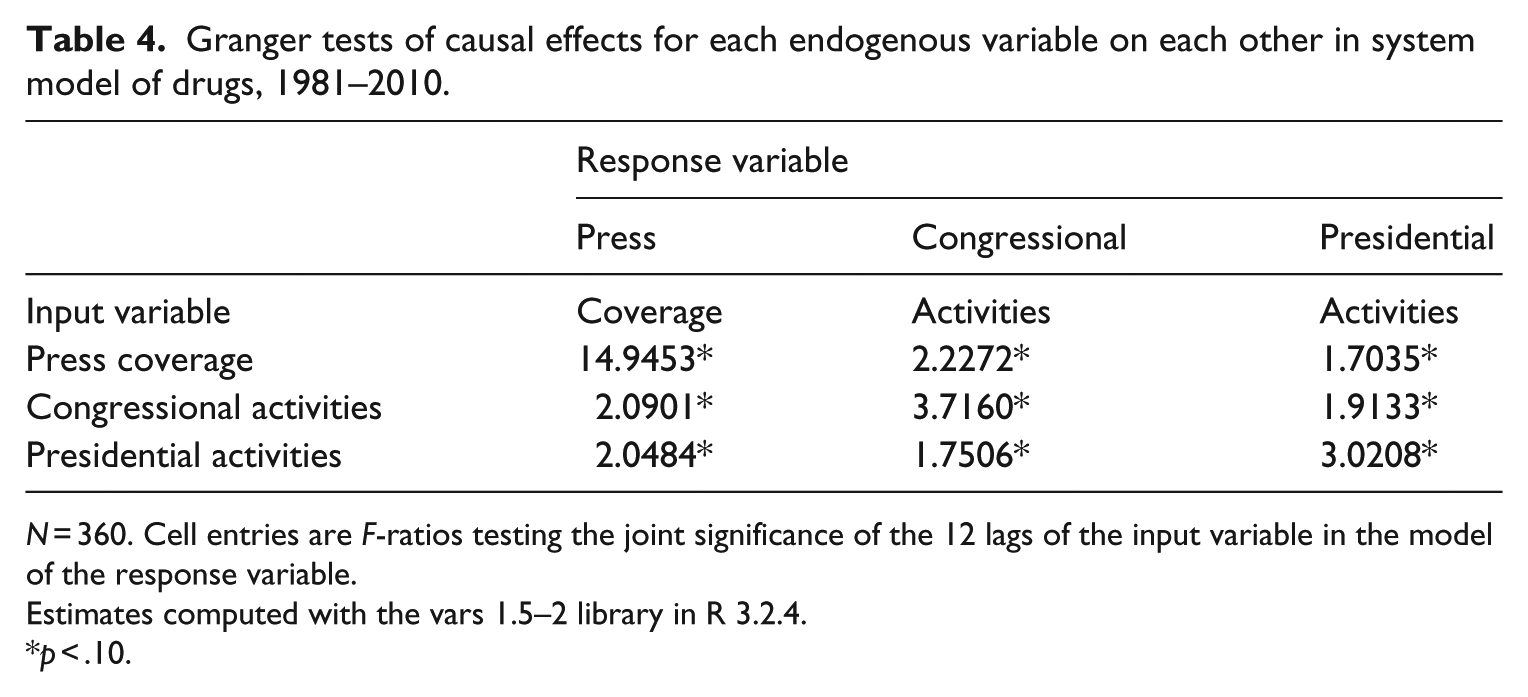
N = 360. Cell entries are F-ratios testing the joint significance of the 12 lags of the input variable in the model of the response variable.
Estimates computed with the vars 1.5–2 library in R 3.2.4.
p < .10.
To what degree do Supreme Court cases shape attention to drugs by the press, Congress, and the president? There were 15 landmark Supreme Court cases related to drugs in this time frame, and Table 5 shows the impact that these cases had exogenously on each actor. Importantly, because the system is endogenous, if a Court case affects even one of the three actors, there will be spillover onto the other two actors’ attention on the issue. Again, this is because each actor’s behaviour is significantly predicted by past values of the other two actors’ behaviour, according to the Granger causality tests. Therefore, if one actor’s attention rises in a given month, in future months that higher value will predict the other two actors’ level of attention, causing a second wave of influence. As can be seen, National Treasury Employees’ Union v. Von Raab (1989) drew immediate attention from the press and President George HW Bush on the drug issue, Employment Division v. Smith (1990) drew a response from Congress, Vernonia School District v. Acton (1995) drew attention from President Bill Clinton, Board of Education v. Earls (2002) drew attention from President George W Bush, and Georgia v. Randolph (2006) led to more press coverage of drugs and attention from George W Bush. These are the direct effects of these cases, but on account of lags there are indirect effects on all three actors in response over time.
Effect of exogenous variables in system model of drug policymaking.
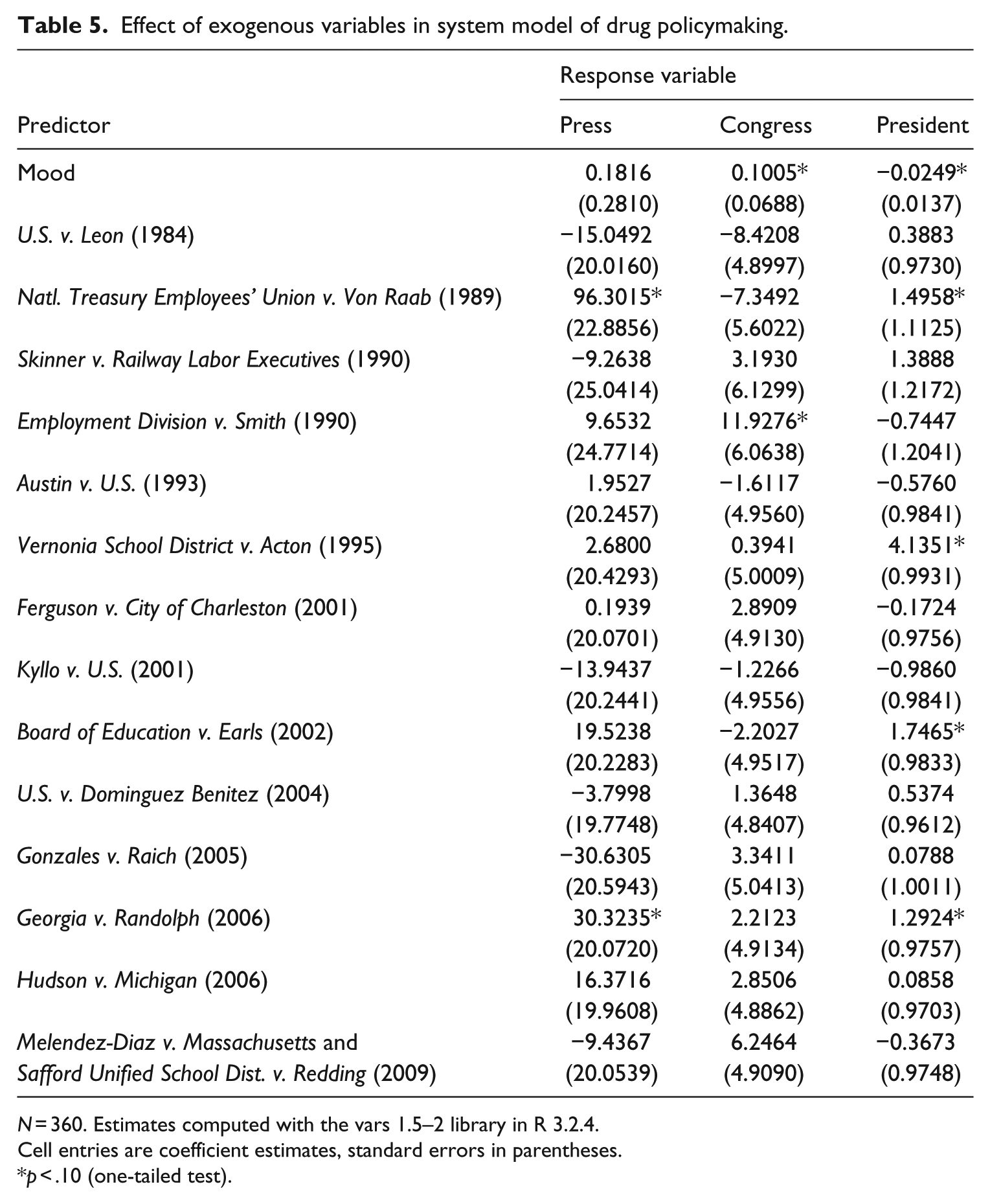
N = 360. Estimates computed with the vars 1.5–2 library in R 3.2.4.
Cell entries are coefficient estimates, standard errors in parentheses.
p < .10 (one-tailed test).
Since press, presidential and congressional attention to drugs are all endogenous and autoregressive, how does a major Supreme Court decision influence the dynamic system as a whole? Figure 3 shows the manner in which the case of National Treasury Employees’ Union v. Von Raab shaped these three outcomes over the year of 1989. Again, the horizontal axis represents time, and the vertical axis represents the predicted value of each respective outcome. Recall that a positive and discernible effect was only present for media coverage and presidential action.
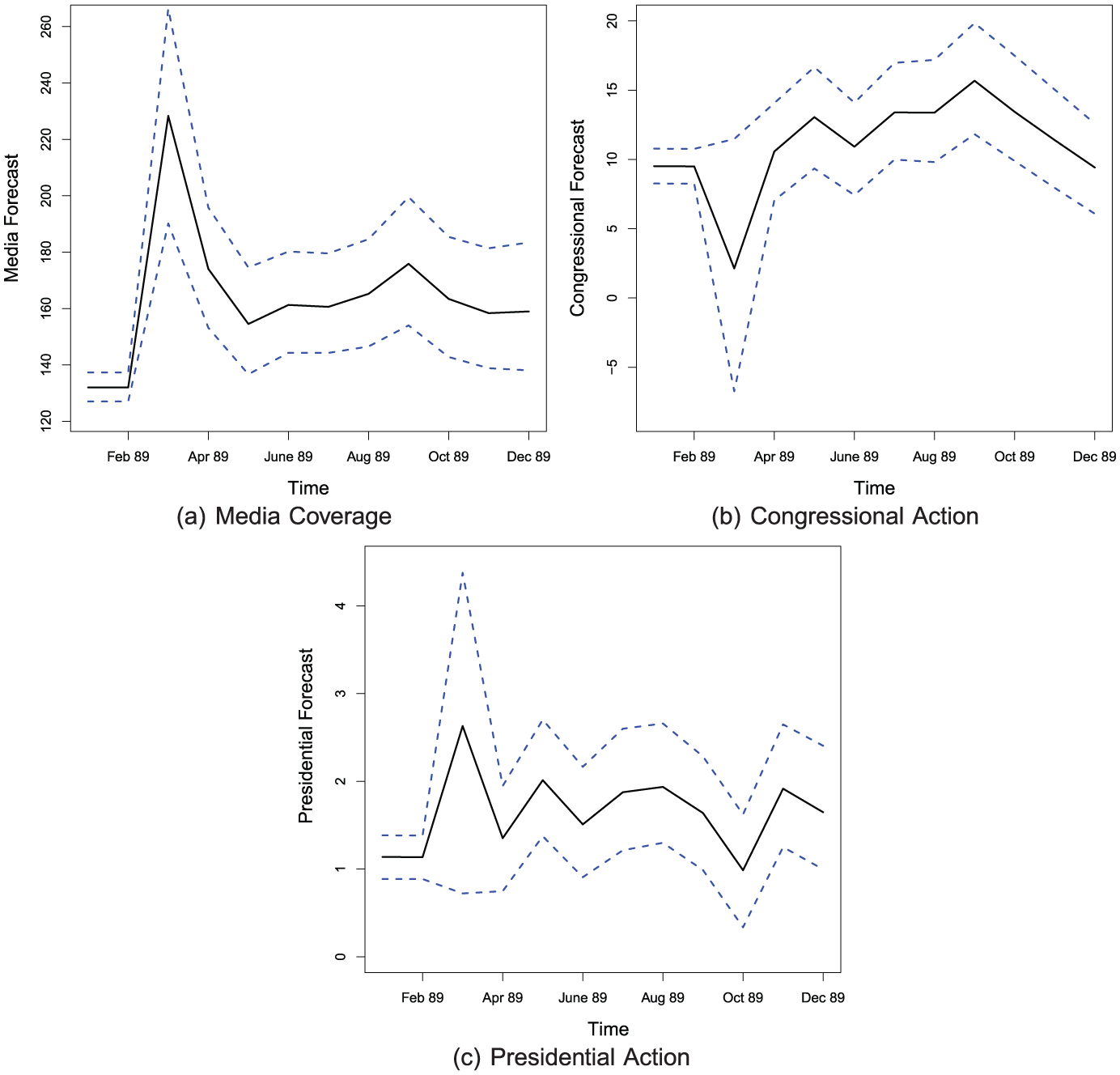
Predicted response of three endogenous variables for the decision of National Treasury Employees’ Union v. Von Raab (March 1989) with 90% confidence intervals. Forecasts are computed using values at the end of the endogenous series.
As Figure 3 shows, in March 1989 there was an immediate spike in media and presidential attention to the issue. For media coverage of drugs, the effect also persists for several months into the future. For congressional action on drugs, the main effect of the coefficient actually shows a drop in congressional attention in the month the case was decided. However, the autoregressive patterns and reciprocal causation actually lead congressional action on the issue to rise over the ensuing months before finally dropping off. Hence, this fully endogenous system on drug policy can be reactive to a major input like an important ruling by the Supreme Court. This figure illustrates that the pattern of indirect effects over time can be complicated, but by visualizing how it unfolds we can see that a Supreme Court case can have a multifaceted impact on the policy system.
Conclusion
There is little question that, in general, some Supreme Court decisions can have a meaningful influence on the policy activity of other branches of government. The Supreme Court’s 2000 ruling in FDA v. Brown & Williamson Tobacco Corp was monumental in stating that the FDA could not regulate tobacco products because Congress had repeatedly decided against granting that authority. While it did not occur for 9 years – at a time when a unified Democratic government came into power – the Family Smoking Prevention and Tobacco Control Act of 2009 is widely thought to be a response to this Supreme Court ruling. In this case, the story is probably one in which elected officials enacted a bill simply because they disliked regulatory policy on tobacco after the high court’s ruling. In addition to reacting to Supreme Court rulings, however, congressional and presidential policy actions also could build upon them. This policy incrementalism should arise in response to public attention on personal morality issues when a prominent case is decided.
We find evidence consistent with this policy incrementalism story: across both issues – drugs and tobacco – we observe a consistent pattern that national print media coverage, congressional actions and presidential actions on these vice issues seem to respond to select significant Supreme Court rulings on these issues. We therefore find support for our hypothesis that policy action by the Supreme Court can raise the prominence of an issue on the agenda of the media and elected branches of government. This implies that the unelected Court can have a major impact on the politics of vice not only through the substance of its landmark rulings, but also through its effect on the level of information that the press reports on these issues and the level of policymaking time spent by the other branches of government.
The impact of the Court on these issues even extends beyond this direct effect. It is well established that elected officeholders are responsive to the concerns of the public and, relatedly, issues raised by the press. As we can see, media coverage of these issues influences attention by the other branches of government. Therefore, the Supreme Court shapes the degree to which an issue is covered, and this increased coverage in turn shapes the level of policy activity taken by the other branches of government. Similarly, the elected branches of government react to each other, and the media reacts to them, so the spillover of an initial Court-induced intervention on an issue can persist for some time. When the Supreme Court rules on questions related to vices such as smoking or using drugs – questions that directly address questions of individual discretion versus government authority – the attention of the public and policymakers is captured, and the issue rises on the national agenda.
Footnotes
Acknowledgements
Complete replication information is available at:  Previous versions of this work were presented at the Department of Political Science at Emory University and the Annual Meeting of the Midwest Political Science Association, 11–14 April 2013, Chicago, IL. For valuable assistance, we thank Patrick C Wohlfarth, Brett W Curry, Tom S Clark, Jeffrey K Staton, Micheal W Giles, Michelle Whyman, and Karen Bodnaruk.
Funding
The author(s) received no financial support for the research, authorship and/or publication of this article.
Supplementary Information
Additional supplementary information may be found with the online version of this article: Online Appendix: Data Sources Online Appendix: Additional Details About the Model Structure Online Appendix: Alternative Model Specifications
C.1. Models Excluding Laws from Congressional Action C.2. Model of Drugs Using Policy-Specific Mood C.3. Models Using Gallup Most Important Problem Data C.4. Model of Tobacco Policy Using All Tobacco-Related Cases as Predictors C.5. Model of Drug Policy Using Additional Drug-Related Cases as Predictors C.6. Model of Drug Policy Treating the Supreme Court as Endogenous
Notes
Author biographies
References
Supplementary Material
Please find the following supplemental material available below.
For Open Access articles published under a Creative Commons License, all supplemental material carries the same license as the article it is associated with.
For non-Open Access articles published, all supplemental material carries a non-exclusive license, and permission requests for re-use of supplemental material or any part of supplemental material shall be sent directly to the copyright owner as specified in the copyright notice associated with the article.
