




Abstract
This article draws on secondary historical sources and primary interviews to highlight how the legacy of the creation of local governments in England and Germany has significant implications for policy-making in the present day. By employing an institutionalist perspective to analyse how one municipality in each country tries to promote renewable energy and retrofit private housing, it demonstrates how historical factors have resulted in the German Council having more capacity to act hierarchically in local governance arrangements than its English counterpart. These findings have notable implications for how governments at all levels seek to tackle major challenges such as climate change.
Keywords
Introduction
Geographers such as Harriet Bulkeley (2005) have emphasised that cities need to play a key role in combating climate change for many years and have also stressed how municipal capacity plays a key role in determining governance approaches (Bulkeley and Kern, 2006). However, political scientists have only recently begun to analyse how and why subnational actors are tackling this crucial issue (Heinelt and Lamping, 2015; Hughes, 2016; Krause, 2013). Furthermore, few studies have compared municipalities in different countries, which means that we do not know a great deal about how contrasting local government systems may influence climate policy-making arrangements. At the same time, comparisons of subnational systems have not drawn explicit links between the reasons why nation-states created modern-day municipalities in the first place and contemporary governance arrangements at the local level. In other words, how have historical legacies shaped the nature of contemporary multi-level systems and what impact do they have on local climate policy-making?
Drawing on both secondary historical analyses and primary fieldwork interviews in two medium-sized cities (Gelsenkirchen and Newcastle upon Tyne), this article will address these questions in the German and English contexts. By focusing on two strands of policy that relate to both municipalities’ climate change strategies (namely renewable energy and improving the thermal efficiency of privately rented housing), it shows how Gelsenkirchen Council has more capacity to act as a genuine local authority and rely on hierarchical implementation techniques compared to its counterpart in Newcastle. This is because German municipalities were established as civic institutions that had significant autonomy to stimulate economic development and foster local pride, whereas the British Government 1 created councils primarily for reasons of politically expediency – namely to deal with the negative side-effects of the industrial revolution. Such contrasting governance approaches have significant implications for local democracy and policy outcomes because they result in a different balance of power between state and non-state actors.
The article uses historical institutionalism as a theoretical lens to make the link between local government’s creation and contemporary subnational arrangements in the two cities. Following the methods section, it will examine historical institutionalist perspectives and their implications for path-dependency in decision-making, before outlining how modern local government has evolved in both countries since the early 19th century. The article then incorporates these historical legacies into an analysis of how Gelsenkirchen and Newcastle Councils have sought to reduce their cities’ reliance on fossil fuels and improve the thermal efficiency of privately rented housing. This leads into a discussion about the nature of policy-making in the two cities, before the arguments are summed up in the conclusion.
Methods
The historical analysis of the creation of local governments relies on a synthesis of existing secondary literature, while the examination of contemporary governance arrangements is based on a total of 34 fieldwork interviews with 37 people in the ‘twin towns’ of Newcastle upon Tyne and Gelsenkirchen, as well as municipal policy documentation in both cities. I conducted the Newcastle interviews between early 2012 and autumn 2015 and carried out the Gelsenkirchen fieldwork in summer 2013. The interviewees were predominantly senior council managers (from the environment, planning, economic development, corporate procurement and policy departments), although they also included staff in a number of other public bodies and representatives from the local voluntary sector in each city. Fifteen of the discussions, which covered 19 individuals, were in Gelsenkirchen and the surrounding area, and the remaining 19 interviews involved 18 different people in Newcastle. I analysed the interview data to identify policy-making processes in each city, including their approaches to promoting renewable energy and improving the thermal efficiency of privately rented housing. Both councils prioritised these issues in their climate protection strategies, and therefore they represent particularly useful cases for comparison.
The cities have similar populations (around 270,000), a shared heritage of heavy industry (particularly coal mining), and both have experienced significant economic decline in recent decades. In addition, they have sought to address this decline by re-branding themselves as forward-thinking, sustainable locations in order to attract investment and stimulate economic development (Bulkeley and Betsill, 2005; Jung et al., 2010). The municipalities are both involved in the Covenant of Mayors initiative and have agreed policy strategies that incorporate explicit political objectives on mitigation and adaptation (Newcastle City Council, 2010; Stadt Gelsenkirchen, 2011), including targets to reduce the level of carbon dioxide emitted from each city by over 20% between 2005 and 2020. In other words, they share similar challenges and objectives on climate change policy. Crucially, however, the legacy of local government’s creation in both countries has resulted in them adopting very different strategies to achieve them.
Overview of historical institutionalist perspectives
After Philip Selznick published his seminal book on the Tennessee Valley Authority (Selznick, 1949), various sub-branches of (neo-)institutionalism developed within political science. Notably, Hall and Taylor (1996) identified three distinct streams, which they termed historical, rational choice, and sociological institutionalism. The historical branch stresses the importance of ‘path-dependency’ to political phenomena and demonstrates how institutions and actors are shaped by previous experience – their ‘historical contingency’, which ‘locks-in’ and restricts the options available to decision-makers (Bogumil and Holtkamp, 2006). This institutional legacy results in ‘sticky’ policies that linger for a long time after they have solved a perceived problem (March and Olsen, 1989; Thoenig, 2003) often because dominant actors benefit from existing arrangements and therefore seek to prolong the status quo (Pierson, 2000). By defining ‘institution’ in very broad terms, this perspective considers the influence of social constructs – such as the traditions, habits, rules and conventions that apply to social interactions (Ostrom, 1986) – as well as large-scale phenomena or organisations. Crucially, institutions are difficult to remove (even once they have outlived their purpose), which means that the legacy of previous behaviour is likely to endure.
Indeed, the implication that institutions remain stable over long periods of time led some scholars to question how the theory can explain changes in policy (Peters et al., 2005). Historical institutionalism appeared to suggest that shifts are slow, incremental and located within the constrained context of the existing institutional framework, or they are precipitated by a ‘radical shock’ (March and Olsen, 1989) at a ‘critical juncture’ (Collier and Collier, 1991) that ‘punctuates the equilibrium’ (True et al., 1999) and leads to the creation of a new set of arrangements. This dichotomous explanation is perhaps too simplistic (Gorges, 2001; Greener, 2005), which led other scholars to suggest more nuanced explanations for gradual – but nonetheless transformative – institutional change (Streeck and Thelen, 2005; van der Heijden, 2011).
However, despite the difficulties associated with trying to explain change, there is widespread agreement that ‘institutions matter’ and help to structure socio-political outcomes (Gandhi and Ruiz-Rufino, 2015). In line with this approach, this article argues that English municipalities have essentially remained politically expedient agents of central government, delivering less ‘glamorous’ services on behalf of ministers, ever since their creation in 1835. In contrast, their Prussian counterparts were established in 1808 as civic bodies, a principle that remained dominant until the ‘radical shock’ of the Great Depression, but was re-established in post-war West Germany and has remained prevalent ever since. Crucially, these legacies have had a significant impact on local policy-making arrangements in both countries, which continues in the present day.
Multi-level governance in England and Germany
In recent decades, various scholars have developed typologies for classifying local government systems in developed countries (Batley and Stoker, 1991; Bennett, 1993; Goldsmith and Page, 1987; Hesse and Sharpe, 1991; John, 2001; Norton, 1994; Pierre, 1999). These categories are based on indicators such as the legal or constitutional status of local authorities, their average size, and their autonomy from central or state governments. Notably, none of them have placed Germany and the United Kingdom/England in the same category, which illustrates how much the subnational governance systems in the two countries differ. Similarly, Herrschel and Newman (2002) adopted Hooghe and Marks’ (2003) typology of multi-level governance to argue that the two countries represented contrasting systems. They pointed out that public bodies in Germany’s federal system are much more structured and have responsibility for a wide range of services (and are therefore archetypal ‘Type I’ jurisdictions in Hooghe and Marks’ terminology), whereas unitary England relies on a plethora of flexible and ‘task-specific’ organisations in a ‘Type II’ arrangement (see Herrschel and Newman, 2002).
Crucially, however, the above typologies do not highlight the contrasting reasons why the British and Prussian governments established local authorities in the first place and how these factors have played a key role in shaping their institutional contexts and municipal capacity. These original drivers have meant that contemporary German Councils are overtly political actors, whereas their English counterparts are more concerned with delivering services on behalf of the central state (Blair, 1991).
The development of local government in England
Modern local government in England dates back to the 1835 Municipal Corporations Act, which allowed towns to petition Parliament for the creation of elected councils. As Aidt, Daunton, and Dutta (2010) have identified, this law was passed primarily to enable the creation of local bodies that could address the negative consequences of rapid urbanisation and the industrial revolution, particularly poor sanitation and anti-social behaviour. Importantly, the Act meant that local authorities were creatures of statute, and therefore they could be created (or abolished) by legislation – in line with the principle of parliamentary sovereignty and the absence of a codified constitution. Moreover, they were only permitted to carry out those functions that were expressly permitted in law – otherwise they could be prosecuted and fined for acting ultra vires (beyond their legal authority). These two factors illustrate how councils were designed to be functional agents of central government and restricted to acting on behalf of ministers (Copus, 2010; Jones and Stewart, 1983) – in keeping with the ‘task-specific’ nature of Type II multi-level governance (Hooghe and Marks, 2003). In other words, they were created for reasons of political expediency because ministers felt that tasks such as overseeing sewerage systems and refuse collection were somewhat beneath them, and therefore established municipal authorities to undertake these functions on their behalf.
Although the Victorian era is often characterised as a ‘golden age’ for English municipalities (Norton, 1994) due to the wide range of activities they undertook, it is important to note that ministers could still determine the scope of their activities and continue to treat them as agents of the centre. For example, local government was not given any responsibility for education until after World War II, which meant that England relied on a patchwork system of religious schools, private institutions, and charities right up until the 1940s. As a result, English councils were unable to use the education system to foster civic pride and develop local economic capacity – in contrast to their Prussian counterparts.
Furthermore, in recent decades, central government has gradually wielded more influence over municipalities and sought to reinforce their status as functional agents – rather than civic bodies that represent recognisable communities and pursue local interests. For example, municipal boundary changes since the 1970s have reduced the number of elected councils in England from 1300 to less than 400 and resulted in the average English council serving a population seven times the size of its German counterpart. This has made it easier for ministers to exert greater control over local government (Dearlove, 1979) and has also resulted in council areas being determined on the basis of administrative efficiency rather than identifiable local communities (Copus, 2010). In addition, ministers removed many responsibilities from local government (including utilities, hospitals, further education, training and urban regeneration (Stoker, 2003)) and imposed a number of ‘New Public Management’ (NPM) reforms on them, with a view to improving the ‘efficiency and effectiveness’ of local services (Hood, 1991). These initiatives led to the outsourcing of functions such as waste collection, school meals provision, and street cleaning to external ‘task-specific’ organisations and meant that municipalities had much less direct responsibility for local public services.
Indeed, ministers have argued that councils should become primarily commissioners rather than direct providers of services such as social care (Knapp et al., 2001), with the result that they depend increasingly on other actors to influence outcomes within their localities. Between the late 1990s and 2010, central government also introduced a series of monitoring frameworks and performance targets that sought to identify whether central government priorities were being delivered at the local level (Eckersley et al., 2014), thereby illustrating how it viewed municipalities primarily as functional agents that were responsible for implementing ministerial policy. For example, the Comprehensive Area Assessment regime, which operated between 2008 and 2010, required local authorities to report their performance against a range of indicators, including three measures that related to climate change (Department for Communities and Local Government, 2008). Although this can be viewed as an attempt to improve the co-ordination of climate policy across tiers of government, it is important to note that it only applied to ministerial objectives – there were very few parallel initiatives that aimed to help municipalities implement local priorities.
Perhaps even more importantly, central government has been able to exercise increasing dominance over municipalities through the funding system. This has led to English councils having far less financial autonomy than their counterparts in other large Western European countries (Ferry et al., 2015) – a situation that has been exacerbated by significant reductions in central grants since 2010 (Lowndes and Gardner, 2016). Ironically, these funding reductions occurred at the same time as the 2011 Localism Act introduced a ‘general power of competence’ that removed the ultra vires constraint by allowing municipalities ‘to do anything that individuals generally may do’. Theoretically, therefore, this legislation gave councils the freedom to broaden their remit away from merely administering services on behalf of the centre (Lowndes and Pratchett, 2012). However, because central government constrains them financially, most municipalities have actually had to scale back their existing functions rather than carry out new activities. The net result is that local politicians (rather than those in London) have had to take potentially unpopular decisions to cut public services (Ferry and Eckersley, 2015), illustrating how ministers have continued to use councils for politically expedient purposes. As the next subsection will show, this situation does not apply in Germany, with the result that municipalities are able to play a very different role in their communities.
The development of local government in Prussia and Germany
Since Germany did not become a unified state until 1871 and was keen to reject Napoleonic centralism after much of it was occupied by the French in the early 19th century, it was perhaps always more likely to favour subnational autonomy than England (Conradt, 2001; Norton, 1994). Indeed, Prussia’s First Minister in the early 19th century, Freiherr vom Stein, played a key role in establishing a tradition of lokale Selbstverwaltung (local self-administration) in the country – a principle that remains very influential two centuries later. The idea was encapsulated in the Prussian Government’s Civic Ordinance of 1808, which included two important powers that eluded their English counterparts for well over a century. First, they were granted a power of general competence, which meant that councils had the freedom to undertake any function that they considered to be in the interests of the locality unless that task was specifically assigned to another government body in law (Wollmann, 2004). Second, the Prussian government gave councils responsibility for public education in order to achieve its twin aims of modernising the country’s economy and instilling ‘moral’ values such as community spirit and civic pride (Palmowski, 2002).
In contrast to England, therefore, Prussia did not establish modern municipalities to deal with the problems of urbanisation and industrialisation; in fact, they became firmly established at a time when the country’s population was still overwhelmingly rural (Gildea, 1987). Like their English counterparts, Prussian Councils decided to provide a broad range of public services – but, crucially, they were able to determine which functions to undertake.
Many of the other German states (the Länder) wanted to emulate Prussia’s economic, political and military success, and therefore adopted Stein’s philosophy of civic governance, local autonomy, and Weberian bureaucracy (Bogumil and Holtkamp, 2006). As a result, the principle of lokale Selbstverwaltung was incorporated into both the Second Reich and Weimar Republic constitutions and remained dominant right up until the 1930s. However, the Great Depression did provide a radical shock to punctuate this equilibrium because it resulted in a municipal financial crisis (which led to Länder governments increasing their control over local government finance (Bogumil and Holtkamp, 2006)) and ultimately paved the way for the Nazi dictatorship. After taking power in 1933, the Nazis subsumed local government into the central state by abolishing municipal elections and political parties. They also replaced the constitutional principle of lokale Selbstverwaltung with that of the Führerprinzip – an obligation that all municipalities had to implement the will of the Führer (Conradt, 2001). In other words, any vestiges of local autonomy disappeared during the Third Reich.
Notably, however, West Germany’s post-war municipal and state structures developed to become very similar to those of the early Weimar Republic, almost as though the Depression and Nazi era had never happened (Norton, 1994; Roberts, 2000). Indeed, the Allied powers resurrected the principle of lokale Selbstverwaltung and enshrined it in Article 28 of the post-war Grundgesetz (Basic Law). Other constitutional provisions – such as an unrestricted right for municipalities to levy and raise the Gewerbesteuer (business tax) and Grundsteuer (property tax) in their areas and the inclusion of lokale Selbstverwaltung in the individual Länder constitutions – also confirmed how Stein’s principles had re-emerged as the dominant institution (Conradt, 2001).
In addition, the Grundgesetz requires the federal government to ensure that all German citizens enjoy ‘equivalent living conditions’ (gleichwertige Lebensverhältnisse). This has resulted in a complex system of financial transfers between Länder and increasing collaboration across tiers of government that has become known as ‘Politikverflechtung’ or ‘co-operative federalism’ (Scharpf et al., 1976). This interdependence has meant that municipalities receive significant additional resources and support from other state actors, which enables them to operate as strong local actors in shaping their communities (Eckersley, 2016). Notably, it also makes it easier for state actors to co-operate when addressing issues that cut across policy areas and levels of government, such as climate change. For example, policy-makers from across sectors and tiers have collaborated on the Energiewende – Germany’s ‘energy transition’ away from fossil fuels and nuclear power (Moss et al., 2015). This contrasts sharply with the UK Government’s strategy of seeking to deliver its climate change policies through hierarchical performance frameworks, which treated municipalities as agents of the centre rather than democratic local bodies.
Furthermore, municipalities in Germany have not introduced NPM initiatives such as outsourcing or privatisation to the same extent as their English counterparts because the federal constitutional structure meant that such reforms were not mandated (Bogumil et al., 2006). Indeed, there is an increasing trend towards ‘re-municipalisation’ (particularly of utilities) once concessionary contracts come to an end (Becker et al., 2015). As such, many German municipalities still operate as largely ‘multi-functional’ organisations within a largely Type I multi-level context and have retained significantly more influence over local services when compared to their English counterparts.
Finally, municipal staff and local politicians benefit from an aura of professionalism and competence that comes from being part of the ‘Expertokratie’ (Kost, 2010). This means that Germans are more likely than the English to respect council decisions and trust local officials to act in the interests of the area, in accordance with the principle of lokale Selbstverwaltung and the legacy of municipalities as representative civic bodies. Similarly, there is a strong belief that local government should act as the ‘school’ or ‘cradle’ of democracy (Blair, 1991); a high proportion of senior German politicians began their careers at the municipal level, and strong bonds exist between party members across tiers of government (Wonka and Rittberger, 2014). To illustrate its comparative societal importance, the percentage of Germans casting a vote in local elections has consistently exceeded the British figure since these data began to be collected systematically in 1979 (Kost, 2010; Wilson and Game, 2011). Overall, therefore, German municipalities are much more powerful local actors than their English counterparts, and German cities have been able to continue developing as distinct ‘local democracies’ – in spite of having to operate under financial constraints in recent years (Bogumil and Holtkamp, 2006).
Table 1 summarises the underlying principles behind local government in Germany and England since the early 19th century. It highlights how English municipalities were created as politically expedient agents of the centre and how this has continued since the early Victorian period. The result is that many residents see municipalities in overwhelmingly functional terms (rather than as democratic representative bodies) and have a transactional (rather than a citizen-state) relationship with their council. Indeed, a recent study found that elected councillors themselves perceive their role as being more concerned with service provision than ‘governing’ in any overtly political sense (Copus, 2014).
The role and status of local government in England and Germany.
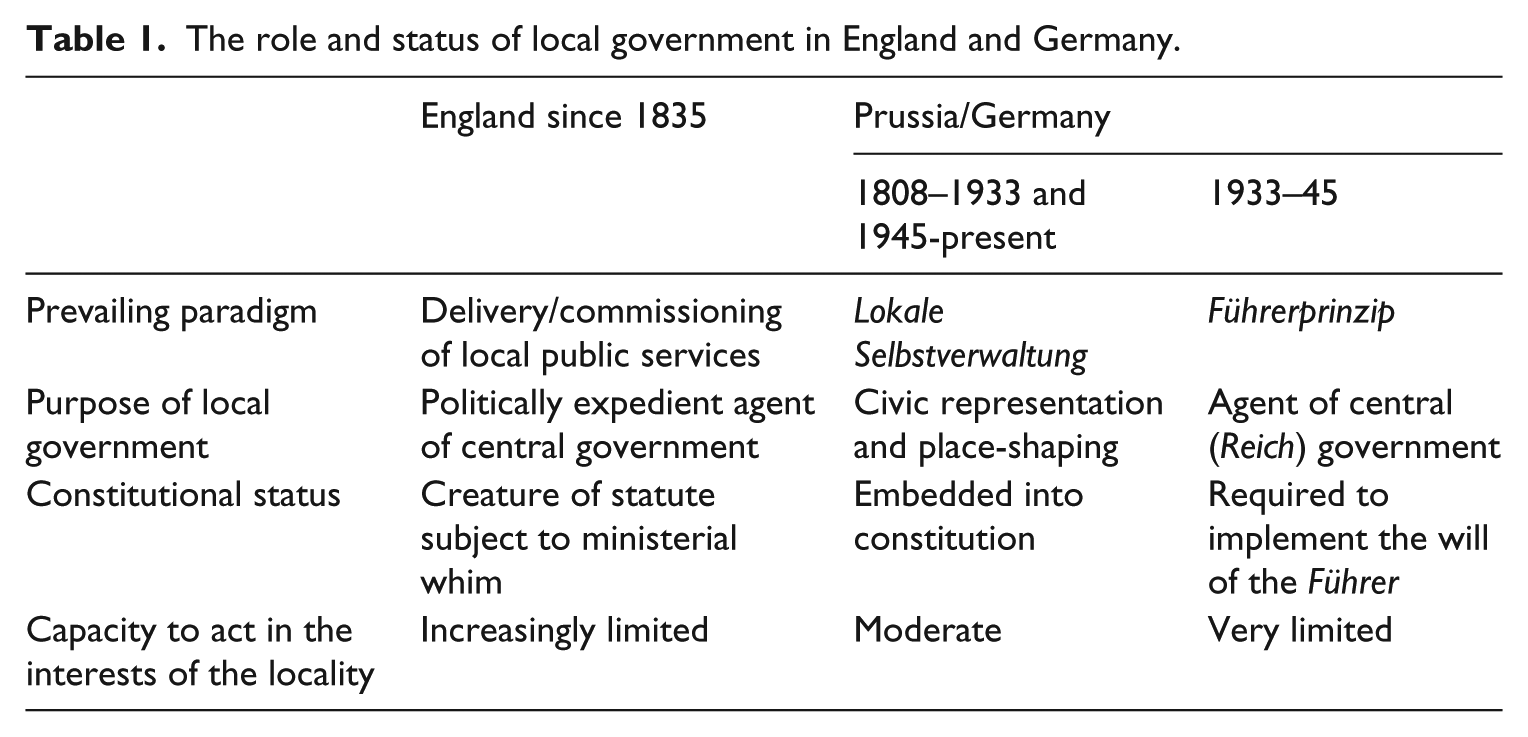
In contrast, German municipalities have their roots in 19th-century Prussian notions of civic pride, community representation and lokale Selbstverwaltung – ideas that were temporarily displaced during the Nazi era, but returned to dominance after World War II. These issues have contributed to German Councils having more capacity to implement policy objectives for two key reasons. First, they are able to exercise more direct control over public services because fewer functions have been outsourced or privatised. Second, they have higher status in local governance arrangements, which allows them to exert greater influence in policy-making processes.
Energy supply and domestic retrofits in Newcastle and Gelsenkirchen
This section draws on primary fieldwork to illustrate how the institutional legacies discussed above shape contemporary policy-making in the ‘twin towns’ of Newcastle and Gelsenkirchen. It focuses on the methods that each municipality has adopted to promote the use of renewable energy and to improve the thermal efficiency of privately rented housing. These examples are used to highlight the link between local government’s establishment in both countries and municipal influence over policy-making in the present day.
Local energy provision in Gelsenkirchen and Newcastle
As mentioned earlier, German municipalities have retained greater control over local utilities compared to their English counterparts, which means that Newcastle Council can do much less than Gelsenkirchen to influence energy provision within the city. Newcastle does control some relatively small district heating networks and has investigated extending them, but one interviewee pointed out that it did not have the financial capacity or expertise to navigate the complex market entry process and set up a municipal energy supply company of its own (interview with officer at Newcastle City Council, 18 September 2015). Instead, it has to try and encourage greater energy efficiency and use of renewables in an environment that is dominated by the ‘Big Six’ power companies (British Gas, Npower, SSE, Scottish Power, E.On, and EDF), which together supply over 90% of domestic gas and electricity in the United Kingdom (BBC News, 2014). These companies are subject to various regulations that require them to generate a certain proportion of energy from renewable sources. However, the regulations are determined at the national level, and therefore, municipalities are not in a position to influence any of them – or indeed ensure that their residents buy any green electricity at all. In other words, Newcastle City Council is almost entirely dependent on the goodwill of power companies and private customers to take decisions that might help to reduce carbon emissions in the city. Other than favouring renewable sources through its own procurement policies, the council can offer very little in return that might encourage consumers to purchase green electricity. As one officer put it:
The idea behind utility privatisation was that it would drive down costs, but actually it is very difficult to develop policy … because the relationship is between consumers and energy companies [rather than between citizens and the state]. (Interview with officer at Newcastle City Council, 6 January 2012)
In response to severe financial problems in the mid-1990s, Gelsenkirchen did sell off some shares in its Stadtwerk (municipal service provider) that was responsible for local utilities. However, this sale was conducted together with the neighbouring municipalities of Bottrop and Gladbeck in order to ensure that the public sector retained influence through a joint 49.9% stake in the new energy supplier, Emscher Lippe Energie (ELE). Although the remaining shares in the company are held by the multinational power company RWE, the organisation is led by two executives, one of whom is employed by the energy giant and the other by the three authorities combined, and any major decisions must be approved by both of these individuals. This enabled the three municipalities to include a clause in the most recent energy contract that requires ELE to generate up to 20 GwH of its annual electricity provision from renewable sources by 2020 (interview with officer at Gelsenkirchen Council, 16 July 2013). As this suggests, Gelsenkirchen has retained much more control over local energy provision than Newcastle – a position in line with its traditional role as a civic body – and thereby help to achieve the council’s policy objectives. In contrast, since the UK energy sector has been almost wholly privatised, the prospect of local (or even national) government asserting significant control over gas and electricity provision appears remote.
Retrofitting privately rented housing in Gelsenkirchen and Newcastle
As part of their climate change strategies, both Newcastle and Gelsenkirchen councils place a high priority on retrofitting residential properties to improve their thermal efficiency, thereby reducing the city’s overall carbon footprint and helping residents to lower their fuel bills (Newcastle City Council, 2010; Stadt Gelsenkirchen, 2011). There are obvious incentives for owner-occupiers to pay for measures such as roof or wall insulation, draught-proofing, double-glazing or more efficient boilers – because they will benefit from warmer homes and lower energy bills. In addition, government-backed schemes exist in both countries to help homeowners invest in these retrofits and pay back the capital cost over a long period of time (Boardman, 2012; Dowson et al., 2012). However, since private landlords will not live in the property and (in most cases) do not pay for their tenants’ energy, both Newcastle and Gelsenkirchen Councils have had to try and persuade these property owners to contribute towards achieving local policy objectives.
Although Newcastle’s proportion of owner-occupiers (at 50%) is lower than the English average, only around one-sixth of the city’s 120,000 homes are rented out privately – the remaining third are in the hands of social landlords or the arms-length management organisation that oversees housing on behalf of the council (interview with officer at Your Homes Newcastle, 11 June 2012). However, a significant proportion of these 20,000 privately rented homes are occupied by students on short-term lets – typically for 12 months – and most landlords are confident of finding new tenants once students graduate and/or leave the city (interview with officer at Newcastle City Council, 6 January 2012). As a result, neither the occupiers nor their landlords have much incentive to invest in retrofits, despite the fact that many privately let homes date from the late 19th century and have a significantly lower level of thermal efficiency than more recently built properties. Moreover, although the local authority has tried to persuade landlords to retrofit their properties, they have been unable to make much progress – reflecting the council’s relatively weak position within the city and inability to compel actors to comply with its wishes (interview with officer at Newcastle City Council, 8 April 2013).
At around 16%, the percentage of homes in Gelsenkirchen that are occupied by their owners is much lower than in Newcastle. In addition, because Gelsenkirchen’s population has declined markedly in recent decades (from a peak of around 400,000 in the early 1960s to approximately 260,000 in the present day), there is a surplus of housing stock in the city, and therefore, landlords are reluctant to increase rents in order to fund retrofitting projects. Furthermore, one-fifth of the city’s homes belong to hedge funds or public limited companies, which one officer characterised as ‘businesses that have purely financial interests in the city’ because they are legally required to act in the interests of their shareholders rather than the municipality or their tenants (interview with officer at Gelsenkirchen Council, 27 June 2013). As such, we might expect the local authority in Gelsenkirchen to find it more difficult to encourage property owners to invest in retrofits than its counterpart in Newcastle.
As of summer 2013, however, the hedge funds and listed companies were engaging with the council and seeking to improve the energy efficiency of their housing stock. Officers at the municipality attributed this to the council’s status and its authority as the democratic voice of local residents, pointing out that private companies often look to the state for leadership and are willing to comply with its requests (interview with officer at Gelsenkirchen Council, 27 June 2013). As such, Gelsenkirchen was able to use its status as the local authority (in the true sense of the term) to persuade them to invest in building retrofits. Indeed, council staff were not particularly surprised by the fact that these landlords agreed to participate in governance processes, even though the municipality was not in a position to coerce or incentivise them in any way.
The fieldwork interviews revealed similar contrasts in municipal capacity in other policy areas, notably Gelsenkirchen Council’s policies to promote the area as a centre for solar energy production (see also Jung et al., 2010). This began in the mid-1990s, when the industry was in its infancy and has resulted in the authority constructing four solar-powered housing estates and requiring all public buildings to install photovoltaic (PV) panels on their roofs, provided they will deliver a financial return within a decade (interviews with officers at Gelsenkirchen Council, 16, 19 and 22 July 2013). Most recently, the council developed its climate change strategy with very little input from external actors, reflecting its position as the pre-eminent authority within the city that seeks to exercise hierarchical influence over other stakeholders.
For its part, Newcastle City Council did not install PV panels on the roof of many public buildings (including its civic centre) until the end of 2015 (Metcalfe, 2015). It has also sought to create a broad coalition of different actors to develop and implement its climate policies. This has resulted in close relationships with Newcastle University (Walsh et al., 2013), as well as non-profit groups such as the Greening Wingrove initiative – a volunteer-run project aimed at improving the quality of green spaces and local environment in the west end of the city (Davoudi and Brooks, 2016). In contrast to Gelsenkirchen, it is notable that Newcastle’s climate change strategy was developed in collaboration with these other actors, reflecting the council’s weaker position within the locality and its legacy as a functional deliverer (or commissioner) of services, rather than a hierarchical civic body.
Discussion
The contrasting drivers for the creation of modern municipalities in England and Germany mean that Newcastle City Council is not able to exert as much authority over other local actors as its German counterpart in Gelsenkirchen. Stein’s philosophy of civic pride and bottom-up development in 19th-century Prussia is still relevant in modern-day Germany, where the council accords greater respect in the locality and can therefore exert more influence over policy-making processes. In contrast, local authorities in England were created primarily for reasons of political expediency, namely to deliver services on behalf of central government that would ameliorate the public health crisis triggered by the industrial revolution. This legacy of municipalities as primarily functional organisations (rather than democratic civic bodies) has meant that English councils are often required to carry out the menial work of central government and has resulted in them becoming weaker local actors.
In short, the more rigid and multi-purpose ‘Type I’ arrangement that operates in Gelsenkirchen has given the German Council greater capacity in local decision-making than the flexible and task-specific ‘Type II’ structures that characterise the Newcastle context. Moreover, since the principle of lokale Selbstverwaltung is recognised at all tiers of government in Germany, Gelsenkirchen receives substantial support from the Land of North Rhine-Westphalia (and its regional arm, the Bezirk of Münster) to implement its climate change policies and the overall Energiewende agenda. Ironically, although UK Government ministers still view local authorities as delivery agencies, their relationship with councils has become increasingly detached from central government since the abolition of performance frameworks in 2010. In particular, the centre is very reluctant to provide municipalities with the resources they may need to achieve their policy objectives (Lowndes and Gardner, 2016).
As the fieldwork interviews highlighted, this means that Gelsenkirchen Council can exercise more control over policy-making than its counterpart in Newcastle. Since it is less reliant on outside bodies (which are likely to further their own interests in decision-making processes), Gelsenkirchen’s approach also raises fewer concerns about local democratic accountability because elected representatives exert more direct influence over policy. For example, interviewees in each case study city responded in markedly different ways to identical questions about their council’s willingness to pursue more radical climate change policies. As the following quote illustrates, an officer at Newcastle was most concerned about how large companies in the city might respond to particular initiatives:
I think at a very basic level, we can’t tell the big partners what to do … There’s a real balancing challenge there around how we use our strategic powers to further the green agenda, whilst at the same time taking businesses with us. (Interview with officer at Newcastle City Council, 9 December 2013)
In contrast, the Gelsenkirchen interviewee stressed the potential electoral impact of such policies:
A politician who came out strongly on climate protection here would not do well at the next election … The policy is always a bit more advanced than the average voter, but it cannot lose touch from them. I think the policy in Gelsenkirchen is where it is able to be. (Interview with officer at Gelsenkirchen Council, 22 July, 2013)
The above quotes show how Newcastle Council is worried about the potential reactions of local businesses and other powerful actors to a change in policy, whereas Gelsenkirchen is more concerned about the views of its citizens. This contrast reflects how private companies are more prominent in Newcastle’s governance arrangements, whereas they play a much more subordinate role in Gelsenkirchen. The language used by interviewees in the two cities is also instructive. Officers at Newcastle referred consistently to local ‘partners’ that help to develop and implement climate protection policies, but this term was noticeably absent from discussions in Gelsenkirchen, where interviewees would instead refer to specific organisations by name or mention the general economic sector within which they operated.
State and non-state actors do have to collaborate in order to tackle ‘wicked issues’ such as climate change (Wurzel et al., 2013), and therefore, Newcastle’s strategy of engaging with local stakeholders to try and persuade them to implement policy objectives appears eminently sensible. Indeed, as Bulkeley and Kern (2006) highlighted in a previous comparison of policy-making in English and German municipalities, councils are increasingly having to engage with non-state actors in order to have sufficient capacity to address climate issues rather than relying on more hierarchical techniques. However, public bodies may also need to coerce private actors to change their behaviour if they do not have a clear incentive to act in the general interest. Therefore, jurisdictions with strong state actors are probably much better placed to implement the kind of transformational (rather than incremental) policies that will be necessary to avoid potentially catastrophic climate change (Park et al., 2012).
Conclusion
By comparing local governance in England and Germany, this article has highlighted how contrasting institutional structures influence climate change policy-making processes and outcomes. It has shown how these arrangements are a legacy of local government’s creation in Prussia and England in the early 19th century and how they continue to shape the activities of Gelsenkirchen and Newcastle Councils in the present day. As a ‘task-specific’ body that was initially created to undertake relatively mundane functions on behalf of central government, Newcastle City Council has limited capacity to shape climate change policy within its area. For its part, however, Gelsenkirchen has retained a much more influential position within local governance arrangements – in line with the principle of lokale Selbstverwaltung and its position as the pre-eminent civic body. This comparative analysis highlights the importance of institutional legacies for policy-making in the present day and also provides a more holistic explanation for the well-documented differences in English and German subnational government systems.
More generally, it emphasises how such institutional contrasts have significant implications for how decision-makers seek to tackle climate change – or indeed other policy problems. Weak subnational governments that exercise less influence over non-state actors can choose from fewer policy instruments and are much more likely to dilute their objectives as a result, potentially leading to sub-optimal policy outcomes and a loss of democratic accountability. This applies not only to other policy sectors but also in any country where public institutions are weak and/or underdeveloped. Policy-makers who seek to address complex challenges need to recognise how such historical and institutional constraints influence organisational capacity and how this in turn shapes decision-making processes – otherwise they may be disappointed with the ultimate policy outcomes. Ultimately, a municipal government (or indeed any public body) can only act as a change agent if it is able to do so – and its capacity to innovate can be shaped by external institutional factors as well as its own internal resources.
Footnotes
Acknowledgements
The author would also like to thank the editorial team at Politics and the two anonymous reviewers for their valuable comments and suggestions on improving the original article.
Funding
The author(s) disclosed receipt of the following financial support for the research, authorship, and/or publication of this article: Economic and Social Research Council (Doctoral Training Grant ES/J500082/1) and the Deutsche Akademische Austausch Dienst (DAAD Scholarship A 13 71899) for funding the fieldwork research on which this article is based.
Notes
Author biography
 .
.