




Abstract
Digital technologies are rapidly transforming economies and societies. Scholars have approached this rise of digital capitalism from various angles. However, relatively little attention has been paid to digital capitalism’s cultural underpinnings and the beliefs of those who develop most digital technologies. In this paper, we argue that a solutionist order of worth – in which value derives from solving social problems through technology – has become central to an emerging spirit of digital capitalism. We use supervised learning to trace the relative importance of different orders of worth in three novel text corpora. We find that solutionism is indeed central to the normative beliefs of digital elites and the broader digital milieu, but not to capitalist discourse at large. We illustrate the importance of these findings by discussing how the spirit of digital capitalism motivates, legitimates, and orients the actions of digital capitalists.
Introduction
From meeting people to building things, from ordering food to consuming news, digitalization is transforming contemporary economies and societies. Existing scholarship has approached the accompanying rise of ‘digital capitalism’ (Seidl, 2023; Staab, 2019) from different angles. Some scholars have focused on the growing use of digital surveillance and manipulation (Tirole, 2021; Zuboff, 2019); others on the central role of digital platforms (Stark and Pais, 2020; Vallas and Schor, 2020) or the (variegated) organizational logic of digital capitalism (Davis and Sinha, 2021; Rahman and Thelen, 2019); yet others on the implications of digitalization for labor markets (Frey, 2019), political behavior (Gallego and Kurer, 2022), welfare states (Busemeyer et al., 2022) or growth models (Hassel and Palier, 2020); and still others on the political power of tech companies and the comparative politics of their (non-)regulation (Culpepper and Thelen, 2019; Thelen, 2018).
However, relatively little scholarly attention has been paid to how those that design, develop and deploy the majority of digital technologies (claim to) see the world and their role in it. Complementing recent work on the cultural and political attitudes of tech workers (Dorschel, 2022; Selling and Strimling, 2023), we look at the beliefs of digital elites themselves as well as at the ideas prevalent in the wider tech milieu and capitalist discourse at large. Specifically, we add a novel theoretical and empirical perspective to existing survey-based (Broockman et al., 2019), text-based (Brockmann et al., 2021; Little and Winch, 2021), historical (Barbrook and Cameron, 1996; Turner, 2006), and discursive (Daub, 2020; Fisher, 2010; Haupt, 2021; Pfotenhauer et al., 2022) research on the ideas and ideology of digital capitalism in general and Silicon Valley in particular. 1 Our approach is not meant to supersede these approaches, but to add an additional perspective to our understanding of the normative and cultural underpinnings of digital capitalism – one that is grounded in a rich tradition of scholarship ranging back to Werner Sombart and Max Weber.
Theoretically, we combine the concept of technological solutionism (Morozov, 2013) with the ‘economics of convention’ reinterpretation of the Weberian concept of the spirit of capitalism’ (Boltanski and Chiapello, 2007; Boltanski and Thévenot, 2006). Following Weber, we define the spirit of capitalism as the combination of normative beliefs that legitimate, motivate, and orient the actions of capitalist actors (cf. Weber, 2007). And following the economics of convention, we conceptualize these normative beliefs as orders of worth or polities (cités) that define ‘the good, the just, and the fair – but according to different criteria of judgment’ (Stark, 2009: 12). We argue that solutionism constitutes a new order of worth that characterizes – although not exclusively – the spirit of digital capitalism, i.e. the beliefs that legitimate, motivate, and orient the actions of today’s digital elites (founders, venture capitalists, senior engineers and managers, etc.).
Solutionism refers to the belief that the use of digital technologies – by inventive and cunning entrepreneurs – is the royal road to fixing social problems. This strange ‘mix of commerce and cause’ (Slee, 2016: 9) is based on the assumption that there is a techno-entrepreneurial solution to every social problem (Morozov, 2013: 5). For solutionists, there is no contradiction between making money and making the world a better place; in fact, the world’s biggest problems are also the world’s biggest business opportunities. Thus, much like the early Protestants believed that economic success is a sign of chosenness, the solutionist entrepreneurs are convinced that if they are doing good, they will also do well; and conversely, that if they are doing well, they must also be doing good. This is not to say that digital elites cannot deceive themselves and others about what they believe. Nor is it to say that they – like other ‘enlightened capitalists’ before them – will not often put principles over profits given the capitalist laws of motion (cf. O’Toole, 2019). But professed – and, we would argue, often genuinely held – beliefs still matter if they influence how employees, policymakers and the public perceive digital elites, and how these elites themselves decide under conditions of uncertainty.
Empirically, we developed a coding scheme to classify statements as expressions of different orders of worth. We then used a supervised classification method (Hopkins and King, 2010; Jerzak et al., 2022) to identify and trace the relative importance of different orders of worth in three novel text corpora: a corpus of digital elites’ public speeches and interviews, of articles in Wired Magazine, and of articles in the Harvard Business Review. Based on these three corpora, we find that solutionist ideas are (i) indeed central to how digital elites see themselves, to embody, as it were, the ‘spirit of the founders’ (Little and Winch, 2021: 14); (ii) have also become increasingly important in broader debates on digitalization; but (iii) remain still marginal in capitalist discourse at large which, for now, is still characterized by Boltanski and Chiapello’s project-based ‘new spirit of capitalism’ (Boltanski and Chiapello, 2007). While the focus of this paper is to descriptively map the broad contours of the spirit of digital capitalism, we also discuss our findings and illustrate their importance in light of primary and secondary literature on the motivating, legitimizing, and orienting role of (normative) ideas. In addition, while we follow in Weber’s footsteps by analyzing an emerging capitalist spirit in a spatially concentrated area – Geneva in his case, Silicon Valley in ours – we encourage further research on the complex dynamics of geographical and social diffusion and translation.
Our paper proceeds as follows. We first provide a conceptual history of the concept of the spirit of capitalism. We then describe the solutionist order of worth in detail. Next, we introduce our data and methodological approach. We then present our findings and discuss their importance for understanding digital capitalism. We conclude with a discussion on the future of the spirit of digital capitalism in times of ‘techlash’, pandemic, and the unabated rise of digital technologies.
The Spirit of Capitalism – Revisited
The concept of the capitalist spirit undoubtedly belongs to the most colorful and controversial concepts in the history of sociological thought. It was first introduced by Werner Sombart in Der moderne Kapitalismus. For Sombart, every economic epoch was defined as much by its predominant economic attitudes – its spirit – as by its institutional form (Sombart, 1902). By arguing that the capitalist spirit was defined by a combination of acquisitiveness and economic rationalism, Sombart laid the conceptual groundwork for an inquiry into capitalism’s ideational underpinnings (Sombart, 1902: 391). Sombart also had already emphasized the ‘general acceptance’ (Sombart, 1902: 379) which the spirit lent to acquisitive and rationalistic attitudes and its role in creating and sustaining capitalism’s ‘dominant motives’ (Sombart, 1902: XXI).
Max Weber borrowed Sombart’s concept in his famous study The Protestant Ethic and the Spirit of Capitalism. What Weber had in mind, however, was less a cognitive attitude than a ‘peculiar ethic’ (Weber, 2007: 17). Weber’s capitalist spirit is not ‘mere business astuteness’ but an ‘ethos’, the violation of which ‘is treated not as foolishness but as forgetfulness of duty’ (Weber, 2007: 17). Like Sombart, Weber believed that the capitalist spirit subjectively motivated capitalist actions through ‘psychological sanctions’ (Weber, 2007: 145) and intersubjectively legitimated them by helping capitalism assert itself in a ‘world of hostile forces’ (Weber, 2007: 20–21; cf. Campbell, 2018: 12). Weber also believed that ideas could play an orienting role: like ‘switchmen’ (Weber, 1946: 280), they can change the tracks on which (capitalist) actors pursue their economic interests.
Weber’s account, however, remained genealogical. The capitalist spirit fades away after having performed its midwifely function. Today’s capitalism, according to Weber, no longer needs the helping hand of its spirit, but ‘educates and selects [economic actors] through a process of economic survival of the fittest’ (Weber, 2007: 20). Almost a century later, this idea is picked up by Boltanski and Chiapello in The New Spirit of Capitalism. Building on Weber’s idea that ‘people need powerful moral reasons for rallying to capitalism’, they define the capitalist spirit as an ‘ideology that justifies engagement in capitalism’ (Boltanski and Chiapello, 2007: 8–9). On the one hand, a ‘minimal argument in terms of compulsory submission to economic laws’ might be ‘a motive for staying in a job’, but it isn’t one ‘for getting involved in it’ (Boltanski and Chiapello, 2007: 8). On the other hand, capitalism needs to constantly assuage its ‘social’ and ‘artistic’ critics by selectively appropriating and thereby diffusing their critiques of the poverty, inequality, and exploitation (social critics) or alienation, oppression, and disenchantment (artistic critics) capitalism produces (Boltanski and Chiapello, 2007: 38).
Contrary to Weber, therefore, Boltanski and Chiapello do not believe capitalism can do without its spirit. But to effectively justify itself over time, capitalism needs ‘to draw upon resources external to it, beliefs which, at a given moment in time, possess considerable powers of persuasion’ (Boltanski and Chiapello, 2007: 20). Here, Boltanski and Chiapello draw on the economics of convention (Diaz-Bone and Salais, 2011) and argue that ‘modern economies comprise multiple principles of evaluation’ (Stark, 2009: 11). While all such principles – or orders of worth or polities (cités) – provide ‘justifications in terms of the common good’ (du Gay and Morgan, 2013: 13), they have different moral ‘grammars’ and different appeal in different contexts.
Table 1 provides a stylized reconstruction of the eight polities identified by the economics of convention (Boltanski and Chiapello, 2007; Boltanski and Thévenot, 2006; Thévenot et al., 2000) and the solutionist polity introduced below. Most importantly, each polity defines what is valuable or worthy (e.g. efficiency in the industrial polity, recognition by others in the opinion polity). This is further specified by a criterion of evaluation (e.g. technical performance or productivity, fame or followers); a mode of investment or sacrifice (e.g. disenchantment, the forgoing of privacy); a distinct ideal representative (e.g. the manager, the celebrity); a type of insanity or pathology (e.g. squander, anonymity); an evaluation test (e.g. a formal test procedure, publicity); and a specific underlying anthropology and cosmology (e.g. the idea that the world can be mastered through calculation and planning, the idea of humans as craving for recognition).
Polity overview.
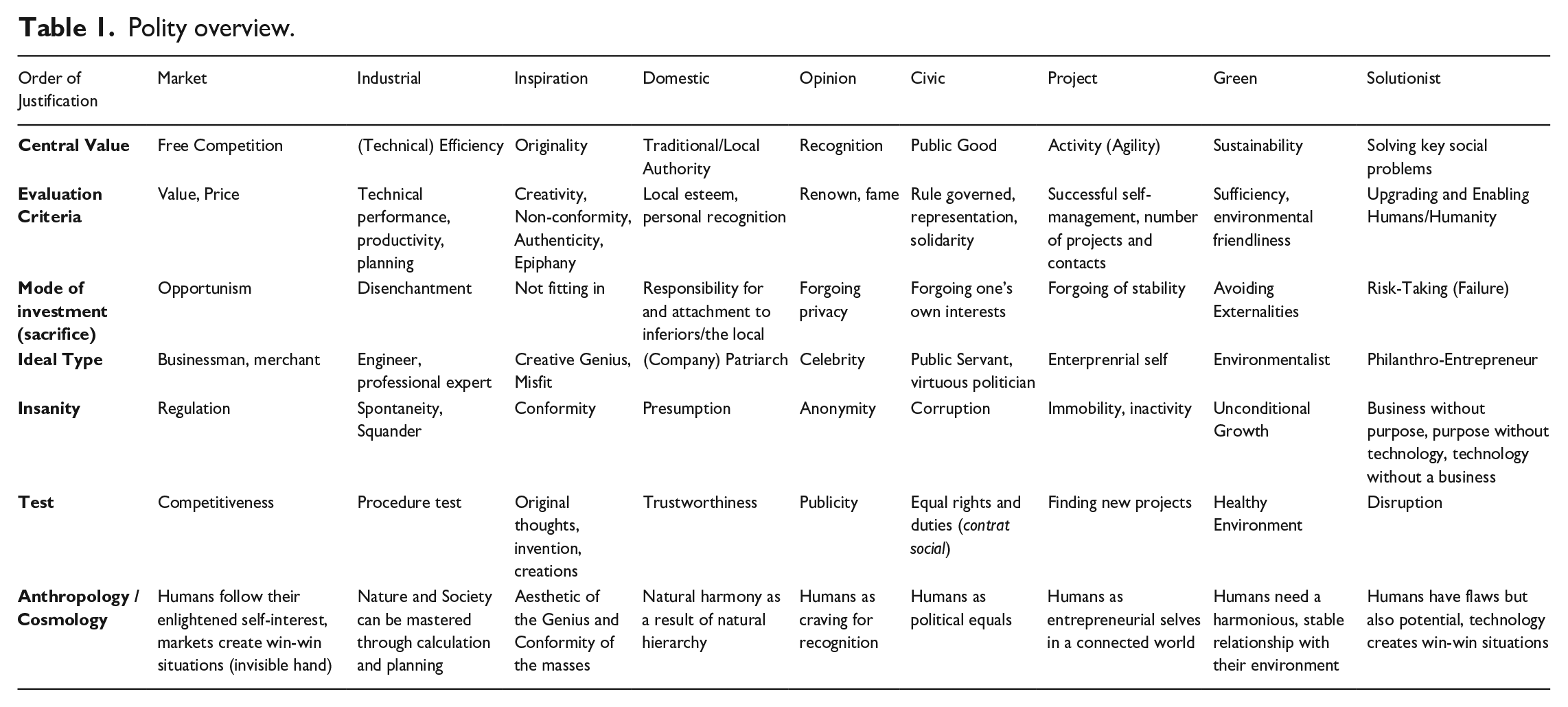
The spirit of capitalism – in its historical evolution – draws on and combines these orders of worth, tapping into the moral resources they provide (Boltanski and Chiapello, 2007: 16–19). It can be understood as the historically evolving combination of normative beliefs that motivate, legitimate, and orient the actions of capitalist actors at different moments in capitalist history. For example, during the heyday of the managerial capitalism of the 20th century, the industrial polity – with its emphasis on rational organization and bureaucratic planning – becomes dominant at the expense of the domestic polity – the manager replaces the company patriarch as capitalism’s heroic figure. Similarly, in the 1970s, a new spirit of capitalism formed around the project-based polity and its values of agility, flexibility, and collaboration (Boltanski and Chiapello, 2007). Today, we argue, we see yet another spirit emerge in which an ethic of solutionism 2 takes center stage, but which – like its predecessors – continues to draw on multiple orders of worth.
The Ethic of Solutionism
Evgeny Morozov defines solutionism as an ideology that recasts ‘all complex social situations either as neatly defined problems with definite, computable solutions or as transparent and self-evident processes that can be easily optimized – if only the right algorithms are in place’ (Morozov, 2013: 5). Building on Morozov, we conceive of the solutionist polity as an order of worth in which value or worthiness derives from solving social problems with technological means. This implies a view of the world in which all relevant social problems can, in principle, be solved technologically; in which there is a technological hammer for every social nail. Social problems are not the result of asymmetries in power or wealth that call for a political solution. Rather, they are the result of inefficiencies and deficiencies that can be eliminated with the right technology (Slee, 2016).
While digital technologies have massively amplified the reach and appeal of solutionist ideas (Morozov, 2013: 15–16), solutionism is not a product of the digital era but has deeper roots: in the culture of engineering and its belief that there is a ‘technological fix’ to all societal problems (Johnston, 2017) as well as in the ‘New Communalist ethos of tool use’ (Turner, 2006: 238) and their faith ‘that experimentation and the proper deployment of the right technologies could save the world’ (Turner, 2006: 244). These techno-optimist tendencies are amplified by the culture of coding, which nurtures an ‘almost aesthetic [. . .] dislike for inefficiency’ (Thompson, 2019: 21); and a hubristic control illusion that understands social problems in the same way as coding problems by extrapolating from the programmer’s intuition that one ‘can program any procedure [one] thoroughly understand[s]’ (Weizenbaum, 1976: 103–4). Such ‘computational thinking’ (Denning and Tedre, 2019) is perfectly epitomized by Mark Zuckerberg’s belief that the ‘first principle’ of engineering is to ‘think of every problem as a system and every system can be better. No matter how good or bad it is, you can make every system better’.
But despite the importance of technology, solutionists are more than just engineers or coders. They are, in Schumpeter’s sense, not inventors but innovators. An invention that cannot be commercialized is a bad invention. Larry Page realized this early, when reading a biography of Nicola Tesla, who was a brilliant inventor but a terrible innovator:
‘You don’t want to be Tesla. He was one of the greatest inventors, but it’s a sad, sad story. He couldn’t commercialize anything, he could barely fund his own research. You’d want to be more like Edison. If you invent something, that doesn’t necessarily help anybody. You’ve got to actually get it into the world; you’ve got to produce, make money doing it so you can fund it.’ (quoted in Serwer, 2008)
Therefore, to really make a difference, the solutionist needs to be an entrepreneur as much as a technologist. But solutionists are not just entrepreneurs; they are philanthro-entrepreneurs. In the solutionist worldview, making money and making the world a better place are not contradictory but can and should go hand in hand. Silicon Valley, as Tom Slee put it, ‘may have its share of the world’s richest people, but it has always seen itself and presented itself as being about more than money: it’s also about building a better future’ (Slee, 2016: 9). The solutionists not only abhor the lone inventors, who know their way with technology but have no business model. They also reject those who, like bankers on Wall Street, lack purpose and are only in it for the money.
But purpose alone – without technology and a viable business model – is equally flawed. Hence the rejection of traditional politics as the best way to address social ills – a rejection that echoes the New Communalists’ turn ‘toward social and economic spheres as sites [of] social change’ (Turner, 2006: 244). Solutionism shares this sentiment with philanthrocapitalism – the idea and practice of applying a business logic to philanthropy in order to make it more efficient, impact-oriented and financially profitable (McGoey, 2012). But while philanthrocapitalism is about the ‘idea that charity is good business’ and can therefore be profitable (McGoey, 2012: 187), solutionism is about the idea that business itself can be philanthropic.
In the solutionist worldview, there is a natural alignment between business opportunities and social problems. We live, as Silicon Valley guru Peter Diamandis puts it, in ‘a world where the biggest problems on the planet are the biggest market opportunities’. Philanthropy is thus neither a separate stage of life nor a more or less profitable side business. Traditional philanthropists in the wake of Carnegie had espoused the idea that ‘after-the-fact benevolence justifies anything-goes capitalism; that callousness and injustice in the cutthroat [marketplace] are excused by later philanthropy’ (Giridharadas, 2018: 164). For solutionists, doing good is not an atonement for doing well, but simply the other side of the same coin. ‘It’s been a yin and yang equation’, as Tom Werner once put it: ‘We’re changing the world on one side and building a great company on the other side’.
Capitalists have of course long believed that the invisible hand of the market will transform private vices into public benefits. Solutionists, by contrast, believe that the companies with the grandest purpose will miraculously also be the companies with the biggest profit. Underlying this idea is an ‘almost religious faith’ (Giridharadas, 2018: 41) in the harmony of human interests and the ability of technologies to create win-win situations (cf. Brandtner and Bromley, 2022).
What’s amazing about tech [. . .] is that there are so many opportunities to have your cake and eat it, too [. . .] There’s a stereotype that you have to choose in life between doing good and making money. I think for a lot of people that’s a real choice [. . .] But for technology, there are a significant number of opportunities – Google search being the most massive example of all time – where we simultaneously are doing something lucrative and really good for the world. [A] lot of times you can get in situations where they’re all aligned, where the bigger the reach of the good you’re doing, the more money you’ll make. (Justin Rosenstein in Giridharadas, 2018: 41)
This notion is based on a worldview that understands the world as simultaneously flawed and full of potential. This is not just about gradually improving production processes in the name of (technical) efficiency as in the industrial polity. Instead, it is about the much grander idea that the entire social world is full of bugs but can also be fixed with the right technology and entrepreneurial mentality. It is therefore every solutionist’s calling to upgrade humanity by becoming a social engineer in the true sense of the word, culminating in a apotheosis of disruption and ultimately a transhumanism that others have likened to ‘messianism’ (Daub, 2020) or the ‘birth of a religion’ (Lanier, 2017). Animated by the normative power of the possible, solutionists have little respect for the status quo – and the institutions that maintain it. Breaking the law thus becomes civil disobedience in the name of a better world. ‘You can’t change the world without a certain amount of healthy willingness to break the rules’, as Sebastian Thrun once put it. In the end, what constrains the solutionist quest to solve humanity’s oldest problems – old age, sickness, death – should only be the laws of physics, not those of society.
Data and Empirical Approach
To test our arguments, we collected three novel text corpora. Each corpus serves a distinct analytical purpose (for details on the corpora, see online Appendix A1–A3). The first corpus consists of public statements of digital elites in which they talk about themselves or their worldview (e.g. interviews, speeches). Digital elites are narrowly defined as members of the 2015 Forbes 400 who played crucial roles (e.g. founder, CEO, major investor) in tech companies founded after 1996, and therefore made most of their money in the last 20 years or so (it thus excludes ‘first-generation’ digital elites like Bill Gates and Steve Jobs). The purpose of this corpus – which consists of 2,326 paragraphs – was to identify the spirit of digital capitalism where we would most expect it: in the professed beliefs of the most recent generation of digital elites – individuals like Larry Page, Mark Zuckerberg or Elon Musk (cf. Brockmann et al., 2021: 16). These are the (mostly) men that Little and Winch (2021) call the ‘new patriarchs of digital capitalism’ and whose close-knit ‘networks of power’ are central to the inner workings of digital capitalism.
The second corpus consists of articles published in Wired between the magazine’s founding in 1994 and 2018. After removing very short paragraphs, we ended up with a total of c.1.5 million paragraphs. Wired is widely known as the house organ of the tech community. It is thus the perfect medium to understand the intellectual proclivities, fads, and currents of the wider tech milieu (Fisher, 2010: 245; Wolf, 2003). The third corpus consists of articles published in the Harvard Business Review (HBR) between 1980 and 2018. Again, after removing very short paragraphs, this resulted in a total of c.190,000 paragraphs. The purpose of this corpus is to check to what extent the spirit of digital capitalism has already diffused into the mainstream of management literature and popular capitalist self-reflection – epitomized by the HBR (Schulz and Nicolai, 2015).
To identify and trace normative references, we developed a comprehensive coding scheme through a reflexive process of theory-building and empirical validation in which the orders of worth were specified and disambiguated in multiple rounds of coding. Our units of analysis were paragraphs, as they can be seen as natural units of meaning; they often make ‘a point’ and are short enough to be relatively unambiguous and long enough to be informative. Paragraphs were assigned to a polity when they contained a clear and affirmative reference to one of the defining dimensions – and especially the central value – of a polity as laid out in Table 1 and further specified in the coding scheme (which we make available as a separate document). If paragraphs were purely descriptive or did not unambiguously refer to one polity, they were assigned to a residual category. Here are two examples of paragraphs that were coded as solution and market respectively:
(1)‘We are investing in driverless technology [. . .], why? Well a million people a year die in cars, and how many more millions get injured, it’s just needless, right, and how much time, how much worse are our lives because we’re sitting there with a steering wheel [. . .] [But] when you can give people their time back, and when you run these cars more efficiently and there’s no more traffic, this is magic.’ (2) ‘We are thinking in terms of purely commercial, business relations. Neither “friendship” nor “international cooperation” can be an excuse for not making a profit. These new ventures are very important strategically for us.’
Since our dataset contains several hundred thousand paragraphs, we used a supervised learning approach to estimate category proportions for the corpora based on a set of hand-coded paragraphs. This requires (i) ensuring intercoder reliability for the 1,518 hand-coded paragraphs, (ii) inferring category proportions in the unlabeled documents, which we did using a method of automated nonparametric content analysis (Hopkins and King, 2010; Jerzak et al., 2022), and (iii) validating the supervised learning model. For reasons of space, we detail these three steps and why each of them gives us confidence in our findings in online Appendices B1 to B3 and C. 3
The Rise of the Spirit of Digital Capitalism
So far, we have developed our paper in three steps. First, we reconstructed the concept of the capitalist spirit and have operationalized it as the historically evolving combination of different ‘orders of worth’ that each provide different criteria for what is good, just, and fair. Second, we introduced the solutionist order of worth in which value derives from solving social problems with technological means. Third, we proposed an approach to identifying and tracing different normative claims in three text corpora that respectively focus on digital elites, the wider digital milieu, and capitalist discourse at large. We now turn to presenting our findings, and then discuss their significance in light of illustrative observations and the secondary literature.
A first finding concerns the professed normative beliefs of digital elites themselves. Figure 1 shows which normative ideas – operationalized as orders of worth – these elites most often refer to in their public speeches and interviews. It clearly shows that solutionist ideas are a central normative reference point for digital elites. Around a quarter of normative references digital elites make are about the ability of technology to address central problems humanity faces. In addition, normative references that express a faith in the blessings of the market and the value of efficiency are also very common. References to green polity, by contrast, are remarkably absent. This, however, is not entirely surprising. Reminiscent of older discussion on applying knowledge and engineering to managing the environment in the Anthropocene (e.g. Crutzen and Stoermer, 2000: 485), Silicon Valley’s emerging ‘green brand of capitalism’ (Bialy et al., 2022) views ecological problems largely through the normative lens of solutionism. That is, it views them as problems to be solved with technology, rather than through a stronger emphasis on the green polity’s values of sustainability and sufficiency. Overall, these findings chime well not just with what we might expect, but also with other quantitative and qualitative research on tech elites.
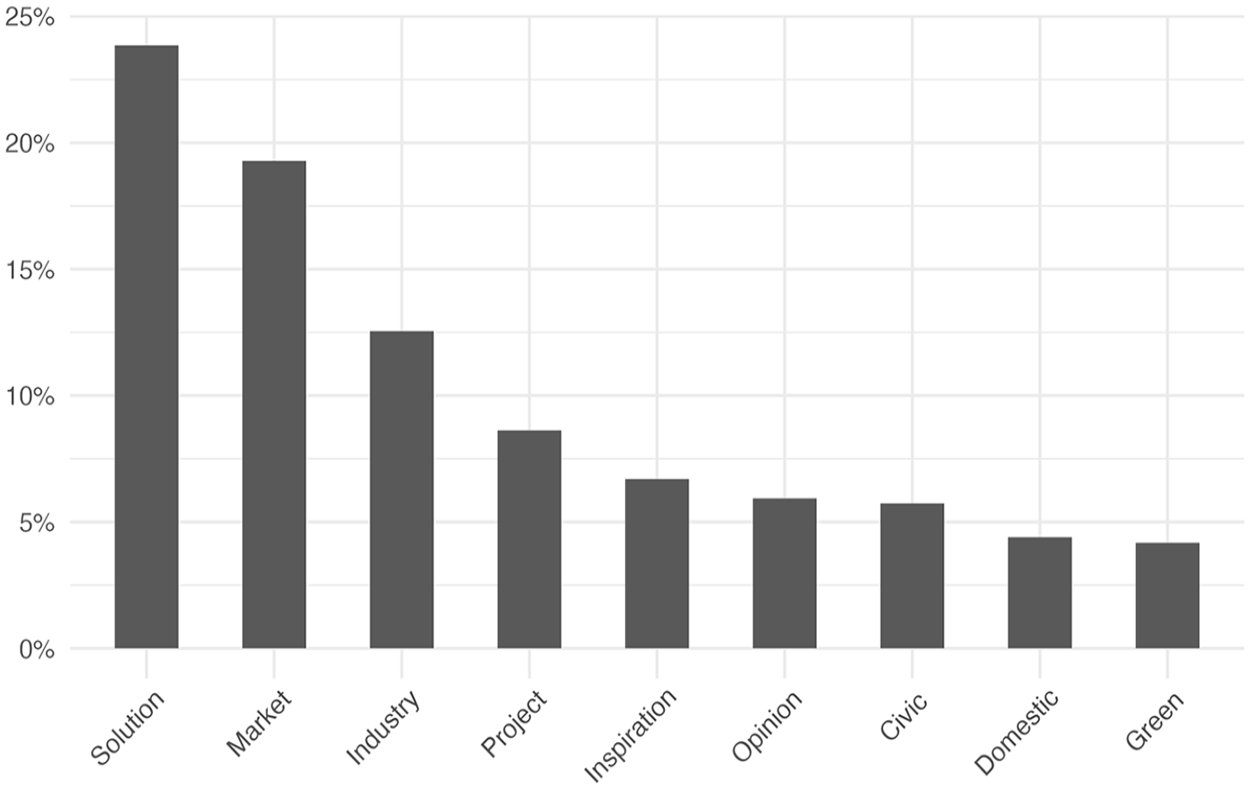
References to different polities in statements by digital elites.
First, a survey of tech entrepreneurs from 2017 shows that while they have culturally progressive, cosmopolitan, even socially redistributive attitudes, they strongly oppose government regulations and public services (Broockman et al., 2019). Digital elites are more concerned about social problems than other business elites, but they don’t think that addressing them should just or primarily be the government’s responsibility. Instead, they trust the invisible hand of the market steered by the helping hand of solutionist businesses. Hence there is no need for regulators to meddle with the world-improving endeavors of digital companies. Second, a quantitative analysis of tweets and philanthropic documents of digital elites also finds that they have a distinct mindset that distinguishes them not only from the general population but also from other wealthy elites – a mindset that is particularly ‘meritocratic’ and ‘mission-driven’ (Brockmann et al., 2021).
Third, detailed qualitative analyses that focus on Facebook specifically have also found that Mark Zuckerberg displays an almost ‘prophetic ethos [when trying to] persuade the public about Facebook’s vision for the future of sociality’ (Hoffmann et al., 2018: 214); and that Facebook strategically constructs a ‘corporate future imaginary’ (Haupt, 2021: 239) in which Facebook itself plays a crucial infrastructural role in connecting the ‘global community’. In doing so, it uses a solutionist ‘corporate prophesy’ (Haupt, 2021: 254) to make itself appear essential in bringing about a ‘better world’. We also find many references to the solutionist – in addition to the civic and project-based – polity in an additional analysis of Zuckerberg’s public utterances (compiled in the ‘Zuckerberg Files’). This further corroborates the centrality of solutionism to how digital elites publicly talk about their values and ambitions (see online Appendix D).
Given the central roles of these ‘celebrity tech founders and their networks of power’ (Little and Winch, 2021) in contemporary economies and societies, understanding the beliefs they hold – or even profess to hold – is crucial to understanding the course and character of digital capitalism more broadly. For example, through the role in shaping the moral and ideational background of political debates (cf. Abend, 2014), solutionist beliefs can help us understand the discursive politics of economic policymaking in the digital age, namely why the Silicon Valley model had such outsized influence on policymakers’ expectations about future growth and how it can help performatively create and sustain hegemonic social blocs (Rothstein, 2021). Likewise, solutionist beliefs are a ‘constitutive element’ of a ‘scalability zeitgeist’ that increasingly permeates public policy thinking and its newfound interest in ‘mission-oriented innovation’ or experimental ‘living labs’ (Pfotenhauer et al., 2022: 3, 6).
A second finding concerns the questions of whether solutionist beliefs have spread beyond the exclusive circle of digital elites and affected the wider digital milieu. Figure 2 depicts the evolving importance of different orders of worth in Wired, widely considered ‘the mouthpiece of the digital revolution’ (Wolf, 2003: 52). First, we find many references to the values of non-conformity, authenticity, flexibility, and anti-regulationism of the inspiration, market and partly also project polity – especially in the 1990s. But we also find significant references to the solutionist polity which, while lower than in the statements by digital elites themselves, increase after the bursting of the dot.com bubble and again after the financial crisis, just when the market and the project-based polity lose importance.
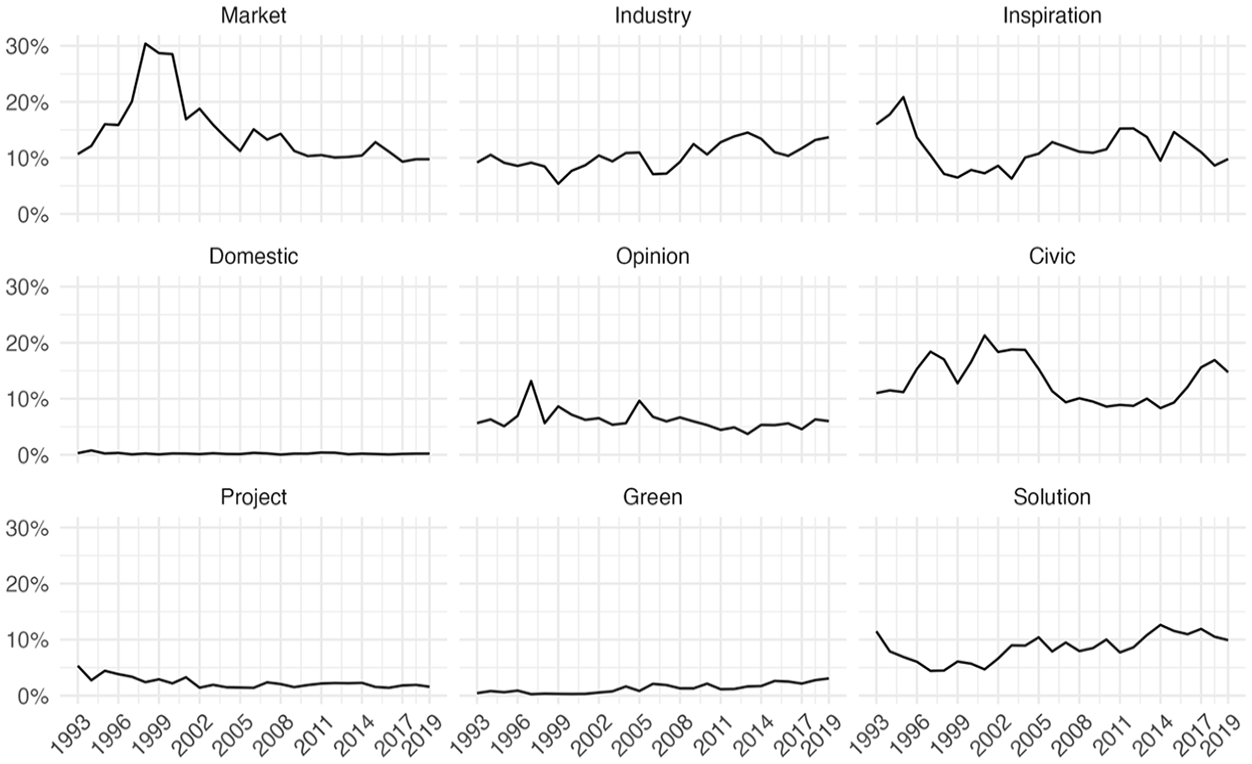
References to different polities in Wired (1993–2019).
This chimes well with the argument about the triangular relationship between capitalism, its spirit, and its critics (Chiapello, 2013). After all, the idea that the purpose of business is not just to make profits but to solve social problems is a powerful counterpoint to social critics who decry the moral parochialism of the shareholder-value doctrine and the self-referential and crisis-prone nature of financial capitalism (Kazmi et al., 2016: 749). 4 Thus, at a time when capitalism was increasingly criticized for producing private but not public wealth and for creating rather than solving social problems, solutionism lent legitimacy to entrepreneurs who promised to harness the power of technology for the common good. The new spirit of capitalism had incorporated the artistic critique of managerial capitalism as overly hierarchical and bureaucratic by singing the praises of flat hierarchies, de-centralization, flexibility, and self-reliance – all highly congenial to the demands of a postindustrial economy. Similarly, the spirit of digital capitalism responds to the charge of selfishness and lack of concern for the common good by highlighting the ability of digital companies to solve social problems. This return of social critique can also be seen in the ‘post-neoliberal subjectivity’ of tech workers, namely their desire for being ‘middle-class wealthy and morally worthy’ (Dorschel, 2022: 1303), although many of them are more critical of naïve forms of solutionism.
This suggests that starting in the early 2000s, we have seen a shift in the dominant technology discourse, which is ‘inextricably linked’ (Fisher, 2010: 243) to the capitalist spirit itself. For example, whereas Fordist technology discourse had extolled the ability of technology to mitigate the exploitative aspects of capitalism (instability, insecurity, inequality), post-Fordist technology discourse promised to overcome ‘the alienating components of capitalism’ while downplaying ‘its exploitative components’ (Fisher, 2010: 235). Indeed, many have argued that the internet has amplified the appeal and reach of the new spirit of capitalism, with a ‘spirit of networks’ (Fisher, 2010: 243) making ‘the network a normative model’ (Boltanski and Chiapello, 2007: xxii) and serving as the ‘ethical foundation of the network enterprise’ (Castells, 2010: 214). Drawing on a long history of cybernetic and countercultural ideas, the digital entrepreneurs of the late 20th century believed that the internet would help them do
what the New Communalists had failed to accomplish: [. . .] tear down hierarchies, undermine the sorts of corporations and governments that had spawned them, and, in the hierarchies’ place, create a peer-to-peer, collaborative society, interlinked by invisible currents of energy and information. (Turner, 2006: 209)
By joining ‘the cultural legitimacy of the counterculture to the technological and economic legitimacy of the computer industry’ (Turner, 2006, 219), these cybercultural apostles not only legitimized a hands-off approach to internet regulation. They also articulated a broader vision of a society – the Californian ideology (Barbrook and Cameron, 1996) – in which digital technologies would ‘marry the competitive demands of business with the desire for personal satisfaction and democratic participation’, achieving ‘productive coordination without top-down control’ (Taylor, 1994). The internet promised an escape from the iron cage of Fordism; it ‘became both a metaphor for [a post-Fordist society] and a means to bring it into being’ (Turner, 2006: 219).
But today’s ‘newest’ spirit of capitalism, as we have seen, reacts not so much to the artistic critique of the alienating aspects of capitalism as to the social critique of capitalism’s lack of solidarity and concern for the common good: it promises not to ‘flatten organizations, globalize society, decentralize control, and help harmonize people’ (Nicholas Negroponte quoted in Turner, 2006: 1) but solve society’s problems root and branch, from traffic deaths to death itself. Moreover, it arises in a technological and politico-economic environment characterized not by personal computers and the internet, with its decentralizing tendencies, but by the centralizing and scalable dynamics of platforms, big data and artificial intelligence (Pfotenhauer et al., 2022; Seidl, 2023). This is not to say that the values of the new spirit of capitalism are absent from the more recent technology discourse. For example, the values of engagement, sharing, and horizontality have recently diffused from the office space of the cadres into the social factory of the Web 2.0, promising digital laborers in symbolic rewards what they lack in material compensation (Yeritsian, 2018). But, due to changes in dominant forms of critique and technologies, we see a new emphasis on solutionist ideas and the ability of even large technology platforms to solve social problems ‘at scale’ (Pfotenhauer et al., 2022). It is this new emphasis on and centrality of solutionist ideas that defines the spirit of digital capitalism and distinguishes it from the more network-centered ‘new’ spirit of capitalism.
However, have solutionist ideas become influential beyond tech elites and the wider tech milieu and begun to characterize capitalist discourse at large? Our third finding is that this is not yet the case. Figure 3 depicts references to the different orders of worth in the Harvard Business Review – perhaps the central venue for capitalist self-reflection and a leading outlet of management discourse (Schulz and Nicolai, 2015). Unsurprisingly, we find that the values of the industrial and market polity play a prominent role in a magazine that is centrally concerned with the efficiency of organizations and the functioning of markets. Unlike in Wired, however, the projective polity becomes a lot more important in the 1990s while the civic and industrial polities lose ground. This strongly confirms Boltanski and Chiapello’s argument that the values of the flexibility and agility have partly replaced the values of technical efficiency and planning, which had their heyday in the age of Fordism. We therefore confirm that from the 1980s onward, the spirit of capitalism – as expressed in management discourse (which Boltanski and Chiapello based their analysis on) – has recentered around of the values of projective polity.
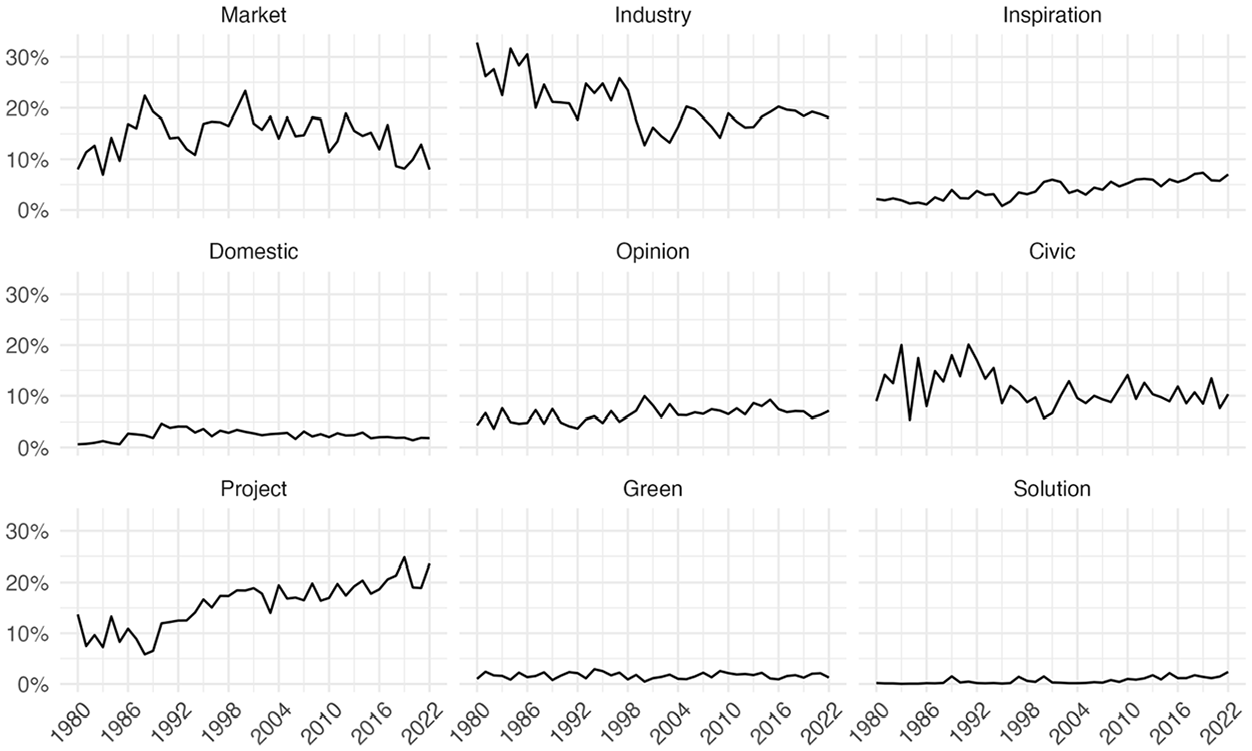
References to different polities in Harvard Business Review (1980–2022).
However, references to the solutionist order of worth remain marginal. For now, the new spirit of capitalism thus remains the dominant configuration of normative principles that justify capitalist action at large. Two developments might serve as a bridgehead for solutionist ideas to enter more mainstream management debates. First, there is a growing corporate social responsibility discourse that makes ‘the business case’ for social responsibility and advances a win-win narrative in which business and social goals are depicted as compatible or even complementary (Brandtner and Bromley, 2022). Second, there is an emerging debate among business scholars that businesses should go beyond the narrow fixation on maximizing shareholder value and instead (re-)focus on ‘producing profitable solutions to problems of people and planet’ (Mayer, 2018: 12). Even the Business Roundtable has recently moved away from the idea that the sole purpose of business is to increase shareholder value; instead, it encouraged companies to also invest in their employees, protect the environment and deal fairly with their suppliers.
The Legitimating, Motivating, and Orienting Role of the Spirit of Digital Capitalism
Our findings add important insights to the literature on the beliefs of digital elites and the broader cultural underpinnings of digital capitalism. However, we have not discussed how solutionist ideas actually influence the trajectory of digital capitalism. While not the primary focus of this paper, we want to briefly illustrate how solutionist ideas can have legitimizing, motivating, and orienting effects – regardless of whether or not solutionist beliefs are held disingenuously. 5
First, solutionist ideas can influence how the public and policymakers perceive digital companies. Securing their legitimacy is ‘a matter of [both] survival [and] reputation’ for companies (Kazmi et al., 2016: 753) and actively curating their public image is therefore essential to successfully managing the ‘non-market environment’ (Bach and Blake, 2016). We argue that the spirit of capitalism can amplify the effectiveness of such legitimacy-seeking strategies by shaping the ‘moral background’ (Abend, 2014) of public and political debates on capitalism (cf. Rothstein, 2021). For example, solutionism can help justify ideas as radical as Larry Page’s view that ‘[o]ld institutions like the law . . . aren’t keeping up with the rate of change that we’ve caused through technology’ and only hamper Google’s ability to ‘build really great things’ (quoted in Zuboff, 2019: 105). Much like the claim that ‘lawlessness is the necessary context for “technological innovation”’ (Zuboff, 2019: 104), solutionist ideas have also lent moral and cognitive plausibility to the promise of the Silicon Valley model that ‘serving tech’s and VC’s interests drives economic growth’ and thus profoundly shaped economic policymaking across advanced capitalist democracies (Rothstein, 2021: 7).
Second, their solutionist credentials helped tech companies convince their workers that their values and those of the company are aligned. Capitalism faces a perennial ‘deficit of motivation’ (Kazmi et al., 2016: 744). And while they can use the stick of deprivation and the carrot of money, there are limits to coercive and economic methods of ensuring compliance.
Workers have so many opportunities to take advantage of employers that it is not wise to depend on coercion and financial incentives alone as motivators. Employers want workers to operate autonomously, show initiative, use their imagination, and take on extra tasks not required by management; workers who are scared or dejected do not do these things. (Bewley, 1999: 431)
Companies are thus incentivized to employ methods of normative compliance which instill identification with the company based on shared values and symbolic rewards (Etzioni, 1975). We argue that by drawing on (and often appropriating) normatively appealing ideas, the spirit of capitalism can help companies create normative compliance and attraction. This can be especially important when work is complex and workers in high demand, as is true for digital companies. Reporting, for example, has shown that tech workers care about the ‘mission of the company and what the companies are trying to achieve’, which is why Facebook had an increasingly difficult time recruiting talent ‘as the social stigma of working for Facebook began outweighing the financial benefits’ (Bowles, 2018). A recent study also found that for college-degree jobs, invoking a prosocial mission allows companies to pay workers less, suggesting that values might be a partial motivational substitute for money (Wilmers and Zhang, 2022).
Conversely, companies will suffer resistance if workers notice that solutionist commitments are disregarded. This became evident during the recent wave of tech worker protests. As one Googler noted, ‘we stood up because [. . .] we believe a strong ethical framework that values human life and safety is inseparable from positive technological progress [. . .] Before the [protests], a lot of Googlers had never considered the fact that their values might not be aligned with the values of leadership’ (Tarnoff, 2018). Thus, solutionist sermons are not just cheap talk but can powerfully motivate workers while also imposing real limitations on what companies can do without facing resistance (for the case of Google’s ‘Don’t be evil’, see Tiku, 2019).
Third, even if what digital elites publicly profess is not what they privately feel, solutionist ideas might still guide their profit-seeking activities by pointing them towards certain problems and away from others. Moral ideas, after all, have been shown to affect rational economic decision-making by offering plausible and appealing strategic goals in the face of uncertainty (Schröder, 2013). For example, when Mark Zuckerberg was urged to sell Facebook to Yahoo in 2006, he refused, arguing that he shared the ‘really deep belief that when companies are executing well on their vision they can have a much bigger effect on the world than people think, not just as a business but as a steward of humanity’ (Friend, 2015). Here, the idea that Facebook could be a ‘steward of humanity’ helped Zuckerberg make a decision laden with much uncertainty; Zuckerberg would have arguably decided differently were he only in it for the money. Similarly, John Doerr uses the missionaries-not-mercenaries heuristic to describe venture capital, and Google’s solutionist ambition to ‘organize the world’s information’ led it to build products long before they became profitable (such as Google Maps, which was released before the smartphone revolution).
Conclusion
In this article, we have revisited and revised the concept of the capitalist spirit. We have shown how a new, solutionist spirit of digital capitalism has formed in which the idea that there is a profitable technological solution to every social problem takes center stage. We have also shown that while this spirit shapes the normative discourse of digital elites and the wider digital milieu, it does not yet define capitalist discourse at large. Here, as our findings confirm, Boltanski and Chiapello’s new spirit of capitalism is still dominant. If digitalization continues apace, this may of course change, with solutionist ideas spreading beyond their cultural crucible in Silicon Valley. We caution, however, against understanding the diffusion of solutionist ideas all too simplistically. Rather, we expect complex dynamics of culturally and institutionally mediated translation as solutionist ideas are taken up by non-US tech elites and companies (cf. Rothstein, 2021: 19); of selective appropriation as tech workers navigate their desire to be both ‘middle-class wealthy and morally worthy’ while keeping a critical distance from the naïve solutionism of their bosses (Dorschel, 2022: 1303); and even in the ambiguous embrace by many policymakers of ‘mission-oriented’ policies in response to ‘grand societal challenges’ – policies that, despite their critical credentials, cannot help but smack of solutionism (Pfotenhauer et al., 2022).
But what about digital capitalism’s recent legitimation crisis? Aren’t the tech giants, long heralded as agents of capitalist rejuvenation and societal progress, increasingly seen as the BAADD guys: ‘big, anti-competitive, addictive and destructive to democracy’ (The Economist, 2018)? While this ‘techlash’ is real and by no means over, we warn against writing off solutionism too early. For one, digital companies have developed a kind of second-order solutionism where they promise technological solutions to problems that their own technologies have created. Co-opting the criticism that they have hijacked people’s minds with their addictive and distracting technologies, tech companies have developed technological fixes to these primary technological and business defects, such as apps that help users understand their habits and nudge them towards more healthy ones. In the case of Facebook’s ‘Time Well Spent’ initiative, they even co-opted the slogan of their most prominent critics at the Center for Humane Technology. This proactive and soft appropriation of ‘tech-humanist’ ideas ‘may provide Silicon Valley with a way to protect that power from a growing public backlash – and even deepen it by uncovering new opportunities for profit-making’ (Tarnoff and Weigel, 2018).
Second, digital companies have aggressively used solutionist rhetoric to legitimize their move into new areas like health care, education, or climate change. Even before the pandemic, Google and Apple promised to use their technological prowess to ‘transform health care’, ‘improve outcomes’ and ‘save lives’. With the pandemic, they have teamed up ‘to harness the power of technology’ to help countries combat the pandemic more effectively, while Facebook wants to help use humanity’s ‘new superpower’ to fight the pandemic: ‘the ability to gather and share data for good’. The pandemic has thus accelerated digital companies’ move into semi-public sectors and recharged or supercharged their solutionist credentials.
Moreover, new technologies such as artificial intelligence or quantum computing have reinvigorated solutionist beliefs. For example, Microsoft’s head of quantum computing wants ‘to solve some of the world’s hardest challenges with the quantum machine’. She argues that only ‘quantum computing will enable us to solve [. . .] the challenges facing humanity’ today; challenges such as climate change or sustainable food production (Svore, 2023). Similarly, Thomas Friedman speaks of a ‘New Promethean Moment’ in the context of recent advances in artificial intelligence, arguing that the ‘potential to use these tools to solve seemingly impossible problems – from human biology to fusion energy to climate change – is awe-inspiring’ (Friedman, 2023). Perhaps not unsurprisingly, then, the newest generation of tech elites around OpenAI’s Sam Altman continues to be ‘resolutely upbeat’ and convinced ‘that with money and brains they can reboot social progress’ (The Economist, 2022).
Understanding solutionism better – including through more detailed qualitative and quantitative analyses of their effects – thus remains crucial to understanding a world in which ‘the solutionist toolkit [becomes] the default option for addressing all our existential problems – from inequality to climate change’ (Morozov, 2020; see also Bialy et al., 2022).
Supplemental Material
sj-zip-1-tcs-10.1177_02632764231196829 – Supplemental material for The Solutionist Ethic and the Spirit of Digital Capitalism
Supplemental material, sj-zip-1-tcs-10.1177_02632764231196829 for The Solutionist Ethic and the Spirit of Digital Capitalism by Oliver Nachtwey and Timo Seidl in Theory, Culture & Society
Footnotes
Acknowledgements
We would like to thank Johannes Truffer, Kemal Yüksel, Jacqueline Kalbermatter, Joshua Klein, Gerhard Lauer, Nicole Philipp-Jahnke, and Matthias Zaugg for their incredible help during various stages of this research project. Without them, this paper would not have been possible.
Funding
The author(s) disclosed receipt of the following financial support for the research, authorship, and/or publication of this article: Schweizerischer Nationalfonds zur Förderung der Wissenschaftlichen Forschung (Grant number: 183066)
Notes
 .
.
References
Supplementary Material
Please find the following supplemental material available below.
For Open Access articles published under a Creative Commons License, all supplemental material carries the same license as the article it is associated with.
For non-Open Access articles published, all supplemental material carries a non-exclusive license, and permission requests for re-use of supplemental material or any part of supplemental material shall be sent directly to the copyright owner as specified in the copyright notice associated with the article.
