




Abstract
This article engages with current discussions on the politics of aesthetics to theorize the role of popular art in reproducing or contesting urban orders. Specifically, we engage with scholars who have taken up the work of Jacques Rancière to understand how power structures are normalized through ‘the distribution of the sensible’. Building on and critically engaging with debates on the ‘post-political city’, we suggest that all too often scholars fall back on a binary, state-centric approach that depicts non-state popular aesthetics as either revolutionary and disruptive, or as indicative of an alternative form of oppression. Drawing on our work in Kingston, Jamaica, and Rio de Janeiro, Brazil, we argue that sensorial-political, art-based urban struggles shape multiple urban orders that are distinct but not necessarily antagonistic. Applying Stuart Hall’s work on popular culture to contexts of criminal governance, we show how art is often simultaneously supportive and disruptive of urban orders.
Introduction
Travelling through Rio de Janeiro on a Friday night, at some point one would likely feel the low-frequency vibrations of a baile funk street party. Many of these parties take place in low-income favelas, some of which are adjacent to wealthier residential areas. The thumping bass, emanating from colossal walls of amps positioned at favela squares or crossroads, reverberates across great distances, reaching the ears of residents within and beyond the neighborhood. These funk parties are a core locus of socio-political struggle, reflecting both the structural violence of urban marginalization and the physical violence of armed confrontations between state and non-state groups. Funk’s detractors argue that the music and parties celebrate criminality, while the genre’s champions contend that they provide space for marginalized youth to express the hardships of favela life, including the experience of police brutality. In the years leading up to the 2016 Olympic Games, a wide-ranging security strategy that involved installing ‘pacification police units’ (UPPs) in favelas saw UPP commanders banning funk parties, using their ability to silence the music as a tool to regulate the behavior of favela youth.
In Kingston, Jamaica, the walls of low-income ‘inner-city neighborhoods’ tend to display a wide range of colorful murals, portraying national politicians, religious figures, reggae stars and sports heroes, but also deceased residents. Some of these memorial murals depict powerful ‘dons’, as criminal leaders are known, and shottas (gunmen) who died violently at the hands of the police or other gunmen. Most of these artworks are produced by professional street artists; they are generally commissioned by friends and family members of the deceased. While those commissioning the memorials may or may not be involved in criminal activities themselves, many residents view these murals as inscriptions of community history and recognize those portrayed as beloved friends or family members and as caring protectors, rather than as criminals (Meikle, 2020). The Jamaica Constabulary Force (JCF) disagree, citing the murals as a corrupting visual influence that legitimizes donmanship. Over the past decade, the police have engaged in an anti-mural campaign across Kingston, using ‘constabulary blue’ paint to erase portraits of alleged criminals and re-establish their own authority.
These two brief descriptions of conflicts around popular music and visual culture raise the question: what is the role of art and aesthetics in reproducing or contesting urban order? This article connects ongoing discussions in anthropology, geography and cultural studies to address this question. Specifically, we engage with how scholars working across these fields have engaged with Jacques Rancière’s work on the politics of aesthetics, which understands aesthetic forms as normalizing power structures through ‘the distribution of the sensible’, that is, the attunement of sensory perception toward a shared political norm. In urban studies – and urban geography in particular – Rancière has been at the heart of debates around the idea of the ‘post-political city’ (e.g. Swyngedouw, 2009, 2014), in which a neoliberal urban order has become culturally and sensorially hegemonic while ‘truly political’ forms of disruption have been evacuated. Such discussions tend to pit ‘the neoliberal state’ against the occasional ‘insurgent mobilization’ that occupies and resignifies urban space. While this scholarship has been important in articulating the spatiality of the distribution of the sensible, art itself has been largely absent.
In this article, we seek to refocus these debates by concentrating directly on the political work that art does in shaping urban order, drawing on readings of Rancière that engage with the sensorial dimension of artistic practices. In addition, we suggest a less state-centric perspective than has commonly been taken, emphasizing the work of sensorial-political, art-based urban struggles in shaping multiple urban orders, that are distinct but not necessarily antagonistic. We draw on examples from Kingston and Rio de Janeiro, where our research 1 focused on the political role of popular music, street dances and street art in shaping publics and legitimizing the political authority of criminal leaders. These leaders and the associated forms of popular aesthetics are often understood as either revolutionary and disruptive, or as indicative of an alternative form of oppression. We seek to tease out a more complicated, intermediate analysis that understands the art surrounding these forms of rule as a field of tension. Along the lines of Stuart Hall’s work on popular culture, we approach this art as simultaneously supportive and disruptive of existing orders, as a site of continuous sensory struggle over order.
In the following section, we start with a theoretical overview of scholarship on cities inspired by Rancière. Next, we show how Hall’s work helps us to analyze popular art as a site of struggle, and to go beyond state-centric analyses of urban order in understanding the workings of power through art. We illustrate this approach through the cases of Kingston and Rio de Janeiro, focusing on the sensorial-political work of art in relation to both state and criminal projects of rule – where the first case foregrounds the politics of visual aesthetics, the second case highlights the sonic and corporeal power of music and dance. In conclusion, we argue that our theoretical extension recenters analyses of the intersections of art and urban struggle to include urban places that are frequently marginalized, without relying on romanticized notions of the art of resistance.
Cities and the Politics of Aesthetics
In order to understand the role of popular art in the construction, maintenance and contestation of urban orders, we focus on the concept of aesthetics. We take as a point of departure an Aristotelian conceptualization of aesthesis, which refers to the totality of our sensory experience of the world and our comprehension of such experience (Meyer, 2009). More specifically, we draw on the work of Jacques Rancière (2004), whose concept of the ‘distribution of the sensible’ (partage du sensible) emphasizes the role of aesthetic forms and practices in organizing what is visible, audible, conceivable and speakable. The ‘sensible’ here should thus be understood both as ‘what makes sense’ and ‘what can be sensed’. According to Rancière, the political character of aesthetics is not found primarily in those instances when art is employed deliberately at the service of a given political actor or regime, but rather in its centrality to processes of carving up ‘spaces and times, of the visible and the invisible, of speech and noise’ (Rancière, 2004: 13).
The politics of aesthetics lies in the ability to shape a sensus communis, or common sense. Aesthetic forms attune sensory perception toward a shared norm, inscribing a sense of community by delineating people’s embodied discernment of what they have in common and what their role is within a community. This attunement of sensory perception – the production of what Rancière calls ‘consensus’ or ‘sensing together’ – is central to the formation of communities and subjects, in short to the formation of a sociopolitical order. Such an order, Rancière argues, is supported by a perceptual and conceptual regime, which structures how people feel and know that an order is normal, natural, and proper. Art – used in its broadest sense here to encompass a wide variety of aesthetic forms – can generate such feelings of normalcy, comfort, mutuality and belonging: consensus. But art can also reveal that what is perceived as normal reflects and reproduces a hegemonic order that should be changed because it is unjust; art can be a disruptive force that generates dissensus.
Understanding not only why sociopolitical orders persist, but also how they come to be challenged, requires attending to both consensus and dissensus, the crafting and the disruption of a shared sense experience. Rancière’s work highlights the role of aesthetics in supporting existing orders, but it also locates the political character of artistic practices in their capacity to redistribute the sensible. Art produces dissensus when it unsettles a consensus on social hierarchies that are experienced as the natural order. In discussing consensus and dissensus, Rancière connects consensus to ‘the police’, and dissensus to ‘politics’. The police, in Rancière’s conceptualization, is not an institution but rather a ‘symbolic constitution of the social’ – it stands for a ‘distribution of the sensible within which it becomes possible to define strategies and techniques of power’ (Rancière, 2010: 36, 95). The ‘truly political’, in contrast to the police, is that which disrupts, which reveals power and creates dissensus: ‘Politics, before all else, is an intervention in the visible and the sayable’ (Rancière, 2010: 37). Or, as Steven Corcoran (2010: 8) explains, politics ‘consists in the often short-lived moment when those who are excluded from the political order or included in it in a subordinate way, stand up and speak for themselves’.
Recent urban theory has engaged extensively with this work to understand how – and where – urban power structures are normalized or challenged through processes of consensus and dissensus. Keith Bassett (2014), for example, builds on Rancière to characterize spaces of politics as ‘in-between spaces’. He argues that such spaces are found particularly in rapidly growing global cities: ‘Such cities, riven by inequalities and tensions, offer varied frictions, cracks, and fissures where dissensual irruptions are more likely to occur within the police order’ (Bassett, 2014: 888). Similarly, Isabell Lorey (2014) highlights how the assemblies that played a central role across a global variety of Occupy movements enacted a Rancièrean form of politics. In the horizontal practices of speaking and decision-making that these assemblies developed, they ‘invent[ed] affect-based politics able to break through the neoliberal logic of working and living’ (Lorey, 2014: 46). Focusing on the consensual police order that such movements seek to disrupt, Erik Swyngedouw (2009, 2014) and Mustafa Dikeç (2013a, 2013b) take up Rancière’s writings to develop the idea of the post-political city. They mobilize this concept to suggest that contemporary cities have become de-politicized, as ‘truly political’ forms of disruption and dissensus have been largely evacuated. The ‘post-political’ city is governed by capitalists and technocratic managers who have achieved a neoliberal governmental consensus – a capitalist police order, or hegemony – that prevents us from imagining other, more radical possibilities for organizing urban life. This post-political, de-politicized form of governance is established by ‘including all in a consensual pluralist order and [by] excluding radically those who posit themselves outside the consensus’ (Swyngedouw, 2009: 610).
While we are sympathetic to these conceptualizations of urban politics, we suggest that the scope of these debates has still been rather limited. Specifically, the role of actual art, a fundamental part of Rancière’s oeuvre (Rancière, 2009, 2013), is largely ignored, or framed only in terms of the performative acts of street protests. Inspired by Rancière, Mustafa Dikeç (2013a) adopts an aesthetic approach to urban conflicts in Paris, analyzing stereotypical negative appraisals of the banlieue in terms of an aesthetic regime. Yet he has little to nothing to say about the actual shapes, forms and performances that constitute such a regime, or the genres and practices of storytelling that normalize it. Artworks and the political work of art, then, remain largely outside the scope of these urban studies debates.
To understand the political dynamics of urban consensus and dissensus, we argue for a more direct engagement with artistic forms and practices. We draw here on Rancièrean scholarship that locates the political work of art in its capacity to re-distribute the sensible: art ‘invents specific forms that link the realm of individual affect to a social way of being’ (Papastergiadis, 2014: 16). In particular, ethnographic studies of the political work of art have explored how specific aesthetic forms – music, livestreamed video, viral images – generate embodied, sensory experiences that generate ‘sensible’ forms of collectivity, that can either consolidate or disrupt hegemonic forms of politics (e.g. Jolaosho, 2015; Stalcup, 2016; Steingo, 2016).
In addition to focusing on urban art, we seek to extend analyses of the politics of aesthetics to consider multiple political orders. Much of the existing scholarship frames political struggle in terms of neoliberal oppression, promoted or enabled by the state, versus the possibilities of anti-capitalist and/or counterhegemonic resistance. In so doing, such research tends to assume one hegemonic consensual order and multiple dissensual sites of resistance. 2 Our own research in Rio de Janeiro and Kingston problematizes such an assumption of a single hegemonic order, suggesting that we attend to the existence of multiple consensual orders. These cities, like many others in the world, are characterized by multiple, hybrid political orders (Jaffe, 2013) in which state and non-state actors compete and/or co-produce rule and order, especially in marginalized urban areas. In such urban landscapes, power cannot be understood ‘as a monolithic and singular regime of rule, but rather as a fragmented domain of multiple and competing sovereignties’ (AlSayyad and Roy, 2006: 12). Recognizing the co-existence of different orders complicates the assumption that there is one dominant order that faces resistance from the margins. Our analysis of Kingston and Rio de Janeiro demonstrates that we cannot take European and North American cities as universal templates for the theorization of urban politics, although we hasten to add that representations of these cities as characterized by one dominant order tend to obfuscate the presence of multiple, hybridized orders outside ‘the Global South’. Cities across the globe display different types of governance actors, who compete and collaborate and who assert their presence through a variety of artforms.
Extending debates on the urban politics of aesthetics, then, this article asks: how does art shape political consensus and dissensus in cities, and how does it do so across multiple urban orders? To answer this question, we develop an approach that connects urban aesthetics to multiple political orders, as outlined in the following section.
Popular Art and Urban Order Beyond the State
To understand the urban politics of actually existing art, in cities characterized by orders beyond the state, we propose a conceptualization of urban order that engages more directly and explicitly with the social life of art. This approach involves analyzing how art – and specifically popular music, dance and visual culture – is entangled with multiple urban orders and their battles over urban territories. In Kingston and Rio de Janeiro, criminal organizations rule over particular urban zones and contest the state’s claim to the monopoly of means of coercion. Diane Davis describes such irregular armed forces – ‘non-state armed actors who wield coercive capacity that either parallels or challenges that held by the state’ – as playing a key role in fragmenting state sovereignty (2010: 398).
In such contexts, criminal organizations’ rule over these urban territories is established not only or primarily through force, but also through their engagement with various aesthetic forms that have become central to social life in these areas. They use music, parties and visual art to communicate and justify their presence. Here, attempting to understand urban order through consensus and dissensus requires thinking beyond the power of the state – in these zones, criminal organizations rather than the state are central to a hegemonic sensorial order. While it is tempting to suggest that such criminal organizations function as state-like organizations and can thus be substituted for the state in the framework of Rancière-inspired urban theory, the aesthetic contestations in these cities are more dynamic. They involve struggles between state actors and non-state sovereigns and residents, as state actors regularly attempt to regain coercive and cultural-sensorial power, while residents stage their own dissensual interventions in multiple orders.
A focus on the popular music and visual culture that emerges in such contested zones, we suggest, allows us to understand art as a key site where urban power struggles unfold, while moving beyond state-centered approaches. Art is where multiple types of sovereigns – both the state and criminal organizations – seek to establish aesthetic consensus, and the hegemonic sensory order this entails. Similarly, marginalized urban residents may attempt to effect dissensus, that momentary rupture in the normalized distribution of the sensible, by targeting either the consensus of the state-centered order, or that of the order generated by criminal organizations. To further complicate matters, the popularity and credibility of ruling criminal organizations – the naturalization of their rule through a particular distribution of the sensible – is sustained by their appropriation of the voices of those who are excluded from the state order. From this perspective, the popular music and visual culture that is rooted in favelas and inner-city areas cannot be classified easily as either aesthetic expressions of political resistance or expressions of immoral outlaws. 3
To understand this ambiguity of the politics of aesthetics, we draw on Stuart Hall’s understanding of popular culture (2019 [1981]). Hall argued forcefully that popular culture should not be understood as a simple tool of either oppression or resistance, as either hegemonic cultural form or counter-hegemonic domain of ‘the people’. Rather, he suggested understanding popular culture as an ongoing, complex site of struggle between different political forces, classed factions and/or ethnoracial formations, a site for negotiations over who ‘the people’ are (see also Morley, 2019). Where Rancière draws our attention to the sensory work of art, 4 Hall’s approach allows us to move beyond a priori dichotomies between state and non-state entities and to develop a broader view of how Rancière’s work can be mobilized to understand the role of popular aesthetics in urban politics.
In the following two sections, we illustrate this approach through the cases of Kingston and Rio de Janeiro. Each section starts with a brief introduction to the city and its socio-spatial contestations, followed by an analysis of how different artforms work to normalize and destabilize both state and criminal projects of rule. In both cities, street dances, popular music and visual art are frequently framed as anti-hegemonic expressions ‘of the people’ – in short, they might commonly be analyzed as enabling a dissensual rupture of the dominant state order by its marginalized antagonists. Yet, as we illustrate, these expressive forms are mobilized and reconfigured to articulate with multiple, distinct forms of consensus by more powerful groups – popular culture is a site of continuous sensory struggle over order. For Kingston, we analyze this ongoing process of contestation through a discussion of mural art; for Rio de Janeiro, we focus on funk dances.
Kingston
Kingston, the capital of Jamaica, is a city of some 670,000 people. In the popular imagination, it is generally understood as split into an ‘Uptown’ and a ‘Downtown’, a division that reflects a colonial legacy of ethnoracial stratification that overlaps with class. The wealthier Uptown areas are associated with, lighter-skinned ‘brown’ Jamaicans of mixed African, European and Asian descent; the ‘inner-city communities’ or ‘ghettos’ of Downtown Kingston are conflated with the low-income, darker-skinned ‘black’ African-Jamaican population. In many of these inner-city neighborhoods, dons – local leaders generally involved in criminal activities – play an important governance role. While their rule relies in part on the use of violence, they also provide impoverished residents with access to various public goods and services, from housing, financial aid and public parks to conflict resolution and security (Jaffe, 2013).
Dons gained their power through connections to Jamaica’s two main political parties. Even prior to Jamaica’s independence in 1962, dons worked as electoral brokers for politicians, mobilizing or intimidating voters in exchange for clientelist benefits such as housing and jobs. While these connections have remained, dons became increasingly autonomous in the late 20th century, as the transnational drug trade presented opportunities to become financially independent of their political patrons (Sives, 2010). The most powerful dons run criminal organizations that span continents, generating income from local extortion, national construction contracts and transnational drug trafficking.
Since the mid-20th century, then, dons were able to consolidate their position as informal sovereigns in Downtown Kingston. An important period of rupture was initiated in 2010 in what came to be known as the ‘Tivoli Incursion’, a major security operation aimed at arresting and extraditing Christopher ‘Dudus’ Coke, the island’s most powerful don. During this operation, the security forces killed 69 residents of Tivoli Gardens. In the years that followed this episode, the Jamaican state developed various strategies to dismantle the urban system of donmanship. Given that many inner-city residents consider the rule of dons to be largely legitimate, these strategies – which resemble Rio de Janeiro’s attempts at ‘urban pacification’ – have not only sought to remove criminal leaders, but also to enact a form of sensory rupture to destabilize the normalcy of the dons’ power.
In addition to their material provisioning role, dons’ projects of rule are also normalized by popular aesthetics (see Jaffe, 2012). Popular music, street dances organized in their neighborhood, and various visual interventions into these territories have all served to produce a Rancièrean consensus, in which it is ‘common sense’ that the socio-political order revolves around criminal leaders who govern ‘the people’ in their territory. In dancehall music, a more fast-paced, electronic form of reggae, various artists celebrate dons as valiant protectors of neighborhood residents, who articulate and enforce a clear moral order. In addition to such lyrical support, dons are also heroized through popular dancehall parties held in inner-city areas, either as ‘birthday bashes’ for living dons or ‘memorial dances’ for deceased dons.
A key site of contestation, however, has been in the visual realm. Jamaica has a long tradition – especially in low-income urban neighborhoods – of mural art, with portraits commemorating national heroes as well as local residents. The memorial murals that depict criminal leaders are often accompanied by captions that present them as fierce aggressors and protectors, but also as loving and beloved (Meikle, 2020). These texts range from the generic ‘We’ll miss you’ and ‘Gone but not forgotten’ to ‘Gangsta fi [for] life’ or ‘Mi know dem fear mi’ [I know they fear me] or ‘Real life legend, king of the streets / 1980s, 1990s, 2000s, the don forever’. Beyond such textual assertions, the murals often feature depictions of status symbols that serve to visually underline these leaders’ masculinity. They sport expensive jewelry and name-brand clothing and hold up bottles of imported liquor. Emphasizing their wealth and mobility, they pose next to fast cars and motorcycles, against backdrops of the skylines of foreign cities.
Such textual and visual tropes mobilize residents to accept and support the dons’ authority; they are part of a consensus, crafting a shared sense experience of don-based community. The murals intervene sensorially in residents’ visual regimes through the work they do in specific urban spaces. They are often located at intersections or key sites of public life within the neighborhood, shaping the visual experience of public order – this intentional siting allows the murals to mobilize the space of the streets to order residents’ perceptual and conceptual regime.
More broadly, these murals gain their efficacy through their insertion into a longer visual tradition of mural-based commemoration. Their capacity to normalize donmanship is rooted precisely in the fact that the murals depict dons in the same visual style as ‘legitimate’ heroes, from Jamaica’s official historical canon of National Heroes to more contemporary political leaders and popular icons. Dons are often painted directly adjacent to them, on the same walls. This is illustrated, for instance, in Figures 1 and 2, photos taken in an area formerly ruled by William ‘Willy Haggart’ Moore, the don heading the Black Roses Crew. Moore’s portrait adorns the wall to the left of the gate and the territorial marker ‘Roses’, while to the right we see former Prime Minister P.J. Patterson, reggae superstar Bob Marley, and former Prime Minister Michael Manley. The inclusion of these two politicians from the People’s National Party (PNP) also indicates the don’s allegiance with this political party – in fact, his funeral was attended by a range of prominent PNP politicians (Paul, 2007).
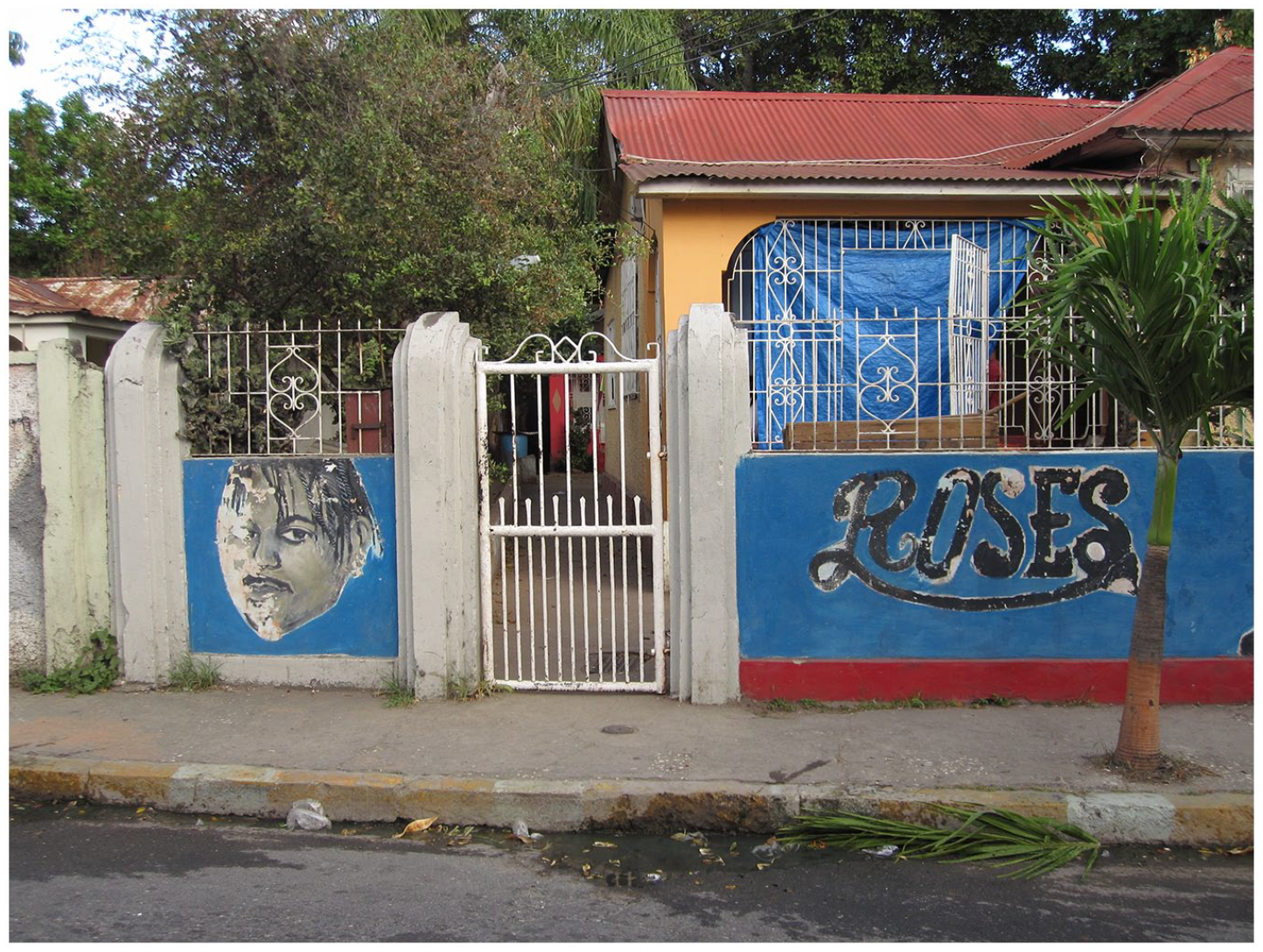
Mural celebrating don Willy Haggart. Kingston, Jamaica. Photo by Rivke Jaffe.
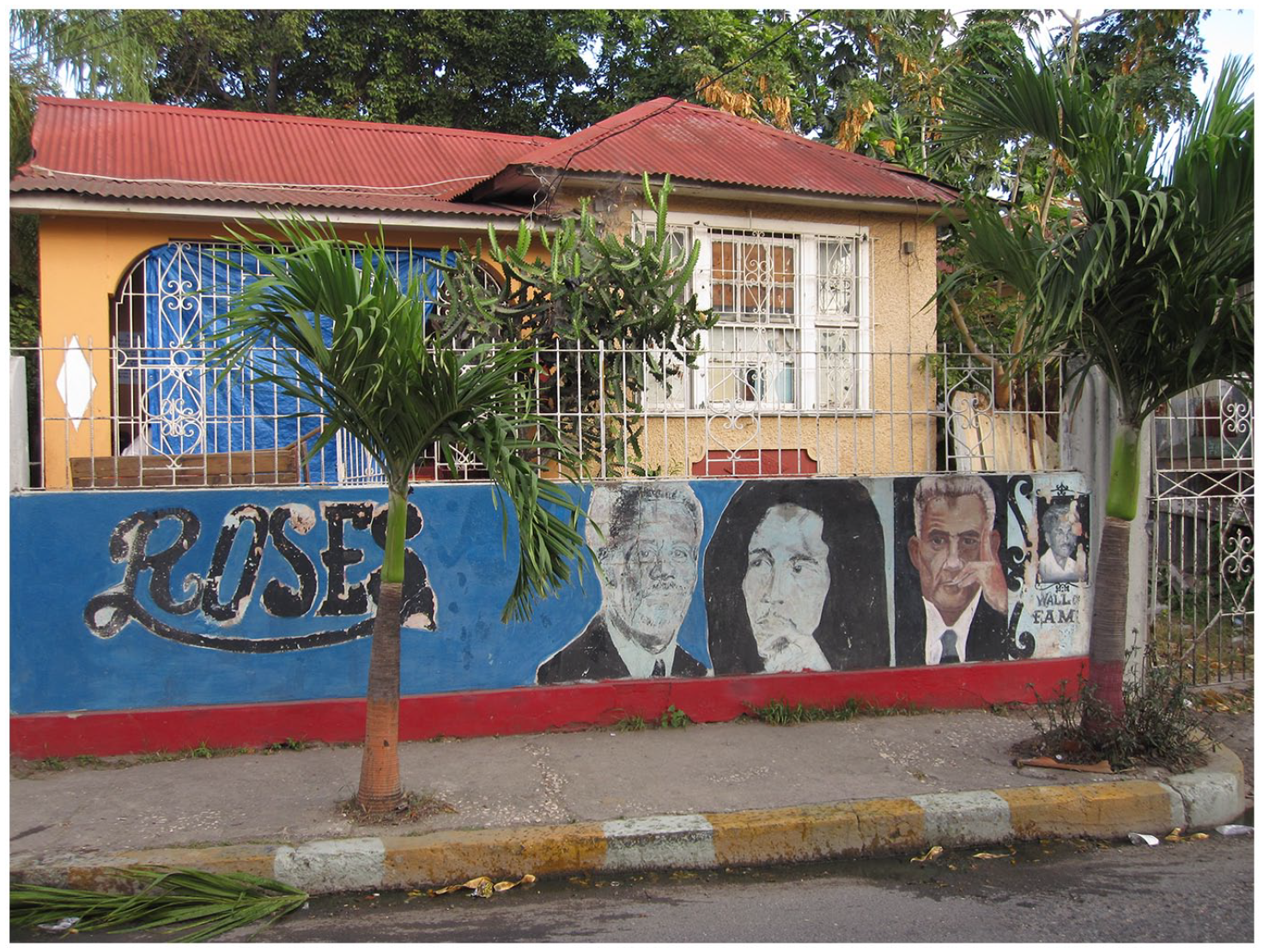
Mural celebrating don Willy Haggart. Kingston, Jamaica. Photo by Rivke Jaffe.
Such forms of juxtaposition and collage have been highlighted by Rancière as visual techniques that enable the emergence of new aesthetic regimes (Papastergiadis, 2014: 15). More broadly, these combined images of heroes are part of what Nicholas Mirzoeff (2011: 5), building on Rancière to analyze the visual constitution of authority across historical periods, calls ‘complexes of visuality’. These sensorial complexes ‘for[m] a life-world that can be both visualized and inhabited’ (2011: 5), in which visuality is the key element in making authority feel self-evident. Yet Mirzoeff acknowledges the layered character of visuality as it both generates countervisuality and leaves room for alternative visualities that are not necessarily antagonistic but range between opposition and neutrality (2011: 24). These dynamics of the visualization of authority are evident in recent contestations surrounding memorial murals.
Over the past decade, as part of a broader range of anti-gang measures – including attempts to criminalize dancehall lyrics ‘glorifying’ dons – the Jamaica Constabulary Force (JCF) has sought to disrupt the sensorial-political consensus that naturalizes the dons’ authority. In 2013, the police initiated an ‘anti-mural campaign’ and began to paint over the memorial murals of men they held to be dons. In a newspaper interview, the officer in charge of this campaign, Senior Superintendent McGregor, emphasized that this was a new era. ‘I’ve issued a warning to people that if any of these communities puts them back up and defies this new development they will feel the wrath of the police’, McGregor explained, stating that he wanted residents to have portraits of local athletes or high-achieving students painted in place of these ‘gang images’ (McFadden, 2013). This does not appear to have happened. Rather, the walls that previously featured dons are now painted over in ‘constabulary blue’, the JCF’s signature color. As Honor Ford-Smith (2014: 8) notes, ‘The murals express and make real a spatial claim: we are here, we have lost one of ours, and we grieve in our space. In painting them out, the police also make a spatial claim: this is not your space to do with as you please.’ We read the anti-mural campaign as a clear attempt to achieve a dissensus, aimed at challenging the normalcy of donmanship by erasing dons’ images. By inserting their own color scheme into the visual regime of the street, the police sought to aesthetically disrupt the status quo and to reorient residents towards accepting a new hegemony, appropriating the walls in an attempt to craft a new state-based consensus.
This campaign elicited some minor protests, with critics suggesting that it amounted to the erasure of community history and was censuring popular forms of memory. Such voices also underline the murals’ capacity to disrupt Jamaica’s dominant discourse on urban crime: Commemorative murals reframe official stories about violence from the standpoint of those who disproportionately suffer its effects. They dramatize how human beings, backed into a corner by the web of extreme inequality, struggle to reclaim dignity, outwit terror and violence through a complex and contradictory dance. (Ford-Smith, 2014: 15; cf. Ford-Smith, 2013)
Critics of the murals interpret them as a dissensual intervention that challenges the hegemonic state order, and this is not necessarily an inaccurate reading. However, such a framing plays down the extent to which, at the neighborhood level, donmanship itself has often become the dominant sensory-political order.
Might we, instead of seeing these murals in terms of ‘resistance’, understand them in relation to multiple, distinct forms of consensus? We suggest here that these expressive forms function as a site of ongoing sensory struggle over order – between dons, the state and residents. As the Willy Haggart mural above suggests, the visual juxtaposition of dons and politicians does not suggest an antagonistic relationship between dons and democratic leadership. Rather, it visualizes an order in which legal and extra-legal rulers can co-exist peacefully as part of the same system, blurring the lines between donmanship and the state.
However, more ‘bottom-up’ attempts at visual dissensus also exist, specifically through individual acts of vandalism. This is evident in the example of Trench Town’s wall of fame, which features local, national and international figures (see Figures 3 and 4). ‘Sons of the soil’, such as football coach Carl Brown and reggae musicians Alton Ellis and Dean Fraser, share the wall with Marcus Garvey, Barack Obama and Winnie Mandela. Also featured is Damian Brown, a reputed ‘badman’. Not long after the wall was painted, somebody expressed their disapproval of Brown’s presence amidst these other heroes, disfiguring his face by splattering it with black paint – a clearly dissensual act.
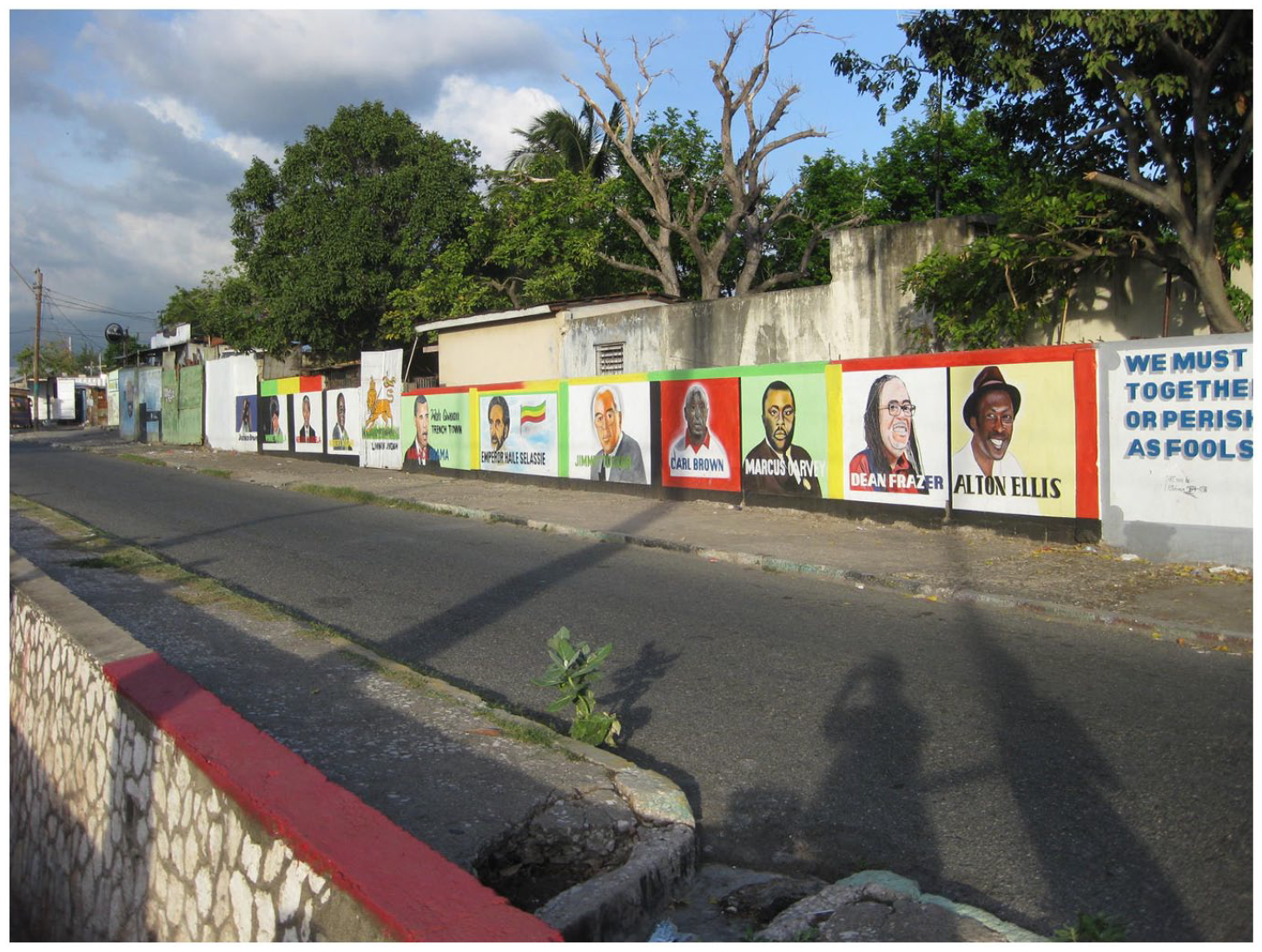
Heroes wall, Trench Town. Kingston, Jamaica. Photo by Rivke Jaffe.
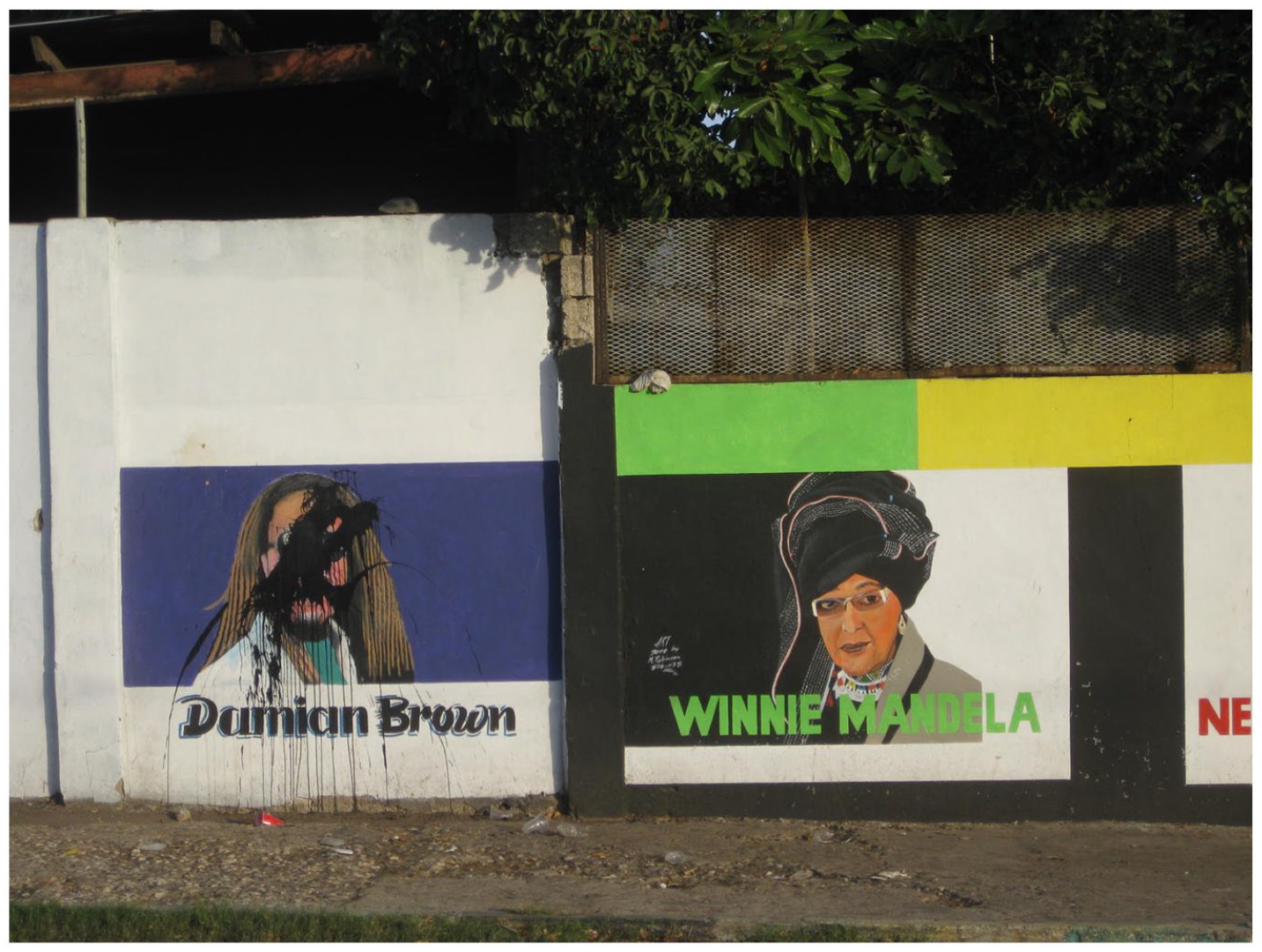
Heroes wall, Trench Town. Kingston, Jamaica. Photo by Rivke Jaffe.
As these examples suggest, reading the murals as a simple contest between oppressors and oppressed – either as an antagonistic expression contesting state rule, or as the aesthetic register through which dons control the urban poor – does not do justice to the complexity of these popular aesthetics. Rather, we suggest approaching them as a field of agonistic tension. As with Rio de Janeiro’s funk music, the murals work as a sensorial-political site in which the legitimacy of multiple orders is constantly being negotiated.
Rio de Janeiro
With a population of around 12.5 million residents, Rio de Janeiro is Brazil’s second largest urban agglomeration, after São Paulo. Rio’s cityscape reflects the country’s larger patterns of socio-economic inequality, with the gated communities of wealthy residents bordering impoverished neighborhoods. The socio-spatial opposition between morro (hill) and asfalto (asphalt) reflects the city’s segregation and socio-political struggles. Many of Rio’s morros are the site of so-called favelas, large hill-side neighborhoods of small, self-built brick and cement houses, surrounded by wealthier areas with high-rise buildings and extensive facilities commonly denoted as the asfalto. Beyond economic inequality and infrastructural disparity, favela inhabitants generally face widespread stigmatization and unequal treatment before the law, and social justice movements often highlight the effects of racism and police violence. Despite the relative success of such movements, particularly in pursuing infrastructural improvements, the distinction between morro and asfalto remains a palpable expression of Rio’s urban inequality.
Over the past 40 years, many favelas have come under the influence of criminal groups (comandos) that sell cocaine and marijuana from within these neighborhoods. Comandos consist of alliances of local drug gangs that compete with each other over favela territories. While favelas are often described as ‘lawless’ areas, in reality, comandos exercise a rudimentary form of governance, prohibiting transgressive behavior such as robbery, theft and certain forms of sexual violence on favela territory. Comando members enforce their control by punishing insubordinate residents and by violently targeting members of rival groups. Many residents lament the dangers and homicides resulting from the drug trade, yet they also commonly view comandos as providing a minimum level of order in the face of an absent and corrupt police force. Although comandos continue to control several important areas in Rio, more recently off-duty policemen, firemen and other state agents have formed paramilitary groups (milícias) that use violence to push comandos out of the favelas. Initially, some understood the rise of these milícias as a positive development, assuming that these groups would function as state agents. However, it soon became clear that milícias illicitly ‘tax’ (i.e. extort) local residents and businesses, and that they use lethal violence against those who oppose them (Mesquita, 2008; Zaluar and Conceição, 2007).
State institutions have long sought to combat such forms of criminal governance. In 2008, in preparation for a series of sports mega-events including the 2016 Olympic Games, the government of the state of Rio de Janeiro began to install Unidades de Polícia Pacificadora (Pacification Police Units, UPPs) in favelas. This involved the construction of UPP posts within favela territories to secure permanent policing and to break the local dominance of criminal groups (Menezes, 2015). At the height of the program, there were 38 manned UPP posts, most in favelas near Olympic sites and areas with high real-estate prices. As we discuss below, the UPP project, which formally ended not long after the Olympics (in February 2019), highlights the role of music and dance in territorial disputes.
While favela life encompasses various different music styles, from the 1990s onward, funk carioca, a Brazilian form of electronic dance music with thumping beats and explicit lyrics, has become the most popular music amongst favela youth. Funk carioca is the dominant genre heard during street parties (bailes), generally the only accessible form of nightlife for local youth in Rio’s favelas. Since the bailes are mostly held in the open air, in the middle of the neighborhood, funk carioca music penetrates the walls of the favela’s brick and cement houses, enveloping not only the dancing crowds on the makeshift dancefloor but also those residents who would rather sleep or who dislike funk music.
Whereas funk music is by no means tied exclusively to criminal gangs, many funk parties are organized or supported by the comandos, and these bailes provide opportunities for their heavily armed young men to parade their weapons. Such bailes generally feature funk proibidão (‘very forbidden funk’), funk songs that celebrate armed violence against rivals and the police. As Paul Sneed describes (2007), funk proibidão should be understood in light of a longer history of relations between comandos, favela residents and state forces: this subgenre is part of an ideological arena in which competing powers attempt to convince residents of the legitimacy of their rule. Funk lyrics remind favela residents that comandos control the means of violence in the favela, but also allow comando members to assert their loyalty to the favela community. Specifically, the well-known Comando Vermelho (Red Commando) draws heavily on a vocabulary of collectivity and unity that dates back to the last period of Brazil’s military dictatorship, when criminals and political prisoners from Rio de Janeiro were incarcerated together (Gay, 2005; Penglase, 2008).
Extending Sneed’s point beyond the genre’s lyrics and the discursive tactics they entail, a Rancièrean approach allows us to see, feel and hear how the sensorial power of the bailes reaches beyond the confines of the dancefloor. During these dances, the thunderous sound of funk blasts beyond the favela territories, literally moving the bodies of favela residents but also those of other Rio inhabitants (Oosterbaan, 2009). Moreover, in comando-dominated favelas these place-based political vibrations resonate with visual signs of authority, specifically the comando logos spray-painted on walls throughout the neighborhood (Figure 5). The amplified music of the funk proibidão and the logos of comandos work intermedially to enforce a multi-sensorial envelopment of favela residents, strengthening a sense of belonging to the ruling gang.
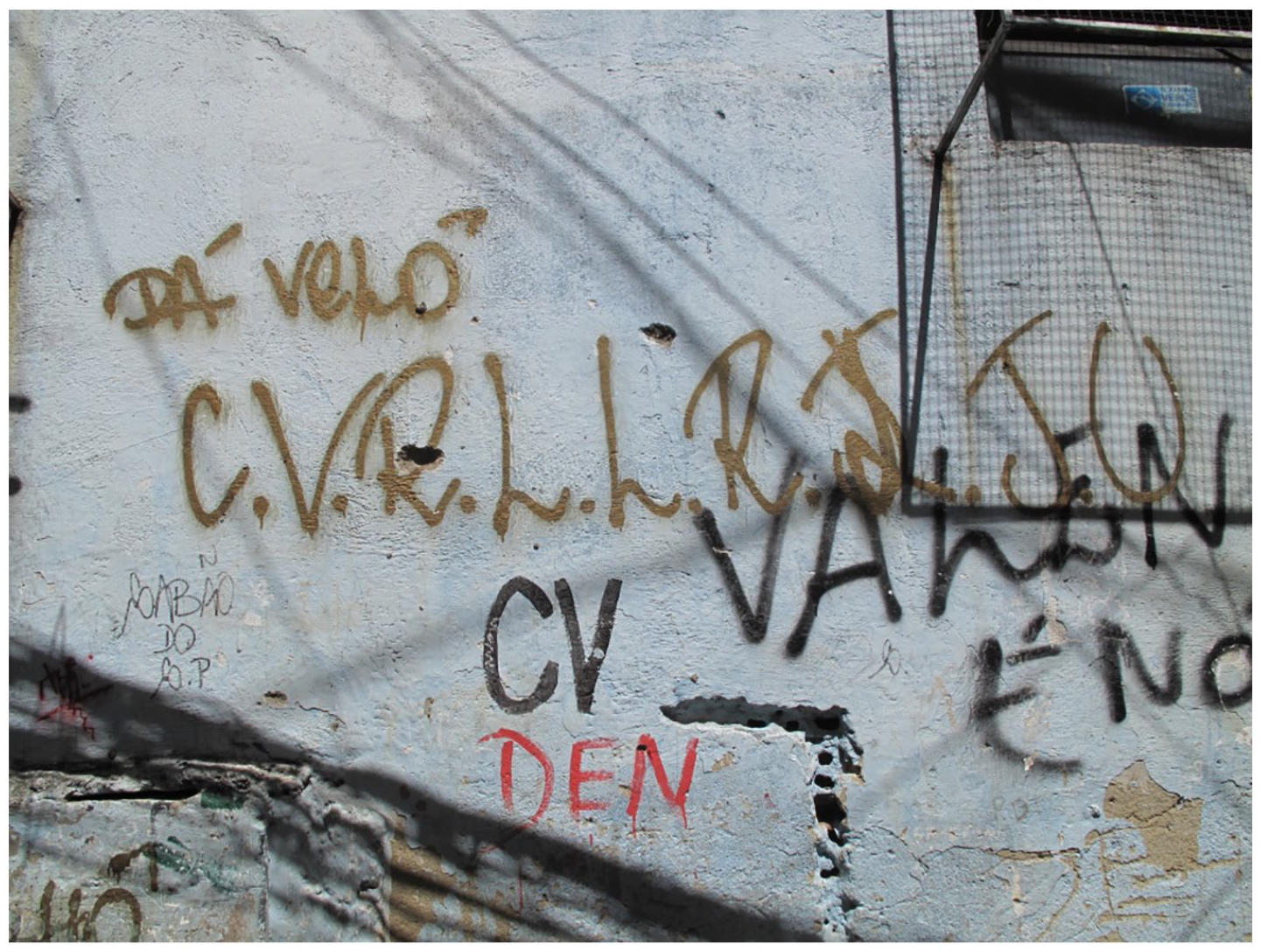
Logo of the Comando Vermelho. Rio de Janeiro, Brazil. Photo by Martijn Oosterbaan.
It is important to note that bailes feature other genres than funk proibidão and that state authorities have attempted to criminalize all types of funk (Facina, 2009), employing stereotypical depictions of young, black favela inhabitants as dangerous and promiscuous. We side with Brazilian scholars and activists who criticize the marginalization of the urban poor by means of the state’s criminalization of artistic expressions of favela residents. As Dennis Novaes (2016) shows, funk proibidão should not be understood as legitimizing crime as it also narrates the extra-legal violence of police forces and the predicament of black adolescent men who live in militarized urban spaces. Nevertheless, characterizing funk purely as resistance to the state’s hegemonic power would not do justice to the entanglements between funk proibidão and comando rule.
Rather, we suggest that funk should not be seen as art instrumentalized in service of one particular faction’s attempts to gain sensorial-political dominance over Rio’s favelas. Funk carioca moves between parties, as multiple governance actors attempt to harness the music’s affective potential in order to legitimize and enforce their rule. For example, in the process of capturing and defending favela territory, various milícias banned the baile funk parties that were associated with the comandos. However, in a number of favelas, local milícias began to control such bailes themselves (Mendes Lopes, 2013). A musical genre known as funk da milícia, or proibidão miliciano, has emerged, in which milícia supporters glorify the milícias. For instance, the funk song ‘O Batman voltou’ (Batman has returned) praises the infamous Liga da Justiça milícia, which uses the Batman logo to mark its territorial rule (Oosterbaan, 2015a).
The emergence of funk da milícia points our attention to the connections between authority, territorial disputes and popular aesthetics in Rio de Janeiro. However, such connections are not limited to criminal groups. While the installation of UPPs initially appeared to signal the end of funk parties in favela territories, in several cases UPP commanders attempted to employ these parties and the genre to legitimize police rule. Sterre Gilsing (2019) describes how UPP forces in the favela Chatuba began to organize ‘pacified’ bailes funk, which ended much earlier than regular bailes and where funk proibidão was forbidden. In their attempts to redirect the affective power of baile funk to literally sway residents towards accepting police rule, UPP officers removed the Comando Vermelho graffiti at the dancehall, repainting the walls in white, grey and blue, the Rio de Janeiro police colors.
Meanwhile, local evangelical churches have begun to stylize funk carioca in service of their own moral, political and spiritual projects. In the past, Pentecostal adherents in the favelas of Rio de Janeiro regularly contrasted gospel music, the ‘music of God’, with carioca funk, which they saw as the quintessential ‘music of the world’, associated with the demonic lifestyles of criminals. Not surprisingly, on one favela wall the Comando Vermelho logo was replaced by an evangelical phrase: ‘Let everything that has breath praise the Lord, Psalm 150.6’ (Figure 6). Over the past decade, however, Pentecostal musicians have begun to produce funk gospel while evangelical churches have started to organize funk gospel bailes (Oosterbaan, 2015b). Some of the proponents of funk gospel argue that evangelical dances can attract teenagers who would otherwise be tempted to visit the funk parties where drugs and alcohol are consumed.
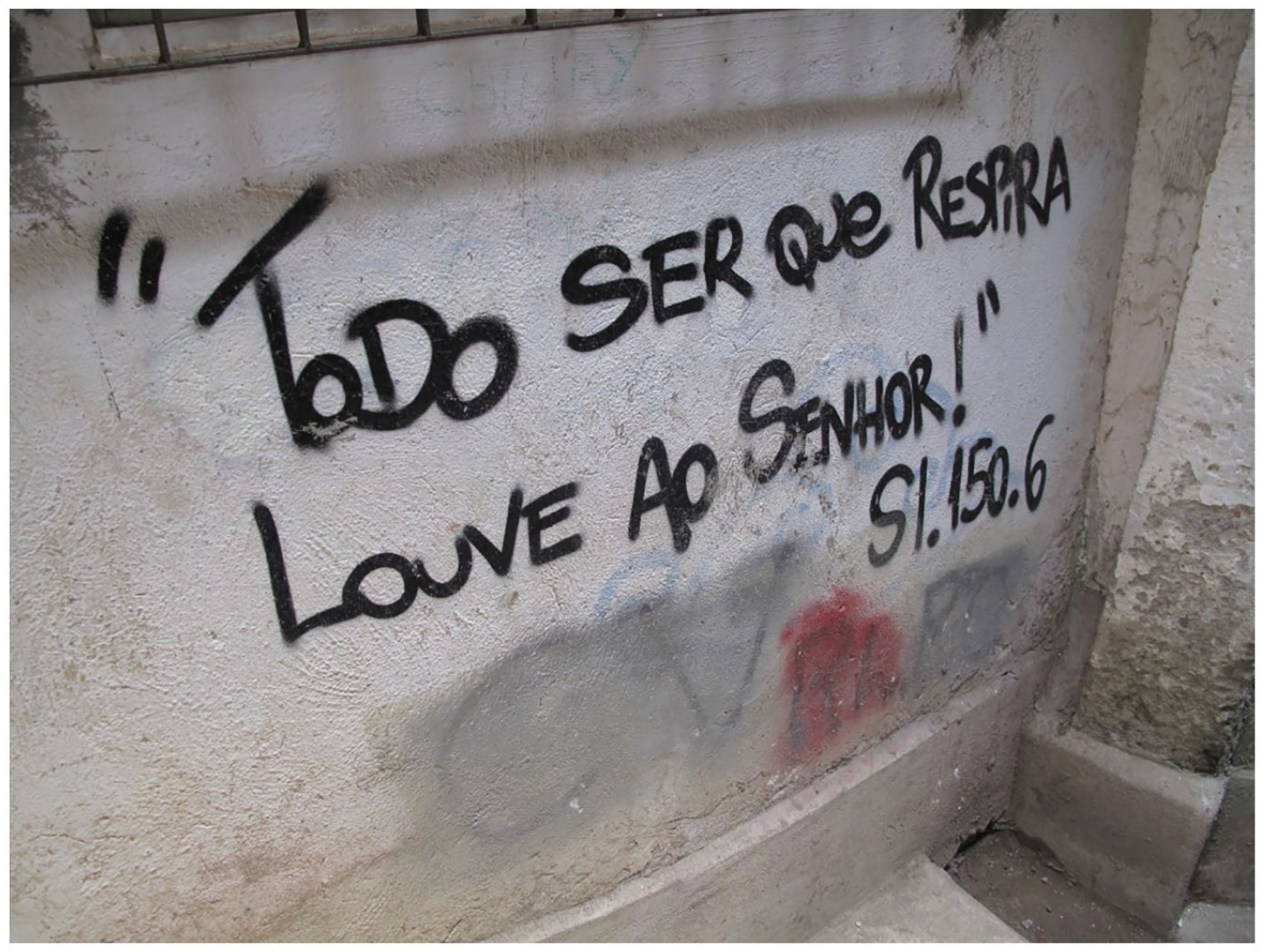
Psalm and removed logo of the Comando Vermelho. Rio de Janeiro, Brazil. Photo by Martijn Oosterbaan.
Like other forms of popular aesthetics created in marginalized urban areas, the appeal of funk carioca for residents lies in their capacity to produce dissensual moments, corporeally experienced ‘moments of freedom’ in Johannes Fabian’s (1998) words. Funk carioca is an important medium through which MCs and residents feel and voice pain and anger at being stigmatized and denigrated, often by representatives of the Brazilian state (Lopes, 2011). Yet the genre represents more than freedom – the same music frequently praises the armed groups that dominate favelas, enforcing harsh rules, using extra-legal violence. Focusing on which voices funk carioca authentically represents shifts our attention away from recognizing how different factions attempt to mobilize funk carioca in service of consensual projects of rule. Since favela residents frequently feel they have less to fear from the comandos than from the corrupt police, the affective power of funk carioca is likely to be absorbed by armed actors who seek to maintain the consensus that they are aligned with residents in the face of the state’s necropolitical force.
Conclusion
As we have argued in this article, the realm of art is central in understanding how urban order is both achieved and contested. Focusing on how locally specific forms of music, dance and visual art normalize social hierarchies adds an important dimension to our understanding of the sensorial politics of cities. Drawing on two cases, of visual art in Kingston and music and dance in Rio de Janeiro, we highlighted the capacity of aesthetic forms to constitute and normalize a socio-political order. While these two cases share similar types of criminal-political contestation, they represent visual and sonic aesthetics respectively, highlighting how distinct aesthetic-sensorial forms work, in Rancièrean terms, to attune sensory perception toward a shared norm within a given urban territory.
Kingston and Rio may appear to be somewhat extreme cases in terms of the centrality of criminal organizations in shaping urban order. While comandos, mafias and paramilitary groups are certainly not key political actors in every city, we argue that the theoretical insights these cases offer have a broader purchase, in how they complicate understandings of what constitutes a hegemonic urban order. Scholarship drawing on Rancière to identify the urban politics of aesthetics has largely focused on European cities, and the sensorial-political dominance of the neoliberal state. This skew in the geographies of theory has perhaps precluded a more thorough engagement with non-state orders that can be found in many cities outside of Europe, but certainly also within Europe. In many cities, multiple types of governance actors – state agents and armed actors, but also religious organizations, or NGOs, or corporations – compete, collaborate and overlap in attempts to shape the city’s aesthetic regimes, relying on a range of artforms.
The politics of aesthetics must be understood within these power struggles, which include but clearly also go beyond state-based orders. Accordingly, the political role of aesthetics cannot be reduced to a battle between, on the one hand, an oppressive neoliberal state largely successful in achieving a sensorial-political consensus, and on the other hand an oppressed population of the urban poor who occasionally achieve moments of revolutionary dissensus. While the artistic expressions we discuss in this article produce dissensual moments, we argue that it is unwise to describe the artforms as either straightforward revolutionary disruptions of the status quo or as compromised art that is complicit with the ruling order. Our material demonstrates how popular urban art is a site of continuous struggle: it harbors the force to break with the consensual order of the state, yet also frequently enforces the consensual regime of non-state governance actors.
Our engagement with urban scholars who have mobilized the politics of aesthetics to analyze contemporary political struggles in cities demonstrates the depth of Rancière’s work – but it also highlights the need to reflect more rigorously on how his thought can be applied to ‘messy’, actually existing urban life-worlds, where art plays a key role in the ongoing sensorial formation and reconfiguration of multiple, dynamic political orders.
Footnotes
Acknowledgements
The ideas presented in this article draw on research funded by the Netherlands Organisation for Scientific Research (NWO, grant no. 360-45-030), including subprojects by Sterre Gilsing and Tracian Meikle.
