



Abstract
Most studies on the membrane vibration are limited to discussing small deflection linear problems, but rarely on the study of nonlinear large deflection problems. In practice, however, membrane deflection is not necessarily far less than the thickness, so it is necessary to research the large deflection vibration problems of moving membrane. In this paper, the large deflection vibration characteristics and stability of the moving printing membrane are analyzed. Large deflection vibration equation of an axially moving membrane is derived by using Von Karman nonlinear plate theory. The large deflection vibration of rectangle moving membrane with four edges fixed boundary is studied by using the Bubnov–Galerkin method which is a semi-analytical-weighted residual method, and the large deflection vibration complex frequency curves along with the change of speed and aspect ratio in the different initial conditions are obtained. The results show that the large deflection nonlinear vibration can be effectively avoided by increasing membrane aspect ratio and decreasing the membrane dimensionless velocity. The study provides theoretical basis for improving the operation stability of the printing equipment.
Introduction
In the printing process, the printing objects of high-speed web press and gravure printing press are tensioned paper or plastic film, which vibrations can seriously affect the printing quality and the printing machines working stability. Most of the researches are related to the small deflection vibration characteristic of moving membrane. However, membrane is liable to occur large deflection vibration phenomenon such as membrane tear, snap in the high-speed production process. Therefore, it is very necessary to analyze large deflection vibration characteristics and stability of the moving membrane. In recent years, the researches on axial movement systems of the transverse vibration and stability have made great achievements. Many scholars at home and abroad pay more attention to the membrane vibration and stability.
Wang and Liu 1 studied nonlinear free vibration of an axially moving string in transverse motions, the nonlinear free vibration equation was derived, and the non-system approximate response was obtained. Chen and Chen 2 and Chen and Zhang 3 analyzed the vibration characteristics of the axially moving viscoelastic string, and the bifurcation and chaos were identified based on the Poincare maps and numerical simulations. Koivurova 4 studied the periodic nonlinear problem of an axially moving string by the Fourier–Galerkin–Newton (FGN) method. Kong and Chen 5 took tilted support spring system under the action of semi-sinusoidal impulse as the research object, and the nonlinear dynamical equations were established. It was shown that there was a sensitive area of the shock response to the dimensionless pulse duration, and this area can be avoided by controlling the stiffness of the tilted spring support. Nonlinear parametric vibrations and stability of an axially accelerating elastic string were researched by Ghayesh. 6 The method of multiple scales was applied to govern nonlinear equation of motion. The stability areas of system were constructed analytically.
In terms of the axially moving beam and plate, Chen and Yang 7 investigated bifurcation and chaos of axially accelerating viscoelastic beams by using the Galerkin method. The bifurcation diagrams were obtained. Chen and Yang 8 also investigated the dynamic stability of the two-term truncated tensioned beam system using averaging method. Numerical examples demonstrated that the stability conditions were related to the tension, the dynamic viscosity and the mean axial speed. The steady-state response of an axially moving viscoelastic beam was obtained by using the method of multiple scales. 9 Geometrically nonlinear vibrations of sandwich beams with viscoelastic materials were analyzed by the finite element methods and the harmonic balance method by Jacques and Daya. 10 Transverse vibration of viscoelastic sandwich beam with time-dependent axial tension and axially varying moving velocity was studied by Lv and Li. 11 Ghayesh and Amabili12,13 and Ghayesh 14 investigated the nonlinear vibrations of an axially moving beam with an intermediate spring support numerically. The equation of motion was obtained via Hamilton's principle, and then it was discretized via the Galerkin method. The resultant nonlinear ordinary differential equations were then solved via either the pseudo-arclength continuation technique or direct time integration. Bifurcation diagrams of Poincare maps were analyzed. Ghayesh and Amabili 15 also researched the nonlinear dynamics of an axially moving beam with time-dependent axial speed, including numerical results for the nonlinear resonant response of the system in the sub-critical speed regime and global dynamical behavior. The nonlinear global forced dynamics of an axially moving viscoelastic beam was examined by Ghayesh et al. 16 The equations of motion for both longitudinal and transverse motions were derived using Newton's second law of motion and then discretized via Galerkin's method. The subsequent set of nonlinear ordinary equations was solved numerically by means of the direct time integration via modified Rosenbrock method. Banichuk and Neittaanmäki 17 and Saksa and Banichuk 18 studied the dynamics and instability of an axially moving viscoelastic plate. Nonlinear free vibration analysis of square plates with various boundary conditions was studied by Saha et al.. 19 The static problem and the dynamic problem of the large amplitude vibration were formulated through energy method. Ghayesh et al. 20 used Von Karman plate theory to examine the nonlinear vibration for forced motions of an axially moving plate, and the equations of motion were obtained via an energy method based on Lagrange equations. The effect of the axial speed and the pretension on the resonant responses was highlighted. The dynamic stability of the moving viscoelastic plate with the piezoelectric layer was studied by Wang et al. 21 A mathematical model was presented to analyze the vibration of a tapered isotropic rectangular plate under different boundary conditions by Khanna and Singhal. 22 The geometrically nonlinear large deformation behavior of triangular carbon nanotube (CNT) composite plates under transversely distributed loads was investigated by using the element-free IMLS-Ritz method by Zhang and Liu. 23
Further investigations on this topic focused on the nonlinear aspects of the web. Marynowski 24 established elastic and viscoelastic dynamic model of an axially moving web using two-dimensional rheology theory. The finite element method was applied by Kulachenko et al.25,26 to study the nonlinear dynamics problems about transverse vibration and stability of web and verify the calculation results. Koivurova and Pramila 27 analyzed nonlinear vibration of an axially moving membrane by finite element method, which contained acoustic fluid elements and contact algorithms. Equilibrium and vibration analyses of a fabric web under arbitrary large deformation were presented by Ma and Jiang. 28 Vedrines and Knittel 29 studied out of plane vibrations of the web in web handling systems and observed the influences of free and forced vibrations. The nonlinear vibration fundamental frequency and vibrational state of the moving rectangular membrane were discussed by Zhao and Wang. 30 Nonlinear vibrations and instabilities of a stretched hyperelastic membrane were analyzed by using the finite element method by Goncalves et al. 31 and Soares and Gonçalves. 32 Von Karman nonlinear plate equations were modified to describe the motion of an axially moving web with small flexural stiffness under transverse loading by Lin and Mote. 33 Transverse vibration characteristics and stability of a moving membrane with elastic supports were analyzed by Wu and Lei. 34 They determined the dynamic instability region and the stability region of the web. Also, the influence of system parameters on the stability region was developed. Parametric vibration and dynamic stability of the printing paper web with multi-roller supports and the active vibration control of the web were also studied by Wu et al. 35 and Ma et al. 36 Nonlinear dynamical analysis of interaction between a three-dimensional rubberlike membrane and liquid in a rectangular tank was studied in Parasil and Watanabe. 37
The large deflection vibration characteristics and stability of the moving membrane are researched. Large deflection vibration equation is derived by using Von Karman nonlinear plate theory. Large deflection vibration of the rectangle moving membrane with four edges fixed boundary is studied by using the Bubnov–Galerkin method, also the large deflection vibration of the moving membrane complex frequency curves along with the change of speed and aspect ratio in the different initial conditions are analyzed.
Large deflection vibration mechanical model of membrane
The mechanical model of the axially moving rectangle membrane is shown in Figure 1. The membrane is soft and homogeneous and has no flexural stiffness, shear force or bending moment. The membrane length is a, the membrane width is b, aspect ratio r is the ratio of the length to the width of the membrane, The mechanical model of the large deflection vibration membrane.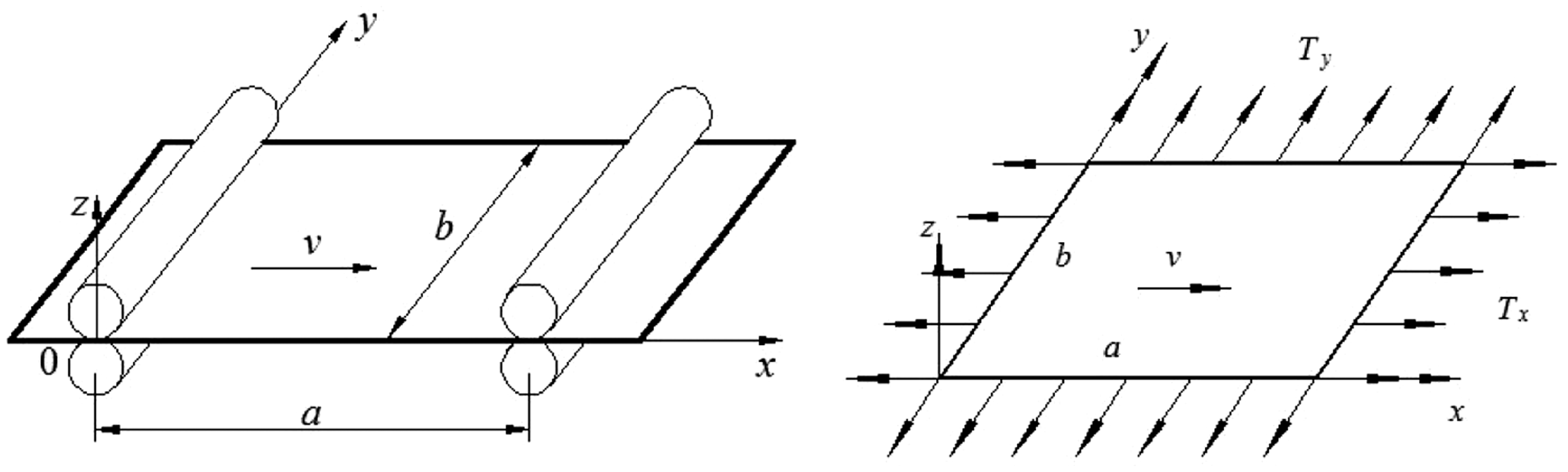
When the deflection is not far less than the thickness, we should deal with it according to the large deflection theory, and we must consider the in-plane displacement of each point in the middle plane caused by the deflection, and therefore we must consider the middle plane strain and in-plane force caused by middle plane displacement.
The equilibrium differential equations are given by
38

Elastic surface differential equation is defined as
34

The system compatibility equation is expressed by the internal force and deflection

The internal force of the membrane can be expressed by the internal force function φ
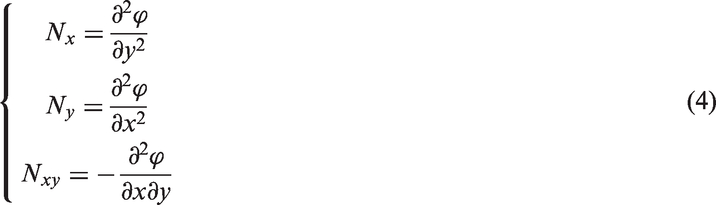
The equilibrium differential equations of the membrane units are independent from each other, and the membrane is soft and homogeneous, so equations (5) are obtained in the boundary conditions of the membrane with four edges fixed.

Substituting equations (4) and (5) into equations (2) and (3), the large deflection vibration equations of the moving membrane are obtained based on the Von Karman nonlinear plate theory
33

Introducing the dimensionless quantities

Then substituting equations (7) into equations (6) yields

The boundary conditions of the large deflection vibration equation are


Solution of large deflection vibration equation
The Bubnov–Galerkin method is used to study large deflection vibration problems.
Firstly, we solve basic unknowns w and f using the separation of variables. Suppose the solutions which satisfy the boundary conditions of equations (9) and (10) are


Substituting equations (11) and (12) into equation (8) yields the following equation.

Then we obtain

Bubnov–Galerkin method is advantageously employed to discretize the partial differential equation of motion to a set of second-order nonlinear ordinary differential equation. Then substituting equations (11) and (12) into equation (8) yields the following equation by the Bubnov–Galerkin method.

Obviously, equation (15) is the nonlinear ordinary differential equation about


A displacement function satisfying the boundary conditions is

Substituting equation (18) into equation (13) yields

So we obtain

According to equations (16), (18) and (20), we can obtain

Equation (16) can be simplified as


Equation (22) is integrated

The different values of H represent different curves on the phase plane, and the value of H is determined by the initial motion condition. The initial displacement C and the initial velocity V0 are given by


Integrating equation (22) can get nonlinear vibration period of the axially moving membrane, which can be expressed as


The nonlinear vibration frequency of the membrane can be expressed as


Substituting equation (30) into equation (29) yields the nonlinear vibration frequency of an axially moving membrane.


Results analysis
Relationship between large deflection vibration frequency and axial velocity
As shown in Figure 2, the curves that nonlinear vibration complex frequency ω of the axially moving membrane along with the change of axial velocity when the initial movement conditions are C = 1 and V0 = 0, the aspect ratio is r = 1, 2, 3, respectively. Figure 2 shows that when the aspect ratio r is constant and the dimensionless velocity c = 0, dimensionless complex frequency ω is a real number. As the dimensionless velocity c increases gradually, the real part of complex frequency ω gradually decreases, while the imaginary part is always zero, which shows that the large deflection vibration of the axially moving rectangular membrane is small and does not damp. When the dimensionless speed c increases to a certain value, the real part of the complex frequency ω decreases to zero, and the imaginary part gradually increase from zero, the rectangular membrane begins to divergence instability and conducts damping vibration. Besides, comparing the curves when aspect ratio r is different, it is clear that the aspect ratio r increases with the increase of vibration instability critical speed. The vibration instability critical speed is higher than the operating speed of the membrane, which can effectively ensure the membrane in a stable state.
The relationship between the dimensionless complex frequency and the dimensionless velocity (C = 1). (a) Complex frequency variation of the real part, (b) Complex frequency variation of the imaginary part.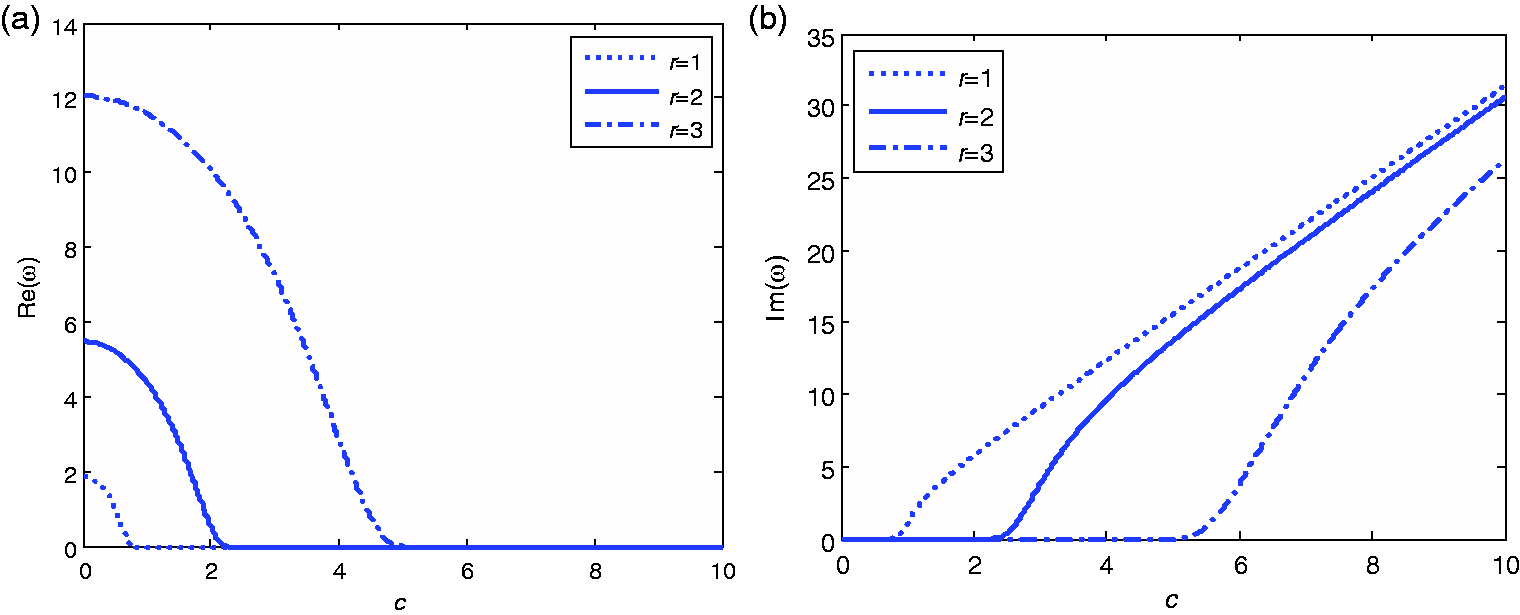
As shown in Figure 3, the curves that nonlinear vibration complex frequency ω of the axially moving membrane along with the change of axial velocity when the initial movement conditions are C = 0 and V0 = 0, the aspect ratio is r = 1, 2, 3, respectively. Figure 3 shows that when the dimensionless speed increases gradually, the real part of the dimensionless nonlinear vibration complex frequency ω is always zero (namely complex frequency ω is purely imaginary number) and the imaginary part linearly increases from zero. The results show that the membrane is always divergent instability, the greater the dimensionless speed, the faster the divergence instability. And this phenomenon has nothing to do with the aspect ratio of the membrane.
The curves relating the dimensionless nonlinear vibration complex frequency to the dimensionless velocity (C = 0). (a) Complex frequency variation of the real part, (b) Complex frequency variation of the imaginary part.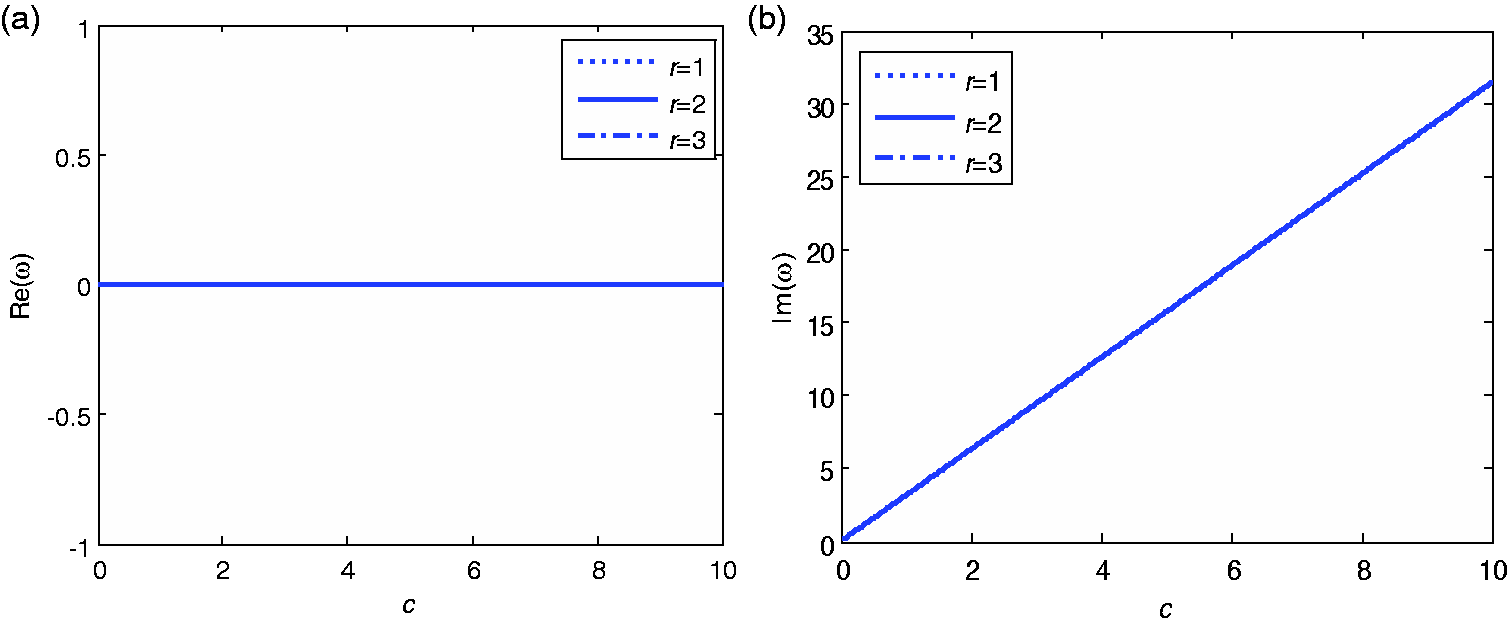
The large deflection vibration frequency and aspect ratio
As shown in Figure 4, the curves that nonlinear vibration complex frequency ω of the axially moving membrane along with the change of aspect ratio r when the initial movement conditions are C = 1 and V0 = 0, the dimensionless speed is c = 0.5, 0.8, 1, respectively. Figure 4 shows that when the dimensionless speed c remains unchanged and the aspect ratio is r = 0, dimensionless complex frequency ω is a pure imaginary number, which indicates that the rectangular membrane begins to divergence instability and conducts damping vibration. As the aspect ratio r gradually increases to a certain value, the real part of complex frequency ω increases gradually, and the imaginary part decreases to zero, which indicates that moving membrane large deflection vibration begins to reduce and then gradually conducts undamped vibration. It can be obtained that large deflection vibration phenomenon is more obvious along with the decrease of the aspect ratio r. In addition, comparing the curves when the dimensionless speed c is different, it can be noted that the large deflection nonlinear vibration is more obvious along with the increase of the dimensionless speed, and the divergence instability happens more easily. To sum up, we can effectively avoid the large deflection nonlinear vibration phenomenon by increasing the membrane aspect ratio r and decreasing the membrane dimensionless speed c.
The relationship between the dimensionless complex frequency and the aspect ratio r (C = 1). (a) Complex frequency variation of the real part, (b) Complex frequency variation of the imaginary part.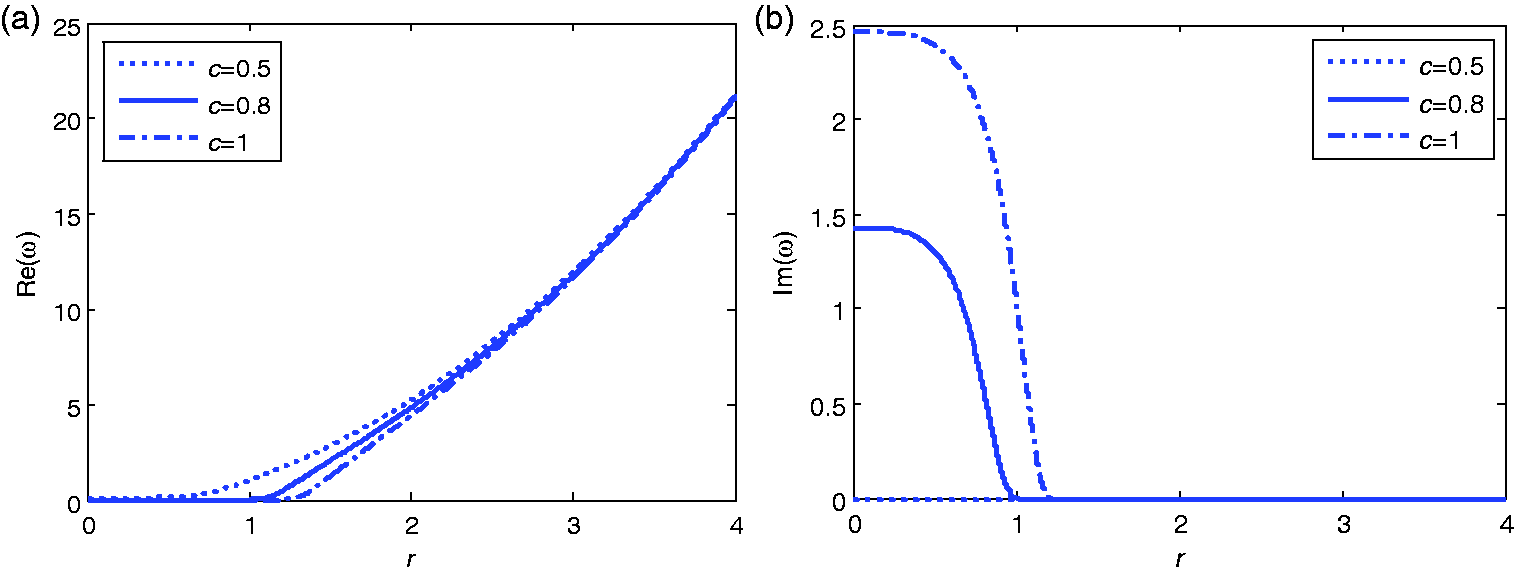
As shown in Figure 5, the curves that nonlinear vibration complex frequency ω of the axially moving membrane along with the change of aspect ratio r when the initial movement conditions are C = 0 and V0 = 0, the dimensionless speed is c = 0.5, 0.8, 1, respectively. Figure 5 shows that when dimensionless speed c remains unchanged, the dimensionless complex frequency ω is always a constant pure imaginary number, which has nothing to do with the aspect ratio r. And the membrane experiences divergence instability at any dimensionless speed c. In addition, comparing curves when the dimensionless speed is different, it can be noted that the large deflection nonlinear vibration is more obvious along with the increase of the dimensionless speed, and the divergence instability happens more easily. To sum up, the large deflection nonlinear vibration phenomenon can be effectively avoided by reducing membrane dimensionless speed c.
The relationship between the dimensionless complex frequency and the aspect ratio r (C = 0). (a) Complex frequency variation of the real part, (b) Complex frequency variation of the imaginary part.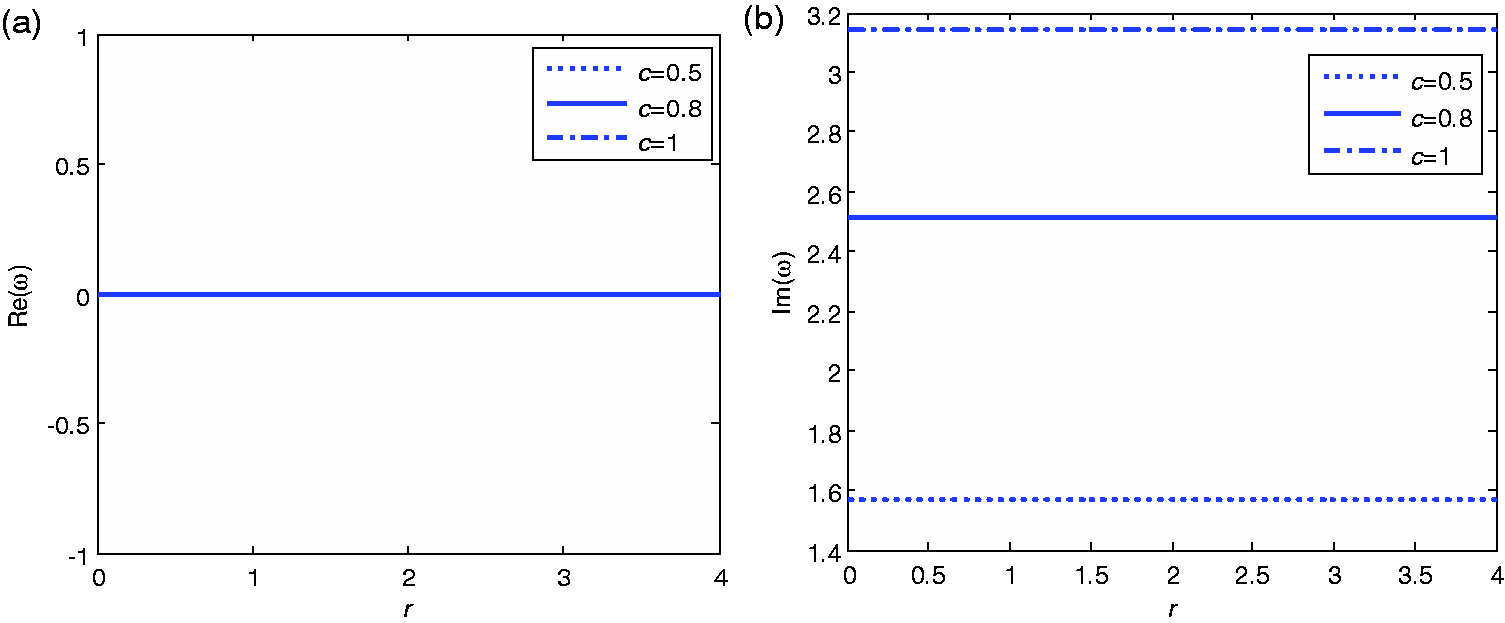
Conclusions
The large deflection vibration characteristics and stability of the moving printing membrane are studied. Large deflection vibration equation of an axially moving membrane is derived by using Von Karman nonlinear plate theory. Large deflection vibration of an axially moving membrane with four edges fixed boundary is studied by using the Bubnov–Galerkin method, and the large deflection vibration complex frequency curves along with the change of speed and aspect ratio in the different initial conditions are highlighted. The conclusions are as follows:
The aspect ratio r increases with the increase of vibration instability critical speed. So the vibration instability critical speed can be improved by increasing the aspect ratio r, when the vibration instability critical speed is higher than the operating speed of the membrane, which can effectively ensure the membrane in a stable state. The large deflection nonlinear vibration is more obvious along with the increase of the dimensionless speed c, when the divergence instability happens more easily. Therefore, we properly reduce dimensionless velocity c, which can effectively avoid the large deflection nonlinear vibration. The initial motion state of C = 0, the membrane has always been large deflection vibration state, the greater the dimensionless velocity c, the faster divergence instability, and the vibration is irrelevant with the aspect ratio r.
Footnotes
Declaration of conflicting interests
The author(s) declared no potential conflicts of interest with respect to the research, authorship, and/or publication of this article.
Funding
The author(s) disclosed receipt of the following financial support for the research, authorship, and/or publication of this article: The author gratefully acknowledges the support of the National Natural Science Foundation of China (No. 11272253 and 51305341). This work is also supported by the Natural Science Foundation of Shaanxi (Grant No. 2016JM5023).