




Abstract
In the present work, using the couple stress theory, a new model is provided for vibrating behavior of anisotropic carbon nanotubes. Carbon nanotubes have many applications, and careful analysis of their behavior is important. So far, using the isotropic models, several studies have been conducted on carbon nanotube vibration. According to the arrangement of carbon atoms on the nanotube walls, their properties will be different in various directions. Therefore, the behavior of carbon nanotubes must be considered as anisotropic materials. In this article, initially, using the Hamilton's principle, motion equations, and boundary conditions of carbon nanotubes are extracted based on couple stress theory. Afterwards, the equations are solved using the analytical solution method. In the results section, the effect of different parameters, particularly the anisotropic effect, on the carbon nanotube natural frequency is investigated.
Introduction
Today, with the development of technology, it has become important to study the behavior of micro/nano structures, and many researchers have studied the properties and behavior of these structures. According to micro/nano structures application, numerous studies have been conducted to investigate their mechanical behavior, and due to their physical and geometrical conditions, mechanical responses of micro/nano systems are examined.1–7 Experimental studies have demonstrated that the nanoscale results have different characteristics compared to the macro scale. Nanostructures, due to their superior properties, have improved the performance in various fields. Elements for modeling nanostructures include nano-beams, nano-discs, and nano-shells.8–23 Carbon nanotube (CNT) is one of the most commonly used elements in nanostructures which are used in a variety of composite materials and nano systems. CNTs are hollow cylinder made of the convolution of graphene sheets around an axis. CNTs are found in two types: single-walled carbon nanotubes (SWCNT) and multi-walled carbon nanotubes (MWCNT). SWCNT has excellent physical properties and investigation of its mechanical behavior is important. Studies have shown that due to curvature effects the properties of CNTs are different from graphene properties. Besides, due to the arrangement of carbon atoms, CNT properties are different in various directions and it could be said that the actual mechanical behavior of CNT is similar to that of the anisotropic material. According to the axial angle around which graphene is twisted, SWCNT is divided into three types: zigzag, armchair, and chiral. Generally, to determine the kind of CNT composition, an element in the (a,b) form is used. The CNT is zigzag for (a,0), armchair for (a, a), and chiral for other (a,b) values. It should be noted that according to the values of (a) and (b) parameters (chirality), the mechanical properties vary across various nanotubes.24–27 At the nanoscale, since the ratio of intermolecular distance to body dimensions is considerable, couple stress effects cannot be ignored; whereas, at the macro scale, because this ratio is small, couple stress effects are insignificant and can be ignored. Structures which have hollow cylindrical shape are usually simulated as cylindrical shell model. 28 In this model, a geometrical parameter, namely, aspect ratio, is important. Aspect ratio is defined as a ratio of cylinder length to cylinder radius (L/R). Researchers have shown that for cylindrical shell with low aspect ratio, size effect is significant and it must be considered in analysis. Consequently, in order to conduct a careful analysis of the CNT mechanical behavior, the effect of their small size must be considered.29–33 There are three basic methods to calculate the small size effects. The first method is experimentation; however, it is difficult to control the testing process in the nanoscale and the cost of the tests is high. The second approach is use of molecular dynamics methods which include heavy, complicated, and costly calculations.21–34 The third method is using the higher order continuum theories. These theories utilize material length scale parameters in their constitutive relations and thus help the results to be more accurate. These theories include nonlocal Eringen's theory, 35 strain gradient theory, 36 and the couple stress theory. 37 According to the foregoing discussion, it can be said that three basic phenomena must be considered in a correct analysis of the CNT behavior: (1) the effect of nanotube's small dimensions, (2) the anisotropic behavior of nanotubes, and (3) the chirality effect caused by the arrangement of the CNTs. Many researchers have investigated the free vibration of SWCNT using size-dependent beam and shell models. Those researchers have predominantly used Eringen's nonlocal theory. Using the nonlocal Timoshenko beam model, Boumia et al. 38 analyzed SWCNT vibration. Bahaadini and Hosseini et al. 39 studied the vibration of CNT immersed in fluid. Using the nonlocal theory, Rahmanian et al. 40 studied the vibrations of SWCNT resting on Pasternak foundation. Vibration of function graded SWCNT was investigated by Janghorban and Zare. 41 They examined the vibration frequency of nanotubes with various thicknesses using the Timoshenko beam model. Also, Bocko and Lengvarský investigated the bending vibration of CNTs based on the nonlocal theory. 42 In recent years, some researchers have studied the effects of chirality on the vibrations of CNTs. By modeling the zigzag CNTs as a nonlocal Levinson beam model, Maachou et al. 43 studied the vibration behavior of CNTs under thermal effects. Fazelzadeh and Ghavanloo,44,45 using the anisotropic nonlocal cylindrical shell model, investigated the effects of various parameters on CNTs frequency. Besides, they studied the effect of chirality on CNT vibrations. As mentioned above, researchers had used different models for CNT free vibration analysis. Initially, CNTs were modeled as macro scale geometrical models. 46 Afterwards, considering the CNT scale effect the researchers used size-dependent isotropic beamlike models. 39 Then, in order to improve the results, nanoscale isotropic cylindrical shells were employed. In recent years, in order to obtain more realistic responses, the nanoscale orthotropic shell was introduced where, in this model, the nanoscale effects are measured based on nonlocal theory. 44 It can be said that in previous studies, conducted on CNT, the effects of size dependency, anisotropy, shear effects, and CNT cylindrical shape have rarely been simultaneously considered. For the first time, the present work develops a new model of chirality-dependent vibration of the anisotropic CNT based on couple stress theory. Initially, using the analytical dynamics principles, CNT motion equations are derived. Afterwards, these equations are solved using Navier solution method. In the results section, changes of vibration frequency in relation to various parameters such as CNT dimensions and material length scale parameters are investigated. Moreover, the effect of chirality on CNT natural frequency is studied, too.
Couple stress theory for anisotropic cylindrical shell
In order to derive the CNT motion equations, Hamilton's principle is used, and, finally, by applying this method, the motion equations are developed. Hamilton's principle is obtained from a variation of Π energy function, which is extracted from the difference between potential and kinetic energy. Therefore, according to Hamilton's principle, it can be said

Regarding the above equation, it should be mentioned that the work done by external force has been ignored because the purpose of this paper is to analyze free vibration. Considering the geometry of SWCNT, the cylindrical shell is a suitable model for CNT simulation. In the analytical studies, in order to consider the shear effects, shear models such as first shear deformation theory (FSDT) are used in the literature. Similarly, in order to increase the accuracy in calculating shear effects, researchers can use higher order shear deformation theory (HSDT). In recent years, HSDT model has been used in many analytical research studies.
1
In the present work, in order to count the shear effects, based on CNT thickness to radius ratio, FSDT model is used. The displacement field of FSDT model is defined as follows
62

In the above equation z represents the distance of any point from the middle shell (z = 0) along the thickness direction. Also u, v, and w represent the middle shell displacements along the longitudinal, circumferential, and thickness directions, respectively. As well as Φ
x
and Φ
θ
represent the rotations around the θ and x axes, respectively (Figure 1).
Schematic of cylindrical shell model.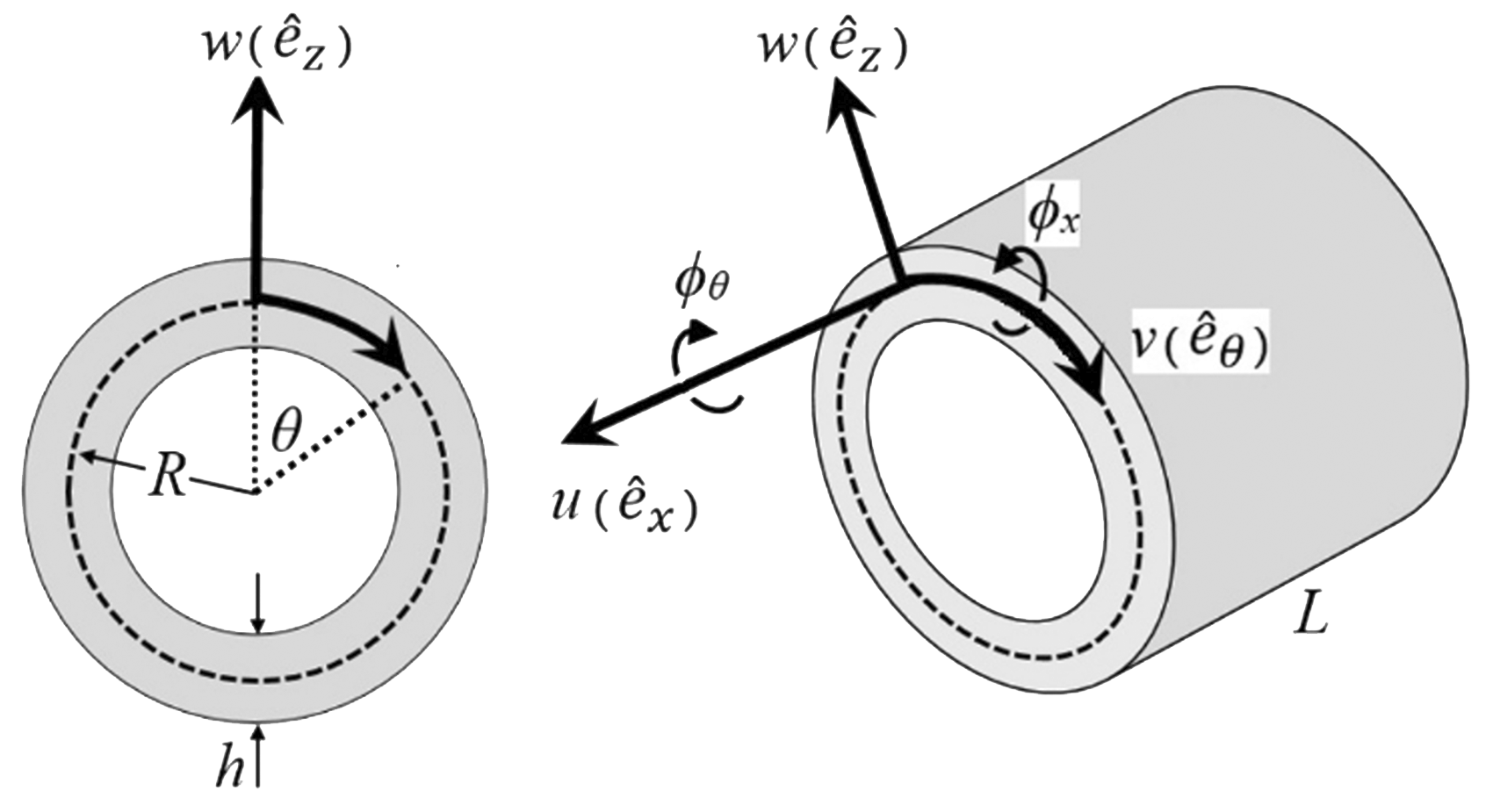
Based on couple stress theory, the strain energy of SWCNT can be computed by summation of classical strain energy (Uclassic) and higher order strain energy (Uhigher-order)

In order to obtain the classical strain energy of a body that occupies volume V, considering the classical elasticity theory, the following formula is used

In equation (4) ɛ
ij
and σ
ij
represent the strain tensor and Cauchy stress tensor, respectively. For small deformations, CNT strain is obtained from the following equation
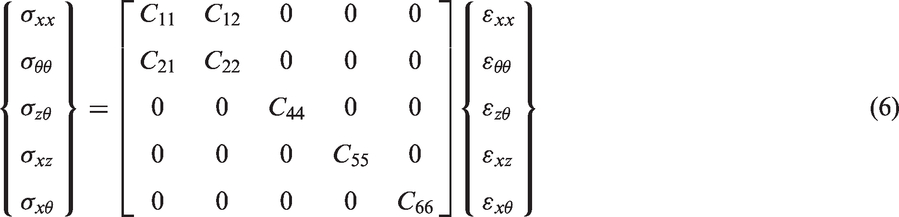

In above equation C
ij
is the elasticity tensor and its components are defined as follows
63

Furthermore, according to the couple stress theory, higher order strain energy is defined as follows









Moreover, by substituting equation (2) into equation (11), rotation vector components are obtained as follows
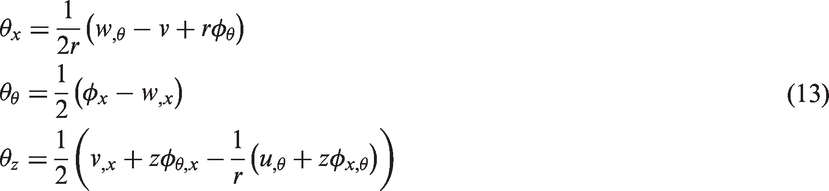
Finally, by substituting equation (13) into equation (9), components of rotation gradient tensor for the FSDT shell are obtained as








In the following sections, in order to conduct a perfect calculation of energy function (Π), the kinetic energy of CNT is calculated. SWCNT kinetic energy can be calculated through the following equation

In the above equation,

By substituting equation (16) into equation (15), the final equation for kinetic energy of CNT is obtained as follows

Afterwards, by substituting equations (3), (4), (6), (8), (10), and (17) into equation (1), this relationship is converted to the following integral equation
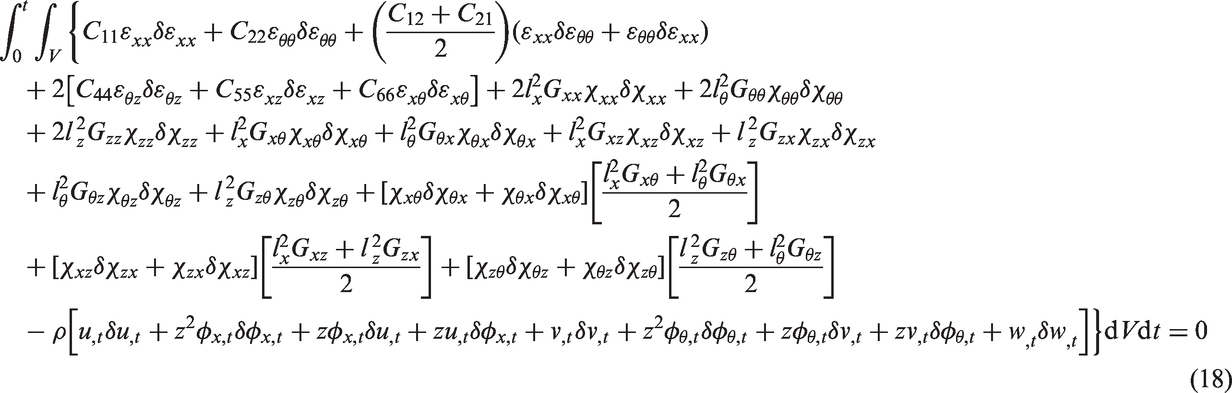
By substituting equations (12) and (14) into equation (18) and by using the partial integration, the motion equations of anisotropic model of SWCNT based on the couple stress theory are extracted as follows
If l
i
, E
ij
, and G
ij
are constant, motion equations of isotropic cylindrical shell based on couple stress theory are achieved.
65
If l
i
= 0, motion equations of orthotropic cylindrical shell based on conventional elasticity theory are obtained.
66
If l
i
= 0 and E
ij
and G
ij
are constant, motion equations of isotropic cylindrical shell based on conventional elasticity theory will be obtained.





Furthermore, after solving integrals related to Hamilton's principle, the following boundary conditions are established within the boundaries of SWCNT








Solving method
In this paper, in order to solve the CNT motion equations, Navier analytical solution method is used. According to this method, the responses of variables in the displacement field for simply supported ends are considered as follows
62
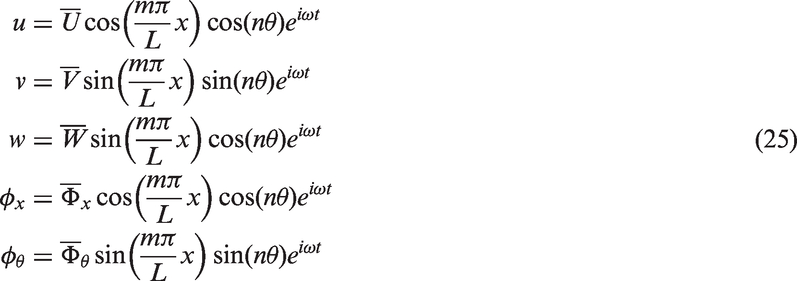

In the above equation I, M, and Q represent the identity matrix, CNT mass matrix, and CNT stiffness matrix, respectively. According to the algebraic principles, it is clear that in order to extract the non-zero answer the following condition must be met

By solving equation (27), CNT frequency will be obtained. In the results section, the effect of various parameters on the CNT frequency has been discussed in detail.
Results and discusions
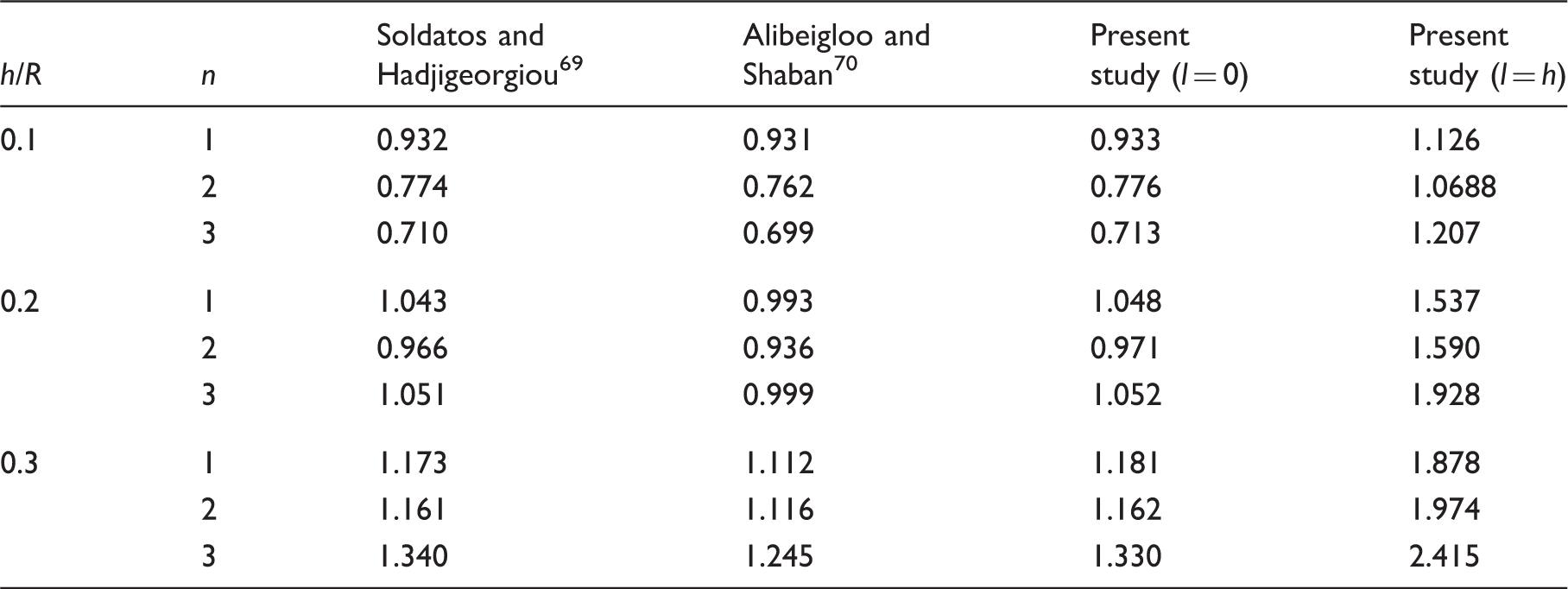
In this section, the free vibration of simply supported anisotropic SWCNTs using the anisotropic shell model is investigated. In order to determine the numerical results, the anisotropic elastic properties, which are dependent on size and atoms chirality, are considered through Chang 67 and the value of the effective wall thickness of SWCNT h = 0.066 nm is utilized according to Ghavanloo and Fazelzadeh. 45 To justify the validity and accuracy of the suggested model, the results obtained by the present model are compared with those available in the literature. Afterwards, the parametric study is presented to illustrate the influence of various involved parameters such as small-scale effect, thickness, length, axial, and circumferential wave numbers and chirality on the natural frequency. Besides, the material length scale parameter is considered as l1 = l2 = l3 = l and assumed only theoretically in the interval of 0 to 3*h in the numerical examples presented here and shear correctness factor, k s , considered 5/6. The mass density per unit lateral area of SWCNT is taken as ρh = 0.7718 × 10⁻⁷ g/cm2. 68
Comparison studies
Comparison of dimensionless first three natural frequencies (ω n , n = 1,2,3) with different thicknesses of isotropic cylindrical shell.
Effects of small-scale parameter on the natural frequency
The effect of the small-scale parameter on the natural frequency ratio of anisotropic SWCNTs with different chirality is shown in Figure 2(a, b). Two groups of SWCNTs with different diameter and chiral angles are considered as a function of small-scale coefficient. Therefore, Figure 2(a) indicates the natural frequency ratio as a function of small-scale parameter for armchair SWCNTs and Figure 2(b) shows for zigzag ones. As depicted in these figures, the trends of natural frequency ratio are similar for different chirality of SWCNTs; so that, the increase in small-scale parameter leads to stiffening of shell and increasing the natural frequency ratio. On the other hand, it is also seen that the increase in natural frequency ratio is dependent on SWCNTs chirality, as such, the zigzag chirality leads to increase in natural frequency ratio more than armchair ones, because of the higher shear modulus of zigzag than armchair SWCNTs, according to Chang.
67
Besides, the influence of small-scale parameter on natural frequency ratio is intensified by decreasing radius of SWCNTs. Figure 2(a) contains (4,4), (5,5), and (8,8) SWCNTs with the radii of 0.271, 0.339, and 0.542 nm, and their counterpart in zigzag chirality, namely (7,0), (8,0), and (14,0), are considered in Figure 2(b). As expected, by increasing SWCNTs radius, the slope of natural frequency ratio is decreased and according to anisotropic surface elastic constants
44
the difference between zigzag and armchair chirality is decreased. Also, when the radius is smaller (chirality (4,4)), the natural frequency ratio is more sensitive to small-scale parameter because a small change in small-scale parameter causes a significant change in the natural frequency ratio and according to Figure 2(a, b), at higher radius, the results of the present model are approaching to those of classical ones which shows the capability of classical model to predict the vibration response of large-scale structures.
Effects of small-scale parameter on the natural frequency ratio.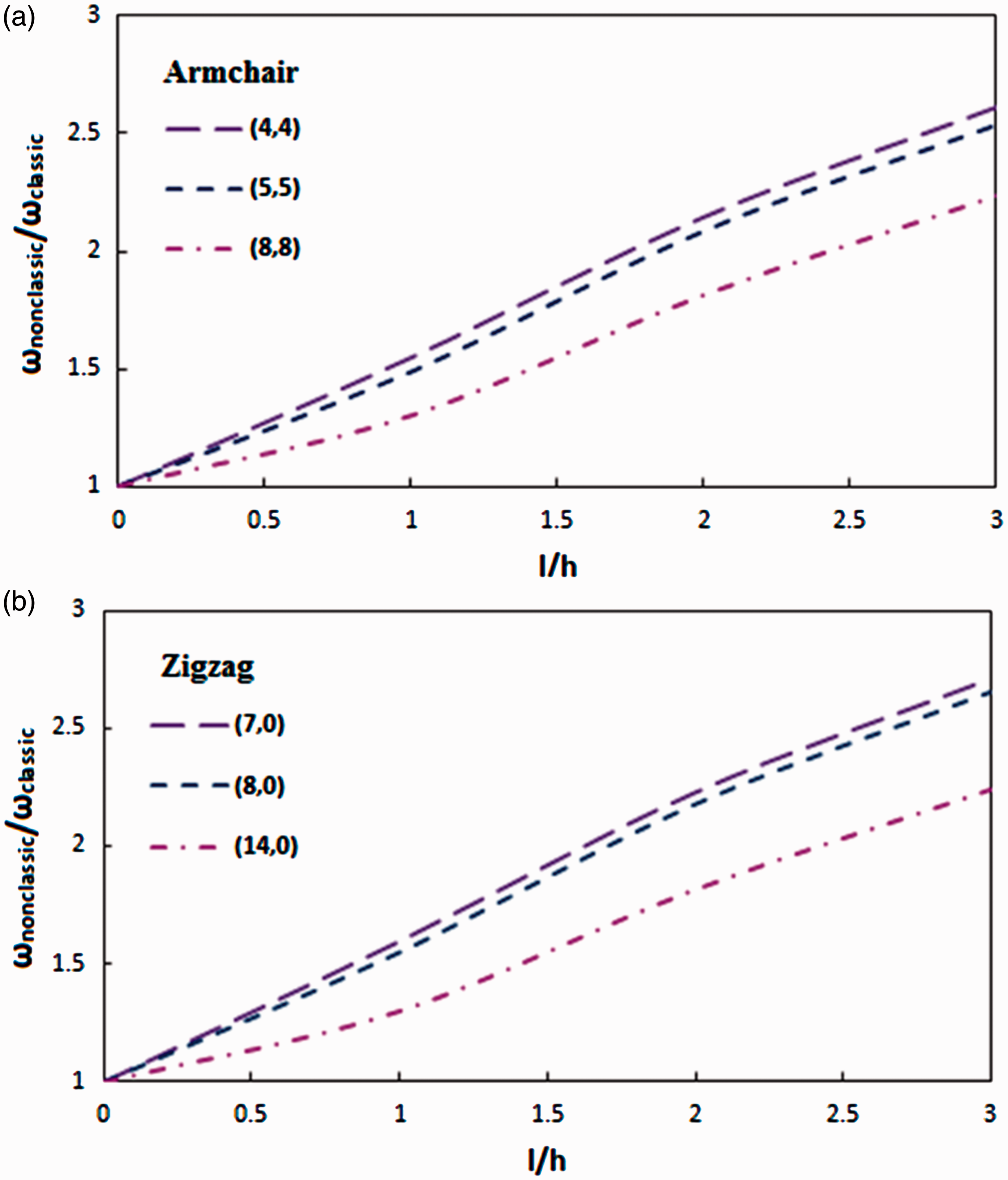
Effects of length ratio on the natural frequency
In order to study the effect of length parameter on the frequency of SWCNTs, the variation of dimensionless natural frequency with respect to length ratio (aspect ratio) in different SWCNTs chirality on the basis of new modified couple stress theory (NMCST) is illustrated in Figure 3(a, b). As it can be seen, since the increase in length ratio decreases the stiffness of cylindrical shell, the dimensionless natural frequency decreases in different types of SWCNTs chirality. Such that, the lower values of the dimensionless natural frequency are obtained in larger values of length ratio. Moreover, the decreasing rate of the dimensionless natural frequency is clearly dependent on the chirality for small radii of SWCNTs. So that, the dimensionless natural frequency is more diminished for zigzag chirality than armchair ones by increasing the length ratio; besides, this the difference between the zigzag and armchair chirality is more specific for small aspect ratio of SWCNTs according to Figure 3(a, b). Additionally, the influence of radius and chirality on dimensionless natural frequency is decreased by increasing length ratio, similarly, the vibration behavior of anisotropic SWCNTs approaches to isotropic ones. As the benefits of Figure 3(a, b), there is a specific length ratio in each radius and chirality in which the dimensionless natural frequency does not affect significantly by increasing length ratio after these.
Effects of length ratio on the dimensionless natural frequency.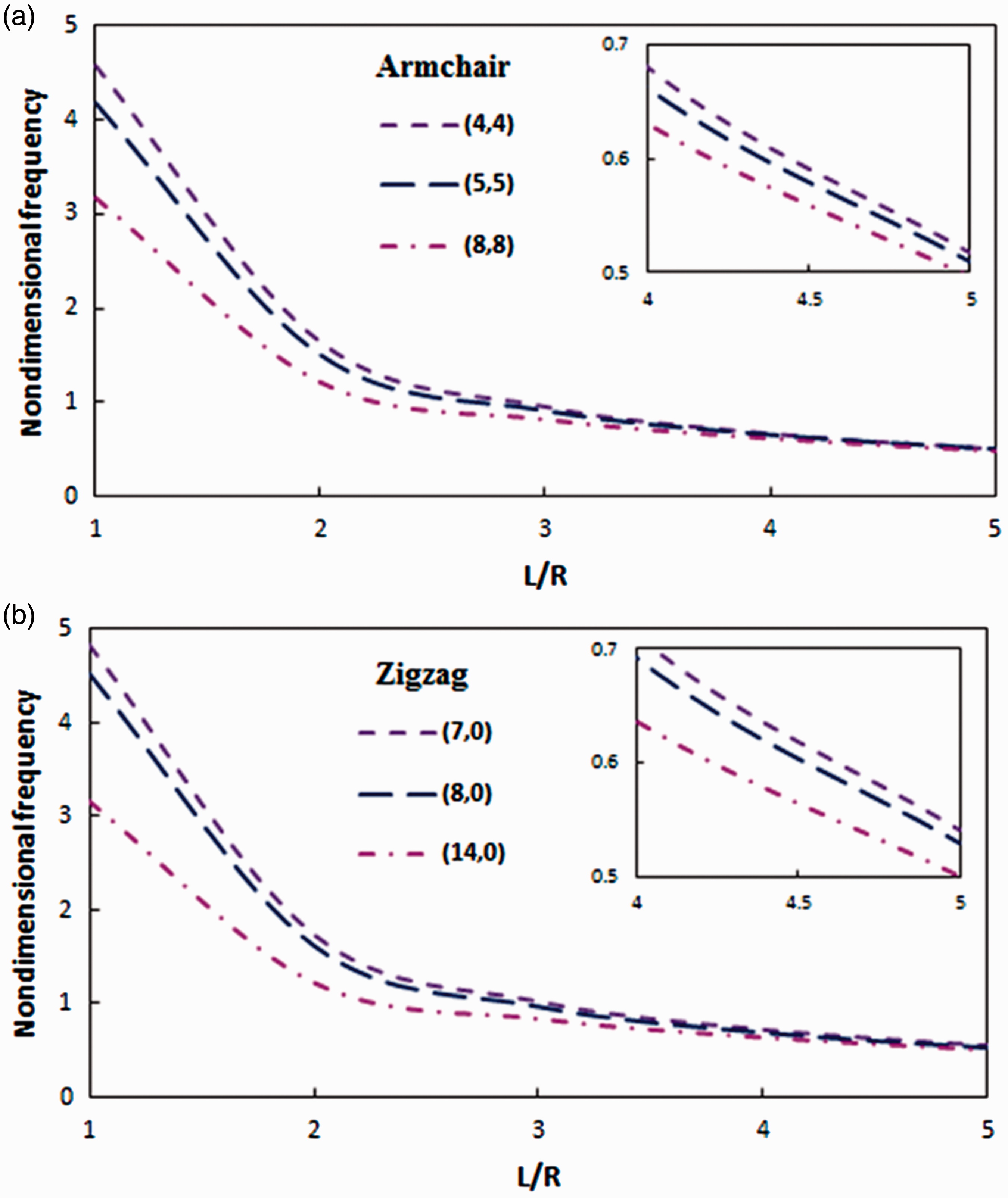
Effects of thickness ratio on the natural frequency
Figure 4(a, b) represents the variation of the dimensionless natural frequency through the thickness ratio distribution for different values of the small-scale parameter and SWCNTs chirality. It is observed that the trends of dimensionless natural frequency are similar for different SWCNTs chirality, so that the dimensionless natural frequency increases by increasing the thickness ratio. Additionally, by comparison between Figure 4(a) and (b), it is observed that the effects of thickness ratio on the dimensionless natural frequency are dependent on chirality. It is clear that the dimensionless natural frequency is further increased for zigzag chirality than armchair ones by increasing thickness ratio. Additionally, according to Figure 4(a, b), increase in small-scale parameter intensifies the influence of chirality on the dimensionless natural frequency; thus, it is clear that by considering the small-scale effect, the influence of chirality plays an important role in analysis of SWCNTs. It is also visible that by decreasing small-scale parameter, the vibration behavior of anisotropic SWCNTs is approaching isotropic ones because the chirality is not important anymore. It should be noted that the influence of the transverse shear deformation is significant when thick and short nanotubes are investigated and the first-order shear deformation theory is capable to consider this effect.
Effects of thickness ratio on the dimensionless natural frequency.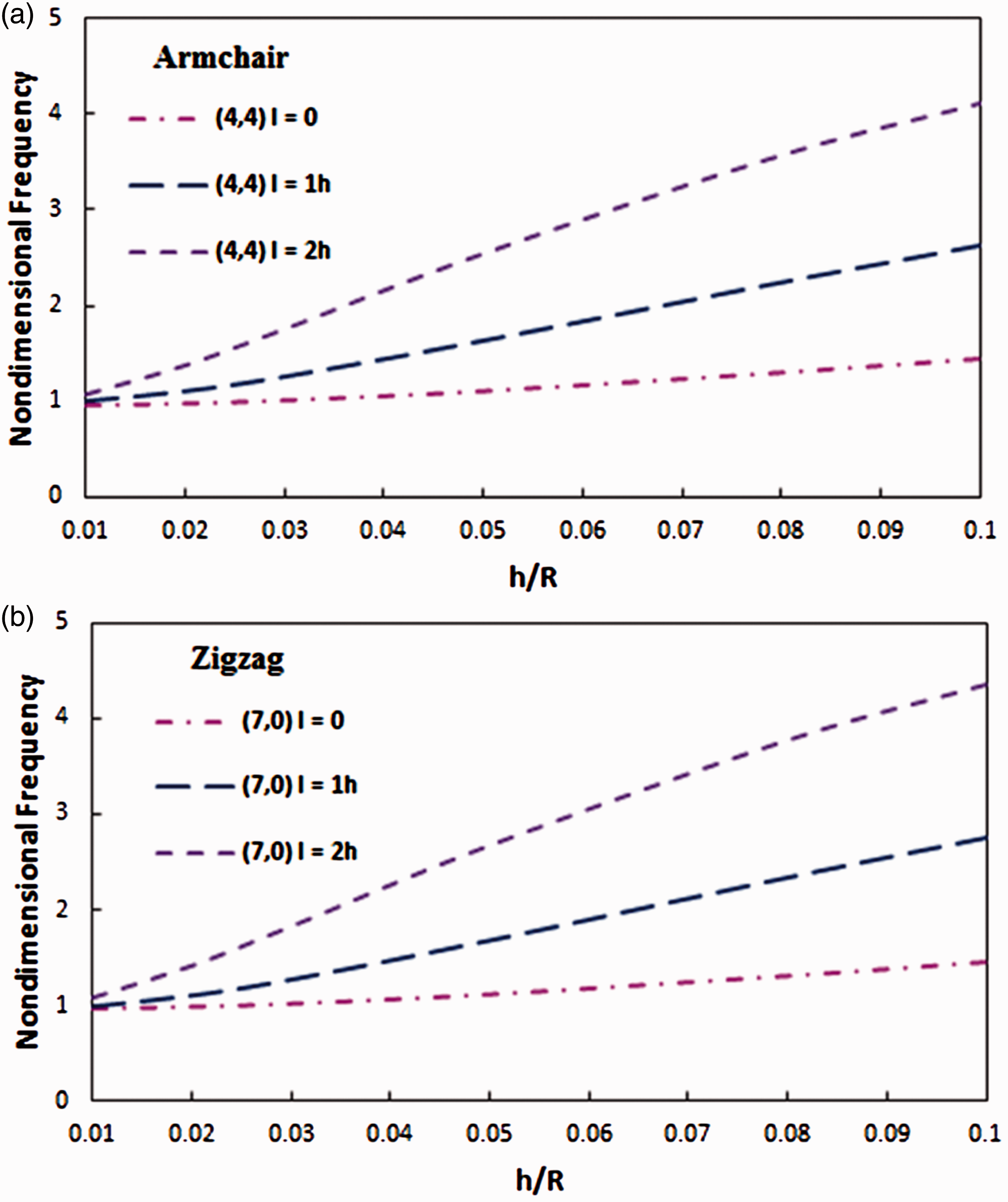
Effects of axial and circumferential wave numbers on the natural frequency
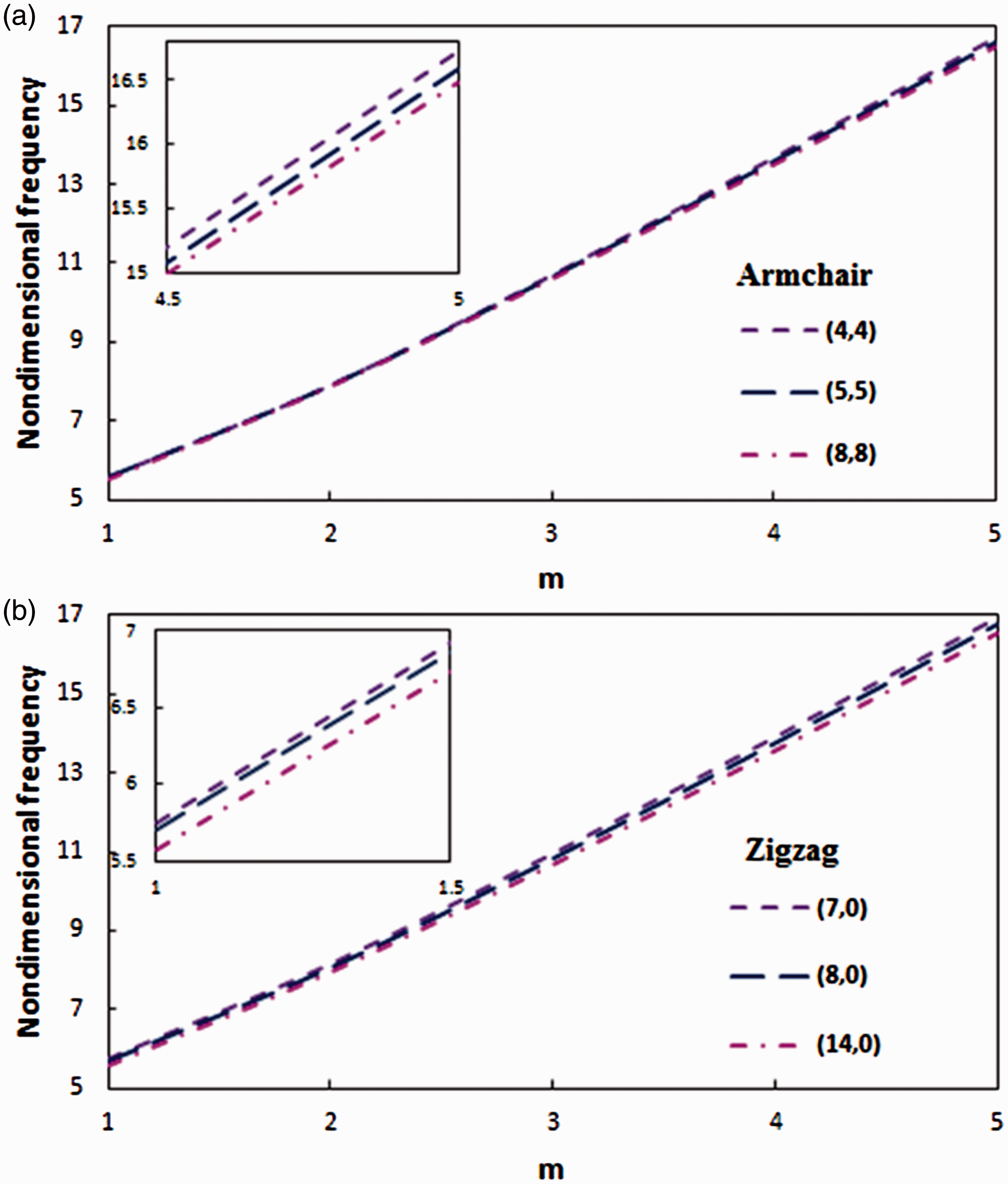
A study on the dimensionless natural frequency of SWCNTs is carried out by the present model for different axial and circumferential wave numbers in Figures 5 and 6. As it can be seen from these figures, the dimensionless natural frequency is strongly dependent on the axial and circumferential wave numbers. In addition, according to both illustrations, the effects of the axial and circumferential wave numbers on the dimensionless natural frequency are dependent on the chirality of SWCNTs, specifically for small radii of SWCNTs. Besides, it is observed that the zigzag SWCNTs is more sensitive to the circumferential wave number. Also, because of high dependency on chirality, the anisotropic shell model should be utilized for studying the vibration behavior of SWCNTs at higher axial and circumferential wave numbers.
Effects of circumferential wave numbers on the dimensionless natural frequency. Effects of axial wave numbers on the dimensionless natural frequency.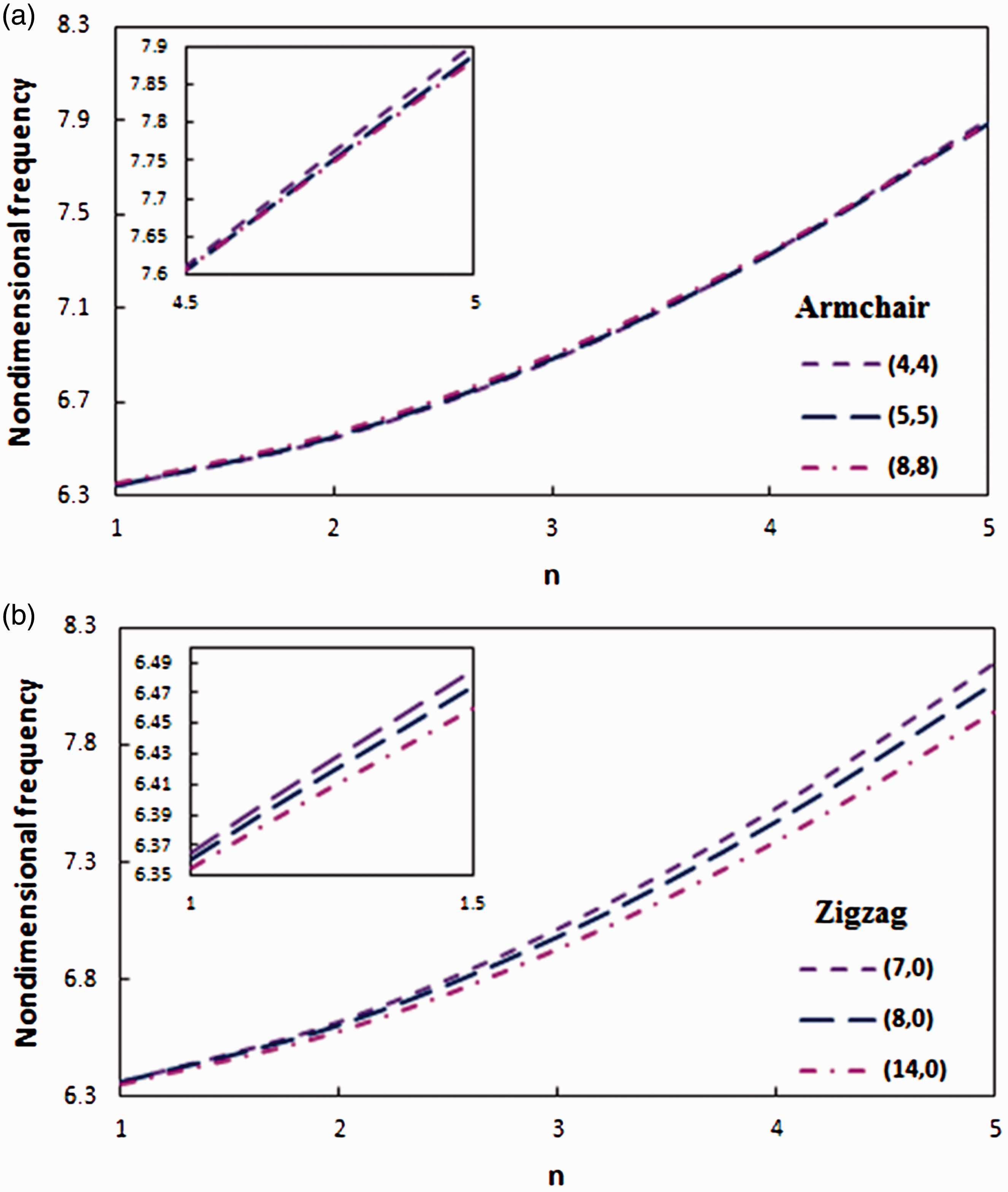
Conclusions
In this paper, a new formulation is provided for size-dependent anisotropic CNT based on couple stress theory, and the motion equations for this model are derived. Using Navier's solution method, CNT vibration equations are solved. After solving these equations, the changes of CNT frequency with CNT geometrical dimensions and length scale parameters are investigated for different chirality. Accordingly, it was found that increase in the material scale parameters leads to increase in the ratio of CNT frequency. Furthermore, it was revealed that for CNT with large diameter, the impact of scale parameter on the frequency ratio diminishes. Moreover, it was revealed that the ratio of frequency is in reverse proportion to the length ratio (aspect ratio). Indeed, for CNTs with low aspect ratio, the influence of CNT chirality is more intense. In relation to the effect of thickness ratio on the CNT frequency, the results showed that CNTs with small thickness ratio have lower dimensionless frequency. In a similar vein, it was shown that, with increase of thickness ratio, the increased frequency for zigzag CNT is more than armchair ones. Also, it was revealed that material scale parameter is more effective for high thickness ratio. Finally, the impact of circumferential and axial mode numbers was investigated on the results, demonstrating that, increase of mode numbers leads to increase in dimensionless frequency. Besides, it was found that chirality has a stronger effect on the results for higher mode numbers.
Footnotes
Declaration of conflicting interests
The author(s) declared no potential conflicts of interest with respect to the research, authorship, and/or publication of this article.
Funding
The author(s) disclosed receipt of the following financial support for the research, authorship, and/or publication of this article: This work has been financially supported by the research deputy of Shahrekord University. The Grant number was 94GRD1M835.