




Abstract
In this work, a revised Bingham model for magneto-rheological damper is used to investigate the primary resonance reduction in the double-layer semi-active isolation system of marine auxiliary machinery. An analytical solution for the auxiliary double-layer semi-active isolation system’s primary resonance is obtained with an averaging method, and this is verified numerically using the Maple software. The effect of model parameters of magneto-rheological damper on the system’s vibration transmissibility is studied. The research results show that the damping of magneto-rheological damper and the control force have a significant effect on the vibration transmissibility in the resonance region. The vibration transmissibility of the double-layer semi-active isolation system decreases with increase in damping of the magneto-rheological damper and control force. Yet the zero force velocity contributes very little to changes in vibration transmissibility.
Introduction
With the development of vibration control techniques and increasing strict requirements for vibration isolation in ships, classical single-layer isolation systems exhibit poor performances.1–3 To achieve more efficient vibration cancellation, double-layer isolation systems have received increased research attention in recent years. Double-layer can isolate vibration of marine auxiliary machinery and reduce the structural noise of ships and submarines subjected to external loads and sudden shocks. Passive vibration isolation systems employing rubber isolators have some advantages such as design simplicity and cost effectiveness. However, as the design of passive vibration isolation systems is fixed, its performance could be limited when the operating conditions change, due to variation of rotating speed of the marine auxiliary machinery. In contrast, an active vibration isolation system utilizing hydraulic or pneumatic actuators can provide high control performance. However, it requires high power and sophisticated control implementation. 4 Besides, the active systems could also be destabilized as mechanical power could be imported into the systems. Therefore, semi-active vibration isolation system utilizing semi-active dampers is proposed to overcome the aforementioned shortcomings in order to achieve high performance with low power while the marine auxiliary machinery is stable and fail-safe.
As far as semi-active dampers are considered, it has been found that magneto-rheological (MR) fluid devices are quite promising for vibration reduction applications.5,6 MR fluids are one kind of controllable fluids that respond to a magnetic field with dramatic changes in rheological behaviours. The essential feature of MR fluid is its ability for reversible change from free flowing liquid to semisolid with controllable yield strength in milliseconds7,8 when exposed to a magnetic field. Comparing with conventional semi-active devices such as variable orifice dampers, MR dampers have the advantages that they are fast responding, have no moving parts, and make them simple and reliable. These have been the primary factors for motivating the development of such devices. 9 Various researchers have studied the application of MR dampers in vehicle suspension systems, buildings, and so on.10,11
The Bingham plastic model is often used to characterize MR fluid properties. 12 Based on the Bingham plastic constitutive equation, a quasi-steady, field-controllable damper model is developed to predict the damper’s performance. In this model, a control force is added to the linear damping force, however, there is no hysteresis element included.
The averaging method which is also named as the KB method (Krylov–Bogoliubov method) is in common for obtaining the analytical solution of non-linear systems. This method is equivalent to the method of multiple scales. But the derivation process of averaging method is simpler than the method of multiple scales. 13 Vahdati devised a criterion for oscillation stability using the averaging method. The proposed criterion is applied to the stability analysis of negative resistance diode oscillators and Colpitts oscillator. 14 Haberman 15 used the averaging method to analyse perturbations to strongly non-linear partial differential equations with oscillatory solutions.
In this study, the double-layer semi-active vibration isolation systems of marine auxiliary machinery are investigated, using a revised Bingham model for MR dampers. A simple relation is introduced to represent the behaviour of MR dampers. The analytical solution for the double-layer semi-active vibration isolation systems is obtained using an averaging method. The physical conditions necessary for primary resonance to occur are determined to assist in the dynamic systems evaluation and in control strategy development. The response of the double-layer semi-active vibration isolation systems is obtained using Maple and finally, the analytical solution for dynamic systems response is validated with numerical simulations.
Model of MR forces
The Bingham plastic model is often used to characterize MR fluid properties.
5
Based on the Bingham plastic constitutive equation, a quasi-steady, field-controllable damper model was developed to predict the damper’s performance. In this model, a control force is added to the linear damping force, however, there is no hysteresis element included. The Bingham plastic model can be expressed as

The Bingham plastic model is often used in predicting MR damper response, however, this model does not include hysteretic element. A revised Bingham model with hysteretic loop is proposed, as follows
The revised Bingham model.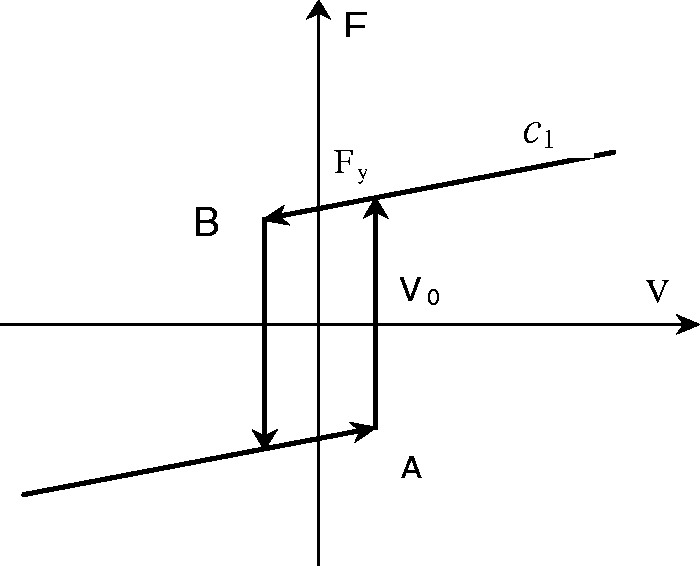

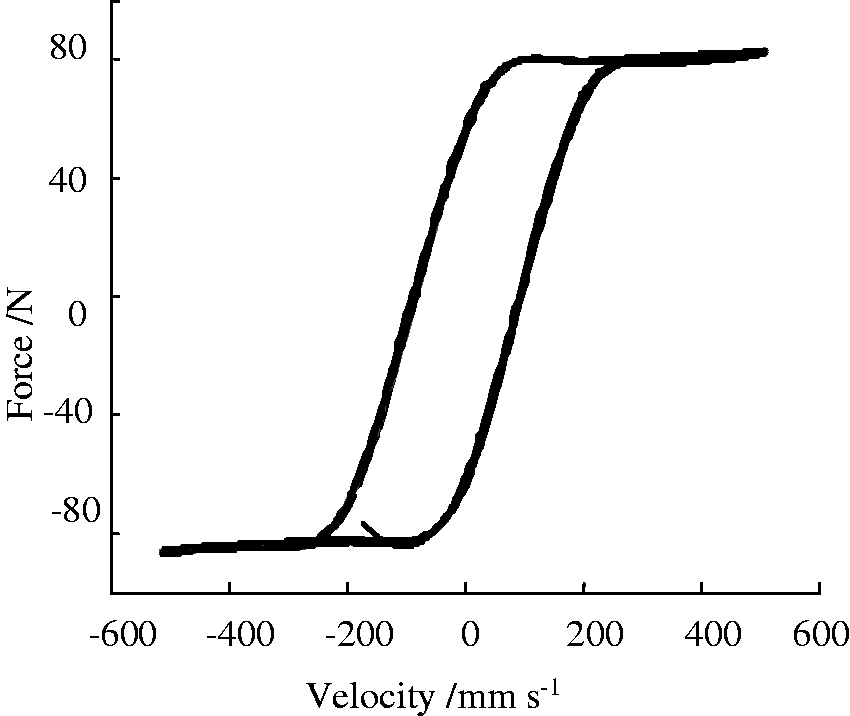
The proposed model requires only three parameters that need to be determined empirically. The theoretical results are shown in Figure 1. The MR damper RD-8040 of LORD Co. Ltd is tested. The experimental setup is shown in Figure 2. A typical experimental result showing the force-velocity relationship of a prototype MR damper is depicted in Figure 3. It can be seen that the model can capture the hysteretic behaviour of an MR damper.
The experiment setup of MR damper. Force versus velocity model of MR damper.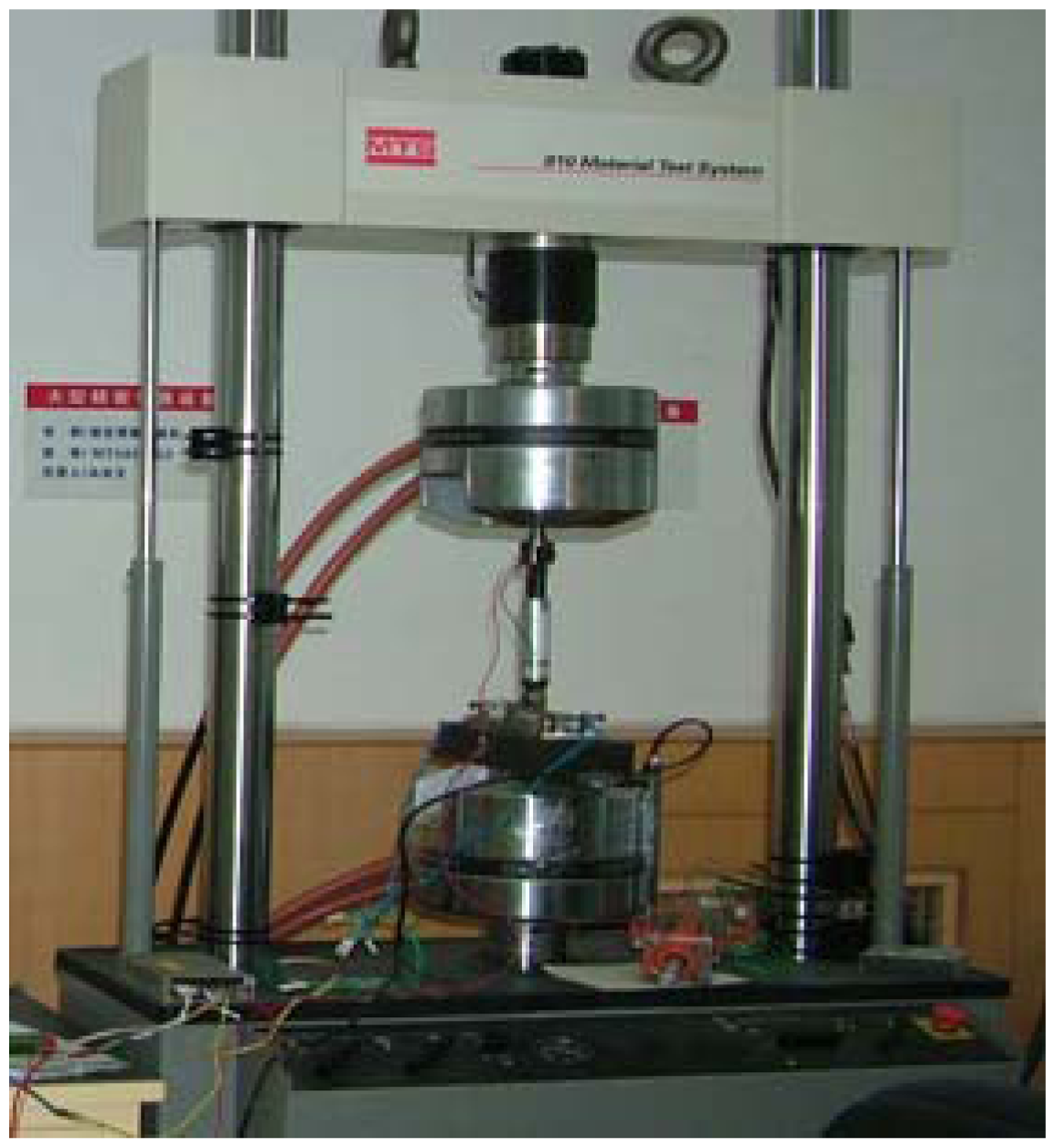
Model of vibration isolation systems
The double-layer semi-active vibration isolation system of marine auxiliary machinery considered in this work is shown in Figure 4. The dynamic equations of the systems are
The double-layer semi-active vibration isolation system of marine auxiliary machinery.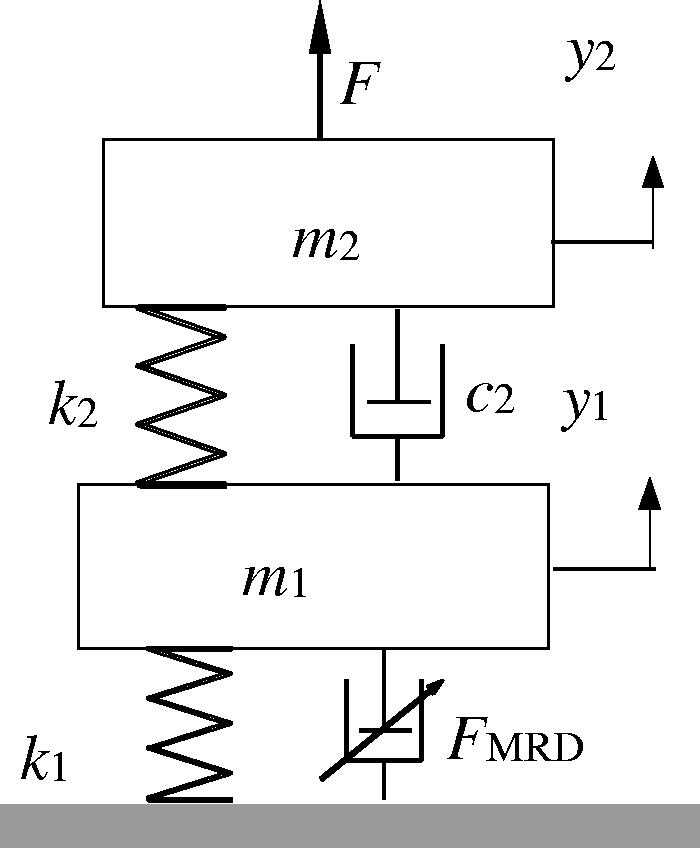

For the sake of brevity, simplifying equation (3) with dimensionless displacement

In this case, the parameter B15 is small compared with other parameters. Thus, the equation is a weakly non-linear oscillation systems. The analytical solution of equation (4) is obtained through the averaging method as follows. Consider the following solution for equation (4)



From equation (6), two equations can be obtained as follows

Performing a K-B transformation to equation (7), and using

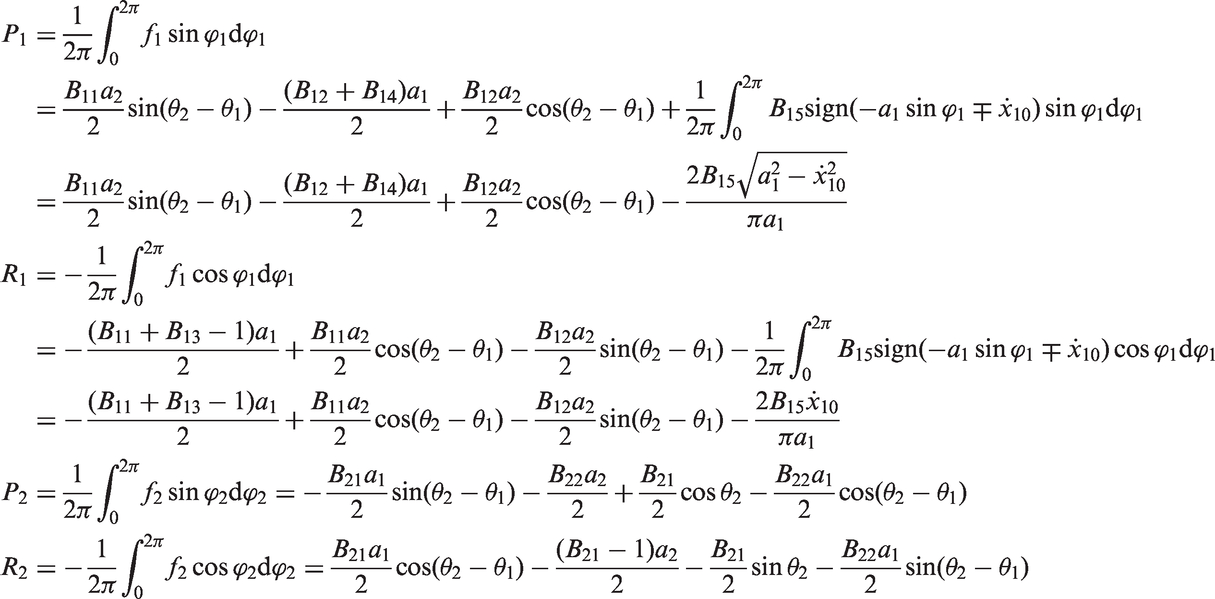
From
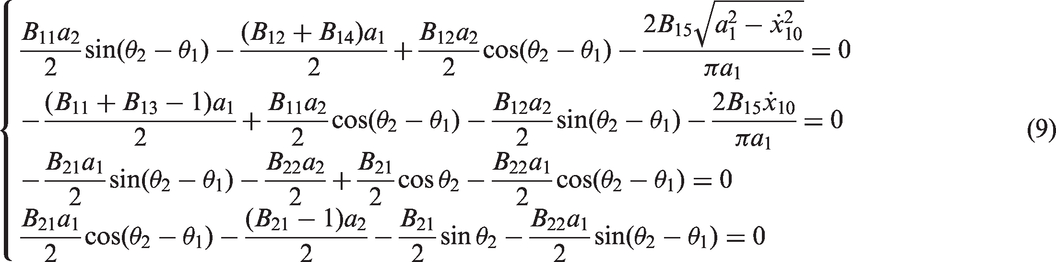
From equation (9), the following two equations can be obtained


The amplitudes a1 and a2 of the steady state resonance solution of the systems can be obtained from equations (10) and (11). The phase shifts

The vibration transmissibility of double-layer semi-active vibration isolation systems is

Numerical results
In order to verify the theoretical results of this work, equation (4) was integrated numerically with the Maple software. The system parameters used were as follows: m2 = 1000 kg, m1 = 620 kg, V0 = 0.1 m/s, k1 = 3.2 × 10⁶ N/m, k2 = 4.0 × 10⁵ N/m, c1 = 1500 Ns/m, c2 = 3000 Ns/m, Fy = 60 N, F0 = 500 N, Theoretical and numerical solutions of vibration isolation system.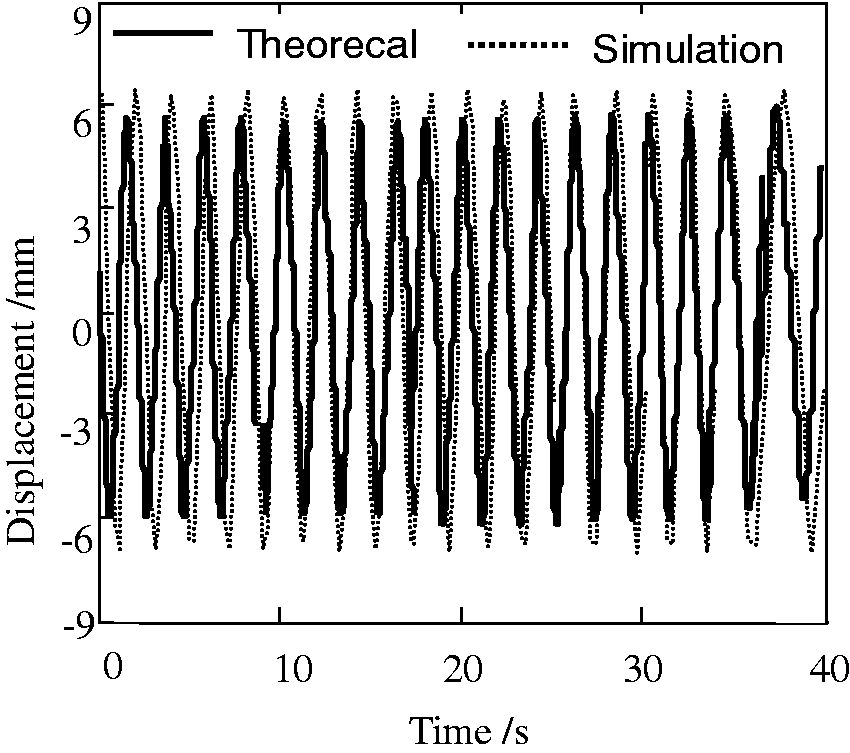
Increasing the off-state viscous damping of the MR damper reduces the vibration transmissibility of the systems, as shown in Figure 6. As c1 makes little contribution to the systems equation, the resonance frequency changes inconspicuously.
The effect of c1 on the vibration transmissibility.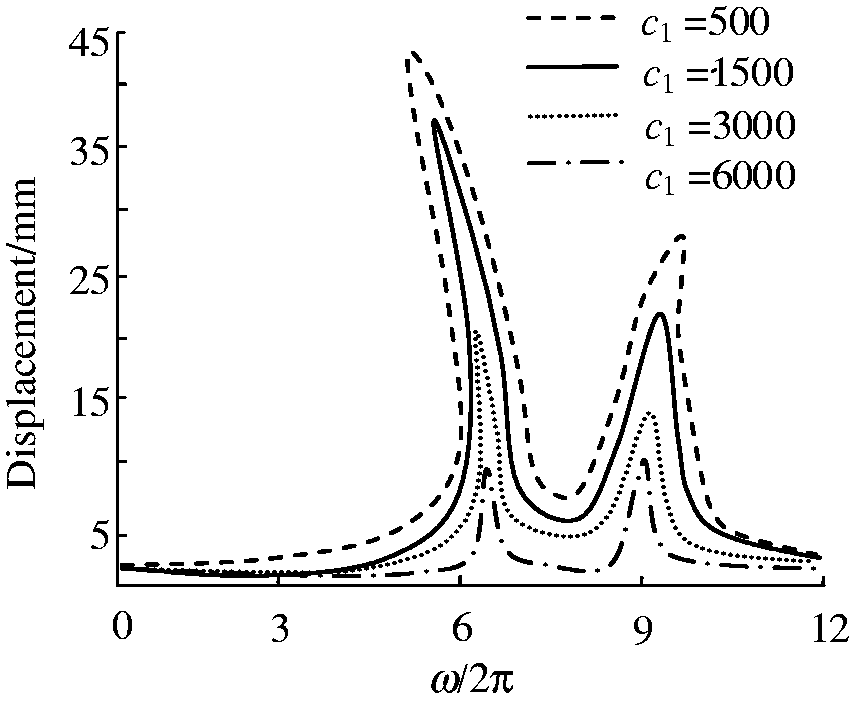
The MR force Fy has a significant impact on the vibration transmissibility of the systems, as shown in Figure 7. It can be seen that as Fy increases, the vibration transmissibility decreases and the systems becomes more stable. As Fy makes little contribution to the systems equation, the resonance frequency changes inconspicuously.
The effect of Fy on the vibration transmissibility.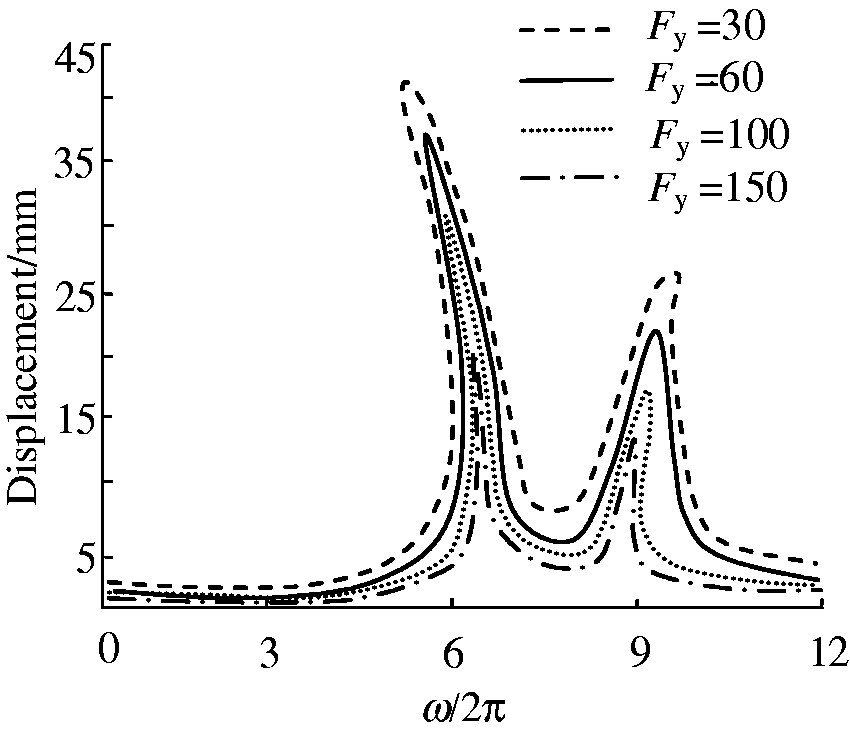
The value of V0, zero-force velocity of the MR damper, depends on the compressibility of the MR fluid and the accumulator. The effect of V0 on the vibration transmissibility of the double-layer semi-active isolation systems in the resonance region is small, as shown in Figure 8. It can also be seen that V0 reduces the response of the systems in the resonance region.
The effect of V0 on the vibration transmissibility.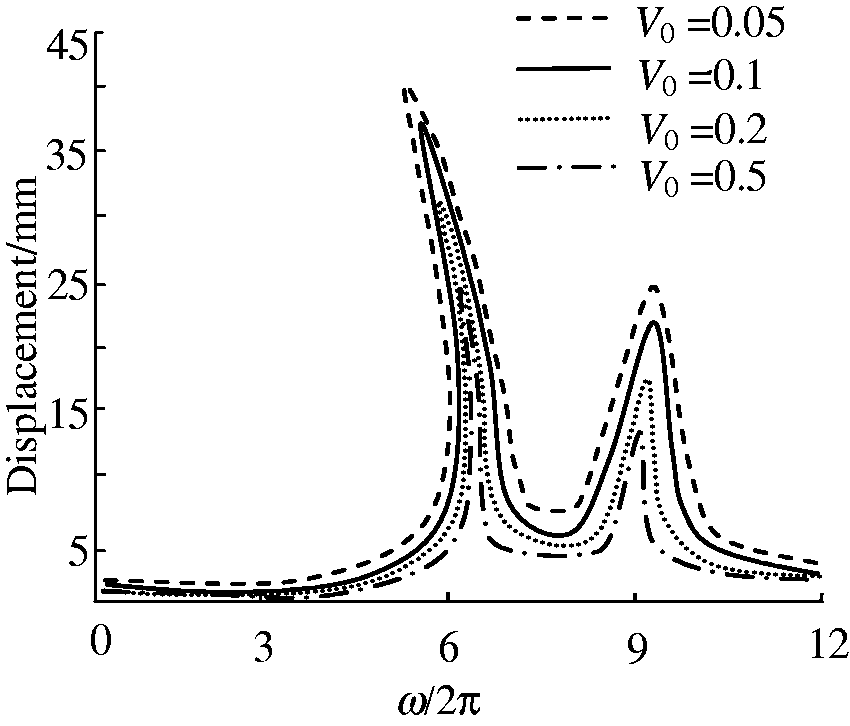
Conclusions
A revised Bingham model for MR damper is used to describe the non-linear damping force of marine auxiliary machinery. The influence of system parameters on vibration transmissibility of double-layer semi-active isolation systems controlled MR damper has been investigated. The factors include the control force Fy, the viscous damping c1 and the zero force V0 of the MR damper, among which the last three factors are related to the compressibility of the MR damper. Increasing of the compressibility leads to a larger value of Fy, c1 and V0. By increasing the control force of the MR damper, the threshold value for the system resonance will increase, and hence, the system would be more stable. In the resonance region, increasing viscous damping c1 or the control force of the MR damper Fy will restrain the primary resonance greatly. However, in the non-resonance region, the effect of them is very minor. The zero force velocity V0 has less effect on the vibration transmissibility of the systems in the resonance region. Increasing the zero force velocity V0 would reduce the vibration transmissibility of the systems.
Footnotes
Declaration of conflicting interests
The author(s) declared no potential conflicts of interest with respect to the research, authorship, and/or publication of this article.
Funding
This study is supported in part by the National Science Foundation of China (11302088) and the Natural Science Foundation of Jiangsu Province (BK2012278).