




Abstract
Although opera outreach has gathered momentum over the last few years, opera is still often overlooked as a potent multisensory tool in dramatherapy, perhaps due to its association predominantly with music and music therapy. Using drama-related case studies, this article wants to breathe new life into the discourse of opera therapy initiated by music therapist Emma O’Brien in 2006. It further ties in with a discourse around dramatherapy work for adults with learning disabilities. The article traces how inclusive engagement techniques inspired by Francisco Cilea’s opera L’Arlesiana can be rendered useful within a dramatherapeutic context. The project was facilitated as part of Opera Holland Park’s accessibility programme in 2019. By sharpening consciousness for the distinct contributions to opera therapy from individual disciplines other than music therapy, the article hopes to put opera back on the map as a medium also for other creative therapies to explore.
Introduction
Opera therapy in context
Although opera has been recognised in recent music and dramatherapy debates, research in the field rarely ventures beyond a focus on singing and music, leaving key contributions from other creative areas dimly lit. 1 Hodermarska and Scott-Moncrieff (2007), for instance, promote the operatic form in their work as a predominately musical vessel to hold the diverse and extreme emotional expression of young clients from deprived urban areas. They present the concept of operatic play as ‘grand dramas in song [. . .] offering [a potent] way of being seen’ (Hodermarska and Scott-Moncrieff, 2007: 252). The practice is interested in the more free-flowing, experimental aesthetic that opera music often provides to contain adolescent emotions through ‘full-voiced singing, rhythm and melody making instruments’ (Hodermarska and Scott-Moncrieff, 2007: 246).
When working with adults with a learning disability, however, the ability to voice freely cannot always be taken for granted, yet music can be a ‘strong motivator’ (Wood, 1993 [1983]: 29). In this vein, Wang (2022) describes the use of Chinese Opera to motivate elderly clients to participate in a Nursing Centre in Jinan. Although part of the genre of music drama, Chinese opera has a different aesthetic tradition and cultural location than the European Opera referenced here. Furthermore, Wang’s article again looks at the medium of opera mainly from the perspective of music therapy; at vocalising, or communal singing. But exposure to opera music can be also harnessed as a way to ease access into related dramatic exercises.
A survey of how opera is currently used in therapy-informed contexts in the United Kingdom reveals an emerging body of diverse practice, albeit in a series of discrete snapshots. Most recently, as a response to COVID-19, the English National Opera re-trained singing tutors to offer vocal coaching to strengthen breathing and lung capacity for patients with long Covid (Dickson, 2021; English National Opera (ENO), 2021). Community drama projects such as Turtle Key Arts (2022) with their subsection Turtle Opera are creating new work, using the classical art form to engage teenagers on the autistic spectrum. Furthermore, Opera Holland Park’s (OHP) outreach section INSPIRE has offered numerous accessibility workshops over the past decade, for example, for people living with dementia or neurodiverse participants, with the aim to improve well-being and foster community. Although not always clinically supported, the documentations of these projects often state that deploying opera can be both mentally and physically stimulating for the participants (ENO, 2021; Turtle Key Arts, 2022).
In 2006, Australian music therapist Emma O’Brien (2006) grasped the therapeutic potential of opera and coined the concept of opera therapy. With a group of patients, she explored cancer stories in classical dramatic form. As a music therapist, she employed opera as an expressive tool to enable clients to emotionally understand their periods of illness through guided composition work and to see their experiences played back to them in performance. In discussing the devised work, O’Brien (2006) hoped to spawn ‘further discourse towards contextualising [opera therapy] within music therapy’ (p. 83). She states as a definition of the praxis:
Opera Therapy is the use of the multimedia of opera as a transformative means of expression for patients as guided by a music therapist using specialised song writing techniques. (O’Brien, 2006: 95)
Starting from this, the research presented here moves on to look closely at the dramatic value of the multimedia of opera. By lodging the discussion around opera therapy in the work of the drama facilitator, the critical discourse gives contour to a varied participatory practice related to opera. This perspective can also inform the work of the dramatherapist in a clinical context. The following discussion of the outreach work suggests how performance-related opera material (e.g. staged scenes or sensory input related to story, movement, and character) could be deployed in dramatherapy for adults. Witnessing operatic material in a therapeutic context, apart from musical exercises, is briefly mentioned by O’Brien (2006), Morris (2012: 26) or Hirst (1997). But in dramatherapy, viewing shows (or elements of them) is still mostly related to straight plays rather than opera (Langley, 2006). The field work described in this article took place in a care setting for people with learning disabilities and consisted in employing the content of an opera production for a community outreach project.
On the relationship between opera and dramatherapy
At the intersection of opera outreach and applied theatre, the practice presented here marks an interdisciplinary research contribution to the related field of dramatherapy. Although inspired by a diversity of creative arts therapies, its underlying interest aligns most directly with Langley’s (2006) key understanding that in dramatherapy ‘the [potentially] therapeutic element is in the process of dramatic art [. . .] the emphasis is on the experience’ (p. 1). Accordingly, in my approach, drama forms the core medium in the creative dialogue described.
Consequently, I am deploying opera content and music in my work to inspire movement-based and acted-out dramatic tasks. In this sense, the suggested opera therapy tools are different from the use of operatic play or opera therapy in music therapy. Primarily they are not interested in facilitating musical expression or singing, but scenic and motoric articulation. For this article, I would like to define opera therapy as a version of dramatherapy, interested more in collective, non-verbal expression and conversations through dramatic exercises than in individual vocal expression through song. Having said that, any sharp demarcation around one art form in the collaboration between music and drama therapy (Chesner, 1995; Hodermarska and Scott-Moncrieff, 2007) that forms opera therapy naturally frizzes out at the edges.
Collaborations between music and dramatherapy often play an important role in the description of therapeutic work with people with learning disabilities. As an example, Chesner (1995) discusses fairy tale work that is framed with music and song in her seminal Dramatherapy for People with Learning Disabilities. Also, Wood (1993 [1983]) has written in Music for People with Learning Disabilities how when ‘music is added to drama we have a further dimension and the enjoyment and benefits from participation are increased’ (p. 152). Both authors show that tools such as writing songs or illustrating stories with music benefit dramatherapeutic work with individuals with learning disabilities.
Research inquiry and aims
I conducted the project from the perspective of inclusive facilitator and practice researcher in the field of music theatre. At the time of the project, I was working on a practice-based PhD in Theatre and Performance at Goldsmiths (University of London), focusing on creating music-dramatic work at the intersection of opera and inclusion, with a particular interest in working with adults with learning disabilities. As a result, I became interested in dramatherapy. At the same time, I started to work with Opera Holland Park as an inclusive facilitator. The coordinator of INSPIRE asked me to devise an accessibility workshop series for OHP’s production of L’Arlesiana. To highlight the different perspectives that informed my analysis at different stages of the project, I am using various terms to describe my role in the facilitation process.
Against this background, this article investigates opera as a potential therapeutic space in an adult care setting. With concrete moments from the workshop series Mental Health in States of Pastoral and Ruin, created in response to Francisco Cilea’s opera L’Arlesiana (1897), the featured case study exemplifies how dramatherapy-informed elements were sparked by the opera production. The dialectic title of the inclusive project refers to the co-existence of intact and damaged places within the story. The pastoral location of the French music drama, set in rural Provence (near Arles), contrasts with the ruinous interior landscapes of some of its inhabitants; most notably those of the main character Federico who is pathologically in love with a mysterious woman from Arles, hence the title L’Arlesiana. The fluid binary of overlapping mental states informed the guiding research question on how opera can be framed as a well-being tool to help participants tolerate seemingly conflicting emotions within the same expressive space. This potential, I argue, could be unpacked also in clinical care settings, not just with music and song work, but also through sensory and scene work.
Participants
The workshops took place in a day centre service for adults with learning disabilities in North West London. The centre offers various workshop activities, from cooking to creative arts sessions to help service users build confidence and make their own decisions. As part of their learning disability outreach, Opera Holland Park engages with the centre regularly. The day centre is part of the organisation Equal People Mencap and this particular service was founded more than 30 years ago. The two L’Arlesiana workshops were held in the summer of 2019. Each workshop was 1½ hours long. The team consisted of the coordinator of INSPIRE as well as singers from OHP’s chorus, musicians, and me. The group of participants was made up of 10 to 15 service users. Participation happened on a voluntary basis. The disabilities in the group ranged from mild to profound and multiple learning disabilities, with some non-verbal members.
Methodological approach
In documenting a more drama-centred opera therapy approach, this article makes use of elements of Practice as Research (PaR) that champions,
The value of the ‘insider’ accounts of those who make and circulate the work to foster learning about other [facilitator’s] processes and compositional strategies; [. . .] [which provide] in combination with other evidence, a much fuller understanding about what is at stake in creative arts practice and the experience of it. (Nelson, 2013: 89)
The accounts are based on my field notes and reflections as well as conversations with my co-facilitator. They are written translations of embodied work. Radical neutrality of the facilitator-researcher in relational work that relies on interpreting actions and emotional cues in a particular sociocultural environment remains difficult to maintain in absolute form. The general aim, therefore, was to establish a non-judgemental space in which participants felt empowered to contribute. Two photographs from the workshop sessions further articulate the practice insights. To make transparent the experiential involvement of a team of facilitators and reference the work processes as team effort, the pronoun we is often used in the descriptions. The written text strives to make practice choices evident, by tracking how the tasks were absorbed and transformed by the participants. When talking about the participants, I prefer ‘people with learning disabilities’ in the interest of a people-first approach.
The idea of co-creative research follows a participatory approach that also invites semi-verbal or non-verbal participants to express themselves through various media, for example, with sensory composition techniques that involve highly tactile objects to create gentle sounds. In applied practice, the drama studio often becomes a space for creative experiment. In our case, the space of the day centre was transformed into such a creative space for the time of the workshops, inaugurated with dramatic rituals and play. For the fine arts, the participatory approach is exemplified by Fox and Macpherson (2015). With their Inclusive Arts Practice and Research manifesto, they are interested in ‘how certain materials and practices aid the process of Inclusive Art making’ (Fox and Macpherson, 2015: 6). I am transferring this intentional approach to dramatherapy-informed facilitation, with the aim of fostering inclusive opera access.
Likewise, the OHP outreach team set out to familiarise the group with the content and extreme themes of Cilea’s opera and make them accessible. The late 19th-century opera re-dramatises a heterosexual love triangle in the wake of the Romantic tradition. A male hero (Federico) is trapped emotionally in his extreme love for a woman that does not reciprocate it. Vivetta, an archetype of caring femininity, desperately tries to get through to him. The plot ends with the death of the protagonist. The original opera version opens with a scene between the ‘innocent’ disabled young brother of Federico and the old shepherd Baldassare. The OHP staging defused the stereotypical representation of disability in the opera by highlighting the youth of the character rather than his mental state. The two preparatory workshops with Equal People Mencap led to an opera visit at Holland Park in summer 2019.
Accessibility work, as promoted by Chesner (1995) and Fox and Macpherson (2015) or practised by OHP, often rests on the belief that ‘full participation in the available culture marks enriching influences that [are often] absent from the identity of some people with learning disabilities’ (Chesner, 1995: 2). My research agrees with this implicitly socio-political observation. During my work with inclusive charity groups, I noticed that opera often does not feature in the cultural content to which adults with learning disabilities are exposed to via their smart phones or televisions, or even as part of community projects. Often, this is due to questions of access (length, place, or time of an opera performance), rather than of aesthetics or taste. I have noticed how groups responded to operatic stories with interest. Relaxed performances and accessibility programmes are important steps towards promoting a genuinely democratic access to the ‘available culture’, including opera art.
Safeguarding
Langley (2006: 144) emphasises that sessions with people with learning disabilities need to be rooted in the reality of a safe space before moving on to imaginative dramatherapy work. When working with vulnerable groups, the awareness that the boundaries between the imagined and the felt can quickly blur requires particular care to set up a safe space (Chesner, 1994; Langley, 2006). Consequently, my co-facilitator and I highlighted the difference between dramatic space and personal space throughout the workshops by, for instance, drawing attention to the fictional nature of dramatic character actions.
The opera ends with a suicide. In preparation, we pointed out how actors got up alive after a show to receive applause. Before the show, the group had the chance to go on stage and see a mattress placed to soften the fall of the actor playing Federico. Secret greetings such as tapping one’s hat during the performance were also agreed between some chorus members and the group to make contact during the show and thereby spark a sense of familiarity and comfort. Noise levels and sensory input were managed by appropriate seating away from the orchestra. In addition, the participants were free to leave during challenging periods. After the performance, the group gathered outside the OHP’s marquee to share any excitement caused by the subject. Support staff from the centre who accompanied the group, were present throughout to hold a safe space together with us.
Ethical considerations
Verbal and pictorial consent forms were handed out before the workshops, informing the participants that the project could become the basis for a research publication. To protect the participants identity, the photographs and descriptions are anonymised through the use of neutral pronouns. Participants who did not give consent do not appear in close-ups. The content went through a process of ethical approval with the coordinator of INSPIRE at the time. As co-facilitator (and former registered general nurse), she was also present during the workshops to ensure safeguarding and monitor the workshops together with me.
Discussion of the outreach project
The first part of the article briefly contextualised outreach at the intersection of participatory opera work and inclusive dramatherapy. In this part, two concrete examples from the applied practice illustrate my dramatherapy-informed outreach approach: (a) a movement composition that uses contrasting tactile props to introduce the non-binary concept of the workshops in a less intellectualised way, integrating musical elements as a motivator during the warm-up phase for scene work; (b) a laughter scene from the opera as a performative discussion starter within the safe, fictionalised setting of dramatic play to address difficult situations in life such as being shamed publicly. When the participants explored personal situations and emotions in an aestheticized form (through character identification or metaphor), I found that this was when dramatic outreach work and possible therapeutic effects could overlap.
Contrasting emotions through touch instruments
Legato ribbons and staccato sticks
The workshops took place in the late mornings, the first part of the sessions was designed to warm-up the group and energise through opera-related exercises. One session opened with a tactile icebreaker. I prepared chop sticks (with rounded tips for safety) and bundles of colourful ribbons to hold (see Figure 1). The chopsticks brought in a clean, hard sensation while the bouquets of red, blue, and neon green ribbons had a soft and flowing quality. I introduced the two objects as special, multisensory instruments and treated them performatively by, for instance, seriously handling them with care. Furthermore, I gave the ribbons the name legato touch harps, similar to the strings of a harp. The wooden batons were called staccato sticks for the clunky sound they were able to produce, a budget version of drumsticks. The musical expression legato describes a smooth and connected playing style, whereas staccato describes the opposite quality of an interrupted, perky expression. Besides providing a warm-up exercise, the instruments had the purpose to introduce classical musical concepts in a taciturn way through their contrasting textures and associated sensations.
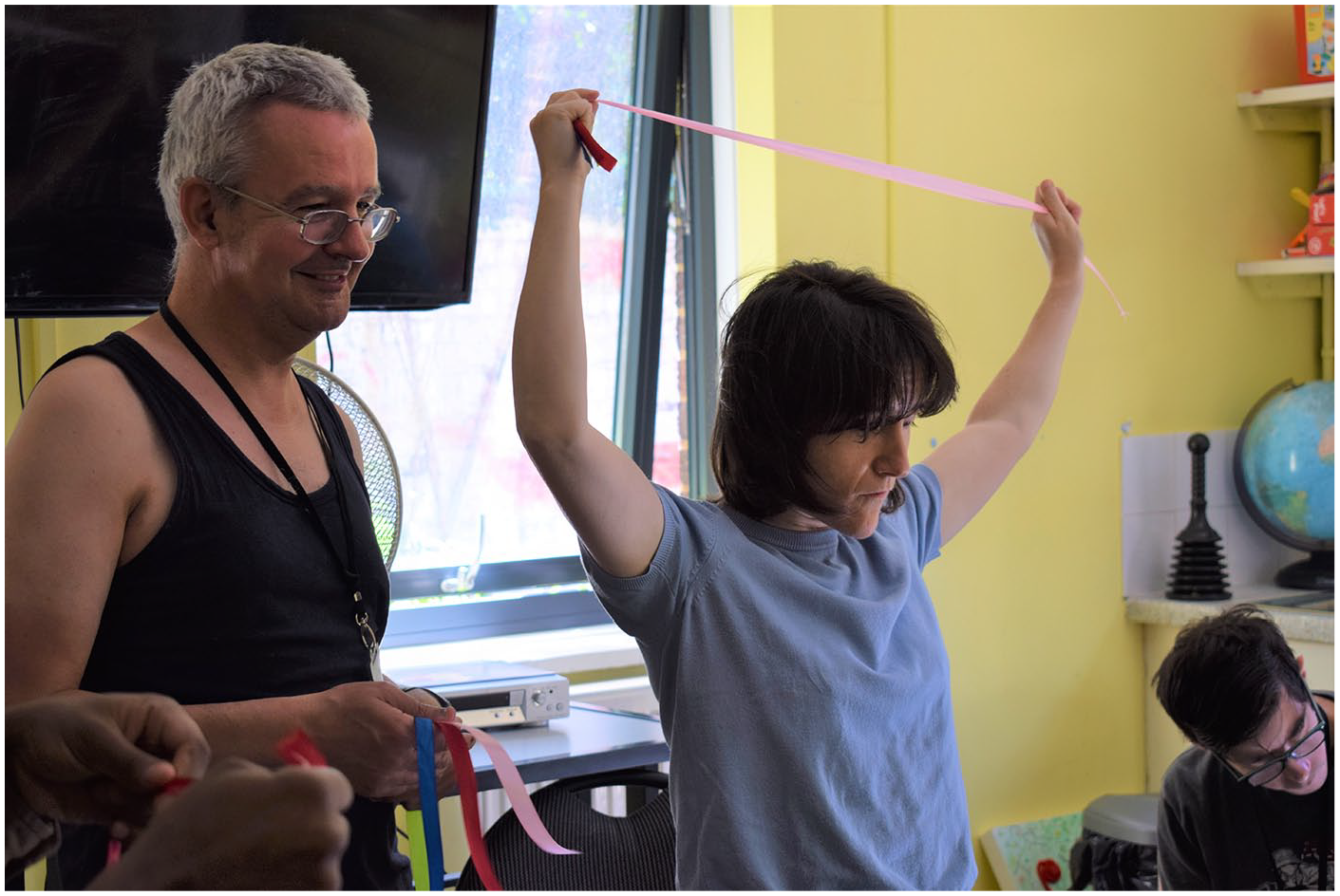
Physical and emotional warm-up inspired by sensory composition: Two participants explore tactile legato ribbons in space. ©OHP.
As I introduced the devices, I invited the group to feel the instruments and explore their unusual sound qualities during a walk through space or from their seats (if in a wheelchair). The sticks were carefully banged against walls and furniture, orientating the participants within the present of their environment, which resulted in a moment of mindfulness. The ribbons were brushed against arms or chairs or waved through the air, creating connections between participants and space. After the exploratory phase, we briefly reflected upon the feelings and what we heard. The participants identified the aesthetic qualities of the legato harps as ‘smooth’ and ‘soft’, those of the sticks as ‘hard’ and ‘disrupted’. The conductor of our team integrated these comments into explaining how these qualities could be felt in opera music.
Following on from that, the INSPIRE team made connections with a sighing motif from the opera that displayed a downwards glissando which could be related to the ribbon movements and a deep flow of emotions. The musical equivalent of the sensation of staccato choppiness was further interpreted by playing around with a sung line from the opera. The girl that stole our hearts was one of the key phrases from the libretto to describe the femme fatale Arlesiana. The musical line mimics her destructive influence on Federico, with a staccato rhythm, undermining a seamless indulgence in romantic love. With intermittent conducting movements, we punctuated the air to also express this quality in a non-verbal form.
Morning mood piece
In a second step, we translated the contrasting tactile and musical sensations into start-of-the-day emotional vocabulary. Together with our conductor, we invited the group to compose a morning mood piece involving contrasting feelings that could be related to the tactual qualities of the instruments. The group decided for the word ‘a-wake’ to represent a perky alertness, separating the pronunciation of the word after the initial syllable. This was counterpointed with a sigh-inspired relaxed ‘ti-red’, with a rest on the long vowel, pitting a languid, altogether different emotional energy against the crisp sounds associated with being awake.
The compositional, opera-inspired exercise introduced the overall concept of the workshops in an accessible way. It situated different sensibilities within a shared aesthetic space, flowing in and out of each other. This echoed the metaphoric ruins set within the pastoral landscape from the staging of the opera. In my field notes afterwards, I noted that the tactile exercise had worked well especially for people with physical impairments and for non-verbal participants as they were able to produce creative and emotional expression through multisensory techniques. A non-verbal participant in a wheelchair enjoyed that they could take part in the exercise by including the sound qualities of their chair. They used the frame of their wheelchair as percussive base, drumming the stick against it.
In a final performance of the morning mood piece, the participant in the wheelchair and other members were then invited to conduct the group, using the chop sticks as batons. This enabled a broad spectrum of participants with profound and multiple learning disabilities to explore being seen as leaders through a co-creative task inspired by the opera setup. A situation that seemed exciting for some of the members who proudly rose to the challenge. Others did not feel comfortable to take on the conducting role and decided to watch the performance from the safety of their chairs.
The co-creative compositional process can be further diversified by introducing musical dynamics (playing softly or loudly). This can facilitate experiences of personal choice within the inclusive artistic process, allowing improvisation and personal preferences during the ad hoc composition. The concept of gradation, along a spectrum of feelings, can be rendered concrete through practicing crescendo and decrescendo passages, where the soundscape (or intensity of touch) finds places in-between the extremes of soft/loud or legato/staccato (as well as options of mix and match). Through the unconventional use of everyday objects in this music-dramatic space, the workshop produced various outcomes. The sensorial exercise illustrated on a non-verbal level how classical composition techniques and sequences from the operatic score can be taken into other media. It translated operatic content into alternative expression for differently abled performers. The performative recontextualisation of opera techniques and musical vocabulary prepared for the second exercise of the workshop.
Releasing shame through laughter
Preparatory exercises: A magic cushion and emotional play
Cilea’s opera features a scene in which a character is derided by a group of villagers (represented by the chorus). In discussions before the workshop, we considered that this situation, during a visit to the actual opera performance, could potentially be triggering for people who are still often disenfranchised, or (unintentionally) not taken seriously within a society that is predominantly organised around ableist and intellectualised interaction (such as linguistic capability and ‘readable’ body language). In various workshops with similar groups, I had encountered stories of this sort, where the participants told through dramatic exercises how they wouldn’t be understood in shops or served in cafes. Therefore, we incorporated an exercise into the accessibility sessions to prepare for the scene and to provide a space to release emotions in a safe group setting in non-verbal and verbal forms.
Before we embarked on the core exercises of addressing questions of being shamed in public, we primed the dramatic space as a contained space where play could happen freely. Two drama exercises introduced the concept of dramatic play as different from real life. First, I adapted an improvisation exercise I had learned during an opera workshop years ago into a sensorial exercise with a ‘magic cushion’. The cushion, I explained, possessed the power to bring about any emotion in the person who touches it. The grey, velvet and intriguingly tactile cushion had a sparkling button in its centre. I explained that the button had the power to neutralise any emotion instantly, like an on and off switch. The prop initiated and focused the exercise. While being passed around, it gently invited every participant who got hold of it to respond to the cushion with an emotional mini performance.
The exercise was interpreted differently by different participants, producing individualised emotional answers to the pillow. One member displayed a hearty soundless laugh with their head tilting gently backwards and their body language communicating a state of emotional relaxation. Some participants opted for a joyous smile. Some chose sadness with a soft cry inspired by the consoling comfort of the grey fabric. One member acted out falling asleep on the cushion, as the ‘cushion felt so soft’. Initially, I had suggested laughter as the dramatic guideline. But the participants became creative and produced a variety of emotions magically brought about by touching the square pillow.
On a therapeutic level, the exercise showed the different expressive responses a similar situation can create in people. The didactic rationale behind the cushion was to rehearse changes in emotions and reveal that it is possible to play around with them or to actively be involved in managing them. Furthermore, the magical prop marked the context we were performing in as fictional. In this context, emotions could transform freely. Similar to an opera setting, the drama game enabled the participants to creatively explore unfamiliar, possibly extreme or contrasting feelings through an embodied performance situation.
We transferred this awareness of emotional play to a short scene from L’Arlesiana, acted out in the centre of our seated circle by cast members from OHP’s chorus. One of the opera singers was asked to perform a piece from the opera in a sad manner. The task for the group was then to find ways to cheer them up during the performance by, for instance, singing with them or miming cheerful expressions, so that the emotional attitude towards the song transformed during its delivery. One of the strongest embodied interventions that occurred was reaching out to the singer by gently touching them on the arm, showing that they were surrounded by and held within a community of compassion.
I observed in the field notes about the feeling created by this acting through operatic scene. As I wrote, ‘coming together by consoling the singer created a nice moment of physical encounter and body action’. The task helped to set up a safe dramatherapy-informed frame. It allowed to discuss personal situations in a creatively held space and to review them from the aesthetic distance of imagined circumstances. Furthermore, I used the exercise to experientially illustrate that in our performative opera setting, extreme emotions were amendable. The predominantly non-verbal techniques of acting within the opera scene through miming and touch noticeably engaged many of the participants, as it revealed a sense of empowerment when stepping into mediating extreme emotions and managing them as a group. The agency to step in and change a performance, and by extension an emotional sensation, through touch and play were evidenced in the preparatory exercises. In a therapeutic process, this learning could also be taken further into managing situations outside of the dramatic space.
Public exposure
One of the core purposes of the workshop series was to prepare the group for an opera visit of L’Arlesiana, where the participants would face extreme emotional situations on stage. Of course, this is partly based on the bias that people with different abilities are not per se able to tolerate strong emotional input, which is not necessarily the case or particular to this group. Within the workshop context, the laughter exercise prepared the group for a short scene from the opera in which one of the characters is derided in public (see Figure 2). In briefings, we anticipated that some of the members could have faced similar situations in their real lives. We took therefore care to prepare for that situation.
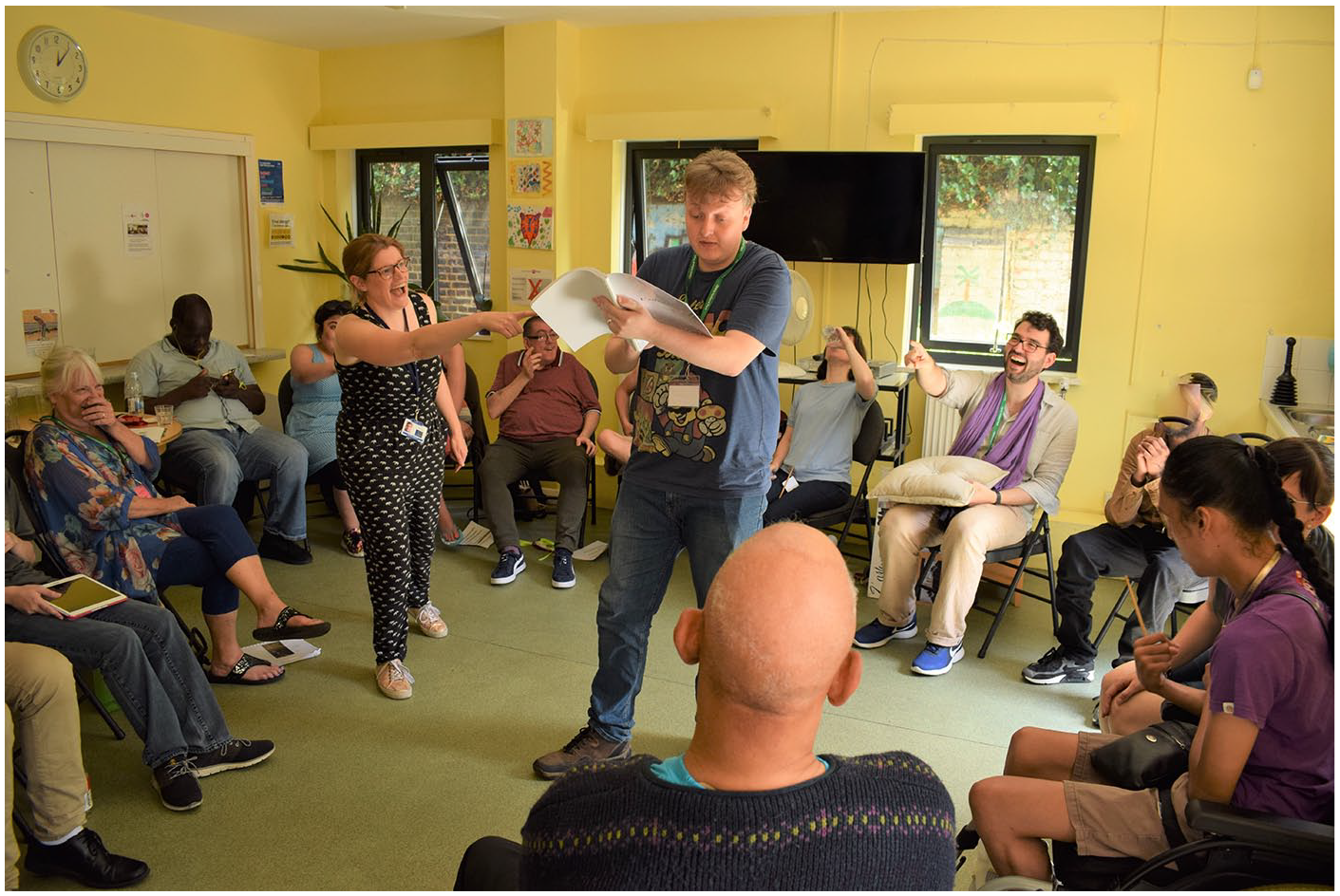
The outreach team performs a shaming scene from the opera L’Arlesiana to inspire a therapeutic conversation about ‘being laughed at’ ©OHP.
The laughter exercise relied on a similar setup as the magical cushion game with the difference that the group members were asked to be part of the ‘angry mob’, making fun of a singer in the centre. This meant that we were moving into emotional territory that could be perceived as difficult or uncomfortable. We therefore also did not want any of the participants to play the role in the centre. However, the role reversal rendered positions of oppressor and oppressed flexible in the scene work. The acting of the angry mob only lasted briefly. Surprisingly, some of the members did not enjoy taking part and opted out, resisting perhaps in an active demonstration of social courage. We then talked about the emotions that had arisen, asking questions about how the fictional situation had felt.
The brief conversation about the situation was guided by indirect questions to not violate the aesthetic distance (Langley, 2006: 84–85) created by the opera scene, unless a participant felt compelled to do so. I therefore asked whether the participants had experienced any similar situations. Before the session, I had agreed with the co-facilitator that she would tell a story as a conversation starter about how one day she slipped on the London tube and had been laughed at. Her story was meant to function as an icebreaker and make the participants feel comfortable to share their stories. To encourage ambiguous responses and open up the possibility of positive twists, I asked my colleague whether she had encountered moments where people had helped others as well, reaching out like we did in the laughter exercise or refusing to take part in public shaming as many of the members had done.
The example sparked two responses from the circle of participants. One participant was noticeably moved by an experience they had witnessed at a bus stop when somebody’s foot got caught in a door. Staying within the dramatic space of telling somebody else’s story, the participant still seemed to release emotions working through their body while telling the story in an agitated state. This story was followed by the personal account of a participant who, usually quiet, shared an experience where they had felt excluded from a dancing experience.
The dramatherapy-informed operatic space allowed us to point to a possible replay of this situation during a dance task we had facilitated earlier. The task had yielded a different outcome. During a performative walk through the countryside, including ‘pastoral movements’ to music from the opera, the participant had joined the dancing freely and fully participated. We highlighted the different experience the participant apparently had in our opera environment compared to their story of exclusion. The participant’s catchphrase of ‘feeling in the middle’ allowed us to pick up the idea that a blended emotional reality might be a helpful way to engage with life, and allow for possible changes in outcome in different contexts. In line with the metaphorical concept of the workshop series, ruinous emotional states where thus juxtaposed with pastoral ones held within a performative opera setting. The memory of a difficult scenario had played out differently in our dramatherapy-informed space of trust and dramatic expression.
Conclusion
This article has outlined opera therapy as a multimodal paradigm within specific, drama-centred practice. While the work itself was located in an inclusive outreach context, I observed potential therapeutic aspects emerging during the facilitation process. Through the close descriptions of two sets of practice from the accessibility sessions Mental Health in States of Pastoral and Ruins for Opera Holland Park, the research describes how impulses from the opera L’Arlesiana fed into drama and movement exercises applied to working with adults with profound or multiple learning disabilities. A tactile composition performance and an interactive scene moved the engagement with opera beyond a music-centred approach.
Seen within a dramatherapy context, the practice revealed therapeutic potential for instance when working with a participant’s agitated states of emotion. The touch composition helped to find sensory metaphors to grasp contrasting emotions and understand them physically. The scene work released emotions and helped to process them through acting. Opera content from L’Arlesiana functioned as conversation-starter. The non-verbal, performative dimension of opera produced therapeutic tools which provide an example of how opera therapy as a praxis can be more than working with singing or rhythm. Future research contributions from other creative therapies, such as art therapy, might explore the multimedia of opera with its rich visual texts, vibrant set designs, and costume textures further beyond music.
Footnotes
Acknowledgements
The author thanks my co-facilitator Abigail Sudbury for the inspiring collaboration and her nuanced expertise when discussing the workshop experience. It was a pleasure to work with the teams of Opera Holland Park and Equal People Mencap on the project.
Declaration of conflicting interests
The author(s) declared the following potential conflicts of interest with respect to the research, authorship and/or publication of this article: Although external interests did not interfere with the carrying out of the project, I want to highlight that financial support came through Opera Holland Park and its funders and commercial partners. The sessions and opera visit were offered free of charge as part of the outreach programme INSPIRE.
Funding
The author(s) received no financial support for the research, authorship and/or publication of this article.
