



Abstract
This article retraces the emergence of contemporary water governance in Pondicherry/Puducherry as a case study to illustrate how new forms or shades of participatory management strategies have recently been created to address the water crisis in a South Indian locality close to the sea. The article first examines evidence of earlier self-governing institutions, engaging premodern agrarian communities in managing sustainable water resource development. It then contrasts this with how manufactured risks produced in the Anthropocene through modernisation and urbanisation processes created serious local water crises that demanded urgent action and prudent management strategies. The analysis articulates how the resulting new shades of management in the form of private-public partnerships of collective action constitute effective new forms of participatory local water governance.
Keywords
Introduction: Reframing Water Governance
The regulatory, physical and ethical challenges of the Anthropocene, the phase of development marked by the predominance of man-made interventions rather than natural forces, are everywhere increasingly prominent and demand urgent attention at multiple levels of regulation (Amirante & Bagni, 2022). Particularly, there is no doubt anymore that escalating exploitative extraction, despoliation and depletion of water resources have progressively resulted in a water-deficit world, with life-threatening local implications. All over South Asia, significant impacts are being felt and need urgent attention.
Earlier, Giddens (2002) highlighted the paradox that human-dominated development of the world, involving basically the end of nature and the end of tradition, generated external and manufactured risks of water crises that have become routine threats experienced by households, communities, nations and the world at large. Giddens (2009: 3) warned that these devastating dangers are elusively connected to the complex politics of water crisis, hiding from the wider public the serious threats confronting present and succeeding generations. Meanwhile, water governance (Fischer & Ingold, 2020; Paloniitty, 2022) and water resilience (Baird & Plummer, 2021) have begun to be vigorously discussed as new challenges to how institutions of collective action for governing the commons (Ostrom & Godwin, 1990) may be developed.
The recent percolation of global sustainable development goals (SDGs) has, also in South Asia, crafted emergent modalities and participatory institutions in the revival and protection of local water resources and their sustainable management. However, the time for endless talking is over, as ‘time is running out’ (Menski, 2022: 259) for finding adequate responses. The present local case study of Pondicherry, known as ‘one of the waterstressed districts of India’ (Swarup, 2020), located in the small Union Territory of Puducherry, brings out how much can actually be achieved when new synergies of different stakeholders in water management are enlivened by local activist engagement.
While individuals, communities and nations have always relied on water as a natural gift, more recent collective efforts and actions for mitigating water crises have often been subjected to procrastination until the dangers become acute and beyond remedy (Kovacˇevic´ & Kovacˇevic´, 2017: 60). Giddens (2009: 4) has argued that while behavioural adaptation of citizens is trifling in comparison to the massive pervasive transmission of manufactured risks, the politics of water crisis have generated gestural politics of the elites (Giddens, 2009: 3). Against this negative assessment, however, Giddens (2009: 4) subscribes to the more optimistic view that water crises can be turned into an opportunity by means of what he calls ‘social reflexivity’. This reframed form of consciousness about the environment calls for taking responsibility for risk management at various levels of values, principles and actions (Amirante & Bagni, 2022) through governance institutions and by generating popular support and public consciousness. While traditional values remain by no means irrelevant, this new and urgent action-oriented approach, rather than endless palaver and politicking, nowadays brings the nation-state or regional governments rather than the affected local communities to the centre stage as the supervising regulatory agent. As shown by various contributions in Amirante and Bagni (2022), this shift towards environmental constitutionalism at national level occurs in coordination with international law efforts, but still also depends on the underpinning value-based support of different local and cultural value systems and traditions, and thus the support of local people.
Together with the state’s role in effecting social transformation through policy reforms and market regulation, transformative efforts therefore now also include new forms of actions of civil society, involving citizen participation for the protection and rejuvenation of water resources (Giddens, 2009: 223). Thus, drawing attention to social reflexivity, Giddens emphasises the significance of reflection and constant review of collective action to invent and/or reshape governance strategies for participatory water governance in contemporary society. Similarly, Beck et al. (2003), drawing attention to the political dynamics of a global ecological crisis, invite social scientists to study the meta-change of re-modernisation, especially in the postcolonial context of non-European countries. They argue that such research can provide evidence about the effects of a kind of second modernity or post-modernity, which tends to be critical of simplistic visions of globalisation, a much-debated issue (Stiglitz, 2002).
In this context, Beck et al. (1994) have emphasised the inner strength of the reflexive modernisation of oriental nations to build upon indigenous institutions to reconstruct collective actions to combat water crises. This particular approach is now also highlighted by Amirante and Bagni (2022), emphasising the input of values, rather than just rules and laws. In a similar, yet more explicitly secular vein, Foucauldian perspectives purport that neo-liberal governmental technologies devolving authority from state bureaucracies to users, combined with bureaucratic control and participation, are found to have created new subjectivities of the ‘water user’ in water governance (Boelens et al., 2015: 282). In this process, individual subjects are assumed to internalise norms and abide by regulations for the creation of a new form of publicly auditable self-regulation. It does not really matter whether one perceives this as religious or secular, what counts is the impact on environmental resilience (Baird & Plummer, 2021). Applying a multidisciplinary approach that adopts a ‘Law as Culture’ paradigm, Amirante and Bagni (2022: 1) emphasise the interactive synergies of values, principles, rules, actions and enforcement to achieve results.
Before the backdrop of these wider ongoing theoretical debates, this article employs historical methods to trace the trajectory of water institutions in the precolonial, colonial, postcolonial and neoliberal regimes, examining qualitative and documentary evidence from Pondicherry. In this regard, interviews with officials of the Public Works Department of the Union Territory of Puducherry, along with the data culled from official documents and unpublished records of Tank Associations and the Public Works Department, offered a portrayal of Pondicherry’s postcolonial and contemporary bureaucratic water governance. In-depth interviews with the presidents of 17 Tank Associations, four Cluster Associations, and the Puducherry Water Resources Federation (PWRF), coupled with published documents, provided details on participatory water governance in precolonial and colonial Pondicherry.
Focused interviews with employees, farmers and university students yielded qualitative evidence of public perspectives on the postcolonial and contemporary water crises and the ongoing peoples’ participation in water governance. Rapid Rural Appraisals by the author through field visits to local sites yielded observations about the present condition of the 684 water bodies (Swarup, 2020) and the extent of collective action to protect water resources in Pondicherry. This study also endeavours to examine how the reframing of social reflexivity embedded in the historicity of participatory water governance contributes to the efficacy of contemporary policy, programmes and schemes for water governance, as promoted in Pondicherry under the directives of global SDGs, with SDG 6 specifically calling for efforts to ensure the availability and sustainable management of water and sanitation for all.
The article first focuses on precolonial evidence and then examines the French institutions of colonial water governance, as Puducherry was a French territory until 1954. It then turns to the modernisation of water management and the emerging water crisis, augmented by the increasing urbanisation of Pondicherry. Later sections examine how the emerging new shades of participatory management manifest as re-modernised neoliberal institutions of participatory water governance. They skillfully combine global environmental concerns and agenda, state interests, local citizen participation and the constant re-evaluation of ethical principles related to water governance.
Precolonial Water Institutions and Governance
Located besides the Bay of Bengal, south of Chennai (formerly Madras), Pondicherry alias Puducherry, also the name of the related district, is the capital of India’s Union Territory of Puducherry since 1962. The article uses the old name of the district, Pondicherry, to refer to the district studied, which had been almost a cradle of civilisation for not less than 2000 years (Antony, 1982: 408). Being highly vulnerable, located on the marine coast and subject to the vagaries of monsoons, irrigated agriculture in this territory was traditionally sustained by tanks, ponds, inundation canals and check dams, called anicuts, a term from the Tamil language.
There were 89 tanks and more than 612 spring ponds in Pondicherry in 1954 (Antony, 1982: 429), constructed by emperors and chiefs and maintained by village communities through self-governing institutions over centuries. The Pallava kings established most of these tanks during 500–900 AD while Ousteri Lake, the biggest tank, was collectively constructed by the villagers. The copper plate inscription in the Sri Moolanathar temple in the village of Bahour conveys that this lake existed even before the Pallava and Chola eras (Antony, 1982: 409). While the rulers funded irrigation systems in Brahmadeva and Devadana villages, they also recognised individuals’ initiatives to sponsor the construction of irrigation works (Antony, 1982: 408). As Prabhakar (2013) documents, embodying ancient wisdom, traditional knowledge, and engineering and managerial skills, these tanks functioned essentially as multiple-use structures for irrigation, livestock and human uses. They were inextricably linked to the socio-cultural environment of rural communities, forming historically an indispensable part of village communities.
These local communities had developed institutional arrangements centred around water resource management under the rubric of congregational religious rituals (Schenk-Sandbergen, 2013: 276). For the people of Pondicherry, water bodies are not only natural resources but also a religio-cultural resource, and villagers revere the tank as ‘mother’. In this regard, RRA interviews brought to light that temples are located on tank banks where deities are propitiated. The people of Pondicherry uphold the religious belief that ‘these deities in the temple at the tank banks ride over horses around the tanks in the night to safeguard tank and water’ (Schenk-Sandbergen, 2013: 276). Thus, water bodies as symbolic resources of the rural collectivities are reified by combined village-water-temple festivals and are ‘part of the symbolic production of locality’ (Mosse, 1997: 472).
As Giddens (2002) postulated about traditional communities’ mechanisms to avert the repercussions of external risks, a renowned tradition of farmer participation in the governance of irrigation tanks was the institution of Kudimaramathu, pervasive under the various monarchies, representing indigenous social reflexivity. Kudimaramathu as a premodern institution of water management existed in Pondicherry for managing the ‘commons’ of the area, specifically tanks and ponds. Mukundan (2005) depicts the scenario under the rule of Pallavas in the fourth to ninth century AD. While the construction of channels for transporting water from rivers and tanks and the creation of dug wells for irrigation were under bureaucratic control, an Irrigation Governing Council called Erivariya Perumakkal (Tank Maintenance Chiefs) carried out the local management of water allocation, mobilisation of labour and resource contributions from farmers for tank maintenance. Similarly, Chola inscriptions mention the annual desiltation of tanks as one of the key functions of village committees, with endowments to protect irrigation infrastructures in case of inattention by authorities (Poyyamoli & Sachudha, 2003).
As water rights were historically associated with land rights, ownership, inheritance, or transfer of lands were periodically enumerated to ensure proper water allocation. The above depictions, however, constitute state-centric perspectives of the indigenous local water institution, which at the same time embody the traditional social reflexivity in the precolonial era regarding the traditional concept of Kudimaramathu. Composed of the terms for village community (kudi) and maintenance (maramathu), at the village and household level, this literally equated to voluntary labour, customarily undertaken by village communities in maintaining village tanks and other irrigation infrastructure. Under Kudimaramathu, water distribution was first of all managed through collective efforts organised by village assemblies or governed by a council of village elders. Village communities maintained these tanks under traditional customary laws, based on mutually agreed rules and regulations through voluntary labour from each household for desilting, strict maintenance of an irrigation schedule and an annual payment of contribution for future maintenance. Overall, there was a tradition of consciousness of the need to participate in local water management.
In this context, Poyyamoli and Sachudha (2003) observe that the traditional primary duty of the village assemblies was to get the silt removed every year from the tank under their control, ensuring the proper depth needed to store water up to the full reservoir level to retain enough water until the onset of the next monsoon. Registers were created for each tank to safeguard the irrigation system from neglect by the village authorities. While village committees were managing the tanks, each household of the village contributed free labour and materials for tank maintenance on a sustainable basis (Antony, 1982: 447). Such voluntary participation was largely embedded in the structure of the caste/class stratification system, in which the lower castes, as landless agricultural labourers, contributed their labour, while the upper castes provided the materials for maintenance. The functionality of indigenous water institutions in mitigating the consequences of external risks to water resources bears strong testimony to the presence and crucial relevance of indigenous premodern social reflexivity in ensuring the sustainability of local irrigation water bodies, which were regulated by precolonial governing institutions.
French Institutions and Colonial Water Governance
Typical for colonial regimes, French rule in Puducherry, from 1861 to 1954, prioritised the maintenance of tanks for generating revenue from irrigated agriculture. Accordingly, the French colonial government contributed to constructing various tanks, check dams and feeder channels in the territory. The French government also created formal farmer associations to maintain and improve canals, tanks and ponds to supply water for agriculture (Prabhakar, 2013), while the indigenous institutions of farmer participation were accorded continuity under the bureaucratic governance of the French colonial regime.
Participatory water governance in this colonial framework operated through two distinct water institutions, namely Caisses Communes (CCs) and Syndicate Agricoles (SAs). These institutions incorporated the indigenous institutions of Kudimaramathu for farmer participation in irrigation management, imputing colonial bureaucratic governance of irrigation systems. After gaining partial control over Pondicherry, on 1 July 1859, the French colonial administration first enunciated the creation of CCs for the purpose of organising farmers of one or more villages for collective maintenance of irrigation works (Antony, 1982: 409). The colonial administration engaged these institutions to mobilise annual subscriptions from landowners, effectively a water tax calculated in proportion to the size of landholding for maintaining canals and emergency repairs. The committee governing the activities of CCs was headed by one representative of the colonial bureaucracy and three farmer representatives. On 9 October 1911, modelled after French institutions, SAs were created with corporate status to manage water resources and flood control. They also had the powers to obtain agricultural loans and collect subscriptions from members. Girod (1938) noted the existence of 15 SAs and 65 CCs, reporting that out of 8,000 hectares of irrigated area, 5,000 hectares were governed by CCs and about 2,000 hectares were regulated by SAs, while the state bureaucracy governed the remaining 1,000 hectares under direct canal irrigation.
Poyyamoli and Sachudha (2003) report that farmers managed the tanks irrigating the fields of one or a group of villages beneath CCs and SAs. These local user organisations were headed by office bearers (OBs) and village elders who supervised irrigation activities and extended cordial relationships with other villages. Though they did not receive any salary, this position was very prestigious and often hereditary (Janakarajan, 1993: A54). The OBs were representatives of different upper castes, while neerkattis (irrigation workers) were exclusively drawn from low-caste communities who hereditarily pursued this occupation (Prabhakar, 2013: 236), sometimes as forced labour (Janakarajan, 1993: A53). The OBs and the neerkattis could be removed from their posts if members were not satisfied. Thus, modelled after French institutions, the colonial administration incorporated the local Kudimaramathu tradition of farmer participation in irrigation management with a rational-legal framework under bureaucratic governance. These forerunners of modern user organisations incorporated the indigenous water institutions and efficaciously managed irrigation tanks sustainably till the transfer of Pondicherry to India in 1954 (Antony, 1982: 411).
Modernisation and Water Crisis
The modernisation of irrigation began with the adoption of bore-well technology for groundwater extraction and bureaucratisation of water management in colonial Pondicherry. Groundwater irrigation, after bore-wells were introduced in 1936, emerged as a vital source of meeting increasing water demands for cultivation. The establishment of a Ground Water Department in 1938 provided administrative support for expanding groundwater irrigation, supervised by the state bureaucracy.
Decades later, during the Green Revolution of the 1960s, the introduction of a high-yielding variety of seeds brought a dramatic shift in irrigation from surface water to groundwater. The greater reliance on groundwater brought a steady increase in groundwater extraction, employing a large number of dug wells in the 1960s, an increase in dug-cum-bore wells in the 1970s and the introduction of energised bore wells in the 1980s. The government of Puducherry accorded support for bore wells based on electric supply, providing subsidies for wells and exemption of electric charges, which induced further manufactured risks to surface irrigation. The dramatic escalation in the extraction of groundwater, marked by a steep increase in the depth and number of tube wells, culminated in the decline of groundwater tables. Figure 1 confirms that the net area irrigated by tanks dropped very significantly by the 1990s.
Figure 1 illustrates the dramatic deterioration of surface irrigation in Pondicherry over a period of six decades. Against its registered created potential of 6,730 hectares, tank irrigation had prominence in the colonial to the postcolonial era, in which 5,497 hectares were cultivated with water supply from tanks in the 1950s. In the 1960s, it registered a gradual increase to 6,328 hectares, especially due to greater dependence on increased irrigation during the Green Revolution. However, such increases in tank irrigation were found unsustainable, so that during the 1970s, the area irrigated by tanks registered a noticeable decline to 5,516 hectares in 1970–71 and 2,954 hectares in 1975–76.
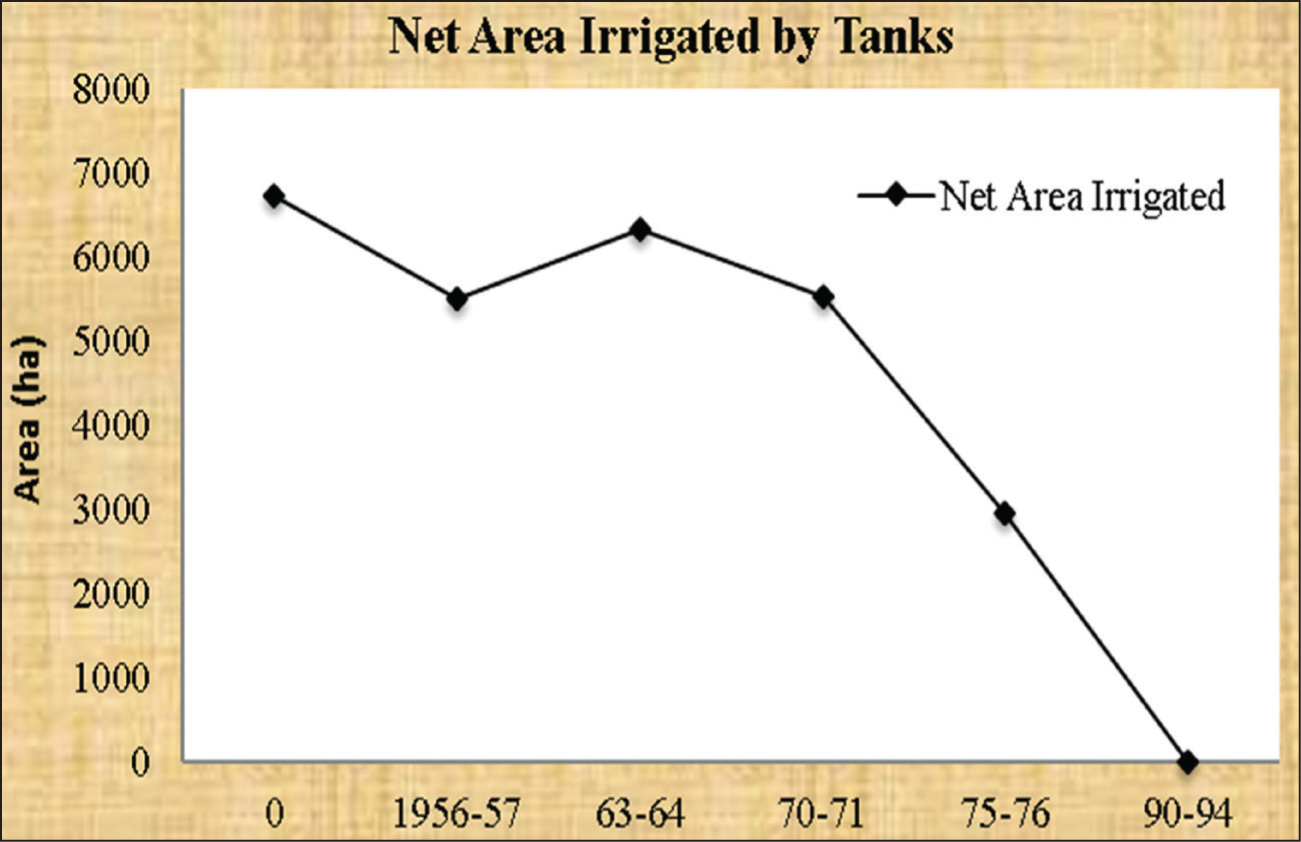
Paradoxically, as Figure 1 depicts, the historical significance of tanks as the chief source of irrigation was forfeited by greater reliance on groundwater in the 1990s. In 1998, there were only 30 tanks in use, while 54 tanks were defunct, the command area of two tanks had been urbanised and one tank had disappeared completely. Thus, in the postcolonial era, the power and authority of unilaterally managing the operation and maintenance of tanks was transferred to the Public Works Department (Schenk-Sandbergen, 2013: 276). Entirely denouncing farmers’ participation, this caused serious deterioration of water bodies in Pondicherry. The end of collective local action and the emergence of bureaucratic governance devoid of farmer participation meant that tank management was largely neglected (Aubriot, 2013: 46). The Central Water Commission recorded and claimed that the area under tank irrigation had rapidly declined due to the Green Revolution (Gnanasundar, 2013). In a follow-up interview connected to the present study, on 11 January 2022, the president of the Federation of Farmer Organisations (Pasana Vivasaigal Kootamaippu) lamented that ‘such privatisation of water resources not only ended collective action institutions under Kudimaramathu, but also generated individualism, commercialisation and commodification in sale and purchase of water’. Thus, resulting from the agrarian transition, a water crisis emerged due to the absence of farmer participation and bureaucratic inattention to tank maintenance, leading to deteriorating surface irrigation, alarming depletion of groundwater and intrusion of seawater into the aquifers in Pondicherry.
Urbanisation and Water Crises
Fidani and Gesovska (2019) report that urbanisation has caused several water management challenges that demand efforts to protect and preserve water resources in contemporary society. Evidently, growing urban populations and a significant increase in urban spaces induced diverse forms of manufactured risks, with diametrical effects on water resources and irrigated agriculture in India. The urbanisation of Pondicherry is a postcolonial phenomenon with a steady increase in the urban population since 1971, reciprocally shrinking the rural population.
According to the respective official figures from the Census of India, the total population of Pondicherry in 1971 was 340,240, with 185,295 (54.46%) rural and 154,945 (45.54%) urban. In 1981, of a total of 444,417 persons, the urban population of 251,420 (56.57%) was now larger than the rural population of 192,997 (43.43%). In 1991, the Census counted 608,338 persons, 401,437 (65.99%) urban and 206,901 (34.01%) rural. This demographic trend continued when in 2001, among the 735,004 enumerated persons, there were 505,715 (68.80%) urban and 229,289 (31.20) rural people. The 2011 Census counted a total of 950,289 persons, showing an increase also in the rural population to 293,080 (30.84%), while the urban population grew much faster to 657,209 (69.16%).
These demographic data confirm the clearly visible postcolonial urbanisation of Pondicherry, which has now turned into an urban agglomeration occupying the status of Class I category of city. The impact of this demographic trend brought much conversion of agricultural lands into residential, commercial and industrial localities, with water bodies now predominantly serving urban water supplies. Such greater urbanisation of Pondicherry posed threats to agrarian livelihoods and led to further degeneration and pollution of tanks and surface water, groundwater depletion and, as mentioned, seawater intrusion.
Most dramatically, the data from 1970–71 to 2017–18, according to figures consulted from the Public Works Department of the Government of Puducherry (2019), confirms the total degeneration of tank irrigation. Whereas in 1970–71, tanks irrigated 5,656 hectares, this gradually turned insignificant and has been zero since 2006. RRA observations in this regard included that ‘the tank sluices are locked and welded up’. The Chief Engineer stated: ‘These shutters may never be opened again’. Surface irrigation by tanks has largely been replaced by groundwater irrigation, serving not less than 8,642 hectares in 2019–20, while canal irrigation continues with great variations, subject to the vagaries of the north-east monsoon in Pondicherry. However, since Pondicherry is located on the coast of the Bay of Bengal, the predominance of groundwater irrigation has caused underground seawater intrusion, leading to water salinity, eroding agricultural lands and hampering farmers’ livelihood.
Concurrently, urbanisation unabatedly challenges the sustainability of water resources. Evidently, in contrast to 89 irrigation tanks earlier (Antony, 1982: 429), as documented in the Action Plan on Restoration of Water Bodies in the Union Territory of Puducherry (Government of Puducherry, 2019), currently there are only 84 tanks in Pondicherry. With the conversion of the landscape and acreage of five tanks for urban use, including the creation of the New Bus terminal in the first decade of the twenty-first century, the existing 84 tanks are fastened for replenishing aquifers to prevent seawater intrusion, as the author was told in interview with the Assistant Engineers of the Public Works Department in Pondicherry.
Precariously, the groundwater table in Pondicherry has declined from 50 feet in the 1960s to around 400 feet, while about 5 kilometres all along the coast, groundwater has turned saline and salinity effects are discernable up to 7 kilometres away from the coast (Government of Puducherry, 2012). This degeneration of water bodies led to a noticeable decline in agricultural activities. The net sown area consistently declined from 18,618 hectares in 1962 to 9,926 hectares in 2018, except for some modulations from 1989–93. This trend clearly reflects the extent of forfeited agricultural land and consequent loss of food production in the past five decades, corresponding with Pondicherry’s gradual urbanisation.
Further, industrial activities in the suburbs of Pondicherry, particularly the Mettupalayam, Thattanchavady, Sedarapattu, Kirumambakkam and Thirubuvanai localities, have escalated water management challenges. According to the Puducherry Disaster Report (Government of Puducherry, 2017), solid waste and chemical effluents from industries are discharged without proper treatment. Such escalated infusion of chemicals and their polluting constituents into the water bodies renders them unsuitable for public consumption. Increased water extraction by industries, factories and power stations has considerably reduced water availability not only for agriculture, but recently also for domestic use. Above all, given the absence of a proper drainage system in Pondicherry, industrial effluents converted one irrigation canal into sewage and seawater intrusion remains a generic predicament. These man-made manufactured risks emanating from modernisation and urbanisation of Puducherry have undoubtedly negative consequences on water resources and the management of water bodies, manifesting in the contemporary surface-cum-groundwater crisis in Pondicherry.
Neoliberal Institutions and Participatory Water Governance
Responding to these manufactured risks, contemporary social reflexivity initiated by neoliberal development goals has begun to be incorporated to protect, preserve and promote water resources in post-rural Pondicherry (Gany et al., 2019: 84). For this purpose, the Pondicherry Ground Water (Control & Regulation) Act was ratified in 2002. The Ground Water Authority was established to control and regulate groundwater extraction in the Union Territory. In 2013, the government of Puducherry constituted a Steering Committee of bureaucrats to re-launch the Tank Rehabilitation Project and the Public Works Department of Pondicherry issued tenders inviting contractors for rejuvenating and deepening various tanks. Correspondingly, the Pondicherry Water Policy of 2016 (Government of Puducherry, 2016) proposed the formation of 84 local tank committees under the Public Works Department and Agriculture Department and the Krishi Vigyan Kendra (Agriculture Information Centre), with appropriate legal and institutional reforms for operating and maintaining these tanks. In this context, on 29 April 2019, responding to a public interest petition filed under Article 226 of the Constitution of India, the Madras High Court accorded approval for post-bureaucratic water governance with citizens’ participation in Pondicherry in a case, promulgated on 29 June 2019, concerning the village of Bahour.
One can frame this perceived need for more regulatory mechanisms as part of India’s constitutionally anchored promise of ‘complete justice’ in Article 142 (Menski, 2022: 259), but the need for urgent local action remains pressing. Given the urgency of the scenario, an activated form of post-bureaucratic governance has emerged in Pondicherry. This new shade of management process involves in effect a bureaucracy-anchored public-private partnership, in which government officials and staff consult, involve and work with citizens and civil society.
One may of course argue that the promulgation of internationally driven SDGs for 2016 to 2030 has brought about such significant changes in the national and regional water policy schemes with new modalities of public-private partnership (PPP) in India, constituting the contemporary social reflexivity in water governance. This becomes then a question about who may claim credit for such progress. The present analysis focuses on the Union Territory of Puducherry to confirm that, in consonance with the promulgation of SDG6, the ‘Water Rich Puducherry’ Programme was operationalised in November 2017, as well as Jal Shakti Abhiyan, a massive Indian campaign for water conservation in water-stressed districts since 2019. So there is indeed evidence of global impact and national action. However, the necessary local engagement involved the Public Works Department and, importantly, the wider public in cleaning the water bodies. Hence, credit must go to them, too. Concurrently, planting trees on the tank embankments has been pursued through the Swachh Bharat Abhiyan (Clean India Campaign). Such integrated, re-constituted form of participatory water governance, corporate social responsibility and institution-based social responsibility is now effectively engaged in recharging groundwater and replenishing ponds.
Further, in compliance with directions of the National Green Tribunal of 10 May 2019, the government of Puducherry implemented the District Irrigation Plan 2017–22 under the Pradhan Mantri Krishi Sinchayee Yojana (PMKSY), the Prime Minister’s Scheme for Agriculture and Irrigation (Government of Puducherry, 2019). It constituted regional-level committees in Puducherry District for the restoration and preservation of water bodies and for rainwater harvesting. Similarly, irrigation channels and tanks are being operated and maintained by the Irrigation Division of the Public Works Department, while village ponds are managed by the respective municipalities and commune panchayats under the Local Administration Department.
Notably, regarding rural water bodies, the District Rural Development Authority now executes work related to desilting of ponds and channels under the Mahatma Gandhi National Rural Employment Guarantee Assurance (MGNREGA) scheme (Government of Puducherry, 2019). Focused interviews with students at Pondicherry University brought to light that under the stewardship of the Lieutenant-Governor of Puducherry, students along with employees, social workers and officials participate in the survey, cleaning and awareness creation for the rejuvenation of ponds during weekends. Seeking to revive a sustained system of water conservation in Pondicherry district’s traditional water management processes, the Neerum Oorum (Water and Village) project was launched on 5 September 2019 to protect and restore the water bodies and augment the groundwater resources of Puducherry. Described in detail by Swarup (2020), this involves (typical for high-tech India) also a pioneering digitisation programme, covering all water bodies. This, too, reflects new synergies of tradition and innovation and a new awareness of the common ownership of water as a most precious natural resource. Related to this, with an eye on raising funds through eco-tourism, activities such as boating in tanks, walking paths and cycling around tanks are being promoted to build a sense of belongingness to water bodies among residents and tourists.
Further, the protection of water bodies is ensured through better control of disposal of sewage, industrial effluents, solid waste, plastic waste and construction debris. This results from judicial intervention through the above-mentioned Madras High Court judgement of 29 June 2019. The observable institutional reforms are executed through financial, managerial and labour contributions by government agencies, cooperatives, education institutions, civil society and individual citizens. All of this has clearly accorded wide legitimacy to the concept and vision of participatory water governance, especially after the transition of the region from rural to urban Pondicherry.
More recently, led by the Alliance for Good Governance (AGG), further collective action to revive and rejuvenate the ponds and tanks of Pondicherry has been initiated, culminating in the resurrection of 54 ponds in urban and rural regions of Puducherry (Dutta, 2023). To ensure the long-term sustainability of these revived ponds, an innovative collaborative action for protecting water resources has been created under the ‘One School One Pond’ (OSOP) scheme since 2020 (Maitra et al., 2023). The core idea is to engage pupils/students and the entire educational system through a distinctive curriculum, increasing environmental awareness and encouraging participation of students, teachers, administrators and bureaucrats in the effective management of water bodies in Pondicherry.
As Harvey (2000) perceived this earlier, the emergence of re-modernisation would create new ‘spaces of hope’, a sentiment reflected in the enthusiastic portrayal of recent progress by Swarup (2020), who describes this as a ‘mammoth exercise’, the outcome of which ‘was there for everyone to see’. Of course, this also saved much money for the government, so is a fiscally prudent management strategy. Swarup (2020) argues that this model can be replicated in other parts of India and presents ‘a great example of Nexus of Good’, a replicable effort based on reconfigured public-private partnerships to bring about effective participatory water management and governance.
Conclusions: Participatory Water Governance as a Viable Model
Though Beck (1992) presupposed that the idea of risk is entrenched in modernity, Giddens (2002) argued that cognition of external risks, such as floods or failure of monsoons, leading to crop failure and the like, has always been embedded in rural people’s life and livelihood. Taking cognition of such traditional awareness of risks, Ostrom (1992) and Tang (1992) discussed the significant role of indigenous self-governing water institutions by which agrarian communities in certain parts of the world had sought to mitigate such external risks over centuries. Other studies reported the significance of such self-governing water institutions in the upkeep of tanks and water channels over centuries in South India (Aubriot, 2013; Dasthagir, 2008; Mosse, 2003). The complexity of the issues involved is analysed well by Janakarajan (1993).
Earlier, Beck et al. (2003) theorised how the transition from tradition to modernisation to re-modernisation occurs through changing master narratives, accompanied by real modifications of practice. Re-modernisation signifies a change in substance as well as in interpretation, producing anti-modernisation and second modernisation (Latour, 2003: 41). While theorising environmental matters as practical issues rather than ideologies, identifying the connections between theory and practice becomes crucial. The present study made a distinctive contribution to applying certain theoretical propositions in practice by capturing the particular social history of water governance in Pondicherry. Analysing the relationship between traditionally familiar collective action and sustainability of water resources and the acute realisation that the present water crisis endangered everybody’s life and requires urgent new forms of action is the core element of the resulting change of consciousness. This underpins the present narrative of the emergence of re-modernisation of water governance in Pondicherry.
In premodern societies, major risks were caused by natural disturbances and therefore constituted external threats to mainly agrarian populations. The collective and existential reliance of rural communities on a common property resource provided the possibility of collectively building consensual social solidarity to manage surface water resources against external risks. However, in modern society, the manufactured risks of the Anthropocene exacerbated water crises by privatising water resources and commercialisation of production. This not only destroyed nature but also cut the links with structures of traditional trust and collective action in water governance.
As argued by Beck et al. (2003), the risks emanating from modernisation in the Anthropocene led to the dawn of re-modernisation under neoliberal directives. This article shows clear-cut evidence from Pondicherry of such re-modernisation through the recent actions of the government of Puducherry, teaming up with its local citizens. Beck et al. (2003) contemplated that re-modernisation in water governance encompasses post-rural social bonds with the genesis of post-bureaucratic water governance. Though it remains susceptible to water crises, the re-modernisation of participatory water governance largely protects Pondicherry through new forms of collective action by preserving and rejuvenating local water resources, thus minimising future risks of crises.
While earlier, indigenous collective action had a predominantly rural character, the contemporary institutional urban networking for water governance brings together individuals of diverse occupational, social and educational backgrounds, both in rural and urban environments. Traditional social reflexivity was premised on consensus, more or less motivated by the shared desire to survive and to live a good life. The theoretical edifice of re-modernisation, in practice largely constructed through social networking and innovative ways of using social capital, results in re-configured participatory collective action as a matter of civic duty in a postcolonial nation-state. This still has the earlier element of public consciousness that connected individuals and the respective social, spatial and other structures around the Self. However, there is a shift of agency, from earlier individual and local self-controlled patterns of ordering in small communities to the contemporary scenario, where the respective state government seems to be in charge. Orchestrating the collaboration of multiple stakeholders, this new style of water management has been instrumental in crafting activated forms of governmentality. It is also manifestly a form of ‘globalization from below’ (Giddens, 2000: 123) when faced with a serious crisis.
Whereas earlier, agrarian communities coexisted with nature by adopting institutionalised collective action to consciously mitigate risks, the Anthropocene and industrialisation, modernisation and urbanisation largely destroyed earlier patterns of collective management of natural resources. Responding to these manufactured risks to water resources and community life, local social reflexivity, premised on global SDG principles, largely re-modernised water governance through post-bureaucratic governance, combined with local institutions of rural and urban community participation in Pondicherry. Concomitantly, neoliberal institutions initiated re-modernisation to create contemporary social reflexivity through political innovations and new types of social mobilisation in protecting water resources.
In the case of Pondicherry/Puducherry, as this article showed, the new private-public partnership and management structure, with the help of concerned, activist citizens at various levels, has been able to mobilise financial and human resources for participatory governance to rejuvenate and protect the water resources in Pondicherry. However, without the more or less informal voluntary element of the input of local citizens, activating self-help and taking responsibility for their shared environment and water as a private and public resource, the existing official measures and programmes would certainly be far less effective.
Footnotes
Declaration of Conflicting Interests
The author declared no potential conflicts of interest with respect to the research, authorship and/or publication of this article.
Funding
The author would like to acknowledge that this work was supported by the Indian Council of Social Science Research.