




Abstract
Positive attitudes toward regional/minority languages are an essential precondition to language maintenance/revitalization. We investigate implicit and explicit attitudes toward Welsh and English and their relationship with childhood and adolescent age exposure among adult Welsh speakers from northwest Wales. Results indicate that implicit and explicit attitude constructs diverge and therefore bear differentially on language maintenance/revitalization. Specifically, comparing speaker data from the Language and Social Background Questionnaire with results from two independent studies, employing the Attitudes towards Languages (AToL) Scale and an Implicit Association Task respectively, we show that the implicit measure reveals a positive correlation between attitudes and exposure in primary school age. Conversely, the AToL returned no statistically significant factors, suggesting differential sensitivity of the explicit and implicit measures. We argue that an understanding of both types of attitude constructs, and attending to exposure levels especially as they relate to intergenerational transmission, is necessary to implement an effective language maintenance/revitalization strategy.
Keywords
Research on language attitudes in Wales has largely employed direct, self-report methods such as questionnaires to elicit attitudinal data on Welsh. More recently, more indirect and implicit methods have been employed (Lee, 2015; Price & Tamburelli, 2020; Robert, 2009). Meanwhile, it has been suggested that implicit attitudes as measured via indirect methods are better predictors of habitual or spontaneous behavior (e.g., Devos, 2008; Perugini, 2005). This is particularly relevant to Welsh, where a dissonance exists between positive explicit attitudes and decreasing language use in the population (Coupland et al., 2005).
Currently, an estimated 538,300 (17.8%) of the Welsh population aged three years or older are able to speak Welsh (Welsh Government, 2022a). The highest concentration of Welsh speakers is found in the traditional “heartlands” of north-west Wales, consisting of Gwynedd and Ynys Môn, where 64.4% and 55.8% can speak Welsh, respectively (Welsh Government, 2022a). Our research focuses on this area (see Figure 1) because, on the one hand, exposure to Welsh as a community and family language, although declining, is still salient, while on the other, language shift towards English is at play to varying degrees.
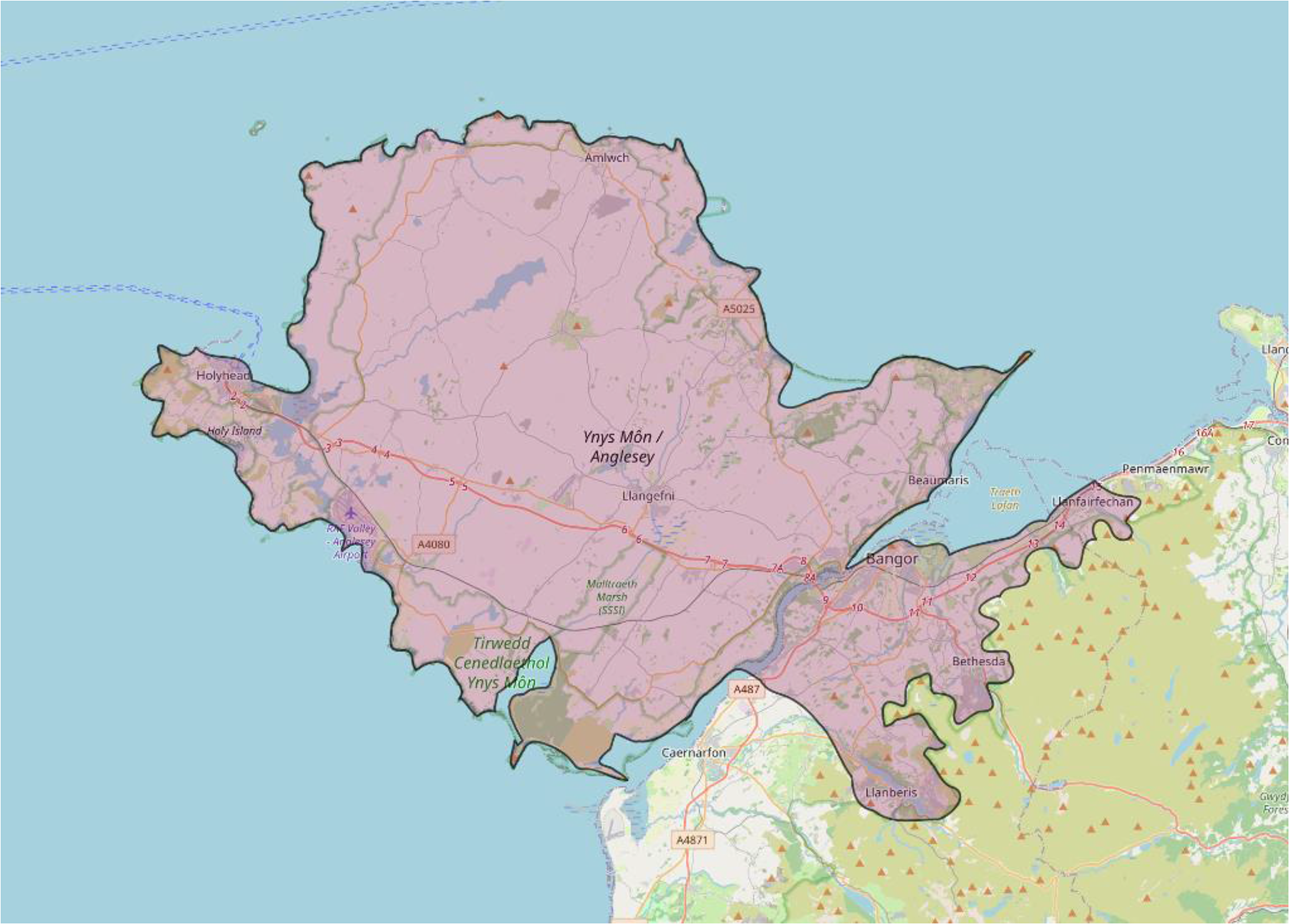
The area of north-west Wales where participants were recruited from. Contains OpenStreetMap data under Open Data Commons Open Database License 2024.
Background
Welsh in Wales
Since the passing of the Welsh Language Act 1993, Welsh has been afforded equal status to English in Wales. The Act was a significant milestone in Welsh language policy and planning. It secured, among many things, the right to use Welsh in courts of law in Wales and the establishment of the Welsh Language Board to promote and facilitate the use of Welsh. Further devolution in 1999 gave rise to the National Assembly of Wales, succeeding the British Government's Welsh Office. Along with this came Iaith Pawb (“Everyone's Language”—Welsh Assembly Government, 2003) seen as a historic and important language strategy which brought language policy and planning to the mainstream in Wales (Gruffudd, 2002; Redknapp, 2008). The Welsh Language (Wales) Measure 2011 secured official status for the Welsh language. Since then, language strategies Iaith Fyw: Iaith Byw (“A Living Language: a Language for Living”—Welsh Government, 2012) and the supporting Iaith Fyw: Iaith Byw—Bwrw Mlaen (“A Living Language: a Language for Living—Moving Forward”—Welsh Government, 2014) were succeeded by Cymraeg 2050: Miliwn o siaradwyr (“Welsh 2050: A Million speakers” — Welsh Government, 2017). As its title suggests, the current Welsh Government language strategy sets an ambitious target to reach one million Welsh speakers by 2050.
Welsh-medium immersion education constitutes a significant part in the Welsh Government's plans to reach a million speakers. Indeed, there has been an increase in the number and percentage of Welsh speakers in areas of the south-east traditionally considered to be less Welsh-speaking, such as Cardiff and Rhondda Cynon Taf (Welsh Government, 2022a), predominantly due to an increase in the provision of Welsh-medium education. Schools providing Welsh-medium immersion education teach pupils primarily through the medium of Welsh. So called “category 3 schools” use Welsh for at least 80% of school activities from age 7 onwards in primary school, and at least 60% of learners undertake at least 70% of school activities in Welsh at secondary school (Welsh Government, 2021a, pp. 14–17). The success of Welsh-medium immersion education is reflected by the fact that 5–15 year-olds represent the largest proportion of Welsh speakers (52.5%—Welsh Government, 2022a). 1 In a language maintenance/revitalization context this is fundamental, because children and young people are a critical demographic (e.g., Fishman, 1991). Welsh-medium education is a powerful language planning tool for creating new Welsh speakers, especially in areas such as the south-east, where 98% of students are from non-Welsh speaking homes (Lewis, 2006, p. 23).
This only tells part of the story, however, as there are long-standing concerns over young peoples’ reluctance to use Welsh in social communication (Coupland et al., 2005; Lewis, 2006; Morris, 2010; Thomas et al., 2014; Thomas & Roberts, 2011) as well as inside the classroom (Thomas et al., 2012). Therefore, a high level of input through education does not necessarily equate to high levels of use (Gathercole & Thomas, 2009). Similar accounts of incongruence between language ability and language use among young people are shared in other minority language contexts (see Cenoz, 2008 for an overview).
The government also collects data on the whole population's use of Welsh via a Welsh Language Use Survey (WLUS). According to the WLUS (Welsh Government, 2021b) around half the Welsh-speaking population use Welsh daily. However, looking more closely at social use, WLUS data show that only 28% of Welsh-speaking adults use Welsh as the language usually spoken with extended family, only 21% with friends, and only 19% with members of their local community (Welsh Government, 2021b). This is a particular area of concern in government policy: increasing the use of Welsh is one of the three strategic themes of the Cymraeg 2050 strategy, with a specific target of doubling the percentage of daily use of Welsh in areas such as the workplace and social situations (Welsh Government, 2017, p. 24).
The reluctance to use Welsh illustrated here is also reflected in decreasing intergenerational family transmission (Gathercole, 2007; Harrison et al., 1981), a domain considered to be one of, if not the, single most important contributor to the survival of a language (Fishman, 1991, 2001). For example, Harrison et al. (1981, p. 61) demonstrated that, even though parents reported that they were generally against the decline of the language and in favor of their children receiving their education bilingually, this did not translate into transmission of the language and use of it with their own children. Indeed, more parents are substituting family transmission with sending their children to Welsh-medium education (Jones & Morris, 2007; Morris, 2023; Morris & Jones, 2007)—a phenomenon referred to by Fishman as a “language rescuer” (1991, p. 13; cited in Hodges, 2012). Qualitative studies of parents have reported many reasons behind this choice, such as only one parent being able to speak Welsh (Evas et al., 2017, p. 60) or the parents’ perceptions of their own Welsh ability or social use of Welsh being low (Gathercole, 2007), which leads to English being the language of choice at home. Research has highlighted that the government's over-reliance on education as a language revitalization tool, without initiatives addressing language use, especially in the family, could lead to a situation similar to the one facing Irish (Edwards & Newcombe, 2005).
In sum, while language planning and policy has achieved a lot in Wales and current language strategy has set ambitious targets, Welsh faces obvious challenges. Many of these challenges stem from decreased rates of speaker use and intergenerational family transmission, which may point towards a general decrease in exposure towards Welsh. As attitudes are a component in decision making (e.g., Sanbonmatsu & Fazio, 1990) and behavior (e.g., Devos, 2008; Perugini, 2005), it is integral that attitudes be considered in order to better understand how to tackle the challenges that arise from declining exposure.
Language Attitudes in Wales
Revitalizing a minority language must encompass shifting language attitudes. Grenoble and Whaley (2021, p. 922) state that “language attitudes [are] not solely, or even in the first place, a matter of teaching competence in a linguistic code, but a matter of introducing (or reinforcing) language use, improving language attitudes and bolstering self-confidence.” The current Welsh Government language strategy Cymraeg 2050 does not discuss improving attitudes per se, although “normalizing perception and use” is something Cymraeg 2050 policy makers identify as a key challenge to be addressed within the strategy (Williams, 2017).
Additionally, several other policy campaigns throughout Welsh language policy and planning history reflect this principle without explicit reference to improving attitudes, such as the Iaith Gwaith orange badges worn to indicate one's ability to speak Welsh in the workplace.
More recently, and independently of government policy, name changes have featured prominently, such as the Welsh national parks Bannau Brycheiniog and Eryri adopting Welsh-only names for their authorities (Messenger, 2023; Thomas, 2023). Nonpublic bodies such as the Football Association of Wales have also been prominent in placing the language at the forefront of their operations and are considering their own name change from Wales to Cymru (BBC Wales, 2022).
Such gestures could certainly be considered a positive step towards protecting native Welsh names that may be under threat. However, they are also analogous to the Cymraeg 2050 goal of one million Welsh speakers: they primarily represent a politically symbolic target, rather than something that is of the utmost importance to language revitalization (Williams, 2017).
Indeed, previous research has shown that although speakers are aware of the iconic value of Welsh, they may still fall short of using it in day-to-day communication (Coupland et al., 2005). Welsh's status in the public sector and education has seemingly resulted in the language enjoying heightened (overt) prestige, for example due to the potential increase in employment opportunities or economic benefits related to the language (Hodges, 2012; Price & Tamburelli, 2016). Previous research has shown that, while one variety may acquire overt prestige, speakers may commonly employ the apparently disfavored cultural variety in cultural practice (Sophocleous, 2011, p. 267), a phenomenon known as “covert prestige” (e.g., Price & Tamburelli, 2020).
Previous Research on Language Attitudes
Current research indicates that attitudes may be both implicit and explicit, and it is likely that both diverge and co-exist as two distinct processes and that the same individual can concurrently hold different (possibly incongruent) attitudes towards the same object (Pantos & Perkins, 2012). In fact, low correlations between implicit and explicit attitudes indicate that they are structurally distinct but related entities (Greenwald & Nosek, 2009). Implicit attitudes are automatic responses outside the control of the individual (Pantos, 2019) thought to tap into more deeply embedded evaluations (McKenzie & Carrie, 2018), while explicit attitudes measure more controlled responses that may be more recently acquired (Hofmann et al., 2005). Research examining both explicit and implicit attitudes is more limited (e.g., Ianos et al., 2023; McKenzie & Carrie, 2018; Pantos & Perkins, 2012) and has tended not to consider the relationship between attitudes themselves and a real-life correlate such as language exposure. We aim to contribute towards filling this research gap, as understanding the relationship between attitudes and language exposure is central to successful language maintenance/revitalization.
There exists a significant body of research on explicit attitudes employing self-reported measures, which reports mainly favorable attitudes towards Welsh (Coupland et al., 2005; Laugharne, 2007; Lyon & Ellis, 1991; Morris, 2014). Indeed, much of the research on attitudes towards Welsh has tended to use self-report questionnaire data, though some studies have used other qualitative explicit methods such as focus groups (Davies & Trystan, 2012; Musk, 2006; Price & Tamburelli, 2016) and interviews (Hodges, 2009). Generally, informants in these studies report more mixed attitudes towards Welsh compared to self-reported questionnaire data.
Explicit attitudes are developed through cognitive effort, introspection and reflection, which means that explicit attitudinal data is susceptible to biases such as social desirability bias, where participants may respond with what they believe the researcher wants (e.g., Fisher, 1993) or acquiescence bias, where participants show disproportionate agreement with research statements (e.g., Jackson & Messick, 1965). Therefore, there are questions over the suitability of such methods to collect attitudinal data and what exactly the data tells us.
The Matched Guise Technique (MGT—Lambert et al., 1960) is a widely used indirect method of investigating underlying prejudices held towards particular varieties. The MGT is an indirect method because, while speakers produce a guise in each language, participants are left to assume that the guises are by different speakers (Mobaerg, 1989). For this reason, it is sometimes considered “implicit” within the linguistic literature (Rosseel & Grondelaers, 2019), though this has been disputed. For example, it has been argued that the MGT does not qualify as an implicit measure because it involves explicit instructions (Kristiansen, 2015; Pharao & Kristiansen, 2019), even if some elements of the task are not fully disclosed to participants.
Robert (2009) employed a variation on the MGT akin to the Verbal Guise Technique (Markel et al., 1967)—where speakers produce only one guise, each in their habitual variety—comparing L1 Welsh speakers with L2 Welsh speakers. Results indicate that Welsh speakers view social attractiveness and prestige as dependent on language competence, with speakers disfavoring guises with higher rates of transfer from English in their Welsh regardless of speaker background. Price and Tamburelli's (2020) MGT study on adolescent L1 Welsh speakers in north-west Wales report that English guises are evaluated more favorably than Welsh, and that a gender gap exists whereby male respondents rated Welsh less favorably than female respondents.
As stated earlier, evidence suggests that implicit attitudes are better predictors of habitual or spontaneous behavior (e.g., Devos, 2008; Perugini, 2005). This makes implicit attitudes particularly relevant to the assessment of vitality in minority language research, seeing as language use is a form of behavior. The Implicit Association Test (IAT—Greenwald et al., 1998) is an implicit behavioral method of collecting attitudinal data that uses latency times to determine associations with dichotomous target concepts. The IAT has been used to investigate implicit attitudes towards different genders, sexual orientation, nationalities, ethnic groups, and religions (Fiske & Taylor, 2008) as well as language variation (e.g., McKenzie & Carrie, 2018; Pantos & Perkins, 2012).
To the best of our knowledge, Lee's (2015, 2016) research on Welsh- and English-medium educated adolescents is the only work employing the IAT to investigate attitudes on Welsh. Lee found that Welsh-medium educated pupils from English-speaking homes displayed stronger associations with Welsh than their English-medium educated counterparts. While Lee explored the attitudes of adolescents, we focus on adults.
Ianos et al. (2023) employed the IAT in combination with a set of explicit measures on young bilingual speakers of Spanish and Catalan, a minority language of similar socio-political strength to Welsh. Ianos et al. (2023) report that although a moderate preference for Catalan emerged, home language was a significant factor, with participants evaluating their home language more favorably. This suggests that implicit attitudes are shaped by environmental and cultural factors, particularly those encountered across earlier life stages. In light of this, we consider language exposure at different stages throughout childhood and adolescence as a potential factor in attitude formation toward Welsh and English. This focus becomes particularly relevant when seen in the context of declining use and intergenerational transmission.
Research Questions
Where previous research on attitudes has tended to report young people's attitudes towards Welsh, we collect attitudinal data from adults between the ages of 24–36, an age range representative of people who will be or already are raising a family (UK Government, 2023). As implicit attitudes are linked to behavior (e.g., Devos, 2008; Perugini, 2005), parents’ implicit attitudes are a useful barometer for how likely they may be to transmit the language to the next generation. As discussed above, declining exposure is a central issue in the landscape of Welsh. This makes the link between exposure at different life stages (e.g., early on in a familial environment vs. the environments encountered in primary and secondary school age) and attitude formation particularly relevant, as it is an aspect that has the potential to feed forward alongside intergenerational transmission.
To investigate both explicit and implicit attitudes, we carried out two separate studies employing distinct methodological combinations. The first combination involved the Language and Social Background Questionnaire (LSBQe—Breit et al., 2023b; adapted from Anderson et al., 2018) in conjunction with the Attitudes towards Languages (AToL)-C questionnaire (Breit et al., 2023b; adapted from Schoel et al., 2013), providing a self-report on language exposure and a direct measure of language attitudes, respectively. The second combination comprised of the LSBQe in conjunction with the IAT (Greenwald et al., 1998), thus combining self-report on language exposure with an indirect method of collecting data on implicit language attitudes.
To our knowledge, this is the first time that explicit and implicit attitudes towards Welsh have been investigated in highly comparable samples from the same age population within a small, restricted geographical area. We therefore address two principal research questions:
Are adult Welsh speakers’ language attitudes, both explicit and implicit, favorable or unfavorable? Does exposure towards Welsh at different developmental stages correlate with adult speakers’ language attitudes?
We also aim to contribute to the overall understanding of differences in the sensitivity of explicit vs implicit methods as reported in the wider literature, particularly in language attitude research, where this has not been previously explored. However, although we draw on two highly comparable samples from the same population, our two-study design is limited in not allowing for a direct comparison at the level of individual participants.
Method
Participants
We recruited 84 Welsh-English bilinguals from north-west Wales, 42 (21 females; Mage = 27.67; four left-handed) completing the LSBQe + AToL-C combination and 42 (25 females; Mage = 30; five left-handed) completing the LSBQe + IAT. Because the aim of the research was to employ attitudinal methods to assess the vitality of Welsh, a bilingual dichotomy to compare attitudes towards both Welsh and English amongst speakers was necessary and chosen by design. For this reason, only bilingual speakers were recruited. Participants were aged 24–36, representative of the current parent generation, as the mean age in England and Wales is 30.9 for mothers and 33.7 for fathers (UK Government, 2023). Gender and home language were split as evenly as possible both within and across the two cohorts as a control measure. Ethics approval was obtained from the College of Arts, Humanities and Social Sciences Ethics Committee at Bangor University (reference: MT1-2022 & MT1-202223).
Participants were recruited through a variety of methods including advertisements in social and local media, through local clubs and societies such as Young Farmers Clubs and mother–baby groups, as well as snowball sampling with the help of those who had already participated. Participants received monetary compensation (between £10 and £15). All participants (n = 84) were included in the final analysis.
As reported in previous research (e.g., Laker & Waller, 2022), there is currently no method that allows calculations for a repeated measures design with multiple within-subject factors. We therefore ran a more conservative sensitivity power analysis by treating “language” as a between factor using G*Power 3.1.9.7 (Faul et al., 2009). Given our sample size of 42, the minimum effect size that could be detected at 80% power with α = 0.05 and an average correlation between repeated measures of r = .57 is f = 0.1847 (η2 = .035). Further, following an alternative solution established in previous work (e.g., Wiese et al., 2019) we ran power analysis simulations (n = 1000) using the Superpower package (Lakens & Caldwell, 2021) in R and established that—setting α = 0.05—a minimum sample size of 30 participants was sufficient to achieve a statistical power of 97.6% for the measure “language” (effect size = 0.289) and a sample size of 20 participants was sufficient to achieve a statistical power of 100% for the interaction between Language and AToL factor (effect size = 0.287), while a sample size of 74 would have been necessary to achieve a statistical power of 71% for the measure “AToL factor” (effect size = 0.10).
Materials
The open-source L’ART Research Assistant app (Breit et al., 2023a) was employed to collect data with the LSBQe, a developed and adapted version of the LSBQ (Anderson et al., 2018) and the AToL-C, a continuous-measure version of the AToL (Schoel et al., 2013), and to obtain informed consent from participants.
The Electronic Language and Social Background Questionnaire
Participant information on language and social background, including information on language acquisition history and self-reported measures of language use, was collected using Breit et al.'s (2023a) electronic implementation of the LSBQ. The central aim of the LSBQ is “to present a valid and reliable measurement tool […] that can be used to quantify bilingualism, lead to evidence-based classifications into language groups, and be sensitive to the nature of bilingual profiles” (Anderson et al., 2018, p. 252). The LSBQ, from which the LSBQe is adapted, has been tested for validity and reliability by Anderson et al. (2018) and Mann and de Bruin (2022), the latter specifically with bilinguals in the UK. Mann and de Bruin (2022) report moderate to high test–retest reliability across items, and high reliability particularly for those items we draw on in our analysis here, with weighted kappas above 0.47 (and all above 0.60 for the exposure items). The LSBQe mainly adapts the LSBQ for use with regional and minority languages and broadens its scope for use with populations outside of the North American context (see Breit et al., 2023b for further detail, including discussions and illustrations of the items and scales used).
Attitudes Towards Languages Questionnaire
To elicit participants’ explicit attitudes towards Welsh and English we employed the AToL-C (Breit et al., 2023a), which is a digital implementation of the AToL Scale (Schoel et al., 2013). The AToL is the only instrument designed to measure explicit attitudes towards languages beyond attitudes towards speakers (Schoel et al., 2013, p. 40) as many argue that attitudes towards speakers and attitudes towards languages are two separate constructs (e.g., Lehnert, 2018; Vari & Tamburelli, 2021). The principal adaptation of the AToL-C is that participants rate on a continuous 0–100 scale using a digital slider interface, as opposed to the 5-point Likert scale used in the original. This was done to facilitate the quantitative treatment of AToL data, following research which shows that continuous scales (such as sliders) are better suited for quantitative measures (e.g., Chimi & Russell, 2009).
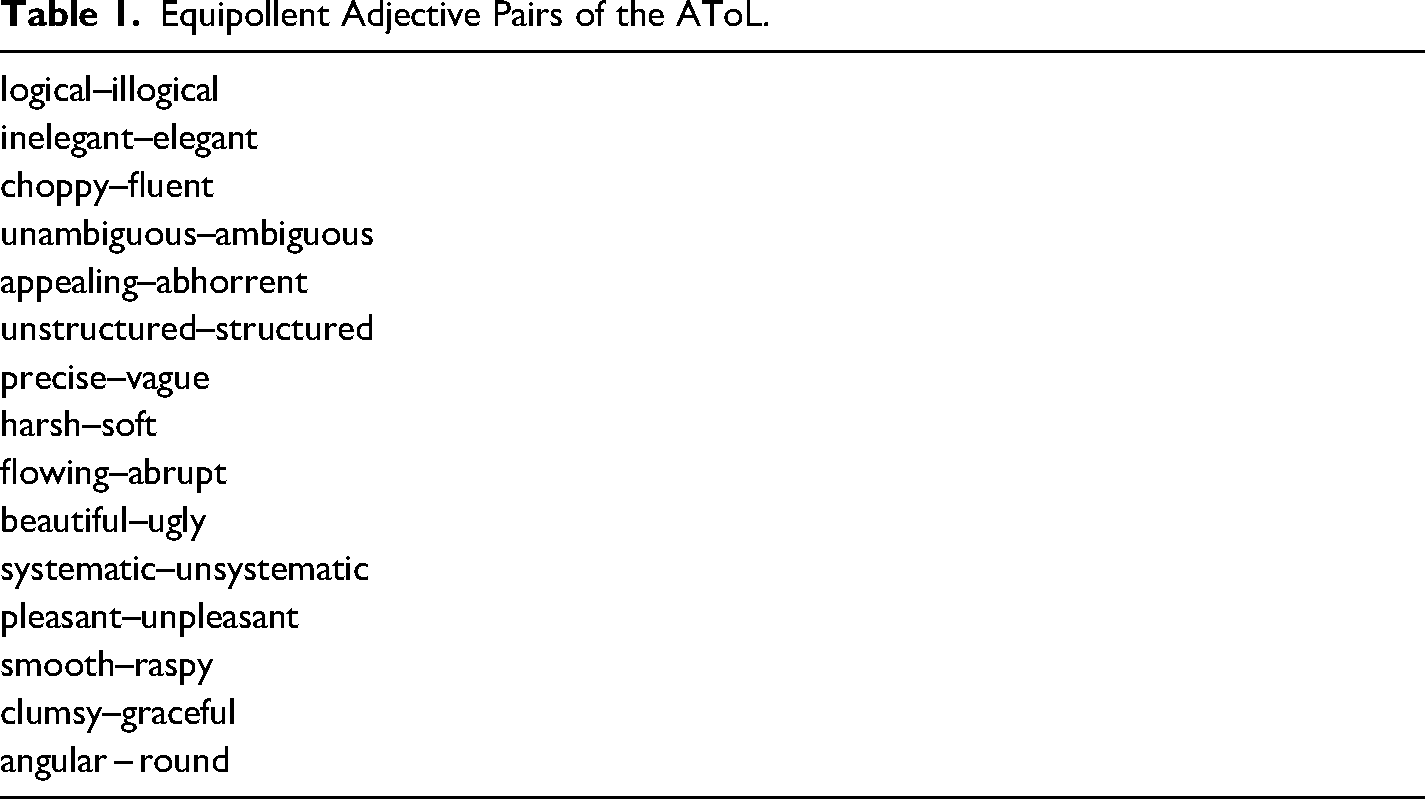
The AToL-C uses 15 equipollent adjective pairs to measure explicit attitudes along three factor dimensions: sound, structure, and the superordinate factor value. Table 1 shows the adjective pairs from our implementation of the AToL-C in Wales; Figure 2 shows the digital slider interface presented to participants.
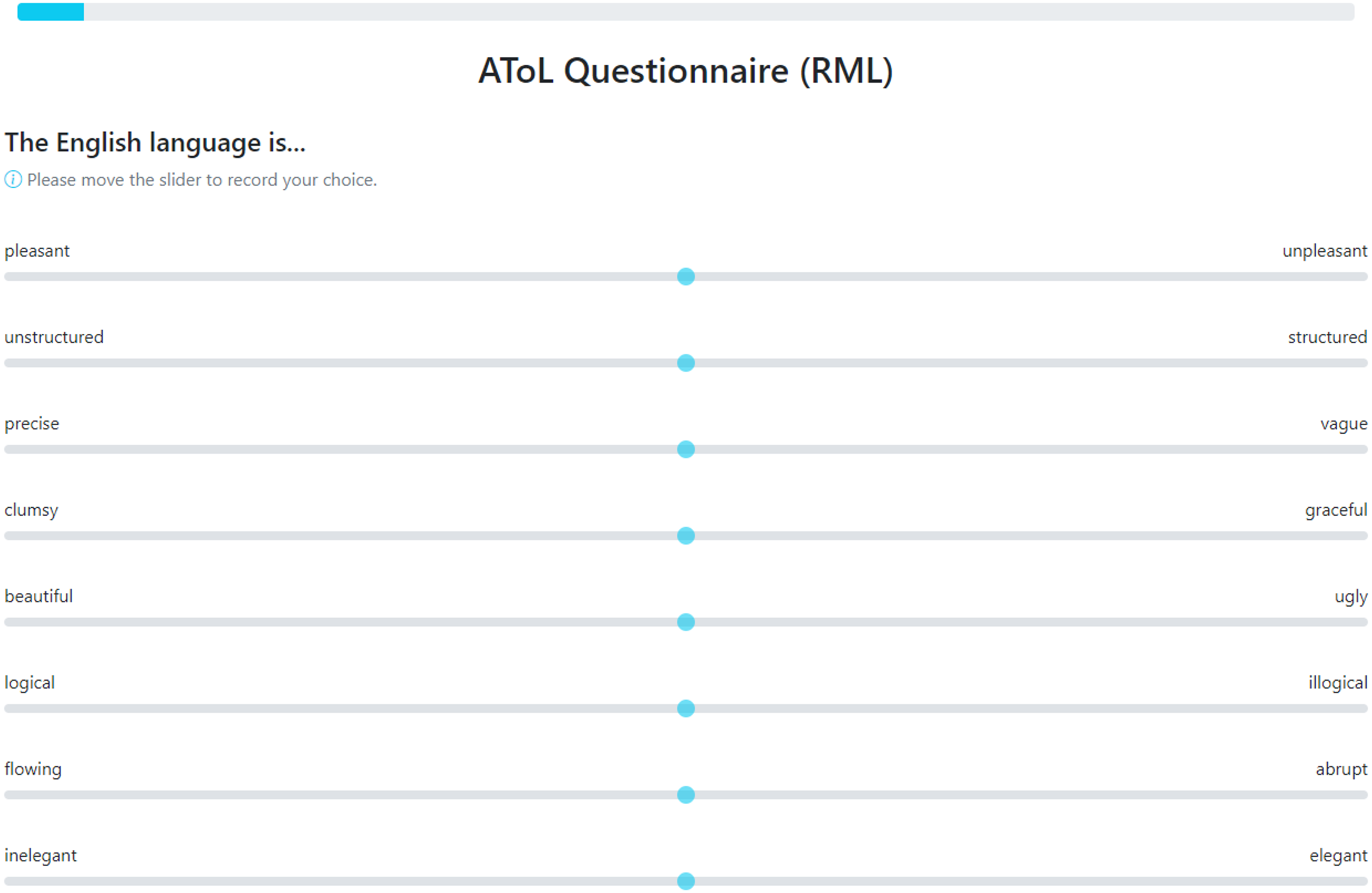
The AToL on the L'ART research assistant app (Breit et al., 2023a).
Equipollent Adjective Pairs of the AToL.
Implicit Association Test
An auditory version of the IAT (Greenwald et al., 1998) was employed to elicit participants’ implicit attitudes towards Welsh and English. The IAT is a reaction time-based categorization task that aims to capture the extent to which participants automatically associate an attitude object to a certain type of evaluation.
IATs require a target category (attitude object) and an attribute category (emotional valence: positive or negative). In this case the attitude objects’ target category was language—pertaining to the minority and majority languages of interest to our study: Welsh and English. The attitude objects were represented by six words in two languages (n = 12 auditory stimuli). The words were neutral in valence as to ensure that any negative association that might emerge from the IAT would be due to the language in which a word was spoken rather than denotations and connotations of the word itself. As the study took part in the context of a project also considering minority and majority languages beyond Wales, some of which have no established orthography, target stimuli were produced in audio format, thus increasing comparability and replicability across languages regardless of factors conditioned by orthography. The attribute category was presented through images representing the two emotional valence poles positive and negative. Images were used instead of linguistic stimuli in order to avoid interference with the target category of language. The positive valence category was represented by six images of flowers and the negative valence category by six images of pests (n = 12 visual stimuli).
Norming Study
A norming study to assess different aspects of potential stimuli towards the construction of the stimuli for the IAT was conducted with n = 12 bilingual Welsh-English raters from north-west Wales (four females; Mage = 33.67). The norming study allowed us to select a set of word stimuli controlled for neutral valence, and a set of image stimuli controlled for maximally contrastive valence, as well as a speaker for the auditory stimuli perceived as suitably authentic in both languages.
Words Norming
We began with a set of 60 words per language (n = 120) made up of 30 words perceived to be neutral by our research team, as well as 15 words perceived to be positive, and 15 words perceived negative which served as points of reference for the raters. To avoid reaction time-related differences we included only disyllabic, concrete nouns as to avoid reaction time-related differences (Reilly & Desai, 2017). Polysemic words, homophonous words within languages (e.g., Welsh plant “children” and English plant) and across languages (e.g., Welsh fforest, English forest), as well as word-initial /s/ + consonant sequences and pairs of direct translations across languages (e.g., Welsh haul “sun”, English sun) were all avoided.
The preselected words were controlled for token frequency, targeting between 10 and 1,000 tokens per million. English frequencies were based on the 201-million-word Subtlex corpus (Van Heuven et al., 2014) and Welsh frequencies on the 11-million-word CorCenCC corpus (Knight et al., 2020).
Raters evaluated word valence on a 7-point Likert scale (1 = extremely negative, 4 = neutral, 7 = extremely positive). Any words with extreme valence ratings were discarded. Raters also reported any words they thought were unfamiliar, generally not widely used, strange, or that seemed artificial. Words that received more than 1 report for the same idiosyncrasy were excluded.
Based on the norming data, we selected 12 words, six for each target category (minority language and majority language). The final list contained esgid (“shoe”), gwyneb (“face”), llythyr (“letter”), neuadd (“hall”), swyddfa (“office”), and carreg (“stone”) for Welsh (M = 4.21; SD = 0.17) and airport, basket, driver, footage, ladder, and machine for English (M = 4.14; SD = 0.22). There is no significant difference between the means for the Welsh and English words, t(10) = −0.60, p = .56.
Image Norming
Thirty images were presented for norming. They consisted of 15 images preselected to be positive and 15 preselected to be negative, based on judgments by the research team. All 30 images contained only the intended flowers or pests; there were no humans or other living beings in any of the images. All flowers and pests were presented against a white background.
Raters scored image valence on the same 7-point Likert scale as the word stimuli. Any images evaluated either neutrally or in the opposite valence category to the one expected were discarded. Any images that overlapped semantically in any way with the finalized word stimuli were also discarded. Based on the norming data, we selected twelve images, six for each attribute category (positive valence and negative valence). The selected positive images of flowers received a mean score of 6.01 (SD = 0.16) and the selected negative images of pests received a mean score of 2.25 (SD = 0.21). The means that positive and negative images are significantly different, t(10) = 34.70, p < .001.
Speaker Norming
Three female speakers (Mage = 23.67) were recruited to produce the audio stimuli for the IAT. Females were decided upon due to the documented tendency for female voices to be overall more intelligible than male voices (e.g., Yoho et al., 2019). As low intelligibility has been reported to correlate with less positive attitudes (e.g., Hutchinson et al., 2019), the selection of female voices minimized the possibility that lower scores may be obtained for reasons independent of the language being spoken. All three speakers were bilingual Welsh-English speakers from North Wales from within approximately the same age range as the sample participants (21–26 years old).
Raters scored the speakers’ authenticity in both Welsh and English on a 7-point Likert scale (1 = very authentic, 4 = indifferent, 7 = very inauthentic), after listening to an excerpt (Welsh mean length: 22 s; English mean length: 20.33 s) taken from a longer segment of speakers describing a holiday experience. Recordings were taken from unplanned responses during an informal conversation so as to elicit speech that was as naturalistic as possible. The speaker that was eventually selected was judged by raters to be the most “authentic” in both English (M = 3.92) and Welsh (M = 2.75), with a paired-samples t-test indicating no significant difference for the English and Welsh ratings of the selected speaker, t(11) = –1.04, p = .078.
Construction of Auditory Stimuli
The speaker was recorded using a Rode NT1A large-diaphragm condenser microphone at the Bangor University Language Laboratory. The recording was made digitally at a sampling rate of 44.1 kHz. The speaker produced the word stimuli embedded in the carrier phrases “say X again” (Welsh: ‘dy’da X eto’) and “say X twice” (Welsh: ‘dy’da X ddwywaith’) to avoid list effects. Two separate carrier phrases were decided upon, to furnish both prevocalic and preconsonantal phonetic environments so that coarticulatory effects could be minimised for stimulus-extraction. Each word was recorded three times embedded in each of the carrier phrases and the final stimulus was then extracted from one of those recordings. Stimuli were extracted from their carrier phrases in PRAAT (Boersma & Weenink, 2024) and the recording was normalized to −1.0 dB in version 2.4.2 of Audacity (Audacity Team, 2014).
Procedure
Both experiments were conducted in person. Participants completed the LSBQe first before moving on to the AToL-C or the IAT. Both verbal instructions by the researcher and task-specific instructions within the L’ART Research Assistant app were presented in English, chiefly to assure consistency and continuity across the project and across speakers who may otherwise have different language preferences.
The LSBQe took on average 10–15 min to complete, while the AToL-C questionnaire took on average 5 min to complete. Upon completion of each task, participants were automatically directed to the next task via the task-sequencing feature built into the L’ART Research Assistant app (Breit et al., 2023a).
IAT Procedure
An auditory modification of the 7-block IAT design (see Greenwald et al., 1998, 2022) was used for this task, which we programmed using PsychoPy 2023.1.3 (Peirce et al., 2019).
To ensure that participants were familiar with the visual stimuli and that they could categorize them easily, all images were presented to the participants on the screen under the heading of their associated category before the experiment proper (Greenwald et al., 2020).
During the experiment, visual stimuli were presented as 6 × 6 cm images centred vertically and horizontally, and audio-stimuli were presented to participants through headphones without accompanying visual stimulus, as illustrated in Figure 3. Participants were instructed to press the keys “E” or “I” as quickly and as accurately as possible to categorize the target categories (Welsh and English audio stimuli) and attribute categories (positive and negative valence visual stimuli).
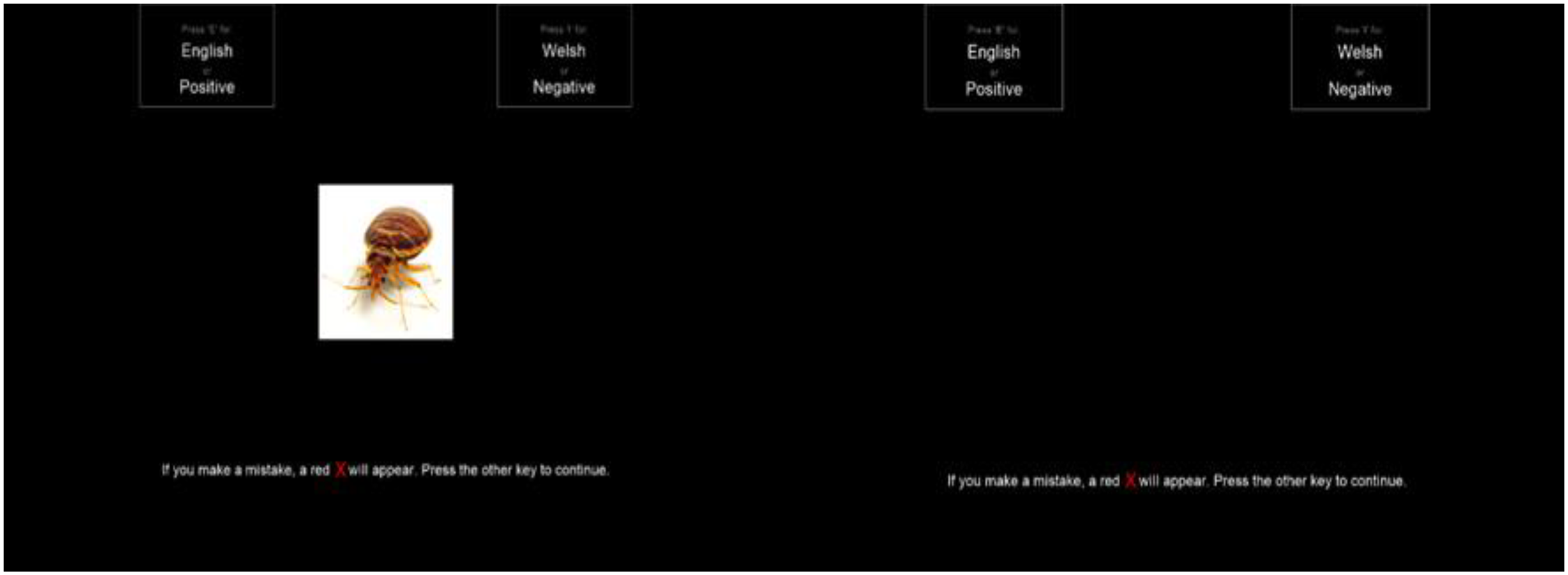
IAT screen displaying a critical IAT block where the participant must categorize visual stimulus (left) and IAT screen displaying a critical IAT block where the participant must categorize audio stimulus (right).
The first two blocks of the experiment were practice blocks in which solely either target categories or attribute categories were presented. This is meant to familiarize the participant with classifying the target and attribute concepts. The following five blocks consisted of two critical blocks separated by an audio block. In critical blocks, either of the target categories (Welsh or English audio) shared the same response key with either of the attribute categories (positive or negative image), as displayed in Figure 3. Only critical blocks were included in the analysis. Table 2 gives an example of the block structure of our IAT with information on number of trials, stimulus type, response key, and screen location of response key.
Experimental Design of IAT Blocks.
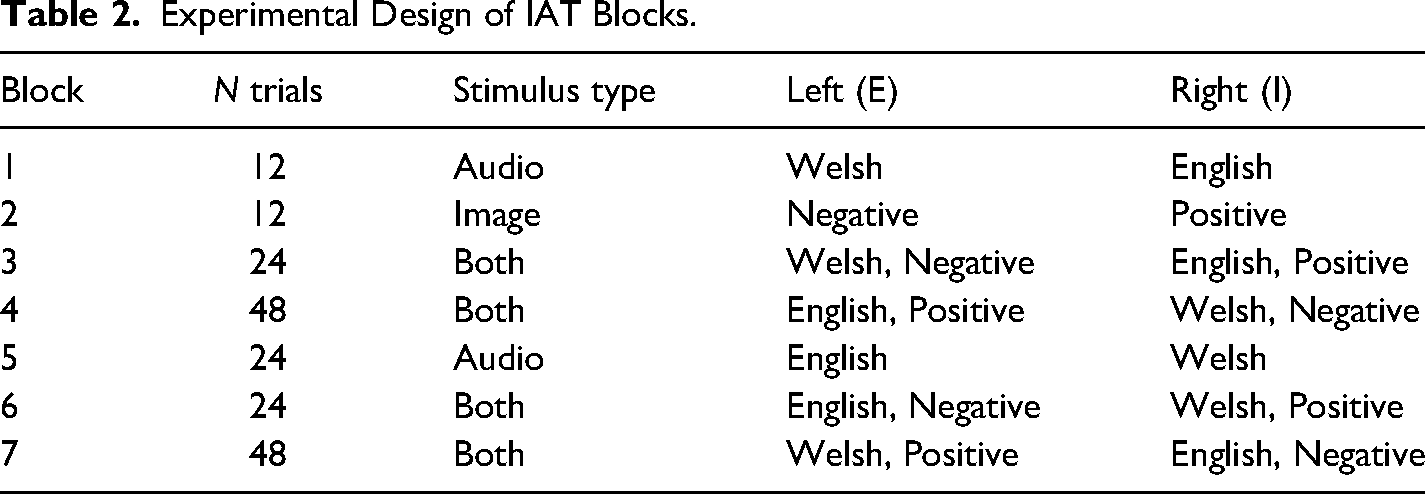
Each participant was assigned to one of the four predefined block order groups. This was done to counterbalance experimental blocks based on two features: the order of presentation of combined blocks (i.e., Welsh-positive first or English-positive first); and the side on which each of the combined categories were shown (i.e., right or left, linked to the response keys used for categorization). Counterbalancing was implemented to reduce the extraneous influence on IAT results known as the order effect (see Greenwald et al., 2022). Accordingly, n = 13 received Order 1, n = 10 received Order 2, n = 10 received Order 3 and n = 9 received Order 4. Number of trials per block and stimulus type presented in each block remained constant across all four blocks.
All trials were randomly presented within each block. Within critical blocks, where stimulus types were combined, visual and auditory stimuli strictly alternated, such that participants were never presented with consecutive stimuli of the same type (e.g., image > image > image). The decision to have stimuli with different modalities (i.e., auditory, visual) was made to ensure that participants would not confound target categories (languages) with valences (positive/negative) and to exclude issues of orthographic recognition that might add a confound (Frost et al., 1987).
Results
AToL
Following the original analysis by Schoel et al. (2013), a 2 (Language: Welsh or English) × 3 (AToL Factor: Value, Sound or Structure) repeated measures ANOVA was conducted on the data. As the assumption of sphericity had been violated for AToL Factor, χ2(2) = 8.469, p = .014, degrees of freedom were corrected using the Greenhouse–Geisser method (ɛ = 0.840). The results indicate a significant main effect for language, F(1, 41) = 10.670, p = .002, ηp2 = .207, and AToL Factor, F(1.680, 68.861) = 5.337, p = .010, ηp2 = .315, and a highly significant interaction between Language and AToL Factor, F(2, 82) = 10.561, p < .001, ηp2 = .320. Bonferroni-corrected post-hoc tests revealed that Welsh was evaluated significantly more positively than English for the AToL factor Value, p < .001, 95% CI [62.351, 139.270], but not for Sound (p = .369) or Structure (p = .244). This is illustrated in Figure 4.
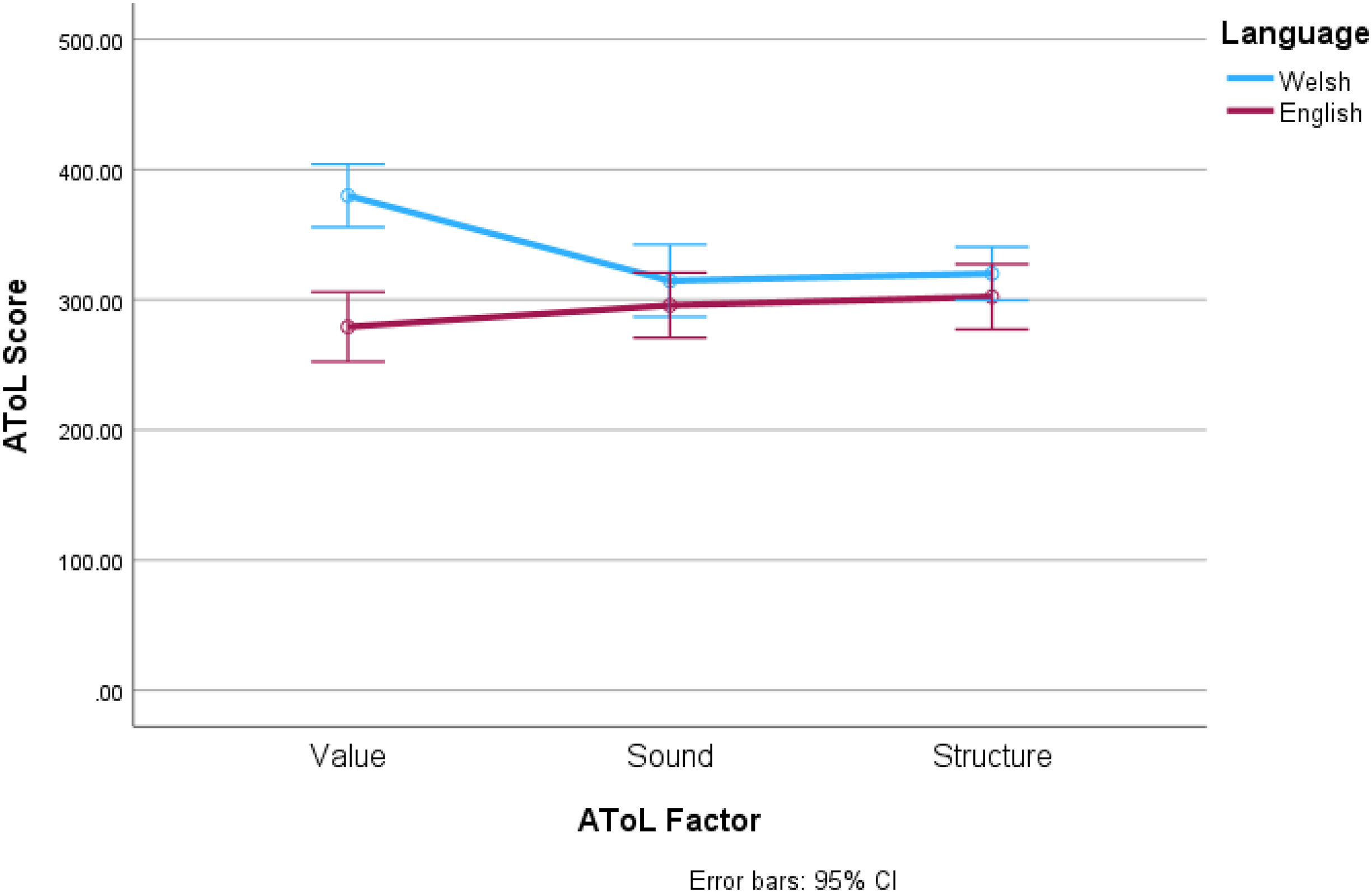
AToL factor scores for each language.
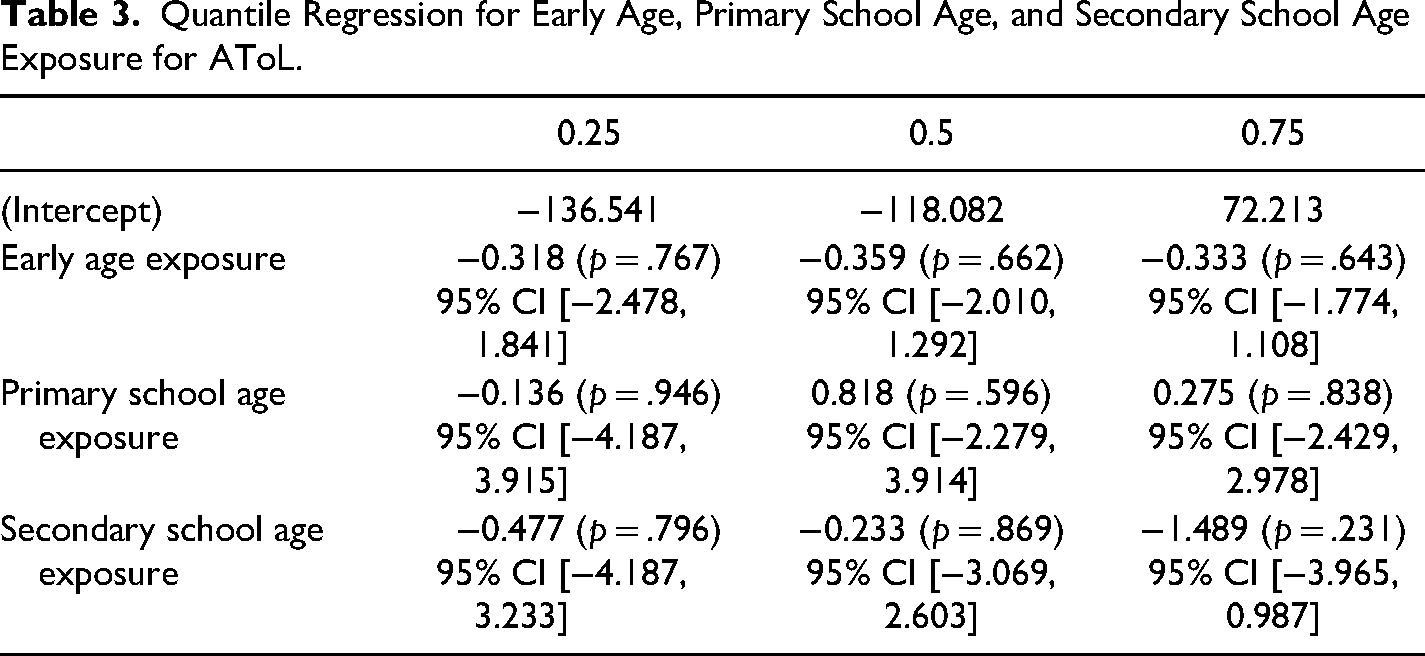
To facilitate a regression analysis with exposure, D-scores were calculated for AToL Value scores by subtracting the Welsh scores from the English scores. Therefore, negative D-scores indicate a preference for Welsh, while positive D-scores indicate a preference for English. To select the appropriate regression analysis, we inspected VIF scores, homoscedasticity and normality of residuals. VIF scores were found to be below five for all predictors, indicating no multicollinearity concerns. Homoscedasticity was confirmed with a Breusch–Pagan test (p = .66), as was independence of errors with a Durbin–Watson statistic (DW = 2.434). One of the predictor variables (Early Age exposure) displayed nonnormality of residuals (Shapiro–Wilk, p < .001). We therefore conducted a multiple quantile regression across multiple points in the distribution, with the AToL value D-score as the dependent variable and three predictors (Early Age exposure, Primary School Age exposure, and Secondary School Age exposure) exported from the Community Language Use Behavior section of the LSBQe, which asked participants to report via a continuous scale which language they most frequently heard or used in different life stages. As shown in Table 3, none of the predictor variables yielded any significant effects.
Quantile Regression for Early Age, Primary School Age, and Secondary School Age Exposure for AToL.
IAT
For the IAT, D-scores were calculated based on the Improved Scoring Algorithm (Greenwald et al., 2003; Roessel et al., 2018) which has been reported to be a more reliable scoring method, having outperformed other scoring algorithms (Glashouwer et al., 2013). This improved algorithm uses standardized reaction time differences to account for variability by dividing the differences by the pooled standard deviation of the overall reaction times across trials. The method also accounts for extreme reaction times, including those that are excessively rapid or excessively slow, reducing variability of D-scores. Accordingly, all data was kept as no response latencies surpassed 10,000 ms and none of the participants produced more than 10% of responses below the 300 ms threshold. Both participant groups demonstrated a similarly strong average accuracy of 96% (range 92%–99%), indicating comparable proficiency in correctly responding to the stimuli. This high accuracy reflects consistent performance across groups, suggesting minimal variation in their ability to correctly categorize target concepts. The Mean D-score across all participants was 0.04 ± 0.54 (95% CI [−0.11, 0.22]), which shows essentially no implicit preference for either language, t(41) = 0.579, p = .566.
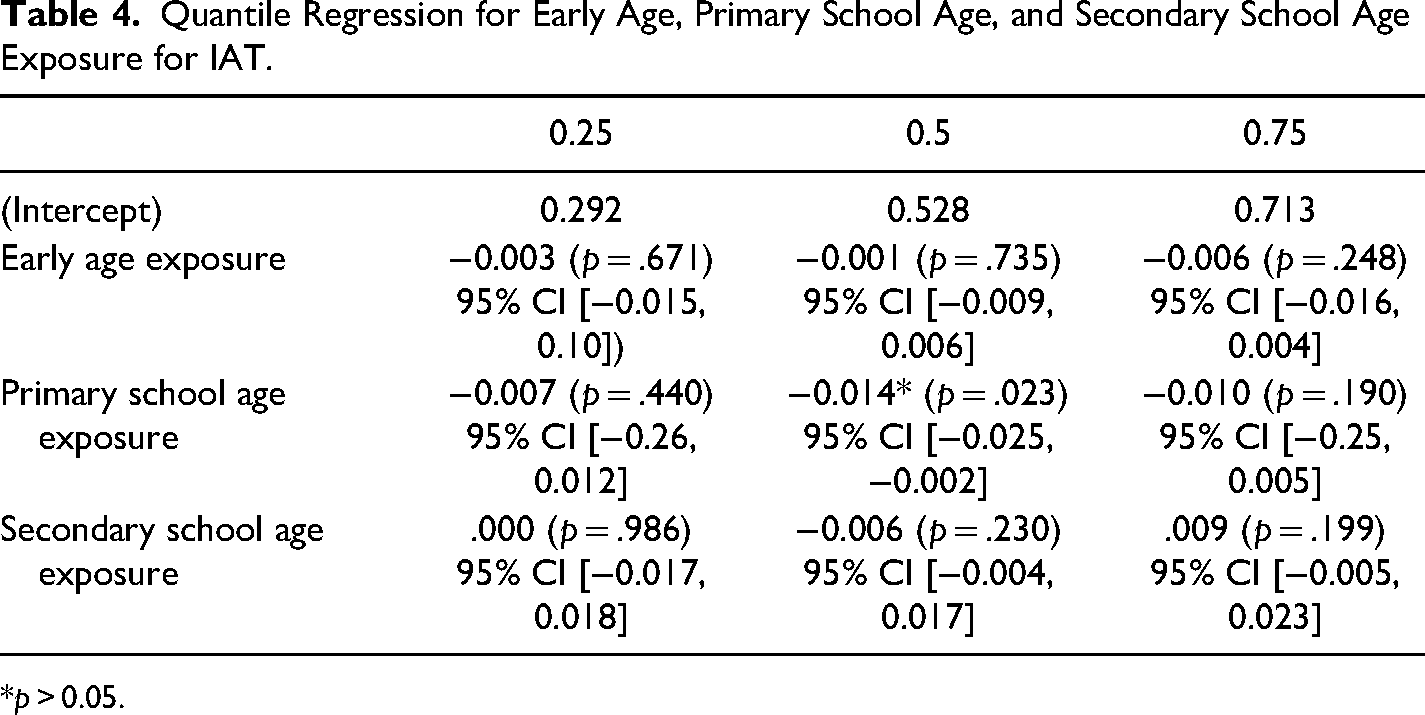
To select the appropriate regression analysis, we inspected VIF scores, homoscedasticity and normality of residuals. VIF scores were below 5 for all predictors, indicating no multicollinearity concerns. Homoscedasticity was confirmed with a Breusch-Pagan test (p = .808), as was independence of errors with a Durbin–Watson statistic (DW = 1.645). The predictor variable “Exposure in Infancy” displayed nonnormality of residuals (Shapiro–Wilk, p = .033). We therefore performed a multiple quantile regression across multiple points in the distribution, with the IAT D-score as the dependent variable and three predictors (Early Age exposure, Primary School Age exposure, Secondary School Age exposure). As shown in Table 4, there is a significant effect for Primary School Age exposure at the 0.5 quantile, while no significant effects were found for either Early Age exposure or Secondary School Age exposure. Figure 5 shows prediction lines for the predictor Primary School Age exposure, indicating a consistent decrease of the D-score (i.e., a stronger preference for Welsh) at all three quantiles, and particularly so at 0.5.
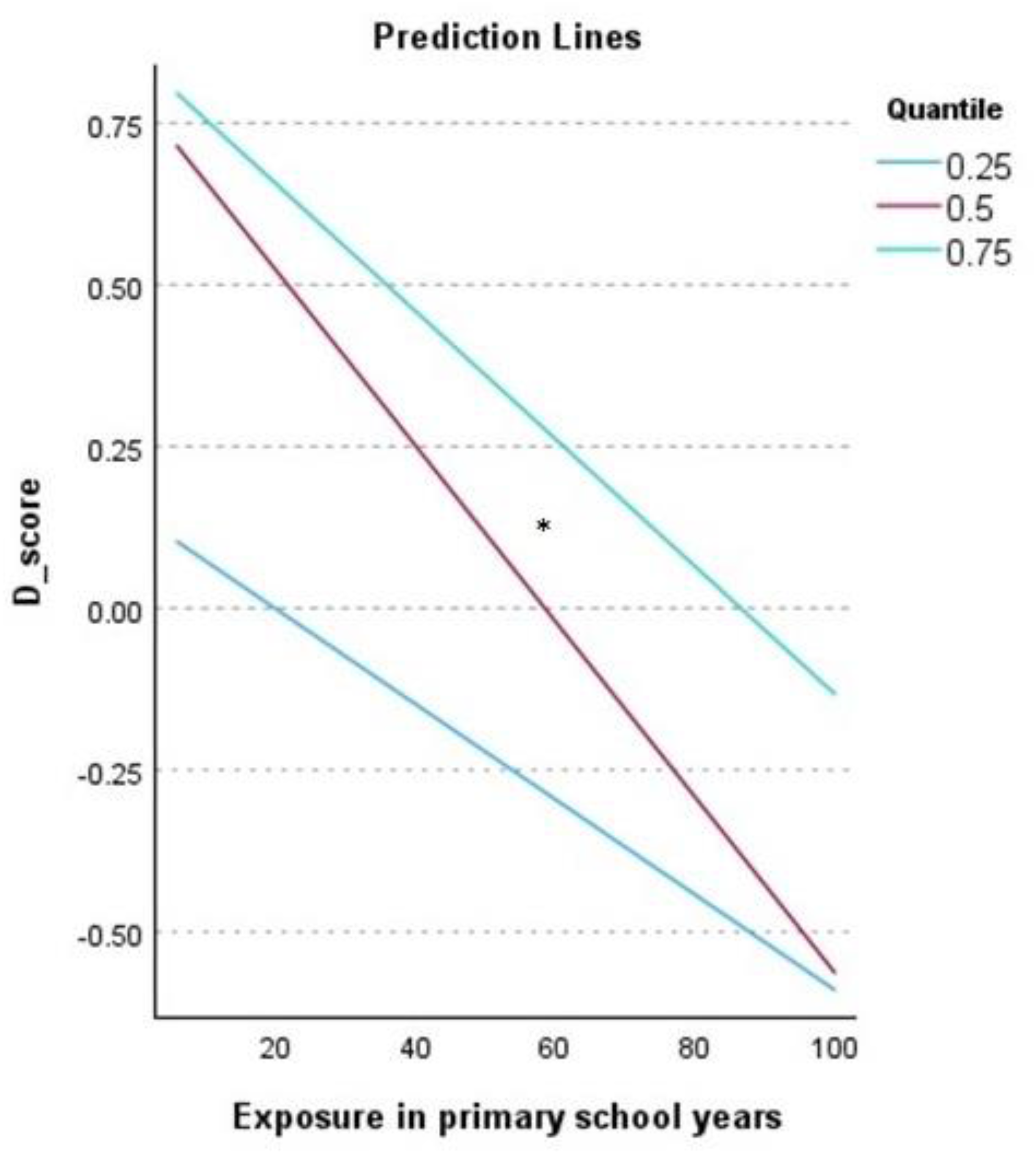
Prediction lines for the predictor primary school age exposure.
Quantile Regression for Early Age, Primary School Age, and Secondary School Age Exposure for IAT.
*p > 0.05.
Discussion
As discussed in the Background section, positive explicit attitudes towards Welsh (e.g., Coupland et al., 2005) are not necessarily congruent with the decrease in social use (e.g., Welsh Government, 2022b) and intergenerational family transmission of Welsh (e.g., Morris, 2023). The decrease in social use and intergenerational family transmission, in turn, leads to less exposure towards Welsh for current and future generations of children. As evidence suggests that implicit attitudes are better predictors of habitual behavior (e.g., Devos, 2008; Perugini, 2005) we employed both an explicit and an implicit measure to analyse the effect exposure has on speakers’ explicit and implicit attitudes.
Our results show that speakers hold more favorable explicit attitudes towards Welsh than English for the AToL Value factor which analyses have found to be superordinate (Schoel et al., 2013, p. 25). This is not unexpected, and parallels previous results from research collecting explicit attitudes through self-reported data (Coupland et al., 2005; Laugharne, 2007; Lyon & Ellis, 1991; Morris, 2014). Therefore, contrary to the current landscape of declining use and exposure towards Welsh in Wales, bilingual speakers’ explicit attitudes towards Welsh remain positive. This is likely due to successive language policy strategies placing an emphasis on normalizing perception of Welsh (Williams, 2017), along with prominent Welsh establishments providing a platform for the language (e.g., via Welsh-only name changes), which overtly highlights the cultural significance of Welsh. Our results show no significant exposure predictors for the AToL. This may indicate a lack of sensitivity of the AToL when identifying more fine-grained attitudinal tendencies.
A different picture emerges from the IAT results. On the one hand, no preference was found for implicitly held attitudes towards Welsh and English. On the other hand, our analysis suggests there may be a pattern that the AToL's mean attitude scores do not pick up on, namely an age exposure effect where speakers’ attitudes differ depending on previous exposure towards Welsh. Speakers with higher exposure to Welsh at primary school age have more favorable attitudes towards Welsh than those with lower exposure, who favor English. This lends support to Ianos et al.'s (2023, p. 224) interpretation that language attitudes are shaped by environmental and cultural factors. These results show the importance of language exposure in fostering positive implicit attitudes towards Welsh. Although all our participants were fluent Welsh speakers from areas offering ample opportunities to speak Welsh, our results suggest that early exposure may do more than give children the necessary language skills required for use—a role which education, too, can successfully fulfil. What early exposure may provide above and beyond language skills is the modelling of Welsh language practice in a broad range of community contexts. This tallies with research in other areas where behavior modeling has been found to play a fundamental role in influencing children's behavior, such as physical activity (e.g., Taylor et al., 1994) and sleep patterns (e.g., Rhodes et al., 2020).
The lack of modeling that some children experience is therefore particularly pertinent when considering the context of declining exposure to Welsh due to a decrease in social use and intergenerational family transmission. This suggests that arresting the decline of social use and, in particular, the decline of intergenerational transmission within the family, is critical for improving implicit attitudes towards Welsh. This should be considered a priority for Welsh Government language policy and could be achieved through community interventions. For example, an intervention along the lines of the now defunct Twf (“Growth”) project, which used midwives and health visitors to encourage mothers and prospective mothers to speak Welsh with their children (Edwards & Newcombe, 2005), would be a potential route policy makers could explore to address this.
To complement intergenerational family transmission, it may be useful to utilize linguistic role models beyond teachers or other authority figures to model children's linguistic behavior. In situations where intergenerational family transmission is not possible, linguistic role models could provide further opportunities for language input. Role models could include older school pupils, musicians or social media influencers. Strong reliance on the education system as a major locus of intergenerational transmission has been shown to increase association of Welsh with the classroom and with teachers as models, which can be detrimental to attitudes among teenagers and young adults (Price & Tamburelli, 2016), an issue that has also been reported in relation to Frisian (Arocena-Egaña et al., 2010). Therefore, the provision of nonauthoritative models becomes a crucial component in the maintenance of a minority language which, like Welsh, has achieved a high level of officialdom. This may be particularly effective where opportunities for intergenerational transmission within the family are lacking, while also providing additional modelling and language “coolification” (Gobbo, 2021) more generally.
We suggest that if current patterns of decline continue, a decrease in exposure could lead to less favorable implicit attitudes towards Welsh, thus highlighting the importance of home and community exposure for the future vitality of Welsh. A similar point regarding community exposure has been made by Price and Tamburelli (2020) in relation to attitudes in general.
Improving implicit attitudes towards Welsh is significant from a language maintenance/revitalization perspective, as implicit attitudes seem to be better predictors of habitual behavior than explicit attitudes, that is, how likely the speaker is to use the language (Devos, 2008; Perugini, 2005). Considering the Welsh Government's current target to double the use of Welsh in areas such as the workplace and social situations, the Welsh Government should actively use and monitor implicit attitudes to inform policy.
The limitations of explicit attitudes are well documented with regard to its susceptibility to biases, such as acquiescence bias and social desirability bias, affecting responses (e.g., Baker, 1992; Garrett et al., 2003; Krug & Sell, 2013). This might also affect the AToL's sensitivity. For example, looking at the results of our two studies overall, the question arises as to whether the AToL is sufficiently sensitive to identify more fine-grained attitudinal tendencies that are at play in Wales. Further limitations become apparent in comparing the results of our explicit attitude study to those of our implicit attitude study, as exposure was found to affect attitudes towards Welsh only using implicit methods in sociolinguistically comparable samples.
The effect for exposure in primary school years is pertinent within the sociolinguistic context of north-west Wales, a traditional Welsh-speaking heartland and the area that contains the highest proportion of Welsh speakers (Welsh Government, 2022a). However, language shift has occurred, and continues to occur, in communities across north-west Wales. Therefore, tackling declining exposure within communities that are presently undergoing shift should also be integrated into the priorities of policy makers.
Limitations and Future Work
Our studies relied on two separate population samples for the explicit and implicit method, respectively. This means that although both samples were representative of the same target population and sociolinguistically comparable, a direct comparison between our explicit and implicit methods was not built into the experimental design, limiting us to a descriptive point of view. Therefore, future work on language attitudes should utilize both direct and indirect methods on the same sample.
We recruited Welsh-English adult bilinguals from the Welsh-speaking heartland areas of north-west Wales, a crucial demographic to investigate from a language maintenance perspective. However, future work should extend also to areas of Wales where exposure toward Welsh is lower. This would help to ascertain whether the role of age exposure to Welsh is significant in forming implicit attitudes outside of heartland areas. Moreover, there are questions as to whether the gender differences previously reported among adolescents for the MGT (Price & Tamburelli, 2020) extend to adults and/or to the methods employed in our studies. Future research could investigate this possibility with a design that has gender as one of its predictors. Finally, attitudinal research on non-Welsh speaking participants would usefully complement our work by investigating the attitudes of those who cannot currently speak the language but are an important target demographic for Welsh language revitalization efforts.
Conclusion
This paper illustrates a distinction between explicitly and implicitly held attitudes of the current parent generation in north-west Wales, a traditional heartland area of the Welsh language. While Welsh was evaluated more favorably than English when employing direct measures, no significant preference was detected when indirect measures were applied.
Considering that implicit attitudes are more indicative of habitual behavior, as well as the known limitations that are associated with direct measures, we suggest that implicit attitudes and their potential impact on use should receive more attention by Welsh researchers and policy makers alike.
Importantly, our results indicate that speakers with higher exposure to Welsh during childhood hold more favorable implicit attitudes towards Welsh than those with a lower exposure. This finding illustrates the particular importance of intergenerational family transmission. We suggest that addressing the decline of intergenerational family transmission in areas such as north-west Wales that are currently undergoing language shift ought to be of utmost importance to policy makers.
Footnotes
Acknowledgments
We’d like to express our gratitude to Lissander Brasca for his input and discussion of the overall research project, to Judit Vari for her methodological guidance relating to the IAT, to Jago Williams for her contribution to data collection, to Lois Elenid Jones for her contribution to the preparation of research materials, and to Canolfan Ucheldre, Caergybi for providing a location for part of the research. We thank the anonymous reviewers for their valuable comments and suggestions. Finally, we would also like to thank all the participants for taking part in our research—diolch o galon.
Declaration of Conflicting Interests
The authors declared no potential conflicts of interest with respect to the research, authorship, and/or publication of this article.
Funding
This project was supported by the Economic and Social Research Council (grant number ES/V016377/1).
