




Abstract
This paper describes one practice of “resistance” to challenging interviewees in television news interviews. Interviewers use turn medial tags when working with field reporters to display shared knowledge to an overhearing audience. In contrast, analysis focuses on examples in which tag questions are issued midturn, e.g., “You put your finger on the button didn’t you.=when you said …”. In this practice knowledge and understanding are built as shared in the face of resistance from high-status and highly experienced interviewees. The syntactic reorganization of different elements within individual turns, combined with the possibility of manipulating the sequential positioning of an utterance, allow intersubjectivity to be invasively and coercively re/built through displays of mis/alignment across turns and sequences of talk. We explore the implications of this for how resistance can be understood. Our analysis also contributes to a politics of intersubjectivity and, more specifically, interknowledgeability.
Keywords
Resistance can manifest in varying forms, be embedded in different everyday and institutional settings, and can appear in different interactional positions. The examination of resistance has typically been prompted by an image of a less powerful social member resisting the demands of a more authoritative or higher status individual. To some extent, such pictures derive from a system of metaphors taken from mechanics; a system that does not always map directly onto the subtle and often collaborative notions seen in contemporary conversation analysis and discursive psychology. Nevertheless, with that caution, we will work within this framing. Our focus will be on a two-party situation where both are powerful and have high status in their own domains. We will consider examples from broadcast interviews where highly experienced interviewers are managing exceptionally high status, perhaps even difficult, interviewees. Our question is how these skilled professionals adroitly mobilize conversational resources to resist the attempts of these high-status interviewees to escape the terms of the question. How, that is, does the interviewer properly represent the viewing audience and push back against the evasions of the powerful. More subtly, how is the apparatus of intersubjectivity drawn on to manage the politics of resistance?
Our analytic focus is on the practice of embedding an interrogative in the middle of either a turn, or a turn constructional unit, to resist incipient or overt disagreement. Our examples are from high status and highly experienced interviewees who are likely to be skilled at managing adversarial questions. We will show that this can be one way of dealing with, and even heading off, further disagreement, as the interrogative treats the recipient as already in possession of, and likely to agree to, the understanding that is built for them, at the same time as burying the response requirement with turn expansion. In effect, the recipient's state of knowledge is formulated and interactionally pinned to them while further talk unfolds. Considering this practice allows us to highlight features of intersubjectivity (or perhaps more precisely “interknowledgeability”) that are both invasive (formulating the other's state of knowledge) and coercive (holding off their opportunity to disavow that knowledge). The analysis will explicate the way intersubjectivity is performed both sequentially (i.e., between turns occupied with the same activity) and syntactically (within a turn) to deal with interviewee resistance in political interviews.
This paper contributes to three overlapping areas of study: First, the literature on interaction in news interviews and in particular the design of, and resistance to, challenging questions and responses (Clayman, 2014; Clayman & Heritage, 2002; Heritage, 2002; Heritage & Clayman, 2010); second, to research on the way knowledge and understanding figure in communicative practices (Heritage, 2012a, 2012b; Heritage & Raymond, 2012; Schegloff, 1992); third, to an ongoing interactional respecification of psychological matters (Edwards, 1997; Edwards & Potter, 2005; Potter, 2020; Potter & Edwards, 2012). We develop an alternative to social cognitive interpretations of matters of knowledge, relationality, and intersubjectivity. We will begin with the first and second of these themes; we reserve the third area for discussion at the end.
Interaction in News Interviews
Interactional studies have mapped a range of activities that take place in broadcast news interviews. Much of that literature has focused on issues of neutrality and combativeness, particularly regarding the design of questions, and pursuit of responses. Various distinctions have been drawn in relation to this, as researchers have noted the increased use of more adversarial styles of questioning. We take each of these related issues in turn.
Neutrality in Question Design
As Heritage (2002) suggested, although news interview questions are inevitably “slanted”—they select agendas, assert propositions and establish presuppositions—interviewees rarely directly challenged the impartiality or objectivity of the questions; parties collaboratively produce the “neutral” organization of news talk, with the interviewee treating the interviewer as disinterested and not the source of views that are embedded in questions. In the case of negative interrogatives, which use a negative interrogative frame such as “Don’t you …?”, Heritage (2002) showed that interviewees treat questions as taking a position, rather than seeking information, partly because the negative formulation of the question strongly projects agreement and a particular preferred, and therefore expected, response. In an early study, Clayman (1992) identified a “footing shift” (Goffman, 1981) as a practice that sustained neutrality, where the news interviewer identifies the source of a challenging question with some other party. Dickerson (2001) noted that if challenges were made, they were rarely personalized; rather they were done “in passing”, or with an explicit justification. Relatedly, it was found that news interviewers rarely include news receipts such as “oh” in their talk, as this would prioritize their own state of knowledge rather than orient to the requirement to inform the audience (Heritage, 1985; Heritage & Greatbatch, 1991).
Following this early focus on the achievement of neutrality, researchers began to document a growing trend towards what Hutchby (2011) calls “hybrid political interviews,” which have some features of standard broadcast news interviews, but also resemble talk radio, or topical debate shows. As such, they can appear to be in breach of institutional norms of “neutral and objective” reporting. This has led some (e.g., Ekström et al., 2018; Hutchby, 2011; 2021) to note a shift away from neutrality altogether, where interviewers adopt views and opinions that are in direct opposition to interviewees, so we now turn to a consideration of research that has explored different properties of adversarial questions in news interviews.
Asking Adversarial Questions
As with neutrality, Heritage and Clayman (2013) show that over the last 50 years there has been a tendency for news interview questions to become less deferential, with political and industrial leaders being held more accountable for their actions and views. In matters of public controversy, where politicians may be held accountable for misconduct or misleading the public, the news interviewer may need to navigate their role as the “tribune of the people” (Clayman, 2002) or the “arbiter of truth” (Montgomery, 2007), and this gives them resources for designing questions that invoke these roles in various ways. Romaniuk (2013) shows how pursuing answers to simple polar questions allows interviewers to highlight and simplify contentious issues and hold interviewees accountable for those issues (see also Clayman and Loeb, 2018). Clayman and Fox (2017) found that even questions that are characterized as “simple” can be a resource for interviewers to mobilize more adversarial, or “hardball”, questions (p. 33–34). Heritage (2002) found that interviewees treat questions framed with a negative interrogative such as “Don’t you …?” at the beginning of the turn, as taking a position, rather than information seeking, partly because the negative formulation of the question strongly projects agreement and a particular preferred, and therefore expected, response. Given our focus on negative interrogatives, we now consider these issues in our next section, taking a closer look at question design and epistemics.
Questions and Epistemics
Conversation analytic research has started to map out the way participants orient to the distribution of rights and responsibilities regarding what speakers treat as accountably knowable, and the way epistemic authority is granted or resisted. Heritage (2012a) has proposed that interaction takes place between parties who are accountable as having certain relatively enduring epistemic statuses. Thus, doctors are taken to know about medicine, and mothers about their children. Further, speakers are accountable for knowing more about their own pets, friends, and upcoming engagements. At the same time, interactants can invoke a range of sometimes competing epistemic stances. Unlike epistemic status, the stance is displayed or built during interaction, often through the grammatical realization of propositional content. The combination of status and stance can place speakers in what Heritage calls an “epistemic landscape” (Heritage, 2012a) in which there are gradients between being knowledgeable (K+) and lacking knowledge (K-). Questioning typically invokes an epistemic gradient between questioner and recipient, where asking a question invokes a K- status and builds the recipient as having a K + status. As Heritage and Raymond (2012, p. 179) put it, the “act of questioning invokes this relative K-/K + epistemic gradient between questioner and answerer, and, with it, the relevance of a response to the question”. In this paper, our focus is on the relative epistemic status of speakers as they build and respond to turn-medial tag questions.
Tag Questions and Knowledge
Like other polar questions, tag questions implement social actions that can include requesting confirmation of known or surmised information (Raymond, 2003; 2010; Robinson, 2020). Such questions have a declarative component and an interrogative component. In the example below, the declarative “They break up on Wednesdee anyway” (line 5) would standardly assert a position of knowledgeability with respect to the recipient. However, by appending a tag question—“don’t they”—to the declarative, the recipient is treated as able to confirm that declarative. Crucially for our analysis, this flattens the epistemic gradient between speaker and recipient, as the following example from a mundane conversation between a middle-aged British teacher, Lesley, and her mother, shows.
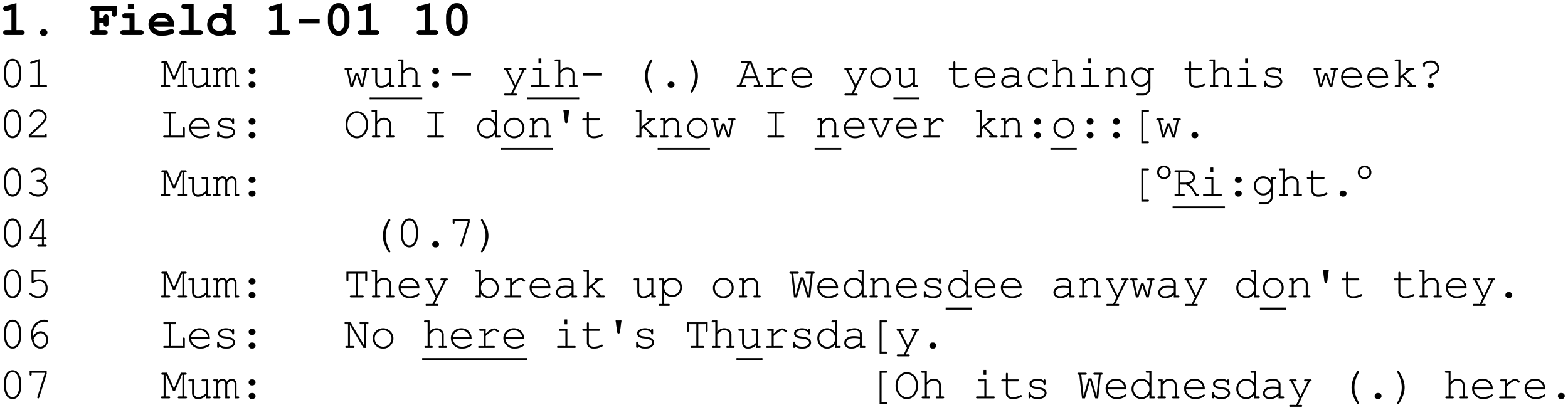
Mum's polar question on line 1 seeks information about Leslie's teaching. Leslie provides an account and perhaps something of a complaint about the predictability of her teaching (I never know). In line 5 Mum offers a judgment about when classes will end—“they break up on Wednesdee anyway.” This on its own would build Mum as K + but adding the tag question—“don’t they”—flattens the gradient, in a context where Leslie's epistemic status as a teacher is invoked (line 1). The tag element treats Leslie as in a position to confirm or deny Mum's understanding, while enacting her supposition that Lesley will only be teaching until Wednesday this week (Robinson, 2020). Leslie's denial leads Mum to account for her tag formatted supposition by citing her independent knowledge in line 7 “Oh it's Wednesday here.” The general, point, then is that tag questions commonly combine some form of assertion, which builds the speaker as K+, with a tag, which builds the recipient as K + . This flattens the epistemic terrain, orienting to probabilities and suppositions and building a particular division of intersubjectivity—things known (rather than felt or experienced, say) in common. We suggest this might be more precisely termed “interknowledgeability.”
Turn Medial Tag Questions
The standard form of tag questions, as seen in Extract 1 above, is that the declarative is directly followed by the tag. This is how tag questions got their name (Otto & Jespersen, 1933). In this form, the recipient has an immediate opportunity to confirm or deny the declarative. However, by syntactical reordering and/or adding further talk past the place where the transition might have happened, the question element can be moved from a turn-terminal position to a turn-medial position. This can construct a response as unlikely or unnecessary as well as making a response more difficult to produce without a possibly unsuccessful fight for the floor. In their research on calls to a UK child protection helpline, Hepburn and Potter (2010; 2011) studied two environments where such turn-medial tags are common.
One environment is where the recipient is displaying upset (Hepburn and Potter, 2010), as in the following example, where a caller is calling a child protection helpline to report an attack on his son, and in the process of asking for advice, starts to cry (line 1):
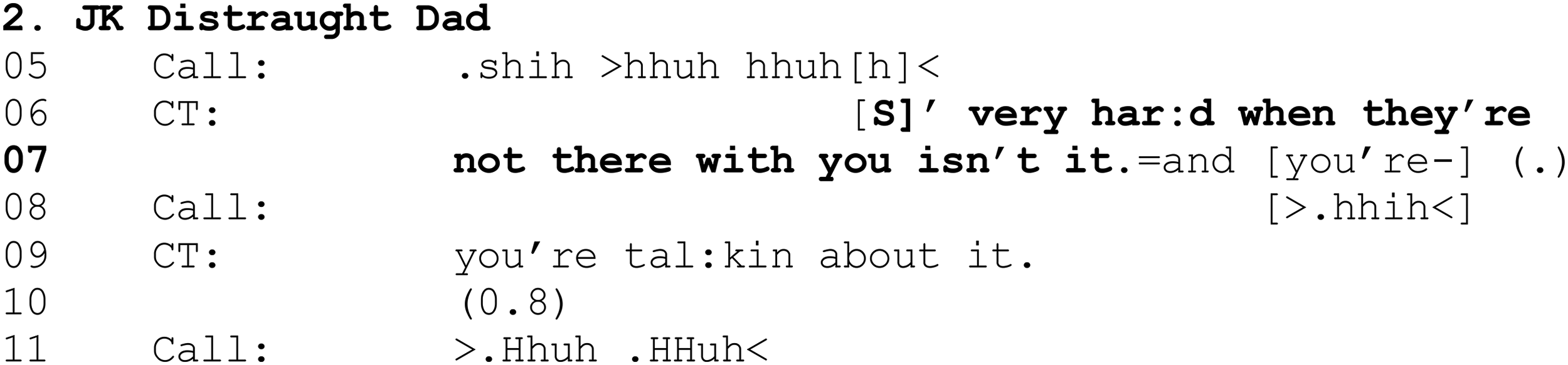
The declarative element of the turn—“it's very hard when they are not there with you”—ratifies the Caller's upset by indexing CT's generic understanding of being separated from one's children when they need help. However, it is also a description of something that the Caller has primary rights to—how they feel about it (it's very hard). In Heritage's (2012b) terms, without the interrogative component this would be a K + move—speakers have primary access to how they feel. This declarative is then tag formatted by adding “isn’t it.” Such a tag formatting treats the recipient as able to confirm the content of the declarative, and therefore flattens the epistemic gradient, in effect marking both parties as knowledgeable, while orienting to the caller's primary access in this context.
An additional feature of this declarative + tag combination is that, like other polar questions, it carries a preference for agreement (Pomerantz & Heritage, 2012; Sacks, 2020), as well as for a “yes/no plus confirmation” type of response (Raymond, 2003). To soften the mobilizing pressure of the tag, CT latches an increment immediately after it. The latching pushes the tag into a turn-medial position, countering or at least softening the response requirement by compressing the transition relevant place that would normally appear after the tag. Hepburn and Potter (2007; 2010) show that this is a regular practice used by call takers to manage speakers who display severe upset and hence have reduced capacity to respond.
A second environment where turn-medial tags have been found is where advice is being delivered in the face of sustained resistance (Hepburn & Potter, 2011). In the following case, a caller to the same UK helpline has expressed the hope that a “very disruptive” teenage daughter can be taken into care by Social Services. Over an extended discussion the CT has noted that Social Services are very unlikely to support this hope and advised the caller to follow various courses of action, including taking more time out of work to focus on the daughter—advice that the Caller has emphatically resisted.
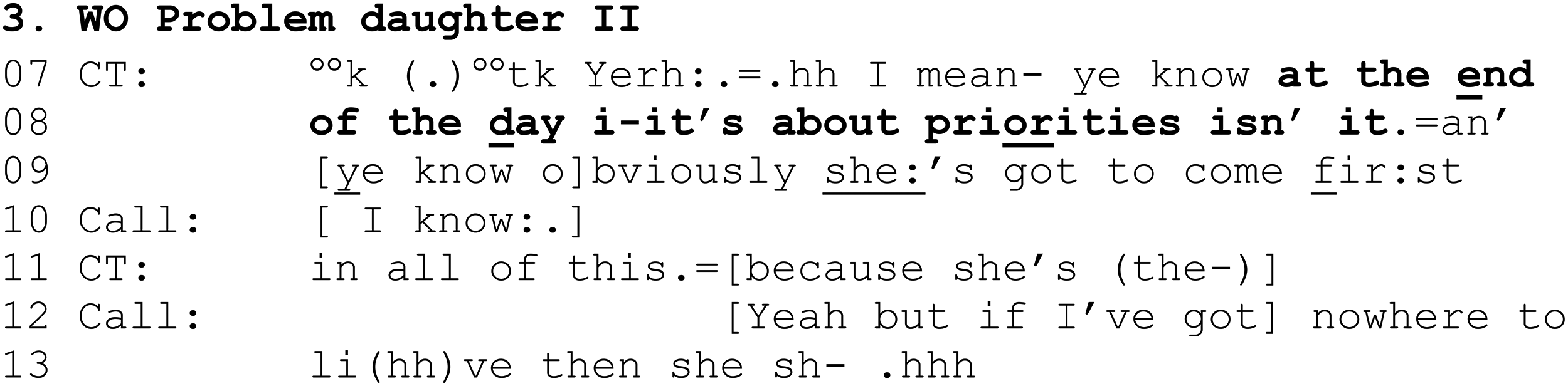
Hepburn and Potter (2011) note the idiomatic “at the end of the day” laying out shared knowledge that is hard to resist (Drew & Holt, 1988; Kitzinger, 2000; Potter & Edwards, 1990). The addition of the tag “isn’ it” to the claim that “it's about priorities” treats the Caller as being in a position to confirm the declarative, which she does in overlap on line 10. Although this would normally be an epistemically flattening move, here the propositional content that the Caller is treated as able to confirm is precisely counter to their prior position, the caller's “priorities” being spelled out by the CT's subsequent element post-tag: “an” ye know obviously she's got to come first in all of this’ (lines 8–11). This maybe builds a contrast between what she knows and what she wishes for.
It's interesting to consider CT's “ye know” (which prefaces her post tag element on line 9) in the light of Clayman and Raymond (2021), who note that “you know” can function as an “interpersonal alignment token” (p308), in that it gives speakers a way of tacitly claiming a next speaker's understanding and affiliation, making it adaptable for situations where there might be some problems of “intersubjectivity and solidarity” (ibid. p308). One element of their analysis focuses on its function in environments where speakers account for their initiating action following actual or potential disaffiliation from recipients.
In a similar way, Hepburn and Potter (2011) suggested that turn-medial tags can claim interpersonal alignment in a way that “designs the recipient”: they enable CTs to rebuild the Caller as in fact knowing the veracity of the offered and already-resisted advice, and then attempt to constrain the Caller's conversational conduct in the transition space. In this way, intersubjectivity is not simply something built across sequences of talk between speakers but is also built and contested within the design of a single turn 1 . This is consonant with Goodwin and Goodwin's (1987), illustration of how single turns of talk can be continuously re/built during interaction between speaker and recipient.
This work suggests that where turn-medial tags are used, recipients’ knowledge and alignment can be built into a turn construction that is hard to resist, due in part to the (often latched) infiltration of the transition space post tag. As Sacks (1987) showed, there is a preference for contiguity, designed to capture the tendency of recipients of complex turns to prioritize last elements of a turn first. This gives further credence to the notion that burying the tag element earlier in the turn makes it less consequential1. Turn-medial tags, therefore, provide speakers with a way of formulating the business of their co-interactants and presenting the formulation as shared knowledge. It is therefore exploitable in situations like advice resistance; places where it is especially important to display or produce continued alignment and where ongoing interaction is challenging (Hepburn, Shaw & Potter, 2018). As such this may constitute a useful practice in arenas of conflict and resistance.
What follows is an examination of turn-medial tag questions in news interviews. We will show how turn-medial tag questions in this context can be employed to project agreement even in the face of ongoing or projectable disagreement, thereby flouting what Heritage and Raymond (2021) refer to as the preference for questioners to make polar questions recipient designed, or “agreeable”: to design questions in such a way that they are likely to secure agreement. Our focus will be on the role of turn-medial tag questions in news interview interaction. The first part of the analysis will consider the basic practice in which turn-medial tag questions manage shared agreement. The second part of the analysis will focus on turn-medial tags that exploit this basic function in the service of building challenging questions.
Data
The following examples are from a collection of 20 sequences including turn-medial tag questions in media interviews, which we have opportunistically collected from various public domain (media) sources. The overwhelming majority of our examples are from UK sources which reflects a general imbalance in the frequency of tag use; Tottie & Hoffman (2006) suggest that tag questions are nearly ten times as common in corpuses of UK spoken English compared to the U.S. Our concern is to identify and explicate the practice rather than to assess its prevalence, with all the complexity that this entails (Schegloff, 1993). We have focused on examples involving experienced interviewers and high-status and experienced interviewees (ministers, heads of political parties, high profile activists). Turn-medial tag questions offer a particular challenge for transcription, due to the importance of tracking turn constructional unit boundaries (for an illustration of this, see Hepburn & Bolden, 2017); our analysis has therefore avoided working on boundary cases, e.g., where the same speaker talk post tag continues after some delay, due to lack of uptake.
In their study of assessments, Heritage and Raymond (2005) also suggest that tag questions play a crucial role in allowing speakers to upgrade their rights to assess when they are in responsive or second position1. Specifically, they show that one way of asserting rights to assess in 2nd position is to employ the “assessment plus tag” format, as an agreement with the position already adopted by the first speaker. By virtue of its interrogative status, this has the effect of issuing a new initiating action to supplant the one just delivered by the first speaker. Not surprisingly, most of our news interview examples are issued by interviewers, so occur in the first position.
Analysis
Our analysis first identifies turn-medial tag's basic practice of laying out common understanding for confirmation in non-adversarial news contexts. The more adversarial form we will primarily focus on exploits this basic form. The turn-medial position strikes a balance between two things. On the one hand, a negative interrogative at turn beginning is likely to be produced as, and treated as, a vehicle for making an assertion in news media contexts (Heritage, 2002). On the other hand, a negative interrogative at turn ending is likely to hand greater epistemic authority to the recipient (Heritage & Raymond, 2005). Turn-medial tags are neither turn initial, nor turn terminal, and Hepburn and Potter's (2010) earlier work suggests that they lay out a common understanding for confirmation in a way that is designed to minimize the response requirement. Our first example (extract 4) illustrates this basic function, while our focal practice (extracts 5–8) exploits features of practice in order to build a question that asserts something known in common, while holding off or resisting any recipient attempt to correct that assertion.
Invoking Shared Understanding
Although our primary focus is on adversarial uses of turn-medial tag questions, we have many examples of turn-medial tag questions in both UK media and other mundane and institutional UK settings. Although a deeper consideration needs to be given to these, we offer the following example to illustrates a basic practice for managing common understanding between news anchors (NAs) and field reporters (FRs). The example contains a turn-medial tag from NA to a FR at the Moldova–Ukraine border. Prior to this clip the FR has been describing how families have been turning up to escape the Russian invasion of Ukraine, and how women and children are being separated from their husbands/fathers, who must stay behind and fight.
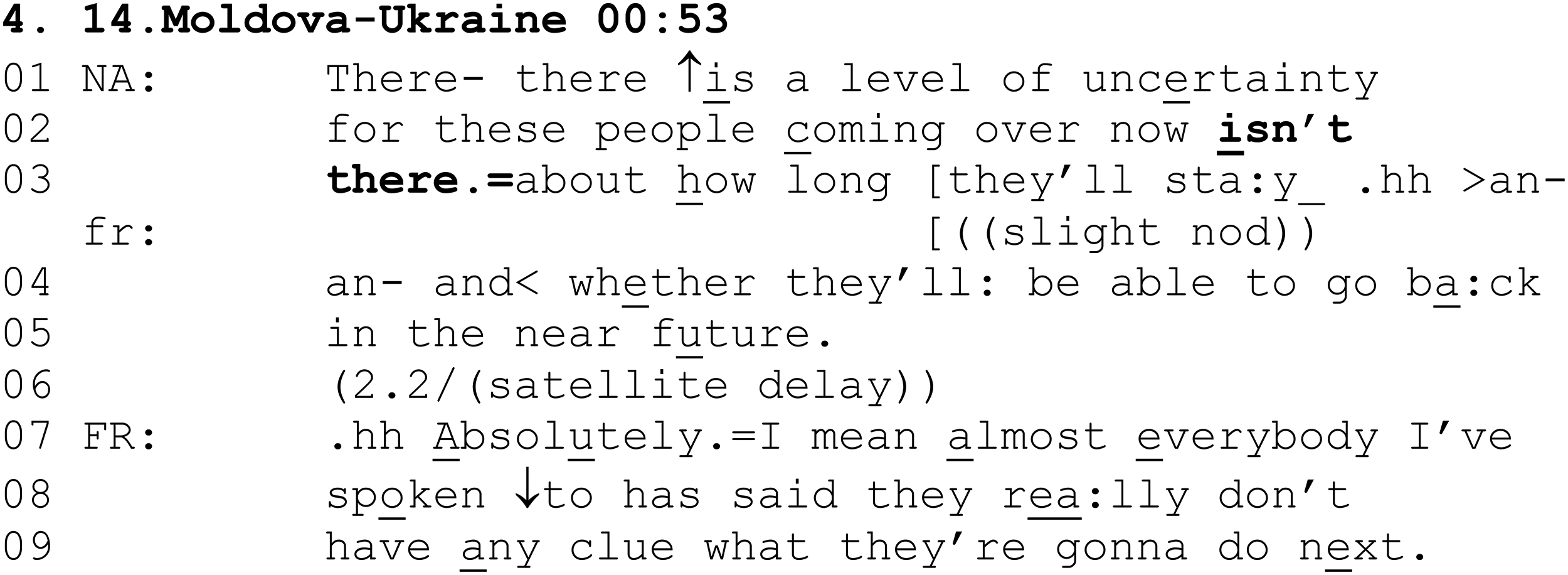
Here the NA sets up a focus for the FR, building on their prior content, invoking her own understanding of “a level of uncertainty” felt by “these people.” It's interesting to note that this is what the tag targets, and there is a slight nod from FR on line 3, possibly a satellite-delayed response to the tag or the prior declarative element. NA's further elements expand on what the uncertainty relates to—“how long they’ll stay and whether they’ll be able to go back.” (lines 3–5). In this way, knowledge of the refugees’ situation is built as shared by both NA and FR, while the precise placement of the tag indexes FR's primary access to the “uncertainty” of the refugees. FR specifically indexes her primary access in building the evidential basis for her response—that her claims are based on “almost everybody I’ve spoken to” (lines 7–8).
Extract 4 shows the basic practice of embedding a tag within a turn in order to index shared understanding in news reporting. Although this builds a similar epistemic landscape to that of turn final tag questions, we suggest that the precise placement of the tag can target a recipient's primary access, while closing a transition space in which they might confirm that access. In this sense, the epistemic valence is moved further towards a turn-initial negative interrogative, (which Heritage (2002) noted can be treated as more of an assertion than a question in adversarial news interviews), by providing a projection of assumed confirmation that hangs over the remainder of the turn. Hence the pre-tag content is being taken as a given, the recipient is designed as having access to that given, and the transition space is closed by further talk, thereby sustaining progressivity. It is worth noting that in the majority of our growing collection, the final contour of the tag element is falling, as opposed to rising or slightly rising, found in other types of polar questions (in American English—Stivers 2010) which adds to the sense of building known in common understanding, as opposed to soliciting information. With this practice, recipients’ alignment is tacitly built for non-adversarial reasons. We turn now to examine how the practice can be mobilized when that alignment is in doubt, in more adversarial news interview settings.
Dealing with resistance
While there are many examples of the above practice, which initial analysis suggests is broadly collaborative; in contrast, the focal practice builds resistance to a position or claim, through exploiting the turn-medial tag to interactively pin the recipient to agreement with a position, while filling the transition space with turn expansion. This limits the opportunity for disagreeing or qualifying and typically introduces more related material that itself needs addressing.
In the following extract, Jeremy Paxman (JP), anchor for the UK news program “Newsnight,” is interviewing Christine Lagarde (CL), then the French Finance minister. The discussion has been around the benefits of Britain adopting the Euro as currency. Prior to this, Paxman has issued three different questions occupied with establishing how “frustrating” it must be to not be able to set France's sales tax or interest rates independently. Lagarde has disagreed each time, stressing the positives of having a strong currency. Immediately prior to this extract, Paxman asks Lagarde whether she agrees with Prime Minister Gordon Brown, that Britain is “uniquely well placed to cope with the current financial turmoil.” She responds with qualified disagreement “not necessarily,” noting that Iceland and Hungary wished they had adopted the Euro as it would have given them more protection against “huge variation in currency movements”.
We join the interview as Paxman criticizes Lagarde for evading his prior question, and builds a further challenging question focused on the lack of control that the Bank of England would have if it joined the Euro-zone of countries:
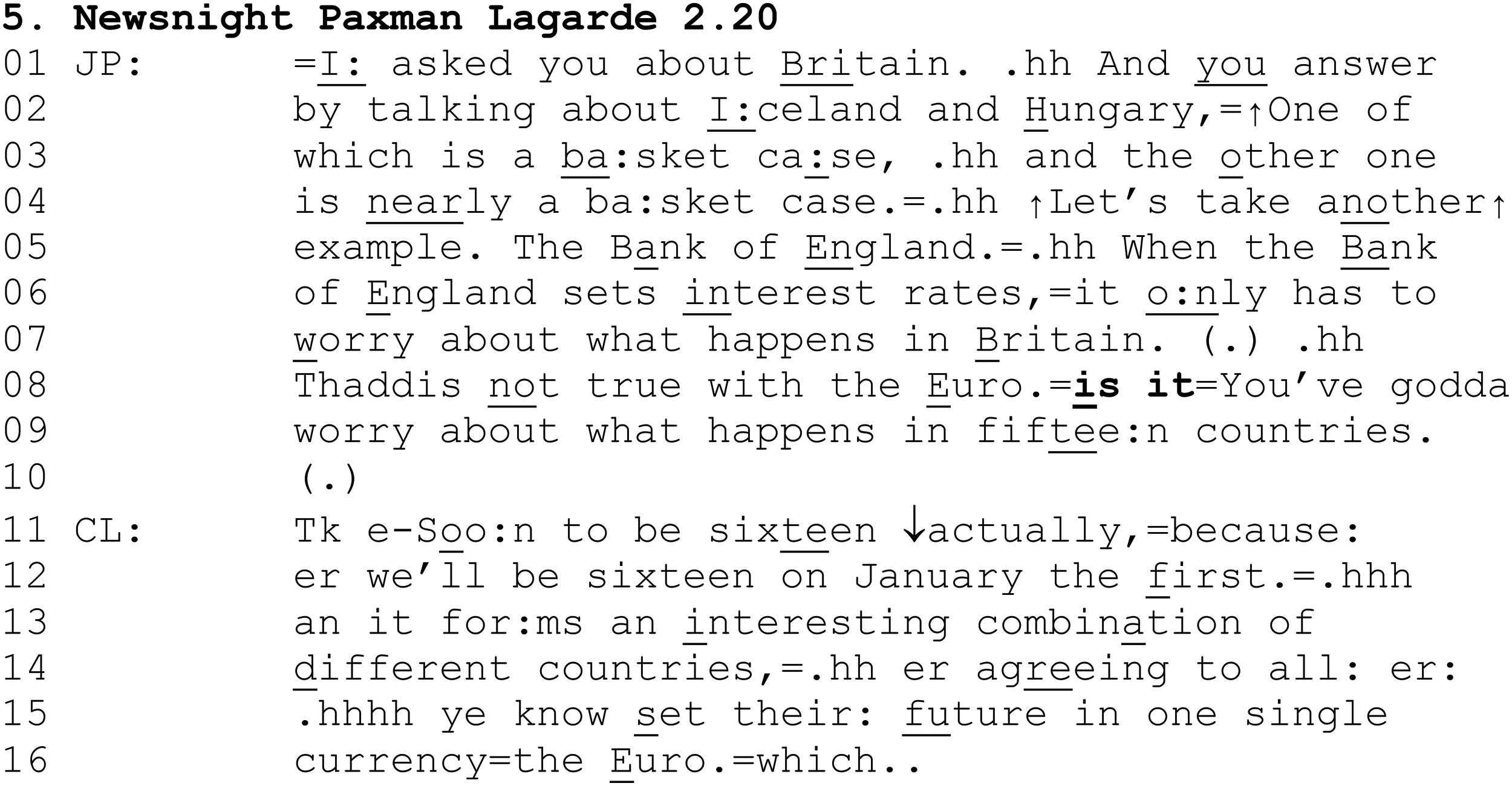
As French Finance Minister, with France a Euro-zone country, Lagarde would be expected to defend that membership, and indeed has done so repeatedly prior to this extract, disagreeing that she is in a “frustrating” position. As part of a complex question preface, Paxman reiterates one of his earlier points: “When the Bank of England sets interest rates, =it only has to worry about what happens in Britain”. He then asserts “Thaddis not true with the Euro.” This assertion is tag formatted, treating Lagarde as able to confirm that there are complex financial issues to “worry” about when in the Euro-zone. Directly after the tag, Paxman latches further talk that builds Lagarde as having to worry about 15 further countries. Further, talk interactionally holds off any dis/agreement. The tag, then, is buried by the general reiteration of the (already dismissed) concern about the varied makeup of the EU, and Lagarde is interactionally built as knowledgeable on important problems with the policy of joining the Eurozone economy. In this context, Paxman's turn-medial format is designed to imply the recipient's inconsistency and evasiveness in a way that is difficult for her to respond to.
Paxman had a reputation as a difficult and confrontational interviewer, able to resist the “slipperyness” of high-profile interviewees. We can see how such interview questions are constructed here. Lagarde also had a formidable reputation (she went on to be first managing director of the International Monetary Fund, and then president of the European Central Bank—the first woman to hold each of these posts). It is notable that she starts her response not by answering the question but by correcting part of Paxman's prior turn. She then starts to build a picture at odds with Paxman's, citing the “interesting combination” of countries who are “agreeing to set their future in one single currency.”
Let's take another example that further illustrates Paxman's use of turn-medial tags in building challenging questions that resist the pushback from high-status interviewees. Here he is interviewing Yvette Cooper who was then First Secretary to the Treasury in the Labor government. The Labor government has proposed a cut in purchasing tax to stimulate the economy and hold off recession. Paxman is challenging Cooper as to how significant the effect will be. At the start of this extract, Cooper is already pushing back by questioning Paxman's line of questioning, joking about telling people what to buy.
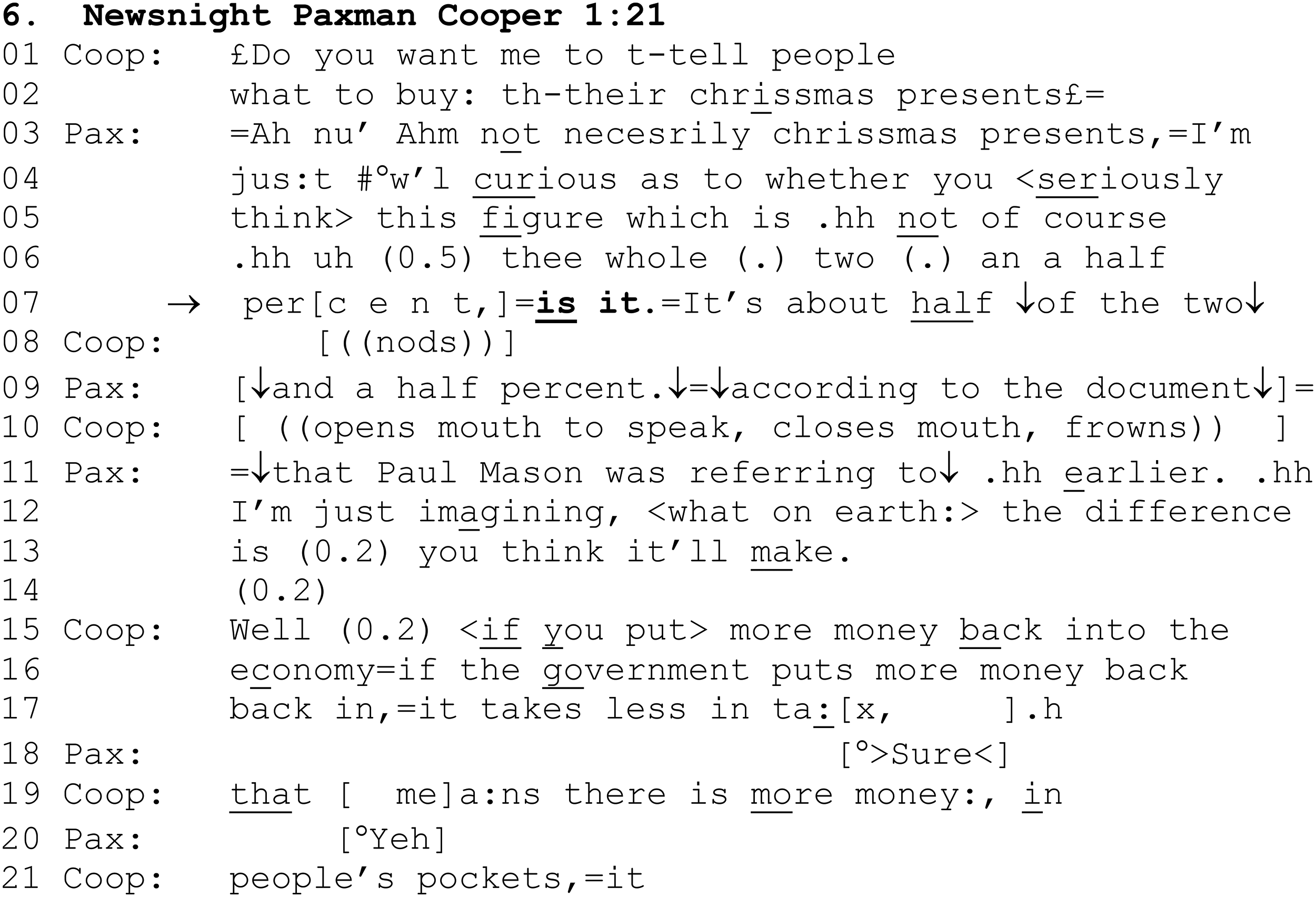
Paxman starts a declarative question on 3–4 “I’m just curious as to whether you seriously think this figure.” At this point, it is pragmatically/grammatically incomplete. Paxman introduces a parenthetical element that specifies that Cooper has overstated the money that has gone into the economy. This is tag formatted on line 7; and the tag is latched to further specification of the limited nature of the stimulus, referencing a “document” that a Newsnight reporter cited earlier. We can see that Cooper is prepared to challenge; she opens her mouth following this claim about the money being overstated and then frowns at Paxman's continued talk (line 10). All of this is then the platform for a strongly worded (“what on earth” line 12) challenge about the difference Cooper sees the money making. Key for our analysis is that the turn-medial tag pins Cooper as knowing that she has overstated the size of the stimulus. The construction resists Cooper's ability to push back by burying the tag. Indeed, the whole assertion about her overstatement, with its tag formatting, is buried in a parenthetical with the question not yet issued, and draws on the normative expectation for news interviews which is for the interviewee to wait for a clear question to be issued before speaking (Heritage & Greatbatch, 1991).
It's interesting to note that, like extract 5, the declarative element is negatively formulated—“not the whole two and a half percent,” so rather than having negative interrogative tags, they both get positive ones “is it.” Like extract 5, (that's not true with the Euro) the declarative element negatively formulates something that runs counter to the recipient's prior position, and the tag format seeks confirmation of that, which similarly gives it the function of seeking a confession about duplicity or evasion, before moving on to close the transition space where disagreement might have ensued. We argue that this practice of claiming interknowledgeability—building the other's state of knowledge—is used as a way of dealing with interviewees’ resistance, and holding them to account for the overhearing audience—in effect fulfilling the role of “tribune for the people” (Clayman, 2002) and “arbiter of the truth” (Montgomery, 2007).
One thing that all the examples have had in common so far is that the post-tag component has been latched onto the tag, so one question is how far this turn design feature is a central part of the practice. We offer the following example, taken from a morning news and current affairs radio program, to consider this. John Humphrys is interviewing Julian Assange about Swedish prosecutors’ requests to extradite Assange due to accusations of sexual offences. Humphreys has asked him why he won’t go back to Sweden; Assange claims he was there for 5 weeks waiting for a chance to put his side of the case but the charges were initially dropped and now have been taken up again. We join the clip just after Assange has said that if Swedish prosecutors want “another interview”, there are “plenty ways to do that” without him going back there.
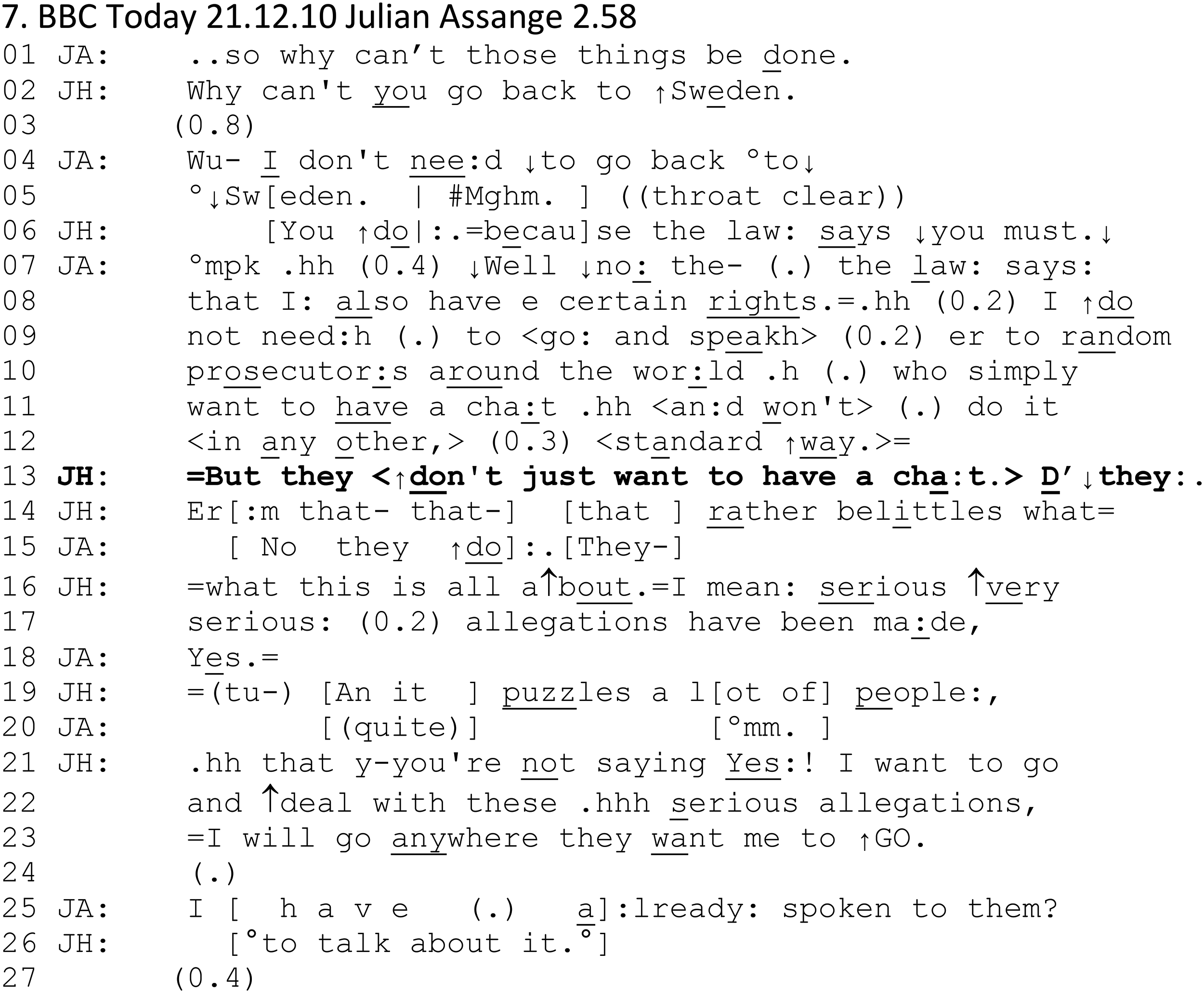
Humphreys’ question on line 2 seeks an account for why Assange isn’t returning to Sweden—a reissued question from earlier in the interview. Assange's delayed response on lines 4–5—that he doesn’t “need to”’ then elicits disagreement from Humphreys “you do” on line 6—his account citing his legal obligation to return. Assange's response on lines 7–12 characterizes the Swedish authorities as “random prosecutors … who simply want to have a chat.” This then gives rise to our target turn on line 13. Humphreys counters with a declarative component that targets Assange's formulation of wanting a “chat”. The addition of the tag component to this is designed to imply that Assange also knows this and is therefore seeking to deceive the overhearing audience. We can also see Humphreys’ explicit orientation to his role as “tribune for the people” (Clayman, 2002) in his further turn expansion on line 19, invoking “a lot of people” who are “puzzled” by Assange's failure to go to Sweden, thereby neutralizing his more adversarial question.
One difference between this example and many of our others, is that there is no immediate latching of the further post-tag expansion, and it's interesting to note how a fight for the floor ensues perhaps as a result, with Assange giving a type-conforming disagreement and disconfirmation in overlap with Humphreys’ turn expansion, which he eventually drops out of (line 15). Humphreys’ turn expansion wins the day—maybe Assange orients to the normative expectation for news interviewees to wait for a clear question to be issued before speaking (Heritage & Greatbatch, 1991). This allows Humphreys to spell out the seriousness of the legal situation that Assange is in.
In our final example, we see the news interviewer dealing with an experienced and combative interviewee who is departing from news interview norms by directly attacking the impartiality of the channel and the interviewer. At the start of the interview Anna Botting has asked George Galloway (then Member of Parliament for Bethnal Green in London, and a high-profile government critic) how he justifies his defense of the Lebanese kidnaping of Israeli soldiers. Galloway denigrates the question as “preposterous,” and as flouting the kinds of normative support for neutralism that interviewees ought to display. He goes on to conduct a lengthy and vigorous defense of his position which is critical of Israel and supportive of Hezbollah. We are 1 min and 19 s into that defense.
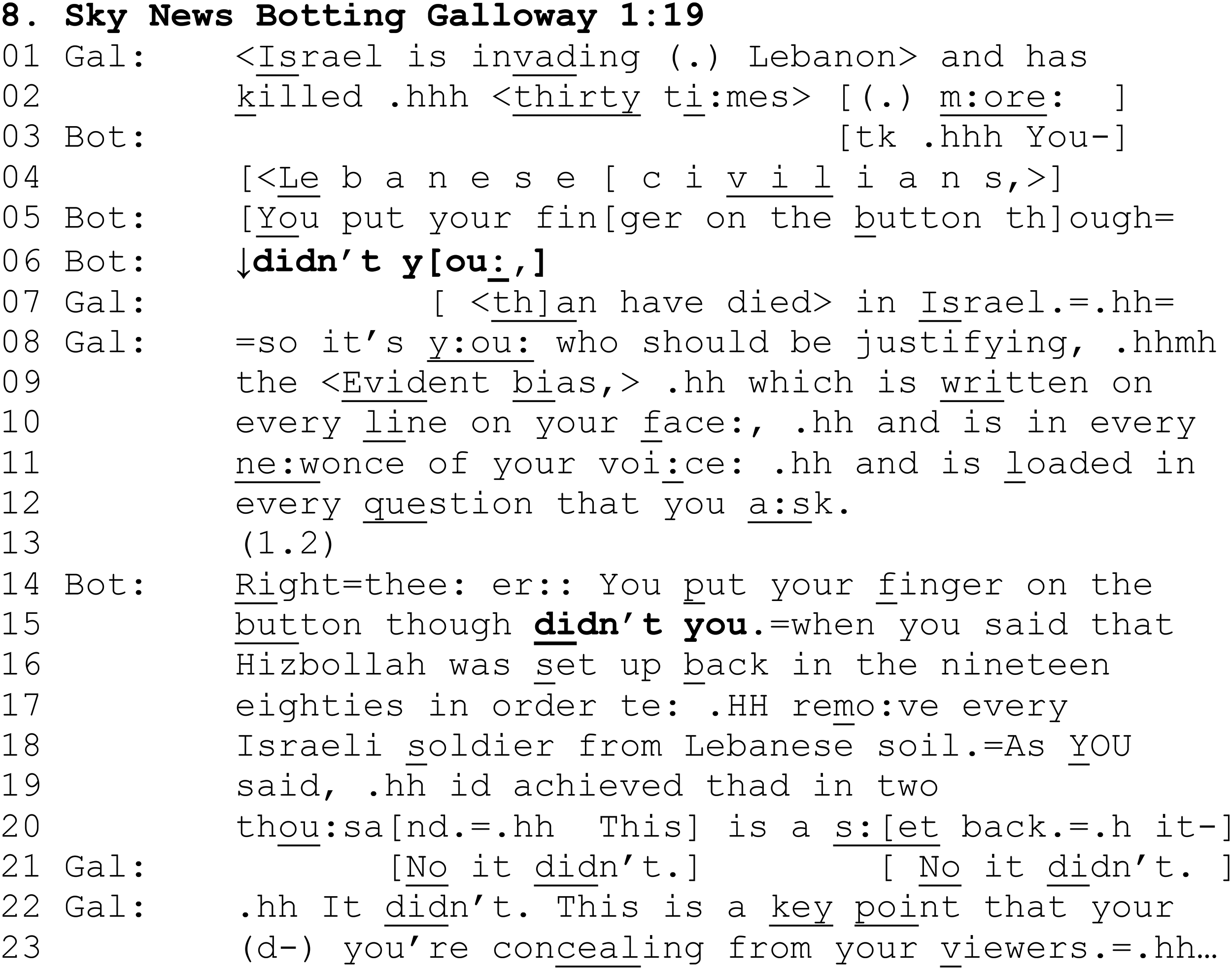
On line 3 Botting, the news interviewer, attempts to cut Galloway off mid-TCU to bring the interaction round to the more common news interview mode of news interviewer questioning and calling interviewees to account. Botting's aborted turn incursion is idiomatic—“you put your finger on the button,” meaning you got something exactly right. It is also formatted in such a way that precisely how Galloway put his finger on the button is not clear at the outset, and yet he is treated as able to confirm this with the tag formatting. This might be a useful way of starting an adversarial question given its initial appearance as some kind of affiliative move. However, Botting abandons her turn as Galloway continues his elaborate and acerbic accusation of Botting's news bias in lines 8–12.
When Galloway is finished, Botting does not respond to the accusation but recycles her earlier turn, including the tag question, this time completing what was only projected in the first construction. This makes clear that it is no accident that the tag appears mid-TCU—its position has sufficient value to head off the reordering that might have been expected on reissue. One thing that is different is the prosody: The tag element on line 6 starts with markedly lower pitch, and ends with the down-to-up contour on “you:.” Her reissuing of the tag corrects this—it has similar prosodic contours to the rest of our examples, in that it ends with a final contour, and quickly latches further elaboration to spell out what Galloway has previously said. Her question is designed to highlight inconsistencies in Galloway's argument; like our other examples, it is designed to highlight his duplicity or inconsistency for the overhearing audience. Galloway vehemently denies this in his confrontational response on 21–23, in which he directly attacks one of her assertions. His emphatic disagreement on line 21 is a type conforming denial and disconfirmation (Raymond, 2003) similar to Assange's in extract 7, line 15. Although he begins at what could be projected to be a transition-relevant place, just before the end of a slightly stretched “thou:sand,” Botting continues with the upshot of her question. Galloway elects to repeat his disagreement in overlap until it is “in the clear” on line 23 with the partial repeat “it didn’t.” As Schegloff (1987) notes such repetition of the turn beginning in the clear is designed to repair it's impaired production.
Stepping back, we can see that Galloway is a challenging figure to interview, comfortable with departing from the sorts of interview norms identified by Clayman and Heritage (2002) and others, with issuing ad hominem attacks, and with questioning the neutrality of the broadcaster. The interviewer works hard to resist his undercutting and part of this work is done through invoking knowledge shared in common as a platform for issuing challenging questions.
Summary and Discussion
Tag questions are a class of polar question where the declarative component is asserted, presenting the speaker as K+, and the interrogative component is appended, building the recipient as also K + . At times syntactic reordering or appending further material can result in the tag being in a turn-medial position. This can treat a response as unlikely, or unnecessary, and can make a response more difficult to produce without fighting for the floor. This can be used affiliatively, as when soothing a crying helpline caller or in resistive mode when countering a caller's unrealistic requests (Hepburn & Potter, 2007, 2010, 2012).
In news interview materials we first showed turn-medial tags as a collaborative way of invoking and displaying shared understanding. When NAs are questioning the station's own FRs, they often include assertions about what the reporter is reporting on in their questions, to help viewers contextualize answers. Turn-medial tags mark the FR as having primary access to events, while closing off the distraction of requiring confirmation.
Our focus has been cases where news interviewers use turn-medial tags as an element in their armory for dealing with resistance from evasive or challenging interviewees. Here the interviewer issues a declarative about a contentious situation or view of the interviewee, tag formats the declarative, and then adds more material to bury the tag midturn. Turn-medial tags used in this way can interactively pin the recipient to a position while moving on with material that closes the opportunity to respond or creates more pressing response needs. Our examples, contain interviewees who are high-status and highly experienced (Lagarde, Cooper, Assange) and famously combative (Galloway).
The separate declarative and interrogative components of tag questions allow a focus on (a) the status of descriptions as performing actions that confront participants with a practical task of inferring a recipient's knowledge and stance; and (b) the various methodic practices through which understanding is coordinated (including preference organization, turn design and sequence organization). Turn-medial tags build a shared epistemic landscape (or equivalence of K+/K-) between parties, as they are positioned to avoid both turn beginning, which claims too much knowledge, and turn ending, which concedes too much. When we take into account the relationship between the declarative element and the talk of the prior speaker, this raises some interesting issues, in that although two parties are being built as having equivalent epistemic access, or what some might call a position of intersubjective alignment, this becomes a contested issue, as what is being treated as shared runs counter to the recipient's already stated position. In other words, one way to manage resistance and disagreement is to build your recipient as already accepting your position. Elsewhere we have described this as “designing the recipient” (Hepburn & Potter, 2011). The middle of the turn is an effective vehicle for this; it neither claims too much priority over, nor concedes too much ground to, the recipient. But it also closes down the transition space where the recipient might have been able to mount a challenge—often by latching further material in the transition space.
As Loeb and Clayman (2017) note, one of the main orientations to the journalistic norm of neutrality is to avoid declarative assertions and stick to questioning activities. We can see that the various strategies for burying the interrogative elements—extending beyond the transition space and latching further content—allow interviewers to go one step further towards making declarative assertions. Notably where latching was missing in Extract 7, a challenge was mounted in overlap with the continuation. In this sense, the turn-medial tag question is a useful resource to build equivalence of understanding on some issue, and then to interdict a response to that element of the turn. It is perhaps notable that the interviewers in all of our examples are seasoned professionals; it may take some skill and experience to deploy turn-medial tags as effectively as here.
Conclusion
The findings of the current study build upon Schegloff's (1992) treatment of intersubjectivity as situated in the turn-by-turn displays of understanding that are present in conversation. This is a contrast to the vision of intersubjectivity as a shared perception of reality achieved through the overlap of discrete individual minds. Analysis of this collection of turn-medial tag questions and responses has highlighted the way that intersubjectivity is continuously re/built through displays of mis/alignment across not just sequences of talk, but through the production of the turn itself; it has shown that “the meeting of minds” is a participants’ practice which has an important function in managing conflict and alignment.
Even in conversation analytic research, intersubjectivity is often treated as a space of agreement or a sharing of views (Lindström et al., 2021). Schegloff's (1992) study focused on parties using third-position repair practices to build a shared understanding. In our current case, however, we have shown how the resources that are used to build intersubjectivity can be exploited for the purposes of debate and conflict, specifically where a news interviewer is resisting the evasions of a high-status or challenging interviewee. Heritage and Raymond (2021) suggest that there is a preference for questioners to make polar questions recipient designed, or “agreeable” by designing questions in such a way that they are likely to secure agreement. By contrast, our analysis has shown how shared knowledge can be exploited to “design the recipient” in a way that resists their continued evasion—building them as knowing information despite previous disavowals. Procedures that build intersubjectivity, then, can on occasion be invasive and coercive in resisting a counter position.
In the contemporary digitally mediated environment, with the increased interactivity between news producers and their audience, where audiences can easily disengage and tune in elsewhere, and where “facts” can equally be dismissed as “opinions”, simply adopting the role of a “tribune for the people” (Clayman 2002)—someone who pursues the facts for the overhearing audience—brings with it a range of contestable moral complexities, where who knows what, and who has rights to know what, become live in different ways, in the service of a range of activities. We have charted one of the more subtly coercive and invasive practices deployed by skilled interviewers in UK news interviews to manage evasiveness.
The limitations and complexity of the issues raised by this analysis also suggest the value of decomposing the broad category of “intersubjectivity” in terms of its more specific features. While “intersubjectivity” captures something important about the coordination of different speakers’ perspectives and understandings, it obscures potential distinctions between different kinds of sharing when looked at interactionally. It may be important to distinguish, for example, between shared knowledge, a shared stance, a shared attitude, a shared worry, and so on. Future research has a rich and complex terrain to address, building on the platform that researchers have already established (Edwards, 1997; Hepburn & Potter, 2011; Lindström et al., 2021). In the specific case of turn-medial tag questions we propose a more precise notion of conflictual “interknowledgeability.” In the future, also, we will need to consider the differences between UK and US news interviews (Clayman & Heritage, 2002); and we will need to address different institutional settings as well as everyday interactional activities, to chart the operation of coercion and psychological invasiveness more precisely through practices invoking interknowledgeability.
Footnotes
Declaration of Conflicting Interests
The author(s) declared no potential conflicts of interest with respect to the research, authorship, and/or publication of this article.
Funding
The author(s) received no financial support for the research, authorship, and/or publication of this article.
