



Abstract
In “cold” sales calls, the salesperson's job is to turn call-takers, or “prospects,” into clients while, very often, the latter resist them. In contrast to laboratory-based research, “cold” calls provide a natural environment where the stakes are real and resistance is manifest. We collected and transcribed 159 “cold” calls the goal of which was for salespeople to secure an appointment to meet prospects. Using discursive psychology and conversation analysis, we identified two practices—“blocks” and “stalls”—through which prospects resisted salespeople's attempts to schedule a sales appointment while also moving to terminate the interaction or delay the scheduling of an eventual appointment. Our findings show that, when approached as an interactive and situated discursive accomplishment, rather than a cognitive process, the practices involved in resisting can be better identified, described, and shared in ways that transform our understanding of resistance as a social psychological phenomenon.
Resistance is ubiquitous in commercial encounters where salespeople and customers can engage in intense negotiations in order to obtain a better deal. For customers, knowing how to resist is useful not only for securing a lower price or higher quality product, but also for extricating themselves from commercial encounters if need be. When a sale is initiated unilaterally by a salesperson, such as in “cold” sales calls, the prospective customer (or “prospect”) is even more likely to resist the sale and strive to terminate the interaction (Bone, 2006; De Stefani, 2018; Humă, 2018; Mazeland, 2004; Woodcock, 2017). This makes “cold” calls an excellent site to study resistance as it occurs naturally in a situation with real stakes for real people—rather than in experimental or other artificial research settings—thus enabling us to better understand, theorize, and specify how real-life resistance is managed by individuals (Stokoe, 2020).
Drawing on a corpus of authentic business-to-business “cold” calls, in this paper, we employ conversation analysis (CA) and discursive psychology (DP) to examine the practices through which prospects resist in the earliest stage of a sale-in-progress. Our paper makes a dual contribution and thus addresses a dual audience. First, we expand the existing body of conversation analytic work on resistance in sales and service encounters (inter alia Clark et al., 1994; Mazeland, 2004; Sikveland & Stokoe, 2016; Stokoe et al., 2020a) by documenting two new practices through which resistance is accomplished in commercial settings: blocks through which prospects attempt to terminate the sale, and stalls through which they delay its progress. We situate our findings in the context of conversation analytic scholarship on progressivity in action—that is, how participants advance courses of action (Stivers & Robinson, 2006)—and discuss how they shed new empirical light on forestalling progressivity by mobilizing extrasequential resources related to the occasion (Raymond & Zimmerman, 2016) of the “cold” call. Second, we further develop DP's program of “respecification” that shows how psychological phenomena, previously conceptualized and researched in cognitive terms, can be productively reconceptualized as interactional practices (Edwards & Potter, 2005; Humă et al., 2020a). Thus, we follow in the footsteps of ethnomethodology's foundational “respecification” program (Button, 1991) whereby phenomena of social order are investigated as locally and interactionally produced (Garfinkel, 1988). This approach leads to a different starting point for investigating resistance and related concepts, such as persuasion and social influence (see Humă et al., 2021). Furthermore, by taking resistance out of the laboratory and into the real world, we can begin to transform our understanding of what is actually, empirically, involved in “resisting” and identify, describe, and share practices that work to accomplish and overcome it.
We proceed, in the next section, by first reviewing the four main ways in which social psychologists conceptualize resistance and by scrutinizing such conceptualizations for their ability to identify, define, and share how resistance is accomplished in real-life sales encounters.
Resistance: Out of the Lab and Into the Real World
Social psychological research on resistance spans several decades leading to a considerable body of work based mainly on experimental studies conducted in laboratory settings. It provides insights into why individuals resist persuasion attempts (Brehm, 1980), how resistance can be stimulated (McGuire, 1961), and, more recently, how it can be overcome (Fransen et al., 2015b). From across this body of work, four core conceptualizations of resistance emerge (though see also Brinol et al., 2004 who treat resistance as an individual trait).
In what follows, we introduce these conceptualizations (for more details, see Fransen, 2013; Knowles & Linn, 2004) before attempting to demonstrate that and how they are ill-equipped to identify, describe, and share how resistance is actually accomplished in real-life interactions. Our skeptical stance toward these conceptualizations is informed by discursive psychological scholarship that has repeatedly demonstrated how laboratory-based studies, employing researcher-designed stimuli and psychometric measurements of psychological constructs, can neither replicate real-life phenomena, nor reproduce the conditions in which they occur naturally (Billig, 1994; Edwards & Potter, 1993; Gibson, 2019; Leudar & Antaki, 1996, 1997; Potter & Wetherell, 1987; Stokoe, 2013; Stokoe et al., 2020b). Thus, when theorizing on the basis of laboratory-based studies, social psychologists fail to engage with the real-life relevancies of the investigated phenomena.
One of the ways resistance has been understood, to date, is as a characteristic of strong attitudes. Within cognitive psychology, attitude strength refers to the extent to which a person's attitudes are consequential in how they think and act. Strong attitudes are also important, stable over time, and they enable individuals to produce counter-arguments which render persuasion attempts fruitless (Howe & Krosnick, 2017). Second, resistance has been used to describe the outcome of a failed persuasion attempt, meaning that the persuasion target has not changed its position after being exposed to a persuasive message (Johnson et al., 2004). Third, and most often, social psychologists conceive of resistance as a motivational state to withstand social influence. Three main motives for resistance have been delineated: threats to one's freedom, concerns of deception, and reluctance to change (Fransen et al., 2015a). Fourth, and most recently, resistance has been conceptualized as a strategy employed to push against social influence attempts. Fransen et al. (2015a) propose a four-category typology comprising “avoidance,” “contesting,” “biased processing,” and “empowering” strategies. We will briefly zoom in on these in turn. By employing “avoidance” strategies, individuals either preempt exposure to a persuasive message or swiftly remove themselves once they have detected a source of persuasion. By contrast, when using “contesting” strategies, individuals push against the influence attempt by taking issue with either the source of the message or the way it has been delivered. Third, “biased processing” strategies zoom in on the ostensible cognitive processes that enable individuals to reduce the impact, or relevance of a message and, thus, withstand its persuasive force. Finally, “empowering” strategies work by strengthening a person's current position or self-confidence, thus rendering them more resilient to counter-attitudinal messages (Fransen et al., 2015a).
Let us now see how these conceptualizations handle a real-life case of resistance from our corpus of business-to-business “cold” calls. Below, we have included a short extract from the beginning of a conversation between a salesperson (S in the transcript) representing an advertising company (anonymized as “Smartmark Media”) and an employee of a home-improvement company that sells PVC windows and doors. We will see the prospect (P in the transcript) resisting (lines 06–08) the salesperson's attempt to engage him in a sale of advertising services for his company (lines 01–04). In transcribing the fragment we used the conversation analytic conventions that capture the actual production of speech (such as prosody, silence, overlap, etc.) because these features are demonstrably relevant for speakers (Hepburn & Bolden, 2017) and therefore relevant for us, as analysts, to take into account.
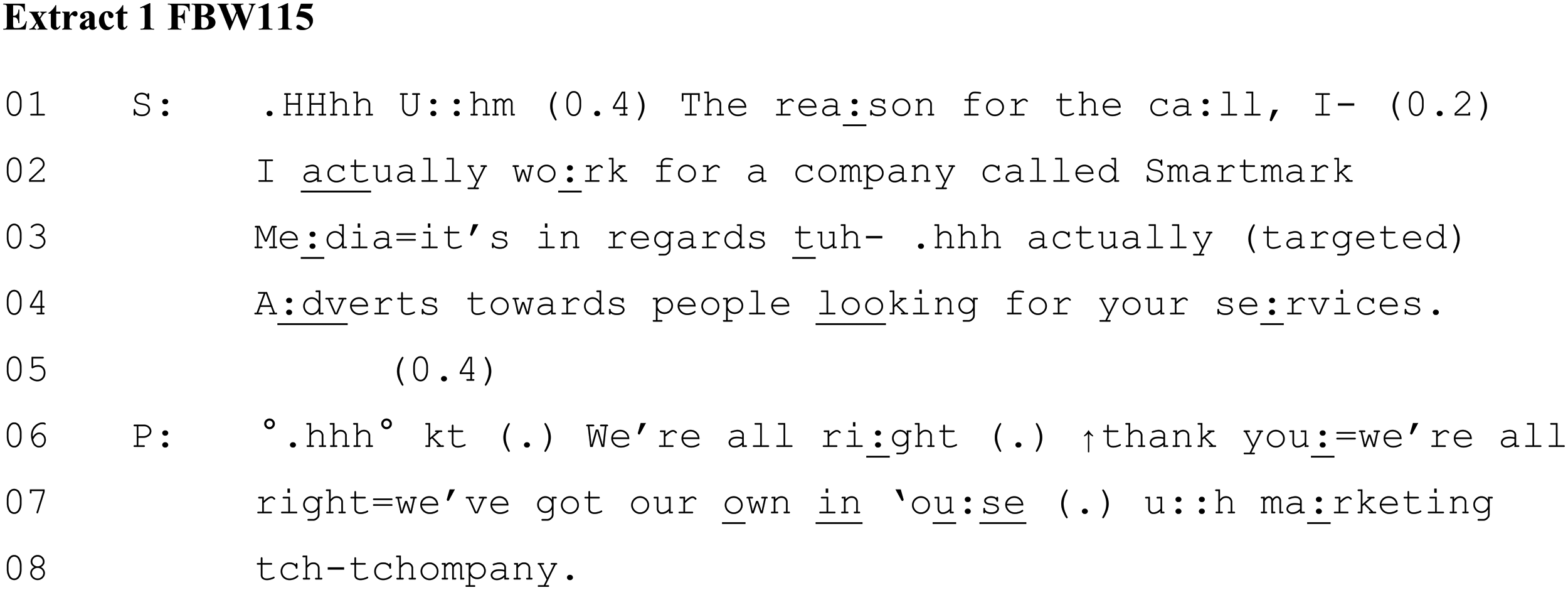
We will now proceed by highlighting details of the interaction that challenge the four conceptualizations of resistance we have outlined above. At this point, we provide an overview rather than a complete analysis of this extract and how resistance is accomplished therein—we will return to it in the Analysis section coming up later in the paper.
First, if we take the prospect's resistance to be a characteristic of a strong attitude, we would expect him to use firm or even extreme language to convey his resistance. But this is not what we see happening in the extract. Instead, his response starts with a conventionalized refusal “We’re all ri:ght” (line 06) whereby the prospect aligns with the salesperson by receipting the action as appropriately targeting him as a potential customer (Lerner, 1993). This is followed by a display of appreciation “↑thank you:” (line 06), a second iteration of the conventionalized refusal and an account for it “we’ve got our
Second, the prospect's resistance is also not an indication of a failed persuasion attempt because, so far, there has been no clear attempt at persuasion. The salesperson's turn in lines 01–04 starts as a reason for calling, which constitutes a standard component of the beginning of business-to-business calls (Pallotti & Varcasia, 2008; Varcasia, 2013), and gradually morphs into a service (pre-)offer (Lerner & Raymond, 2021). Note that the design of this turn provides the prospect with several response alternatives thus upholding rather than restricting his response autonomy. Thus, we can argue it is not designed to strongly pursue a particular aligning response that would be conducive to a sale (Humă, 2023; Humă et al., 2019).
Third, we have no empirical reason to interpret the prospect's refusal as indicative of an underlying motivation. Whether the prospect experiences having his freedom encroached on, is concerned that he is deceived, or is reluctant to change (Fransen et al., 2015a) or not, we are unable to verify these explanations on the basis of his visible verbal conduct in lines 06–08. On this matter, it is worth highlighting an existing dispute about the relationship between language and mind. Approaches such as cognitive psychology treat language as a “window on the mind” (Edwards & Potter, 1993, p. 23) and thus allow inferences about putative cognitive processes that undergird visible verbal conduct. Meanwhile, approaches such as DP and CA, in line with ordinary language philosophy (Ryle, 2009; Wittgenstein, 1986), treat language as social action and thus refrain from speculating about its representational relationship with mental states and processes (Edwards, 1997). As social actions, accounts such as the one produced by the prospect “we’ve got our
Finally, the prospect's turn in lines 06–08 may lend itself to being understood as a strategy for dealing with the salesperson's influence attempt. While this explanation comes closest to helping us understand what is going on in this interaction, it still has one shortcoming. By treating the prospect's response as an instance of some kind of “strategy,” we end up ignoring the details of his verbal conduct and how they contribute to the accomplishment of resistance. We end up with an incomplete explanation that not only requires further specification, but also does not illuminate what resistance is and how it is interactionally accomplished.
To sum up, in the previous paragraphs, we have reviewed and discounted existing social psychological conceptualizations of resistance because they do not fit or are not able to account for all the details of real-life cases of resistance. We contend that, in order to explain such cases, we need an approach that is equipped to systematically deal with the actual details of talk-in-interaction. To that end, we turn to CA and DP. These approaches, which we introduce in the next section, have been developed to systematically map how individuals use language in naturally occurring interactions.
Resisting as an Interactional Accomplishment
Insights from early conversation analytic empirical studies revealed that, when we interact in everyday life using language, how we speak and what we say is not at all random. In the words of CA's founder, Harvey Sacks (1984, p. 22): “there is order at all points.” Building on insights from CA, DP has investigated how people use language to manage psychological matters inherent in everyday situations. For example, what a person likes and dislikes (van der Heijden et al., 2021), what they remember or not (Locke & Edwards, 2003), or who they are for each other (Widdicombe, 2017) are treated by discursive psychologists as public issues that are negotiated by individuals in interaction and not as subjective experiences to be privately known and selectively shared.
Zooming in on the details of language-in-use in everyday settings, conversation analysts found that social interactions consist of distinguishable courses of action that are implemented through orderly sequences of talk that interactants produce collaboratively (Schegloff, 2007). For example, a purchase in a convenience store requires a client and a seller to cooperate via the former producing a sales request and the latter granting it (Merritt, 1976). Larger commercial interactions such as business negotiations (Firth, 1995; Niemi & Hirvonen, 2018) or “cold” calls comprise several sequences of talk through which sales-oriented activities are implemented (De Stefani, 2018; Humă & Stokoe, 2020).
A request and its granting form what conversation analysts call an “adjacency pair” sequence. This type of sequence consists of a first and a second pair part (abbreviated as “FPP” and “SPP,” respectively). Requests are not always granted, they can also be refused. Refusals can also constitute an SPP of a requesting sequence. However, granting and refusing a request are not interchangeable equivalents for interactants. The former constitutes the “preferred” SPP, while the latter is “dispreferred.” These terms do not refer to participants’ subjective preferences, but to the relationship between the FPP and the SPP. A preferred SPP, such as a granting, aligns with the FPP and successfully carries out the course of action initiated by it; meanwhile, a dispreferred SPP, such as a refusal, misaligns with the FPP and thwarts the ongoing course of action. Thus, a preferred SPP is affiliative as it supports the collaboration between the interactants, while a dispreferred SPP is disaffiliative (Schegloff, 2007).
Dispreferred SPPs, such as refusals, rejections, and disagreements, are ideal vehicles for accomplishing resistance (Muntigl, 2013) because they hinder the progressivity of the ongoing course of action. Conversational progressivity refers to the movement from one unit of talk to the next projectable element without any delay or disruption (Sacks, 1987; Schegloff, 2007). It is worth noting that progressivity characterizes not only sequences, but also other units of talk-in-interaction such as words, turn constructional units (TCUs), turns, and activities. This means that, besides through dispreferred SPPs, resistance can also be accomplished through a variety of other practices that (a) slow down the progressivity of the interaction, for example, via silences, laughter, and turn-initial particles (Glenn, 2003; Heritage, 1998; Heritage & Raymond, 2012; Koenig, 2011); (b) temporarily or permanently hinder the accomplishment of the course of action or activity, for example, via misaligned SPPs (Heritage & Sefi, 1992; Muntigl, 2013, 2023); or (c) divert the direction of the interaction, for example, via challenges or counters (Clift & Pino, 2020; Hutchby, 1996; Joyce, 2022).
To date, conversation analytic research on resistance in commercial encounters has focused on resistance at the level of sequence and activity. For example, Clark et al. (1994) found that resistance featured in extended price negotiations and that, as Clark and Pinch (2001) showed, it first manifested implicitly, through customers’ withholding acceptance of sales offers by remaining silent or otherwise passing their turn. If unaddressed, implicit nonacceptances would escalate to explicit forms, such as objections or rejections, which the salespeople were then compelled to deal with. Mazeland's (2004) study of “cold” calls documented how resistance in response to opinion queries goes beyond just thwarting the progressivity of the sequence. He found that in producing resistance-implicative responses to opinion queries, the prospects still aligned with the salespeople's assessment elicitations, but then extend their turns to block the sale by invoking a reason for why they would not purchase the promoted services. A similar conclusion was put forward by De Stefani (2018) who investigated resistance in calls from a bank inviting prospects to a sales appointment. He found that, in responding to the bank's invitation, prospects would orient to it being a vehicle for selling financial services and, thus, would not only decline the appointment invitation, but also oppose the sale.
Both Mazeland’s (2004) and De Stefani's (2018) studies highlight how, in resisting, prospects treat the occasion that engendered the ongoing course of action (Raymond & Zimmerman, 2016) as an objectionable aspect of the current interaction. More specifically, prospects orient to the current call as part of a commercial activity leading up to a projectable purchase of goods/services (cf. Lerner & Raymond, 2021). In resisting, they construct the projectable outcome as undesirable thus blocking the sale. The current study builds on the insights from Mazeland’s (2004) and De Stefani's (2018) work by systematically investigating and describing the practices prospects use for blocking and how they relate to the overarching sale as the occasion of the “cold” call. Furthermore, we document another type of resistance—stalling—that also orients to the commercial activity that the “cold” call is a part of. However, unlike treating its outcome as unwanted and stopping it in its tracks, through stalls, prospects draw out the sale, thus attempting to slow down its progressivity.
Data and Method
We draw on data from three corpora of business-to-business “cold” calls initiated by salespeople working for British companies that provide multifunctional printers, telecommunication (“Eplus” and “Tech” corpora), or advertising services (FBW corpus). The corpus comprises 159 calls totaling around 6.5 hr of sales conversations featuring 12 salespeople from four companies. The calls were recorded between 2014 and 2016 for training and research purposes by the companies and then shared with us. Ethical approval to use the data was obtained from Loughborough University's Ethics Approval (Human Participants) Subcommittee prior to the start of the project.
A transcription service produced verbatim transcripts of all calls which we used in our first inspection of the data. Subsequently, we transcribed all fragments featuring potential cases of resistance using the Jefferson transcribing conventions developed for CA (Hepburn & Bolden, 2017). At this stage, identity-related information in the transcripts was replaced with equivalent pseudonyms. We conducted the analysis of the data in an inductive manner, in accordance with DP and CA methodologies (Hoey & Kendrick, 2018; Humă et al., 2020a). First, we built a collection of all cases of possible resistance to the sales activity. Then we performed a line-by-line analysis of the selected extracts with a focus on aspects of sequence organization (Schegloff, 2007), and turn design (Drew, 2013). This resulted in the identification of the two practices—blocks and stalls—that we describe in the next section. In light of these incipient analytic insights, we conducted another search through the entire corpus in order to identify new cases that might have been overlooked before. The final analysis draws on a collection of 12 blocks and 14 stalls. The extracts presented in this article have been selected on the basis of their brevity and clarity.
Analysis
This section documents how resistance is practically accomplished in “cold” calls through blocks and stalls. Blocks, examined first, hinder the ongoing course of action by delivering a dispreferred response while also attempting to close down the call. Stalls, examined second, frustrate the ongoing course of action through the production of hedged or nonstraightforward responses followed by alternative proposals that attempt to delay or divert the progress of the sale, thus threatening its chances of success.
Resisting by Blocking the Progress of the Sale
We start by outlining the key features of sales blocks on the basis of Extract 2 coming from a “cold” call to a school. In line 01, the salesperson is asking for the name of the person in charge of the school's printers. Worth noting that prior to line 01, the prospect had already informed the salesperson that the school's current printer contract will run for another few years.
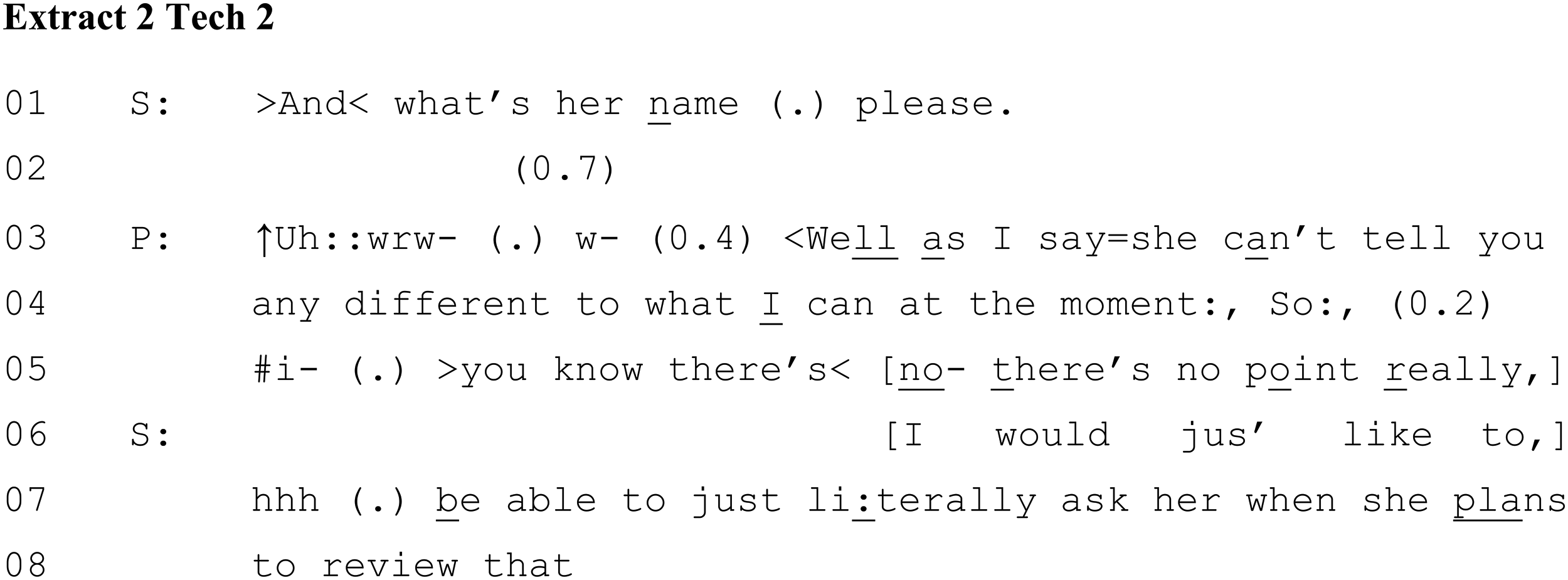
Three features of the salesperson's request for information (line 01) are worth noting. First, through the and-preface (Heritage & Sorjonen, 1994) it is designed as a component of the ongoing information-gathering activity, which routinely occupies business-to-business “cold” calls (Humă & Stokoe, 2020). Second, the format of the request—contracted verb form and no contingencies—indexes the speaker's high entitlement to ask for the information and forecasts its provision by the prospect as unproblematic (Curl & Drew, 2008; Lindström, 2005). Third, the incremental “please” recompletes the request (Wootton, 2007) and, by filling a place where inducements are often produced (Davidson, 1984), it frames the request as effortlessly fulfillable by the recipient (Ervin-Tripp et al., 1990). Taken together, these features convey that asking for the name of the person in charge of the school's printers is a routine request that should be easily carried out by the prospect. However, as we show below, this is not how the prospect takes up the request.
The prospect's response (lines 03–05) comprises two TCUs, each achieving different actions. A TCU is a “coherent and self-contained utterance” (Clayman, 2013, p. 151) that is recognizable by an interlocutor as possibly complete. The first TCU “↑Uh::wrw- (.) w- (0.4) <We
The prospect's second TCU, “So:, (0.2) #i- (.) >you know there's<
Note that a large part of h the second TCU is produced in overlap with the salesperson's account for her initiating action in line 01. The account disputes the prospect's interpretation of the salesperson's purpose for reaching out to the contact person. She emphasizes that her aim is only to request information “to just li
Let us look at a second case in which a different prospect produces a block (lines 06–08) in response to a request for information.
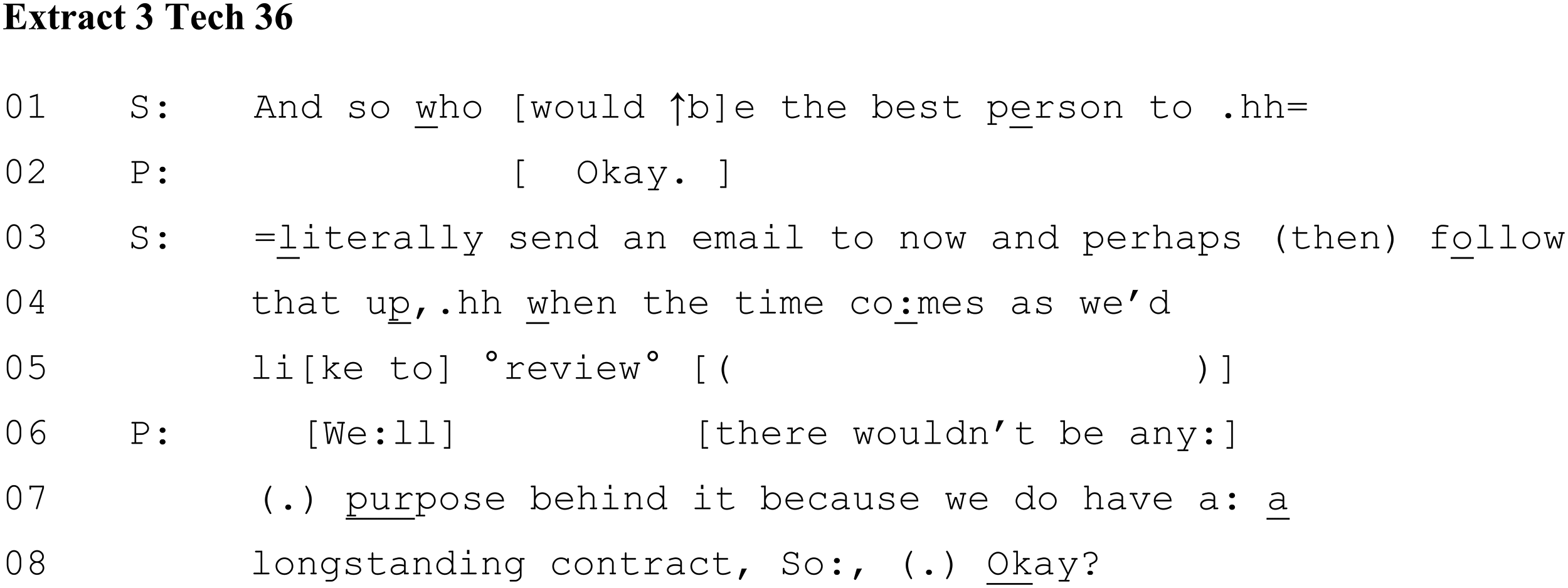
In this extract, the prospect pushes back against the salesperson's information solicitation while also blocking the progress of the sale. Let us zoom in on the features of the response's design that support this claim. First, notice how the turn starts to overlap with a turn-initial “Well” indicating that it will deviate from the grammatical and interactional constraints set up by the initiating action (Drew, 2009; Heritage, 2015). Second, the first TCU within the turn “We:ll there wouldn’t be any: (.)
The remainder of the prospect's turn contains an additional TCU “So:, (.)
The final case presented in this section is the one we briefly scrutinized at the beginning of this paper. It features a block (lines 06–08) produced in response to the salesperson's reason for calling (lines 01–04).
In line 01, the salesperson starts announcing the reason for calling, but his action trajectory is momentarily discontinued through the insertion of a side sequence (Jefferson, 1972; Mazeland, 2007) whereby he introduces himself via his institutional identity “↓I- (0.2) I
Scrutinizing the prospect's response we see he indeed treats the salesperson's turn as projecting that some kind of service offer is forthcoming. After some turn-initial delay and hesitancy—markers of a dispreferred response—he produces a sufficiency report “We’re alri
While resisting by blocking the initiating action brings the ongoing course of action and the sale to a halt, resisting through stalling, which we will see next, ostensibly carries forward the sale, albeit slowing down its progress or diverting its trajectory.
Resisting by Stalling the Progress of the Sale
By stalling, prospects interfere with the progress of the sale. For instance, while a salesperson may propose a face-to-face meeting to do a service presentation, the prospect may instead ask to be sent all the relevant information via email. Thus, even though the prospect has not declined receiving service information, the sales trajectory they outline is less conducive to the sale. Stalls pose a variety of problems, ranging from slowing down the sale to drawing it out over an unforeseen period of time while the salesperson waits for a response from the customer. Thus, salespeople often treat these trajectories as less than optimal and propose alternatives, which speed up the sale to ascertain its success.
Let us examine how stalling is practically accomplished in Extract 4. Prior to line 01, the interactants have been discussing a possible sales meeting and who would need to take part in it from the prospect's company. “He” in line 01 refers to the company's finance director. Starting in line 03, the prospect, who has so far already shown reluctance toward the meeting by invoking various hurdles, is now changing tack and stalling by asking the salesperson to call him back a week later.
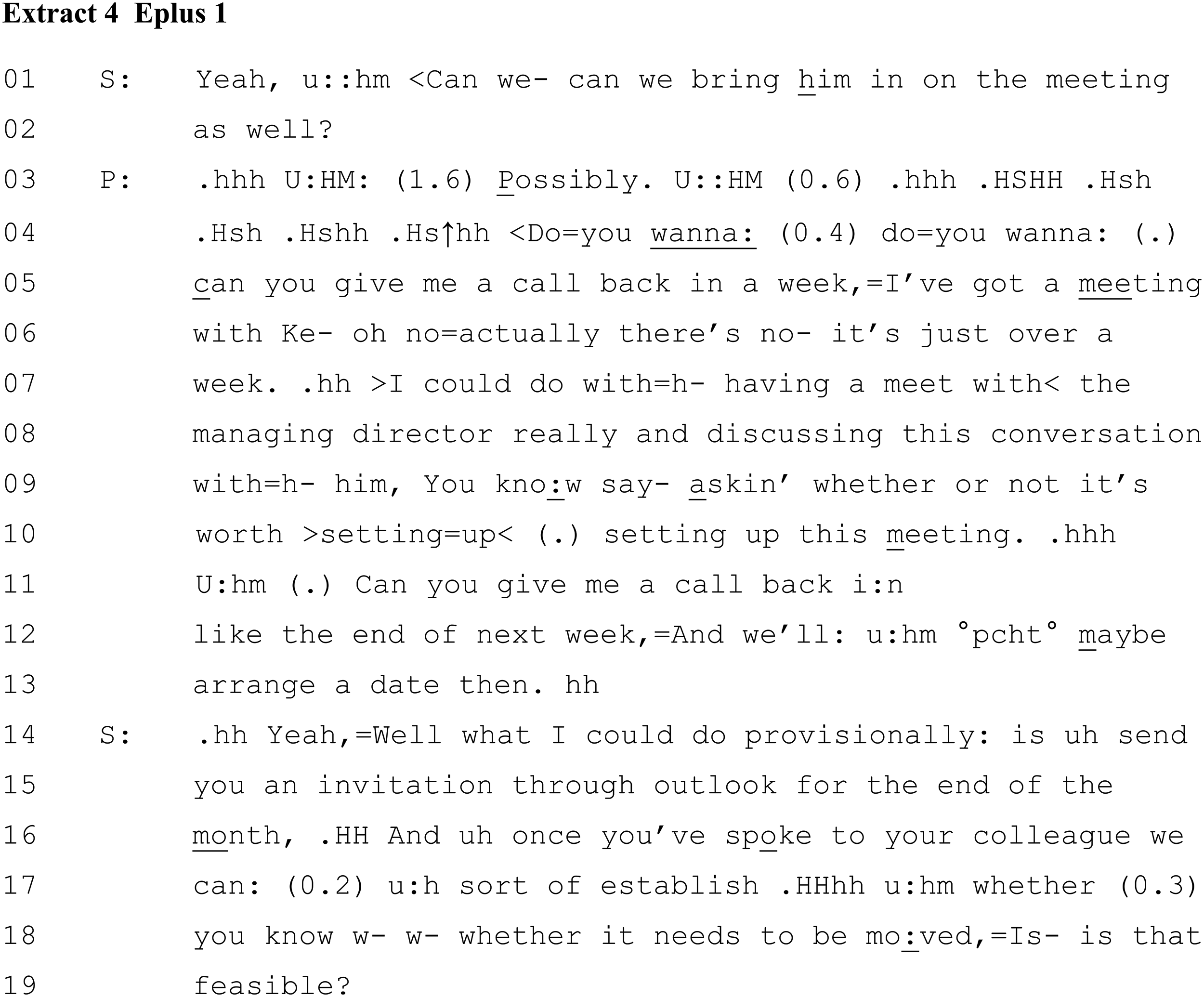
By considering the sales trajectory outlined by the prospect (lines 03–13) against the one envisaged by the salesperson (lines 14–19) it becomes apparent that the former's proposal is less conducive toward the sale. For context, it is worth noting that, before line 01, the interactants were in the midst of organizing an upcoming meeting, which presumes agreement from both parties that the meeting will take place (cf. Humă et al., 2020b). Therefore, when the prospect asks the salesperson to call him a week later, at which point scheduling the meeting may or may not go ahead, this can be seen as backtracking on the implicit agreement that the meeting will take place.
In fact, the prospect outlines an alternative sales trajectory that not only slows down the progress of the sale, but also jeopardizes its success. By asking to be called back later, the prospect postpones setting a date for the meeting. Within the course of his turn, he first asks to be contacted in a week and then even later, at the end of the subsequent week, which moves the date of the meeting even further away. The turn is littered with hesitation (note in-breaths in lines 03–04), with cutoffs, and repetitions. Through its tentativeness, this delivery contributes to positioning the prospect as noncommitted to the sale. Moreover, he introduces doubt about the likelihood that the meeting will take place by announcing he is going to discuss it with his managing director “whether or not it's worth >setting= up< (.) setting up this
Evidence for the prospect's turn accomplishing resistance comes also from how the salesperson treats it. Instead of aligning with the prospect's proposed trajectory, he proposes a swifter timeline through which he ascertains that the meeting will be scheduled during the current call. The salesperson's proposal envisages the meeting to be held at the end of the month. To minimize the misalignment between the two alternative trajectories, the salesperson frames the scheduling as provisional and concedes that the date could be amended to accommodate the outcome of the prospect's discussion with his colleagues. Importantly, the salesperson's proposal only introduces flexibility regarding when but not whether the meeting will take place and thus deals with the prospect's attempt to hamper the progress of the sale.
Let us have a look at another fragment where the prospect produces a stall to resist the sale. Earlier in the call, the salesperson had asked to visit the prospect and the latter has, so far, eschewed responding to this request. This led to the salesperson expanding the sequence by asking for the prospect's address in order to ostensibly determine which consultant would visit the company. “Both” in line 01 refers to the two consultants named by the salesperson as the ones likely to perform the sales visit.
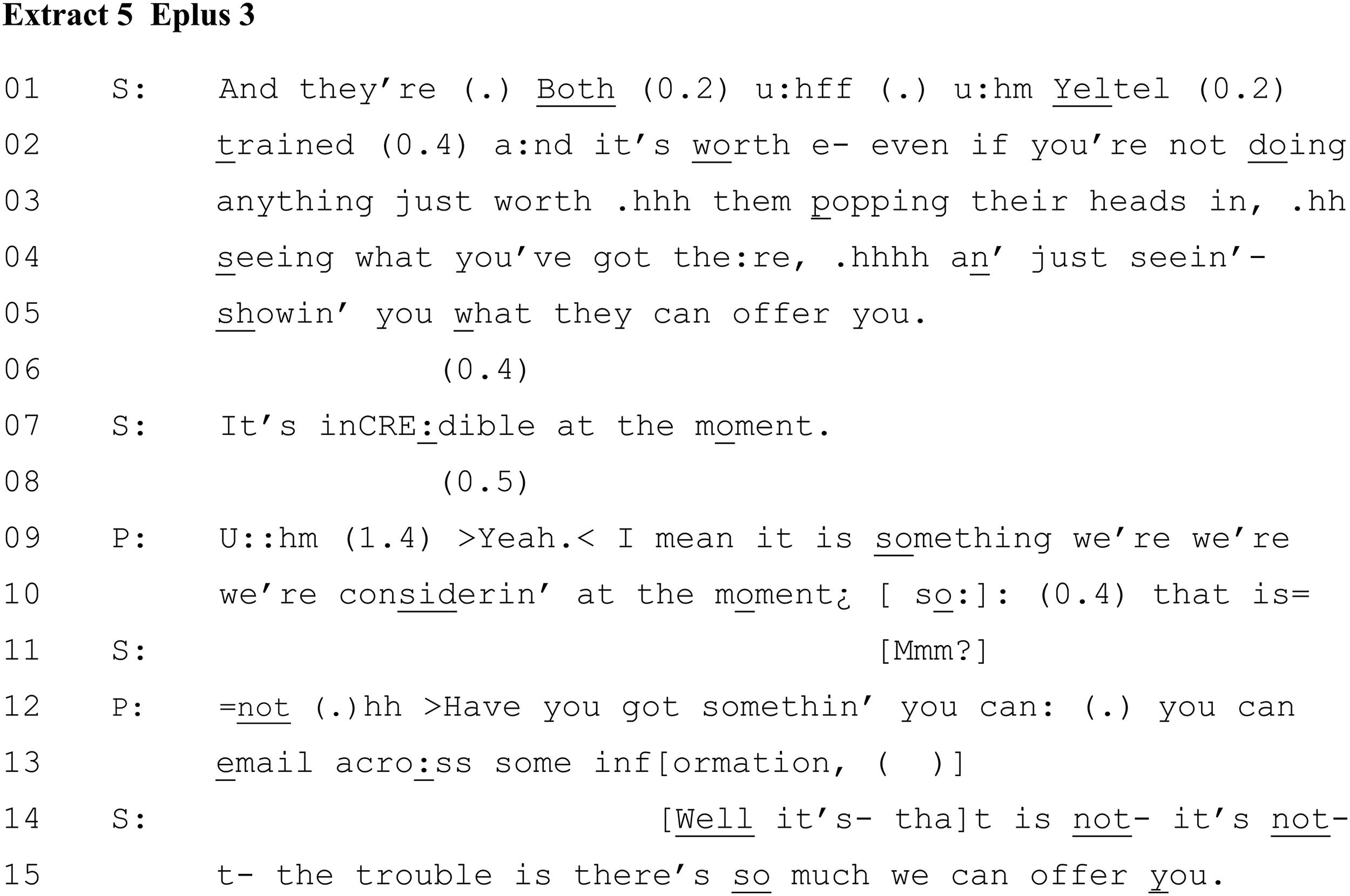
In lines 02–05, the salesperson revives the outstanding issue of the sales visit. Orienting to the so far reluctant positioning of the prospect toward it, he reintroduces the visit in terms that deal with multiple bases for the prospect's resistance. First, he neutralizes the possibility that the prospect's company does not require the offered services “e- even if you’re not
After a 0.4 s gap, the salesperson produces a high-grade assessment that recompletes his prior turn and thus refreshes the relevance of a response from the prospect (Jefferson, 1981). The prospect acknowledges the assessment without aligning with it 3 thereby passing the opportunity for producing a second assessment that could have been used by the salesperson as an incipient display of commitment to the transaction (Mazeland, 2004). He then reveals, in hedged terms, that his company is currently looking for suppliers.
The stall is produced in lines 12–13 where the prospect asks the salesperson to send him information via email, instead of aligning with the latter's course of action whereby a sales visit was being planned. Similar to Extract 4, here the salesperson also does not accept the prospect's request. Through the “well” preface (Heritage, 2015), the turn is designed to break away from the constraints imposed by the prospect's request. The TCU is subsequently repaired four times until the final version is produced. Notably, abandoned versions either contain or foreshadow the employment of the freestanding negative marker “not.” By contrast, the use of the word “trouble” (line 15), connoting a negative state of affairs, relinquishes the need for the negative marker in the final version of the TCU. Thus, the salesperson avoids going on record as having opposed the prospect's request (Lee, 2011).
The TCU “the trouble is there's
To sum up, in this section, we showed that prospects stall the sale by proposing arrangements for future contact that either postpone or redirect the sale to a different (offline) medium, thus (a) slowing down the sale and (b) limiting their commitment to the commercial transaction. In what follows, we will review our findings and discuss how they advance our understanding of real-life resistance in commercial encounters.
Discussion
The aim of this article was to identify and describe the communicative practices through which resistance manifests in real-life “cold” sales calls and where, as an outcome, salespersons fail to accomplish the first key step to a successful commercial transaction. In doing so, we aimed to “respecify” resistance; that is, investigate it as a live concern and achievement of interaction where the stakes for both parties are as actual prospects and salespersons, versus investigate it through experimental or posthoc measures where the stakes are as research participants. In so doing, we demonstrate the transformative theoretical and practical relevance of studying the social world “as it happens” (Boden, 1994, p. 46).
We identified two practices for accomplishing resistance: blocks, that close down the ongoing course of action as well as the broader commercial activity, and stalls that slow down the progress of the sale. Blocks encompass the following features: (a) they are responsive turns occupying the second position within adjacency pairs, (b) they implement dispreferred actions that do not align with the course of action set out by the FPP, (c) the misalignment is accomplished mainly, but not solely, through accounts hinged not on the ongoing course of action, but on a future commercial transaction, (d) prospects stop the advancement of the ongoing course of action by invoking that, for their company, the foreshadowed commercial transaction is untimely or unnecessary, (e) they orient to the initiating action as a preliminary to the upcoming sale, and (f) they make call preclosure relevant.
Unlike blocks, stalls do not propose the termination of the sale, but instead, attempt to divert or delay its progress. They are produced in response to a salesperson pursuing the prospect's agreement to some next step in the sale, usually a face-to-face meeting. Instead of accepting or refusing to meet, the prospect's response slows down the sale (a) by postponing future contact, (b) by replacing direct means of contact (such as in-person or telephone conversations) with less direct ones (such as emails), and (c) by constructing the transaction as unlikely or contingent on forthcoming developments, such as meetings with other company employees. Salespeople treat these sales trajectories as less than optimal and, while refraining from outrightly rejecting them, they still pursue their original plans or propose alternatives that speed up the sale.
Our findings illuminate that and how in accomplishing resistance prospects mobilize extrasequential resources such as the occasion of the “cold” call—the sale—and its projectable unfolding and outcome. Thus, our paper extends the known repertoire of discursive practices and resources through which resistance is accomplished (see the Introduction to the special issue). Furthermore, building on Raymond and Zimmerman's (2016) insights about the role of social occasions in the local organization of conversations, we demonstrate how speakers can invoke two aspects of social occasions—their projected outcome and future development—as resources for obstructing conversational progressivity. Via blocks, prospects not only respond to salespeople's prior initiating actions, but also seek to preempt call continuation and move toward its closing. Via stalls, prospects avoid accepting or rejecting a sales meeting and instead propose an alternative, drawn-out sales trajectory that is also less conducive to a commercial transaction.
In presenting how blocks and stalls work as practices for accomplishing resistance we refrained from speculating about prospects’ thoughts, attitudes, or motives. Our findings suggest that, in accomplishing resistance, individuals orient to and mobilize sequential and interactional contingencies instantiated through language-in-use. This demonstrates that the accomplishment of resistance depends on and exploits interactional practices and thus cannot be reduced to a cognitive epiphenomenon. 4 Let us highlight five empirical details that support this argument. First, blocks and stalls are not produced immediately in response to salespeople's FPPs. Instead, these turns feature various turn-initial elements such as discourse markers, acknowledgment tokens, or delay tokens that deal with the sequential constraints set up by the salesperson's preceding turn while also foreshadowing the trajectory of the prospect's responsive action. Relatedly, second, in responding to salespeople's FPP, prospects treat them as initiating actions (e.g., questions, requests, and offers) that make conditionally relevant matched responsive actions (Schegloff, 2007), thus demonstrating that the organization of resistance follows the normative rules that underpin orderly social interactions. Third, when prospects block the sale, they can be seen to do additional work to convey their interpretation of salespeople's initiating actions as preliminary moves eventually leading toward a sale. The reference to this overarching commercial activity serves as a resource for halting the ongoing action, while at the same time, the accounts employed to terminate the ongoing course of action close down the sale. Similarly, stalls are embodied by counter-requests or counter-proposals that, as initiating actions, make conditionally relevant a fitted responsive action from the salesperson. Thus, it is fair to surmise that, in producing blocks and stalls, prospects exploit the sequential orderliness of social interaction requiring salespeople to either desist or alter the trajectory of the sale. All in all, our analysis not only supports theoretical conjectures of how persuasion and resistance are intimately interconnected (Knowles & Linn, 2004), but also provides an empirical handle on how this is interactionally accomplished.
Concluding Remarks
Throughout this paper, we have remained agnostic regarding what may go on “under the [prospects’] skull” (Garfinkel, 1963, p. 190), as we do not claim to have access to their minds, only to their observable communicative conduct. However, our account of resistance in talk-in-interaction is strengthened by the transparency, integrity, and verifiability of the analysis (Humă & Joyce, 2022). While further research on resistance in naturally occurring encounters is certainly necessary for refining and extending our understanding of resistance as an interactional accomplishment, this article has proven the theoretical and applied value of this approach. Furthermore, it has hopefully demonstrated the importance of critically interrogating the real-world validity of conclusions from studies of resistance that rely exclusively on researcher-generated data in artificial laboratory settings.
Footnotes
Acknowledgments
We are grateful to the two anonymous reviewers who provided detailed and helpful suggestions for improving this paper. We would also like to thank the coeditors of the special issue, Jack Joyce and Geoff Raymond, for their continuous support and insightful comments provided throughout the development of the article.
Declaration of Conflicting Interests
The author(s) declared no potential conflicts of interest with respect to the research, authorship, and/or publication of this article.
Funding
The author(s) received no financial support for the research, authorship, and/or publication of this article.
