




Abstract
This paper examines how callers to an NHS complaints helpline get to “tell their story.” As project-based institutional calls, the closure of a complaints call is observably organized around “mutually ratified project completion.” Our analysis reveals the practices that callers deploy to resist call handlers' (CH) progress through the institutional phase structure of the call, thus also resisting ratification of their project as complete. We show how these practices are varyingly oriented to (re-)telling elements of the complaint or pursuing legitimation of their complaint and/or identity as “reasonable.” Callers’ resistance to institutional progressivity is oriented to misalignment in the prior uptake of their complaint narrative, revealing the relationship between projects and “identities” in the context of helpline interactions and the tension between the separate projects of caller and CH.
Callers to NHS complaints helplines are typically focused on explaining not just the facts of their complaint, but their experience of their complaint and how it has impacted them. CHs, by contrast, are institutionally required to distill the facts of the complaint from the caller's narrative and progress efficiently through the complaints handling procedures. These separate agendas of caller and CH often come into tension with consequences for progress through the call. The aim of this article is to examine one aspect of the interactional work by callers to create the “interactional space” to “tell their story,” namely the practices that callers use to resist CHs’ attempts to progress through the institutional requirements of the call. We focus on how callers’ resistance to progressivity interacts with the structural organization of the encounter. In particular, we examine how participants orient to the “project-based” nature of the call and to the phases and transitions between phases in the interaction as “procedurally consequential” (Schegloff, 1992) to reveal the practices that participants deploy to move through the encounter and how this informs our understanding of the interpersonal challenges of this particular institutional context.
In examining how callers work to get to tell their complaint story, we build on and contribute to conversation analytic (CA) work on resistance as an interactional and, more specifically, sequential phenomenon (Humă & Stokoe, 2023; Joyce, 2020) that necessarily interacts with progressivity. We also draw on prior work that demonstrates how the extra-sequential properties of projects and identities interact with the sequential organization of a “project-based” institutional call (Raymond & Zimmerman, 2016). Before turning to this prior CA work, however, we first provide contextual details about NHS complaints calls and previous work on the phase structure of these calls.
NHS Complaints Calls
The NHS (UK National Health Service) complaints procedure was first introduced in April 1996 and revised in 2005, 2012, and 2021. Complaints calls are initially fielded by a Complaints Handler who determines the nature of the complaint and whether it can be resolved informally without recourse to the formal process. A Complaint Investigation officer is then appointed to investigate and provide a response within 20 days. Complaints are thus not responded to in the sense of being resolved within these phone calls. Rather the response options available to the CHs are typically limited to recording the details of the complaint and managing the next steps in the institutional procedures.
Calls in our data exhibit the following phase structure identified by Stitt (2021) in her work examining the specific phases of activity through which the distinct institutional projects of caller and CH are accomplished in a typical healthcare complaint call 1 :
(brackets indicate optionality)
Opening -
a. greetings/identification, b. reason for call c. third party check
2
Re-launching the call
(personal information gathering—1st opportunity), complaint elicitation. Complaint narrative. CH response –
(interrogative series), service delivery—giving of advice/offers of assistance/problem solving (personal information gathering—2nd opportunity). Closing.
Personal information gathering refers to details of the caller, such as name, address, etc. It occurs in every call in one of two possible positions (although participants orient to the second opportunity as late/dispreferred). This is distinct from the optional interrogative series in the CH's response phase which is oriented to checking details of the complaint.
Projects and Identities in Institutional Talk-in-Interaction
A complaints call can be characterized as a “project-based” institutional call; a type of call for which call closure is organized around “mutually ratified project completion” (Raymond & Zimmerman, 2016). Raymond and Zimmerman (2016, p. 717) define projects as “participants' orientation to an extra-sequential unit of organization for activities with (1) a recognizable beginning and (2) a projectable end that is (3) oriented to over the project's course with (4) its production constituting a recognizable form of (possible) completion.” Crucially, projects are distinct from the sequences through which they may be instantiated (Levinson, 2012). Moreover, a project is not an inherently shared or joint action; it is a course of action pursued by at least one participant that may even be launched covertly and only retrospectively discernible (Levinson, 2012). In this sense, projects are interactional units but oriented to either institutional or client agendas: courses of action that the participants wish to accomplish within the encounter. Raymond and Zimmerman's work on emergency calls demonstrates that the participants are oriented to separate but articulated 3 projects tied to the locally constituted “identities” of caller and CH as service seeker and service provider. Their work focuses on the connection between projects and identities, observing that participants orient to the normative expectations regarding the “proper” participants of a given project and the rights and obligations and attendant practices that form the basis of conduct required of said “proper” participants. Project resolution thus requires not just completion of projected activities but also alignment of the associated identities, observable in the attendant practices through which the rights and obligations of “proper” participants are accomplished.
Our previous work (Benwell & Rhys, 2017) has shown that the central project for callers in healthcare complaint calls is typically not just the making of the complaint itself but the telling of the story of the whole experience within which the complaint is embedded. 4 Moreover, callers observably pursue ratification of their complainable and their identity as reasonable (Benwell & McCreaddie, 2017; Benwell et al., in prep). This suggests that practices that ratify the complaint are oriented to by callers as contributing to accomplishment of the identity and “proper” conduct of complaint recipient. On the other hand, the call taker is primarily oriented to a series of tasks required for institutional complaint recipiency: information gathering and service delivery, including explanations of process, advice-giving, problem-solving, and offers of assistance. The articulation of these complementary projects is thus typically more extended than in the emergency calls examined by Raymond and Zimmerman (2016).
Raymond and Zimmerman (2016, p. 716) argue that “sequence and occasion closings produced in the service of projects are fateful: they inexorably demand that the participants arrive at some alignment—or make visible their failure to do so—regarding the projects pursued in it.” In other words, while projects are extra-sequential, at closing-oriented sequential locations participants orient to mutual alignment with respect to projects and their attendant roles, rights, and obligations. Our analysis shows how the extended phase structure of complaints calls provides multiple sequential opportunities for managing mutual alignment, focusing on how participants orient to transitions in the phase structure as making relevant mutual ratification of project status. Our analysis focuses on the relationship between emerging misalignment at phase transition moments and resistance to progressivity through the phase structure of the call.
Resistance and Progressivity in Interaction
Hollander and Einwohner (2004) describe resistance as a “deeply sociological concept… [involving] issues and debates that are at the heart of the sociological perspective, including power and control, inequality and difference, and social context and interaction” (p. 551). In CA, both resistance and these associated concerns are re-conceptualized as interactional accomplishments and analyzed at the micro-interactional level. Resistance in CA terms encompasses a wide range of (typically) responsive actions that serve to block or not comply with the successful completion of a co-participant's agenda, project, or course of action. Previous work has analyzed resistance at different levels of organization from the fine-grained level of specific features of turn design through to the extra-sequential levels of projects and category attributions. It has been examined in response to a range of different actions (e.g., advice-giving, treatment recommendations, proposals, complaints) and in a range of different mundane and institutional settings (family, therapeutic, medical, crisis negotiation, telephone sales, etc.), revealing different forms and degrees of resistance from weaker/passive resistance (nonresponse, withheld response, minimal response) to stronger/more active forms of resistance (rejection, disagreement, challenge). However, for “resistance” to have any kind of meaningful sociological traction, we argue that it is important not to conflate isolated, micro-level acts of disaffiliation/disalignment with a more macro-level sense of resistance at the level of “project” or “agenda.” In this article, we conceive resistance (or compliance) as the interactional sum of participants’ negotiations of the “overall structural organization” of a conversation (Robinson, 2012) and the projects embodied by that structure (Levinson, 2012). The resistance we examine in our data relates to moments when misalignment emerges in the projects of caller and CH in the presentation and handling of complaints and progressivity in the call is hindered.
Progressivity in CA terms formalizes the idea that the units and structures of interaction project a trajectory to completion and participants in interaction are oriented to further progress through those units/structures (Stivers & Robinson, 2006). As an interactional move that typically displaces the normatively expected next move, resistance unsurprisingly has consequences for progressivity in interaction (Muntigl, 2013) but the precise nature of the relationship between resistance and progressivity depends on the context and type of resistance. Resistant responses have been shown to have consequences for progressivity not just of the immediate course of action but also of the interactant's wider project or agenda. For example, Muntigl (2013) shows how a client's resistance to the constraints of the counselor's questions “derailed goal-directed talk, thereby blocking therapeutic work” (p. 34). The distinction between weak/passive resistance and strong/active resistance has also been examined in relation to progressivity. For example, Joyce's (2020) analysis of resistance in public disputes differentiates passive resistant responses that “stall the progressivity of the interactional trajectory” and active resistant responses that “outrightly suspend the progressivity of the interaction” (p. 245). Humā and Stokoe's analysis of resistance in unsolicited sales calls (this issue) reveals a similar distinction between “blocks, that close down the ongoing course of action as well as the broader commercial activity, and stalls that slow down the progress of the sale.”
In our analysis, it is progressivity itself that participants are oriented to resisting. As Robinson (2012, p. 278) points out “overall structural organization frequently imposes the onus of progressivity (Lerner, 1996; Schegloff, 2007) through the structure and its components toward completion, and provides the resource of projectability (Sacks et al., 1974) regarding the completion of the structure and its components.” Our analysis shows that when participants disagree about whether phases of that overall organization have been satisfactorily achieved, resistance to progressivity tends to occur.
Data and Methods
Data
The data in this study emerges from an applied CA project examining complaints to three separate NHS Trusts in two UK nations over a period of 10 years. 5 The data comprises telephone calls made to the complaints handling service in each Trust. Calls are initially fielded by a CH who records the details of the complaint and manages the next steps in the institutional procedures. Data collection was conducted with relevant NHS ethical approvals as well as approval from the ethics committees of Stirling and Ulster universities. Informed consent was secured verbally from callers at the start and end of the call, and subsequently in writing. Informed written consent was secured from CHs in advance. A corpus of 83 calls has been collected over two different time periods. The overall corpus was transcribed verbatim for first-pass analysis. Stretches of talk relating to the themes of this article were transcribed using Jeffersonian conventions to capture features of timing and delivery (Hepburn & Bolden, 2017) for more fine-grained analysis. Anonymity for all participants (including individuals discussed within calls) is assured by the alteration of any potentially identifying details.
Analytical Approach
Our data is analyzed using Conversation Analysis (CA), a qualitative method motivated by a concern with members’ own formulations of the organization of social life as it is revealed through their talk (Sidnell, 2009). CA focuses on the turn-by-turn organization of interaction and is concerned with explicating the way in which speakers make sense of each other's turns and how a turn determines the trajectory of the conversation, often as a way of revealing speakers’ concerns or determining the organizational principles of institutional interactions. Some of the sequential concerns of CA (such as preference organization, the uptake of turns, formulations, and patterns of (dis)affiliation) are particularly relevant to the data and arguments in this paper. CA tends to work with collections of short fragments of audio/video where analytical phenomena are determined by what is oriented to as relevant by participants and replicated across other extracts within the same corpus. CA thus does not determine the significance of its findings in statistical terms but rather addresses concepts of validity through the emic, intersubjective orientations of its analysis (Seedhouse, 2005).
Data Analysis
In our analysis, we examine how callers orient to transition to the projected next phase of the call as an opportunity to resist the progressivity of the call and thereby to resist ratification of their complaint project as complete. In particular, we are focusing on transitions following the complaint narrative phase, which are oriented to both participants as implying complaint project completion. For example, we see in extract 1 how the caller in l.8 resists the CH's transition from information gathering to the service delivery phase of the call by explicitly declaring her complaint story unfinished.
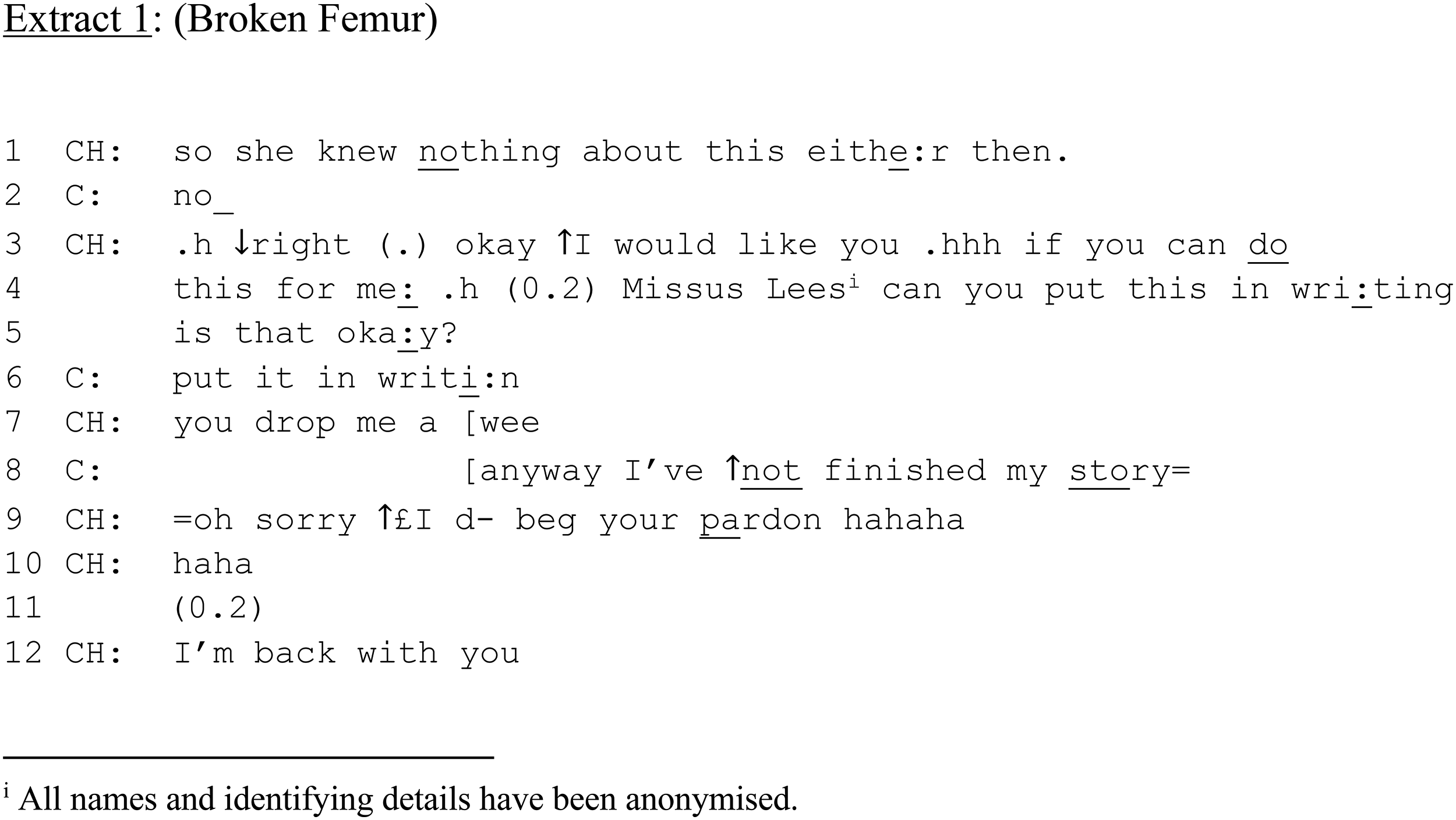
At the start of this extract, the CH asks the final question of the interrogative series phase, which receives a simple “no” response. The CH then projects transition to the next phase (service delivery) with turn initial “.h right (.) okay” (Beach, 1995) before delivering instructions for what should happen next. The caller initially responds minimally with partial repetition, but then interrupts the CH to protest that she has not finished her story. Extract 1 thus shows how the participants’ failure to align regarding the status of the caller's project is made visible in the transition to the service delivery phase of the call. Note that in resisting the transition to the next phase, the caller is not resisting closure of the immediately prior phase, ie the interrogative series phase, but returning to the earlier complaint narrative phase in order to carry on “telling her story.” Our analysis thus aims to show that transition between phases demands alignment with respect to the extra sequentially organized projects pursued in the call. Examining progressivity through the specific institutional phases of the complaint call thus reveals how caller and CH negotiate mutual resolution of their respective projects.
Our analysis draws from the corpus of 83 calls to identify examples of practices through which callers resist transition to the recognizably next phase of the call: adding an increment to the complaint narrative; resisting the CH's formulation of the complainable; pursuing affiliation. In line with Raymond and Zimmerman (2016), we examine how these practices are revealing of the interactional rights and responsibilities tied to the locally constituted identities of complainant and complaint recipient and show how phase transition provides participants with a sequential opportunity to “check they are on the same page” in relation to their projects and associated identities.
Adding an Increment
The first practice of interest involves the caller returning to their complaint and extending the complaint narrative through talk designed as an increment to claim grammatical dependency on prior talk (Ono & Couper-Kuhlen, 2007; Schegloff, 2016). This practice orients to the caller's complaint-telling project as incomplete because the story is incomplete. In Extract 2, the caller is complaining about her husband's treatment in a hospital ward. The complaint thus far has focused on claims of neglect in the care of her husband and criticism of a specific nurse. The CH has moved through the information-gathering phase of the response and in this extract, we see the CH initiate the move to service delivery with turn-initial “right” marking transition to the next phase. However, the caller ultimately resists this transition and returns to the complaint narrative phase, adding an entirely new complainable to the story:
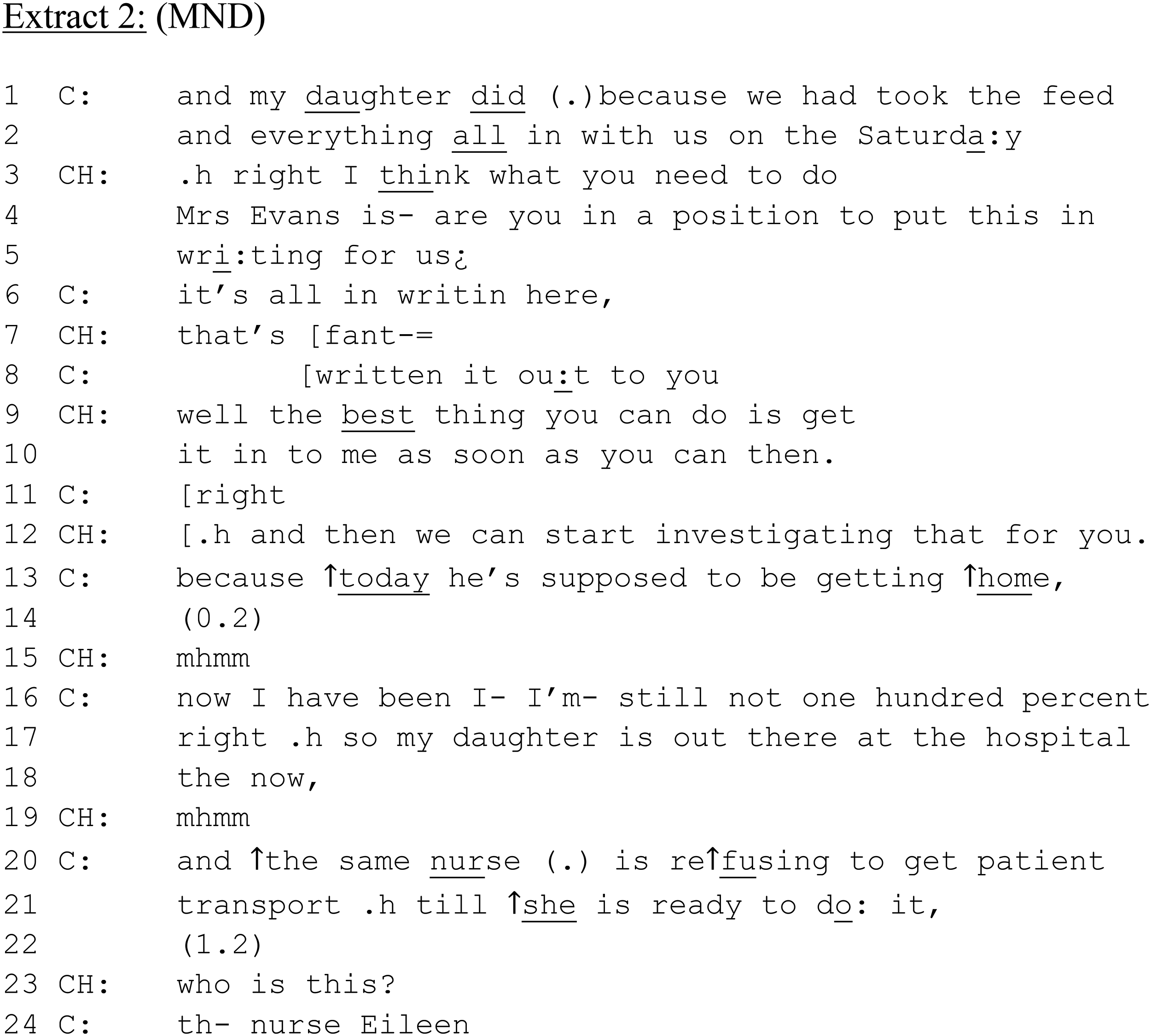
The CH's turn in line 3 begins as an instruction, “what you need to do,” but switches formulation 6 to a declarative question, “you interested to put this in writing for us?” This turn design downgrades the deontic authority invoked, but also restricts the terms of the response, presupposing that the caller has not yet put her complaint in writing and positioning the caller as seeking advice on how to complain and the handler as advice giver. The caller's transformative answer (Stivers & Hayashi, 2010, p. 2) in line 6 gives the first indication of misalignment; “it's all in writin here” is sequentially fitted but resists the terms and presuppositions of the declarative question along with the locally constituted identity as advice seeker. The CH's next turn begins a high-grade assessment (HGA), “that's fant -” (fantastic). HGAs project movement to the relevant next task (Antaki et al., 2000), so are oriented to progressivity. However, the caller resists the transition projected by the HGA by producing overlapping talk (l.8) that resumes her prior turn, effectively sequentially deleting the HGA turn. The CH persists with a well-prefaced reformulation of the next step, formulated as advice-giving, “well the best thing you can do” followed by the relevant offer of assistance, “then we can start investigating that for you.”
At this point, the caller does not provide a fitted response. Instead, she resists the whole move to service provision by returning to her complaint story with a new complainable about “the same nurse” who is the focus of the first part of the complaint. Here, the caller's turn is grammatically designed as an additional increment to the complaint narrative through prefacing with “because,” which frames the turn as grammatically dependent on a prior clause (Ono & Couper-Kuhlen, 2007; Schegloff, 2016). It is worth noting here that there is no clear candidate prior clause for the “because” increment; the importance of the “because” prefacing is that it marks the turn in line 13 as a continuation of the narrative in an earlier phase of the call. It might be argued that the caller at this point moves to a new project in response to the CH's proposal to move to investigation because the complaint increment moves to a current problem with her husband's care that potentially could be met with immediate redress. Calls to the complaint service often move between complaining and help seeking
7
and a task for CHs is to discern which is the primary project of the caller at any particular moment. Indeed, the CH in this particular call does, at the end of the call, orient to the potentially implied help seeking in this turn with a belated offer of help embedded in the closing sequence. However, we argue that, along with the “because” prefacing and the referential tie to “the same nurse,” an additional design feature of the caller's turn that ties it as an increment to the prior complaint narrative and clearly marks it as an additional complainable is the inclusion of (and emphasis on) the time formulation “ “right on Monday the sixth t- err the sixth of June my husband was admitted…”; ⇒ “on Tuesday the seventh of June he was transferred…”;
“on Wednesday the eighth of June .hh ehm to let you understand I couldn't go...”;
⇒ “on Friday the tenth dad who was peg fed still had nothing”
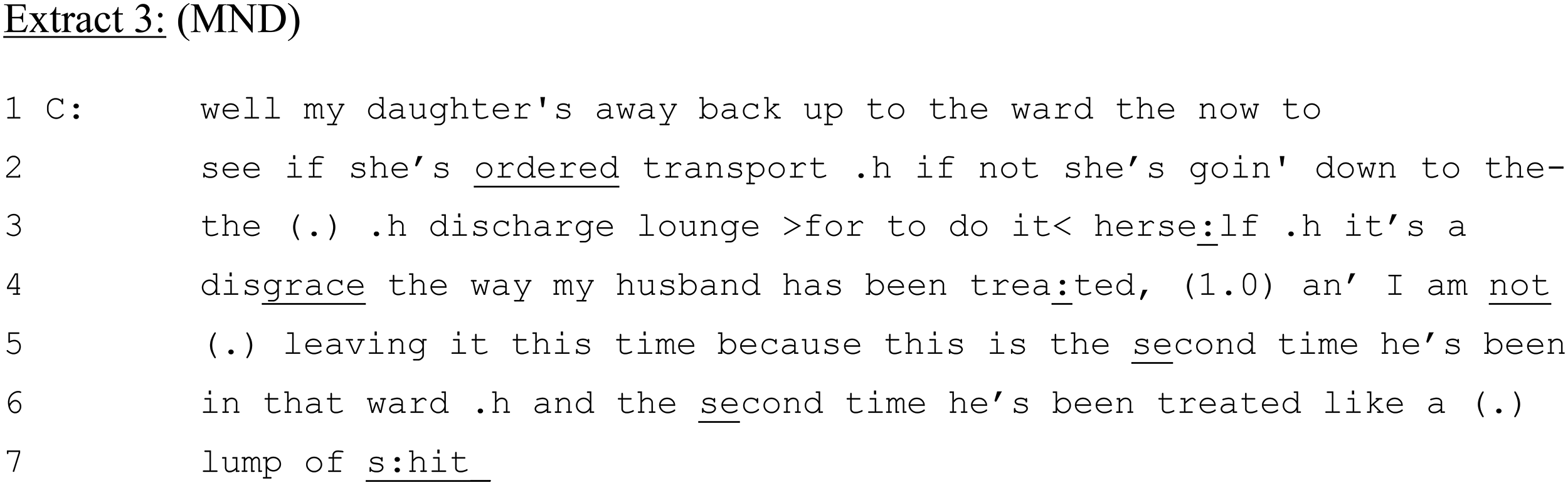
In producing the complaint increment about her husband's discharge, the caller thus derails progress through the phase structure of the call, moving the call back to the complaint narrative phase, and effectively sequentially deleting the CH's move to the assistance offer in order to extend the complaint.
What is striking in Extract 2 is that while the resistance that derails the phase structure of the encounter does not occur until line 13, participant orientation to misalignment emerges on line 6 immediately following the CH's observable transition to the next phase of the encounter, acting as a possible harbinger of the resistance to come. The caller's transformative answer (Stivers & Hayashi, 2010) in line 6, “it's all in writing here” resists the presuppositions in the CH's request which align her as advice recipient. This makes visible the emerging misalignment of their locally constituted identities and her impending resistance to progressivity through the phase structure, which then comes in the form of the complaint story increment. In addition, when the complaint increment moves to the problem with her husband's discharge, the caller's and CH's projects take a somewhat disjunctive turn with the caller articulating a current problem that could be addressed by immediate intervention and the CH continuing to focus on institutional processes of complaint recipiency. 8 The misalignment here thus relates not only to the projects of caller and CH but also to the attendant identities and associated rights and obligations with the CH oriented to the institutional obligations of complaint recipient (recording and investigating) and the caller oriented to both complaining and help seeking. This points to moments of transition between phases as, “inexorably demanding that the participants arrive at some alignment- or make visible their failure to do so” (Raymond & Zimmerman, 2016, p. 716, emphasis added).
In the next section, we examine how callers deploy the practice of reformulating the CH's summary formulation of their complaint as vehicle to return to the complaint narrative phase of the call.
Re-Formulating
A key task of the CH is to extract the “points of complaint” from the caller's extended narrative. CHs often accomplish this by providing a formulation of the complaint. The term formulation refers to a gloss, summary or “gist” of what has been said previously (Garfinkel & Sacks, 1970; Heritage & Watson, 1979 9 ). Antaki et al. (2005) show how therapists use formulations to shape the client's talk into “hearably factual, recordable ‘data’” (p. 630) which the client can then confirm, reject or indeed resist. Similarly in our data, CHs often use formulations to shape the complaint story into the “hearably factual, recordable” points of complaint. The formulations then afford an opportunity to negotiate shared understanding of the complainable. Formulations have also been shown in some settings to be oriented to closing the business-at-hand (e.g., Barnes, 2007) and for this reason, they are often located at phase transition moments. Extract 4 illustrates the CH's use of a formulation to present and confirm the “facts” of the complaint and shows how the formulation also provides a vehicle to project transition to the next phase of the call.
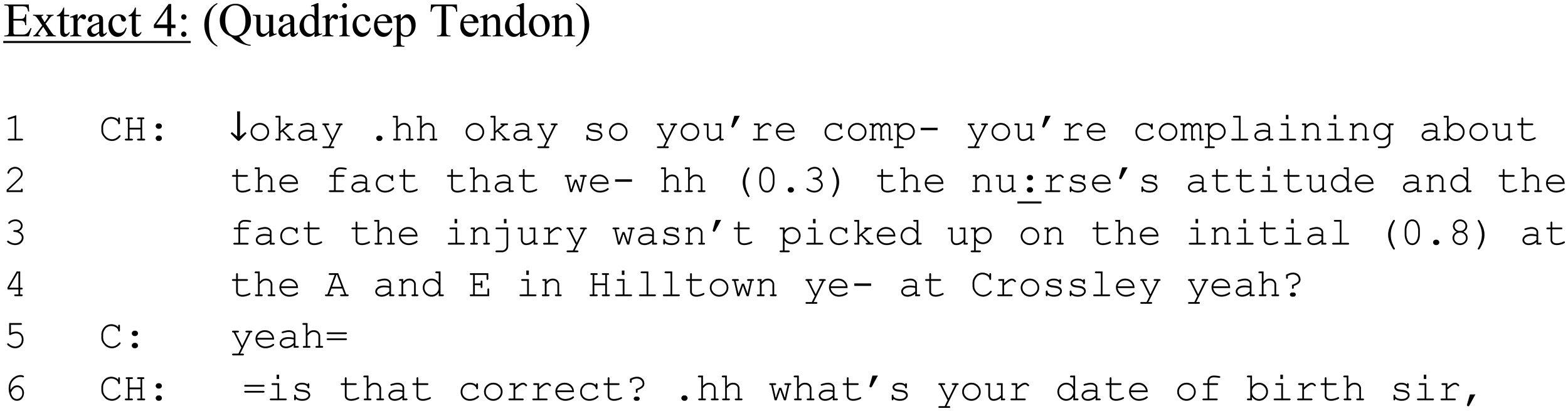
The CH formulates the key “points of complaint” with the turn final tag “yeah?” (l.4) which makes relevant confirmation from the caller. Confirmation is produced in the next turn and the CH moves straight from a more explicit request for confirmation to the next phase of the call. This extract shows how responsibility for the formal characterization of the complaint lies with the CH and frequently marks the progress into the stage of administering the complaint, gathering personal details and moving toward a closing sequence.
Formulations are however a contested space which “enables co-participants to settle on one of many possible interpretations of what they have been saying” (Heritage and Watson (1979, p. 123). Within the complaint process, this means that CHs often seek to clarify or gain consensus around a formulation. Conversely, formulations are often a site of challenge by the caller since they have the potential to “gloss” a complaint in a way that the caller believes mischaracterizes it. A next turn response that neither confirms nor disconfirms but challenges a formulation is often referred to in CA as “resisting” the formulation (e.g., Antaki et al., 2005). However here we focus on resistance that operates at an extra-sequential (project) level, where the caller deploys a reformulation of the CH's summary of the complaint not only to challenge the CH's understanding of the complaint but also as a vehicle (Schegloff, 2007; Sidnell, 2017) to resist the projected transition to the next phase of the call and return to the earlier complaint narrative phase, often re-launching the complaint narrative to add or elaborate on particular details.
In the following extract, the CH attempts to offer a formulation of the complaint based on the caller's earlier extended narrative in which he tells the story of his experience in A&E where he was not offered an x-ray so an injury to his quadricep tendon was not identified and he did not receive appropriate, timely treatment. This stage of the call is a potential point of transitioning to the information-gathering sequence, but depends on the caller's agreement that this is an accurate characterization of the complaint to be able to progress to this next phase of the complaint.
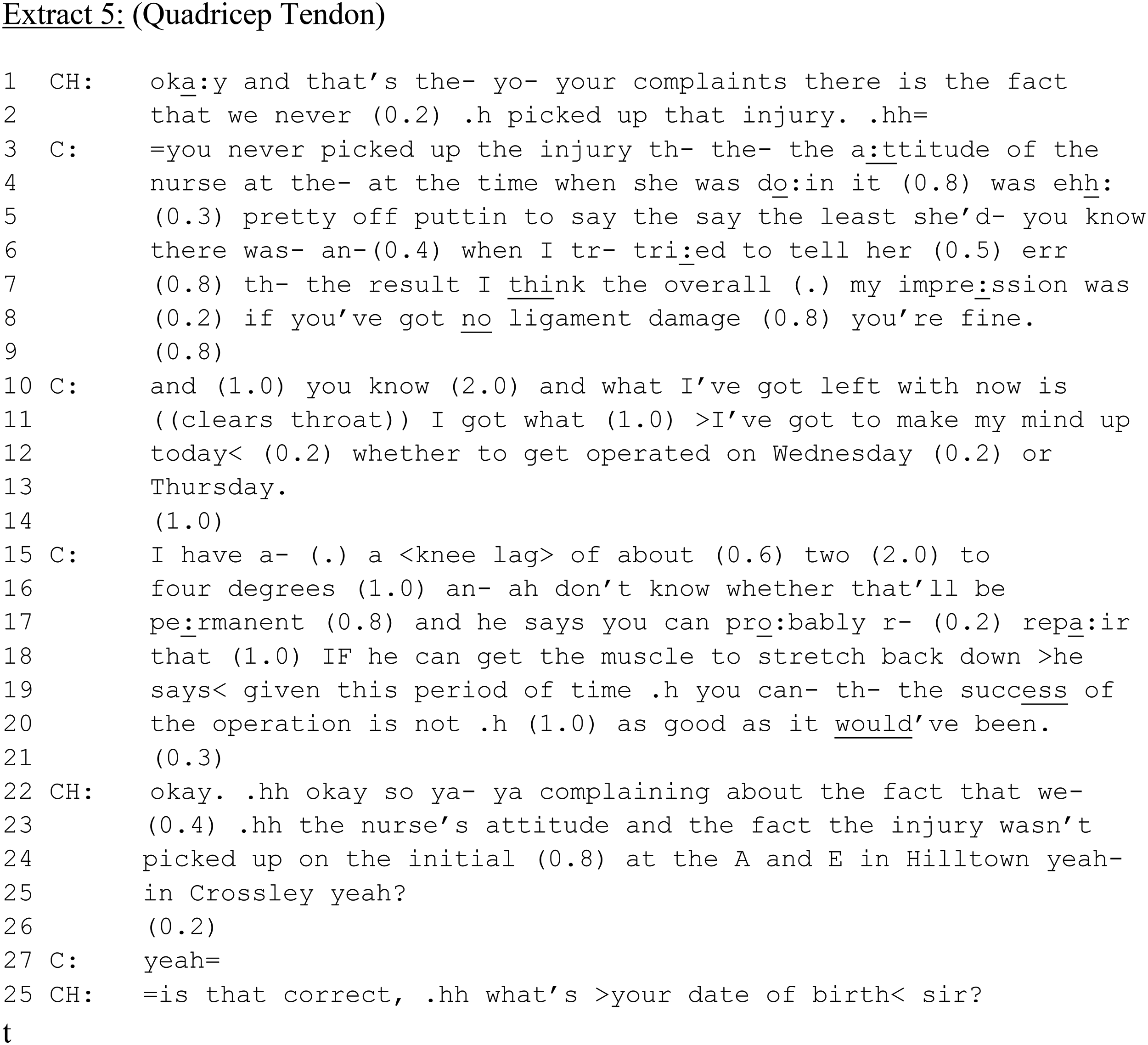
The caller responds to this formulation by initially repeating the call-handler's words “you never picked up the injury” (l.3), suggesting agreement with this version of the complaint. However, this is followed immediately by an additional complainable which the CH did not mention in their formulation: “the attitude of the nurse” which was “pretty off-putting” (l.5). This reformulation of the complaint serves as a vehicle to re-launch and expand the telling of the story of his experience at A&E. Specifically, the caller makes explicit both his complaint about the nurse's failure to acknowledge the validity of his concerns at the time and the burden of decision making that the neglect has caused for him. This complaint thus strikes at the heart of the caller's need to secure a formulation which not only properly acknowledges the negligence of the hospital regarding his injury, but also the nurse's dismissal of his initial concerns, reported in line 8, “you’re fine” and contrasted in line 10 with the actual current state of affairs, “what ah got left with now is.” The caller stresses the potentially life-changing effects of this error, “ah don’t know whether that’ll be permanent” (ll.16–17) and the doctor's own assessment that “the success of the operation is not as good as it would’ve been” (l.20).
This extract illustrates clearly how the practice of resisting the CH's formulation is simultaneously a means to challenge a perceived inaccuracy in the way the complaint is characterized as well as a vehicle for making visible their misalignment with respect to the status of the caller's project and resisting progressivity through the interactional phases of the call. In other words, the caller does not simply provide other-initiated repair of the CH's formulation but deploys the reformulation as a vehicle to return to the complaint narrative phase. In re-launching the complaint narrative, the caller makes explicit aspects that in the first telling were relatively implicit and in so doing also escalates the complaint in pursuit of a more aligned response. The CH then goes on to offer a reformulation of the complaint which includes the second element (the nurse's attitude) in line 22. Once this is offered the caller accepts the formulation, albeit minimally, 10 and the CH progresses into the next stage of the call involving the gathering of personal details (shown in Extract 4).
The next extract shows a similar resistance to the CH's closure implicative formulation of the complaint. We join the conversation where the CH is finishing gathering personal information from the patient following receipt of his complaint that a minor surgical procedure has left him with a catheter and that the procedure for removing the catheter is significantly delayed impacting his plans for the summer. For the CH, therefore, the complaint narrative phase is complete, and he is moving to the service provision phase prior to call closure.
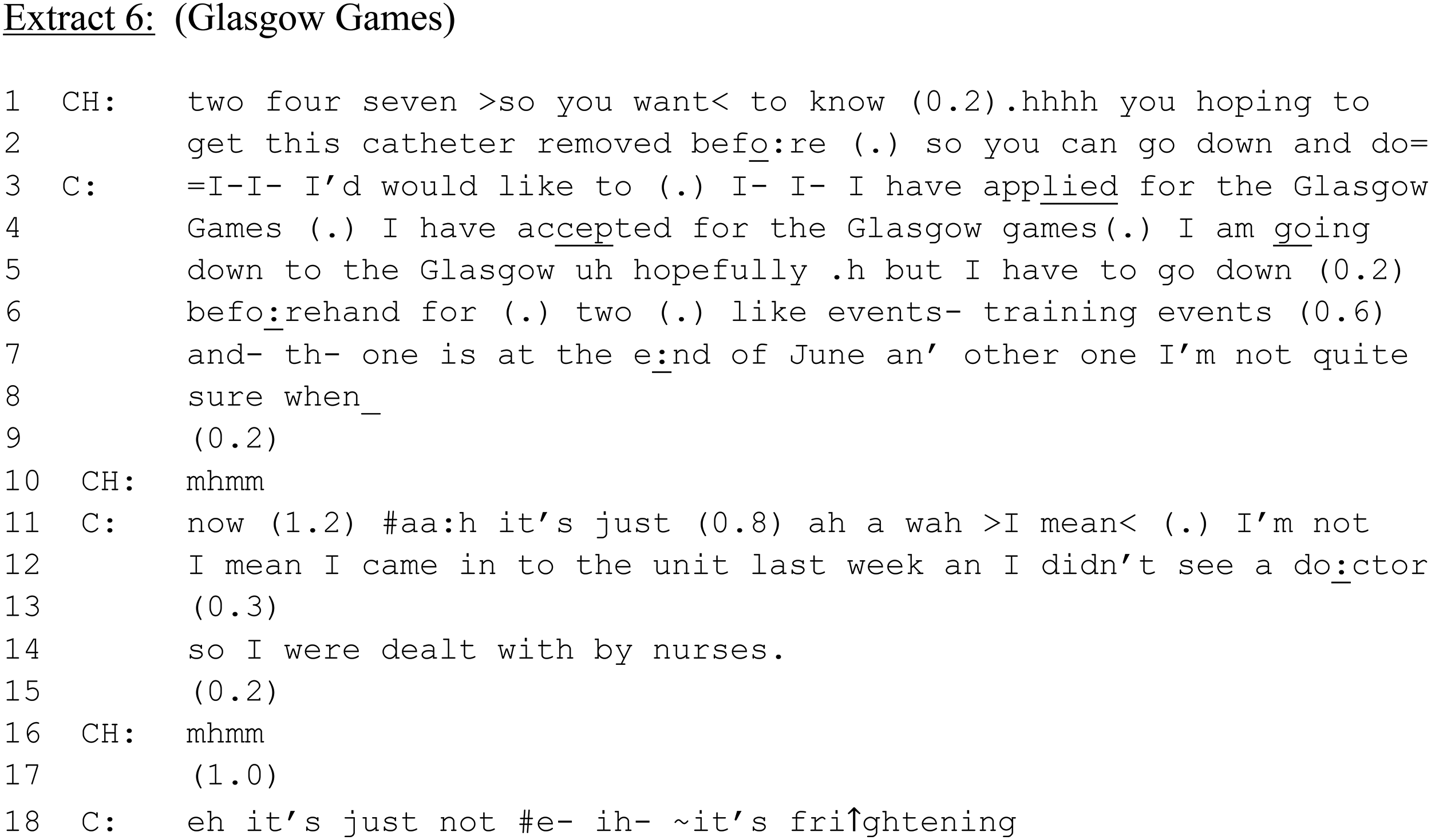
Having gathered relevant personal details, the CH starts to present a formulation of the caller's complaint (ll.1–2) which involves a self-repair from “want to know” to “hoping to get.” The repair here arguably refocuses the complaint to accommodate implicit reference to the caller's plans for the summer, “so you can go down and do” (rather than simply information about the timing of the procedure) and therefore may be seen as an affiliative repair. Note that as with Extract 2, it is also perhaps oriented to an ambiguity for the participants between complaining and complaining as a vehicle to help seeking, hence to an ambiguity as to the identity and “proper” conduct for the CH (cf. Tennent, 2021). However, the CH's formulation is interrupted by the caller who expands upon the formulation, focusing particularly on his plans to work for a sports event during the summer, which are in potential jeopardy if the catheter is not removed in time.
The caller's turn involves a three-part list formulation (“I have applied for the Glasgow games I have accepted the Glasgow games and I am going down to (the Glasgow) hopefully”) whose representation of a temporally related sequence combined with high modality reinforces the logic and legitimacy of his concerns and the necessity of a timely resolution to the catheter problem. The caller's expanded formulation of the timeline relating to his participation in the games also provides an opportunity to stress the urgency of his problem by introducing an earlier date (end of June) than might be assumed by reference to shared knowledge about the dates of the games themselves (end of July). On line 10, the CH issues a neutral minimal response (“mhmm”) rather than any uptake of the caller's specific concerns about timelines. On line 11, the caller then expands upon the formulation of the complaint to incorporate elements previously raised, but not present in the CH's formulation, including a partially new complainable that he was only “dealt with by nurses” and “didn’t see a doctor” (the caller has earlier expressed his desire to be seen by a doctor, but did not include being “dealt with by nurses” as part of his original complaint narrative). This is a complainable whose legitimacy the CH later goes on to explicitly resist (i.e., the implication that nurses are not sufficiently qualified to deal with his condition). Again, there is no noticeable uptake of this new complainable by the CH, who repeats the minimal response “mhmm.” There is a noticeable pause at this point (l.17) after which the caller articulates their emotional response to the situation “it's just not ih—it's frightening.” The absence of substantive uptake by the CH at these transition relevance points possibly leads to this incremental escalation of the caller's complaint through these additional turns, which could be deemed to be a series of pursuits (Pomerantz, 1984), culminating in the high stakes expression of fear (cf. Weatherall & Stubbe, 2015).
Although the caller here does not explicitly reject the CH's (incomplete) formulation of the complaint at the start of the extract, his commandeering of the complaint summary in order to strengthen and add to it, points to a perception of deficiency in the way the complaint has been understood, received and responded to by the CH. The caller is thus resisting the CH's attempts to move the complaint process into the next phase and ultimately toward call closure. His reformulation of the complaint is, as we observed in Extract 5, a means of returning to the earlier complaint narrative phase of the call. It is thus a means of resisting the progressivity of the handling of the complaint and the CH's stance toward the caller's project.
Pursuing Affiliation
Our final two extracts support our claim that each transition to the expected next phase of the call provides a further “fateful” moment, where participants are oriented to the relevance of mutual alignment with respect to their respective projects and associated identities, rights, and obligations. Here we explore the challenge to progressivity through caller's practices that are oriented to the absence of expected affiliation to elements of their complaint. Interactional difficulties often occur in institutional complaints where callers’ expectation that their complaint should be ratified may come into tension with the institutional requirement for a CH to remain professionally “neutral” and not endorse a complaint that has yet to be investigated (Weatherall, 2015). 11
The first of these extracts come toward the end of the same call as Extract 5. The CH at the start of the extract produces a closure-oriented summing up of the processes he has just agreed with the caller. This indexes (for the CH at least) mutual resolution of their articulated projects. This summing up, however, is met with a 1.2 s gap and a partial repetition rather than a preferred acceptance. This leads the CH in line 11 to seek to confirm that the caller is “okay with” the arrangements, at which point the caller produces a pro-forma agreement, “yeah yeah” (l.13) that then immediately pivots to resist the move to closure and return to the complaint narrative:
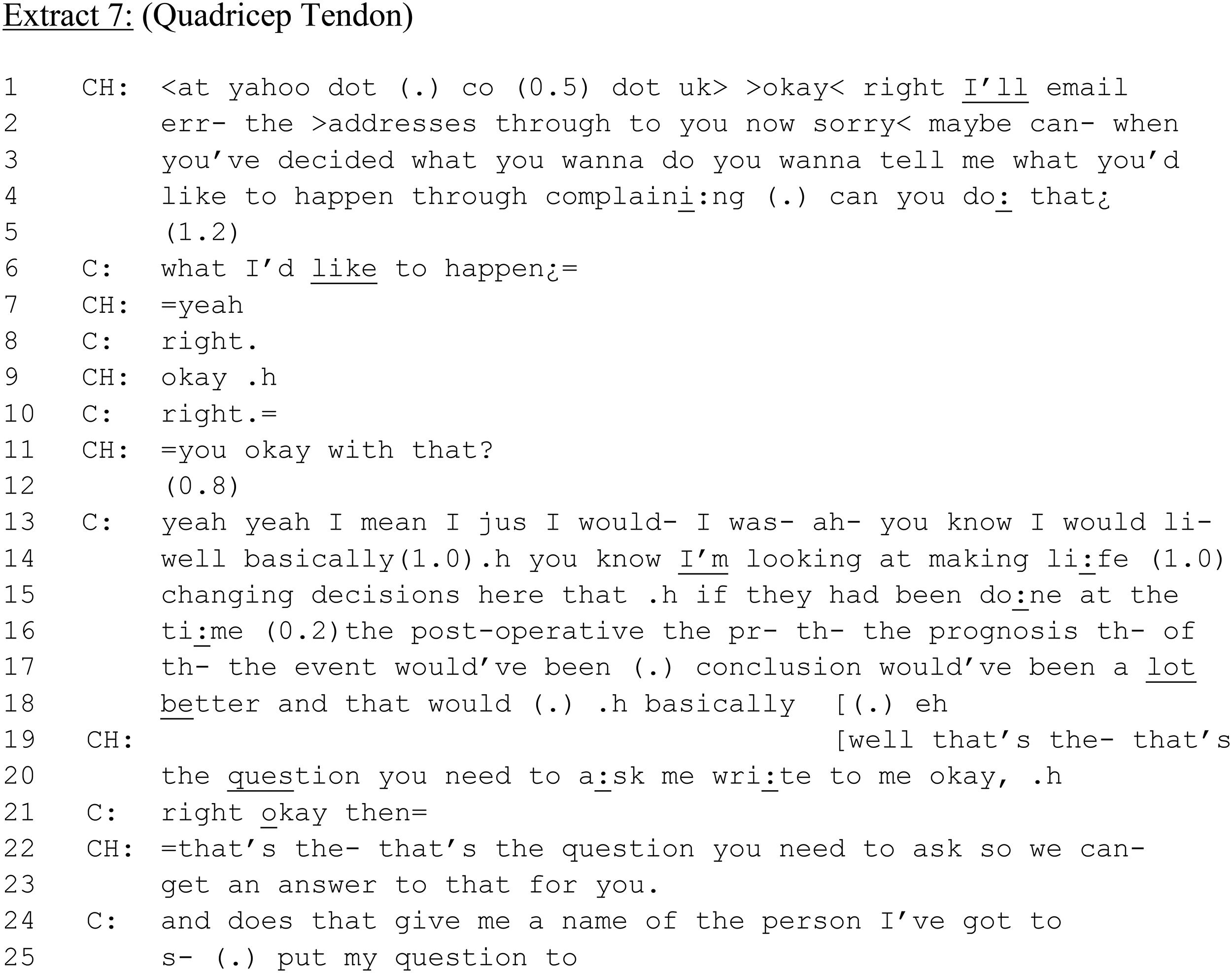
Earlier in the call, we saw the caller resist the CH's initial formulation of his complaint, relaunching the complaint narrative to include in the story his treatment by a particular nurse and the lifeworld consequences of his misdiagnosis (Extract 5). He then accepts the CH's subsequent formulation which summarizes his complaint as the misdiagnosis and the nurse's attitude, but noticeably omits any mention of the lifeworld consequences of the misdiagnosis. In the intervening interaction, CH and caller move through two phases of the call (personal information gathering and agreeing formal processes) during which the participants appear to cooperate in mutual resolution of their projects, orienting to aligned identities as information gatherer and information provider.
Mutual resolution of their projects provides the interactional warrant for call closing, so the transition at the start of Extract 7 provides the last structural opportunity for the caller to resist the CH's stance toward the caller's project as resolved. At this point, the caller uses the CH's reference to what he (the caller) wants to “happen through complaining” as a vehicle to return to his complaint story with an I-mean-prefaced utterance. Maynard (2013) argues that I-mean-prefaced utterances work to provide the speaker with the interactional space to complete a complaining action and to pursue aligning responses such as affiliation. Noticeably, with this return to the complaint narrative, the caller does not add or change the details of his complaint. Rather he focuses entirely on the aspect of the story that was noticeably omitted from the CH's previous formulation of the complaint, namely the lifeworld impact of the complainables in his story, “I’m looking at making life (1.0) changing decisions.” In so doing, the caller appears to be oriented to pursuing a more affiliative response from the CH. Until this point in the call, the CH's talk is entirely information oriented; his turns oriented to information receipting or information seeking in the earlier phases and information providing in the later phases.
In this extract, the CH's uptake (ll.19–20) is not overtly affiliative, but does legitimize the caller's lifeworld concerns by framing them as appropriate content for the caller's complaint email, “that's the question you need to ask.” The caller appears to accept the CH's uptake as ratifying the lifeworld impact as a legitimate element of his complaint and resolving their misalignment. Following brief practical clarifications, the participants orient to mutual resolution of their respective projects and the call closes.
The next extract also concerns how resistance to progressivity occurs as a result of a pursuit of affiliation perceived to be “absent” by the caller. Here the caller is complaining about waiting times for her elbow replacement operation. Complaints about waiting times are arguably difficult for an NHS complaints handler to affiliate with since they are a systemic and inevitable consequence of chronic under-resourcing of the NHS and the CH will be aware that there is little prospect of a satisfactory resolution to such a call. Throughout this call, the caller interrupts successive attempts by the CH to move into the personal information-gathering phase by repeatedly returning to the complaint narrative in order to add details linked to the lifeworld impact of the lengthy wait for her operation. At the point at which this extract begins, the CH has already made three attempts to move to the next phase of the call and toward closure. She now renews her turn to initiate call closure:
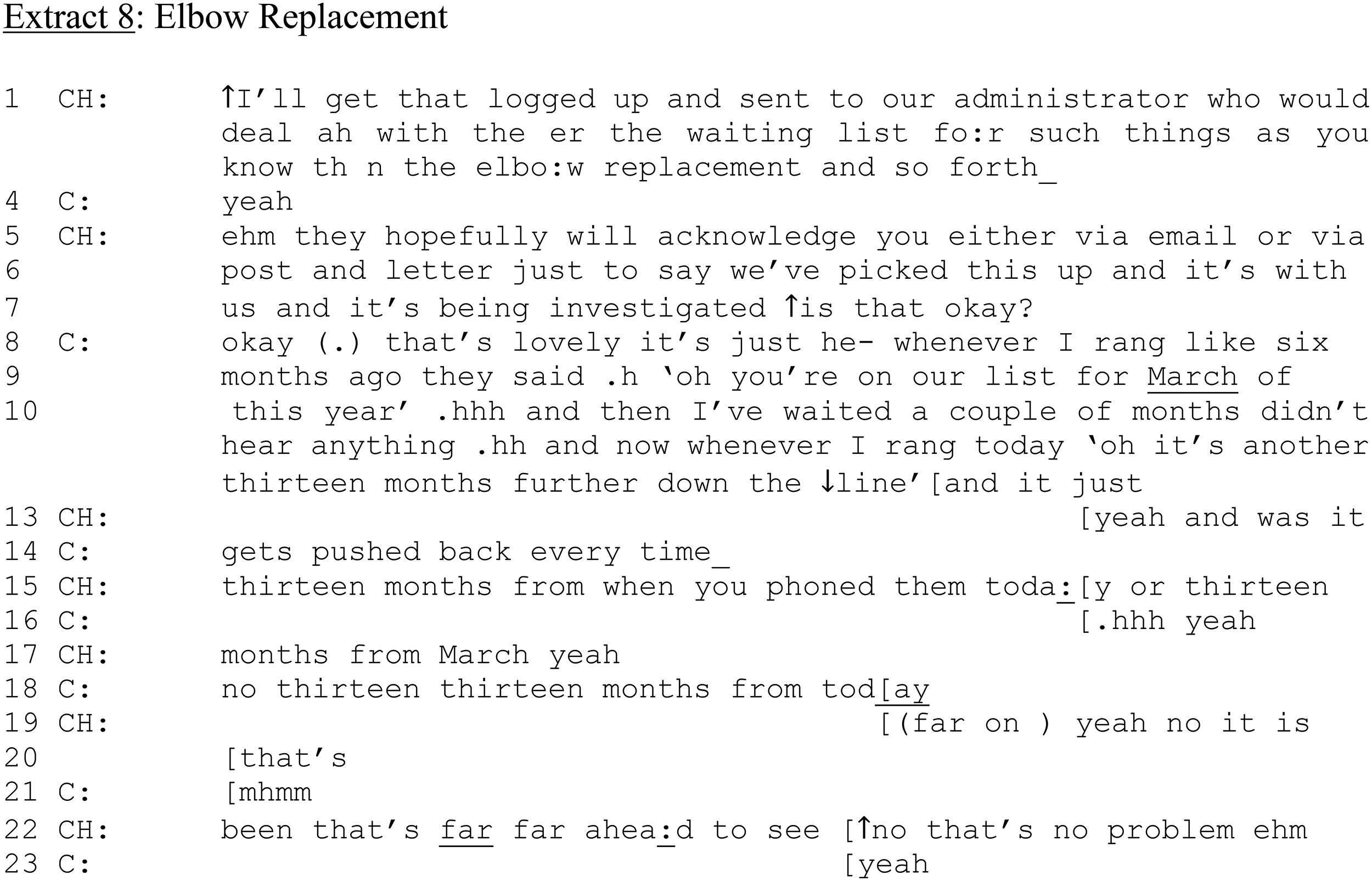
Between lines 1 and 7, the CH signals that she is moving into the pre-closing phase of the call by explaining the next institutional steps for the complaint. She explicitly seeks agreement from the caller that their respective projects are aligned at this point with the turn “is that okay?” The caller's next turn seems to align positively with this proposal as she responds with “okay” and a positive assessment “that's lovely.” However she then immediately returns to her complaint narrative and repeats the substance of the initial “reason for the call” complaint narrative but this time prefaced with “it's just” which frames the turn as accounting for complaining as a resource to pursue ratification of her identity as a “reasonable complainant.” She enhances the legitimacy of the complaint by articulating the incrementally increasing waiting times between each postponed appointment, culminating in a “thirteen month” wait. We argue that the caller here resists the CH's attempt to characterize the caller's project of the call as resolved. Up to this point, and as with the previous extract, the CH's turns have been entirely information oriented and have not offered affiliation with the caller's repeated pursuit of ratification for the grounds of their complaint. On receipt of this latest bid for affiliation, the CH finally offers a shared negative assessment of the “thirteen month” wait as unacceptable: “far on” and “far far ahead” and in this sense affiliates with the caller's articulation of the grounds for complaint. Shortly after this, the call draws to a conclusion.
In pursuing affiliative uptake of the lifeworld impact of their complaint, the callers in both extracts here appear to be oriented to making visible their misalignment with respect to the rights and obligations associated with complaint recipiency in this context and in making visible this misalignment, the callers also resist the mutual resolution of their projects which would warrant call closing. Our previous analysis of affiliation in complaints calls (Benwell & Rhys, 2017) demonstrated that callers’ pursuit of affiliation is oriented to achieving ratification of both their complaint and themselves as “reasonable” but also that practices that are not explicitly affiliative but do ratify the complaint, as we saw in Extract 7, may also work to accomplish affiliation.
Discussion and Conclusion
Our analysis shows that callers are sensitive to transitions in the phase structure as opportunities to “check” the accuracy of the understanding of the complaint being made and the expected stance and obligations of the CH to both the complaint and the complainant. Complaints are embedded in often lengthy narratives, layered with other actions such as troubles telling and help-seeking that create ambiguities for the participants as to their identities as “proper participants” of institutional complaint handling and their associated rights and obligations. Progressivity through the phases of the call, however, makes relevant alignment with respect to participants’ ongoing projects and associated “proper” conduct. We examined examples of emerging misalignment that related to (mis)understanding of the status of the caller's project or of the normatively expected conduct of the CH. The participants display misalignment through a range of practices and actions that resist progressivity through the phase structure of the call, typically re-launching the earlier complaint narrative phase to resolve the misalignment. The practices used to display resistance to progressivity are revealing the caller's project and oriented to ensuring that their project articulates with the CH's project, in that they are often oriented to ensuring that the CH records an accurate representation of the complaint. In addition, the practices are often revealing of the caller's orientation to affiliation/ratification as an expected obligation attached to complaint recipiency (Benwell & McCreaddie, 2017; Benwell & Rhys, 2017). In other words, callers display a normative expectation that the proper conduct of the complaint recipient includes interactional practices that work to affiliate with the complainant or ratify their complaint. Examining resistance to progressivity through the specific institutional phases of the complaint call thus reveals how caller and CH deploy sequential resources to negotiate mutual resolution of their respective projects.
Our examples show that resistance to transition to the next phase provides an opportunity to relaunch a prior phase in the call structure, typically the earlier complaint narrative phase. This supports the claim that these are sequential moments at which extra-sequential orientations are made relevant and made available for assessment by participants. More speculatively, extracts 6 & 8 raise the question that participants may also orient to an ordering with respect to the extra sequential elements of the occasion, as we see the caller initially prioritizing the “hearably factual, recordable” formulation of his complaint and moving through two further phases of the call before returning to the complaint narrative to pursue a more affiliative response from the CH (cf. Weatherall & Stubbe, 2015 for a similar observation about the sequential organization of emotion).
These findings about the importance of transition points as sequential opportunities to achieve alignment between caller and CH are particularly relevant to types of institutional communication where “missed opportunities” to affiliate typically lead to escalation of the scope, scale, or emotional intensity of the call (Benwell & Rhys, 2017). Developing CHs’ awareness of phase transitions as potential moments to check alignment enables CHs to identify opportunities to reassure the caller that their complaint has been understood and ratified as legitimate. This increases the efficiency of the call by averting the potential need to relaunch the earlier complaint narrative and yields greater satisfaction with the overall call handling. These findings have been successfully applied to the professional development of call handlers in the Real Complaints Training for Complaints Handlers (realcomplaints.org).
With respect to the EMCA respecification of resistance as an interactional phenomenon that is the focus of this special issue, the analysis presented supports the view that resistance is accomplished through an interactional move that displaces the normatively expected next move with consequences for the interactional trajectory. The specific contribution of this work is the focus on resistance that is directly oriented to blocking progressivity at the phase structural level of organization of the interaction. Resistance to progressivity has been widely analyzed at the more local level of resistance to topic/sequence closure (e.g., Hoey, 2018; White, 2012) or closure of the overall encounter (e.g., Raymond & Zimmerman, 2016). Our analysis demonstrates that resistance to phase transition is oriented both to the overall sequential organization of the encounter and to the extra-sequential normative expectations and obligations of participants.
Footnotes
Declaration of Conflicting Interests
The author(s) declared no potential conflicts of interest with respect to the research, authorship, and/or publication of this article.
Funding
The author(s) disclosed receipt of the following financial support for the research, authorship, and/or publication of this article: This work was supported by the Health Services Research Programme, (grant number 127367).
