



Abstract
This conversation analytic study explores a single case of a teenager's resistance to a parental threat. Resistance in the conversation analytic literature typically refers to an interactional move that displaces a sequentially relevant or normatively expected next action. A resistant turn, while not aligning with the ongoing course of action, also avoids overtly disaligning with it. In this paper, we make the case for a particular form of resistance that involves intercepting an action-in-progress. In our data, the teenager deploys this form of resistance as an alternative to either complying with or defying a parental threat. More specifically, our analysis shows how the threat recipient uses resources such as complex turn design, projectability and repair to anticipate and resist the projected trajectory of the sequence where the projected trajectory is compliance or defiance. The analysis also explores how participants invoke epistemics and deontics in this context as resources in resistance.
In this paper, we provide a single case analysis of how a teenager resists compliance with a parental threat without suffering the consequences of defiance. This is achieved with a form of resistance that deploys interactional resources such as projectability, repair, and displays of epistemic status to resist the projected trajectory of the sequence. Hepburn and Potter (2011) have previously explored the interactional organization of parental threats in families with young children. They examined the design of threats, children's basic responses to parental threats, and some of the broader social psychological concerns such as power and asymmetry in relation to social influence. This paper expands this line of research by analyzing a case of a teenager's resistance to a parental threat-in-progress, considering the practices employed by the teenager to derail the ongoing action, and ultimately resist compliance. Finally, this paper explores the growing autonomy of the teenager as a recipient of a parental threat, and the parent's and teenager's orientations to deontics and epistemics, revealing how epistemics and deontics interact with category work as resources for opposition in family interaction.
Conversation Analytic Research on Resistance
Outside of conversation analytic (henceforth, CA) and interaction research, resistance has been conceptualized in psychological terms in relation to persuasion, focusing on cognitive processes (see Knowles & Linn, 2004). CA research respecified resistance as an interactional accomplishment in areas such as repair and epistemics and deontics (see Bloch & Antaki, 2022; Lindstöm & Weatherall, 2015; Stivers & Timmermans, 2020). In recent years, resistance has been the focus of many studies in CA and was the focus of a panel at the 2019 Conference of the International Institute of Ethnomethodology and Conversation Analysis (organized by Jack Joyce, Bogdana Huma & Claire Feeney). These studies focus on a range of contexts of resistance including resisting by exploiting category boundaries in public disputes (Joyce et al., 2019), resisting performing cardiopulmonary resuscitation in emergency calls (Riou et al., 2019), overcoming resistance in negotiations with individuals in crisis (Sikveland et al., 2019).
Particularly relevant to this study is the prior CA work on resistance in family interactions. Kent's work on resistance in family settings explored how children resist compliance with parental directives (see Kent, 2011, 2012a, 2012b). Kent analyzed directive sequences in family interactions with young children (under the age of eight) and identified the potential responses to directives as compliance, defiance, and resistance. She describes resistance as stalling progressivity and noted that these responses often led to more entitled, less contingent upgraded, repeated directives (2012a). The resistance she explored was typically sequentially fitted to the immediate prior, but dispreferred. It typically followed a directive that provided some “scope” for resistance, such as directives with modal formulations, or less strongly entitled directives (Kent, 2011).
Goodwin and Cekaite (2014) provide a fine-grained analysis of responses to parental directives including reluctant disagreement, embodied exasperation (such as “uh::”), defiant refusal, reluctant agreement, and compliant unhappiness. These are sequentially fitted responses, in that the child either complies or defies their parent's objective. The forms of resistance in these responses emerge from the stance-taking of the child, for example, by embodying unhappiness or exasperation.
Goodwin and Loyd (2020) explored how extended directive response sequences unfold in family interactions, showing how such extended sequences can consist of resistance, persuasion, negotiation or argument. They focus on how apologies are called for in American family interactions through the use of directives and persuasion from the parent and examine how these are resisted by the child. Their findings suggest that children resist the parent's authority rather than orienting to quickly restoring equilibrium. They show how, in response to the child's resistance, the parents sanction inappropriate behavior and pursue an apology from the child, thus socializing the child into what counts, in the family culture, as morally appropriate behavior.
The different forms of resistance discussed by Goodwin and Cekaite (2014) and Goodwin and Loyd (2020) encompass practices that resist actions in ways that nonetheless structurally align with the projected action or action-in-progress. In contrast, in this study we explore ways in which a speaker can resist by intercepting the action-in-progress before a possible point of completion, which derails the projected ongoing sequence.
Defining Resistance
As this special issue attests, there are a wide array of practices that accomplish resistance. In this section, we consider some specific forms of resistance that are relevant to our single case analysis below. We consider how transformative answers (Stivers & Hayashi, 2010), fitted turns that “block the action trajectory” (Berger et al., 2016, p. 572), and subversive completions (Bolden et al., 2019) in different ways transform the trajectory of the sequence in progress.
Stivers and Hayashi's (2010) study of transformative answers shows how participants can resist a question by providing a response that retroactively adjusts aspects of the original question. They note that when a question is posed, “constraints” are placed on both the action that the recipient should produce next (Schegloff, 1968) and the design of that action. When a response abides by these constraints, it accepts the terms and presuppositions imposed, however transformative answers allow question recipients to (dis)confirm “a somewhat different question than was originally posed” (Stivers & Hayashi, 2010, p. 2). By adjusting the question posed, question recipients resist the constraints of the action while still providing a sequentially fitted next turn. Note that Stivers and Hayashi's notion of the constraints of a first pair part are applicable to other initiating actions which constrain the action and design of a fitted second pair part.
Stivers and Hayashi's work on transformative answers is supported by Clayman's (2013) analysis of resistance in question-answer sequences in news interviews. He identified resistance involving either declining to address the topical or action agenda of a question or shifting to a different agenda, or both, and highlighted two forms of resistance: overt and covert resistance. The cases of overt resistance are often launched with requests for permission to address another issue. Covert resistance, on the other hand, obscures the resistance. The covert forms of resistance identified by Clayman can be likened to Stivers and Hayashi's (2010) transformative answers, as these substantial transformations appear to “‘steer the question’ in a more favorable direction” (Clayman, 2013, p. 652). This idea of resistance as transforming the ongoing sequence by retrospectively transforming aspects of the initiating action will be relevant to the teenager's response to her mother's directive in our single case analysis below.
A different type of resistance is explored in Berger et al.'s (2016) study of a 911 call, which examined a caller's resistance to performing CPR given the presence of a personal doctor. They characterized the caller's resistance as not being “designedly obstructive” or defiant but as resisting the progress of the projected sequence. They recognize that this form of resistance begins with the caller's noticeable absences and delayed responses, along with marked upward intonation of compliance markers conveying some problem with understanding/complying with the instructions given by the emergency dispatcher (Berger et al., 2016, p. 569). In this case, the caller resists compliance with the dispatcher's instructions using a categorial reference to a “personal doctor” being present. As a result of this fitted, but resistant turn, the dispatcher abandoned their instructions to the caller. Berger et al. noted that the dispatcher's question regarding providing CPR to the patient provided the caller with an opportunity to resist the larger course of action of initiating CPR, but without providing a disaligned or unfitted turn. Berger et al. observed that as a fitted response, the resistant turn is hearably “polite” and “formal,” suggesting that resistance does not necessarily have to be oppositional or obstructive. The single case analyzed in this paper shows how sequential and categorial resources can combine to accomplish resistance.
The final form of resistance we consider here is Bolden et al.'s (2019) study of subversive completions, where speakers produce grammatically fitted completions that subvert actions-in-progress. These completions can be used for comedic effect or teasing but are also used to derail sequences as a means of resistance. Their analysis reveals how “speakers draw on the projectability of talk and the windows of opportunity provided by brief holdups in progressivity, as opportunities to build subversive alternative completions” (Bolden et al., 2019, p. 156). This form of resistance is particularly relevant for our analysis of how a threat recipient intercepts a threat-in-progress as similar resources are used to halt an action-in-progress prior to a point of possible completion.
Parental Threats
This study considers a form of resistance that is achieved in the context of a parental threat-in-progress to their teenage daughter. Threats have been the focus of many studies from a range of disciplines, however, there has been relatively little focus on threats in CA, despite Sacks (1995) discussing threats in his early lectures (Vol.2: 318 –– March 11, 1971) as an initiating action (or first pair part of an adjacency pair). Over the following 40 years, threats were largely overlooked in the CA literature until Hepburn and Potter's (2011) study. Here, we consider studies on threats and other more widely studied “directive actions,” namely requests, directives, and warnings.
The focus on directive actions was initiated by Heinemann's (2006) work on displays of entitlement in interrogative requests in Danish interactions between elderly care recipients and their home help assistants. She found that the choice of verb and use (or lack of) mitigating devices displayed entitlement in making requests. Curl and Drew (2008) examined orientations to both entitlement and contingency in requests in telephone calls between family and friends and in out-of-hours calls to the doctor. They found that modal verbs (such as “can you …”) were more frequent in mundane interactions, whereas “I wonder if …” was more common in requests to the doctor. These studies were the foundation for interactional studies on a range of directive actions such as requests, directives and threats, including work on parental directives in family interactions (Antaki & Kent, 2015; Craven & Potter, 2010; Kent, 2011, 2012a, 2012b) and threats (Hepburn & Potter, 2011).
As previously mentioned, studies of parental directives have examined forms of children's resistance to directives (Kent, 2011, 2012a, 2012b). However, other work has considered other aspects of parental directives including parent's issuing and delivery of directives (Antaki & Kent, 2015; Craven & Potter, 2010; Kent, 2011). For example, Antaki and Kent explore “or” directives which warn or threaten by issuing a directive followed by a less desirable alternative. The interactional effect they observe is that they seem to preserve the child's choice and agency whilst also tipping the balance in favor of the adult's preference (Antaki & Kent, 2015:37).
Our analysis of parental threats builds on these previous studies of directives (Kent, 2011, 2012a, 2012b) and requests (Curl & Drew, 2008; Heinemann, 2006). Kent (2011, p. 220) noted that it remains to be seen how far the notions of entitlement and contingency can be applied to other actions including threats, as well as offers and bribes. Our analysis will consider how entitlement and contingency are relevant to the parental threat in our single case study.
Hepburn and Potter's (2011) study of threats during family mealtimes provides a critical foundation for this analysis. Hepburn and Potter (2011) discuss how threats are built and the way(s) threats work (or, in some cases, fail to work) as a means of social influence. They also consider warnings in their work on threats, as the actions are similar but are distinguishable with respect to the agency of the consequent. When a person issues a warning, the consequence is not issued by the speaker. For example, a parent warning their child that if they play on the road, they might be hit by a car would not be threatening their child despite the warning taking the same conditional form as a threat. Participants are thus able to identify conditionals as threats or warnings through the presence or absence of agency in relation to the consequent.
Hepburn and Potter (2011, p. 6) investigated the formulation, sequential organization, and responses to a particular form of threat, namely if-then threats and identified the following response options in their data:
Compliance Ceasing the problem action or initiating the required action Defiance Continuing (or even exaggerating) the problem action or not initiating the required action Minimal Compliance Compliance with a flavor of defiance Undermining the Noxiousness of the Threat Turning the threat into an empty threat
These response categories outlined by Hepburn and Potter (2011) consider the basic response options of compliance and defiance, but also consider how threat recipients can “evade these options by … reworking the unpleasant upshot specified in the threat or producing barely minimal compliance” (Hepburn & Potter, 2011, p. 2). In contrast to our case of intercepting a threat action-in-progress, these are fitted responses that align with the sequential trajectory of the threat. Although they could be considered as resistant, in relation to power and asymmetry, they nonetheless align with the ongoing sequence of action. It is worth noting here that Hepburn and Potter's (2011) study explored family interactions with young children, whereas we consider a teenager's response to a parental threat. Therefore, our analysis may provide some comparison of related settings, but also provides insight into the growing autonomy of a teenager, in particular how the teenager orients to displays of parental deontic authority.
Data and Method
The single case analysis presented in this paper emerged out of a larger project on the sequential organization of resistance in family interactions (Flint, in prep-a). The data for the project come from a variety of corpora of naturally occurring English language, audio or video recorded family interactions, many of which are publicly accessible and available via www.talkbank.org. This paper focuses on a single episode between a mother and her teenage daughter. Schegloff commented on the value of single case analyses, noting that “one is also a number, the single case is also a quantity, and statistical significance is but one form of significance” (Schegloff, 1993, p. 101 emphasis in original). This single case is also the basis for a larger collection of instances of intercepting actions-in-progress, and further work on this phenomenon can be built on the back of the single case we analyze here (Schegloff, 1993, p. 102). Moreover, whether these other instances are similar instances, or whether they develop differently, “no other episodes […] will undo the fact that in these cases it went the way it did” (Schegloff, 1993, p. 101).
We analyze the single case using conversation analysis (CA; see Sacks et al., 1974) and membership categorization analysis (MCA; see Eglin & Hester, 1992; Housley & Fitzgerald, 2002). MCA is an ethnomethodological approach that Eglin and Hester Fdetailed history). MCA explores the reasoning practices of members and how interlocutors organize themselves, others and objects in and through interaction. In essence, MCA reveals how people assemble the “who-we-are” and “what-we’re-doing” (Butler et al., 2009) in social interaction. Specifically, MCA analysis focuses on the “inference-rich” nature of membership categories and the ways that participants invoke and deploy category membership. This combined approach of CA and MCA provides the tools to empirically study social interaction and its sequential and categorial organization.
The single case we analyze here comes from the Santa Barbara Corpus of Spoken American English (SBCSAE) accessed via CABank (MacWhinney & Wagner, 2010) as a part of TalkBank. This SBCSAE corpus is based on recordings of naturally occurring speech from across the United States collected by the University of California, Santa Barbara Center for the Study of Discourse. 1 The particular interaction we analyze was recorded in a family home in Michigan. In this interaction, Mom and Dad are talking with Ron (Mom’s brother who is visiting from California). Their children, 14-year-old Melissa and 12-year-old Brett, are doing homework and also taking part in the conversation. The episode of interest for this paper involves negotiation between Mom and Melissa over the progress of Melissa's homework. The suggestion has already been made (and rejected) that Melissa and her brother Brett would make better progress if they went downstairs to do their homework. In the sequence of interest, shown here in full in Extract 1, Mom attempts to threaten Melissa with being sent to work downstairs if she doesn’t make enough progress (l.15–16):
Your ten minutes are up: SBCSAE 19 (00:38 – 01:13)
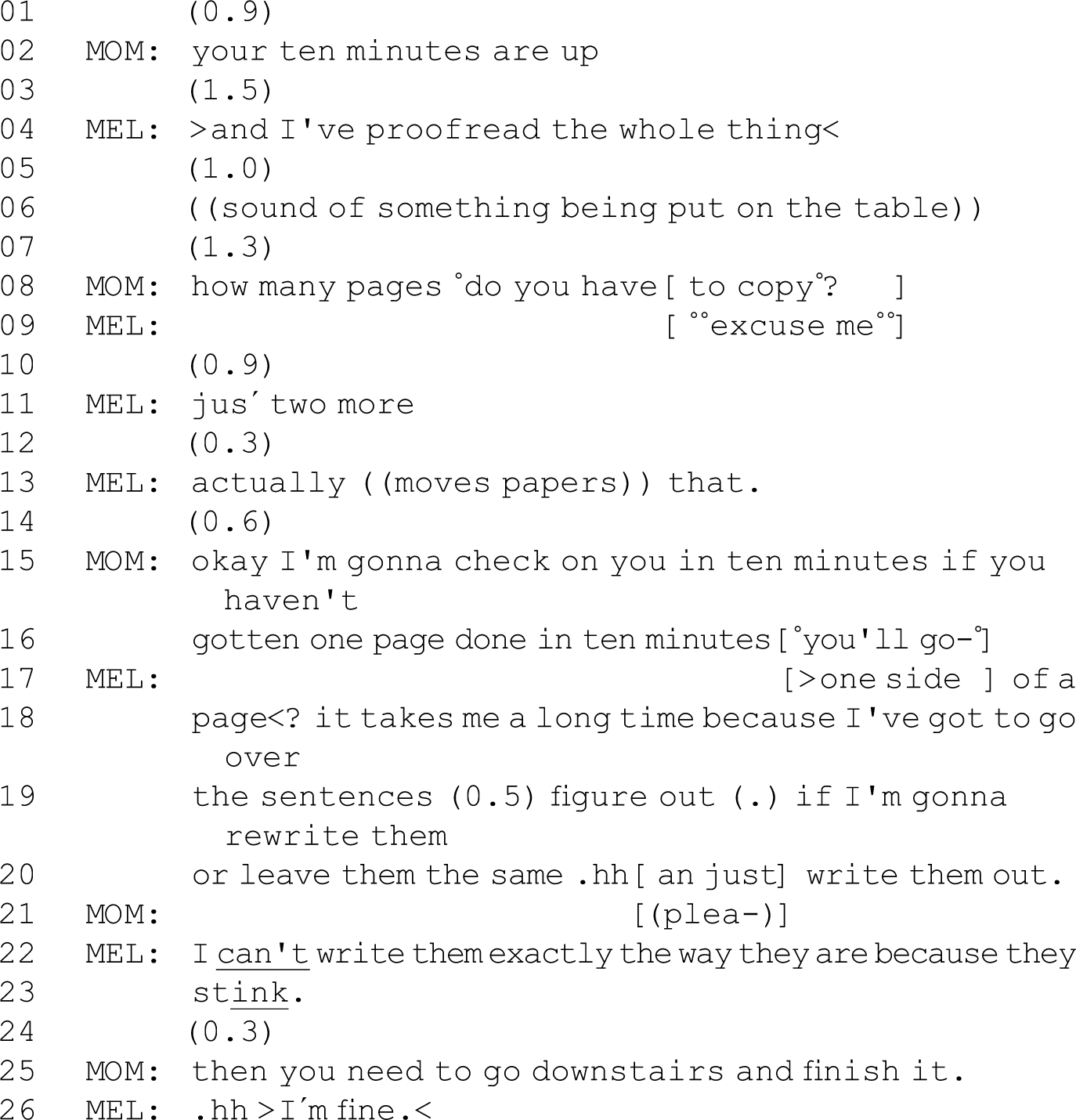
Our analysis below focuses on the full array of interactional resources that Melissa deploys to resist this threat, from micro-level features of turn design, through the sequential organization of the resistance and extra-sequential orientations to epistemics, deontics and category membership.
Analysis
The form of resistance in our single case analysis, which we have labelled as intercepting an action-in-progress, is distinctive with respect to the interactional resources provided by the intercepted turn as well as the cluster of interactional resources deployed to implement the resistance itself. Our analysis below thus focuses first on the linguistic and interactional properties of the intercepted turn, the threat, before then moving our attention to the array of interactional resources involved in resisting the threat.
Turn Design and Projectability
Firstly, we consider the form of conditional if-then threats. The syntactic structure of this type of threat is central to the form of resistance we are focused on in this single case, where the resistance involves exploiting the syntactic structure in order to intercept an action-in-progress (in this case a threat-in-progress). In our single case analysis, we will show how the syntactic structure of the turn-in-progress is demonstrably oriented to by the participant, as the threat is resisted at a point of syntactic completion (albeit of a subordinate clause) but prior to completion of the action. Specifically, we will show how the threat is resisted at the point in the structure where the action-in-progress becomes recognizable; where part of the propositional content is complete, projecting the action, while it is still in progress. In their study of parental threats in families with young children, Hepburn and Potter (2011, p. 8) presented the schematic structure of a threat as follows:
If the recipient continues problem action/does not initiate required action
Then negative consequences will be effected by the speaker
Threats are not the only action that uses conditional if-then constructions, so therefore we, as analysts, and the interactants in the conversation, must be able to distinguish one conditional action from another. Consider the following threat:
Hepburn and Potter (2011): 1. Crouch 14 0:40

Mum presents her five-year-old daughter, Katherine, with a “candidate threat” (Hepburn & Potter, 2011, p. 8). Although Mum characterizes her own action as a warning, the action is, in fact, a threat in which Mum provides the “if”-component (the antecedent) followed by the “then”-component (the consequent), although here without the use of “then.” This threat can be mapped onto Hepburn and Potter's schematic structure as follows: If the recipient continues “whinging and whining during breakfast time”
Then the speaker will send the recipient “to the bottom step”
The conditional construction of if-then threats suggests a causal relationship between continuing the negative behavior / not doing the desired behavior with a negative consequence. As noted above, this causal relationship can be seen in other conditional actions. For example, in warnings, the negative consequences are oriented to as an effect of a direct causal relationship between the antecedent and consequent of the if-then construction. By contrast, the causal relationship in threats (and promises) requires an agent to enact the consequent (Wood et al., 2016). In Extract 2, the agency is explicitly stated “I’ll send you to the bottom step,” however implied agency in the consequence (i.e., you’ll go to the bottom step) is also indicative of a threat, as opposed to a warning (especially as there is no direct causal correlation between whinging and whining and going to the bottom step).
Of course, this isn’t the only form threats can take. One other potential form that a threat can take is a not Y unless X structure, represented below: Positive consequences will be withdrawn by the speaker
Unless the recipient stops problem action/ initiates required action
Extract 3 comes from an interaction between a father and his 3-year-old daughter at the dinner table. This extract comes towards the end of the meal as Ella has finished eating. Prior to this extract, Dad and Ella have been looking through the biscuit tin for a biscuit for Ella. In this extract, Dad thinks of something Ella can have and leaves the room to get it.
Forrester (2002) - Forrester F179 (11:13 – 11:35)
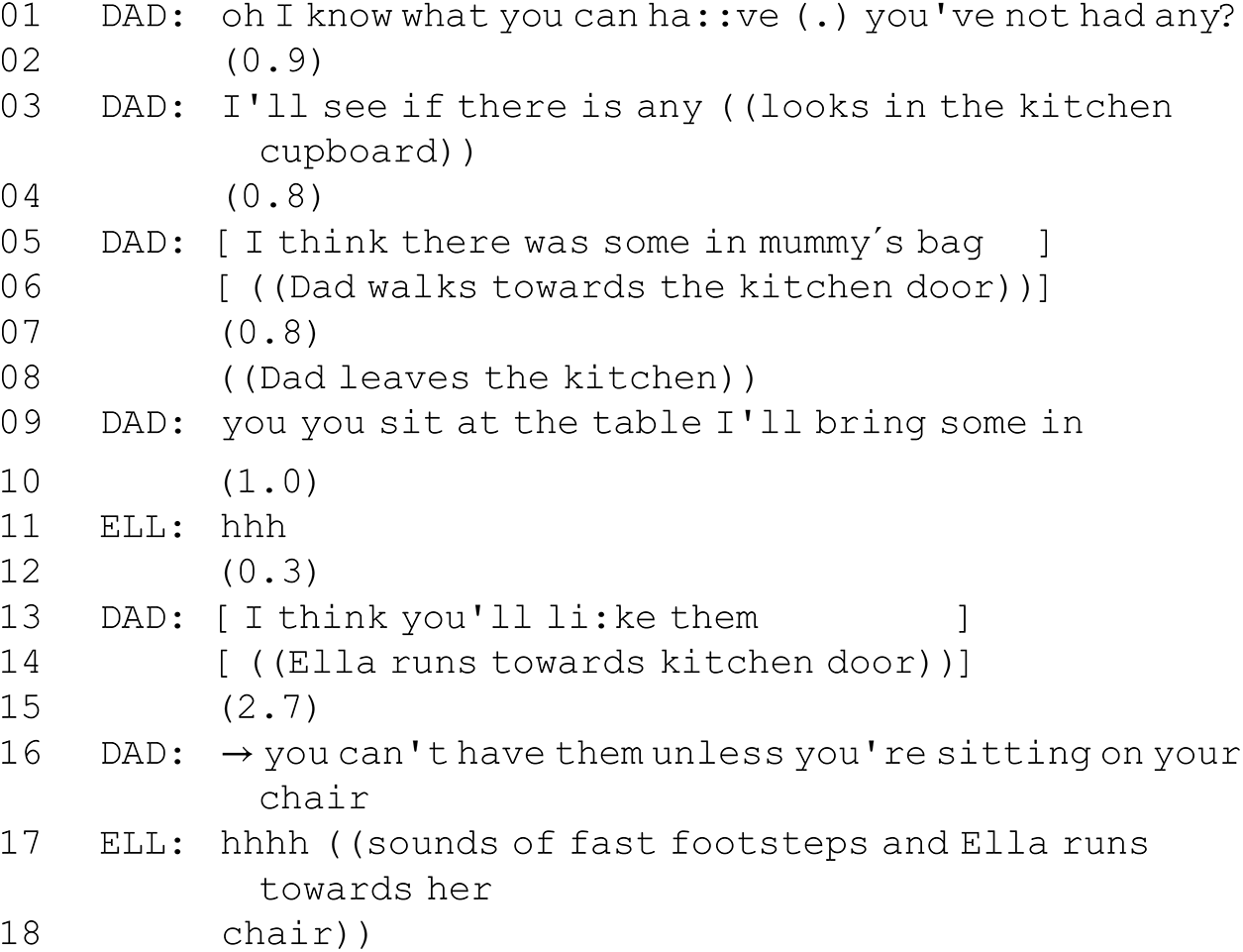
Throughout the extract, Dad's offering to Ella is treated as something desirable to Ella but is never explicitly named by Dad. 2 This is most noticeable at line 13, as Dad says, “I think you’ll like them.” It is at this point (line 14) that Ella defies her father's prior directive (line 9) as she does not sit at the table. Dad's threat is issued following Ella's non-compliance and begins with the consequence, “you can’t have them” followed by the desired action “unless you’re sitting on your chair.” This differs from the if X then Y threat, as the consequent (Y) component comes before the antecedent (X) component. The different form of this threat does not alter the function of the threat; however, the form is consequential for the way that a recipient can respond to the threat. 3
As noted above, the form of the threat is relevant for recognizing and projecting a threat-in-progress and that projectability is essential for intercepting the action-in-progress. Extract 4a focuses in on the form of the threat in our single case (shown in full in Extract 1). The threat is issued by a mother to her 14-year-old daughter, Melissa:
Your ten minutes are up: SBCSAE 19 (00:52 – 00:59)

This parental threat uses the if-then construction discussed above as part of a multi-unit turn that starts with “okay I’m gonna check on you in ten minutes.” This initial component is not a necessary part of issuing a threat, but many if-then threats we have identified are preceded with a turn-initial component or unit such as this. Other examples of this phenomenon include, “this is your warning” (Extract 2) and “I’ll tell you what kid.” 4 This initial component sets the context for the upcoming the threat and makes Mom's deontic status relevant as she unproblematically displays her rights to supervise her daughter. Mom's intention to check on Melissa appears to be non-negotiable. This displays the lack of contingency for Melissa, and Mom's entitlement to check on Melissa as she has the authority to supervise her daughter's homework activity (see Craven & Potter, 2010; Curl & Drew, 2008; Kent, 2011).
Following this, Mom issues her threat, restating the time frame as a part of the desired action of the threat, thereby further invoking her deontic authority by setting specific tasks with time frames, and presumably, 5 issuing consequences if these conditions are not met within the time frame. Mom thus invokes her deontic authority to supervise her daughter's homework, and then proceeds to issue a threat relating to the homework. Although this homework task was not set by Mom, as it is a school task, Mom still asserts her deontic authority in supervising the homework. She displays high levels of entitlement as she issues a threat, which would (presumably) have negative consequences for Melissa.
The if-component of the threat details the desired action - that Melissa will have done one page in ten minutes. This is followed by the then-component (although this is not completed). The form of this conditional threat involves a compound TCU (Lerner, 1996) which includes “a preliminary component that projects roughly what it will take to bring that component to possible completion and projects a possible form for the final component of the TCU as well, and thereby a shape for the TCU as a whole” (Lerner, 1996, p. 240). The design of the consequent as the second component in a compound TCU allows the turn to be intercepted and resisted prior to the issuing of the consequence. This would not be the case for other forms of threats that do not use a compound structure.
Extract 4a shows how Melissa exploits the specific if-then compound TCU structure of the threat to resist the trajectory of the sequence. Melissa intercepts the threat-in-progress following the first component (the antecedent), but prior to the issuing of the consequence. The point of interception is at the point where Melissa is able to project the ongoing action. This form of intra-turn projectability would not necessarily be possible in other environments. For example, although a not Y unless X threat also involves a compound TCU structure (see Extract 2), the action is not projectably recognizable following the first component because the first indicator of the compound structure (“unless”), which also provides for the recognizability of the action-in-progress by marking the first component as contingent on the second, is at the start of the final component.
Here, as with anticipatory completions (Lerner, 1996) and subversive completions (Bolden et al., 2019), participants orient to these locally managed interactional resources to establish the nature of an ongoing action, project the overall shape of the TCU, and roughly project the possible completion of the ongoing TCU. Bolden et al. (2019, p. 144) note that the same resources can be “deployed to subvert the action of an unfolding turn and the ongoing sequence” in the case of subversive completions.
A considerable factor in the case of these if-then threats is thus the design of the threat as a compound TCU with two distinguishable components and TCU-initial marking of the contingent relationship between the two components. Lerner (1996, p. 240) noted that “turns produced in a compound turn-constructional form provide a place - a projectable place at preliminary component possible completion–and a form–the projected final component form–for another speaker to finish the current TCU.” Here, we note that the same resources that are used for collaborative, affiliative purposes can also be used to subvert, disaffiliate, and resist.
In investigating this case of intercepting a threat-in-progress, we explore not only how Melissa is able to identify the ongoing action and project a place of possible interception, but also how she is able to successfully intercept and derail the turn-in-progress prior to a transition-relevance place (TRP).
Sequential Organization of Resisting an Action-in-Progress
In the previous section we considered the design of the turn being resisted. In this section we consider the resources used to resist the action-in-progress. Here, we primarily focus on the sequential organization of the teenager's resistance to the parental threat-in-progress. We consider how the threat is “intercepted” by the threat recipient while the threat is still in progress and the resources used to attempt to halt the action prior to the TRP. We then consider how this type of resistance pushes against the constraints of the threat.
Intercepting Actions-in-Progress. Extract 4b extends the threat sequence analyzed in the previous section in which Mom and Melissa are discussing Melissa's homework. This extract shows how Melissa halts the threat prior to a point of possible completion and argues against the conditions of the threat, ultimately derailing the whole sequence:
Your ten minutes are up: SBCSAE 19 (00:38 – 01:13)
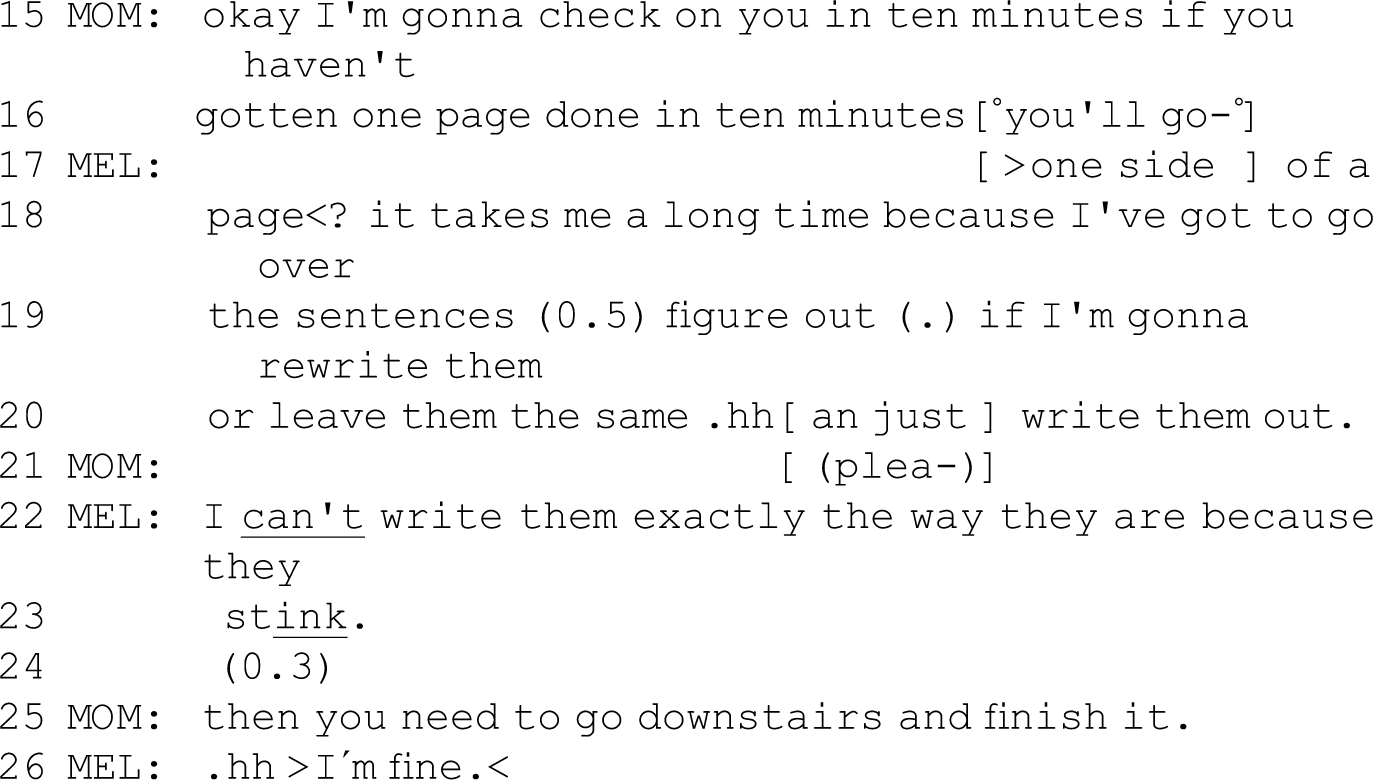
Prior to the issuing of the threat, Mom is supervising Melissa as she does her homework and has asked how many pages she has yet to copy, Melissa answers first by saying that she has two pages left, then showing Mom how much she has left to do. 6 Mom then begins to issue the threat (ll.15–16), but Melissa halts Mom's turn in line 17 after hearing just the antecedent of the threat, and in overlap with the consequent.
Melissa's turn consists of two different elements that accomplish resistance. Her turn begins with a next turn repair initiator, which halts the progressivity of the course of action and takes issue with mom's threat. The second part of the turn consists of several inability accounts through which Melissa conveys the impossibility of complying with the conditions set in the antecedent of the threat. Focusing on the first TCU, we see that Melissa's intercepting next turn repair initiator successfully derails the interaction as repair is oriented to by participants as a “priority activity” (Sacks et al., 1974, p. 720) which takes precedence over the turn-taking system. The use of a repair initiator thus halts the action-in-progress in a way which is unique to repair, as these actions generally systematically supersede the ongoing turn, therefore halting the progressivity of the interaction. Here repair is used as a “cloaking device,” as it is being used as a vehicle for some other purpose. The repair initiator is the first TCU in Melissa's multi-unit turn, which then abandons the repair and focuses on the unreasonable conditions outlined by Mom in the antecedent of the threat. Melissa does not demonstrate any difficulty in hearing or understanding. She employs a repair initiator which repeats the problematic talk but inserts a “repair solution.” This alters the potentially ambiguous quantity identified by Mom (“one page”) to the minimum potential understanding (“one side of a page”). However, Melissa is not offering this repair to Mom as a potential candidate repair solution, as she immediately pivots to argue why this smaller quantity of work cannot be achieved in the time frame set by Mom. By designing her turn in this way, Melissa interrupts Mom's turn-at-talk using repair as an omnirelevant device, then uses the sequential effect of gaining a turn-at-talk to negotiate and argue against the conditions of the threat. Melissa thus successfully derails the threat-in-progress, first by projecting the ongoing action based on the initial component and intercepting at the point of projectability, and then by employing repair as an omnirelevant device to halt the ongoing turn and intercept the action-in-progress.
While repair provides the vehicle to derail the action-in-progress and project resistance to the threat, Melissa's substantive resistance to the threat is achieved through her subsequent inability accounts that invoke her epistemic authority with respect to the homework task and accomplish explicit objections to the conditions expressed in the antecedent of Mum's threat. She explains the many steps required to get one page “done,” specifically, going over the sentences, figuring out whether to rewrite them or leave them the same and then writing them out (lines 17–20). Everything Melissa argues against here is present in the antecedent of the threat. The details of the consequence do not matter as Melissa adopts a stance towards the conditions of the threat after hearing just the antecedent.
Similar to the explicit objections to advice analyzed by Bloch and Antaki (2022), Melissa's explicit objections claim epistemic entitlement by orienting to aspects of doing homework for which she can claim a K+ epistemic status relative to Mum. Melissa firstly invokes primary epistemic access to the experience of completing the homework task (l.18), then claims epistemic authority with respect to the demands of the task (l.18–20) before finally producing a first assessment (l.22) that carries an implied claim of primary epistemic rights to assess her work.
As Bloch and Antaki show, objections grounded in the epistemic territory of the objector are hard for the recipient to overcome and in this sequence, we see a noticeable absence of uptake of any element of Melissa's multi-unit turn. Instead, Mom says “then you need to go downstairs and finish it,” which interestingly through the turn initial “then” marks the turn as accepting the claims embodied in Melissa's objections and asserting a consequence of those claims.
Mom's assertion in line 25 is delivered with marked falling final prosody and with a high entitlement modal (need) rather than a modal with less entitlement and more contingency, such as “should.” These features combine with Mom's overarching orientation to her deontic authority throughout this sequence, to render her assertion hearable as a directive. However, Melissa avoids compliance by orienting to the assertion, not as a directive, but as a piece of advice. Melissa's response transforms the prior turn, treating the assertion as advice-giving rather than a directive. This is an agenda transformation (Stivers & Hayashi, 2010), as Melissa does not simply shift the focus of the prior turn, instead she transforms the agenda of the ambiguously designed assertion to the action which offers more contingency, i.e., advice giving. By treating the turn as advice-giving, rather than a directive, Melissa treats the turn as being low entitlement and high contingency. This response resists Mom's displayed deontic status as Melissa claims autonomy by mobilizing the potential for contingency in Mom's assertion.
Throughout the extract, Melissa deploys epistemics as a resource in doing resistance, as she resists by displaying her K+ status in relation to the ongoing homework activity. It appears that Melissa's orientation to epistemic status is responsive to her mother's displays of deontic status. As Mom asserts her deontic authority, Melissa invokes her epistemic authority; she provides explicit objections that claim epistemic entitlement with respect to the demands of the homework task. In other words, rather than negotiate her deontic status relative to Mum's displays of deontic authority, she instead mobilizes epistemics as a resource to displace Mom's orientation to the deontic domain. She is able to provide an evidence-based argument concerning the size of the task and the quantity of time allocated by Mom, assess the quality of her work, and resist an assertion by orienting to it as advice, and dismissing it as not necessary given that she is more knowledgeable than her mother in relation to this task.
As well as seeing epistemics and deontics as opposing forms of authority, we also note that the ways in which epistemic and deontic status are made relevant by the participants are also oriented to two unrelated membership categorization devices, the family device and the school device. Mom orients to the category bound activities of being a parent, such as, supervising homework, issuing threats and directing/advising her daughter, however, Melissa does not orient to the family device, or the category bound attributes applicable to her category of “teenage daughter.” Instead, Melissa orients to the school device, notably her category as a student, in particular attributes of being a good student. She does this by demonstrating her knowledge of the homework task, orienting to the task as defining how long it will take to complete homework, as opposed to Mom's time constraints which do not appear to consider the task-at-hand, and assessing the quality of her work. Conversely, Mom does not appear to orient to the school device. Interestingly, each of these devices appear to have an underlying orientation to deontic or epistemic status. Mom's uses the family device to assert her deontic authority, while Melissa invokes her epistemic status to assert her membership of the school device. The way that Mom and Melissa orient to categories and category bound activities demonstrates how deontics and epistemics are understood by participants in interaction. We suggest that membership categorization may contribute to how analysts’ evidence epistemics and deontics as being relevant in an interaction, as participants appear to orient to their membership of particular categories or devices to assert deontic and/or epistemic status. 7
Resisting the Constraints of a Threat. In their paper on transformative answers, Stivers and Hayashi (2010) consider how transformative answers resist the constraints of a question. These constraints include the normatively expected action and design of the response. For example, polar questions constrain responses to “yes” or “no” (Raymond, 2003; Stivers & Hayashi, 2010). They consider how questions (as first pair parts) place the questioner in an “interactionally powerful position” and place “significant constraints on what the recipient does next” (Stivers & Hayashi, 2010, p. 1). Threats, as first pair parts, also enforce constraints on the recipient. The fitted responses explored by Hepburn and Potter (2011) abide by the constraints of the threat, whereas the teenager in the extract we explore here resists the constraints enforced by the first pair part by intercepting the action-in-progress before the consequent of the threat has been delivered. Bolden et al. (2019) consider another form of potential resistance in their analysis of subversive completions. However, in the case of a teenager resisting a threat-in-progress presented in the present paper, the threat recipient resists the constraints of the sequence by derailing rather than completing the action-in-progress. The responses outlined by Hepburn and Potter (2011)—compliance, defiance, minimal compliance and undermining the noxiousness of the threat—abide by the constraints of the threat; they are fitted responses. By contrast, the resistance we have explored is responsive, but not sequentially fitted. Melissa resists her mother's ongoing threat by intercepting the turn prior to the issuing of the consequence, resisting the constraints of the threat and making compliance and defiance no longer relevant.
Conclusion
This single case explores one instance of intercepting an action-in-progress, a previously unexamined form of resistance. We have explored how the micro-level features of turn design are used by a speaker to intercept a turn-in-progress. Here, we have recognized the resources members use to project the course of action during an ongoing turn, in this case a conditional threat, and we showed how the structure of a compound TCU provides the recipient with resources to project and anticipate moments of completion not just at the TRP but also TCU internally. These linguistic and interactional properties afford the recipient with opportunities for anticipatory completion (Lerner, 1996), or interception, as we have identified here. This form of resistance thus differs from others discussed in the existing literature in terms of its sequential positioning. While most forms of resistance discussed involve responsive turns in second (or more rarely third) position, we have observed how resistance can involve intercepting early in the initiating action in a sequence, halting the action-in-progress and derailing the sequence.
Our analysis showed how repair provides an omnirelevant device that can be deployed to intercept the action-in-progress. Repair is used here, not to resolve some issue of speaking, hearing or understanding, but instead as a vehicle for taking a turn prior to a TRP. By beginning a turn with a repair initiator, the turn is made relevant, even in another's turn space. In examining how intercepting resistance is accomplished, we detailed the clustering of interactional resources that are used in conjunction with one another and showed how they are deployed to resist compliance not just with the action-in-progress but with the larger project at stake. This is in line with the arguments presented in Benwell and Rhys (2023/this issue) that resistance operates primarily at the more macro level of projects and activities. In particular, we showed how epistemic authority was invoked to resist displays of deontic authority embodied not just in the intercepted threat-in-progress itself but in the overall course of action / project. Orientations to epistemic and deontic authority are, of course, not specifically tied to the form of resistance we analyze in this paper; as extra sequential orientations to forms of authority, epistemic and deontic authority are more widely relevant to resistance as an interactional phenomenon. In our analysis, we focused on how the participants assert their epistemic and/or deontic authority by invoking membership categorization devices or categories within that device (see Flint, in prep-b for more detailed analysis and discussion). This points to the more general observation that membership categorization analysis may be usefully applied to provide participant orientation evidence for the relevance of epistemics and deontics in sequences of interaction.
Finally, we also explored adolescent orientations to authority, as in this case, a teenager uses interactional resources to resist projected sequential trajectories. The interactional resources used by the teenager (particularly the projectability of a compound TCU and repair as an omnirelevant device to take a turn prior to the competition of the parental threat), are used in order to resist a larger project in which a parent is trying to influence their teenage child's behavior. The resistance of the teenager here, is not just a case of resisting a turn in a conversation but is claiming autonomy by pushing back again the parent's claimed deontic authority by invoking their epistemic authority relative to the parent through orientation to their membership of a membership category device that doesn’t include the parent (the school device).
Overall, our analysis thus supports a conception of resistance as an interactional accomplishment that draws on a collection of local interactional practices but is ultimately oriented to compliance or resistance at the more macro-level of the interactional project. Through our single case analysis, we have provided insights into a previously unexamined form of resistance that supports this conception of resistance but also demonstrates how aspects of the social context and the dynamics of the social relationships of the participants are observable in the micro-level details of the interaction.
Footnotes
Acknowledgments
The authors are grateful to Geoffrey Raymond for his useful comments concerning the use of repair as a resource for halting the threat-in-progress. They are also grateful to the community at CARDS at Ulster and to the organizers and attendees of the ‘Resistance Days’ for their valuable discussion of this data. The authors are also incredibly grateful to the editors and anonymous reviewers for their feedback.
Declaration of Conflicting Interests
The author(s) declared no potential conflicts of interest with respect to the research, authorship, and/or publication of this article.
Funding
The author(s) received no financial support for the research, authorship, and/or publication of this article.
