



Abstract
This paper explores how police negotiators offer “help” to suicidal persons in crisis. The phrase “a cry for help” is long associated with suicide ideation, and “help” is a key offer made in crisis situations. However, we know little about how “help” is formulated, and received, in crisis encounters as they actually unfold. Fourteen cases (31 h) of UK-based police crisis negotiations with (suicidal) individuals in crisis were transcribed and analyzed using conversation analysis. Our analysis shows that persons in crisis typically reject negotiators’ offers of “help.” However, when negotiators propose that (and how) matters can be “sorted out,” or refocus “help” as actions that the person in crisis can do themselves, progress is made. The paper contributes to the growing literature on the management of resistance in institutional encounters, and to our understanding of how negotiators may minimize or de-escalate resistance in crisis communication.
Many emergency, health, and helpline services exist to help people in crisis. But not all people in crisis seek help and they may actively resist or even reject help offered to them. This study explores resistance towards help offered by professional hostage and crisis negotiators to persons threatening suicide or self-harm. In such encounters, negotiators face sustained and strong forms of resistance from persons in crisis. Yet they also often overcome this resistance during the course of the negotiation as the parties move towards a secure and safe outcome (Strentz, 2012).
Previous studies of resistance in conversation analysis have largely focused on resistance to advice (e.g., Butler et al., 2010; Heritage & Lindström, 2012; Jefferson & Lee, 1981; Koenig, 2011). Most of these studies address implicit forms of resistance such as minimal responses and silences, as opposed to more explicit forms of resistance which specify what is resisted and for what reason. However, a recent study by Bloch and Antaki (2022) collates explicit forms of client/patient resistance across medical and welfare settings (and primarily the Parkinson's UK helpline) and how practitioners respond to it. What is evident from this and most studies on resistance to date, however, is that they seldom include strong, outright rejections of the kind that threaten the very foundations of initiating or progressing an interaction. This is what we find in our dataset of crisis negotiations: a person in crisis, who has not sought the intervention of a negotiator, may resist, reject, or otherwise undermine their presence and purpose. So, how do negotiators make “help” relevant to someone who, positioned precariously at the edge of a roof-top, tightening a noose around their neck, or carrying a weapon, has not asked for help in the first place?
As a point of departure, we join the early stages of a negotiation (Extract 1). A person is located on the top of a building, threatening suicide. The negotiator (N) defines their role and purpose as one of providing help to the person in crisis (henceforth PiC), in this case addressed as “Oliver” (pseudonymized).
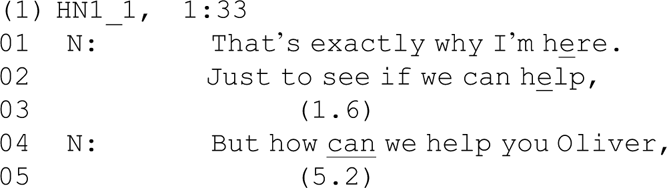
N formulates their role and purpose in line 02, as “Just to see if we can h
In this paper, we address how negotiators come to present, and defend, “help” as something they can legitimately offer or propose, and how they define their proposed actions as “help,” both of which people in crisis routinely reject. We also identify and describe the circumstances in which resistance towards “help” is reduced, and eventually overcome. The paper therefore offers unique insights into what strong resistance actually looks like, as well as how professional crisis negotiators respond to such resistance and manage to minimize or de-escalate it.
We proceed by providing more background on how resistance to help has been understood previously, first related to the largely psychological literature on suicidal ideation and crisis negotiation, and second in the context of understanding resistance towards advice help from conversation analytic research.
Help Resistance and Suicidal Ideation
A person is in crisis when they face “an obstacle to important life goals that is, for a time, insurmountable through the utilization of customary methods of problem-solving” (Caplan 1961, p.18). A range of specialist institutions and organizations aim to support people in crisis and help to address such obstacles and problems, including counseling and helpline services (Mishara & Kerkhof, 2013; see also, Baker et al., 2005, for an overview). Depending on the type and purpose of the service, some helplines are given more targeted, crisis-oriented, names such as “crisis hotlines” (Gould et al., 2012—as opposed to “warmlines,” Pudlinski, 2005). Overall, a crisis (i.e., the problem) and help (i.e., its solution) are fundamentally tightly linked, both conceptually and institutionally.
While the provision and availability of help for people in crisis is important from an outsider's point of view—societally, practically, and morally—the proposed recipient of help may not see things the same way. In psychology, research on suicide ideation explores the association between a person's willingness or ability to seek help, and the degree to which they are thinking about taking their own lives. Importantly, while help is institutionalized through, for instance, online services or telephone helplines (e.g., Mathieu et al., 2021), not all suicidal people in crisis seek out professional help. Barriers to seeking help have been identified in the psychological literature on suicide prevention, in terms of how suicidal individuals may negate, refuse, or avoid seeking help—the so-called help negation effect (Gould et al., 2012). For example, Deane et al. (2001) surveyed the help-seeking behaviors of university students and found that suicidal ideation was (negatively) associated with a reduction in all intentions to seek help, implying that if suicidal ideation increases then the intention to seek help decreases.
The phrase “a cry for help” is commonly used to describe the discrepancy between the relevance (i.e., from an outsider's point of view) of help, and a person's unwillingness to seek or accept help. The phrase is also a cliché and, according to Kahn and Earle (1982), “more likely to be used ironically …[and]… come to resemble the term “attention seeking,” which is often taken to mean that attention should not be given” (p. 1). It was first associated with suicide in 1961, in Farberow and Shneidman's book of the same title (Farberow & Schneidman, 1961). Researchers have long since examined the relationship between “the verbal and nonverbal communication of suicidal ideas” and “the wish to die” (e.g., Steer et al., 1988). Typically, “a cry for help” describes a person's behavior as having escalated to self-harm and potential suicide, treating the displayed intent (or threat) of suicide as merely a threat, not true intent (see e.g., Jordan & Samuelson, 2016). Indeed, “a cry for help” is also reportedly used by individuals who themselves attempted suicide, in explaining their non-intent; for example, “my attempt was a cry for help. I did not intend to die” (Jordan & Samuelson, 2016, p. 295), and, “I saw the doctor and said I was over it and told my family it was a cry for help not a serious attempt” (Fortune et al., 2008, p. 9). Thus, “a cry for help” is available as a commonplace to understand and account for another's, or one's own, suicidal behavior as non-intentional. While it is imperative to understand suicidal ideation and how to prevent suicide, including the use and effectiveness of service provision, such understandings do not necessarily provide practical solutions for negotiators dealing with help resistance and resolving a high-stakes crisis unfolding in real time. And the notion of “a cry for help” may not fully appreciate the routine ways suicidal individuals go about seeking help in the first place.
In his early conversation analytic studies of calls to the Los Angeles Suicide Prevention Center, Sacks (1966, 1992) argued that contemplating suicide is routine and rational, and that we need to appreciate that “the decision to take one's own life is fully embedded in this world” (Silverman, 1998, p. 3). He (1966, 1992) showed how callers to suicide helplines complained to call-takers that others (e.g., friends, family) did not take their suicidal ideation seriously and sometimes responded with laughter. Sacks argued that such responses avoid treating someone's suicide threat as an implicit criticism of their relationship, and thus “transform […] ‘a cry for help’ into a joke” (Silverman, 1998, p. 2). Thus, callers concluded that they have “no one to turn to” since help had been sought and rejected from their spouse, partner, or friend—the most likely and categorially-obliged to provide support to the other spouse, partner, or friend. Herein lies a possible understanding of “help resistance”: if a person in crisis has experienced that their suicide threat is not taken seriously by those closest to them, why would they accept offers of help from a stranger—a negotiator?
We know very little about how the notion and formulation of “help” works in crisis negotiation where the stakes are acutely high. Instead, the relevance of help in crisis negotiations is assumed but not investigated in situ, in terms of the circumstances in which crisis negotiators offer to help, and whether/not and how the person in crisis rejects, resists, or accepts it. Only a handful of studies examine live, real cases of crisis negotiation (e.g., Charlés, 2007; Rubin, 2016; Sikveland et al., 2020), but these remain the minority of the overall literature on communication in this field. We know a little more about help resistance in helpline interactions. However, the occurrence and management of help resistance in helplines (e.g., Sacks, 1966, 1992; te Molder, 2005) raises key questions for our setting where help-seeking has not occurred: interventions in crisis negotiations in which suicidal persons may have expressed an intention to “do it” through embodied actions such as standing on the edge of a tall building, or in which they are interrupted during their attempt because someone else has called the police. Whether or not standing on a roof in a public place makes one more “available” for help or conveys an intent not to “do it” more than those who attempt suicide in private is impossible to discern in the live timeline of the episodes we study. What we do know is that the persons in crisis in our data have not sought help from the specific negotiators who arrive at the scene (indeed, persons in crisis may ask to speak to someone other than them—see Sikveland & Stokoe, 2020). This means that negotiators are accountable for simply approaching the person in crisis, let alone offering and providing their assistance. We address issues about who is entitled to offer help (and advice) to whom in the next section.
The Asymmetries Associated With Offering Help and Other Support
A body of research in conversation analysis addresses resistance towards actions like institutional offers, proposals, or advice (e.g., Albury et al., 2022; Butler et al., 2010; Bloch & Antaki, 2022; Heritage & Lindström, 2012; Jefferson & Lee, 1981; Koenig, 2011). While previous studies generally find and analyze (relatively) weak forms of resistance, they are also based on settings involving advice rather than help. By giving advice, “a person forwards a future course of action for another person” (Hepburn et al., 2014, p. 241). The asymmetry associated with giving advice—that the proposed future action is better than any current action—might also extend to offering help, the possible difference being that in accepting and receiving help the recipient has less autonomy in carrying out the proposed alternative action than if they choose to follow someone's advice. In any case, we may expect that resistance towards advice and help may both operate on similar dimensions of epistemic and deontic rights in circumstances where these are at stake (see, for example, Heritage, 2012; Stevanovic & Peräkylä, 2012), though the form and strength of the resistance, and the hurdles to overcome it, may differ from situation to situation.
Bloch and Antaki (2022) investigated explicit resistance to advice across medical and welfare services. They observed that, when clients objected to something in the practitioner's domain of expertise and authority, resistance was easily set aside. But when the client's resistance was based on something to which they had primary access, it took more work from the practitioner to overcome it. A similar challenge might be relevant to crisis negotiations, regarding who has the right to ask or tell the person in crisis to turn away from what they have already decided to do. In Bloch and Antaki's (2022) study, one common resource for practitioners to overcome resistance was to concede to the objection but then re-issue the advice in a different form, building on their own territory of knowledge or expertise.
Any institutional encounter involves handling potential asymmetries of category entitlement (Potter, 1996), and epistemic access, rights, and responsibilities (Stivers et al., 2011). This can be illustrated by the way help is offered (or not, and/or assumed) across various professional encounters. As we saw earlier in Extract 1, offering to help may not be as straightforward in crisis negotiations as they are in other forms of service encounters. In a doctor-patient consultation, for example, the need for help is presumed, and a generalized offer such as “how can I help you today” (where, crucially, “can” is not prosodically marked as it is in Extract 1) serves to open the encounter and display the doctor's lack of knowledge of the reason for the visit (Heath, 1981). Many types of service providers, who may also be described as in some way “helping” the service recipient, do not start the encounter making explicit that “I am here to help.” Yet this is a type of formulation we regularly find in crisis negotiations, and which we will see negotiators use when responding to and managing resistance from the person in crisis. But how and why do negotiators do this, and does it work to reduce or increase the distance between the negotiating parties? If not, what alternatives do negotiators have?
Data and Methods
We analyzed 14 cases of audio-recorded crisis negotiation totaling 31 h. Data were collected and provided by a UK police hostage and crisis negotiation unit as part of routine practice (i.e., not for research in the first instance, and no video-recordings were made). We were granted access to the data by the hostage and crisis negotiation unit under a Data Processing Agreement (used in the UK by police when working with academic researchers). The project was also approved by Loughborough University's Ethics Approval (Human Participants) Sub-Committee. The data were stored under encryption and anonymized in line with established ethical practice when working with recordings (Speer & Stokoe, 2014), which includes the anonymization of the audio files by removing names and all other identifying information and anonymizing voices through pitch shifting software.
Crisis negotiators are specially trained police officers (see, for example, McMains & Mullins, 2014). The negotiations happened in many configurations: a person in crisis may be barricaded inside a building or on a roof; the negotiation may be conducted over the telephone or “face to face,” sometimes at some physical distance. Twelve cases ended safely and “successfully”: the person in crisis eventually moved away or came down from a precarious position. One case ended fatally, and one with injury. All the cases reported in this paper ended with the person in crisis moving to safety.
The data were transcribed using the Jefferson (2004) system and analyzed with conversation analysis. We identified each case in which the negotiator formulates their purpose, in terms of helping the person in crisis, and otherwise offers their assistance using constructions with “help” and/or “sort (X) out.” Our collection of cases comprised a collection of 57 cases in total, 40 constructions of “help” and 17 of “sort (X) out.” We analyzed each case in terms of their sequential location and turn designs/action in both the initial offer and the response(s) that followed. In line with the conversation analytic notion of the “next turn proof procedure,” it is the participant's (not the analyst's) understandings and treatments of previous turns which is a resource for analysis (see e.g., Sidnell, 2013). Next turn proof is key to understanding resistance in our research since on each occasion a negotiator offers to help, the person in crisis may align or disalign with the negotiator. We build our analysis around how and in what circumstances the person in crisis aligns/disaligns with the negotiator's offer, and accounts for such positioning in the next turn(s) of talk.
Analysis
The first two analytic sections focus on how negotiators use formulations of “help” in two different stages of the negotiation. We start by showing how negotiators offer help as a way of defining their role and purpose (“I am (just) here to help”) and to defend and legitimize their presence in the face of resistance from the person in crisis. This first type of help formulation typically occurred during early stages of the negotiation, when offers of help are generalized or pro-forma; that is, not yet specified for or by the person in crisis. Next, we examine help formulations found later in the encounters, whereby negotiators attempt to propose and specify what help may look like and how help is relevant to resolve the crisis (e.g., “that's help we can genuinely provide”). Both types of help formulation were routinely met with strong resistance and rejection from the person in crisis. In the third and final analysis section, we investigate some exceptions to formulations of help being rejected and demonstrate alternative ways of making “help” relevant to the person in crisis, associated with a positive shift in the negotiation.
Negotiators Offer Help as a Contrast to Other Purposes of Negotiation
Early in crisis encounters, negotiators may formulate their role and purpose as providing help for the person in crisis, for example, “I’m here to help.” More than a generalized opening offer (e.g., the opening of a service telephone call, “Good morning, how can I help?”), negotiators use these early formulations of role and purpose to defend and legitimize their presence, by contrasting their offer to help with the expressed or perceived reasons behind the person in crisis's resistance towards the negotiation. But, as we will see, a negotiator's offer to help leads to further resistance and, indeed, an outright rejection from the person in crisis.
In Extract 2, the negotiator (N) has just arrived at the scene where the person in crisis (PiC) is barricaded inside her flat.
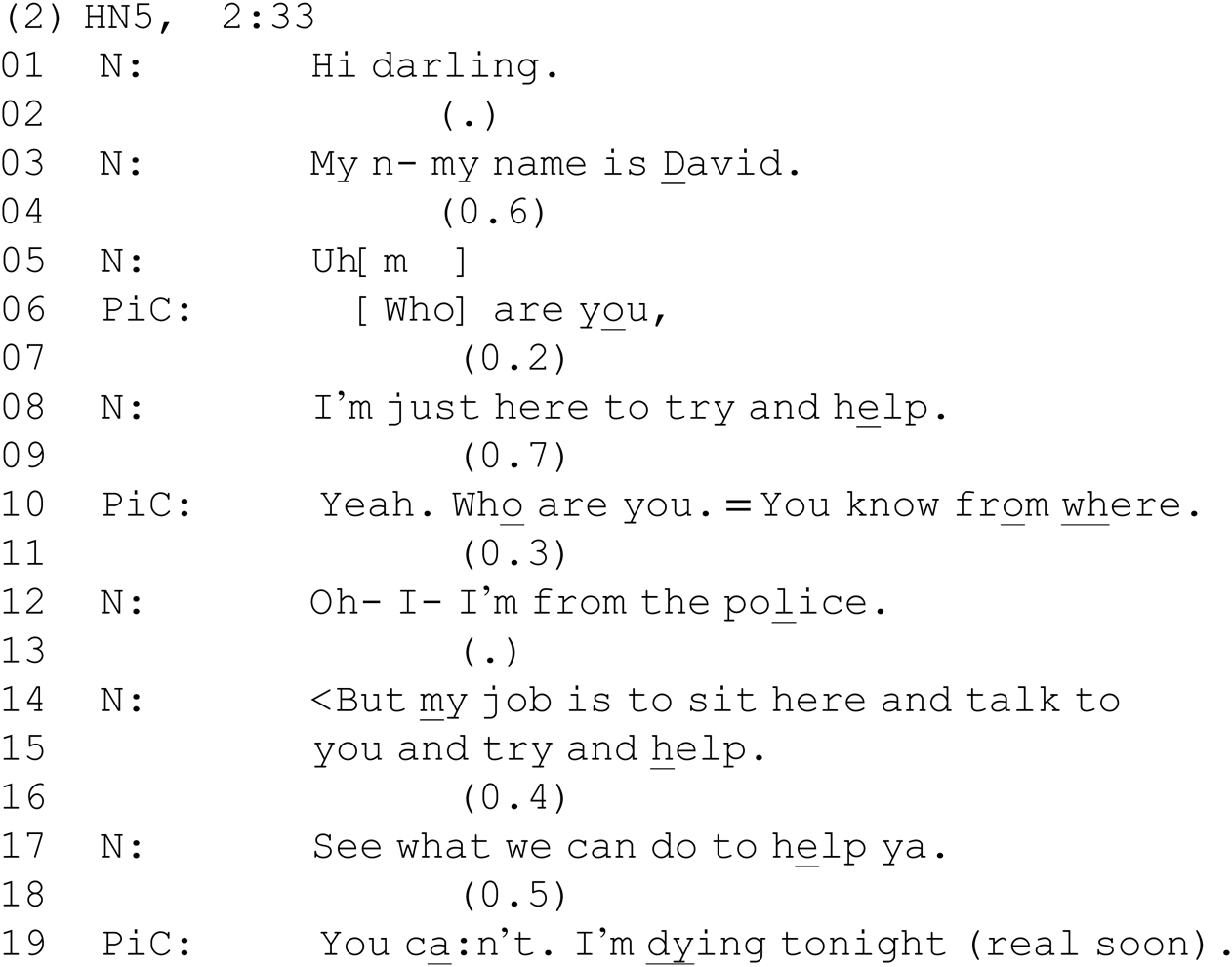
Following an unreciprocated greeting (line 01), N introduces himself by name in line 03: “my name is David.” A return greeting remains absent for 0.6 s (line 04), before N initiates a new turn in overlap with PiC in lines 05 and 06. PiC's “who are you,” (line 06) is produced where one may expect a return greeting or acknowledgment of N's presence. By asking “who are you” PiC resists engaging with N and treats N as accountable for not giving PiC the relevant information to disclose his identity. In response, N provides an account of his purpose or role: “I’m just here to try and help.” (line 08). This is not a direct answer to “who are you,” and PiC treats N's answer as unfitted by reformulating her question: “Yeah.
In line 12, with the turn-initial “oh,” N displays his “change of state” (Heritage, 1984), suggesting that only at this moment did the potential mismatch between PiC's question (“who are you”) and his answer (“I’m just here to try and help.”) occur to him. Then, in line 14, N returns to his first answer, expanding on his identity as “police”: “<But my job is to sit here and talk to you and try and help.” By expanding on and contrasting (with the turn-initial “but”) his identity as “police” in this way, N shows that his original agenda from line 08 has not changed, despite providing additional information about his identity or role in the meantime. In its interactional context, N's formulation of his role as help provider is responsive to PiC's resistance towards the negotiation/negotiator, that is, by not reciprocating N's greeting and instead confronts them with “who are you” (line 06).. Furthermore, this exchange suggests how negotiators may seek to avoid or dissociating from categorization as “police,” and that defining their role as one that involves “helping” is used in service of that dissociation.
Now that we have seen how negotiators first come to use formulations of help as a contrast offer dealing with resistance towards the negotiation, we proceed with our second observation, that the persons in crisis in our data maintain their resistance following the negotiator's offer to help. In Extract 2, PiC's disalignment is visible throughout, then she produces an outright rejection of help in line 19: “You c
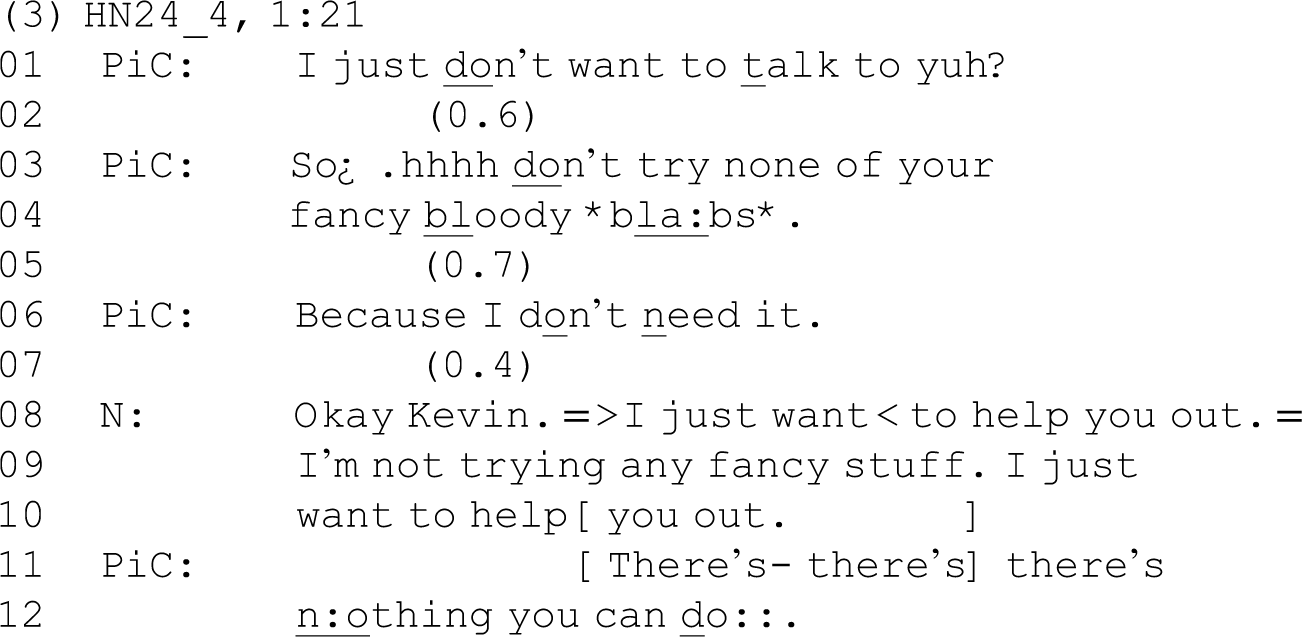
In lines 01–06, PiC rejects N's earlier proposal to talk (line 01), first on account of “just
In line 08, N responds to PiC's resistance, starting with an address term projecting a course of action that diverges from PiC's understanding (Clayman, 2013). Here, N goes on to contrast his offer “to help you out.” (line 01) with his take on PiC's earlier claim that negotiators are “trying […] fancy stuff” (line 09) to get him to align with them. N repeats his offer to help in lines 09–10. As in Extract 2, N's “just” modifies the verb “help,” to argue against the reasons PiC presents for resisting the negotiation, in this case that the negotiators are guided by hidden agendas or methods. The negotiator on his part defends his intentions as genuine and legitimate, with the implication that they are there in PiC's best interest, not their own. In transitional overlap (Jefferson, 1984), PiC rejects N's offer outright, with “There's n:othing you can do::.” (lines 11–12), including an extreme case formulation (“nothing”) to ward against potential challenge (Pomerantz, 1986). Instead of further challenging N's intentions as genuine, PiC rejects N's offer to help as in any case irrelevant for him, as in Extract 2.
A person in crisis may also involve a third party when targeting the genuine nature of the negotiation as the reason for their resistance. In Extract 4, PiC points to his mother as responsible for having “got [the negotiators] over here.” (line 05). PiC is located in a loft threatening to end his life. The reasons he gives are having suffered an abusive relationship with his mother and a series of setbacks in life including not being able to secure a home of his own.
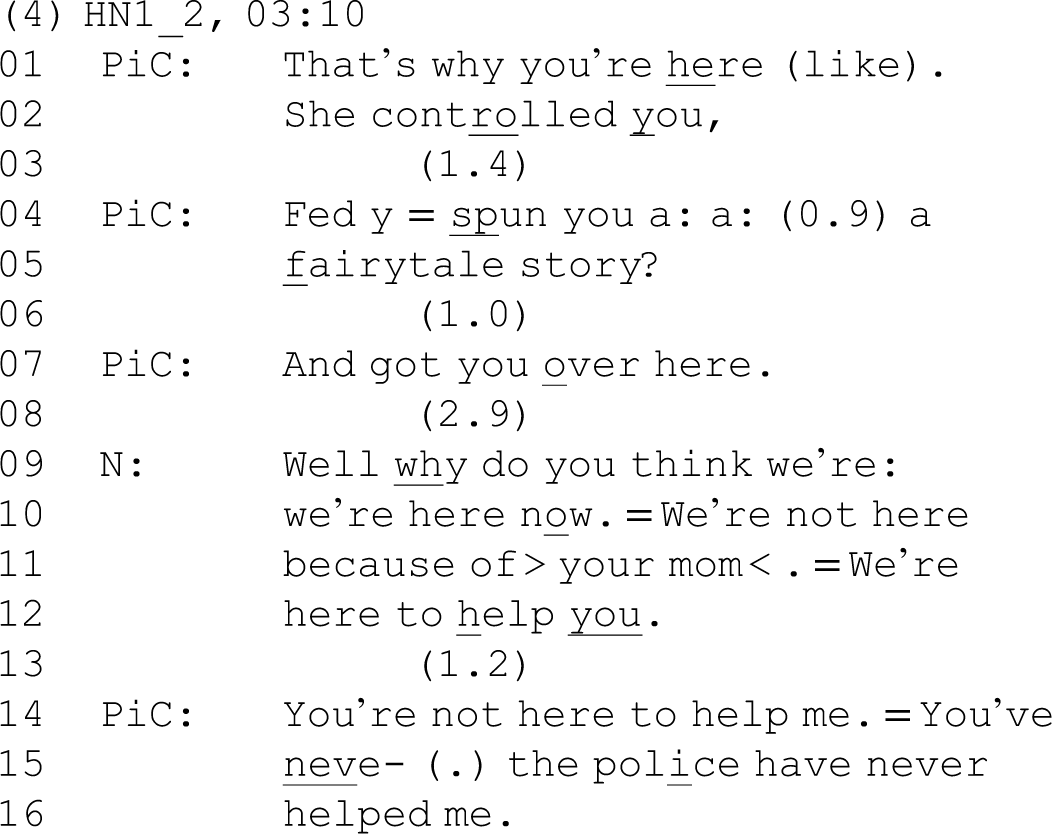
In lines 01–07, PiC accounts for his resistance towards N's presence. The “that” in “That's why you’re here (like)” indexes prospectively (Goodwin, 1996) the specification of “she” (i.e., PiC's mom) as responsible for getting the negotiators “over here.” (line 07), and that his mom's intentions are based on lies, “She controlled you,” (line 02) and “spun […] a fairytale story?” (lines 04–05). Like Extract 3, PiC targets a hidden agenda as a reason to resist the negotiation; in this case, that the negotiation is based on false premises. In response, N poses a challenge in the form of an interrogative, “Well why do you think we’r:e here n
Like Extracts 2 and 3, N contrasts help with PiC's (expressed or perceived) reasons for resisting the negotiation. As part of this contrast, N specifies the recipient (or beneficiary) of help: PiC, not PiC's mom. By prosodically marking “
In summary, based on Extracts 2–4, we have seen how negotiators use formulations of help in defense of role legitimacy and purpose, treated as an offer contrasting the expressed or perceived reasons for resistance. Negotiators offer help to show they are different from police enacting force (Extract 2), and to show their intentions are genuine (Extracts 3 and 4); that is, modifying or subverting the category-bound activities and predicates (Sacks, 1992) of “police.” While negotiators set out to minimize the risk of threat to the PiC (e.g., with the modifier “just” in “I’m just here to help”), their resistance is maintained and even intensified following an offer to help. Our analysis shows that offering to help at the outset of these encounters is not interactionally productive, as it leads to rejection. In the next section we present later stages of the negotiations, where negotiators come to define help in terms of needs particularized in and through the interaction. We explore whether and how negotiators’ efforts to define help may be productive for the negotiation, and how they may productively involve the person in crisis in doing so.
Persons in Crisis Reject Negotiators’ Definition of Help as “Help”
In the previous section, we saw how negotiators’ offers to help were easily rejected by the person in crisis. In our data, what actually constitutes “help” was not readily defined in the early stages of the negotiation; for example, in terms of any specific needs or wishes of the person in crisis. In the next two sections, we explore the possibility that people in crisis might accept some formulation of help if it were further developed, perhaps based around actions the people in crisis themselves initiate or align with. But before getting to resources for overcoming resistance to “help,” we will see in Extracts 5 and 6 how people in crisis reject a potential resolution to the crisis when formulated as “help,” with negative consequences for the interaction.
Extract 5 is taken from later in the same negotiation as Extract 3, in which PiC is barricaded in his flat, with a gun. The negotiation is conducted over the telephone, and PiC keeps hanging up and thereby refusing to engage in conversation. In lines 01–02, PiC demands cigarettes, something the negotiators will attempt to use to bargain: here, proposing PiC “speak to [N]” (line 05).
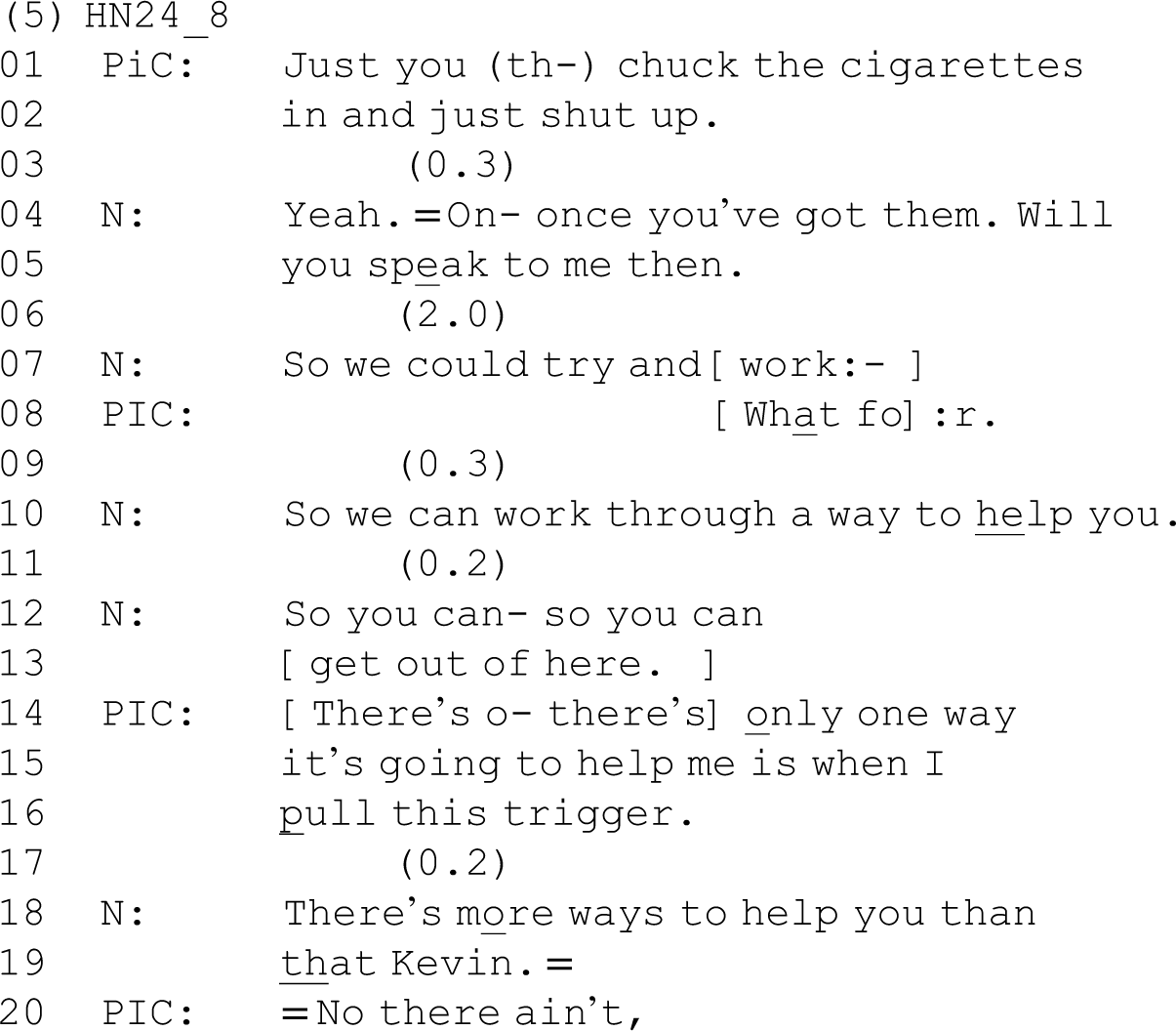
Following N's dialogue proposal in lines 04–05, PiC verbally disaligns and challenges the proposal in line 08: “Wh
Extract 6 presents another example whereby a potential resolution defined as “help” is more advanced and built on previous alignment and engagement from PiC. Extract 6 is taken from the same negotiation as Extract 4, where PiC has had a number of setbacks including not being able to secure his own home to live in. PiC has previously been involved with social services but has now turned 18 years old and is therefore ineligible for particular kinds of continued support. Prior to the extract, PiC has displayed concern his situation will worsen if he goes to the police station.
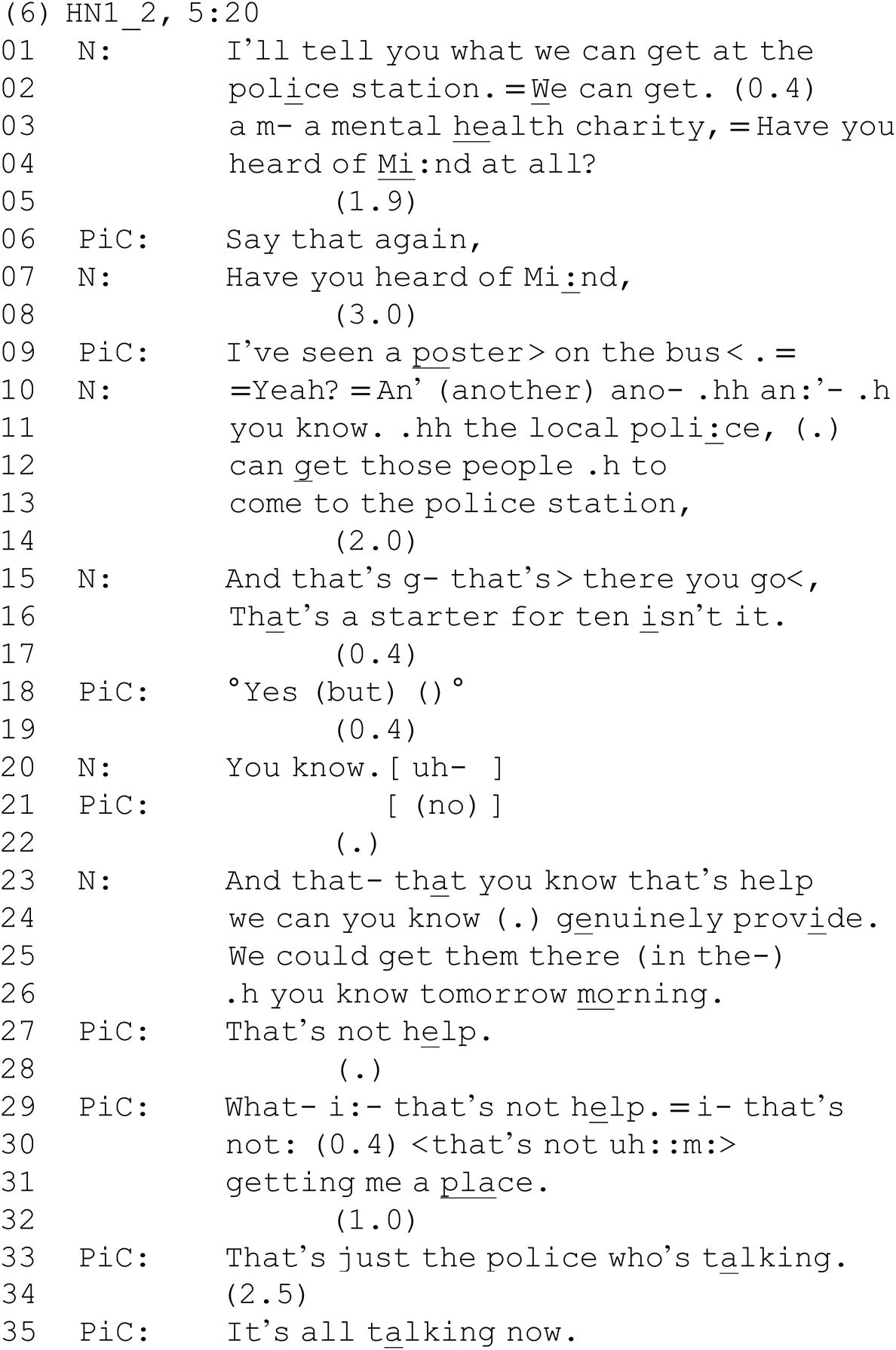
In lines 01–04, N initiates a proposal that a mental health charity, “Mind,” might be able to support PiC. N does so in a multi-unit turn: “I’ll tell you what we can get” (line 01) sets the frame for additional turn components to specify the proposed resolution. Before proceeding with the proposal, N seeks a confirmation whether PiC has heard of “Mind” in line 04, in which the “at all” opens for a “no” as a relevant response, that is, opening for the possibility that PiC has not heard of this charity. N thereby may also secure that any upcoming resistance is based on a domain that PiC already has epistemic access to (see Heritage, 2012). Following a 1.9 s gap (line 05), PiC initiates a repair in line 06 (“Say that again”), which, compared to the strong forms of resistance we saw in some of the earlier cases, aligns with rather than prevents N from progressing his proposal. After a long gap (line 08), which we have shown can precede an aligned rather than disaligned response in crisis negotiation (Stokoe et al., 2020), PiC gives a go-ahead to N's solution-based proposal (“I’ve seen a poster > on the bus<,” line 09), which N then proceeds to unpack in lines 10–16.
PiC displays a weaker form of resistance in lines 18/21 (silence, and ambiguous verbal content), before N formulates the proposed resolution as “help we can you know (.) g
In summary, Extracts 5–6 show how negotiator attempt to make help relevant and specific (moving away from a generalized offer), to progress the negotiation beyond outright rejection. However, defining the proposed action in terms of “help” (e.g., “that is help”) seems to open a slot for further rejection from the person in crisis. In the final section, we explore some alternative approaches to defining help, including not formulating them as “help.”
Overcoming Resistance: Alternatives to “Help”
Extracts 5 and 6 are examples of how negotiators attempt to propose a way forward. However, in these cases, defining the way forward in terms of “help” did not lead to acceptance from the person in crisis. Rather, the person in crisis leveraged the terms of the negotiator's “help” formulations to formulate an explicit rejection. A core issue in the extracts shown so far, and in crisis negotiation generally, is that a person in crisis does not themselves initiate requests for help or define what would comprise it. In our data, we did not find instances where the person in crisis would accept assistance that was formulated as “help.” Given that many negotiations ended safely and successfully, however, we know that negotiators do find alternative ways of working towards a potential resolution. In this section, we start by showing alternative formulations to “help”; specifically, to “sort (X) out,” and how they are not met with similar strong forms of resistance (e.g., we do not find “you can’t sort it out… no one has ever sorted things out for me”; “the only way things can be sorted is…”;), but weaker forms of resistance inviting the negotiator's further elaboration (e.g., “what's going to happen then”).
Extract 7 takes place a couple of minutes later than the start of Extract 6, where N reiterates his proposal to take PiC down to the police station, so that PiC can meet health personnel and charities that are set up to help people in PiC's situation. Only this time N does not define it as “help” but as a way to “[ ] sort[X] out” (lines 03 and 13).
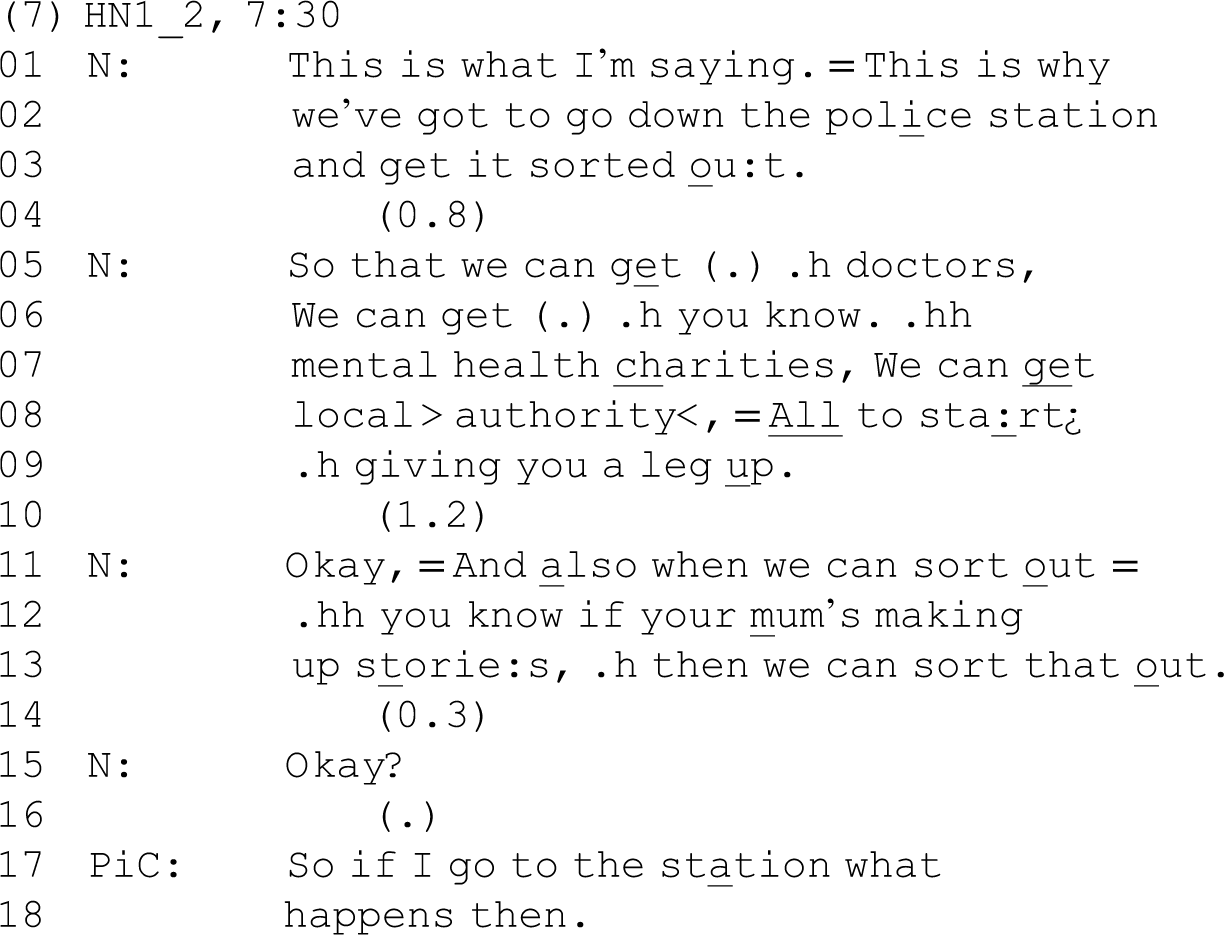
In lines 01–03 N pursues the relevance of the support proposed in Extract 6: “This is why…” N goes on to list three category items of professionals PiC can meet if agreeing to come with them to the police station: doctors, mental health charities, local authority (in lines 05–09). Then, in lines 11–13, N also brings up PiC's mom and her “making up stories” as something they can potentially “sort out.” N takes PiC's side proposing a resolution building on his complaint about his mom. PiC resists the proposal in lines 17–18, however not as an outright rejection that these are things that can be sorted out, but providing N with another opportunity to specify the terms with which PiC may decide to come down.
Extract 8 is taken from later stages of a negotiation where PiC is positioned on a roof top. N makes a directive “We’re going to the station, ‘n we’ll sort this
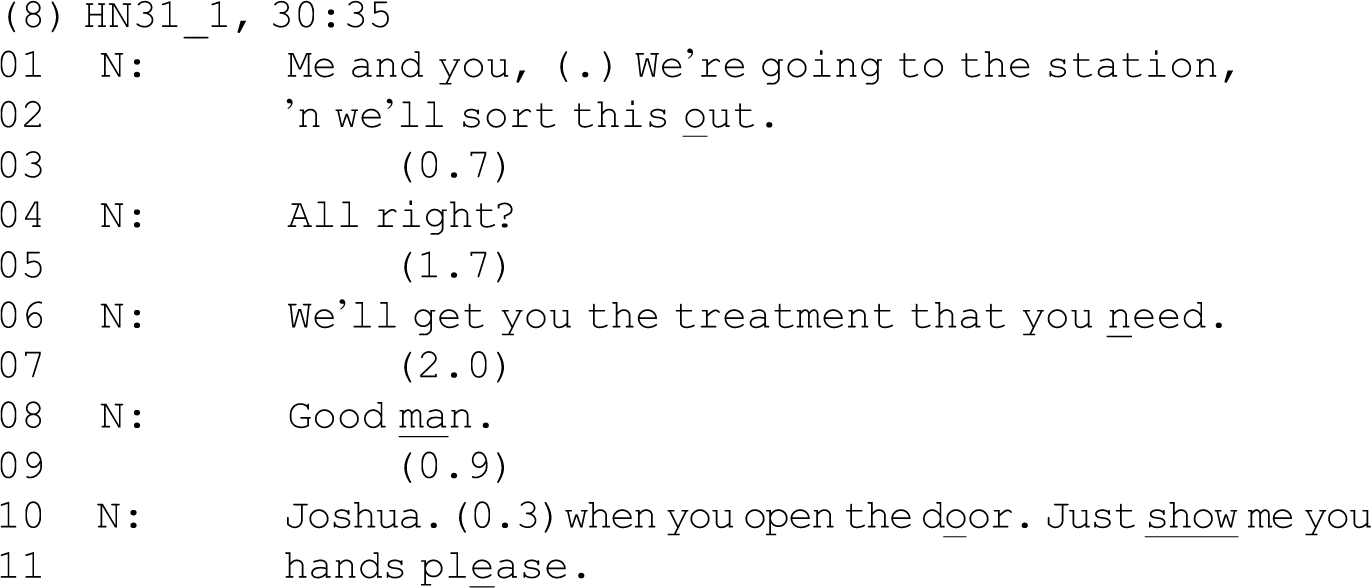
In Extract 8, as in Extract 7, the formulation “we’ll sort this
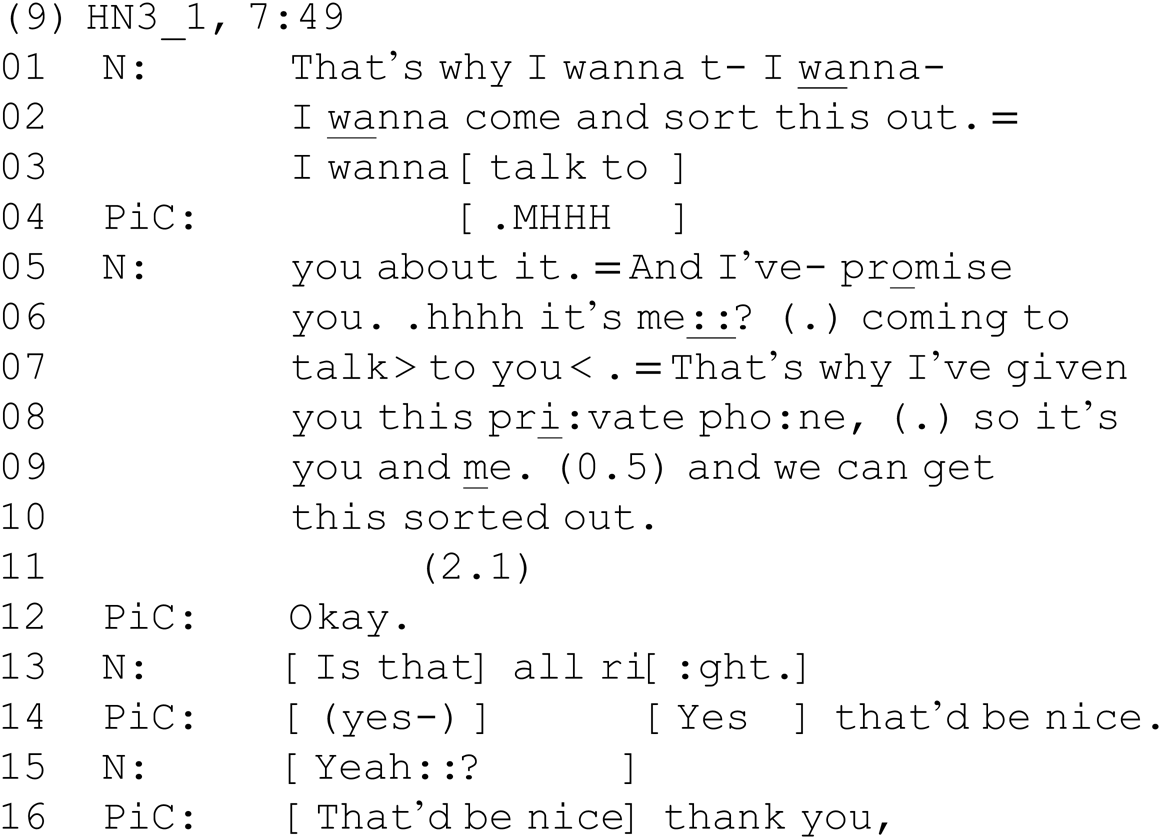
N ties her account “That's why I […] I wanna come and sort this out.” (lines 01–02) with PiC's displays of fear that the police is going to break into his flat. Without further defining what will be sorted out (lines 05–10), N reassures PiC that it will only be the two of them involved in a conversation, and that “we can get this sorted out” (lines 09–10). This is a rare case of PiC accepting an offer, and he does so in lines 12 (“Okay.”) and 14 (“Yes that’d be nice”).
In Extract 10, PiC is barricaded on a balcony. PiC has challenged N in that they are just there to avoid getting in trouble, not because they genuinely want to help the PiC. Like Extracts 3–4, PiC can here be seen to attempt undermining the negotiation. But following PiC's rejection of help as something N can legitimately provide (line 10), N starts building a proposal based on what PiC sees the problem: that, because the police are already there they will have to do something, implying that something is outside PiC's control.
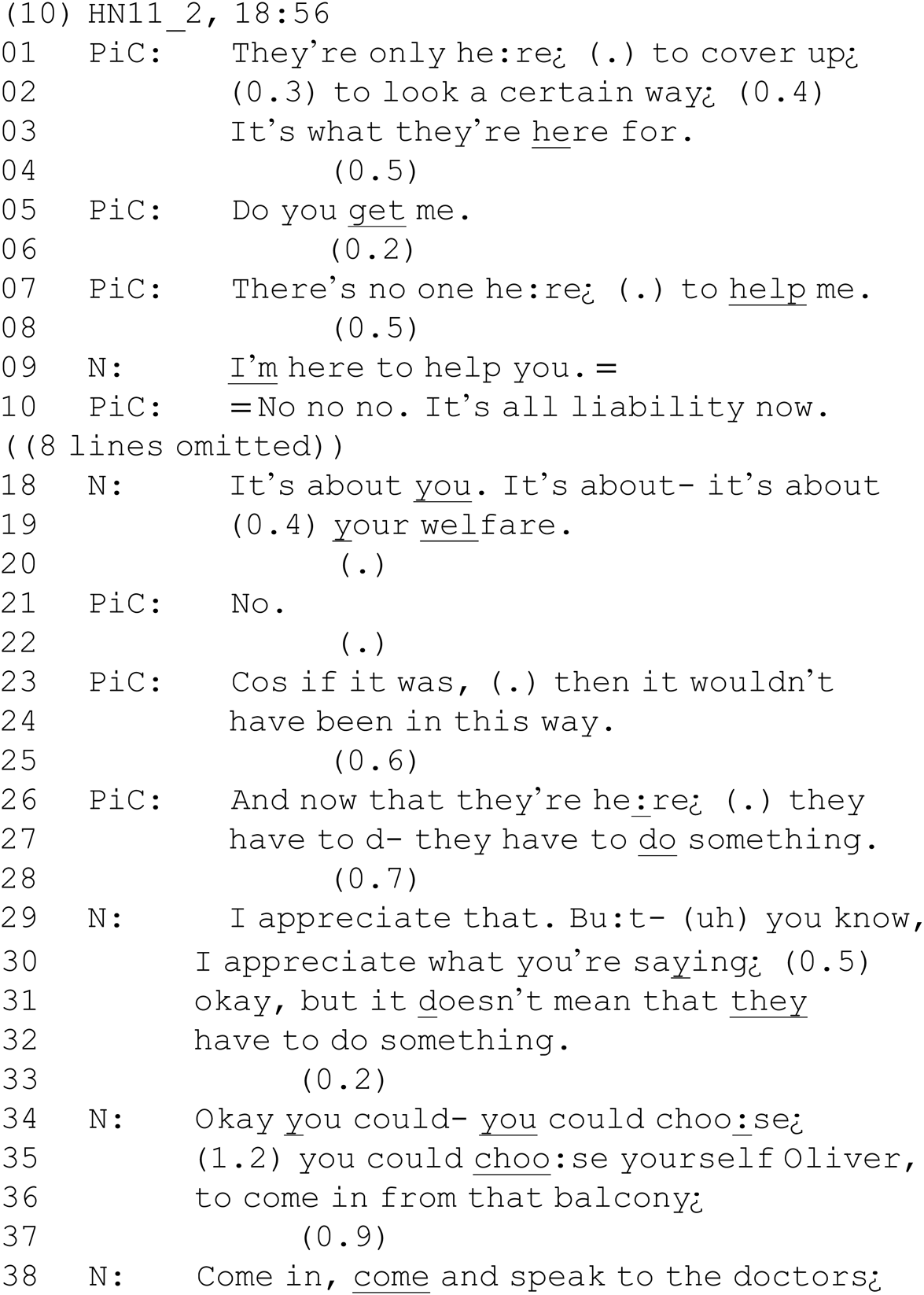
In lines 01–03 we see similar accounts to those in Extract 3–4, seeking to expose the negotiators as not genuine, “They’re only he:re […] to cover up … to look a certain way.” While not directly asking for help, PiC makes help a relevant concept (that no one can provide) in line 07. N then claims that he is there to help (line 09), which PiC immediately rejects, on the basis that “It's all liability now.” (line 10), implying that the police/negotiators are only there to avoid creating trouble for themselves, not because they have an interest in PiC's well-being. From here onwards, N turns away from insisting he is there to help, focusing instead on PiC being the one making choices to do something. N responds to PiC's claim that the police “have to
Unlike Extracts 1–6, Extract 10 (lines 18 onwards) is a case where N does not seek to legitimize and define help as “help,” yet progress is made in that PiC no longer explicitly rejects what N's proposal. A person in crisis rarely displays direct agreement with the proposals or offers made by a negotiator in our data (for responses to dialogue proposals, see Sikveland & Stokoe, 2020), and at no point in the data does a PiC accept “help” directly. Yet most PiCs (and all PiCs in the data we present in this paper) do eventually move to safety. Our final example is one where PiC eventually decides to come down, in a sequential position where he could be seen to agree with N's proposal involving “help,” but as we will see, PiC by design initiates a first action not a responsive action. Negotiators have offered a lift, with the assistance of the fire brigade.
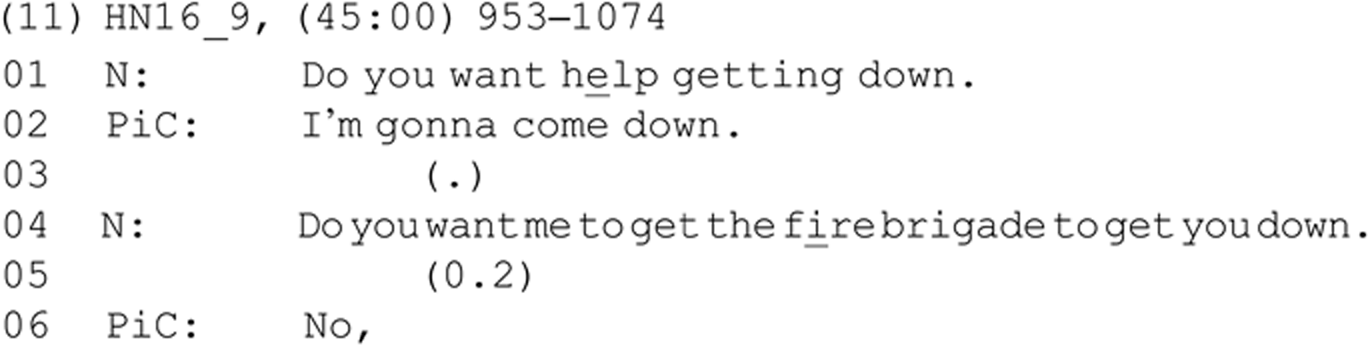
Unlike Extracts 1–6, the formulation of “help” at line 01 is not a generalized offer or an effort to define help as “help.” Note that although N asks a yes/no question to offer a particular kind of help at line 01, PiC's response is neither yes or no, but rather a sequentially “independent” assertion of his intention to “come down” of the kind we have found elsewhere in the data (Stokoe et al., 2020). This example shows that when a person in crisis eventually decides to move to safety, they often orient to and formulate the decision as independent from the negotiator's proposed course of action. Finally, while initially rejecting the fire brigade lift that N next inquires about (line 06), PiC implicitly agrees for the lift to get him down a few minutes later.
In this analysis, we have shown how negotiators offer help to define their role and purpose (“I am (just) here to help”) and to defend and legitimize their presence in the face of resistance from the person in crisis. We have then shown how negotiators use help formulations later in the encounters, to propose and specify what help may look like and how help is relevant to resolve the crisis. Both types of help formulation were routinely met with strong resistance and rejection from the person in crisis, and to contrast these cases we have shown some alternative methods negotiators have of making “help” relevant to the person in crisis, and which were part of a positive shift in the negotiation.
Discussion
The starting point of a negotiation with a (suicidal) person in crisis is one where negotiators offer help to someone who has not asked them for it, and therefore have no interactional rights or access to knowing what that help might be. This creates barriers to negotiation and delays progress towards a safe outcome and crisis resolution, which our data show negotiators must continually manage. This paper focused on how negotiators come to formulate help as something they are there to provide, and as something that is relevant to the person in crisis. But what implications does offering help have for someone who has not asked for it, and for whom help might be something they have previously sought but failed to get? Little research has explored these questions based on naturally occurring crisis negotiations where the stakes are acutely high and live.
Our analysis has shown that negotiators use formulations of help as a contrasting device, in response to already-articulated resistance from the person in crisis. We have shown how negotiators use formulations of help in defense of role legitimacy and purpose, treated as an offer contrasting the expressed or perceived reasons for resistance.
“I’m just here to help” responds to implicit or explicit resistance in crisis negotiations, the implicit resistance seemingly based on persons in crisis equating the categories “police” and “negotiator” in terms of their presumptive entitlements and role obligations; that is, an institutional actor who may remove agency from those in crisis. People in crisis were also found to reject generalized offers of help in explicit terms, either by contrasting the negotiator's offer with what they want (or have already decided to do), or exposing the negotiator's agenda as different from how they present themselves.
As we have shown in Extract 3, as soon as negotiators were able to defend their genuine intentions to help, persons in crisis typically rejected help on the basis of its irrelevance. The challenge for negotiators is, therefore, to specify help as something concrete. We saw how, later in encounters, negotiators may proceed to legitimize help, building concrete proposals made about future actions to resolve the crisis (Extracts 6 and 7). When formulated as “help,” such proposals were met with continued and escalated resistance using the very terms negotiators used (Extracts 6 and 10). However, when negotiators reformulated their proposal to “sort X out,” they were met with weaker forms of resistance rather than outright rejection, as well as challenges that nevertheless expanded the sequence underway (Extracts 7–9). The analysis also showed that, when negotiators shifted the focus onto decisions within the PiC's territory of control, progress was made (Extracts 10 and 11).
Our findings suggest that the way to make offers work is not simply to specify their relevance in terms of PiC's needs (unidirectionally or bidirectionally), but also in terms of the precise words used: while PiC would regularly resist or challenge proposals to “sort out X,” they did not explicitly undermine the act or relevance of “sorting (X) out.” In contrast, PiCs would explicitly undermine the relevance of “help” (e.g., “that's help” in Extract 6). Based on our findings, we suggest that by avoiding defining help as “help,” negotiators also avoid escalating resistance from persons in crisis towards the negotiation.
We may understand the persons in crisis's resistance towards help based on dimensions of epistemic and deontic rights are at stake (see e.g., Heritage, 2012; Stevanovic & Peräkylä, 2012). Also, we may seek to understand the resistance in terms of who counts as the benefactors and beneficiaries of offers and proposals (Clayman & Heritage, 2014). According to this framework, the person putting forward an offer displays a (benefactive) stance that the offer is genuine and relevant; however, sometimes the stance does not correspond to the (benefactive) status of the person making the offer. Clayman and Heritage (2014) refer to benefactive status as “a complex of underlying conditions for the action, including such matters as whether a service will be rendered that is of actual benefit to its recipient, whether the performer of the service is able and willing to perform it, whether the cost to the performer is high or low, and whether the service is to be performed immediately (a ‘proximal’ service) or at some later time (a ‘distal’ service)” (p. 58). Consequently, a recipient may also undermine the notion that an offer or a proposal put forward is something they can accept.
Such mismatch between benefactive stance and status is evident in our data, but it remains unclear to what extent aspects of directionality in the offer/proposal sequence are of relevance to the type and strength of resistance forthcoming. According to Clayman and Heritage (2014), offers and proposals are understood as different in terms of division of labor between the benefactor and beneficiary, offers working unidirectionally (from the producer to the recipient of the offer) and proposals bidirectionally (joint production). However, our analysis did not readily separate offers/proposals to “help” or “sort (X) out” in terms of directionality, thus, the directionality associated with offering or proposing help does not seem to fully account for the problem of accepting assistance. Resistance towards offers and proposals calls when deontic rights are at stake calls for further enquiry, in terms of whether and how both different turn designs (including word choices and phrasal constructions other than “help” and “sort”) and directionality are tied with different outcomes.
It has been suggested that the best help a crisis negotiator can provide is to “remain calm, poised and in control” (James & Gilliland, 2016, p. 24). Yet there is a persistent gap between written recommendations, theories, or models of crisis communication—such as “remain calm,” “listen actively”—and whether and how such phenomenon occur in negotiation “as it happens” (Boden, 1990). For the New York Police Department, for example, core negotiation skills comprise their “motto,” which is “talk to me…we’re here to help.” We have specified elsewhere how qualities like “remaining calm in a crisis” are actually accomplished through phonetic resources working in aggregate with turn and action design (Sikveland, 2019)—as well as whether they are actually effective, or just normatively imagined to be. The current paper shows that being “here to help”—like “talk to me” (Sikveland & Stokoe, 2020)—reveals a disconnect between the imagined purpose of negotiation and its empirical reality. This is not to say that the goals of talking and helping are wrong, but that, like “the cry for help,” mottos and catchphrases that comprise the discourse of suicide negotiation and prevention may not align with the way the same words are formulated as actions by the professionals whose job is to interact with persons in crisis.
Conclusion
The interactional challenges associated with offering help to someone in crisis that we have identified in this paper underlines the importance of researching help resistance in situ, including in circumstances where help is not sought in the first place, or is pre-defined in institutional terms (e.g., on a “helpline”). Our research contributes towards our understanding of the nature of different forms of resistance and to understand how professionals like crisis negotiators work to minimize or de-escalate the challenges they face in trying influence people in choosing life over death.
Footnotes
Declaration of Conflicting Interests
The author(s) declared no potential conflicts of interest with respect to the research, authorship, and/or publication of this article.
Funding
The author(s) received no financial support for the research, authorship, and/or publication of this article.
