



Abstract
Can theories of power be used to explain differences in the linguistic styles of Donald Trump and Joe Biden? We argue that the two candidates possess and use different forms of power—and that this is associated with typical language patterns. Based on their personal history, news reports, and empirical studies, we expect that Trump’s approach to power is characterized by coercive power forms and Biden’s by collaborative power forms. Using several LIWC categories and the moral foundations dictionary, we analyzed over 500 speeches and 15,000 tweets made during the 2020 election battle. Biden’s speeches can be described as analytical and frequently relating to moral values, whereas Trump’s speeches were characterized by a positive emotional tone. In tweets, Biden used more social words and words related to virtue, honesty, and achievement than Trump did. Trump’s coercive power and Biden’s collaborative power were more observable in tweets than speeches, which may reflect the fact that tweets are more spontaneous than speeches.
My father used to have an expression. He'd say, 'Joey, a job is about a lot more than a paycheck. It's about your dignity. It's about respect. It's about your place in your community.'
—Joe Biden, Twitter, 2019
Be strong & prosper, be weak & die!
—Donald Trump, Twitter, 2019
These two quotations represent statements made by the former and the present most powerful man in the world: Donald Trump and Joe Biden. As the quotations illustrate, the two presidents use different language styles. Whereas Biden emphasizes dignity, respect, and social responsibility, Trump uses derogation and celebrates egocentrism. The presidency offered each man power and social rank. Yet, the two men differ in the arguments they make and how they phrase them. We argue that this may reflect, in part, the different forms of power they value and project. In the present study, we compared the linguistic features of written and spoken language by Trump and Biden, and tested whether the differences can be matched with different forms of power.
Below, we first briefly review literature showing that the language politicians use reflects individual differences. Then, we present three different power theories that reflect a two-factor distinction common in the power literature, between more conflict-based and more collaborative forms (naked vs. traditional power, dominance vs. prestige, coercive vs. collaborative power). We argue that the opposing dimensions can be linked to Trump or Biden based on their political agenda and what is known about their personalities. On that basis, we derive hypotheses about how certain linguistic variables that would be typical of one or the other form of power differ in public communication by Trump and Biden.
Language of Politicians
Previous research has shown several associations between personality and word usage (Fast & Funder, 2008; Hirsh & Peterson, 2009; Schütz & Baumeister, 1999; Tausczik & Pennebaker, 2010). Linguistic styles have been used to make inferences about personality (Borkenau et al., 2016) and social hierarchy (Carney et al., 2005; Fragale, 2006). In this vein, social psychology and political science feature an increasing literature on word usage by politicians.
For example, Slatcher et al. (2007) analyzed the linguistic styles of John Kerry, John Edwards, George W. Bush, and Dick Cheney by using transcripts of speeches, interviews, and debates. They found, among other things, that Dick Cheney’s language was highly cognitively complex and Bush’s language resembled that of a senior person.
A comparison of the linguistic styles of Donald Trump and Hillary Clinton during the 2016 election campaign showed that Trump tended to use short sentences, verb phrases, and pronouns, whereas Clinton preferred nouns and prepositions (Savoy, 2016). It was concluded that Trump’s language was oriented toward action whereas Clinton’s language was more descriptive. Clinton’s communication style was also described as more complex, with a varied vocabulary whereas Trump tended to use repetitions and simple words (Savoy, 2016). Further, Trump’s language style was found to be more negative, higher in authenticity, and lower in analytical thinking than Clinton’s was (Jordan et al., 2018; Liu & Lei, 2018).
These past analyses of linguistic features of political candidates were rather descriptive. In the present study, we investigated descriptive differences in the language used by Biden and Trump, but aimed to advance and deepen this literature by applying a theoretical framework; specifically, we wished to examine whether the two men’s language differences reflect different forms of power as described in three relevant theories.
Theories of Power
Power is understood as the capacity to influence others (Anderson et al., 2012; Fiske, 1993). This capacity is typically based on control over valued resources (Keltner et al., 2003). Researchers studying power have noted the dual nature of this concept because power can have positive as well as negative aspects. Indeed, many power theories propose both a negative, conflict-based aspect and a positive, constructive aspect (e.g., personalized vs. socialized power, McClelland, 1970; harsh vs. soft power, Raven et al., 1998; conflict vs. functional power, Lenski, 1966; naked vs. institutional power, Russell, 1938; coercive vs. collaborative power, ten Brinke & Keltner, 2022; and dominance vs. prestige, e.g., Rucker et al., 2018; see also Anderson & Kilduff, 2009; Fast & Overbeck, 2021; Overbeck, 2010). We propose that these two factors provide a theoretical foundation for predicting differences between Trump’s and Biden’s use of language. To develop our arguments, we borrow from specific instances of two-factor power theories. Further, consistent with some prior work, we use power as an umbrella term that incorporates not only asymmetrical control of resources, but also rank-attaining strategies involving dominance and prestige (see, e.g., Belmi & Pfeffer, 2016; Rucker et al., 2018; Suessenbach et al., 2019).
Power as a Force for Dominating Others
At least as far back as Machiavelli (1532/1961), theorists have observed that power offers a force to impose one’s will on others, regardless of their consent (e.g., Sturm & Antonakis, 2015). Russell (1938), in outlining a lifecycle of political power, identified two manifestations of this kind of power: naked power, which relies on force, coercion, and fear to compel compliance; and revolutionary power, which applies such force specifically for the purpose of overthrowing existing orders. In sum, naked and revolutionary power are characterized by force and aggression; politicians may use these kinds of power when seeking fundamental change in the political system.
Recent work in the psychological literature on power has shown that people often hold the lay theory that power is fundamentally coercive and involves manipulation and strategic violence (Belmi & Laurin, 2016; ten Brinke & Keltner, 2022). People who see power this way perceive a dog-eat-dog world in which traits such as Machiavellianism and psychopathy may be necessary for claiming or keeping power. The coercive lay theory echoes Russell’s lifecycle stages: Holding a coercive lay theory should foster a tendency for political leaders to strive for naked or revolutionary power, expressed through tactics such as intimidation and fraud.
Indeed, another two-factor theory speaks specifically to the strategies people use to pursue rank and influence. One strategy is to seize rank by using aggression, coercion, and intimidation to induce fear in others (Cheng et al., 2010; Cheng & Tracy, 2014; Henrich & Gil-White, 2001). This approach—grounded theoretically in animal dominance relations—involves the strategic calculation that “it is better to be feared than loved” (p. 59; Machiavelli, 1532/1961). In sum, people with a coercive lay theory of power are likely to see dominance as the best strategy to pursue power, which is likely to yield a more naked or revolutionary power system. We will use the term “coercive” to refer to this aspect of power.
However, coercive power is not inevitable or universal. We turn next to the second type of power proposed in two-factor theories.
Power as a Tool to Lead Others
Aristotle (350 B.C./1962) recognized the existence of coercive power, but argued that a power based in virtue would yield better outcomes for individuals and society. Consistent with this notion, Russell (1938) proposed that naked and revolutionary power tend to give way, over time, to traditional power based on heredity, expertise, and the respect others owe to that expertise rather than on political violence. Traditional power relies strongly on legitimacy—a hereditary role or mystical rituals are met with obedience only if subjects recognize their obligation to obey—and tend to be reflected, in modern life, by institutions such as government, education, and the church. Political leaders can be expected to use traditional power when seeking to preserve existing systems.
Again, these political power stages are reflected in a distinct lay theory of power—this time, that power is fundamentally collaborative (ten Brinke & Keltner, 2022). This view sees power as a tool to address the welfare of others, the greater good, and social coordination. People who hold a collaborative lay theory of power are likely to see traditional power, with its emphasis on collective institutions and consensus, as the most appropriate form of political organization.
Again, too, this type of power is associated with a particular strategy for gaining rank and influence. This second strategy involves providing value to others in exchange for their voluntary deference. The prestige strategy relies on power seekers’ skills, expertise, and experience as the basis for others to offer willing support (Henrich & Gil-White, 2001). 1 In sum, people who hold a collaborative lay theory of power are likely to use a strategy of demonstrating value and seeking willing support to sustain a traditional power system. We will use the term “collaborative” to refer to this aspect of power.
Distinct Consequences of Coercive and Collaborative Power
Past research on both lay theories and strategies suggests systematic differences in various individual and social outcomes as a function of coercive versus collaborative power (e.g., Maner, 2017). We propose that these differences generally comprise emotion, cognition, social relations, and morality. 2 Later, we discuss a few additional, specific predictions based on the language dictionaries available for our analyses.
First, coercive and collaborative power are characterized by different emotional experiences and displays (Cheng et al., 2010; Körner & Schütz, 2020; ten Brinke & Keltner, 2022; see also Widmann, 2021). Coercive power emphasize dominance and intimidation as well as putting self-interest above others’; this is reflected in lower positive emotionality, lower warmth, and more negative emotions such as anger (from powerful parties) and fear (from the less powerful; Cheng et al., 2010; ten Brinke & Keltner, 2022). Collaborative lay theories foster the opposite pattern.
The two forms of power are further associated with differences in cognition and achievement. Whereas collaborative power is based in skills and abilities—individuals believe these are the proper foundations of power (ten Brinke & Keltner, 2022) and display them to others to acquire rank (Cheng et al., 2010)—coercive power has no such association. Thus, collaborative power seekers should emphasize cognitive skill and expertise, whereas coercive power seekers should not. Further, collaborative power seekers should show more achievement motivation than do coercive power seekers.
Another distinction lies in the social orientation of the two styles. Coercive power operates “ultimately without concern for others” (ten Brinke & Keltner, 2022, p. 3) in a context of “agonistic battles” (Cheng et al., 2013, p. 105). This suggests a more competitive, hostile social orientation. On the other hand, collaborative power emphasizes “social coordination and concern for the well-being of others” (ten Brinke & Keltner, 2022, p. 2) because power depends on a voluntary exchange of deference for access to skilled leadership (Cheng et al., 2010).
The two forms of power are also known to differ in their approaches to morality, defined as “interlocking sets of values, practices, institutions, and evolved psychological mechanisms that work together to suppress or regulate selfishness and make social life possible. […] It assumes that cultures have found many ways to build on the broad potential of the human mind to suppress selfishness and form cooperative communities” (Haidt, 2008, p. 70). Haidt (2008) has posited five moral foundations: care/harm, fairness/cheating, ingroup/betrayal, authority/subversion, and purity/degradation (see also Graham et al., 2009). These dimensions are distinguished into virtues, which support the respective foundation, and vices, which threaten it. Care virtues include empathy, sympathy, and concern about caring, whereas care vices might be aggression or bullying. Fairness includes virtues of justice and reciprocity and vices of injustice and disproportionate resources distribution. Ingroup or loyalty is characterized by self-sacrifice for the group, by building coalitions, and by unity as well as solidarity. The foundation is violated if individuals experience threats to the in-group or betrayal. Authority is concerned with virtues of leadership and tradition. The corresponding vice is disrespect and nonconformity. Finally, purity is defined as protecting dignity and cleanliness whereas foundation-violating words relate to contamination (Graham et al., 2009; Graham et al., 2018).
Collaborative power has been found to relate positively to moral virtues, particularly fairness; on the other hand, coercive power shows almost no relation to moral virtues (ten Brinke & Keltner, 2022). To our knowledge, past research has not examined the relation of power with moral vices. Yet, as coercive power entails the seizure of power regardless of others’ willingness, and then the use of power to dominate and coerce, we argue that most of the moral vices are likely to characterize coercive power.
We have argued that coercive and collaborative power are associated with distinct patterns of emotion, cognition, social orientation, and morality. Concepts of power are mirrored in written and spoken language (Ng, 1995) and linked to the use of specific words (e.g., more first-person plural pronouns; Kacewicz et al., 2014). Moreover, as Fragale (2006) has stated, different ways of using language can support power attainment—which is why different linguistic cues may be associated with different forms of power. Thus, coercive power attained through naked force and dominance should be characterized by different linguistic features than collaborative power based on legitimacy and prestige. We turn now to Donald Trump and Joe Biden, specifically, to develop our arguments for expecting these two candidates’ speech to reflect the two proposed forms of power.
Biden and Trump
Relying on reports in the news and previous publications, it seems likely that Biden and Trump represent different forms of power. Specifically, we believe that Biden’s approach to power reflects collaborative power, whereas Trump’s represents coercive power. Biden has a political career that dates back to 1970 and he has been elected and re-elected repeatedly. He has been a U.S. senator for 36 years and vice president for 8 years (Wilser, 2017). He has participated in and chaired organizations such as the Senate’s Judiciary Committee, and played a relevant role in laws such as the Violence Against Women Act. Thus, his behavior suggests a conviction that power is most appropriately exercised through legitimate institutions.
Biden’s professional resume is not the only indication of a collaborative theory of power; his personality and demeanor also provide evidence along these lines. Biographical sources and media reports portray Biden as a cooperative, conciliatory, and outgoing person, someone who emphasizes teamwork and wants to be liked by others, and wants to be seen as a friend or ally (Griebie & Immelman, 2020)—which is consistent with traditional power reflecting collaboration and prestige.
By contrast, Trump was an entertainer and businessman before he won his first political position—the U.S. presidency—in 2017. He presented himself as an outsider with anti-establishment (“drain the swamp”) views; his rejection of institutions is reflected in withdrawing from international committees and using U.S. military capacities and resources without congressional approval. Before entering politics, he had a business career characterized by propensity to risk, corruption, and breaking the law. In short, Trump appears to embrace a coercive theory of power.
Like Biden, Trump shows dispositional qualities consistent with this proposed orientation to power. He has been described as becoming angry easily, tending to provoke and confront others, and threatening political opponents to assert his position (Kranish & Fisher, 2017). Political psychologists have described Trump as dominant, unsentimental, intimidating, impulsive, controlling, and aggressive (Immelman & Griebie, 2020). Linking these accounts to the theories on power, his approach to power may be understood as the pursuit of naked and revolutionary power and his search for that seems based in dominance. 3
The Present Study
Do the communications of Trump and Biden—two politicians who appear to represent two different forms of power—reflect expected theoretical distinctions between those forms? More broadly, can natural language processing be used to identify these forms of power in Trump’s and Biden’s tweets and speeches during the 2020 election campaign by using tools such as the Linguistic Inquiry and Word Count software (LIWC: Pennebaker et al., 2015)? The time period was chosen because the election campaign provides a communications context in which strategies to obtain or retain power are highly relevant, and thus the distinct language styles regarding the pursuit of power of the two candidates may be especially pronounced.
Because of findings regarding the relation of self-reports concerning power and psychological states (e.g., ten Brinke & Keltner, 2022), we expected that language typical of collaborative power would use positive emotion words and refer to skills and achievements, social concerns, and moral values. By contrast, language typical of coercive power should have a less positive tone and words related to force should be present.
Hypotheses
To analyze Trump’s and Biden’s public communications, we selected specific multi-word variables as well as dictionaries representing collections of variables, both of which can be implemented in LIWC and similar dictionaries, such as VADER (Hutto & Gilbert, 2014). Our hypotheses are grouped by constructs derived from literature reviewed above; within each hypothesis, we make predictions about specific variables or categories from LIWC.
Hypothesis 1: Emotion Words
The LIWC dictionaries include variables for positive emotion 4 and negative emotion. In line with the differences between emotions associated with coercive and collaborative power, we expected Biden to use more positive emotion and fewer negative emotion words than Trump.
Hypothesis 2: Cognitive Words
We have shown that language related to cognition and expertise is more characteristic of collaborative than coercive power. The LIWC dictionaries include relevant variables analytical thinking, cognitive processes, and cognitive complexity. We predicted that Biden would use more of these words than would Trump.
Hypothesis 3: Achievement
Achievement motivation is more characteristic of collaborative than coercive power. LIWC includes an achievement variable; we predicted that Biden would use more achievement words than Trump.
Hypothesis 4: Social Words
As outlined earlier, collaborative power is characterized by valuing and maintaining good social relations (Cheng & Tracy, 2014; ten Brinke & Keltner, 2022), whereas coercive power is related to psychopathy and low communion. Accordingly, Biden was expected to use more social words (LIWC variables social processes and affiliation) than Trump.
Hypothesis 5: Moral Words
The LIWC dictionaries include measures of moral foundations, using both vice and virtue forms. Consistent with our earlier discussion, collaborative power (in contrast to coercive power) should be associated with care for others, fairness, authority, dignity, and a focus on the in-group. By contrast, coercive power is theoretically linked with harm, cheating, violence, subversion and betrayal whereas collaborative power is theoretically not or negatively linked with vices. Thus, we expected that Biden’s language would be characterized by the virtue-related words consistent with collaborative power and Trump’s by the vice-related words consistent with coercive power.
Finally, we develop two hypotheses derived from the specific word categories available in LIWC dictionaries, rather than in the foundational literature on two-factor theories of power. These two categories are presidentiality—of clear relevance both to power and to the specific context of our study—and honest language.
Hypothesis 6: Presidentiality
LIWC includes a presidentiality category that reflects consistency with past presidential speech. Because collaborative power, as we have argued, reflects continuity in institutions and systems, presidentiality should correspond positively with collaborative and negatively with coercive power. Thus, we expected words from the category presidentiality to be used more often by Biden than by Trump.
Hypothesis 7: Honest Language
Finally, LIWC includes an honest language dictionary that indexes truthful versus deceptive speech. Because collaborative power is represented by openness and interpersonal trust (ten Brinke & Keltner, 2022) and coercive power is linked to lying and deception (Jonason et al., 2014), honest language should be associated with collaborative power. Therefore, we predicted that Biden would use honest language more than Trump.
As can be seen in the hypotheses above, we used different numbers of linguistic variables for the hypotheses. If more than one variable was used to examine a hypothesis, we considered the hypothesis as having been supported when more than half of the variables showed the expected difference between Trump and Biden. Further, we considered our overarching hypothesis that Biden’s language reflects collaborative power and Trump’s language reflects coercive power as supported when at least 4 out of the 7 hypotheses would be supported.
Method
Language Samples
Tweets. We used Twitter archives (https://www.kaggle.com/rohanrao/joe-biden-tweets, Kaggle dataset, https://www.thetrumparchive.com/faq, dump of all Trump tweets) to obtain tweets from Trump and Biden. All tweets from November 1, 2019 to November 1, 2020 were used (11,691 for Trump; 3,365 for Biden). From the original tweet datasets, we kept only the text and date/timestamp fields. We then cleaned up the raw tweet content by normalizing spaces and line breaks. From the tweet text itself we removed hashtags, retweet markers (“RT (@someuser):”), and URLs; mentions were left as they were a more structural part of the content. Afterwards, we further normalized the text by removing most punctuation marks (e.g., quotes, commas, periods, parentheses). The mean word count of the tweets following these changes was 23 (SD = 13.67, range: 1 to 90). The programming code for extracting the tweets and speeches is available at GitHub (https://github.com/Querela/trump-biden-linguistic-style-analysis).
Speeches. Written transcripts of speeches were obtained from https://www.rev.com/blog/transcripts. We used “Trump” and “Biden” as search terms and collected all URLs of transcripts that were created from June 26, 2019 to November 4, 2020. We downloaded the webpages, extracted the text blocks of all speakers, and parsed this into a data frame (table). We cleaned the text by removing unspoken annotations, e.g. “[…]” or “(…).” The result was then filtered to isolate the speech of either Trump or Biden—that is, text from other speakers was discarded. We concatenated all texts for a given transcript and speaker into a single text block to allow easy comparisons by speaker. In total, 506 transcripts were available (375 for Trump, 131 for Biden), comprising 123 rallies, 118 speeches, 104 press conferences, 43 interviews, 35 meetings, 23 roundtables, 17 debates, 16 town halls, 27 other. The mean length of all transcripts was 4,960 words (SD = 3,736, range: 36 to 18,428). All data are at OSF (https://osf.io/mk5dv/).
Measures
The software LIWC2015 (Pennebaker et al., 2015) was used as the standard dictionary. LIWC consists of two components: a dictionary with grammatical and psychological word categories and a processing algorithm that counts words for about 90 categories. Sample words for the categories used in this study are presented in Table 2. In addition, we used LIWC2001 (Pennebaker et al., 2001) because for the composite variables presidentiality, honesty, and cognitive complexity, some necessary word categories for the calculation are only output in that version.
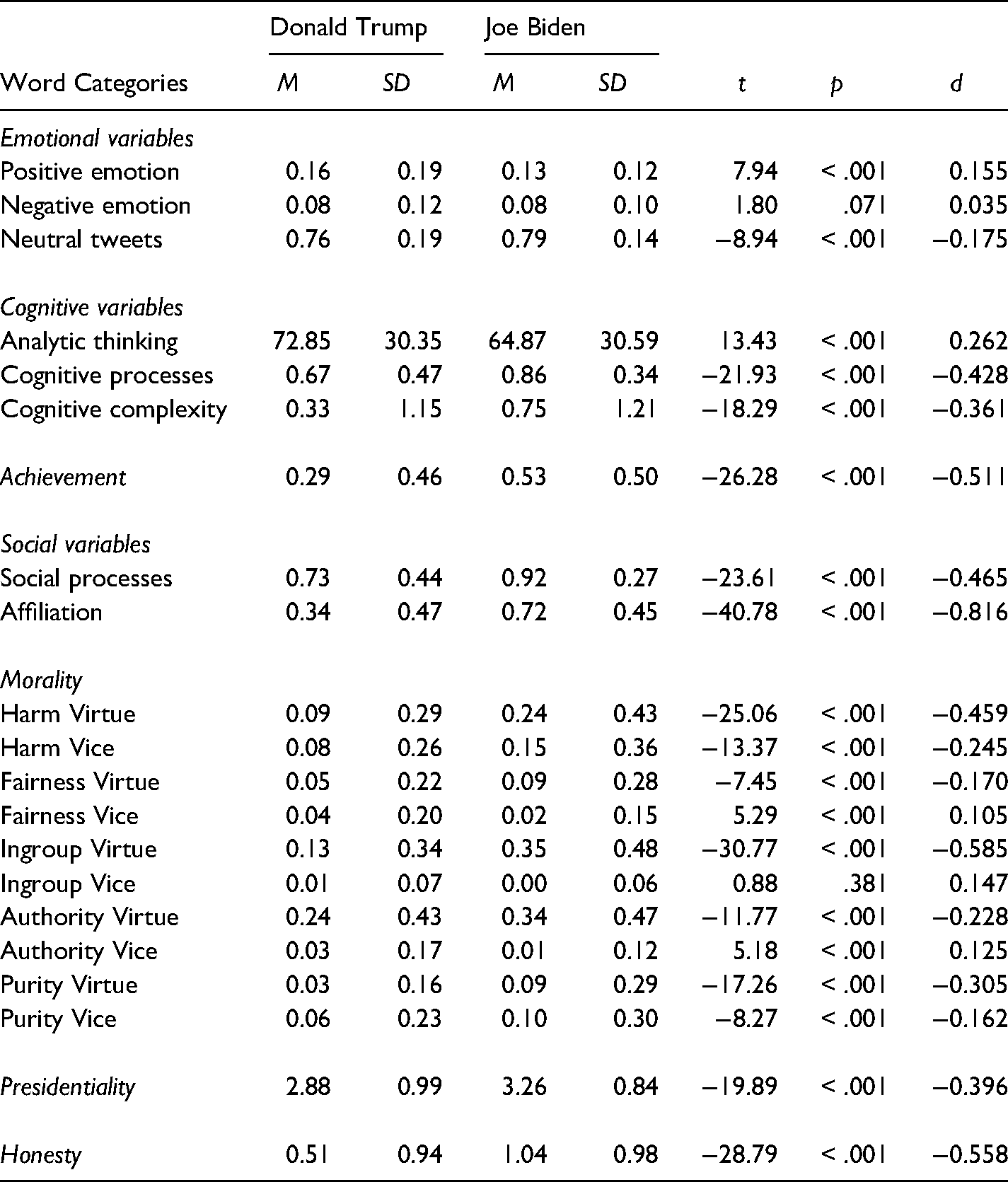
Descriptive Statistics and Results of t-Tests for Tweets by Donald Trump (N = 11,691) and Joe Biden (N = 3,365).
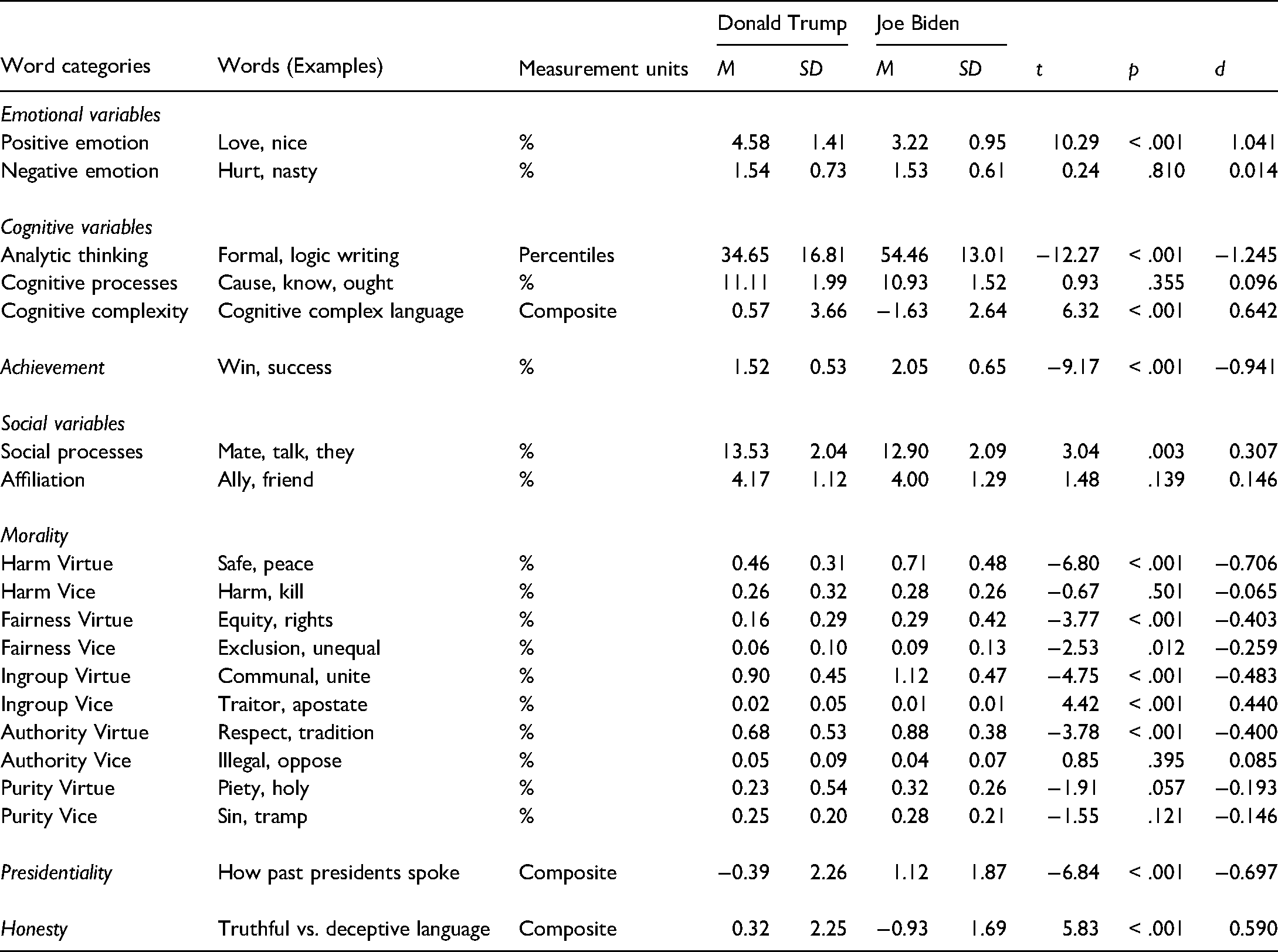
Descriptive Statistics and Results of t-Tests for Speeches by Donald Trump (N = 375) and Joe Biden (N = 131).
For social media content, natural language processing programs exist that outperform LIWC with respect to emotional language, such as the Valence Aware Dictionary for sEntiment Reasoning (VADER; Hutto and Gilbert, 2014). We used VADER, which outputs three variables—positive tone, neutral tone, and negative tone—to analyze emotion in tweets.
Words related to moral foundations theory were assessed with the moral foundations dictionary 2.0 (Frimer et al., 2019), which we also implemented in LIWC. Ten variables are computed: vice- and virtue-related words for the five foundations.
Analytical Procedure
For the speeches, descriptive statistics refer to percentages of words related to a certain category in each transcript. Only the variable analytical thinking (for the computation, see Pennebaker et al., 2014) and composite variables (for the computation, see Slatcher et al., 2007) were not calculated as percentages.
For tweets, we recoded each category for whether at least one word of this category was present (1) or absent (0) in a tweet (Sterling et al., 2020). Comparisons between the two candidates were made using t tests. As the number of words per tweet or speech is an integral part of the personality of Trump and Biden (Kangas, 2014; Immelman & Griebie, 2020; cf. Tausczik & Pennebaker, 2010), we did not control for this feature. Further, we aimed to avoid an artificial comparison of their unique linguistic style (i.e., adjusting frequencies of words solely based on statistics). Nonetheless, ANCOVA results with number of words per speech/tweet can be found at OSF and are largely in line with the results reported here.
Due to the large sample size and multitude of tests, we focus not on significance levels but on effect sizes (note, however, that p-values for all tests are provided in tables). We considered only effects d > 0.40 as meaningful, as these are nearly medium-sized according to Cohen (1988) and correspond to the threshold of desired effects with practical relevance with respect to Hattie (2009). Thereafter, we carried out descriptive discriminant analyses (DDAs) to confirm the results of the t tests and analyze the relative importance of each linguistic category. DDA analyzes differences on several categories simultaneously and avoids Type I error (Sherry, 2006). It is useful to capture which variables contribute most to differences between the two presidents. SPSS Version 25 was used for analyses.
Additionally, we provide results of an automatic language processing for neighbor words of the words “Trump” and “Biden” in their speeches and tweets. Using the raw text of tweets and speech transcripts, we employed standard corpus creation tools (Büchler, 2008) to segmentize text into sentences and words. Those items were then used to perform word co-occurrence analysis (Evert, 2005) in which word pairs in a given context (immediate neighborhood or co-occurrence in a sentence) were computed using the Log-Likelihood-Ratio. For tweets, we converted everything to lowercase to equate different types of spelling (e.g., “TRUMP,” “Trump,” “trump”). This significantly improved co-occurence results. We ranked word pairs based on frequency and removed infrequent ones (fewer than 3 occurrences). Because findings indicated little difference between words that appeared immediately to the left or right of “Biden”/“Trump” and those that appeared elsewhere within the sentence, we collapse across direct neighbors and sentence co-occurrences when presenting results. Moreover, we discard function words (e.g., pronouns, articles, auxiliary verbs, conjunctions) in the discussion of the results, as our hypotheses concerned nouns and adjectives.
Results
Tweets
Biden’s tweets (M = 31 words) on average were longer than Trump’s (M = 21 words). The LIWC2015/morality dictionaries recognized 73.91%/4.29% of all words for Trump and 83.66%/5.99% of all words for Biden.
No large differences were found between positive (d = 0.15) or negative emotion words (d = 0.04) used by the two candidates; thus, Hypothesis 1 was rejected. Note that VADER also output the neutral sentiment of the tweets: Biden showed a tendency to be more emotionally neutral than Trump (d = −0.18).
Hypothesis 2 was supported: Biden’s language was more cognitively complex (d = −0.36) and he more often referred to cognitive processes (d = −0.43) than Trump did, although Trump’s language was characterized by more words related to analytical thinking (d = 0.26). Further, consistent with Hypothesis 3, Biden used more achievement words than did Trump (d = −0.51).
In line with Hypothesis 4, Biden used more social process (d = −0.47) and affiliation (d = −0.82) words than Trump—and this is what we would expect from a collaborative power leader.
For Hypothesis 5, with respect to morality, 8 out of 10 variables showed the expected differences. The largest hypothesis-confirming differences pertained to harm virtue (d = −0.46) and ingroup virtue (d = −0.59)—both linguistic variables that were more often used by Biden.
Consistent with Hypothesis 6, Biden used more words than Trump with respect to presidentiality (d = −0.40). Finally, Biden’s language was characterized by more honesty than Trump’s (d = −0.56). Thus, Hypothesis 7 was supported.
A DDA with the twenty language categories showed statistical, λ = .80, χ²(20) = 3287.03, p < .001, as well as practical, Rc = .44., Rc² = 19.62%, significance; however, this was weaker than the DDA for speeches. Table 3 presents standardized discriminant function coefficients, structure coefficients, and explained variance for the single categories. Note that negative coefficients indicate Trump more frequently used words of the respective categories (for a DDA with the variables that showed only meaningful differences between the presidents, please see the Online Supplement).
Standardized Discriminant Function and Structure Coefficients for DDAs for Tweets and Speeches.
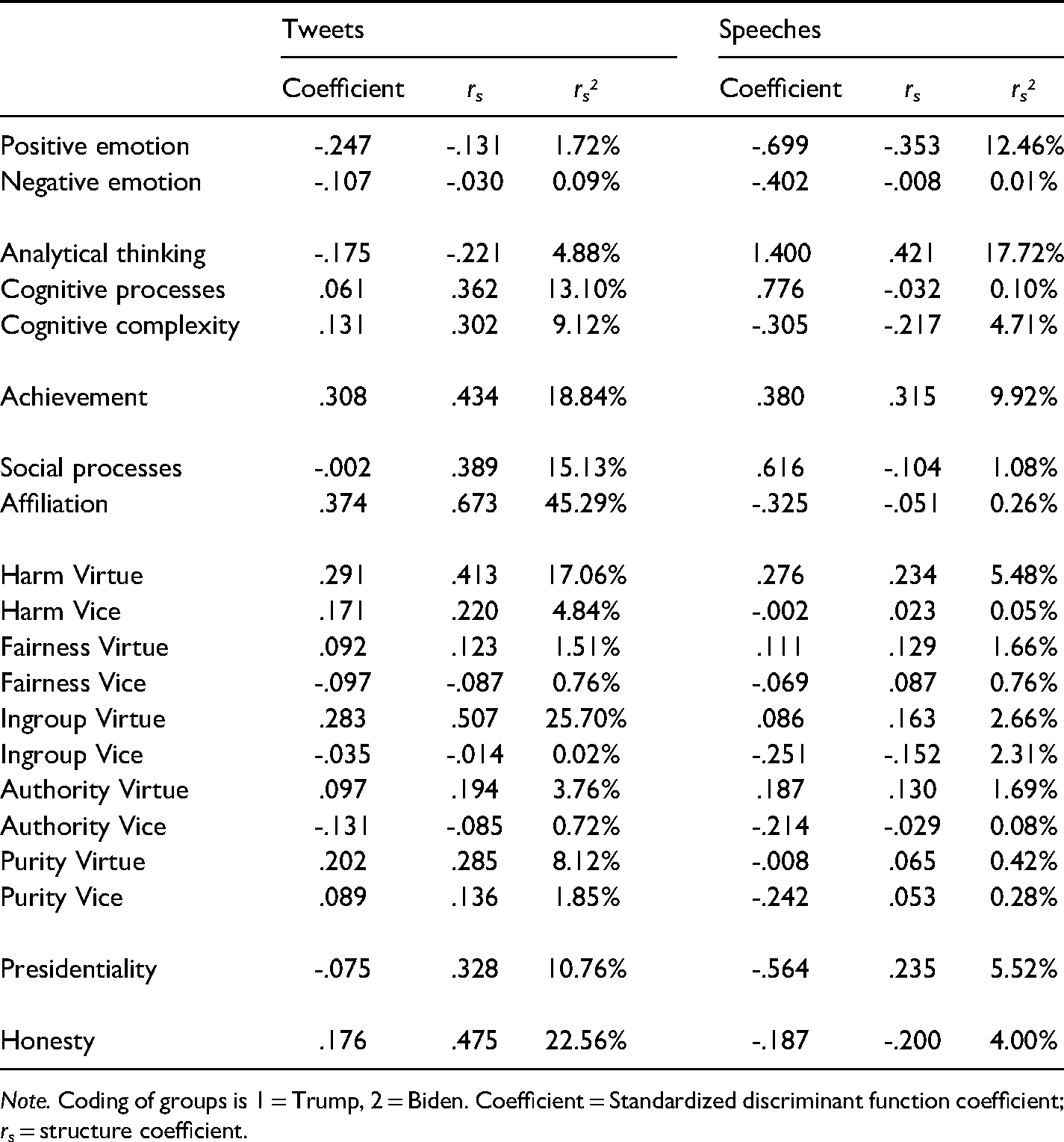
Note. Coding of groups is 1 = Trump, 2 = Biden. Coefficient = Standardized discriminant function coefficient; rs = structure coefficient.
Structure coefficients were high for variables that showed meaningful differences between the two presidents in our prior analyses (i.e., d > 0.40; rss ≥ .33) and accounted for large proportions of the explained variance in the discriminant function (10.76% ≤ rs²s ≥ 45.29%). Yet, presidentiality, social and cognitive processes had low standardized discriminant function coefficients (see Table 3). The use of affiliation-related words contributed most to differences between the two candidates (.37) followed by achievement (.31), harm virtue (.29), and ingroup virtue (.28). Altogether the DDA results were largely in line with the results of the t tests.
Speeches
Trump spoke on average 5,556 words, and Biden 2,049, per speech. The LIWC2015/ morality dictionaries recognized 73.91%/3.08% of all words for Trump and 83.66%/4.02% for Biden.
Hypothesis 1 predicted that Biden would use more positive and fewer negative emotion words than Trump. Contrary to the prediction, Trump used more positive emotion words (d = 1.04) and virtually no difference was found between the candidates in the use of negative emotion words (d = 0.01).
In line with Hypothesis 2, Biden’s language was characterized by more words related to analytical thinking (d = −1.25). The candidates barely differed in their use of words related to cognitive processes (d = 0.10) and Trump’s language was more cognitively complex than Biden’s (d = 0.64). Thus, results for Hypothesis 2 were mixed. However, in line with Hypothesis 3, Biden used more achievement-related words than Trump did (d = −0.94) and this is what we would expect from a leader who celebrates collaborative power.
The results for the social variables did not yield a clear picture. Contrary to Hypothesis 4, Trump used descriptively more words related to social processes (d = 0.31) and affiliation (d = 0.15), but the effect sizes were below the threshold of practical significance.
Hypothesis 5 specified that Biden would more often rely on virtue words than Trump, who would rely more on vice-related words. Consistent with the hypothesis, seven out of 10 variables showed the expected difference. Five variables—harm virtue (d = −0.71), fairness virtue (d = −0.40), in-group virtue (d = −0.48), ingroup vice (d = 0.44), and authority virtue (d = −0.40)—supported our hypothesis. The other moral virtues and vices showed only small differences between Biden and Trump (see Table 1).
Hypothesis 6 was supported: Biden’s language was characterized by more words related to presidentiality (d = −0.70) than Trump’s. This differences indicates that Biden’s language is comparable to that of past presidents—and this is typical of the language of a leader who relies on collaborative power.
Hypothesis 7 proposed that Biden’s language would be characterized by honesty to a larger degree than Trump’s language. Yet, Trump’s language was actually more related to honesty (d = 0.59).
Next, we conducted DDA. The model test of the discriminant function was statistically significant, λ = .37, χ²(20) = 487.75, p < .001, and squared canonical correlation effect size also suggested practical significance, Rc = .79, Rc² = 62.73%.
Three variables had the largest structure coefficients (see Table 3): Of these, analytical thinking and achievement were consistent with our hypothesizing; positive emotion was contrary. Together, these three variables accounted for the largest variance in the discriminant function (9.92% ≤ rs²s ≥ 17.72%), and the individual variables each had medium to large discriminant coefficients. Altogether, these three variables largely discriminated between the two candidates although other variables had a larger discriminant coefficient than achievement had (.38).
Context Analysis: Neighbor Words of “Trump” and “Biden”
In an attempt to analyze the context in which the two presidents refer to each other or themselves, we investigated word co-occurrences. The results can be found in permanent links at external websites (see Table S1 in the Online Supplement at OSF for the links). In Biden’s tweets, typical neighbor words of his own name were “administration,” “family,” “achieve,” and “I give you my word”. Again, he refers to U.S. institutions, achievements, and morality, consistent with the constructs of prestige and traditional power. Words in co-occurrence with Trump are “defeat,” “threat,” “poison,” “administration,” “failed,” “ignored,” or “promised.” Some of these typical words are clearly due to the position of being the challenger; others may be interpreted as denial of Trump’s trustworthiness and dependability.
In Trump’s tweets, neighboring words with his own name are “campaign,” “breitbartnews,” “nobel peace prize,” “derangement,” or “impeaching”—words that reflect present threats but also self-praise, which may be considered typical of revolutionary power (Russell, 1938). When referring to Biden, the words resemble those in speeches: “depression,” “sleepy,” “Hunter” (Biden). Again, Trump’s word usage reflects coercive power in its negative emotionality.
In speeches, Biden often used words such as “failed” or “panicked” in co-occurrence with Trump—he often criticized Trump’s politics and behavior. Moreover, he pointed out that Trump is linked to dominance and harm. A typical statement by Biden is: “we’re facing multiple crises. crises that under Donald Trump have kept multiplying.” His own name showed frequent co-occurrence with “Obama,” “Beau” (Biden), “administration,” “medicare,” “Obamacare,” and “my word.” Referring to a past president, his respected son, U.S. institutions, and values may reflect the traditional approach to power. Further, speaking about health insurance may be considered typical of a communion-oriented leader.
By contrast, Trump used words such as “sleepy,” “Hunter” (Biden), “deadly,” “depression,” “lockdown,” and “betrayed” when referring to Biden. A typical statement is: “we’ve spent the last four years reversing the damage Joe Biden and Obama inflicted.” Trump used negative scenarios to describe Biden’s politics, and directly attacked him. Whereas Biden referred proudly to his son Beau, Trump instead referenced Hunter Biden, who had been criticized with respect to drug use and fiscal offenses. Regarding his own name, Trump referred to words such as “president,” “vote for,” and “run against.” This points to his pursuit of power, though it is not especially diagnostic with regard to type of power.
Discussion
In this study, we analyzed speeches and tweets delivered by Joe Biden and Donald Trump during the 2020 U.S. presidential election, and tested whether their linguistic styles can be matched with different forms of power. On the basis of their personal history, news reports, and empirical studies, we found converging evidence that Trump would portray coercive power, dominance, naked and revolutionary power, and that Biden would portray collaborative power, prestige, and traditional power.
For tweets, differences in word frequencies were in the expected direction for 15 out of 20 variables. On the remaining variables, we found no relevant differences. Though Hypothesis 1 called for differences in the use of positive and negative emotion words, barely any difference was observed between the candidates. In contrast, the remaining 6 hypotheses were supported: In line with our reasoning, we found that Biden used more words related to cognitive and social processes and achievement. Thus, Biden’s word choice in tweets represents cognitive differentiation and emphasis of social bonds, as we would expect from a politician who represents collaborative power (Cheng et al., 2010; ten Brike & Keltner, 2020). Biden’s tweets used more language typical for a president and a truth teller, and he more often referred to moral values.
In speeches, with respect to total numbers, 8 out of 20 categories showed the expected differences, whereas 3 categories were contrary to our hypotheses. The remaining categories showed no relevant differences between the two candidates. The three hypotheses concerning achievement, morality, and presidentiality were supported. Biden’s language resembled that of past presidents, and often used references to achievements and moral virtues, particularly ingroup virtue. This is what we would expect from a leader who celebrates collaborative power because in self-reports this form of power has been linked to values (ten Brinke & Keltner, 2022) as well as high performance-based self-esteem and excellent performance (Cheng et al., 2010). Moreover, with an emphasis on solidarity and ingroup virtue, Biden’s language is typical of the reliance on prestige as a pathway to power.
For the hypotheses about emotional, cognitive, and social words, the results were mixed: Contrary to our expectation, Trump had a more positive emotional tone in his speeches than Biden, and the two presidents did not differ in their word usage regarding negative emotions. Further, Biden’s language was more analytical but Trump’s language was more cognitively complex. Finally, contrary to Hypothesis 7, Trump used more words related to honesty. These characteristics (i.e., truthful language, positive tone, using social words) may reflect advice from campaign managers or scripted speeches. Furthermore, even though fact-checking has often pointed out that Trump’s arguments do not hold (Kessler et al., 2021) and many liberals accuse him of being dishonest, millions of people see him as a real “truth teller.” Perhaps one reason for that is that he (and/or his advisers) knows how to prepare speeches in ways that signal truth telling, consistent with his reality TV experience and with other examples of his success in inverting consensus meaning (e.g., “fake news”: Mitchell, 2017).
Another possibility is that Trump feels authentic despite his lies, because his statements reflect his own, if not others’, view of reality (or, to quote George Costanza: “It’s not a lie if you believe it”, 1989). Deceptive language is characterized by low cognitive complexity because lying requires cognitive resources. Furthermore, lying often produces guilt that is reflected in using more negative emotion words. Finally, liars less often than others use first-person pronouns and the low usage of these pronouns has been associated with discomfort (Newman et al., 2003). Trump was repeatedly reported to be dishonest (Kessler et al., 2021) and prevaricate, but our LIWC analysis indicates that his language is authentic. A possible interpretation is that he feels neither guilt nor discomfort when lying, identifies strongly with what he is saying, and does not worry whether his speeches are consistent. This reasoning would be in line with the assumption that he does not experience increased cognitive load and thus would be able to tell relatively complex stories.
Results differed somewhat between speeches and tweets. Consistent findings pertained to achievements, presidentiality, and morality (in particular ingroup value): On these categories, which are associated with collaborative power, Biden consistently had higher word usage than Trump. In contrast, language that signals honesty differed between tweets and speeches: In speeches, Trump scored higher than Biden in that category. Overall, the findings regarding the tweets largely supported the predicted connection between power forms and speech styles because 6 out of 7 hypotheses were supported. By contrast, the results of the speeches provided only partial support for the assumption that the language used by the two candidates reflects different forms of power because only 3 out of 7 hypotheses were clearly supported.
A reason for the difference between the speeches and tweets may be authorship or spontaneity. Speeches are often written by speechwriters, and may thus represent goals and values of both the candidate and the party. By contrast, tweets are often more spontaneous and often written by the candidate himself, who can thus more strongly express his personality and approach to power in that form of communication (Marwick & Boyd, 2011). Thus, the forms of power that characterize the two candidates may be more pronounced in tweets, and indeed the results in tweets were more in line with the results that we had expected on the basis of power theories. (Note, however, that a good staff will generally strive to capture a politician’s own values and worldview; Pazzanese, 2017. Thus, speeches do remain a useful indicator.)
Results of the context analysis for tweets were partly in line with our hypothesizing. For example, in Biden’s tweets the words that co-occured with his own name were related to trustworthiness, achievements, and social processes. By contrast, the words that co-occurred with Biden’s name in Trump’s tweets were negative and hostile, as is typical in dominance. Trump tended to self-praise in his tweets, but also to pair his own name with words that may be related to revolutionary power (e.g., “derangement”).
The exploratory results of the context analysis for speeches support our hypothesizing because, in referring to his own name, Biden also refers to credibility and presidentiality—terms that represent traditional power. When speaking about Trump, Biden often linked the name to dominance-related words; this raises the intriguing possibility that Biden had some degree of awareness of the difference between his and Trump’s approaches to power, and perhaps a desire to highlight that difference. Trump, on the other hand, often used negative words in combination with Biden’s name, which is typical of a leader high in dominance (Cheng et al., 2010). The words that Trump used in co-occurrence with his own name are representative of a high power motive coupled with derogation of competitors. Credibility and presidentiality did not seem to be central. In any case, the interpretation of the results from the context analysis is highly exploratory and should be treated cautiously. Nevertheless, we consider it remarkable to find patterns that resemble the previously identified patterns in linguistic word count on the basis of mere associations with automatic language processing.
To our knowledge, these findings are the first to compare the linguistic styles of Biden and Trump and to show how these correspond to distinct approaches to using power. The forms of power that we described in the introduction—coercive and collaborative power, as reflected in Russell’s lifecycle of power systems, the dominance-prestige framework as strategies to obtain power, and lay theories of the fundamental nature of power— were useful in describing the language of the two top politicians. As expected, we found Biden’s language to be typical of a person who values and projects collaborative power, whereas Trump’s language was typical of a person who values and projects coercive power. Our empirical approach provides a novel avenue to understand Trump’s and Biden’s thinking and behavior because word choice across several contexts and time points is a reliable predictor of individual characteristics, such as beliefs or personality (Slatcher et al., 2007; Tausczik & Pennebaker, 2010). In fact, natural language has been suggested to be a more sensitive measure of personality than self-reports (Sterling et al., 2020). As Ng and Bradac (1993) stated, “language does more than neutrally inform hearers or readers. It is inevitably an instrument for enacting, recreating, or subverting power” (p. 1). Our research supports this statement and goes further: Different forms of power can be discerned from different language styles (cf. Fragale, 2006).
Moreover, supposing Trump and Biden might run for president in 2024, it remains to be shown whether they use the same distinct language styles as they did in their 2020 election battle. Further, as our language analysis provides initial support for viewing Trump as leader who relies on coercive power and Biden as one who relies on collaborative power, we may speculate about voters’ preferences. For example, dominant leaders are favored over prestige leaders in situations of economic uncertainty (e.g., high poverty and unemployment rate; Kakkar and Sivanathan, 2017) and thus people in difficult economic circumstances may prefer a candidate who shows dominance. Should the U.S. economy be in poor shape during the 2024 campaign, this might privilege Trump. On the other hand, U.S. Democrats strive to build a coalition that includes and respects people from diverse demographic, geographic, and political backgrounds; a more collaborative and inclusive style is appropriate for leading in these circumstances (Miller, 2019), giving Biden some advantage. In short, prevailing circumstances that heighten the perceived value of coercive versus collaborative leadership will likely determine which candidate’s approach to power will succeed.
Limitations and Future Research
A possible factor contributing to distinct linguistic patterns between Biden and Trump may be party affiliation. Recent research suggests that Republicans differ from Democrats in their language (Jost & Sterling, 2020; Okdie & Rempala, 2019; Robinson et al., 2017). More substantively, research on social dominance theory (Pratto et al., 1994) and authoritarianism suggests that fundamental approaches to power may differ between more liberal and conservative individuals. The notion that party affiliation may account for some of the observed differences represents a potential explanation for, rather than a challenge to, our findings.
That said, our results for the morality categories may tentatively speak against a party-based explanation. Graham et al. (2009) reported that liberals more often refer to the harm and fairness foundations as compared with binding foundations (ingroup, authority, purity), whereas conservatives refer to all 5 foundations in an equal manner. We found that Biden most often referred to the ingroup and authority foundations, and this cannot be explained by party affiliation. This finding is in line with other research suggesting that language differences between Democratic and Republican elites do not reflect differences in morality or values (Neiman et al., 2016). Thus, power forms or personality may actually be a better predictor of the two politicians’ language for explaining differences in moral word choice.
Beyond differences in power forms, the position of incumbent versus challenger might contribute to different word choices of the two candidates. Initial evidence suggests that incumbents have a different linguistic style than challengers (Leuprecht & Skillicorn, 2016). For example, we found Trump’s speeches to be significantly more positive than Biden’s, although we had expected the opposite based on power theories. It makes sense for an incumbent to stress the positive state of the nation as a reason to support the status quo, whereas challengers must make dissatisfaction more salient to motivate voters to make a change (e.g., Beer & Walton, 1987).
Further, we do not know whether Biden and Trump actually wrote their speeches or tweets themselves. Probably, tweets are more spontaneous and self-authored; and, indeed, the findings on tweets were more in line with our predictions. Some speeches may be written by others and may pursue specific self-presentational goals (Savoy, 2016; Schütz, 1993, 1995). This may explain why Trump’s language in speeches was more cognitively complex than Biden’s was. Moreover, Trump’s tweets contained misspelled words, which are not automatically identified by LIWC. Therefore, a small amount of text was not identified with the software. 5
Finally, LIWC does not analyze the context in which words were used. To remedy this constraint, we did a context analysis with neighbor words. However, a discourse analysis might offer even more information. That said, qualitative text analysis techniques are somewhat limited in the amount of text that can be analyzed (Kangas, 2014). Thus, we used LIWC as established text analysis software in psychology to detect stable communication differences between the two candidates over time in an objective fashion, and added the context analysis to provide more information regarding word choice. Nevertheless, additional techniques to analyze these communications will provide additional valuable information.
Upcoming studies may benefit from using the theoretical framework suggested here to compare politicians who may use prestige strategies to achieve collaborative power in a traditional system (e.g., Angela Merkel) with those who use dominant strategies to grab coercive power for relatively naked or revolutionary political action (e.g., Jair Bolsonaro). Such analyses would allow for generalization of the associations between forms of power and word usage across leaders and countries. Further, combining linguistic analyses with self-report studies on power may help to identify the speech style of a person with high (or low) forms of collaborative or coercive power. Finally, it is relevant to study whether people who value coercive power and think dominance is necessary for an effective leader are more likely to vote for a politician who projects that form of power than one who projects collaborative power.
Conclusion
Joe Biden and Donald Trump differ remarkably in their language styles. This difference can partly explained by the different forms of power they value and project. The quote “Language is power” (1983, p. 77) by writer Angela Carter is more topical than ever; however, a more nuanced view seems necessary. Different forms of power are characterized by different language. Thus, individuals representing collaborative power differ from those who represent coercive power in their specific linguistic style. The present study shows that power theories bear a considerable potential to better understand politicians’ communications and interpret language usage in general.
Supplemental Material
sj-docx-1-jls-10.1177_0261927X221085309 - Supplemental material for How the Linguistic Styles of Donald Trump and Joe Biden Reflect Different Forms of Power
Supplemental material, sj-docx-1-jls-10.1177_0261927X221085309 for How the Linguistic Styles of Donald Trump and Joe Biden Reflect Different Forms of Power by Robert Körner, Jennifer R. Overbeck, Erik Körner and Astrid Schütz in Journal of Language and Social Psychology
Footnotes
Acknowledgments
We thank Jochen Ranger for helpful feedback regarding the discriminant analyses. Further, we thank Nick Holtzman, Howard Giles, and an anonymous reviewer for extremely helpful comments.
Data Availability Statement
Data and materials are available at https://osf.io/mk5dv/ and  . We have no conflicts of interest to disclose. All procedures performed in studies involving human participants were in accordance with the ethical standards of the national research committee and with the 1964 Helsinki declaration and its later amendments or comparable ethical standards. This article does not contain any studies with animals performed by any of the authors.
Declaration of Conflicting Interests
The author(s) declared no potential conflicts of interest with respect to the research, authorship, and/or publication of this article.
Funding
The author(s) received no financial support for the research, authorship, and/or publication of this article.
Supplemental material
Supplemental material for this article is available online.
Notes
Author Biographies
References
Supplementary Material
Please find the following supplemental material available below.
For Open Access articles published under a Creative Commons License, all supplemental material carries the same license as the article it is associated with.
For non-Open Access articles published, all supplemental material carries a non-exclusive license, and permission requests for re-use of supplemental material or any part of supplemental material shall be sent directly to the copyright owner as specified in the copyright notice associated with the article.
